
Category Archives: what I’m reading

Beach Reads

My wife Stephanie and I recently returned from ten much-needed days in Barbados. The last time we went on vacation was four years ago—also to Barbados, in the auspicious month of March 2020. So, yeah … we ended up having to come home early when the Prime Minister got on TV and told Canadians abroad to come home. Which sort of put a pall on the otherwise wonderful holiday.

So we were more than ready for our return. It had been an unusually busy school year, and I was looking forward to one of my favourite activities while vacationing: reading. In the weeks leading up to our departure, I started three piles of books. Pile one was novels I’ve purchased but not yet read; pile three was unread nonfiction; the middle pile was the ever-shifting lineup of books I would bring with me, which changed day by day as I moved titles back and forth between the piles. Based on the fact that we had ten days, I kept the reading pile to what I thought was a reasonable volume, often swapping out two or three shorter texts for one chunky one, or vice versa.

I should add that what I considered a “reasonable volume” of reading evoked profound scepticism from Steph, who felt I was being excessively optimistic in how much I would be able to read in ten days—which to her mind was an issue because of the space the books would take up in our luggage.

(And don’t get at me about the virtues of e-readers. I will stipulate to all those virtues, while still hewing to my luddite ways with paper books. Reading should be pleasurable, reading on vacation doubly so, and I will always love the feel and look of a physical book infinitely more than a slim slab of silicone, no matter how convenient the latter.)

I ultimate settled on four chunky reads: Infinity Gate by M.R. Carey; Sugar in the Blood by Andrea Stuart; Bomber by Len Deighton; and Babel by R.F. Kuang.

And yes: I read them all.
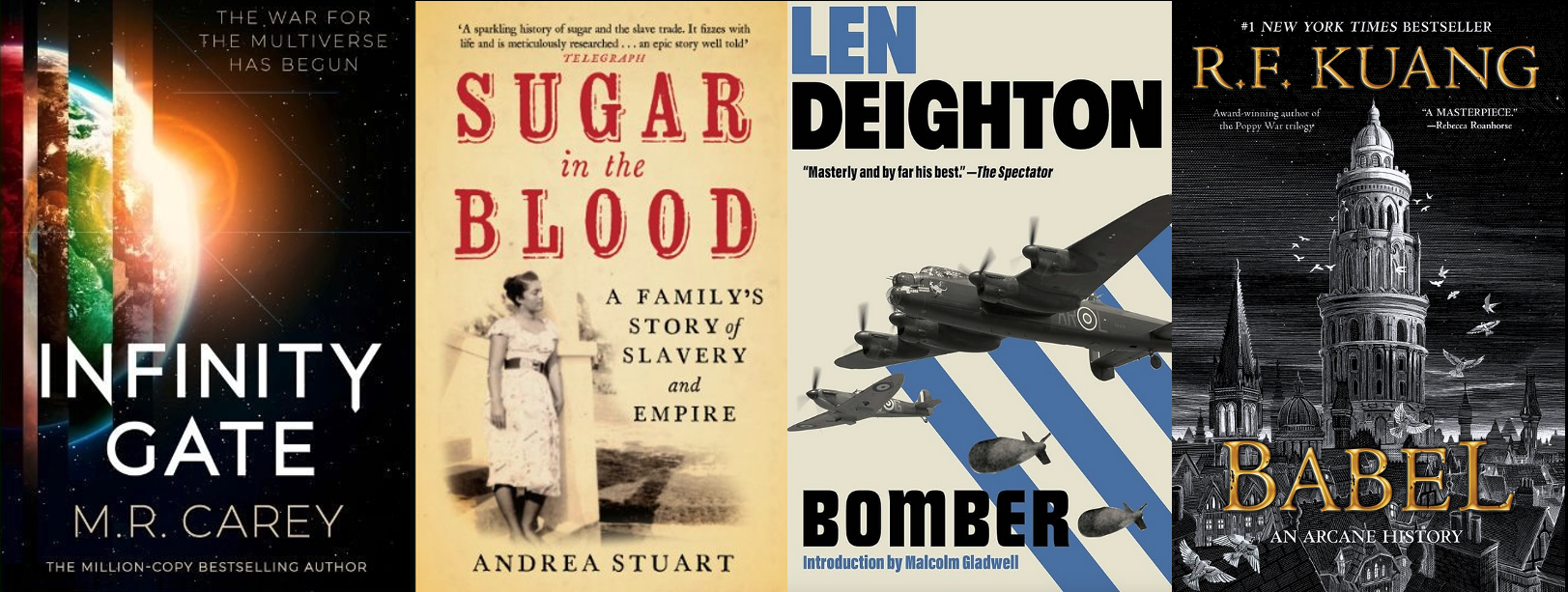
M.R. Carey, Infinity Gate. Carey has rapidly become one of my favourite contemporary SFF authors. He is most famous for The Girl With All the Gifts, a brilliant zombie apocalypse novel that was adapted into a quite good film starring Glenn Close, Gemma Arterton, and Paddy Consadine. He followed that up with The Boy on the Bridge, set in the same world with an intersecting storyline. He then wrote the rather astonishing Rampart Trilogy: The Book of Koli, The Trials of Koli, and The Fall of Koli. Like his zombie novels, the trilogy is also post-apocalyptic, set in Britain in a distant future in which a catastrophe has almost wiped out humanity and reduced them to premodern circumstances and all of nature has mutated to be hostile to the survivors.

Infinity Gate had been sitting on my shelf since last September. On seeing it I purchased it right away and started reading. But about twenty pages in I forced myself to stop. The school year was shaping up to be the busiest I’ve had in my academic career, and I couldn’t let myself indulge in a long novel (500 pages) that would suck me in. So it sat, unread, until the day before our departure.

I was not disappointed. Though it departs from Carey’s previous post-apocalyptic preoccupations, it nevertheless hits many of the same thematic sweet spots. It begins in a familiar place: a world on the brink of environmental and civilizational collapse. A Nigerian physicist, recruited to a lavishly funded Hail Mary project to discover a last-ditch solution for the world’s imminent demise, invents technology that allows her to move between different possible Earths—a mode of stepping between alternative realities in an infinite multiverse.

I’ve recently been kicking around a post or two musing about the recent prevalence of multiverse-based stories, from Everything Everywhere All At Once to the Spider-Verse movies, so I’ll have a lot more to say about Infinity Gate soon. But I do want to note that one of the great things about Carey’s world-building—aside from the simple fact that a chunky novel has more depth than your average Marvel property—is that he really engages with the implications of an infinite multiverse. Which is to say: every possible iteration of our planet exists, which includes countless timelines in which no version of humanity evolved, or in which the Earth is unliveable, or indeed where the planet simply never came together. On the other hand, there are millions of Earths with variations on primate-evolved humanity, and millions in which the intelligent species evolved from canines, felines, lizards, herbivorous mammals, and so on.

And as we quickly learn, thousands of these other Earths have developed interdimensional travel, and have formed a massive alliance called the Pandominion—into which the Nigerian physicist accidentally trespasses.

Andrea Stuart, Sugar in the Blood. Barbados has always had a special place in my heart, not least because my maternal grandmother’s family emigrated from there to Canada in the first decades of the twentieth century. We can trace our heritage back to the seventeenth century, a fact that, as I matured and learned more about the history of colonialism and the slave trade, inspired an increasing discomfort and ambivalence. We can, for example, locate our ancestors’ plantation on eighteenth century maps. And so, as much as I love Barbados, I’m also always aware of my family’s fraught history there.

Sugar in the Blood is a story of a similar such history, though from the perspective of a Black author whose enslaved ancestor was the bastard offspring of a wealthy planter. Andrea Stuart is a Barbadian-British historian; she traces her family back to her original white ancestor, an English blacksmith who took a chance on the promise of the colonial “adventure” and arrived on the island in 1630. Stuart then follows her ancestors’ struggles and successes, telling the broader history of Barbados, the Caribbean, and colonialism as she goes.

It is not an especially happy or uplifting history. When her white ancestors finally attain a measure of success and wealth after several generations of precarious farming, it comes from the blood and pain and death of countless enslaved Africans who were brought in great numbers to cultivate the cane fields that yielded “white gold,” the sugar that built obscenely large fortunes and filled the coffers of the British crown. When my mother first read this book and called to tell me about it, she accidentally called it Blood in the Sugar. Catching her error, Mom noted ruefully the serendipity of the misstatement, reflecting that it might almost be a more appropriate title. Stuart is frank and brutal in her recounting of Barbados’ centrality in the burgeoning sugar trade and its human cost, describing with unsparing detail the usually short lives of the enslaved as they worked in searing heat to harvest the knife-like sugar cane, as well as the dangers of operating the mills and presses that processed it.

As you might imagine, there is a not-insignificant cognitive dissonance that occurs when reading this history while on vacation in the place it occurred. That history lives in the present moment: in the food and drink, in the local dialect, in the vestiges of the British colonial presence. The sugar industry, though no longer the primary driver of the island’s economy—tourism now comprises the greater share—is still there: cane fields cover much of the island’s interior, rum remains a key export. And as a twenty-year resident of Newfoundland, it is always odd to find salt cod on many menus down there—itself a legacy of the triangular trade, as is the ubiquity of rum in Newfoundland.

As Stuart relates, Barbados is a post-imperial success story, having possessed one of the Caribbean’s most stable democracies since it won independence in 1966. And however fraught its history, Bajans are fiercely proud of their island.

Len Deighton, Bomber. I’d never read any of Deighton’s fiction prior to Bomber. The only book of his I’d read was Blood, Tears, and Folly, his acerbic history of WWII; as a systematic debunking of the gauzy mythos of “the good war,” it is second only to Paul Fussell’s Wartime for its unstinting refusal to sentimentalize any aspect of that conflagration. Bomber is very much of a piece, a polemic in the form of historical fiction that takes aim at the Allies’ strategic bombing campaign against Germany.

I picked up Bomber because I’ve been immersing myself in this particular history for almost two years now—research that started as the basis for an article on Randall Jarrell’s war poetry. In characteristic fashion it has mushroomed into an ever-expanding preoccupation that has several possible writing projects emerging. I’ve now read somewhere in the neighbourhood of seven or eight histories, with a few sitting on my shelf waiting to be read. (I also, for my sins, subjected myself to Masters of the Air, the recent mini-series about American B-17 crews. I’ll probably have more to say about it in a future post; suffice for the moment to say that, as the third in a series that started with Band of Brothers and continued with The Pacific, the quality of the storytelling has fallen rather precipitously.)

Bomber is the kind of historical fiction that manages to be compelling as fiction while also functioning solid history. It is a sprawling narrative that encompasses a huge cast of characters, including a group of British Lancaster crews, German night-fighters and their base personnel, the mission planners at RAF bomber command, the operators of a German radar station tracking the bombers, and the citizens of a German town that becomes the accidental target of the RAF raid and suffers a Dresden-like catastrophe. All of which takes place within a twenty-four hour period.

As a work of fiction, the novel is astonishing: Deighton handles the complexity of the narrative deftly and manages to imbue all the numerous characters with depth and nuance. Early on, it becomes clear what will happen at the story’s climax: the bombers will miss their intended target and instead bomb the town we encounter, a town with no military structures or strategic value. Knowing this does not denude the building tension as the bomber stream makes its way through the night. Just the opposite: Deighton communicates the textures of the town and its people, the good, bad, and ugly, to the point where what finally befalls them is nothing short of horrifying.

As a work of history, the novel is a trenchant indictment of Arthur “Bomber” Harris’ leadership of the RAF Bomber Command. As I’ve written about on this blog previously, Harris was a bloody-minded sociopath who dismissed the American strategy of daytime targeted bombing of military and industrial targets. Leaving aside the fact that the American claims to accuracy were wildly overblown, Harris pursued the “area bombing” of city centres on the premise that this would (1) kill or de-house thousands of German workers, and (2) break the German spirit so that they rose up and threw off Hitler’s regime (for this reason, the strategy also went by the name “morale bombing”). Spoiler: it did not work. At all. It did however result in a nearly 50% attrition rate for bomber crews, the destruction of countless cities and towns (many of which had no military value), and the deaths of hundreds of thousands of civilians—some in such hellish cataclysms as the firebombing of Hamburg and Dresden. Deighton’s description of the effect of just such a firebombing at the culmination of the novel is genuinely harrowing.

R.F. Kuang, Babel. R.F. Kuang is a writer who’s been on my radar for some time, but I’ve only now managed to read any of her work. She is one of a new generation of SFF authors who bring a much greater, and much-needed, diversity to genre fiction. (Or, from the perspective of genre’s reactionary rump, she’s one of the legions of woke writers ruining SFF with her politically correct scolding. See here, and here, and here to get my thoughts on that particular attitude.) She has a trilogy of fantasy novels starting with The Poppy War that I am now eager to read, and more recently came out with Yellowface, a non-genre novel about an Asian-American writer who has her manuscript stolen by her white friend (also sitting on my shelf, waiting to be read).

But Babel is the one I’ve been keen to read since I first read about it. It takes place in the early 19th century in an alternative-history Great Britain in which silver possesses certain magical qualities and the British Empire—approaching the first apogee of its global power—is determined to use it to advance its imperial interests. It is not silver however that is inherently magical—rather, silver is the medium for magic that is effected through language. More specifically, when you take two words in different languages that can mean the same thing, inscribe them on either side a silver bar, and then speak them aloud, this produces a magical effect consonant with the words’ meaning. The crux however is that the greater the dissonance between the words, the more powerful the spell; or to put it another way, what remains untranslatable is the source of the power. And so in Kuang’s alternative 1830s, language is an exploitable commodity. As the British Empire expands and its influence spreads, this causes a linguistic convergence that reduces the power of spells employing English and European languages. Hence, the Babel Institute (a tower, naturally) at Oxford University labours to learn increasingly exotic tongues even as British military and commercial interests seek out new sources of silver.

To this end, the Babel Institute comprises an unusually racially and ethnically diverse student body, as it sponsors fledgling scholars from around the world whose fluency in their native languages is invaluable. Of course, the privileges and status afforded the “Babblers,” (1) does not inoculate them against the bigotry of the university’s rank and file, nor of the town of Oxford at large; (2) comes with a series of insidious strings attached; and (3) inspires in many of the students a profound ambivalence as they realize their linguistic talents are being employed in the service of imperial depredations of their home countries.

I won’t spoil the story by sharing any more—suffice to say I’ll be looking for an excuse to include this novel on future courses.
Leave a comment

Filed under what I'm reading

A Few Things

Summer Blogging Update     Several posts ago, I announced my summer blogging plans; I then dutifully followed up with a three-part series on memory, history, and forgetting in fairly quick succession. And then … well, nothing for two weeks. That’s largely due to the fact that my next series of posts, which will be a deep dive into postmodernism—what it is, what it was, what it isn’t, and why most of the people using the word in the media these days have no idea what they’re talking about—has been taking somewhat longer to write than I’d planned. Actually, that isn’t entirely true: the second and third installments are all but completed, and I’ve gotten a healthy start on the third and fourth, but the introductory post is taking longer (and is getting longer). I am optimistic that I will have it done by the end of the weekend, however, so hopefully Phase Two of My Ambitious Posts No One Will Read will soon commence.

What I’ve Watched     A few weeks ago I binged the series Rutherford Falls on Amazon Prime. I’d read some positive reviews of it and heard good things via NPR’s Pop Culture Happy Hour podcast (always a reliable guide); the show is also co-created by Michael Schur, a showrunner who, in my opinion, has been batting 1.000 for years: The Office, Parks and Recreation, Brooklyn Nine-Nine, The Good Place. But what’s particularly notable about Rutherford Falls is that the premise of the show is rooted in the relationship in the titular town between its indigenous and non-indigenous townsfolk. The series was co-created by Sierra Teller Ornelas, a Navajo screenwriter and filmmaker. The writers’ room is also well represented with Native American writers, and the cast is remarkable.

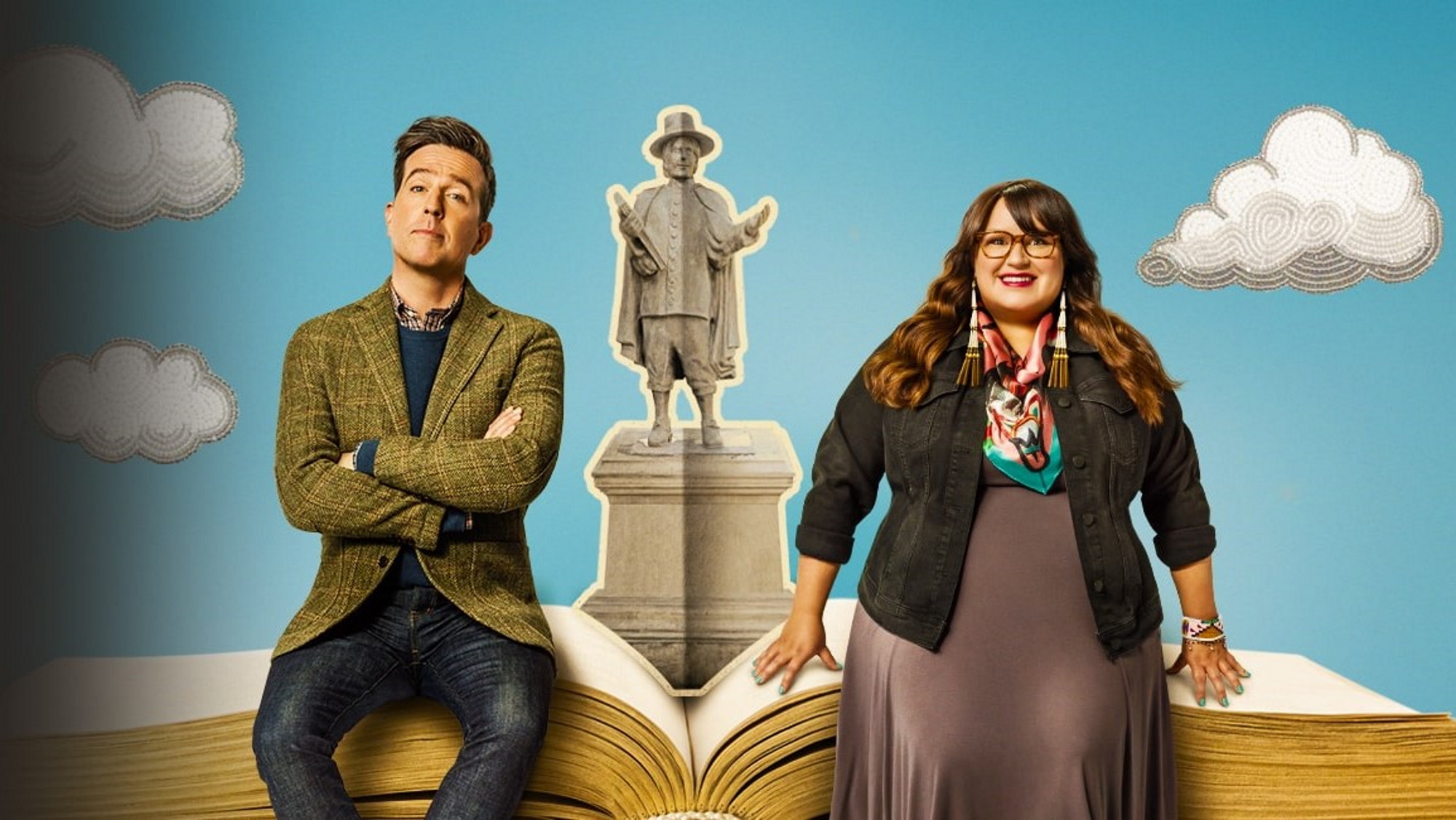
Ed Helms and Jana Schmieding.

Ed Helms plays Nathan Rutherford, a scion of the family that gives the town its name, and who is about the most Ed Helms character I’ve yet seen—a painfully earnest and well-meaning but frequently clueless fellow whose entire sense of self is bound up in his family’s history and that of the town. He runs a museum-ish space in his ancestral home. His best friend is Reagan (Jana Schmieding), a member of the (fictional) Minishonka Nation who is more or less persona non grata in her Native community because she left her fiancée at the altar a number of years before and instead went and did her masters degree at Northwestern. She runs—or attempts to run—a “cultural center” inside the local casino, which is owned by Terry Thomas (Michael Greyeyes), the de facto leader of the Minishonka community.

The show is hilarious, but is also quite comfortable in its own skin (so to speak)—it engages with difficult issues of Native history, white entitlement and appropriation of Native culture, the memorialization of settler culture (the precipitating crisis is when the town’s African-American mayor seeks to remove a statue of the town’s founding Rutherford in the town square, not because it’s a symbol of colonialism, but because cars keep crashing into it), and the fraught navigation by Terry Thomas of American capitalism as a means of accruing power and influence for his people—all without ever losing its humour or coming across as pedantic. A key moment comes in the fourth episode, when an NPR podcaster, having sniffed out that there might be a story in this sleepy town, interviews Terry. He asks him how he reconciles the contradiction of running a casino—the epitome of capitalistic graft—with his own Native identity. Terry, who had been answering the podcaster’s questions with a politician’s practiced smoothness, reaches out and pauses the recorder—and then proceeds, in a stern but not-angry voice, to school the well-meaning NPR hipster on precisely how the casino is consonant with Native values because it is not about the accrual of wealth for wealth’s sake, but for the benefit of a community that has long been marginalized. He then hits play again, and resumes his breezy tone for the rest of the interview.

It is a bravura performance; indeed, Michael Greyeyes is the series’ great revelation. A Canadian-born actor of the Cree Nation, he has long been a staple in Canadian and American indigenous film, or film and television featuring indigenous characters, and has (at least in most of the stuff I’ve seen him in) tended to play stern, brooding, or dangerous characters. So it is a joy to see him show off his comedic talents. His best line? When arguing with Nathan Rutherford over the historical accuracy of a costume he wants him to wear in his planned historical theme park, he says in exasperation, “Our market research shows that the average American’s understanding of history can be boiled down to seven concepts: George Washington, the flag, Independence Day, Independence Day the movie, MLK, Forrest Gump, and butter churns.”

What I’m Currently Watching     Well, we just watched the season four finale of The Handmaid’s Tale last night, and I’m going to need a while to process that. And we watched the series premier of Loki, which looks promising—largely on the basis of the fact that a Tom Hiddleston / Owen Wilson buddy comedy is unlikely to disappoint no matter what is done to it.

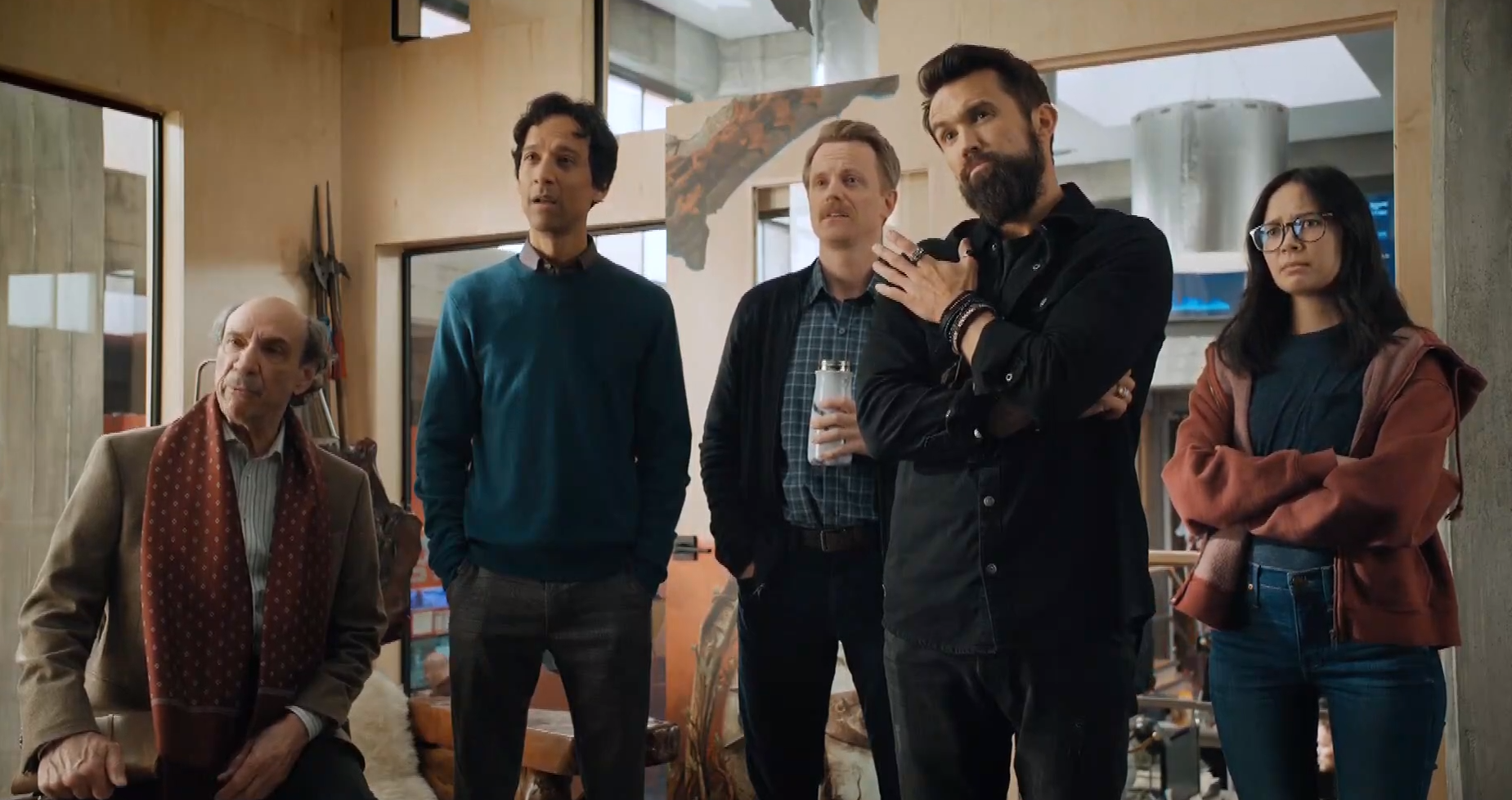
F. Murray Abraham, Danny Pudi, David Hornsby, Rob McElhenney, and Charlotte Nicdao

But the show we’re loving right now beyond what is strictly rational is the second season of Mythic Quest on AppleTV. For the unfamiliar: it’s the creation of Rob McElhenney, Charlie Day, and Megan Ganz, the folks who brought you It’s Always Sunny In Philadelphia; the series is a workplace comedy set in the offices of a video game called Mythic Quest: Raven’s Banquet, an MMORPG along the lines of World of Warcraft or Elder Scrolls. McElhenney plays the game’s creator and mastermind Ian (pronounced “Ion”) Grimm, a self-styled visionary who is sort of a cross between Steve Jobs and a lifestyle guru. Charlotte Nicdao plays Poppy, the perennially anxious and high-strung lead engineer who is responsible for turning Ian’s (again, pronounced “Ion”) ideas into workable code. Danny Pudi, who most famously played Abed in Community, is Brad, the “head of monetization,” and is delightfully cast here as a kind of anti-Abed who knows little and cares less about pop culture and video gaming and is only concerned about how he can wring every last cent out of the game’s devoted players. And F. Murray Abraham—yes, Salieri himself—plays the game’s head writer, washed-up SF author C.W. Longbottom, a lascivious alcoholic whose sole claim to fame (to which he clings like a barnacle) is having won a Nebula award in the early 1970s.

That combination of characters alone is a selling point—but the show is also incredibly smart, and also—just when you least expect it—deeply emotional.

What I’m Reading     At this point in the early summer as I scramble to use my time to complete at least one article before September, as well as move my summer blogging project forward (to say nothing of starting on course prep for the Fall), the question feels a little more like what am I not reading.

But that’s all business. My pleasure reading of the moment is a trilogy by M.R. Carey. Carey wrote the brilliant zombie apocalypse novel The Girl With all the Gifts—which was made into a quite good film starring Glenn Close and Gemma Arterton—and its companion novel set in the same world The Boy on the Bridge. One of my grad students this past semester alerted me to the fact that Carey had recently published a series set in another post-apocalyptic scenario. The “Ramparts Trilogy”—comprised of the novels The Book of Koli, The Trials of Koli, and The Fall of Koli—isn’t really a trilogy per se. The novels were all released within several months of each other, suggesting that “Ramparts” was really more of 1000+ page novel that the publisher chose to release in serial form rather than all at once.

Like the other Carey novels I’ve read, the Koli books are post-apocalyptic, set in an England some three to four centuries after humanity more or less obliterated itself in “the Unfinished War.” It is a word in which humanity has been reduced to a mere handful of its former numbers, and everything in nature now seems to be intent on killing the remaining survivors. Human manipulation of trees and vegetation to make them grow faster as part of an effort of reverse climate change has resulted in hostile forests: only on cold or overcast days can anyone walk among the trees without them snaring them with their tendrils. Any wood cut has to be “cured” in saline vats to kill it before it can be used as lumber. And the animal life that has evolved to live in such an environment is equally dangerous.

Koli is, at the start of the novels, an earnest if slightly dim fifteen-year old living in the village of Mythen Rood in the Calder Valley in the northwest of what was once England. His family are woodsmiths; Mythen Rood is protects by the Ramparts, villagers who can use the tech of the old world—a flamethrower, a guided bolt-gun, a “cutter,” which emits an invisible cutting beam, and a database that offers up helpful but cryptic knowledge and information from the old world.

There is much tech left over from the old world, but most of it is useless. Koli’s story essentially begins when he becomes obsessed with “waking” a piece of tech and joining the ranks of the Ramparts.

And that’s all I’ll tell you of the story: suffice to say, with one-third of the last novel to go, I am captivated by both the story Carey tells and the potential future he envisions.

Leave a comment

Filed under A Few Things, what I'm reading, what I'm watching

A Few Things

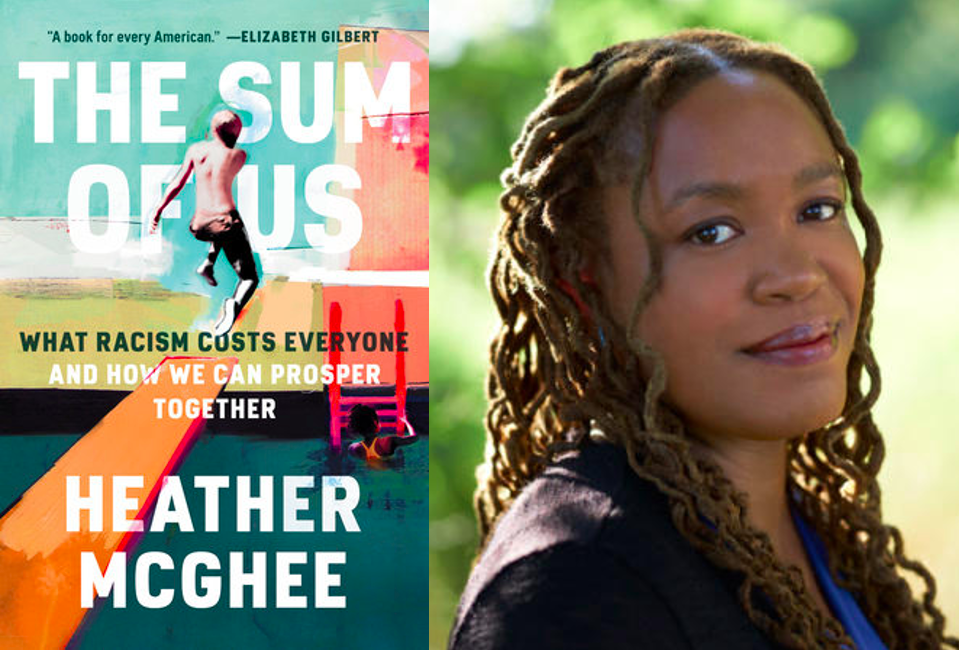
What I’m Reading     I first heard of Heather McGhee two or three years ago when she was interviewed on one of the political podcasts I listen to. She was then the president of Demos, a progressive think-tank focused on race and economics and strategies to strengthen American democracy; I was immediately impressed by how clearly and articulately she broke down the inextricability of race and economic policy, and the ways in which Republicans have successfully sold the idea to white voters of government spending as a zero-sum game in which every dollar that goes to help Black people and minorities is a dollar taken from them—and that government programs that help non-wealthy whites  are somehow stealing from them to benefit inner-city Blacks. And hence, non-wealthy whites have become reliable Republican voters who vote against the own interests in election after election.

To be clear, this is not a new insight. President Lyndon B. Johnson himself, who signed the Civil Rights Act into being in 1964 and the Voting Rights Act the following year, knew that he was alienating a significant portion of his own party. “Well, we’ve lost the South,” he is reported to have said on signing the civil rights legislation; he also famously acknowledged the principle on which Richard Nixon would successfully court southern white Democrats: “If you can convince the lowest white man he’s better than the best colored man, he won’t notice you’re picking his pocket. Hell, give him somebody to look down on, and he’ll empty his pockets for you.”

What impressed me about McGhee was how clearly she laid out the historical narrative, as well as how convincingly she argued her central premise: that systemic racism hurts everyone, white people included. I don’t remember which podcast it was on which I originally heard her, but that’s become something of a moot point as since then she’s been on all the podcasts—especially lately since her book The Sum of Us: What Racism Costs Everyone and How We Can Prosper Together came out. Since that first podcast I heard, she resigned as Demos’ president and traveled the U.S., speaking to hundreds of experts, activists, historians, and ordinary people. The Sum of Us is the result, and it makes her original argument in an exhaustively detailed and forceful manner. It is an eminently readable book: personal without being subjective, wonky without losing itself in the weeds, and both rigorously historical while still relating straightforward stories that persuasively bring home the societal costs of systemic racism. The one example she shares in her interviews functions as the book’s central metaphor: starting in the 1920s, the U.S. invested heavily in public projects and infrastructure, one thing being the construction of public pools. During the Depression, Roosevelt’s Works Progress Administration (WPA) continued this trend, using such community investment to generate jobs. By the 1950s, towns and cities across the country boasted ever-larger and more lavish public pools, which became a point of pride for communities—pools large enough, in some cases, to admit thousands of swimmers.

But such pools were, of course, whites-only. With the advent of desegregation in the mid-late 50s, courts decreed that these public pools were legally obliged to admit Blacks. Town and city councils responded swiftly, voting to drain the pools and fill them in with dirt and seed them over with grass (in Georgia, the Parks and Recreation Department was simply eliminated, and was not resurrected for ten years). Affluent whites did not suffer: there was a concomitant boom in the construction of backyard pools and the establishment of private swimming clubs, which could effect de facto segregation by leaving membership decisions to the discretion of a governing board. But non-wealthy whites were suddenly left without a key option for summer recreation, all because their communities could not countenance sharing a publicly-funded pool with their Black citizens. In what is one of the pernicious elements of systemic racism, McGhee observes, many of the non-wealthy whites who could no longer bring their children to swim in one of these magnificent pools for free probably thought that this was a fair deal—better to go without than be obliged to share with people you’d been brought up to consider beneath you.

I am at present about halfway through The Sum of Us; look for a longer blog post when I’ve finished it. Meanwhile, I would suggest that this book should be required reading for our present moment.

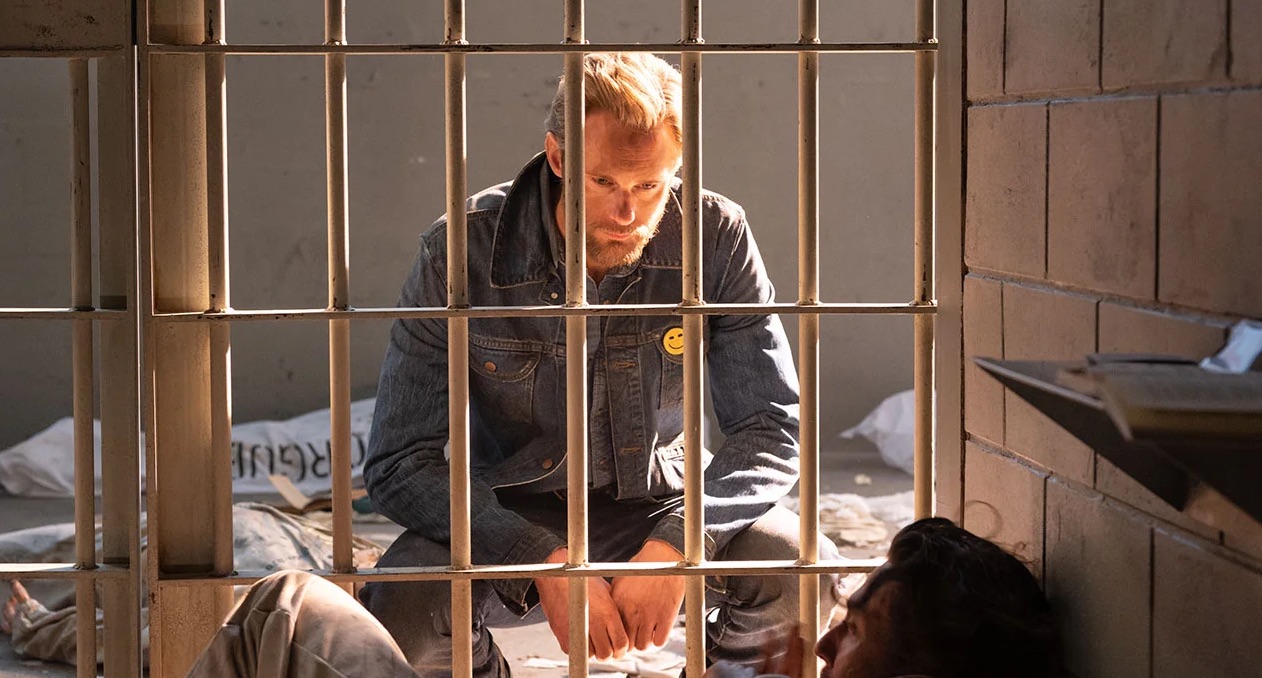
What I’m Watching     I wrote in my last post about how much I’m enjoying rewatching Battlestar Galactica, but as Stephanie and I took a hiatus from that show to binge The Mandalorian, so again we’re taking a hiatus to watch The Stand­—the recent mini-series adaptation of Stephen King’s mammoth 1978 novel in which 99.9% of the world is wiped out by a weaponized superflu nicknamed “Captain Trips,” and the remaining people of the U.S. gather in two opposing communities. On one side are the forces of good, who have been drawn to Boulder, Colorado by dreams of a 108 year old Black woman named Mother Abigail. On the other are those drawn by promises of power, licentiousness, and revenge by the evil Randall Flagg, a denim-clad and cowboy-boot shod demon in human form, who establishes his new society in (of course) Las Vegas.

As I’ve discussed a few times on this blog, last term I taught a fourth year class on pandemic fiction; I did not include The Stand, in spite of the fact that it’s one of the few actual pandemic novels written prior to the 21st century, mainly because it is way too long (almost 1500 pages) to shoehorn into a semester-long course. Given its significance to the topic, however, I did record a short lecture in which I ran down the key themes and plot points (which you can watch here if you’re so inclined). But one of the things I found interesting in retrospect—I first read The Stand in high school, and then read it again when King published the unexpurgated version in 1990—after doing all the preparatory reading for my course, was how King transformed a story about a biological catastrophe into a Manichaean light v. dark, G v. E, cosmic battle royale with Mother Abigail as God’s surrogate and Randall Flagg as Satan’s proxy. While the novel meditated at length on the nature of civilization and how one pragmatically goes about rebuilding after the apocalypse—with 1500 pages, how could it not?—it is obvious that it’s the metaphysical war that most interested King.

We’re slightly more than halfway through the new adaptation, and quite enjoying it. It was quite badly reviewed; and while I can agree with some of the complaints, it has been on the whole well-adapted to the screen, and (mostly) well-cast. Alexander Skarsgard is at his menacing best as Randall Flagg, James Marsden is all wry southern charm as Texan Stu Redman, Greg Kinnear plays the professorial Glen Bateman with the right balance of pomposity and insight; Whoopi Goldberg basically plays Mother Abigail as a devoutly Christian Guinan with a head of white dreadlocks; my favourite however is Brad William Henke, who plays the mentally disabled Tom Cullen with a guileless, earnest simplicity that avoids stereotypes (those who watch Justified will recognize Henke from season two as Coover Bennett, a similarly mentally delayed character whose disability manifests instead in sociopathic violence).

There is much that is left out, and much that could have been done better, but on the whole it is a pretty satisfying adaptation of an intriguing but flawed novel (“intriguing but flawed” is how I’d characterize most of King’s oeuvre, but I suppose that is to be expected when you churn out an average of two brick-sized novels a year). If you like The Stand, or are just amenable to Stephen King more generally, I’d recommend this series.

What I’m Writing     I recently dusted off an article-in-progress that had been mouldering for a year or two, on zombie apocalypse and celebrity; in a fit of energy I finished it and submitted it to a journal. I now have another that I’m looking to finish, on Emily St. John Mandel’s Station Eleven and nostalgia. Given that I’ll be doing that novel in both of my classes over the next two weeks, it seems an ideal time to return to it. Given that it is also about apocalypse, though of the non-zombie variety—and indeed about a civilization-ending pandemic—I’ve been trying to rewrite my introduction to put it in the context of the past year. It’s been slow going, not least because finding the right balance between the personal and the objective can be tricky when your aim is to submit it to a scholarly journal. But the overarching argument—that Mandel’s post-apocalyptic world in which the main characters are actors and musicians travelling between settlements to perform Shakespeare and classical music comprises a nostalgic desire to return to a pre-postmodern humanism—is, I think, a strong one. I just have to fill out a core section in which I discuss humanism in a more granular way.

(This process will also be useful, as it will give me a lot of lecture material).

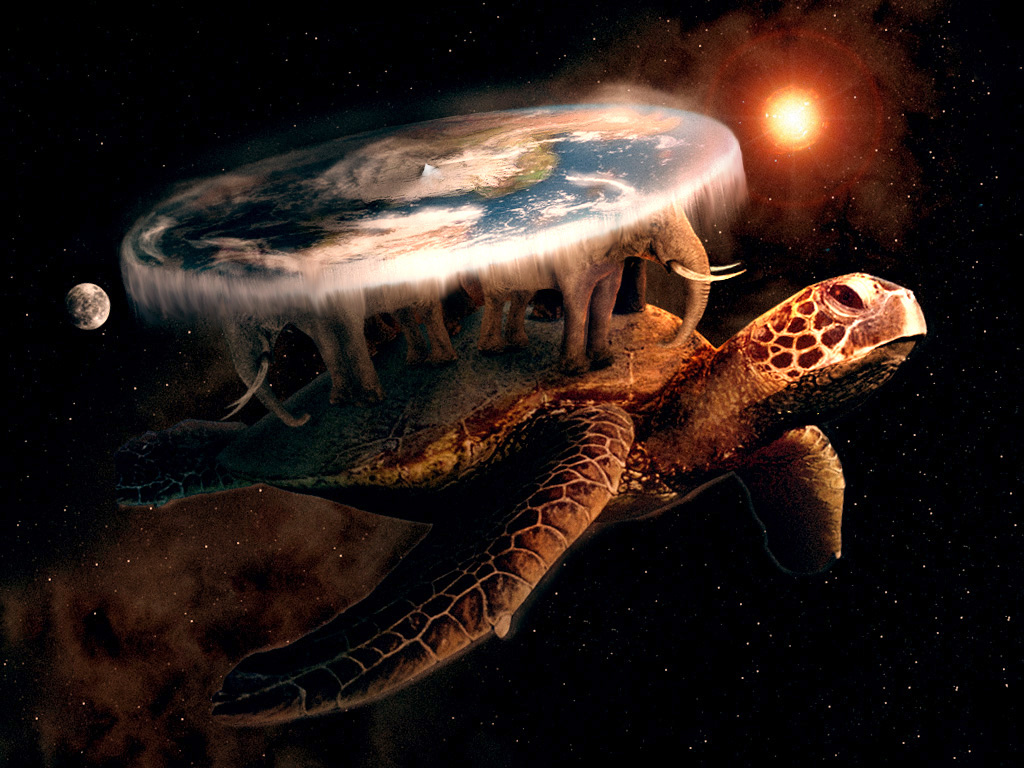
On a related subject, I’ve also been working on a new essay on Terry Pratchett and Discworld. I have an article on Pratchett and his campaign for assisted dying coming out soon in a new collection; I’m trying to carry that momentum forward on a handful of Sir Terry essays, but the one I’ve been focusing on is a reading the Discworld novels in the context of the philosophy of American Pragmatism and what I’ve been calling the “magical humanism” exhibited in a lot of contemporary fantasy.

As much as I love Sir Terry’s writing, I find it difficult to write about it in a scholarly manner, for the basic reason that I find it difficult to find a focus and not end up running off madly in all directions. The essay I wrote for the collection, which came in way past deadline, needed to be cut from nine thousand words to six thousand (one of the essay’s blind reviewers said something to the effect of “this is obviously a piece of work gesturing to a much larger theory of Pratchett’s fiction,” which was at once both gratifying and true). Part of the problem is the iterative nature of the Discworld’s world-building: each  of the forty-one novels is a standalone narrative, and with each new installment, Sir Terry modified and refined aspects of that world, but also returned to the same themes and preoccupations in such a way that it is close to impossible to discuss the political and philosophical preoccupations of a given novel without being obliged to reference a dozen others.

This isn’t the most conducive thing for my intellectual temperament, which at the best of times is digressive and inclined to run down whatever rabbit holes I find, until I realize that, several paragraphs of writing on, I’ve found myself discussing an entirely different topic. (Presumably, devoted readers of this blog will have noticed this). That being said, however, it is a pleasure to lose myself in this topic … not least because I increasingly see Sir Terry’s humanism as a necessary antidote to our present toxic political moment.

Leave a comment

Filed under A Few Things, Uncategorized, what I'm reading, what I'm watching, what I'm working on

A Few Things

What I’m Reading  Aside from my reading for the term and for research, I’m about three-quarters of the way through Barack Obama’s memoir A Promised Land. It is a very long book (700+ pages) that doesn’t even get to the end of his first term; it is reflective, often pausing in its narration of events so Obama can ponder the vagaries of decisions he made or didn’t make, and ruminate on the broader significance of this or that detail in the broader context of American history; he also frequently digresses into little potted lectures on history and political philosophy to better frame the stories he’s telling.

Or to put it another way: I’m loving it. There are many reasons why I have such vast respect for this man, and why I think history will ultimately rank him as one of the best presidents; his humanity, intelligence, and passion are among those reasons, and they come through on every page, along with a professorial and nerdy wonkishness that I aspire to. After four years of Trump, this book is a salve to my soul.

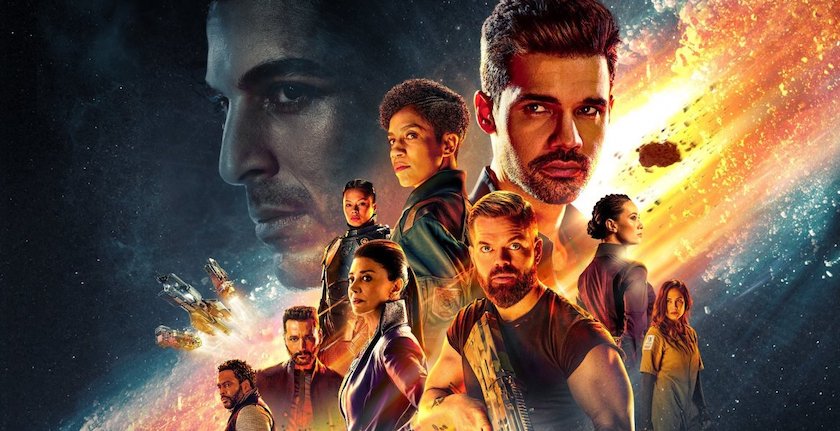
What I’m Watching  Really, my life these days in measured out in week-long increments of impatience between each new episode of The Expanse. I latched onto the novels by James S.A. Corey (the pseudonym of Daniel Abrahamson and Ty Franck) soon after the first one (Leviathan Wakes) was published, and have read them obsessively since (we’re now eight novels along, and I’m waiting for the ninth and final installment rather impatiently). So when I saw they were adapting the novels to TV, I experienced the usual excitement and trepidation one often does when beloved books are being adapted to the screen. Will it be good (Good Omens, Game of Thrones) or bitterly disappointing (American Gods) or just … meh (The Magicians)?

The Expanse not only did not disappoint, it has gotten steadily better every season as the writers have found their groove and the special effects budgets have grown. This season—the fifth—is the best so far. It benefits in part from the narrative build of the previous seasons, in which otherwise seemingly insignificant plot points and elements of world-building have culminated in some pretty virtuosic storytelling, matched by amazing acting and visuals that now rank The Expanse among the best SF/F that has been brought to TV.

I don’t want to get into detail, because spoilers, but I will almost certainly write a much longer and spoiler-filled post once this season is done.

The Pleasures of Zoom-Teaching  To be certain, I miss being in the classroom with the intensity of a nova—teaching and interacting with my students is easily my favourite part of my job, and the classroom has always been a quasi-sacred space to me. Talking to the Brady Bunch arrangement of squares on my laptop screen is nowhere near the same thing … but there are aspects of it I like. Not the least of which is I can conduct classes wearing pyjamas. Also, they don’t know what’s in my mug, heh …

There is also Zoom’s chat function. As class discussion progresses, sometimes students will carry on a parallel conversation in text. It’s as if they’re passing notes in class, but I get to read them.

But by far my favourite aspect is the presence of pets. My cat Gloucester is a frequent visitor, jumping up onto my lap and staring at the faces on my screen with his golden eyes. And there is a petting zoo worth of dogs and cats—and in the case of today’s class, a bunny!—perched on my students’ laps or occasionally pushing their snouts close in to the webcams.

Oh, Yeah—Classes Started Today  Memorial delayed the start of term for a few days to give students a slightly longer break (something I was grateful for, too), so today was day one of the winter term. My first class was my graduate seminar “The Spectre of Catastrophe,” and if today was any indication, this is going to be a good term. There was a wonderful energy to the class, and everyone was enthused and engaged.

Tomorrow I start with my fourth-year seminar “Utopias and Dystopias,” a class that was designed by a former colleague of mine, now retired. It was always a student favourite when he taught it, and I’ve been requesting it since he retired several years ago. My teaching dance card was always too full to slot it in previously, so I’m delighted to finally get to teach it.

Last semester I taught a course on pandemic fiction; this term, it’s utopias and dystopias and post-apocalyptic narratives of the 21st century. Sense a theme? It feels a little bit, after 2020, like I’m steering into the skid.

Leave a comment

Filed under A Few Things, teaching, what I'm reading, what I'm watching

Isolated Thoughts: Pandemic Reading

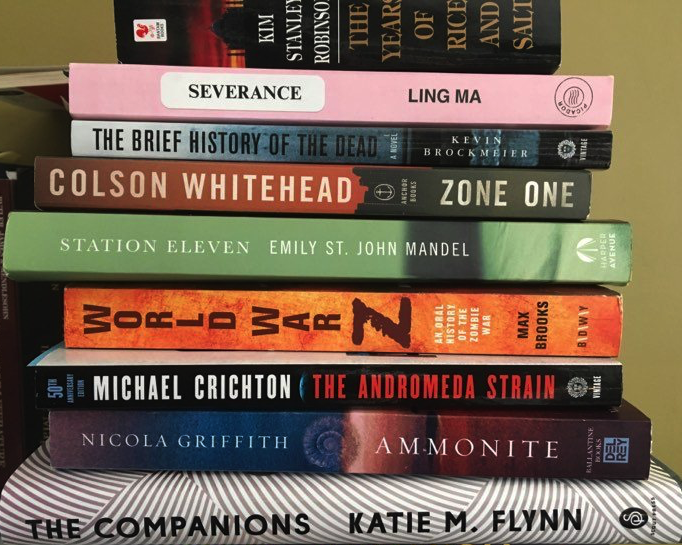
I’d been wracking my brain trying to figure out how to theme the fourth-year contemporary American literature seminar I’m teaching in the Fall, when I realized the obvious topic was right in front of me: Pandemic Fiction! Having taught a course a few years ago on post-apocalyptic narratives, I already had a handful of titles under my belt. A quick internet search yielded an embarrassment of riches, and I put in an online order for some that seemed likely candidates.

pandemic reading

(Possibilities not pictured: Katherine Ann Porter’s 1938 novella about the Spanish Flu, Pale Horse, Pale Rider; Jack London’s weird post-plague dystopia The Scarlet Plague [1912]; and Philip  Roth’s last novel, Nemesis [2010], about a polio outbreak in 1945 New Jersey).

When I mentioned on Facebook that I’d decided on pandemic fiction for my course, the response was pretty uniformly enthusiastic. Some people asked me to post the reading list when I’d finalized it; a few others, some of them former students, wistfully said that would be a course they’d love to take. And more than one person said it would likely be a course that would draw in a lot of students.

I think it will, but I also think there will be a not-insignificant number of students who will, as I commented back, “avoid it like the plague.” (The bad joke was unintentional, but apt). For everyone who might welcome the perspective a course on pandemic fiction might offer on our current moment, I’m sure are those who would much rather not either revisit the coronavirus experience or deal with such fictionalizations during an ongoing crisis (fingers crossed pretty damn hard for the first eventuality).

It’s an odd quirk of human idiosyncrasies that some of us lean into fictional figurations of crisis in response to the experience of a real one, while others most emphatically do not. It makes me think of the way in which, after September 11th, Clear Channel distributed a memo to all its radio stations listing the songs they were to avoid playing because they might evoke thoughts of the attack (including some truly bizarre choices, like “We Gotta Get Out of this Place,” or risible ones, like “Walk Like An Egyptian”), and movie studios froze production or postponed release of films depicting terrorism or large-scale destruction; meanwhile, video stores (remember those?) reported that movies like Armageddon and Independence Day were constantly being rented. In the present moment, one of the highest-trending offerings on Netflix has consistently been Contagion, Stephen Soderbergh’s 2010 film about a pandemic. I have seen a significant number of discussions of this sort of thing on social media, i.e. people soliciting pandemic/apocalypse/dystopian themed isolation viewing, as well as people voicing incredulity that anyone would want to watch or read such stuff in the present moment.

I suppose it doesn’t come as a great galloping shock that I fall into the former category, and not just because I need to read a bunch of titles and make final reading list decisions before the call comes from the English Department to submit our book orders for the Fall (usually, that happens early-mid May). Speaking personally, it’s not the fictional representations of pandemic that bother my soul, but the daily news that makes me afraid for my blood pressure. As I mentioned in my initial “isolated thoughts” post, what narrative tends to offer is catharsis; it is, to paraphrase Fredric Jameson (my copy of The Political Unconscious is currently in my campus office and thus inaccessible), the symbolic resolution of irreconcilable real-world contradictions … even when that resolution entails something putatively negative, like a pair of sclerotic old men in a Beckett play, or the wholesale destruction of society in a zombie apocalypse.

In the latter, at least you might get to use a crossbow.

Leave a comment

Filed under course readings, Isolated Thoughts, Uncategorized, what I'm reading

Thoughts on Reading The Road in a Time of Crisis

ENGL 4272 - title

I must admit that it is somewhat unsettling to be starting a course on post-apocalyptic fiction at this particular moment. Uncertain of how to order my selected texts, I finally decided—for the sake of everyone’s sanity as the term progresses—to start with the bleakest and most cynical novels, and finish with the most hopeful. Which means I’ll have the pleasure of finishing the term with Emily St. John Mandel’s beautiful Station Eleven. But it means starting with Cormac McCarthy’s well-nigh nihilistic vision in The Road. Now, I do love The Road, but it means I’m reading about an environmentally devastated world that has reverted to Hobbesian brutality and scarcity. This while the direst predictions of climate scientists are burning up huge swaths of the American and Canadian west while drowning Houston, Florida, and Bangladesh; while an unhinged despot with nuclear weapons taunts and goads a dangerously incompetent and thin-skinned president; and while we’re seeing the kind of social cohesion and trust necessary to address such large-scale, transnational problems dissolving into nationalist and nativist tribalism.

There are times when the obvious contemporary relevance of a given text I’m teaching is a gift. Then there are times when I wish it wouldn’t feel quite so on the nose. Perhaps comparing the bleakness of The Road to our present moment seems a little extreme—after all, we’ve hardly witnessed the collapse of social order. This much is true. And yet as I have watched the images of devastation, specifically those of Hurricane Harvey, it’s not the destruction that evokes McCarthy for me so much as the feel-good news stories about ordinary citizens stepping up and risking life and limb to help strangers.

boats-into-houston

To be certain, these are inspiring stories, and the individuals pictured in the image of the long line of trucks towing boats into Houston should be celebrated. I should hope that we all might find it in ourselves to behave in such a manner if presented with such circumstances. But as someone pointed out on a podcast I was listening to (don’t remember who or which podcast, unfortunately), this celebration of individual heroism highlights a flaw in the American character: people are eager to be heroes in a crisis, but collectively unwilling to do the tedious stuff or make the minor sacrifices that might ameliorate or even prevent a crisis. Run into a disaster area to volunteer? Sign me up! Raise property taxes slightly for the sake of infrastructure and regulate development in potential flood zones? Don’t tread on me!

I hasten to add that this is a bit of an over-generalization, and Americans are hardly unique in their penchant for individual action and collective apathy; but the mythos of rugged individualism that inflects the national psyche is one much better suited to reaction than foresight. Part of the problem is that individual heroism and sacrifice makes for much better news copy, and resonates more powerfully with audiences. Perhaps the most iconic moment in coverage of Harvey is the guy who, when asked by CNN (as he prepped his boat) “What are you going to do?” replied “Go try to save some lives.” That sound bite went viral almost instantly—both because it was admirable, but also because it had the kind of laconic “git ‘er done” sentiment one expects to hear from Bruce Willis or Tommy Lee Jones in a Hollywood blockbuster. It put me in mind of the way in which “Let’s roll” became a catch phrase after 9/11—spoken by a passenger on United 93 just before they rushed the cockpit and crashed the plane, sacrificing themselves but preventing greater carnage, it came to symbolize American resilience in the face of crisis, and the willingness of civilians to step up. As well it should.

Heroism, however, especially the kind that entails great sacrifice, is a compelling narrative that tends to paper over the uncomfortable fact that many crises are avoidable; heroism is the proverbial pound of cure that would be unnecessary had an ounce of prevention been applied—better urban planning, for example, or a president who took seriously his national security memos. Heroism is also contingent on a certain amount of altruism, which itself entails a certain amount of privilege. Not “privilege” in the way the term tends to proliferate now—though class and racial privilege can certainly play a part—but the privilege of being confident that one’s own corner of the world is not directly threatened.

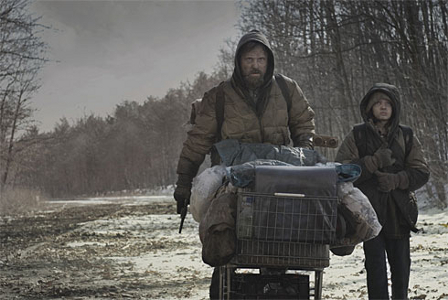
The_Road_bleak_scenery

The Road (dir. John Hilcoat 2009).

Strip that confidence away, and altruism and sacrifice will become entirely contingent on whom they benefit. In its extreme vision, The Road makes this point plain: while all post-apocalyptic narratives depict some form of social collapse or another, few match the level of scarcity of McCarthy’s novel. Indeed, in many there is material pleasure to be taken in the apocalypse, as the sudden depopulation of the world leaves behind the excess of consumer society: such is the centerpiece of both versions of Dawn of the Dead, as the survivors plunder the goods in the malls in which they shelter; one thinks of the grocery scene in 28 Days Later, and The Walking Dead certainly has no shortage of cars, gasoline, guns and ammo, and food. In all of these examples, of course, there is the clash between different pockets of survivors and the perennial moral and ethical questions about survival versus humanity; but none truly present the problem of scarcity as McCarthy does, and the dehumanizing process that entails.

All of which is by way of saying that the kind of heroism on display in localized catastrophes is unlikely to manifest itself when catastrophes are not so localized. It is sadly not surprising that the far more devastating floods in Bangladesh received a tiny fraction of the coverage devoted to Houston and Florida, but that goes to my point: what’s missing in the coverage of the heroism here is that it’s responding to a global crisis affecting the people there. And what happens when the crisis becomes even more prevalent? Harvey, Irma, and now José … and whatever comes after that. Individuals are not going to step up when they are themselves under threat, and in the absence of a collective will, the state itself will fail to cover all its bases—something we see in the hypocrisy of Ted Cruz clamoring for relief for Texas a mere five years after he voted against an aid package for Hurricane Sandy victims.

All I can hope is that things get more hopeful in lock-step with the progression of my course readings. Though even the end of the course will see us traveling around a post-apocalyptic landscape … performing Shakespeare, yes, but still …

Leave a comment

Filed under teaching, The Triumph of Death, what I'm reading

You should watch The Expanse, but you should also read the novels

expanse

Tonight, the new ScyFy Channel series The Expanse premieres, which seems as good an excuse as any for me to nerd out about about the novels from which it is adapted.

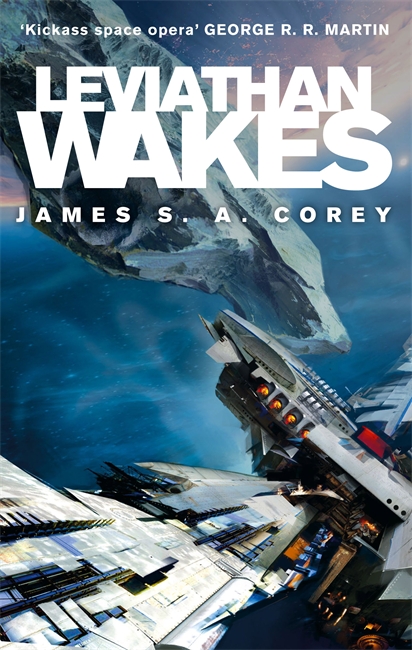
Leviathan-WakesI picked up Leviathan Wakes earlier this year, as much out of curiosity as anything. It’s a thick, brick-like book, and at that point it had three others in the series on the shelf beside it. Its cover featured generic huge-spacecraft art, but what had been catching my eye was the blurb above the title from none other than George R.R. Martin declaring “It’s been too long since we’ve had a really kickass space opera.” Its author, James S.A. Corey, is actually the pseudonym for two people: Daniel Abraham and Ty Franck, the latter of whom was GRRM’s personal assistant for a long time (or might still be, but I suspect he’s busy with his own stuff now). Colour me intrigued: I gave Leviathan Wakes a chance.
And then proceeded to devour the next three books—Caliban’s War, Abaddon’s Gate, Cibola Burn—all of which are 500+ pages, in the space of about a week.

It is a really, really good series, and if you like SF at all you owe it to yourself to read them. It’s space opera in the hands of a pair of pros. Structurally, one senses GRRM’s influence: they proceed through point-of-view chapters like A Song of Ice and Fire, but unlike Martin’s books, they exercise restraint. At no point are we overwhelmed by a surfeit of perspectives, and each novel has a contained narrative arc. They are very tightly plotted, and feature well-realized characters.

The basic premise is a compelling one: set several centuries in the future, humanity has colonized the solar system, but has not progressed into interstellar space. In interviews, the authors cite the fact that the great deal of outer-space SF tends to focus on our first steps in becoming spacefarers, or skips ahead to a point where we’ve mastered the technology that allows us to travel between the stars. What these novels do is posit a future moment when we’ve become quite facile at hopping between Earth, Mars, and the outer planets (the “Belt”), but lack anything resembling the capacity to traverse the unthinkably vast distances beyond. Hence, we encounter a future with a notably industrial, jury-rigged feel to it, as the economies of this future depend upon vast fleets that essentially approximate the tramp steamers plying the oceans of the present. Many of the ships, to say nothing of the ports and shipyards, are old and rusted, oft-repaired; much more Millennium Falcon that U.S.S. Enterprise.

I won’t get into plot points, as my main goal here is to just plug the books. As the series proceeds, however, I imagine there will be a number of posts in the future getting into the narrative particulars.

I do however want to say that one of the things I really love about this series of novels is that they’re a big thumb in the eye of the Sad Puppies. Last April I wrote about the furor surrounding this year’s Hugo Awards, in which a group calling themselves the Sad Puppies successfully lobbied a portion of Worldcon’s membership to nominate their slate of choices, in order to strike back, in the words of one of their more vociferous agitators, “against the left-wing control freaks who have subjected science fiction to ideological control for two decades and are now attempting to do the same thing in the game industry.” To recap, the previous round of Hugo nominees featured a significant number of works by women and authors of colour, or which featured stories with socially progressive elements. And, well, we couldn’t have that!

My blog post on the subject focused mostly on the arguments of author Brad Torgersen, who along with Larry Correia spearheaded the Puppy revolt. Torgersen’s main beef is that science fiction and fantasy (SF/F) has forsaken its origins in order to effect “subversive switcheroos” that appropriate traditional SF/F tropes and pervert them to articulate leftist, social justice agendas rather than good old-fashioned straightforward adventures.

Space opera? Our plucky underdogs will be transgender socialists trying to fight the evil galactic corporations. War? The troops are fighting for evil, not good, and only realize it at the end. Planetary colonization? The humans are the invaders and the native aliens are the righteous victims. Yadda yadda yadda.

Which is not to say you can’t make a good SF/F book about racism, or sexism, or gender issues, or sex, or whatever other close-to-home topic you want. But for Pete’s sake, why did we think it was a good idea to put these things so much on permanent display, that the stuff which originally made the field attractive in the first place — To Boldly Go Where No One Has Gone Before! — is pushed to the side? Or even absent altogether?

You can read the entirety of my critique in my post, but my response basically boiled down to this:

The reductiveness of this kind of thinking is truly sad, as it implies yet another canard—that one can’t do sweeping, epic, Tolkienesque fantasy, or bombastic space opera, and introduce the elements Torgersen derides. Except that you can, and writers do, all the time. It might not precisely be Tolkien or Heinlein, but the last time I was at the bookstore (yesterday), Tolkien and Heinlein were still quite well represented on the shelves.

Which brings us back to The Expanse, which is as perfect a demonstration of this principle as I’ve encountered. The novels depict a racially diverse future, one in which race and ethnicity are hardly remarked upon, often leaving us to divine characters’ origins through their names (Naomi Nagata, Alex Kamal, Julie Mao, e.g.), and features a lot of sharply drawn, compelling female characters without it ever feeling as though this representation is there for the sake of representation. One of the best characters is a U.N. undersecretary named Chrisjen Avasarala, an Indian woman with a marvelously foul mouth, who generally functions as the power behind the throne on Earth (she’ll be played in the TV adaptation by the magnificent Shohreh Aghdashloo). The series deals with such contemporary concerns as corporate power and malfeasance, terrorism, colonialist arrogance and colonial resistance, militarism and the ethics of warfare, and more. And it does so with all the spirit and bombast of the space operas of yore that Brad Torgersen and company lament as passing from this earth.

What’s more, the series delights in the trappings of genre: Leviathan Wakes is a noirish, hard-boiled conspiracy narrative. Caliban’s War, the second in the series, is good old-fashioned military SF, replete with space marines in mechanized combat armour. Abaddon’s Gate is a classic revenge drama. Cibola Burn is a about a standoff between planetary settlers and the corporate interests who have assumed ownership of their new home. And Nemesis Games is the high drama of desperate diplomacy in the midst of war. All of which unfolds from a variety of points of view, but especially from a core group of characters whose depth and complexity is what makes us care about the larger dramas engulfing the solar system.

So I’ll be turning on The Expanse tonight with about the same level of anticipation as a new season of Game of Thrones. My fingers are crossed that it will be good, but early reviews are all positive. Even if I hadn’t read the novels, one critic’s promise that “it will fill the void left by Firefly and Battlestar Galactica” would certainly have me watching.

1 Comment

Filed under nerd stuff, what I'm reading

What I’m Reading: Michael Crummey, Sweetland

Fair warning: the following post includes mild spoilers.

If you haven’t yet read anything by Michael Crummey, you need to correct that ASAP. Not because his books are capital-G, capital-L Great Literature (though they are), but because in not reading his work you are denying yourself a great pleasure. I’d rank him as one of the best prose stylists currently writing, but never does his talented wordsmithing distract from his stable of vibrant, humorous, tragic characters or his superb storytelling. Reading a Michael Crummey novel is a balancing act between wanting to read slowly to savor the prose and race ahead to see what happens next.

And because you can’t swing a dead cat in St. John’s without hitting a great writer, I can also personally attest to the fact that he is one of the nicest people you could ever meet (he didn’t even get upset with me for hitting him with a dead cat).

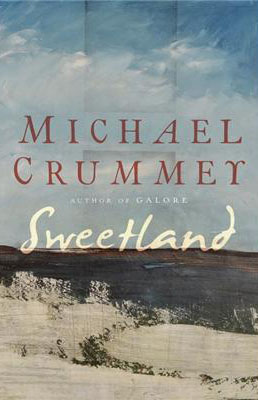
sweetlandSweetland is his fourth novel, and like the three previous, it is about Newfoundland’s fraught relationship with its  history. In River Thieves (2001) he tells the story of the extinction of the Beothuk as seen from the perspective of British naval officer; in The Wreckage (2005), he depicts a romance between a Catholic young man and a Protestant girl, and the intrusion of the Second World War into Newfoundland in the form of the recruitment of its young men and the presence of American military bases. Both novels are solid pieces of storytelling, beautifully written; but it was his third novel Galore (2009) that truly blew me away. Set in the fictional outport of Paradise Deep, it is a multi-generational narrative (I hesitate to use the word “epic,” though it comes close to being appropriate in this case) that tells the story of a community and their struggles: with each other, with their own selves, but especially with this hostile geography to which they have been brought by hope, misfortune, or happenstance. Galore is a magical realist novel whose most obvious influence (or at least precursor) is One Hundred Years of Solitude. Like Gabriel Garcia Marquez’s landmark novel, Galore is about a small village beyond the fringes of civilization, in which anything can happen and indeed often does. Crummey employs a combination of harsh realism to describe the hardships endured by the community, and a host of legends and folklore from Newfoundland’s past; the result is a narrative that pivots between a painfully tactile sense of reality and outsized events and circumstances.

Sweetland, by contrast, is set in the present day in the midst of what has become the most recent wave of Resettlement. If you wonder why that word deserves a capital R, you need to know that in the aftermath of Newfoundland joining Confederation in 1949, premier Joey Smallwood embarked on a project of modernization. He had been able to sway the province’s opinion to his side on the Confederation issue by making lavish promises to rural Newfoundland about the financial benefits that would accrue by joining Canada. Part of fulfilling those promises entailed resettling huge swaths of outport populations to more central locations, where they would have access to both the promised financial benefits and such infrastructure as roads and electricity, health care, and education. Huge amounts of money were spent in payouts to those being relocated, and in literally uprooting entire villages.

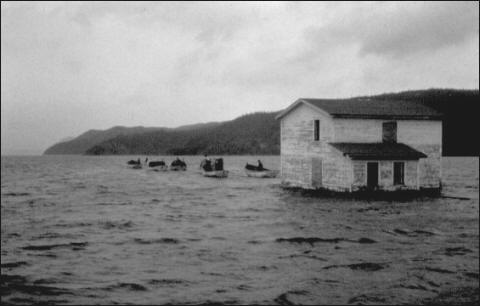
resettlement

One of the many bewildering images from Resettlement: a house being towed across the water to its new home.

Resettlement remains a painful wound in Newfoundland’s modern history, as it was carried out more or less by fiat and destroyed countless communities with, in many cases, hundreds of years of history.

Today, there is a similar move (this time termed “Relocation,” presumably to avoid the painful connotations of “Resettlement”) as Newfoundland’s economy, largely buoyed by oil revenues, booms; outports, many whose only connection to the rest of the province is by ferry, find their populations shrinking and aging as the young move to St. John’s or farther afield to Alberta. The government is again offering money to those wishing to relocate—and in the process leaving behind villages that will no longer need ferry service or electricity. But with Smallwood’s high-handedness and the resentment it incurred (and still incurs) ever in mind, the deal now is that Relocation can only happen if a community votes unanimously for it.

Which brings us to Sweetland, which is about a fictional island outport called Sweetland and the argument about Relocation. The village is mostly on board, but for one or two holdouts—among whom is Moses Sweetland, a stubborn old bachelor who refuses to sign on even as his few allies fall away and leave him standing alone. He resists the blandishments of his neighbours, which eventually come to comprise threatening notes, vandalism, and a few gruesome messages in the form of mutilated rabbits.

When a certain tragedy befalls the village, however, particularly affecting Moses, he finally agrees to sign the papers. Perhaps predictably, he does not leave with the rest but effectively fakes his own death by setting his boat adrift and hiding until the village has emptied.

The novel’s first half—which is all about Moses’ relationships with his friends and neighbours, and in particular his autistic nephew Jesse—is a wonderfully nuanced and textured depiction of Moses’ life in his village, and dramatizes the political context to great effect. But it is the second half of the novel, when Moses is left alone on the island without power or any means of contacting the outside world, that Crummey’s narrative reaches virtuosic levels. For one thing, it leaves the political argument behind and becomes the story of a man very slowly losing his mind as solitude and winter implacably close in on him. But it is also where the political argument of the first half opens up into symbolic and indeed allegorical dimensions. Left alone with only the ghosts of the past—and his neighbour’s mutt—for company, there is nothing to mediate between the two Sweetlands, the man and the outport with which he shares a name.

The more I reflect on Sweetland, the more I find it functions as a companion piece to Galore. Where the former is a sweeping story in the mold of One Hundred Years of Solitude, Sweetland is a minutely observed story about a single person in a narrow corridor of time. And yet what they have in common is the vivid sense of the mystery of place, the invidious way in which geography conflates with history in ways that are by turns comforting and pernicious. Galore, by its nature as magical realism, romanticizes a certain dimension of Newfoundland history, but it most emphatically does not sentimentalize it. It is romantic in the true sense of the word, in that it depicts a space outside the settled, domesticated world. If not literal wilderness, Paradise Deep is nevertheless as close as one can be to it while still being inhabited: a marginal space that, in the tradition of romance, is also a mythic space home to the embellishments of reality that extreme geographies spawn.

The first half of Sweetland is neither sentimental nor romantic; the romance of Galore does burble up in the second half however, but only in suggestive, fleeting ways, and only at the fringes of Moses’ decaying sanity. His explicit connection to the village, made first by their common nomenclature, develops allegorically as he erodes along with its structures, as he cannibalizes the village for supplies. Seeking toilet paper (which he kicks himself for not having stockpiled), he plunders his neighbour’s collection of Harlequin romances. Among the pulp novels are a handful of “literary” texts the woman’s daughter had attempted to get her to read, one of which has the bookmark at the halfway point. It is a novel about Newfoundland, he sees, and as a means of passing the time decides that he will finish what she had started:

Half an hour later he was ready to throw the bloody thing in the stove. Three afternoons in a row he sat in the day’s last light with the book, feeling like a man sentenced to dragging beach stones up the face of the Mackerel cliffs. He looked at the cover each time he quit reading, flipped it to inspect the back. A quote from a Toronto paper about “authentic Newfoundland.” Whoever wrote the book didn’t know his arse from a dory, Sweetland figured, and had never caught or cleaned a fish in his life. “Jesus fuck,” he whispered.

This comic reaction to a novel about “authentic” Newfoundland (my money is on The Bird Artist) speaks to one of Sweetland’s subtle themes, which is the fallacy of authenticity. Though Sweetland is adamant in his refusal to abandon his home, even in the face of overwhelming opposition and threats, he cannot articulate his reasoning to himself. He offers no speeches, articulated either internally or externally, about history or community roots, about the depredation of traditional Newfoundland, about the need to hold fast to one’s principles in the face of nefarious societal change. He is no sentimentalist, and in the final stages of his life bears little in the way of affection for any of his neighbours (with the exceptions of Jesse and his longtime friend Duke).

So why does he reject Relocation for so long, and after capitulating, go to the extreme of faking his own death in order to stay behind? Crummey leaves that questions unanswered, and it is in the very lack of articulation of Sweetland’s motives that the novel ultimately rests. As mentioned above, it is in part the mystery of history and geography: Sweetland’s home as both a lived reality but also an imaginary space, which functions as a representation of Newfoundland more broadly. The fallacy of authenticity on display in the nameless novel he reads finds a somewhat more symbolic articulation in the final few pages of the novel. Not long after winter starts to set in, Sweetland takes refuge from a snowstorm in a cabin once owned by the thuggish Priddle brothers. In a delirium of near-hypothermia (as well as the alcohol and stale pot he finds stashed there), he annotates a map of Newfoundland tacked to one of the walls. He takes the map with him when he escapes back to the village, but forgets about it until the final pages, when he looks at what he has written:

Noticed the map there, spread across the table’s surface, the paper kinked along the rough creases where it had been folded in his knapsack. Stay Home Year scrawled across the top. Sweetland shook his head at that now, at the long list of fanciful harbours and coves and islands and straits he’d pencilled around the coast. Along the entire length of Newfoundland’s south coast were the words Here Be Monsters with a shaky emoticon happy face drawn beside it. His handwriting, though he couldn’t for the life of him remember settling them there.

In one way, Sweetland is a novel about the impossibility of writing a novel about Newfoundland—or rather, the impossibility of reaching an authentic understanding of what I’m calling the conflation of history and geography and its effects, of the representation of place as being at once a set of lived realities and necessarily imaginary. Moses’ literally ecstatic over-writing of the map, especially with the warning Here Be Monsters, evokes the medieval cartographic imagination and the long tradition of romance in which the spaces beyond the known are invariably filled with the stuff of legend. It also however evokes the geographies of Galore, which articulate the truths of story and myth and the unreality of history.

In the end, Moses Sweetland’s very name provides one of the novel’s central ironies: if his surname explicitly speaks to his apparently absolute connection to place, his first name is a cruel reminder that there is no Promised Land, and that the exodus his people undertake is a movement away from home. If there is an epiphany for Sweetland at all, it is at best an ambivalent one, which occurs as he nearly drowns trying to escape his self-imposed solitude:

This was the sway of things, Sweetland knew. There was fighting the sway of things or improvising some fashion of riding it out. And then there was the sway of things beyond fighting and improvisation. It was almost impossible to know the difference between one and the other.

Leave a comment

Filed under what I'm reading

What I Read On My Summer Vacation

I didn’t post that much this summer … I had all the best intentions, as exhibited in my folder of unfinished blog posts, some of which barely made it past a sentence or two. All of which speaks to the fact that I had a lot on my mind these past few months, but little in the way of closing. Always be closing! Dammit, now Alec Baldwin will deny me coffee …

I hope that will change in the coming months. I am now eleven days into my very first sabbatical, and while my favourite new pastime has been walking up and down my department hallways and making faces at my colleagues as they teach, I do mean for this to be a productive year. And given that being prolific on this blog tends to reflect being productive in other areas, I mean to be posting a lot more here.

I haven’t done a “What I’m Reading” post in a while … which, again, isn’t for a lack of fragmentary paragraphs in my work-in-progress folder. I read a lot this summer, though much of it was re-reading, as I was doing a directed reading course with one of our doctoral students. And there were some unfortunate reading choices (most notably, the Guillermo del Toro collaboration with Chuck Hogan on The Strain), but I also read some pretty extraordinary books. I’ll give you the highlights here.


Rebecca Solnit, The Faraway Nearby and Men Explain Things to Me

solnitThis was the summer when I discovered the writing of Rebecca Solnit and fell deeply in love with her gorgeous prose and genre-defying vaguely-autobiographical essays. I had read her without being aware of her for some time, as she is prolific and frequently turned up on online journals and magazines. But it was her now-famous (or notorious, depending on your perspective) essay “Men Explain Things to Me” that stuck the landing for me and made me sit up and take notice whenever I saw her name on a byline.

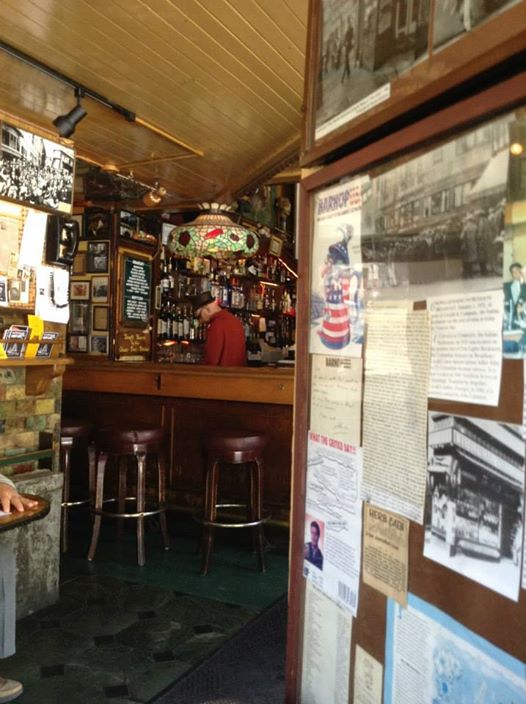
I was in San Francisco for a few days in June and made the requisite pilgrimage to City Lights bookstore. And because I cannot enter a bookstore without giving them money, but also not wanting to be a cliché and buy something by the Beats, I picked up The Faraway Nearby. Next door to City Lights is the bar Vesuvio, made famous by a list of clientele in the 50s and 60s that reads like a who’s-who of San Francisco arts and letters: Jack Kerouac, Alan Ginsberg, Lawrence Ferlinghetti, Neal Cassady, among others … and the pictures crowding the walls show everyone from Dylan Thomas to Bob Dylan dropping in for a drink or three (or, presumably in Dylan Thomas’ case, a dozen). Because I’d been tramping all over the city, I had a pint there and started reading Solnit—which turned out to be serendipitous, as she lives in San Francisco. (Lest I felt like too much of a cliché, reading in a famous literary bar, I was out-cliched by a magnitude by a fellow in hipster glasses and big mutton-chop sideburns sitting in an alcove reading On the Road).

city-lights

The view from my seat in Vesuvio.

The view from my seat in Vesuvio.

Suffice to say, The Faraway Nearby is one of the most gorgeous collections of personal essays I’ve ever read, moving effortlessly between Solnit’s fraught relationship with her mother and her mother’s descent into dementia, through a dizzying series of meditations on winter, Iceland, adventuring, rafting, and the proper methods of preserving several bushels of apricots she finds herself with. The essays are deeply erudite without being esoteric, personal without being mawkish, and written in prose that I can only envy with the white-hot intensity of a thousand stars.

men-explainI then read Men Explain Things to Me, a slim volume of essays on women and violence prefaced by the original essay that inadvertently gave rise to the concept of “mansplaining.” Solnit has expressed ambivalence about having become associated with the term, not because it is not a real thing (and as someone who has occasionally been guilty of it, there was a lot of internal cringing when I first read the essay), but because it is reductive. The essays grouped in this short but incredibly powerful book remind us—forecfully—of the original essay’s main thesis, which is that the phenomenon of men condescendingly explaining things to women (even, or especially, when they’re ignorant on the topic) is reflective of the gendered structures of power in the world today and systemic violence that proceeds from it.


Michael Waldman, The Second Amendment: A Biography

2ndamendmentI won’t say much about this book, as I’m slowly working on a blog post talking about it in greater detail. I will say this: it is a bracing and very concise read that manages to make the endless debates in and around the Continental Congresses, and all of the court rulings on the Second Amendment since, not merely not tedious but gripping. It is a persuasive and balanced discussion of the Second Amendment’s origins, interpretations, and evolution, but in some ways, the focus of the book isn’t really the right to bear arms at all: rather, it’s a polemic against constitutional originalism, the judicial philosophy holding that the Constitution must be interpreted in terms of what were the Framers’ original intentions. As it turns out, the Second Amendment (for a variety of reasons) is the perfect departure point for this argument.

As I said, I’ll have more to say about this book at a later time.


Terry Pratchett, Equal Rites

equalrites1As I said in my post of July 5th, I’ve been rationing the remaining Discworld novels against the unthinkable day when Sir Terry will not be around to write any more. Equal Rites has been sitting on my shelf for a long time, both because of my rationing but also because I don’t care as much for the earlier novels. Equal Rites was the third, after The Colour of Magic and The Light Fantastic; what’s slightly off-putting about the earliest novels (when you have, like me, initially entered Discworld with the more recent novels) is that everything still feels a little formless—as if the landmarks and characters still await greater definition, like rudely shaped clay. Granny Weatherwax makes her first appearance here, and while she is very identifiably Granny, she is also … not. Or not quite. Nevertheless, the novel is hilariously funny: a baby girl is accidentally chosen by a dying wizard to take his place, precipitating a protracted argument between Granny and the wizards of Unseen University about what defines magic, about what is specific to men and women—or wizards and witches—respectively, and how those definitions are arbitrary.

What I loved about this book, coming at it as I am from the far end of Discworld journeying, is how you can see Sir Terry’s shift from the overt parody of his first two novels (in which he’s just basically taking the piss of fantasy as a genre) to a more thoughtful use of fantasy and its conventions to offer a critique of “real world” social and societal mores—which in the end is what tends to define the Discworld novels overall.


Lev Grossman, The Magician’s Land

magicians-landSpeaking of parodic fantasy that isn’t really parody at all: if you haven’t yet read the first two installments of Grossman’s trilogy about a school of magic and a Narnia-like alternative world, you really must do so. Like, now. The Magician’s Land completes the story begun in The Magicians and carried on in The Magician King, the story of narcissistic and self-absorbed Quentin Coldwater, who is inducted into a secret school of magic called Brakebills at the age of seventeen. As critics have pointed out, it’s like Hogwarts for grownups.

Again, there will be a more in-depth blog post in the future on this book, and the trilogy as a whole. But for now, let me just say: this was about as perfect a conclusion to a fantasy series as has been written.


N.K. Jemisin, The Killing Moon

killing-moonNo, I didn’t read this because it shares a title with an Echo and the Bunnymen song. My broad research project of the moment is all about humanism and fantasy; one of the problems I have right now is one of representation. That is to say: my current list of authors on whom to focus is almost entirely male, and so I have been on the hunt for fantasy written by women that fits the criteria of the novels I want to look at. N.K. Jemisin was a repeated recommendation, and so I started on her Dreamblood trilogy, set in an alternative world modeled vaguely on Ancient Egypt. Reading fantasy that moves outside the medieval European model is wonderful in and of itself, but Jemisin is a very talented writer who renders her world with wonderful tactility and establishes its mythology with an enviable economy of storytelling. The overarching conceit is that in the city-state of Gujaareh, an elite priesthood exist to harvest “dreamblood,” the magic that exists in sleeping minds. Dreamblood is used for healing and other positive ends, but its reaping by the “Gatherers” kills … and so the Gatherers move at night across the rooftops to harvest it from those who have been judged corrupt.

For several reasons, The Killing Moon is not a novel I will be able to use to argue my broader thesis, but the second book of the trilogy (The Shadowed Sun) sits in the pile of my eagerly anticipated reading.


Radley Balko, Rise of the Warrior Cop

Rise-of-the-Warrior-CopAbout three weeks ago I wrote a post about the crisis in Ferguson, Missouri, the rise of police militarization, and The Wire. Largely due to the fact that a friend of mine posted it to Reddit, it received the most hits this blog has ever received, by a magnitude (my average post gets between sixty and seventy hits when it goes up; the most I’d ever had was just shy of three hundred, back when I posted on the whole David Gilmore and guy-guy Lit fiasco; the post on The Wire and Ferguson received twelve hundred, and a comment from David Simon himself. That’s not actually relevant, I just like reminding people of it). While reading the various news items and opinion pieces that ultimately informed the post, I kept hearing about Radley Balko’s book, conveniently just out in trade paperback. So I ordered it.

The book is … terrifying. It exposes in excruciating detail the violence done to the Fourth Amendment—for the rise of SWAT teams in towns with populations as low as fifteen thousand or less has not, ultimately, been about responding to well-armed criminals, but the use of the militarized groups to kick in doors for drug raids. And as the book chronicles, the sheer number of botched raids in which ridiculously armed and armored cops burst into the wrong house, terrorizing the inhabitants and destroying property (and, distressingly, shooting an awful lot of dogs in the process) is bewildering—especially considering how rarely the wronged citizens receive anything resembling remuneration.

Just today there was an article in The Chronicle of Higher Education about the spread of military equipment and munitions to campus police at various universities in the U.S. Campus. Police. Armed with grenade launchers (seriously) and equipped with armoured vehicles. Even before reading that, I’d concluded that Balko’s book is required reading for the contemporary moment.


So as not to end on such a down note, here is “The Killing Moon” by Echo and the Bunnymen—which on reflection, is also kind of a downer, but would weirdly work as a not bad theme song for Jemisin’s novel.

Leave a comment

Filed under what I'm reading

24, the CIA, and the Fantasy of Hyper-Competence

I’ve been watching 24: Live Another Day, a so-called “event series” of 24 that brings back everyone’s favourite gravelly-voiced secret agent, Jack Bauer. I’ve watched 24 since its third season (and have since watched the first two on DVD), and it is difficult to pinpoint when my interest morphed from “hey, exciting TV show” to something more academic. Certainly, it was the academic interest that saw me through some of its terrible later seasons, for even when the show got repetitive and (oddly) lugubrious, it always functioned as a fascinating window into a terrified zeitgeist that imagined terrorist threats in increasingly absurd and outlandish ways.

new-trailer-and-poster-arrive-for-24-live-another-day-159450-a-1395819178-470-75

“So, what does it take to be an uber-agent? Training? Tactical brilliance? Ruthlessness?” “No, it’s mostly just shouting.”

Watching the newest season (really a half-season, though I suppose they can’t very well rebrand it as 12), I am struck anew by the way the show rests on the foundation of a sort of symbolic arms race, in which the terrorists possess increasingly sophisticated technology and apparently unlimited funds, which they employ in increasingly, ludicrously, complex and intricate plots against America. Arrayed against such threats is the CTU (Counter Terrorist Unit) and, in Live Another Day, the CIA, which possess something resembling omniscient surveillance capabilities and the technological savvy to instantly hack almost any electronic system for information and/or more surveillance. This panoptical apparatus and its operators’ preternatural technological ability (as embodied in the savant-like Chloe O’Brian) is tacitly justified by the terrorist du jour’s own sophistication and resources. A typical 24 plot would never be concerned with a bunch of foreign nationals attending flight school in, say, Florida; it would instead feature terrorist hackers taking over air traffic control communications, or, in the case of the current season, taking control of American drones.

Michelle Fairley, aka Catelyn Stark, as the most recent alpha-terrorist on 24. See? I told them there's be serious blowback from the Red Wedding.

Michelle Fairley, aka Catelyn Stark, as the most recent alpha-terrorist on 24. See? I told them there would be serious blowback from the Red Wedding.

All of the apparatus of an electronic surveillance state is present but unremarked: 24 would be unthinkable without it. And yet, it is invariably vulnerable. In every single season of 24, CTU’s omniscient technology proves insufficient to deter whatever attack is afoot. It falls instead to the indomitable Jack Bauer, whose instincts and intuition almost always trump the conclusions of legions of intelligence analysts.

24 has such an odd paradox at its center, one that is something Fredric Jameson would call a symbolic resolution, in fiction, of an intractable real-world contradiction. On one hand you have the implicit faith in the panoptical surveillance state—and not just faith, but the tacit understanding that such apparatus is necessary and indeed a given, something so universally understood as reality that there is no question of it being, well, questioned. And let’s be clear on what this means: though all we ever see of it are the dim offices of a subterranean CTU station, it represents a vast and omnipresent governmental reach with apparent impunity to spy on both citizens and foreigners. On the other hand, I don’t believe there has been a single season of 24 in which Jack Bauer hasn’t gone rogue in some capacity, because working within the confines of the “law” (however egregiously attenuated it might be) straitjackets Jack and prevents him from doing what has to be done.

Hence, 24 has always been equally invested in pervasive and invasive government and the need to escape it. It’s really no surprise that 24 is a favourite of neoconservatives, as it articulates that contradiction at the heart of their creed: the desire for American omnipotence co-existing with an ideological antipathy to “big government.”

And while the series’ main ongoing controversy—and its most egregious and troubling element—has been the use of torture as a legitimate means of extracting actionable intelligence, more subtly pernicious is the depiction of Jack Bauer’s preternatural competence, as well as that of CTU. This is not, of course, anything different from the dozens and hundreds of films and television shows about espionage and clandestine military ops—from James Bond to the Smoking Man to every film about elite commandos ever, the appeal of these stories lies in their illusion of mastery and control and the unerring accuracy of intelligence, intuition, and interpretation.

Legacy_smpbAll of which is, of course, a patent fallacy. I probably wouldn’t be writing about all this if I hadn’t recently read a history of the CIA, Legacy of Ashes (2007), by Tim Weiner. It might as well have been subtitled “A History of Abject Failure,” given that it is a brutal chronicle of the CIA’s chronic ineptitude, from the opening salvos of the Cold War to the clusterfuck that was the catastrophic intelligence failures of Iraq. Much of Weiner’s source material is reams of documents that were declassified in 2004-2005, so the story he tells is not only a new one but decidedly at odds with the way the agency has been depicted in popular culture, and how it depicted itself. Depending on when the CIA has been depicted in film, fiction, or television largely determines whether it is portrayed as malevolent or heroic; but one way or another it has tended to appear as a ruthlessly efficient operation, sometimes riven by internal rivalries and discord, but always a terribly efficacious tool in the service of either good or evil.

The reality of its history as detailed by Weiner is one in which failure, incompetence, and willful institutional blindness are the norm. If the agency has been consistently good at one thing, it is the ability to whitewash those failures, spin them as successes, and burnish its reputation as an omniscient and omnipotent force for American security and freedom.

Weiner starts his book by noting that the CIA was founded for the sole purpose of intelligence aggregation and analysis. Harry Truman basically wanted a small agency whose job would be to present him on a daily basis with a snapshot of what was going on in the world. The agency that developed, however, was very quickly hijacked by men far more interested in covert operations: who instead of keeping tabs on international communism and other threats, saw themselves as freebooters whose job was to actively combat these threats and work to roll them back. As the Cold War took shape and the USSR emerged as the United States’ principal antagonist, their energies went into clandestine skirmishes. They never succeeded in providing the president with what he most desired: a window into Soviet operations and a reliable intelligence that would warn of an imminent nuclear threat.

In fact, the first two hundred pages of Legacy of Ashes reads not so much as a comedy of errors as a tragic farce. It took the CIA over a decade to realize that the Soviets had spies riddling both American and British intelligence. In operation after operation, they trained refugees from behind the Iron Curtain (and in the Korean War, South Korean nationals) in combat and intelligence gathering and dropped them into enemy territory. The failure rate for these operations was one hundred percent, as the enemy knew precisely when and where these drops would take place and often had men there waiting for them. The hapless agents were imprisoned and tortured (if they weren’t summarily shot on sight), and either turned by the KGB or executed. Ten years the CIA bloody-mindedly continued … and that is only a single story from Weiner’s six hundred page litany of incompetence. As he remarks about the early, enthusiastic forays of the fledging agency, the United States was childishly blundering into a world of espionage that Russia had been playing like a chess master for two centuries.

homeland

When I watched Homeland for the first time, my initial thought was that here was a series that functioned in part as a corrective to 24—it approached the questions of nation, identity, faith, and loyalty (as well as the business of intelligence-gathering more generally) with a nuance and complexity alien to 24. And yet in the aftermath of reading Weiner’s book, it becomes obvious that even Homeland manages to completely overestimate the CIA’s efficacy and competence.

The figure of the elite soldier or agent backed by a technologically sophisticated agency has become increasingly commonplace in popular culture. James Bond might have blazed the trail, but you see his progeny strewn throughout film and television. I don’t care to speculate on why precisely—that’s a post for another day—but we’ve moved far away from the images of the grunt and the common soldier which dominated war films until the first post-Vietnam movies introducing us to the likes of John Rambo started to focus on the elite, hypercompetent soldier to the exclusion of mere mortals. On one hand, such musclebound commandos as portrayed by Stallone and Schwartzenegger were an obvious overcompensation for America’s symbolic emasculation in Vietnam; but I’m also tempted to say it becomes bound up in the delusions of conspiracy theory that pervaded the 1970s and afterward, so beautifully summed up by Don DeLillo in his novel Libra:

If we are on the outside, we assume a conspiracy is the perfect working of a scheme. Silent nameless men with unadorned hearts. A conspiracy is everything that ordinary life is not. It’s the inside game, cold, sure, undistracted, forever closed off to us. We are the flawed ones, the innocents, trying to make some rough sense of the daily jostle. Conspirators have a logic and a daring beyond our reach. All conspiracies are the same taut story of men who find coherence in some criminal act.

Certainly this figuration of conspiracy is what animates 24—the specter of such “cold, sure, undistracted,” perfect schemes perpetrated by “silent nameless men with unadorned hearts,” which cannot be countered with anything so wishy-washy as legal or democratic means.

That is the fantasy, and yet everything we learn from history teaches us otherwise. I’ve never actually met a real 9/11 Truther (at least none who have declared themselves as such), but my counter-argument would have nothing to do with the ostensible physics of building collapses, and everything to do with the simple question “Do you honestly think that the Bush Administration would be competent enough to pull something like that off?” In the aftermath of 9/11, Elaine Scarry wrote a remarkable essay titled “Citizenship in Emergency” which did a wonderful job of taking down all our assumptions about the “fast response” capabilities of the military and civil defense and arguing that there was only one response to the terrorists’ attack that succeeded: the ad-hoc resistance of the passengers on United 93.

The more I dwell on this topic, the more it bothers me, and the more I come to believe that the fantasy of hypercompetence, while appealing as a popular trope, is also culturally pernicious. It affords the delusion of precision and exactitude in spheres of action that are inherently chaotic and unpredictable. It is why Wayne LaPierre’s mantra “the only thing that can stop a bad guy with a gun is a good guy with a gun” is just so much horseshit. It assumes that the good guy with the gun will unerringly put down the bad guy as opposed to adding to the carnage with shots that go wide of the target. Even highly trained peace officers or soldiers, when put in the crucible of a firefight, can’t shoot with the innate accuracy of a nickelodeon gunslinger; what are we to expect of a well-meaning citizen whose only experience firing his weapon has been on the gun range? When two police officers in Manhattan fire sixteen rounds at a man with a gun and succeed in wounding nine bystanders, the comforting idea that a firefight can be contained sort of goes out the window.

On the other hand, if we all get together and be reasonable about the topic, we can come to the comforting conclusion that the uber-terrorists of 24 are just as much of a fantasy.

Leave a comment

Filed under maunderings, television, what I'm reading