Tolkien and the Humble Tater: Thoughts on Food and Fantasy

ring_edited-2

I always loved the fact that the original Japanese version of Iron Chef started with a epigraph from the nineteenth-century French gourmand Jean Anselme Brillat-Savarin: “Tell me what you eat and I’ll tell you what you are.” Besides being the perfect pretentious opening for one of the most beautifully bombastic television shows ever made, the sentiment has always rung true for me … and unlike many pithy aphorisms, does not start to crumble under examination.

In my other life where I’m still a university professor, I’m a food historian or possibly food anthropologist (as opposed to my other other life, in which I’m a military historian). This is, I should add, a relatively recent enthusiasm: moving to Newfoundland has been something of a catalyst in this regard, as there are so many examples of this province’s history built into its food traditions. Go into the liquor store and you find nearly an entire wall given over to rum—which at first glance is odd, as you wouldn’t think liquor made from sugar cane would have such a foothold in this northern clime. By the same token, the presence of salt cod in so many traditional Caribbean dishes is similarly counter-intuitive, considering the bounty of fresh fish readily available. But both of course are legacies of the trade routes running salt cod south and sugar and rum north, and both are deeply and unfortunately entwined with the horrors of slavery and the depredations of colonialism.

Perhaps it is because of this dilettantish enthusiasm for food (though I stop well short of calling myself a “foodie”) and its history, but I find myself noticing it a lot in fiction … or in some cases, noticing its absence. I always tell my students: pay attention to the stuff. That is, pay attention to what a given author foregrounds, what he or she chooses to devote especial attention to. If that happens to be food, all the better: why, for example, does someone so parsimonious with detail as Ernest Hemingway devote so much attention to what his characters eat and drink (especially drink)? Or consider our first introduction to Mr. Leopold Bloom in Ulysses:

Mr Leopold Bloom ate with relish the inner organs of beasts and fowls. He liked thick giblet soup, nutty gizzards, a stuffed roast heart, liverslices fried with crustcrumbs, fried hencods’ roes. Most of all he liked grilled mutton kidneys which gave to his palate a fine tang of faintly scented urine.

Bloom is, above all else, a sensualist, a man whose tactile and sensory relationship to the world is placed in contradistinction to the moody and cerebral Stephen Dedalus; a partiality to inner organs of beasts and fowls is eminently appropriate to a man with a more visceral experience of life.

Fantasy as a genre has a particularly interesting relationship with food, for the simple reason that the creation of an alternate world requires some benchmarks for readers rooted in what Tolkien called the “primary world.” The most obvious example today is A Song of Ice and Fire, in which George R.R. Martin lavishes loving detail on (it sometimes seems) every single morsel of food his characters consume (seriously: Every. Single. One). On one hand, it is the prose of an author who himself obviously loves good food; on another hand, it is a shrewd and pungent way to establish regional identity in a world that, as the series progresses, just keeps getting bigger.

Indeed, food plays a prominent enough role in Martin’s novels that one of the promotional gimmicks for HBO’s adaptation was a series of food trucks roaming New York and L.A. selling “the food of Westeros” … food inspired by the series and devised by celebrity chef Tom Colicchio:
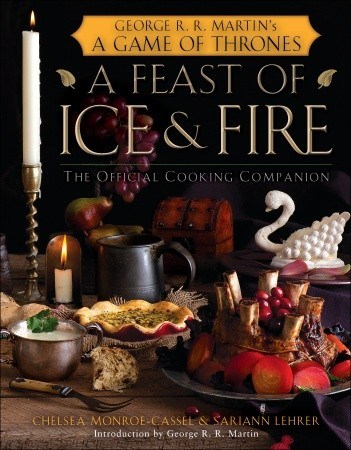
feastoficeandfireMartin’s preoccupation with food has also spawned a Game of Thrones cookbook, A Feast of Ice and Fire—itself the product of a blog, Inn at the Crossroads, which has for several years been approximating meals from the novels like almond-crusted trout, honeyed chicken, honey-spiced locusts (which are probably best to avoid, and not just because they’re insects, as readers of the books will attest), and of course Sansa Stark’s beloved lemon cakes.

But in Tolkien? Not so much. If we are, as I enjoin my students, to pay attention to the stuff in The Lord of the Rings, our attention is drawn predominantly to descriptions of landscape. The most descriptive passages tend to focus on the terrain through which the main characters pass. This preoccupation is perhaps unsurprising, considering that Tolkien was an avid hiker and loved a good walk about as much as George R.R. Martin likes a good restaurant; but more specifically to the novel, landscape in its various iterations becomes deeply significant in its oppositions between the pastoral cultivation in the Shire and dangerous wilderness; between plain and forest; and most crucially between a utopian, idyllic world of beauty, and the blighted, dystopian spaces of Mirkwood or Mordor.

Food is of course present in the novel, but usually in passing and rarely with any detail or description. It is indeed rare that we even know what characters are eating (lembas excepted). There are no Game of Thrones-esque scenes in which “Pippin tore a crisp leg, sticky with honey and crusted with herbs, from the roasted capon.” And what specificity we do get with food tends to rest with the hobbits—the lavish feast at Bilbo’s birthday party, for example, or the hobbits’ two meals of mushrooms. Hobbits, as we are told repeatedly, are small creatures with capacious appetites, so it stands to reason that they’ll be more preoccupied with meals than stern men, stoic dwarves, or ethereal elves.

Hence, when Sam determines to cook a meal for Frodo and cajoles Gollum into catching some rabbits for the task, the scene stands out. And we get a fun little insight into hobbit priorities:

All hobbits, of course, can cook, for they begin to learn the art before their letters (which many never reach); but Sam was a good cook, even by hobbit reckoning, and he had done a good deal of the camp-cooking on their travels, when there was a chance. He still hopefully carried some of his gear in his pack: a small tinder-box, two small shallow pans, the smaller fitting into the larger; inside them a wooden spoon, a short two-pronged fork and some skewers were stowed; and hidden at the bottom of the pack in a flat wooden box a dwindling treasure, some salt.

The resulting meal is, however simple it ends up being, among the most vividly described in the novel. More than that however, it serves to make Sam’s familiar, banal act of cooking that much more remarkable. Indeed, given the context, cooking a simple and wholesome meal is nothing short of heroic, and the attention Tolkien gives it emphasizes its thematic importance, something I’ve touched on in a previous post: the role of “home” and the “homely” as a touchstone, the manner in which it, by contrast, emphasizes just how far from home they actually are, and (of course) it serves as a concrete manifestation of Sam’s loyalty and devotion. That being said, the stew’s lack is just as significant as what it possesses. It has nothing to flesh it out besides the rabbits themselves, and the paltry herbs Sam is able to forage. It is on one hand a reminder of the comforts of home; but Sam is also keenly aware of how deficient a stew it is, with its lack of any vegetative besides herbs—and in particular, its lack of potatoes. His little disquisition on taters in answer to Gollum’s question is one of my favourite Sam moments, and one rendered very well in the film:

“Po—ta—toes,” said Sam. “The Gaffer’s delight, and rare good ballast for an empty belly. But you won’t find any, so you needn’t look. But be good Smeagol and fetch me some herbs, and I’ll think better of you. What’s more, if you turn over a new leaf, and keep it turned, I’ll cook you some taters on of these days. I will: fried fish and chips served by S. Gamgee. You couldn’t say no to that.”

But of course Gollum can say no, preferring his own rather gruesome version of sashimi. This little wistful ode to potatoes speaks to Sam’s rustic and rural simplicity—if we think of potatoes in cultural terms, there is much of the peasant attached to them, in part because of their colonial associations with the rural Irish. And if we can cast our minds back to the very first chapter, we recall that the list of Bilbo’s bequeathals included two sacks of potatoes for “Old Gaffer Gamgee,” Sam’s father (as well as “a new spade, a woolen waistcoat, and a bottle of ointment for creaking joints”).

There is also here yet another fun anachronism, for both potatoes and the practice of frying in oil were alien to the European Middle Ages. We might associate potatoes with Ireland, but in fact potatoes were not indigenous to Europe—they were transplanted from South America in the sixteenth century. And frying as a means of cooking, while practiced in, for example, ancient Rome, was not at all common in the Middle Ages. Certainly, the dish of “fish and chips” as we know it did not become standard fare until the eighteenth century and after. (Fun fact: initially, the batter was not meant to be eaten, but was used to protect the flesh of the fish from the hot oil). The point here being that “fish and chips” is an ahistorical gesture on Tolkien’s part that grounds the hobbits and the Shire in a particular sense of Englishness—and again, in a particular sense of “home.”

So what? (you might well ask). Tolkien isn’t writing historical fiction; potatoes and battered, fried fish might be fatal anachronisms in a novel seeking to accurately depict the middle ages, but there’s no such restrictions in fantasy. Indeed, the presence of a potato in an ostensibly medieval, vaguely European context is rather insignificant next to sorcery, magical rings, and immortal elves. Which is true enough, but misses the point, which is that this scene, with Sam’s ode to the humble tuber, is deeply significant for the fact that nowhere else is food so celebrated except in the abstract. Hobbits, as we have established, love to eat; what they love to eat is left to the imagination.

“Tell me what you eat and I’ll tell you what you are.” Sam’s love of potatoes speaks to who and what he is, the simple but sturdy rural yeoman embodying certain qualities of the English agrarian working class. If other hobbits (such as the Sackville-Bagginses, Ted Sandyman, or those who get in line twice at Bilbo’s party to receive gifts twice) are Tolkien’s gentle poke at country folks’ small-minded parochialism, Samwise Gamgee is his celebration of their virtues of loyalty, tenacity, and common-sense (or “hobbit-sense”). Sam is, ultimately, the novel’s true hero: it is he who gets Frodo to Mount Doom through sheer force of will, finally carrying him when Frodo no longer has the strength to walk. He also, in a moment that bears quoting in full, resists the temptation to take up the Ring himself while he bears it:

As Sam stood there, even though the Ring was not on him but hanging from a chain around about his neck, he felt himself enlarged, as if he were robed in in a huge distorted shadow of himself, a vast and ominous threat halted upon the walls of Mordor. He felt that he had from now on only two choices: to forebear the Ring, though it would torment him; or to claim it, and challenge the Power that sat in its dark hold beyond the valley of shadows. Already the Ring tempted him, gnawing at his will and reason. Wild fantasies arose in his mind; he saw Samwise the Strong, Hero of the Age, striding with a flaming sword across the darkened land, and armies flocking to his call as he marched to the overthrow of Barad-dur. And then all the clouds rolled away, and the white sun shone, and at his command the vale of Gorgoroth became a garden of flowers and trees and brought forth fruit. He had only to put on the Ring and claim it for his own, and all this could be.

In that hour of trial it was the love of his master that helped most to hold him firm; but also deep down in him lived still unconquered his plain hobbit-sense: he knew in the core of his heart that he was not large enough to bear such a burden, even if such visions were not a mere cheat to betray him. The one small garden of a free gardener was all his need and due, not a garden swollen to a realm; his own hands to use, not the hands of others to command.

There is an awful lot in this passage to parse, and I want to come back to it in a future post to talk about Tolkien’s conception of tyranny and what it means to be a “free gardener” (or “free” anything). But for now the main point is the fantasy the Ring gives Sam: that of the uber-gardener, the Great Power who will make the desert bloom. As I mentioned in one of my first Lord of the Rings posts, Tolkien’s vision of the pastoral is not an unequivocal celebration of nature, which it its wild incarnations is perilous and frequently terrifying. Rather, he romanticizes the domestication of wilderness in the form of the Shire, in which domestication is effected not by domination but by cultivation. The twinned figures of the farmer and gardener are ultimately as heroic in Tolkien’s world as the warrior.

I seem to have strayed a little from my overarching topic here, which is about the thematic, symbolic, and metaphorical significance of food. Do I derive this reading of Sam solely from his love of potatoes? Of course not. But that moment—which is, in its way, a moment of honesty and vulnerability, spoken to an unsympathetic listener—stands out for me, not least because it is one of the only instances when food is described in specific terms. “Tell me what you eat and I’ll tell you what you are.”

****

UPDATE: I had literally posted this blog entry when my friend Allan Pero posted this picture to my Facebook wall.

one_donut

2 Comments

Filed under Return to Middle-Earth, what I'm reading

Game of Thrones 4.01: Two Swords

GameOfThrones_Teaser02_Screencap10

Well hello again, old friends, and welcome once again to the great Game of Thrones co-blog between myself and the talented and beautiful Nikki Stafford. As always, we will be posting our impressions, critiques, and interpretations of each episode after it airs, and as always we’ll be simulblogging™ on this humble blog of mine, and on Nikki’s far more widely read blog Nik at Nite.

So after a long year, and (appropriately, I suppose) even longer winter, here we are again—season four! When we last left Westeros, the ruin of the Stark clan had shocked everyone with the notorious Red Wedding; Jon Snow was limping back to Castle Black full of arrows courtesy of his erstwhile wildling lover Ygritte; Jaime Lannister was finally returning to King’s Landing, minus one sword hand; Sansa and Tyrion were unhappily married; the Jaime-Brienne buddy comedy was in the process of being superseded by the Arya-Hound version; and Bran was slowly, slowly making his way north.

So where are we now? I cede the stage to Nikki to start us off.

tywin_shadows

Lurking in the shadows: you’re doing it right.

Nikki: Valyrian steel, murdered families, brothel visits, a Lannister hand nailed to a table, backstabbing, arguing, and a little shit of a king.

Why, Game of Thrones must be back!!

I’m going to start with the one-handed knight himself, Jaime Lannister. The Kingslayer is back, and now owns a sword forged with Valyrian steel… Ned’s Valyrian steel, by the way. You would think Cersei would be falling at his feet in relief, that Tywin would finally have the beloved son at home and be holding a parade, and that Joffrey would be honoured to once again have his father uncle in the Kingsguard.

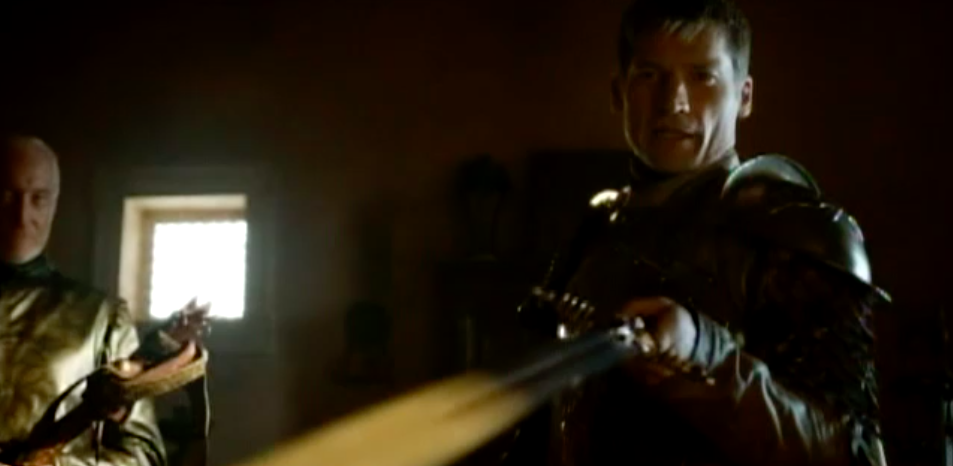
But it turns out, when you return to King’s Landing as damaged goods, your past deeds don’t mean shit. Ol’ Leftie is no longer the Great Kingslayer of old. Tywin tries to remove him from the Kingsguard, telling him instead to return to Casterly Rock and rule in his name. When Jaime is shocked at the suggestion, Tywin doesn’t mince words in telling Jaime that he’s a cripple, that he’s less of a man, that he can’t possibly properly protect the king, and that he’d basically receive an Honourable Discharge from His Highness The Little Shit. But Jaime pleads that his only wish is to serve, something that makes Tywin visibly sneer in disgust. He waves him away with the back of his hand, telling him to just take the damn sword, adding his biting goodbye: “A one-handed man with no family needs all the help he can get.”

jaime_sword

Figuratively emasculated man given the gift of a phallic symbol by his domineering father. Insert Freudian joke here.

Cersei spurns him, insipidly telling him, “You took too long,” when he told her what he did to fight his way back to her side. After her 45-second summary of The Series So Far, she pulls away from him like he’s some disgusting creature, whines that she’s had to live all alone all this time while being terrorized by her father, brother, and horrible son, and that he wasn’t there to save her. And then to return missing an appendage? He might as well slap her in the face. He’s no longer whole, and she doesn’t want him to touch her.

And finally, the little shit. Joffrey lords around the room, and Jaime doesn’t betray any surprise that his “nephew” has become even more insufferable than he’d been when Jaime left (Jaime probably saw it coming). As Jaime remains calm throughout the scene, constantly bowing to Joffrey’s insults and never failing to call him, “Your Grace,” Joffrey gets crueler and crueler. Jaime apologizes for not having been around, joking that he’d been a little busy. “Yeah, busy getting captured,” spits back Joffrey, immediately turning to the other guard for backup that he is simply HIGH-larious. Joffrey prances about the room, finally landing on a book that contains all the great deeds of the knights of King’s Landing. He flips through the pages with a purpose, posturing as he reads out the great deeds of Jaime’s predecessors with mock solemnity and awe. And then he gets to Jaime’s page, which is only half-filled, with a blank page beside it. He pretends to be shocked. “Someone forgot to write down all your good deeds!” “There’s still time,” whispers Jaime, with rage simmering just below the surface. “Is there? For a 40-year-old knight with one hand? How can you protect me with that?” “I use my left hand now, Your Grace. Makes for more of a contest.”

Jaime Lannister left King’s Landing as the great hope of the Lannister clan: he was the Kingslayer, Cersei’s lover, unknowing father of a king, unbeatable in battle, admired by all. He returns to a disappointed father, a disgusted lover, and a sneering king. He’s less than a man, worthless and a disappointment to everyone; his brains and brawn mean nothing to anyone because his body is damaged.
In other words, he’s become Tyrion.

Jaime is calm and measured in two of the scenes, doing a good job of suppressing his heartbreak with Tywin and keeping his head down and voice quiet around Joffrey. With Cersei he’s far more emotional and hurt, as if her rejection hurts him far more than the others. As he slams the book of knights closed after Joffrey leaves, we can see these comments are getting to him. Will it turn him against his family?

Later, with Brienne, she reminds him of his oath to protect the Stark children, or, in the immediate case, Sansa. He doesn’t know where Arya is, but Brienne tells him he must do everything in his power to keep Sansa safe. He argues that he can’t exactly steal her away from his own brother and whisk her off somewhere else to “keep her safe,” but she won’t listen, causing the two of them to banter back and forth like the days of old. “Are you sure we’re not related?” he says to her, clearly annoyed. “Ever since I’ve returned every Lannister I’ve seen has been a terrible pain in my ass. Maybe you’re a Lannister, too. You’ve got the hair for it… but not the looks.”

Brienne: [glare]

As an aside, I was a little surprised to hear Joffrey say that Jaime was a 40-year-old man. I remember back in season 1 being surprised to discover that Cersei was in her early 30s, so her age might have been mentioned at some point for me to have assumed her to be that young, and Jaime is her twin. Perhaps they’re simply changing the age at this point in the show because it’s less likely to believe you’re washed up at 32 than that you’d be washed up at 40. And now, being 40, I shall crawl away and cry.

This episode featured two new people: Prince Oberyn and his paramour, Ellaria, played by the gorgeous Indira Varma from Rome and Luther. What did you think of their portrayal here, Chris?

Pedro-Pascal-as-Oberyn-Martell-Indira-Varma-as-Ellaria-Sand_photo-Helen-Sloan_HBO-1024x681

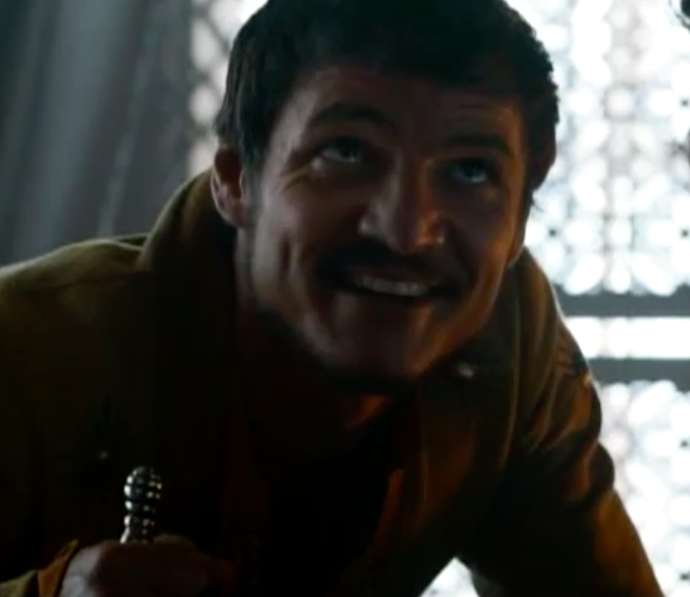
Christopher: I’m quite delighted with Oberyn and Ellaria. When I saw pictures of Pedro Pascal, the actor playing Oberyn, I wasn’t convinced—he looked at first glance to be too slight and a little too pretty to be playing the Red Viper of Dorne, who is described in the novel as somewhat more ruggedly handsome. But I have no complaints about how Pascal is playing him … he brings a dangerous calm to the character, a sense of the threat always simmering behind flat eyes. The confrontation with the Lannister men (not in the novel) was very well done, and conveyed precisely how dangerous—and how impulsive—he is. One of the things clearly communicated about Oberyn in the novel is that he is hot-headed, given to acting without thinking and doing it with no warning whatsoever. That’s obviously at play here, but it’s balanced by a cold deliberation and precision.

As for Indira Varma … well, I’m happy to watch her in anything, as she is not only mind-numbingly beautiful but is also an extraordinarily talented actor. But as Ellaria Sand? That is one of the best pieces of casting I’ve seen on this show so far (and that’s saying a lot). Though I think it’s worth mentioning—Lucius Vorenus, John Luther, and now Oberyn Martell? Isn’t she starting to get typecast as a woman drawn to mercurial, dangerous men?

oberynWith the arrival of Oberyn and Ellaria, we’re getting introduced to more of Westeros’ fraught and bloody history. Part of that history was recounted in the conversation between Tyrion and Oberyn, but it bears repeating: Rhaegar Targaryen was wed in a dynastic marriage to Elia Martell of Dorne, Oberyn’s sister. She had two children with him, but Rhaegar was in love with someone else (Lyanna Stark, sister of the lamented Eddard). It was in part Rhaegar’s ostensible abduction of Lyanna that drove Robert Baratheon (who was engaged to her) to rebel. When the Lannister forces sacked King’s Landing, Gregor “The Mountain” Clegane, brother to the Hound, raped and killed Elia and killed her two children. Since that day, the rage and desire for revenge has simmered in Dorne … and now the hot-headed Oberyn has come to King’s Landing with vengeance on his mind. This should turn out well.

Speaking of volatile creatures … oh, how Daenerys’ dragons have grown! They’re getting quite massive. And dangerous. I love the opening bit where we find Dany reclining on a rock with Drogon’s head in her lap, purring like a giant kitten. For a few moments we get to enjoy an entirely maternal moment: the Mother of Dragons looks here like a mother indeed, until her other children returns and, like this dickish older brother he is, Drogon steals their food. And when Daenerys attempts to play peacemaker … well, it’s all fun and games when her dragons scare the crap out of her enemies, but it’s another thing entirely when they turn on mom. “They’re dragons, Khaleesi,” Ser Jorah observes. “They can never be tamed. Not even by their mother.”

Um. OK, I think I might have noticed a slight flaw in Daenerys’ plan.

We’re also introduced in this episode to the newest incarnation of Daario Naharis. The impossibly handsome, cleft-chinned Adonis from last season has been recast with … Sonny, the heroin-addicted musician from Treme. I think I’m going to have to wait and see on this particular choice. It’s not that I don’t like Michiel Huisman as an actor (I loathed Sonny, but that spoke to the actor’s talent), but he is almost the antithesis of how I imagined Daario based on his description in the novel. The previous Daario also did not conform to the novel’s depiction, but he was at least more overtly handsome and smugly arrogant. Huisman has the swagger, but not the looks—and certainly, he’s far too scruffy to even remotely resemble the piratical mercenary we first meet in A Storm of Swords, who is described as having flamboyantly dyed hair and beard, clad in colourful silks, and twin swords whose pommels are shaped like women in wanton poses. (Full disclosure: in my dream casting of this series before HBO picked it up, I always imagined Daario played by Joseph Fiennes).

His apparent rivalry with Grey Worm is an invention of the show, and makes very little sense in terms of his character—Daario would never consider a eunuch (and a former slave at that) either his peer or his rival. And I don’t buy Grey Worm rising to Daario’s goads. Aside from the obvious joke about the pointlessness of dick-measuring, Daario would be as little concern to Grey Worm as vice versa. It makes for a fun little scene, but I just don’t buy it. And I found Daario’s flirtation with Dany far less convincing than last season’s … I didn’t care for Daario much last season either, but there was a more tangible chemistry. But I will withhold further judgment until I can wait and see.

What did you think of Sonny’s reincarnation as a swaggering sellsword, Nikki?

bet

Insert more Freudian jokes here.

Nikki: It definitely took me by surprise, and made me confused; I tend to avoid Hollywood talk and didn’t know that Daario had been recast (after watching this episode, I looked it up and it would appear Ed Skrein, who originally played him, and who might have been the most beautiful man on the show, has been cast as the younger Jason Statham for the Transporter films and he left GoT to follow that opportunity. And, not having watched Treme in a while but instead more recently watching its far soapier network cousin, Nashville, my immediate response to my husband was, “Uh… what the hell is LIAM doing on Game of Thrones?!” And that accent? Terrible. Which is suprising, because he pulls off a great American accent in Nashville and Treme and rarely betrays that he’s actually Dutch, but he can’t seem to quite find the accent he’s looking for here. British? Northern British? South African? Perhaps that’s just growing pains, and he’ll be more comfortable with it in the scenes to come. If there’s one thing actors can get away with on Game of Thrones, it’s having strange accents. I say go with the Dutch, since Daario could pretty much have any accent; I’m not sure why they told him to try on British instead.

I thought he was intriguing and slightly dangerous and I didn’t know whether or not I could trust him when he was being played by Skrein. I’m not sure Huisman can play him with that same enigmatic quality, but again, I guess time will tell.

What did intrigue me was the scene where he showed Daenerys the plants, explaining that when she enters Meereen (which you see in the opening credits for the first time), she’ll need to know the plants of the area, and the rivers, and the people. He shows her three plants, and that one is dull but makes an excellent tea, and the other strange and beautiful, also making a good tea. But the third one is the most beautiful and strange-looking of the three, and is poisonous. Like Dany’s dragons, she’s learning that things aren’t always as they seem. As you said, when Drogon turned and screamed at her before flying away, my heart sank: if you can’t tame the dragons, you can’t make them necessarily work for you. And without the dragons, Daenerys just lost her main source of strength. (I’m still rooting for her, though!)

I am happy to say that now that I’ve read the first book, I understand the whole Rhaegar thing so much more: before, it was something mentioned offhandedly all the time, but its true significance kept getting lost on me. Now I realize just how heinous the Mountain was, and what Rhaegar had to suffer through before he was killed, and also why Dany’s claim to the throne is such a strong one. But also how complicated Rhaegar’s situation was, and that he’s not exactly the good guy, either.

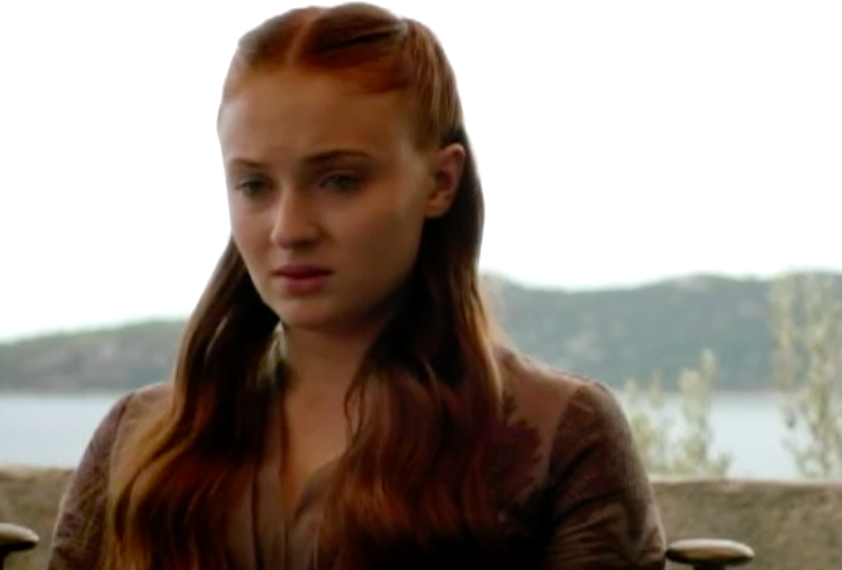
sansaSpeaking of complicated characters, let’s talk about Tyrion. I loved the scene of him with Sansa, as she sat at the table in her abject misery, thinking about what had been done to Robb and her mother and her sister-in-law that she’d never even met. The world has become hopeless to Sansa: she’s an orphan, her eldest brother is dead, as far as she knows Bran and Rickon were hanged and burned at Winterfell, and Arya is probably dead too. And she never had a particularly soft spot for Jon Snow, so I doubt he even enters her mind at this point. As far as she’s concerned, she’s all alone, and it won’t be long before the Lannisters have their way with her, too.

Tyrion happens to be one of those Lannisters, but he’s someone who’s been the butt end of every Lannister joke since he was born, so he sympathizes and identifies with Sansa and her pain. He creates a beautiful eulogy for Catelyn, telling Sansa, “Your mother, I admired her. She wanted me executed… but I admired her.” His words are very powerful, as he remembers how much Catelyn loved her children, and wouldn’t want Sansa to starve herself to death the way she is right now. But to Sansa’s mind, what point is there to eat and go on living? At least if she starves herself her death is in her own hands. As she gets up and tells Tyrion that she’ll be in the godswood because it’s the only place where nobody tries to talk to her, you can see the misery on his face. He actually cares about Sansa. He’s not in love with her — he’s still very much in love with Shae, which is why he pushes her away in this episode and seems terrified that she’s in his room — but he does care for her very much. But Sansa is not in the mood to be comforted by a Lannister, and we can hardly blame her.

Hm… of the three Lannister children, two of them are sympathetic to the Starks and want to protect the family from further harm. Unfortunately, Tywin, Cersei, and Joffrey are a more powerful triumvirate. But for how much longer?

Another person mourning the results of the Red Wedding is Jon Snow, who tells Sam how much he looked up to, and sometimes even hated, Robb for being so good at everything, prompting Sam to say that’s how he often feels about Jon. And then Jon must go before the Night’s Watch tribunal to answer for his connections to the wildlings… or “free folk” as he accidentally calls them. What did you think of this scene, Chris?

Christopher: What I liked about this scene was what I liked about Jaime’s successive humiliations: the show does a good job of taking what comprises pages and pages and pages in the novel(s) and compressing it into a few relatively short but deeply poignant sequences. Jon Snow’s interrogation at the hands of his old nemesis Allister Thorne and the newly-arrived Janos Slynt (whom you’ll recall was the treacherous captain of the city watch in King’s Landing, whom Tyrion sent to the Wall) is somewhat more protracted in the novel. What we lose in its abbreviation is Jon Snow’s initial humiliation when Slynt arrives, as he is thrown into a cell and forced to endure a host of sneering accusations. We get the gist of them in this brief scene, whose brevity is both a blessing (we don’t have to endure endless interrogation) and a curse (we lose some of the depth of feeling). There are also some chronological inconsistencies between the show and novel, but in the interests of not spoiling plot points I’ll wait to expound on them in a later post.

The scene between Jon and Sam is original to the show: though it certainly articulates feelings one suspects Sam has about Jon, Sam is never quite so bold in the novels. It was a nice moment, however … a pause before Jon faces the music, and a useful reflection on fraternal relationships (considering that Sam is now Jon’s brother in a way Robb never could have been).

fletching arrows

Meanwhile, while Jon is having to atone for the fact that he slept with a wildling girl, the wildling girl in question is having to deal with accusations herself—even as she is obviously in the midst of plotting her revenge, fletching what appears to be an overabundance of arrows. Toramund’s question, “Do you plan on killing all the crows yourself?” has an obvious, if unvoiced, answer: “Just one … but I plan to make absolutely certain he’s dead this time.” Toramund’s accusation, “If that boy’s still walking, it’s because you let him go” is too true, and must rankle Ygritte’s wildling heart. There’s a cruel symmetry to Jon and Ygritte’s respective situations: they are both absolutely loyal to their people, yet in crucial ways they both betrayed them. But whatever the sanctity of Jon Snow’s vows, it is difficult not to see Ygritte as the wronged one in this equation—if only for purely emotional reasons.

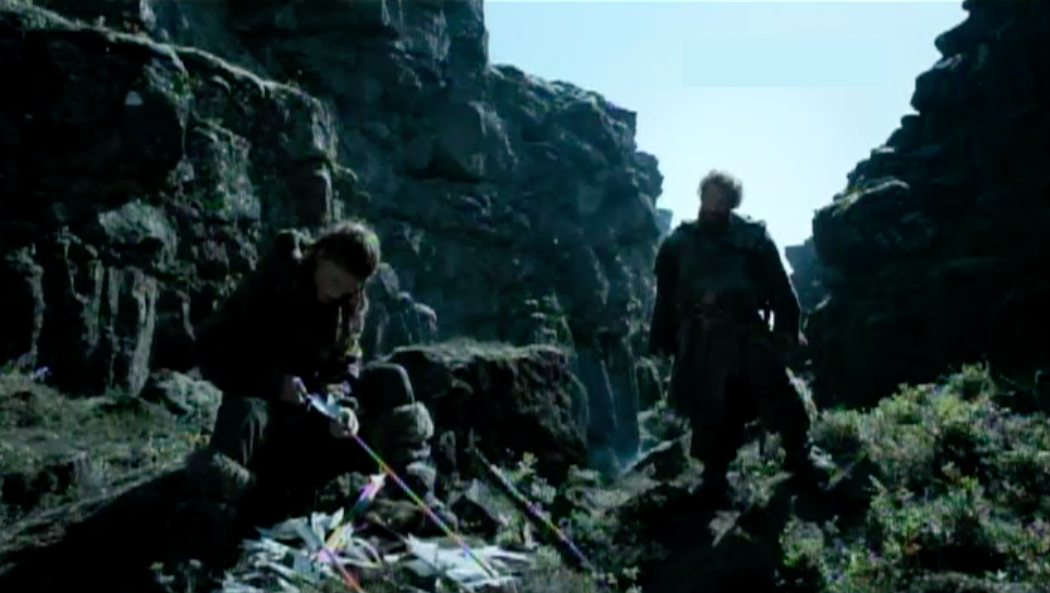
Besides Ygritte’s enormous stockpile of arrows, things look bleak for Castle Black as we meet the reinforcements Mance Rayder has sent south of the Wall: Thenns, who in the novel are an entirely different breed of wildlings. The scene when they arrive does a good job of encapsulating the tribal divisions in Mance Rayder’s army, and reminds us of what he told Jon Snow last season: that the only reason he could actually get the wildlings to work in concert was their fear of the White Walkers. That doesn’t obviate their internecine conflicts and hatred—it just gives them a common enemy. Toramund is suddenly no longer the scariest wildling in the room, and the very question of Jon Snow’s betrayal, which he was berating Ygritte over a moment ago, becomes his own reason for being defensive. “I answer to Mance,” he growls when the leader of the Thenns challenges him on the same point. The newcomers appear as monsters from a nightmare, bearing tribal scars, contempt for weakness (which one would not have thought to seen in Toramund, or to have seen him get defensive about) … and a sack full of dismembered Night Watch brothers, which they proceed to spit and roast in preference to whatever game Toramund’s people were cooking.

[shudder]

What did you think of that scene, Nikki? And is it just me, or when you say “the Thenns,” does it sound like you’re referring to a one-hit 90s band?

Nikki: LOL!! I thought the Thenns were terrifying, which had a lot to do with the dark, one-note, foreboding music that played as they first walked into the canyon where the wildlings were sitting. (I just wanted to add that I loved watching Ygritte make the arrows, especially when she’d carefully slice the edges of the feathers.) But it also had a lot to do with their leader Styr, played by Yuri Kolokolnikov. I had to look him up, because he’s so mesmerizing I wanted to know what else I’d seen him in, but apparently this is his first English-speaking role. Was anyone else thinking Roy Batty from Blade Runner? Because I certainly was. But much scarier. I’m guessing the Thenns tattoo themselves by carving shapes into their skulls and then letting them heal? I second your [shudder] and raise you a [geeyaaaaahhh].

Of course, the scariest person in this episode was probably The Hound, and quite honestly, I’d love to see an Odd Couple–type show starring Arya and the Hound, just for their banter. (Of course, only after they’ve developed the Brienne and Jaime Hour.) They are hilarious, with Arya complaining about his stench to mocking him about his skewed morals.

Hound: “I’m not a thief.”

Arya: “You’re fine with murdering little boys but thieving is beneath you.”

Hound: “Man’s gotta have a code.”

I do hope I wasn’t the only one who was disappointed that the Hound wasn’t whistling “The Farmer in the Dell” while walking up to the inn immediately following this scene.

And what a scene it is. Arya and the Hound first peer in from the bushes, and he’s happy to just sit and watch and wait until the time is right. Unfortunately, when Arya spots Needle and the man who’d taken it from her, she changes his plans. Quick recap: Polliver is the guy who looks like Eddie from Nurse Jackie, who was working under the Lannisters when they attacked Yoren and then marched them to Harrenhal (that’s when Arya and Gendry, along with the others, were put in the pen and then pulled out one by one and tortured with rats inside buckets on their heads). He took Needle and killed Lommy, that little curly-headed kid who was with Arya. He’d been wounded when they attacked, and because they weren’t about to carry a kid back to Harrenhal, Polliver walked up to Lommy and pushed the sword up through his throat.

And now, Arya does the same to him. It’s a great scene, first with the Hound and Arya bickering in the bushes:

Arya: “He killed Lommy.”

Hound: “What the fuck’s a Lommy?”

Arya: “He was my friend. Polliver stole my sword and put it right through his neck… He’s still got it, my sword. Needle.”

Hound (sneeringly): “Needle. ’Course you named your sword.”

Arya: “Lots of people name their swords.”

Hound: “Lots of cunts.”

OK, so maybe the Odd Couple sitcom wouldn’t work on ABC.

When Arya runs to the inn, the Hound tries to stop her, but it’s too late. So he plays it cool, goes in, becomes belligerent, slurping rudely at his beer and demanding two chickens to eat, until the place goes nuts. And in the midst of the melee, with the Hound killing and maiming anyone who comes near, Arya manages to get Needle and return the favour that Polliver had given to Lommy. It’s a great moment, but also a shocking one — if you think of where Arya was just a few short months ago, she never would have been able to kill someone in cold blood like that. But now, not only does she do it, she enjoys it. The half smile that she gives as she looks down on him speaks volumes. Arya was never innocent, but we realize that she’s become ruthless when she has to be. Which she’s going to have to be if she’ll survive all of this. Both Maisie Williams and Rory McCann shine in this scene; they’re such fantastic actors. In this episode you see mutual loathing become mutual respect.

Tip #582 in surviving Westeros: Don't take Arya's stuff.

Tip #582 in surviving Westeros: Don’t take Arya’s stuff.

I think we’ve actually covered everyone at this point! Bran doesn’t appear in this episode, nor does Theon. Perhaps we’ll see them next week, along with what is probably going to be the Little Shit’s wedding. Is it too much to ask that he trips while coming back down the aisle and accidentally falls on someone’s sword? Because, other than being a truly awesome moment, it would certainly save Margaery from what will no doubt be the worst night of her life.

Any final thoughts?

arya_hound

Christopher: It was very wise of the writers to end this episode with Arya and the Hound … much of the rest was Red-Wedding reaction and Lannister angst (albeit very well done) and setup for what was to come in terms of the wildlings and the Wall. It was satisfying to conclude with a wee bit of the ultra-violence, no? I second your thoughts on the general awesomeness of Maisie Williams and Rory McCann—I was particularly taken with the way McCann plays the Hound’s studied hostility to his brother’s men. As you observed, he does not want to go into that inn … but when Arya effectively gives him no choice, he plays it with the cool menace of a man who holds his antagonists in utter contempt. The scene plays out almost precisely as it does in the novel, but with one crucial difference—something I will not mention here, because spoilers.

Well, that brings us to a close! It has been a long year waiting, and there’s always the worry that the new season will disappoint. But in the words of Syrio Forel: not today.

1 Comment

Filed under Game of Thrones, television

Tolkien’s Wars (Part One)

This is the first of two posts dealing with war as a critical trope in The Lord of the Rings. I’ve been thinking for a long time now about the role of violence and cruelty in fantasy generally, and Tolkien specifically; at some stage in the near future I’ll be posting something about the Uruk-hai, torture, and rapine. What’s on my mind this week, however, is war more generally: war as an organizing principle in The Lord of the Rings, what role it plays thematically and otherwise, and the ways in which battle functions as a redemptive and ennobling experience. In class this past week we finished the first book of The Return of the King, with its climactic battle in which the forces of Sauron meet with temporary defeat. What I want to suggest in this post is that however much Tolkien was steeped in the myth, legend, and history of the Middle Ages—and indeed created in The Hobbit and The Lord of the Rings a compelling modern retread of medieval preoccupations—by the end of his masterpiece and in such supplemental texts as his appendices and Unfinished Tales, the scope and scale of Middle-earth has become identifiably twentieth-century.

ring_edited-2

Considering that The Lord of the Rings was written during and immediately after the Second World War, there is a not insignificant amount of criticism and interpretation that looks for parallels between Tolkien’s narrative and the events raging in the world at the time of writing. Tolkien himself tended to deny real-world correlations: Sauron was not Hitler, Mordor was not Nazi Germany. In so saying, he echoed and anticipated legions of fantasists who reject straightforwardly allegorical readings of their texts. And with good reason: such reductive this=that interpretations deny narratives like Tolkien’s their nuance and complexity (and by contrast, otherwise compelling stories can become hackneyed when they too-obviously employ obvious correspondences; indeed, the most cringeworthy parts of the Narnia Chronicles come when C.S. Lewis slaps on the Christian allegory with a trowel).

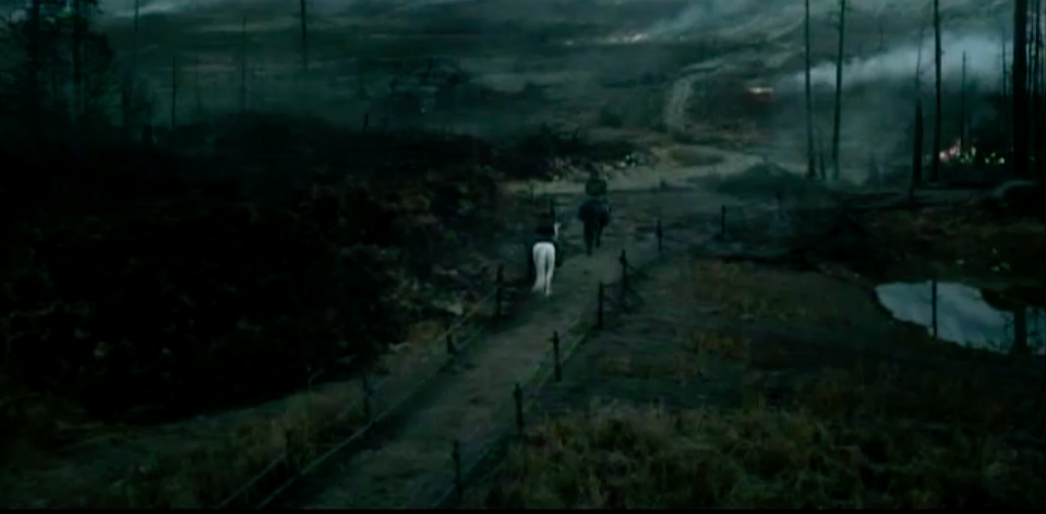
That being said, The Lord of the Rings’ resonances with its recent and contemporaneous history can be hard to ignore. As I observed to my students this week, it would be hard to credit that a thoughtful and deeply intelligent man like Tolkien would not find himself influenced by traumatic, world-shaping traumas like the two world wars. Tolkien himself fought in the First World War and was wounded at the Battle of the Somme, badly enough that he spent several years convalescing (during which time he shaped the substance of the mythology that would become The Silmarillion). It is easy to imagine how the pastorally-minded Tolkien was traumatized not just by the horror and violence of the trenches, but by the way the verdant fields of France and Belgium were transformed into blasted horrorscapes of mud, blood, broken metal, and corpses. Frodo and Sam’s traversal of the Dead Marshes and Dagorlad (the “Battle Plain”) is about as vivid a recreation of the Western Front as possible while still taking place in Middle-earth. In the Dead Marshes, the see the faces of the dead under the water. Frodo says:

I have seen them … They lie in all the pools, pale faces, deep deep under the dark water. I saw them: grim faces and evil, and noble faces and sad. Many faces proud and fair, and weeds in their silver hair. But all foul, all rotting, all dead.

Gollum concurs, adding that “There was a great battle long ago … They fought on the plain for days and months at the Black Gates.” The battle to which he refers is the battle fought by the Last Alliance of Elves and Men against Sauron, which ended with Isildur cutting the Ring from Sauron’s hand. The faces Sam and Frodo see beneath the marshes are the dead from that battle, and though it is uncertain whether they are specters or actually there (somehow sorcerously preserved), the image of dead faces peering up through foul water unavoidably evokes the experience of many in WWI who saw the dead submerged in water-filled craters and corpses disinterred from the mud by shellfire. After they pass on from the Dead Marshes, Frodo and Sam follow Gollum through Dagorlad, which even a thousand years after the war between the Last Alliance and Sauron is still a reeking, desolate landscape. At one point they take shelter in a close facsimile of a shell-crater:

Frodo and Sam crawled after [Gollum] until they came to a wide almost circular pit, high-banked upon on the west. It was cold and dead, and a foul sump of oily many-coloured ooze lay at its bottom. In this evil hole they cowered, hoping in its shadow to escape the attention of the Eye.

(It is worth noting here that while soldiers on either side of the Western Front did not have to worry about the malevolence of a Dark Lord, there was a constant struggle to not be visible. The superstition about not lighting three cigarettes on the same match was born out of the fear of snipers; and any soldier managing to survive his first front-line posting learned the lesson of staying low.)

Observing the WWI resonances in these chapters is by no means original or new: it is, indeed, a staple of Tolkien biography and criticism to note this rare moment where his own experience bleeds into the text (pun intended). The imagery is obvious enough that Tolkien himself acknowledged it, saying in a letter that “The Dead Marshes and the approaches to the Morannon owe something to Northern France after the Battle of the Somme.” (Not content to leave it there, however, he adds, “They owe something more to William Morris and his Huns and Romans, as in The House of the Wolfings or The Roots of the Mountains.”)

By contrast, there is little or nothing overtly referencing the global conflict that raged while he wrote The Lord of the Rings—too old for service at that point, he had no firsthand experience of the war, and Oxford was never a target for the Luftwaffe’s bombs. That being said, it is difficult not to see the shift in focus and scope over the course of The Lord of the Rings as reflecting the global changes wrought by a global war. If Tolkien’s storytelling impulses had started with traditional quest-romance in The Hobbit and into The Fellowship of the Ring, by the end of The Return of the King the novel’s scope has expanded to encompass most of Middle-earth. The Hobbit and Fellowship both exhibit the limited scope of a quest narrative, with a narrative specific to the band of adventurers and, in both cases, more or less limited to the perspective of a single character. Both proceed from romance’s basic narrative premise, namely the essaying forth from enclaves of safety and security into an unknown (unknown to the hobbits, at any rate) wilderness full of dangers.

battle of pelennor fields

Starting with The Two Towers however, the narrative fractures, and the preoccupations of the principal characters have less to do with the quest per se than with what can really only be characterized as geopolitical concerns. I never would have thought to hear myself using the word “geopolitical” with regard to The Lord of the Rings, but it is apt when one considers the larger picture of the imminent war with Sauron. It is telling that just before Frodo determines to desert the Fellowship and set off on his own to Mordor—breaking not just the Fellowship, but the single narrative thread the novel has so far followed—he has a totalizing vision of Middle-earth from the Seat of Seeing atop the hill of Amon Hen:

But everywhere he looked he saw signs of war. The Misty Mountains were crawling like anthills: orcs were issuing out of a thousand holes. Under the boughs of Mirkwood there was deadly strife of Elves and Men and fell beasts. The land of the Beornings was aflame; a cloud was over Moria; smoke rose on the borders of Lorien.

Horsemen were galloping across the grass of Rohan; wolves poured from Isengard. From the havens of Harad ships of war put out to sea; and out of the east men were moving endlessly: swordsmen, spearmen, bowmen upon horses, chariots of chieftans and laden wains. All the power of the Dark Lord was in motion.

In his book Inventing the Middle Ages, Norman Cantor lauds Tolkien for depicting a medieval setting in relatively realistic terms, “not the Arthurian heroism of golden knights but the wearying, almost endless struggle of the little people against the reality of perpetual war and violent darkness.” Middle-earth, he asserts, presents “the medieval world at its most bellicose, destructive, and terrible moments: the Age of the Barbarian Invasions in the fifth and sixth centuries; the Hundred Years’ War in the fourteenth and fifteenth centuries.” Perpetual war is the crucial designation here, as indeed any casual familiarity with the European Middle Ages is one of near-constant skirmishes, campaigns, shifting alliances and loyalties, punctuated with larger battles and wars, but always with some armed strife smoldering in some corner of the continent. Our image of Middle-earth—once we leave the Shire behind—is precisely of that sort of constant conflict, whether expressed by the relics of old wars like the Barrow-Downs, or the ongoing skirmishes between Gondor and Mordor as described by Boromir. And even where there is no battle in progress, there is always one waiting for those who trespass into enemy territory, such as occurs in Moria.

If the medieval condition is one of perpetual war, however, Tolkien builds to conflict on a much larger and indeed totalizing scale. Frodo’s vision from Amon Hen is a foretaste of what is to come and it is markedly continent-wide, stretching from the Misty Mountains to Mirkwood to Lorien, and finally south to Gondor. The narrative itself expands outward to encompass broader and more varied geographies, and broader and more varied concerns. Even Sam and Frodo, whom can be said to be carrying on the quest-narrative, have in their encounter with Faramir and his rangers an impromptu education in history and geopolitical considerations, as well as bearing witness to such considerations manifested in the rangers’ battle with the Men of Harad. Elsewhere, Aragorn, Legolas, and Gimli become embroiled in Rohan’s struggle with Saruman; Merry and Pippin find themselves allied with Treebeard and the Ents, and witness the defeat of Isengard while their friends are still fighting at Helm’s Deep; Pippin finds himself caught up in Gondor’s intrigues, stuck between the dueling wills of Denethor and Gandalf (between a rock and a hard case, one might say); he swears his service to Gondor; Merry similarly pledges his sword to Rohan, and is witness to the Battle of Pelennor fields.

lotr-siege-towersAll this is by way of highlighting the ever-widening scope of The Lord of the Rings, but even these examples are only hints of a vaster conflict, one that only really becomes apparent in such supplementary texts as the novel’s appendices or Unfinished Tales. There we learn that Sauron’s forces attacked more or less simultaneously along an east-west front running almost the entire length of Middle-earth: as Gondor was besieged, so too was eastern Rohan invaded, Lothlorien and the elves of Mirkwood attacked, and a force of Easterlings descended on Dale and the Lonely Mountain. A sample from the appendices:

At the same time as the great armies besieged Minas Tirith a host of the allies of Sauron that had long threatened the borders of King Brand crossed the River Carnen, and Brand was driven back to Dale. There he had the aid of the Dwarves of Erebor; and there was a great battle at the Mountain’s feet. It lasted three days, but in the end both King Brand and King Dain Ironfoot were slain, and the Easterlings had the victory. But they could not take the Gate, and many, both Dwarves and Men, took refuge in Erebor, and there withstood a siege.

After the destruction of the Ring, the appendix goes on to say, the Dwarves of Erebor and Men of Dale emerged and routed their enemy. So too did Celeborn and Galadriel take their forces from Lothlorien to destroy Dol Guldur, and there under the trees of Mirkwood meet up with the forces of Thranduil (Legolas’ father and king of the wood-elves). According to Tolkien’s chronology, the events of this great, final battle take place over the course of about two weeks—two weeks in which all of Middle-earth is locked in simultaneous battle.

middle-earth total war

Any sense that the War of the Ring is anything less than a global conflict is further dispelled by Gandalf’s story in Unfinished Tales about how he conceived of his scheme to send Bilbo along with Thorin and the Dwarves to Erebor. Knowing that the Necromancer in Dol Guldur was in fact Sauron, Gandalf fears what dire use he might make of the dragon Smaug:

You may think that Rivendell was out of his reach, but I did not think so. The state of things in the North was very bad. The Kingdom under the Mountain and the strong Men of Dale were no more. To resist any force that Sauron might send to regain the northern passes in the mountains and the old lands of Angmar there were only the Dwarves of the Iron Hills, and behind them lay a desolation and a Dragon. The Dragon Sauron might use with terrible effect.

When Thorin accuses Gandalf of having ulterior motives for helping him, Gandalf replies “You are quite right … If I had no other purposes, I would not be helping you at all. Great as your affairs seem to you, they are only a small strand in the great web. I am concerned with many strands.” Gandalf has always appeared as a wise counselor; here we see him as a shrewd strategist operating on a global scale. One of the fascinating parts of returning to The Lord of the Rings this term as I have has been seeing how Tolkien retroactively folded the events of The Hobbit into the broader sweep of Middle-earth’s history: not just an unexpected journey, but a shrewd move on the geopolitical board with deeply significant benefits many, many years later. As Gandalf concludes his tale:

It might all have gone very different indeed. The main attack was diverted southwards, it is true; and yet even so with his far-stretched right hand Sauron could have done terrible harm in the North, while we defended Gondor, if King Brand and King Dain had not stood in his path. When you think of the great Battle of Pelennor, do not forget the Battle of Dale. Think what might have been. Dragon-fire and savage swords in Eriador! There might be no Queen in Gondor. We might only hope to return from the victory here to ruin and ash. But that has been averted—because I met Thorin Oakenshield one evening on the edge of spring not far from Bree. A chance-meeting, as we say in Middle-earth.

The broader point I am making here is that, while Tolkien does not effect one-to-one analogies with his contemporaneous history, the global scope with which The Lord of the Rings ends does reflect—however obliquely—the radical changes wrought by the Second World War. Britain had of course been a global power for some two centuries, but the twentieth century ushered in a terrible era of total war that had not been possible in previous centuries. The Hobbit and The Fellowship of the Ring depict a neo-medieval world in terms of the traditional scope of the quest-romance; by the end of The Return of the King, the geopolitical conflict consuming an entire continent is the unmistakable product of the fraught twentieth century.

1 Comment

Filed under course readings, Return to Middle-Earth

Here Be Spiders

ring_edited-2
Apologies for the unplanned hiatus here—this term has turned into something of a gong show, and I’ve been snowed under with various committees and my teaching. As a result, I have a handful of half-finished blog posts about The Lord of the Rings starting to clutter up my desktop … I’ll return to them when things ease up, which means whatever semblance of chronological order I’d been maintaining will be out the window, but that doesn’t bother me overmuch. For today, just a short post on everyone’s favourite subject: spiders!

frodo_shelob_sc

Frodo, about to totally regret going to Australia for holiday.

Yes, as you might have guessed, we just passed through Shelob’s Lair and left Frodo cold and apparently dead in the pass of Cirith Ungol while Sam takes up the Ring and the quest. We start The Return of the King this week and head into the home stretch.

Shelob2

Samwise vs. Shelob

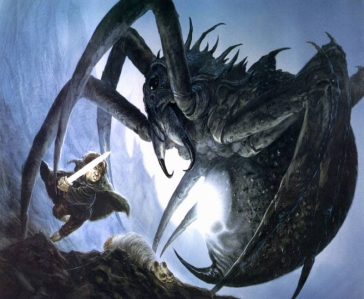
I’ve got spiders on the brain because one of my students asked whether Tolkien, in giving us Shelob—who I maintain is one of the most terrifying inventions in all of fantasy fiction—was citing a certain mythological and legendary tradition of monstrous spiders.

My gut reaction was to say yes—because obviously arachnophobia is a common element of the human condition, yes? But I caught myself, realizing I could not think of any examples outside of twentieth-century popular culture; and the more I thought about it, the more I began to think that no, spiders in myth tend at worst to be trickster figures—the African god Anansi, for example, or the Lakota trickster Unktomi. Most central to the western tradition (and to biological taxonomy) is the woman Arachne, a master-weaver who challenges Athena and either (1) defeats her and is struck down by the goddess in a rage, but is resurrected as a spider when Athena feels remorse, or (2) loses to the goddess and is transformed into a spider for her sin of pride.

The spider is less significant, then, than her web—hence the tendency toward the trickster figure, something that has also been suggested with regards to Norse myth. One etymological interpretation of Loki’s name connects it to the pre-medieval Swedish vernacular, in which “spider” is “locke.” (As an aside, some preliminary investigation into my own name’s origins suggest that “Lockett” is a diminutive of “locke” and is similarly connected to Loki. So there you have it: Tom Hiddleston and I are practically brothers).

Tolkien’s spiders, it goes without saying, are explicitly and terrifyingly monstrous. One interpretation of this derives from a story told (not by Tolkien) to his biographer Humphrey Carpenter, that when Tolkien was just a small child of four or five in South Africa, he was bitten by a tarantula. However, Tolkien would later refute this, saying that while the story might have been true he had no memory of it, and that he first introduced the giant spiders into The Hobbit because his son Michael was terrified of them.

One wonders if this is a bit disingenuous, as large swaths of The Silmarillion had been written before he ever conceived of The Hobbit, and the giant spider-demon Ungoliant plays a significant role first as Morgoth’s ally and then his captor. Her principal characteristic is her insatiable need to consume: specifically, to consume light, “for she hungered for light and hated it … In a ravine she lived, and took shape as a spider of monstrous form, weaving her black webs in a cleft of the mountains. There she sucked up all the light that she could find, and spun it forth again in dark nets of strangling gloom, until no light more could come to her abode; and she was famished.” Melkor (Morgoth) befriends her, and together they travel to Valinor, where Ungoliant feeds on the light of the two trees of Valinor, killing them, and in the process “swelled to a shape so vast and hideous that Melkor was afraid.”

Ungoliant

Ungoliant

Shelob is described in similar terms, insatiable and lusting always for more to feed on in spite of how bloated she has grown. A brief history is offered:

There agelong she had dwelt, an evil thing in spider-form, even such as once of old had lived in the Land of the Elves in the West that is now under the Sea, such as Beren fought in the Mountains of Terror in Doriath, and so came to Luthien upon the green sward amid the hemlocks in the moonlight long ago. How Shelob came there, flying from ruin, no tale tells, for out of the Dark Years few tales have come. But still she was there, who was there before Sauron, and before the first stone of Barad-dur; and she served none but herself, drinking the blood of elves and men, bloated and grown fat with endless brooding on her feasts, weaving webs of shadow; for all living things were her food, and her vomit darkness. Far and wide her lesser broods, bastards of her miserable mates, her own offspring, that she slew, spread from glen to glen, from the Ephel Duath to the eastern hills, to Dol Guldur and the fastnesses of Mirkwood. But none could rival her, Shelob the Great, last child of Ungoliant to trouble the unhappy world.

Like her mother, Shelob has little care for power or possessions or treasure, living only to consume and destroy: “Little she knew or cared for towers, or rings, or anything devised by mind or hand, who only desired death for all others, mind and body, and for herself a glut of life, alone, swollen till the mountains could no longer hold her up and the darkness could not contain her.” She is pure appetite and little more: Freud might say she is pure id, with no consciousness outside her monstrous lust.

All of which is rather terrifying, but leaves us with the question: why the spider-shape? For indeed, it does seem here that Tolkien is doing something quite original, or at any rate not borrowing from a set of extant mythological tropes. I want someone far smarter about this sort of thing than me (and more willing to do the research) to inquire as to why spiders have not figured as nightmarish monsters in our mythic and legendary collective imaginations more than they have. Considering just how rampant arachnophobia seems to be today, and how frequently spiders have figured as objects of terror in twentieth-century narratives from John Wyndham’s Web to a host of B-movie monsters (to say nothing of the giant spiders in the Harry Potter series), I have to wonder if this is a uniquely modern nightmare. Humanity has always had the fear of being consumed, but when we look at myth and legend, those monsters doing the consuming are more often than not giants, ogres, trolls, and suchlike; nary a spider to be seen. When we’re not being devoured by giant human-shaped things, the predators tend to be serpents, giant birds, or other such massively-proportioned animals … all of which suggests the lingering nightmare of being eaten by wild animals on one hand, or fellow humans on the other.

So why is it that spiders only start to loom large in our nightmares so relatively recently?

ed38_lego_lotr_shelob_attacks_pieces

Shelob Lego. Seriously. Complete with little figures of Frodo, Sam, and Gollum. (It’s the fish in Gollum’s hand that makes it art.)

1 Comment

Filed under course readings, Return to Middle-Earth

What’s that got to do with the price of mithril in Eregion?

ring_edited-2

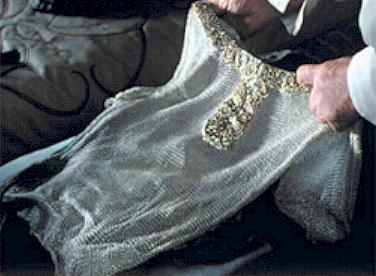
Back in Rivendell, Bilbo gave Frodo his coat of mail, the one that had been given to him by Thorin in The Hobbit. It proves to be a prescient gift, as it saves the Ring-bearer’s life at least twice. Frodo wears it hidden under his outer-clothes, and no one else knows he has it on his back until after they emerge from Moria.

mithril_coat

While deep in the halls of Moria, Sam asks Gandalf what inspired the dwarves to brave the dangers and attempt to re-establish a kingdom here. “For mithril,” Gandalf replies, explaining that “here alone in the world was found Moria-silver, or true-silver as some have called it. Mithril is the Elvish name. The Dwarves have a name which they do not tell. Its worth was ten times that of gold, and now it is beyond price; for little is left above ground …” He goes on,

“Bilbo had a corslet of mithril-rings that Thorin gave him. I wonder what has become of it? Gathering dust still in Michel Delving Mathom-House, I suppose.”

“What?” cried Gimli, startled out of his silence. “A corslet of Moria-silver? That was a kingly gift!”

“Yes,” said Gandalf. “I never told him, but its worth was greater than the value of the whole Shire and everything in it.”

Frodo said nothing, but he put his hand under his tunic and touched the rings of his mail-shirt. He felt staggered to think that he had been walking about him with the price of the Shire under his jacket. Had Bilbo known? He felt no doubt that Bilbo knew quite well.

This moment is a rare glimpse into exchange-value in Middle-earth. A single mail-shirt worth as much of the entirety of the Shire? In practical terms, that seems fair—but only in retrospect, insofar as it saves Frodo’s life and thus prevents the Fellowship’s mission from falling into catastrophe. In that respect, the mithril-coat is worth the entirety of Middle-earth.

Wealth and poverty appear in The Lord of the Rings, but only obliquely. At no point is money ever a concern for any of the characters. Indeed, I am hard-pressed to think of any point after the hobbits leave Bree when anyone is shown selling or purchasing goods or services. Not that there are many opportunities: as mentioned here before, Tolkien’s Middle-earth is predominantly large swathes of wilderness dotted with towns and cities that are few and far between. Even so, money plays at best a miniscule role in Tolkien’s narrative furniture.

smaug

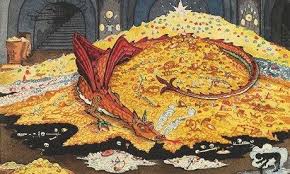
Smaug and his hoard, as it appeared on my first copy of The Hobbit.

The same, oddly, cannot be said about wealth. As with The Lord of the Rings, The Hobbit does not show money as being anything problematic or significant, even though it is strongly suggested that their years in exile have impoverished Thorin’s people. But wealth—vast, huge, stupefying wealth—is the novel’s principal motivating force. Yes, Thorin &co. want to reestablish themselves as the rightful rulers of Erebor, and yes, they were manipulated into the quest by Gandalf, who wanted the dragon dispensed with; but the narrative also possesses an unpleasant undercurrent of avarice, the desire for the dragon’s enormous hoard. In his book There and Back Again, an excellent study of the writing of The Hobbit, Mark Atherton points to Tolkien’s earlier fascination with myths and legends of dragon-hoards, in particular Beowulf’s battle with a dragon, and the story of Sigurd and the dragon Fafnir. In both cases, the allure of the dragon-hoard is a key motivating factor, and one which leads to a hero’s doom (Beowulf in the first instance, and Fafnir himself in the second, who was a man transformed into a dragon by his gold-lust).

smaug_hoard

Smaug’s hoard as depicted in the film.

Indeed, the dwarves’ song in Bilbo’s parlour at the very start of the novel—the song that wakes something “Tookish” in the hobbit—has little to do with birthright and kingdoms, and much to do with reclaiming the wealth stolen by the dragon. It’s worth watching the scene from the film, as it’s one of the few things Peter Jackson has gotten exactly right this time around:

There’s a small but significant change in the lyrics: the last line of the first verse in the novel is not “To find our long-forgotten gold,” but “To seek the pale enchanted gold.” Enchanted is the key word here, establishing as it does the sense of their lost gold as possessing magic of its own—the power to enthrall and entrap. The first half of the dwarves’ song is indeed preoccupied not with the mountain or the dwarves’ usurpation, but with the varieties of treasure shaped by the dwarven hands:

For ancient king and elvish lord
There many a gleaming golden hoard
They shaped and wrought, and light they caught
To hide in gems on hilt of sword.

On silver necklaces they strung
The flowering stars, on crowns they hung
The dragon-fire, in twisted wire
They meshed the light of moon and sun.

Goblets they carved there for themselves
And harps of gold; where no man delves
There lay they long, and many a song
Was sung unheard by men or elves.

And the song has an infectious quality, for “As they sang the hobbit felt the love of beautiful things made by hands and by cunning and by magic moving through him, a fierce and jealous love, the desire in the hearts of the dwarves.” Though this gold-lust is framed as somehow congenital to dwarves—we learn later that Elrond “did not altogether approve of dwarves and their love of gold,” for example—it is not specific to them, as even the Elvenking of Mirkwood is enthralled by the wealth of Erebor. The people of Laketown fete Bilbo and the dwarves outrageously, principally because they succumb to the fantasy of excessive wealth. And in a crucial moment, when Bilbo beholds Smaug’s hoard, he is enraptured:

Bilbo had heard tell and sing of dragon-hoards before, but the splendour, the lust, the glory of such treasure had never yet come home to him. His heart was filled and pierced with enchantment and with the desire of dwarves; and he gazed motionless, almost forgetting the frightful guardian, at the gold beyond price and count.

The physical scope and scale of such wealth is dramatically reduced in The Lord of the Rings, while the actual value of specific items grows by a magnitude. The staggering value of Frodo’s mithril-coat is itself vastly exceeded by the Ring. Which is a fact that makes The Lord of the Rings quite unusual in the tradition of quest-romance, as the entire point is not the acquisition of wealth and power, but its destruction. As the dwarves’ song and Bilbo’s reaction to it makes clear, wealth and value are closely tied to beauty—there’s no such thing as “filthy lucre” in Middle-earth, but that doesn’t mean that wealth is not a corrupting power. The gold-lust on display in The Hobbit is a foretaste of the Ring’s addicting nature. And though the Ring itself afflicts with ugliness, its destruction will lead to the diminution of the beauty in the world wrought by the Three Elven-Rings, as Elrond predicts: “maybe when the One has gone,” he says, “the Three will fail, and many fair things will fade and be forgotten. That is my belief.”

I’d argue that Tolkien’s treatment of wealth and value in both The Hobbit and The Lord of the Rings is crucial to understanding how Tolkien depicts the nature of power. Wealth is not portrayed as a means to an end. It is barely portrayed as an end in itself: it mostly just is, and as such is conflated with power. As George W. Bush is supposed to have said of the French, the people of Middle-earth have no word for “entrepreneur.” (Not entirely true, as such a man as Barliman Butterbur obviously runs his inn for the purpose of profit, but he is very much the exception to the Middle-earth rule. Presumably a more careful consideration of such places as Minas Tirith would show a more actively market-based society, but Tolkien does not oblige us on this front). Money and its acquisition, accrual, and deployment play no role in Tolkien’s world—which parallels the acquisition and accrual of power. The Ring, as Gandalf tells Frodo, grants its user power commensurate to his or her abilities. Hence, Frodo could not expect to become anything more than a second Gollum; Aragorn or Boromir would become great leaders and warriors, but little more; whereas Gandalf, Galadriel, Saruman, or anyone already possessing great power would become a new Dark Lord.

Such rigid stratifications are not surprising: Tolkien’s Catholicism, after all, provides a template for divine versus temporal power. In his essay “On Fairy-Stories,” he makes a telling distinction between the “right to power” and the “possession” of power. The former is divinity, and is “the due of worship.” “Possession” is delineated here as the lesser of the two; though he does not expand on this distinction, the suggestion is that one “possesses” power in the same manner as one earns wages, whereas the “right” to power is akin to inherited wealth, especially as it functioned in feudal contexts. Power, in other words, is a transcendent principle.

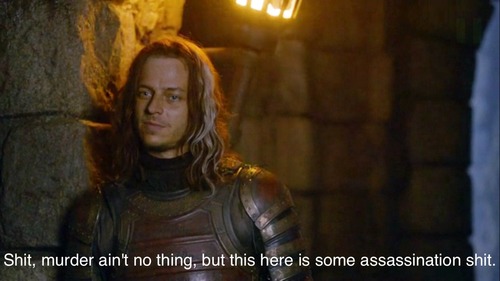
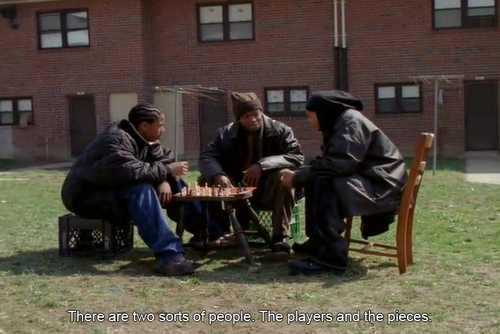
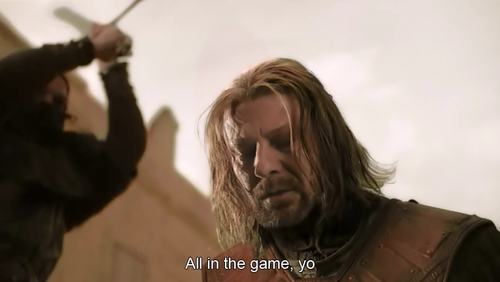
It is in the shift from Tolkien’s depiction of power as innate and immutable—destroyable but not transferable—to a more fluid and indeed Foucauldian model that underwrites my argument that much contemporary fantasy articulates a specifically humanistic world view. To this end, it is worth contrasting the lack of monetary concerns in Tolkien’s world with George R.R. Martin’s veritable preoccupation with money in A Song of Ice and Fire (second only to his preoccupation with food). The economics of Westeros comprise a crucial and persistent trope: “a Lannister always pays his debts” is the unofficial motto of the most powerful house, but it also points to the fact that debts, both financial and symbolic, pervade the narrative. The cost of things—be those things swords, food, or loyalty—is always at the forefront of everyone’s mind, and “the wealth of nations” determines their power, status, and geopolitical influence. To put it another way, power in Martin’s world is essentially fluid—or, to put it yet another way, and paraphrase Omar Little, money in Westeros doesn’t have owners … just spenders. There’s a reason why the Tumblr page A Song of Ice and The Wire, in which stills from Game of Thrones are captioned with lines from The Wire and vice versa, is so uncannily apt:

ice&wireice&wire2ice&wire3

Leave a comment

Filed under course readings, Return to Middle-Earth

Hic Sunt Dracones

ring_edited-2

There’s a moment in The Hobbit, before Bilbo and company arrive at Rivendell, when Bilbo sees the first of the Misty Mountains, the range that more or less runs the length of Middle-Earth. Gazing up at it in awe, he asks whether the mountain he sees is in fact Erebor, the Lonely Mountain, the troupe’s ultimate destination. Balin the dwarf scoffs at him, setting him straight—informing him that they will have to go over those mountains and then through huge swathes of wilderness on the other side before they will arrive at Erebor.

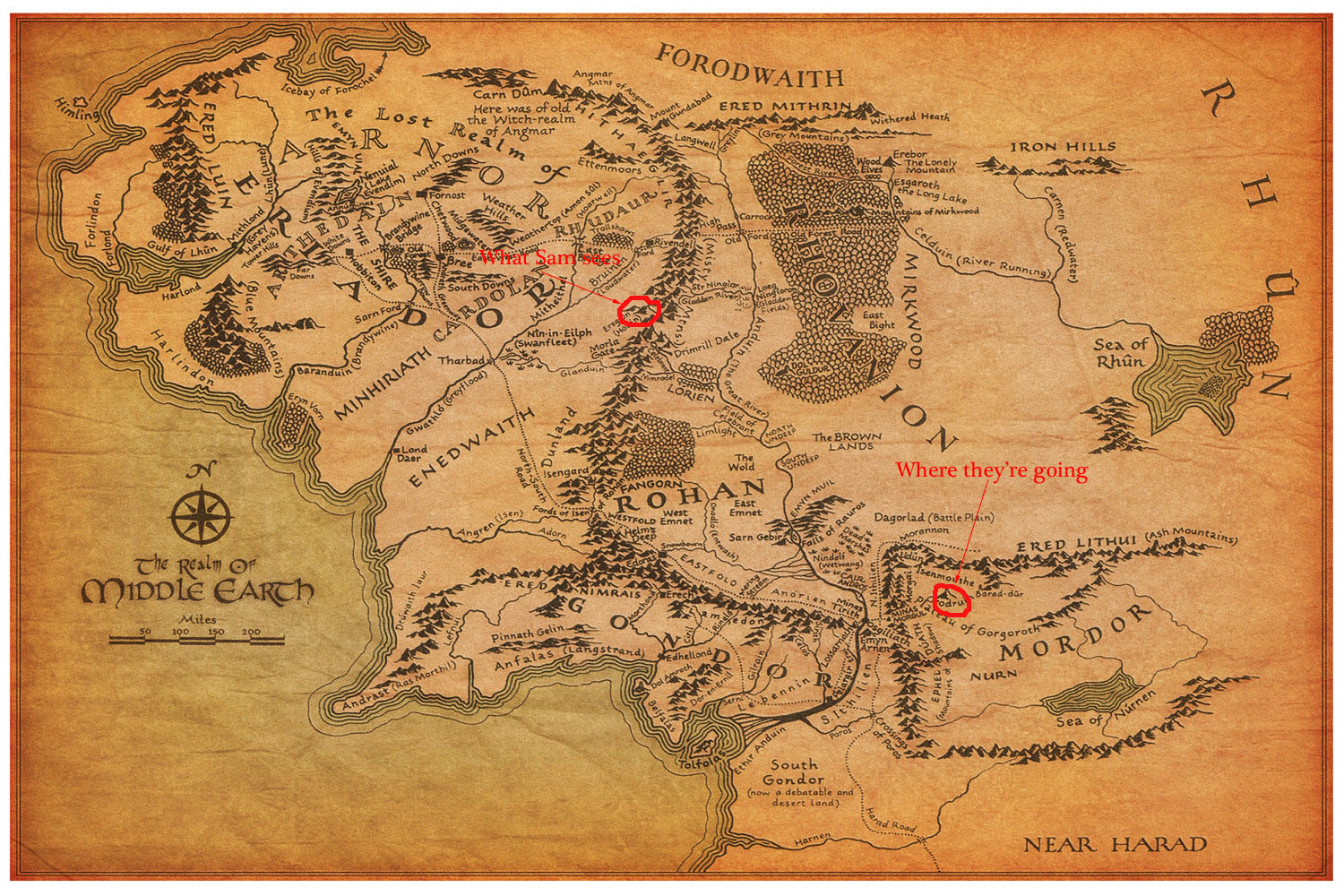
It’s one of those fish-out-of-water moments, of which Bilbo has many over the course of the novel. It also emphasizes his parochialism and his complacent ignorance of the wider world. In itself, it is not much worth dwelling on, except that it is replicated by Samwise Gamgee in The Lord of the Rings. As the Fellowship journeys south they come in sight of a spur of the Misty Mountains, prompting confusion on Pippin’s part, who assumed that the mountains should be to their left and not directly ahead. Exasperated, Gandalf says, “There are many maps in Elrond’s house, but I suppose you never thought to look at them.” And once again they are set aright by a dwarf, as Gimli comes forward, declaring, “I need no map” and naming all of the mountains in view. A little bit later Sam, unknowingly echoing Bilbo, says “I’m beginning to think it’s time we got a sight of that Fiery Mountain, and saw the end of the Road, so to speak. I thought at first that this here Redhorn, or whatever its name is, might be it, till Gimli spoke his piece.” Tolkien wryly observes that “Maps conveyed nothing to Sam’s mind, and all distances in these strange lands seemed so vast that he was quite out of his reckoning.”

We can hardly blame Sam or Bilbo, for either their geographical ignorance or their wistful hope that the respective objectives of their journeys are much closer than they actually are. There might have been maps at Rivendell, but how useful would they have been to people who lack an understanding of the scope and scale of the wider world? In The Hobbit, Bilbo is excited by the appearance at his unexpected party of Thror’s map because he loves maps—and then we are informed that he had a large map framed in his hallway of the local land around him, with all his favourite hiking trails drawn in red ink. The juxtaposition of what is literally a treasure map depicting a mountain hundreds of miles away with one highlighting local hiking trails is almost touching, so great is the difference between the two—like a map of local parks placed alongside the map of a military campaign (which, when you consider how The Hobbit ends, is not an inapt comparison). By the same token, after Bilbo’s departure at the beginning of The Lord of the Rings, “Frodo began to feel restless, and all the old paths seemed too well-trodden. He looked at maps, and wondered what lay beyond their edges: maps made in the Shire showed mostly white spaces beyond its borders.” It is hard (for me, at least) not to read this passage without thinking of Heart of Darkness and Marlow’s fascination with “the white spaces on the map.” (Indeed, when talking about maps in my Tolkien class, I allude to Conrad’s novel enough that I’m starting to wonder if there’s an article there to be written).

Maps play a significantly different semantic role in fantasy fiction, however, insofar as they reverse the standard relationship between maps and the territory they depict. One way or another, maps are inherently fictional, in that they necessarily distort the material they seek to represent, even as they strive for scientific or mathematical accuracy. The actuality of the world, with all its intricacies, is translated into a set of lines on a flat surface, alongside a set of such overt fictions as national borders, other political designations, and place names. (To be clear: in calling borders and place names “fictional,” I am not saying they are not real, just that they are invented—they are fictions agreed upon by a consensus, and as such, are always subject to change). Mountains become gradations of colour or concentric lines on a relief map, cities and towns are rendered as dots, different nations are designated by a palette of striking colours and circumscribed by dotted lines. In this respect, maps are not dissimilar from fiction proper, which similarly seeks to render a given interpretation of reality but must needs deform it for specific purposes.

It is at this point in discussing maps that I like to pause and show a clip from The West Wing.

Maps in fantasy fiction, by contrast, are not depictions of extant territory. How could they be? They are rather outright inventions, but therefore have a drastically different relationship to their worlds than our maps. They are, in a word, deterministic. That is to say, the map determines the territory.

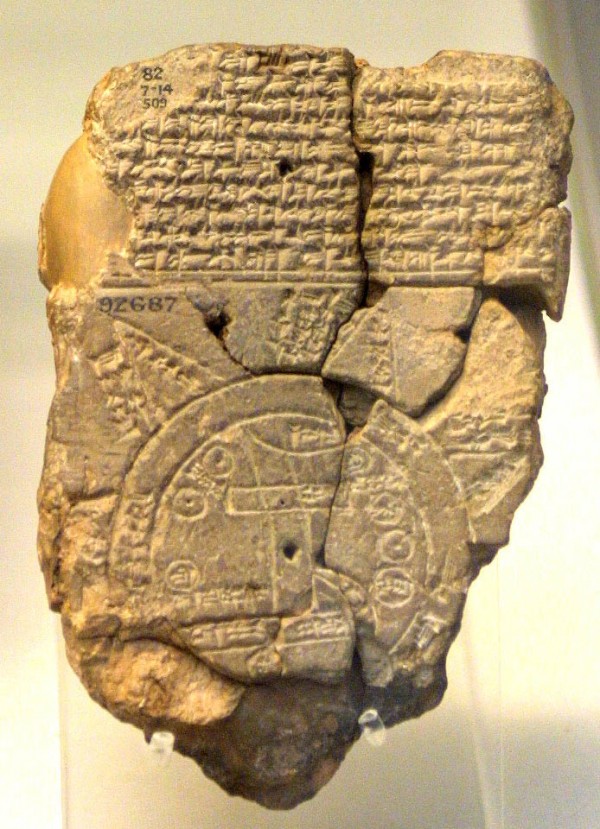
Consider the history of maps of our world. The earliest known attempt to present a map of the world is one from Babylon, around 600 BCE. It essentially depicts the world as a disc, with a handful of lands and cities and landmarks surrounding Babylon, all of which is surrounded by a circle of ocean.

babylon_world-map

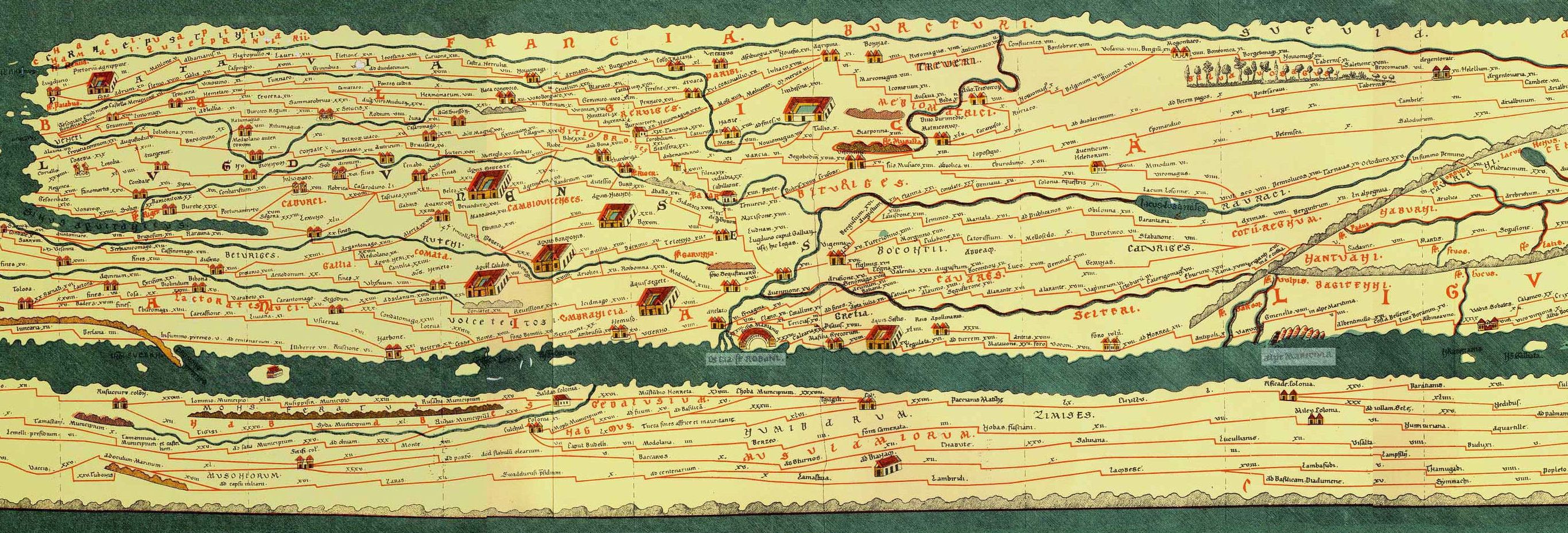
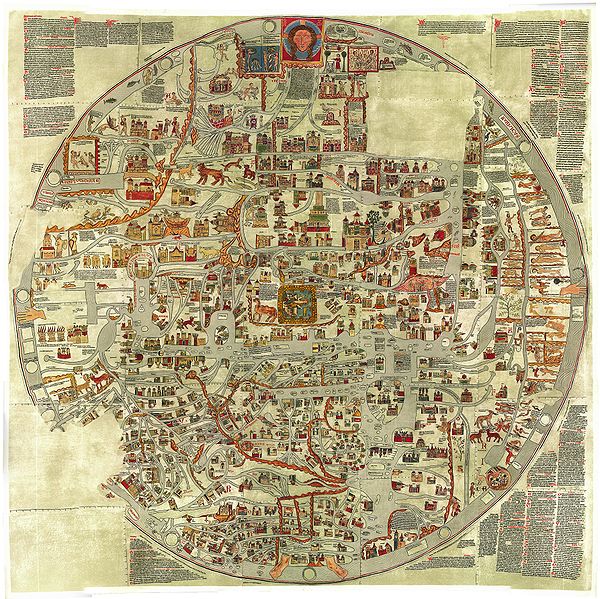
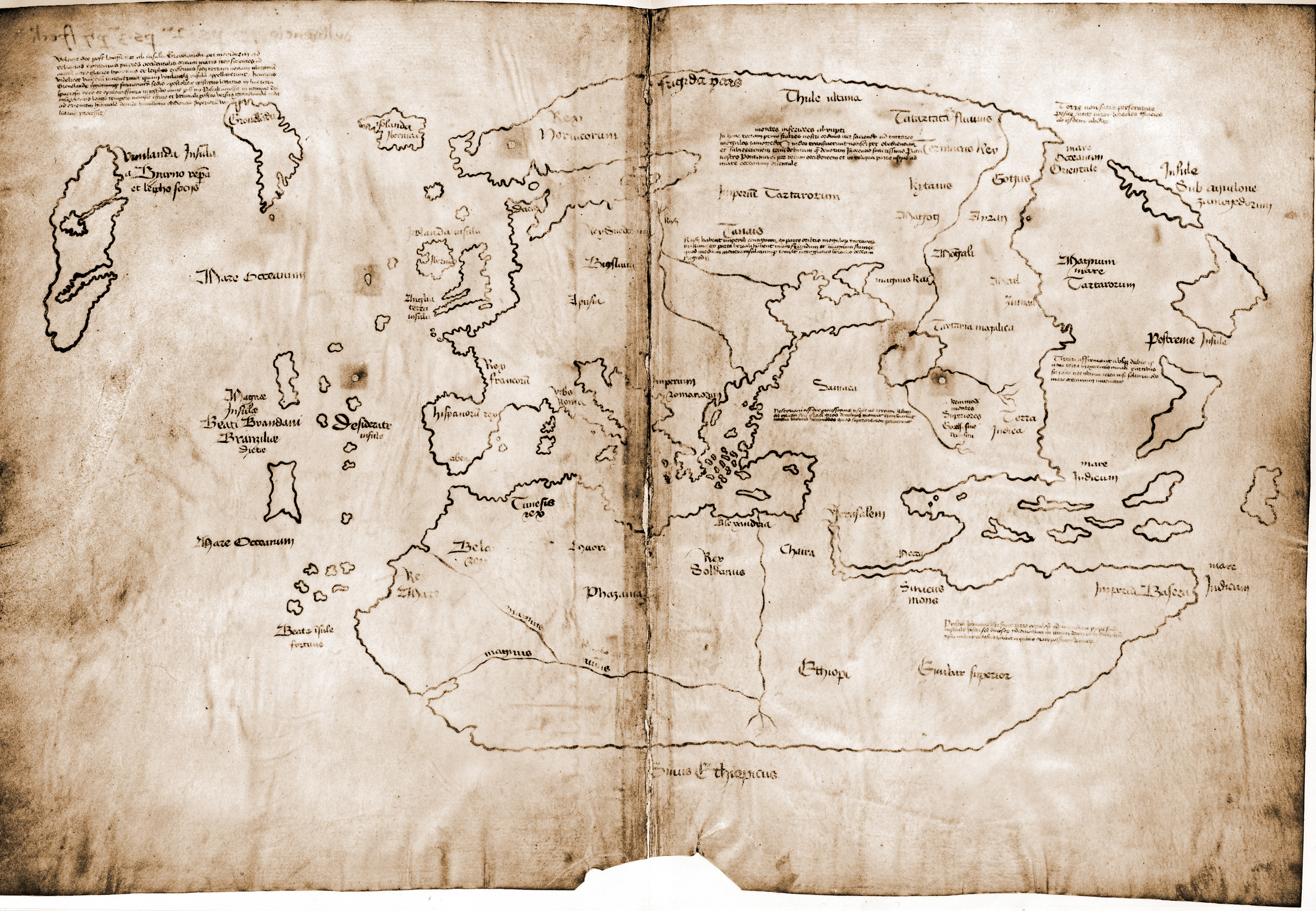
Consider, in turn, a series of maps down through the ages:

TabulaPeutingeriana2

The Tabula Peutingeriana (ca. AD 500), a Roman illustrated itinerarium (road map) showing the cursus publicus, the road network in the Roman Empire.

Ebstorf_map

The Ebstorf Map (ca. 13th century), a medieval map of the world.

Vinland_Map_HiRes

A map purporting to show Vinland (Newfoundland and the Maritimes–upper left corner), based on Viking exploration in the tenth century.

barent_langenes_map_600

Can you see my house?

I suppose it could be argued that the movement of maps toward increasing accuracy contradicts my premise that maps are inherently fictional, but I would disagree; accuracy and reality are not the same thing. And as the (fictional) Organization of Cartographers for Social Equality would point out, the conflation of accuracy with reality can and has been deployed in the service of the powerful.

But I digress. Maps in fantasy fiction are paratextual, which is to say that—like prefaces, indices, appendices, annotations, title pages, afterword, and so forth—they work to circumscribe and define the text of the story. And by the same token, we are privy to them in a way the characters of the narrative are not. So when Sam grumbles about Caradhras not being Mount Doom, as he’d hoped, it is a moment not unlike dramatic irony—assuming, of course, the reader is anything like myself and obsessively consults the maps provided in order to know where in the world the characters are at any given point.

(This is not, I have been given to understand, a pervasive tendency—indeed, last year when I taught The Hobbit in my first-year English class, I polled the students to find out how many of them consulted the maps while reading. To my considerable shock, two-thirds of them did not look at the maps at all. And suddenly the more general geographical ignorance of our undergraduate population became a little bit more comprehensible).

The (quasi) dramatic irony of Sam and Bilbo’s misapprehension lies in the fact that readers know, far more indelibly than the characters, the geography of the world they inhabit.

middle-earth3
Of course, such characters as Bilbo and Sam and Pippin are contrasted with Elrond and Gandalf and Aragorn (for example), all of whom presumably have a much greater and more thorough grasp of the extant maps of Middle-earth. But for a long time I have wondered—and yes, this is entirely speculative—do they consult the same maps as the readers? Over the Christmas holidays this past year I read Creation by Gore Vidal, which is about a Persian diplomat named Cyrus, a boyhood friend of the Emperor Xerxes, who over the course of his life travels from Persia to India, to China, and at the end of his life to Greece. At one point as he consults with the Emperor Darius about his first embassy to India, a map of the known world—etched onto copper shields—is produced. Part of Cyrus’ mission is to map the territory into which he ventures, with an obvious emphasis to be put on trade routes. His description of the maps makes it clear that they are only slightly more accurate than the Babylonian map pictured above.

However, the novel provides maps at the beginning, one depicting the entirety of the Persian empire around 500 BCE, and a detail map depicting Greece and the Greek colonies on Asia Minor. Maps of such accuracy are not of course available to Cyrus. And when we read histories of, for example, the Wars of the Roses or the Roman conquest of Gaul, we similarly have maps that the Yorks and Lancasters did not have; and the Romans were sojourning into (literally) unmapped territory. All of which is by way of observing that, if fantasy is in part a nostalgic escape to premodern, neo-medieval settings, I think it is a fair assumption that Middle-earth’s cartographers were no more accomplished than their medieval European counterparts.

Again, this is entirely speculative: I can no more determine the accuracy of the maps in Rivendell than I can definitively tell you how many children Lady Macbeth had. The point here is more to draw attention to the dissonance between the maps with which Tolkien provides us, and his characters’ experience of the territory those maps determine. (It makes me think that someone needs to write a fantasy novel that unfolds as a series of increasingly-accurate maps, with disputes over their validity and the theological arguments over the shape of the world providing the main conflicts for the narrative).

The point is also the epistemological certainty the maps of various fantasy novels afford. One could argue that a fantasy map isn’t meant to be seen as accurate, that it is in fact meant to be understood as replicating the distortions and inaccuracies of medieval maps … except that I cannot think of any reason The Lord of the Rings or any other fantasy novel gives us to make that assumption. Rather, maps of Middle-Earth, Westeros, Pern, Earthsea, and so forth—take your pick—provide a privileged perspective that is consonant with fantasy’s relationship to history. As Farah Mendlesohn observes in her book Rhetorics of Fantasy, the genre tends toward a scholastic conception of the past—which is to say, like medieval Scholasticism, it treats historical accounts as straightforward fact rather then with historiographic skepticism. However much Tolkien characterized his writing of the tales that would become The Silmarillion (and the countless subsequent books edited by his son Christopher) as “creating a mythology,” in the context of The Lord of the Rings they comprise its history. Beren and Luthien, the voyage of Earendil, the fall of Gil-Galad—all of which we encounter in The Lord of the Rings through song—are not mere myth or legend like Gilgamesh or Odysseus, or legend embellished from history, like the Trojan War, but are indelible history. (In case we doubt their validity, we have such literally immortal figures as Elrond and Galadriel, who were actually around for much of Middle-earth’s “mythic” origins).

The question of history versus myth in Tolkien is one I will return to in a future post. For now, let me return to his maps: I know I am not alone in having been enthralled by the geography of Middle-earth; certainly, the hugely popular multiplayer Lord of the Rings Online game exploits the detailed topography of Middle-earth to great effect (I recently signed up for an account, but haven’t yet had much chance to play—more on that when I have). I unfortunately don’t have anything resembling a proper conclusion to this post—like most of them, this is mostly my musings and little more—but I do mean to return to this topic in the future. Stay tuned.

Leave a comment

Filed under Uncategorized

Tolkien and the Magic of Home

ring_edited-2This week in my Tolkien class we arrived at Rivendell, where Frodo and company have a well-deserved rest. I introduced our discussion of Rivendell by positing to the class the significance, indeed the necessity of periodic safe havens in adventure narratives—and the more harrowing the adventure, the more important it is for the protagonists to have occasional respite, for it is a respite for the reader/viewer as well. The emotional relief of momentary security balances the anxiety, fear, or terror to which we and our heroes are otherwise subjected.

Of course, part of the emotional and thematic power of safe havens is the certainty of their ephemerality: either (1) we know our heroes will be obliged to move on sooner rather than later, (2) their safety will inevitably be breached, or (3) the safe haven isn’t quite as safe as first imagined, because those with whom we share it are themselves a threat (any fellow zombie film aficionado will be intimately familiar with this last one).

Nevertheless, the ability to pause and take a breath comprises its own odd form of catharsis. The most striking example of this, for me, is in Cormac McCarthy’s bleak post-apocalyptic novel The Road, possibly one of the most harrowing books I’ve ever read. A father and son (simply referred to as the Man and the Boy) travel across a blasted landscape that makes Mordor look like the Salinas Valley, avoiding cannibalistic gangs and searching for sustenance. Around the middle of the story they discover a Cold War-era bomb shelter, stocked with imperishable food and boasting beds with clean, warm blankets. My relief when they made it to this temporary safety would have been comical if it wasn’t so deeply felt.

Frodo waking in Rivendell to Gandalf’s voice isn’t quite the same thing, but there is a similar degree of relief, amplified by the idyllic quality of Rivendell itself—“a perfect house,” Bilbo had once said, “whether you like food or sleep or story-telling or singing, or just sitting and thinking best, or a pleasant mixture of them all.” Simply being there “was a cure for weariness, fear, and sadness.” Perhaps more importantly, it comes to feel to Frodo like home, not least because he is reunited with Bilbo, and because he allows himself to believe that his task is done. Just before he volunteers to carry on as Ring-Bearer, “An overwhelming longing to rest and remain at peace by Bilbo’s side in Rivendell filled his heart.” It is telling that, on imagining his burden has passed on, he does not think of returning to the Shire, a fact that anticipates his later emotional distance when his task is truly done, and his decision to leave Middle-Earth forever. (I suppose I should have prefaced that with “Spoilers!”) His apparent inability at that point to take pleasure in the Shire and in his post-Ring life deeply bothers Sam, for whom the Shire was always the beloved home to which he desired to return. That Frodo never really returns is, perhaps, first hinted at while he is in Rivendell.

rivendell-film

Frodo looks out at Rivendell in The Fellowship of the Ring.

Home and its different conceptions and figurations are a crucial theme in The Lord of the Rings; which is perhaps utterly unsurprising, considering that home—or a point of return, at any rate—is a crucial element in most quest romances, that space of safety from which the hero journeys into the space of adventure. Certainly, that was its thematic role in The Hobbit. We learn a lot less of the Shire and its denizens there, as Bilbo is thrown into his adventure with unseemly haste. In Rings, it takes the hobbits five chapters to get a leg on and finally depart, and in the process we learn a lot more about it, its qualities, its people. In The Hobbit, the Shire is what Bilbo thinks of wistfully while sleeping in the rain or skipping yet another meal. In The Lord of the Rings, however, we learn enough about the Shire to have a deeper sense of its worth and its meaning, and it becomes one of several figurations of home.

Why is this at all significant? Well, aside from mere curiosity, I’d argue that home as an idea and a reality as we understand it in the novel is connected to Tolkien’s figurations of power and magic. In a novel that is otherwise exhaustively detailed with regards to the history, mythology, and languages of its various peoples and societies, the nature of magic remains infuriatingly opaque. Tolkien does not deign to outline the laws and nature of magic as practiced by Gandalf, Elrond, or Sauron; aside from a few instances when Gandalf sets things on fire, magic appears as a nebulous, usually unseen force. Such coyness on Tolkien’s part sets him apart from those who followed him: fantasists such as Ursula K. Le Guin, Patrick Rothfuss, J.K. Rowling, and Lev Grossman turn magic into something that, while there must needs be an inborn talent for it, must be exhaustively studied and practiced. Each of the writers I mentioned incorporate magical schools or universities, where the students must commit thousands of details to memory and pass rigorous examinations.

Possibly Gandalf and the other istari had to undergo some such training back in Valinor, but the more acute sense communicated by Tolkien is that magic is innate. Of the rare glimpses into its workings we get, it also appears to be connected to contact to the “other realm,” a parallel or simultaneous reality that Frodo glimpses whenever he puts on the Ring. I will have another post soon on that subject; but for now …

*

Gandalf has something interesting to say to Frodo not long after he wakes up. When Frodo asks him if Rivendell is safe from Sauron, Gandalf replies “Indeed there is a power in Rivendell to withstand the might of Mordor, for a while: and elsewhere other powers still dwell. There is power, too, of another kind in the Shire.” Given that he doesn’t go on to say anything more about the Shire and what it’s “other kind” of power is, it’s an interesting comment. Obviously, the Shire is by no means as powerful as Rivendell or Lothlorien; and as we discover at the end of the novel, it was by no means prepared to repulse even the assault of a deeply weakened Saruman.

But there is power there: in class this week, we queried why the Nazgul are so much less fearsome in the Shire and Bree? At the Council of Elrond, Boromir describes the rout of Gondor’s forces: “[It] was not by numbers that we were defeated. A power was there that we have not felt before … Some said it could be seen, like a great black horseman, a dark shadow under the moon. Wherever he came a madness filled our foes, but fear fell on our boldest, so that horse and man gave way and fled.” Later on, we will see such fear deployed as the Nazgul’s main weapon—but while they are still Black Riders in the Shire, all they seem to do is creep out Frodo’s neighbours. In Bree, they become somewhat more menacing, actually attacking what they think are the hobbits in their beds—only to discover that they have been deceived by the illusion of pillows and bolsters underneath the bedclothes, in a ruse that could have been devised by Ferris Bueller.

maxresdefault

See? You can hardly tell the difference.

On one hand, it is tempting to think that Tolkien wasn’t sure who these villains were just yet when he wrote them. On another hand—and this was the class consensus—perhaps they lack the power they show elsewhere (such as the attack at Weathertop) while in a place of community. In both the Shire and Bree, they are objects of fear and suspicion—very obviously outsiders and strangers. It could be argued that they preferred stealth at such moments; but it could also be argued that, well, they’re Ringwraiths! Who needs stealth? Except that Gandalf tells Frodo that the Shire has its own kind of power. He does not, of course, elaborate on what the nature of that power might be, but the fact that he feels compelled to mention it at all is significant.

So what is the power of the Shire? This is not a question I have previously asked myself in my rereadings of The Lord of the Rings. I do think that my class is on the right track with this one: if there is power in Rivendell to withstand Mordor (for a time),  part of that power manifests itself in the peace and contentment its visitors feel, both in terms of obvious relief to be in such a secure place, but also in terms of the magic that sustains it. In Tolkien, landscape is frequently an expression of the mind or minds that inhabit it, and comes to manifest the dominant power for good or ill. Mirkwood was Greenwood the Great before Sauron took up residence in Dol Goldur in the guise of the Necromancer; his pernicious influence turned it into the dark and forbidding wood we see in The Hobbit, choking out sunlight and populated with such terrifying beasts as the giant spiders. Likewise, Mordor is a dire hellscape, and Saruman is in the process of turning the vale of Isengard into a comparably post-apocalyptic space when he meets his defeat. The cleansing of Isengard by the Ents in The Two Towers is, in my opinion, one of the things Peter Jackson got spectacularly right:

In contrast, Rivendell and Lothlorien are idyllic expressions of their masters’ benign power. On the first leg of their journey from Rivendell, the Fellowship reaches the land of Hollin, which used to be called Eregion when Elves dwelled there. Though they have been gone from the land for several thousand years, it is still a fair and pleasant place. Gandalf notes that, “There is a wholesome air about Hollin. Much evil must befall a country before it wholly forgets the Elves.” By the same token, the Shire is the embodiment of hobbit-society: pleasant, complacent, well-tended, and eminently comfortable.

It is in the experience of Rivendell however that Frodo and company have their first real encounter with the power of place. Rivendell—Imladris, in Elvish—is referred to as “The Last Homely House” (variously, “The Last Homely House East of the Sea” or “The Last Homely House West of the Mountains,” which tells us pretty emphatically that it is the only Homely House, at least on this latitude). In the first draft of The Hobbit, Tolkien initially refers to Rivendell as “the Last Decent House,” though he changes his mind about a page and a half on and changes “decent” to “homely,” and makes a marginal notation beside “decent” to change it later. The change is a sensible one, as “decent” conjures up connotations on one hand of moral propriety, and on the other of a certain snobbishness (as in “there’s no decent hotel in this city”). But “homely”? Why? It’s obvious we can dismiss our common contemporary understanding of homely as blandly unattractive (assuming Rivendell didn’t earn that name for poor design choices). It’s also obvious that the term can be understood, in part, as “homey,” but it does seem odd to call the home of Elrond Halfelven, son of Earendil the Mariner, “homey,” however much it might be so. Besides the obvious alliteration, why “homely”?

Rivendell_illustration

Tolkien’s own illustration of Rivendell.

To the OED!

“Homely” as it turns out is a far more textured and loaded term than one might at first assume. According to the Oxford English Dictionary, it comes to us by way of German and Dutch. Heimlike is Middle Dutch for belonging to a household or a home; hemelik is Middle Low German for “friendly or intimate”; and heimlich is Middle High German meaning either “belonging to a person’s own country” or “familiar and intimate.” So far, nothing surprising—all of these definitions are in line with “at home with” or other such uses of “home” to designate a place of safety and comfort, in which individuals sharing that space similarly share intimacy.

What immediately struck me however was the paradoxical way in which the German heimlich features crucially in Sigmund Freud’s essay on the uncanny. The word he uses is unheimlich, which though we translate that as “uncanny,” it more literally translates as “unhomely.” As Freud notes at the start of his essay, this understanding of the uncanny as that which makes us feel metaphorically not at home—unfamiliar, weird, unsettling—has been the one that traditionally obtained. But heimlich, in addition to meaning what is known and familiar, also carries the meaning of “Concealed, kept from sight, so others do not get to know about it, withheld from others.” And in the OED entry for “homely,” there is also this note: “In several cognate Germanic languages, the parallel adjective shows a semantic development from ‘private’ to ‘secret, clandestine’ or ‘mysterious’.”

Freud’s explication of the uncanny is largely focused on this seeming paradox, wherein heimlich and unheimlich come to have a significant semantic overlap. His thesis, moving beyond the simplistic understanding of the uncanny as merely weird and unfamiliar, posits that the unheimlich, the uncanny, has as much to do with revelation as it does with the unfamiliar. That is to say, the revelation of what is private and hidden; and most crucially, that which is hidden from the self as much as from others.

But what, you might ask, does this have to do with Rivendell? Quite a lot, I would argue. Tolkien might not have had much use for Freud, but he certainly had a lot of use for the OED (working as an editor on it was one of his first academic jobs), and one has to assume that given “homely’s” affinities with and roots in Germanic languages, he would have been well aware of its variegated meanings. Rivendell embodies both meanings of heimlich, in terms of its hominess, familiarity, and comfort—but also in terms of its secrecy and concealment. It is literally concealed, hidden among the valleys of the Misty Mountain foothills. This quality is less obvious in The Lord of the Rings, as Frodo is unconscious during the last leg of his journey from the Ford of Bruinen to Rivendell itself, and so has no memory of the hidden trail—unlike Bilbo’s experience In The Hobbit, in which the way to Rivendell is depicted as extremely tricky, with even Gandalf not entirely certain of his route. But Rivendell is also a place of concealment and secrets in a variety of other ways, not least of which is what it hides from the eye of Sauron: most prominently, Elrond (spoiler), as we discover in the final pages, is the wearer of one of the three Elven-Rings; Elrond’s ring however we can also read as representative of the practices and qualities of Elven-magic—felt but not seen, sensed but not grasped by those who are not themselves imbued with such power. Though Rivendell is advertised as the “Last” Homely House, we encounter a similar space when the Fellowship arrives in Lothlorien—and there the uncannier qualities of magic and power are more forcefully felt. Indeed, one of the significant moments of those chapters comes when Galadriel meets the gaze of each of the Fellowship in turn: “And with that word she held them with her eyes, and in silence looked searchingly at each of them in turn. None save Legolas and Aragorn could long endure her glance. Sam quickly blushed and hung his head.” Sam admits later that “She seemed to be looking inside me and asking me what I would do if she gave me the chance of flying back home to the Shire with a nice little hole with—with a bit of a garden of my own.” The rest of the company uneasily admits to having been similarly tempted; Sam’s embarrassed discomfiture, to my mind, perfectly expresses that aspect of the uncanny in which something previously hidden is revealed to the self. Galadriel’s test (which is turned around on her when Frodo offers her the Ring) is uncanny precisely because it makes explicit repressed desire to the self. That Sam’s unheimlich moment was precisely a desire for home articulates the way in which Tolkien’s figurations of home and power are really rather complex, if not in fact fraught.

*

I’ll end this post here, as it has grown well beyond what I had originally intended. Suffice to say, this particular thesis is still embryonic but evolving. I will continue this line of inquiry, as promised, with a post about what that “other world” I mentioned earlier might entail. Na lû e-govaned vîn, novaer.

Beyond the Old Forest by Ted Nasmith

Rivendell as illustrated by Ted Nasmith.

Leave a comment

Filed under course readings, Return to Middle-Earth

On Arriving at the Answer to Life, the Universe, and Everything

I’m forty-two years old today. Forty-two doesn’t have the quality of such milestone ages as nineteen, twenty-five, thirty, forty, or so on … but as a number in and of itself, forty-two has always had something of a talismanic quality for me, for reasons I wasn’t aware of until I started to give it some thought.

It all goes back to the multiplication tables, really. The four central numbers there are thirty-six (six by six), forty-nine (seven by seven) and forty-two twice (six by seven and vice versa). Forty-two has always been a comforting number, in its centrality and in the fact that I always liked the equation 6×7. I never had to reach for the answer, or ask myself what numbers multiplied to make forty-two, unlike such products as fifty-four, sixty-three, and fifty-six. Why those numbers always required (and still require) a moment’s thought to remember their combinations, I couldn’t say—other than to speculate that there’s a lot of reasons why I am an English professor and not, say, and engineer or accountant.

math_multiplication_chart

I also like the individual numbers six and seven. Seven has the obvious talismanic quality of luck, of prime numberhood, and the fact that it just looks cool. 7. Six seems like a friendlier number, hobbit-like in its cheerful rotundity and evenness. 6. Together they seem like a fun pair.

There is also, of course, the fact of galactic philosophical history as chronicled in The Hitchhiker’s Guide to the Galaxy. Tasked with coming up with the answer to life, the universe, and everything, the uber-computer Deep Thought calculated for several million years, until finally presenting its answer:

“Alright,” said the computer and settled into silence again. The two men fidgeted. The tension was unbearable.
“You’re really not going to like it,” observed Deep Thought.
“Tell us!”
“Alright,” said Deep Thought. “The Answer to the Great Question …”
“Yes …!”
“Of Life, the Universe and Everything …” said Deep Thought.
“Yes …!”
“Is …” said Deep Thought, and paused.
“Yes …!”
“Is …”
“Yes … !!! … ?”
“Forty-two,” said Deep Thought, with infinite majesty and calm.

I await enlightenment. Hopefully it is not mathematical in nature.

Leave a comment

Filed under maunderings

In Defense of Tom Bombadil

ring_edited-2

There are few characters more loathed in the world of Tolkien fandom than poor Tom Bombadil, the odd little man who rescues the hobbits, first from the Old Forest, and then from the Barrow-wight. The antipathy is not overly surprising, considering just how bizarre his sudden appearance in the narrative is—to say nothing of just how bizarre his actual appearance is:

There was another burst of song, and then suddenly, hopping and dancing along the path, there appeared above the reeds an old battered hat with a tall crown and a long blue feather stuck in the band. With another hop and a bound there came into view a man, or so it seemed. At any rate he was too large for a hobbit, if not quite tall enough for one of the Big People, though he made noise enough for one, stumping along with great yellow boots on his thick legs, and charging through grass and rushes like a cow going down to drink. He had a blue coat and a long brown beard; his eyes were blue and bright, and his face was red as a ripe apple, but creased in a hundred wrinkles of laughter.

bombadilLOTRO

Tom Bombadil, as depicted by The Lord of the Rings Online

Matching his appearance is his singing, which is incessant and mostly nonsensical:

Hey dol! merry dol! ring a dong dillo!
Ring a dong! hop along! fal lal the willow!
Tom Bom, jolly Tom, Tom Bombadillo!

Tom comes along as a deus ex machina for the hobbits, very fortunately for them and for the narrative as a whole, but in such a way that is jarringly out of step with the tone and style of the rest of the novel. Even in these early chapters where Tolkien has not quite shaken off the vestiges of The Hobbit, Tom’s appearance is baffling (and I would also argue he would have even been a bit much for The Hobbit). He rescues them from Old Man Willow and gives them respite in his cottage for a couple of days while he tells them stories and his wife Goldberry the River-Daughter serves them meals.

Ironically, the reaction of most readers to Tom Bombadil is perhaps summed up best by Tolkien himself, in his essay “On Fairy-Stories” when he takes issue with Coleridge’s formulation of “the willing suspension of disbelief.”

[T]his does not seem to me a good description of what happens. What really happens is that the story-maker proves a successful “sub-creator.” He makes a Secondary World which your mind can enter. Inside it, what he relates is “true”: it accords with the laws of that world. You therefore believe it, while you are, as it were, inside. The moment disbelief arises, the spell is broken; the magic, or rather art, has failed. You are then out in the Primary World again, looking at the little abortive Secondary World from outside. If you are obliged, by kindliness or circumstances, to stay, then disbelief must be suspended (or shifted), otherwise listening and looking would become intolerable. But this suspension of disbelief is a substitute for the genuine thing, a subterfuge we use when condescending to games or make-believe, or when trying (more or less willingly) to find what virtue we can in the work of art that has for us failed.

In other words, Tolkien’s gripe with Coleridge is the qualifier “willing”; a well-wrought story that does not transgress its own internal coherence does not require the reader to be “willing,” as the acceptance of that Secondary World is intuitive. Awareness of disbelief, he argues, is fundamentally at odds with belief.

I think it’s reasonably safe to say that if readers of The Lord of the Rings are going to have a moment of being jarred out of Middle-Earth, it is when they encounter Tom Bombadil: and unfortunately, that experience is only aggravated on re-reading, as one comes back to these early chapters knowing precisely how grave and serious the hobbits’ adventures become, and Tom’s nonsensical capering is dramatically more bizarre after having met the Uruk-Hai, Shelob, and seen the true terror of the Nazgul. The great temptation with Tom is to dismiss him out of hand—he is such a ludicrous character, so obviously plucked from children’s tales, that one wonders exactly what Tolkien was thinking. Everything about him, from his appearance to his nonsense rhymes, seems designed for little more than making small children laugh. Indeed, that is precisely his genesis: Tolkien invented him around or about 1934, in a poem called “The Adventures of Tom Bombadil.” This poem, along with a collection of other mostly comic poems about animals and nature, was published in 1962. The poem details a series of minor adventures that begin with Tom resting by the side of the river Withywindle, dangling his beard in the water. Goldberry the river-daughter yanks him into the river teasingly. Irritated, Tom dries out underneath Old Man Willow, who sings Tom to sleep and traps him precisely as he would later trap Merry and Pippin:

Up woke Willow-man, began upon his singing,
sang Tom fast asleep under branches swinging;
in a crack caught him tight: snick! it closed together,
trapped Tom Bombadil, coat and hat and feather.

Tom commands Willow-man to release him, which he does, but is then waylaid by a badger, who drags Tom down into his lair and promises him he’ll never escape. But again Tom rebukes his captor, who, chastened, releases him (basically it seems as though Tom’s principal response to adversity is to speak sternly to it). Tom returns aboveground to his home, only to discover an unwelcome visitor:

Dusk came under Hill. Tom, he lit a candle;
upstairs creaking went, turned the door-handle.
“Hooo. Tom Bombadil. Look what night has brought you!
I’m here behind the door. Now at last I’ve caught you!

You’d forgotten Barrow-wight dwelling in the old mound
up there on hill-top with the ring of stones round.
He’s got loose again. Under earth he’ll take you.
Poor Tom Bombadil! Pale and cold he’ll make you!”

But again through his super-power of speaking sternly, he puts the Barrow-wight to flight, and then the next day goes and repays Goldberry for her mischief by abducting her and compelling her to marry him. The end.

If nothing else, this earlier version of Tom is intriguing because we see the raw material of the three chapters that have so irked a lot of Tolkien readers: the Willow trapping an unwary person, the Barrow-wight, and of course Tom himself and his love of Golberry (though his interactions with her in the novel are less kidnappy). All is presented here in lighthearted fashion: both Old Man Willow and the Barrow-wight (especially the Barrow-wight) are far more sinister in The Lord of the Rings—in this poem, they’re comic villains easily dispatched by Bombadil. They are just as (apparently) easy for him to dispatch in The Lord of the Rings, but because their prey is unwary mortals, we have a more profound sense of just how dangerous they are.

So who is Tom Bombadil? How does he fit into the larger mythos of Middle-Earth? Is he, as some assume, merely an anomaly? It is tempting to see him as something Tolkien threw in while he was still finding his way with this—one of the most-quoted passages from Tolkien’s letters is where he describes the process of writing LotR as an adventure in itself, that he was as surprised by his heroes’ encounters as they were. The first eight chapters carry much of the spirit of The Hobbit—but did Tolkien write Tom Bombadil, cannibalizing his earlier poems, when he still had the sense his new book would be much like the last? And then, having written him, was he reluctant to edit Bombadil out?

It is a tempting reading, but as I drill into my students every year, our job isn’t to speculate on what a writer may have intended, but to work with what is present in the text itself. And while Tom Bombadil seems like a complete anachronism, he is nevertheless folded into the novel’s history and mythology when the hobbits arrive at Rivendell. Elrond has this to say about Bombadil:

I had forgotten Bombadil, if indeed this is still the same that walked the woods and hills long ago, and even then was older than the old. That was not then his name Irwain Ben-adar we called him, oldest and fatherless. But many another name he has since been given by other folk: Forn by the Dwarves, Orald by Northern Men, and other names beside.

Given that he seems to precede the elves and the strife and conflicts of Middle-Earth, he is a being out of time. As Gandalf says, “the Ring has no power over him. He is his own master. But he cannot alter the Ring itself, nor break its power over others. And now he has withdrawn into a little land, within bounds that he has set … and he will not step beyond them.”  If my speculation is correct and Tolkien wrote the Bombadil sequences before he had a grasp of where LotR was going, he at least did a yeoman’s job of building him into the mythology.

(Which, of course, he also did with The Hobbit: both in terms of incorporating its “sequel” into the broader mythology he had been constructing for over twenty years, but also by offering supplementary material in the appendices of The Lord of the Rings and Unfinished Tales in which he made clear the fact that Bilbo’s adventure to the Lonely Mountain was a sideshow—orchestrated by Gandalf—to the broader conflict between the White Council and a re-emergent Sauron. If nothing else, the stubborn inclusion of Tom Bombadil is another example of Tolkien grafting his stories for his children onto his broader mythology).

If I were to make a more specific defense for poor Tom, however, it would be this: perhaps it has taken me multiple rereadings of this novel and that touch of world-weariness we all adopt as we age, but I now see in Tom Bombadil something of a poignant pathos. Who is he, after all? All we know is that he is ancient and immortal, and hugely powerful, but essentially indifferent to the travails of the world. The question I now find myself asking is why he chooses to be this person? Why, when you possess that sort of power, do you choose to dress so ludicrously (sort of like an inept wizard imitating a muggle, when you get down to it), limit your domain to a relatively tiny acreage of forest and down, and devote your days to capering through meadows singing nonsense verse?

Leaving aside for the moment the fact that there’s probably a good number of us who wouldn’t mind that kind of life (at least in retirement, if not necessarily in eternity), there is in that choice, I feel, a powerful undercurrent of melancholy: a deliberate withdrawal from the world “into a little land, within bounds that he has set,” as Gandalf says. As if, having seen too much of the world’s cruelty and pain, he wants nothing to do with it … which, incidentally, resonates with that crucial little moment when he puts on the Ring and nothing happens.

In my previous post I made the suggestion that forests in Middle-Earth are repositories of memory; if we glean nothing else from the hobbits’ encounter with Tom, we know that so is he. Elsewhere in the novel it is said that, to the elves, the lives of Men are like the passing seasons, or ripples on the water; Tom’s brief description of the rise and fall of kingdoms gives us a similar sense:

Suddenly Tom’s talk left the woods and went leaping up the young stream, over bubbling waterfalls, over pebbles and worn rocks, and among small flowers in close grass and wet crannies, wandering at last up to the Downs. They heard of the Great Barrows, and the green mounds, and the stone-rings upon the hills and in the hollows among the hills. There were fortresses on the heights. Kings of little kingdoms fought together, and the young Sun shone like fire on the red metal of their new and greedy swords. There was victory and defeat; and towers fell, fortresses were burned, and flames went up into the sky. Gold was piled on the biers of dead kings and queens; and mounds covered them, and the stone doors were shut; and the grass grew over all. Sheep walked for a while biting the grass, but soon the hills were empty again. A shadow came out of dark places far away, and the bones were stirred in the mounds. Barrow-wights walked in the hollow places with a clink of rings on cold fingers, and gold chains in the wind.

No wonder he’d rather spend his days roaming meadows and gathering water-lilies for his wife.

*

But to end on a cheerful note: many have speculated on what a confrontation between Tom Bombadil and Sauron might have looked like. Thanks to the internet, we now know.

1 Comment

Filed under course readings, Return to Middle-Earth

Into the Woods

ring_edited-2One of the things that has struck me on returning to The Lord of the Rings (and The Hobbit) is the ambivalent quality of forests in Tolkien’s fiction. I say “ambivalent” because, for an author who expresses a deep sense of antipathy to modernity and industrialism, and a corollary nostalgia for a premodern, agrarian England, his fiction is suspicious of forests. If on one hand the Shire is a utopian depiction of a pre-industrial society living in something resembling harmony with nature; and on the other Mordor is a nightmarish hellscape visited on the land by industry and technology; there is a third space in Tolkien’s fiction, not necessarily blighted by the evils of modernity, but also comparably dangerous. This is the “wild,” in which such havens as the Shire and Rivendell exist as an archipelago of safe spaces amidst huge stretches of untamed country. And forests in Tolkien comprise some of the most perilous parts of the wild.

Mirkwood_01

Mirkwood.

There are a number of ways in which the Old Forest, the first of the hobbits’ obstacles after leaving the Shire, is more menacing even than Mirkwood was in The Hobbit. To be certain, they get through it in just a day, the forest itself is not as dark and foreboding, and there’s a distinct lack of giant spiders. But where it was the inhabitants of Mirkwood that made it dangerous, the Old Forest is itself malevolent: the trees whisper to each other, the paths shift and change, the trees crowd in on the hobbits and lower over them, and of course Merry and Pippin find themselves trapped in the bole of the most malevolent of all the trees, Old Man Willow.

In one sense, the adventures Frodo and company have in the early stages of Fellowship are very much of a piece with The Hobbit, and their travails in the Old Forest have little of the gravity and indeed terror of what is to come later in the novel. I will have more to say about this in a later post: but for now, it is worth noting that, for all the eeriness and foreboding on display in the Old Forest, it lacks the dread we experienced in Mirkwood, and however nasty Old Man Willow is, he is preferable to an encounter with the Black Riders—the avoidance of whom was the whole point for the circuitous route through the forest. And yes, it also doesn’t help things when the hobbits are rescued by a droll fellow in yellow boots with a fondness for nonsense rhymes.

I am by no means the first reader to note that the adventure in the Old Forest, the appearance of the annoyingly flamboyant Tom Bombadil, and the subsequent blundering in the Barrow-Downs are far more of a piece with the tone and style of The Hobbit than with what The Lord of the Rings will become. I am also not the first reader to speculate that these episodes were written when Tolkien was still in The Hobbit’s head-space and his new story was still merely a sequel. Peter Jackson was not unwise when he elided them from the film: the novel can bear them, but having them in the movie would have made it (even more) dilatory.

That being said, it is eminently appropriate that the hobbits’ first move beyond the borders of the known is into a forest. “Dark Woods,” “Enchanted Forest,” “Forbidden Forest”—these are all familiar place-names in fantasy and fairy-tales. Forests typically symbolize darkness and the unknown, for the very simple reason that it is easy for the unwary traveler to lose his or her way; forests are (or can be) opaque and impenetrable, and can convey a quiet menace. Tom Bombadil’s words about the Old Forest are as good as any to start:

Tom’s words laid bare the hearts of trees and their thoughts, which were often dark and strange, and filled with a hatred of things that go free upon the earth, gnawing, biting, breaking, hacking, burning: destroyers and usurpers. It was not called the Old Forest without reason, for it was indeed ancient, a survivor of vast forgotten woods; and in it there lived yet, ageing no quicker than the hills, the fathers of the fathers of trees, remembering times when they were lords.

Forests are crucial thematic spaces in Tolkien, always the sites of adventure or tribulation. And they are always perilous: even the haven of Lothlorien is spoken of darkly by the men of Gondor, as Boromir’s reluctance to pass through it attests. They are the true wilderness, but unlike the more amorphous designation “the wild,” forests possess power and dangerous sentience: the Old Forest, Mirkwood, Fangorn, Lorien. Of the races of Middle-Earth, only the Elves seem to have power over the woods, which is less perhaps power over them than a certain affinity—possibly the shared sympathy of the long-lived.

As I mentioned, Tolkien’s ambivalence to forests might seem incongruous at first glance, considering his utopian depictions of the pastoral. It is however important not to mistake his sentimental, nostalgic figurations of the Shire with an unequivocal embrace of all nature. Tolkien is no enthusiastic naturalist—he’s certainly no tree-hugger. The Lord of the Rings does decry indiscriminate logging, but in Middle-Earth you take your life in your hands doing violence to forests (after all, you never know if the oak you’re attempting to fell is an Ent). In many ways, C.S. Lewis is far more unambiguously sentimental about nature in the Narnia chronicles—like Tolkien, he imbues his forests (and rivers and animals and, really, any avatar of nature) with sentience and spirit, but solely within the borders of Narnia; and no right-thinking human need fear nature, as all falls under Aslan’s benevolent rule. Tolkien, by contrast, is rather more clear-eyed about the dangers of the untamed wild. The Shire is a deeply nostalgic and romantic recreation of pre-industrial England—but unlike most of the rest of Middle-Earth, it is post-medieval in character and nature. The Shire is a haven largely because nature there has been tamed into well-tilled fields, small forests that have been domesticated into pleasant locations for hikes, and criss-crossed with that crucial hallmark of civilization: roads. It is, perhaps, not a coincidence that the unsung hero of The Lord of the Rings is Samwise Gamgee: Sam after all is a gardener, tasked with tilling and pruning and taming nature; and at the end of The Lord of the Rings it is he (with help from Galadriel’s gift) who heals the Shire from Saruman’s industrial depredations.

Beyond the Old Forest by Ted Nasmith

Ted Nasmith’s artistic rendering of Hobbiton.

Fantasy is—pretty much by definition—a mishmash of geographies, histories, and mythologies: and if the Shire is Tolkien’s affectionate homage to his own rural upbringing, the Old Forest is our first substantive glance into Norse mythology, in whose imagination dark and dangerous forests loomed large. The trope of the “enchanted forest” is eminently familiar in folk- and fairy-tales, as well as in medieval romances: it is almost always a space of testing and tribulation, in which the already tenuous laws of reality are jettisoned even further. The term in Germanic mythology is myrkviðr (myrkvithr), which translates as “black forest” or “dark wood” or … Mirkwood. (myrk=murky, dark, viðr=wood, forest).

The dark wood, Mirkwood, Enchanted / Black Forest, etc., all also function as analogues to the underworld. To journey into a dark wood is a metaphorical descent, and indeed the most famous narrative of underworld journeying starts in a dark forest:

Midway upon the journey of our life
I found myself within a forest dark,
For the straightforward pathway had been lost.

Ah me! how hard a thing it is to say
What was this forest savage, rough, and stern,
Which in the very thought renews the fear. (Inferno, I:1-6).

Of course, the danger of forests in this respect was (is) the fear of being lost. The forest is where one might be led astray and abducted by the faerie, and where one might expect to encounter magical beasts. It is a common enough motif and metaphor that it seems like a given that Hogwarts would have one: I always feel J.K. Rowling uses the enchanted forest (“Forbidden Forest” in the Harry Potter books) in a pro forma sort of way—as if a school of magic that is also a castle wouldn’t quite be complete without a mysterious forest off-limits to students (but where they venture anyway).

bierstadt_albert_forest_sunrise

“Forest Sunrise” by Albert Bierstadt.

In The Hobbit, Mirkwood is deliberately evocative of the German Schwarzwald, the Black Forest, the setting of numerous German folk-tales and legends; in the Norse tradition “crossing the Black Forest” was a trope representing the trespass from one world to another. To reiterate an earlier point, the Old Forest is not nearly as dark and claustrophobic as Mirkwood, but it is oddly more menacing—principally because it is not the forest’s inhabitants who are malevolent, but the forest itself. It shifts and moves, and Merry had warned, seeming to crowd in on them, and turning their path away from where they want to go until they finally halt for a rest in the shade of Old Man Willow.

This depiction of forests as sentient is absent from The Hobbit, but is a powerfully recurring trope in LotR. We might in fact look at forests as embodiments of memory: indeed, Tom Bombadil’s dire description of the trees emphasizes memory, characterizing them, again, as “remembering times when they were lords.” Later, Elrond will say of the Old Forest that of it “many tales have been told: all that now remains is but an outlier of a northern march. Time was that a squirrel could go from tree to tree from what is now the Shire to Dunland west of Isengard.” Again: an implied kinship between elves and forests, both of whom remember the world when it was young. The elegiac quality of LotR can be also read in this light, as the loss of that ancient memory—the forests have shrunk, often from the depredations of Men, and the Elves themselves are leaving Middle-Earth. The trees, obviously, cannot follow: and the mortal races (like hobbits) must needs only enter such forests at their own peril, and hope they might have a savior like Tom Bombadil.

Leave a comment

Filed under course readings, Return to Middle-Earth