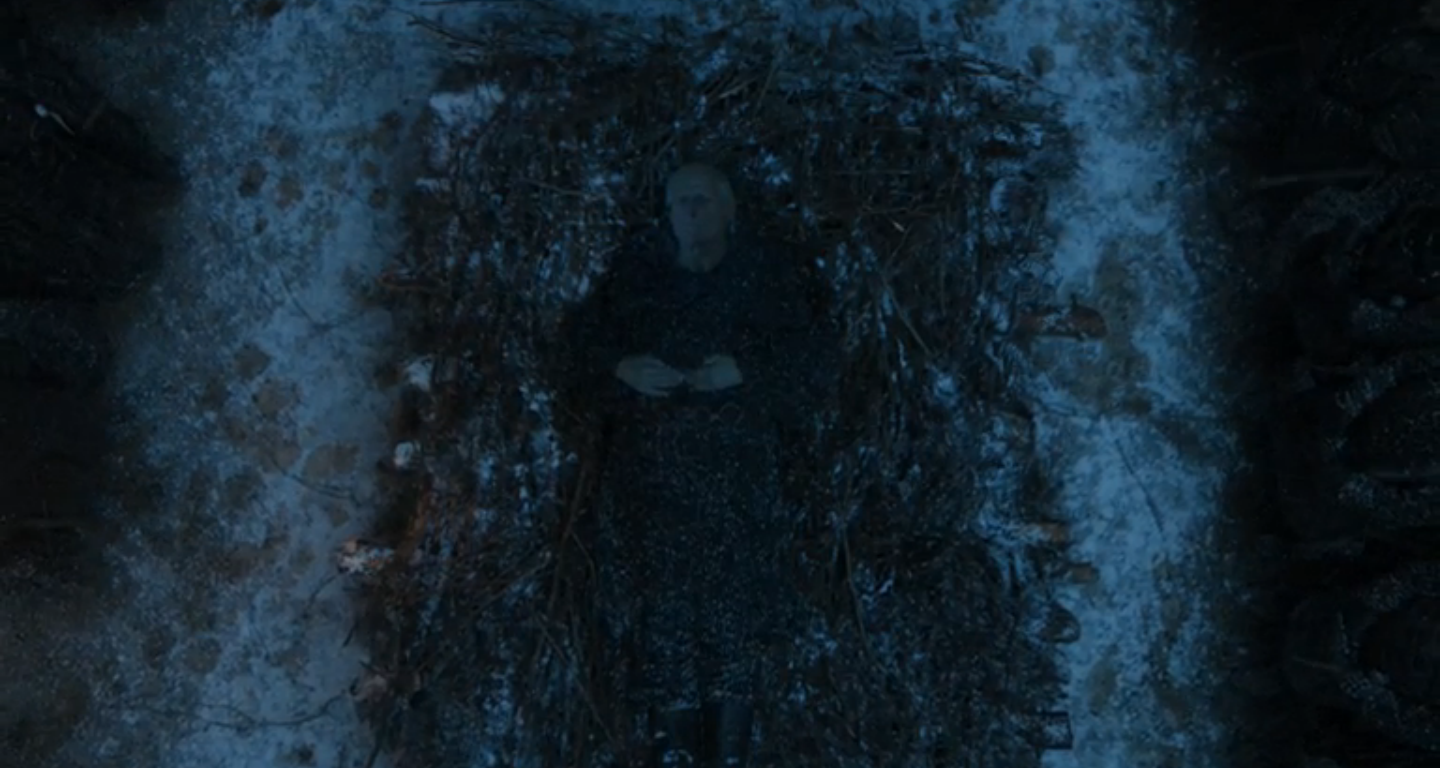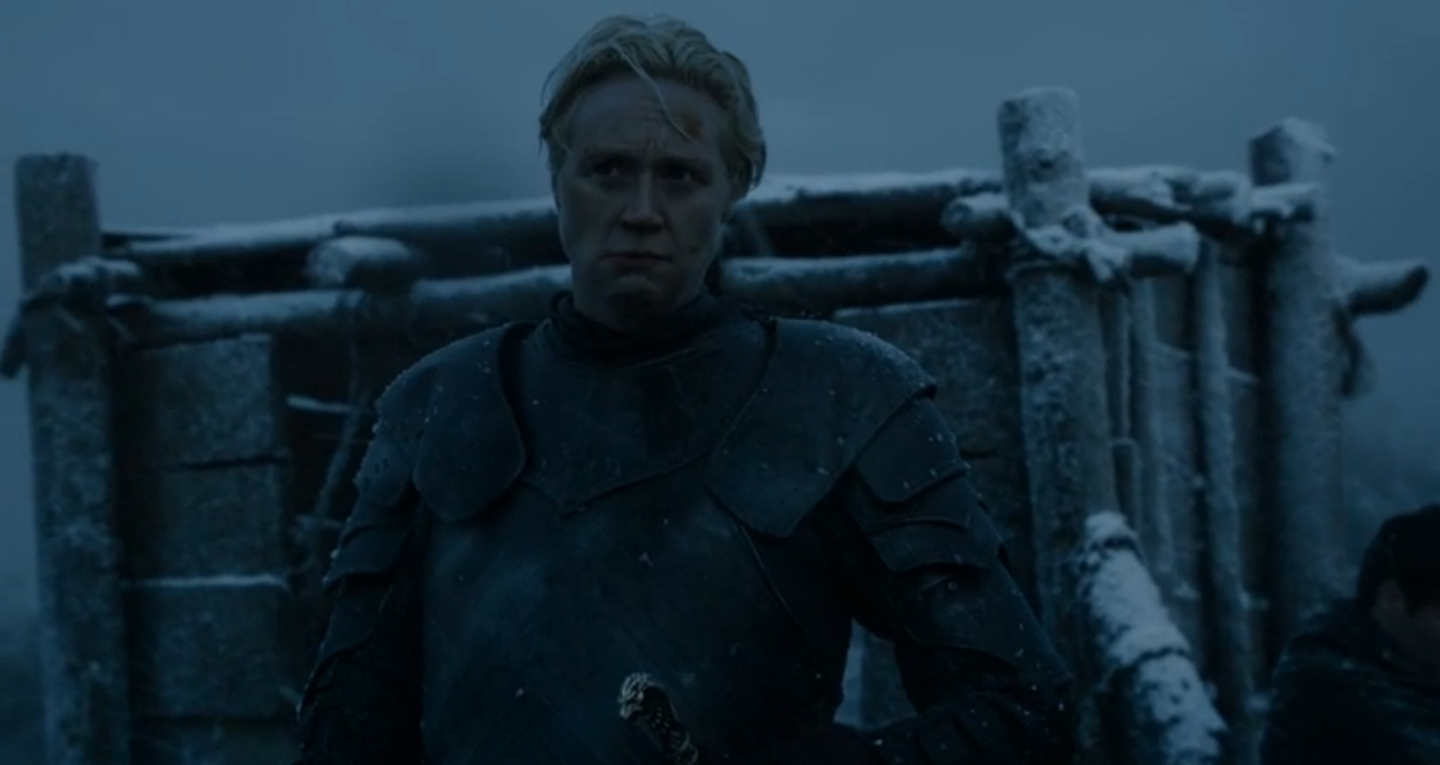
You should watch The Expanse, but you should also read the novels

expanse

Tonight, the new ScyFy Channel series The Expanse premieres, which seems as good an excuse as any for me to nerd out about about the novels from which it is adapted.

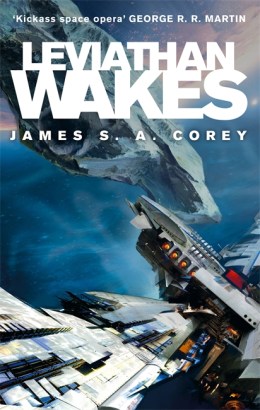
Leviathan-WakesI picked up Leviathan Wakes earlier this year, as much out of curiosity as anything. It’s a thick, brick-like book, and at that point it had three others in the series on the shelf beside it. Its cover featured generic huge-spacecraft art, but what had been catching my eye was the blurb above the title from none other than George R.R. Martin declaring “It’s been too long since we’ve had a really kickass space opera.” Its author, James S.A. Corey, is actually the pseudonym for two people: Daniel Abraham and Ty Franck, the latter of whom was GRRM’s personal assistant for a long time (or might still be, but I suspect he’s busy with his own stuff now). Colour me intrigued: I gave Leviathan Wakes a chance.

And then proceeded to devour the next three books—Caliban’s War, Abaddon’s Gate, Cibola Burn—all of which are 500+ pages, in the space of about a week.

It is a really, really good series, and if you like SF at all you owe it to yourself to read them. It’s space opera in the hands of a pair of pros. Structurally, one senses GRRM’s influence: they proceed through point-of-view chapters like A Song of Ice and Fire, but unlike Martin’s books, they exercise restraint. At no point are we overwhelmed by a surfeit of perspectives, and each novel has a contained narrative arc. They are very tightly plotted, and feature well-realized characters.

The basic premise is a compelling one: set several centuries in the future, humanity has colonized the solar system, but has not progressed into interstellar space. In interviews, the authors cite the fact that the great deal of outer-space SF tends to focus on our first steps in becoming spacefarers, or skips ahead to a point where we’ve mastered the technology that allows us to travel between the stars. What these novels do is posit a future moment when we’ve become quite facile at hopping between Earth, Mars, and the outer planets (the “Belt”), but lack anything resembling the capacity to traverse the unthinkably vast distances beyond. Hence, we encounter a future with a notably industrial, jury-rigged feel to it, as the economies of this future depend upon vast fleets that essentially approximate the tramp steamers plying the oceans of the present. Many of the ships, to say nothing of the ports and shipyards, are old and rusted, oft-repaired; much more Millennium Falcon that U.S.S. Enterprise.

I won’t get into plot points, as my main goal here is to just plug the books. As the series proceeds, however, I imagine there will be a number of posts in the future getting into the narrative particulars.

I do however want to say that one of the things I really love about this series of novels is that they’re a big thumb in the eye of the Sad Puppies. Last April I wrote about the furor surrounding this year’s Hugo Awards, in which a group calling themselves the Sad Puppies successfully lobbied a portion of Worldcon’s membership to nominate their slate of choices, in order to strike back, in the words of one of their more vociferous agitators, “against the left-wing control freaks who have subjected science fiction to ideological control for two decades and are now attempting to do the same thing in the game industry.” To recap, the previous round of Hugo nominees featured a significant number of works by women and authors of colour, or which featured stories with socially progressive elements. And, well, we couldn’t have that!

My blog post on the subject focused mostly on the arguments of author Brad Torgersen, who along with Larry Correia spearheaded the Puppy revolt. Torgersen’s main beef is that science fiction and fantasy (SF/F) has forsaken its origins in order to effect “subversive switcheroos” that appropriate traditional SF/F tropes and pervert them to articulate leftist, social justice agendas rather than good old-fashioned straightforward adventures.

Space opera? Our plucky underdogs will be transgender socialists trying to fight the evil galactic corporations. War? The troops are fighting for evil, not good, and only realize it at the end. Planetary colonization? The humans are the invaders and the native aliens are the righteous victims. Yadda yadda yadda.

Which is not to say you can’t make a good SF/F book about racism, or sexism, or gender issues, or sex, or whatever other close-to-home topic you want. But for Pete’s sake, why did we think it was a good idea to put these things so much on permanent display, that the stuff which originally made the field attractive in the first place — To Boldly Go Where No One Has Gone Before! — is pushed to the side? Or even absent altogether?

You can read the entirety of my critique in my post, but my response basically boiled down to this:

The reductiveness of this kind of thinking is truly sad, as it implies yet another canard—that one can’t do sweeping, epic, Tolkienesque fantasy, or bombastic space opera, and introduce the elements Torgersen derides. Except that you can, and writers do, all the time. It might not precisely be Tolkien or Heinlein, but the last time I was at the bookstore (yesterday), Tolkien and Heinlein were still quite well represented on the shelves.

Which brings us back to The Expanse, which is as perfect a demonstration of this principle as I’ve encountered. The novels depict a racially diverse future, one in which race and ethnicity are hardly remarked upon, often leaving us to divine characters’ origins through their names (Naomi Nagata, Alex Kamal, Julie Mao, e.g.), and features a lot of sharply drawn, compelling female characters without it ever feeling as though this representation is there for the sake of representation. One of the best characters is a U.N. undersecretary named Chrisjen Avasarala, an Indian woman with a marvelously foul mouth, who generally functions as the power behind the throne on Earth (she’ll be played in the TV adaptation by the magnificent Shohreh Aghdashloo). The series deals with such contemporary concerns as corporate power and malfeasance, terrorism, colonialist arrogance and colonial resistance, militarism and the ethics of warfare, and more. And it does so with all the spirit and bombast of the space operas of yore that Brad Torgersen and company lament as passing from this earth.

What’s more, the series delights in the trappings of genre: Leviathan Wakes is a noirish, hard-boiled conspiracy narrative. Caliban’s War, the second in the series, is good old-fashioned military SF, replete with space marines in mechanized combat armour. Abaddon’s Gate is a classic revenge drama. Cibola Burn is a about a standoff between planetary settlers and the corporate interests who have assumed ownership of their new home. And Nemesis Games is the high drama of desperate diplomacy in the midst of war. All of which unfolds from a variety of points of view, but especially from a core group of characters whose depth and complexity is what makes us care about the larger dramas engulfing the solar system.

So I’ll be turning on The Expanse tonight with about the same level of anticipation as a new season of Game of Thrones. My fingers are crossed that it will be good, but early reviews are all positive. Even if I hadn’t read the novels, one critic’s promise that “it will fill the void left by Firefly and Battlestar Galactica” would certainly have me watching.

1 Comment

Filed under nerd stuff, what I'm reading

Donald Trump, Mother Night

donald_trump_esclataor_sk_150616_16x9_992

Since June 16th, the day Donald Trump announced his candidacy for President of the United States, it’s safe to say that the goalposts of “conventional wisdom” have had to be moved so far, it’s entirely possible they’re currently in the next county. Comedians sent up hosannas for the rich veins of humour Trump would provide, but it was generally assumed that his campaign would be ignominiously short. When we arrived at the end of August with his poll numbers only going up, the conventional wisdom was that the end of summer would see the end of his fortunes—people would return from their vacations, start paying more attention to the news, and once that happened, Trump would inevitably fade.

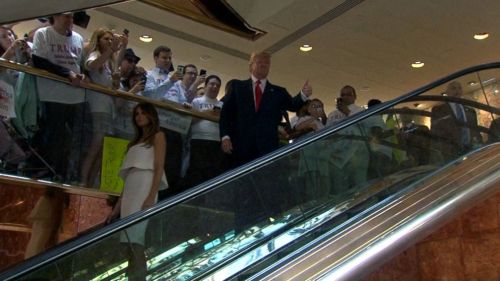
Except that here we are in the middle of December, six months on from that day he rode that ridiculous escalator down to his podium to the strains of Neil Young, and the Donald ain’t going anywhere. If anything, he seems even more entrenched, a fact that is worrisome all across the political spectrum: people on the left blanch at how his outrageous, nativist bigotry has found such fecund soil, while establishment Republicans are terrified at the prospect of the lasting damage he might do the GOP (to be fair, I’m certain there are those on the right who are also appalled at his racist populism, but very few—certainly not those running against him—have been particularly aggressive in condemning him).

One of the theories that has been floated in an attempt to explain his candidacy is that he’s actually colluding with Hilary Clinton: that he’s actually a Democratic sleeper whose entire campaign is an elaborate scheme to destroy any possibility that the GOP could emerge in this election cycle looking accommodating and reasonable (as their postmortem on 2012 strongly encouraged). Those who endorse this theory—though in reality it is difficult to discern just how serious people are when they propose it—point to Trump’s previous associations with the Clintons, to the fact that they attended his (most recent) wedding, that Donald and Bill have been not-infrequent golf buddies, that Trump has made political contributions to both of them, and that in the past he has self-identified as a Democrat. And then there is the matter of the phone call between Donald and Bill in the weeks before his launched his campaign, in which, it has been reported, Bill strongly encouraged him to run for president.

To be clear, I do not buy this theory. At all. If Bill Clinton did in fact egg Trump on, to my mind all that demonstrates is that Bill is a wily old fuck who knew full well that, if Trump heeded his words, his candidacy would throw a massive spanner in the GOP gears (though just how massive a spanner, no one could have foreseen). I think it far more likely that Trump’s run is simply the product of his egoism and narcissism, the desire for a huger, more luxurious diamond-encrusted reality TV stage than The Apprentice. And however brain-dead and idiotic his policy suggestions have been, he’s shrewd enough to know that his brand of populism simply wouldn’t play with Democrats—something he himself noted in 1998, according to a new meme that’s been making the rounds of social media:

trump

The possibility that Trump’s campaign is all an act designed to sabotage Republican fortunes is an attractive idea on both sides of the political coin. On the left, it would give the lie to his egregious stances, and would further be a deeply satisfying thumb in the eye to all those who bought into his rhetoric. On the right—at least among those aghast at Trump’s insurgency—it would recuperate the Republican brand somewhat, to say nothing of confirming everyone’s worst suspicions about the perfidy of the Clintons.

Jeb!

As I say above: unlikely. But then, I’m reluctant to make pronouncements on the Republican campaign(s) anymore.

But let’s for a moment, just as an intellectual exercise, grant the premise. If for no other reason than it makes me think of my favourite novel by Kurt Vonnegut, Mother Night. If Trump’s campaign is in fact a massive ruse, it’s scarcely less horrifying than the more likely scenario that he is serious.

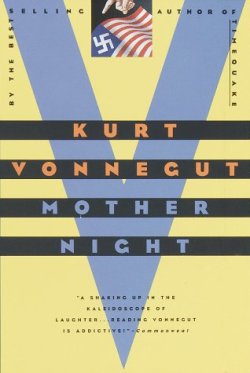
mother_night-largeMother Night is a novel about an American writer and playwright “of moderate reputation” named Howard W. Campbell, living in Germany in the years leading up to the Second World War. His family had moved there because of his father’s business when he was young, and so he grew up as facile in German as in English—and indeed, he works exclusively in German. He married a German actress named Helga, whose father is the Chief of Police in Berlin. Howard and Helga are studiously apolitical: as Germany descends into fascism around them, they withdraw into their “nation of two,” ignoring the political and social upheavals and living the privileged lives of the well-connected and moderately famous.

One day in 1938, Howard is approached in a park by a man from the U.S. War Department, who asks him if he would be willing to serve his country as a spy—to parlay his fame as a playwright into a position within Goebbels’ propaganda agency, broadcasting Nazi propaganda in English. He would be contacted anonymously by American agents in Germany and given instructions on certain words, phrases, and inflections to work into his scripts, which would be coded messages to Allied intelligence.

At first he is reluctant, but the American agent is confident he will cooperate—because, as he says, he has read all of Howard’s plays, and that he learned from them “that you admire pure hearts and heroes … That you love good and hate evil.” Except, Howard notes, his conspiratorial new friend is blind to the real reason this job appeals to him:

He didn’t mention the best reason for expecting me to go on and be a spy. The best reason was that I was a ham. As a spy of the sort he described, I would have an opportunity for some pretty grand acting. I would fool everyone with my brilliant interpretation of a Nazi, inside and out.

And I did fool everybody. I began to strut like Hitler’s right-hand man, and nobody saw the honest me I hid so deep inside.

And so Howard W. Campbell goes from studiously apolitical citizen of a “nation of two” to famous, fulminating American Nazi. Which is how he is known to history: as a traitor who turned his back on his birth nation to spew vile anti-Semitic propaganda for one of the most murderous regimes in history. The novel, incidentally, is presented as a confession and testament written in preparation for his trial for war crimes; he writes in a cell in Jerusalem in 1961, after he has been abducted from New York City by Israeli Nazi-hunters. The U.S. government, having facilitated his escape from Europe at the end of the war, will not confirm or deny his story.

He never knew what intelligence his broadcasts communicated; he never knew what effect he had for the Allied war effort. But he became a darling of the SS and the Nazis’ braintrust, and until the end proselytized their philosophy of hate. And at the end of the war, after his wife goes missing while performing for the soldiers in Crimea, he has one last encounter with his father-in-law Werner, the Berlin police chief and inveterate Nazi who had always hated the fact that his daughter had married an American writer rather than a German soldier. “Did you know,” he asks Howard, “that until this very moment, nothing would have delighted me more than to prove that you were a spy, to see you shot?” But no longer, he says: he no longer cares, because he has listened to every single one of Howard’s broadcasts, which he started doing out of hatred, wanting to study his loathed son-in-law. But he eventually came to a realization:

“You could never have served the enemy as well as you served us,” he said. “I realized that almost all the ideas that I hold now, that make me unashamed of anything I might have felt or done as a Nazi, came not from Hitler, not from Goebbels, not from Himmler—but from you.” He shook my hand. “You alone kept me from concluding that Germany had gone insane.”

Mother Night is an odd novel when considered in relation to Vonnegut’s other writing—odd because it is generally very low-key, lacking the verbal bombast and exuberance of such novels as Breakfast of Champions, Slaughterhouse-Five, or Cat’s Cradle, to say nothing of its quiet realism, utterly unlike the others’ irruptions of the fantastic. There is no “So it goes” in Mother Night, no invitations to take a flying fuck at a rolling donut. And it has something rare in Vonnegut, something he acknowledges in a preface: it has a pretty straightforward moral. “We are what we pretend to be,” he writes, “so we must be careful about what we pretend to be.”

It is a striking variation on George Orwell’s famous observation that “He wears a mask, and his face grows to fit it.” The prospect that Donald Trump’s candidacy might be a charade is no comfort to me—not even close. In fact, I wonder if that wouldn’t in some ways be even worse. One way or another, it’s a reasonably good bet that his increasingly outrageous pronouncements aren’t sincerely held beliefs, but rhetoric designed to elicit roars of approval from the crowd to stoke the gaping maw of his ego. (Here’s a variation on the Clinton-Trump collusion narrative, Hollywood version: he started out as a Democrat sleeper, never expecting to last more than two or three months; but once he found himself on top in the polls, receiving the adoration of thousands of mouth-breathers, he embraced his new identity as conservative demagogue, and the increasingly frantic calls of Clinton staffers go unanswered). But whether his campaign is pretence, pandering, or deeply-held beliefs, its pernicious effects are the same: he has given voice to America’s id, and that’s a genie that won’t be going back into its bottle for a long time to come.

Several times in the lead-up to the Canadian federal election in October, I found myself jotting down notes toward a blog post on Stephen Harper and his increasingly noxious campaign. My principal theme was that it’s unfortunate that we have so often tended to misuse the terms “fascist” and “fascism,” throwing them at conservative figures so frequently that, when something actually approximating a fascist sensibility emerges, they have lost their power and meaning. I think the other reason Mother Night resonates when I think of Donald Trump is that his demagoguery—rallying an aggrieved nativist rump by vilifying certain ethnic and religious minorities through outright lies—has such clear analogues in the twentieth century. And, frankly, we do ourselves a disservice not to point them out.

2 Comments

Filed under wingnuttery

Paris 1919, Paris 2015

paris1919CORRECTION: It was pointed out to me that the Treaty of Versailles dealt specifically with Germany. The partitioning of the former Ottoman Empire, which I discuss below, was performed by the Treaty of Sèvres. Apologies for the inaccuracy.

***

Out of a handful of books that I habitually recommend as “required reading for the modern age,” I probably most frequently proselytize for Margaret MacMillan’s magisterial history Paris 1919: Six Months that Changed the World. It chronicles the negotiation and signing of the Treaty of Versailles, that notorious document that now reads like a roadmap of the twentieth century. I’ve been thinking a great deal about that book in the last few days, as I watch the flow of confusion, argument, and fear in my various newsfeeds.

MacMillan, then a professor of history at Ryerson University in Toronto (she is now at Oxford), wrote Paris 1919 in the late 1990s, and at first had difficulty finding a publisher. After September 11th, 2001, however, she was beating them off with a stick: people looked at the smoking ruins of the World Trade Center, and watched the ramp-up to the invasion of Iraq and asked a series of questions: how did this happen? why did this happen? who are these people, and why do they hate us? In the triumphal decade that spanned from the fall of the Berlin Wall to the fall of the two towers, when America had apparently emerged as the world’s sole superpower and Francis Fukuyama could smugly announce the “end of history,” no one wanted to read a lengthy, detailed history about a treaty that effectively set the stage for the twentieth century’s bloodiest conflicts. But the West’s rude awakening on that crystalline Tuesday morning made MacMillan’s book and others like it hot property.

Why? The Treaty of Versailles is most notorious for imposing humiliating and punishing reparations on Germany, a punitive measure that served to fuel the rise of Hitler and National Socialism. But among the other provisions for the victorious allies was the carving up of the collapsed Ottoman Empire. The western powers divvied up the oil-rich territory into mandates, arbitrarily setting down new borders without consideration given to tribal affiliation, sectarian division, local geography, or for that matter history. Versailles basically drew the lines of what today is Syria, Iraq, Jordan, and Lebanon, and of course Palestine.

MEimageModernMiddleEast2

I bring this up because it is so frustrating to see so many assertions, about Syria, ISIS, Iraq, and the monumental clusterfuck that region has become, made with no regard to history, and the role the West has played in bringing us to this Gordian Knot of tangled alliances, loyalties, motivations, and intentions. If the twentieth century has any lesson for us, it’s that every time the West intervenes in the Middle East, we make things worse. Always. The Treaty of Versailles imposed arbitrarily drawn nation-states on a volatile region with all the subtlety of a sledgehammer. Britain and France governed their mandates in the region through bribery, violence, and the stoking of sectarian and tribal rivalries. The oil-producing regions did not benefit from their resources, as Western stakeholders took the lion’s share of the profits. When the secular, democratically elected prime minister Mohammad Mossaddegh of Iran moved to nationalize the Iranian oil industry, Great Britain and the U.S. orchestrated a coup in 1953 and installed the dictatorial Shah, who would rule with an iron fist for almost thirty years. When he was finally ousted by the fundamentalist regime of the Ayatollah Khomeini , the U.S. encouraged their ally Saddam Hussein with money and arms to prosecute a war in which millions died on both sides, during which Hussein used American-supplied chemical weapons against his own people. When Hussein went a bridge too far into Kuwait and was routed by the U.S. and its allies, the U.S. encouraged rebel factions within Iraq to rise up, but did nothing to support them. Saddam crushed them.

I won’t rehearse the idiocy of Operation Iraqi Freedom, other than to point out that the incompetence of the occupation gave rise to a large number of disenfranchised men with combat training who now form the core of ISIS. And all the while, even as bloviators vilify Islam and paint all Muslims as potential threat, the West remains faithfully allied to Saudi Arabia, the site and source of the most virulent strain of fundamentalism, Wahhabism, looking the other way while they pour huge amounts of money into ISIS. If for a significant number of people in the Middle East the U.S. is the Great Satan, the House of Saud is the Only Slightly Lesser Satan.

And they are our ally and partner in arms deals.

All of this is by way of saying that when you see people on Facebook or elsewhere asking why their tax dollars should go to support refugees from Syria, you might want to not-so-gently remind them that we in the West have profited hugely from that region in the ninety-six years since the Treaty of Versailles was formalized. And that every time we’ve poured our blood and treasure into military interventions, we’ve only made things worse for the people living there.

Nor is this all a form of geopolitical victim-blaming. France suffered a horrific attack from dehumanized monsters, and it is always a blow to the soul to see such terrible things unfold—and it is always more distressing when it takes place somewhere we consider safe. But we should also remember that there was a similar attack in Beruit the day before, and one in Ankara a month ago, and remind ourselves when someone starts honking off about the “clash of civilizations” that Islamist extremism has disproportionately harmed Muslims.

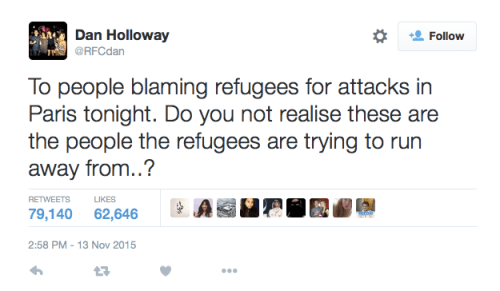
And it is those people who are fleeing. As a much-retweeted Twitter post pithily said, “To people blaming refugees for attacks in Paris tonight. Do you not realise these are the people the refugees are trying to run away from..?”

refugee-tweet

I don’t know what a solution in the Middle East looks like, but it cannot have fear and hatred as its starting point. The West deserves to have some skin in this game, by which I don’t mean we’re owed, but that we owe the world at large to help these people whose house is on fire. And when your neighbour’s house is on fire, as FDR famously said, you don’t haggle over the price of your garden hose. The Paris attacks were specifically designed to make us fear, and to translate that fear into suspicion, paranoia, and ideally hatred of Muslims. That’s what they want. Why on earth would we want to hand them such an easy victory?

Always remember that the road to peace begins with compassion.

Leave a comment

Filed under maunderings

My Idea of Canada: An Apology

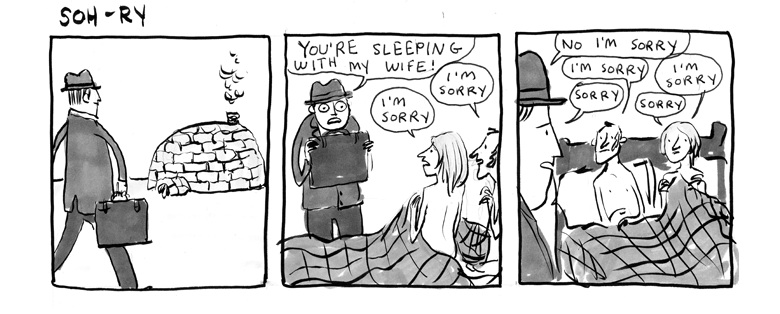
Stuart McLean has suggested that the proper descriptor for a group of Canadians is an “apology.” Stephen Colbert joked that “I’m sorry” means both hello and goodbye in Canadian. The old line is that a Canadian is someone who apologizes to someone who steps on his or her foot.

beaton_apology

We’re mocked for it, and we even more mercilessly mock ourselves, but I do believe that being apologetic is quintessentially Canadian. It’s a key element of our national character. But for those who say it’s a sign of meekness or weakness, I’m sorry to tell you that you’re wrong.

Apologies aren’t necessarily meek or deferential: they are frequently ironic or sarcastic, passive-aggressive, or rank insincerity in the face of bloody-minded or tyrannical ignorance. A case in point: when Galileo recanted his theory of the movement of the heavenly bodies under threat of torture and death, he muttered “Eppur se muove” under his breath. “And yet it moves.” And though he lived the rest of his life under house arrest, he quietly continued his studies and disseminated his research anonymously.

About as Canadian as a seventeenth century Italian can be.

Apology isn’t surrender. The word derives from the Greek apologia, which means a strong defense against a charge or accusation. Considering that one of the most basic elements of Canadian identity is angst over what constitutes Canadian identity, especially in our efforts to distinguish ourselves from Americans, it makes sense that we derive strength and meaning from defending our senses of self against the barrages of the U.S. culture industry.

Apology does not indicate weakness. In its most significant instances, it is about having the strength of character to admit wrongdoing and error, owning one’s past, and possessing sincerity of purpose going forward. When I find fault with my country, it is most often when this last element is lacking.

Apology is humility. It is about always having in the front of one’s mind the knowledge that we may be wrong, or may be in the wrong; not necessarily conceding the point, but waiting, watching, and weighing so as to best understand the given situation, as opposed to arrogantly asserting what we’re determined is the truth.

Further to that, apologetics refers to a series of reasoned arguments: the understanding that the knowledge of how best to govern, improve, or simply live is never a given but the result of honest and open discourse in which disagreement should never obviate listening.

Apology is courtesy. It is politeness. It is the acknowledgement that we share space with other people, and that our right to swing our fist ends where another person’s nose begins. (Unless they’ve just cross-checked you. Then the gloves are on the ice).

sorry

This post started its life as a reflection on everything I believe we’ve lost under Stephen Harper’s government, and became an exercise in articulating my particular understanding of Canada in contradistinction to Harper’s, as we can understand it through his governance.

I think it’s safe to say that Stephen Harper is one of the most unapologetic prime ministers in this nation’s history. His administration has forced our government scientists to mutter eppur se muove under their breaths, because they have otherwise been effectively prevented from disseminating their research or speaking publicly. He has steamrolled the messy, angsty, self-deprecating diversity of Canadian identity with jingoistic nationalism, a celebration of militarism rather than peacekeeping and diplomacy, and the demonization of ethnic and religious minorities. He is congenitally incapable of admitting failure or wrongdoing, relying instead on the hope that people have short memories. He does not allow for alternative perspectives, even within his own party and caucus, denigrating and mocking anyone who calls for anything resembling nuance. He goes out of his way to shut down argument, either by having moronic mouthpieces like Paul Calandra repeat talking points until they’re non sequiturs, or by ramming massive omnibus bills through Parliament in unconscionably short periods of time.

And finally, he is a bully. Of all the pernicious ways he has made good on his promise that “You won’t recognized Canada when I’m done with it,” the fact that he is simply mean-spirited and nasty is perhaps the least of them. And yet to my mind it emblematizes the very spirit of his governance. He has used the PMO to attack and bludgeon whomever he sees as his enemies, political or otherwise, embracing the politics of cruelty as developed in the U.S. by Lee Atwater and refined by Karl Rove. Since taking office, Harper has made it clear through word and action that he prefers the American style of politics to ours, and gone out of his way to do so: from Rovian attacks and smears, to the transformation of the PMO from Westminster—“first among equals”—to the west wing. All the while systematically denuding everything Canada has symbolized on the world stage.

Of the myriad things that I, as a Canadian, feel compelled to apologize for, I won’t apologize for my Prime Minister. He doesn’t deserve the consideration.

captain_apology

2 Comments

Filed under Uncategorized

Game of Thrones 5.10: Mother’s Mercy

gameofthrones_teaser02_screencap10

Hello friends, and valar morghulis. All men must die, and all television seasons must come to an end. It has been four years and five seasons of Game of Thrones that the beautiful and talented Nikki Stafford and I have reviewed and recapped, and I couldn’t ask for a better writing partner in this endeavor. So thanks to you, Nikki, for your forbearance and your insight, as we once more put a season of Starks, Lannisters, Targaryens, and everyone in between to bed.

I’m going to go out on a limb and guess that every dedicated watcher of the show who has not read the novels is still lying on the floor in the fetal position after this episode. I know this because I have read the novels, and I’m lying on the floor in the fetal position. It makes typing extremely difficult though, so perhaps you should begin, Nikki.

jon_sam 

Nikki: I have begun this first pass 15 different times… I don’t even know where to begin. (I even tried one that was simply, “Wow, that was quite the episode, what did you think, Chris?” just to avoid having to go first…)

We’ll get to the ending of this episode in good time, although I can’t promise that I won’t mention it once or twice. I mean, for god’s sakes, I’d invested so much in that character! I thought everything was going to come down to him!! It’s one thing to kill off Ned Stark after one season as a big shocking ending, but to build up Jon Snow as this man of mystery with a big secret in his past and then… ah, we were just kidding folks, sorry you took so much time theorizing who his real parents were: he was just a red herring. Run along, now. I honestly thought he was the son of Lyanna Stark, Ned’s sister, with Rhaegar Targaryen. I thought he was the last male Targaryen, with lineage leading to the Starks after all.

Bah.

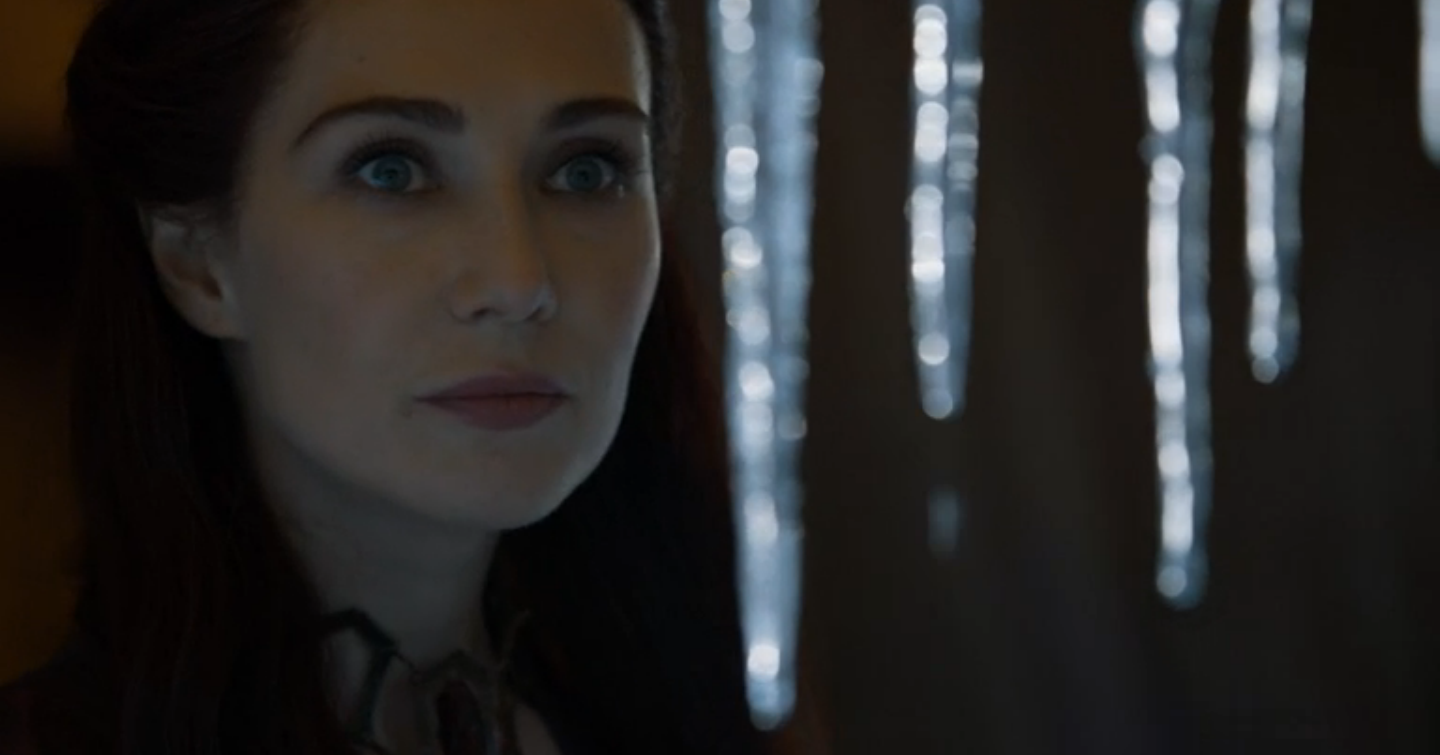
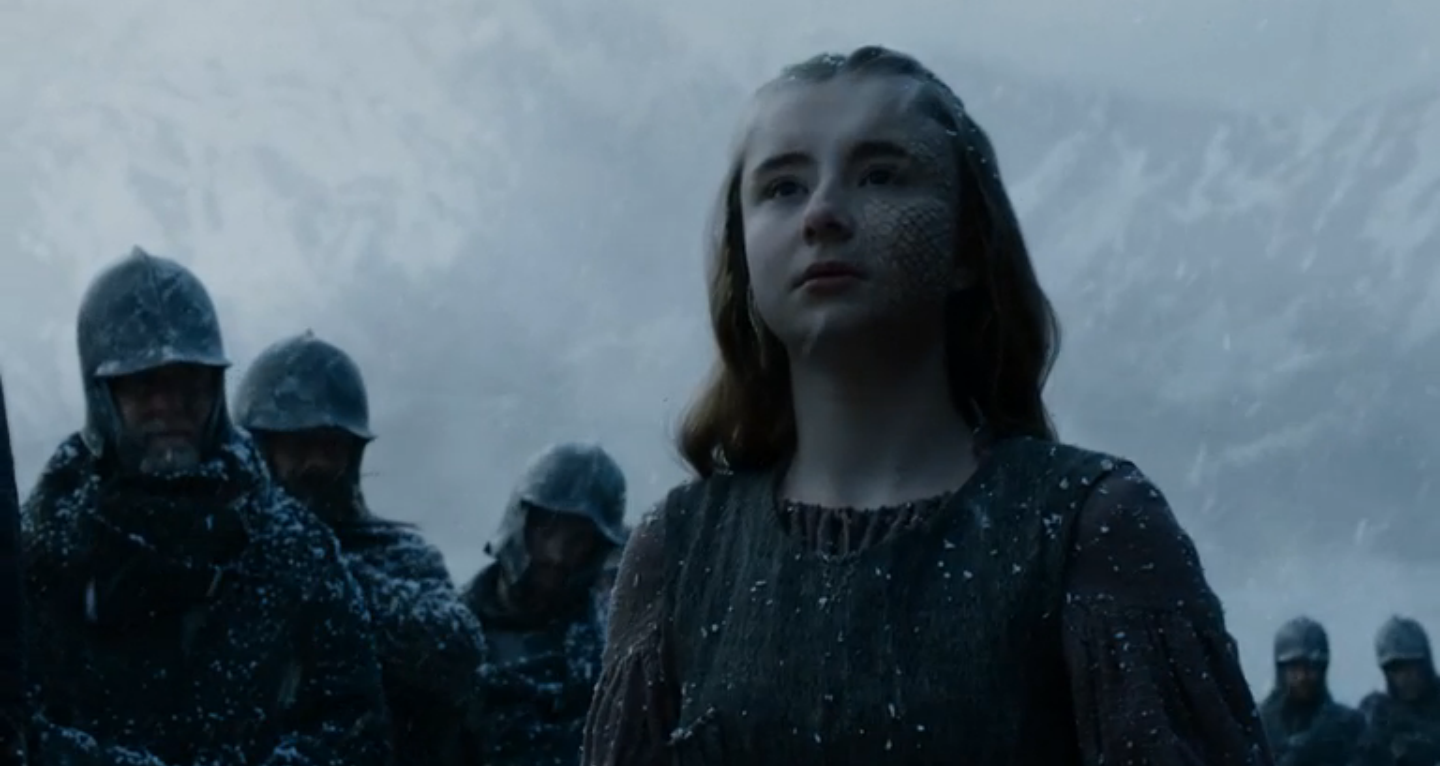
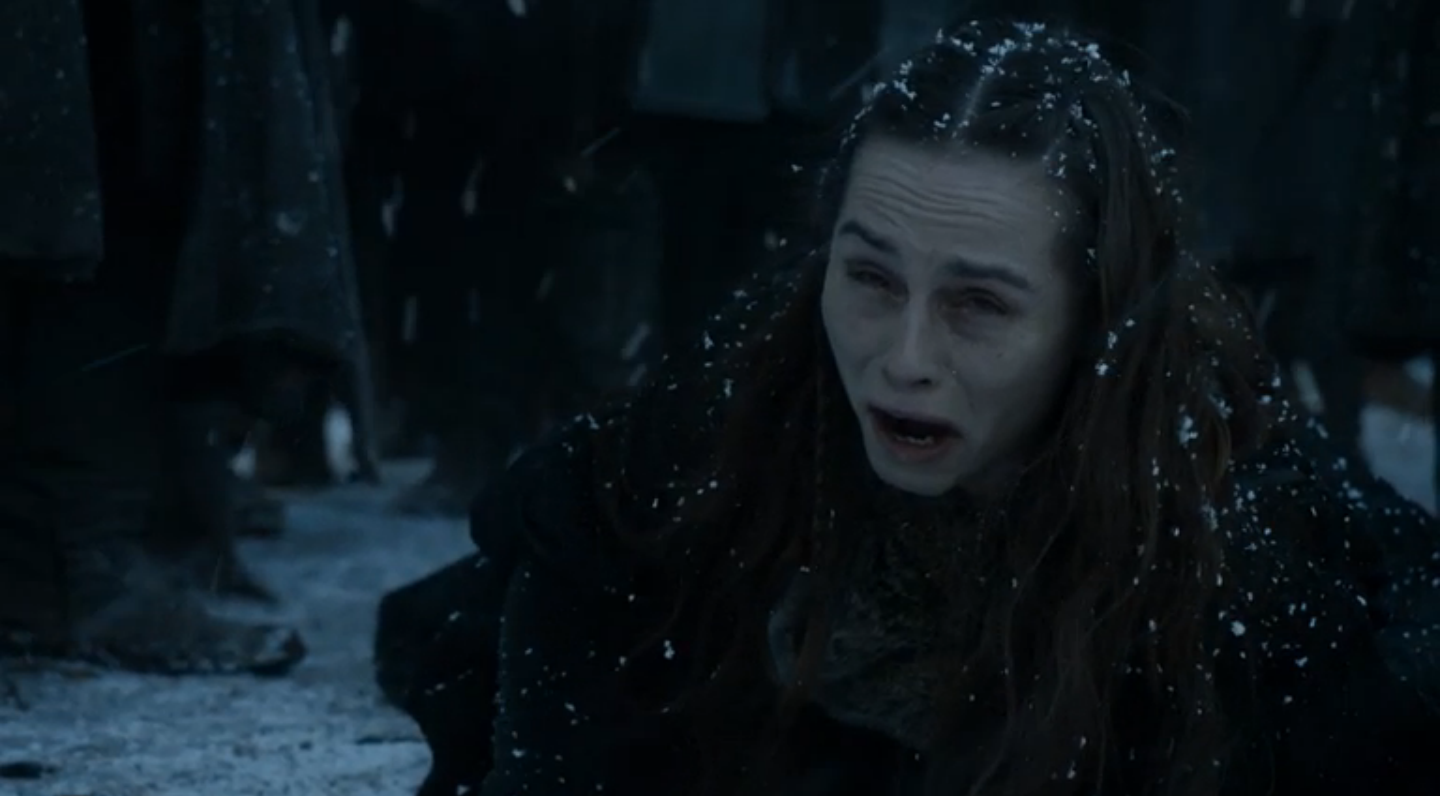
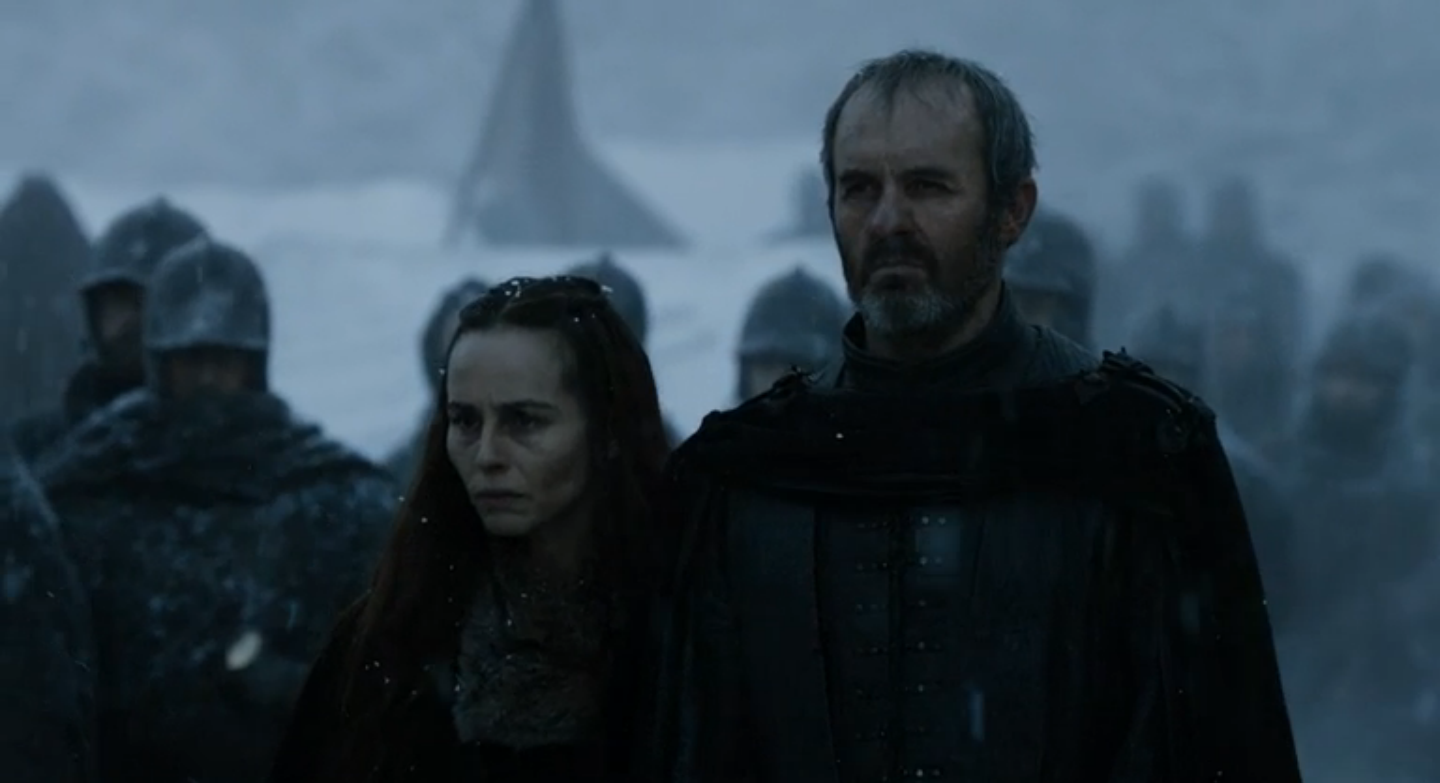
But more on that later. Let’s open with the fallout of What Stannis Did last week to Shireen. I don’t have to remind you of the horrific action he took in the name of becoming even more powerful than he already was. And even as we were watching it, you couldn’t help but see the look of disgust and horror on the faces of Stannis’s followers. So, despite the episode opening with a triumphant Melisandre, noting that the ice is beginning to melt and that must be a sign from the Lord of Light that Stannis’s sacrifice was a worthy one, he can’t exactly do much fighting if half his army has deserted him. Without sellswords — or horses, for that matter — Stannis isn’t exactly going to be a formidable foe on the battlefield. When Stannis gets the news and darts a look at Melisandre, she looks confused, then closes her eyes as if wondering if she might have made a wee error in judgment last week. When another soldier approaches Stannis with news — “It can’t be worse than a mutiny,” says Stannis naively — he’s led to Selyse’s body, where she’s hanged herself either out of agony of losing her daughter to her husband’s ambition, or to avoid having to tell him that whoopsie, she wasn’t actually your baby and therefore had no king’s blood… or both. AND THEN, while he’s watching his wife’s lifeless corpse get chopped down from a tree, a third messenger informs Stannis that Melisandre has apparently decided she hitched her cart to the wrong horse and has abandoned him, too.

mel_icicles

Well THIS is turning out to be a terrible, horrible, no good, very bad day for Stannis, now, isn’t it? (Maybe you shouldn’t have tied your daughter to a fucking wooden stake and burned her, you dickhead.)

And so, like the Monty Python knights, Stannis’s army marches on Winterfell sans horses — though, sadly, no one thought to click some coconut shells together for mere effect — and think they’ll somehow scare the Boltons into surrendering. Stannis has given up at this point: you can see the look of resignation on his face, the lack of determination as he practically shrugs before drawing a sword to run to his inevitable death.

A few minutes and several thousand deaths later, the Boltons are victorious, but Stannis has somehow persevered, and we watch how, if he just hadn’t been taken in by Melisandre and her Lord of Light voodoo, he could have been unstoppable. But after getting stabbed in the gut and the leg, he’s unable to go any further, and falls against a tree.

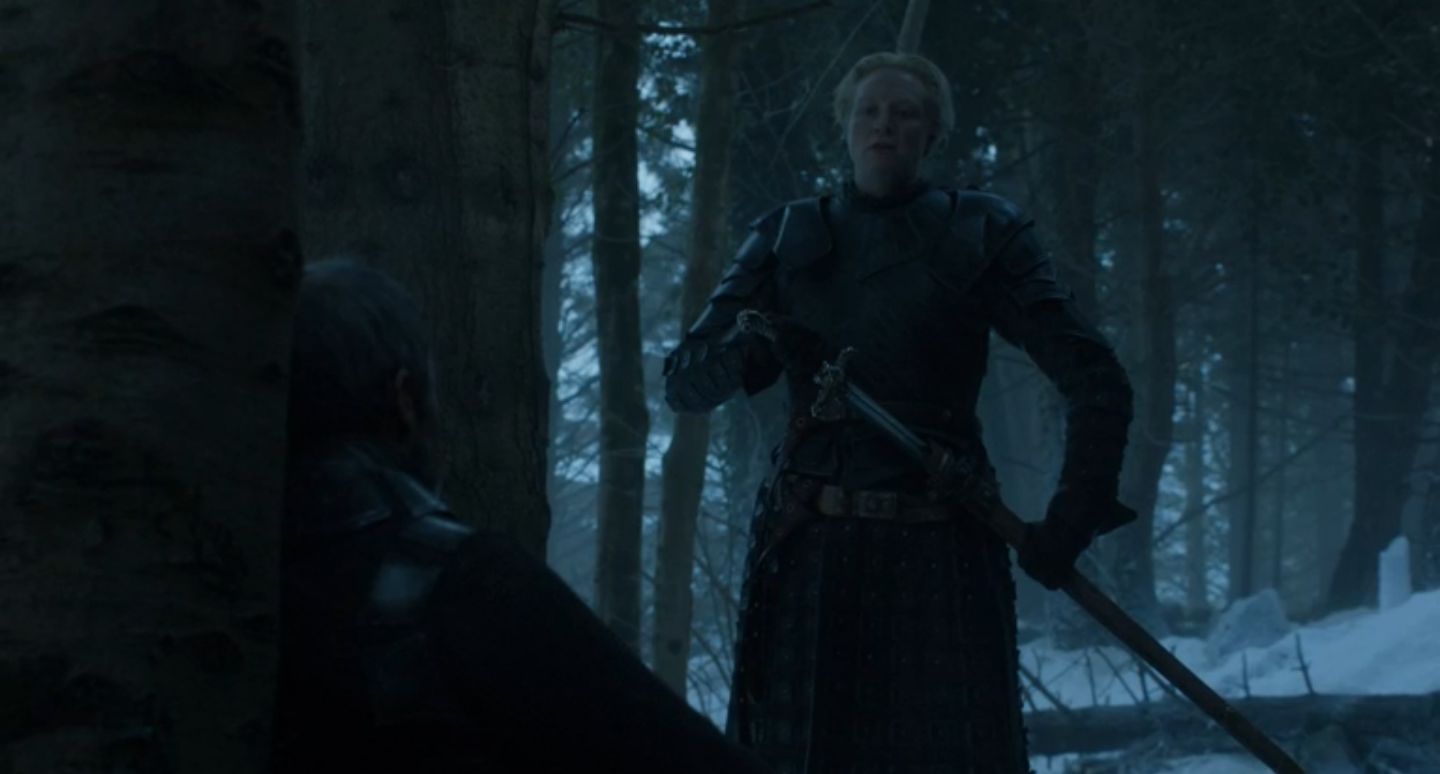
And that’s where Brienne finds him.
brienne_stannis

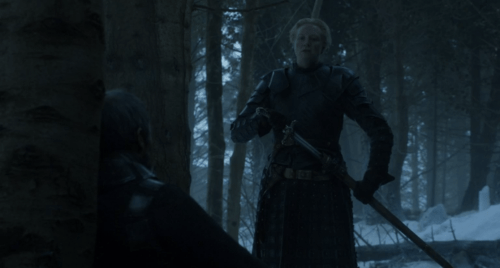
I’ve been waiting for most of the season for Brienne of Tarth to play a more major role in the goings-on, and instead she’s spent most of the season leaning against a wall, staring at a window for any sign of a distress light (I found it rather cheesy that the very moment she turns her back, the window lights up with Sansa’s candle…) but in this incredible scene, she shows that the name of her sword — Oathkeeper — is an apt one indeed. For not only has she found herself on the edge of Winterfell to keep an oath she made to a woman who is now dead, but she kills Stannis Baratheon in the name of Renly Baratheon, to whom she made an oath that predated the one she made to Catelyn, and she now gets to follow through. Stannis looks up at her, and one can only imagine what is running through his head — My seat on the throne was compromised by that blonde harpy in King’s Landing whose bastard son is now sitting on it. My main foe is a silver-haired mother of dragons in Meereen. I gave up everything I had, everything I loved, for a redheaded madwoman who promised me everything. And now I’m about to be killed by a giant woman in a suit of armour. Well colour me thrilled.

But he no longer has anything to live for; if anything, the sudden arrival of Brienne is merciful for Stannis; his only other option was to lie there bleeding out, or, more likely, to be captured and tortured by the horrific Boltons. With the knowledge of the unforgiveable thing he did to his daughter — her screams still echoing in his head — and the desertion of his men, his wife, and his god, he has been reduced to nothing.

Now, with Stannis gone, there’s one less person in line for the Throne, and the puzzle pieces once again realign. My money would have been on Jon Snow except for ONE LITTLE THING. Later, later.

Meanwhile, over in Winterfell, we finally get the return of Theon and a hint that he just might have some balls after all. What did you think of these scenes, Chris?

brienne_watchful

Christopher: Like you, I thought it more than a little contrived that Brienne would desert her post just seconds before Sansa’s candle became visible. Of course, once Podrick sees Stannis’ army on the march, you know exactly what is about to happen. Quite frequently the writing on this show has been surperb … this was not one of those moments, but was rather totally hackneyed and hamfisted. I would have preferred Brienne seeing Sansa’s candle just as Podrick brought the news, and having her make a painful choice between oaths—for after all, which one is more sacred to her? Her oath to Catelyn, or her oath to Renly’s memory? How much more dramatic tension would ensue if we’d seen her struggle and then say “She’ll still be there,” and run off to kill Stannis? For a show that, at its best, is often about impossible choices, they missed a great chance to put one to Brienne.

It’s funny that you took so many tries to get started on this post—my principal thought when the credits rolled was “well, thank the gods Nikki has to lead us off.” The one thing that did occur to me as I reflected on everything that happened was that, aside from Tyrion and Varys’ muted but happy reunion, the happiest ending in this episode was Cersei’s. Think about that: though she endured unspeakable humiliation and indeed torture as she made her naked walk from the sept to the Red Keep, she was welcomed with an embrace, the relief in knowing that she wouldn’t have to endure another moment in her cell, and hope. Whereas Daenerys ends up surrounded by a circling Dothraki horde, Arya pays for her assassination with blindness, Sansa and Theon leap off a very tall wall, Jaime Lannister watches his daughter die in his arms, Stannis watches his ambitions crumble before him, Brienne has her revenge at the expense of losing Sansa, and Jon Snow …

Yeah, you’re right—we’ll come to that last one in a little bit.

For a show that has never hesitated to leave us with our stomachs in our mouths and the prospect of spending nine and a half months waiting for the next season in the fetal position, they’ve pretty much outdone themselves. By a magnitude. The number of people in my Facebook feed saying “Fuck you, Game of Thrones!” or something to that effect was quite amazing (if unsurprising).

That being said, I don’t think all things are quite as dire as we may imagine. But I will come back to that thought.

I’m reasonably certain that people will agree when I say that one of the most satisfying moments in this episode was when Theon knocks Myranda off the walkway to her death. In an episode with somewhat uneven writing, I thought they hit all the right notes here. The question until now has been what would shock Reek out of his stupor and let him be Theon again? We’ve seen some of Theon burble up to the surface here and there this season, such as when he’s required to name himself properly at Sansa’s wedding and, more importantly, when he confesses to her that her brothers are actually alive. But these moments have been ephemeral, overshadowed by his betrayals.

theon_sansa

But Myranda’s gloating speech to Sansa detailing how dire her future would be once she tattled on her was too. “If I’m going to die,” Sansa says, looking over Myranda’s shoulder at Theon, “let it happen while there’s still some of me left.” But no, Myranda says: Sansa’s father was Warden of the North; Ramsay needs her. “Though I suppose he doesn’t need all of you. Just the parts he’ll use to make his heir—until you’ve given him a boy or two, and he’s finished using them. Then, he’s got incredible plans for those parts.”

If anything was to break Reek out of his reverie and bring back Theon, it was this threat. In her moment of sadistic triumph, Myranda inadvertently said the very words necessary to re-masculate Theon, rehearsing for Sansa the very hell he endured at Ramsay’s hands and finally cracking the façade of Reek. After throwing her down to the distant ground below, he and Sansa take hands and make their own leap on the other side of the wall—but theirs is a leap of faith. And though he dispensed with Myranda’s threat, it isn’t a heroic rescue: they jump together, hands entwined, siblings once more.

One only hopes that there is a big-ass snowdrift beneath.

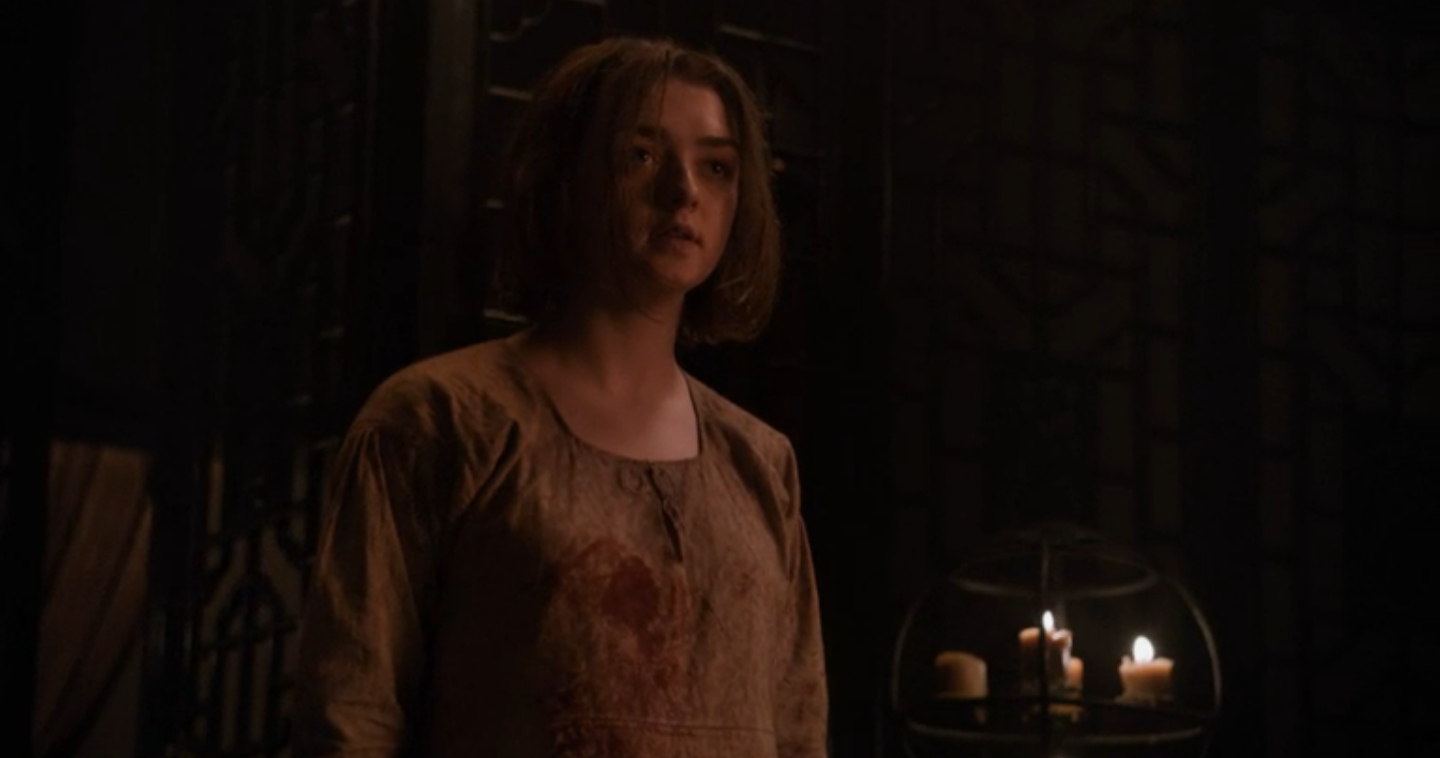
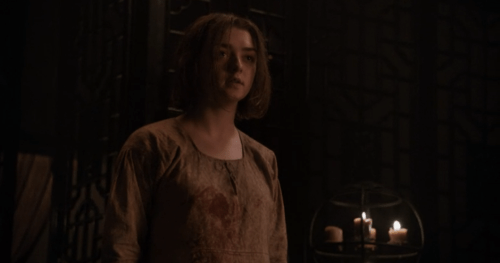
If Myranda’s death was one of the satisfying moments of the show, Arya’s dispatching of Meryn Trant has to be another. This scene was not what I was expecting, not exactly—certainly it was bloodier and more brutal than I’d thought, and it was followed by Arya’s punishment for taking a life she had no sanction to take. Here it squares up with the novel: after killing someone on her own whim, she is rendered blind. But in A Feast for Crows, she merely wakes up without sight. Here, the scene—as she rips face after face off the corpse at her feet, finally coming upon her own—is far more fraught (and indeed terrifying). What did you think of Arya’s scenes in this episode, Nikki?
arya_brothel

Nikki: And even if you DON’T subscribe to the idea that Jon Snow is a Targaryen, wouldn’t those black locks insinuate he’s perhaps Robert Baratheon’s son? Maybe Robert consummated his love with Lyanna after all? I mean… come on.

Now, I will admit, as soon as it happened, my husband immediately said, “Welp. There goes Jon Snow,” and I simply would have none of it. I said no, there’s no way there goes Jon Snow, he’s going to live through this one because he is too damn important. And then Olly — the one I knew was trouble as soon as first Jon and then Sam dismissed him with a chuckle and a ruffle of his hair when he was trying to explain to them what it’s like to watch his parents be slaughtered in front of him — stuck that dagger right in Jon’s heart (the appropriate spot for it, coming from a boy Jon has come to care about) and my husband went, “Nope. Jon Snow is deader than dead.” I still can’t accept it.

Anyway… let’s not discuss that just yet, of course. (Ahem.)

Arya’s scenes were stunning. First you see the despicable Meryn Trant whipping the little girls while planning to do unspeakable things with them, and the third one doesn’t even flinch. With her head down, her hair swirled around her face, it was clear they were hiding her identity, and I said to my husband, “Heeeeere’s Arya!” in my best Shining impression. And then she looked up, and he said, “Nope.” And I was confused but then at the same time we were like, “Ooh, ooh, what if she’s a faceless person now??” and sure enough… theeeeeere’s Arya! The swiftness with which she leapt on Trant, stabbing him in the eye (which was awesome), before pulling out the knife and stabbing him in the other eye (HAHAHAHA!) and then stabbing him everywhere made me wonder if this was actually a dream sequence, because how often on Game of Thrones does something actually happen that you WANT to happen? But the scene kept going, not pausing to cut to Arya sitting up in bed, covered in sweat. Instead, she continues stabbing Meryn before finally pulling an Inigo Montoya, pausing to tell him, “My name is Arya Stark. You killed my dance instructor. Prepare to die” and then slicing his throat. Wow. Five years of promise that Arya’s character has had, from her lessons in swordfighting to the way she somehow stayed alive all this time despite all the odds, paid off in this one scene.

jaqen_displeased

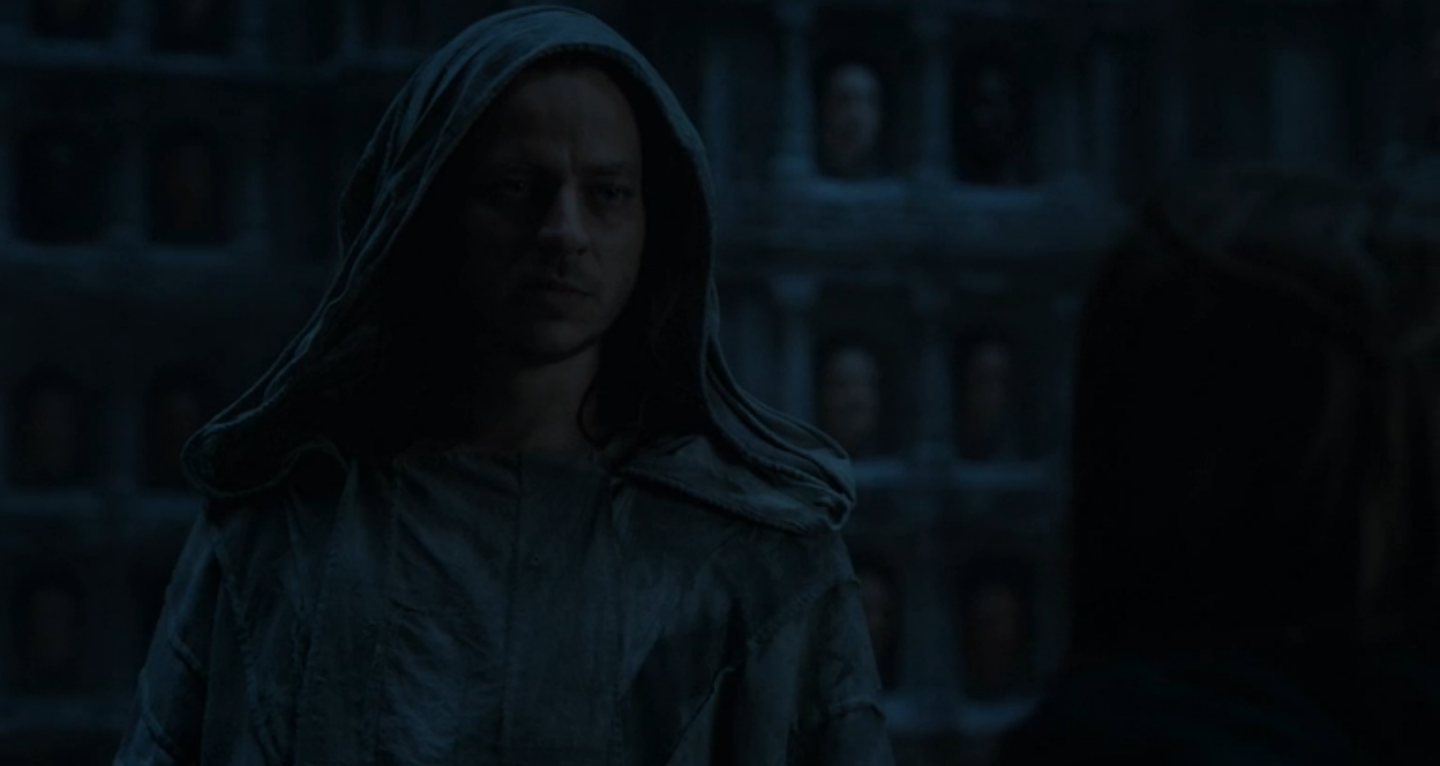
Not that Jaqen was thrilled about it. She owes the Many-Faced God a debt for Jaqen having been her saviour all the way back in season two, and she’s here in the House of Black and White to pay that off. She wants to become a Faceless Person (is it Man? I’m confused by the gendering of this term when the only other person there besides Jaqen is a female) but as long as she has hatred for someone because of what that someone did to Arya Stark, she cannot be No One. And so he takes away the one person to whom Arya still has a tie in this world — himself. (Me: “NOOOOOOOO!!!”) Or so she thinks. As Arya begins flipping the faces off the corpse, one by one — in a brilliant effect that is one of the more startling things I’ve seen on this show — it runs through the people she’s washed, the people whose faces she’s seen, until finally resting on her own. And in that moment she discovers what Jaqen means when he says a debt must be paid — an eye for an eye. She stabbed Meryn Trant in the eyes so he was blind in his final moments, and now she’s afflicted with blindness for the rest of her life. It was horrifying, and something I didn’t see coming. How will Arya survive now? Is it possible she’d have any of the abilities of her brother Bran, who can “see” in a way other than using his eyes?

OK, so. Selyse is dead, Stannis is dead, Myranda is dead, and Arya is blinded. And somehow these are footnotes compared to what happened at the end. So let’s continue this Happy Fun Parade of Death by moving over to Dorne. What did you think of what happened there? Was it consistent with the books?
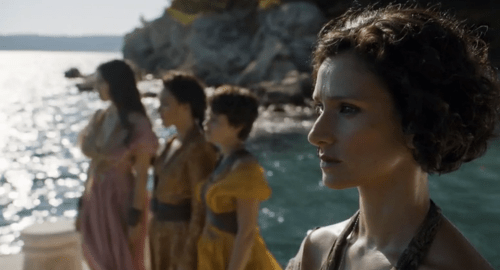
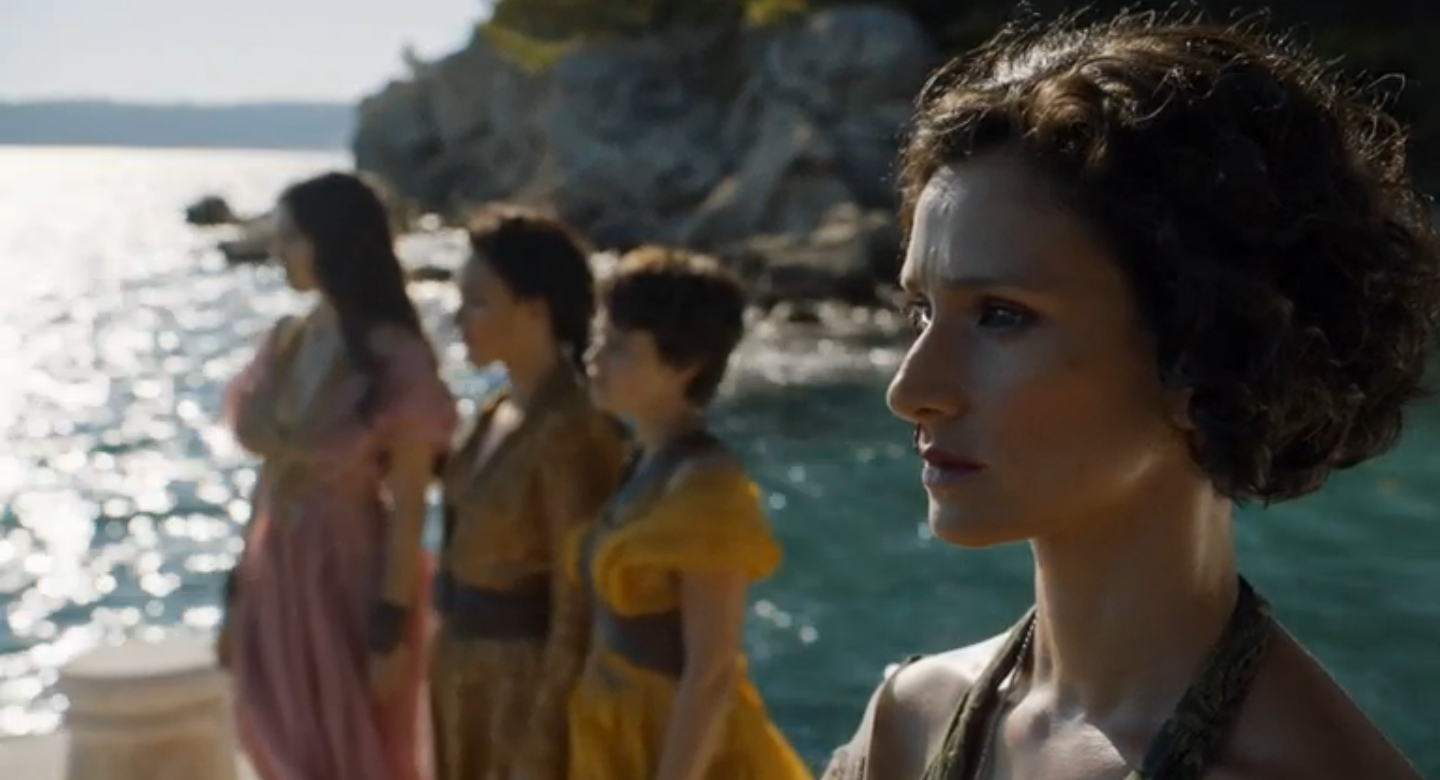
ellaria_snakes

Christopher: In no way whatsoever. At this point, the Dorne story bears about as much resemblance to the books as Tyrion does to the Mountain.

Last week I suggested that those saying the Dorne storyline was pointless were likely mistaken—that it looked as though, with Trystane and Myrcella’s engagement firm and him promised a place on the Small Council, that Dorne had secured a not-insignificant niche in the story to come. Well … one way or another, I think Dorne has a substantive role to play in seasons to come, but for obviously very different reasons now. Unless Myrcella makes a surprising recovery in season six, the marriage pact between Lannister and Martell is just so much dust; and I doubt it would take a genius to deduce that Myrcella’s poisoning was the fault of Ellaria (certainly not if they’ve ever watched the episode of Firefly when Saffron uses her drugged lipstick to knock out Mal). One way or another, I suspect war between Lannister and Martell is imminent.

And once again, Weiss and Benioff appear determined to one-up their source material in terms of giving and taking away. Last week, Stannis betrayed the loving conversation he’d had with Shireen several episodes earlier. This week, Jaime has all of seconds to rejoice in his daughter’s recognition and acknowledgement of his paternity. It really is a poignant scene, made all the more so by Jaime’s bumbling attempts to preface his revelation. But Myrcella stops him mid-bumble: she knows, she tells him; she’s known for some time. “I’m glad that you’re my father,” she tells him, and the look on Jaime’s face is heartbreaking … or rather, it shortly becomes heartbreaking as Ellaria’s poison takes effect, and she collapses into his arms.

myrcella_nosebleed

Cut back to the dock where Ellaria and the Sand Snakes silently watch the boat recede in the distance. Ellaria’s own nose starts to bleed, and is impassively tended to by her daughter. Last week we pondered whether Ellaria’s comments to Jaime—in which she said that Dorne cared not a whit that he and Cersei were lovers—signaled a détente or hinted at a deeper threat. Well, now we know … and I have to wonder now if Myrcella’s certainty of her parentage was cemented in Dorne, by Ellaria or similar people who told her in the guise of open-mindedness of her mother’s incestuous relationship.

One way or another: I really, really want to see these characters in future seasons.

After Dorne we move to a dejected throne room in Meereen, where Tyrion, Daario, and Jorah engage in a collective mope. “You love her, don’t you?” Tyrion asks, and it is obvious the question is directed at both of them. “How could you not? Of course, it is hopeless for the both of you—a sellsword from the fighting pits, and a disgraced knight? Neither one of you is a fit consort for a queen.” They are joined by Missandei and a still-wounded Grey Worm, and after a bit more comic banter (my favourite line from this episode is “My Valyrian is a bit nostril”), they get down to the big question, the elephant in the room—what to do with Daenerys gone? How to run the city?

Well, at least they’ll have Varys with them. What did you make of the Meereen scenes, Nikki?

mope_trio

Nikki: Haha! I was texting a friend today and we were both like, “Our Mrs. Reynolds!!” regarding the lipstick scene. I wonder how many other fans noted the Firefly moment there.

Speaking of fiery redheads (didja see what I did there??), I can’t help but think a certain redhead on this show might be the one to change the fate of our poor dead friend at the end of the episode. It can’t be a coincidence that she showed up at Castle Black hours before the guy was killed. (Yes, this is what absolute denial looks like.)

But anyway, as you mentioned, the Meereen scenes were the short moments of humour we got in an episode that didn’t otherwise have much of it. We have here the man who loved her but it was unrequited, the one who bedded her, and the one who wants to help her topple his own family. As they stand up and begin to bicker, it’s like watching a Three Stooges routine. Tyrion’s the only one who doesn’t have a torch for Daenerys, and therefore the other two vote him off their road trip. At first Tyrion looks shocked, until Daario asks him if he’s ever tracked animals (no), can he fight (not really), is he good on a horse (middling). “So… mainly you talk,” Daario concludes. Tyrion nods his head, “…and drink. I’ve survived so far!” Daario illustrates for everyone present that Tyrion simply wouldn’t be an asset to the search party. But he would be useful as someone left behind to govern Meereen in Dany’s place, since, among all of them, he’s the only one who knows anything about actually governing a people. And he’s proven himself to be good and fair (Mormont is pissed that Tyrion had him exiled once again, but seems to have forgotten that he successfully negotiated for Jorah’s life to be spared).

Jorah disagrees at first — “He’s a foreign dwarf that barely speaks the language, why would anyone listen to him?!” — but Daario proves he’s more than just muscle when he continues to convince everyone that this is the right thing to do. He assures them that Grey Worm is the one whom the Meereenese people will listen to. (I agree that the “nostril” line is hilarious, but my favourite line of the episode is Daario saying that Grey Worm is the “toughest man with no balls I’ve ever met.”) Missandei is the woman Daenerys trusts above all others, so she completes the new triumvirate.

tyrion_varys

I thought at first this was how we were going to leave our favourite imp, until he walks outside and sees the beginning of the Daario and Mormont road show beginning on the road below. And then the line, from behind Tyrion, in an unmistakable voice, “Hello, old friend.” You know, I didn’t know how much I missed Varys until I heard his voice. I squeed very loudly when that happened. Remember: the last time we saw Varys this season was in episode 3, right before Tyrion was captured by Ser Jorah and taken away. When he’s on screen, he’s scintillating, but because he’s not a major player in the game of thrones, we can forget him when he’s not there. Now, I realized the only thing better than Daenerys ruling with Tyrion by her side would be Tyrion ruling with Varys by his side. Tyrion asks for his advice on the spot, and Varys says basically, know the difference between your friends and your enemies. “If only I knew someone with a vast network of spies,” Tyrion jokes. “If only,” Varys echoes, his head tilted comically.

“A grand old city, choking on violence, corruption, and deceit. Who could possibly have any experience managing such a massive, ungainly beast?” says Varys with a twinkle in his eye. Tyrion looks at him, and back out over the city with a smirk. “I did miss you,” he says. And so did we. I think seeing these two manage Meereen might be the thing I’m most looking forward to in season six. (Aside from the resurrection of Jon Snow, of course…)

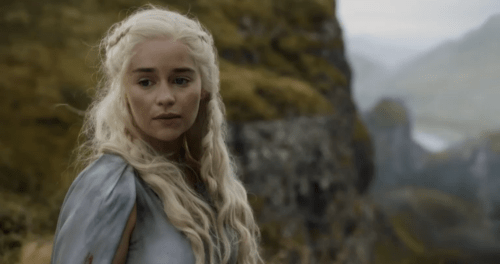
And from there, we see where Dany ended up, and I must admit, her story left me with a ton of questions: were those Dothraki who surrounded her? And why did she drop Khal’s ring on the ground? Was it to hide the fact that she was the Khaleesi in case these were enemies of his, or was she leaving a signal to someone else on how to find her?

Either way, I’m thinking she’ll need some bleach for that dress.
daenerys_cliff

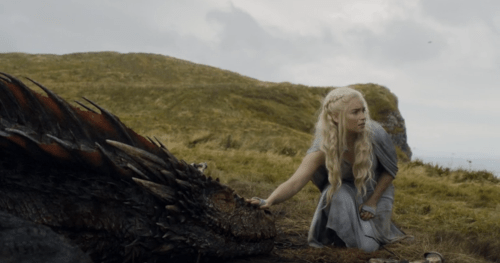
Christopher: They’ve ended Daenerys’ story on a slightly different note than in the novel. In A Dance With Dragons, she’s just sort of along for the ride as Drogon wanders around the countryside. The first indication of the approaching khalasar is a herd of wild horses preceding the riders, one of which Drogon burns and proceeds to eat. Daenerys, at this point starving (she’s been gone from the city for at least two days) helps herself to some of the charred horseflesh. It is in this way, with her dragon beside her, that the Khal and his men find her.

In the novel, the Khal in question is Jhaqo, who was one of Khal Drogo’s lieutenants, and who claimed a sizable chunk of Drogo’s people after he died. Here, we’re not certain: the Dothraki come on Daenerys suddenly, catching her alone. I have to imagine she drops Drogo’s ring so they do not identify her, though it could also be a signal to whoever searches for her. One of the things we learned about Dothraki culture in A Game of Thrones was that a khaleesi was expected, on the death of the khal, to go and live out her years in the Dothraki city Vaes Dothrak as part of the dosh khaleen, a group of widows who also function as seers. That Daenerys refused to do so was a great point of contention with her bloodriders … until she survived the fire and found herself with three dragons, which kind of changed the calculus.

Finding her out in the middle of the Dothraki Sea, rather than in her proper place, Khal Jhaqo will undoubtedly be confused and angry, but then with Drogon beside her, he can hardly complain. But that’s the novel: in the show, they’ve separated Daenerys from her dragon (who has gone from being a fearsome beast to a sulky cat), and we don’t know who the leader of these Dothraki is … or whether any of them are from Drogo’s fractured khalasar and will recognize her. I don’t know where they plan to go from here. I suppose the obvious thing will be that the Dothraki abduct her and ride off, and we’ll have an episode or two that plays out like the chase scene in The Two Towers, with Jorah and Daario playing the parts of Aragorn et al to Daenerys’ Merry and Pippin; during which, presumably, Drogon will be conveniently absent, and they will find Drogo’s ring in much the same way Aragorn finds Pippin’s brooch (if Jorah says something that’s a variation on “Not idly do the leaves of Lorien fall!” my head might actually explode).

Or … maybe she’s recognized and something else happens entirely. I’m just spitballing here.
daenerys_drogon

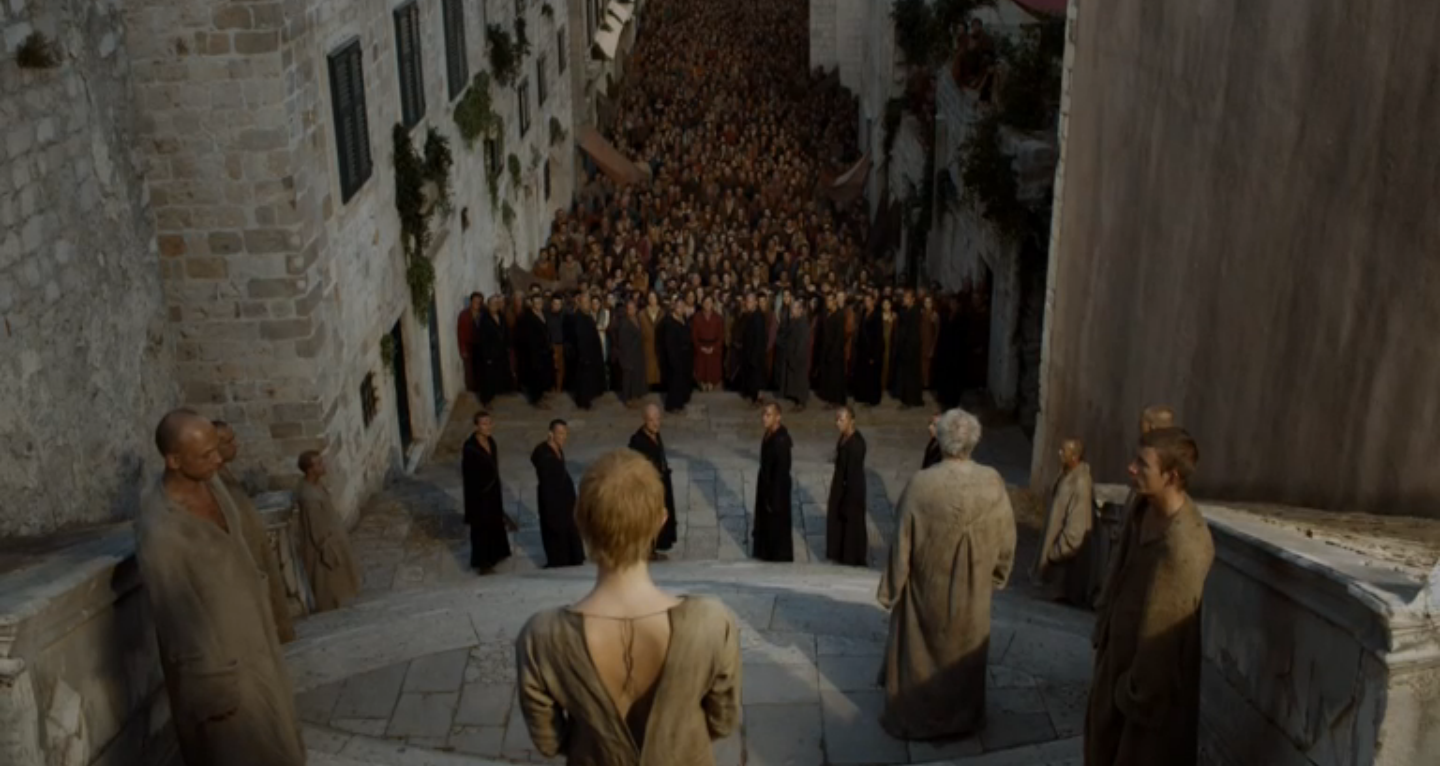
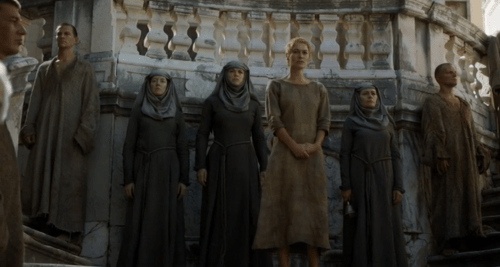
We have, however, come definitively to the end of Daenerys’ story in the novels. Similarly, we’re more or less at the end of Cersei’s as well. Her long, humiliating walk from Baelor’s Sept to the Red Keep is depicted almost precisely as it is described in the novel. And once again the show demonstrates that it is able to shift our sympathies quite deftly: for many episodes we waited eagerly to see if Cersei would get her comeuppance, and it was deeply satisfying to see that smug smirk of hers wiped off. But somewhere early on in her walk of shame, it is difficult not to feel sorry for her and to hate the self-righteousness of the Sparrows (well, hate it even more than we already did).

And kudos to Lena Headey for going the full monty, especially considering that there was nothing sexual about her nudity in this scene. Indeed, this was one of the rare sequences on this show where nudity is employed not to titillate but to engage our sympathy. We’ve written previously about how Cersei has lost everything: her beauty and her name were her weapons in the past, but here she is literally stripped of everything, and however beautiful she is, her exposure before the hateful mob is appalling to watch.

What did you think of Cersei’s ritual humiliation, Nikki?

cersei_sparrow

Nikki: This is a scene that’s really tough for me to write about, actually. The internet exploded in outrage over Sansa’s rape, and you and I tried to write a reasonable piece about how the camera was used brilliantly, not actually showing things but making us realize what was happening, and that it was a representation of a very real thing that still happens today. When Shireen was killed the internet exploded with outrage and once again the cries of “I am never watching this show again!” rang out across the land, and you and I discussed how this was horrifying to watch and changes our view entirely of Stannis, and clearly it set up the massive one-fell-swoop downfall he underwent in this week’s episode.

And then we come to this moment. What a moment it was. It was like something out of Ken Russell’s The Devils, so over the top and almost surreal. The camera angles were different than anything else on the show, right from the moment we join Cersei in her cell and that horrible nun-like woman comes in once again to tell her to CONFESS. (I can’t even count how many films and TV shows I’ve seen where there’s a scene of someone representing the Catholic church or some sort of religious order meant to evoke it, screaming “Confess!” where it’s played out like a horror film.) And Cersei does. (Mostly.) As she prostrates herself before the High Sparrow, there’s a moment, as you said Chris, where we as viewers start to think of everything this horrible woman has done to people around her, and we smirk, happy that she’s finally being brought down off that high horse of hers. In season one she ordered Jaime to push Bran out the window and he did. Then she tried to have Bran killed. She arranged the murder of her husband, then convinced Joffrey to kill Ned Stark, then was absolutely horrible to Sansa. She knew her son was a psychopath, and encouraged his behaviour at every turn. She tried to have her little brother killed, and now she’s stupidly put a religious cult in charge so she can nail Margaery and the Tyrells.

cersei_shorn

And now it’s come back to bite her in the ass.

There’s another side to Cersei. The woman may have been part of one of the most powerful families in the kingdom, but where her twin brother was lauded as a great knight and her little brother allowed to be a drunken lout, she was married off to a despicable man who never loved her, who pined after Lyanna Stark and openly caroused right in front of her. The man she loved was her own brother, and she’s kept this dark secret close to her chest, having to watch her children grow up and be called bastards by everyone who knows how to add two and two together. And when she finally stands up and gets rid of that drunken, whoring husband of hers and puts her beloved son on the throne, her father arranges for her to marry a man that everyone knows is gay. She loves her children more than anything, and her son is killed in a political manoeuvre, her daughter shipped off to marry an enemy just as she’d been forced to do (and she’s about to get the terrible news of how THAT ended).

And so we come to the long walk of shame. After we see Cersei “confess,” we can’t help but snigger that she thought she was going to shame Margaery and Loras for his homosexuality when what she’s done in her life — murder, conspiracy to murder, attempted fratricide, incest — makes Loras look like the High Sparrow. But we can’t help but think that Cersei has been used and abused by a thoughtless father and culture that doesn’t exactly uphold women, and it’s not surprising that in those few moments where she doesn’t feel powerless, she takes advantage of them to rise up over the others.
cersei_steps02

And here she is, hoist by her own petard, brought out before the people of King’s Landing, the very fleabags stuck in Fleabottom, who’ve despised her and her family for years as they lorded over them, as Cersei would always hold her hankie over her nose when having to walk amongst them, living her excessive and depraved life while these people are desperate for food and water. Now they get the chance to show the Lannisters what they really think of them — who can blame them for what they end up doing to her? Her beloved golden locks, which have always been such a big part of her character, have been nastily shorn from her head, and then her potato sack is yanked off her and she stands before them, naked.

cersei_steps

The walk itself was hard for me to watch. Oddly, it was harder for me than watching the Sansa rape or even… no, actually, I don’t think anything could be harder than watching Shireen’s death. But in a way, it was. Because in both of those instances, the people were acting. The camera pulls away from Sansa so she doesn’t have to actually be in a rape scene. Shireen wasn’t actually burning at a stake. But Lena Headey had to parade down a street filled with extras who were told to throw things at her, and had to do it over and over and over for hours on end. And the scene goes on forever, as Cersei first walks with her head held high, as if to say, “Fuck all of you. Check out my hotness.” And it’s utterly silent, except for that witch behind her ringing the bell and chanting, “Shame! Shame! Shame!” Cersei continues along the cobblestone streets, the jagged rocks slowly cutting into her feet, and then finally one person has the balls to yell a pejorative term at her that I just can’t bring myself to type (there are, like, three words in the English language I just can’t say, and that’s one of them, though my British friends are brilliant at using it), and the rest of the crowd unleashes on her. They call her a whore, and a bitch, and a slut. Someone spits on her, then mud comes flying, then various bits of rotten food. By the next street people are dumping their chamber pots on her, and Cersei can no longer hold her head high. She falls at one point, the rocks having cut her feet to shreds. Suddenly her back is slouching, her head dropped, as she tries not to cry but can no longer keep from doing so. This is humiliation beyond anything she could have imagined, and how the High Sparrows and his fucking legions somehow think they’re better than the people they shame is beyond me, but what’s done is done.

Did the scene have to go on so long? I was saying to my husband that by the time it’s in its third minute, I was very uncomfortable. I imagined Headey having to film the same areas over and over. Having to wash off and start over, having to descend those steps. It seemed to be veering into the territory of a Lars von Trier film, the director who’s known for treating his actresses so badly that Björk accused him of sucking out her very soul. What made this scene so vastly uncomfortable was that, unlike Sansa’s rape and Shireen’s death, this was moving from fiction into non-fiction. Sophie Turner wasn’t acually raped; Kerry Ingram wasn’t burned at the stake. But in this scene, we were watching an actress who was actually completely naked, having things thrown at her, people spitting in her face and shouting nasty things at her. And we watched her do it for what seemed like an eternity. Yes, they were abusing a fictional construct called Cersei, but the actress herself had to actually go through the agony of filming the scene.

Now, I should probably say here (because I know 10 people will say so in the comments if I don’t) that I noticed a moment — just a glimmer — at one point as Cersei was coming down the street where it looked like her head moved in a strange way. So I checked online, and sure enough . . . turns out that wasn’t Lena Headey. She has a no-nudity clause in her contract, and refused to do the scene. So a body double was brought in, and that’s who you see from behind and above. When you see her in front, they’ve CGI’d Headey’s head onto her body. And now that I’ve gone back and watched the scene one more time, I think they did a rather brilliant job. With the exception of that one moment where the head bobbed in a funny way that wasn’t consistent with the neck, which was the tip-off for me, you wouldn’t have known if you hadn’t, um, been staring at her head. (When I was chatting with a friend, he said he knew it definitely wasn’t her from behind because apparently Headey has a large tattoo on her back.)
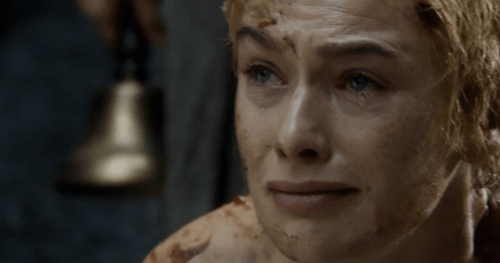
cersei_dirty

So does that make it easier to take? Headey was able to do the scene over and over, probably wearing a nude-coloured bathing suit like the one Maddie Ziegler wears in Sia’s “Chandelier” video. But the body double? She was naked. And that still means, whether it was Headey or someone else, a woman had to actually go through that to ensure that the scene was caught on video for all of us to watch and be reviled by it. So I found the scene very unsettling.

But… there’s always a but… just as I argued with Sansa, it’s because of how difficult it is for us to watch that this scene is just so damn effective. They paraded the High Septon through the streets and he kept his bits covered with his hands, even if they kept whacking his hands away, and his scene lasts only a few seconds. Cersei’s scene, on the other hand — she’s disrobed at the 45-minute mark, when they wash her body (watch how the body double keeps Cersei’s hair in her face the entire time), then her hair is chopped, and then she’s brought out before the people and walks to the Red Keep. When she finally arrives and has a blanket thrown over her, we’re at 53:30. Eight and a half minutes. That’s a really, really, long time. Cersei keeps her head up and never covers herself with her hands because that’s who Cersei is. She believes she has nothing to hide and shows it in her very body language. We, the audience, must endure this scene because we’ve reviled her for so long, but we need to watch the slow destruction of this character. In eight and a half minutes, she’s brought from Cersei Lannister to someone lower than the lowest peasant in Fleabottom. We need to watch her shoulders begin to slump, her feet bleed, the way she begins to trip and fall. Her cries of pain, her whimpering, the constant call of “Shame!” and the bell ringing. Our sniggers turn to sympathy, and we’re made to feel the way Cersei is feeling. And we watch the extraordinary depths of the sadism of the Sparrows. You just wouldn’t get that if they’d shown her descending the steps, going through the first street, and then cutting to her arriving at the Red Keep covered in shit and bleeding. We needed to watch every painful step.

Were they turning Cersei into a Christ figure? Perhaps; there’s certainly something about the way she bears her cross through the streets. The difference is, Cersei never gets a Simon. No one ever comes out of the crowd to help lift her up and carry her the rest of the way. No one in King’s Landing feels a smidge of sympathy for Madame Lannister.

cersei_qyburn

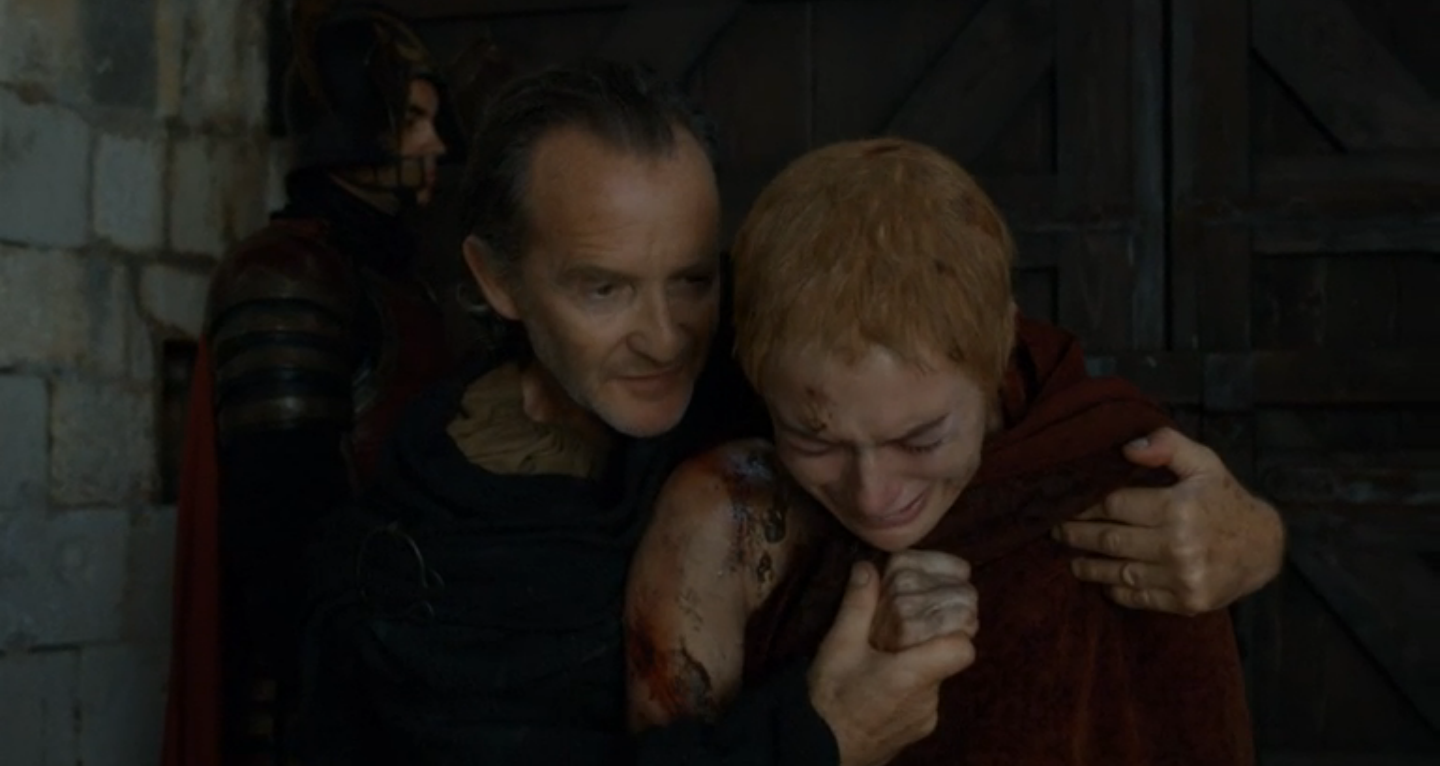
And when she arrives at the Red Keep, she’s a shadow of her former self. Bowed, bleeding, and weeping, she falls into the arms of Doctor Frankenstein, who introduces her to the resurrected Mountain, who doesn’t have much to say, as creepy Qyburn admits, but is dressed all in armour, picks up Cersei effortlessly, and carries her to safety. And the look on her face suddenly transforms to peace and determination. They tried to shame her and break her, but despite it all, she’s just seen a way out, and I have a feeling Fleabottom is about to burn.

Which brings us to the credits. Yay! Thanks for reading our recaps each week and OK FINE. Dammit.

Which brings us back to the Wall, to Jon Snow. Last week when I was sending the last pass over to Chris I mentioned offhandedly that we hadn’t mentioned Jon Snow, but nothing much happened there. He didn’t even respond. I had no idea that’s because he knew something massive was coming and I didn’t know. Thanks for sparing my feelings, Chris, but I can’t remember being so distraught, shocked, and betrayed by a death. Which is why, unlike those who have declared they’re jumping ship and will never watch again, I instead live with my denial that he’s only mostly dead, and he’ll be back. Entertainment Weekly posted an interview immediately following the broadcast where Kit Harington declared Jon Snow was deader than dead, and wasn’t coming back. But he’s also a prankster who’s being paid to say that wherever he goes, so I don’t believe that for one second. You know nothing, Jon Snow!!

So Chris… take it away. I’m leaving this scene for you to dissect while I go off and sob some more.

jon-dejected

Christopher: Well, I think it’s pretty obvious that Jon Snow is dead; the question, rather, is whether he’ll stay dead. If he does, well, that’s par for the Game of Thrones course (your husband is a golfer, Nikki—would he play a Game of Thrones course?). I find it difficult to imagine, however, especially if the most prominent fan theory about his parentage is correct.

You’re right that I knew this was coming, as did everyone who read A Dance With Dragons. But unlike all the other shocking deaths, I was never convinced that this one would stick. Because Melisandre. We’ve seen the red priest Thoros of Myr resurrect Beric Dondarrion, which apparently he’d done half a dozen times previously. And there are other instances of this particular magic in the novels. Given Melisandre’s particular interest in Jon Snow, I have to imagine she’ll be on hand to breathe life back into him.

Again, this is just speculation, but this episode went a long way to making me more confident in this prediction. In the novel, Melisandre stays behind at Castle Black when Stannis marches. When instead, on the show, she goes with Stannis, part of me wondered “Oh, crap—how’s she going to save Jon?” But instead she deserts her would-be hero and rides back to Castle Black. Why she chose there instead of, well, anywhere else is puzzling … or perhaps not. Perhaps she wants to be on the front lines when the Walkers come; perhaps, losing faith in Stannis, she sees Jon Snow now as the vehicle of destiny. But the fact that she came back just in time for Jon to get all Caesar-on-the-capitol-steps, seems to suggest that she’ll be the one to bring him back.

Anyway … that’s my theory. So sob no more for Lord Snow … weep and wail instead for the fact that we now have to wait nine and a half months to see whether my prediction holds true.

The scene, I must say, was well done—and I think I speak for those of us who knew it was coming when I say knowing made it almost worse. Because it is far more obviously a conspiracy than in the novel. In the novel, a handful of knights stay behind with the queen, Shireen, and Melisandre, and for some reason one of them attacks the giant Wun Wun (and is literally torn to pieces for his efforts). During the commotion, while Jon attempts to cool everyone down and prevent the other knights from provoking the giant further, he is set upon by a handful of the more querulous watchmen, men who have been antsy about the wildlings from the start.

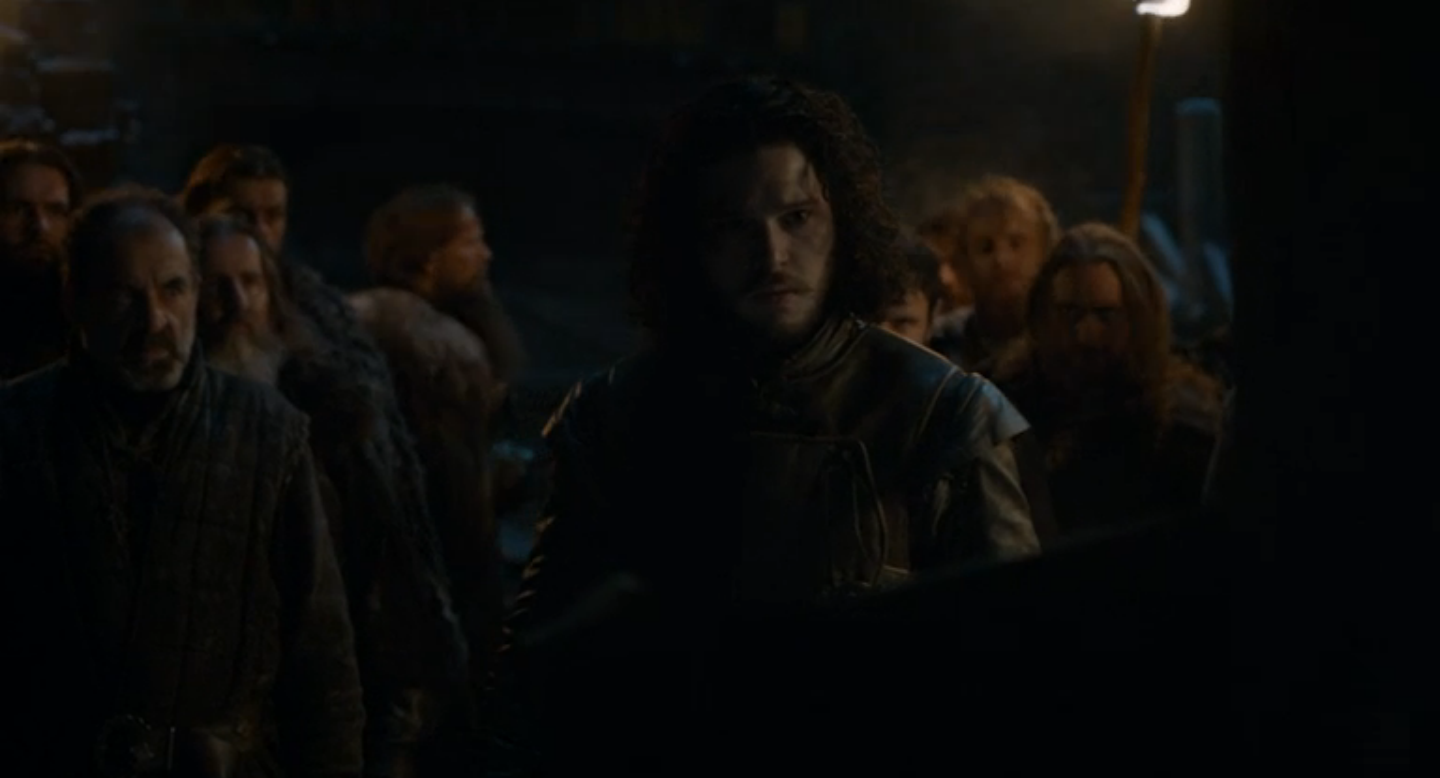
Here, it’s a set-up from start to finish. The scene begins with Jon in his study reading messages sent by ravens, discarding them one by one in a discouraged manner that suggests they’re all negative replies to his requests for more men and supplies. Then Olly bursts in excitedly with a piece of news that is guaranteed to bring Jon running: one of the wildlings can tell him about his Uncle Benjen, who disappeared early in the first season. Outside, they are joined by Alliser Thorne, who says the wildling “saw your uncle at Hardhome at the last full moon.” He leads Jon to a cluster of men with torches, and when Jon shoulders his way through he finds not a wildling, but what looks like a grave marker with “traitor” written on it.

And then Act Three, Scene One of Julius Caesar, complete with Jon’s “Et tu, Brute?” moment as a stricken-looking Olly delivers the final blow.

et-tu-olly

So: Jon Snow is assassinated, which is consonant with the novel; the difference between how it happens in the book and on the show, however, has huge implications (assuming, of course, that Melisandre resurrects him—always allowing for the Ned Stark factor, in which case I might have to burn down GRRM’s house personally). In the novel his assassins appear to be a handful of panicking wimps who just can’t even with the wildlings. Here, however, it looks as those most of the Night’s Watch are in on the plot—including Ser Alliser, who is effectively the Watch’s second in command. In the first scenario, a resurrected Jon would just have to deal with a few conspirators. In the show’s version, however, what happens if he comes back? How does he face a unified front of antagonists? Does this mean he’s still part of the Night’s Watch? After all, the oath enjoins you to remain in the Watch until you die—does the assassination mean his watch is now ended? Is this the get-out-of-jail card that frees Jon Snow up for a new destiny, one more in line with the most common theory about his parentage? (Sorry to be coy on this front, but I’m not sure if it’s kosher yet to say it out loud).

Again, we must now wait nine and a half months to find all this out.

Just a few more random thoughts before I close things out on my end:

  • I’m not convinced that Stannis is dead. I watched that scene a few times, and I find it suspicious they don’t show him die, but instead cut from Brienne’s downstroke to Ramsay’s as he kills someone. Why would she spare him? Where did her sword go? I don’t know, but killing Stannis at this point is either (1) a MASSIVE deviation from the novels, or (2) a MASSIVE spoiler for what we can expect in The Winds of Winter. Both are eminently possible, but I’m remaining skeptical until the novel comes out or the next season of the show … whatever comes first.
  • I had assumed that the show was simply dispensing with Sam’s journey to the Citadel. It’s one of the main story threads in A Feast for Crows, with Jon sending Maester Aemon along to keep the oldest living Targaryen away from Melisandre and her hankering for king’s blood. Aemon dies on the journey, but Sam makes it to Oldtown, the city at the southeastern end of Westeros, where the Citadel is located. Jon’s premier reason is so Sam can take up the maester’s duties at the Wall. Sam makes the same argument, but the timing at this point is a bit off: one assumes training to be a maester takes several years, but we got pretty powerful evidence two episodes ago that the Walkers’ attack on the Wall will be sooner rather than later. Still, it at least indicates that Sam’s travails at the Citadel will be a significant enough storyline to keep in the show.

And there we have it. What did everyone think of this season? Nikki? Myself, I thought it was, with the exception of a few hiccups (the Sand Snakes’ hackneyed conspiracy, for example), about the best we’ve seen so far. Certainly it pushed the envelope more than any previous season, and almost certainly caused more viewers to wash their hands of the show than ever before. But the flip side of that was its audacity, both in terms of going off script in a host of creative ways, and in the execution of most of the storylines.

And now we wait. Valar morghulis.

jon-surprise

Nikki: And here’s my final expression of bafflement over Jon Snow: where the hell was Ghost? That dog has always been there when Jon needed him to be, and he’s gone. I’m concerned that Ghost jumped the men who were trying to hurt Gilly, and they knew enough to imprison him somewhere… or at least they’d better make that part of the storyline because otherwise it makes no sense that Jon’s direwolf would abandon him when he needed it the most. (And he’s not dead.)

I agree with you on this season. The way the characters have finally begun coming together — Daenerys and Tyrion, in particular — and storylines are crossing over and converging is something we’ve been waiting for for a very long time. I hate to admit it, but I haven’t missed Bran and his merry band one whit, but it’ll be nice to check in with them next season, which I assume we’ll be doing. Arya’s story just took a dark turn; I’ll be interested in how Cersei takes revenge on the Sparrows, and what will be the future of King’s Landing, including Tommen, Loras, and Margaery. I’m intrigued by your suggestion that Stannis isn’t dead! Strange how that never occurred to me, and usually if it happens off-screen, I don’t believe it happened. Now I’m very intrigued by the possibilities of Stannis and Brienne together, and what that could mean.

But perhaps I’m most excited about the Tyrion and Varys Show coming back.

This has been a rollercoaster of a season filled with our typically VERY long posts, and I wanted to thank our readers for hanging in there with us, and a huge thank-you to Christopher Lockett, who manages to do this year after year and lure me back to a blog that otherwise seems to have tumbleweeds blowing through it. Thank you, sir, and here’s to the long nine-and-a-half-month wait! Ours is the fury, indeed.
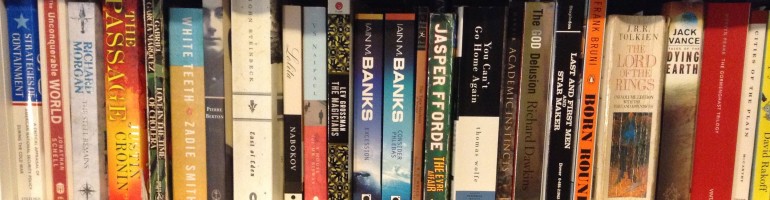
Leave a comment

Filed under Game of Thrones

Game of Thrones 5.09: The Dance of Dragons

gameofthrones_teaser02_screencap10

Greetings once again, and welcome to the great Chris and Nikki co-blog on Game of Thrones. We’re almost through another season, if you can believe it—this was the second-to-last, and we’ll be tying up season five with a bow this time next week.

Well, the showrunners have established the precedent of ending the penultimate episodes with something shocking, spectacular, or both … and in this case it’s definitely both as fiery death is visited on a lot of characters—both those who deserve it, and one who most definitely does not.

It’s my turn to lead us off, but a word of warning—hic sunt draconis.

fire_camp

Christopher: The past two episodes have really ratcheted up the stakes, haven’t they? It feels like a payoff moment—after almost five seasons of hearing that “winter is coming” and the promise of the “mother of dragons,” finally we’re starting to see the significance of those coinages. Last week, speculating on what if anything could realistically defeat the implacable force of the Night King and his vast undead army, I said—with my tongue only slightly in my cheek—that it would probably involve dragons. Now that Daenerys has fulfilled a crucial element of being a Targaryen and ridden Drogon into the clouds, that does not seem like such a distant possibility.

Or to put it another way, let’s remember that GRRM’s series is called “A Song of Ice and Fire.” Last week we got the ice. This week we got the fire.

Unfortunately, we got fire in a number of different ways. First, Ramsay’s guerrilla attack on Stannis’ camp was terribly effective, burning tents, supplies, and horses (the image of a panicked horse entirely aflame was particularly affecting). Secondly …

In my notes for a specific scene in this episode, I’ve written “it’s like the showrunners are trying to turn off viewers.” Several episodes ago, Nikki, we saved discussion of a controversial scene until the end. I think this time we should address it at the beginning. I’m speaking, of course, of the horrific death of Shireen Baratheon, sacrificed by her father at Melisandre’s behest.

stannis_tent

Predictably, a lot of reviews and commentaries on this episode have asked the same question they did with Sansa’s rape: Why? Why include this awful, deeply distressing plot twist, especially considering it doesn’t appear in the novels? Why, especially after we were treated to a scene several episodes ago in which Stannis expressed his love for Shireen in terms that humanized him far more than he ever is in the novels?

As my comments on the Sansa scene might indicate, I tend to find this particular line of questioning wrong-headed. The “what ifs” of storytelling can make for interesting speculations on how it all might have fallen out otherwise, or considerations of the authors’ intentions, but it doesn’t make for good criticism. Like it or loathe it (and based on my casual perusal of reactions to this episode, there are many in the latter camp), Stannis has sacrificed a crucial element of his humanity on the altar of his ambition, in the belief that being king is his destiny. And once again we see that the show is playing the long game, that in fact his touching scene with his daughter a few episodes back was not a matter of humanizing Stannis, but humanizing him enough that we are even more shocked and horrified than we would have been otherwise. We really ought to know by now to be on our guard when Game of Thrones gives us moments of sentiment and warmth.

And as with Sansa’s wedding night, the show layers on the dread by signaling what is to come. As soon as Stannis refuses the very possibility of returning to Castle Black, we know something is off. “Forgive me, Your Grace,” says Davos, “I never claimed to be an expert in military matters, but if we can’t march forward and we won’t march back—” He cuts himself off to follow Stannis gaze behind him and sees Melisandre and Queen Selyse standing there. A look then passes between him and his king, who curtly orders him to butcher the dead horses for meat and walks away, followed by the two women. Later, he orders Davos to return to Castle Black for supplies over Davos’ objections, and further refuses to send Shireen with him. We begin to discern Stannis’ design here: remove the one man with conscience and standing enough to protect Shireen.

What is doubly heartbreaking is the sense that Davos knows this—that he has an inkling of the king’s mind, but is perhaps in denial about it. His scene with Shireen, in which he gives her the carved stag and thanks her for helping him grow up, has a certain finality to it. Is he in denial about Stannis’ intentions? Are his feelings too vague for him to act on them? Or is he that steadfast in his loyalty that he willingly absents himself from camp?

Whatever the case, he is now complicit. Stannis’ crime thus compromises more than just his own soul, but those of every one of his followers.

shireen_pyre

Sansa’s rape was devastating for many viewers because she was perceived as the last innocent. That may be true, but at least Sansa agreed to her marriage pact with her eyes open. She might not have known the abject depths of Ramsay’s depravity, but she knew the Boltons well enough to know she was agreeing to something humiliating and unpleasant. Shireen is genuinely the last innocent of the show, and she has no idea what her father plans when she tells him she’ll do anything to help.

Stephen Dillane is one of the unsung heroes of this show, playing one of the more thankless roles—Stannis is rigid and uncompromising, with an iron sense of right and wrong. His rationale is simple and straightforward: his older brother was king, Robert’s children are illegitimate, and therefore he is the true king. He cannot step away from that fact any more than he could cut off his own limb. “If a man knows what he is and remains true to himself, the choice is no choice at all,” he tells Shireen. “He must fulfill his destiny and become who he is meant to be … however much he may hate it.”

Fantasy has traditionally had a deep investment in the power of prophecy and destiny; unsurprisingly then, GRRM undercuts its logic. Melisandre, in proclaiming Stannis a prophesied hero—Azor Ahai the Lightbringer reborn—marries her religious fervor to Stannis’ sense of his own destiny. But having come so far only to court defeat in the Northern winter, Stannis does not see any other choice. Not even when his fanatical wife breaks down and tries to save Shireen does he waver, though her breakdown goes a long way to expose the hollowness of his reasoning. It was Selyse who brought Stannis to the worship of the Lord of Light, and if anyone would cheerfully sacrifice Shireen to him, we’d expect it to be her. From a simple, eminently logical starting point of his drive to be king, he has arrived at a place of profound irrationality and indeed madness.

What did you think, Nikki?

selyse_distraught

Nikki: The television shows I watch always seem to be rife with shitty parents: Lost was a show about a bunch of people on an island with serious mommy and daddy issues. On Buffy one of the greatest characters on the show was Giles, who for all intents and purposes was a father to Buffy after her own father abandoned her and her mother for his secretary. Fairytales are filled with absentee or dead parents and evil, horrid, stepmothers.

And then there’s Game of Thrones. Where one son kills his father while Dad’s taking a crap; where the best mother on the show is the mother of dragons and slaves, not children; where the strong and determined Catelyn Stark still can’t find it in her heart to love an innocent baby who’s her husband’s bastard; where Craster kills his sons and lets his daughters reach an age where they’re old enough to rape for more daughters and sons;… and where Stannis Baratheon, who gave the most moving speech about the lengths a father will go to save his only child, just had her burned alive at the stake to feed his own ambition.

I hope he and Selyse are haunted by those screams for the rest of their days.

I’ve always seen Selyse as a cold, heartless woman, and at first, when she steps out, she has that same callous face that she’s always had. Interestingly, she seems to be completely on board with everything that’s happening until Stannis says that she has the blood of a king in her, and therefore this must be done. Only then does this look of horror cross her face, and she rushes at the stake. And I couldn’t help but think… is it possible Shireen does not have king’s blood in her? Has Selyse been keeping some secret from her husband all these years and only now does she realize her daughter’s about to be sacrificed for no reason?

stannis_selyse

The thought was only a fleeting one, however, as Selyse rushes forward and begs for mercy for her daughter. It was a shocking moment — Stannis is the one who’s always treated his daughter like she was worth more than others did, while his wife had nothing but cold words for her, and now he stares at her burning to death and screaming in abject pain and does nothing, while his wife begs for it to stop. Melisandre, on the other hand, is a cold-hearted bitch who doesn’t seem to have an ounce of humanity in her whatsoever, and she stands nearby with that same smug look on her face that she wore when Mance Rayder was being burned alive. But at least someone showed Mance some mercy by shooting him with an arrow. No one was there to save this little girl from the feeling of flames burning her flesh as her heart fell to pieces within her, knowing what her parents were allowing to happen to her.

We can’t forget that Stannis has gone along with hiding this child away all these years; in a dungeon, in an old library in the basement. And even in that scene where he proclaims what he did to save her life, she throws her arms around him with unbridled love, and he stands there, stiff, like he can’t embrace her back. And when he does, he looks like he means it.

But his love for her is no match for his ambition.

stannis_watching

Before her horrifying death — the thought of which fills me with so much grief as a mother that I wanted to push my way through the flames just to embrace her as she burned to death, just so she wouldn’t have to die alone — she was reading the Dance of the Dragons, the story of the Targaryen wars, which not only is the second time in as many weeks that the title of a George RR Martin book has been referenced — last week Ramsay said Stannis’s army would become a feast for the crows — but it’s a line that came full circle by the end of the episode. But let’s hold off on talking about THAT moment for a bit.
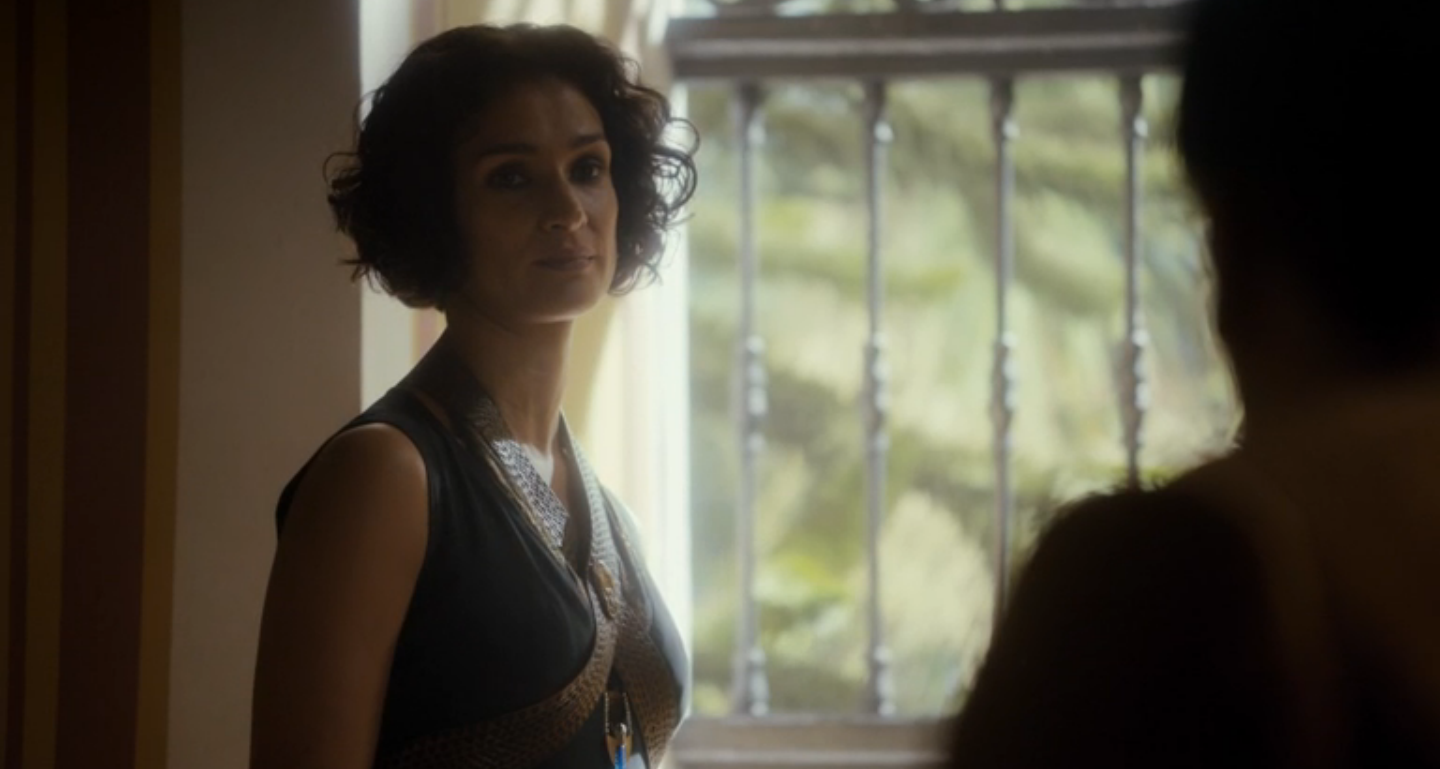
I wanted to add that when the tents in Stannis’s camp catch fire — fulfilling the “Fire” half of the saga that this episode represents as you demonstrated so well in your commentary, Chris — it’s carrying out the plan that Ramsay Bolton had in the previous episode. Roose Bolton is a formidable military man, and he saw that Stannis’s army had no way of winning with it being so cold, so he figured he could just starve them out. Ramsay, on the other hand, requested 20 men, and with those men he somehow found a way to sneak into their camp with ninja-like precision and light several tents — and people and horses — on fire. It’s a brilliant strategy on so many levels: Roose’s plan would have taken ages, and Ramsay would rather end this now so they don’t have to waste precious time looking over their shoulder in the direction of the Baratheon sigil any longer than they have to. But it also seems to take the very thing that Stannis bows to — the Lord of Light — and throws it back in his face. The night is dark and full of terrors indeed, dude. Ramsay Bolton is a loathsome character in so many ways, but in this moment, he showed that he’s a cunning strategist, which should raise his profile in his dad’s eyes several notches.

Now let’s move over to Braavos, where Arya is playing the oyster girl and about to fulfill the task asked of her by Jaqen when she spots none other than Mace Tyrell… or the Mayor of Munchkinland, as I like to think of him. Oh wait, no, she’s not looking at Mace… she’s looking at Meryn Trant standing behind him. If you’re like my husband, who went, “Who he?” when she started focusing on him and following him through the square, Meryn is one of the people on Arya’s Kill List, and was the man who killed her “dance instructor” all the way back in season 1.

I can’t believe that when Cersei assigned Meryn to follow Mace to Braavos to meet with Mycroft that I didn’t figure out he’d cross paths with Arya. Duh. What did you think of this scene, Chris?

arya_seeing-meryn

Christopher: I think it confirms what we pretty much knew all along, namely that Arya has a long way to go before she can put aside her identity as Arya Stark and honestly say she is “no one.” One of the things we can surmise from her training thus far is that a girl cannot truly be a Faceless Man if a girl still clings to her own loves and hates, and especially not if a girl still nurses vengeance in her heart. The Many-Faced God dispenses death with equanimity, and his servants must have the same even-handedness.

This is presumably why they seem to hate pronouns so much.

It is something of a relief, however, to know Arya’s still there: the thought of losing her rather distinct personality is distressing, even though it probably means she’s in for some punishment from Jaqen—it’s obvious from his expression he knows she’s lying when she says the thin man wasn’t hungry.

They’ve telegraphed where this is going pretty clearly: Meryn Trant likes his girls young, so I’m guessing Arya will pose as a prostitute in order to kill him. This storyline actually follows one of the sample chapters from The Winds of Winter that GRRM has posted on his website. Unfortunately it has been replaced by another sample chapter, so I can’t link to it, but here is the synopsis on the Song of Ice and Fire Wiki. In it Arya is posing as a girl named Mercy in a theatre troupe, which is about to stage a play loosely modeled on the events of King’s Landing. They have a special guest: an envoy from the Iron Throne in Braavos to negotiate with the Iron Bank (not Mace Tyrell), and Arya sees that one of his guards is a man on her kill list (not Meryn Trant, but a fellow named Raff the Sweetling, who doesn’t appear in the TV show). She tempts him into a secluded alcove with the promise of sex and kills him.

Again, this was pretty clearly telegraphed in the show. The question will be: what will be her punishment? I have a pretty clear idea, as she transgresses in a similar way in A Feast for Crows, so it will be interesting to see if her story continues to hew more or less closely to the novel.

Also, it’s a delight to see Mycroft Tycho Nestoris again, especially in contrast to the buffoonish Mace Tyrell.

ellaria_throwing-shade

Meanwhile, things all seem very civilized in Dorne, compared to the rest of Westeros. I quite enjoyed these scenes, as we’re finally getting a more nuanced sense of the characters involved here. I do still think they’ve done it back-asswards: a fuller understanding of the personalities at work, and the underlying tensions and enmities and loyalties would have improved the Sand Snakes’ story immeasurably and invested us in the fate of their plot more deeply. Instead, we’re getting after-the-fact exposition—still engrossing, but it makes me wonder where they’re going with the Dorne narrative. I’ve read a few commentaries on the episode opining that the Dorne storyline has been pointless, simply a side-journey to give Jaime Lannister something to do, far away from his sister’s plight.

I’m not so sure. With Trystane returning to King’s Landing with Myrcella, their engagement intact, It may be that Benioff and Weiss have some ideas for how to use their Dornish characters in ways that will now necessarily deviate dramatically from the novels.

I particularly liked Prince Doran in these scenes. As I’ve said before, I think Alexander Siddig is a great actor, and it doesn’t hurt that he has ST:DS9 geek cred. But I love the way he plays this character, in such stark contrast to Ellaria and the hot-headed Sand Snakes. He is calm and measured, thoughtful, but radiates command. Not someone I’d want to face across a poker table. His brief moment of ire as Ellaria attempts to storm from the room is more dangerous than all of Cersei’s threats to her captors, as is his later comment that “I believe in second chances; I don’t believe in third chances.” I think we can add him to the running list of characters whose actors endow them with extraordinary gravitas, alongside Tywin, Mance, Olenna, and the High Sparrow.

doran_gravitas

Perhaps most interesting in this Dorne sequence is Ellaria’s apparent rapprochement with Jaime, in which she tells him she knows the truth of his relationship with Cersei, and the fact that in Dorne “no one blinked an eye.” Social mores about who we’re allowed to love, she says, are constantly changing, but “the only thing that stays the same is we want who we want.”

It’s an odd and interesting moment, considering her previously implacable hatred for all things Lannister. Is she signaling a détente? Or is she reminding Jaime that the man she wants is now dead, at least in part due to Lannister scheming?

What do you think, Nikki?

ellaria_detente

Nikki: I found it a strange scene indeed; she seems to be almost setting up an alliance with Jaime in a sense of, “Hey, bro, don’t fret. You had sex with your sister, gave her a bunch of kids; I’m a bastard daughter of a nobleman and had five bastard daughters of my own with Oberyn, whom I loved to watch have sex with other people. It’s like we were made to work together.” Back in season four, Ellaria and Oberyn were a breath of fresh air, I thought; these people who sweep in from Dorne and seek pleasure where they can get it, who don’t judge others for any sexual proclivities because they’ve tried it all — let’s just say in Dorne, the High Sparrow would have been beheaded by now and Loras upheld as a hero. What is normal to Ellaria and her people is loathed and judged in King’s Landing, a place where Jaime and Cersei have to lie about their children, and where Loras and Margaery are in a jail because one is a homosexual and the other one knew about it.

Jaime is the brother/lover of Cersei, the woman who got Oberyn killed by the Mountain. Ellaria loathes her. What better way to come at Cersei than to bed the man she loves? Things haven’t exactly been hunky dory in Lannister land lately, as we know. The last time Jaime was intimate with Cersei was when he raped her on the floor next to their son’s corpse — not exactly candlelight and roses — and Cersei has shown him nothing but disdain ever since he arrived with one hand fewer than before. But we know that despite Cersei pushing him away, she’s not going to let anyone else come near him. If she found out that Jaime had been intimate with Ellaria, she would fly into a rage of epic proportions.

I’m starting to think Ellaria’s simply moved on to a Plan B.

I agree with you that the Sand Snakes had a spectacular entrance when we first saw them on the beach, and then in their next scene, when they’re summarily beaten by Doran’s guards, I pretty much just heard this:

But since then, as you say, we’ve been watching them develop almost backwards, and perhaps that’s a sneaky way of making them explode onto the scene enveloped by their own legend, only to break down that legend and build them back up again. One thing that I must say I actually like about them — but I know a lot of fans might be up in arms about it — is that they use their bodies and physical attractiveness for their own means. I suspect Ellaria is trying to lure Jaime into a sexual tryst. I could be completely wrong, and, as you say, she’s just telling him this as a frame story to send the real message: I know about you and your sister, and that your children are illegitimate, and by the way your lover killed mine, and I WILL have my revenge.” But it seemed more intimate than that, especially the way she was slinking around the room as she talked to him.

nymeria

Similarly, Tyene believes she’s conquered Bronn by forcing him to tell her that she’s the most beautiful woman in the world, again using her body and sexual wiles to dominate him. In the slapping fight we see in the jail cell, the girls have a lot of sibling rivalry, whether it’s physical, where Tyene smacks Nymeria in the face right after Nymeria brags that Tyene’s reaction time is too short, or verbal, where Obara — the one who seems to have no time for either one of them — simply rolls over to face the wall, muttering “slut” under her breath at her younger sibling. These women will stand together to fight, despite their infighting, because they all believe in a common cause. And, interestingly, when they watch Ellaria groveling before Doran, kissing his hand and begging his forgiveness, they’re united in their repulsion at watching her do so. The question is, watching their reaction to her in this scene, will they continue to follow her commands?

But now it’s time to talk about the scene we’ve both been waiting to discuss: DRAGONS!! I, for one, had no idea that dragon-riding was going to enter into this show, and jokingly said to my husband near the end, “She should just climb on Drogon’s back and get the hell out of there.” And then OH MY GOD SHE DID.

But you must have known this scene was coming, and once again the readers haven’t spoiled dragon-riding for the rest of us! Tell me about your thoughts of the final scenes in Meereen.

owners_box

Christopher: I don’t think you needed to be a reader of the books to suspect, once the odds looked hopeless, that there was about to be a deus ex draconis. As our heroes grew increasingly outnumbered and pressed back into the defensive circle, I was muttering under my breath “Any time now, Drogon …” And when Daenerys closes her eyes, waiting for the end, and we suddenly hear the dragon’s distinctive squawk in the distance … and as he makes his spectacular entrance in a ball of flame … well, let’s just say there was some fist-pumping happening on my end. I may or may not have shouted “Boom!”

Ahem. Before I get too excited about the final sequence to lose the capacity for speech, I suppose I should outline the differences and similarities with the novel. Toward the end of A Dance With Dragons, Daenerys has married the unctuous Hizdahr zo Loraq and agreed to re-open the fighting pits. There is a great celebration on the first day—much as we see in this episode—with much food and drink in the royal box. Daenerys is unimpressed with the displays in the pit, and after a fight between a female gladiator and a huge boar—which the fighter loses—decides she’s had enough. As she attempts to leave, Hizdahr protests. Meanwhile, one of her men (a former pit fighter named Strong Belwas, who does not make it onto the show) has eaten too many honeyed locusts and is noisily sick on the floor. As it turns out, the locusts were poisoned, likely intended for Daenerys. While Daenerys argues with Hizdahr, Drogon makes his appearance, descending on the dead pit fighter and live boar, and proceeds to eat them both. Spearmen converge on the dragon, with Hizdahr exhorting them to kill the beast. Daenerys leaps into the pit without thinking, and for a moment it is touch and go—she does not know whether he’ll immolate her as well. But of course he doesn’t, and she rides him out of the city.

jorah_spear

So … some similarities, but the show has played up Drogon as her rescuer rather than uninvited guest.

There’s a lot going on in the final sequence, which I want to unpack in a moment. But first, a few random points and observations:

  • I love how Daario just doesn’t give a fuck. He’s the honey badger of third wheels, gleefully insinuating himself between his lover and her new fiancée.
  • The next time I find myself talking about ideology and privilege in one of my classes, I am totally going to quote Tyrion’s brilliant line “It’s easy to confuse ‘what is’ with ‘what ought to be,’ especially when ‘what is’ has worked out in your favour.”
  • The Unsullied don’t really seem to be living up to their reputation, do they? The last time the Harpies attacked them in force, they were hardly indomitable, and once again they’re dying in large numbers here. Lestways, this is a complaint I have read in a bunch of other reviews … which I don’t think is entirely fair. The Unsullied were billed as a formidable fighting force, as soldiers who subsume everything to standing in an unbreakable shield wall. Certainly in the novels their prowess has far more to do with standing firm on the battlefield than in individual combat. In both this sequence and the one where we lost Ser Barristan (sob!), the Unsullied are outnumbered and outflanked. They do pretty well, considering.
  • My first thought on watching this scene was “Holy crap, how many Harpies are there?” It seems like half the city owns sinister gold masks, but on rewatching, it occurred to me that this is an illusion created by the relatively small numbers of people present (compared to the city at large). I suppose it’s possible that this is all of them, thinking that if they come out in force at this one event they can overwhelm the queen’s bodyguard. Well played, Harpies … too bad about the dragon.
  • Did you notice that the lineup of fighters with Jorah looked like a model U.N.? There was a Mereenese champion, a Braavosi water dancer (who nearly defeated Jorah), a Dothraki, a bare-chested barbarian type whose origin I can’t guess; and the first person Jorah fights is a black man wielding a weapon very similar to that of Prince Doran’s bodyguard Areo Hotah—which, based on Areo’s heritage in the novel, would indicate that this fellow comes from the Free City of Norvos.
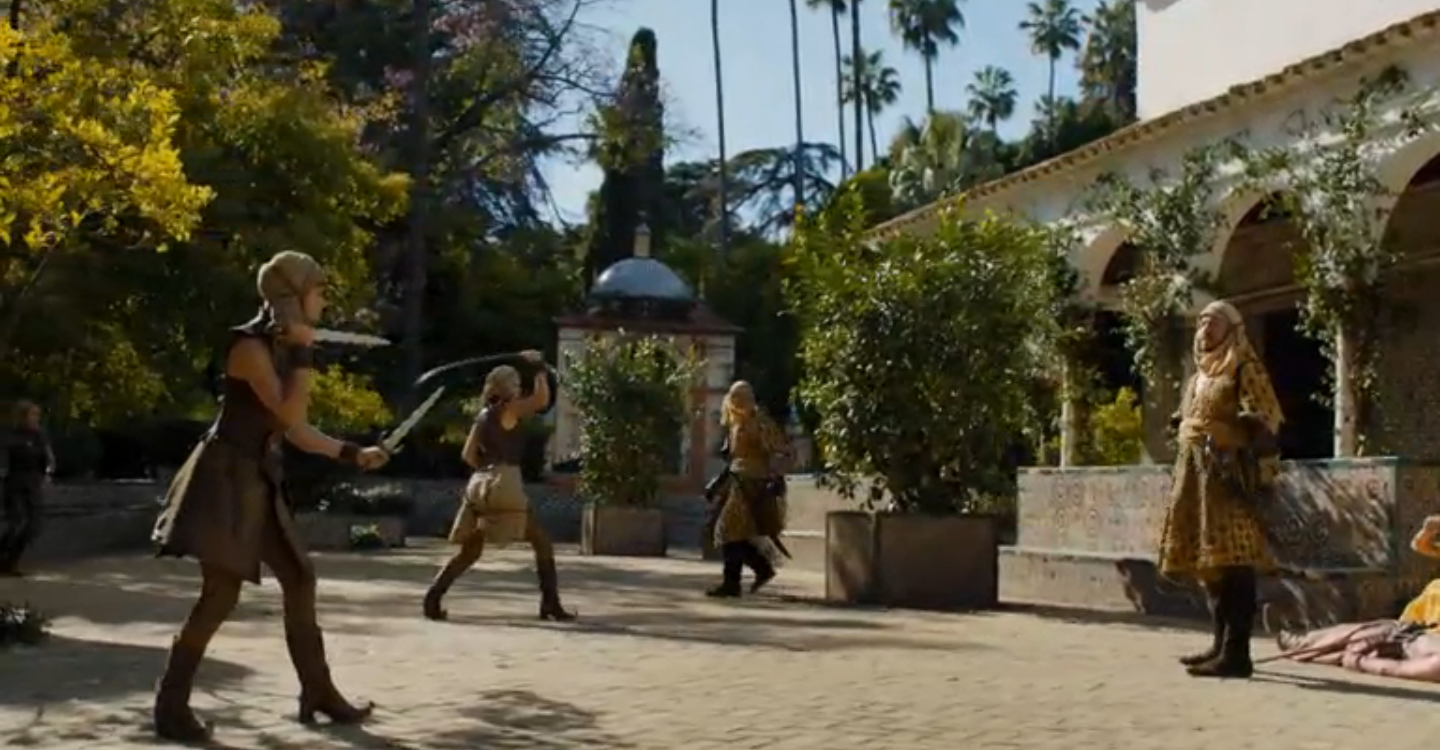
But on to the most interesting stuff: what I liked best about this sequence, aside from DragonRescue 911, was Hizdahr’s rhetorical question, “What great thing has ever been accomplished without killing or cruelty?” It is a question that underwrites this series, and the books on which it is based. Hizdahr’s question made me think immediately of Orson Welles’ iconic performance as the amoral Harry Lime in The Third Man, in which he famously makes a similar claim:
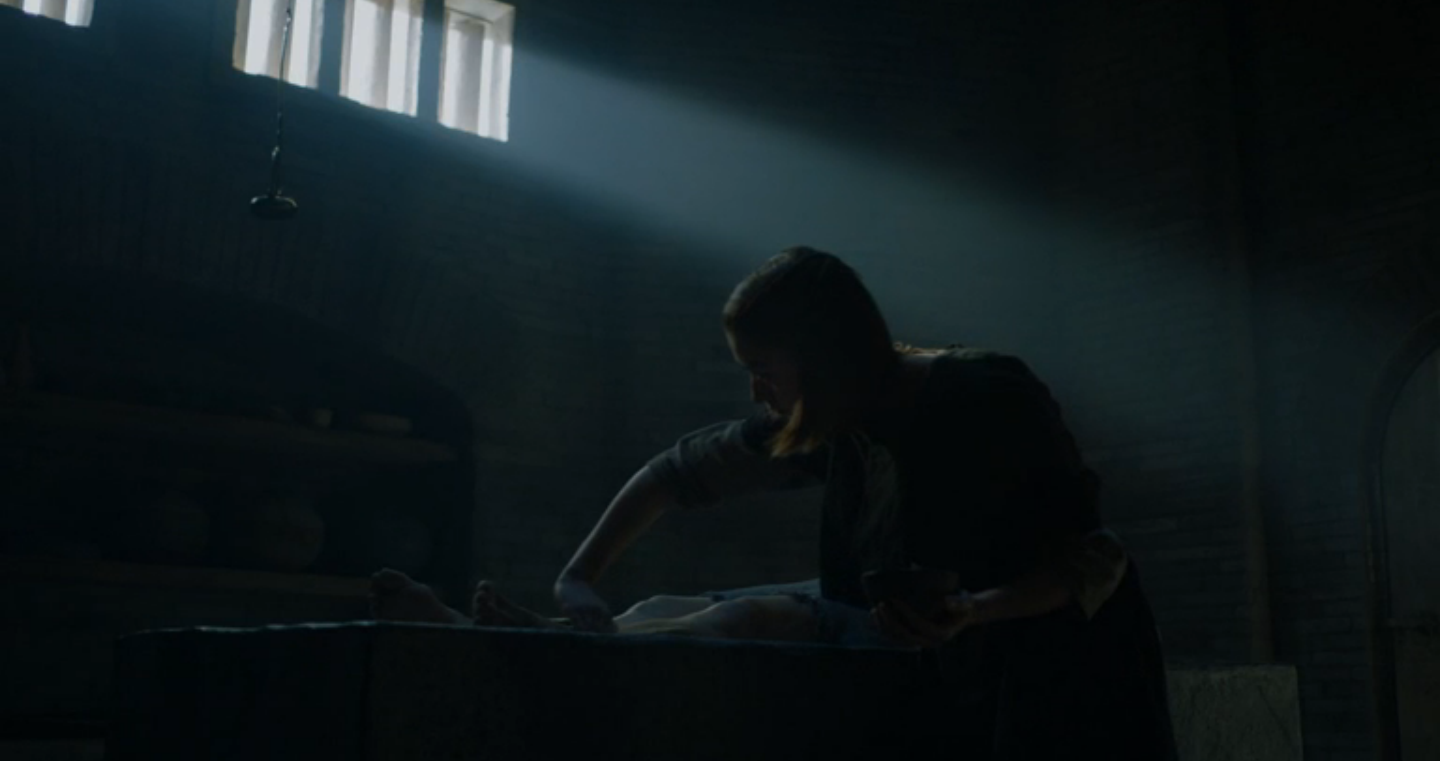
You asked the question a few posts ago, Nikki, about why Daenerys seemed so queasy about men killing each other in gladiatorial combat when she’d witnessed—and caused—so much death herself. I think Tyrion’s observation that “There’s always been more than enough death in the world for my taste. I can do without it during my leisure time,” serves as at least a partial answer to that. The question of what is unavoidable or necessary violence versus what is cruelty is one of the things that animates this show, not least because we start to become queasy when characters we love, like Arya, start to take pleasure in killing; in contrast, we grow more sympathetic to a character like Jaime Lannister as he sheds his killer’s glee and appears to develop (or reveal) a conscience. And as we see in this episode, what is right may not be the smartest course. “You have a good heart, Jon Snow,” Ser Alliser says as they watch the wildlings pass through the gate. “It will get us all killed.”
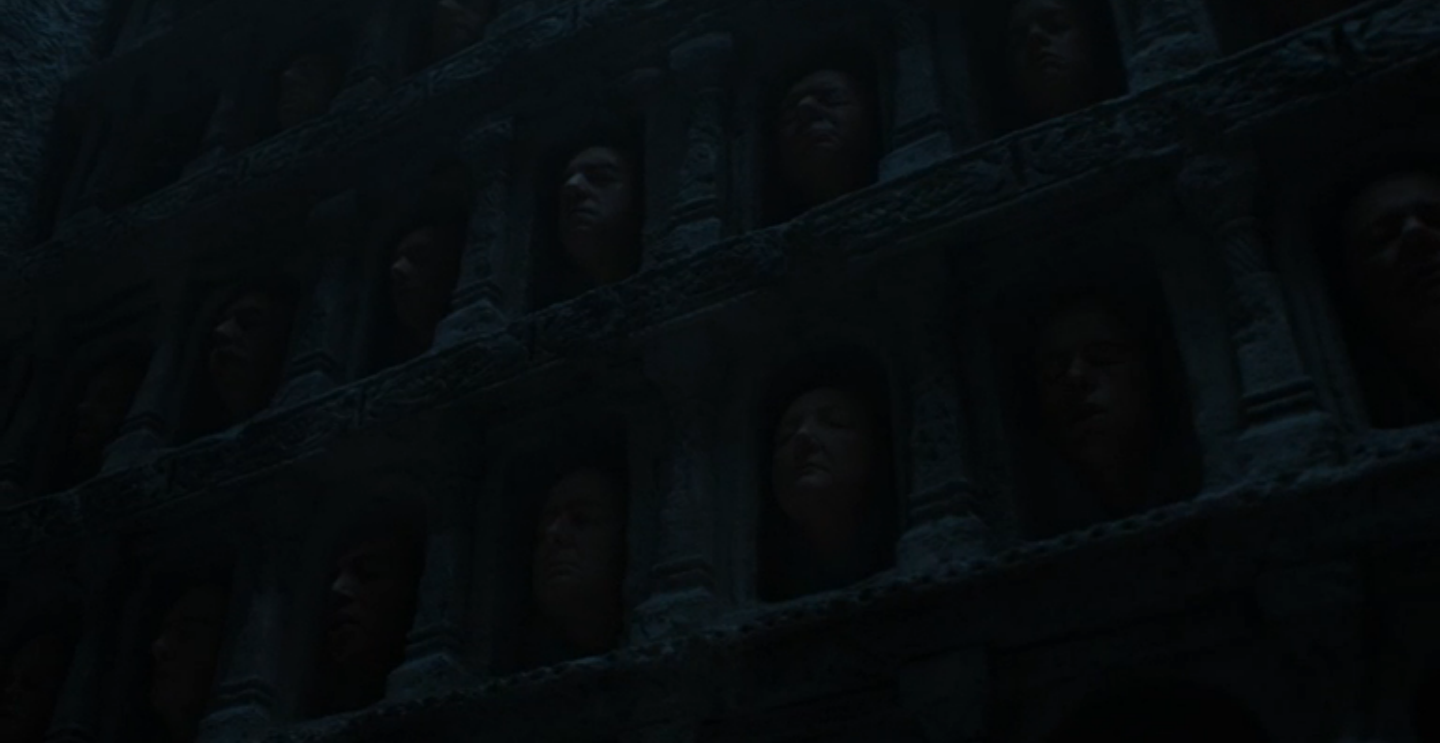
Stannis also does what he believes is right, or at the very least necessary in order to attain what he believes is his right. Daenerys negotiates the same fraught landscape. But this show does not reward those who hew to an abstract sense of right or justified, more often than not rewarding the opportunists and schemers like Littlefinger or the Boltons. Whatever good intentions Daenerys has had, she still finds herself surrounded by enemies in the middle of a fighting pit, dead but for the timely intervention of Drogon.

What did you think of this episode’s final scene, Nikki?

dracharys

Nikki: After this episode was finished, it’s the first time in a long time my husband immediately said, “Back that up; let’s watch that scene again.” We were both freaking out and cheering when she climbed onto Drogon’s back.

Although my favourite Twitter comment was this one:

tweet

But let’s back up. My notes, not surprisingly, stop just as the Harpy ambush begins, because even though I’ve watched this scene several times now, I just can’t take my eyes off the screen. I think Hizdahr is — oh no wait, was, heh — a condescending prick. Until now he’s always been a groveler who tries to maintain reason in every scene by explaining to Daenerys the way things were (mostly because he wants things to return to the way things were) but now that she’s betrothed to him, he turns into a holier-than-thou asshat. He scoffs at Tyrion, who he may have recognized is a far more reasonable advisor than he’ll ever be, making comments about how large men will always triumph over smaller men (camera zoom on Tyrion’s unamused face), and pushing his own Machiavellian agenda so much throughout the conversation that Tyrion finally wearies of him and simply says, “My father would have liked you.”

I found it strange that Hizdahr just happened to show up late, then made no move to protect Daenerys, and seemed completely unsurprised when the Sons of the Harpy showed up. But then he got killed in the attack. Did he set it up? Perhaps. And then they realized, “Yeah, Hizdahr may have set up this whole thing and helped us get rid of that silver-haired bitch, but he’s a d-bag, so let’s kill him while we’re at it.”

(That right there is Reason #741 why I’ll never be allowed to write dialogue for Game of Thrones.)

I agree with you on Daario, Chris — you are right on the money by calling him the honey badger of Meereen, haha!! I loved the way he just kept sticking his face between Daenerys and Hizdahr and making his snide remarks, even if he did turn out to be wrong in the moment. But we know that in the long run, comments like where he says large people tend to have nothing but muscle in their heads, and the smaller man has intelligence, will prove to be true.

And I also agree on the Unsullied. As I said in that post for episode 4, the Unsullied are trained to fight in perfect lines in battle, much like the British were. That’s why, when the British were fighting in the American Revolution, they were so outweighed by a bunch of people hiding in the woods with muskets — they were not trained for an ambush. The Sons of the Harpy fight like they’re in a gladiator ring, and perhaps some of them were (though that would suggest they were slaves, and why would slaves want a return to slavery?) It’s not exactly clear how these noblemen became such admirable street fighters, but let’s just suspend our disbelief on that one for a bit, and say there’s a reason the Unsullied always seem to be outnumbered in these instances: it’s because they are.

arena_overwhelmed

But now on to Drogon. The last time Daenerys saw him was when he perched above her on her balcony. She reached out a hand to him tentatively, and there was a moment where he seemed to acknowledge her with his eyes before suddenly taking to the air and leaving again. Then Tyrion saw him sailing over Valyria, and it’s the first time he actually sees a dragon. Drogon is the largest of the three, and has always been Dany’s favourite. In the terrible moment where they are surrounded by the Harpies and it appears there’s no way out, Daenerys suddenly closes her eyes, using that telepathic messaging service she used when the dragons were babies, and to her shock — and ours — it actually works. As you said, Chris, that faraway screech is SO exciting that I was literally — and that, kids, is the correct use of that word — sitting on the edge of my seat, gasping and screaming throughout the rest of it. My husband was cheering… it was a glorious moment. From immolating dozens of Sons of the Harpy in one go, to grabbing a man and shaking him the way a dog shakes a stuffy just to get the squeaker out (and, similarly, Drogon makes the man’s stuffing come out), to simply crawling around menacingly and hissing at them the way my cats do when they’re around each other, he was fantastic. When the spears began flying through the air I was worried — if the Sons of the Harpy all began throwing spears at once, could that kill a dragon? My husband was confident that Drogon would be OK. He kept saying there was no way spears could kill a dragon, that their hides are probably like rocks and they are probably nearly indestructible. But Daenerys is still devastated when it happens, because she knows there must be some pain. As he slinks around the ring in a fury, barbequing some of the people while eating others, she walks up to him and pulls the spear out of his side. The looks on the faces of Daario, Tyrion, and Jorah at that point are priceless. They’ve all seen the dragons, but they’ve seen just how wild they’ve become.

howtotrainyourdragon happy_drogon

In his rage, Drogon could have just as easily turned to her and accidentally set her on fire (though it wouldn’t have actually hurt her at all) but instead he simply screams in her face, turning the fire off momentarily. And then he stops. He tilts his head, and like a wild horse being tamed, sits quietly as an idea suddenly comes to her, and she walks around and mounts his back. The CGI as he lifts her off the ground isn’t so hot — you can instantly tell that was all green-screened and done so badly — but once he gets into the air it’s spectacular.

Though, just like the dude on Twitter, I couldn’t help but think, “Uh, Dany? You, um, forgot three people back there. The Sons of the Harpy aren’t all dead, you know…”

But something tells me they’ll be fine.

final_shot

Thanks once again for reading all of this! Next week we shall return with the finale! Wherein Sansa lops off Ramsay’s penis and feeds it to Arya’s direwolf, which she happens to find in the woods behind Winterfell; where Daenerys takes Drogon to see Viserion and Rhaegal and the three dragons are reunited and forgive Mama and head off to burn some White Walkers; where Jon Snow rises up to rule the North after the giant stomps on Ser Alliser’s head and Sam and Gilly kill Stannis and Melisandre; and where the Starks are all reunited and rule King’s Landing when Cersei is pecked to death by a crow.*

(*Nik at Nite cannot guarantee any of the above will happen.)

Leave a comment

Filed under Game of Thrones

Game of Thrones 5.08: Hardhome

gameofthrones_teaser02_screencap10Hello again and welcome to the epic Chris and Nikki co-blog, in which we recap and review the most recent Game of Thrones episode. We apologize for this one going up late, but I have been in Ottawa this past week at the Congress of Humanities, and apparently Ottawa has no reliable wireless anywhere, so it took me awhile before I could watch the episode. Also, I was busy conferencing (by which I mean drinking beer with colleagues I haven’t seen for a while).

But here we are, and wow was this week’s episode a barn-burner. Literally. I think a barn might have been burning in the background at one point. It is Nikki’s turn to kick us off, so I will cede the stage to her …

 Tyrion_Jorah

Nikki: Wow. The last 15 minutes of this episode were so intense that I’m writing this the next day, and my stomach feels like I did 100 crunches.

So, as we always do, let’s start somewhere else and lead up to that moment.

I’ll start at the beginning, with Tyrion and Daenerys. Last week I had high hopes for this moment, and it was as wonderful as I thought it was. Tyrion and Ser Jorah appear before Dany and her guards, and she asks Tyrion why she should believe that he is who he says he is. Using that silver tongue of his, he talks his way through everything, from her questioning why, if he’s from the House that killed her family, she should allow him to live — “I am the greatest Lannister killer of all time,” he replies — or where he finally silences her when he begins telling the story of Daenerys the way he has always heard it. He recounts the story of a baby that was in peril its entire life, who grew up into a young woman who was married off to the Dothraki and he thought that would be the last he’d hear of her, until she rose up and suddenly had armies and respect and people following her. “I thought you were worth meeting at the very least,” he says with his usual wit.

He explains to her that she doesn’t understand the Houses the way he does, and that he could become her advisor. Daenerys is quiet, calm, and listens to him closely throughout this scene, and she’s as smart in her silence as Tyrion is in his loquaciousness. Remember: her longtime advisor betrayed her and was sent away, and the advisor who took over from him has just been slaughtered. She’s been making her own decisions for the past couple of weeks, and trying her best to do the right thing, but her missteps have always happened when she didn’t listen to counsel as closely as she could. Tyrion has always been so good at captivating a listening audience that he naturally commands this scene, and she listens to him.

And… she gives him his first task. He has to advise her on what to do with Ser Jorah, and his advice is spot-on: you can’t murder a man who is devoted to you, because that will deter the devotion of others. And yet, he betrayed her. And yet, he changed his mind about her and would give his life for her now. And yet, he had opportunities to confess his crime to her and he chose not to, so even when he was most devoted to her, he was withholding very important information. Therefore, let him live, but he cannot be at her side. Daenerys looks astonished, and then impressed, and without a moment’s hesitation tells her guards to get Jorah out of the city. As we later see, Jorah will not go quietly into that good night, because with the death sentence growing ever more rapidly on his arm, he feels he’s got nothing to lose.

tyrion_wine

The next time we see Tyrion and Dany, they’re enjoying some wine (I imagine Tyrion must have been in some serious withdrawal, since he hasn’t had any wine since Jorah kidnapped him) and having a discussion. He begins to explain the Houses and their various loyalties to her, and I loved this scene because it felt like he was summing up The Show So Far. He sets the record straight on the Spider, explaining to Dany that it’s because of Varys that she probably wasn’t killed in her crib a hundred times. He’s still being a tad careful around her, asking if she’s going to lop off his head, and after a few jokes of how close he’s come to losing it before, she finally tells him that he will be her advisor, and no one’s going to be losing their heads today. Amusingly, she says, “You can advise me” then takes the wine goblet from his hand “while you can still speak in complete sentences.” Ha! Perhaps Dany will be the one to help wean Tyrion from his greatest weakness (after women, of course).

But after Tyrion begins his new vocation by suggesting that perhaps the Iron Throne is overrated, and Dany might be better here, in Meereen, where she’s running the place, where she’s loved and respected and finally has things under control, she waves him off, and tells him that Meereen isn’t her home — King’s Landing is (which is so interesting to us viewers, since we’ve never seen her in that place, and yet she’s right). He explains the tumultuous conditions over in Westeros, with the Houses all at war and stabbing each other in the back, so intent on grabbing the throne for themselves that no one will actually help her. She simply retorts that the Houses are spokes on a wheel, and Tyrion sits back like he’s looking at a naive little girl, and says stopping the wheel is nothing but a beautiful dream and she’s not the first person to have it. Daenerys turns to him with confidence and says, “I’m not going to stop the wheel; I’m going to break the wheel.”
Now it’s Tyrion’s turn to look impressed.

daenerys_lounging

These opening scenes set up a recurring motif in this episode, which is the power of language. Tyrion saves his own life — and that of Jorah’s — through his words. In fact, he’s made it this far on words alone (and is the only Lannister not dead or imprisoned at the moment). If only Cersei would confess — she doesn’t have to mean it, she just has the say the words — they say they’d let her out of her prison. Ramsay undercuts Roose’s plans to have a giant army by suggesting that strategy would work more than numbers. The discussion between Sam and Ollie — and the words Sam uses without realizing the effect they have on the boy — could spell doom in the future. And the speeches that Tormund and Jon Snow give at the end of the episode are the ones that ring out throughout the battle that follows.

If it’s intelligence and words over sheer military might that will win the Iron Throne, Daenerys and Tyrion have the best chance of all of them at this point.

One of the most fascinating scenes follows the opening one, where Arya reinvents herself using only speech and a new backstory, as Jaqen gives her an initial mission. What did you think of the House of Black and White storyline this week, Chris?

arya_close

Christopher: Considering how much the show is now diverting from the source material, it is an odd comfort to have one storyline at least hew closely to the novels. Arya’s story continues to fall out much as GRRM wrote it, with a handful of changes for the sake of economy. What I liked about her story in this episode is that, in an episode largely—as you observe—about talking, Arya’s bit is very much about seeing, both in terms of Arya seeing and at the same time not being seen. As Lana the oyster-girl, she is all but invisible, and from this position is able to observe very astutely and acutely.

One thing I should point out is that in A Feast for Crows, her apprenticeship as oyster-girl is more protracted and more literally an apprenticeship, as she is instructed to work for and live with a family who harvest and sell shellfish (and who take her in from the Faceless Men without question). The slight change the show makes in not drawing this out is an obvious one, but it is worth pointing out the novel’s treatment because it helps highlight the way in which our understanding of the faceless men has evolved.

The Faceless Men are a remarkable invention by GRRM, a society of assassins that ultimately comes to eschew all the clichés that usually attach to such characters. In A Game of Thrones, we first hear of them when Robert Baratheon demands that the newly pregnant Daenerys be killed, and the Faceless Men are floated as a possible means to this end—only to be ruled out by Littlefinger on the grounds that their services are monumentally expensive. Littlefinger later placates a furious Ned Stark, saying that in offering a general reward for her death (as he had suggested), it was unlikely that anyone would succeed in killing her—whereas, had they hired the Faceless Men, she’d be as good as dead.

jaqen

Then we meet Jaqen H’ghar in season two and in A Clash of Kings, who seems to embody some of the aforementioned assassin clichés: suave, mysterious, preternaturally capable of dealing death. But this season he bears more resemblance to Yoda than anyone else, and the further we go into the House of Black and white (literally and figuratively), the more we come to understand the Faceless Men as a religious order rather than a mysterious order of assassins, who do not exist in isolation from society but in continuity with it. How they choose their victims remains a little mysterious, as does the precise method of remuneration. Littlefinger laments how expensive they are, but a man begins to wonder if that is perhaps the going rate for the rich and powerful, for whom assassination isn’t about giving the gift of death but a calculated move—whereas vengeance against a cynical insurance adjuster by an impoverished widow, who certainly could not afford the Littlefinger rate, would cost something more commensurate with the man’s crime and the widow’s means.

This is of course highly speculative, but it makes sense with regards to everything we have seen thus far. Arya’s apprenticeship to Jaqen has been about the dissolution of ego and concomitant ability to dissolve oneself into the world at large, to swim in its currents without being noticed, and above all to be able to see people for what they are.

arya_selling

In this respect, Arya’s story stands in stark (ha!) contrast to Cersei’s, who currently suffers the consequences of her blindness. All her life she has had two weapons: her beauty and her name, and they have never failed her before. As a result, she has been able to delude herself into believing herself a shrewd player in the game of thrones, whereas in reality she has been little more than a bungler. She now finds herself in a position where all she can do is rail and threaten, for she has put power in the hands of the one body that trumps the crown, and she did so in the mistaken belief that the High Sparrow understood the process as a transaction, as a quid pro quo. “I made him,” she tells Qyburn when he suggests that confession is one way out of her quandary. “I rose him up from nothing. I will not kneel before some barefooted commoner and beg his forgiveness.” This assertion reveals more about Cersei than her stubborn pride: it betrays the fact that she still just doesn’t get it, that she has arrived at a place and time where the Lannister name is not a get out of jail free card, does not entitle her to others’ fear and respect, and does not grant her authority.

There’s a nice little resonance here with Tyrion’s speech to Daenerys in which he enumerates why the various great houses will oppose her. Tyrion, though far smarter and shrewder than his sister, is nevertheless still captive to the same fallacy as Cersei, one that Daenerys is determined to upend. Daenerys understands one of the central truths of The Wire—“the game is rigged.” But she does not mean to play by the usual rules.

It will be interesting to see how Littlefinger fares.

Meanwhile, in the North, Sansa hears the first good news she’s had in a very, very long time. What did you think of the Winterfell story in this episode, Nikki?

sansa_room

Nikki: Oh, I’ve been waiting so long for Sansa to hear anything good about her family, and this moment was wonderful. It’s a quiet one, hidden in the middle of the episode and certainly overshadowed by the high drama happening in the King’s Landing prisons (for which I must give major kudos to Lena Headey, who is brilliant as Cersei this week) and the beyond spectacular battle scene at the end. As you called it last week (and I bungled as badly as Cersei has screwed up with the Sparrows), Reek did indeed turn to his master rather than try to help Sansa. But in this episode he pleads with her that in not trying to carry out her plan, he was helping her. She thinks because she’s somehow escaped the clutches of Joffrey she’s seen the worst Westeros has to offer. Turns out a bastard Bolton is far more dangerous than an inbred Lannister. (The Westerosians need to make bumper stickers with that motto just to spread the word.)

Reek tries to explain his motives to Sansa, but she won’t have any of it. He’s utterly broken; sadly, he’s not rising up to fight Ramsay the way I thought he might. I’m still not ruling it out, but it’s going to take something major to switch the Theon in him back on. In this episode he speaks of Theon in the third person, and says he’s absolutely not him any longer (which renders him answering to Theon two episodes ago a bit of a continuity error, in my eyes). He tells Sansa, “Theon Greygoy tried to escape.” He explains that “the master” knew, and “he cut away piece after piece until there was no Theon left.” Sansa simply looks at him and says, “Good.” She says if Ramsay hadn’t done those things to him, she would have done all of them and worse, or at least wished she had. She’s getting no argument from Reek, who tells her that he deserved everything he got.

But then she demands to know why, and how, could he have done what he did with her little brothers. He grew up with Rickon and Bran, how could he do those terrible things to them? And for a split second, Theon returns, and he says it wasn’t— and then stops short. Sansa catches him, though, and won’t let him walk away. She pushes and pushes until he finally admits he never killed her brothers, he couldn’t find them. He killed two innocent farmboys. The look on Sansa’s face was worth the price of admission. Just imagine this news for her. She watched her father be beheaded by the man to whom she was betrothed. She heard that her mother, brother, sister-in-law, and their unborn child were slaughtered by the Boltons. Arya has gone missing and is presumed dead. And then she hears that her two little brothers have been burned alive by a man who was raised like one of her brothers. The only relation she believes she has left is Jon Snow, and he’s been banished to the Wall and isn’t a Stark. She’s gone from having a family of eight, including Theon the ward, to it just being her. Even the Theon she knew is gone. And now it’s as if two of the dead have come back to life. She doesn’t know where they are, but they’re out there somewhere, and she might see them again one day. It’s a wonderful, wonderful moment, filmed with the two faces in profile, silhouetted against a grated window, as Sansa clutches the sides of Reek’s face, trying to catch her breath. I absolutely loved the art direction of this moment.

sansa_theon

This scene moves to the Boltons planning their strategy against Stannis Baratheon’s army. Roose says he’s prepared for the siege and Stannis’s men are outnumbered. They simply hold out, wait for Stannis’s men to starve or mutiny, et voila, they win. But Ramsay’s got another idea up his sleeve. Or, as he says in an obvious shout-out to the title of the fourth book, he believes they need to take an offensive strategy and force Stannis’s army to become a Feast for the Crows. Roose (whose profile made me realize for the first time that his nose has clearly been broken at some point, for it has absolutely no curve to it whatsoever) argues that if you have the clear defensive advantage, why would you go on the offensive with an army, especially considering how deep the snow will be? Ramsay says he can do this with 20 good men. Whatever he’s up to, I’m assuming it’s not what any good military man would expect. And probably involves the removal of fingernails at some point.

Meanwhile, at the Wall, Sam is recovering from his injuries with Gilly (whose baby, as someone commented to us last week, is still a baby, despite the fact it was born three years ago, something that never occurred to me!) and is visited by Ollie. This is the second scene where Ollie has argued with a man of the Night’s Watch about the plan, and it feels ominous to me. What did you think of Sam and Gilly’s conversation, and then Ollie’s?

sam

Christopher: I think this was a very tight little scene that speaks to the truth of Sam’s words: here we are in the heart of Castle Black, and Sam feels compelled to grab a blade when someone knocks at the door. “Wildling are people,” he tells Ollie. “Just like us, there are good ones and bad ones.” Given that Sam has had a recent run-in with some of the bad ones who are supposedly on his side, who would have beaten him to death and raped Gilly were it not for Ghost, he has a better sense of this than does Ollie. Ollie can hardly be faulted for hating the wildlings, and Tormund in particular, but it is worth noting that if his village had been north of the wall it might well have suffered a similar fate at the hands of Karl Tanner and his renegade crows.

Not that Sam makes this point, or that Ollie would accept it. The tensions and the conflicts in the Castle Black storyline this season are very much about hatreds and enmities so deeply rooted than many people simply cannot see past them, even if it’s a matter of their own survival.

ollie

Which is what makes Sam’s well-meaning words—as you say—so very ominous. “Sometimes, a man has to make hard choices,” he says, “choices that might look wrong to others, but you know are right in the long run.” It’s obvious that while Sam is talking about Jon Snow, Ollie is thinking about what he thinks is right, and what hard choice he might make in the future. “Try not to worry, Ollie,” Sam says. “I’ve been worrying about Jon for years. He always comes back.” Not quite what’s on Ollie’s mind, Samwell—a man suspects that Ollie is hoping he won’t come back with ships stuffed with wildlings.

Cue Jon Snow’s crossing the Delaware moment, as his men row him into the docks at Hardhome, where he’s greeted by a wall of faces all wearing expressions not dissimilar to Ollie’s.

I think it’s fair to say that the ending of this episode is one of the most spectacular sequences Game of Thrones has given us … and that’s saying a lot. What did you think of it, Nikki?

tormund

Nikki: Oh wow, you’re right! I’d completely forgotten about this ending. NOT.

Wow… every year the production crew of Game of Thrones is faced with some insane battle in the books, and they have to try to up the ante of what they did the year before. And as I immediately said on Twitter at the end of this one, this episode = Rome + The Walking Dead. We saw the spectacular battle at Castle Black last season, which followed the Battle of Blackwater, the Red Wedding, the mutiny at Craster’s… they’ve all been beautifully choreographed and the budgets are so big, you can just imagine hundred-dollar bills shooting out of a cannon in the background. This battle resembles the Red Wedding more than Blackwater or Castle Black, simply because it’s less a battle and more a full-on slaughter. First we have wildlings and Thenns vs. Tormund and Jon Snow, then wildling on wildling (those who agree with Tormund, and those who are on the side of the Thenns), then the wights show up, the skeletal zombies of the wildling dead, and then the white walkers show up (thanks, by the way, GRRM for calling them wights and white walkers, because THAT is not confusing when we’re hearing it and not reading it)… it’s just a madhouse. The CGI on the skelezombies was terrifying, and they move so fast they made The Walking Dead look like a rom-com in comparison.

I loved Karsi (whose name I had to look up because I never caught anyone calling her by name on the show), the wildling who actually listens to John and Tormund and trusts them enough to hand over her children to them. She’s played by Birgitte Hjort Sørenson, whom I immediately recognized as a Danish actress, though I couldn’t put my finger on what I knew her from. And yet, as I kept saying to my husband, I swear I saw her in something recently where she wasn’t playing a Dane. And then IMDb tells me she was the German Kommissar in Pitch Perfect 2, which I’d just seen the day before with my daughter.

Sadly, there were no a capella battles in this episode (I bet she and Jon Snow could have done a mean “Islands in the Stream”) and instead in the melée it becomes an every man for himself situation. The moment Karsi handed off her children, my husband and I assumed she was a goner. Then she became a formidable comrade on the battlefield and I was excited that she might actually live and become a great new female character in the North. And then… she faces off against the child wights. Since they were only in beginning stage of decomposition it would seem they’ve been killed recently, and the shocked look on Karsi’s face led me to believe they may have been her children. Paralyzed in the moment, and unable to hurt them, she dies in battle, eaten alive by the kinderskelezombies.

As if the politics and wars going on in Westeros and beyond aren’t unsettling enough, by the end of this episode it’s clear that no matter where they go, men will die — Valar Morghulis, after all. And when those men die, they will be reanimated by the white walkers and become wights, forced to obey the wishes of the Night’s King — the spiky-headed dude who brought them all to life at the end — and become an unstoppable army. Which suddenly begs the question in that horrible eerie silence at the end of the episode: what’s the point of anything else? The Baratheons, Lannisters, Targaryens, Boltons, Tyrells, and Martells can fight all they damn well please, but in the end, the white walkers will win because nothing can stop them. Or… can something stop them?

Jon_shock

Did Jon Snow just become the single most important character of the series? As someone who hasn’t read the books, I read this ending as a twist that might have changed the direction of the entire series to this point. Jon has Valyrian steel. Valyrian steel can kill a white walker. Ned Stark’s Ice sword was made of Valyrian steel, and it was melted down into two swords — one given to Jaime, the other to Joffrey. Joffrey did dick-all with his sword — he was too busy being poisoned to death right after — and then his was given to Tommen, while Jaime gave his sword to Brienne. The Targaryens would have had Valyrian steel swords, but Daenerys wouldn’t still have those. There was that dagger way back near the beginning of the series that was apparently made of Valyrian steel and was used to try to kill Bran and then blamed on Tyrion, but I don’t know where that dagger ended up.

So. If some of the Houses have Valyrian steel — and I’m assuming more, just ones I either don’t remember or they haven’t been brought up — what if the white walkers become the thing that actually unites Westeros? They all have to get together with their swords and stop these things, and that’s the only thing that will do it.

Hm… now I’m thinking too far ahead, but the white walkers just made me forget every other battle that’s either currently being planned, because they all pale in comparison to the scope of what Jon Snow just saw at the very end.

When John and Tormund first arrive at Hardhome, they’re met by a group of hostile people who see Tormund as a traitor and Jon as the one who killed their leader, and yet they find a way not to be killed on the spot. The battle itself was spectacular, but it’s these scenes in the huts that everything else rested upon. What did you think of those, Chris, and could you tell us something more about the giants? I still don’t follow where their loyalties lie or how many of them are even left.

wight_children

Christopher: Kinderskelezombies. That is awesome.

Well, the first thing I should say is that this whole scene is a major departure from the books … so in some ways I’m as at sea as you. In A Dance With Dragons, Jon Snow sends an expedition to rescue the wildlings at Hardhome, but does not go himself. The fleet of ships he sends runs into bad weather, and a number of them are lost. The ships’ captain sends a message by raven to Jon, begging for help. Jon at first plans to lead an overland rescue, then ends up sending it under Tormund’s command.

Hence, the action and events in the second half of this episode are wholly the invention of the show.

I’m wracking my brain to try and remember whether the anti-walker qualities of Valyrian steel are known or not … I think yes? Or perhaps it’s suspected? (I’m writing this post on the road, and so don’t have access to my copies of the books to consult). I seem to think that because of its origins as steel forged with magic by dragonlords, that it was assumed to be the natural enemy of the White Walkers.

We’re given to understand in the books that there are a few hundred blades forged of Valyrian steel in Westeros, and that they are mostly prized heirlooms among families of note. We learn at one point that the Lannisters, in spite of their wealth, never possessed a Valyrian sword until Tywin “appropriates” Ice—that in fact he had long attempted to acquire one, offering large sums of money to impoverished houses, but that however much they might need the cash, no one would ever part with their Valyrian steel. So theoretically, if you could ever get those people in possession of such weapons to fight together, you could have a pretty effective shock unit to face off against the Walkers. Of course, based on what we saw in this episode, their strategy seems to be to hang back and let their undead hordes do all the dirty work for them, and then add the newly dead to their ever-growing army. Which at this point is very formidable indeed.

walker-lieutenant

I really loved the council of elders scene, especially Tormund’s line re: Jon Snow, “Well, he’s prettier than my two daughters …” If I have a quibble with it all, it’s what you mentioned above: that it was obvious from the outset that Karsi was marked for death. I suspected as much when she made her presence at the meeting known so overtly, and was inclined to trust Tormund and join her people to Jon’s cause. When she promises her children that she’ll be along shortly, I wrote in my notes, “She might as well be wearing a red shirt.” I was a little annoyed that the writers chose to go with the cliché of the disposable character—confounding expectations by letting her escape with Jon would have given us a new and compelling character.

That being said, her death was heartrending, especially as, as you suggest Nikki, the sense is that she sees a child of her own among the child-wights. It’s a chilling moment, if you’ll pardon the pun. And it’s worth noting that one of them bears more that a passing resemblance to the child-wight we saw in the very first episode of this show four years ago and eight weeks ago.

Overall, this entire sequence was brilliant. I’m not sure what the deal with the giants is, Nikki, or how many of them there are. The books say that the giants are a dying race, and there are very few of them left. Wun Wun might well be the last of his kind, as far as the show is concerned—though now that the wildlings are allies rather than enemies, that’s too bad. He shows pretty clearly that having a giant on your side is somewhat advantageous. I loved watching him stomping the wights and pulling them off him like mere irritants.

The final moments as Jon Snow’s boat drifts away from the docks and the Night King was haunting. I think you put your finger on it, Nikki: in that few seconds as the Night King defiantly brings hundreds, perhaps thousands of the dead back to reanimated “life,” the look on Jon Snow’s face is one of stupefaction and despair. How indeed do they fight that enemy?

winter-king

I’m going to go out on a limb and wager that dragons will be involved.

Well, that’s it for us for another week, sports fans. We’ll see you soon when we do our review of the penultimate episode. In the meantime, stay warm, keep your Valyrian steel close, make sure that palisade will withstand zombie attack, and keep Carl in the goddamn house.

1 Comment

Filed under Game of Thrones

Game of Thrones 5.07: The Gift

gameofthrones_teaser02_screencap10Hello again sports fans, for the latest installment of the great Chris and Nikki Game of Thrones co-blog! This week: Samwell Tarly cowboys up, Theon totally fails to do so, Bronn gets the worst lapdance ever, Cersei ain’t so smug now, and Tyrion and Jorah find themselves as extras on the set of Gladiator. We who are about to die salute you!

 alliser

Christopher: We begin at the Wall, with Jon Snow releasing Tormund, giving command to Alliser Thorne in his absence, and departing for Hardhome in the hopes of recruiting the wildlings to his cause. And with his departure, attention shifts to Sam and Gilly: we feel very sharply how alone they are now that Jon is gone, especially as we see Maester Aemon on his deathbed, growing ever more delirious.

Storylines from the novels have been discarded of late like things that one is eager to throw away, and with the passing of Maester Aemon we lose yet another story thread that runs through A Feast For Crows. Our one glimpse of Jon Snow in that novel comes right at the beginning, when Jon sends Sam away with Gilly and Maester Aemon. He wants Sam to go to the Citadel in Oldtown, an entire continent away, and study to earn his maester’s chain. He also wants Aemon sent away for his health—both for the benefit of a warmer climate, but also because he is concerned that Melisandre might look at the ancient Targaryen and get some ideas about what she could do with the royal blood in his veins. As it happens, Aemon dies before they can arrive at Oldtown, but in his final delirium he has an epiphany: Melisandre, he says, has gotten it wrong. She has proclaimed Stannis the prophesied hero who will do battle with the forces of ice and darkness, but in reality the prophecy refers to Daenerys (duh).

I suppose that Sam might still be sent to the Citadel, but I have to imagine that is now a vanishing possibility. And with the passing of Maester Aemon, the Wall loses its single greatest storehouse of lore and wisdom. The scene is touching and poignant, especially with Aemon revisiting his memories of youth, seeing in Gilly’s baby his own little brother Aegon—or “Egg” as he was nicknamed. (I won’t go into the vagaries of Targaryen history, but the story of Aegon V before he was king is told in a series of novellas, The Hedge Knight, The Sworn Sword, and The Mystery Knight, that detail the adventures of Dunk and Egg, aka Aegon and his sworn sword Duncan the Tall). I must say I was a little disappointed: in the final stages of his delirium, I was expecting Aemon to gasp and have his epiphany about the prophecy … but no.

aemon_pyreAnd again, Sam is more isolated, something that Alliser Thorne is grimly happy to remind him of: “You’re losing all your friends, Tarly.” The Wall has always been a hostile place to Sam, but up until this moment he has had the friendship and protection of Jon and Aemon—the absence of which is felt quite soon when two of his sworn brothers come upon Gilly alone and, when Sam attempts to intervene, beat him bloody.

On the heels of last week’s episode, this scene was particularly difficult to watch. What follows, however, was quite well done, in part because Sam wasn’t the heroic saviour. Ghost plays the unlikely deus ex machine (unlikely, because why the hells isn’t he with Jon Snow?), which makes the resolution unfortunately hackneyed, but that’s small beer (it would have been better, or at least more likely, for Sam and Gilly to have been saved by someone like Alliser Thorne coming on the scene). Sam and Gilly needed an exit, and Ghost was as useful a saviour as any. The point is that Sam was, for all intents and purposes, as unable to prevent what was happening as Gilly. But he doesn’t stay down. “I killed a White Walker,” he tells their assailants. “I killed a Thenn. I’ll take my chances with you.” Without Ghost’s intervention, it would almost certainly have played out as predicted: with Sam dead, and Gilly raped (and probably dead). And Sam knows that.

gillyLater, as she tends to Sam’s wounds, Gilly upbraids him for it. “The next time you see something like that, you leave it alone,” she says. It is an interesting moment, a reminder of where Gilly comes from. She has lived a life of abuse and violence at the hands of her husband-father Craster, a life in which sexual violence was simply a basic fact of life. To her, Sam’s doomed efforts to protect her are foolishness, because getting himself killed means he won’t be around to protect her child. “Just promise me, whatever happens you’ll be there to take care of Little Sam,” she chides him. “But of course I will,” he replies. “And … I’ll take care of you too.”

What’s so touching and poignant about the blossoming love between these two—aside from the fact that there aren’t many other couples on this show at the moment genuinely in love—is the way each of them takes the other out of their assumptions about themselves and the world. Sam, in spite of his accidental heroism with the White Walker and the Thenn, is a coward—not someone who would otherwise choose to enter a fight. But he takes strength from Gilly, even though he knows he isn’t up to the task. And Gilly is stunned that he would choose to do so, that there are men in the world who aren’t brutal, violent, and selfish. Their sex is about the only genuine lovemaking we’ve seen since … what? I’m at a loss.

But of course, this is Game of Thrones, which means that these scenes are intercut with those of Sansa, Theon, and Ramsay. What did you think of the Winterfell segments, Nikki?theon_tower

Nikki: It’s so funny you should ask when the last time we saw genuine lovemaking on this show, because I wondered the exact same thing. Jon and Ygritte, maybe? Yikes, that seems like so long ago. Tyrion was kind to Sansa but she wanted nothing to do with him, so there’s nothing there. Margaery is using Tommen, so while it was an amazing time for him, it wasn’t so much for her. And we don’t need to mention Sansa and Ramsay. The last time we saw Jaime and Cersei together it was a rape… oh wait, I have one: Daario and Daenerys. Although even that at times feels a little political.

But I digress. I must also admit that when Ghost suddenly appeared, my husband and I cheered (as we always do when one of those magnificent beasts appears) but right after I said, “Wait… why wasn’t Ghost with Jon?!” Glad I wasn’t the only one who wondered that.

The Winterfell segments were heartbreaking, especially in the midst of the bit of tiny glimmer of hope we had left after the scene last week. Sansa’s arms are now covered in bruises, and she spends her days curled up in a fetal position, locked in the room, waiting for Ramsay to come back and ravage her once again. There’s a very brief moment when she’s later speaking to Ramsay — and has the audacity to bring up the fact that he’s a bastard, and he’d been given his name by the authority of Tommen Baratheon, also a bastard — where I saw a flash of the Sansa that will not be kept down. And where I thought, in the right circumstance, could she bend him to her will the way Daenerys did Khal Drogo? After all, their wedding night consisted of her being married to a man against her will, and then being bent over and him having rough sex with her, yet we never referred to that as rape. She eventually takes over and brings him to her side, and makes him utterly devoted to her.
Then again, Khal Drogo might have been a merciless warrior, but he wasn’t a psychopath like Ramsay. I don’t think anyone will be able to bend that little bastard to their will, and Sansa seems to know that and doesn’t even try.

But earlier, when she cornered Theon and grabbed him by the arms, he looks terrified, and she says to him — clearly having no clue what he’s been through — that it couldn’t possibly be worse than this. Even though his eyes are wild and he looks like a raving lunatic half the time, there’s a spark of sanity still left there, and when he looks back at her and tells her to trust him, it really could be so, so much worse, she’s actually taken aback. I’m not sure she buys it (if she actually knew HOW much worse maybe she would) but she certainly takes pause. She recruits him to put the candle in the window of the Broken Tower, and while Theon is scared for his own life, he decides to go with it.

What happens next was probably what we all expected — Theon rushes across the grounds of Winterfell, looking like he has a purpose for the first time in years, and climbs the countless stairs to get to the top… where Ramsay is sitting in front of a feast, waiting to surprise him. Later Ramsay shows Sansa the bloodied, tortured corpse of the old woman who had promised to help Sansa, and tells her that Theon was the one who snitched. Had he already found the woman by the time Theon got up to the tower? Or did he just randomly choose that place to have his feast (how in hell did they get all that food, and a table and chair, up there, by the way?!) and when Theon got there, he immediately reverted back to Reek and fell upon the mercy of his master, telling him everything?

And if Brienne is standing in a nearby inn, watching that window for the glimmer of a candle, why didn’t she see the candlelight from Ramsay’s candles, which were all over the table, and take that as a sign?

brienneWhile, as I said last week, I’m glad Brienne didn’t swoop in to save the scene because it would have been disingenuous, I must say I’m a little disappointed that she’s yet to make a move. Sansa has arrived at Winterfell, met the Boltons, Baelish has left, she’s been betrothed, has dined with them, walked around Winterfell some more, reunited herself with Theon and some old servants, got married, got raped, and then has been repeated beaten and raped every night… how long has Brienne been standing at that window, exactly? And what the hell sign is she WAITING for? I’m a little frustrated by the inaction. I know the Brienne bit — and the Sansa bit, for that matter — are not from the books, but I’m worried they’ve added them in and now don’t know what to do with them.

The other thing they don’t seem to know what to do with would be the Sand Snakes. As I was saying on Facebook on Monday, in last week’s recap I said I enjoyed the fight scene with the Sand Snakes. To be honest, the fight scene was exciting for the 40 seconds it actually lasted, but then it all fizzled out like a dying firecracker and didn’t amount to anything. I was undaunted, however, assuming that the Snakes had something more up their sleeves. Instead, they’re stuck in a dungeon listening to Bronn sing bawdy songs about Dornishmen while Tyene is flashing her breasts at him. I don’t know what to make of this trio anymore, but I’m really hoping this isn’t it. Tell me there’s a lot more awesomeness to come with the Sand Snakes, Chris, please?

tyene_cell

Christopher: Wait—did Theon go up to the broken tower? My sense was that they made it seem as though he might be, but instead simply went straight to Ramsay’s rooms. Certainly, the room in which Ramsay is eating looks far more well-appointed than the room in which we first saw Jaime and Cersei having sex. That would make a difference: if he went to the tower with all best intentions of lighting the candle, that means there’s more of a vestige of Theon there than we had hoped … only to have it squashed by Ramsay being clever. My read, however, was that the camera did a bait-and-switch—having Theon look at the tower, seeing Theon from the window through which Jaime pushed Bran, but in the end he went right to his master. In which case he’s farther gone (or just as far gone) as we suspected.

I like that they leave that ambiguous. I’d be interested to hear what our readers think on this.

But to get to the Sand Snakes: I honestly don’t know how much we’ll be seeing of the Sand Snakes, or whether what we see will include awesomeness. Both the Sand Snakes and the High Sparrow initially seemed determined to prove my complaints in my supplemental comments wrong, in both cases giving us a more nuanced sense of these characters. But to me, at least as far as the Sand Snakes are concerned (the High Sparrow is another story), it’s a case of closing the barn door. One of the complaints I’ve been reading a lot in various reactions to this episode is the superfluousness of the scene between the Snakes and Bronn: what does it add to the story? How does it move the plot forward? Why are we wasting time on this interlude when there’s so much else to attend to? Was this any more than just an excuse for Tyene to show us her breasts?

I don’t think the scene was superfluous so much as mistimed. What we did get out of the scene was a better sense of who these women are, and how they interact with each other—for me the highlight was Nymeria rolling her eyes the moment she realized what Tyene was doing, a nanosecond of face acting that spoke volumes about the personalities involved. This scene would have been brilliant if it—or something approximating it—had come as a function of the Snakes suborning some man or men to their plot. Instead, it is wasted as a bit of after-the-fact sexposition that offers no exposition. I suppose if, going forward, the Snakes have a more substantive role to play (as you and I dearly hope, Nikki), then this moment contributes to our understanding of them; failing that, I am so far underwhelmed by the writers’ treatment of a trio of women who could have been, and indeed deserve to be, awesome.

nymeria_eyerollOn the other hand, the other Dornish scene was quite well done. Poor Bronn … the lowly underling gets to spend his sojourn in a dank cell, while the nobleman has the gentleman prisoner’s arrangement of a comfortable and well-lit room. That being said, I think Jaime has the harder time of it—even taking into account the fact that Bronn nearly dies of poison. “I’ve come to take you home,” Jaime tells Myrcella. “This is my home,” she snaps. “This has been my home for years! I didn’t want to come here, but I did as she said. I did my duty, and now she’s forcing me to go back?” She then proceeds to tell him she’s in love with Trystane, and that they will be married. “I don’t understand,” says Jaime. “Of course you don’t!” is the retort, and then the body blow: “You don’t know me.”

Or in other words, you know nothing, Jaime Lannister. He loses so much in that moment, as he (presumably) realizes what a fool’s errand this was, and how wrong he was when he repeatedly said to Bronn “It has to be me.” As it turns out, he’s more or less irrelevant to the young woman he’s obliged to call his niece.

More and more, Jaime is becoming one of this show’s tragic characters, even as he becomes more sympathetic. Two things have defined him in the past: his skill with a sword and his love for his sister. Those were all that mattered to him. The loss of his sword hand has made him at best an encumbrance to men like Bronn, and as their family fortunes sink, Cersei is becoming more and more distant, grieving for her dead son and spiraling down into a series of plots to keep her living son close to her. Jaime embarks on this quest to regain what they once had, but finds that an increasingly impossible task.

Meanwhile, back in King’s Landing, Cersei thinks she has won. But we’ll come to that in a moment. In the meantime, I’m interested to know what you thought of the meeting between The Queen of Thorns and the High Sparrow, Nikki. Did you feel the same thrill as me at watching two brilliant actors showing the young ‘uns how it’s done?

olenna

Nikki: First, I can’t believe I fell for a bait and switch! You must be right, because I remember the Broken Tower as being, well, broken, and Ramsay is in this bright room with candles, and then the camera cuts to Brienne watching a dark, unlit tower, and I couldn’t put the two together. Oh Theon… maybe you’re gone after all. That would explain why he simply hangs his head in shame before Sansa rather than shaking his head.

But on to the Queen of Thorns and the High Sparrow. What a brilliant scene that was, and for exactly the reason you say above. Here we have two magnificent British theatre veterans, going toe to toe on the screen and just showing what remarkable talents they both are. Lady Olenna has crushed everyone who has tried to verbally parry with her, especially Cersei. Tywin seemed to have an upper hand in parts of their conversations, but she would always dominate by the end… and in the very end, she killed his grandson. Now she spars with the High Sparrow, who remains calm before her insults, then pulls them to similar ground as they compare elderly aches and pains, before holding up a mirror to exactly who she is. She’s there to argue for her grandchildren, and he simply waves her off, telling her they’re degenerates and they will be punished. She similarly waves him off, offering him gold, and he waves her off, saying he serves the gods, and can’t be bought. He proceeds to quote from the Seven-Pointed Star, and she waves him off again (the constant dismissal each has to the other kept this conversation sparkling from beginning to end) and says of course she’s read that book, and that’s when he turns everything on her, asking, if the Tyrells are known for their agriculture, how many fields has she tilled? How much back-breaking work has she actually done? When you think about the various Houses, the Targaryens fight in battles, as did the Baratheons, and the Lannisters, the Martells… the Tyrells, on the other hand, are the ones who provide food to the other kingdoms, and where the heads of the other Houses have actually earned their spots, Lady Olenna just sits around doing nothing and throwing coins at any situation that gets in her way. But if that’s all she can do, and she’s suddenly faced with a situation where coins aren’t accepted… what will she do? “You are the few,” he tells her, lumping her in with all the other wealthy rarities who have no idea how the majority of people actually live, “and we are the many, and when the many stop fearing the few…” And he just lets that thought trail off as he picks up his bucket and goes off to scrub another floor.

high-sparrow_floorIt’s a glorious scene.

Later we see Olenna with Baelish, another man famous for his words, and he’s back seeing his brothel for the first time, its former glory now a ravaged hall of shredded sheets and broken glass. Baelish tries to also jockey for verbal dominance in this scene, but Olenna’s not about to be beaten twice in one day. She tells him that their fates are joined. “Together we killed a king,” she declares, and implies that should anything happen to her or the people of the House Tyrell, he’ll get dragged down with them. Where it looked like there was no way out for Margaery and Loras, Littlefinger might be it.

And that brings us to Cersei herself. A few weeks ago we were discussing how she keeps putting things in place that backfire, and boy do they backfire in this episode. What did you think of the handling of her story?

cersei_unimpressed

Christopher: Well, this is one of those moments that line up more or less nicely with the novel. In A Feast for Crows, Cersei’s attempt to defame Margaery fails when the sparrows actually interrogate her false witnesses rather than accepting their sworn testimony. And by “interrogate,” I mean torture and beat bloody, until they give Cersei up. So they’ve changed things around here, but the result is the same: Cersei, blithely arrogant until the end, finds herself thrown in a filthy cell. And we might have felt a wee bit of sympathy had she not just been visiting Margaery in a similar cell, all the while wearing an insufferably smug expression.

Her conversation with the High Sparrow was also a work of art, at least as far as Jonathan Pryce’s monologue went. In this scene Cersei plays unwitting foil to his lengthy disquisition on the history of the chapel and the simple beauty of its spartan interior. She is oblivious to the significance of his words, impatient for him to finish. Lady Olenna, by contrast, however much she dismissed everything the High Sparrow had to say, was at least shrewd enough to realize this was not an ordinary man she could manipulate.

I find it rather amusing that my complaints in my supplemental comments about the development of the Sand Snakes and the sparrows were both met in this episode with scenes that I would have loved to have seen earlier. As with the Snakes, the High Sparrow’s scenes lend a greater understanding of who he is, and what the motivations of his movement are. In this case, however, the after-the fact exposition works somewhat better. His final words to Olenna—“you are the few; we are the many”—remind us that, however religiously inspired, the sparrows are a populist movement. But unlike the Occupy movement, however, they have divine law on their side, which makes them the final arbiter in moral matters. Which wouldn’t matter nearly as much if they WEREN’T ARMED.

I bet Cersei’s really wishing for a separation of church and state right now.

high-sparrow_candlesThe High Sparrow’s speech about the simplicity of the chapel cites above all else the philosophy of the Protestant Reformation. His sentiments would be familiar to anyone who has ever been in a church of one of the more austere Presbyterian sects:

“The people who built this place didn’t inflict their vanity on those that came after them, the way Baelor did with that great gilded monstrosity up there. Their faith was clean. Strip away the gold, and the ornaments, knock down the statues and the pillars, and this is what remains. Something simple. Solid. And true.”

I’d like to say this is one of those lovely moments of creative anachronism that fantasy often engages in—and it is—but it could also be read as an alternative history of the Roman church in which the Franciscan Order somehow became ascendant and pulled down the gilded edifices of the papacy. One way or another, however, this final scene is one of the most beautiful bits of schadenfreude we have yet seen on this show. As creeped out as I am by the High Sparrow’s absolutism and the fanaticism of his followers, it is still so deeply satisfying to see Cersei hoisted on her own petard.

Which brings us to our final bit of business, namely the new careers of Tyrion and Jorah, which apparently is to be extras on the set of Gladiator. Seriously. Was anyone else quoting from that film as Yezzan gave his new slaves their pep talk? “Thrust this into another man’s flesh, and they will applaud and love you for that!” I said as Yezzan declared that “This is the day your lives actually start to mean something!”

But I suppose that when gladiatorial combat is the spectacle of the day, such comparisons are inevitable. What did you think of the Jorah/Tyrion storyline in this episode, Nikki?

slave_mart

Nikki: The scene of Tyrion striding out onto the battlefield to meet Daenerys is the one I’ve been hoping for all season, and it didn’t disappoint. One thing we can’t forget is that Daenerys stands apart in this series as the one character who never encounters any of the others. The major characters were mostly split up — Stannis and Melisandre; Jon Snow at the Wall; Cersei and Tyrion in King’s Landing; Daenerys in Meereen; Jaime and Brienne wherever; Arya in Braavos; Sansa in various places: Baelish wherever the action is. But with the exception of Daenerys, they’ve all crossed paths. Back in the first episode, the Lannisters and Baratheons descended on Winterfell, bringing all of those characters together, and then the entire gang went to King’s Landing for a spell. Stannis and Melisandre came to King’s Landing in the Battle of Blackwater, and then ended up at the Wall. But Daenerys stands apart from everyone… until now.

While I agree with you that watching Cersei finally gets hers was infinitely satisfying, as an editor I would have put the Tyrion scene at the very end of the episode to finish it off spectacularly. The battle scene itself was fantastic, and everything the Sand Snakes battle wasn’t. It was gory, and watching Daenerys turn her head in horror was interesting — on the one hand, this is the very thing she didn’t want. On the other hand, many thousands of people have been slaughtered at the hands of her own army, and she never flinched once. But that, as far as she was concerned, was for the betterment of people who desperately needed her help, whereas here it’s for sport. The whole time I kept thinking, “Oh my god she’s going to get up and leave, and we’ll have to wait until NEXT season for Jorah and Tyrion to cross paths with her.” Thank the gods that didn’t happen.

The auction scene with Tyrion and Jorah was interesting, because we saw Tyrion’s exaggeration of Jorah’s prowess when he was trying to avoid having his penis lopped off, and now the slave trader exaggerates his powers even more. And yet, the moment Jorah enters the ring, it’s like every single word both men said was 100% true. Jorah mows down every warrior in the ring as if they were toddlers holding Nerf swords. She looks impressed — this isn’t a man who seems to revel in the pain of others, but who quickly and cleanly deals with everyone in his path as he moves towards her. She looks at him with awe and respect… until he removes his mask. And the disgust that washes over her face in that moment is devastating. Remember, in season 4 she banished him because she found out that he had been hired by Robert Baratheon to spy on Daenerys and report back to Varys, telling Baratheon everything he needs to know about the surviving member of the Targaryens. He had told Baratheon about Daenerys’s pregnancy by Khal Drogo, leading her to almost be poisoned. Of course, if it weren’t for Jorah knocking away the cup and warning her of it, she would have died, but she argued that if he hadn’t spied on her, she wouldn’t have been in danger at all. She could no longer trust the one person she trusted above everyone else.

And so now, many months later, he’s back, calling her Khaleesi, a memory of the worst betrayal she’d ever endured, and she wants him out of her sight. But just as Tyrion had talked himself quickly out of the situation with the slavers last week, Jorah tells Daenerys that he’s brought her a gift… and out walks Tyrion. For me this was the single best moment of the series so far. The look on her face was priceless — “A dwarf? Are you kidding me?” — but it only got better. Because no sooner does Tyrion stride out on the battlefield than he says, “I am the gift. My name is Tyrion Lannister.” And hearing those five words, she is utterly, deeply confused.

jorah_watchingAfter all, the Lannisters are her sworn enemies. They were in bed — literally — with the Baratheons. Tyrion’s brother killed her father. Robert Baratheon led the charge to slaughter her entire family. Her brother Rhaegar and his son Aegon were brutally murdered by The Mountain, who works for the Lannisters. Why the hell would he be a gift?!

I cannot WAIT for the scene that follows this one. I’m confident Tyrion will be able to convince her — he’s the man with the golden tongue, after all — and putting these two together will strengthen her claim, and infuriate everyone at King’s Landing, more than I could have possibly dreamed. (This is my fantasy way of how this plays out, so if instead she simply feeds him to the dragons, don’t tell me!) 😉

tyrion_giftBits and Bobs:

-I just realized that we completely forgot to mention Stannis and Melisandre’s discussion in this episode, so for the record I’ll say that I hope that scene we saw a couple of weeks ago, where we see just how much Shireen means to Stannis, will be the one thing that will strengthen him against the Red Woman. Could this be the one request that just goes too far for him?

-Also, despite all the terrible things Cersei has done, I felt she was being 100% sincere in the scene where she told Tommen she would do anything for him. Despite her hatred for Tyrion, her despicable treatment of Margaery, and her general booziness, this is a mother who loves her children more than anything.

And on that note, we shall see you all again next week! Thanks for reading.

Leave a comment

Filed under Uncategorized

Some extra thoughts on “Unbowed, Unbent, Unbroken”

gameofthrones_teaser02_screencap10I have three follow-up thoughts to our previous post; because Nikki and I decided to focus mainly on the episode’s final scene, some things had to be left out—including, in my case, some extra thoughts on the episode’s final scene. Two of my three considerations here are largely complaints about how, even with the series’ unsparing pruning of storylines, we’re starting to experience compression problems, in which what otherwise might be thoughtful and nuanced elements of the show suffer from being rushed.

On the other hand, my final addendum is a closer reading of how the show does manage to get things exactly right much of the time.

bronn_jaime

The Sand Snakes

Fan consensus tends to rate book four, A Feast for Crows, as the least favourite. It could hardly be otherwise, coming as it did on the heels of A Storm of Swords, which contains the Red Wedding, the Purple Wedding, the saga of Jaime and Brienne, Daenerys’ conquest of Slavers Bay, Stannis’ attack on the Wall, and Jon Snow’s election as Lord Commander. That, coupled with the fact that GRRM hived off the Jon Snow and Daenerys storylines for A Dance with Dragons, meant that A Feast for Crows was inevitably going to disappoint a large contingent of readers.

It didn’t disappoint me, largely because of the Dorne storyline. The inside politics of Westeros’ southernmost kingdom were (to my mind) a good counterbalance to losing Jon and Dany. But of course the series has to make hard choices, or else risk packing in way too many characters and story threads at the expense of audience interest and the ability to actually tell these stories with a measure of nuance. In choosing to feature a Dorne narrative, Weiss and Benioff discarded the Iron Islands narrative also featured in book four, in which Theon’s sister Asha (or Yara, as she’s known in the series) negotiates the dangerous politics of succession after her father, Balon Greyjoy, dies.

sand-snakes_fightEven with this wholesale dumping of a story thread, there’s still a lot of balls to be kept in the air, and it’s a shame that the Sand Snakes suffer as a result … especially considering how impressive they were on first encountering them. Their scene in this episode is disappointing on a variety of levels: first, the fight isn’t that well shot or choreographed; second, the convenient timing of Bronn and Jaime’s arrival made me roll my eyes; and finally, the pat end to the Sand Snakes’ plot is too easy, too cheap, and unworthy of a trio of characters who were poised to join Game of Thrones’ ranks of nuanced, compelling, and strong female characters.

Their plot in the novel is more protracted and allows for more development not just of their characters but those of Prince Doran and his inscrutable bodyguard Areo. In the novel, the plot is foiled because, as it turns out, Doran had always been one step ahead of them and always knew what was going on. Something of the sort happens on the show too … but without more time spent with the main players, it loses all of its dramatic tension, and the payoff is just a cheat.

GRRM has frequently complained about HBO’s insistence that every season be limited to ten episodes—arguing that one or two more episodes would let the show do more with the capacious source material. I agree with him, though I understand HBO’s ironclad rule; the show is already hugely expensive to produce, and even with its popularity, those extra episodes might be too much. What I wonder is why don’t they run longer episodes? In the early days of HBO’s new dramas, you never knew when an episode of The Sopranos might run to seventy or eighty minutes (or sometimes pull up short at fifty). Episode length was a lot more elastic in those days, and it’s something I think GoT could benefit from.

I'm particularly sad that Areo Hotah seems to have been given short shrift, as he's an amazing character in the novel.

I’m particularly sad that Areo Hotah seems to have been given short shrift, as he’s an amazing character in the novel.

Loras and the Sparrows

I read a good article in Salon yesterday lamenting the way in which Loras Tyrell has gone from being a strong character, acting as something of a Lady Macbeth for a less-than-ambitious Renly, to being a caricature of a closeted gay man, providing winking humour at Sansa’s obliviousness during her brief engagement to him, and simple awkwardness when he’s betrothed to Cersei. All of which makes his arrest at the hands of the Sparrows less affecting than it would be if we had any emotional stake in his character. By the same token, the fact that he becomes the focus of the Faith Militant’s hatred—and by extension all gay men and women—is a clumsy shorthand to allegorically connect the Sparrows to contemporary Christian conservatism, rather than providing a more nuanced portrait of how the Sparrows emerged to begin with.

lorasOne very astute point made in the Salon article is the suggestion that the series’ depiction of the Sparrows is crafted for an audience that cannot conceive of how religious evangelicism and fundamentalism could evolve out of what is essentially an egalitarian movement—the Sparrows, initially, are Occupy King’s Landing, though that is something made clearer in the novels. It seems odd to the contemporary sensibility, but rural evangelicism in the U.S. in the first half of the twentieth century was largely wedded to leftist, not to say socialist, politics. Some of the most vocal proponents of leftist populism were ardent Christians, most famously William Jennings Bryan—who besides being the Democratic Party’s presidential candidate three times, is most famous for being the antagonist in the Scopes Monkey Trial.

The puzzling shift of rural states from leftist populism—a politics that specifically focused on the interests of largely working-class populations—to red state social and fiscal conservatism is a tangled narrative much better dealt with by Thomas Frank in his book What’s the Matter with Kansas? The point here is that in the present moment, conservative Christianity is most easily associated with homophobia. The populist and egalitarian dimension of the Sparrows has been, at best, only vaguely gestured at before they are transformed into fanatical thugs. In A Feast for Crows, they converge on King’s Landing as refugees from the war-torn countryside to place the bones of their dead at the Sept of Baelor as a symbolic plea that the crown honour its sacred obligation to the people. The crown is unsurprisingly unsympathetic, and it is only when Cersei sees them as a means to an end that they receive any consideration at all.

high-sparrowAt this point, the fury boiling beneath the surface of the populace, the rage at the privation, violence, exploitation, and the rapine of the noble houses’ armies, has had no salve or outlet. When Cersei re-establishes the Faith Militant, they do what angry mobs have done throughout history when given the chance: they enact vengeance on anyone and everyone they imagine has been their tormentors.

All this is by way of saying that the too-quick transformation of the Sparrows from suffering supplicants to club-wielding morality police elides one of the more interesting political critiques in A Song of Ice and Fire; similarly, after introducing Loras as an explicitly gay character in seasons one and two, the writers lost the script on him, and in so doing missed a golden opportunity to have him be more than a humorous caricature. And that loss resonates in the moment of his arrest and trial, because we haven’t had the chance to be invested in him.

loras_trial_everyone

That Final Scene

One thing I wanted to write about, but didn’t because the post was already overlong, is the imagery and camerawork. With the obvious exception of the actual rape itself, the rest of the final scene is hauntingly beautiful, but it is a beauty that makes everything that much more painful to watch. And perhaps more crucially, the entire sequence is a betrayal of all the dreams young and innocent Sansa cherished at the beginning of the series.

At this point it is hard to remember that Sansa was (aside from Joffrey) season one’s most-hated character: whiny, petulant, haughty, and so caught up in her dreams of romance that she betrayed her father rather than let him take her away from King’s Landing and her dream wedding to Joffrey. Way back then, Sansa was the representative voice of romantic fantasy, which views the world in terms of good and evil, beauty and ugliness, and the absolute correlation between the former and latter. She loved the pageantry of it all, the knights in their bright armour, the sumptuous feasts, and the (so she believed) handsome and noble prince to whom she was betrothed.

As we know, Sansa’s road since then has been the systematic destruction of all those dreams and illusions. And so it is a particularly cruel turn of events that her wedding to Ramsay unfolds like a fairy-tale.

sansa_towerThe first shot of Sansa in her wedding-dress is from outside, through the casement in her tower: it is soft-focus, or perhaps softened by the window-glass, with snow drifting prettily past. This brief shot evokes the trope of the princess imprisoned in her tower, waiting for her prince to rescue her. But the prince who comes is the broken shell of a man who, though he once styled himself the crown prince of the Iron Islands, is now a slave who sleeps in the kennels—and a man who, she believes, killed her two younger brothers.

The wedding itself is like a dream: lanterns light the way to the Godswood, seeming to hover like faery-lights over the snow. One is hard-pressed not to think that, of the numerous wedding ceremony fantasies young Sansa almost certainly had, this comes pretty damn close to what she’d imagined.

lanterns01lanterns02

lanterns03Her journey has been one in which all the things she once thought beautiful have had their ugliness exposed: knights in shining armour are ruthless, bloody killers; beautiful queens like Cersei are cruel and manipulative; her handsome prince was a sociopathic monster; and traits like honour and loyalty can and will get you killed. And so here at the heart of the dream wedding, in the heart of her home, is the man who killed her brother, and his monstrous heir.

roose_ramsayAs Nikki observed, a last-minute rescue by Brienne or some other saviour would have been a betrayal of a show that—like its source material—has been primarily about subverting the fairy-tale tropes that are common in fantasy. The pageantry and romantic veneer of Sansa’s wedding is a reminder of how often ceremony, ritual, and romance are employed to obscure the cruel realities of power and politics.

sansa

1 Comment

Filed under Game of Thrones

Game of Thrones 5.06: “Unbowed, Unbent, Unbroken”

gameofthrones_teaser02_screencap10Hello again and welcome to the great Chris and Nikki Game of Thrones co-blog. This week’s episode has lit up the interwebs with argument and controversy, so let’s just get to it, shall we?

roose_ramsay_wedding

Nikki: What an episode. In one hour we have discussions about faith, a queen is imprisoned, a turncoat turns… turncoat, Arya finally discovers where the bodies go, Olenna and Cersei show us the importance of commas, and we end on one of the most brutal scenes this show has ever shown… without them actually showing it.

I’m not sure exactly where to start, so I’ll just pop into the middle and go from there. I’m terrible with actually keeping up with casting decisions, so I was thrilled when Adebisi/Mr. Eko showed up as one of Daenerys’s slavers. Though I must admit, I was a little disappointed that he was missing a tiny little hat on a jaunty angle on the side of his head. (Maybe with little dragon wings? I’ll ring the costume designer and get her on that…) And not only is his first act to order the slicing of Tyrion’s throat and capture of Ser Jorah, but he delivers perhaps the greatest line ever on this show: “The dwarf lives until we find a cock merchant.”

If there were Emmys handed out for single lines, this one would be unbeatable.

As we know, Ser Jorah is Daenerys’s previous advisor, and Tyrion is the one we’re hopeful will be the advisor of the future. Together, they become a great team. With a knife at his throat (they’re going to chop off his head, then his penis, and sell it on the black market because apparently dwarf penises have magical properties), Tyrion is somehow able to move past his horror at losing the thing most dear to him and instead explains — quite rationally, I might add — that to do so would be a major mistake. You must take him whole to the cock merchant, and then lop it off so he KNOWS it came from a dwarf. Brilliant. Unless, of course, they actually get to the cock merchant and Adebisi follows through.

But then a better idea comes along, when Tyrion convinces them that Ser Jorah is a great warrior, and if Daenerys has indeed opened the fighting pits in Meereen, then Mr. Eko would have no greater chance at making a ton of cash than to throw Ser Jorah into the pit as a ringer, thereby hustling everyone who bet against the old guy thinking he didn’t stand a chance. Mr. Eko goes for it, and the two advisors are safe… for now.

But let’s rewind a bit to the conversation they were having before this moment: Mormont and Tyrion are chatting, and Tyrion asks Mormont if he’s a cynic or if he actually believes in God. Jorah replies, “Have you ever heard baby dragons singing? It’s hard to be a cynic after that.” Until this discussion, the men have been at each other’s throats. But now Tyrion listens to him — he did, after all, just witness his first dragon — and then he tells Mormont that his father had been a great man. And it’s only when he tells him what a great man he was (past tense) and that the world will never see another one like him, he looks up and realizes that Mormont didn’t even know his father had passed away. First he finds out that he’s got greyscale, and now his father has died? Ser Jorah is having a really bad day.

tyrion_inquisitiveOn that note, however, I must admit that when he sat down next to Tyrion on the log, I kept thinking, “Don’t touch him, don’t touch him” and then later, when Tyrion is standing near the rock and Mormont grabs him to pull him back, I recoiled. Is Mormont just as contagious as the Stone Men? Notice he never actually touches Tyrion’s skin: he only grabs him by the shoulders, which are draped in fabric. But the slavers end up grabbing Mormont and tying up his wrists and no doubt touch his skin a lot. And then they grab Tyrion. How fast could this stuff spread? (Or are we supposed to be thinking like that??)

While Tyrion and Mormont are on their way to see the queen and the fighting pits, Baelish has returned to King’s Landing to see another queen. And, as usual, you just don’t know what side he’s on (though if I had to guess, I don’t think there’s any way he’s turning over Sansa to Cersei… though… could it be worse than the fate he’s left Sansa to in the moment?) What did you think of the scene of those two back together, Chris?
olennaChristopher: First, let me add my delight to yours at seeing the Tyrion/Jorah road show coming into its own, especially where the news of Jorah’s dead father comes into play. I’m loving the way they’re developing these two. And I’m just as delighted as you are to see Adewale Akinnuoye-Agbaje, aka Simon Adebisi, aka Mister Eko make an unexpected appearance as a pirate-slash-slave trader. I’m actually quite surprised not to have heard of this casting in advance: the show has generally been quite boastful of the talented actors they’ve scored, and given Akinnuoye-Agbaje’s niche appeal to HBO fans and Losties, one would have imagined he’d have been brought in with no little fanfare.

(And I must admit, I had a moment of doubt about whether it was him—the voice is unmistakable, but he’s put on some weight, and he seemed somewhat shorter than he always did on Oz and Lost—which makes me think that Iain Glenn is a tall, tall man).

(Also, I think Tyrion’s line that prefaces Adebisi’s “The dwarf lives ‘til we find a cock merchant” matches it as one of the show’s best lines: “It will be a dwarf-sized cock.” “GUESS. AGAIN.”)

adebisi02But to return to Cersei and Littlefinger: his entry into King’s Landing is as perfect a contrast to King Tommen’s impotence on the steps of the Sept as could be crafted. We of course know that his brothel has been attacked and (presumably) put out of business, and that he is notorious as a man who has made a significant amount of money in the sex trade. So he’s naturally a target for the newly formed Faith Militant, and we see Lancel’s eagerness in confronting him. But Littlefinger is no Tommen: he’s completely unimpressed by the dirty-robed fanatics who bar his way. “I have urgent business with the Queen Mother,” he says calmly, like butter wouldn’t melt in his mouth. “Shall I tell her I’ll be delayed?” As always, his armour and weapons are not steel, but his mind: he sees the Faith Militant for what they are, just another group jockeying for power in the game of thrones, even if they don’t have to wit to see it themselves. “Step carefully, Lord Baelish,” Lancel warns. “You’ll find there’s little tolerance for flesh peddlers in the new King’s Landing.”

Littlefinger’s response is one of the most subtly meta- moments we’ve seen on this show: “We both peddle fantasies, Brother Lancel. Mine just happen to be entertaining.” On the face of it, he’s speaking of the illusions his whores and whoremongers sell, that of their clients’ power and desirability—such as which was on pathetic display in episode three, when the High Septon has his religious pantomime played out. But it is also a wonderful little encapsulation of Baelish’s own theatrics. On every level, he peddles fantasies: be they the fantasy of an overflowing treasury he gave King Robert, the dream of power he used to bring the Tyrells into alliance with the Lannisters, his deft misdirection that made Cersei convinced it was Tyrion who poisoned Joffrey, and all of the schemes he is spinning this season: his alliance with the Boltons, his promise to Sansa, and now his suggestion to Cersei that, once the war in the North is settled between Stannis and Roose, he will lead the Vale to victory at Winterfell. All in exchange for being named Warden of the North … which may or may not entail putting Sansa’s head on a spike.

littlefinger_blockedIt is this last demand of Cersei’s that throws Littlefinger’s enterprise into question, for whatever his cold calculations, there has always been the underlying suggestion that he desires Sansa as a surrogate for his frustrated love of her mother. But … really, who the hells knows? Baelish’s talent, as he points out to Lancel, is the ability to spin out pleasurable fantasies. Which corresponds to his desires?

I don’t have an answer to your question about what side he’s on, Nikki … I think the Littlefinger we get in the series is something more of an improviser than we get in the novels. GRRM’s Baelish always comes across to me as a chess grandmaster, someone who sees the moves happening twenty turns ahead of anyone else. The Baelish of the series strikes me as someone who plants a whole bunch of seeds and sees what takes root. He simply has too many balls in the air right now (yes, I’m mixing my metaphors) to be that precise—he’s waiting (I think) to see what happens with such conflicts as Stannis v. Roose before making his next moves.

As for Cersei … one of the things I love about her character, both in the novels and in the series, is that she’s an overstated but ultimately inept villain. She imagines herself to be a schemer, but lacks her father’s (or for that matter, Tyrion’s) ability to play the game of thrones coolly. Arming the faith, as we’re starting to see, was mounting a tiger. In her meeting with Littlefinger, we see how deftly he plays her, how easily she allows her emotions and hatreds to guide her judgment.

All of which speaks to the fact that Ellaria Sand had it spot on: if the Sand Snakes had succeeded in killing, hurting, or otherwise harming Myrcella, Cersei would not have hesitated in launching an ill-advised war on Dorne.

What did you think of the southern part of this episode’s story, Nikki?

sand_snakesNikki: I loved the anticipation of the Sand Snakes, the way Ellaria stood below the palace and gave them their marching orders, the way they chanted, “Unbound, Unbent, Unbroken,” even if the actual scene didn’t quite live up to the promise of these magnificent women. The problem is, they weren’t counting on Jaime Lannister being there. Or Bronn, for that matter.

And neither side was expecting that Myrcella would actually be in love with her betrothed, and refuse to be taken away. Jaime’s there to take her back home to her mother; the Sand Snakes are there to kidnap her and use her as a bargaining chip. Prince Doran, confined to a wheelchair, was watching Myrcella moments earlier and commented to his captain that he’d better remember how to use that axe, for he’ll probably need to use it soon. Where, as you pointed out above, Chris, Cersei rules with her heart and emotions, Doran Martell is more calculated, thinking through everything. It’s no wonder Doran’s captain and his army show up soon after the fighting breaks out; Doran had already anticipated it and had the men watching Myrcella and Trystane as they walked through the garden. Trystane, Doran’s son, seems to have inherited his father’s cunning, for when Jaime and Bronn first approach Myrcella, he looks down and immediately notices the blood stains on their clothing, and knows they’re not actual Martell soldiers.

When the Sand Snakes show up, they fight fiercely, and I loved the action scene, but Martell’s soldiers quickly stop it, taking away Jaime, Bronn, and the Sand Snakes, as well as Ellaria, who was waiting under the palace for her girls to return.

arya_washingMeanwhile, over in Braavos, a girl washes a woman and a man and another man and a girl and a man and … and never actually discovers why she’s washing all of these people. The young surly woman who is often with her continues to be harsh, but I noticed that when she speaks to Arya, she says “you” and not “a girl,” so I’m thinking that despite all her bluster, like Arya she is not yet able to become one of the Faceless Men (if, indeed, she strives to be). When Arya finally asks her to explain her deal, the girl tells her a story that sounds right out of The Brothers Grimm — her mother died, her father remarried, and her stepmother had a baby girl and wanted that baby to become the heir to their fortune, so she tried to poison the girl. The girl went to the Faceless Men, and, as she put it, her father was widowed once again. For the first time since meeting her, Arya looks at her with some respect, a small smile playing on one corner of her mouth… until the girl asks her to decide whether or not that story was true. The smile instantly fades from Arya’s face, and she’s told she’s still not ready.

Later, Jaqen awakens Arya and asks her who she is. I expected her to say, “No one,” but she knows better, and begins to tell her story. Every time she so much as wavers from the truth, Jaqen beats her with a switch he’s holding, and she corrects herself, reverting to the true story. But when she says she hated the Hound, he hits her, and she repeats herself, and gets hit again. We viewers know there was some affection there, and leaving him was as painful as it was satisfying, but while Arya can’t seem to convince Jaqen of any of her lies, she’s certainly convinced herself of one of them. On the floor, with her mouth bleeding, she tells Jaqen that she’s no longer playing his games. “We never stop playing,” he shoots back.

And then Arya gets a chance to bring peace to someone else. When a girl is brought in, and her father begs for them to just take away her pain — knowing he’s asking for her to be euthanized — Arya steps up and lies convincingly to the little girl, telling her that drinking the poisoned water will actually make her pain go away, and that she’d done the same thing herself. Later, when she’s washing the corpse, Jaqen appears in the doorway and signals for her to follow. He had watched her with the little girl and saw that she was able to convince someone else of a lie, and she pretended to be someone else and did so as if she truly believed it. And so now he deems her ready to see where the corpses really go… and the truth was shocking. Down in the catacombs of the House of Black and White are pillars covered in the faces of the dead — faces that the Faceless Men use to become other people. And he tells her that she’s not ready to become no one, but she’s ready to become someone else. Looking at the pain and misery so many of the characters on this show have endured, becoming someone else almost feels like a luxury. I can’t imagine Arya with a different face, but we’ll see where this storyline takes us next.

Are they following the Arya storyline from the books, Chris? And what did you think of the Tyrell storyline in King’s Landing?

room_of_faces02

Christopher: For a season where they’ve more or less thrown out the script for almost all the major storylines, Arya’s story is all but identical to the novels—with the one crucial exception being that it is not Jaqen who mentors her. That being said of course, given that the Faceless Men can take on whatever visage they want, there’s no way of knowing for sure that Arya’s guide in the novels isn’t Jaqen. Like you, I’m delighted the series made that minor change, because I really like that actor, and having him return offers a certain structural resonance to the story.

As for the Tyrells … well, first off, it’s great to have the Queen of Thorns back. Lady Olenna’s brusque, tart tongue is once again a wonderful counterpoint to Cersei’s mannered spite. “As for your veiled threats …” Cersei starts to say, only to have Olenna snap “What veil?” As in her exchange with Littlefinger, we begin to see the extent of Cersei’s self-deception, best expressed in her arrogant assertion that “House Lannister has no rival.” Um, Cersei, may I draw your attention to an observation made by Petyr Baelish several episodes ago? Tywin Lannister is dead, Jaime has one hand, Tommen is a soft boy, and the title of Queen Mother means less and less with each passing day.

Yet Cersei can only see what is immediately in front of her nose, which in this case is her hatred for Margaery and her petulant need to cling to power … which she obviously believes she has succeeded in doing. And for the moment, it appears that she is successful, playing her trump card with Loras’ lover and implicating Margaery in his “perversions.” (For the record, this is different from the novel but not dramatically so: in the novel, Cersei concocts a story in which Margaery and her ladies-in-waiting had sex romps with a pair of brothers in the Kingsguard, whom Cersei seduces into testifying against her).

loras_trial_everyoneCersei’s question to Olenna is ironic: “The Lannister-Tyrell alliance brought peace to a war-torn country,” she says, and asks: “Do you really want to see the Seven Kingdoms slide back into warfare?” The question is ironic, because she’s putting the obligation of pragmatism on Olenna, while she herself proceeds from a place of purely personal vengeance. Olenna’s response is to remind Cersei about her father: Tywin was ruthless, cold, and often brutal in his tactics, but was never emotional in his decisions—and it was for that reason, in spite of her own antipathy to him, that Olenna was willing to enter into the alliance to begin with. Whether she’s being cynical or just stupid, Cersei is relying on all the other actors in this drama being unwilling to have conflicts renew, blind to the fact that some, like the Tyrells, probably are; and the fact that others, like Littlefinger or the Sand Snakes, actively want war again. And meanwhile, Cersei has gone and isolated herself from all those who might have been valuable allies.

Which brings us to the heartwrenching conclusion of this episode, and the question of whether the title—“Unbowed, Unbent, Unbroken”—isn’t just the motto of House Martell, but an allusion to all that Sansa has endured since the death of her father. The horror and in many cases the anger of many people when they realized what Littlefinger’s plan for Sansa was bound up in the prospect of her wedding night with Ramsay. The sparse hope many of us had lay in the possibility of a deus ex machina in the form of Brienne or Stannis.

But it was not to be. And in the days since the episode aired, there has been a great deal of outrage and argument about it. Some have said the scene was vile, yet another example of Game of Thrones using sexual violence as mere plot point, citing the also-controversial scene last season where Jaime rapes Cersei as evidence that this kind of exploitative use of rape is endemic to the series; others are angry with the entire shift in Sansa’s storyline, that it necessarily brought her into Ramsay’s twisted grasp; others are outraged that the scene focuses not on Sansa’s anguish but Theon’s. And some, like the website The Mary Sue, have declared that they want nothing more to do with Game of Thrones.

What are your thoughts, Nikki?sansa_tower-shot

Nikki: Well, as some readers may have surmised, right after the two of us had gone through our first passes, the internet exploded into outrage over that final scene. So in the last two passes, we’ve tried to sum up the rest of the episode more quickly to focus the end of this post on what happens in the final scene.

Like you, I was hoping Brienne would stop it. Or the elderly woman warning Sansa to put a candle in the Broken Tower. “The North remembers,” after all. Or perhaps Theon is faking it, and he would stop things. But if he stabbed Ramsay in the neck in his chambers, how the hell would he and Sansa get out alive?

None of that was to be. Instead, Ramsay goes from being saccharine sweet (and as phony as a three-dollar bill) to turning back into the Ramsay Bolton we all know and hate. He forces Theon — interestingly, he’s allowed to be Theon again, because in this instance, it’s far more painful for him to be Theon, the boy who was Sansa’s childhood friend, than to distance himself and become Reek — to stand in the room and watch as he bends Sansa over her parents’ bed and rapes her on the very furs that used to keep Ned and Catelyn warm at night. The bed she was probably conceived in. She has entered Winterfell with her head held high, with her hair dyed black, declaring to Myranda that she’s not afraid of her. But now the black has been washed out, Littlefinger has abandoned her, and it’s just her, the sadistic Ramsay, and the damaged Theon in a room, where Ramsay takes the first step to break her the way he broke the boy she used to play with as children.

The scene is very carefully filmed. We see Sansa from behind as Ramsay rips her beautiful dress from her. The camera comes back around to her front so we can see the look of terror forming on her face. She is bent over, pushing her face into the furs, her fists gripping the hair, and you hear the sound of Ramsay taking off his own pants, and then the camera pans around again and you see Sansa’s body jerk forwards, and her moans of pains turn to screams as the camera focuses itself on Theon’s face. As he shakes and shivers in the corner, his eyes wide with horror, we hear Sansa’s screams and can only imagine the look on Ramsay’s face. Fade to black.

Even the camera acknowledged that what was happening on screen was too horrifying to actually show us. Despite what the article you quoted above stated, I don’t believe this final scene was cutting Sansa out of the picture and showing us Theon’s horror instead; it was saying that what she was going through was so awful they wouldn’t make us watch it. Theon becomes the stand-in viewer, his horror simply mirroring what Sansa was going through. This moment was all about Sansa; we weren’t exactly being sympathetic to poor Theon in this scene, but picturing our dear Sansa, all power being ripped from her.

It’s the most horrific ending of any episode so far. Did I enjoy it? Of course not. Did it horrify me? Yes, it did. Was it meant to? ABSOLUTELY.

And that’s where I’ve been deeply saddened by the vitriol and typical Internet Outrage that has accompanied it. I’m a huge fan of The Mary Sue, which offers a feminist perspective of pop culture and is usually right on the money. And I respect them for actually being calm and measured in their article that stated they will no longer be covering the show because of how upset this scene made them. They weren’t rude or condescending, and in an age where it’s easier to take to Twitter and type “DIE HBO AND GRRM,” I appreciate the way they did it.

sansa_dressHowever, I respectfully disagree with their position. Seeing a woman raped upset you? Good. It should upset you, because — and I hate to be the bearer of bad news here — women get raped. This is not a fictional thing. In the time you have been reading this piece, several women have been raped. There is a young girl right now being married off to a man four… five… six times her age, and she’s about to have the worst night of her life. And tomorrow it’ll happen again to another. Somewhere in the world another girl is trying to figure out how to get her father or uncle to stop coming into her room at night. Somewhere else a woman is on her way home to her husband and children and is about to be accosted by a stranger. Somewhere else a teenage girl is getting drunk at her first keg party and is having a rufie slipped into her drink. Or a wife is being raped by her abusive husband. A young girl is being raped by her older brother. A girl is being gang-raped as punishment for having shown her family dishonour by being raped in the first place.

THIS SHIT HAPPENS AND IT IS REAL. And if the show had glossed over it, and instead Brienne had suddenly flown into the room accompanied by the sounds of sweeping orchestral music, reaching down to Sansa with one arm declaring that Lady Sansa needs to come with her in the name of Catelyn Stark, it would have been disingenuous, and skirting around a very, very serious topic that needs to be addressed.

Sansa’s rape upset you? Good. But instead of throwing your hands up and saying you will no longer pay attention to a show that honours women in all their magnificent glory on a weekly basis, why don’t you use that outrage in another way: why not direct it at the reality that many non-fictional women are trying to overcome rape? Or that some cultures condone it? THAT should make you angry as hell.

wedding_lampsThere was nothing gratuitous about this scene. It’s Ramsay Fucking Bolton. What did you think was going to happen — he was going to lay rose petals all over the bed, peel her some grapes, caress her arm gently, be gentle with her, all while whispering sweet nothings in her ear, run her a bath afterwards, and make her breakfast in bed? No. He’s Ramsay Bolton. He’s the worst sadistic fuck in Westeros, worse even than Joffrey.

I think the line in the Mary Sue piece that bothered me the most when I saw it yesterday was where they wrote that “the extent of Theon’s torture at the hands of Ramsay is barely covered in the show.” What?! Are we watching the same series? Because I remember a huge part of season three being devoted to Theon being tied to a wheel (an emblem now used to denote Winterfell in the opening credits), of having screws literally screwed into the bottoms of his feet, of Ramsay threatening to take off his finger, then shaving it off in pieces, of tricking him time and again — in one scene he almost gets away only to discover he’s been travelling in a circle and is back with Ramsay; in another scene women seduce him only for Ramsay to show up and lop off his penis.

You know what, let’s just sit with that one for a second longer. He is literally dismembered by Ramsay, who mocks him by eating a sausage the next morning to make Theon think it’s his penis, but instead Ramsay sends the penis to Lord Greyjoy to show him that his son is really the screw-up he always thought he was. He strips him of appendages, dignity, and then his very sanity. He turns him into a snivelling animal, and keeps him in the dog kennels.

But yeah, let’s just forget all of that and say the show has glossed over Theon’s torture. To say that Sansa’s rape is unforgivable but Theon’s torture was entertainment isn’t feminism, it’s outright hypocrisy.

Sansa’s rape is meant to invoke fury in us, to make us hate Ramsay Bolton more than we already did, to put us more on Sansa’s side than we already were, to want the Boltons to PAY for what they’ve done to the Starks. It’s meant to make us rise up in an angry tide against Ramsay, the same way killing off Tara on Buffy the Vampire Slayer was not Joss Whedon saying, “The only good lesbian is a dead lesbian,” which is what the Internet Outrage-mongers back then tried to peddle, but instead was him saying, “You should be furious that things like this happen to people who are as special and amazing as Tara.”

I hope this scene made you angry. It made me angry. Angry at a world where things like this happen. Game of Thrones is meant to invoke medieval England, and if you think women had it good back then, then perhaps it is better that you stop writing or talking about this show and instead go read a history book or two. In medieval England — hell, in 2015, I hate to say it — Ramsay just had sex with his wife. At least, that’s what it looks like under the law. You can’t rape your own wife, says the misogynistic laws in place in several countries in our modern world, and in every single country in the medieval one.

And if watching this scene made one person decide they were going to use a fictional character’s plight to transfer that ire to the real-world horrific reality — which is so, SO much worse than what we saw — then it was worth it.

I promised I wouldn’t get emotional in my response, and as usual that’s flown right out the window. So I turn it over to you, Chris. I know this scene wasn’t in the book, which is why most people are upset about it (I guess if GRRM had written a rape scene it would magically make it okay?) but I know you have a lot to say about this, too, so the floor is yours, my friend.

wedding_long-shot

Christopher: The final scene of this episode epitomizes something this series has occasionally accomplished, which is to produce a brutal and horrifying work of art. And it also epitomizes the danger and necessity of turning pain, trauma, and the unthinkable into art. When James Joyce was living in Zurich during the First World War, someone asked him if the novel he was working on was an anti-war novel. “The best way to write an anti-war novel,” Joyce replied, “is don’t write a novel about war.” His point, or at least one of his points, was that turning anything, however ugly or horrible, into art aestheticizes it. That is the dangerous element: one risks losing the critical edge of the work with readers or viewers who simply don’t see that there is a critical edge at all, either because they’re thrilled by the aesthetic or, conversely, are so turned off that they simply reject the work wholesale.

Apocalypse Now is one of the most profound anti-war films ever made, and yet the air cavalry’s attack on the village set a new standard for how to do thrilling action sequences, and Robert Duvall’s line “I love the smell of napalm in the morning” has gone from being a trenchant comment on the absurdity of war to an unironic cliche of military masculinity.

Or to use an example closer to our subject: I long ago discovered that Lolita is the easiest novel to teach because one third of the class loves it unequivocally, one third hates it with a white-hot intensity, and the remaining third likes it but are totally creeped out by the premise, and this makes them confused. I don’t have to do much lecturing: I just let the class fight about it.

These are dangerous waters, and to be fair, Game of Thrones hasn’t always navigated them well. Last season’s rape scene with Jaime and Cersei is a case in point, and I tend to agree with those who hated it. It was a hamfisted scene, though not nearly as hamfisted as the showrunners’ inane attempts to claim that it depicted consensual sex. It was infuriating, both because the scene itself was terrible, but also because it could have been handled so much more deftly. In the novel, it’s an awkward, hurried sex scene in which the line of consent is blurry—handled precisely that way in the series, it would have been less infuriating and more discomfiting, and would have spawned a far more fruitful series of arguments about lines of consent between sexual partners.

theon_weddingThe Sansa scene is entirely different because there’s no question of consent, and no question of partnership. This is rape, and if it takes place in a scene that is beautifully lit and shot, I hardly think that mitigates what takes place. Quite the contrary: for me it called to mind some of the more touching depictions of lovemaking on the show, such as Jon and Ygritte’s subterranean waterfall dalliance. We can easily imagine characters who genuinely love each other in this candlelit setting, which makes the contrast with Sansa and Ramsay (and Theon) that much more horrifying.

The Mary Sue’s principal line is more or less the James Joyce line: just don’t write a storyline about rape. In some respects I am not unsympathetic to this argument, but as you say, Nikki, this is not what Game of Thrones does, and as Alyssa Rosenberg argues, “Game of Thrones has always been a show about rape.” By which she means “that the omnipresence of sexual violence in the world Martin created is the point, not ‘illicitness … tossed in as a little something for the ladies,’ as New York Times critic Ginia Bellafante wrote in her bizarre review of the show when it premiered in 2011.” A Song of Ice and Fire has always been, before anything else, a high fantasy series whose main project is the upending of the romantic conventions of high fantasy, the demythologization of a genre that tends to depict premodern and medieval settings with a nostalgic glow.

Two years ago, when we reviewed episode 3.03 “The Walk of Punishment,” we talked about the way in which Game of Thrones builds the threat of sexual violence into the fabric of Westrosi society, and the way GRRM is in this respect historically accurate. This was the episode in which Jaime lost his hand; it was also the episode in which he manages to save Brienne from getting raped by their captors by telling them she was worth a fortune in ransom. It was also, if you’ll recall, the episode in which Ramsay “rescued” Theon, who was then ridden down by a group of horsemen and himself threatened with rape—until Ramsay again “rescued” him, only to subject him to a far worse fate in the dungeons of the Dreadfort.

roose_ramsay_weddingThat episode was on my mind as I watched the final scene of this one, because what makes it affecting rather than simply horrifying is the way the camera zooms in slowly on Theon’s face as Ramsay rapes his bride. As I said in our review of “The Walk of Punishment,” Jaime’s advice to Brienne that she just lie back and think of Renly when their captors rape her betrays his fundamental misapprehension of rape, seeing it as different from consensual sex in degree rather than in kind; the focus on Theon’s face in this scene does not, as some have charged, make the moment all about him—rather, I would argue that it makes the thematic connection between torture and rape. Rape isn’t about sex, but domination and subjugation, the violent humiliation of a person and breaking them to your will. This scene is horrifying and terribly difficult to watch, but in the end its point isn’t about violence but suffering. A recent review of Mad Max cited an argument made by Anthony Lane in The New Yorker ten years ago. In a negative review of Sin City, Lane observes,

Nothing is easier than to tumble under the spell of its savage comedy—Marv driving along with the door open, say, holding another guy down so that his head is roughly sanded by the road, or Jackie Boy continuing to chatter with his throat cut. We have, it is clear, reached the lively dead end of a process that was initiated by a fretful Martin Scorsese and inflamed, with less embarrassed glee, by Tarantino: the process of knowing everything about violence and nothing about suffering.

“Knowing everything about violence and nothing about suffering.” It is here, I would argue, that the worth of this scene lies: there is nothing here to redeem Ramsay, and nothing to titillate. Alfred Hitchcock knew the value of not showing the shocking image but rather the reflection of the shocking image in a character’s reaction shot. Sansa and Theon’s fraught history is writ there on Theon’s face, and we have been subtly prepared for the moment not only by Ramsay’s taunts over the dinner table, making Theon apologize, but in the scene immediately preceding in which Theon is required to describe himself as the ward of Eddard Stark and to speak his real name in order to give the bride away.

As with any such dramatization, one of the dangers is the people who just don’t get it. The Mary Sue, among others, lamented the fact that this scene would churn up, like sludge from a pond’s bottom, all those who say there’s no such thing as marital rape—that Sansa was just performing her wifely duty, and everyone who says otherwise just have to get over themselves. And of course that fear has been vindicated. But as someone who believes that more speech is always preferable to less, however vile much of it may be, I say: good. Let the trolls and troglodytes have their say. At least we’re talking about it.

theon_anguish

And on that cheerful note, we bid you adieu for another week. Be good, dear friends, and work hard, and for the love of the Old Gods and New, remember that friends don’t let friends marry Boltons.

Leave a comment

Filed under Uncategorized