Category Archives: Uncategorized

Hic Sunt Dracones

ring_edited-2

There’s a moment in The Hobbit, before Bilbo and company arrive at Rivendell, when Bilbo sees the first of the Misty Mountains, the range that more or less runs the length of Middle-Earth. Gazing up at it in awe, he asks whether the mountain he sees is in fact Erebor, the Lonely Mountain, the troupe’s ultimate destination. Balin the dwarf scoffs at him, setting him straight—informing him that they will have to go over those mountains and then through huge swathes of wilderness on the other side before they will arrive at Erebor.

It’s one of those fish-out-of-water moments, of which Bilbo has many over the course of the novel. It also emphasizes his parochialism and his complacent ignorance of the wider world. In itself, it is not much worth dwelling on, except that it is replicated by Samwise Gamgee in The Lord of the Rings. As the Fellowship journeys south they come in sight of a spur of the Misty Mountains, prompting confusion on Pippin’s part, who assumed that the mountains should be to their left and not directly ahead. Exasperated, Gandalf says, “There are many maps in Elrond’s house, but I suppose you never thought to look at them.” And once again they are set aright by a dwarf, as Gimli comes forward, declaring, “I need no map” and naming all of the mountains in view. A little bit later Sam, unknowingly echoing Bilbo, says “I’m beginning to think it’s time we got a sight of that Fiery Mountain, and saw the end of the Road, so to speak. I thought at first that this here Redhorn, or whatever its name is, might be it, till Gimli spoke his piece.” Tolkien wryly observes that “Maps conveyed nothing to Sam’s mind, and all distances in these strange lands seemed so vast that he was quite out of his reckoning.”

We can hardly blame Sam or Bilbo, for either their geographical ignorance or their wistful hope that the respective objectives of their journeys are much closer than they actually are. There might have been maps at Rivendell, but how useful would they have been to people who lack an understanding of the scope and scale of the wider world? In The Hobbit, Bilbo is excited by the appearance at his unexpected party of Thror’s map because he loves maps—and then we are informed that he had a large map framed in his hallway of the local land around him, with all his favourite hiking trails drawn in red ink. The juxtaposition of what is literally a treasure map depicting a mountain hundreds of miles away with one highlighting local hiking trails is almost touching, so great is the difference between the two—like a map of local parks placed alongside the map of a military campaign (which, when you consider how The Hobbit ends, is not an inapt comparison). By the same token, after Bilbo’s departure at the beginning of The Lord of the Rings, “Frodo began to feel restless, and all the old paths seemed too well-trodden. He looked at maps, and wondered what lay beyond their edges: maps made in the Shire showed mostly white spaces beyond its borders.” It is hard (for me, at least) not to read this passage without thinking of Heart of Darkness and Marlow’s fascination with “the white spaces on the map.” (Indeed, when talking about maps in my Tolkien class, I allude to Conrad’s novel enough that I’m starting to wonder if there’s an article there to be written).

Maps play a significantly different semantic role in fantasy fiction, however, insofar as they reverse the standard relationship between maps and the territory they depict. One way or another, maps are inherently fictional, in that they necessarily distort the material they seek to represent, even as they strive for scientific or mathematical accuracy. The actuality of the world, with all its intricacies, is translated into a set of lines on a flat surface, alongside a set of such overt fictions as national borders, other political designations, and place names. (To be clear: in calling borders and place names “fictional,” I am not saying they are not real, just that they are invented—they are fictions agreed upon by a consensus, and as such, are always subject to change). Mountains become gradations of colour or concentric lines on a relief map, cities and towns are rendered as dots, different nations are designated by a palette of striking colours and circumscribed by dotted lines. In this respect, maps are not dissimilar from fiction proper, which similarly seeks to render a given interpretation of reality but must needs deform it for specific purposes.

It is at this point in discussing maps that I like to pause and show a clip from The West Wing.

Maps in fantasy fiction, by contrast, are not depictions of extant territory. How could they be? They are rather outright inventions, but therefore have a drastically different relationship to their worlds than our maps. They are, in a word, deterministic. That is to say, the map determines the territory.

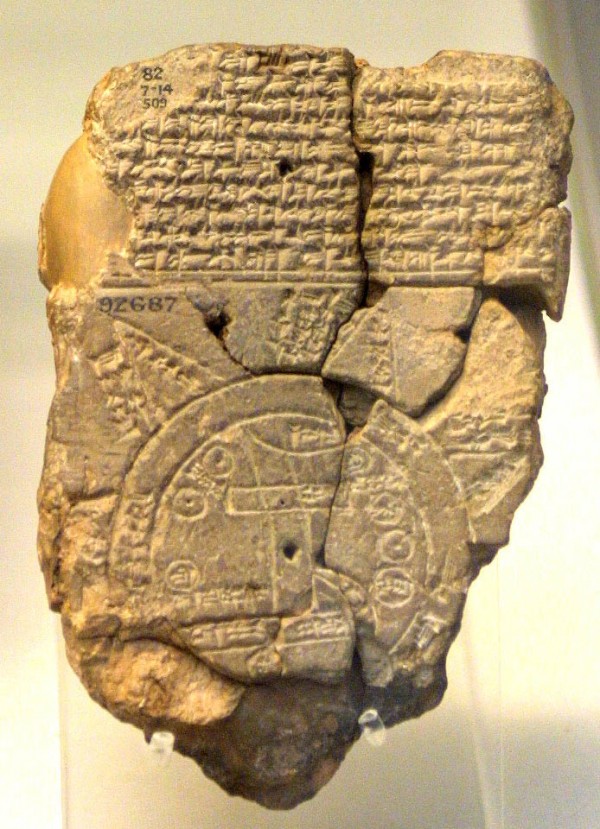
Consider the history of maps of our world. The earliest known attempt to present a map of the world is one from Babylon, around 600 BCE. It essentially depicts the world as a disc, with a handful of lands and cities and landmarks surrounding Babylon, all of which is surrounded by a circle of ocean.
babylon_world-map

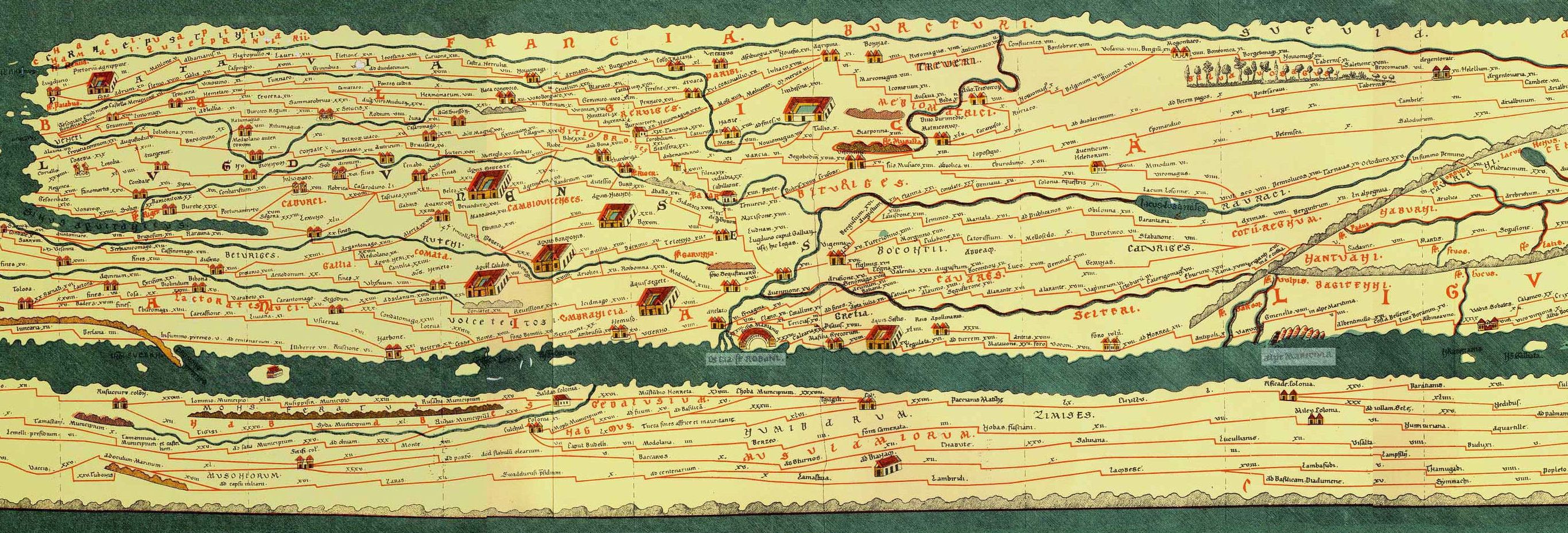
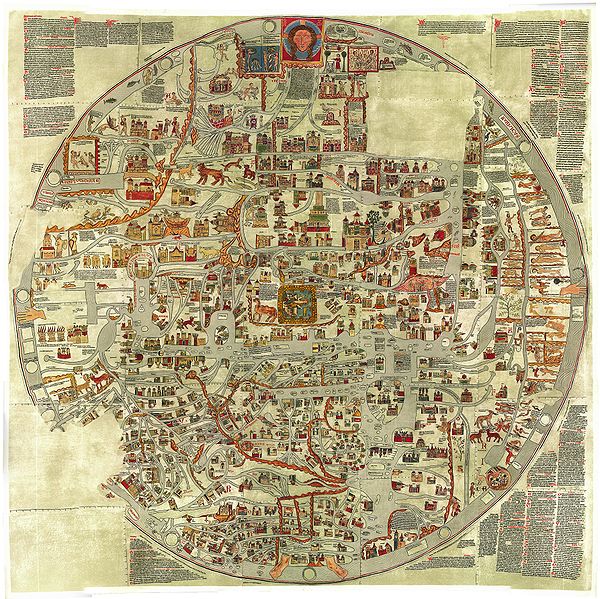
Consider, in turn, a series of maps down through the ages:
TabulaPeutingeriana2

The Tabula Peutingeriana (ca. AD 500), a Roman illustrated itinerarium (road map) showing the cursus publicus, the road network in the Roman Empire.
Ebstorf_map

The Ebstorf Map (ca. 13th century), a medieval map of the world.
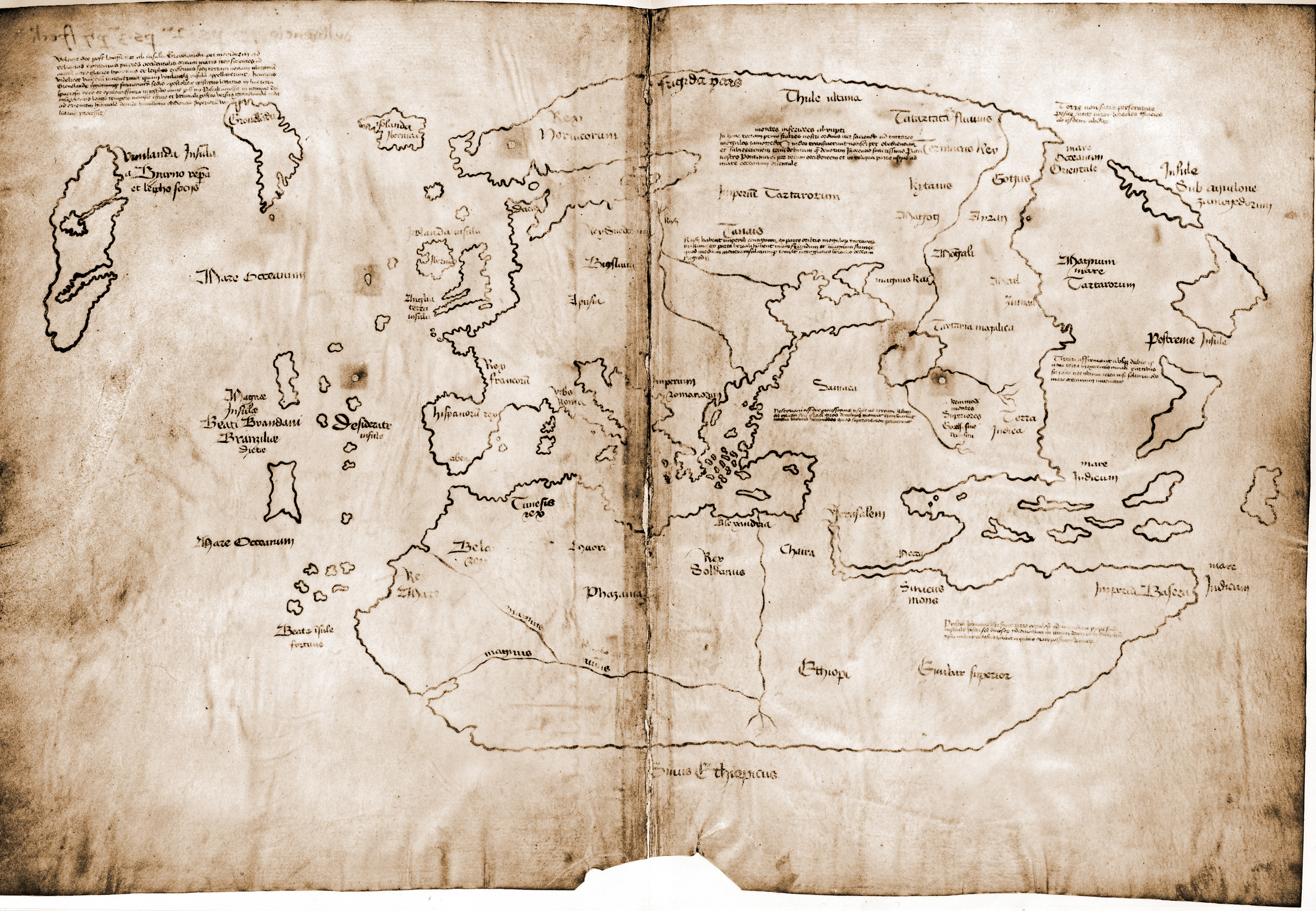
Vinland_Map_HiRes

A map purporting to show Vinland (Newfoundland and the Maritimes–upper left corner), based on Viking exploration in the tenth century.
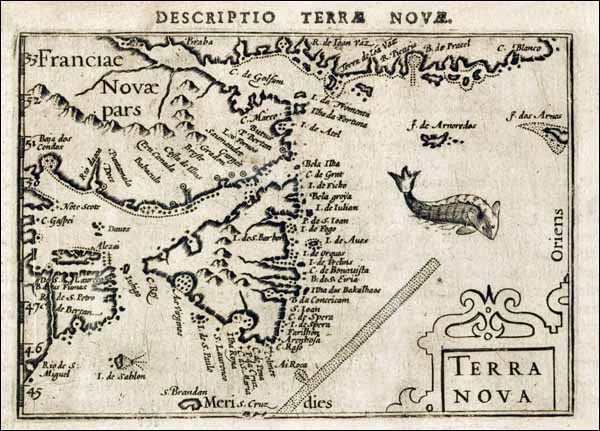
barent_langenes_map_600

Can you see my house?

I suppose it could be argued that the movement of maps toward increasing accuracy contradicts my premise that maps are inherently fictional, but I would disagree; accuracy and reality are not the same thing. And as the (fictional) Organization of Cartographers for Social Equality would point out, the conflation of accuracy with reality can and has been deployed in the service of the powerful.

But I digress. Maps in fantasy fiction are paratextual, which is to say that—like prefaces, indices, appendices, annotations, title pages, afterword, and so forth—they work to circumscribe and define the text of the story. And by the same token, we are privy to them in a way the characters of the narrative are not. So when Sam grumbles about Caradhras not being Mount Doom, as he’d hoped, it is a moment not unlike dramatic irony—assuming, of course, the reader is anything like myself and obsessively consults the maps provided in order to know where in the world the characters are at any given point.

(This is not, I have been given to understand, a pervasive tendency—indeed, last year when I taught The Hobbit in my first-year English class, I polled the students to find out how many of them consulted the maps while reading. To my considerable shock, two-thirds of them did not look at the maps at all. And suddenly the more general geographical ignorance of our undergraduate population became a little bit more comprehensible).

The (quasi) dramatic irony of Sam and Bilbo’s misapprehension lies in the fact that readers know, far more indelibly than the characters, the geography of the world they inhabit.
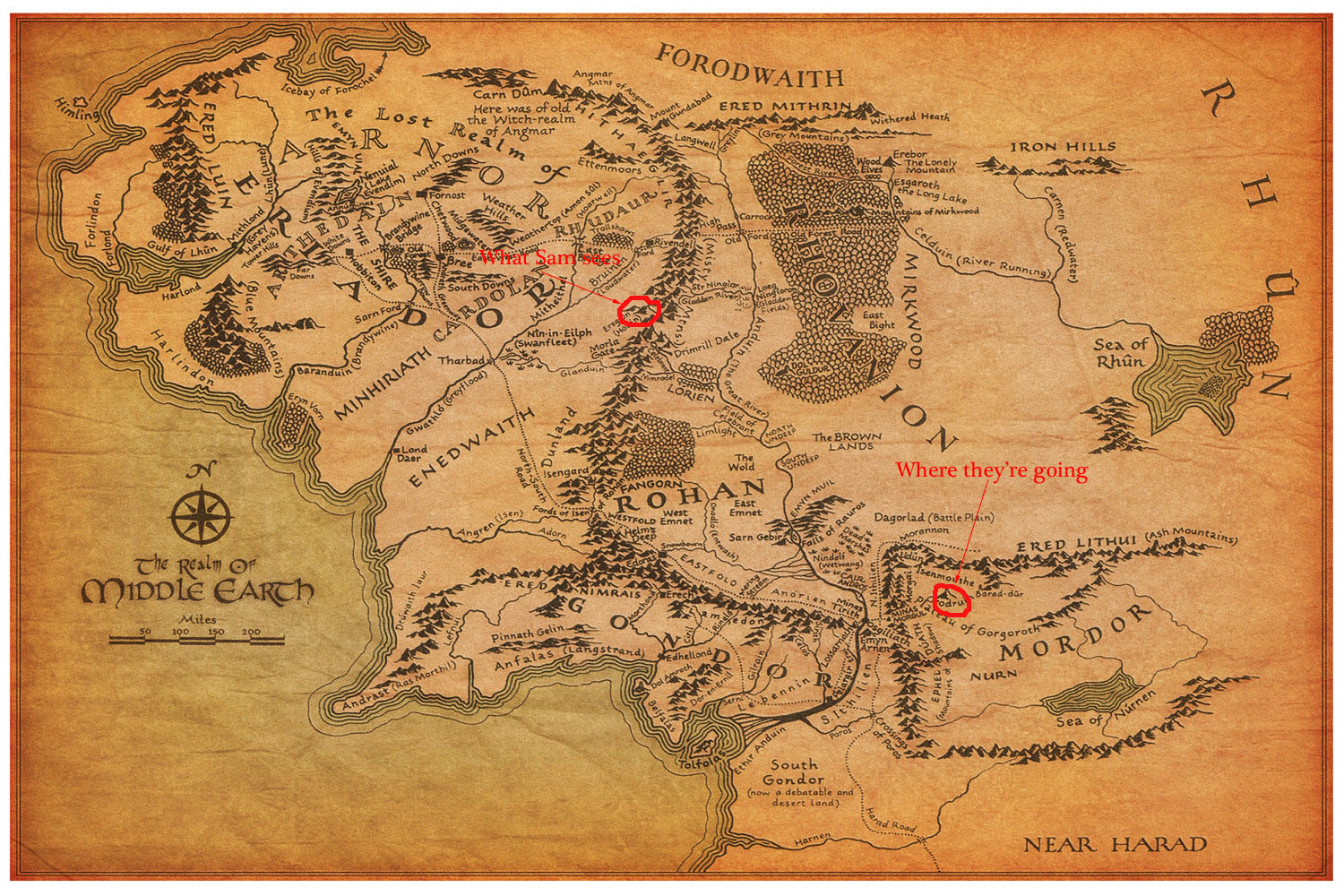
middle-earth3
Of course, such characters as Bilbo and Sam and Pippin are contrasted with Elrond and Gandalf and Aragorn (for example), all of whom presumably have a much greater and more thorough grasp of the extant maps of Middle-earth. But for a long time I have wondered—and yes, this is entirely speculative—do they consult the same maps as the readers? Over the Christmas holidays this past year I read Creation by Gore Vidal, which is about a Persian diplomat named Cyrus, a boyhood friend of the Emperor Xerxes, who over the course of his life travels from Persia to India, to China, and at the end of his life to Greece. At one point as he consults with the Emperor Darius about his first embassy to India, a map of the known world—etched onto copper shields—is produced. Part of Cyrus’ mission is to map the territory into which he ventures, with an obvious emphasis to be put on trade routes. His description of the maps makes it clear that they are only slightly more accurate than the Babylonian map pictured above.

However, the novel provides maps at the beginning, one depicting the entirety of the Persian empire around 500 BCE, and a detail map depicting Greece and the Greek colonies on Asia Minor. Maps of such accuracy are not of course available to Cyrus. And when we read histories of, for example, the Wars of the Roses or the Roman conquest of Gaul, we similarly have maps that the Yorks and Lancasters did not have; and the Romans were sojourning into (literally) unmapped territory. All of which is by way of observing that, if fantasy is in part a nostalgic escape to premodern, neo-medieval settings, I think it is a fair assumption that Middle-earth’s cartographers were no more accomplished than their medieval European counterparts.

Again, this is entirely speculative: I can no more determine the accuracy of the maps in Rivendell than I can definitively tell you how many children Lady Macbeth had. The point here is more to draw attention to the dissonance between the maps with which Tolkien provides us, and his characters’ experience of the territory those maps determine. (It makes me think that someone needs to write a fantasy novel that unfolds as a series of increasingly-accurate maps, with disputes over their validity and the theological arguments over the shape of the world providing the main conflicts for the narrative).

The point is also the epistemological certainty the maps of various fantasy novels afford. One could argue that a fantasy map isn’t meant to be seen as accurate, that it is in fact meant to be understood as replicating the distortions and inaccuracies of medieval maps … except that I cannot think of any reason The Lord of the Rings or any other fantasy novel gives us to make that assumption. Rather, maps of Middle-Earth, Westeros, Pern, Earthsea, and so forth—take your pick—provide a privileged perspective that is consonant with fantasy’s relationship to history. As Farah Mendlesohn observes in her book Rhetorics of Fantasy, the genre tends toward a scholastic conception of the past—which is to say, like medieval Scholasticism, it treats historical accounts as straightforward fact rather then with historiographic skepticism. However much Tolkien characterized his writing of the tales that would become The Silmarillion (and the countless subsequent books edited by his son Christopher) as “creating a mythology,” in the context of The Lord of the Rings they comprise its history. Beren and Luthien, the voyage of Earendil, the fall of Gil-Galad—all of which we encounter in The Lord of the Rings through song—are not mere myth or legend like Gilgamesh or Odysseus, or legend embellished from history, like the Trojan War, but are indelible history. (In case we doubt their validity, we have such literally immortal figures as Elrond and Galadriel, who were actually around for much of Middle-earth’s “mythic” origins).

The question of history versus myth in Tolkien is one I will return to in a future post. For now, let me return to his maps: I know I am not alone in having been enthralled by the geography of Middle-earth; certainly, the hugely popular multiplayer Lord of the Rings Online game exploits the detailed topography of Middle-earth to great effect (I recently signed up for an account, but haven’t yet had much chance to play—more on that when I have). I unfortunately don’t have anything resembling a proper conclusion to this post—like most of them, this is mostly my musings and little more—but I do mean to return to this topic in the future. Stay tuned.

Leave a comment

Filed under Uncategorized

My top one hundred. Sort of. After a fashion. You know.

David Bowie recently listed his top one hundred must-read books as a part of his art show David Bowie Is, which has had spectacular runs at the Victoria and Albert Museum in London, and more recently at the Art Gallery of Ontario. He has, as one would expect of such an extraordinarily talented and intelligent person, some thought-provoking choices, and the list, overall, is endearingly eclectic. It is gratifying to see some of my own favourites there (Lolita, Herzog, In Cold Blood, Nights at the Circus, The Brief Wondrous Life of Oscar Wao), though he also includes On The Road (ick) … and there are a lot of Newfoundlanders who will not be pleased to see Howard Norman’s The Bird Artist, a book that ranks even lower in people’s esteem than The Shipping News for its hackneyed and egregiously inaccurate depiction of outport Newfoundland.

That being said, reading the list got me thinking … not so much about what my one hundred “must-reads” would be, but which one hundred books have affected me the most profoundly over the years. I’m not sure why my mind went there precisely, when the practice of telling people what they should read is both a pedantic hobby and a professional imperative … but I suspect that in the aftermath of last week’s posts about David Gilmour and his insistence on only teaching what he loves had me reflecting on those texts that I love.

It didn’t really occur to me as I wrote those posts, but when I go back and reread Gilmour’s Hazlitt piece and his interview in The National Post, I find it a little odd that, if his personal mandate is to teach only what he truly loves, he seems to have such a narrow range of authors he’s willing to teach. As I sat and made my own list, I reflected that the books I have read that I love and which had affected me profoundly is massive. My favourite part of teaching is that I get to share some of these books with my students.

But then, perhaps I’m just undiscriminating.

I’ve been picking away at this list all week in my spare moments. I started compiling it partially out of curiosity, because I’ve never really done it before. I was also curious to see—after two posts in which I took issue with David Gilmour’s and Margaret Wente’s antipathy to women authors—whether I would prove myself a hypocrite. The one comment I received on those posts was someone pointing out that the banner image at the top of this blog is almost exclusively male, with only Zadie Smith and Marjorie Garber as exceptions. As I replied, my choice of banner image is actually quite random: I took a few pictures of the various bookshelves in my office at home, and that was the one that turned out best (if I’d posted the shelf beneath, you’d think this was a George R.R. Martin fan site). I quite deliberately did not rearrange books to be more flattering—I wanted something honest, if not necessarily representative.

So, a word on my list: my rules to myself were that I could choose one book per author. (If it was a list of books proper, regardless of author, you’d see an awful lot more of Don DeLillo, Toni Morrison, Martin Amis, and so forth). The representative book had to be the work by that author that affected me in a significant manner, not the book that I would later come to consider the best by that author. So for example, Love in the Time of Cholera is the entry here from Gabriel García Marquez, even though I believe One Hundred Years of Solitude is his masterpiece (and one of the greatest novels of the twentieth century), because that was my first real encounter with Marquez. By contrast, the first book of Annie Dillard’s I read was The Writing Life, a slim volume in which she talks about the nature of writing and what the writer’s task is. I read that in high school and loved it, but it was eclipsed a few years later when I read A Pilgrim at Tinker Creek. I read Jane Austen’s Emma when I was an undergraduate, and hated it. Later I read Pride and Prejudice, which made me grudgingly think maybe this Austen person had some game; but it was on reading Northanger Abbey as the urging of an Austen-mad friend that I truly grasped Austen’s genius. I then went back and reread the other two novels (as well as the rest of her books) with new eyes , but it was Northanger that had the greatest affect.

All this is by way of saying that these choices are entirely idiosyncratic.

Also: there is no poetry, for the simple reason that, for me, that is an entirely different category and an entirely different species of affect. What we have here are novels, histories, philosophy and theory, and a handful of plays.

I encourage other lists. Most of the people reading this probably came here from Facebook: if so, post a list there! Otherwise, for you other bloggers, post to your blog and I’ll link to you.

Isabelle Allende, The House of the Spirits
Dorothy Allison, Bastard out of Carolina
Martin Amis, Time’s Arrow
Karen Armstrong, The Battle for God
Margaret Atwood, Lady Oracle
Jane Austen, Northanger Abbey
John Banville, Doctor Copernicus
Pat Barker, The Eye in the Door
Julian Barnes, A History of the World in 10 ½ Chapters
Walter Benjamin, Illuminations
Jorge Luis Borges, Labyrinths
Charlotte Brontë, Jane Eyre
Emily Brontë, Wuthering Heights
Judith Butler, Gender Trouble
Italo Calvino, Invisible Cities
Angela Carter, Nights at the Circus
Noam Chomsky, Necessary Illusions
Kate Chopin, The Awakening
Agatha Christie, And Then There Were None
Joseph Conrad, Heart of Darkness
Don DeLillo, Libra
Junot Diaz, The Brief Wondrous Life of Oscar Wao
Charles Dickens, A Tale of Two Cities
Joan Didion, Slouching Toward Bethlehem
Annie Dillard, A Pilgrim at Tinker Creek
Umberto Eco, The Name of the Rose
George Eliot, Middlemarch
Susan Faludi, The Terror Dream
William Faulkner, As I Lay Dying
Timothy Findley, Famous Last Words
E.M. Forster, A Passage to India
Michel Foucault, The Order of Things
George MacDonald Fraser, Flashman
Northrop Frye, The Educated Imagination
Paul Fussel, Wartime
Neil Gaiman, American Gods
Marjorie Garber, Shakespeare’s Ghost Writers
William Gibson, Neuromancer
Seamus Heaney, Preoccupations
Ernest Hemingway, A Farewell to Arms
Christopher Hitchens, God is not Great
Richard Hofstadter, The Paranoid Style in American Politics
Homer, The Iliad
Zora Neale Hurston, Their Eyes Were Watching God
Linda Hutcheon, A Poetics of Postmodernism
Henrik Ibsen, Hedda Gabler
Fredric Jameson, Postmodernism, or, The Cultural Logic of Late Capitalism
James Joyce, A Portrait of the Artist as a Young Man
Maxine Hong Kingston, The Woman Warrior
Arthur Koestler, The Sleepwalkers
Thomas Kuhn, The Copernican Revolution
Harper Lee, To Kill a Mockingbird
Milan Kundera, Immortality
Margaret Laurence, The Diviners
Ursula K. Le Guin, The Left Hand of Darkness
C.S. Lewis, Prince Caspian
Margaret MacMillan, Paris 1919: Six Months that Changed the World
Christopher Marlowe, Doctor Faustus
Gabriel García Marquez, Love in the Time of Cholera
George R.R. Martin, A Game of Thrones
Cormac McCarthy, Suttree
Ian McEwan, Atonement
Herman Melville, Moby-Dick
Toni Morrison, Paradise
Haruki Murakami, A Wild Sheep Chase
Vladimir Nabokov, Pale Fire
Azar Nafisi, Reading Lolita in Tehran
Gloria Naylor, Mama Day
Edna O’Brien, The House of Splendid Isolation
Flannery O’Connor, The Violent Bear it Away
Michael Ondaatje, The English Patient
Ann Patchett, Bel Canto
Terry Pratchett, Night Watch
Sylvia Plath, The Bell Jar
Thomas Pynchon, The Crying of Lot 49
Bill Readings, The University in Ruins
Jean Rhys, The Wide Sargasso Sea
Richard Rorty, Contingency, Irony, Solidarity
Philip Roth, The Human Stain
Salman Rushdie, Midnight’s Children
Elaine Scarry, On Beauty
William Shakespeare, Macbeth
Mary Shelley, Frankenstein
Jane Smiley, Moo
Susan Sontag, Against Interpretation
Sophocles, Antigone
Muriel Spark, The Prime of Miss Jean Brodie
Art Spiegelman, Maus
John Steinbeck, East of Eden
Bram Stoker, Dracula
Tom Stoppard, Rosencrantz and Guildenstern are Dead
J.R.R. Tolkien, The Lord of the Rings
Monique Truong, The Book of Salt
Alice Walker, Possessing the Secret of Joy
Evelyn Waugh, Brideshead Revisited
Edith Wharton, The Age of Innocence
Colson Whitehead, Sag Harbor
Jeannette Winterson, Sexing the Cherry
Virginia Woolf, A Room of One’s Own
Slavoj Zizek, Everything You Always Wanted to Know About Lacan, But were Afraid to Ask Hitchcock

Leave a comment

Filed under Uncategorized

Of deck renovation, podcasts, and the art of lecturing

IMG_0371

The deck, in process.

A few posts ago I mentioned that I’ve been renovating my home’s back deck and reminisced about the art of the mixed tape—an exercise largely lost in the world of MP3s and iPods, in which a playlist can be thrown together in minutes. As nostalgic as I got—exactly nostalgic enough to write a blog post about it, apparently—I do reiterate my protestation that I do not regret this particular evolution of technology. At all. Certainly, there is a lingering affection for handwritten playlists on those always-too-small card inserts in blank tapes, and the time and care that went into making them … but nostalgia is a dangerous thing, as it tends to elide the less-than-excellent elements of the past, in this case the crappy sound quality, heavy, chunky walkmans, the tapes that tended to get chewed up and tangled, and the space they occupied. As a friend of mine observed, people who grew up with iTunes will likely find excuses to be nostalgic about a time when you actually chose what MP3s you wanted rather than having Apple anticipate, based on an algorithm, what your next favourite songs would be. (Actually, I have a feeling that might be happening very soon).

So, the massive library of music at my fingertips? All on a device so small, granted, I worry I might inhale it by mistake? Yeah, that doesn’t bother me so much.

But there’s also the amazing fact of podcasts. In the last several years I have become a podcast addict, discovering and downloading a whole assortment of stuff, political discussions and arguments, dramatic and comedic series, food shows, literary shows—and what’s so great about the medium is how, while many of these are professionally done by institutions like the CBC or Slate Magazine, many are also just done out of some guy’s basement … and often, the latter prove to be just as good or better.

I’m thinking as I write this that I’ll start doing a weekly podcast recommendation … starting with this one.

I listen to podcasts in the car, or when I’m doing dishes or housework. I like having something to occupy my mind at such times. I will also listen to them when playing Civilization V or a comparable strategic game on the computer, or when I’m working on something that doesn’t require me to write or comprehend sentences. And while the process of tearing up my old deck was best accompanied by eclectic mixes of heavy metal and Korean dance music, the process of framing and laying decking is much better accompanied by podcasts.

And because I’m a dork, many of the things I listen to are quasi-educational: podcasts about books and writers, about politics, and, most recently, I have discovered the joy that is iTunesU.

For the uninitiated, iTunes has a section dedicated to all things academic—or, well, some things academic. There is a lot of dreck to wade through, as many if not most universities posting channels have used it principally for advertising purposes. But there are some gems in there, and my favourite so far is Open Yale … which has put up podcasts of entire courses, mostly (so far as I can see) undergraduate survey courses. Which makes sense: a seminar course would not work on podcast, whereas as a series of lectures delivered to large classes fits the bill nicely. There have been two I’m listening to, a course on European history after 1645 by John Merriman, and an introduction to ancient Greece by Donald Kagan. I’ve only listened to a few of Merriman’s lectures so far; I’ve been entirely sucked in by Kagan’s. I’ll get back to Europe when my sojourn in ancient Greece is done. For now, I’m thoroughly enjoying the endearingly cantankerous Kagan’s narrative of Greece from the dark ages to the twilight of the city-state—not least because it reminds me of my time as a first-year university student taking a very similar class. For the record, Kagan is an academic rock star (a number of years ago, I read his magisterial account on the Peloponnesian War, and was entranced), but that doesn’t necessarily translate into being a good lecturer. Kagan? Great lecturer. He may have a lot of harrumphs, both bronchial and political (he likes to refer to the contemporary university as the “Politburo”), but the story he tells of the rise and fall of Greek society is wonderfully compelling.

(Credit where it’s due: I learned of Open Yale by way of the blog of Ta-Nehisi Coates, who blogs for The Atlantic—someone whom, if you’re at all interested in American politics, you should read. One of the smartest and best writers currently blogging. The link is to your right).

Kagan had one lecture that sent me to YouTube, in which he uses students in his class to demonstrate the arrangement of a hoplite phalanx. This had me wracking my brain to think of novels I could teach that would allow me to make a similar demonstration. The fun stuff starts to happen at 17:30:

I like to think I’m a good lecturer, but then I listen to such things and am reminded that I can always get better.

So: Open Yale. My podcast recommendation for the week.

I can’t quite let this go, however, without a little more nostalgia—even though I inveighed against nostalgia at the start of this post. As I said, one of the things I love about listening to these podcasts is remembering how amazed I was by some of the lecturers I encountered in my undergrad. I really hope people reading this post had similar experiences, because there is really nothing, nothing, like sitting in a lecture hall and listening to someone who knows his or her craft blowing your mind with their account of, well, anything. I don’t discriminate: some of the best lectures I had in my first year were on the history of science. I suppose that is one of the things—or perhaps the thing—that makes me a dork. I just love learning stuff. Which is why I am so happy to be out under the blazing sun (well, sun that blazes as much as it can in Newfoundland) building a deck while listening to the vagaries of ancient Athenian politics. IF … and this, granted, is a big if … it can be done in an engaging and compelling way. If it can be done so that the story is good (see how I brought that around to this blog’s theme?).

On that note, I leave you with something I recently discovered. My undergraduate alma mater, York University, has discovered YouTube … and while much of its postings are of an advertising nature, they have also posted some lectures by prominent professors—including my favourite professor ever, and my first real academic mentor, Arthur Haberman. Arthur is now retired, but he is one of those people who affected me profoundly. Every time I teach—and I am not exaggerating there—I sense his influence. He was, and is, an extraordinary educator and academic, and a wonderful person. York has posted a lecture of his on Impressionism and society, broken into nine parts. Here is the first.

I watch this and think: students of mine will probably see echoes in my teaching. Believe me when I say they are just echoes. I could never live up to Arthur’s example.

Leave a comment

Filed under Uncategorized