Category Archives: teaching

Thoughts on AI as the New School Year Approaches

TL;DR: this year I’m being unequivocal about students’ use of AI. I’m banning it.

And yes, this is very much an exercise in spitting into the wind, fighting the tide, etc. Choose your metaphor. AI’s infiltration of every aspect of life seems inevitable at this point, but to my mind that makes an education in the humanities in which students engage with “The best which has been thought and said” (to use Matthew Arnold’s phrasing) all the more crucial, and all the more crucial that they do it without recourse to the banalizing effects of AI.

I’m profoundly sceptical of the claims made for AI’s potential, and not just because twenty-five years of Silicon Valley utopianism has given us the depredations of social media, monopolistic juggernauts like Amazon and Google, and a billionaire class that sees itself as a natural monarchy with democracy an also-ran annoyance. In the present moment, the best descriptor I’ve seen of AI is a “mediocrity machine,” something evidenced every time I go online and find my feeds glutted with bot-generated crap. “But it will get better!” is not to my mind an encouraging thought, not least because AI’s development to this point has often entailed the outright theft of massive amounts of intellectual property for the purposes of educating what is essentially a sophisticated predictive text algorithm.

But that is not why I’m banning use of AI in my classrooms.

To be clear: I say that knowing all too well how impossible it is to definitively ban AI. Unlike plagiarism proper, AI’s presence in student essays is at once glaringly obvious and infinitely slippery. With plagiarism, so long as you can find the source being copied, that evidence is ironclad. But AI is intrinsically protean, an algorithmic creation that potentially never produces the same result twice. And yet it’s always obvious, whenever I get an essay that is grammatically perfect but intellectually vacuous. A ChatGPT-authored essay is basically the uncanny valley in prose form: it looks like a reasoned and structured argument, but it lacks the idiosyncrasies and depth that make it, well, human. I’ll say this much for AI—it has pulled off the feat of making me grateful to find an essay riddled with grammatical errors and unreadable sentences. In the present moment, that’s the sign of a student actually doing the work.

But then, that’s the basic point: it’s doing the work that’s important. I recently read an interview with Texas teacher Chanea Bond on why she’s banning AI in her classroom. It’s a great interview, and she helped clarify some of my thinking on the subject. But what depresses me is that her stance is even remotely controversial—that she received a great deal of pushback on social media, much of it from fellow educators who see AI as a useful tool. To which Bond said: No, in Thunder. Which was not a response emerging from some sort of innate Luddism, but from her own experience of attempting to use AI as the useful tool so many claim it to be. “I envisioned that AI would provide them with the skeleton of a paper based on their own ideas,” she reports. “But they didn’t have the ideas—the analysis component was completely absent. And it makes sense: To analyze your ideas, they must be your ideas in the first place.”

This, she realized, was the root of the problem: “my students don’t have the skills necessary to be able to take something they get from AI and make it into something worth reading.” To develop a substantive essay from an AI-generated outline, one must have the writing skill set and critical acumen to grasp where the AI is deficient, and to see where one’s own knowledge and insights build out the argument. Bond’s students were “not using AI to enhance their work,” she observes, but are rather “using AI instead of using the skills they’re supposed to be practicing.”

And there’s the rub. In my lifetime, and certainly in my professional academic career, there has never been a time when the humanities has not been fighting a rearguard action against one form of instrumentalization or another. Tech and STEM are just the most recent (though they have certainly been the most overwhelming). The problem the humanities invariably faces is that it’s ultimately rooted in intangibles. Oh, there’s a whole host of practical abilities that emerge from taking classes in literature or philosophy or history—critical reading, critical writing, communication, language—and perhaps we could do a better job of advertising these benefits. But I’m also loath to play that game, for reducing humanities education down to a basic skillset not only elides its primary, intangible benefit, but also plays into the hands of administrators seeking to reduce the university to a job creation factory. In such a scenario, it’s all too easy to imagine the humanities reduced to a set of service courses—English transformed to basic composition, literature jettisoned; languages taught solely on the basis of what’s of practical use in industry; philosophy a set of business ethics classes; communication studies entirely instrumentalized, stripped of all inquiry and theory; and entire other departments simply shuttered, starting with classics and history and working down from there.

It may appear I have drifted from my original topic, but this sort of thinking is exactly the kind that believes AI can replace critical, intellectual, and creative work. What is both risible and infuriating about this assumption is that whatever sophistication AI has attained has come by way of scraping every available resource to be found online—every digitized book, every image, every video, a critical mass of which is other people’s intellectual property, all plundered to feed the AI maw. (And still, all it can produce are essays that top out in the C range in first year English classes.) I don’t think AI’s cheerleaders have grasped what a massive Ouroborosian exercise this is: as the snake consumes more and more of its tail there is less and less of it. The more we collectively rely on AI to do our thinking for us, the less creative, new, and genuinely revolutionary thought there will be to feed the beast. And as a result, the more stagnant and banal becomes the output.

Last year I reread 1984 for a course I was teaching and was struck anew by the degree to which Orwell is less concerned with totalitarianism’s mechanisms of brutality than with the curtailment of people’s capacity to articulate resistance and dissent. His notorious Thought Police are just the crude endpoint of power’s expression; the more insidious project lies in removing the ability of people to think thoughts worth policing. Winston Smith labours at the Ministry of Truth revising history to square it with the Party’s ever-changing reality, but it is his lover Julia’s work in the Ministry’s fiction department that struck me this time around. Her job, she tells Winston, is working the “novel-writing machines,” which consists of “chiefly in running and servicing a powerful but tricky electric motor.” She off-handedly refers to these machines as “kaleidoscopes.” Asked by Winston what the books she produces are like, she replies, “Oh, ghastly rubbish. They’re boring, really. They only have six plots, but they swap them round a bit.” These novels function as a societal soporific, titillating the masses with stories by turns smutty and thrilling, but which deaden their readership by circumscribing what is possible to imagine.

Julia’s description struck me as uncannily prescient, conceiving as it did a sort of difference engine version of Chat GPT.  The point of Julia’s work is the same as that of Newspeak, the language replacing English in Orwell’s dystopian future. Newspeak radically reduces available vocabularies, cutting back the words at one’s disposal to a bare minimum. In doing so it curtails, dramatically, what can be said and therefore what can be thought—eliminating the possibilities for resistance by eliminating the ability to articulate resistance. How does one foment revolution when one lacks a word for revolution?

I’m banning AI, insofar as I can, because its use cranks the law of diminishing returns up to eleven. In the process, it obviates the most basic benefit and indeed the whole point of studying the humanities, which can’t be reduced to some abstracted skill set. The intrinsic value of the humanities lies in the process of doing—reading, watching, thinking, researching, writing; then being evaluated and challenged to dig deeper, think harder, and going through the process again. There is of course content to be learned, whether it’s the history of colonialism, the Copernican Revolution, the aesthetic innovations of the Renaissance, or dystopian novels like Orwell’s; all of that is valuable because all knowledge is valuable, but inert knowledge is little better than trivia. Making connections, puzzling out knotty and difficult texts, and most importantly making sense of it to yourself and engaging in dialogue about it with others—it is this process wherein lies the great intangible benefits of the humanities. The use of AI is kaleidoscopic in the sense Julia alludes to in 1984, providing the illusion of variation and newness, but ultimately just a set of mirrors combining and recombining the same things over and over.

Leave a comment

Filed under teaching, Uncategorized

The Opposite of Poetry

Well, it’s Labour day–which to me is the real New Year’s Eve. My calendar has been tied to the cycle of the academic year since kindergarten, so the desperate festivities that happen on December 31 always have seemed to me … well, misguided.

This September is of particular note in my family, as my niece Morgan is starting university. My brother Matt, his wife Michelle, and my nephew Zachary (himself just two years out from that big step) drove Morgan out to Kingston, Ontario to get her settled at Queens for the next great adventure of her life. As Matt noted, “It was a silent three-hour drive home.” By all reports, Morgan is already thriving, making new friends and signing up to try out for the women’s baseball team. She asked my mother whether it was OK to be both terrified and excited; my mom told her that combination of emotions always signifies something momentous and memorable.

Morgan starting university has an odd symmetry for me. She was born eighteen years ago. I went to meet my new niece at the hospital and then, three days later, hopped in my car to drive to Newfoundland to start my new job at Memorial University. Which means my university career is now old enough … to go to university.

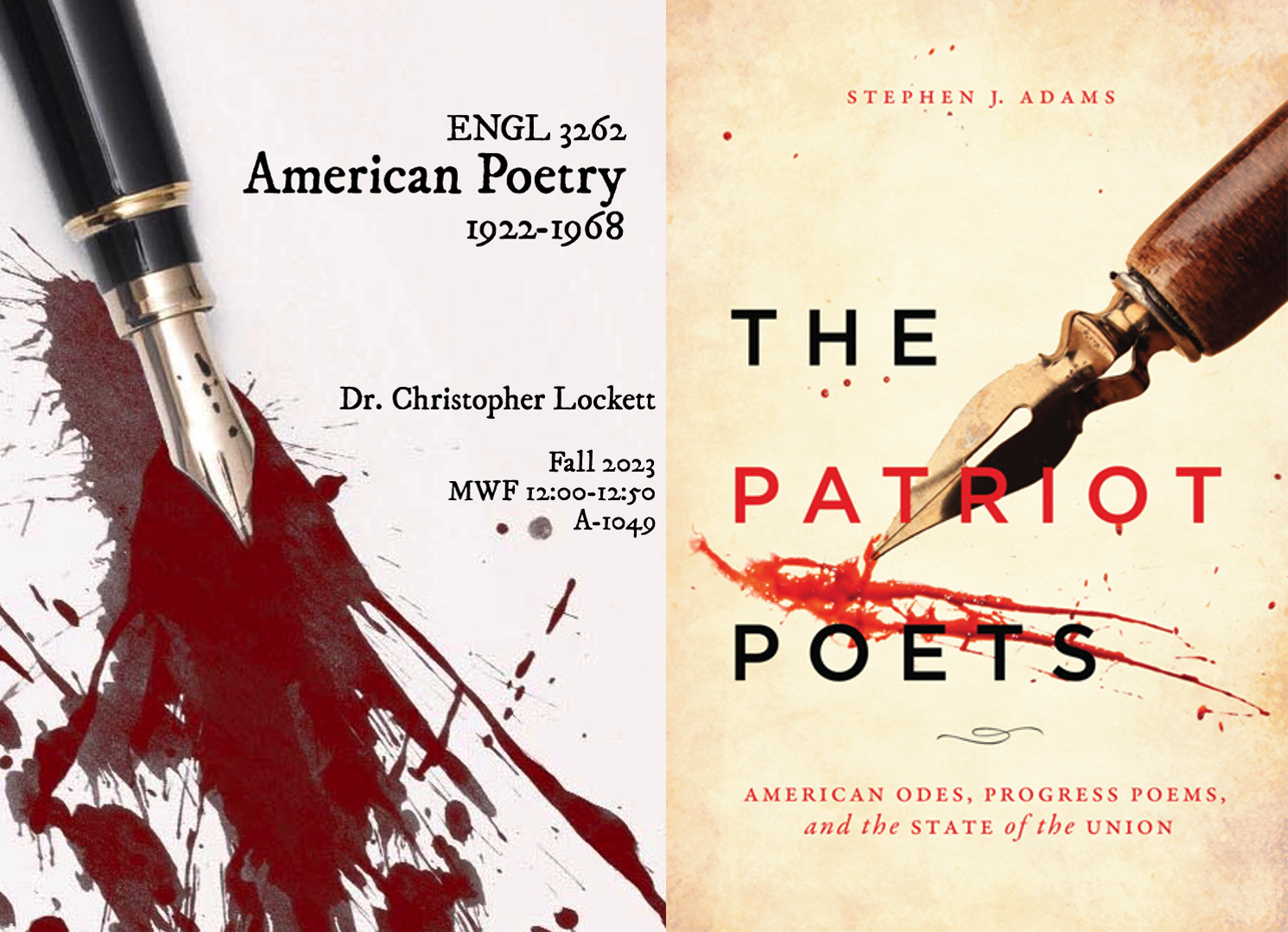
Eighteen years in this job! You’d think that in all that time, as well as the eight years as a TA and sessional lecturer through my PhD at Western, I would have taught a poetry course. But no–this fall will be the first time, as I gear up for ENGL 3262: American Poetry 1922-1968. I was worried it would be undersubscribed, as poetry courses often have been in years past, but it’s full. There’s even one student on the waitlist.

At any rate, I wrote a post on Medium I’ve titled “The Opposite of Poetry.” What, might you ask, is the opposite of poetry? Well, you’ll just have to read it. It’s basically a variation on the introductory lecture I’ll be delivering this week.

I am really looking forward to this course, but also a bit sad. This summer a former professor of mine passed away. I say “former professor,” but I didn’t actually take any classes with Stephen Adams … Stephen was more of an informal mentor, a kind and generous presence. He was technically a specialist in 20th Century American poetry, with an emphasis on such modernists as Ezra Pound, but really his remit was just poetry in general. All of it. He had an encyclopedic mind and an unmatched ear for the music of verse–something he put to use in his book Poetic Designs, which is to my mind the best guide to poetic structure and prosody there is. What’s more, it’s an eminently readable book, no mean feat when your subject is rhyme and meter.

After he retired, Stephen continued researching and writing, producing the book The Patriot Poets just a few years ago. I designed my course syllabus cover in homage:

The course, indeed, is dedicated to Stephen. There’s an “In Memorium” section in the syllabus. He and I corresponded quite frequently over the past few years, often when I wanted to pick his massive brain over various poetic topics. I was looking forward to telling him about the course as it unfolded. I’ll have to be happy with carrying his memory forward into the course, both because I’ve assigned Poetic Designs as required reading, but more importantly in the wisdom he shared with me that I can pass on to my students.

Leave a comment

Filed under teaching

Gearing up for the Fall

Just for starters, I have a new Medium post up. This one was supposed to just be a regular blog post, but, as so frequently happens with me, it grew in the telling. It’s a bunch of thematically linked musings precipitated by finally watching the HBO adaptation of Station Eleven (so good!), the ongoing drama of the WGA/SAG-AFTRA strikes, and starting to prep my Fall classes in earnest. As is usual with my thought processes, I was struck by the serendipities: the relevance of the strikes to the popular culture class I’m teaching, the ways in which Station Eleven plays with the distinctions between high and low culture, the fact that I’m teaching Station Eleven in my Utopias/Dystopias class, and that I’ll be asking both classes a question arising from these musings.

Which is: in the event of a civilization-ending apocalypse that wipes out electrical infrastructure, assuming you survive, what would you do for entertainment in your down time? When not foraging for food or killing zombies, how will you nourish your soul?

Considering the critical mass of post-apocalyptic ideation over the past twenty years, it’s not a question that has had much play.

Anyway, I get into it in the Medium post.

Prepping my classes is oddly energizing. As I mentioned in my previous post, I didn’t teach in the winter term, so I’m excited about getting back into the classroom. I’m particularly looking forward to my first-ever poetry class. I’ve taught a lot of poetry in the twenty-six years since I was a TA at the start of my PhD … but I’ve never taught a course exclusively about poetry. A number of years ago, my fellow Americanist in the department and I completely revamped all the American literature courses, basically burning it all down and rebuilding. Third year classes are our genre classes: drama, fiction, poetry. My colleague is the American theatre encyclopaedia, so he has taken drama, and I’ve taught the fiction class numerous times. But I didn’t want the poetry class to lie fallow forever, so I put it on my roster this year.

I’m covering the years 1922-1968—basically from the first cannon-shot of modernism (i.e. The Waste Land) to the symbolic end of 60s counterculture, from Pound and Eliot to Ginsberg, with stops along the way at imagism, the Harlem Renaissance, WWII, mid-century women poets, and voices from the Civil Rights era.

I was always trepidatious about teaching a poetry class, for the simple reason that I was concerned about enrolments. Poetry classes have had a tendency to be undersubscribed, and in the university’s current economic straits, the powers that be are quicker to cancel classes than usual. I was marshalling my arguments for keeping the class in the event it garnered students in the single digits (the class is capped at 35), and was prepared to let me other classes be oversubscribed.

Turns out I needn’t have worried.

As of writing this, the class is full. Apparently, students want to read poetry after all. I really have to stop underestimating this generation—they’re always surprising me in heartening ways.

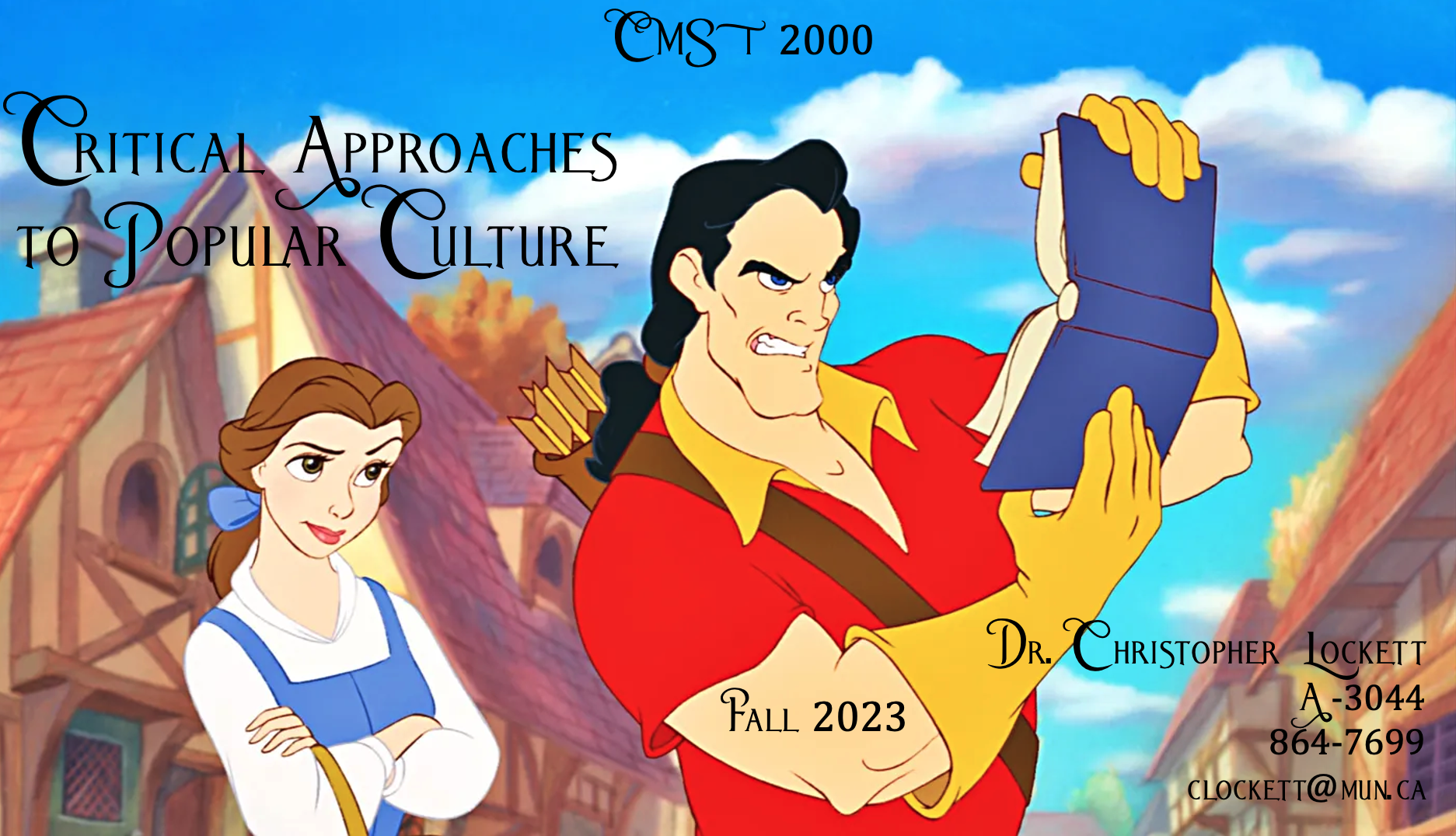
I haven’t taught our Communications Studies course on popular culture in six years; when starting to put it together for this fall, I realized one of my decisions would be which streaming services I would oblige my students to subscribe to. There are other ways to do things, of course, but streaming is now where the lion’s share of content resides. After a certain amount of deliberation, I decided to opt for just one: Disney+. There were several reasons for this. One, Disney is now so all-encompassing that it includes all Star Wars properties, all Marvel, Pixar, as well as a host of stuff that seems weird to find on the Disney service (What We Do in the Shadows, for example, or It’s Always Sunny in Philadelphia are hardly content one would associate with the Mouse). Two, that very all-encompassing quality will comprise a very useful meta-question when thinking about the history of the culture industry and its present state. Three, the ongoing feud between Ron DeSantis and Disney just begs to be interrogated in a class such as this. Four, Disney has Hamilton, which will let me revisit the play—when I did our pop culture class the first time, in fall of 2016, we did Hamilton, but were limited to the cast recording. Coinciding with the election of Trump, Hamilton went from being a musical embodiment of the Obama era to a naïve relic of “hope and change” in the space of a day. It will be interesting to consider Lin-Manuel Miranda’s theatrical phenomenon after the past seven years.

Finally, the real seed of this choice came when I watched Andor and thought “Oh, if I ever teach pop culture again, this is totally going to be on the course.”

Finally, Utopias and Dystopias. This course was on the books when I started at Memorial eighteen years ago, the creation of a senior colleague now retired. I coveted it from the start, and finally got a chance to teach it in winter 2021. Teaching a course on utopias and dystopias remotely during a pandemic lockdown was … well, a little on the nose, shall we say? Though I was also teaching a graduate seminar on post-apocalyptic literature at the same time, so I was sort of leaning into the theme I suppose.

That first go-around I did not include Orwell’s 1984—I went in with the vague assumption that all my students would have read it. Turns out none of them had, which I found odd. So I put it on the course this time, and am currently re-reading it for the first time in I don’t know how long. I went on a big Orwell kick last year and read a whole bunch of his essays, inspired by Rebecca Solnit’s Orwell’s Roses. Getting stuck back into 1984 after having done all that reading, and after having not re-read it for so long, is quite lovely. And terrifying.

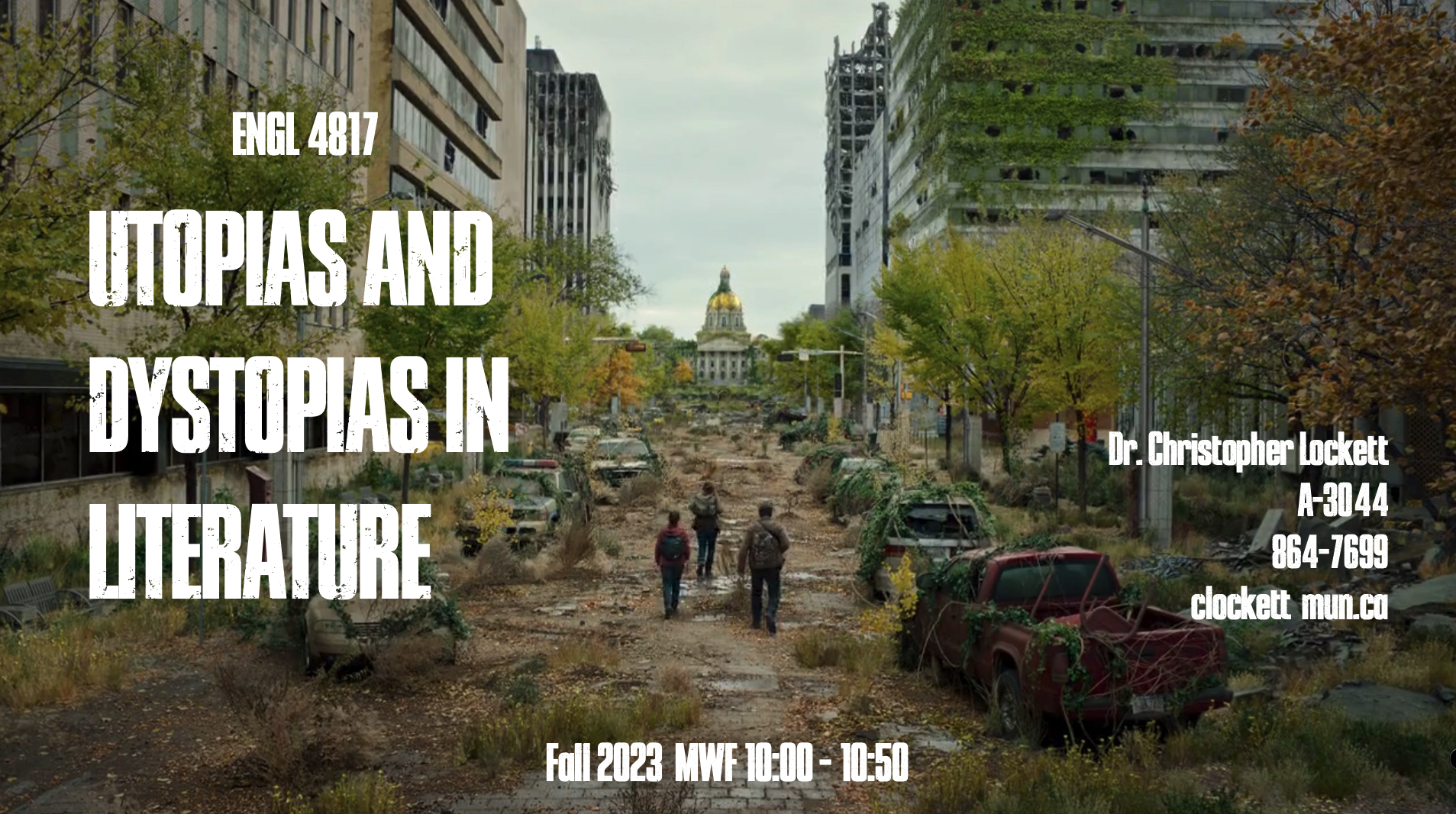
Oh, and for those wondering, based on my poster image—yes, we’ll be doing an episode of The Last of Us. In fact, we’ll be doing that episode concurrently with Station Eleven under the general theme of “what will survive of us is love.”

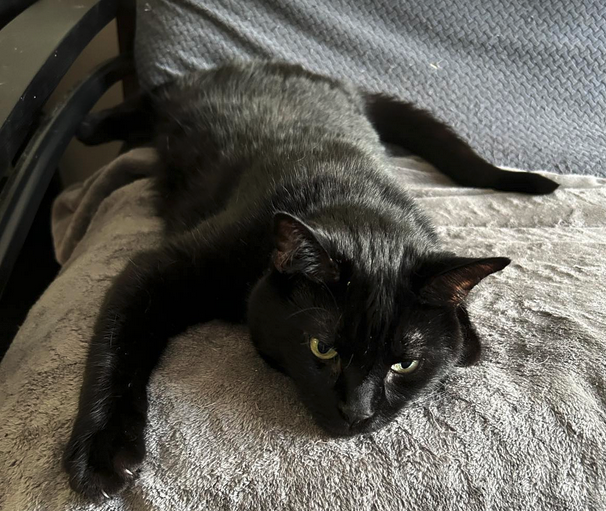
That’s it for now. Again, I leave you with a cat: Gloucester, not quite coping with the recent spate of un-Newfoundland hot weather.

Leave a comment

Filed under A Few Things, teaching

Catastrophe as MacGuffin, or, Were the Zombies Trying to Warn Us About Trump This Whole Time?

As I mentioned in my last post, we’re currently watching The Stand, a mini-series adaptation of Stephen King’s 1978 novel. Though both the novel and the series are quite graphic in their depictions of the weaponized superflu that wipes out most of the world—and quite clear on just how the pathogen escaped its experimental military facility—ultimately, the flu itself is ancillary to the substance of the story, which is about a showdown between the forces of good and those of evil.

As I enter the last two weeks of classes for the term and reflect back on the texts we’ve done in my graduate seminar on 21stC post-apocalyptic narratives, some of which have overlapped with my Utopias & Dystopias course, and the course I taught last term on pandemic fiction, I’m struck by how often it has been the case that the catastrophe precipitating these stories has been, more often than not, simply a device to clear the decks for what comes next. I really have no reason to be so struck by this fact, given that I titled my grad course “The Spectre of Catastrophe,” specifically because it focuses on narratives preoccupied less with the catastrophe itself than the aftermath. But it occurs to me that when the catastrophe—be it a viral outbreak, asteroid strike, alien invasion, or whatever—is the focus of the story, it’s usually because it will be resolved by the end. It is, in such instances, the focus of the action, not the setup for the action.

By contrast, many of the post-apocalyptic narratives I’ve been looking at this year often go out of their way to be vague about the nature of the precipitating catastrophe. Your average zombie apocalypse has little to say about what caused the dead to rise—few offer even as much exposition as 28 Days Later prologue, in which eco-terrorists storm a lab and inadvertently free monkeys who have been infected with the Rage virus, or the vague suggestion in Night of the Living Dead that zombies are the result of radiation from a satellite. Shaun of the Dead offers the most perfect parody of this tendency, when at the end, again safely ensconced on his couch, Shaun flips through channels on the TV reporting on the aftermath of the zombie plague and changes the channel before anyone can offer an explanation for how it happened.

Even the arguably bleakest post-apocalyptic narrative of the past twenty years—Cormac McCarthy’s The Road—deliberately frustrates readers keen to know how the world of the novel ended up a blasted wasteland. So too Emily St. John Mandel’s far more hopeful Station Eleven is conspicuously uninterested in the details of the “Georgia Flu” that devastates the world. The comparable pandemic in Kevin Brockmeier’s The Brief History of the Dead is less significant for how it wipes out the world’s population than for the simple fact that it does, which allows for the rather intriguing vision of the afterlife on which the novel is premised. And even all of the gross, granular detail with which Stephen King endows “Captain Trips,” the superflu that wipes out 99.9% of America (and presumably the world, but that’s a speculation for a future post), is ultimately a bit of misdirection as the novel then settles into its aforementioned epic battle between Light and Dark.

In all of these examples, catastrophe plays the narrative role of what film nerds like me call a “MacGuffin,” a concept most associated with Alfred Hitchcock. A MacGuffin, Hitchcock said, is something the characters find important, but the audience doesn’t care about—something that precipitates the action, but is ultimately ancillary to it, like the Maltese falcon of The Maltese Falcon, a putatively priceless statuette that drives the plot, but which is never found; or, more specific to Hitchcock, the money Marion Crane (Janet Leigh) steals from her employer in Psycho, but which is less important than the fact that in fleeing her crime she ends up at the Bates Motel.

Catastrophe has become one of our more prevalent MacGuffins: how the world ends is more or less incidental to what comes afterward. There are of course exceptions to this rule; this post comes about in part from my notes for my grad class on Monday, in which we’re finishing Ling Ma’s novel Severance and starting Mandel’s Station Eleven. The latter, as I mention above, is exemplary of this tendency to use catastrophe as a plot device; Severance, by contrast, is far more interested in the particulars of the pandemic that collapses civilization, mainly because the particulars of the “Shen Fever” are tied closely to the novel’s themes of nostalgia and home. The infectiousness of the disease, in which people are reduced to mindless automatons repeating rituals from their former lives, is most prevalent among those given to nostalgia. Candace Chen, the novel’s protagonist, came to the U.S. at a young age when her parents immigrated from China; in the novel’s present, both of her parents have died, and she feels equally not at home in New York City and her home region of China, which she visits on business trips. Feeling generally rootless and untethered makes Candace ironically immune to the disease.

This thematic connection between the catastrophic pandemic and Candace’s situation—which in the novel is also more broadly representative of the millennial experience of late capitalism—makes the cause and particulars of the catastrophe central to the novel, in that both the characters and the audience care about it; this also makes Severance an instructive outlier in a burgeoning sub-genre full of catastrophic MacGuffins.

A large part of the reason for this relates to one of my overarching arguments about contemporary post-apocalyptic narratives, which is also one of the premises of my course: namely, that the preoccupation with the aftermath of catastrophe is indicative of a breakdown of faith and trust in government—not a new phenomenon by any means, but something that became supercharged by the Bush Administration’s post-9/11 failures in Iraq, the debacle of Hurricane Katrina, the increasing polarization of politics and culture, all culminating in the election of Donald Trump. Trump was an is a catastrophic figure, and while I mean that quite literally, it’s important to keep in mind that being symbolically catastrophic—i.e. being seen by his followers as a bomb that would demolish “the Establishment”—was a huge part of his appeal. To many people, Trump is an expression of what I’ve been terming “hopeful nihilism,” which is also an animating factor in many post-apocalyptic narratives. Hopeful nihilism is the flip side of what Lauren Berlant terms “cruel optimism,” a condition in which the object of your desire is actually an obstacle to your flourishing; hopeful nihilism is the belief that burning down and destroying the present system clears the decks for a freer and more authentic existence in the wreckage.

Hence, the general lack of interest in the nature of the catastrophe in these stories: the important thing isn’t the why and how, but the simple fact of civilization’s end. The catastrophe is a MacGuffin; the important thing is what happens next, and how the characters negotiate the circumstances. It may be that in time that we see Trump in similar terms, which would actually go a long way towards explaining how a fatuous, preening New Yorker billionaire became the symbol of defiance for a rump of resolutely “anti-elitist” people; perhaps the particulars of the Trumpian catastrophe were less important than the fact of it. It is, I admit, a comforting thought, as it suggests a huge difficulty for those who want to step into Trump’s role going forward—especially if (and it’s a big if) the Biden Administration can take steps to re-establish people’s faith in government to help its people.

1 Comment

Filed under teaching, The Trump Era

A Few Things

What I’m Reading  Aside from my reading for the term and for research, I’m about three-quarters of the way through Barack Obama’s memoir A Promised Land. It is a very long book (700+ pages) that doesn’t even get to the end of his first term; it is reflective, often pausing in its narration of events so Obama can ponder the vagaries of decisions he made or didn’t make, and ruminate on the broader significance of this or that detail in the broader context of American history; he also frequently digresses into little potted lectures on history and political philosophy to better frame the stories he’s telling.

Or to put it another way: I’m loving it. There are many reasons why I have such vast respect for this man, and why I think history will ultimately rank him as one of the best presidents; his humanity, intelligence, and passion are among those reasons, and they come through on every page, along with a professorial and nerdy wonkishness that I aspire to. After four years of Trump, this book is a salve to my soul.

What I’m Watching  Really, my life these days in measured out in week-long increments of impatience between each new episode of The Expanse. I latched onto the novels by James S.A. Corey (the pseudonym of Daniel Abrahamson and Ty Franck) soon after the first one (Leviathan Wakes) was published, and have read them obsessively since (we’re now eight novels along, and I’m waiting for the ninth and final installment rather impatiently). So when I saw they were adapting the novels to TV, I experienced the usual excitement and trepidation one often does when beloved books are being adapted to the screen. Will it be good (Good Omens, Game of Thrones) or bitterly disappointing (American Gods) or just … meh (The Magicians)?

The Expanse not only did not disappoint, it has gotten steadily better every season as the writers have found their groove and the special effects budgets have grown. This season—the fifth—is the best so far. It benefits in part from the narrative build of the previous seasons, in which otherwise seemingly insignificant plot points and elements of world-building have culminated in some pretty virtuosic storytelling, matched by amazing acting and visuals that now rank The Expanse among the best SF/F that has been brought to TV.

I don’t want to get into detail, because spoilers, but I will almost certainly write a much longer and spoiler-filled post once this season is done.

The Pleasures of Zoom-Teaching  To be certain, I miss being in the classroom with the intensity of a nova—teaching and interacting with my students is easily my favourite part of my job, and the classroom has always been a quasi-sacred space to me. Talking to the Brady Bunch arrangement of squares on my laptop screen is nowhere near the same thing … but there are aspects of it I like. Not the least of which is I can conduct classes wearing pyjamas. Also, they don’t know what’s in my mug, heh …

There is also Zoom’s chat function. As class discussion progresses, sometimes students will carry on a parallel conversation in text. It’s as if they’re passing notes in class, but I get to read them.

But by far my favourite aspect is the presence of pets. My cat Gloucester is a frequent visitor, jumping up onto my lap and staring at the faces on my screen with his golden eyes. And there is a petting zoo worth of dogs and cats—and in the case of today’s class, a bunny!—perched on my students’ laps or occasionally pushing their snouts close in to the webcams.

Oh, Yeah—Classes Started Today  Memorial delayed the start of term for a few days to give students a slightly longer break (something I was grateful for, too), so today was day one of the winter term. My first class was my graduate seminar “The Spectre of Catastrophe,” and if today was any indication, this is going to be a good term. There was a wonderful energy to the class, and everyone was enthused and engaged.

Tomorrow I start with my fourth-year seminar “Utopias and Dystopias,” a class that was designed by a former colleague of mine, now retired. It was always a student favourite when he taught it, and I’ve been requesting it since he retired several years ago. My teaching dance card was always too full to slot it in previously, so I’m delighted to finally get to teach it.

Last semester I taught a course on pandemic fiction; this term, it’s utopias and dystopias and post-apocalyptic narratives of the 21st century. Sense a theme? It feels a little bit, after 2020, like I’m steering into the skid.

Leave a comment

Filed under A Few Things, teaching, what I'm reading, what I'm watching

A literally fantastic autumn

I have a bad habit of letting this blog lie fallow for months at a time, and then posting something somewhat apologetically and promising to get back into regular posting. Well, I guess it’s that time again! At least this time I posted something substantive without comment first, but now I feel I should offer some explanation for what will hopefully be a more productive summer of blogging.

I’m extremely excited about my fall term: for one thing, I will once again be teaching English 3811: The Lord of the Rings. When I taught this course for the first and so far only time four years ago, I posted an awful lot under the header “Return to Middle-Earth.”

ring_edited-2

I mean to do a lot more of that, both over the summer and during the term.

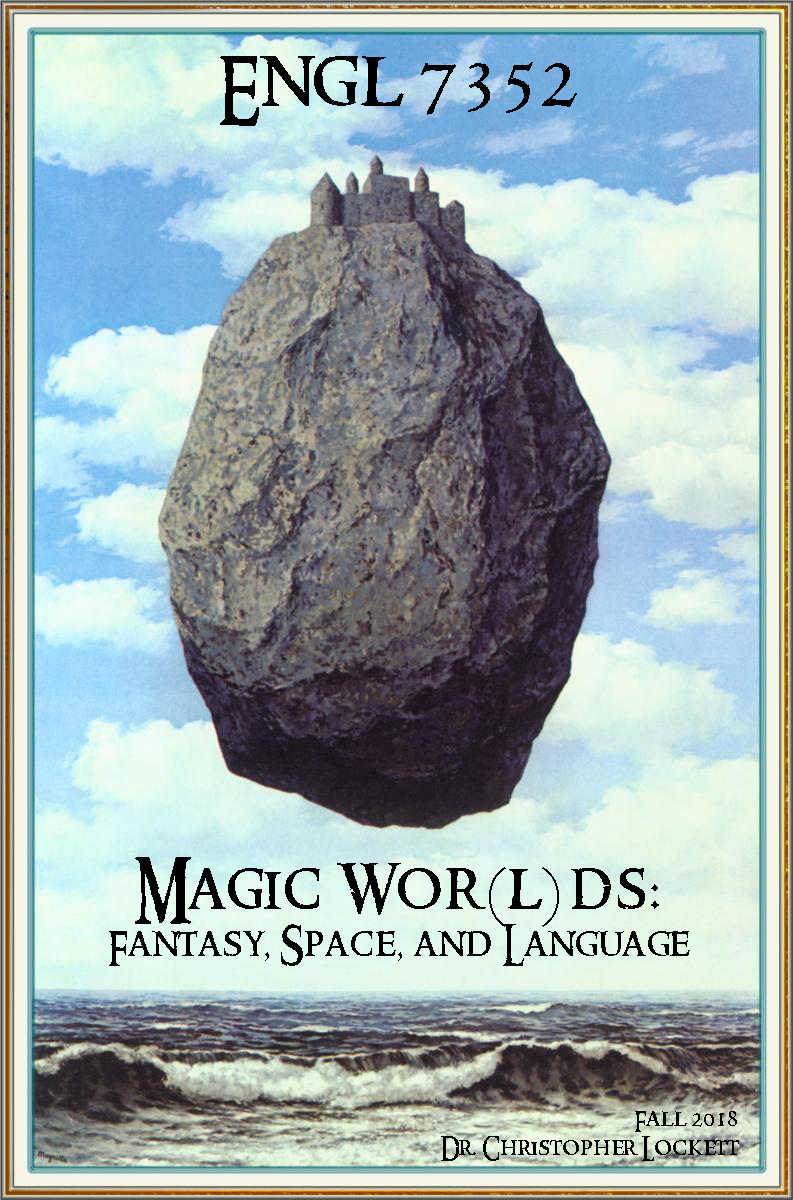
I will also be teaching a graduate course that I’ve been working up to over the past two years or so:

ENGL 7352 poster

As my ever-so-clever title suggests, the course will be looking at the intersection between “magic worlds,” as in the world-building and creation of alternative realities in fantasy, and “magic words,” as in the role played by language in the figuration of magic and conjuring, as well as the way in which these imaginary worlds are linguistic and semantic creations.

As you might imagine, that’s a lot of ground to cover in just thirteen weeks, so the reading list is by necessity somewhat eclectic and wide-ranging:

Anonymous, Sir Gawain and the Green Knight
Jorge Luis Borges, Labyrinths
Italo Calvino, Invisible Cities
Neil Gaiman, Sandman: Season of Mists
Lev Grossman, The Magicians
N.K. Jemisin, The One Hundred Thousand Kingdoms
Ursula K. Le Guin, A Wizard of Earthsea
John Milton, Paradise Lost
Thomas More, Utopia
Terry Pratchett, Witches Abroad
Vernor Vinge, True Names

(Students will also be enjoined to have The Fellowship of the Ring and The Lion, the Witch, and the Wardrobe under their belts before classes start).

A big chunk of my summer is going to be devoted to prepping this class, both because of the rather large scale of material it entails, but also because doing so feeds into my current research preoccupations. I’ll be posting as I go, using this blog as I so often do: as a means of thinking out loud.

Look for a multi-part series on the whole “expanded universe” phenomenon to lead us off, coming soon.

Leave a comment

Filed under Magic Wor(l)ds, Return to Middle-Earth, teaching, what I'm working on

Thoughts on Reading The Road in a Time of Crisis

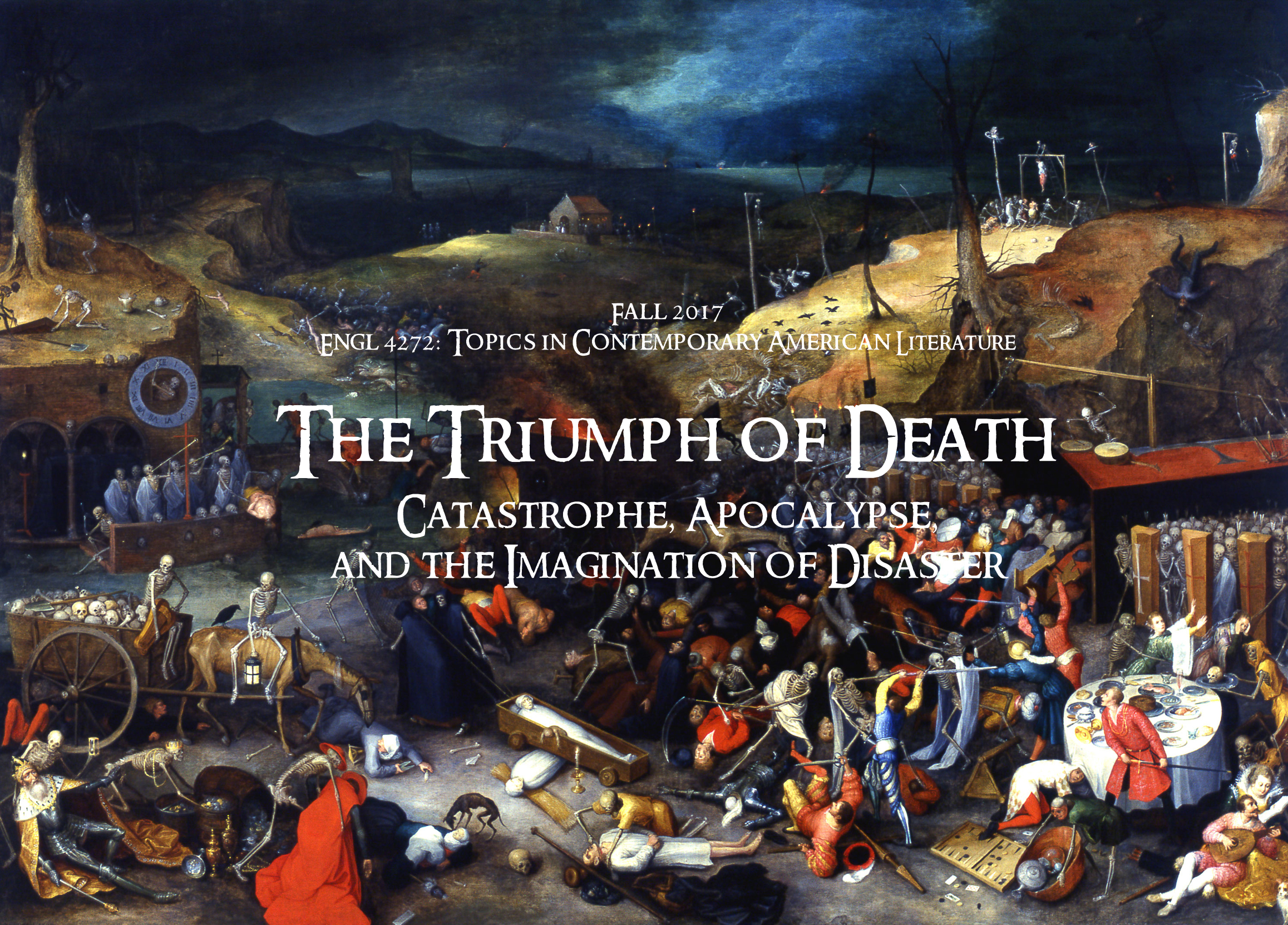
ENGL 4272 - title

I must admit that it is somewhat unsettling to be starting a course on post-apocalyptic fiction at this particular moment. Uncertain of how to order my selected texts, I finally decided—for the sake of everyone’s sanity as the term progresses—to start with the bleakest and most cynical novels, and finish with the most hopeful. Which means I’ll have the pleasure of finishing the term with Emily St. John Mandel’s beautiful Station Eleven. But it means starting with Cormac McCarthy’s well-nigh nihilistic vision in The Road. Now, I do love The Road, but it means I’m reading about an environmentally devastated world that has reverted to Hobbesian brutality and scarcity. This while the direst predictions of climate scientists are burning up huge swaths of the American and Canadian west while drowning Houston, Florida, and Bangladesh; while an unhinged despot with nuclear weapons taunts and goads a dangerously incompetent and thin-skinned president; and while we’re seeing the kind of social cohesion and trust necessary to address such large-scale, transnational problems dissolving into nationalist and nativist tribalism.

There are times when the obvious contemporary relevance of a given text I’m teaching is a gift. Then there are times when I wish it wouldn’t feel quite so on the nose. Perhaps comparing the bleakness of The Road to our present moment seems a little extreme—after all, we’ve hardly witnessed the collapse of social order. This much is true. And yet as I have watched the images of devastation, specifically those of Hurricane Harvey, it’s not the destruction that evokes McCarthy for me so much as the feel-good news stories about ordinary citizens stepping up and risking life and limb to help strangers.

boats-into-houston

To be certain, these are inspiring stories, and the individuals pictured in the image of the long line of trucks towing boats into Houston should be celebrated. I should hope that we all might find it in ourselves to behave in such a manner if presented with such circumstances. But as someone pointed out on a podcast I was listening to (don’t remember who or which podcast, unfortunately), this celebration of individual heroism highlights a flaw in the American character: people are eager to be heroes in a crisis, but collectively unwilling to do the tedious stuff or make the minor sacrifices that might ameliorate or even prevent a crisis. Run into a disaster area to volunteer? Sign me up! Raise property taxes slightly for the sake of infrastructure and regulate development in potential flood zones? Don’t tread on me!

I hasten to add that this is a bit of an over-generalization, and Americans are hardly unique in their penchant for individual action and collective apathy; but the mythos of rugged individualism that inflects the national psyche is one much better suited to reaction than foresight. Part of the problem is that individual heroism and sacrifice makes for much better news copy, and resonates more powerfully with audiences. Perhaps the most iconic moment in coverage of Harvey is the guy who, when asked by CNN (as he prepped his boat) “What are you going to do?” replied “Go try to save some lives.” That sound bite went viral almost instantly—both because it was admirable, but also because it had the kind of laconic “git ‘er done” sentiment one expects to hear from Bruce Willis or Tommy Lee Jones in a Hollywood blockbuster. It put me in mind of the way in which “Let’s roll” became a catch phrase after 9/11—spoken by a passenger on United 93 just before they rushed the cockpit and crashed the plane, sacrificing themselves but preventing greater carnage, it came to symbolize American resilience in the face of crisis, and the willingness of civilians to step up. As well it should.

Heroism, however, especially the kind that entails great sacrifice, is a compelling narrative that tends to paper over the uncomfortable fact that many crises are avoidable; heroism is the proverbial pound of cure that would be unnecessary had an ounce of prevention been applied—better urban planning, for example, or a president who took seriously his national security memos. Heroism is also contingent on a certain amount of altruism, which itself entails a certain amount of privilege. Not “privilege” in the way the term tends to proliferate now—though class and racial privilege can certainly play a part—but the privilege of being confident that one’s own corner of the world is not directly threatened.

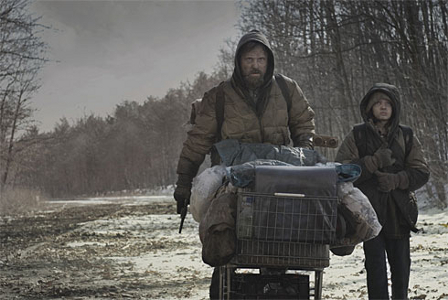
The_Road_bleak_scenery

The Road (dir. John Hilcoat 2009).

Strip that confidence away, and altruism and sacrifice will become entirely contingent on whom they benefit. In its extreme vision, The Road makes this point plain: while all post-apocalyptic narratives depict some form of social collapse or another, few match the level of scarcity of McCarthy’s novel. Indeed, in many there is material pleasure to be taken in the apocalypse, as the sudden depopulation of the world leaves behind the excess of consumer society: such is the centerpiece of both versions of Dawn of the Dead, as the survivors plunder the goods in the malls in which they shelter; one thinks of the grocery scene in 28 Days Later, and The Walking Dead certainly has no shortage of cars, gasoline, guns and ammo, and food. In all of these examples, of course, there is the clash between different pockets of survivors and the perennial moral and ethical questions about survival versus humanity; but none truly present the problem of scarcity as McCarthy does, and the dehumanizing process that entails.

All of which is by way of saying that the kind of heroism on display in localized catastrophes is unlikely to manifest itself when catastrophes are not so localized. It is sadly not surprising that the far more devastating floods in Bangladesh received a tiny fraction of the coverage devoted to Houston and Florida, but that goes to my point: what’s missing in the coverage of the heroism here is that it’s responding to a global crisis affecting the people there. And what happens when the crisis becomes even more prevalent? Harvey, Irma, and now José … and whatever comes after that. Individuals are not going to step up when they are themselves under threat, and in the absence of a collective will, the state itself will fail to cover all its bases—something we see in the hypocrisy of Ted Cruz clamoring for relief for Texas a mere five years after he voted against an aid package for Hurricane Sandy victims.

All I can hope is that things get more hopeful in lock-step with the progression of my course readings. Though even the end of the course will see us traveling around a post-apocalyptic landscape … performing Shakespeare, yes, but still …

Leave a comment

Filed under teaching, The Triumph of Death, what I'm reading

New courses, and a new school year

As those who follow my blog know, my posting tends to come in bursts of productivity interspersed by long fallow periods (at this point, I’d estimate my Game of Thrones posts account for about a third of the material here).

I’m hoping the next few months will be more productive. This time last year, I managed to post on a more or less weekly basis about the texts I was doing in my Revenge of the Genres fourth-year seminar; I want to repeat that, this time with a new fourth-year class. Introducing “The Triumph of Death”!

ENGL 4272 - title

Basically, we’re looking at twenty-first century narratives of post-apocalypse—a sub-genre that is coming to rival (if only because of the ubiquity of zombie apocalypse) young adult dystopia as the most prevalent dystopian SF on the market. Here’s our schedule of readings for anyone who wants to play the home version:

Sept. 12-21: Cormac McCarthy, The Road
Sept. 26-Oct. 5: Colson Whitehead, Zone One
Oct. 12-19: Lidia Yuknavitch, The Book of Joan
Oct. 24-Nov. 2: Edan Lepucki, California
Nov. 7-9: Kevin Brockmeier, The Brief History of the Dead
Nov. 14-16: Max Brooks, World War Z
Nov. 21-30: Emily St. John Mandel, Station Eleven

If you followed my course-based blog posts of last fall, you’ll note two repetitions: Zone One and Station Eleven. That’s due in part to the fact that it was thinking about Station Eleven (I also taught it in my winter SF/F class, so now I’ve basically put it on a course for three straight semesters) that led me to the project I’m currently working on, a book I’m tentatively titling The Spectre of Catastrophe, about—you guessed it—twenty-first century post-apocalyptic narratives. I wrote a draft of an article on Station Eleven, which grew too long, so I hived off a digression about zombie apocalypse to be its own article, which itself grew too long and so I’ve divided it in two. Meanwhile, another digression in the Station Eleven paper gave rise to a meditation on the shift from disaster films in the 1990s, which are preoccupied with the spectacle of catastrophe, to the post-apocalyptic boom of the new century, which is preoccupied with the aftermath of catastrophe. Then the play on “spectacle” vs. “spectre” popped into my head, and suddenly I had a book title.

I made a fair bit of progress writing this past summer, with four articles in varying stages of completion and a reasonably good idea of what the other chapters of the book will look like. And in the interests of keeping the momentum going, I decided that a fourth-year seminar would harmonize nicely and keep these topics in the forefront of my mind during what promises to be an insanely busy fall term.

Hence, the blog posts: once again, I want to post once or twice a week as a supplement to our class, but also as a way of testing out new material (as it were). Words on the page, as my thesis advisor used to say, are money in the bank—even if you don’t end up using them in your finished product.

***

I’m also teaching two second-year courses this term, one on American literature after 1945, and one on popular culture for our Communication Studies program. The American literature course is a new addition. Prior to this year, our curriculum had two second year American courses, one on 19th and the other on 20th-century U.S. fiction. Last year, my colleague Andrew and I changed that, replacing them with three courses that would cover not just fiction but poetry, non-fiction, and drama as well—on the principle that lower-level courses should be surveys that introduce students to a range of genres and forms. So now we have three second-year courses in American literature: 1776-1865, 1865-1945, and after 1945 (the reasoning behind that periodization might make for a blog post in the near future, as it comprises at least part of my intro lecture on Tuesday).

I’m also returning to Critical Approaches to Popular Culture, a required course for our Communication Studies degree. The English Department absorbed Communication Studies last year; last fall was my first chance to teach the class, and the first time I taught popular culture since 2004-2005, when I taught it at UWO. Western’s version was (and presumably still is) a full-year course, which gives one a certain amount of leisure to develop themes; like every course here at Memorial, this one is a single semester. Twelve and a half weeks can be a remarkably tight time frame to teach, well, anything … hopefully I’ll be learning this year from the mistakes I made last year.

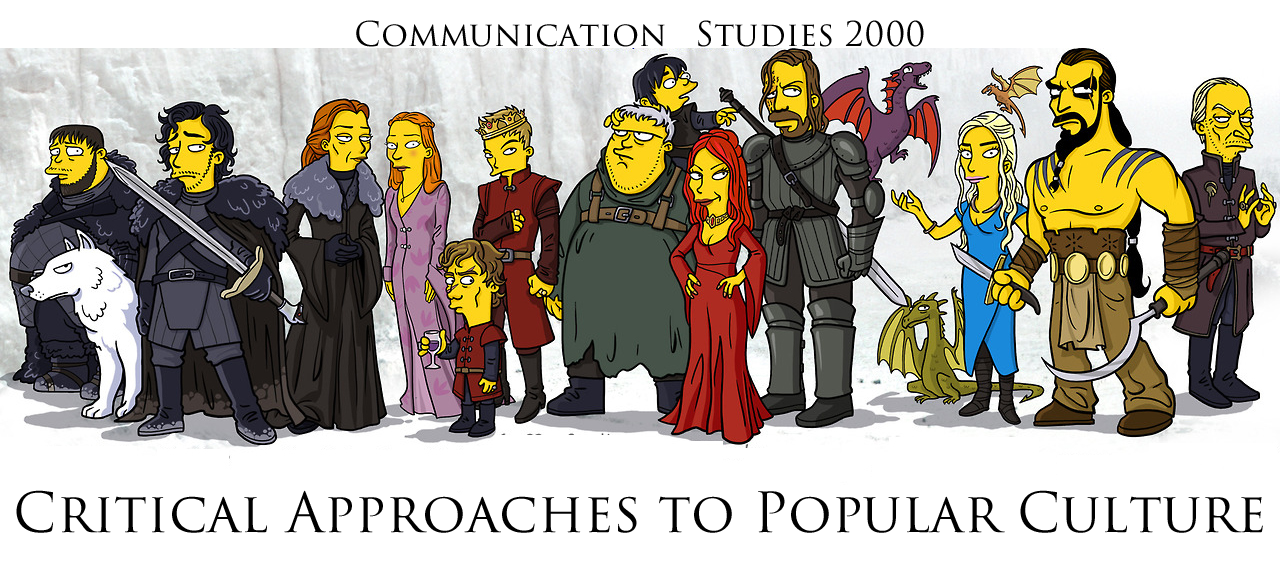
One way or another, I’m happy with my syllabus cover image, even though we’re not doing either The Simpsons or Game of Thrones:

simpsons-GOT

I’m pretty stoked about this incarnation, though, and hopefully will have a post or three inspired by it here (I’m already making notes toward one. Fingers crossed).

One way or another, happy September, everyone. My new year always begins the day after Labour Day—it has since I first started going to school, and that’s still the way of things. Until later …

Leave a comment

Filed under course readings, teaching, what I'm working on

A Blog Post In Lieu of Other Blog Posts That Should Have Been

Revenge of the Genres

junot_wao_coverThe past two weeks have been an unforgivable lapse on my part, particularly so because I neglected to post on the text that was the original inspiration for this course: Junot Díaz’s The Brief Wondrous Life of Oscar Wao. That I didn’t manage to get anything up on this beautiful novel—which I count as one of the best of the past twenty years—is rather embarrassing. It wasn’t for lack of anything to say: I have copious notes on magical realism, the way in which the novel uses genre(s) to allegorize intersectional identities, and finally I had planned a post about allusion, in which I would have talked about Oscar Wao and Stranger Things.

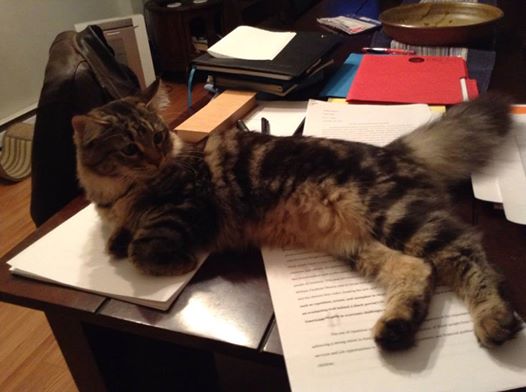
Alas. A stultifying combination of busyness and post-election rage has made writing anything more than angry notes in my journal rather difficult. It’s that time of the term, when finishing one stack of grading only clears the desk to provide a clear view of the next stack of grading. It doesn’t help that I have a cat for whom stacks of paper are apparently a more attractive bed than, y’know, her bed:

catesby-grading

When I set myself the task of regularly blogging about this course’s texts, I knew there was a fair-to-likely chance I’d fall down on the job at some point, or that this experiment would simply peter out well before the end of the term. I’m actually halfway impressed that I’ve posted as regularly as I have.

I do want to continue with this, however, even after the class ends in two weeks time. I’ve enjoyed this process too much, and have too much in the hopper that hasn’t made it to the page to simply end these posts with the course. The class itself has been a great experience: my students are amazing, and have been quite tolerant of my lengthy digressions and extemporaneous musings. As sometimes happens with this kind of class, I feel as though I’m only now getting a handle on the scope of the topic … so I will definitely be continuing to use this blog as a space in which to think out loud, and hopefully produce some raw material for some scholarly articles.

It helps than next term I’ll be teaching our second-year course on SF/F. Twelve weeks to do science fiction AND fantasy? Yeah, the reading list is pushing the envelope a little:

H.P. Lovecraft, selected stories
China Miéville, selected stories
Robert A. Heinlein, Starship Troopers
John Scalzi, Old Man’s War
Ursula K. Le Guin, A Wizard of Earthsea
J.K. Rowling, Harry Potter and the Prisoner of Azkaban
John Wyndham, Day of the Triffids
Emily St. John Mandel, Station Eleven
N.K. Jemisin, The Hundred Thousand Kingdoms

I’m thinking I will continue this blog experiment with this class—there will be, after all, more than a little overlap in subject matter.

engl2811

So … apologies for the missing Oscar Wao posts, which I still intend to write; a little bit like closing the barn door as far as my class is concerned, but I’d hate for the stuff in my head to go to waste. In the meantime, look for some posts on Hamilton to go up soon.

Leave a comment

Filed under Revenge of the Genres, teaching

Fun Home, Part Two

Hello everyone, and welcome back for the second part of my conversation with my friend and colleague Andrew Loman, whose knowledge of comics and graphic novels (as both this post and the last one amply demonstrate) is considerably greater than my own. Last time we talked comics more generally; this time we get into the weeds with Alison Bechdel’s Fun Home.
Revenge of the Genres

Christopher: Perhaps we can start with something I teased in my introductory Fun Home post: Bechdel introduces her story by specifically citing James Joyce’s autobiographical novel A Portrait of the Artist as a Young Man, which is just the first of many allusions she makes to canonical literary works in whose mold she specifically crafts her own memoir. Proust also makes a number of appearances as a model. But in some ways, Bechdel is far from alone in creating a graphic memoir—MAUS falls into the same realm, as do Marjane Satrapi’s Persepolis and a number of other texts (arguably, Allie Brosh’s Hyperbole and a Half qualifies, and our own Kate Beaton is currently at work on the story of her time working in the Alberta tar sands). And then you have the work of people like Joe Sacco, who produces historical-journalistic accounts like Palestine. To my inexperienced eye, it seems that graphic narrative has a decided inclination toward autobiography or otherwise documentary formats. Am I just imagining this? And if not, why do you think the graphic narrative has proved so amenable to this kind of storytelling?


Andrew: You’re not just imagining this: graphic memoir is a popular genre, both in America and in France (Satrapi’s Persepolis and David B.’s Epileptic being the best-known French contributions, both published by the great publisher L’Association). Depending on how flexible you are with your genre classifications, you might even say that graphic memoir antedates the superhero: in 1931, seven years before Clark Kent first took his pants off and jumped out his window, Henry Yoshitaka Kimanga self-published a book called The Four Immigrants Manga. It dramatizes his life and the lives of fellow Japanese immigrants in early twentieth-century San Francisco. It’s a fascinating book and it suggests that for whatever reason, comics have been a congenial medium for life-writing for longer than even many of its own practitioners know.
spiegelman-hellplanet

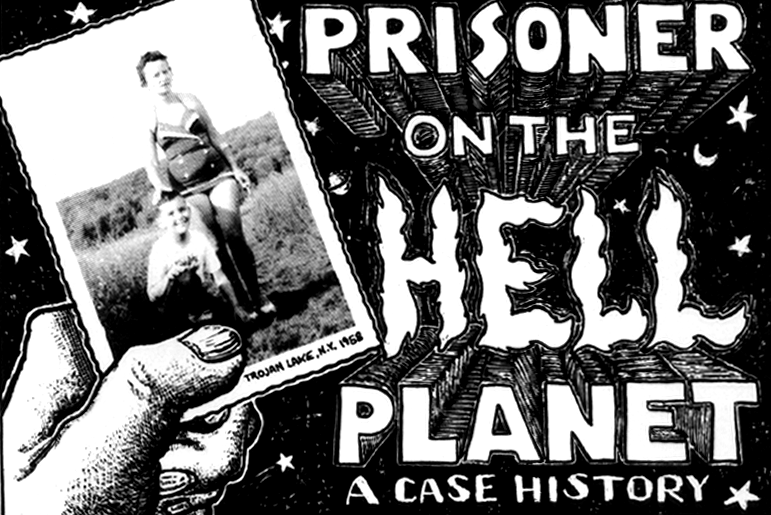
But most graphic memoir is of far more recent vintage, emerging as a distinct field of comics in the 1970s. That’s when Spiegelman wrote Prisoner on the Hell Planet – the harrowing account of his mother’s death that he later incorporated into MAUS. Spiegelman has said that he was emboldened to write something so painful and honest upon reading Justin Green’s Binky Brown and the Holy Virgin Mary, which is – how do you summarize Binky Brown? – which is about the psychic travails of a young ardently Catholic boy of a visionary bent. In the first pages, when he’s a small boy, he hears blades of grass talking to him; at the height of the book, he’s hallucinating that a magic ray is emanating from his penis and hitting all the statues of the Virgin Mary in its path. The memoir is alarming and blasphemous and tragic and funny and a bit of a beautiful mess: where Fun Home is tautly constructed and formally elegant, Binky Brown is raw and shambolic. But it had a profound influence on graphic memoir, if only because without Binky Brown, there’d be no MAUS.

As to why the genre of memoir has had such success in comic – who knows? Champions of the form will surely make the argument that there’s something peculiar to the combination of images and words that makes comics an especially suitable form for life-writing. (Here, for example, is Hillary Chute, an eminent American comics critic: “The stories to which women’s graphic narrative is today dedicated are often traumatic: the cross-discursive form of comics is apt for expressing that difficult register….”) I’m allergic to that class of argument, which always sounds to me less like an attempt to explore the quiddity of the form and more like special pleading by comics devotees, but to give the claim its due, there is something about a drawn image that immediately emphasizes the idiosyncrasy of the artist and hence the life. I can’t think of many graphic memoirs where the images are in the vein of old Classics Illustrated comics – inert and bereft of style. (Now, of course, I’m imagining a parodic graphic memoir in exactly that lifeless non-style, an account of a conventional white middle-class American life in mid-century Muncie. R. Sikoryak should write it.)

But as I say, I’m skeptical about that argument. A more convincing one would begin with the economics of writing comics. Relative to other mass media, comics are cheap to make. And that inexpensiveness is of course liberating: it permits artists to explore far more idiosyncratic material. I love Hollywood, but even small-budget films are too expensive to risk exploring the kind of subjects that are common currency in graphic memoir – not if the filmmakers are aiming for the multiplex, at least. Debbie Drechsler’s Daddy’s Girl is a harrowing memoir of child abuse that no one would ever greenlight. It’s conceivable that some Bowdlerized, banalized version of Fun Home will make it to the screen someday, but that will only be possible because the book and the musical have been such successes. Think of the other literary form with a significant confessional tradition: poetry.

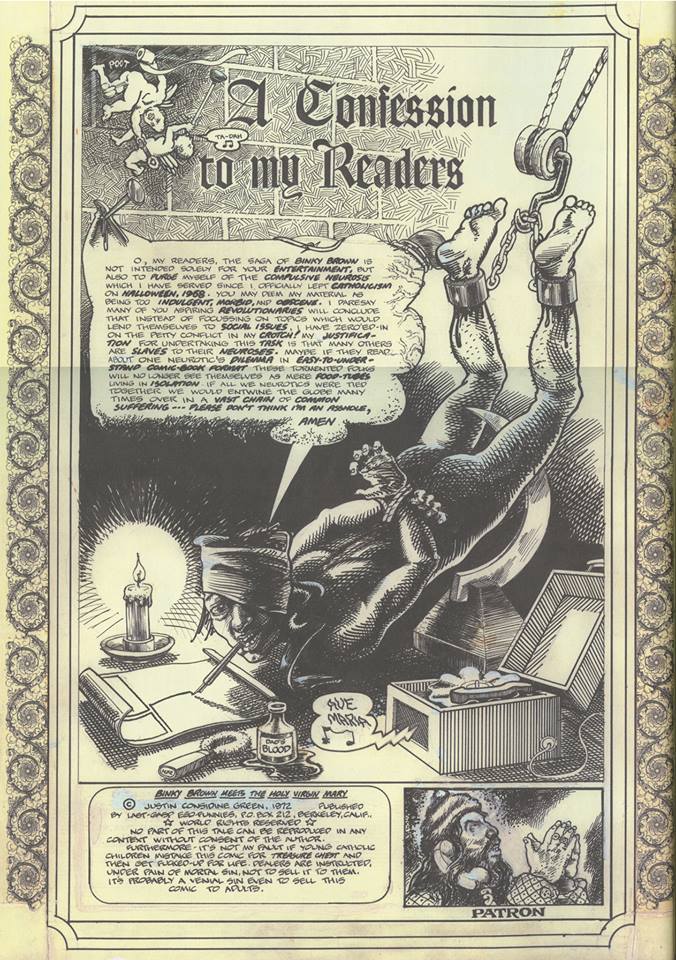
But above all, life-writing is a dominant genre in comics because life-writing in the book industry as a whole is a dominant genre. James Frey disguised his work as a memoir because no one was interested in it as a novel. I remember reading an essay in Bookforum by the curmudgeonly Walter Benn Michaels after the 2008 collapse. He was full of hope that the crisis in capitalism would lead to a crisis in the memoir industry: he saw a link between memoir and individualism, and hoped for a reorientation towards less narcissistic literary forms. No such turn is on the horizon, but don’t feel bad for Michaels: he enjoys his splenomegaly. And I think he’s right in drawing the connection. On the first page of Binky Brown, Justin Green makes this combative confession to his readers:

I officially left Catholicism on Halloween, 1968. … I daresay many of you aspiring revolutionaries will conclude that instead of focusing on topics which would lend themselves to social issues, I have zeroed in on the petty conflict in my crotch! My justification for undertaking this task is that many others are slaves to their neuroses. Maybe if they read about one neurotic’s dilemma in easy-to-understand comic-book format these tormented folks will no longer see themselves as mere food-tubes living in isolation. If all we neurotics were tied together we would entwine the globe many times over in a vast chain of common sufferingPlease don’t think I’m an asshole, Amen.
binky

Christopher: “Narcissistic literary forms.” I like that, if for no other reason than that I wonder if there’s any act of literary (or artistic) creation that doesn’t require at least a small measure of narcissism, enough self-regard to assume that one’s voice is worth hearing.

Michaels does get my hackles up a little, however, because however much hubristic self-regard we might read into Joyce or Proust, or for that matter someone like Norman Mailer or Karl Ove Knausgård, the flip side of that memoiristic coin are those people articulating experiences from the margins: the long history of slave narratives from Fredrick Douglass to Harriet Jacobs, for example, accounts that deploy the tacitly ascribed truth-value of confession and revelation in the service of communicating the realities of lives otherwise invisible or ignored.

While I wouldn’t necessarily situate Fun Home in a comparable tradition (though as a queer woman, she does write from a culturally marginal position), Bechdel is very canny in the way she situates her memoir in a canonical context with her allusions to Joyce and Proust, but also ironizes her relationship to such texts. One minor detail I’ve found interesting about her illustrations is the way she replicates text on the page: at various points, we see images of passages from a variety of books, from dictionary entries to the novels she or her father read, rendered carefully but not exactly—she does not simply paste in photographic or photocopied reproductions, but scrupulously draws the fonts and formatting (and does the same with handwritten notes and letters).
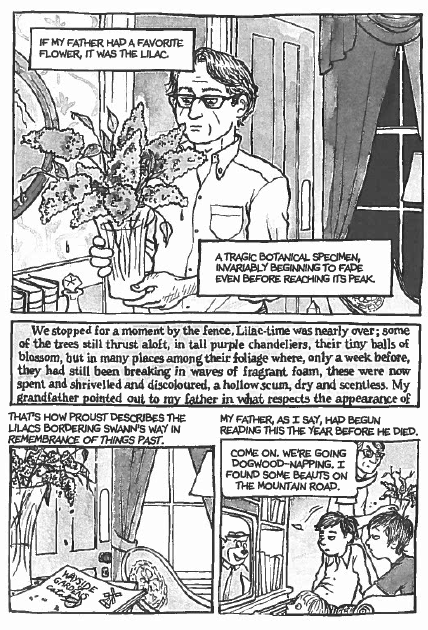
proust-lilacs

Again, perhaps this is a minor point, but it seems to me an interesting choice: in conventional documentary forms and memoirs, archival photographs and texts perform a significant semantic role, providing a touchstone to something “authentic” or “real” (and while sparing in his use of such elements, Spiegelman does use them in MAUS). Bechdel’s mimetic reproduction of text self-reflexively references her chosen medium of graphic narrative: drawing Proust’s words gives them a visual tactility we rarely ascribe to printed text. The intrusion of such text as image rather than narration turns it into a visual object, which then in turn highlights the medium in which Bechdel works, which is itself a repudiation of the written word as the apogee of narrative art.

What do you think? Am I completely off base here?


Andrew: You’re so far off-base you may be Paul Ryan.

No, you’re not: you’re squarely astride the base.

Let me say first, apropos of MAUS, that the three photographs Spiegelman uses are themselves complicated in all sorts of interesting ways. I think it may be the critic Thomas Docherty who first noted the ironies of the third photo in the book, a portrait of Vladek Spiegelman in camp uniform. One might assume that it was taken while he was an internee in Auschwitz. In fact, it was taken after he had left the camp, in a “photo place,” as he calls it, which had a uniform that people could pose in for souvenir pictures. It’s a photo that might well mislead those naïfs who still imagine that photos point to authenticity and the real, but instead calls attention to its implication in an emergent (and bizarre) culture of remembrance.

In Fun Home, the mediation is a striking feature, and it’s more thoroughgoing than you may realize. Bechdel’s method is to take photographs of herself for every human figure she draws: it’s a way, she argues, of capturing the idiosyncrasies of gesture with a subtlety and specificity that she couldn’t achieve if she were relying only on her imagination. In other words, the mediation you’re noting in her drawings of Proust’s words and elsewhere extends to the whole book, which is altogether a strange palimpsest.

I might, however, quibble with your assertion that Fun Home offers a “repudiation of the written word as the apogee of narrative art.” I’m not sure who would still accept that notion of the written word: surely it’s been tottering at least since the moment that movies turned from a cinema of varieties into a predominantly narrative form, if it ever had much solidity outside the circles of its champions. It doesn’t seem to me to be a battle that Bechdel needs to fight, nor do I see much sign that she feels such a need. If she’s engaged in any kind of struggle or negotiation through her emphasis on the iconicity of the printed word, I think it might be with her father Bruce, who taught English literature when he wasn’t running the family funeral home and whom she identifies, at various moments, with Camus, Fitzgerald, and Proust. She’s crafting a Kunstfigur of this man, who is so strongly identified in her memory with the written word, and maybe that informs her process of graphic mediation. But evidently “repudiation” isn’t the right word to describe her relationship with her father. In a two-page comics essay she published in Granta, Bechdel discusses the photo of her father that she used as the basis for the title page of Chapter One. She struggled, she says, “with the technical challenge of rendering the tonality and blurry motion [of the photo] using only line,” before admitting that “my drawing is as crude a schema of the color photo as perhaps the photo is of the raw, unspooling life it purports to capture.” Perhaps the point of her mediation is to insist on the inevitable crudeness of her schemas – the clumsiness of even this miraculously subtle work to capture the quiddity of her dad’s life.
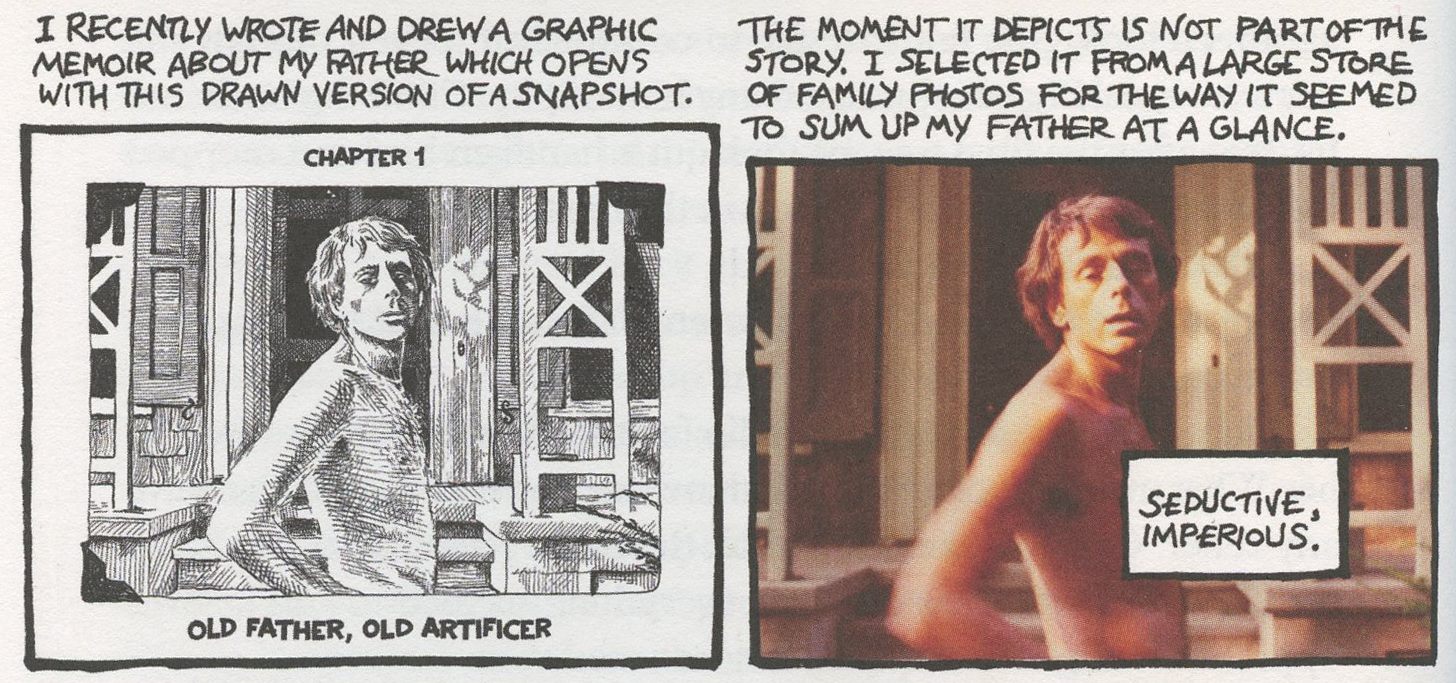
fun-home-photo

Christopher: Granted, “repudiation” is probably too strong a word for what’s going on—say instead that it troubles or critiques a canonical understanding. I realize it’s perhaps a little disingenuous to discount authorial intent with a memoir—what genre is more about authorial intent?—but I also think it’s valid to see the ways in which a text offers a critique independent of the idiosyncratic and personal dimension informing its production. If this were a fictional narrative, it would be a pretty straight line between her father’s forbidding, aloof, and indeed authoritarian tendencies, and his symbolic connection to these texts that have played a comparable role in the normative discourses of literary study. That Fun Home is a memoir doesn’t necessarily change that fact: I think your reading of Bechdel’s agon with her father as the site and source of her graphic mediation is pretty spot on, but I also don’t think that discounts or obviates a broader reading in which we can see this work as a representative point of resistance to the canonical tradition … whether or not the written word still holds the same status I seemed to be claiming for it.

On that point, I should note that when I brought this up in class last week, I was surprised to find that the balance of my students could not tell me what “the canon” was. As I told them, I didn’t know whether to be dispirited or heartened—dispirited because they’d progressed to the fourth year of their English degrees without having gleaned an understanding of what, for decades, constituted the core of literary study in English; or heartened because it signalled that we’re now past the pro- and anti- canon arguments that pervaded literary study for so long. On reflection, I’ve decided that I’m heartened: whatever other problems bedevil academe in general and the liberal arts in particular these days, I like where we’ve arrived, where we’re (starting to) question long-held assumptions about what makes a given text worthy of scholarly and pedagogical attention.

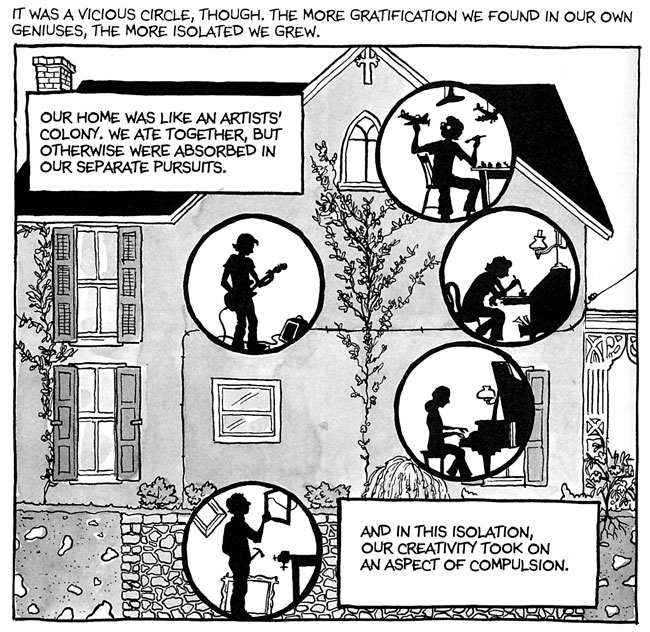
After you take apart my argument above, I’m curious as to your thoughts on the way Bechdel spatializes the narrative. I may not know much about comics on the theoretical front, but even I can see that comics art is about compartmentalizing: literally framing each image in sequence, except for when we get more elaborate double-page spills and the like. The titular “fun home” of course references the funeral home Bruce Bechdel operates, but it’s hard not to see the title also as an ironic reference to the gloomy, gothic house in which much of the story unfolds, a structure (like all the literary allusions) indelibly associated with him. Again, this is an element Alison Bechdel draws from her life, but which here functions symbolically—the compartmentalization of the lives within the home, which also connotes the metaphor of the “closet”—as well as allusively, bringing to mind the long tradition of novels, from nineteenth-century Irish fiction, to Thomas Mann’s Buddenbrooks, to Michael Ondaatje’s The English Patient, in which the old and often crumbling manor house is itself a character in the story.

I don’t have a question here, I’m just curious to hear your thoughts.
funhome-brothers

Andrew: A discussion about the literary canon isn’t quite the same as one about the written word as the apogee of narrative art, though, is it? Those are different topics, despite having points where they overlap. The kinds of judgement that a would-be canon-builder has to make are different from those of a given narrative form’s champions. The aspiring canon-builder says: “Within this range of forms that we admit as literature, these are the best works.” The champion of the written word says: “This narrative form is superior to that one – and all those others, too.” I took you to be saying that Fun Home attacks the second creature, which I think is such a demoralized and thoroughly confuted shadow of a thing that Bechdel would hardly need to bother with it.

But let me talk about Fun Home as a “point of resistance to the canonical tradition.” It is and it isn’t, which I’ll start to argue by focusing on a related tradition that Bechdel portrays in Fun Home – literary interpretation. When I first read those parts of the work that are set in college, and specifically those portraits of male professors holding forth about interpretation, I felt modestly uncomfortable. Bechdel’s satire on the Jungian literary critic and his genital reading of Heart of Darkness is devastatingly funny, but it cuts to the quick, since I’ve elaborated my fair share of harebrained interpretations to bemused students: “You think the Headless Horseman is Irving’s figure for a man without capital? Isn’t that just a bad pun?” But even as she makes quick work of these dopes, she makes interpretation a key part of her book. What is Fun Home, after all, but an interpretive project, an attempt to solve the mystery of her father’s life and death, using the texts of her own memories and the family archive? It’s a work of interpretation, in other words, that also happens to satirize interpretation. I think it has a similar ambivalence about literature. There’s no question that there’s a connection between her father and the canonic works that he loves and that he teaches, often bullyingly, to his bored and captive students. But at the same time, there are very few comics that are as literary as Fun Home. As you note, the book is crafting itself in the mold of all the literary “classics” it cites. I’ve just distributed the topics for the final essay in my comics course, and one of my questions invites students to pick just one of the references to other books in Fun Home and explore how the cited book works intertextually to illuminate or enrich Fun Home itself. If you find an instance where Helen Bechdel is reading the part of Mommy in Albee’s The American Dream (and you will), then consider how that play’s meditations on national fantasy intersect with similar meditations in Bechdel’s memoir. It’s a perverse essay topic in that by design it invites students to distort the text, a single allusion among hundreds becoming, at least in that thought piece, the key to the memoir. But it’s making a point that I hope won’t be lost on my students, which is that Fun Home is richly implicated – in the sense of being entwined or entangled – in literature. Again, that’s part and parcel of its treatment of her literary father. You’re right to note that he’s forbidding and aloof and has authoritarian tendencies. He’s a terrible husband and often a terrible father. But he’s also intelligent, stylish, seductive, and dryly funny; and he’s vulnerable, and tormented, and desperate; he’s an artist but also an abuser of young men; “in short a complex personality, an enigma, a contradictory spokesman for the truth, an obsessive litigant and yet an essentially private person who wished his total indifference to public notice to be universally recognized – in short a liar and a hypocrite, a tight-fisted, sponging, fornicating drunk not worth the paper, that’s that bit done.” (It wouldn’t be a real conversation between us without someone quoting Stoppard’s Travesties.) Insofar as Bruce stands for the Canonical Tradition, the complex relationship that Alison has with him extends to literature itself. To read the attitude towards Modernist literature as resistance alone doesn’t do the complexities of that attitude justice.

Two last notes on this front. First, the authors identified with Bruce Bechdel are all men. When Alison, in college, starts exploring a Lesbian intellectual tradition, she almost immediately borrows Radclyffe Hall’s The Well of Loneliness from the library, and we later see, among the books strewn on the bed that she shares with Joan, Adrienne Rich’s Dreams of a Common Language. Even if I don’t agree that the memoir is antagonistic to literary tradition, it’s certainly interrogating that tradition, or inviting us to understand it as a particular, contingent body of works, or to think in terms of literary traditions in the plural. Secondly, as the critic Michael Moon noted in one of the early works of Fun Home scholarship, many of those male authors that Bechdel quotes in Fun Home were gay. Proust is Moon’s key example, but I mentioned Albee, above, and Helen acts in a performance of Wilde’s An Ideal Husband, and Henry James figures in a sly literary allusion, too (the short piece in Granta offers a more thoroughgoing reading of the Bechdels alongside James). I mention Moon’s insight to emphasize, first, how judicious Bechdel is in her choice of allusion and secondly, to destabilize once again the notion of a literary tradition as an uncomplicatedly “normative discourse.”

But to carry on. You’re of course right to understand the home of the memoir’s title not only in relation to the Bechdel Funeral Home but also the Gothic revival house that Bruce restores so carefully. It’s in a long line of crumbling manors in American literature, from the House of Usher and the House of the Seven Gables to the Bates Motel – and a cousin, of course, to the crumbling manor houses of other Gothic traditions. In keeping with the allusions to Icarus and Daedalus that pervade the memoir, the labyrinth is a key figure, too: Bechdel writes that “[her father’s] shame inhabited our house as pervasively and invisibly as the aromatic musk of aging mahogany. In fact, the meticulous, period interiors were expressly designed to conceal it. Mirrors, distracting bronzes, multiple doorways. Visitors often got lost upstairs.” And lurking somewhere inside, the minotaur who is also the labyrinth’s inventor. The home is, as you suggest, a metaphor for the closet.

As to how Bechdel spatializes the narrative: the page you include above is a great example of how she finds apt visual metaphors for a given moment in her narrative. The isolation of the Bechdels within their respective bubbles is itself a canny way to figure their absorption in separate pursuits. But placing the viewer outside the house, privileged with a kind of X-Ray vision that nevertheless only reveals the Bechdels’ silhouettes, is another means of emphasizing alienation, in this case of the reader from the five obsessives inside the fun home. That flirtation with the voyeur (if that’s the right way to put it) suggests to me a representational tradition I’m familiar with as a student of early American urban literature. It’s a tradition that’s embodied in what the historian Helen Lefkowitz Horowitz calls “the fascinating character of Asmodeus, a fictional devil with origins in the Apocrypha, who had been refashioned in the nineteenth century as a devil-dandy who could reveal urban secrets by taking off roofs of houses to reveal the vices of those dwelling within.” The appetite to see these domestic secrets is itself a function of what Franco Moretti has characterized as the “great novelty of urban life, [which] does not consist in having thrown the people into the street, but in having raked them up and shut them into offices and homes.” And into small-town fun homes, too.

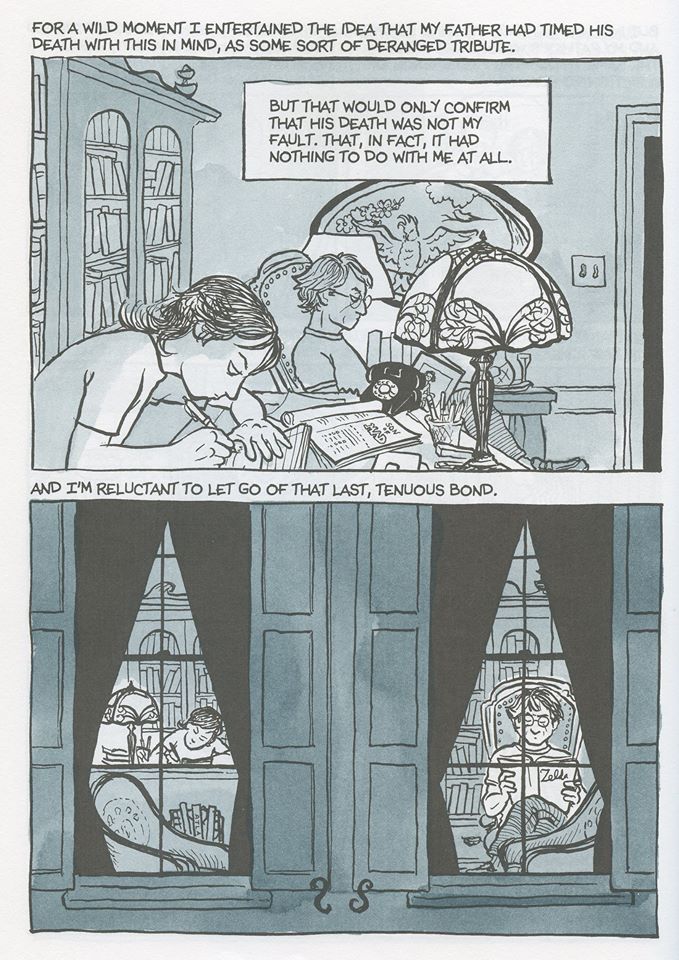
But I prefer another example of Bechdel’s use of the comics page – one with some affinities to this one. Bechdel divides the last page of the third chapter into two panels roughly equal in size. The first of these shows Alison and Bruce in profile, sitting alongside one another in Bruce’s library. The two of them are companionably silent, Bruce reading a book about Zelda Fitzgerald and Alison sitting at his desk writing a check that he’s promised to sign. In the caption, the narrator Bechdel is imagining that her father killed himself in “deranged tribute” to Fitzgerald, who was, like Bruce, 44 when he died. But, she reflects, if that were true, then it would mean that his death had nothing to do with her. “And I’m reluctant,” she says, “to let go of that last, tenuous bond.” The second panel, the last one of the chapter, shows them still sitting alongside one another, still in the library, each of them at ease. But now we the viewers are outside, looking in through two windows; Alison is visible through one window, and Bruce is visible through the other. The curtains are a funereal black, and even though the static medium of the comics page means that they’re frozen in place, their appearance at the end of the chapter suggests a closing, after the fashion of a stage play. Alison and Bruce are still in the room together, but the new perspective on them now emphasizes the tenuousness of their bond. The first of the two panels immerses us in Bechdel’s memory of domestic happiness; the second reluctantly retreats from that memory. It’s a beautifully subtle dramatization of mourning that Bechdel articulates primarily through the image.
funhome-library

Christopher: As much as I would love to keep going with this, I’m overdue for posting it, so that will have to be the last word … which is only appropriate, given that it is an eloquent and incisive final word, and far subtler than my own evolving understanding of Fun Home. Thank you so much for your time and thoughts, Andrew. Perhaps we’ll have to do this again when we talk Hamilton in a little more than two weeks.
Leave a comment

Filed under Revenge of the Genres, teaching