
.
WARNING: SPOILERS AHEAD
The Rig is a new British series on Amazon Prime that I watched for two reasons: one, it stars Iain Glen; two, the trailer teased it as a Lovecraftian horror set on an oil rig in which something from the deeps makes its presence known in increasingly disturbing and threatening ways.
.
So OBVIOUSLY this was something I needed to watch, both from personal interest and, as someone who has now taught three classes on H.P. Lovecraft and weird fiction, from professional obligation. And it was … good. It was obviously done on a budget and there were moments of didacticism that made it feel more like a Canadian than a British show,1 as well as some clunky writing just more generally, but it was interesting and definitely worth watching. What makes it worth posting about is that it embodies a number of themes and tropes that are representative of the ongoing evolution of the New Weird, which are what I want to talk about here.
The setup is quite simple: the crew of an oil rig off the Scottish coast, the Kinloch Bravo, are looking forward to heading home as their rotation ends. A crisis on another platform diverts the helicopters, however, so everybody has to sit tight for however long that takes to be resolved. But then a tremor shakes the rig and a thick, spooky fog rolls in, and all communication from internet to the radio goes down. Tempers, already frayed from the helicopters’ diversion, erode further. A crewmember named Baz goes aloft in an attempt to fix the radio transmission; he falls and is badly injured. His injuries, however, which should have killed him, start to heal on their own. At the end of the first episode he staggers out to where the crew is assembled on the helicopter deck to warn “It’s coming!” Meanwhile, just before his appearance, it is noticed that the fog is composed partly of ash.
And that’s the first episode. One of the things I quite liked about The Rig is that it settles in for a slow burn over its six episodes. Though punctuated here and there by moments of shock or surprise, it’s mostly about two things: the personalities of the crew and their (often fraught) relationships, and the gradual figuring-out of just what is going on. And if both of these components tend toward overstatement and occasional hamfisted exposition, the story is nevertheless compelling. In short, the drilling of the undersea oil fields has released or awakened an ancient life form, bacterial in nature, which lives in the ash that falls out of the mist. When a human is infected by way of a cut or simple excessive exposure to the falling ash, the organism takes up residence and makes the host more amenable to it by fixing injuries and expelling impurities. For Baz, this means he heals quickly; it also means the gold fillings in his teeth fall out, as they’re treated by the organism as foreign objects. So, on the balance, not bad for Baz—but another crewmember doesn’t fare so well, as his history of addiction and many tattoos make the process fatal for him. (The scene in which he is about to get into the shower and suddenly finds all the ink in his skin running is a great uncanny moment).
What’s most interesting in The Rig, and what makes it worth discussing in some detail, is that the “invader” isn’t necessarily monstrous and isn’t overtly malevolent. The agony Baz experiences, we come to understand, isn’t torture or assault but the entity trying to communicate. The ultimate climactic crisis isn’t about whether our heroes can defeat and/or destroy the invading force, it’s whether they should. The problem posed isn’t how to repel an invader, but how two intelligent species can communicate and whether they can coexist. In later episodes, Mark Addy shows up as a company man named Coake2 who has an explicitly instrumentalist and zero-sum response to such questions: as seen in the trailer, he spits “Nature isn’t a balance, it’s a war!” Later, he informs one of the crew that “[the corporation] Pictor’s business is resource management! We find them, we use them up, we move on! And that includes human resources.” He boils it down: “We’re useful or not. We have value or not. They’re coming for me because I have value. Anyone who doesn’t gets left behind.” He delivers this rant as, against the explicit orders of the rig’s captain Magnus MacMillan (Glen), he prepares to put into action a plan to destroy the entity.
This confrontation, coming as it does in the final episode, clarifies lines of conflict that had been usefully muddled and uncertain to this point. Kinloch Bravo is under threat, but that threat has been ambiguous. As the nature of the entity becomes clearer, the nature of the danger it poses becomes less so. If there is a consistent bogeyman throughout, it’s the company itself, a faceless corporate entity regarded with a sort of low-grade antipathy by everyone. Rumours that the platform is set to be decommissioned—rumours later confirmed—circulate, with people’s anxiety about future employment in tension with the understanding of the pernicious impact of their industry on the environment. As one character observes, a long life of gainful employment is meaningless if, in the end, the sky is on fire.
The ambivalence of the crew (or some of them, anyway) to their industry squares with their ambivalence to their company: Coake’s rant is in some senses merely an explicit confirmation of the more diffuse sense pervading the crew of their expendability—that they, like the oil they drill, are resources to be extracted. The character of Hutton (Owen Teale) anticipates Croake’s sentiments with an embittered speech in the final episode: “I used to think we were the steel, holding it all together,” he tells Magnus, “even if the rest of the world didn’t see it. But now I know we’re the well. Because every trip, every person that gets chewed up, every chopper that goes down, it just takes a bit more, and a bit more … till it hollows you out.”
Hence, the emergence of the entity—the “Ancestor,” as Rose (Emily Hampshire) comes to call it—is threatening not because it offers destruction, but because it represents an alternative way of thinking and being. It is a collective organism; the humans it “infects” can communicate with it, after a fashion, and with each other. Its threat to the lives of the rig workers and people more generally is commensurate with the threat it perceives from them. It is not itself malevolent or casually destructive.
Its ancient provenance and apparent immortality—Rose establishes that it measures time on a geological scale—as well as its capacity to infect people, puts it very firmly in the Lovecraftian tradition of cosmic horror. However, the wrinkle that it potentially poses no existential threat is a significant departure from the standard conventions of the genre. To be certain, there is a definite Lovecraft vibe in The Rig in the frequent refrains about how we know less about the ocean depths than the surface of the moon, or in Alwynn’s pithy observation (featured in the trailer above) that “If we keep punching holes in the earth, eventually it’s going to punch back.” The implicit sentiment that the madcap drive for oil exploration in the name of profits will take us into dangerous territory is not dissimilar from Lovecraft’s opening paragraph of “The Call of Cthulhu”:
We live on a placid island of ignorance in midst of black seas of infinity, and it was not meant that we should voyage far. The sciences, each straining in its own direction, have hitherto harmed us little; but some day the piecing together of dissociated knowledge will open up such terrifying vistas of reality, and of our frightful position therein, that we shall either go mad from the revelation or flee from the deadly light into the peace and safety of a new dark age.
“Cosmic horror” of the Lovecraftian variety is built around existential dread arising from the realization of humanity’s insignificance in the face of the infinitude of vast, cosmic entities. The “old gods” like Cthulhu and Dagon that populate Lovecraft’s stories find echoes in the “Ancestor” of The Rig, but the way in which it infects certain crewmembers is more in line with “The Shadow Over Innsmouth,” Lovecraft’s story in which he grafts his Cthulhu mythos onto an allegory of his horror of miscegenation. (For those unfamiliar with Lovecraft, an important bit of context is that he was terribly racist). The story’s narrator is touring historically interesting towns in Massachusetts. As part of his itinerary, he arrives in Innsmouth—a run-down old fishing community with some interesting architecture, an odd historical relationship to the reef just off its shores, and people who have a vaguely fish-like aspect about them. TL;DR: having long ago made a Faustian deal with the Old God who inhabits the reef, the people of the town have become fish-human hybrids. The narrator discovers that he is descended from Innsmouth stock and will inevitably be thus transformed.
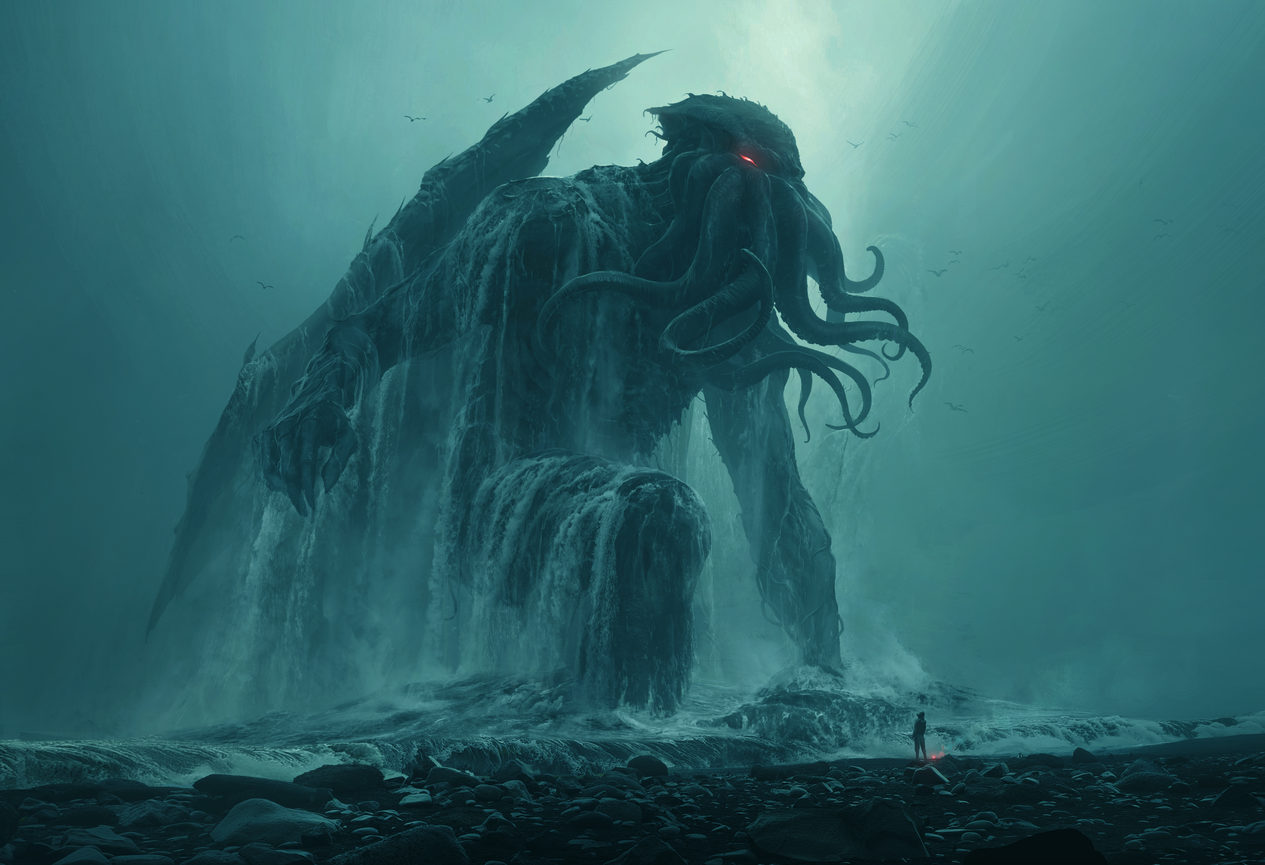
I cite “The Shadow Over Innsmouth” because it set a standard in weird fiction rooted in the horror of this revolting otherness, usually framed in slimy cephalopodic terms: the tentacle-faced god Cthulhu being the apotheosis.
.
What is so fascinating in weird fiction is less the lugubrious racism of Lovecraft than the ways in which his idiom has been adapted and transformed by such contemporary authors as China Miéville, Jeff Vandermeer, Charlie Jane Anders, and Annalee Newitz (among many others). One key shift in the “new weird” is the quasi-erasure of Lovecraft’s instinctive antipathy to the uncanny Other. What surfaces instead (so to speak) is a more complex interrogation of that otherness and the consideration that (a) it isn’t necessarily evil or destructive; (b) it might offer alternative modes of thinking and being; and (c) perhaps it is the next stage of evolution. The Rig’s principal literary allusion is thus not Lovecraft, but an author whose apocalyptic imagination was somewhat more nuanced.
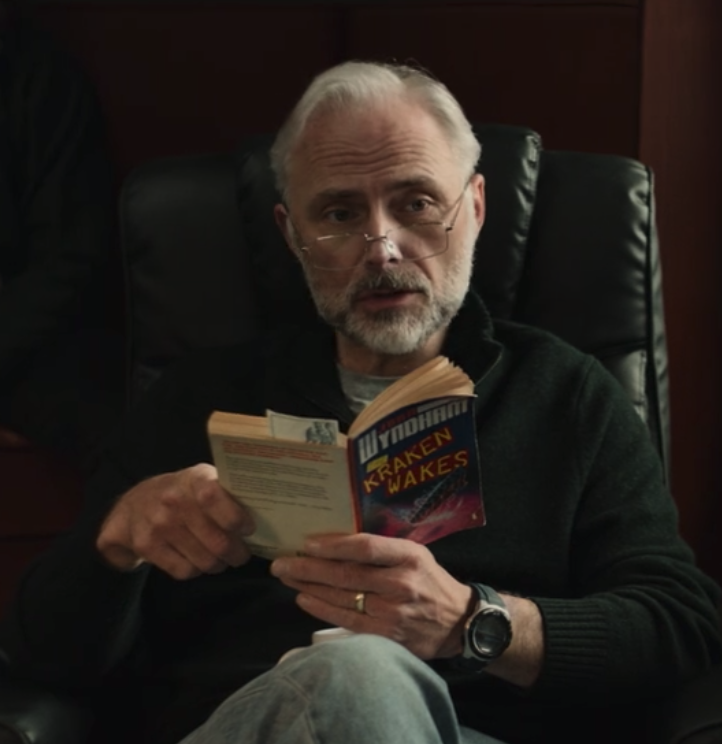
About five minutes into the first episode (four minutes and thirty seconds, to be exact) we see the character Alwynn (Mark Bonnar)3—the calm sage wisdom archetype—reading John Wyndham’s novel The Kraken Wakes.
.
Wyndham’s novel, published in 1953, is about an invasion by an alien species that can only live under conditions of enormous pressure, and so arrive as a series of mysterious fireballs that land in the deepest parts of the ocean. At first the fireballs are thought to be just some weird cosmic phenomenon, but then it slowly becomes apparent that the Earth’s deeps have been colonized by an intelligent species. For the reader’s benefit, Wyndham provides one of the more obvious voice-of-the-author characters you’re likely to encounter, an outspoken scientist named Alistair Bocker who is more clear-eyed and prescient than anyone else about the newcomers and the threat they pose, though he is dismissed by most for the better part of the novel as a crank. The narrator and his wife, however, a pair of journalists, befriend Bocker and so have a front row seat to his outlandish theories, which are, of course, all correct and the actual reality of what’s going on.
The Kraken Wakes has had something of a revival in literary study because it squares nicely with recent waves of climate fiction (cli-fi) and ecocritical literary theory. The third phase of the aliens’ war against the landlubbers—after phase one, in which shipping is sunk, and phase two, which involved “sea-tanks” coming ashore and assaulting coastal towns and cities—is the melting of the polar ice caps to raise the sea levels. This last attack precipitates the collapse of civil society, as scarcity takes hold and nations fall into civil strife and factional warfare. Hence, one can see how it resonates now, seventy years after its publication.4
The Rig, for all of its less subtle tendencies, is a thoughtful contribution to the growing body of creative works thinking through the crisis of the Anthropocene, which is among its other aspects a philosophical and imaginative crisis. Alwynn only offers comment on The Kraken Wakes twice; when first asked what it’s about, he replies cryptically, “A collective failure of imagination.” The rising sea levels that drive humanity away from the coasts and topple governments are the culmination of this failure: while Wyndham’s Dr. Bocker does eventually opine about the impossibility of co-existence with another intelligent species, he makes clear that the instinctively aggressive response to the submerged interlopers will end badly. His calls to attempt contact are ignored, dismissed, or simply laughed off as naïve. When the first of a series of nuclear weapons is dropped into the deeps, he effectively throws up his hands in disgusted resignation.
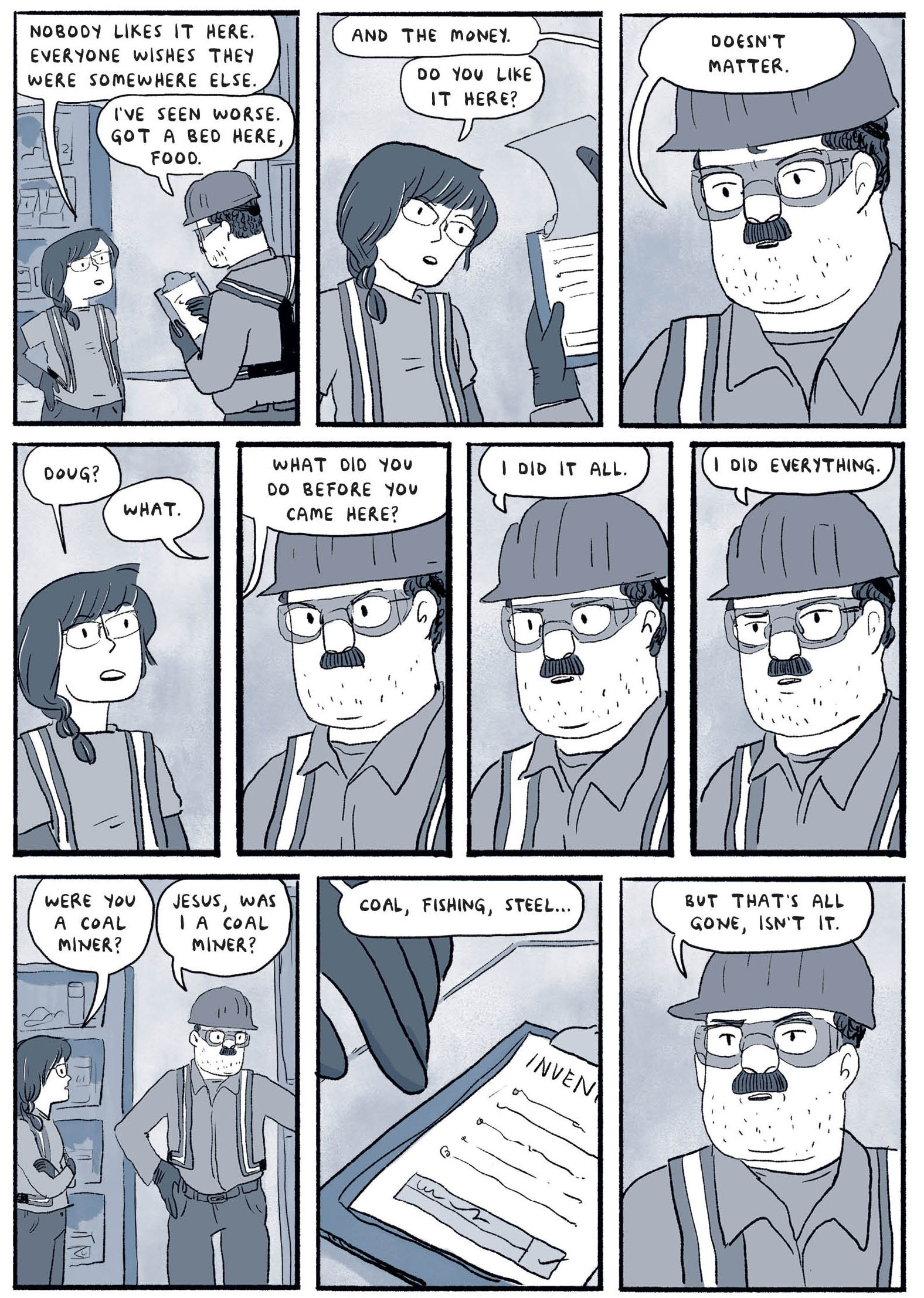
That this dynamic is reiterated in The Rig—replete with the allusions to Wyndham—makes for an interesting thematic turn in the contemporary context. The series is by no means a straightforward climate change allegory but is sympathetic to the people whose livelihoods depend on the fossil fuel industry. That these people are, as Hutton makes clear in his speech, as much an extractive resource as the oil itself puts the emphasis on the inhumanity of the industry and the collective failure to imagine alternative economies, alternative ways of being. The Rig makes an interesting, if unlikely, companion piece to Kate Beaton’s recent graphic memoir Ducks: Two Years in the Oil Sands, which chronicles her time working in the oil patch as a means of paying her student loans off. The book’s consonance with The Rig is precisely in this depiction of people as objects of extraction.
.
The conflict at the heart of The Rig is not between collective and individuated intelligences, but between a collective intelligence and one desperately invested in seeing itself as individuated. The latter state is given to the sort of zero-sum thinking proffered by Coake: you either have value or not, and those without value can be justifiably excised from the equation. Though never stated explicitly (one of the series’ rare moments of such restraint), the collective intelligence of the “Ancestor” is the principal threat to the corporation—itself an ironically amorphous entity, but which is reliant on its workers and consumers believing themselves locked in a zero-sum individualistic society for which there is no alternative. Environmental movements have always advocated seeing ourselves as parts of a collective entity, as survival as a species is never down to any single one of its creatures. Such thinking is anathema to capitalism, which has done its best to convince people that, in Margaret Thatcher’s words, “There is no alternative.” It has indeed become a commonplace observation that it is easier to imagine the end of the world than the end of capitalism.
The second and final time Alwynn comments on The Kraken Wakes is in response to a crewmate’s question, “How’s it working out?” To which he responds, “Not good for us.”
NOTES
1. Weirdly enough, the more earnest didacticism that I always associate with CBC dramas is mostly provided by a Canadian actor. Emily Hampshire plays Rose, a company representative on the platform who seems to operate outside the usual chain of command. At first she appears as though she’ll be one of the bad guys, as she’s a company mouthpiece. But she chooses her side quite emphatically, which is at least partially based on her erstwhile desire to be a paleontologist; this educational background makes her the person best able to grasp what the “Ancestor” is, but also makes her the source of most of the show’s lecture moments when she provides lessons in geology.
Hampshire most indelibly played Stevie Budd on Schitt$ Creek, which also makes her a weirdly uncanny presence in this dramatic and vaguely apocalyptic setting.
2. Three thoughts. One, The Rig gives us a troika of Game of Thrones alumni: Iain Glen aka Ser Jorah Mornont as Magnus, captain of the rig; Owen Teale, who played Ser Aliser Thorne, Jon Snow’s principal antagonist at the Wall—here as the malcontent Hutton, he’s playing essentially the same character, albeit with a redemptive moment at the end; and of course King Robert Baratheon himself, Mark Addy. Thought the second: Mark Addy has a peculiar, almost nasal quality of voice, that is extremely endearing when he plays a good bloke as he does in The Full Monty, but which is extremely sinister and grating as the nasty Coake. Three: though we see his name spelled “Coake,” it’s a homonym for “Koch” and I wondered if the series is deliberately referencing the fossil-fuel billionaire Charles Koch and his late brother David.
3. Mark Bonnar’s Alwynn is the other lecturer-type in the show. He is also so much like an elder version of David Tennant that my partner and I started referring to him as Grandpa Tenth.
4. I’m delighted that John Wyndham is having a revival. I read The Chrysalids in grade nine English and proceeded to tear through his other work—discovering as I did that The Chrysalids is not close to his best. The Kraken Wakes was the one I wanted to read but it was out of print for years; it was only on finding a copy in a used bookstore that I was able to read it, and it immediately became my favourite. Several years ago in a second-year SF class I taught Day of the Triffids and was struck by its prescience—not the kind of prescience that has made Kraken Wakes a cli-fi staple, but a kind of genre prescience, given that the basic structure, narratively and thematically, anticipates zombie apocalypse.


 it's all narrative