Hello everyone, and welcome back for the second part of my conversation with my friend and colleague Andrew Loman, whose knowledge of comics and graphic novels (as both this post and the last one amply demonstrate) is considerably greater than my own. Last time we talked comics more generally; this time we get into the weeds with Alison Bechdel’s Fun Home.

Christopher: Perhaps we can start with something I teased in my introductory Fun Home post: Bechdel introduces her story by specifically citing James Joyce’s autobiographical novel A Portrait of the Artist as a Young Man, which is just the first of many allusions she makes to canonical literary works in whose mold she specifically crafts her own memoir. Proust also makes a number of appearances as a model. But in some ways, Bechdel is far from alone in creating a graphic memoir—MAUS falls into the same realm, as do Marjane Satrapi’s Persepolis and a number of other texts (arguably, Allie Brosh’s Hyperbole and a Half qualifies, and our own Kate Beaton is currently at work on the story of her time working in the Alberta tar sands). And then you have the work of people like Joe Sacco, who produces historical-journalistic accounts like Palestine. To my inexperienced eye, it seems that graphic narrative has a decided inclination toward autobiography or otherwise documentary formats. Am I just imagining this? And if not, why do you think the graphic narrative has proved so amenable to this kind of storytelling?
Andrew: You’re not just imagining this: graphic memoir is a popular genre, both in America and in France (Satrapi’s Persepolis and David B.’s Epileptic being the best-known French contributions, both published by the great publisher L’Association). Depending on how flexible you are with your genre classifications, you might even say that graphic memoir antedates the superhero: in 1931, seven years before Clark Kent first took his pants off and jumped out his window, Henry Yoshitaka Kimanga self-published a book called The Four Immigrants Manga. It dramatizes his life and the lives of fellow Japanese immigrants in early twentieth-century San Francisco. It’s a fascinating book and it suggests that for whatever reason, comics have been a congenial medium for life-writing for longer than even many of its own practitioners know.
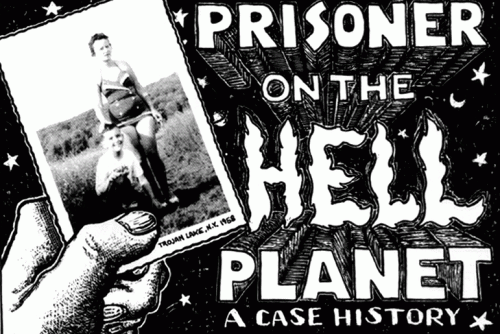
But most graphic memoir is of far more recent vintage, emerging as a distinct field of comics in the 1970s. That’s when Spiegelman wrote Prisoner on the Hell Planet – the harrowing account of his mother’s death that he later incorporated into MAUS. Spiegelman has said that he was emboldened to write something so painful and honest upon reading Justin Green’s Binky Brown and the Holy Virgin Mary, which is – how do you summarize Binky Brown? – which is about the psychic travails of a young ardently Catholic boy of a visionary bent. In the first pages, when he’s a small boy, he hears blades of grass talking to him; at the height of the book, he’s hallucinating that a magic ray is emanating from his penis and hitting all the statues of the Virgin Mary in its path. The memoir is alarming and blasphemous and tragic and funny and a bit of a beautiful mess: where Fun Home is tautly constructed and formally elegant, Binky Brown is raw and shambolic. But it had a profound influence on graphic memoir, if only because without Binky Brown, there’d be no MAUS.
As to why the genre of memoir has had such success in comic – who knows? Champions of the form will surely make the argument that there’s something peculiar to the combination of images and words that makes comics an especially suitable form for life-writing. (Here, for example, is Hillary Chute, an eminent American comics critic: “The stories to which women’s graphic narrative is today dedicated are often traumatic: the cross-discursive form of comics is apt for expressing that difficult register….”) I’m allergic to that class of argument, which always sounds to me less like an attempt to explore the quiddity of the form and more like special pleading by comics devotees, but to give the claim its due, there is something about a drawn image that immediately emphasizes the idiosyncrasy of the artist and hence the life. I can’t think of many graphic memoirs where the images are in the vein of old Classics Illustrated comics – inert and bereft of style. (Now, of course, I’m imagining a parodic graphic memoir in exactly that lifeless non-style, an account of a conventional white middle-class American life in mid-century Muncie. R. Sikoryak should write it.)
But as I say, I’m skeptical about that argument. A more convincing one would begin with the economics of writing comics. Relative to other mass media, comics are cheap to make. And that inexpensiveness is of course liberating: it permits artists to explore far more idiosyncratic material. I love Hollywood, but even small-budget films are too expensive to risk exploring the kind of subjects that are common currency in graphic memoir – not if the filmmakers are aiming for the multiplex, at least. Debbie Drechsler’s Daddy’s Girl is a harrowing memoir of child abuse that no one would ever greenlight. It’s conceivable that some Bowdlerized, banalized version of Fun Home will make it to the screen someday, but that will only be possible because the book and the musical have been such successes. Think of the other literary form with a significant confessional tradition: poetry.
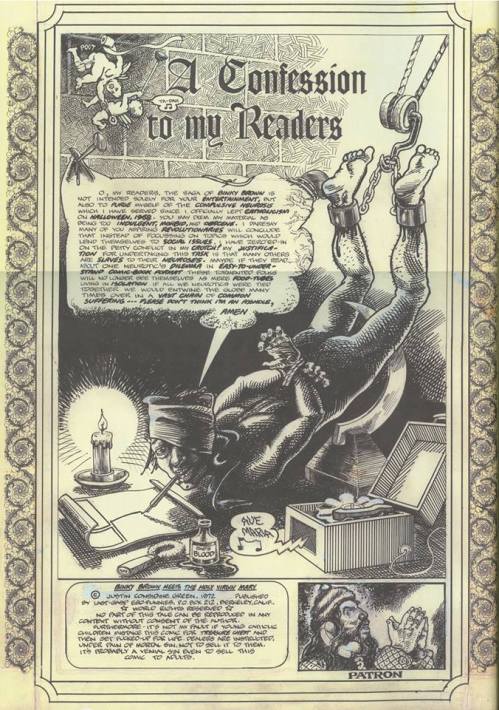
But above all, life-writing is a dominant genre in comics because life-writing in the book industry as a whole is a dominant genre. James Frey disguised his work as a memoir because no one was interested in it as a novel. I remember reading an essay in Bookforum by the curmudgeonly Walter Benn Michaels after the 2008 collapse. He was full of hope that the crisis in capitalism would lead to a crisis in the memoir industry: he saw a link between memoir and individualism, and hoped for a reorientation towards less narcissistic literary forms. No such turn is on the horizon, but don’t feel bad for Michaels: he enjoys his splenomegaly. And I think he’s right in drawing the connection. On the first page of Binky Brown, Justin Green makes this combative confession to his readers:
I officially left Catholicism on Halloween, 1968. … I daresay many of you aspiring revolutionaries will conclude that instead of focusing on topics which would lend themselves to social issues, I have zeroed in on the petty conflict in my crotch! My justification for undertaking this task is that many others are slaves to their neuroses. Maybe if they read about one neurotic’s dilemma in easy-to-understand comic-book format these tormented folks will no longer see themselves as mere food-tubes living in isolation. If all we neurotics were tied together we would entwine the globe many times over in a vast chain of common suffering… Please don’t think I’m an asshole, Amen.
Christopher: “Narcissistic literary forms.” I like that, if for no other reason than that I wonder if there’s any act of literary (or artistic) creation that doesn’t require at least a small measure of narcissism, enough self-regard to assume that one’s voice is worth hearing.
Michaels does get my hackles up a little, however, because however much hubristic self-regard we might read into Joyce or Proust, or for that matter someone like Norman Mailer or Karl Ove Knausgård, the flip side of that memoiristic coin are those people articulating experiences from the margins: the long history of slave narratives from Fredrick Douglass to Harriet Jacobs, for example, accounts that deploy the tacitly ascribed truth-value of confession and revelation in the service of communicating the realities of lives otherwise invisible or ignored.
While I wouldn’t necessarily situate Fun Home in a comparable tradition (though as a queer woman, she does write from a culturally marginal position), Bechdel is very canny in the way she situates her memoir in a canonical context with her allusions to Joyce and Proust, but also ironizes her relationship to such texts. One minor detail I’ve found interesting about her illustrations is the way she replicates text on the page: at various points, we see images of passages from a variety of books, from dictionary entries to the novels she or her father read, rendered carefully but not exactly—she does not simply paste in photographic or photocopied reproductions, but scrupulously draws the fonts and formatting (and does the same with handwritten notes and letters).
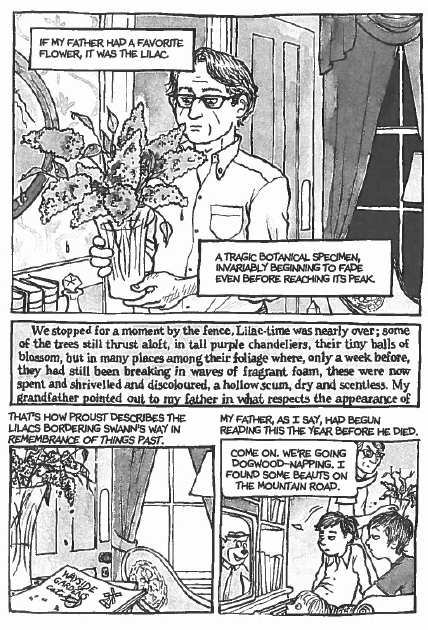
Again, perhaps this is a minor point, but it seems to me an interesting choice: in conventional documentary forms and memoirs, archival photographs and texts perform a significant semantic role, providing a touchstone to something “authentic” or “real” (and while sparing in his use of such elements, Spiegelman does use them in MAUS). Bechdel’s mimetic reproduction of text self-reflexively references her chosen medium of graphic narrative: drawing Proust’s words gives them a visual tactility we rarely ascribe to printed text. The intrusion of such text as image rather than narration turns it into a visual object, which then in turn highlights the medium in which Bechdel works, which is itself a repudiation of the written word as the apogee of narrative art.
What do you think? Am I completely off base here?
Andrew: You’re so far off-base you may be Paul Ryan.
No, you’re not: you’re squarely astride the base.
Let me say first, apropos of MAUS, that the three photographs Spiegelman uses are themselves complicated in all sorts of interesting ways. I think it may be the critic Thomas Docherty who first noted the ironies of the third photo in the book, a portrait of Vladek Spiegelman in camp uniform. One might assume that it was taken while he was an internee in Auschwitz. In fact, it was taken after he had left the camp, in a “photo place,” as he calls it, which had a uniform that people could pose in for souvenir pictures. It’s a photo that might well mislead those naïfs who still imagine that photos point to authenticity and the real, but instead calls attention to its implication in an emergent (and bizarre) culture of remembrance.
In Fun Home, the mediation is a striking feature, and it’s more thoroughgoing than you may realize. Bechdel’s method is to take photographs of herself for every human figure she draws: it’s a way, she argues, of capturing the idiosyncrasies of gesture with a subtlety and specificity that she couldn’t achieve if she were relying only on her imagination. In other words, the mediation you’re noting in her drawings of Proust’s words and elsewhere extends to the whole book, which is altogether a strange palimpsest.
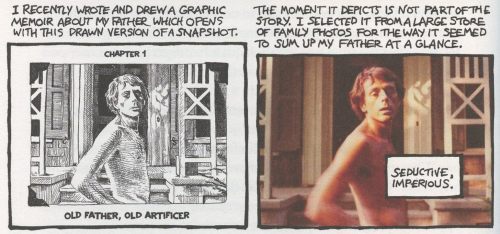
I might, however, quibble with your assertion that Fun Home offers a “repudiation of the written word as the apogee of narrative art.” I’m not sure who would still accept that notion of the written word: surely it’s been tottering at least since the moment that movies turned from a cinema of varieties into a predominantly narrative form, if it ever had much solidity outside the circles of its champions. It doesn’t seem to me to be a battle that Bechdel needs to fight, nor do I see much sign that she feels such a need. If she’s engaged in any kind of struggle or negotiation through her emphasis on the iconicity of the printed word, I think it might be with her father Bruce, who taught English literature when he wasn’t running the family funeral home and whom she identifies, at various moments, with Camus, Fitzgerald, and Proust. She’s crafting a Kunstfigur of this man, who is so strongly identified in her memory with the written word, and maybe that informs her process of graphic mediation. But evidently “repudiation” isn’t the right word to describe her relationship with her father. In a two-page comics essay she published in Granta, Bechdel discusses the photo of her father that she used as the basis for the title page of Chapter One. She struggled, she says, “with the technical challenge of rendering the tonality and blurry motion [of the photo] using only line,” before admitting that “my drawing is as crude a schema of the color photo as perhaps the photo is of the raw, unspooling life it purports to capture.” Perhaps the point of her mediation is to insist on the inevitable crudeness of her schemas – the clumsiness of even this miraculously subtle work to capture the quiddity of her dad’s life.
Christopher: Granted, “repudiation” is probably too strong a word for what’s going on—say instead that it troubles or critiques a canonical understanding. I realize it’s perhaps a little disingenuous to discount authorial intent with a memoir—what genre is more about authorial intent?—but I also think it’s valid to see the ways in which a text offers a critique independent of the idiosyncratic and personal dimension informing its production. If this were a fictional narrative, it would be a pretty straight line between her father’s forbidding, aloof, and indeed authoritarian tendencies, and his symbolic connection to these texts that have played a comparable role in the normative discourses of literary study. That Fun Home is a memoir doesn’t necessarily change that fact: I think your reading of Bechdel’s agon with her father as the site and source of her graphic mediation is pretty spot on, but I also don’t think that discounts or obviates a broader reading in which we can see this work as a representative point of resistance to the canonical tradition … whether or not the written word still holds the same status I seemed to be claiming for it.
On that point, I should note that when I brought this up in class last week, I was surprised to find that the balance of my students could not tell me what “the canon” was. As I told them, I didn’t know whether to be dispirited or heartened—dispirited because they’d progressed to the fourth year of their English degrees without having gleaned an understanding of what, for decades, constituted the core of literary study in English; or heartened because it signalled that we’re now past the pro- and anti- canon arguments that pervaded literary study for so long. On reflection, I’ve decided that I’m heartened: whatever other problems bedevil academe in general and the liberal arts in particular these days, I like where we’ve arrived, where we’re (starting to) question long-held assumptions about what makes a given text worthy of scholarly and pedagogical attention.
After you take apart my argument above, I’m curious as to your thoughts on the way Bechdel spatializes the narrative. I may not know much about comics on the theoretical front, but even I can see that comics art is about compartmentalizing: literally framing each image in sequence, except for when we get more elaborate double-page spills and the like. The titular “fun home” of course references the funeral home Bruce Bechdel operates, but it’s hard not to see the title also as an ironic reference to the gloomy, gothic house in which much of the story unfolds, a structure (like all the literary allusions) indelibly associated with him. Again, this is an element Alison Bechdel draws from her life, but which here functions symbolically—the compartmentalization of the lives within the home, which also connotes the metaphor of the “closet”—as well as allusively, bringing to mind the long tradition of novels, from nineteenth-century Irish fiction, to Thomas Mann’s Buddenbrooks, to Michael Ondaatje’s The English Patient, in which the old and often crumbling manor house is itself a character in the story.
I don’t have a question here, I’m just curious to hear your thoughts.
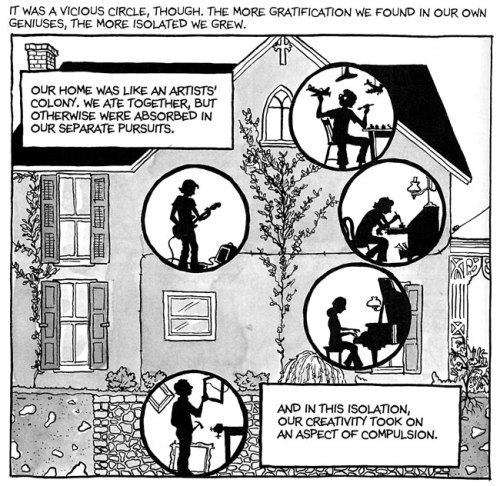
Andrew: A discussion about the literary canon isn’t quite the same as one about the written word as the apogee of narrative art, though, is it? Those are different topics, despite having points where they overlap. The kinds of judgement that a would-be canon-builder has to make are different from those of a given narrative form’s champions. The aspiring canon-builder says: “Within this range of forms that we admit as literature, these are the best works.” The champion of the written word says: “This narrative form is superior to that one – and all those others, too.” I took you to be saying that Fun Home attacks the second creature, which I think is such a demoralized and thoroughly confuted shadow of a thing that Bechdel would hardly need to bother with it.
But let me talk about Fun Home as a “point of resistance to the canonical tradition.” It is and it isn’t, which I’ll start to argue by focusing on a related tradition that Bechdel portrays in Fun Home – literary interpretation. When I first read those parts of the work that are set in college, and specifically those portraits of male professors holding forth about interpretation, I felt modestly uncomfortable. Bechdel’s satire on the Jungian literary critic and his genital reading of Heart of Darkness is devastatingly funny, but it cuts to the quick, since I’ve elaborated my fair share of harebrained interpretations to bemused students: “You think the Headless Horseman is Irving’s figure for a man without capital? Isn’t that just a bad pun?” But even as she makes quick work of these dopes, she makes interpretation a key part of her book. What is Fun Home, after all, but an interpretive project, an attempt to solve the mystery of her father’s life and death, using the texts of her own memories and the family archive? It’s a work of interpretation, in other words, that also happens to satirize interpretation. I think it has a similar ambivalence about literature. There’s no question that there’s a connection between her father and the canonic works that he loves and that he teaches, often bullyingly, to his bored and captive students. But at the same time, there are very few comics that are as literary as Fun Home. As you note, the book is crafting itself in the mold of all the literary “classics” it cites. I’ve just distributed the topics for the final essay in my comics course, and one of my questions invites students to pick just one of the references to other books in Fun Home and explore how the cited book works intertextually to illuminate or enrich Fun Home itself. If you find an instance where Helen Bechdel is reading the part of Mommy in Albee’s The American Dream (and you will), then consider how that play’s meditations on national fantasy intersect with similar meditations in Bechdel’s memoir. It’s a perverse essay topic in that by design it invites students to distort the text, a single allusion among hundreds becoming, at least in that thought piece, the key to the memoir. But it’s making a point that I hope won’t be lost on my students, which is that Fun Home is richly implicated – in the sense of being entwined or entangled – in literature. Again, that’s part and parcel of its treatment of her literary father. You’re right to note that he’s forbidding and aloof and has authoritarian tendencies. He’s a terrible husband and often a terrible father. But he’s also intelligent, stylish, seductive, and dryly funny; and he’s vulnerable, and tormented, and desperate; he’s an artist but also an abuser of young men; “in short a complex personality, an enigma, a contradictory spokesman for the truth, an obsessive litigant and yet an essentially private person who wished his total indifference to public notice to be universally recognized – in short a liar and a hypocrite, a tight-fisted, sponging, fornicating drunk not worth the paper, that’s that bit done.” (It wouldn’t be a real conversation between us without someone quoting Stoppard’s Travesties.) Insofar as Bruce stands for the Canonical Tradition, the complex relationship that Alison has with him extends to literature itself. To read the attitude towards Modernist literature as resistance alone doesn’t do the complexities of that attitude justice.
Two last notes on this front. First, the authors identified with Bruce Bechdel are all men. When Alison, in college, starts exploring a Lesbian intellectual tradition, she almost immediately borrows Radclyffe Hall’s The Well of Loneliness from the library, and we later see, among the books strewn on the bed that she shares with Joan, Adrienne Rich’s Dreams of a Common Language. Even if I don’t agree that the memoir is antagonistic to literary tradition, it’s certainly interrogating that tradition, or inviting us to understand it as a particular, contingent body of works, or to think in terms of literary traditions in the plural. Secondly, as the critic Michael Moon noted in one of the early works of Fun Home scholarship, many of those male authors that Bechdel quotes in Fun Home were gay. Proust is Moon’s key example, but I mentioned Albee, above, and Helen acts in a performance of Wilde’s An Ideal Husband, and Henry James figures in a sly literary allusion, too (the short piece in Granta offers a more thoroughgoing reading of the Bechdels alongside James). I mention Moon’s insight to emphasize, first, how judicious Bechdel is in her choice of allusion and secondly, to destabilize once again the notion of a literary tradition as an uncomplicatedly “normative discourse.”
But to carry on. You’re of course right to understand the home of the memoir’s title not only in relation to the Bechdel Funeral Home but also the Gothic revival house that Bruce restores so carefully. It’s in a long line of crumbling manors in American literature, from the House of Usher and the House of the Seven Gables to the Bates Motel – and a cousin, of course, to the crumbling manor houses of other Gothic traditions. In keeping with the allusions to Icarus and Daedalus that pervade the memoir, the labyrinth is a key figure, too: Bechdel writes that “[her father’s] shame inhabited our house as pervasively and invisibly as the aromatic musk of aging mahogany. In fact, the meticulous, period interiors were expressly designed to conceal it. Mirrors, distracting bronzes, multiple doorways. Visitors often got lost upstairs.” And lurking somewhere inside, the minotaur who is also the labyrinth’s inventor. The home is, as you suggest, a metaphor for the closet.
As to how Bechdel spatializes the narrative: the page you include above is a great example of how she finds apt visual metaphors for a given moment in her narrative. The isolation of the Bechdels within their respective bubbles is itself a canny way to figure their absorption in separate pursuits. But placing the viewer outside the house, privileged with a kind of X-Ray vision that nevertheless only reveals the Bechdels’ silhouettes, is another means of emphasizing alienation, in this case of the reader from the five obsessives inside the fun home. That flirtation with the voyeur (if that’s the right way to put it) suggests to me a representational tradition I’m familiar with as a student of early American urban literature. It’s a tradition that’s embodied in what the historian Helen Lefkowitz Horowitz calls “the fascinating character of Asmodeus, a fictional devil with origins in the Apocrypha, who had been refashioned in the nineteenth century as a devil-dandy who could reveal urban secrets by taking off roofs of houses to reveal the vices of those dwelling within.” The appetite to see these domestic secrets is itself a function of what Franco Moretti has characterized as the “great novelty of urban life, [which] does not consist in having thrown the people into the street, but in having raked them up and shut them into offices and homes.” And into small-town fun homes, too.
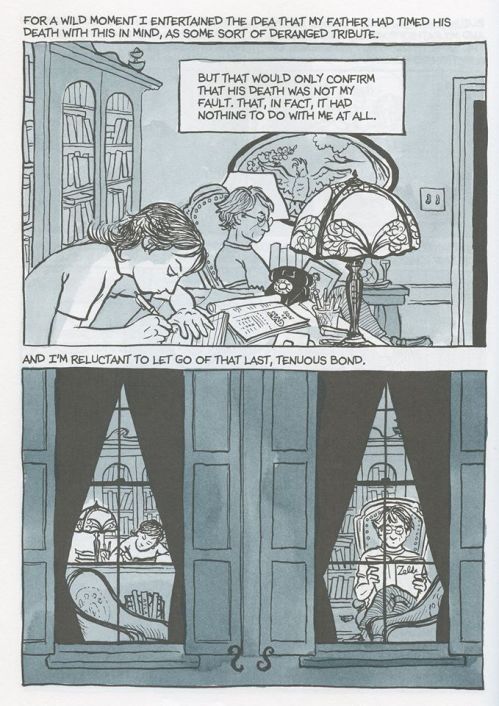
But I prefer another example of Bechdel’s use of the comics page – one with some affinities to this one. Bechdel divides the last page of the third chapter into two panels roughly equal in size. The first of these shows Alison and Bruce in profile, sitting alongside one another in Bruce’s library. The two of them are companionably silent, Bruce reading a book about Zelda Fitzgerald and Alison sitting at his desk writing a check that he’s promised to sign. In the caption, the narrator Bechdel is imagining that her father killed himself in “deranged tribute” to Fitzgerald, who was, like Bruce, 44 when he died. But, she reflects, if that were true, then it would mean that his death had nothing to do with her. “And I’m reluctant,” she says, “to let go of that last, tenuous bond.” The second panel, the last one of the chapter, shows them still sitting alongside one another, still in the library, each of them at ease. But now we the viewers are outside, looking in through two windows; Alison is visible through one window, and Bruce is visible through the other. The curtains are a funereal black, and even though the static medium of the comics page means that they’re frozen in place, their appearance at the end of the chapter suggests a closing, after the fashion of a stage play. Alison and Bruce are still in the room together, but the new perspective on them now emphasizes the tenuousness of their bond. The first of the two panels immerses us in Bechdel’s memory of domestic happiness; the second reluctantly retreats from that memory. It’s a beautifully subtle dramatization of mourning that Bechdel articulates primarily through the image.
Christopher: As much as I would love to keep going with this, I’m overdue for posting it, so that will have to be the last word … which is only appropriate, given that it is an eloquent and incisive final word, and far subtler than my own evolving understanding of Fun Home. Thank you so much for your time and thoughts, Andrew. Perhaps we’ll have to do this again when we talk Hamilton in a little more than two weeks.

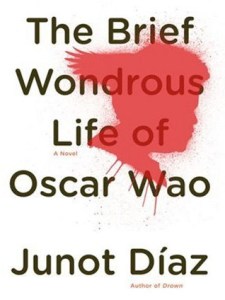 The past two weeks have been an unforgivable lapse on my part, particularly so because I neglected to post on the text that was the original inspiration for this course: Junot Díaz’s The Brief Wondrous Life of Oscar Wao. That I didn’t manage to get anything up on this beautiful novel—which I count as one of the best of the past twenty years—is rather embarrassing. It wasn’t for lack of anything to say: I have copious notes on magical realism, the way in which the novel uses genre(s) to allegorize intersectional identities, and finally I had planned a post about allusion, in which I would have talked about Oscar Wao and Stranger Things.



 it's all narrative