Monthly Archives: May 2015

Game of Thrones 5.07: The Gift

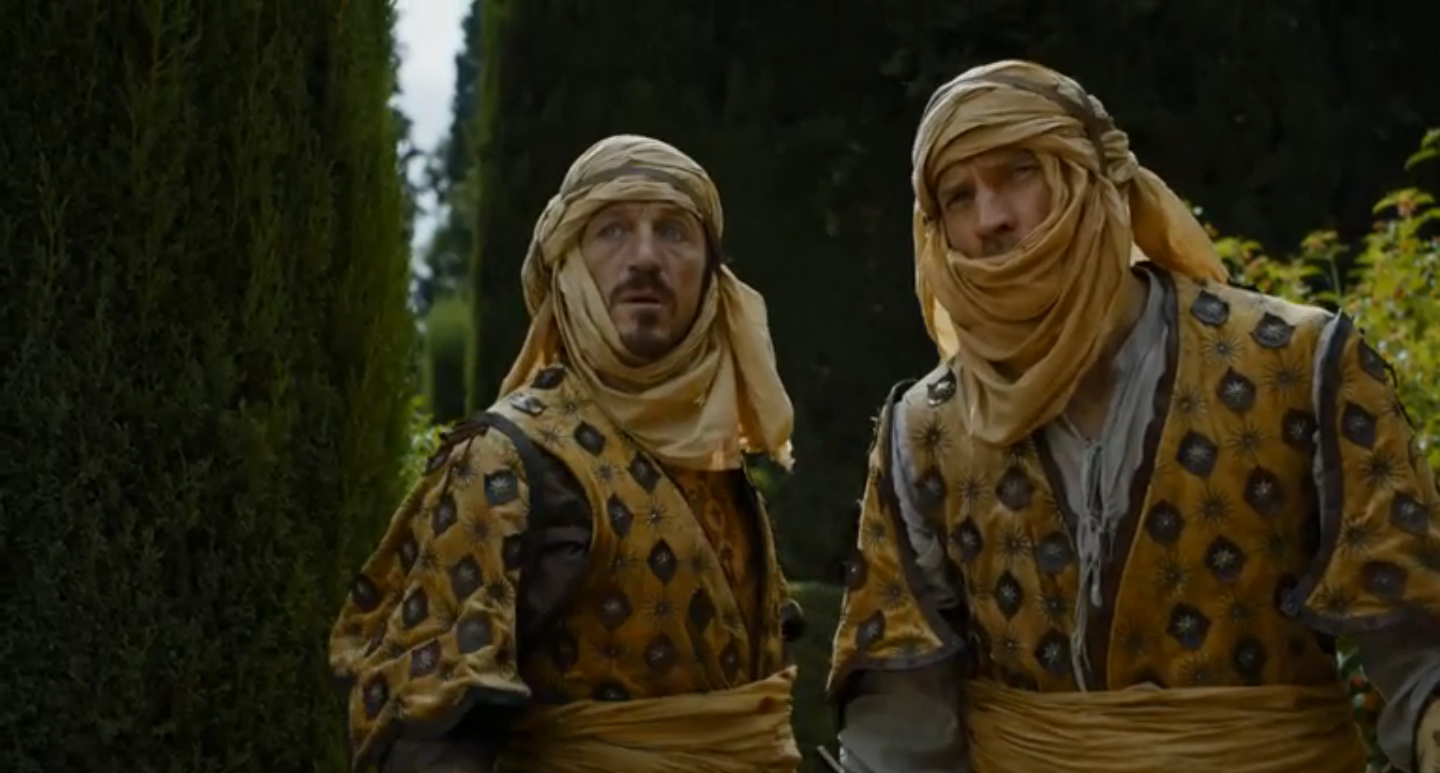
gameofthrones_teaser02_screencap10Hello again sports fans, for the latest installment of the great Chris and Nikki Game of Thrones co-blog! This week: Samwell Tarly cowboys up, Theon totally fails to do so, Bronn gets the worst lapdance ever, Cersei ain’t so smug now, and Tyrion and Jorah find themselves as extras on the set of Gladiator. We who are about to die salute you!
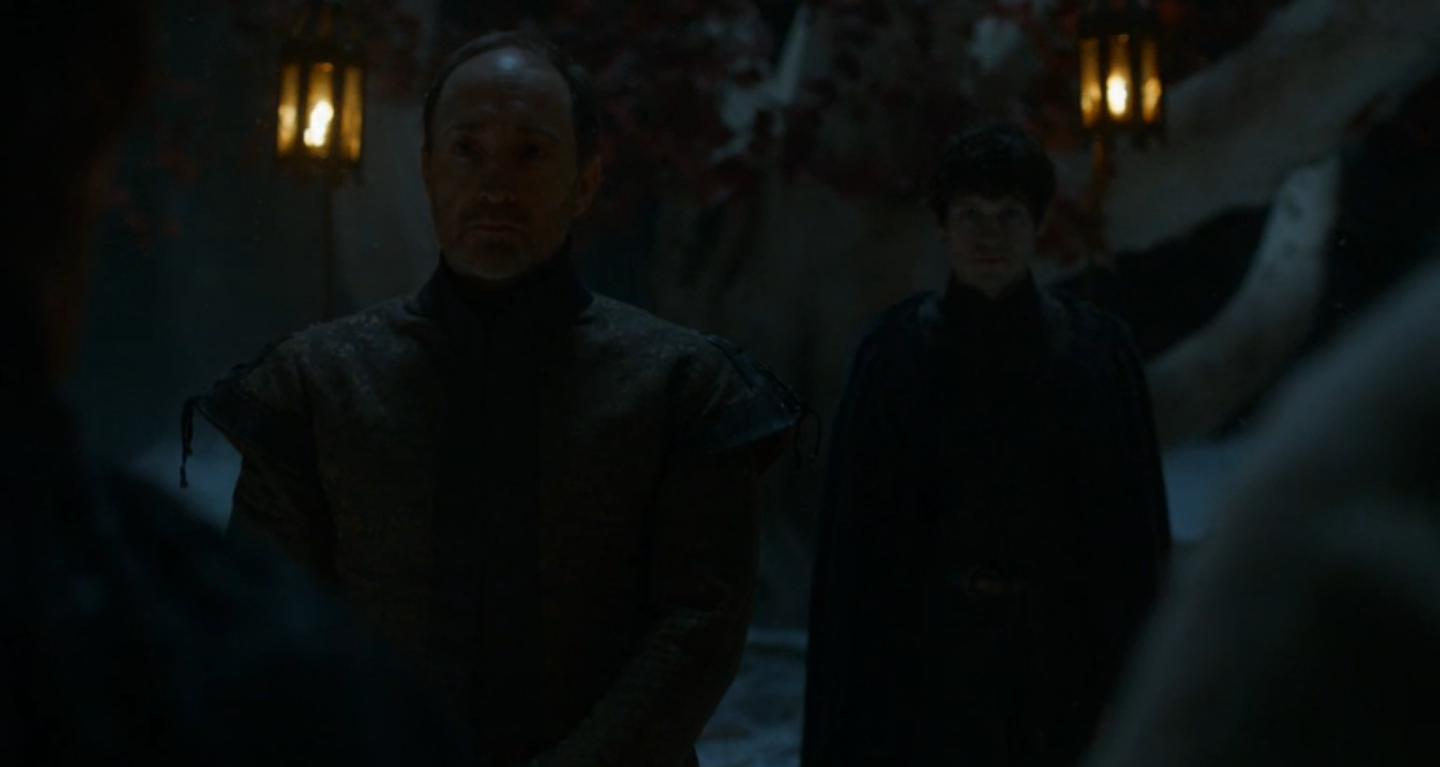
 alliser

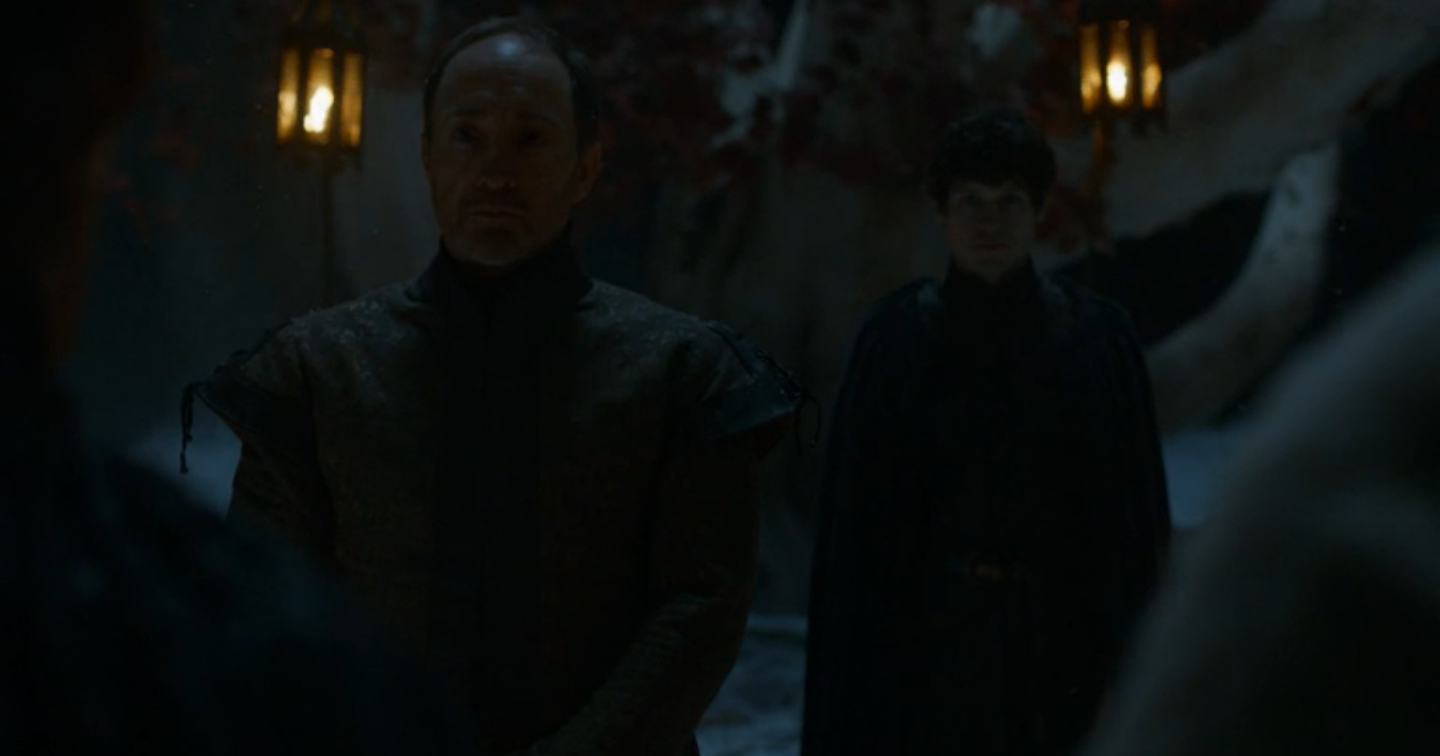
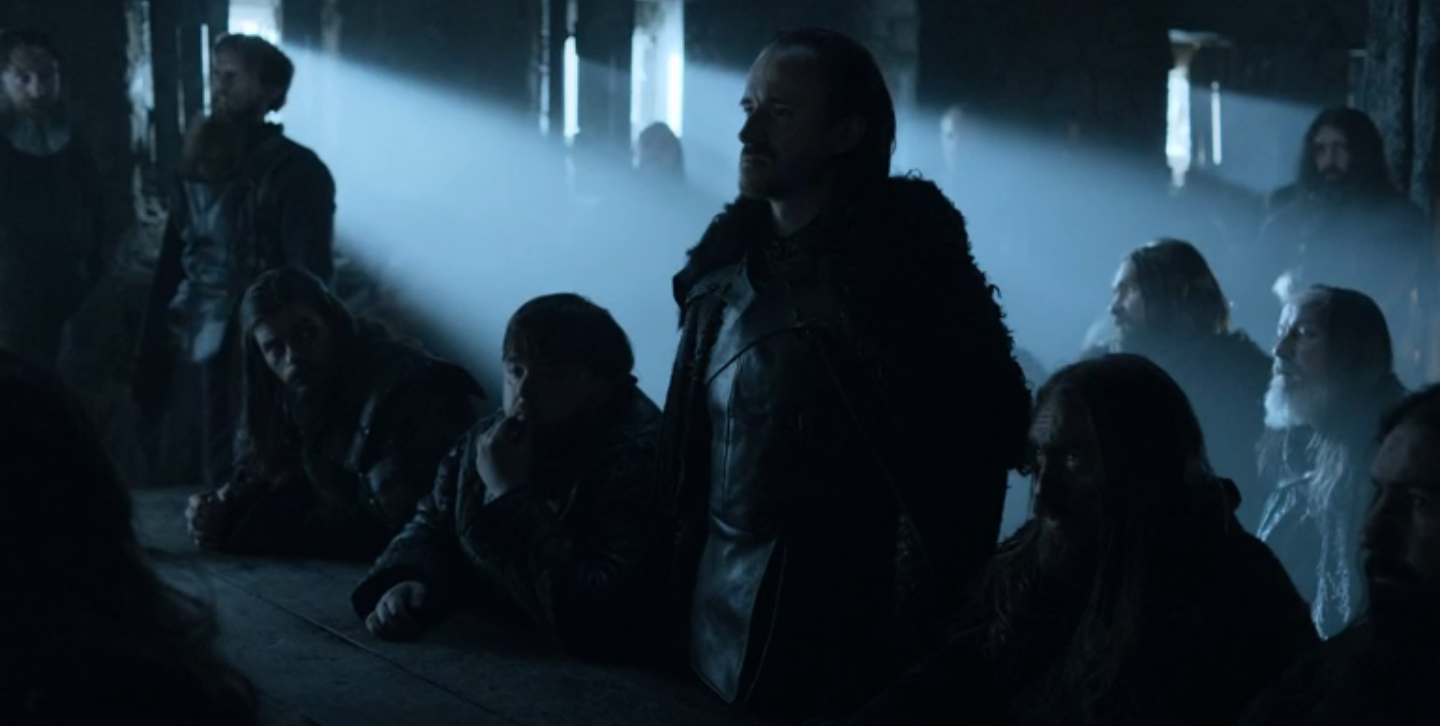
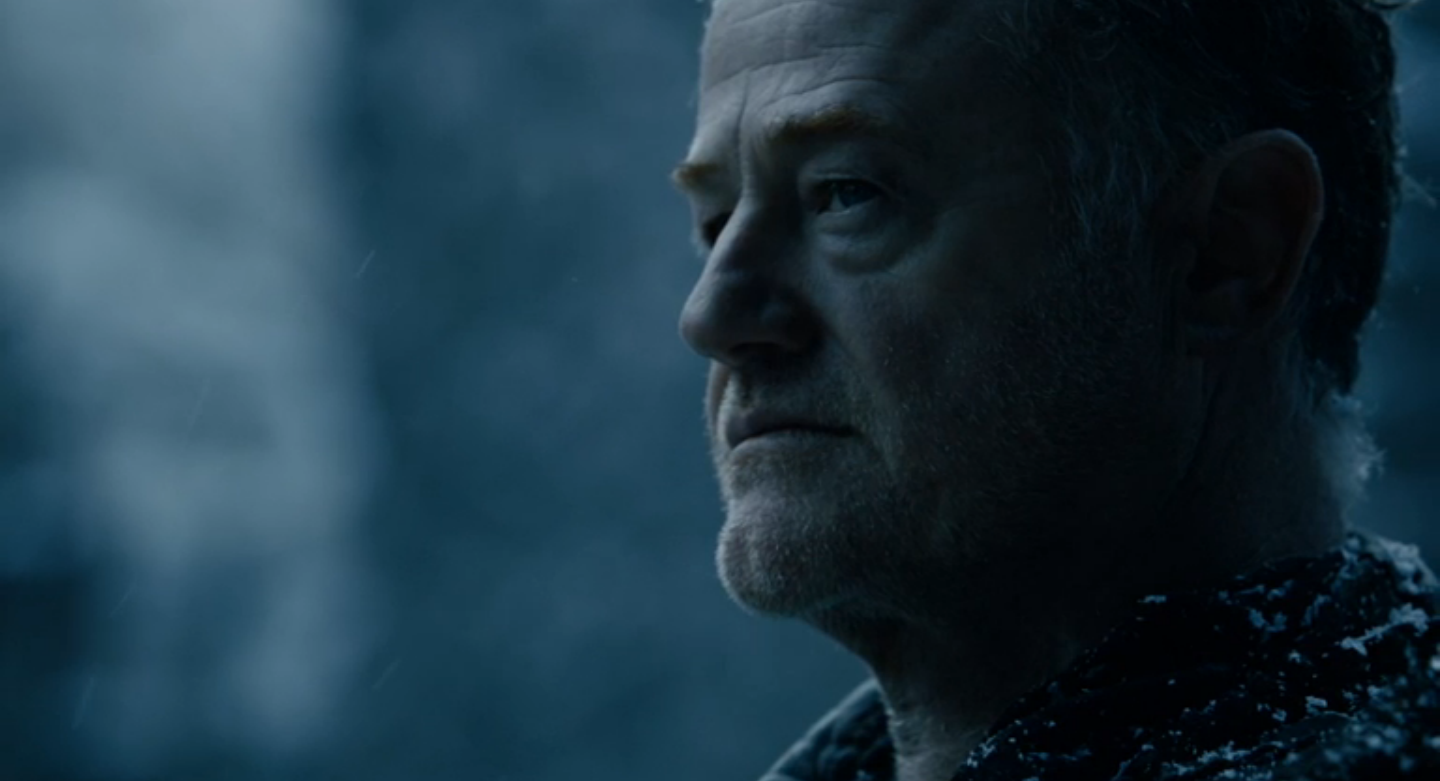
Christopher: We begin at the Wall, with Jon Snow releasing Tormund, giving command to Alliser Thorne in his absence, and departing for Hardhome in the hopes of recruiting the wildlings to his cause. And with his departure, attention shifts to Sam and Gilly: we feel very sharply how alone they are now that Jon is gone, especially as we see Maester Aemon on his deathbed, growing ever more delirious.

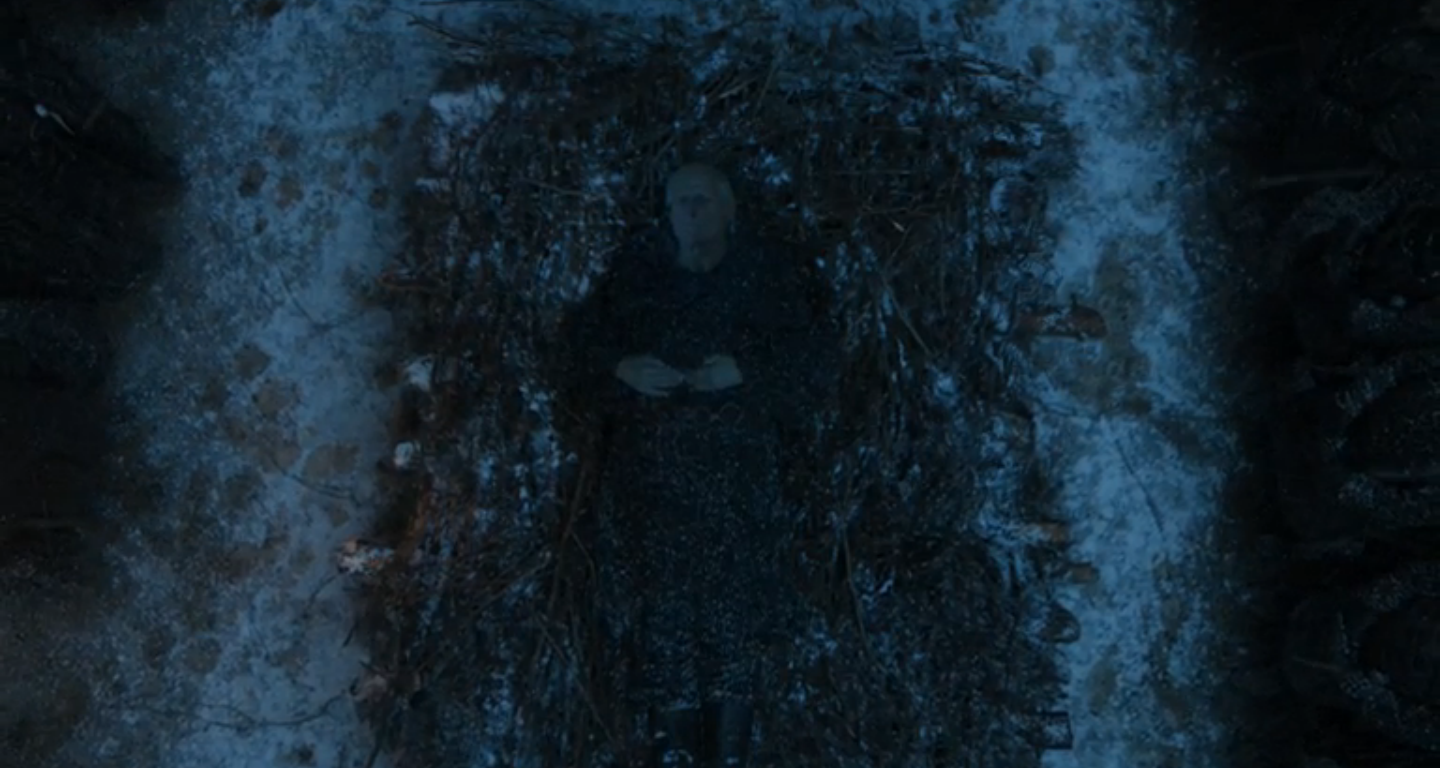
Storylines from the novels have been discarded of late like things that one is eager to throw away, and with the passing of Maester Aemon we lose yet another story thread that runs through A Feast For Crows. Our one glimpse of Jon Snow in that novel comes right at the beginning, when Jon sends Sam away with Gilly and Maester Aemon. He wants Sam to go to the Citadel in Oldtown, an entire continent away, and study to earn his maester’s chain. He also wants Aemon sent away for his health—both for the benefit of a warmer climate, but also because he is concerned that Melisandre might look at the ancient Targaryen and get some ideas about what she could do with the royal blood in his veins. As it happens, Aemon dies before they can arrive at Oldtown, but in his final delirium he has an epiphany: Melisandre, he says, has gotten it wrong. She has proclaimed Stannis the prophesied hero who will do battle with the forces of ice and darkness, but in reality the prophecy refers to Daenerys (duh).

I suppose that Sam might still be sent to the Citadel, but I have to imagine that is now a vanishing possibility. And with the passing of Maester Aemon, the Wall loses its single greatest storehouse of lore and wisdom. The scene is touching and poignant, especially with Aemon revisiting his memories of youth, seeing in Gilly’s baby his own little brother Aegon—or “Egg” as he was nicknamed. (I won’t go into the vagaries of Targaryen history, but the story of Aegon V before he was king is told in a series of novellas, The Hedge Knight, The Sworn Sword, and The Mystery Knight, that detail the adventures of Dunk and Egg, aka Aegon and his sworn sword Duncan the Tall). I must say I was a little disappointed: in the final stages of his delirium, I was expecting Aemon to gasp and have his epiphany about the prophecy … but no.
aemon_pyreAnd again, Sam is more isolated, something that Alliser Thorne is grimly happy to remind him of: “You’re losing all your friends, Tarly.” The Wall has always been a hostile place to Sam, but up until this moment he has had the friendship and protection of Jon and Aemon—the absence of which is felt quite soon when two of his sworn brothers come upon Gilly alone and, when Sam attempts to intervene, beat him bloody.

On the heels of last week’s episode, this scene was particularly difficult to watch. What follows, however, was quite well done, in part because Sam wasn’t the heroic saviour. Ghost plays the unlikely deus ex machine (unlikely, because why the hells isn’t he with Jon Snow?), which makes the resolution unfortunately hackneyed, but that’s small beer (it would have been better, or at least more likely, for Sam and Gilly to have been saved by someone like Alliser Thorne coming on the scene). Sam and Gilly needed an exit, and Ghost was as useful a saviour as any. The point is that Sam was, for all intents and purposes, as unable to prevent what was happening as Gilly. But he doesn’t stay down. “I killed a White Walker,” he tells their assailants. “I killed a Thenn. I’ll take my chances with you.” Without Ghost’s intervention, it would almost certainly have played out as predicted: with Sam dead, and Gilly raped (and probably dead). And Sam knows that.
gillyLater, as she tends to Sam’s wounds, Gilly upbraids him for it. “The next time you see something like that, you leave it alone,” she says. It is an interesting moment, a reminder of where Gilly comes from. She has lived a life of abuse and violence at the hands of her husband-father Craster, a life in which sexual violence was simply a basic fact of life. To her, Sam’s doomed efforts to protect her are foolishness, because getting himself killed means he won’t be around to protect her child. “Just promise me, whatever happens you’ll be there to take care of Little Sam,” she chides him. “But of course I will,” he replies. “And … I’ll take care of you too.”

What’s so touching and poignant about the blossoming love between these two—aside from the fact that there aren’t many other couples on this show at the moment genuinely in love—is the way each of them takes the other out of their assumptions about themselves and the world. Sam, in spite of his accidental heroism with the White Walker and the Thenn, is a coward—not someone who would otherwise choose to enter a fight. But he takes strength from Gilly, even though he knows he isn’t up to the task. And Gilly is stunned that he would choose to do so, that there are men in the world who aren’t brutal, violent, and selfish. Their sex is about the only genuine lovemaking we’ve seen since … what? I’m at a loss.

But of course, this is Game of Thrones, which means that these scenes are intercut with those of Sansa, Theon, and Ramsay. What did you think of the Winterfell segments, Nikki?theon_tower
Nikki: It’s so funny you should ask when the last time we saw genuine lovemaking on this show, because I wondered the exact same thing. Jon and Ygritte, maybe? Yikes, that seems like so long ago. Tyrion was kind to Sansa but she wanted nothing to do with him, so there’s nothing there. Margaery is using Tommen, so while it was an amazing time for him, it wasn’t so much for her. And we don’t need to mention Sansa and Ramsay. The last time we saw Jaime and Cersei together it was a rape… oh wait, I have one: Daario and Daenerys. Although even that at times feels a little political.

But I digress. I must also admit that when Ghost suddenly appeared, my husband and I cheered (as we always do when one of those magnificent beasts appears) but right after I said, “Wait… why wasn’t Ghost with Jon?!” Glad I wasn’t the only one who wondered that.

The Winterfell segments were heartbreaking, especially in the midst of the bit of tiny glimmer of hope we had left after the scene last week. Sansa’s arms are now covered in bruises, and she spends her days curled up in a fetal position, locked in the room, waiting for Ramsay to come back and ravage her once again. There’s a very brief moment when she’s later speaking to Ramsay — and has the audacity to bring up the fact that he’s a bastard, and he’d been given his name by the authority of Tommen Baratheon, also a bastard — where I saw a flash of the Sansa that will not be kept down. And where I thought, in the right circumstance, could she bend him to her will the way Daenerys did Khal Drogo? After all, their wedding night consisted of her being married to a man against her will, and then being bent over and him having rough sex with her, yet we never referred to that as rape. She eventually takes over and brings him to her side, and makes him utterly devoted to her.
Then again, Khal Drogo might have been a merciless warrior, but he wasn’t a psychopath like Ramsay. I don’t think anyone will be able to bend that little bastard to their will, and Sansa seems to know that and doesn’t even try.

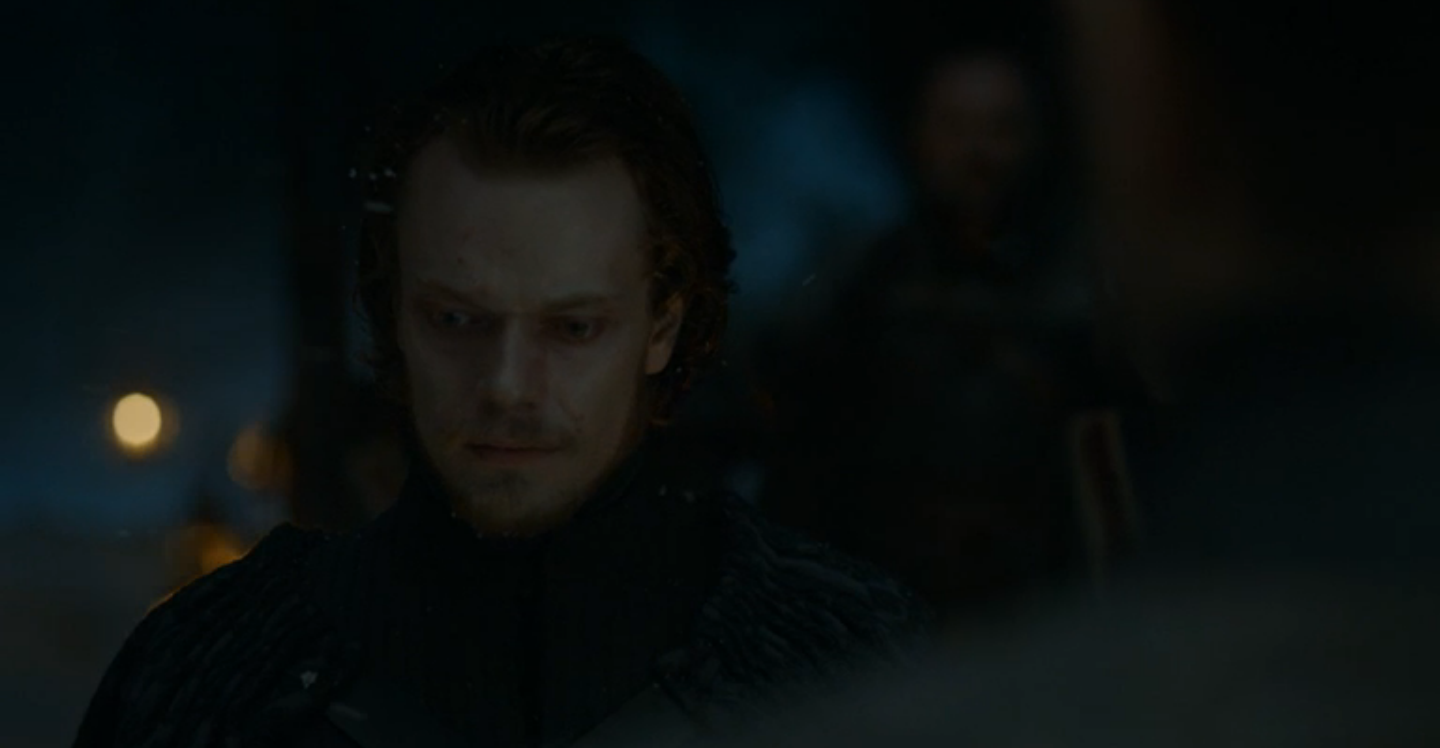
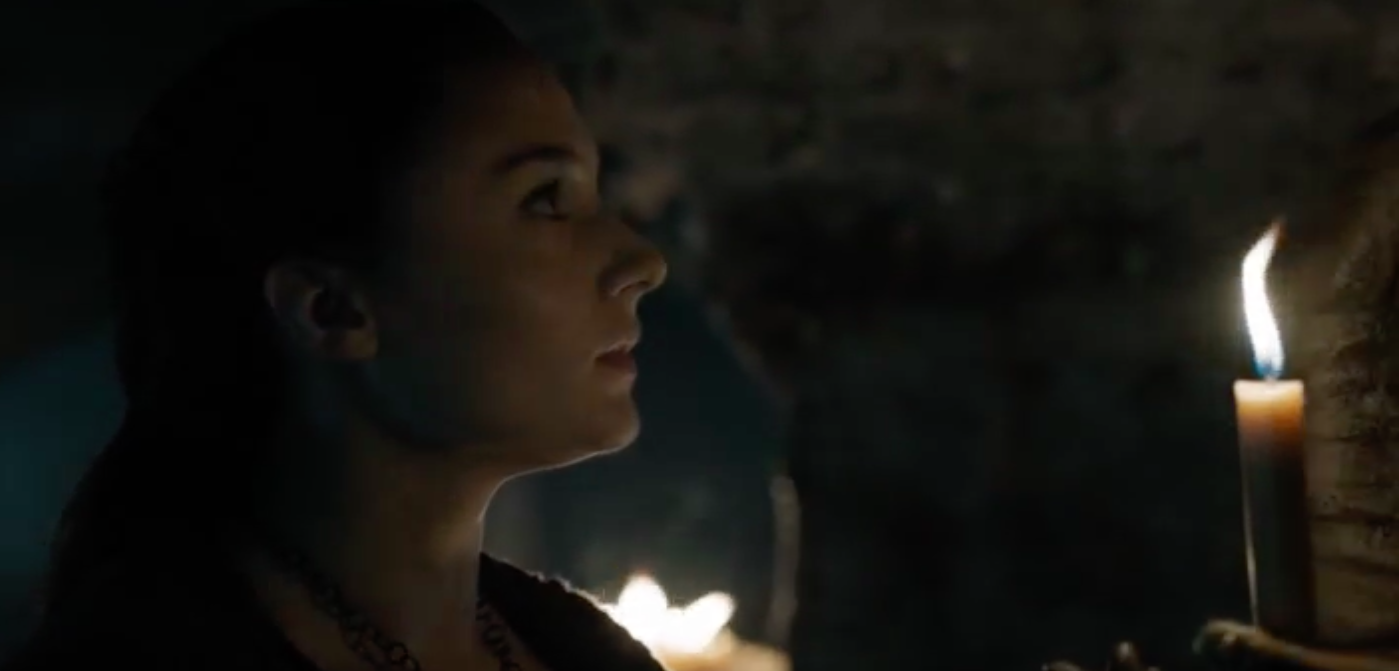
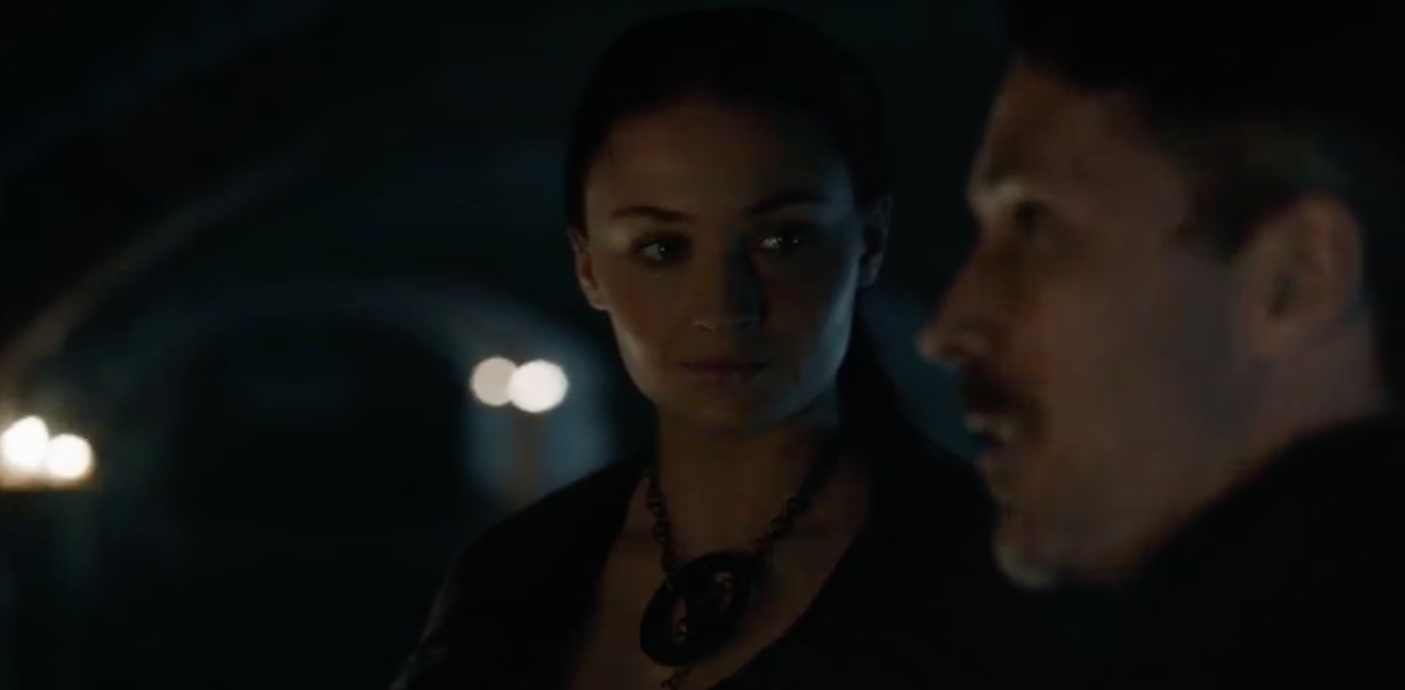
But earlier, when she cornered Theon and grabbed him by the arms, he looks terrified, and she says to him — clearly having no clue what he’s been through — that it couldn’t possibly be worse than this. Even though his eyes are wild and he looks like a raving lunatic half the time, there’s a spark of sanity still left there, and when he looks back at her and tells her to trust him, it really could be so, so much worse, she’s actually taken aback. I’m not sure she buys it (if she actually knew HOW much worse maybe she would) but she certainly takes pause. She recruits him to put the candle in the window of the Broken Tower, and while Theon is scared for his own life, he decides to go with it.

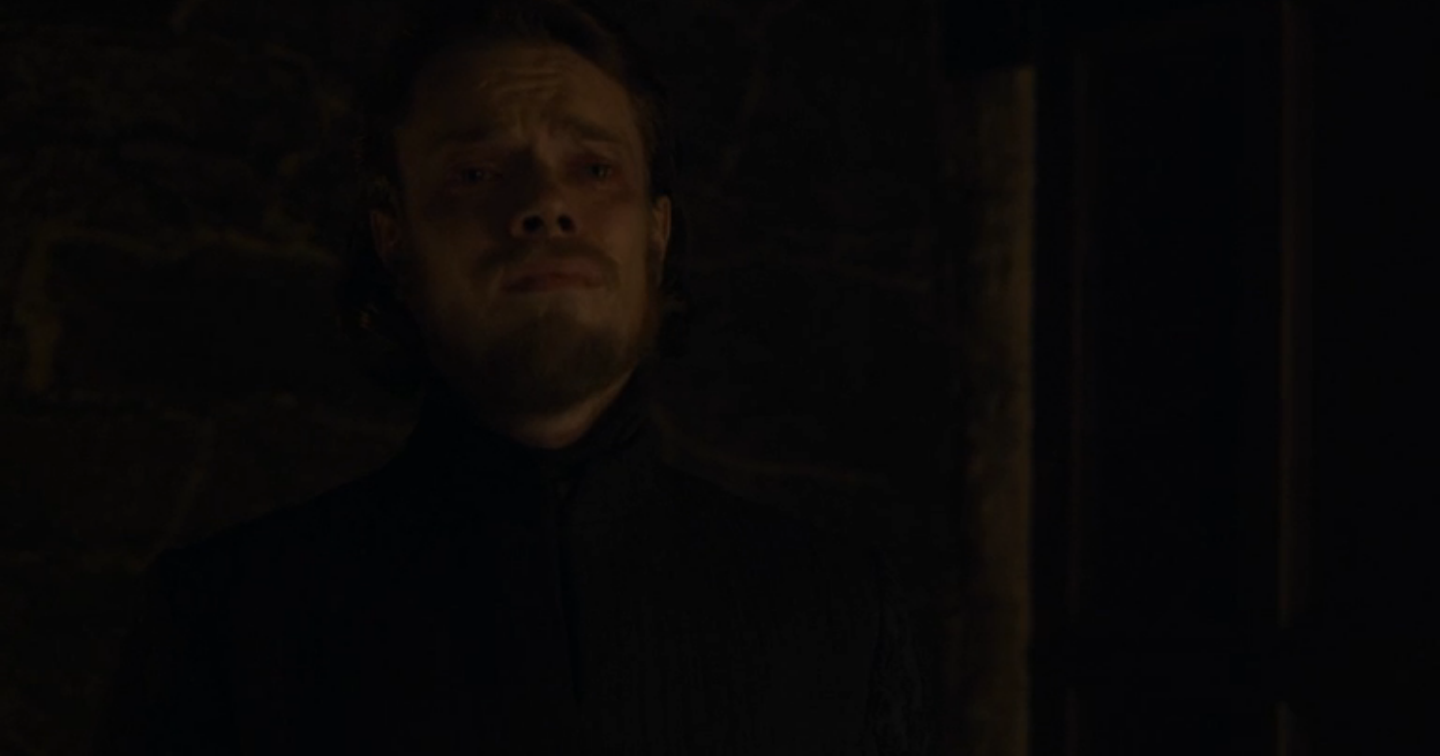
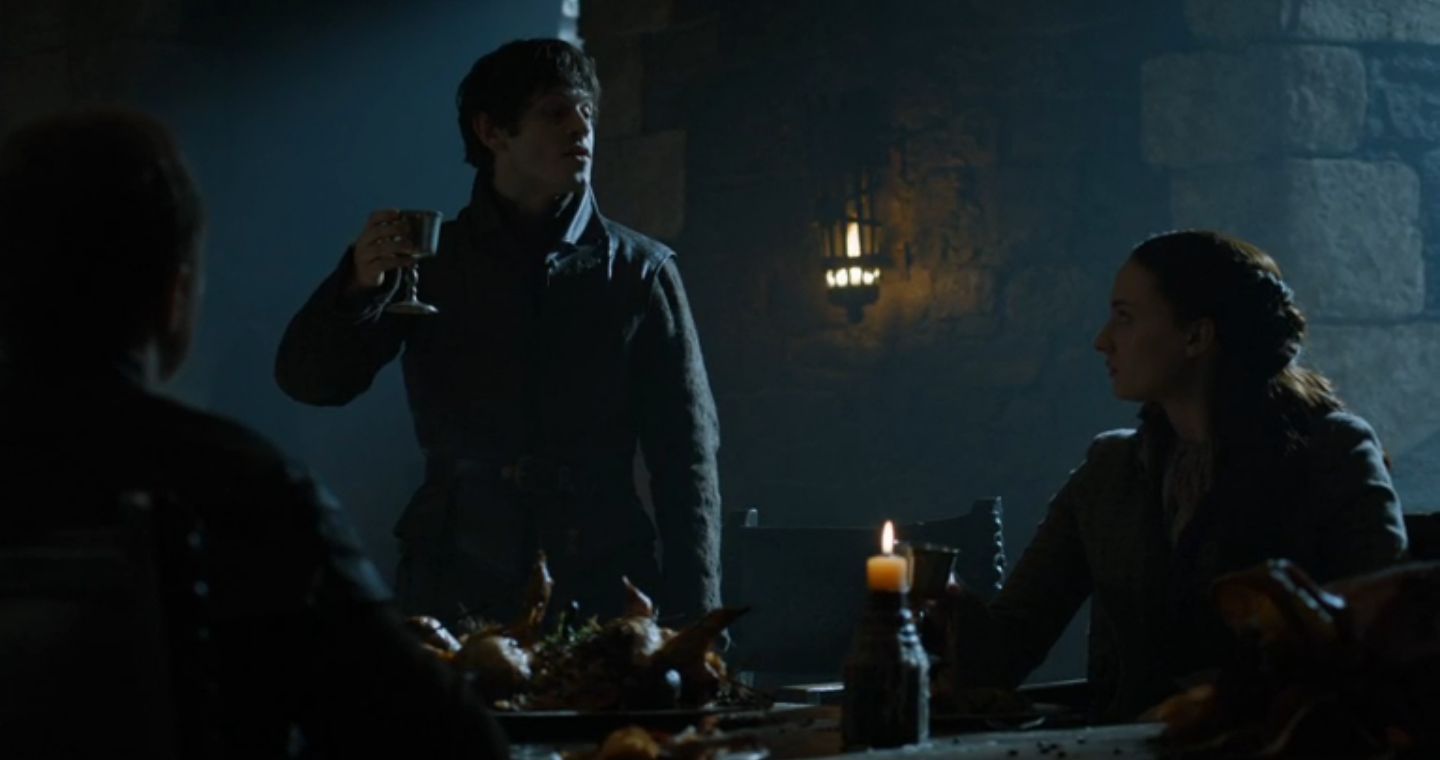
What happens next was probably what we all expected — Theon rushes across the grounds of Winterfell, looking like he has a purpose for the first time in years, and climbs the countless stairs to get to the top… where Ramsay is sitting in front of a feast, waiting to surprise him. Later Ramsay shows Sansa the bloodied, tortured corpse of the old woman who had promised to help Sansa, and tells her that Theon was the one who snitched. Had he already found the woman by the time Theon got up to the tower? Or did he just randomly choose that place to have his feast (how in hell did they get all that food, and a table and chair, up there, by the way?!) and when Theon got there, he immediately reverted back to Reek and fell upon the mercy of his master, telling him everything?

And if Brienne is standing in a nearby inn, watching that window for the glimmer of a candle, why didn’t she see the candlelight from Ramsay’s candles, which were all over the table, and take that as a sign?
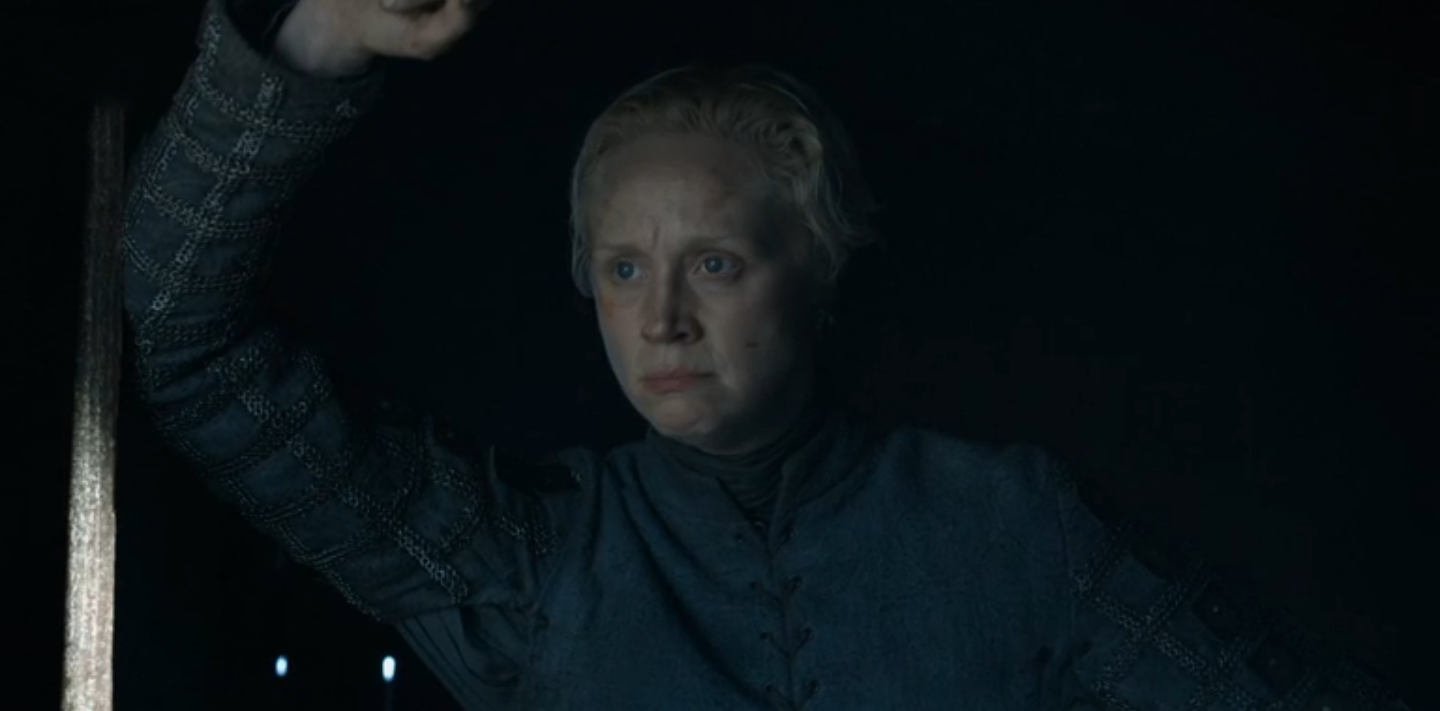
brienneWhile, as I said last week, I’m glad Brienne didn’t swoop in to save the scene because it would have been disingenuous, I must say I’m a little disappointed that she’s yet to make a move. Sansa has arrived at Winterfell, met the Boltons, Baelish has left, she’s been betrothed, has dined with them, walked around Winterfell some more, reunited herself with Theon and some old servants, got married, got raped, and then has been repeated beaten and raped every night… how long has Brienne been standing at that window, exactly? And what the hell sign is she WAITING for? I’m a little frustrated by the inaction. I know the Brienne bit — and the Sansa bit, for that matter — are not from the books, but I’m worried they’ve added them in and now don’t know what to do with them.

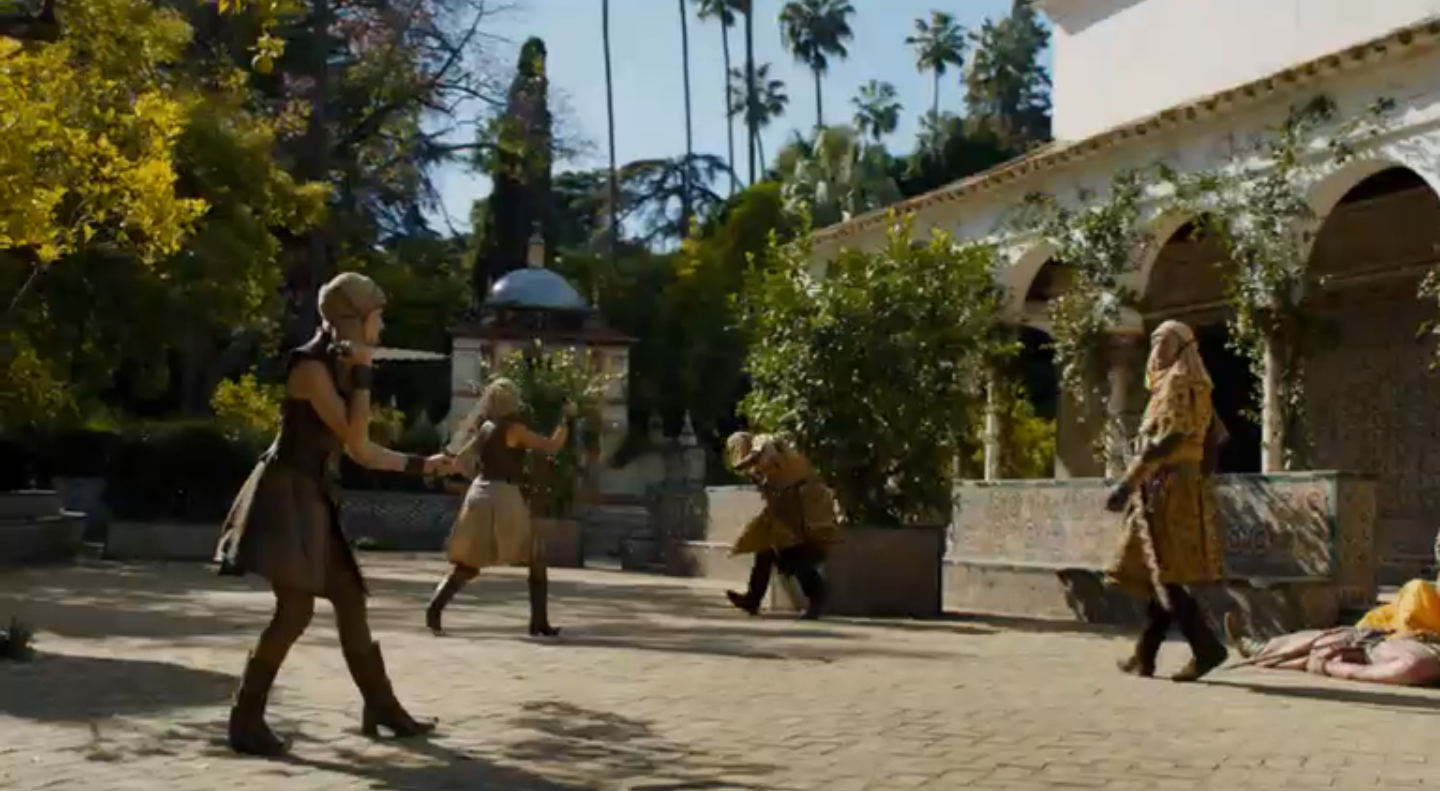
The other thing they don’t seem to know what to do with would be the Sand Snakes. As I was saying on Facebook on Monday, in last week’s recap I said I enjoyed the fight scene with the Sand Snakes. To be honest, the fight scene was exciting for the 40 seconds it actually lasted, but then it all fizzled out like a dying firecracker and didn’t amount to anything. I was undaunted, however, assuming that the Snakes had something more up their sleeves. Instead, they’re stuck in a dungeon listening to Bronn sing bawdy songs about Dornishmen while Tyene is flashing her breasts at him. I don’t know what to make of this trio anymore, but I’m really hoping this isn’t it. Tell me there’s a lot more awesomeness to come with the Sand Snakes, Chris, please?
tyene_cell

Christopher: Wait—did Theon go up to the broken tower? My sense was that they made it seem as though he might be, but instead simply went straight to Ramsay’s rooms. Certainly, the room in which Ramsay is eating looks far more well-appointed than the room in which we first saw Jaime and Cersei having sex. That would make a difference: if he went to the tower with all best intentions of lighting the candle, that means there’s more of a vestige of Theon there than we had hoped … only to have it squashed by Ramsay being clever. My read, however, was that the camera did a bait-and-switch—having Theon look at the tower, seeing Theon from the window through which Jaime pushed Bran, but in the end he went right to his master. In which case he’s farther gone (or just as far gone) as we suspected.

I like that they leave that ambiguous. I’d be interested to hear what our readers think on this.

But to get to the Sand Snakes: I honestly don’t know how much we’ll be seeing of the Sand Snakes, or whether what we see will include awesomeness. Both the Sand Snakes and the High Sparrow initially seemed determined to prove my complaints in my supplemental comments wrong, in both cases giving us a more nuanced sense of these characters. But to me, at least as far as the Sand Snakes are concerned (the High Sparrow is another story), it’s a case of closing the barn door. One of the complaints I’ve been reading a lot in various reactions to this episode is the superfluousness of the scene between the Snakes and Bronn: what does it add to the story? How does it move the plot forward? Why are we wasting time on this interlude when there’s so much else to attend to? Was this any more than just an excuse for Tyene to show us her breasts?

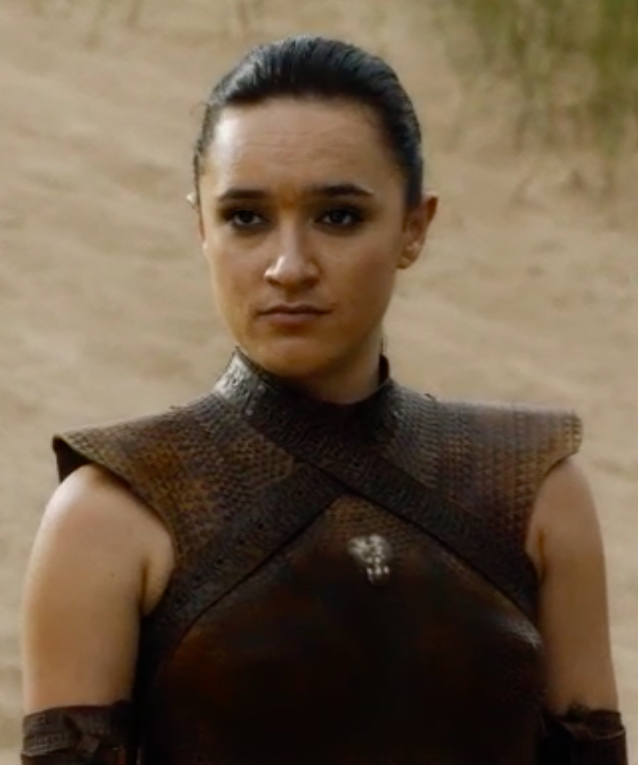
I don’t think the scene was superfluous so much as mistimed. What we did get out of the scene was a better sense of who these women are, and how they interact with each other—for me the highlight was Nymeria rolling her eyes the moment she realized what Tyene was doing, a nanosecond of face acting that spoke volumes about the personalities involved. This scene would have been brilliant if it—or something approximating it—had come as a function of the Snakes suborning some man or men to their plot. Instead, it is wasted as a bit of after-the-fact sexposition that offers no exposition. I suppose if, going forward, the Snakes have a more substantive role to play (as you and I dearly hope, Nikki), then this moment contributes to our understanding of them; failing that, I am so far underwhelmed by the writers’ treatment of a trio of women who could have been, and indeed deserve to be, awesome.
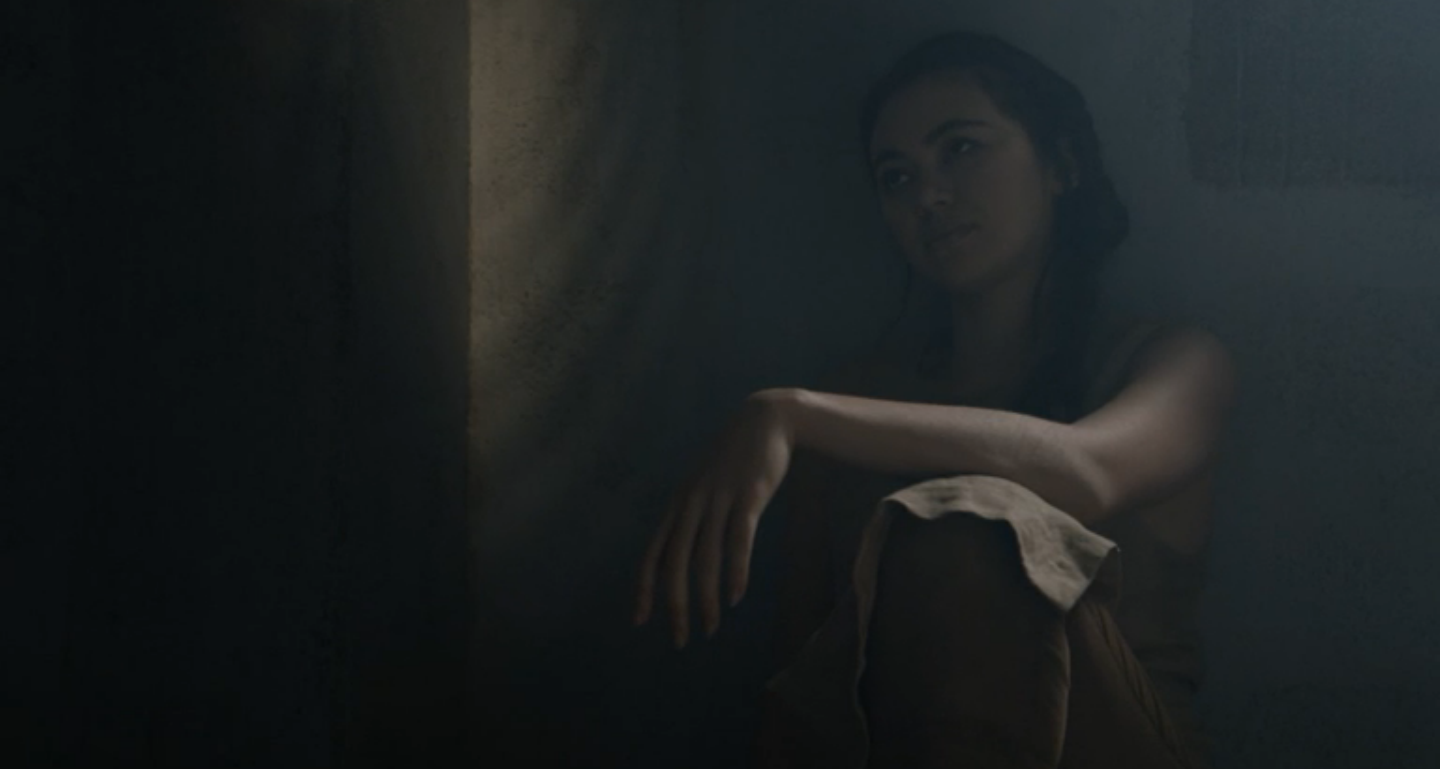
nymeria_eyerollOn the other hand, the other Dornish scene was quite well done. Poor Bronn … the lowly underling gets to spend his sojourn in a dank cell, while the nobleman has the gentleman prisoner’s arrangement of a comfortable and well-lit room. That being said, I think Jaime has the harder time of it—even taking into account the fact that Bronn nearly dies of poison. “I’ve come to take you home,” Jaime tells Myrcella. “This is my home,” she snaps. “This has been my home for years! I didn’t want to come here, but I did as she said. I did my duty, and now she’s forcing me to go back?” She then proceeds to tell him she’s in love with Trystane, and that they will be married. “I don’t understand,” says Jaime. “Of course you don’t!” is the retort, and then the body blow: “You don’t know me.”

Or in other words, you know nothing, Jaime Lannister. He loses so much in that moment, as he (presumably) realizes what a fool’s errand this was, and how wrong he was when he repeatedly said to Bronn “It has to be me.” As it turns out, he’s more or less irrelevant to the young woman he’s obliged to call his niece.

More and more, Jaime is becoming one of this show’s tragic characters, even as he becomes more sympathetic. Two things have defined him in the past: his skill with a sword and his love for his sister. Those were all that mattered to him. The loss of his sword hand has made him at best an encumbrance to men like Bronn, and as their family fortunes sink, Cersei is becoming more and more distant, grieving for her dead son and spiraling down into a series of plots to keep her living son close to her. Jaime embarks on this quest to regain what they once had, but finds that an increasingly impossible task.

Meanwhile, back in King’s Landing, Cersei thinks she has won. But we’ll come to that in a moment. In the meantime, I’m interested to know what you thought of the meeting between The Queen of Thorns and the High Sparrow, Nikki. Did you feel the same thrill as me at watching two brilliant actors showing the young ‘uns how it’s done?
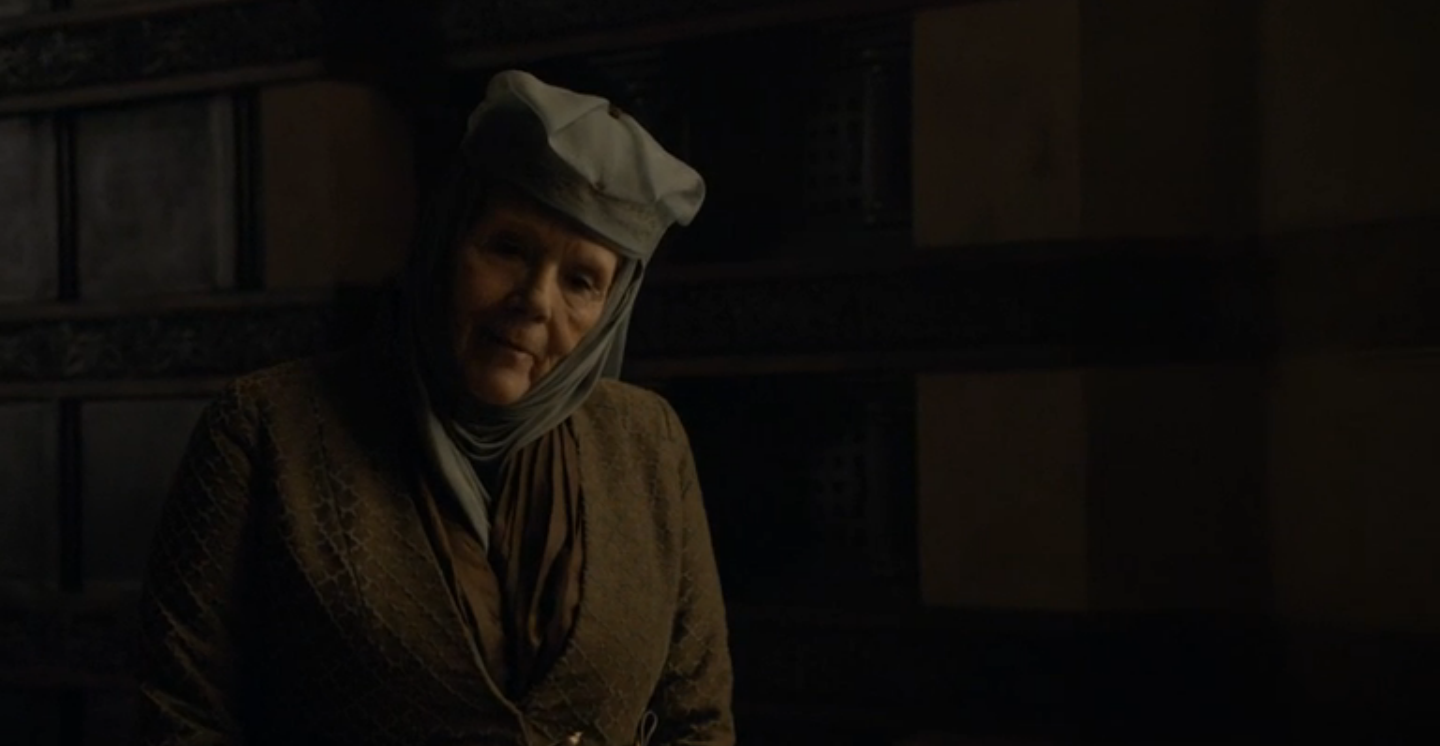
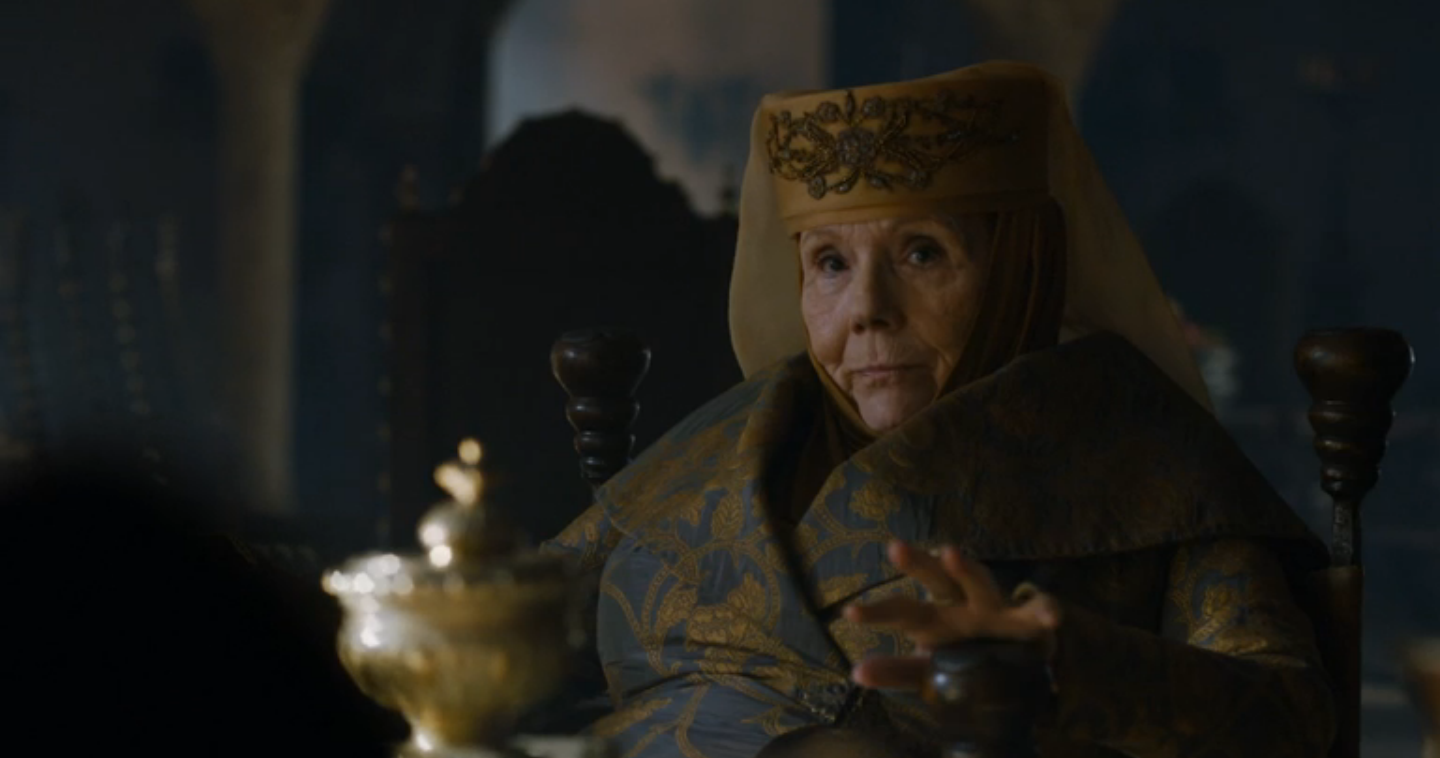
olenna

Nikki: First, I can’t believe I fell for a bait and switch! You must be right, because I remember the Broken Tower as being, well, broken, and Ramsay is in this bright room with candles, and then the camera cuts to Brienne watching a dark, unlit tower, and I couldn’t put the two together. Oh Theon… maybe you’re gone after all. That would explain why he simply hangs his head in shame before Sansa rather than shaking his head.

But on to the Queen of Thorns and the High Sparrow. What a brilliant scene that was, and for exactly the reason you say above. Here we have two magnificent British theatre veterans, going toe to toe on the screen and just showing what remarkable talents they both are. Lady Olenna has crushed everyone who has tried to verbally parry with her, especially Cersei. Tywin seemed to have an upper hand in parts of their conversations, but she would always dominate by the end… and in the very end, she killed his grandson. Now she spars with the High Sparrow, who remains calm before her insults, then pulls them to similar ground as they compare elderly aches and pains, before holding up a mirror to exactly who she is. She’s there to argue for her grandchildren, and he simply waves her off, telling her they’re degenerates and they will be punished. She similarly waves him off, offering him gold, and he waves her off, saying he serves the gods, and can’t be bought. He proceeds to quote from the Seven-Pointed Star, and she waves him off again (the constant dismissal each has to the other kept this conversation sparkling from beginning to end) and says of course she’s read that book, and that’s when he turns everything on her, asking, if the Tyrells are known for their agriculture, how many fields has she tilled? How much back-breaking work has she actually done? When you think about the various Houses, the Targaryens fight in battles, as did the Baratheons, and the Lannisters, the Martells… the Tyrells, on the other hand, are the ones who provide food to the other kingdoms, and where the heads of the other Houses have actually earned their spots, Lady Olenna just sits around doing nothing and throwing coins at any situation that gets in her way. But if that’s all she can do, and she’s suddenly faced with a situation where coins aren’t accepted… what will she do? “You are the few,” he tells her, lumping her in with all the other wealthy rarities who have no idea how the majority of people actually live, “and we are the many, and when the many stop fearing the few…” And he just lets that thought trail off as he picks up his bucket and goes off to scrub another floor.
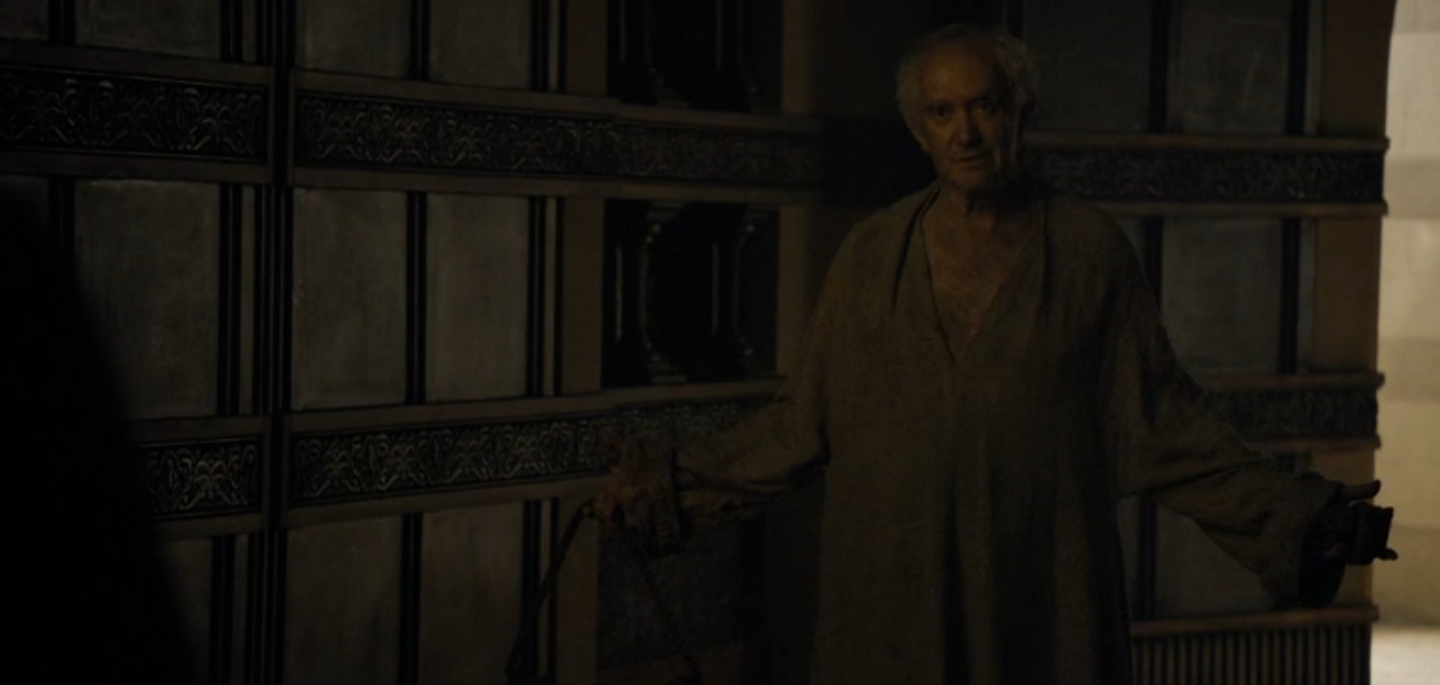
high-sparrow_floorIt’s a glorious scene.

Later we see Olenna with Baelish, another man famous for his words, and he’s back seeing his brothel for the first time, its former glory now a ravaged hall of shredded sheets and broken glass. Baelish tries to also jockey for verbal dominance in this scene, but Olenna’s not about to be beaten twice in one day. She tells him that their fates are joined. “Together we killed a king,” she declares, and implies that should anything happen to her or the people of the House Tyrell, he’ll get dragged down with them. Where it looked like there was no way out for Margaery and Loras, Littlefinger might be it.

And that brings us to Cersei herself. A few weeks ago we were discussing how she keeps putting things in place that backfire, and boy do they backfire in this episode. What did you think of the handling of her story?

cersei_unimpressed

Christopher: Well, this is one of those moments that line up more or less nicely with the novel. In A Feast for Crows, Cersei’s attempt to defame Margaery fails when the sparrows actually interrogate her false witnesses rather than accepting their sworn testimony. And by “interrogate,” I mean torture and beat bloody, until they give Cersei up. So they’ve changed things around here, but the result is the same: Cersei, blithely arrogant until the end, finds herself thrown in a filthy cell. And we might have felt a wee bit of sympathy had she not just been visiting Margaery in a similar cell, all the while wearing an insufferably smug expression.

Her conversation with the High Sparrow was also a work of art, at least as far as Jonathan Pryce’s monologue went. In this scene Cersei plays unwitting foil to his lengthy disquisition on the history of the chapel and the simple beauty of its spartan interior. She is oblivious to the significance of his words, impatient for him to finish. Lady Olenna, by contrast, however much she dismissed everything the High Sparrow had to say, was at least shrewd enough to realize this was not an ordinary man she could manipulate.

I find it rather amusing that my complaints in my supplemental comments about the development of the Sand Snakes and the sparrows were both met in this episode with scenes that I would have loved to have seen earlier. As with the Snakes, the High Sparrow’s scenes lend a greater understanding of who he is, and what the motivations of his movement are. In this case, however, the after-the fact exposition works somewhat better. His final words to Olenna—“you are the few; we are the many”—remind us that, however religiously inspired, the sparrows are a populist movement. But unlike the Occupy movement, however, they have divine law on their side, which makes them the final arbiter in moral matters. Which wouldn’t matter nearly as much if they WEREN’T ARMED.

I bet Cersei’s really wishing for a separation of church and state right now.

high-sparrow_candlesThe High Sparrow’s speech about the simplicity of the chapel cites above all else the philosophy of the Protestant Reformation. His sentiments would be familiar to anyone who has ever been in a church of one of the more austere Presbyterian sects:

“The people who built this place didn’t inflict their vanity on those that came after them, the way Baelor did with that great gilded monstrosity up there. Their faith was clean. Strip away the gold, and the ornaments, knock down the statues and the pillars, and this is what remains. Something simple. Solid. And true.”

I’d like to say this is one of those lovely moments of creative anachronism that fantasy often engages in—and it is—but it could also be read as an alternative history of the Roman church in which the Franciscan Order somehow became ascendant and pulled down the gilded edifices of the papacy. One way or another, however, this final scene is one of the most beautiful bits of schadenfreude we have yet seen on this show. As creeped out as I am by the High Sparrow’s absolutism and the fanaticism of his followers, it is still so deeply satisfying to see Cersei hoisted on her own petard.

Which brings us to our final bit of business, namely the new careers of Tyrion and Jorah, which apparently is to be extras on the set of Gladiator. Seriously. Was anyone else quoting from that film as Yezzan gave his new slaves their pep talk? “Thrust this into another man’s flesh, and they will applaud and love you for that!” I said as Yezzan declared that “This is the day your lives actually start to mean something!”

But I suppose that when gladiatorial combat is the spectacle of the day, such comparisons are inevitable. What did you think of the Jorah/Tyrion storyline in this episode, Nikki?
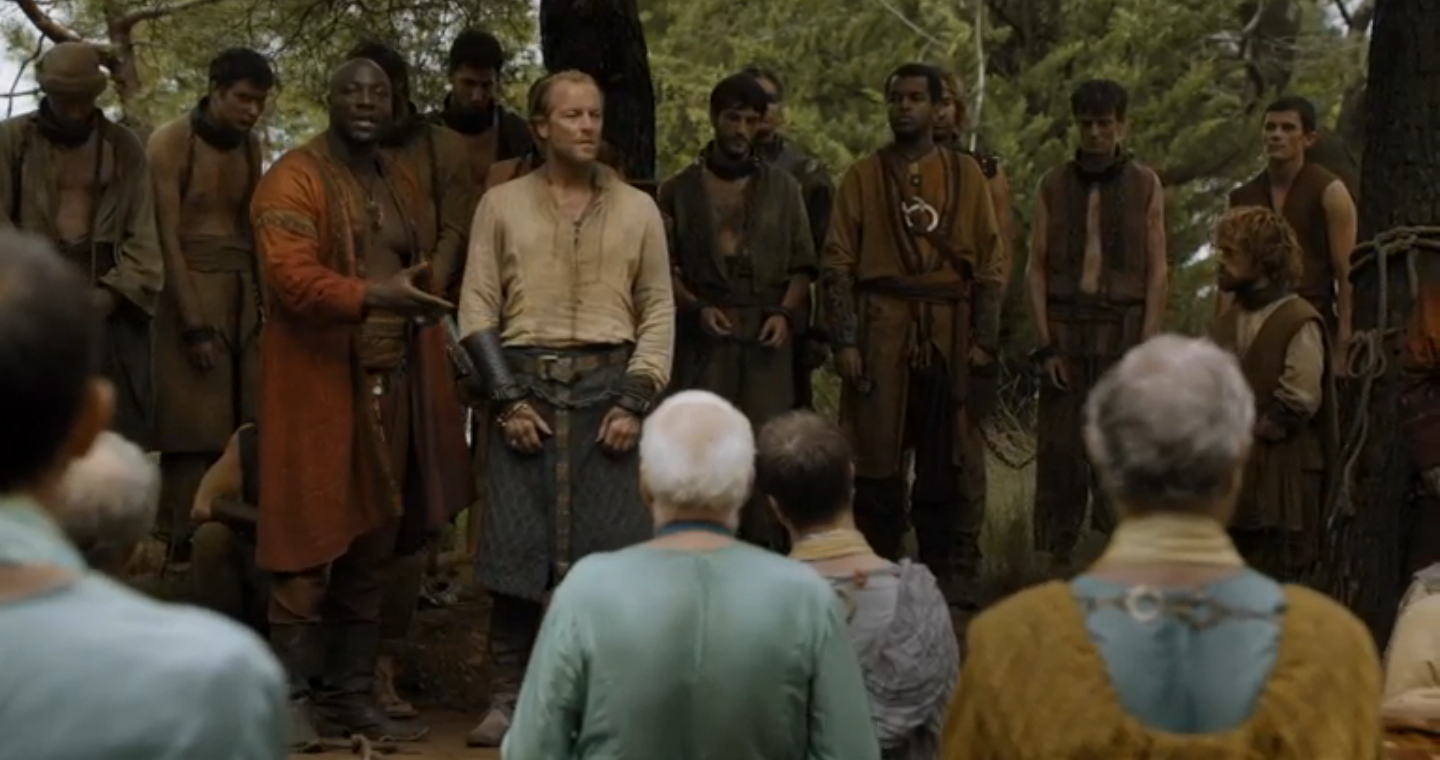
slave_mart

Nikki: The scene of Tyrion striding out onto the battlefield to meet Daenerys is the one I’ve been hoping for all season, and it didn’t disappoint. One thing we can’t forget is that Daenerys stands apart in this series as the one character who never encounters any of the others. The major characters were mostly split up — Stannis and Melisandre; Jon Snow at the Wall; Cersei and Tyrion in King’s Landing; Daenerys in Meereen; Jaime and Brienne wherever; Arya in Braavos; Sansa in various places: Baelish wherever the action is. But with the exception of Daenerys, they’ve all crossed paths. Back in the first episode, the Lannisters and Baratheons descended on Winterfell, bringing all of those characters together, and then the entire gang went to King’s Landing for a spell. Stannis and Melisandre came to King’s Landing in the Battle of Blackwater, and then ended up at the Wall. But Daenerys stands apart from everyone… until now.

While I agree with you that watching Cersei finally gets hers was infinitely satisfying, as an editor I would have put the Tyrion scene at the very end of the episode to finish it off spectacularly. The battle scene itself was fantastic, and everything the Sand Snakes battle wasn’t. It was gory, and watching Daenerys turn her head in horror was interesting — on the one hand, this is the very thing she didn’t want. On the other hand, many thousands of people have been slaughtered at the hands of her own army, and she never flinched once. But that, as far as she was concerned, was for the betterment of people who desperately needed her help, whereas here it’s for sport. The whole time I kept thinking, “Oh my god she’s going to get up and leave, and we’ll have to wait until NEXT season for Jorah and Tyrion to cross paths with her.” Thank the gods that didn’t happen.

The auction scene with Tyrion and Jorah was interesting, because we saw Tyrion’s exaggeration of Jorah’s prowess when he was trying to avoid having his penis lopped off, and now the slave trader exaggerates his powers even more. And yet, the moment Jorah enters the ring, it’s like every single word both men said was 100% true. Jorah mows down every warrior in the ring as if they were toddlers holding Nerf swords. She looks impressed — this isn’t a man who seems to revel in the pain of others, but who quickly and cleanly deals with everyone in his path as he moves towards her. She looks at him with awe and respect… until he removes his mask. And the disgust that washes over her face in that moment is devastating. Remember, in season 4 she banished him because she found out that he had been hired by Robert Baratheon to spy on Daenerys and report back to Varys, telling Baratheon everything he needs to know about the surviving member of the Targaryens. He had told Baratheon about Daenerys’s pregnancy by Khal Drogo, leading her to almost be poisoned. Of course, if it weren’t for Jorah knocking away the cup and warning her of it, she would have died, but she argued that if he hadn’t spied on her, she wouldn’t have been in danger at all. She could no longer trust the one person she trusted above everyone else.

And so now, many months later, he’s back, calling her Khaleesi, a memory of the worst betrayal she’d ever endured, and she wants him out of her sight. But just as Tyrion had talked himself quickly out of the situation with the slavers last week, Jorah tells Daenerys that he’s brought her a gift… and out walks Tyrion. For me this was the single best moment of the series so far. The look on her face was priceless — “A dwarf? Are you kidding me?” — but it only got better. Because no sooner does Tyrion stride out on the battlefield than he says, “I am the gift. My name is Tyrion Lannister.” And hearing those five words, she is utterly, deeply confused.

jorah_watchingAfter all, the Lannisters are her sworn enemies. They were in bed — literally — with the Baratheons. Tyrion’s brother killed her father. Robert Baratheon led the charge to slaughter her entire family. Her brother Rhaegar and his son Aegon were brutally murdered by The Mountain, who works for the Lannisters. Why the hell would he be a gift?!

I cannot WAIT for the scene that follows this one. I’m confident Tyrion will be able to convince her — he’s the man with the golden tongue, after all — and putting these two together will strengthen her claim, and infuriate everyone at King’s Landing, more than I could have possibly dreamed. (This is my fantasy way of how this plays out, so if instead she simply feeds him to the dragons, don’t tell me!) 😉
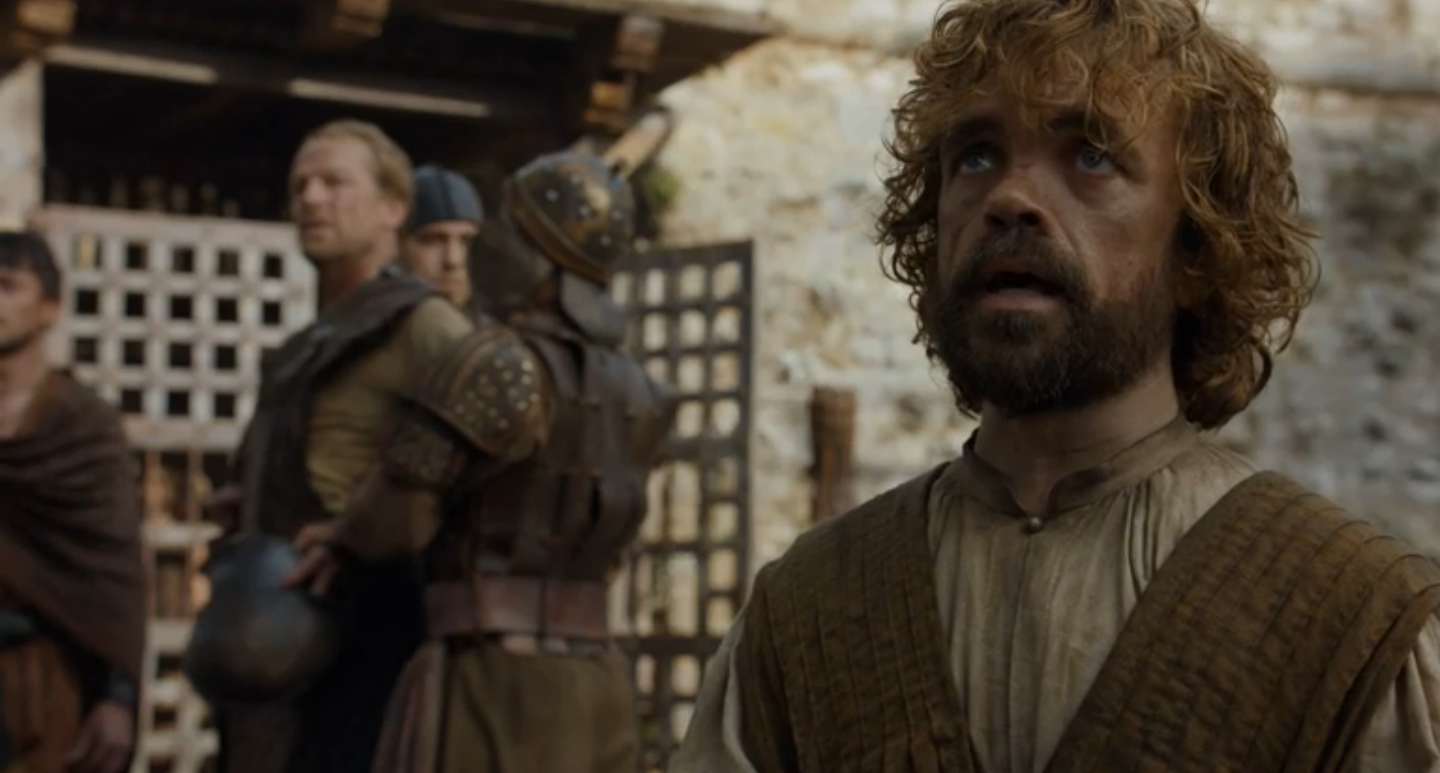
tyrion_giftBits and Bobs:

-I just realized that we completely forgot to mention Stannis and Melisandre’s discussion in this episode, so for the record I’ll say that I hope that scene we saw a couple of weeks ago, where we see just how much Shireen means to Stannis, will be the one thing that will strengthen him against the Red Woman. Could this be the one request that just goes too far for him?

-Also, despite all the terrible things Cersei has done, I felt she was being 100% sincere in the scene where she told Tommen she would do anything for him. Despite her hatred for Tyrion, her despicable treatment of Margaery, and her general booziness, this is a mother who loves her children more than anything.

And on that note, we shall see you all again next week! Thanks for reading.
Leave a comment

Filed under Uncategorized

Some extra thoughts on “Unbowed, Unbent, Unbroken”

gameofthrones_teaser02_screencap10I have three follow-up thoughts to our previous post; because Nikki and I decided to focus mainly on the episode’s final scene, some things had to be left out—including, in my case, some extra thoughts on the episode’s final scene. Two of my three considerations here are largely complaints about how, even with the series’ unsparing pruning of storylines, we’re starting to experience compression problems, in which what otherwise might be thoughtful and nuanced elements of the show suffer from being rushed.

On the other hand, my final addendum is a closer reading of how the show does manage to get things exactly right much of the time.

bronn_jaime

The Sand Snakes

Fan consensus tends to rate book four, A Feast for Crows, as the least favourite. It could hardly be otherwise, coming as it did on the heels of A Storm of Swords, which contains the Red Wedding, the Purple Wedding, the saga of Jaime and Brienne, Daenerys’ conquest of Slavers Bay, Stannis’ attack on the Wall, and Jon Snow’s election as Lord Commander. That, coupled with the fact that GRRM hived off the Jon Snow and Daenerys storylines for A Dance with Dragons, meant that A Feast for Crows was inevitably going to disappoint a large contingent of readers.

It didn’t disappoint me, largely because of the Dorne storyline. The inside politics of Westeros’ southernmost kingdom were (to my mind) a good counterbalance to losing Jon and Dany. But of course the series has to make hard choices, or else risk packing in way too many characters and story threads at the expense of audience interest and the ability to actually tell these stories with a measure of nuance. In choosing to feature a Dorne narrative, Weiss and Benioff discarded the Iron Islands narrative also featured in book four, in which Theon’s sister Asha (or Yara, as she’s known in the series) negotiates the dangerous politics of succession after her father, Balon Greyjoy, dies.

sand-snakes_fightEven with this wholesale dumping of a story thread, there’s still a lot of balls to be kept in the air, and it’s a shame that the Sand Snakes suffer as a result … especially considering how impressive they were on first encountering them. Their scene in this episode is disappointing on a variety of levels: first, the fight isn’t that well shot or choreographed; second, the convenient timing of Bronn and Jaime’s arrival made me roll my eyes; and finally, the pat end to the Sand Snakes’ plot is too easy, too cheap, and unworthy of a trio of characters who were poised to join Game of Thrones’ ranks of nuanced, compelling, and strong female characters.

Their plot in the novel is more protracted and allows for more development not just of their characters but those of Prince Doran and his inscrutable bodyguard Areo. In the novel, the plot is foiled because, as it turns out, Doran had always been one step ahead of them and always knew what was going on. Something of the sort happens on the show too … but without more time spent with the main players, it loses all of its dramatic tension, and the payoff is just a cheat.

GRRM has frequently complained about HBO’s insistence that every season be limited to ten episodes—arguing that one or two more episodes would let the show do more with the capacious source material. I agree with him, though I understand HBO’s ironclad rule; the show is already hugely expensive to produce, and even with its popularity, those extra episodes might be too much. What I wonder is why don’t they run longer episodes? In the early days of HBO’s new dramas, you never knew when an episode of The Sopranos might run to seventy or eighty minutes (or sometimes pull up short at fifty). Episode length was a lot more elastic in those days, and it’s something I think GoT could benefit from.

I'm particularly sad that Areo Hotah seems to have been given short shrift, as he's an amazing character in the novel.

I’m particularly sad that Areo Hotah seems to have been given short shrift, as he’s an amazing character in the novel.

Loras and the Sparrows

I read a good article in Salon yesterday lamenting the way in which Loras Tyrell has gone from being a strong character, acting as something of a Lady Macbeth for a less-than-ambitious Renly, to being a caricature of a closeted gay man, providing winking humour at Sansa’s obliviousness during her brief engagement to him, and simple awkwardness when he’s betrothed to Cersei. All of which makes his arrest at the hands of the Sparrows less affecting than it would be if we had any emotional stake in his character. By the same token, the fact that he becomes the focus of the Faith Militant’s hatred—and by extension all gay men and women—is a clumsy shorthand to allegorically connect the Sparrows to contemporary Christian conservatism, rather than providing a more nuanced portrait of how the Sparrows emerged to begin with.

lorasOne very astute point made in the Salon article is the suggestion that the series’ depiction of the Sparrows is crafted for an audience that cannot conceive of how religious evangelicism and fundamentalism could evolve out of what is essentially an egalitarian movement—the Sparrows, initially, are Occupy King’s Landing, though that is something made clearer in the novels. It seems odd to the contemporary sensibility, but rural evangelicism in the U.S. in the first half of the twentieth century was largely wedded to leftist, not to say socialist, politics. Some of the most vocal proponents of leftist populism were ardent Christians, most famously William Jennings Bryan—who besides being the Democratic Party’s presidential candidate three times, is most famous for being the antagonist in the Scopes Monkey Trial.

The puzzling shift of rural states from leftist populism—a politics that specifically focused on the interests of largely working-class populations—to red state social and fiscal conservatism is a tangled narrative much better dealt with by Thomas Frank in his book What’s the Matter with Kansas? The point here is that in the present moment, conservative Christianity is most easily associated with homophobia. The populist and egalitarian dimension of the Sparrows has been, at best, only vaguely gestured at before they are transformed into fanatical thugs. In A Feast for Crows, they converge on King’s Landing as refugees from the war-torn countryside to place the bones of their dead at the Sept of Baelor as a symbolic plea that the crown honour its sacred obligation to the people. The crown is unsurprisingly unsympathetic, and it is only when Cersei sees them as a means to an end that they receive any consideration at all.

high-sparrowAt this point, the fury boiling beneath the surface of the populace, the rage at the privation, violence, exploitation, and the rapine of the noble houses’ armies, has had no salve or outlet. When Cersei re-establishes the Faith Militant, they do what angry mobs have done throughout history when given the chance: they enact vengeance on anyone and everyone they imagine has been their tormentors.

All this is by way of saying that the too-quick transformation of the Sparrows from suffering supplicants to club-wielding morality police elides one of the more interesting political critiques in A Song of Ice and Fire; similarly, after introducing Loras as an explicitly gay character in seasons one and two, the writers lost the script on him, and in so doing missed a golden opportunity to have him be more than a humorous caricature. And that loss resonates in the moment of his arrest and trial, because we haven’t had the chance to be invested in him.

loras_trial_everyone

That Final Scene

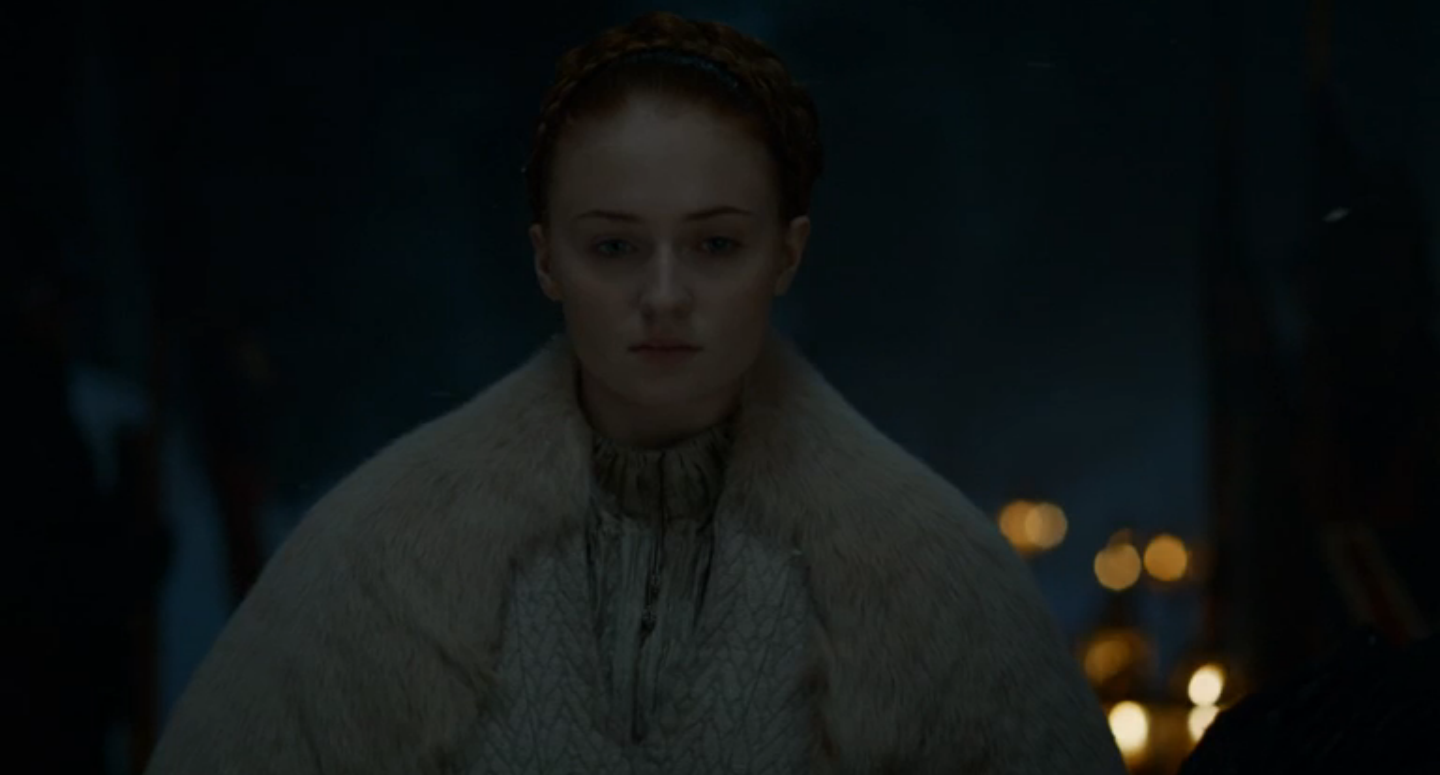
One thing I wanted to write about, but didn’t because the post was already overlong, is the imagery and camerawork. With the obvious exception of the actual rape itself, the rest of the final scene is hauntingly beautiful, but it is a beauty that makes everything that much more painful to watch. And perhaps more crucially, the entire sequence is a betrayal of all the dreams young and innocent Sansa cherished at the beginning of the series.

At this point it is hard to remember that Sansa was (aside from Joffrey) season one’s most-hated character: whiny, petulant, haughty, and so caught up in her dreams of romance that she betrayed her father rather than let him take her away from King’s Landing and her dream wedding to Joffrey. Way back then, Sansa was the representative voice of romantic fantasy, which views the world in terms of good and evil, beauty and ugliness, and the absolute correlation between the former and latter. She loved the pageantry of it all, the knights in their bright armour, the sumptuous feasts, and the (so she believed) handsome and noble prince to whom she was betrothed.

As we know, Sansa’s road since then has been the systematic destruction of all those dreams and illusions. And so it is a particularly cruel turn of events that her wedding to Ramsay unfolds like a fairy-tale.

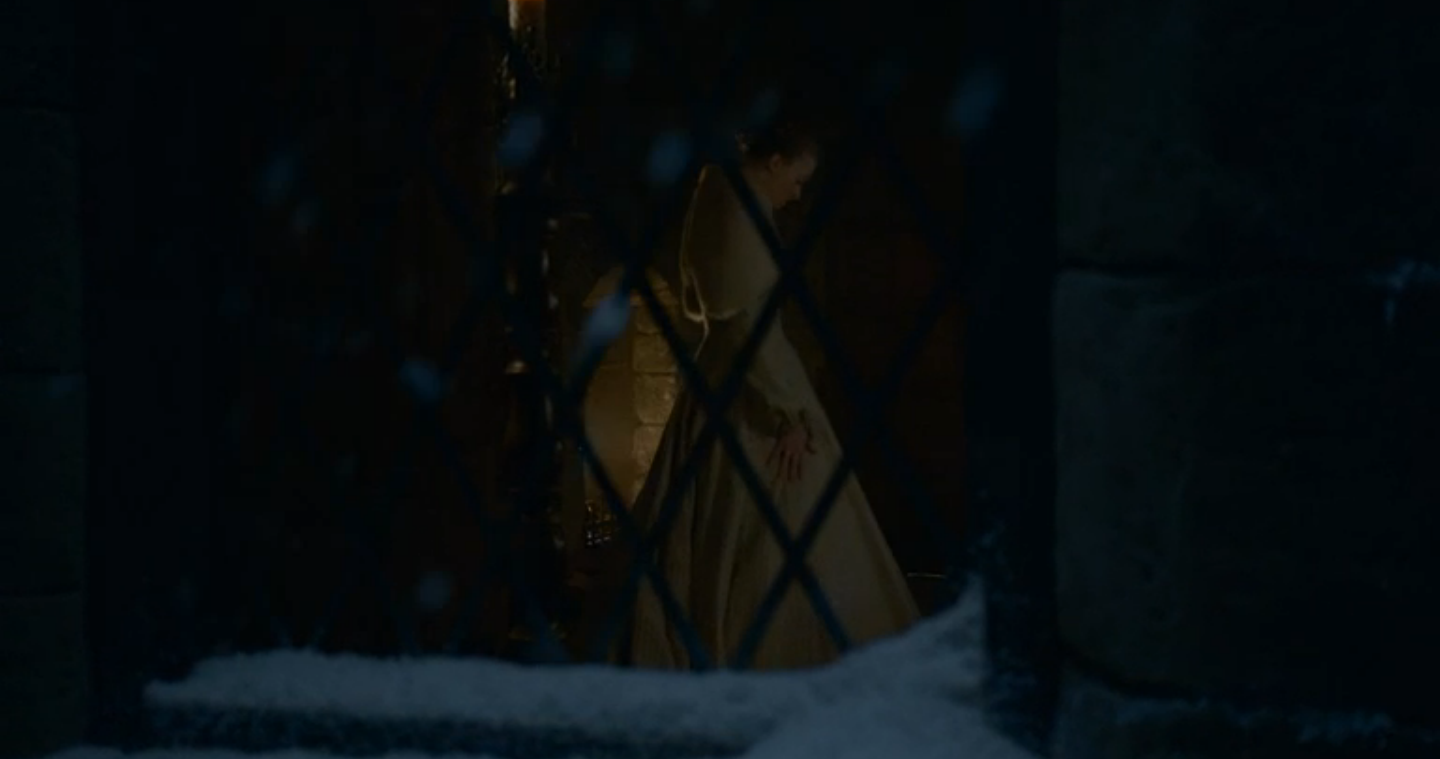
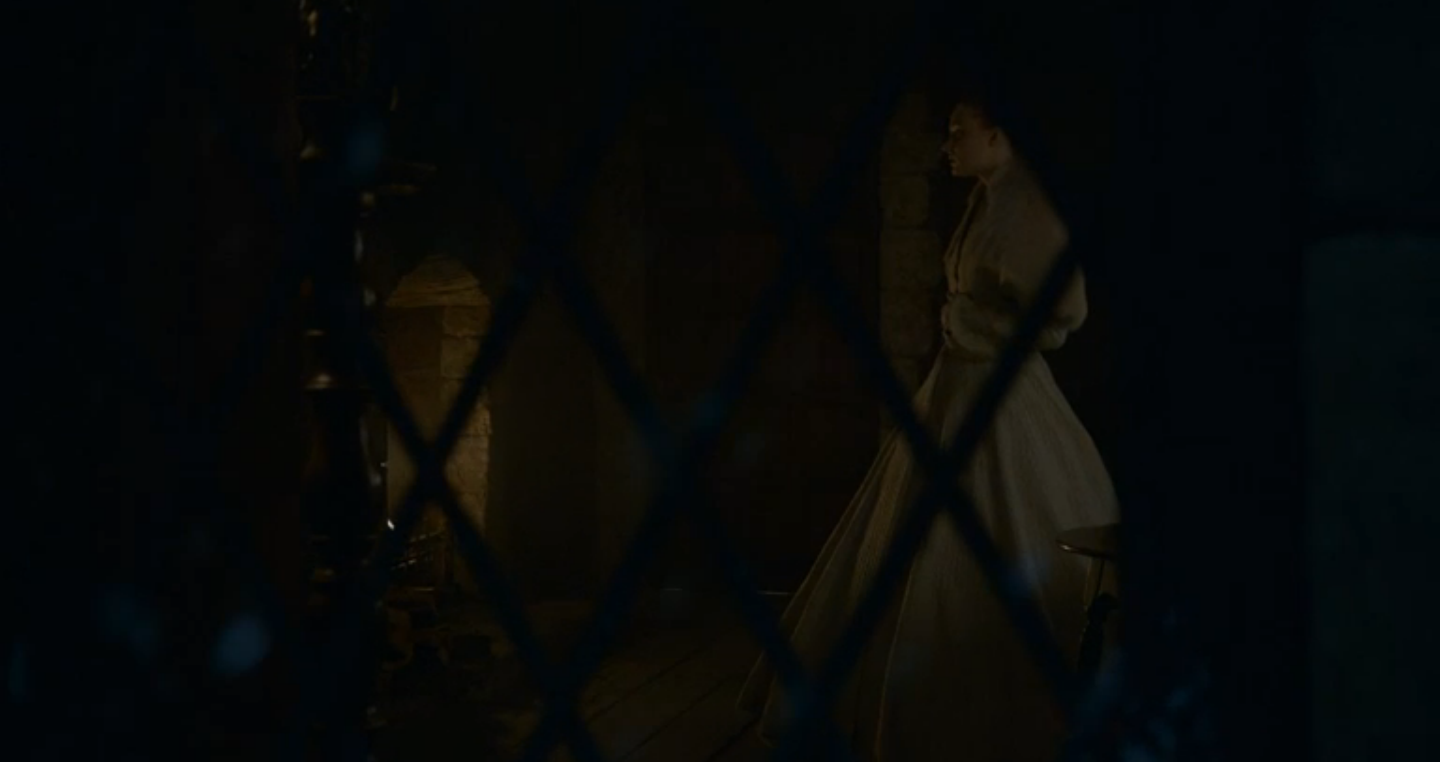
sansa_towerThe first shot of Sansa in her wedding-dress is from outside, through the casement in her tower: it is soft-focus, or perhaps softened by the window-glass, with snow drifting prettily past. This brief shot evokes the trope of the princess imprisoned in her tower, waiting for her prince to rescue her. But the prince who comes is the broken shell of a man who, though he once styled himself the crown prince of the Iron Islands, is now a slave who sleeps in the kennels—and a man who, she believes, killed her two younger brothers.

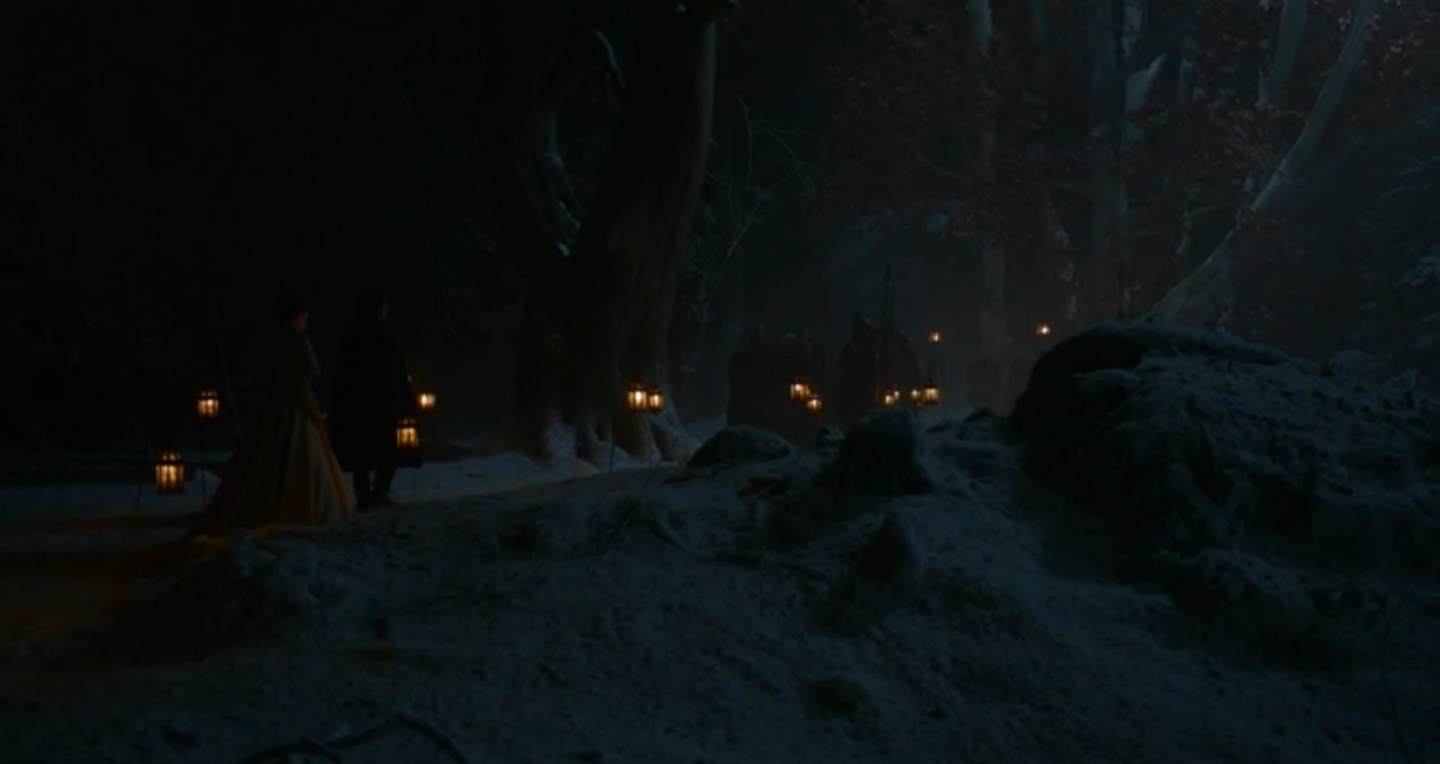
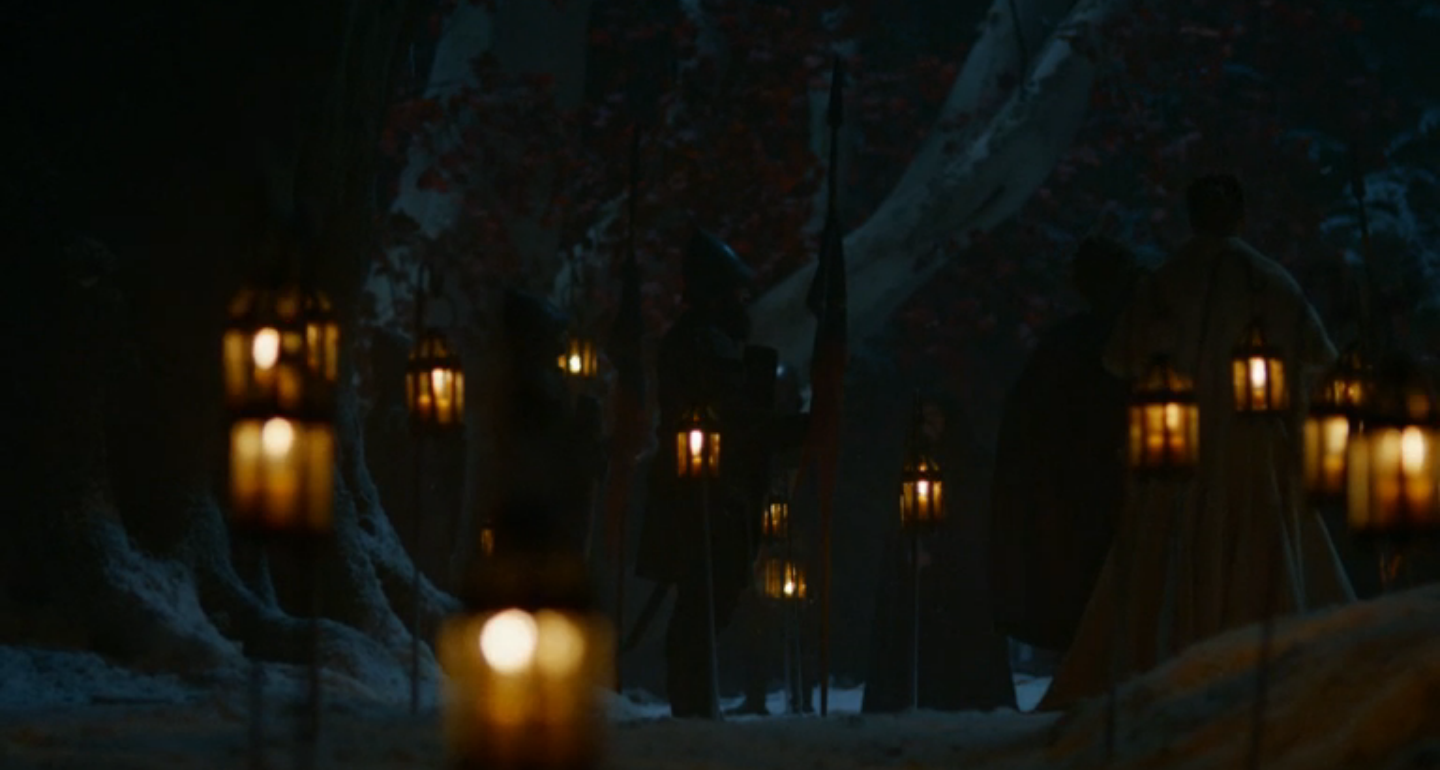
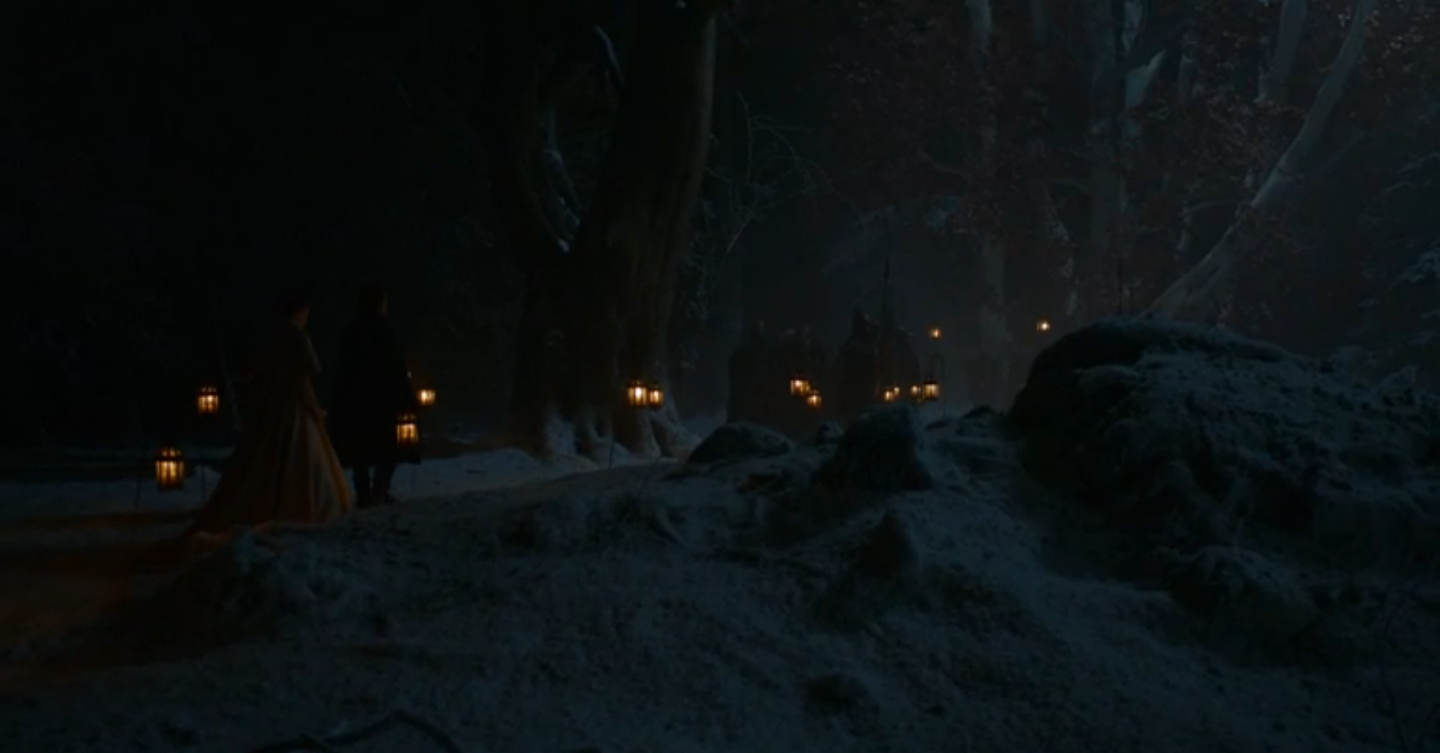
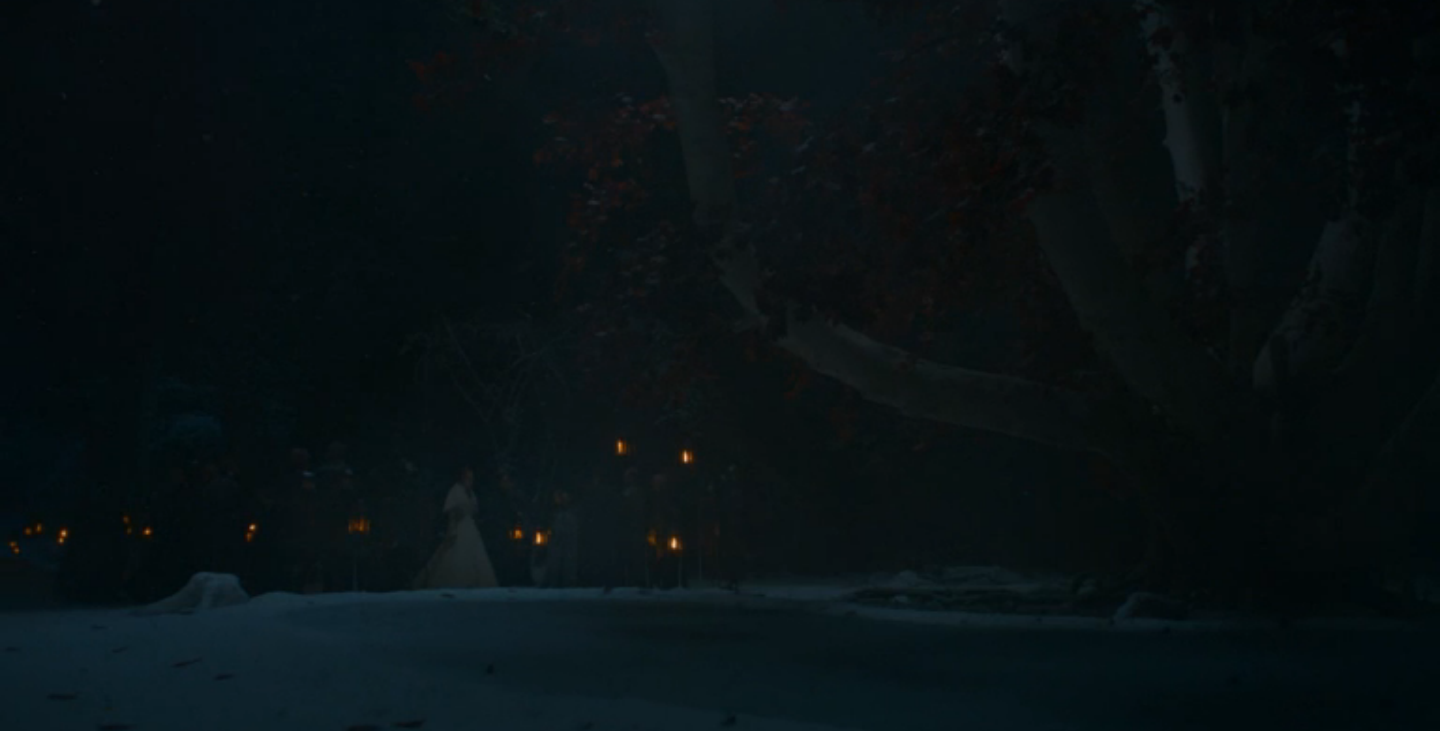
The wedding itself is like a dream: lanterns light the way to the Godswood, seeming to hover like faery-lights over the snow. One is hard-pressed not to think that, of the numerous wedding ceremony fantasies young Sansa almost certainly had, this comes pretty damn close to what she’d imagined.

lanterns01lanterns02

lanterns03Her journey has been one in which all the things she once thought beautiful have had their ugliness exposed: knights in shining armour are ruthless, bloody killers; beautiful queens like Cersei are cruel and manipulative; her handsome prince was a sociopathic monster; and traits like honour and loyalty can and will get you killed. And so here at the heart of the dream wedding, in the heart of her home, is the man who killed her brother, and his monstrous heir.

roose_ramsayAs Nikki observed, a last-minute rescue by Brienne or some other saviour would have been a betrayal of a show that—like its source material—has been primarily about subverting the fairy-tale tropes that are common in fantasy. The pageantry and romantic veneer of Sansa’s wedding is a reminder of how often ceremony, ritual, and romance are employed to obscure the cruel realities of power and politics.

sansa

1 Comment

Filed under Game of Thrones

Game of Thrones 5.06: “Unbowed, Unbent, Unbroken”

gameofthrones_teaser02_screencap10Hello again and welcome to the great Chris and Nikki Game of Thrones co-blog. This week’s episode has lit up the interwebs with argument and controversy, so let’s just get to it, shall we?

roose_ramsay_wedding

Nikki: What an episode. In one hour we have discussions about faith, a queen is imprisoned, a turncoat turns… turncoat, Arya finally discovers where the bodies go, Olenna and Cersei show us the importance of commas, and we end on one of the most brutal scenes this show has ever shown… without them actually showing it.

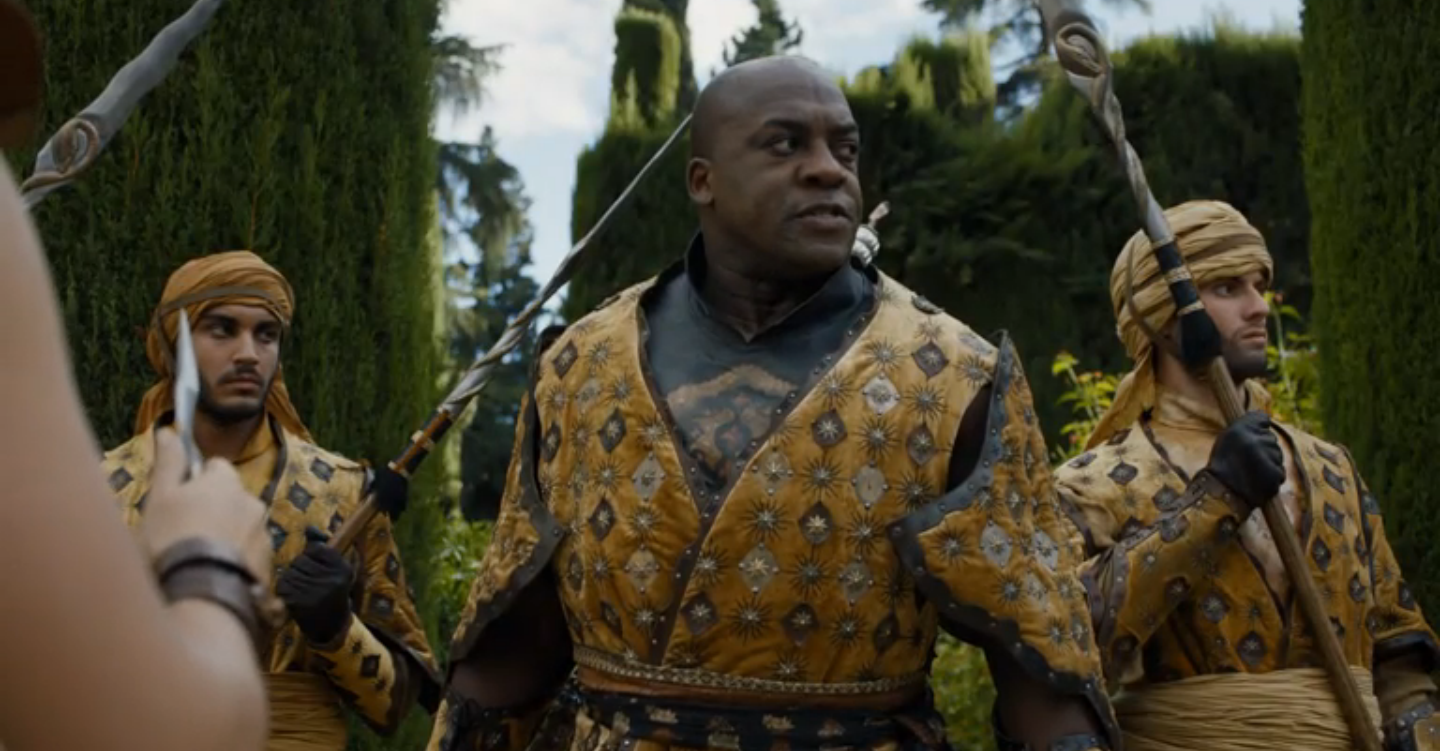
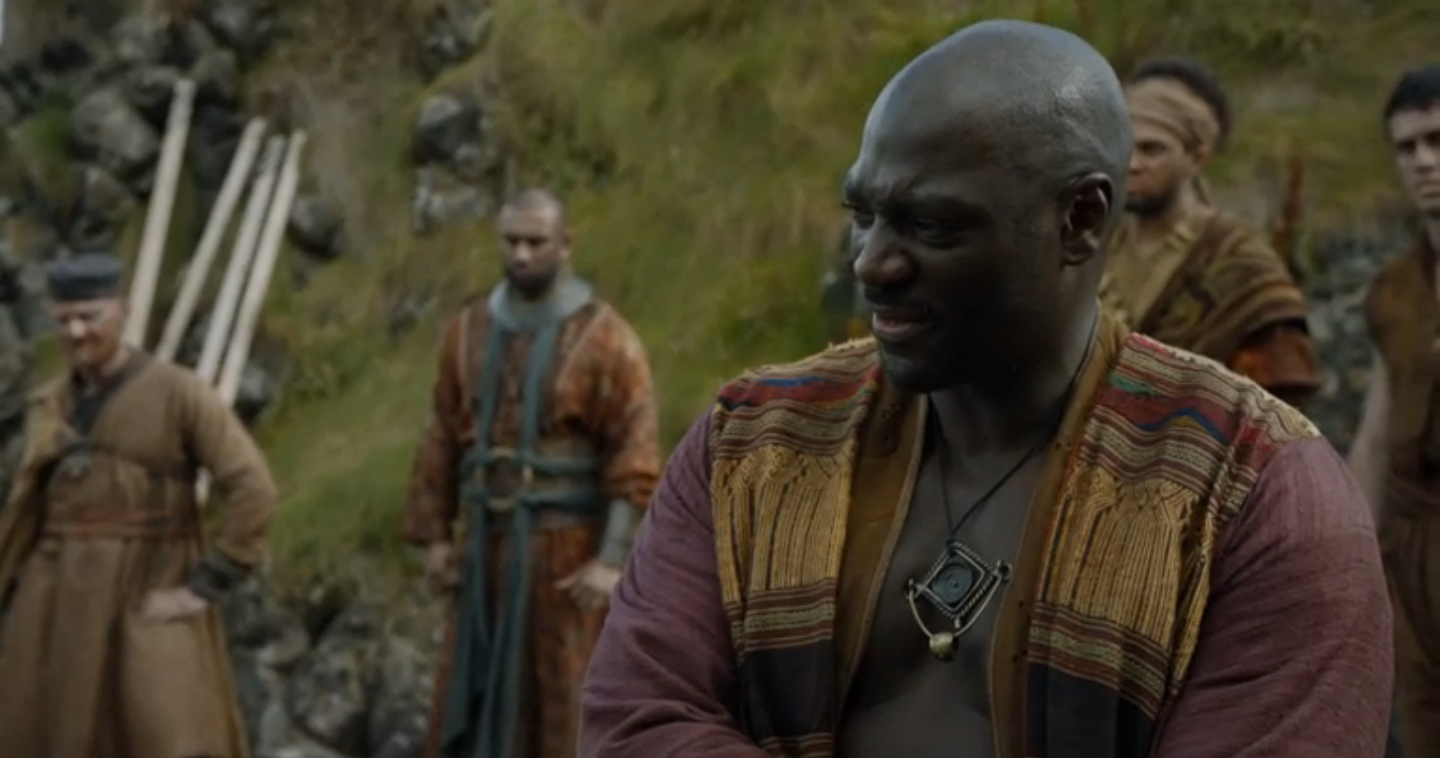
I’m not sure exactly where to start, so I’ll just pop into the middle and go from there. I’m terrible with actually keeping up with casting decisions, so I was thrilled when Adebisi/Mr. Eko showed up as one of Daenerys’s slavers. Though I must admit, I was a little disappointed that he was missing a tiny little hat on a jaunty angle on the side of his head. (Maybe with little dragon wings? I’ll ring the costume designer and get her on that…) And not only is his first act to order the slicing of Tyrion’s throat and capture of Ser Jorah, but he delivers perhaps the greatest line ever on this show: “The dwarf lives until we find a cock merchant.”

If there were Emmys handed out for single lines, this one would be unbeatable.

As we know, Ser Jorah is Daenerys’s previous advisor, and Tyrion is the one we’re hopeful will be the advisor of the future. Together, they become a great team. With a knife at his throat (they’re going to chop off his head, then his penis, and sell it on the black market because apparently dwarf penises have magical properties), Tyrion is somehow able to move past his horror at losing the thing most dear to him and instead explains — quite rationally, I might add — that to do so would be a major mistake. You must take him whole to the cock merchant, and then lop it off so he KNOWS it came from a dwarf. Brilliant. Unless, of course, they actually get to the cock merchant and Adebisi follows through.

But then a better idea comes along, when Tyrion convinces them that Ser Jorah is a great warrior, and if Daenerys has indeed opened the fighting pits in Meereen, then Mr. Eko would have no greater chance at making a ton of cash than to throw Ser Jorah into the pit as a ringer, thereby hustling everyone who bet against the old guy thinking he didn’t stand a chance. Mr. Eko goes for it, and the two advisors are safe… for now.

But let’s rewind a bit to the conversation they were having before this moment: Mormont and Tyrion are chatting, and Tyrion asks Mormont if he’s a cynic or if he actually believes in God. Jorah replies, “Have you ever heard baby dragons singing? It’s hard to be a cynic after that.” Until this discussion, the men have been at each other’s throats. But now Tyrion listens to him — he did, after all, just witness his first dragon — and then he tells Mormont that his father had been a great man. And it’s only when he tells him what a great man he was (past tense) and that the world will never see another one like him, he looks up and realizes that Mormont didn’t even know his father had passed away. First he finds out that he’s got greyscale, and now his father has died? Ser Jorah is having a really bad day.

tyrion_inquisitiveOn that note, however, I must admit that when he sat down next to Tyrion on the log, I kept thinking, “Don’t touch him, don’t touch him” and then later, when Tyrion is standing near the rock and Mormont grabs him to pull him back, I recoiled. Is Mormont just as contagious as the Stone Men? Notice he never actually touches Tyrion’s skin: he only grabs him by the shoulders, which are draped in fabric. But the slavers end up grabbing Mormont and tying up his wrists and no doubt touch his skin a lot. And then they grab Tyrion. How fast could this stuff spread? (Or are we supposed to be thinking like that??)

While Tyrion and Mormont are on their way to see the queen and the fighting pits, Baelish has returned to King’s Landing to see another queen. And, as usual, you just don’t know what side he’s on (though if I had to guess, I don’t think there’s any way he’s turning over Sansa to Cersei… though… could it be worse than the fate he’s left Sansa to in the moment?) What did you think of the scene of those two back together, Chris?
olennaChristopher: First, let me add my delight to yours at seeing the Tyrion/Jorah road show coming into its own, especially where the news of Jorah’s dead father comes into play. I’m loving the way they’re developing these two. And I’m just as delighted as you are to see Adewale Akinnuoye-Agbaje, aka Simon Adebisi, aka Mister Eko make an unexpected appearance as a pirate-slash-slave trader. I’m actually quite surprised not to have heard of this casting in advance: the show has generally been quite boastful of the talented actors they’ve scored, and given Akinnuoye-Agbaje’s niche appeal to HBO fans and Losties, one would have imagined he’d have been brought in with no little fanfare.

(And I must admit, I had a moment of doubt about whether it was him—the voice is unmistakable, but he’s put on some weight, and he seemed somewhat shorter than he always did on Oz and Lost—which makes me think that Iain Glenn is a tall, tall man).

(Also, I think Tyrion’s line that prefaces Adebisi’s “The dwarf lives ‘til we find a cock merchant” matches it as one of the show’s best lines: “It will be a dwarf-sized cock.” “GUESS. AGAIN.”)

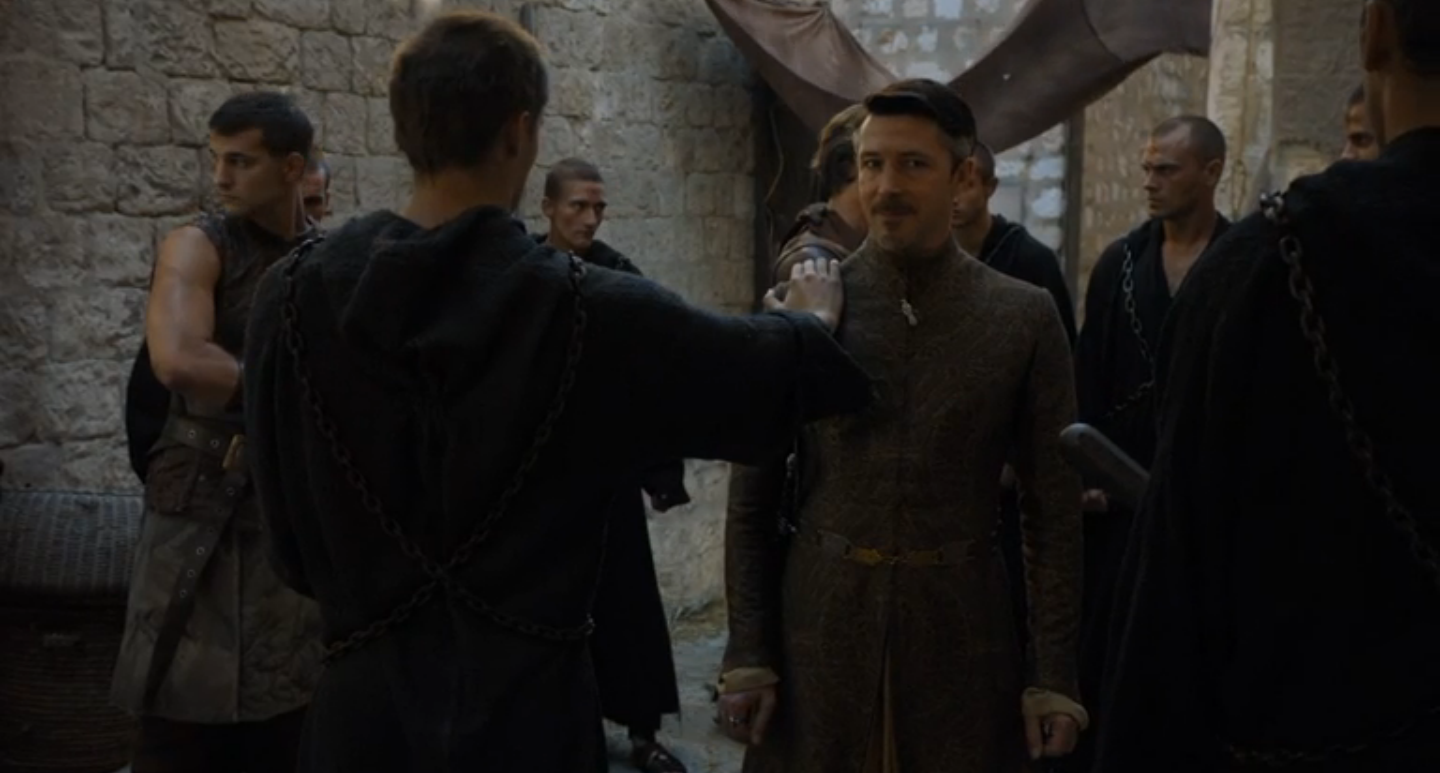
adebisi02But to return to Cersei and Littlefinger: his entry into King’s Landing is as perfect a contrast to King Tommen’s impotence on the steps of the Sept as could be crafted. We of course know that his brothel has been attacked and (presumably) put out of business, and that he is notorious as a man who has made a significant amount of money in the sex trade. So he’s naturally a target for the newly formed Faith Militant, and we see Lancel’s eagerness in confronting him. But Littlefinger is no Tommen: he’s completely unimpressed by the dirty-robed fanatics who bar his way. “I have urgent business with the Queen Mother,” he says calmly, like butter wouldn’t melt in his mouth. “Shall I tell her I’ll be delayed?” As always, his armour and weapons are not steel, but his mind: he sees the Faith Militant for what they are, just another group jockeying for power in the game of thrones, even if they don’t have to wit to see it themselves. “Step carefully, Lord Baelish,” Lancel warns. “You’ll find there’s little tolerance for flesh peddlers in the new King’s Landing.”

Littlefinger’s response is one of the most subtly meta- moments we’ve seen on this show: “We both peddle fantasies, Brother Lancel. Mine just happen to be entertaining.” On the face of it, he’s speaking of the illusions his whores and whoremongers sell, that of their clients’ power and desirability—such as which was on pathetic display in episode three, when the High Septon has his religious pantomime played out. But it is also a wonderful little encapsulation of Baelish’s own theatrics. On every level, he peddles fantasies: be they the fantasy of an overflowing treasury he gave King Robert, the dream of power he used to bring the Tyrells into alliance with the Lannisters, his deft misdirection that made Cersei convinced it was Tyrion who poisoned Joffrey, and all of the schemes he is spinning this season: his alliance with the Boltons, his promise to Sansa, and now his suggestion to Cersei that, once the war in the North is settled between Stannis and Roose, he will lead the Vale to victory at Winterfell. All in exchange for being named Warden of the North … which may or may not entail putting Sansa’s head on a spike.

littlefinger_blockedIt is this last demand of Cersei’s that throws Littlefinger’s enterprise into question, for whatever his cold calculations, there has always been the underlying suggestion that he desires Sansa as a surrogate for his frustrated love of her mother. But … really, who the hells knows? Baelish’s talent, as he points out to Lancel, is the ability to spin out pleasurable fantasies. Which corresponds to his desires?

I don’t have an answer to your question about what side he’s on, Nikki … I think the Littlefinger we get in the series is something more of an improviser than we get in the novels. GRRM’s Baelish always comes across to me as a chess grandmaster, someone who sees the moves happening twenty turns ahead of anyone else. The Baelish of the series strikes me as someone who plants a whole bunch of seeds and sees what takes root. He simply has too many balls in the air right now (yes, I’m mixing my metaphors) to be that precise—he’s waiting (I think) to see what happens with such conflicts as Stannis v. Roose before making his next moves.

As for Cersei … one of the things I love about her character, both in the novels and in the series, is that she’s an overstated but ultimately inept villain. She imagines herself to be a schemer, but lacks her father’s (or for that matter, Tyrion’s) ability to play the game of thrones coolly. Arming the faith, as we’re starting to see, was mounting a tiger. In her meeting with Littlefinger, we see how deftly he plays her, how easily she allows her emotions and hatreds to guide her judgment.

All of which speaks to the fact that Ellaria Sand had it spot on: if the Sand Snakes had succeeded in killing, hurting, or otherwise harming Myrcella, Cersei would not have hesitated in launching an ill-advised war on Dorne.

What did you think of the southern part of this episode’s story, Nikki?

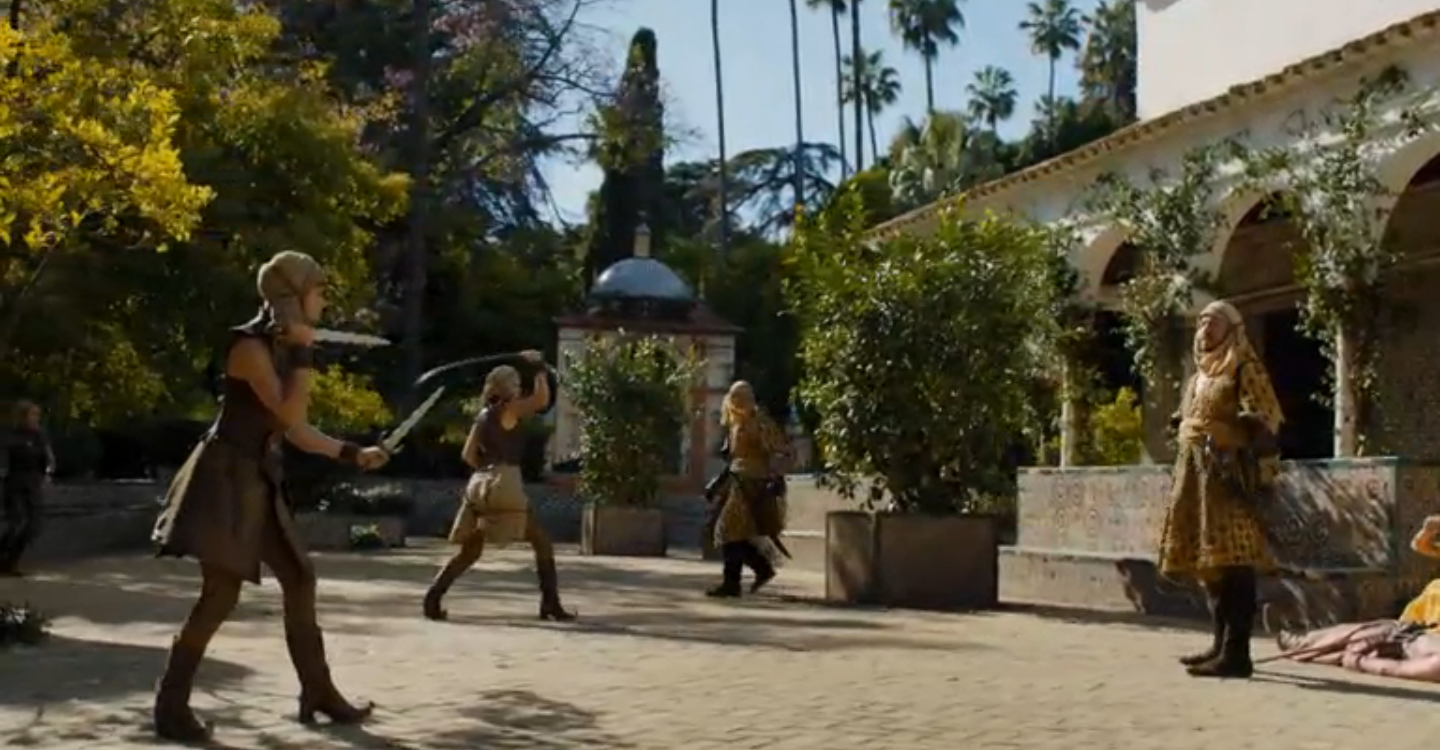
sand_snakesNikki: I loved the anticipation of the Sand Snakes, the way Ellaria stood below the palace and gave them their marching orders, the way they chanted, “Unbound, Unbent, Unbroken,” even if the actual scene didn’t quite live up to the promise of these magnificent women. The problem is, they weren’t counting on Jaime Lannister being there. Or Bronn, for that matter.

And neither side was expecting that Myrcella would actually be in love with her betrothed, and refuse to be taken away. Jaime’s there to take her back home to her mother; the Sand Snakes are there to kidnap her and use her as a bargaining chip. Prince Doran, confined to a wheelchair, was watching Myrcella moments earlier and commented to his captain that he’d better remember how to use that axe, for he’ll probably need to use it soon. Where, as you pointed out above, Chris, Cersei rules with her heart and emotions, Doran Martell is more calculated, thinking through everything. It’s no wonder Doran’s captain and his army show up soon after the fighting breaks out; Doran had already anticipated it and had the men watching Myrcella and Trystane as they walked through the garden. Trystane, Doran’s son, seems to have inherited his father’s cunning, for when Jaime and Bronn first approach Myrcella, he looks down and immediately notices the blood stains on their clothing, and knows they’re not actual Martell soldiers.

When the Sand Snakes show up, they fight fiercely, and I loved the action scene, but Martell’s soldiers quickly stop it, taking away Jaime, Bronn, and the Sand Snakes, as well as Ellaria, who was waiting under the palace for her girls to return.

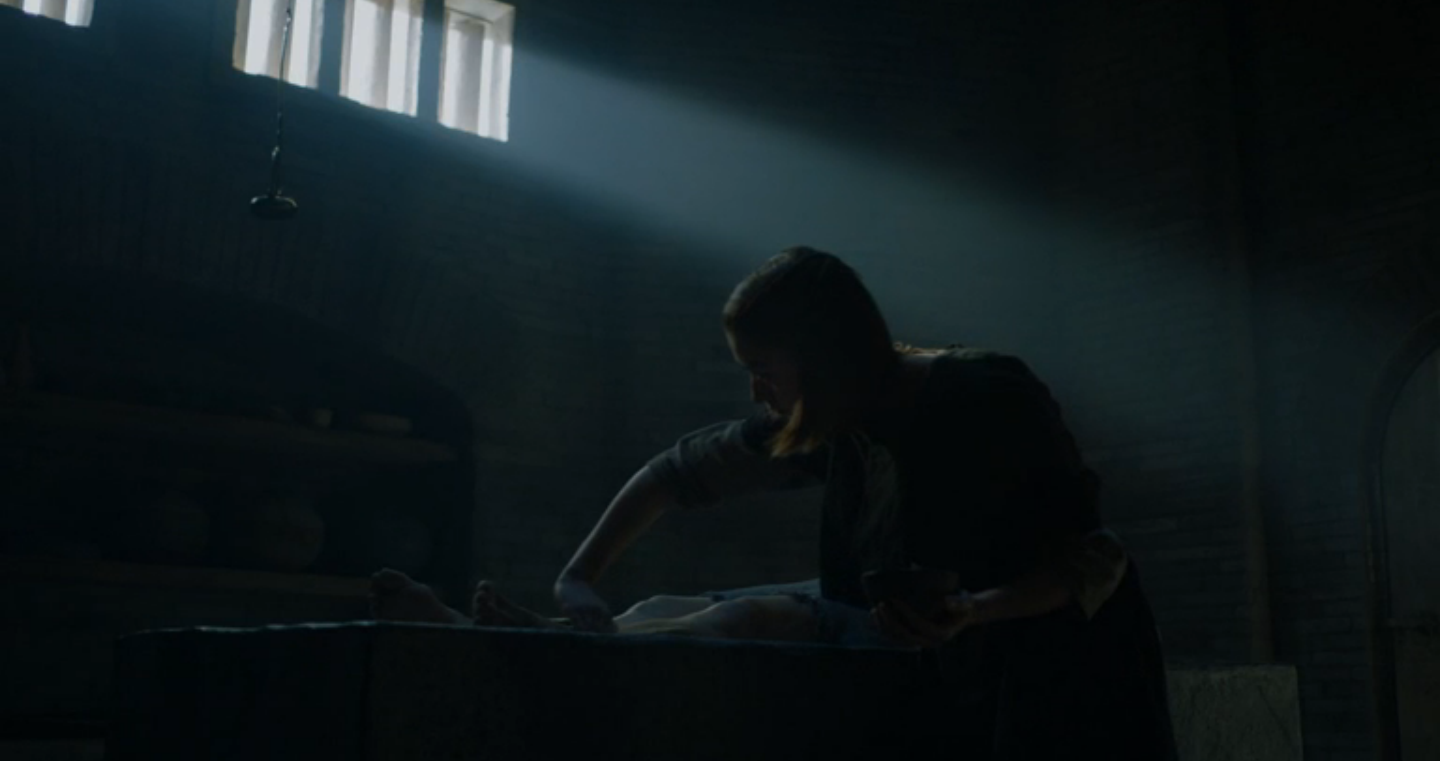
arya_washingMeanwhile, over in Braavos, a girl washes a woman and a man and another man and a girl and a man and … and never actually discovers why she’s washing all of these people. The young surly woman who is often with her continues to be harsh, but I noticed that when she speaks to Arya, she says “you” and not “a girl,” so I’m thinking that despite all her bluster, like Arya she is not yet able to become one of the Faceless Men (if, indeed, she strives to be). When Arya finally asks her to explain her deal, the girl tells her a story that sounds right out of The Brothers Grimm — her mother died, her father remarried, and her stepmother had a baby girl and wanted that baby to become the heir to their fortune, so she tried to poison the girl. The girl went to the Faceless Men, and, as she put it, her father was widowed once again. For the first time since meeting her, Arya looks at her with some respect, a small smile playing on one corner of her mouth… until the girl asks her to decide whether or not that story was true. The smile instantly fades from Arya’s face, and she’s told she’s still not ready.

Later, Jaqen awakens Arya and asks her who she is. I expected her to say, “No one,” but she knows better, and begins to tell her story. Every time she so much as wavers from the truth, Jaqen beats her with a switch he’s holding, and she corrects herself, reverting to the true story. But when she says she hated the Hound, he hits her, and she repeats herself, and gets hit again. We viewers know there was some affection there, and leaving him was as painful as it was satisfying, but while Arya can’t seem to convince Jaqen of any of her lies, she’s certainly convinced herself of one of them. On the floor, with her mouth bleeding, she tells Jaqen that she’s no longer playing his games. “We never stop playing,” he shoots back.

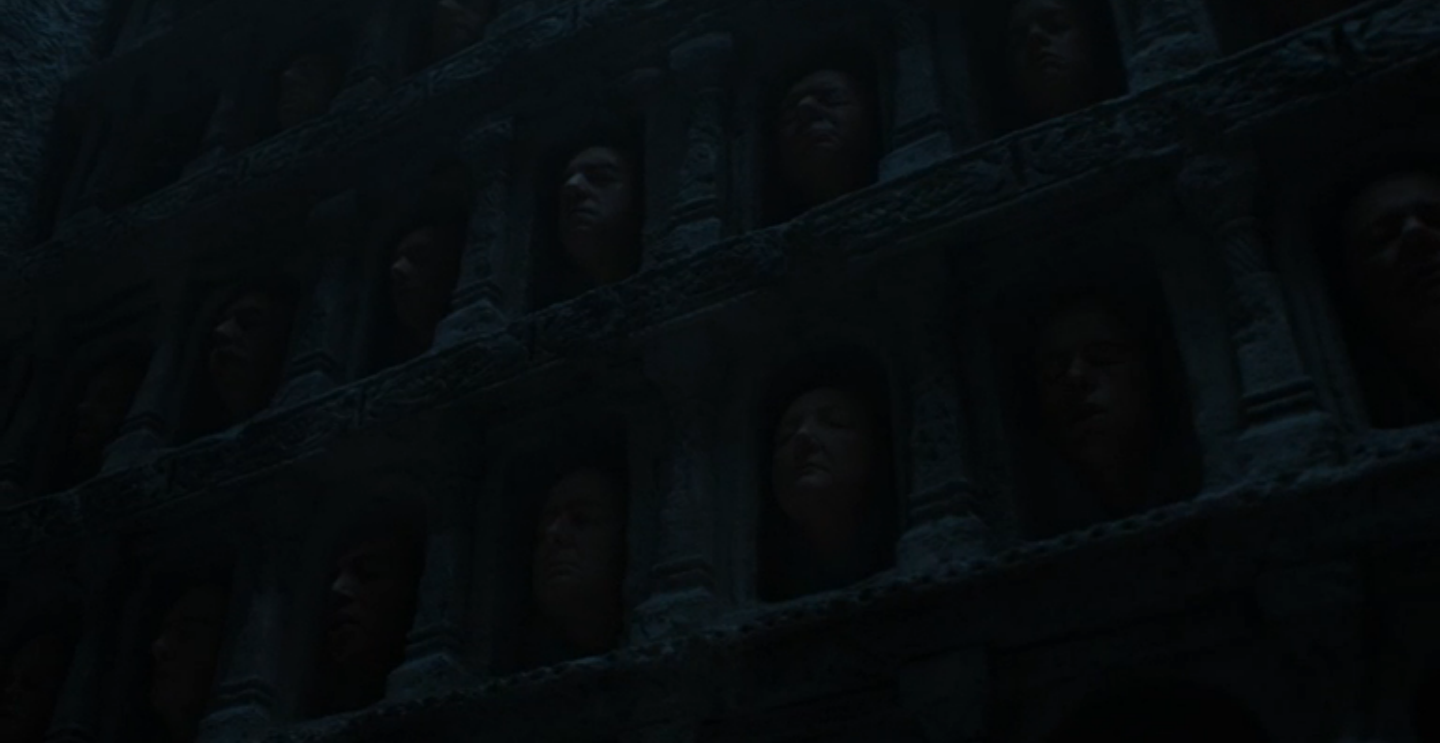
And then Arya gets a chance to bring peace to someone else. When a girl is brought in, and her father begs for them to just take away her pain — knowing he’s asking for her to be euthanized — Arya steps up and lies convincingly to the little girl, telling her that drinking the poisoned water will actually make her pain go away, and that she’d done the same thing herself. Later, when she’s washing the corpse, Jaqen appears in the doorway and signals for her to follow. He had watched her with the little girl and saw that she was able to convince someone else of a lie, and she pretended to be someone else and did so as if she truly believed it. And so now he deems her ready to see where the corpses really go… and the truth was shocking. Down in the catacombs of the House of Black and White are pillars covered in the faces of the dead — faces that the Faceless Men use to become other people. And he tells her that she’s not ready to become no one, but she’s ready to become someone else. Looking at the pain and misery so many of the characters on this show have endured, becoming someone else almost feels like a luxury. I can’t imagine Arya with a different face, but we’ll see where this storyline takes us next.

Are they following the Arya storyline from the books, Chris? And what did you think of the Tyrell storyline in King’s Landing?

room_of_faces02

Christopher: For a season where they’ve more or less thrown out the script for almost all the major storylines, Arya’s story is all but identical to the novels—with the one crucial exception being that it is not Jaqen who mentors her. That being said of course, given that the Faceless Men can take on whatever visage they want, there’s no way of knowing for sure that Arya’s guide in the novels isn’t Jaqen. Like you, I’m delighted the series made that minor change, because I really like that actor, and having him return offers a certain structural resonance to the story.

As for the Tyrells … well, first off, it’s great to have the Queen of Thorns back. Lady Olenna’s brusque, tart tongue is once again a wonderful counterpoint to Cersei’s mannered spite. “As for your veiled threats …” Cersei starts to say, only to have Olenna snap “What veil?” As in her exchange with Littlefinger, we begin to see the extent of Cersei’s self-deception, best expressed in her arrogant assertion that “House Lannister has no rival.” Um, Cersei, may I draw your attention to an observation made by Petyr Baelish several episodes ago? Tywin Lannister is dead, Jaime has one hand, Tommen is a soft boy, and the title of Queen Mother means less and less with each passing day.

Yet Cersei can only see what is immediately in front of her nose, which in this case is her hatred for Margaery and her petulant need to cling to power … which she obviously believes she has succeeded in doing. And for the moment, it appears that she is successful, playing her trump card with Loras’ lover and implicating Margaery in his “perversions.” (For the record, this is different from the novel but not dramatically so: in the novel, Cersei concocts a story in which Margaery and her ladies-in-waiting had sex romps with a pair of brothers in the Kingsguard, whom Cersei seduces into testifying against her).

loras_trial_everyoneCersei’s question to Olenna is ironic: “The Lannister-Tyrell alliance brought peace to a war-torn country,” she says, and asks: “Do you really want to see the Seven Kingdoms slide back into warfare?” The question is ironic, because she’s putting the obligation of pragmatism on Olenna, while she herself proceeds from a place of purely personal vengeance. Olenna’s response is to remind Cersei about her father: Tywin was ruthless, cold, and often brutal in his tactics, but was never emotional in his decisions—and it was for that reason, in spite of her own antipathy to him, that Olenna was willing to enter into the alliance to begin with. Whether she’s being cynical or just stupid, Cersei is relying on all the other actors in this drama being unwilling to have conflicts renew, blind to the fact that some, like the Tyrells, probably are; and the fact that others, like Littlefinger or the Sand Snakes, actively want war again. And meanwhile, Cersei has gone and isolated herself from all those who might have been valuable allies.

Which brings us to the heartwrenching conclusion of this episode, and the question of whether the title—“Unbowed, Unbent, Unbroken”—isn’t just the motto of House Martell, but an allusion to all that Sansa has endured since the death of her father. The horror and in many cases the anger of many people when they realized what Littlefinger’s plan for Sansa was bound up in the prospect of her wedding night with Ramsay. The sparse hope many of us had lay in the possibility of a deus ex machina in the form of Brienne or Stannis.

But it was not to be. And in the days since the episode aired, there has been a great deal of outrage and argument about it. Some have said the scene was vile, yet another example of Game of Thrones using sexual violence as mere plot point, citing the also-controversial scene last season where Jaime rapes Cersei as evidence that this kind of exploitative use of rape is endemic to the series; others are angry with the entire shift in Sansa’s storyline, that it necessarily brought her into Ramsay’s twisted grasp; others are outraged that the scene focuses not on Sansa’s anguish but Theon’s. And some, like the website The Mary Sue, have declared that they want nothing more to do with Game of Thrones.

What are your thoughts, Nikki?sansa_tower-shot

Nikki: Well, as some readers may have surmised, right after the two of us had gone through our first passes, the internet exploded into outrage over that final scene. So in the last two passes, we’ve tried to sum up the rest of the episode more quickly to focus the end of this post on what happens in the final scene.

Like you, I was hoping Brienne would stop it. Or the elderly woman warning Sansa to put a candle in the Broken Tower. “The North remembers,” after all. Or perhaps Theon is faking it, and he would stop things. But if he stabbed Ramsay in the neck in his chambers, how the hell would he and Sansa get out alive?

None of that was to be. Instead, Ramsay goes from being saccharine sweet (and as phony as a three-dollar bill) to turning back into the Ramsay Bolton we all know and hate. He forces Theon — interestingly, he’s allowed to be Theon again, because in this instance, it’s far more painful for him to be Theon, the boy who was Sansa’s childhood friend, than to distance himself and become Reek — to stand in the room and watch as he bends Sansa over her parents’ bed and rapes her on the very furs that used to keep Ned and Catelyn warm at night. The bed she was probably conceived in. She has entered Winterfell with her head held high, with her hair dyed black, declaring to Myranda that she’s not afraid of her. But now the black has been washed out, Littlefinger has abandoned her, and it’s just her, the sadistic Ramsay, and the damaged Theon in a room, where Ramsay takes the first step to break her the way he broke the boy she used to play with as children.

The scene is very carefully filmed. We see Sansa from behind as Ramsay rips her beautiful dress from her. The camera comes back around to her front so we can see the look of terror forming on her face. She is bent over, pushing her face into the furs, her fists gripping the hair, and you hear the sound of Ramsay taking off his own pants, and then the camera pans around again and you see Sansa’s body jerk forwards, and her moans of pains turn to screams as the camera focuses itself on Theon’s face. As he shakes and shivers in the corner, his eyes wide with horror, we hear Sansa’s screams and can only imagine the look on Ramsay’s face. Fade to black.

Even the camera acknowledged that what was happening on screen was too horrifying to actually show us. Despite what the article you quoted above stated, I don’t believe this final scene was cutting Sansa out of the picture and showing us Theon’s horror instead; it was saying that what she was going through was so awful they wouldn’t make us watch it. Theon becomes the stand-in viewer, his horror simply mirroring what Sansa was going through. This moment was all about Sansa; we weren’t exactly being sympathetic to poor Theon in this scene, but picturing our dear Sansa, all power being ripped from her.

It’s the most horrific ending of any episode so far. Did I enjoy it? Of course not. Did it horrify me? Yes, it did. Was it meant to? ABSOLUTELY.

And that’s where I’ve been deeply saddened by the vitriol and typical Internet Outrage that has accompanied it. I’m a huge fan of The Mary Sue, which offers a feminist perspective of pop culture and is usually right on the money. And I respect them for actually being calm and measured in their article that stated they will no longer be covering the show because of how upset this scene made them. They weren’t rude or condescending, and in an age where it’s easier to take to Twitter and type “DIE HBO AND GRRM,” I appreciate the way they did it.

sansa_dressHowever, I respectfully disagree with their position. Seeing a woman raped upset you? Good. It should upset you, because — and I hate to be the bearer of bad news here — women get raped. This is not a fictional thing. In the time you have been reading this piece, several women have been raped. There is a young girl right now being married off to a man four… five… six times her age, and she’s about to have the worst night of her life. And tomorrow it’ll happen again to another. Somewhere in the world another girl is trying to figure out how to get her father or uncle to stop coming into her room at night. Somewhere else a woman is on her way home to her husband and children and is about to be accosted by a stranger. Somewhere else a teenage girl is getting drunk at her first keg party and is having a rufie slipped into her drink. Or a wife is being raped by her abusive husband. A young girl is being raped by her older brother. A girl is being gang-raped as punishment for having shown her family dishonour by being raped in the first place.

THIS SHIT HAPPENS AND IT IS REAL. And if the show had glossed over it, and instead Brienne had suddenly flown into the room accompanied by the sounds of sweeping orchestral music, reaching down to Sansa with one arm declaring that Lady Sansa needs to come with her in the name of Catelyn Stark, it would have been disingenuous, and skirting around a very, very serious topic that needs to be addressed.

Sansa’s rape upset you? Good. But instead of throwing your hands up and saying you will no longer pay attention to a show that honours women in all their magnificent glory on a weekly basis, why don’t you use that outrage in another way: why not direct it at the reality that many non-fictional women are trying to overcome rape? Or that some cultures condone it? THAT should make you angry as hell.

wedding_lampsThere was nothing gratuitous about this scene. It’s Ramsay Fucking Bolton. What did you think was going to happen — he was going to lay rose petals all over the bed, peel her some grapes, caress her arm gently, be gentle with her, all while whispering sweet nothings in her ear, run her a bath afterwards, and make her breakfast in bed? No. He’s Ramsay Bolton. He’s the worst sadistic fuck in Westeros, worse even than Joffrey.

I think the line in the Mary Sue piece that bothered me the most when I saw it yesterday was where they wrote that “the extent of Theon’s torture at the hands of Ramsay is barely covered in the show.” What?! Are we watching the same series? Because I remember a huge part of season three being devoted to Theon being tied to a wheel (an emblem now used to denote Winterfell in the opening credits), of having screws literally screwed into the bottoms of his feet, of Ramsay threatening to take off his finger, then shaving it off in pieces, of tricking him time and again — in one scene he almost gets away only to discover he’s been travelling in a circle and is back with Ramsay; in another scene women seduce him only for Ramsay to show up and lop off his penis.

You know what, let’s just sit with that one for a second longer. He is literally dismembered by Ramsay, who mocks him by eating a sausage the next morning to make Theon think it’s his penis, but instead Ramsay sends the penis to Lord Greyjoy to show him that his son is really the screw-up he always thought he was. He strips him of appendages, dignity, and then his very sanity. He turns him into a snivelling animal, and keeps him in the dog kennels.

But yeah, let’s just forget all of that and say the show has glossed over Theon’s torture. To say that Sansa’s rape is unforgivable but Theon’s torture was entertainment isn’t feminism, it’s outright hypocrisy.

Sansa’s rape is meant to invoke fury in us, to make us hate Ramsay Bolton more than we already did, to put us more on Sansa’s side than we already were, to want the Boltons to PAY for what they’ve done to the Starks. It’s meant to make us rise up in an angry tide against Ramsay, the same way killing off Tara on Buffy the Vampire Slayer was not Joss Whedon saying, “The only good lesbian is a dead lesbian,” which is what the Internet Outrage-mongers back then tried to peddle, but instead was him saying, “You should be furious that things like this happen to people who are as special and amazing as Tara.”

I hope this scene made you angry. It made me angry. Angry at a world where things like this happen. Game of Thrones is meant to invoke medieval England, and if you think women had it good back then, then perhaps it is better that you stop writing or talking about this show and instead go read a history book or two. In medieval England — hell, in 2015, I hate to say it — Ramsay just had sex with his wife. At least, that’s what it looks like under the law. You can’t rape your own wife, says the misogynistic laws in place in several countries in our modern world, and in every single country in the medieval one.

And if watching this scene made one person decide they were going to use a fictional character’s plight to transfer that ire to the real-world horrific reality — which is so, SO much worse than what we saw — then it was worth it.

I promised I wouldn’t get emotional in my response, and as usual that’s flown right out the window. So I turn it over to you, Chris. I know this scene wasn’t in the book, which is why most people are upset about it (I guess if GRRM had written a rape scene it would magically make it okay?) but I know you have a lot to say about this, too, so the floor is yours, my friend.

wedding_long-shot

Christopher: The final scene of this episode epitomizes something this series has occasionally accomplished, which is to produce a brutal and horrifying work of art. And it also epitomizes the danger and necessity of turning pain, trauma, and the unthinkable into art. When James Joyce was living in Zurich during the First World War, someone asked him if the novel he was working on was an anti-war novel. “The best way to write an anti-war novel,” Joyce replied, “is don’t write a novel about war.” His point, or at least one of his points, was that turning anything, however ugly or horrible, into art aestheticizes it. That is the dangerous element: one risks losing the critical edge of the work with readers or viewers who simply don’t see that there is a critical edge at all, either because they’re thrilled by the aesthetic or, conversely, are so turned off that they simply reject the work wholesale.

Apocalypse Now is one of the most profound anti-war films ever made, and yet the air cavalry’s attack on the village set a new standard for how to do thrilling action sequences, and Robert Duvall’s line “I love the smell of napalm in the morning” has gone from being a trenchant comment on the absurdity of war to an unironic cliche of military masculinity.

Or to use an example closer to our subject: I long ago discovered that Lolita is the easiest novel to teach because one third of the class loves it unequivocally, one third hates it with a white-hot intensity, and the remaining third likes it but are totally creeped out by the premise, and this makes them confused. I don’t have to do much lecturing: I just let the class fight about it.

These are dangerous waters, and to be fair, Game of Thrones hasn’t always navigated them well. Last season’s rape scene with Jaime and Cersei is a case in point, and I tend to agree with those who hated it. It was a hamfisted scene, though not nearly as hamfisted as the showrunners’ inane attempts to claim that it depicted consensual sex. It was infuriating, both because the scene itself was terrible, but also because it could have been handled so much more deftly. In the novel, it’s an awkward, hurried sex scene in which the line of consent is blurry—handled precisely that way in the series, it would have been less infuriating and more discomfiting, and would have spawned a far more fruitful series of arguments about lines of consent between sexual partners.

theon_weddingThe Sansa scene is entirely different because there’s no question of consent, and no question of partnership. This is rape, and if it takes place in a scene that is beautifully lit and shot, I hardly think that mitigates what takes place. Quite the contrary: for me it called to mind some of the more touching depictions of lovemaking on the show, such as Jon and Ygritte’s subterranean waterfall dalliance. We can easily imagine characters who genuinely love each other in this candlelit setting, which makes the contrast with Sansa and Ramsay (and Theon) that much more horrifying.

The Mary Sue’s principal line is more or less the James Joyce line: just don’t write a storyline about rape. In some respects I am not unsympathetic to this argument, but as you say, Nikki, this is not what Game of Thrones does, and as Alyssa Rosenberg argues, “Game of Thrones has always been a show about rape.” By which she means “that the omnipresence of sexual violence in the world Martin created is the point, not ‘illicitness … tossed in as a little something for the ladies,’ as New York Times critic Ginia Bellafante wrote in her bizarre review of the show when it premiered in 2011.” A Song of Ice and Fire has always been, before anything else, a high fantasy series whose main project is the upending of the romantic conventions of high fantasy, the demythologization of a genre that tends to depict premodern and medieval settings with a nostalgic glow.

Two years ago, when we reviewed episode 3.03 “The Walk of Punishment,” we talked about the way in which Game of Thrones builds the threat of sexual violence into the fabric of Westrosi society, and the way GRRM is in this respect historically accurate. This was the episode in which Jaime lost his hand; it was also the episode in which he manages to save Brienne from getting raped by their captors by telling them she was worth a fortune in ransom. It was also, if you’ll recall, the episode in which Ramsay “rescued” Theon, who was then ridden down by a group of horsemen and himself threatened with rape—until Ramsay again “rescued” him, only to subject him to a far worse fate in the dungeons of the Dreadfort.

roose_ramsay_weddingThat episode was on my mind as I watched the final scene of this one, because what makes it affecting rather than simply horrifying is the way the camera zooms in slowly on Theon’s face as Ramsay rapes his bride. As I said in our review of “The Walk of Punishment,” Jaime’s advice to Brienne that she just lie back and think of Renly when their captors rape her betrays his fundamental misapprehension of rape, seeing it as different from consensual sex in degree rather than in kind; the focus on Theon’s face in this scene does not, as some have charged, make the moment all about him—rather, I would argue that it makes the thematic connection between torture and rape. Rape isn’t about sex, but domination and subjugation, the violent humiliation of a person and breaking them to your will. This scene is horrifying and terribly difficult to watch, but in the end its point isn’t about violence but suffering. A recent review of Mad Max cited an argument made by Anthony Lane in The New Yorker ten years ago. In a negative review of Sin City, Lane observes,

Nothing is easier than to tumble under the spell of its savage comedy—Marv driving along with the door open, say, holding another guy down so that his head is roughly sanded by the road, or Jackie Boy continuing to chatter with his throat cut. We have, it is clear, reached the lively dead end of a process that was initiated by a fretful Martin Scorsese and inflamed, with less embarrassed glee, by Tarantino: the process of knowing everything about violence and nothing about suffering.

“Knowing everything about violence and nothing about suffering.” It is here, I would argue, that the worth of this scene lies: there is nothing here to redeem Ramsay, and nothing to titillate. Alfred Hitchcock knew the value of not showing the shocking image but rather the reflection of the shocking image in a character’s reaction shot. Sansa and Theon’s fraught history is writ there on Theon’s face, and we have been subtly prepared for the moment not only by Ramsay’s taunts over the dinner table, making Theon apologize, but in the scene immediately preceding in which Theon is required to describe himself as the ward of Eddard Stark and to speak his real name in order to give the bride away.

As with any such dramatization, one of the dangers is the people who just don’t get it. The Mary Sue, among others, lamented the fact that this scene would churn up, like sludge from a pond’s bottom, all those who say there’s no such thing as marital rape—that Sansa was just performing her wifely duty, and everyone who says otherwise just have to get over themselves. And of course that fear has been vindicated. But as someone who believes that more speech is always preferable to less, however vile much of it may be, I say: good. Let the trolls and troglodytes have their say. At least we’re talking about it.

theon_anguish

And on that cheerful note, we bid you adieu for another week. Be good, dear friends, and work hard, and for the love of the Old Gods and New, remember that friends don’t let friends marry Boltons.

Leave a comment

Filed under Uncategorized

Game of Thrones 5.05: Kill the Boy

gameofthrones_teaser02_screencap10

Hello, my friends, and welcome once again to the ongoing Chris and Nikki co-blog on Game of Thrones, in which I have read the novels since the first was in hardcover, and Nikki comes to this series as a neophyte. Normally it would have been Nikki’s turn to lead us off, but apparently she was in Niagara or some such place one Monday, talking to aspiring writers. So I’m leading us off …

 black-watch_council

Christopher: Tonight’s episode was really interesting, and not just because of the content. Structurally and narratively it was interesting, because the bulk of it took place in the North—alternating between different story threads, but giving us a geographic preoccupation that (I seem to think) we haven’t seen before. Normally, episodes move the different narrative threads in tandem, often giving us only a few minutes in, say, Castle Black and with whatever road-tripping duo is current, almost as narrative place-holders, while giving over more substantive blocks to King’s Landing, Mereen, or wherever. And then every so often there’s an episode devoted entirely to one storyline—the Battle of the Blackwater, or the assault on the Wall. But normally this show has divvied up its story blocks more or less equally.

Which of course makes sense, as it’s in the show’s interests to remind us of all the balls it has in the air at any given time. But I loved this episode because it served to highlight the interconnections in a group of stories whose geographical proximity makes them more immediate to one another. In a given episode what happens in King’s Landing, the Wall, and Mereen are only vaguely connected; here, we see how events at the Wall concern the denizens of Winterfell (or should), we see Brienne’s view of Winterfell from a local inn, and sending word to Sansa through Stark loyalists, and finally watch Stannis marching south shortly after a scene (that shows what I suspect passes for a touching moment in the Bolton family) where Ramsay pledges to help his father fight.

I loved this because it doesn’t show disparate, parallel storylines—it shows the ferment of proximate events, all of which inform and shape each other.

That this northern narrative is effectively bookended by Daenery’s travails in Mereen (with the Tyrion/Jorah bit functioning almost as a coda or epilogue) makes it that much more interesting, as Daenerys’ story works both by contrast and similarity. That shocking opening scene where she feeds one of the Great Masters to her dragons is followed by one about as far away from Mereen as you can get, where Sam reads news of Daenerys to her sole surviving kin. In the moment when Daenerys leaves the dragons’ lair (well, prison), she looks about as alone as we’ve seen her since her marriage to Drogo; and Maester Aemon laments that very fact, saying “She’s alone. Under siege, no family to guide her or protect her … her last relation thousands of miles away. Useless. Dying. A Targaryen alone in the world … it is a terrible thing.” As both a maester and a brother of the Night’s Watch, Aemon Targaryen gave up his family name and birthright twice over, but we see the pain of that sacrifice here as he contemplates Daenerys’ solitude—which is worse than he probably imagines, not knowing that she has lost two of her most loyal and steadfast allies—banishing Ser Jorah, and bearing witness at the beginning of this episode to Barristan’s lifeless body. Who is left? Grey Worm has been grievously wounded; Daario is loyal but mercurial; Missandei is similarly loyal, but cannot offer the same counsel of her absent knights; and in her grief and anger she makes an example of one of her subjects in a manner that would have made her mad father proud.

The pairing of Mereen with the North makes great thematic sense, especially in the balance of Daenerys and Jon Snow—both face the isolation of command.

What did you think of this episode, Nikki?

ramsay_toast

Nikki: I agree with your excellent assessment of what made this episode great. On the one hand, it’s not as exciting as the previous four episodes have been — each season must have one or two bridge episodes — but on the other hand, we always love those moments that bring storylines together. I still remember the thrill last season of Bran almost encountering Jon Snow, but not quite. For me, the best moment of this episode was where Tyrion finally saw a dragon. FanTAStic.

In addition to the connections you’ve already pointed out above, there was one I’d been waiting to see — the reunion of Theon and Sansa. Miranda — Ramsay’s girlfriend who is engaged in some sort of ongoing S&M thing that clearly involves him starving her — is deeply jealous with his impending engagement to Sansa. While he, frustrated, tells her that he has no choice in the matter but reassures her that she’ll always be in his life, she still decides to get her revenge. This comes later, when she approaches Sansa in the Winterfell courtyard, cunningly uses a compliment about Sansa’s dress to remind her of her mother’s death at the hand of the Boltons, and then leads her to the kennels, telling her there’s something she’ll want to see at the end. The very comment about Sansa’s proficiency in stitching takes us all the way back to the first episode, where Arya was complaining about having to sit still and learn how to embroider like her older sister, when all she wanted to do was go out and practise archery like her brothers. Just as last week’s feather reminded us of Robert Baratheon in season one, now we get the mention of the stitching, as well as the old woman telling Sansa that the North remembers, and to light a candle in the Broken Tower should she ever need anything. The Broken Tower, of course, being the place where Bran was pushed from a window by Jaime Lannister, the incident that sparked this whole damn thing.

But now, as Sansa slowly moved her way through the kennels, I actually have to admit I didn’t anticipate what was there — instead, I was hoping it was Nymeria, Arya’s direwolf, whom we last saw being chased away by Arya, who feared for her life after she bit Joffrey (because of the stitching comment, my mind was firmly back in season 1 at this point). Though the last mention of Nymeria had her down in the Riverlands, I was half-hoping the Boltons had captured her and brought her here, and that she might work with Sansa somehow.

But instead, what she found was Theon, shivering and chained to the wall. “You shouldn’t be here,” he says the moment he sees her, and Sansa, horrified at what she’s just seen, turns and runs as fast as she can out of that kennel.

The last Sansa had heard about Theon was that he had taken Winterfell, and had killed Bran and Rickon in order to do so. Of course, we know that Theon only meant for people to think that, and in fact he’d killed two other boys and strung them up, skinless (the way the Boltons do in the courtyard every day). But Sansa doesn’t know that. For a moment, I thought she’d feel sorry for him, and then the truth of what she believes has happened came washing back, and I realized she’s horrified not at what’s become of him, but that he’s there at all.

I wondered what was going through her head at the dinner, where Ramsay trots out Reek to stand before Sansa and apologize for what he did to her brothers. What a whirlwind of emotions must be rushing through her head. Ramsay is putting on a show not to torture Reek, but to humiliate Sansa and put her in her place. By making Reek stand there and give her a pat “yeah, sorry ’bout that” apology, and then sit back triumphantly and say, “There, all better now!” Ramsay is not only making fun of Sansa’s pain, but reminding her that there’s nothing that can be done now to bring them back, and a simple “sorry” is all she’ll be getting out of the bargain. As she sits there, looking confused about Reek’s condition, perhaps upset that she didn’t get to do that to him herself, or perhaps concerned about how much of a monster Ramsay Bolton really is, she’s also eminently aware that sitting across from her — not saying sorry — is the man who orchestrated the deaths of her brother, her mother, a sister-in-law that she never met, and a niece/nephew that was never born. And sitting next to him is the daughter of the other man who committed the crimes. It’s a dinner from hell, and Sansa keeps her chin up, letting the wave of emotions wash over her and never betraying any of them for an instant. She smiles, she kowtows, and does exactly what needs to be done to get through the scene. Theon is an example of what happens when you don’t bend to the will of the Boltons. She’ll pretend to do so… for now.

I’ve been watching this show from season one, waiting for Arya’s revenge on everyone who’s wronged her. Now I want to see Sansa’s revenge even more. May it be sweet and painful to those who have killed the ones she’s loved.

After Sansa and Theon leave, Ramsay and Roose talk about Roose’s wife’s pregnancy, and after some particularly cruel comments from Ramsay, it’s clear that he’s worried about his station. If she gives birth to a boy, then that boy will be the trueborn heir. Ramsay has been given the Bolton name for now, but he’ll always be Roose’s bastard son. Roose, on the other hand, after revealing to Ramsay that he’s a child of rape, tells him that he knew from the moment he saw him that he was his son, and he hasn’t forgotten that. Ramsay doesn’t look particularly convinced, and time will tell if Roose will stand by those words.

Time will also tell if Theon is who he’s letting on he is. I’m less certain he’s actually Reek; he immediately recognizes Sansa, knows she shouldn’t be in the kennels, and apologizes. He hasn’t forgotten who he is or what he’s purported to have done, but when Ramsay destroyed Theon to create Reek, he made it clear he was killing the one to create the other. But it’s clear the remnants of Theon are still there.
And killing the one to create the other brings us back around to the title of this episode, which comes from what Maester Aemon tells Jon Snow. What did you think of Snow’s storyline this week, Chris?

jon_snow

Christopher: I can’t figure out whether I think Kit Harrington is a great actor or just lucked into a role that perfectly suits his temperament, but this week’s episode showed him off to his best advantage. It helps that his accent is very similar to Sean Bean’s, but he conveys the gravitas his father did, and takes a similarly sober and unflinching view of his responsibilities and obligations. What I loved about his storyline here was that it perfectly performed—or started to perform—what Maester Aemon told him he must do. He begins by asking the sage old man’s advice; then has a wonderful scene with Tormund, laying the groundwork for his plan; sees precisely the kind of hate and anger he has to deal with when he puts the idea to his men; and in another poignant moment has to tell Ollie that, in the larger scheme of things, the brutal killing of his parents and village matter less than standing united against the enemy—even if it means standing with the very people who killed your family.

Kill the boy, indeed.

As I said above, I think the symmetry of this week’s episode lies in the parallel between Jon and Daenerys as they both face what are effectively impossible situations. Everything Jon Snow argues for is valid: it makes total sense to bring the wildlings south of the Wall for the simple reason that they then won’t come south as a massive army of ice zombies. But of course he’s fighting upstream against millennia of hatred and enmity, to say nothing of recent bleak memories. And the mistrust goes both ways: “You sure seemed like my enemy when you were killing my friends,” Tormund scoffs at Jon’s overtures.

Both Jon and Daenerys are looking at a much bigger picture than their subjects and followers can apprehend. That’s what makes them good leaders; it’s also what isolates them.

Can I pause for a moment and say how much I loved Stannis’ little grammar lesson? During the meeting when Jon Snow makes his case for protecting the wildlings, one of his men advocates leaving them and letting them die. “Less enemies for us!” he says, to much acclaim in the room. We then cut to Stannis, who corrects the man under his breath. “Fewer.” HA! I love that the man who would be king is as strict about grammar as he is about everything else.

stannis_davosA few points here about divergences from the novels. The Jon Snow scenes are more or less consonant with the GRRM storyline, from Jon Snow’s hugely unpopular decision to allow the wildlings south of the Wall, to the expedition to Hardhome to rescue them. The principal difference is that in this version Jon Snow is leading the expedition. In the novel, he sends Tormund and a handful of men with the ships, and gets sporadic messages by raven (mostly bad news). So the fact that he is going himself at Tormund’s insistence represents a significant change … it will be interesting to see what happens out there. (Episode Eight, according to IMDb.com, is titled “Hardhome”).

This show has been so wonderfully cast that I find it difficult to pin down precisely which performances are my favourites—but the person most consistently in the top three is Gwendolyn Christie as Brienne. Every time she is on screen it makes me happy, and here she is, doggedly clinging to her vow even though she was spurned by Sansa. What did you think of her continued attempts to help her, Nikki?

brienne

Nikki: Stannis’s upbraiding of that man’s grammar was one of the episode highlights for me. (Incidentally, I watched Mad Men the same night and Don Draper ALSO corrected a kid’s grammar — not once, but twice — making me think I’d missed some wonderful announcement that it was National Editor Appreciation Day on cable networks…)

But back to Brienne. Game of Thrones is a show about people trying to claw their way to the top to get the Iron Throne, in the case of Stannis, Daenerys, Cersei, Margaery, the Boltons, or Baelish. Or it’s about people plotting revenge for those who have done them wrong, like Ellaria and the Sand Snakes, or Arya, Sansa, possibly Theon. And in the midst of the power plays and plots for revenge, we have a few folks who are simply trying to do the right thing. Among those would be Jon Snow, or Sam and Gilly. You have Jaime trying to right a wrong, Varys hoping for a kingdom of peace, and Tyrion escaping a wrongful accusation while no doubt becoming a key player in someone else’s climb to the Throne.

And then there’s Brienne. Of all these people, she lives by a moral code that is unwavering, like Omar Little on The Wire (minus the drug dealing and petty theft). She made a vow to Catelyn Stark, and she will follow through on that vow. The only reason she’s not still chasing after Arya is because Arya escaped and she couldn’t find her, and Brienne has been beating herself up over that ever since. But she’s found Sansa, and despite being rejected by her, she has tracked her to Winterfell and will continue to keep watch over her.

In some ways, Brienne is like a viewer of the show: she’s an outsider to all these families, and therefore can see things objectively and clearly. When Podrick says that Sansa is back at home away from the Lannisters, and perhaps they should leave her alone because she’s safe and better off here, Brienne turns to him and says, “Better off with the Boltons? Who murdered her mother and brother? Sansa’s in danger even if she doesn’t realize it.” We’ve been talking a lot over the past two seasons how Sansa has come into her own and is so much stronger than we ever would have thought that character would become, and yet during the Bolton dinner scene it was clear their manipulations surpass even Littlefinger’s, and perhaps she’s underestimated just how much danger she’s in.
Brienne hasn’t. You can tell as she’s staring out the window that her mind is trying to formulate a plan, and when the innkeeper brings her some water, she spots an opportunity. What’s so remarkable about what happens next is… just how unremarkable the conversation is. He asks a question, she gives him a straight answer. He asks another one, she gives another straight answer. I am here for Sansa Stark, I need to get a message to her, I swore a vow to her mother. “Her mother’s dead,” he sneers, and she replies, “That doesn’t release me from my oath.” Almost any other character would have lied about their true intentions, manipulated the situation to trick the innkeeper into helping them, and then probably killed the innkeeper somewhere along the way to dispose of the witness. And you can tell by the wary look on the innkeeper’s face that he knows that’s exactly how this works, and can’t figure out who this woman is who is… telling the truth. She explains to him with so much conviction that she served Lady Catelyn, and serves her still. “Who do you serve?” she asks. And for the first time, the innkeeper lifts his head and looks straight at her.

As Brienne continues on her single-minded conviction to save Sansa Stark, Ser Jorah Mormont pushes into Valyria in what Gay of Thrones referred to as the “worst Disneyland Jungle Cruise ride EVER.” I thought the production design on these scenes was extraordinary, creating Valyria from GRRM’s words in much the same way Peter Jackson created Middle Earth from Tolkien’s description. We know from previous episodes what happens to people with extreme greyscale (Gilly recalls two of her sisters turning into animals) and Stannis mentioned to Shireen in the previous episode that when the greyscale began on her, he was told to send her to Valyria but he didn’t.

What did you think of the Tyrion/Jorah/Stone Men scenes in Valyria, Chris? Was it similar to what happened in the books?

valyria

Christopher: Yes and no. In A Dance With Dragons, Tyrion’s journey is far more protracted: he is taken by litter with Illyrio (not Varys) to the head of the Rhoyne River, where he joins a group of Targaryen loyalists on a river barge. They travel down the river for many chapters. Many chapters. In the novel, the Stone Men are not sent to Valyria, but an old city that bestrides the river, now known as the Sorrows. It is there that they are attacked by the Stone Men. Tyrion survives after falling in the water, as happened in this episode.

It is after this encounter that the group arrives at Volantis, and Tyrion makes his way to a brothel only to be captured and taken by Ser Jorah.

I’m finding the pruning the series has been doing to be quite ingenious at times: they have completely dispatched the river-journey narrative, along with the handful of extra characters it brought to an already overstuffed list of dramatis personae. And we get to see Valyria! The fact that Jorah can steer them through it and survive is another change from the novel: the ruins of Valyria are notoriously dangerous, and no traveler that anyone knows of has ever returned. Here they seem to be suggesting that the fear surrounding Valyria is mostly superstition, and because pirates steer clear of it, Jorah uses it as both a short cut and a route safe from brigands.

But not Stone Men, apparently. More on them in a moment.

The memory and myth of Valyria haunts A Song of Ice and Fire, much as the memory of Rome haunted medieval Europe. “How many centuries before we learn how to build cities like this again?” Tyrion wonders. “For thousands of years the Valyrians were best in the world at almost everything.” This moment reminds me of Bernard Cornwell’s trilogy The Warlord Chronicles, in which he reimagines the Arthurian stories from a rigorously historical perspective: in 500 CE or so, the Romans would have been gone from Britain for a generation, but the memory of them lingered, as did all of their feats of engineering. Roads, manses, baths, fortresses … all of which are slowly crumbling, but none of which the Britons have the expertise, tools, and technology to repair or replicate. In GRRM’s books, we get fragments of stories about Valyria’s Doom, stories that hint at hubris and arrogance that led to their ultimate destruction. In this episode what we get is a sense of brutal finality. The Valyrians were the best in the world at almost everything, Tyrion says, “And then …” “And then they weren’t,” Jorah finishes for him, and Tyrion quotes from a poem about a pair of doomed lovers in Valyria:

They held each other close,
And turned their backs upon the end,
The hills that split asunder,
And the black that ate the skies,
The flames that shot so high and hot,
That even dragons burned,
Would never be the final sights,
That fell upon their eyes,
A fly upon a wall,
The waves the sea wind,
Whipped and churned,
The city of a thousand years,
And all that men had learned,
The Doom consumed them all alike,
And neither of them turned.

The poetry is original to the series: we hear about this song being sung by a Tyroshi singer named Collio Quaynis in A Storm of Swords, but get no lyrics. “A haunting ballad of two dying lovers amidst the Doom of Valyria might have pleased the hall more,” Tyrion reflects, “if Collio had not sung it in High Valyrian, which most of the guests could not speak.” But here Tyrion recites it, only to discover that Jorah knows a bit of poetry too.

It is a fittingly elegiac moment, and poignantly done, and serves as a wonderful ramp-up to what has to be the most amazing moment of this episode: when Tyrion sees Drogon flying overhead. Even if the rest of this episode had been crap, the expression on Peter Dinklage’s face is would be worth the price of admission. The ruins of Valyria, replete with a dragon … both Dinklage and Iain Glenn have some great face-acting here: the mix of awe and shock as the abstraction of the “mother of dragons” becomes suddenly very real; and Jorah’s pained, lost expression. He’s looking at Drogon, but we know he is thinking of Daenerys.

tyrion_awejorah_dragon

And then the Stone Men, for this show’s usual dramatic ending. I thought for a moment that they would end it with Tyrion being pulled down into the depths. There’s always a long moment of black screen before the credits role, but this time they head-faked us, and we get Tyrion’s perspective as he wakes up to see Jorah’s concerned face above him. There’s no more pretense about captor and prisoner: after Valyria, there’s no point. Jorah cuts Tyrion’s bonds and goes off to scrounge some firewood … but not before he reveals to us that he’s been infected with greyscale.
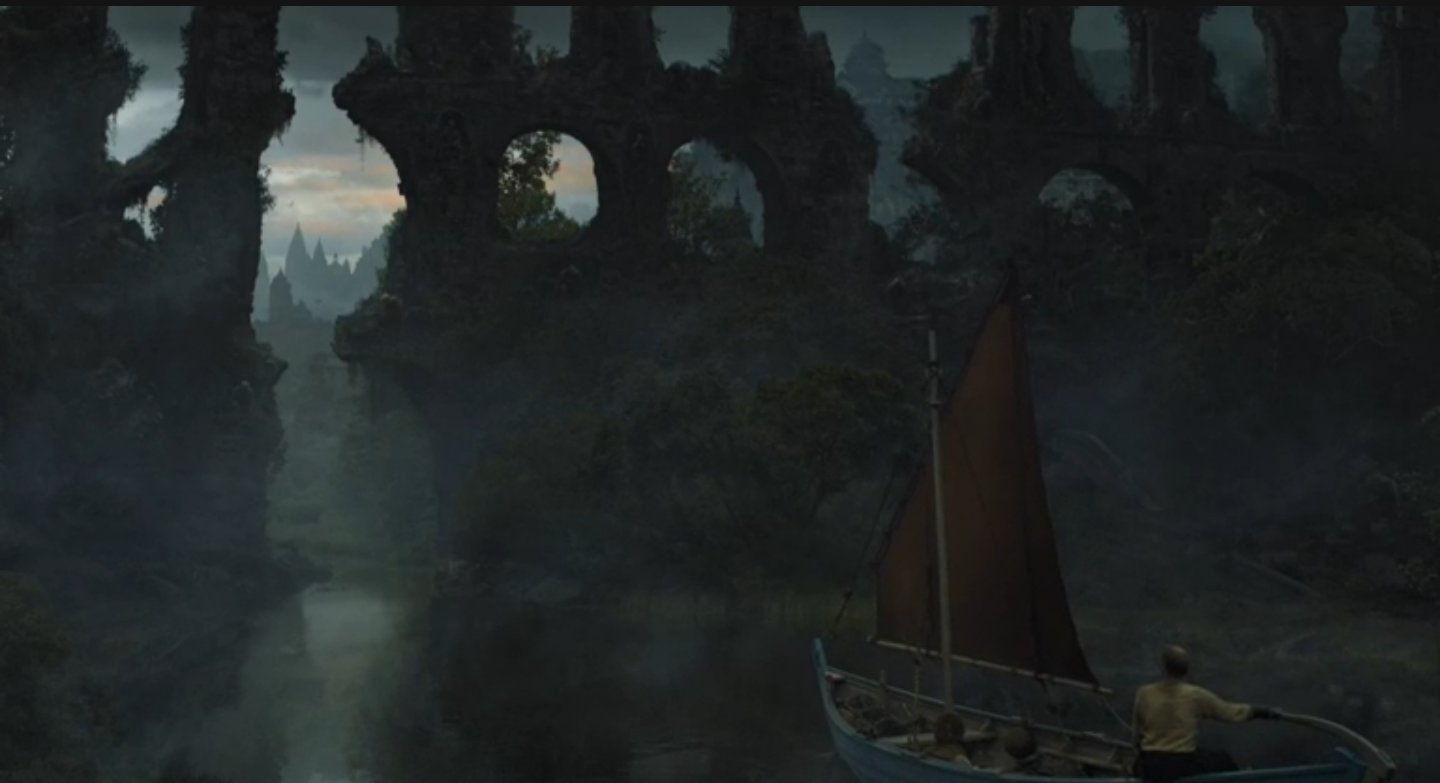
In the novel, the leader of the river-barge group gets infected. But with that storyline dispensed with, we instead have a death sentence levied on Ser Jorah. A death sentence and a ticking clock: he now has to fulfill whatever mission he has assigned himself before the disease overtakes him.

What did you think of the Tyrion/Jorah scene, Nikki? And what did you make of Daenerys’ decision to make a power marriage?

dany_cell

Nikki: I knew Tyrion wasn’t going to drown (GRRM can kill just about anyone, but I feel like Tyrion is one of the Untouchables), but like you, I thought they were going to cut to credits as he was going down. Brilliant use of the long black screen — the last time I saw a screen stay black that long was at the end of The Sopranos series finale. I’m saddened to see Ser Jorah affected by greyscale, but wonder if there’s any way he could beat it, too? It seems unlikely; Stannis was able to save his daughter by employing everyone in the country that he could. Mormont doesn’t exactly have Stannis’s standing, so I’m thinking his days are numbered.

As for Daenerys, however, I think she’s finally figured out how to use those dragons. Back in the season premiere, Daario told her that she’s the mother of dragons, and needed to show the world what that meant. She went down into the dungeons but it felt hopeless — her children were lost to her.

Not anymore. That scene of the nobleman being immolated and then ripped in two by the dragons might be the single most graphic effect on the show so far, and it was spectacular. She put the fear of dragons into those noblemen for sure, before taking the remaining ones and putting them into jail cells. But what to do with them? As she explains to Missandei, Ser Barristan wanted mercy for them; Daario wants them all killed. Without a single advisor, Daenerys has many voices ringing in her head, and unlike Brienne, simply cannot see a single correct path, and keeps changing her mind. Now she turns to Missandei, but of all Daenerys’s advisors, Missandei is the one who tells her she needs to make this decision. She has seen advisors tell Daenerys many things, and she’s seen Dany listen to them… or ignore them when she knows there’s a better choice out there. In this scene Missandei becomes Daenerys’s conscience and voice of reason, and suddenly, with an absence of male advisors, Dany makes a decision for herself. She heads down to the jail cell where Hizdahr Zo Loraq is being held, and finally acknowledges what I’ve been thinking all along — that of all the people who have been talking to her these past months, he’s always come off as the most reasonable, the one who calmly tells her the way things are and gives her the advice she needs to keep her citizens happy.

Advice, by the way, she’s completely ignored until now.

She tells him that she agrees with him that he’s been right, and she was wrong, and she apologizes for ignoring him for so long. She will once again open the fighting pits, but it will be only free men who will fight in them, not slaves. Loraq looks pleased, but remains on his knees before her. Then she tells him that she’ll go one step further — she will marry the head of a noble family in Meereen. “Thankfully,” she adds, “a suitor is already on his knees.” And she walks out, leaving him still sitting on the floor, probably thinking, “Did… she just tell me I’m marrying her?”

Yes she did, my friend. Because that’s how Dany rolls.

I hope this is the right decision. But at the very least, we know Tyrion’s on his way to her side to help strengthen her even further… with or without Ser Jorah.

And that’s it for this week’s Game of Thrones! Join us next week, where I hope we drop in to check up on the Sand Snakes and Arya, and perhaps Tyrion and Jorah have some more upbeat poetry they could recite for us. See you then!

Leave a comment

Filed under Uncategorized

Paranoia’s White Privilege

At this point in my life, I can safely say that I’ve got conspiracy theory fatigue. Part of that is self-inflicted, as I spent five years writing my doctoral dissertation on conspiracy theory and paranoia in postwar American fiction and film; and having staked out that scholarly turf, I’ve kept myself apprised of the currents of paranoid wingnuttery in the eleven years since, from Trutherism to Birtherism and beyond. After a time it all becomes extremely repetitive: the pronouncements of those whom Richard Hofstadter dubbed “paranoid spokesmen” are about as formulaic and predictable as pornography.

I offer this preamble by way of saying that I very, very rarely feel compelled to write about this sort of thing any more.

What twigged my interest over the last few days is a report that a group of Texan Tea Partiers have raised concerns over a series of joint military exercises that will take place partially in the state, code-named Jade Helm 15. Now, concern over a large military exercise taking place in your backyard is understandable, but of course the conspiracists are proclaiming loudly that this is a “false flag” operation designed to provide cover for the invasion of Texas and establishment of martial law. Those making this claim point to the fact that several Wal-Marts have closed unexpectedly, and have suggested that the empty stores will be used as detention camps for anyone resisting the ensuing occupation.

wal-mart

There’s more, involving dark claims that tunnels have been built between the Wal-Marts and other points to better facilitate the invasion, but I think you get the idea. Yet another installment in the wingnut chronicles, right? Except that this time the conspiracy theory has received political endorsement: Governor Greg Abbott has responded to the wingnuts by mobilizing the Texas National Guard and ordering them to “monitor” the operations to make certain they don’t overstep their bounds. “It is important that Texans,” he said, “know their safety, constitutional rights, private property rights and civil liberties will not be infringed upon.” And if that wasn’t enough, Senator Ted Cruz has promised his constituents that he will get answers from the Pentagon because “when the federal government has not demonstrated itself to be trustworthy in this administration, the natural consequence is that many citizens don’t trust what it is saying.” Though if Jade Helm 15 is in fact a false flag operation designed to turn Texas into Obama’s tinpot dictatorship, I’m not certain why Cruz seems to think the Pentagon would tell him that.

But then, wacko-bird is as wacko-bird does.

Senator Ted Cruz - Lynchburg, VA

Even here, with elected officials getting in on the paranoia, I can hardly colour myself surprised. Considering the accusations and charges thrown at Obama from the highest levels of the GOP, the invasion of Texas seems like small beer.

No, what’s gotten under my skin in reading this most recent conspiracist argle-bargle is the realization that this kind of paranoia proceeds from a position of privilege. “Paranoia,” let’s not forget, is a psychological designation and entails, among other things, a high degree of delusion and fantasy. Paranoia is by definition contingent upon context. To put it another way: a 1950s housewife living in Topeka who becomes convinced that the government has her under intense surveillance and will soon send the secret police to arrest her is almost certainly paranoid; by contrast, a mid-ranking member of Stalin’s Politburo in the 1930s who believes this is just exercising common sense.

In his excellent book Empire of Conspiracy, Timothy Melley marks out conspiracy-theory based paranoia from more pedestrian manifestations by identifying it with what he calls “agency panic.” The term is a deft little double entendre referring to the fear on one hand of “agencies” like the ATF, CIA, FBI, and so forth (or more classically, the Illuminati or the Freemasons); and on the other hand, the fear of losing one’s individual agency at the hands of a conspiratorial group or organization.

But let’s return to the Texas conspiracy and run down a checklist of fears it expresses that are common to most such conspiracy theories:

  • Agency panic
  • Military occupation and martial law
  • Constitutional abuses
  • Mass incarceration

As I said above, I don’t willingly return to my dissertation topic without significant motivation. But what inspired me to sit down with this topic was my sudden anger at just how obscene this kind of conspiracy theory is after a year that has seen the events of Ferguson and the current unrest in Baltimore, the deaths of Michael Brown, Eric Garner, Tamir Rice, Freddie Gray, and the increasingly unavoidable fact that police forces across the U.S. are implacably and systemically set against urban black populations. I don’t mean this in the sense of “how dare you float a conspiracy theory when there’s racism you should be paying attention to,” but rather that all of those elements that comprise conspiracists’ paranoid fantasies are quotidian realities for African-Americans. Agency panic? Black agency has been systematically denuded by agencies from HUD to local police forces. Military occupation and martial law? From a strict legal perspective, no; but from any practical estimation, urban blacks are constantly subjected to a militarized police force, something that was on terrifying display in Ferguson last summer (as I wrote about in a blog post then). Randy Balko’s book Rise of the Warrior Cop is as damning an indictment of this fact as any I have encountered. Constitutional abuses? The War on Drugs, which has disproportionally hurt African-Americans, has all but dispensed with the Fourth Amendment. Mass incarceration? I don’t feel this one needs any explanation, as the U.S. has the highest incarceration rate in the world, again disproportionately affecting black Americans.

Outrage In Missouri Town After Police Shooting Of 18-Yr-Old Man

The paranoid fantasies emerging from the right wing of the American political spectrum have always had a disturbingly racist character, and while organizations like the John Birch Society are Exhibit A, the Birchers are by no means sui generis. If I have to point to the highest-profile paranoia on the American right, the NRA unavoidably takes the top spot, with Wayne LaPierre playing the mouth-frothing role of their paranoid spokesman. Everything in his many, many screeds is framed in terms of governmental intrusion and overreach—the slightest hint of a suggestion of a longer waiting period or a restriction on magazine capacity gets characterized as a plot to disarm Americans in order to pave the way for a totalitarian socialist government. Whether LaPierre actually believes his conspiracist bloviation or is just cynically playing on the credulity of his organization’s membership, it nevertheless feeds an insatiable appetite. When I earlier compared conspiracism to pornography, this was what I was thinking of.

But as any even casual observer of NRA rhetoric knows, second amendment fundamentalism is a whites-only club. When Cliven Bundy defied federal agents who wanted him to stop illegally grazing his cattle on government land, and was supported by heavily-armed “patriots,” he was the darling of Fox News in general and Sean Hannity in particular. When Bundy let his mouth run and revealed he was an unreconstructed racist, watching Hannity backpedal was amusing; but really, if he was being honest, he shouldn’t have. Everything about Bundy’s standoff, from Fox’s initial valorization of his bold defiance of government agents, to the fact that said agents responded peacefully when faced with armed citizens, screams white privilege. A counterfactual floated by any number of people at the time wondered how the situation would have been different if Bundy and his supporters had been black.

cliven

It would take a particularly torturous and disingenuous argument to suggest it would be no different. Fox News and Bundy’s other boosters in the right-wing media would have condemned it as armed revolt; the fact that Bundy was breaking the law in grazing his cattle on government land would have been repeated ad nauseam; and the “patriots” in the scenario would have been the agents of law enforcement. And had Bundy et al been black, it is highly doubtful the government agents would have backed down.

All of this is by way of saying that right-wing paranoia about government is just that—paranoia. The Cliven Bundy fiasco was not in itself a manifestation of conspiracism, it just shared its DNA—the Fox News crowd was quick to jump on board because it perfectly encapsulated the kernel of the conspiracist narrative, i.e. a dictatorial government seeking to run roughshod over a good old boy’s rights (rights which, in this case, he didn’t actually have—but whatever). The touchstone moments of right-wing conspiracism, most notably the catastrophe at the Branch Davidian compound in Waco, Texas, are not cumulative indicators of systematic government aggression but examples of massive cock-ups. Meanwhile, the actual grist for the paranoiac mill, such as the NSA’s massive, and massively unprecedented, surveillance of digital communication does not seem to figure into the right-wing paranoid mentality. No one in those corners seems inclined to claim Edward Snowden or Chelsea Manning as martyrs to the cause.

martial-law

Meanwhile, what this past year has continually showed us is that precisely the kind of governmental behavior that animates conspiracist fantasy has been deployed for decades against actual people. A right-wing website, apropos of Jade Helm 15, poses the hypothetical “What would happen if martial law was declared in America?” If actual martial law were declared, that would be shocking, and would go a certain distance to vindicating the paranoia of a vocal minority. But what is not shocking, or at least doesn’t make the news unless there’s a police killing and/or riot, is that a certain segment of America lives under de facto martial law, their rights of privacy and personal autonomy constantly contravened; and in every confrontation with law enforcement, whether it’s for a broken taillight or loitering, black Americans know they are under threat of deadly violence. That’s not paranoia: that’s everyday reality.

To be genuinely paranoid, you have to have the freedom to concoct imaginary enemies.

Leave a comment

Filed under wingnuttery

Game of Thrones 5.04: The Sons of the Harpy

gameofthrones_teaser02_screencap10

Greetings friends once again for the great Game of Thrones co-blog. Season five continues apace, and what a pace it is in this episode—Jaime and Bronn arrive in Dorne, we finally meet the notorious Sand Snakes, Cersei rolls the dice and arms the Faith Militant, Melisandre tests her fiery wiles on Jon Snow (who still, apparently, knows nothing), and we see just how much game Barristan the Bold had (spoiler: LOTS).

With me as always is my friend and bantery roadshow companion Nikki Stafford, the Brienne to my Jaime. Or is it the Varys to my Littlefinger? Hard to say. It changes.

But without further ado …

 dorne_map

Christopher: Well, to start with, we finally get Dorne in the opening credits. Though if I can offer a geographical quibble, this is the first time the credits name an entire region rather than a specific castle or city. But I guess that’s neither here nor there.

We open this episode with a wordless scene picking up from where we left off: Ser Jorah knocking a hapless fisherman unconscious and stealing his boat. He leaves a couple of coins in the prone man’s body, though I somehow don’t think it’s quite enough for the poor guy to buy himself a new boat. And he unceremoniously—and rather callously—dumps a bound and gagged Tyrion in the bilges to start them on their quest to take him to the “queen.”

I read an article yesterday in which the author praised Game of Thrones for its dramatic use of editing, specifically its use of blunt cuts to drive the narrative forward: a great example from last week being the cut from Roose Bolton telling Ramsay that he’d found him an ideal bride who could solidify the North for him, to Littlefinger and Sansa riding along an escarpment under a gloomy sky. That gave us, the viewers, the heads up on the plot twist before Sansa twigged to it: a moment of shock for both those who have read the books and those who haven’t, one that heightens the dramatic tension of watching Littlefinger’s scheme dawn on Sansa.

jaime_boat

Here we have a lovely transition that provides a certain thematic symmetry: the cut from Jorah’s stolen boat to a proper ship, which houses another Lannister. The brothers are both embarked on treacherous journeys (though Tyrion does so under protest), but away from each other—literally and figuratively, a fact emphasized by Jaime when he tells Bronn that Tyrion “murdered my father … if I ever see him, I’ll split him in two.”

Initially, the Jaime and Bronn road show is rather more moribund than Bronn’s travails with the shorter Lannister brother. Bronn doesn’t understand Jaime’s strategy, and Jaime is not inclined to spell it out for him. All he will say is “It has to be me”—from which Bronn deduces that it was Jaime who freed Tyrion. Jaime maintains that it was Varys, but it’s obvious Bronn knows he’s sniffed out the truth. Presumably he assumes that Jaime has embarked on this fool’s errand as a form of atonement for the act that led to the murder of Tywin … but of course we know it’s more complicated than that.

Once again, this is uncharted territory: Jaime makes no such journey in the novels. And while there is almost certainly a measure of atonement for Tywin here, there is also the fact of Mycella’s parentage, something he of course cannot divulge to Bronn. Not that I think Bronn would care one way or another, but it was obvious in the scene when Cersei shows him the intricately-packaged threat from Dorne that his necessary denial of his daughter and the distance he has had to put between himself and all his children weighs on him. Cersei’s accusation that he was never a father to his children was petty and disingenuous, but we begin to see in this episode the emotional damage it has done to Jaime. This is in itself something of a departure from the novels, though a subtler one: in Jaime’s POV chapters, he makes his relative indifference to his children clear, reflecting at points that the only person who has ever mattered to him—the only person he’s loved—is his twin sister. “It has to be me,” is atonement, yes, but also perhaps his vestigial paternal instincts asserting themselves.

Though the banter between Jaime and Bronn is tepid aboard ship, things get more interesting once they’re ashore … actually, before they get ashore, as we see what will almost certainly be one of the running jokes of their partnership: Bronn hauls laboriously at the oars, panting, and when he pauses to give Jaime a pointed look, Jaime just raises his false hand. “Sorry dude. Can’t very well row with this thing.”

What I’m enjoying about this partnership is the subtle and not-so-subtle ways in which the differences between Jaime and Bronn emerge. Bronn’s relationship with Tyrion was always far more cut-and-dried; even though it was obvious that Bronn had a great deal of affection for Tyrion (and vice versa), it was always clear that their main relationship was financial—in part because Tyrion’s stature necessitated the hiring of a bodyguard. Less his sword hand, Jaime Lannister is no longer the brilliant fighter he was, but there is at least (at first) the illusion of parity between these two. But their breakfast conversation begins to highlight the significant class differences between the two. With a pragmatism born of want, Bronn does not hesitate to chow down on his snake kebab; Jaime eyes his suspiciously and puts it aside. And he voices surprise that Bronn’s ideal death is “In my own keep, drinking my own wine, watching my sons grovel for my fortune.” Why not something more exciting, Jaime asks? “I’ve had an exciting life,” Bronn says. “I want my death to be boring.”

"You want your death to be boring. OK ... I know what all those words mean, but when you put them together it makes no sense to me."
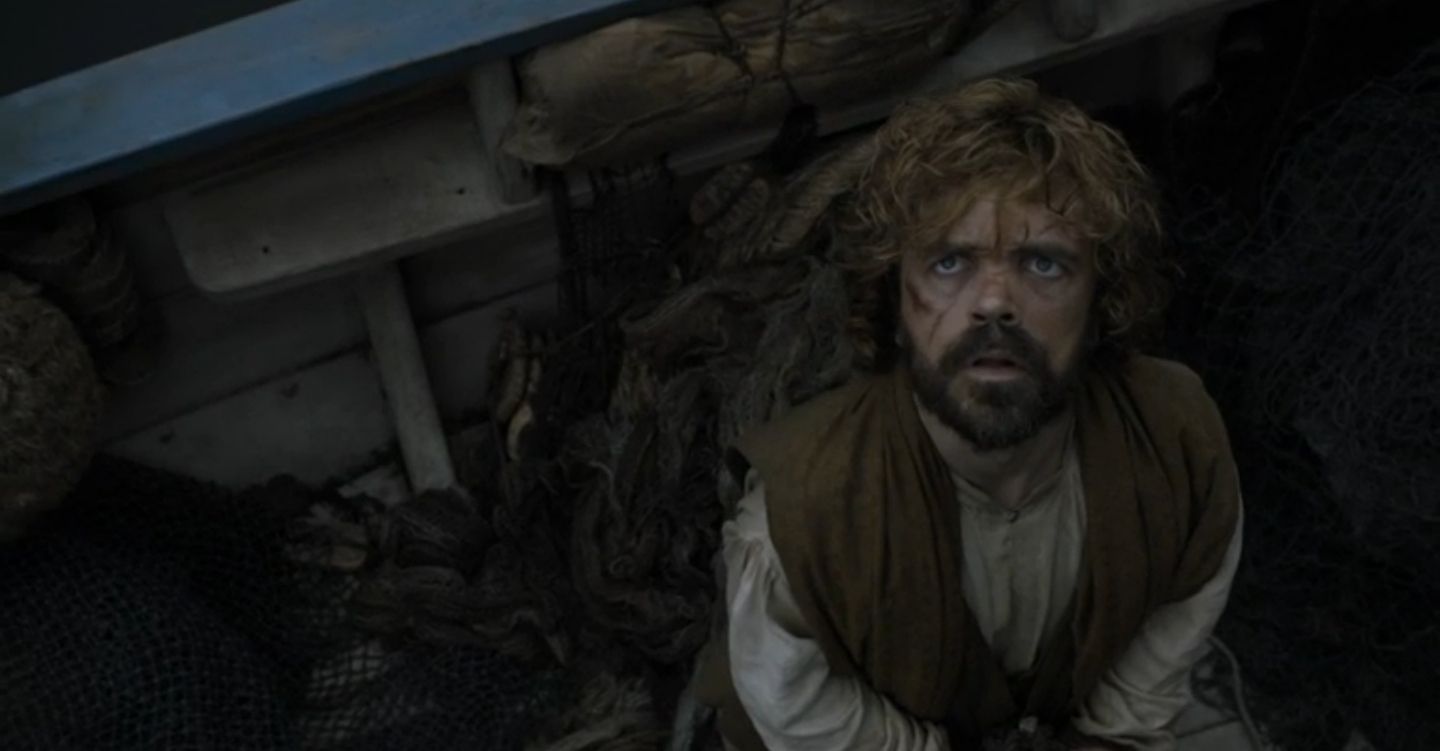
“You want your death to be boring. OK … I know what all those words mean, but when you put them together it makes no sense to me.”
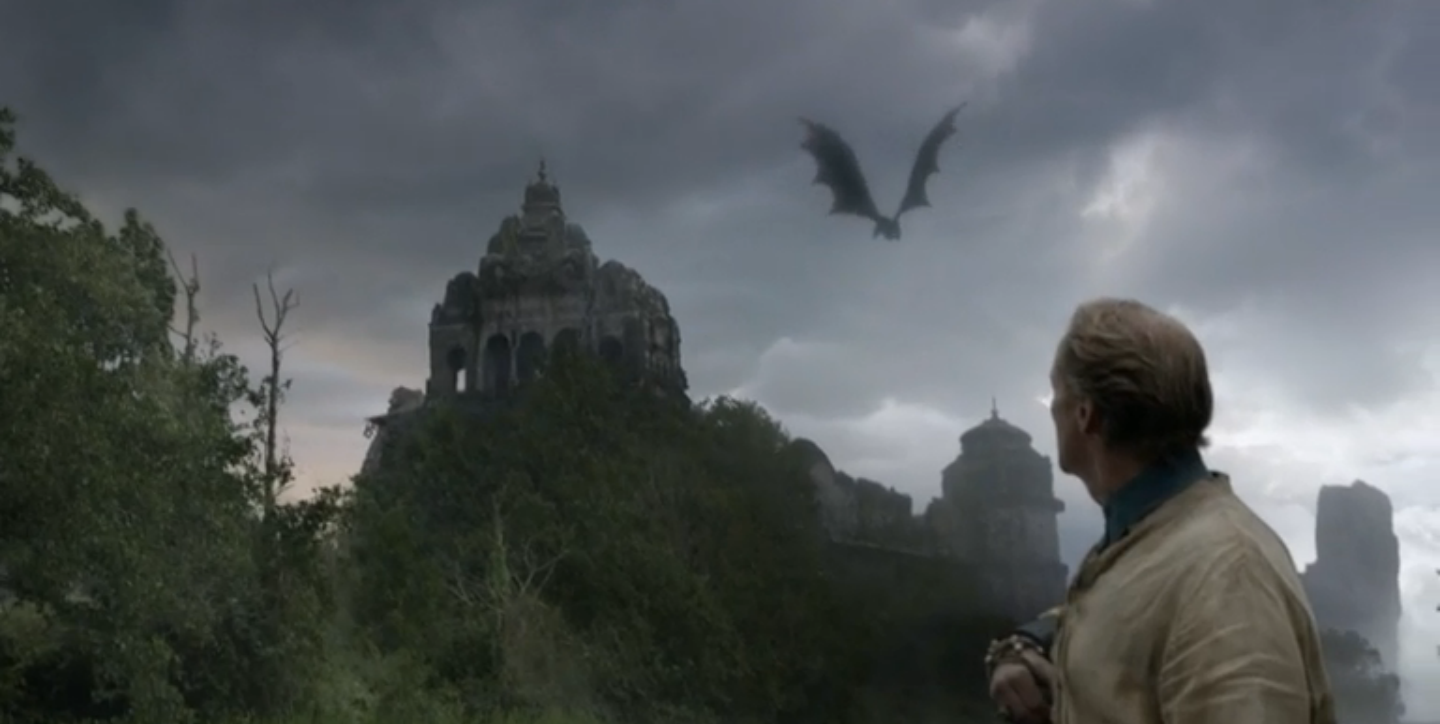
Jaime, raised in a castle as the golden son of Westeros’ richest and most powerful family, thinks nothing of the comforts Bronn desires. Bronn however, who has probably spent his life impoverished more often than not, is far more practical. He is, to paraphrase Liam Neeson, a man with a specific set of skills—and unlike those who would seek glory, he employs his talents as a means to an end. Which shortly after breakfast is simple survival: in yet another amazing fight scene, he dispatches three out of their four attackers, while the formerly fearsome Jaime Lannister is humiliated by a mere guardsman, saved only by chance by that which nearly doomed him—his false hand. And once again Bronn is reminded that he is as much servant as partner, as Jaime’s false hand means the burying of the bodies is left to him.

And then another nice piece of editing: after Bronn extols the virtures of Dornish stallions, we see a veiled rider galloping through the surf. As it turns out it is Ellaria, meeting up with Oberyn’s bastard daughters to plot against both the Lannisters and their own prince.

What did you think of our first encounter with the Sand Snakes, Nikki?

sand_snakes

Nikki: They were everything I’d hoped they would be. As I know by pinging it on the Google, “Sand” is the surname given to noble-born bastard children in the south, much as “Snow” is the name given in the north. If I understand correctly (and you can correct me if I’m wrong, Chris), the Sand Snakes are all Oberyn’s daughters, and there are actually eight of them. The one with the short brown hair — Tyene — is Ellaria’s daughter with Oberyn. Ellaria has also mothered several of the others who aren’t shown. But perhaps on the show the Sand Snakes will consist of only the three, and the other five will remain literary characters only.

For years before I had children, I used to attend the Toronto International Film Festival with my best friend. We would take the week off work and attend 30 films, sending long emails to friends who had signed up for our email list, in an early version of blogging that predated actual blogs. In 2002, our top film of TIFF was Whale Rider, starring a then-12-year-old Keisha Castle-Hughes. She was transcendent in the film, at one point having to deliver a stirring speech in a school play on the verge of tears, and the entire audience was bawling. It was the world premiere of the film, and afterwards Castle-Hughes and several other cast members got up in front of the room. She was so young, so sweet, grinning the entire time (this was her first time watching that movie, and first time seeing an audience’s reaction to her work), and yet there was a fierceness to her even then, a toughness that made you think this is going to be one of those child stars who transcends child stardom.

keisha-castle-hughesAnd she has. While she’s mostly taken small parts, you can see what a fantastic actress she is in everything she does. And it’s no different here, where, as Obara Sand, the eldest of the Sand Snakes, she is very devoted to her father, and will stop at nothing to avenge his death. Ellaria explains to the Snakes that their uncle, Prince Doran, will not start a war to avenge his brother’s death. So, she concludes, they must do it themselves. They have Myrcella, and that’s a major bargaining chip against the Lannisters. Nymeria explains that they have a problem, and with one crack of her whip, she flips a nearby cannister up in the air to reveal a man’s head. He’s alive, but has been buried up to his neck in the sand, and has three giant scorpions crawling on his face. He had approached Obara and told her that he had information (seeing his current predicament, methinks he should have kept his mouth shut). He told the girls that he had brought Jaime Lannister over from King’s Landing. This puts a new wrench in the plan. Ellaria says, matter-of-factly, that the girls must make a choice: “Doran’s way and peace, or my way, and war.” Tyene immediately joins her mother, while Nym nods a quiet agreement. Ellaria turns to Obara, and in a magnificent speech, where she tells of her father taking her from her mother at an early age and telling her she had to choose between one of two weapons — the “manly” spear, or her mother’s “womanly” tears. And with that, she picks up a spear, and in one throw lands it directly in the centre of the skull of the man in the sand. Looking back at Ellaria, she says, “I made my choice long ago.”

As we’ve said many times while talking about this show, this is a series where women are not subservient to men. Yes, Daenerys was taken by her vicious brother and married to the terrifying Khal Drogo, but she stepped up, took over, made him love her, and then became the Khaleesi. Her brother? Dead. Brienne is every bit the knight that any man is, if not more. Sansa might be manipulated at every turn, but despite that, she is stepping into a new role now as vengeance for her family, and something tells me she’s got this. Arya is embarking on a life where she has almost always been in complete control. Gilly was raped and impregnated by her father, yet now she lives confidently within a town of all men, and shows no fear. Stannis makes his decisions based on what Melisandre tells him to do. His daughter is brilliant. Robert Baratheon, Ned, Tywin, and Joffrey are all dead: Cersei and Margaery are still standing, and hold all the power.

Yes, this is still a show where women have to “overcome” being women to show they’re strong, and yet it feels like that’s more for us, as an audience, and less for the people in this world, who accept that Daenerys, Cersei, Ellaria, and Melisandre are in charge.

I adored this scene, where the women basically shrug and say, “All right, if the menfolk aren’t up to it, I guess WE have to do it,” as if they assumed that was going to be the way the entire time. I also loved the outfits, the shoes with the upturned toes, the way the horse was dressed, the simple tent — everything about that scene was perfection. These sisters are doin’ it for themselves.

But now let’s move away from the warm climes of Dorne and back to the land of the ice and snow, where Melisandre — whom I think is absolutely gorgeous, regardless of how evil she is — discovers that Jon Snow might not be into all redheads. What did you think of the seduction scene, Chris?

mel_jon_02

Christopher: Before I answer that question, Nikki, I just want to address your excellent point about the women of Game of Thrones. In many ways the depiction of women on this show is a bit fraught, largely because it has taken advantage of HBO’s now-signature freedom to show full frontal female nudity. Last week’s scene with the High Septon in the brothel was a case in point: yet more sexposition, with nothing like parity for male nudity (lots of asses, no dongs). I wish they’d either tone down the former or ratchet up the latter for the simple reason that it detracts from what you’ve pointed out: this is a show that depicts any number of nuanced, complex, ambitious, and capable female characters—you can see I’m trying to avoid using the cliché “strong,” which has effectively become meaningless—who, despite their pseudo-medieval environment have as much as (if not more) agency than many of the key male characters.

This, I must say, is one of the things I love about HBO in general. I’m teaching a graduate seminar this fall titled “Difficult Men,” which looks at prestige television’s tendency to create dramas centering around mercurial, brilliant, and, well, difficult men: The Sopranos, Mad Men, Breaking Bad, Sons of Anarchy, Deadwood, and so forth. One of the questions to be asked is: why this masculinist turn in television so loved by the intelligentsia? But of course what makes so many of these shows notable is not so much the masculine center as the female counter-narratives that provide dramatic and narrative tension and undercut the logic of what are unavoidably masculine economies of power (whether it’s the mafia, 1960s Madison Avenue, the drug trade, and so forth).

Game of Thrones is a bit too much of an ensemble piece to make it onto my syllabus, but this dynamic is baked into its DNA.

To return to your question about Melissandre: we sort of knew a moment like this was coming since her flirtatious elevator ride with Jon Snow in episode one. Melissandre is quite literally a femme fatale—she possesses enormous power, and much of it is bound up in her sexuality. The Lord of Light does not seem to preside over a particularly austere or prudish church: Melissandre’s attempted seduction employs the rhetoric of free love and the naturalness of sex. “The Lord of Light made us male and female,” she purrs, “Two parts of a greater whole. In our joining, this power—the power to make life, power to make light, the power to cast shadows …” Given the persecution of Ser Loras by the sparrows in this episode, to say nothing of the serendipitous coincidence of this episode airing while the Supreme Court of the U.S. hears a case on marriage equality, one wonders what Melissandre thinks about sexual coupling that falls outside the male-female paradigm?

Of course, her whole point is to tempt Jon away from Castle Black, first by showing him how tenuous his oath to the Night’s Watch is, and second by reminding him of the pleasures he could enjoy as a free man and a Stark. And if her quarry were almost anyone else in the world, she’d likely have succeeded. The beautiful little irony in this scene is that, in the end, it’s not so much his vow as a Night’s Watchman that makes him hold firm as the memory of the time he’d broken that vow. He remains true to Ygritte. “I swore a vow,” he protests, and follows that with “I loved another.” “The dead don’t need lovers, only the living,” Melissandre responds. “I know,” he says, with finality. “But I still love her.” To that Melissandre has no riposte, and abandons her seduction attempt. But as she exits, she echoes Ygritte’s favourite mantra: “You know nothing, Jon Snow.”

mel_jon

Coincidence? Or does Melissandre know more about Ygritte than she lets on? One way or another, the comment devastates Jon, and he sits behind his desk with a distraught expression. It was a moment that gave me pause, as I reflected that Jon Snow, more than anyone else on this show, has what he “knows” derided. But it occurred to me that, whatever his real parentage, he really is Ned’s son in this respect: “as stubborn as he is honourable,” as Stannis said last week, which the would-be king did not mean as a compliment. Eddard Stark knew nothing, or rather he knew just enough to underestimate Cersei and let himself be betrayed by Littlefinger. But then, Ned was unwise enough to take on the role as Hand of the King, which requires a shrewder political mind than he possessed. As Lord Commander of the Night’s Watch, Jon Snow has found his level.

Perhaps.

That being said, I loved the poignancy of the scene preceding Melissandre’s seduction attempt. We’d just watch Stannis et al watching Jon training men to fight—and listened to Queen Selyse’s blinkered prejudices against bastards and cripples—but here we see him playing the tedious role that every administrator knows: paperwork. Sending out requests for men to a legion of petty lords, few of whom Jon has heard of. But he balks at sending a letter to Roose Bolton in a moment that ironically parallels Sansa’s anguish of last episode. There was little in the series to hint at Jon and Sansa’s relationship; in the novels, when Sansa thinks of him, it’s in dismissive terms. He’s just the bastard. Arya of course loves Jon, because she does not care about the social niceties that preoccupied pre-King’s Landing Sansa. But Sansa had basically a milder version of her mother’s antipathy. So it makes for an interesting twist that they’re both in a position of needing to kowtow to the new Warden of the North, and that both of them do so with murder in their hearts.

Speaking of Sansa, she’s being left alone at Winterfell by the only person who qualifies as a friend. Littlefinger apologizes, but fills her (and us) in on his larger plans. So remember that time, last week, when I speculated about how Baelish had miscalculated? Turns out I was wrong. Turns out he wasn’t forgetting about Stannis, he was counting on Stannis marching on Winterfell. Huh.

What did you think of the Sansa scene, Nikki?

sansa_candle

Nikki: Your excellent analysis of Melisandre as one with a single-minded purpose, pulling people over to her dark side by brainwashing them but at the same time probably not accepting of the idea of same-sex coupling just made me realize something I hadn’t before: she’s the Michele Bachman of Westeros. Now I’m looking forward to the inevitable scene, when her empire crumbles and she’s standing in the ashes, looking upwards, shaking her fist and angrily yelling, “This is your fault, Obama!”

Also, you and I should do a post on the treatment of women on TV. And I need to come out and audit your course.

Before we leave the Wall, I just wanted to add that I loved the scene between Stannis and his daughter. Yet another thing I constantly love about this show is that they make these characters so complicated. There are characters whom we’d love to see as evil, but with almost no exceptions (let’s just set Joffrey, Ramsay, and Craster aside for the moment), they are still human, and capable of earning our sympathy. Stannis is someone who claims to have the blood right to the throne, and frankly, he’s not wrong. If his brother died, and Robert had no legitimate children of his own, then the succession should have been the same as before Robert was married — it automatically goes to the brother (one need look no further than the current royal family and what happened when Edward VIII abdicated to see evidence of that). On the other hand, his devotion to Melisandre and the Lord of Light makes his judgement suspect. In this scene with his daughter, he’s a loving father, devoted even more to her than to anything else — I feel like he’d throw this entire “heir to the throne” thing to the direwolves if he thought it would rid his daughter of the greyscale on her face. In a moving story, he admits that it was he who caused it, by buying a little doll for her that had been infected with it. His act of love had gone awry, and infected the one person he loved more than anyone. Everyone told him that she was a goner — just think of Gilly’s sad story in last week’s episode, where she told of two of her sisters getting greyscale, and how her horrible father put them outside to separate them from everyone else, rather than attempting to treat the condition. (Considering his daughters were nothing more than sex toys to him, one is unsurprised.) Last week’s story was in there to show viewers just how horrible the greyscale could have gotten for Shereen, but for her father’s relentless belief that he could make her better and save her life.

shireen

And he did. He put his mind to it, gathered up everyone he could, and managed to stave off the spreading of the disease on her face. She will forever be marred by it — and her repugnant mother reminds her of her ugliness at every turn — but he doesn’t see the greyscale. He sees only the way in which he failed his beloved daughter. His similarly relentless pursuit of the Iron Throne seems to have been fueled by this failure: if he can attain that Throne and rule the Seven Kingdoms, he will have made his daughter a princess. “You are the princess Shereen of the House Baratheon,” he says to her. “And you are my daughter.” In this moment, I was willing to burn my Targaryen sigil and follow him into battle.

Stephen Dillane has always played Stannis with such solemnity and sadness that I can’t help but sympathize with him. Even when he was burning Mance Rayder at the stake, I saw that as something he 100% believed in at the moment. It’s that sense of conviction that makes him such a dangerous foe, but also an invaluable ally. What a mesmerizing character.

But back to Winterfell. Sansa is in the crypt below the castle, paying her respects to the dead. She’s painfully aware that both of her parents and her brother Robb (and his wife) should also be buried there, but they aren’t. She lights the candles, ending with the one she puts in the hand of the statue of Lyanna — her aunt, her father’s sister, and the woman whom Robert Baratheon loved so much he never recovered from losing her. I squealed out loud when Sansa reaches down and finds a dusty feather sitting on the ground next to Lyanna’s feet. This hearkens back to a scene way back in season one, when Robert and Ned go to the crypts to pay their respects:


How fantastic that they reminded us of how much had changed in so short a time. Just holding that feather in her hand links her to that earlier discussion, where Robert Baratheon places the feather on the hand of the statue and tells Ned, “In my dreams I kill him every night.” He is king because he swore a vengeance that Rhaegar Targaryen would die for what happened to Lyanna. And she, similarly, is about to help Baelish wreak vengeance on the House Bolton for killing her family.

And then Baelish suddenly shows up, like the Oirish Batman he is, lurking in the shadows, and takes us back even further, to when he was a child and he got to see a tournament at Harrenhal, where Robert Baratheon and Rhaegar Targaryen and several other men were jousting. He tells the story of how, when Rhaegar won, he rode past his own wife, Elia Martell — for those keeping score at home, she was the sister of Prince Doran and Oberyn Martell, and the sister-in-law of Daenerys — and instead laid the crown of winter roses in Lyanna’s lap, as a hush fell over the crowd. Baelish looks back at the statue: “How many tens of thousands had to die because Rhaegar chose your aunt?”

Sansa reminds Petyr that he did choose her . . . right before he kidnapped and raped her. He smiles knowingly. They then begin walking away from the tombs and he explains his plan to her. He’s heading to King’s Landing, leaving her at Winterfell (I would panic if I didn’t know that Brienne was waiting in the hills outside the castle), but he knows that Stannis and his army are headed south. First, he explains, they have to take Winterfell, and his army is stronger than Bolton’s. Once he wins, he’ll have the north behind him and will take the Iron Throne. “A betting man would put his money on Stannis,” he says. “As it happens, I am a betting man.” Then, if all goes to plan, Baelish says Stannis will rescue Sansa from the clutches of the Boltons, and to repay her father for having supported his claim to the throne, he will name her Wardenness of the North. If, by chance, the Boltons are victorious, Baelish tells Sansa to simply make Ramsay hers, in much the same way Daenerys did with Khal Drogo. Ramsay’s attracted to her already, and Petyr reminds her that she learned political maneuvering from the best of them — i.e., him. And then he stands on his tippy-toes and kisses her because he’s a foot shorter than she is, reassuring her, “The North will be yours. Do you believe me?” She nods, and reminds him she’ll be a married woman the next time she sees him.

sansa_baelish

It’s a lovely fairy tale, but will any of it come true? Does Baelish actually believe any of it? I noticed in this scene one slip that he made, something he said that differed from the previous episode. When he’s reassuring Sansa that this will all work out in her favour, he says, “You’re the last surviving Stark.” But in the previous episode he’d said, “You’re the eldest surviving Stark,” as if he somehow knew about Bran and Arya being out there somewhere. Did he slip then? Is he slipping now? Is he playing her? One must always remember that with Baelish, no matter what, he never puts another person before his own political maneuverings. She’s right: she did learn from the best of them. But will her learning be enough to win over Ramsay Bolton? He, after all, is inhuman.

It’s not just Baelish I’m beginning to wonder about, but Reek. Last season I was pretty convinced that Theon Greyjoy was 100% gone, and that Reek was now here. But in the past couple of episodes, the way he appears to be listening to Ramsay and Roose as they talk, and the way he seems to be a little less shaky and more focused — while hiding himself from Sansa, as if remembering that he was raised almost like a brother of hers, something Reek shouldn’t have remembered — is making me wonder what’s up with him. He could turn out to be a wild card we didn’t see coming.

But now, as Baelish heads to King’s Landing, let’s go there, too. The Sparrows have become a malicious army that is wreaking havoc in the city. Cersei has given the High Sparrow full power, but in doing so, she’s allowed her own son’s power to be undercut, since her single-minded purpose at this point is to imprison Loras to punish Margaery. Last week I said that poor Tommen is caught in the crossfire between these two, and is being emasculated in the process, and that was clearly evident in this episode, as Margaery demands that he DO something, and Cersei makes it impossible for him to perform. Freud would be having a field day with this plotline.

What did you think of the way the Sparrows are taking over King’s Landing, Chris?


Wasn't this a scene in The Untouchables?

Wasn’t this a scene in The Untouchables?

Christopher: There’s an old saying about reaping and sowing. I forget how it goes.

I think it’s safe to say that Cersei is playing with fire. Absent her father or for that matter any competent allies besides Dr. Frankenstein Qyburn, she’s making a power play by arming the Sparrows, assuming that their leader will adopt a quid pro quo attitude in exchange for this alliance. It becomes pretty obvious that this is a dangerous assumption when Tommen is refused entrance to the Sept. He’s just a boy, and has little idea how to properly exercise his royal power (his one lesson in governance from Tywin being “do everything I tell you”). But more important than this is the reminder that the Lannisters aren’t exactly loved in King’s Landing—and that the pervasive rumours that the Queen’s children were born of incest have not gone away. “Bastard!” the crowd shouts at Tommen. “Abomination!” What before were salacious rumours that gave the commons license to mock the Lannisters in secret are something dramatically different in the hands of a mob of religious fanatics. They feel completely comfortable shouting out in public what was previously whispered in private.

tommen

And if this is the reception the king gets … what will they have to say about the woman who birthed these “abominations”? How inclined will the High Sparrow be to play Cersei’s game then? After all, in giving them Ser Loras, Cersei has essentially given them license to beat, punish, and imprison anyone they suspect of sexual deviance—or, really, anyone they suspect of sinning against the Seven, and the Jesus-in-the-Temple sequence shows that they’re casting a pretty wide net.

And Cersei isn’t doing herself any favours in her attempts to consolidate her power. She alienates her uncle Kevan, who decamps to Casterly Rock; and in this episode she denudes the power of the Tyrells at court by sending Margaery’s father away on the pretext of making him an emissary to the Iron Bank. Mace Tyrell is a fool and a buffoon, absurdly honoured by the mission rather than seeing it for the ploy it is. Whatever she has planned for Margaery can now happen without her father to stand in front of her. And the fact that she has sent Meryn Trant along to “guard” him might well mean he’s not meant to return from the trip.

But in the process, Cersei has managed to isolate herself. “The Small Council grows smaller and smaller,” Grand Maester Pycelle observes. “Not small enough,” Cersei retorts, making it obvious that she wants to shoulder the old man out too.

It is plain that she hopes to win her son back to her influence. And in the short term at least she has made progress: whatever havoc ensues from the now-armed Sparrows, in having Ser Loras taken she has driven a wedge between Tommen and Margaery. How quickly the worm turns … just last episode he was ecstatic about his new bride, and with the enthusiasm (and randiness) of adolescence imagined things would always be the sexy romp of their wedding night.

Poor Tommen. So oblivious, and so utterly confused when Margaery deserts his bed. How long before he returns to his mother for help?

The maneuvering between Cersei and Margaery reminds me a great deal of the war between Caesar’s niece Atia and his lover Servilia on Rome. That show did a wonderful job of undermining the whole “great man theory of history,” in part because it depicted those groups marginalized by history—the underclasses and women—as actually being the people who shaped history’s course. Male and female power is even more complex on Game of Thrones because there isn’t such a clear distinction between the two. Daenerys is as powerful and competent as any of the male kings or would-be kings, but is an explicitly matriarchal figure. With the symbolic emasculation of Jaime when he lost his hand, it is now clear that the single greatest fighter on the show is Brienne, a woman who has chosen to embody all the trappings of traditionally male power. Arya has also chosen the route of eschewing traditional female roles, and at this point has gone farther than anyone else in agreeing to divest herself of (almost) all the trappings of her previous identity. And if Cersei, Margaery, and Sansa seek agency within their circumscribed roles as highborn women, our sojourns this season to Dorne and our introduction to the Sand Snakes open new possibilities entirely.

tyrion_jorah_boat

But whatever other small victories Cersei might be savouring in the short term, mounting Tyrion’s head on a pike won’t be one of them. “You’re going the wrong way,” he tells Ser Jorah. “My sister is in Westeros.” But instead of taking Tyrion west for the certainty of a pardon and a lordship, he’s taking him east, gambling that handing Daenerys a scion of the Lannisters will atone for his sins. “A risky scheme,” Tyrion observes. “One might even say desperate.”

Suffice to say, Jorah is not happy with Tyrion’s observations.

But it raises the question: Lannister or not, Tyrion made Daenerys’ life easier by taking one of her most formidable foes off the board when he killed Tywin. Why would she exact her revenge on someone who did that, and was furthermore just a child during the war that killed her family and exiled her?

One way or another, the Jorah/Tyrion road show promises to be a whole lot less entertaining than the one with Varys. One suspects that Tyrion’s wit will be lost on Lord Friendzone, and will probably result in a few more beatings.

Which brings us to our rather dramatic conclusion … what did you think of the Rise of the Harpies, Nikki?

harpies

Nikki: What I find so interesting about the Jorah/Tyrion debacle is that at the end of the third episode, when Jorah said that he was taking him to the queen, my husband immediately said, “Well, he’s about to see his sister a lot sooner than he expected to.” And I looked at him, baffled, and said, “No, he’s going to Daenerys; she’s the only person Jorah would ever refer to as queen.” And neither of us had even considered there was more than one “queen.” It’s amazing that, again, the show is so complicated it would elicit two completely different responses. (This is also me relaying that story to boast that I WAS RIGHT. Hehe…)

The end of the episode, where we see the Harpies rise up against the Unsullied, is a heartstopping scene. It’s preceded by Ser Barristan regaling Daenerys with the story of her brother Rhaegar, whom she’d always been told was a vicious killer — the one who, as we were reminded at the beginning of this episode, loved Lyanna Stark only to kidnap, rape, and kill her. But now, after hearing that story, the audience hears Ser Barristan tell a very different one. Rhaegar had a beautiful singing voice, he loved singing, and hated the killing. People lavished money on him, which he gave to charities and orphanages. Daenerys sits and listens to Ser Barristan with a starry look in her eye, as amused and thrilled by this story as she was revolted and ashamed of the story that Ser Barristan told her in the second episode of this season about her father. We’re reminded in this scene of how loyal Ser Barristan has been to the Targaryens, and how long he has served her. When she’s called away by Daario, Daenerys smiles at the aged knight. “Go, Ser Barristan,” she says. “Sing a song for me.”

barristan_dany

We didn’t know she meant swansong.

As Daenerys sits and listens to another plea by nobleman Hizdahr Zo Loraq, once again arguing that she should allow the fighting pits, we see what the Harpies are doing out on her streets. With the help of the same prostitute who helped kill White Rat, the Unsullied run after the Harpies as the latter embark on their killing spree, only to be cornered in a stone hallway on both sides. Grey Worm is a brilliant fighter, as are all the Unsullieds, but they’re outnumbered.

I have to say that, at first, I felt a little betrayed by this scene. The Unsullied are the most experienced and adept army in the Seven Kingdoms. From the moment they are toddlers, they are taught to focus on absolutely nothing but fighting. Ten thousand Unsullied, we have been led to believe, could take on an army 10 times their size. So a bunch of men — whom I suspect, though I could be wrong, are the noblemen who are angry with Daenerys for unseating them — corner them in an alleyway and they somehow manage to beat them? Shouldn’t 15 Unsullied be able to fell 100 noblemen? Perhaps these men aren’t who I think they are. If the scene is introduced by the words of Hizdahr Zo Loraq talking about how badly they want the fighting pits back, perhaps the Harpies are in fact the men who have achieved champion status fighting in those pits. And if that’s, in fact, who they are, then I can believe they are a mighty force. But even that shouldn’t rival an army of men with one single-minded purpose in life, I thought.

However, the one thing we need to remember is that the Unsullied are taught to fight like an army. And the Harpies aren’t fighting with any sort of order or training, but ambushing them. And that’s a VERY different fighting style. You have men stabbing you in the side with daggers, rather than forming a line and coming straight at you on the battlefield. And every time they kill one, two more seem to run into the room.

The fight itself is awesome. Grey Worm is a formidable foe, taking down as many as four men at a time, sustaining serious stab wounds and continuing to fight with the focus of a true warrior. Blood is splattered all over the walls, heads are rolling, but it’s still too much. There are 15 men bearing down on him and he can’t take them all on.

Barristan the Badass.

Barristan the Badass.

And then Ser Barristan finally shows up to sing his song — and what an epic, glorious aria it is. He comes flying into the room like Obi Wan Kenobi, unsheathes his sword and effortlessly begins making a Harpy shishkebob with it. He stabs one in the back, then takes out NINE men in a row before splitting the tenth one right up the middle (ew). Meanwhile, Grey Worm hasn’t gone down, and now sees his chance, as several Harpies run over to take on Ser Barristan instead. But then Ser Barristan is stabbed. He swings and takes out a man. He’s stabbed again, in the leg. He takes out another. He’s stabbed in the shoulder. He kills that guy. And then he’s stabbed in the abdomen, and he falls forward. As that man runs around behind him and is about to give him the Catelyn Stark treatment, Grey Worm stabs that man in the back. Ser Barristan falls, and Grey Worm falls to lie beside him.

Noooooooooooooo!!! Daenerys’s strength just dwindled considerably if they’re actually dead. Maybe they’re not dead, I’m thinking… but this is Game of Thrones. George RR Martin isn’t exactly known for his generosity when it comes to NOT letting characters die. Ahem.

I should probably mention to everyone here that TV critics everywhere were given the first four episodes, and we watched them a month ago and have been hanging on that cliffhanger ever since. It feels like such an inordinately long time since that episode already — let’s just say next week’s episode cannot come soon enough.

the_end

Just a note that this will be the last episode recap that will appear immediately following the end of an episode. As of next week, Christopher and I will be watching live with everyone else, and our recap will probably go live on Tuesdays. Thanks for reading what might be the longest recap we’ve done yet!! See you next week…

1 Comment

Filed under Game of Thrones