Monthly Archives: February 2014

What’s that got to do with the price of mithril in Eregion?

ring_edited-2

Back in Rivendell, Bilbo gave Frodo his coat of mail, the one that had been given to him by Thorin in The Hobbit. It proves to be a prescient gift, as it saves the Ring-bearer’s life at least twice. Frodo wears it hidden under his outer-clothes, and no one else knows he has it on his back until after they emerge from Moria.
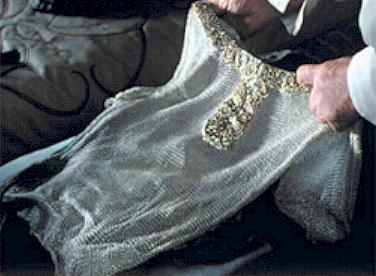
mithril_coat

While deep in the halls of Moria, Sam asks Gandalf what inspired the dwarves to brave the dangers and attempt to re-establish a kingdom here. “For mithril,” Gandalf replies, explaining that “here alone in the world was found Moria-silver, or true-silver as some have called it. Mithril is the Elvish name. The Dwarves have a name which they do not tell. Its worth was ten times that of gold, and now it is beyond price; for little is left above ground …” He goes on,

“Bilbo had a corslet of mithril-rings that Thorin gave him. I wonder what has become of it? Gathering dust still in Michel Delving Mathom-House, I suppose.”

“What?” cried Gimli, startled out of his silence. “A corslet of Moria-silver? That was a kingly gift!”

“Yes,” said Gandalf. “I never told him, but its worth was greater than the value of the whole Shire and everything in it.”

Frodo said nothing, but he put his hand under his tunic and touched the rings of his mail-shirt. He felt staggered to think that he had been walking about him with the price of the Shire under his jacket. Had Bilbo known? He felt no doubt that Bilbo knew quite well.

This moment is a rare glimpse into exchange-value in Middle-earth. A single mail-shirt worth as much of the entirety of the Shire? In practical terms, that seems fair—but only in retrospect, insofar as it saves Frodo’s life and thus prevents the Fellowship’s mission from falling into catastrophe. In that respect, the mithril-coat is worth the entirety of Middle-earth.

Wealth and poverty appear in The Lord of the Rings, but only obliquely. At no point is money ever a concern for any of the characters. Indeed, I am hard-pressed to think of any point after the hobbits leave Bree when anyone is shown selling or purchasing goods or services. Not that there are many opportunities: as mentioned here before, Tolkien’s Middle-earth is predominantly large swathes of wilderness dotted with towns and cities that are few and far between. Even so, money plays at best a miniscule role in Tolkien’s narrative furniture.
smaug

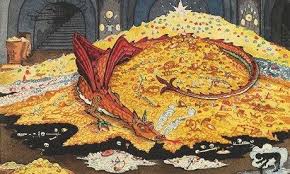
Smaug and his hoard, as it appeared on my first copy of The Hobbit.

The same, oddly, cannot be said about wealth. As with The Lord of the Rings, The Hobbit does not show money as being anything problematic or significant, even though it is strongly suggested that their years in exile have impoverished Thorin’s people. But wealth—vast, huge, stupefying wealth—is the novel’s principal motivating force. Yes, Thorin &co. want to reestablish themselves as the rightful rulers of Erebor, and yes, they were manipulated into the quest by Gandalf, who wanted the dragon dispensed with; but the narrative also possesses an unpleasant undercurrent of avarice, the desire for the dragon’s enormous hoard. In his book There and Back Again, an excellent study of the writing of The Hobbit, Mark Atherton points to Tolkien’s earlier fascination with myths and legends of dragon-hoards, in particular Beowulf’s battle with a dragon, and the story of Sigurd and the dragon Fafnir. In both cases, the allure of the dragon-hoard is a key motivating factor, and one which leads to a hero’s doom (Beowulf in the first instance, and Fafnir himself in the second, who was a man transformed into a dragon by his gold-lust).

smaug_hoard

Smaug’s hoard as depicted in the film.

Indeed, the dwarves’ song in Bilbo’s parlour at the very start of the novel—the song that wakes something “Tookish” in the hobbit—has little to do with birthright and kingdoms, and much to do with reclaiming the wealth stolen by the dragon. It’s worth watching the scene from the film, as it’s one of the few things Peter Jackson has gotten exactly right this time around:

There’s a small but significant change in the lyrics: the last line of the first verse in the novel is not “To find our long-forgotten gold,” but “To seek the pale enchanted gold.” Enchanted is the key word here, establishing as it does the sense of their lost gold as possessing magic of its own—the power to enthrall and entrap. The first half of the dwarves’ song is indeed preoccupied not with the mountain or the dwarves’ usurpation, but with the varieties of treasure shaped by the dwarven hands:

For ancient king and elvish lord
There many a gleaming golden hoard
They shaped and wrought, and light they caught
To hide in gems on hilt of sword.

On silver necklaces they strung
The flowering stars, on crowns they hung
The dragon-fire, in twisted wire
They meshed the light of moon and sun.

Goblets they carved there for themselves
And harps of gold; where no man delves
There lay they long, and many a song
Was sung unheard by men or elves.

And the song has an infectious quality, for “As they sang the hobbit felt the love of beautiful things made by hands and by cunning and by magic moving through him, a fierce and jealous love, the desire in the hearts of the dwarves.” Though this gold-lust is framed as somehow congenital to dwarves—we learn later that Elrond “did not altogether approve of dwarves and their love of gold,” for example—it is not specific to them, as even the Elvenking of Mirkwood is enthralled by the wealth of Erebor. The people of Laketown fete Bilbo and the dwarves outrageously, principally because they succumb to the fantasy of excessive wealth. And in a crucial moment, when Bilbo beholds Smaug’s hoard, he is enraptured:

Bilbo had heard tell and sing of dragon-hoards before, but the splendour, the lust, the glory of such treasure had never yet come home to him. His heart was filled and pierced with enchantment and with the desire of dwarves; and he gazed motionless, almost forgetting the frightful guardian, at the gold beyond price and count.

The physical scope and scale of such wealth is dramatically reduced in The Lord of the Rings, while the actual value of specific items grows by a magnitude. The staggering value of Frodo’s mithril-coat is itself vastly exceeded by the Ring. Which is a fact that makes The Lord of the Rings quite unusual in the tradition of quest-romance, as the entire point is not the acquisition of wealth and power, but its destruction. As the dwarves’ song and Bilbo’s reaction to it makes clear, wealth and value are closely tied to beauty—there’s no such thing as “filthy lucre” in Middle-earth, but that doesn’t mean that wealth is not a corrupting power. The gold-lust on display in The Hobbit is a foretaste of the Ring’s addicting nature. And though the Ring itself afflicts with ugliness, its destruction will lead to the diminution of the beauty in the world wrought by the Three Elven-Rings, as Elrond predicts: “maybe when the One has gone,” he says, “the Three will fail, and many fair things will fade and be forgotten. That is my belief.”

I’d argue that Tolkien’s treatment of wealth and value in both The Hobbit and The Lord of the Rings is crucial to understanding how Tolkien depicts the nature of power. Wealth is not portrayed as a means to an end. It is barely portrayed as an end in itself: it mostly just is, and as such is conflated with power. As George W. Bush is supposed to have said of the French, the people of Middle-earth have no word for “entrepreneur.” (Not entirely true, as such a man as Barliman Butterbur obviously runs his inn for the purpose of profit, but he is very much the exception to the Middle-earth rule. Presumably a more careful consideration of such places as Minas Tirith would show a more actively market-based society, but Tolkien does not oblige us on this front). Money and its acquisition, accrual, and deployment play no role in Tolkien’s world—which parallels the acquisition and accrual of power. The Ring, as Gandalf tells Frodo, grants its user power commensurate to his or her abilities. Hence, Frodo could not expect to become anything more than a second Gollum; Aragorn or Boromir would become great leaders and warriors, but little more; whereas Gandalf, Galadriel, Saruman, or anyone already possessing great power would become a new Dark Lord.

Such rigid stratifications are not surprising: Tolkien’s Catholicism, after all, provides a template for divine versus temporal power. In his essay “On Fairy-Stories,” he makes a telling distinction between the “right to power” and the “possession” of power. The former is divinity, and is “the due of worship.” “Possession” is delineated here as the lesser of the two; though he does not expand on this distinction, the suggestion is that one “possesses” power in the same manner as one earns wages, whereas the “right” to power is akin to inherited wealth, especially as it functioned in feudal contexts. Power, in other words, is a transcendent principle.

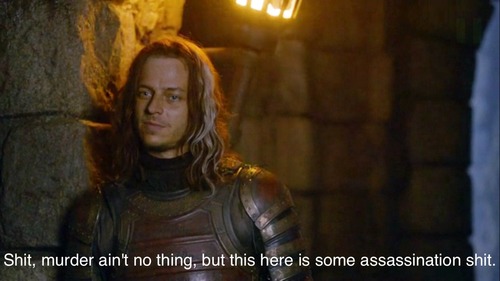
It is in the shift from Tolkien’s depiction of power as innate and immutable—destroyable but not transferable—to a more fluid and indeed Foucauldian model that underwrites my argument that much contemporary fantasy articulates a specifically humanistic world view. To this end, it is worth contrasting the lack of monetary concerns in Tolkien’s world with George R.R. Martin’s veritable preoccupation with money in A Song of Ice and Fire (second only to his preoccupation with food). The economics of Westeros comprise a crucial and persistent trope: “a Lannister always pays his debts” is the unofficial motto of the most powerful house, but it also points to the fact that debts, both financial and symbolic, pervade the narrative. The cost of things—be those things swords, food, or loyalty—is always at the forefront of everyone’s mind, and “the wealth of nations” determines their power, status, and geopolitical influence. To put it another way, power in Martin’s world is essentially fluid—or, to put it yet another way, and paraphrase Omar Little, money in Westeros doesn’t have owners … just spenders. There’s a reason why the Tumblr page A Song of Ice and The Wire, in which stills from Game of Thrones are captioned with lines from The Wire and vice versa, is so uncannily apt:
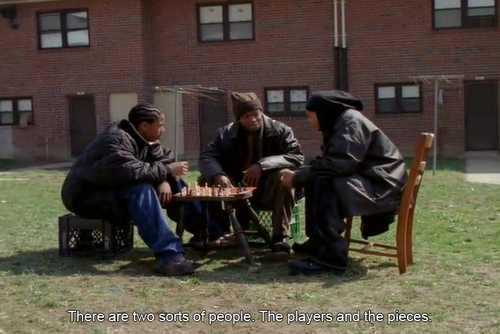
ice&wireice&wire2ice&wire3

Leave a comment

Filed under course readings, Return to Middle-Earth

Hic Sunt Dracones

ring_edited-2

There’s a moment in The Hobbit, before Bilbo and company arrive at Rivendell, when Bilbo sees the first of the Misty Mountains, the range that more or less runs the length of Middle-Earth. Gazing up at it in awe, he asks whether the mountain he sees is in fact Erebor, the Lonely Mountain, the troupe’s ultimate destination. Balin the dwarf scoffs at him, setting him straight—informing him that they will have to go over those mountains and then through huge swathes of wilderness on the other side before they will arrive at Erebor.

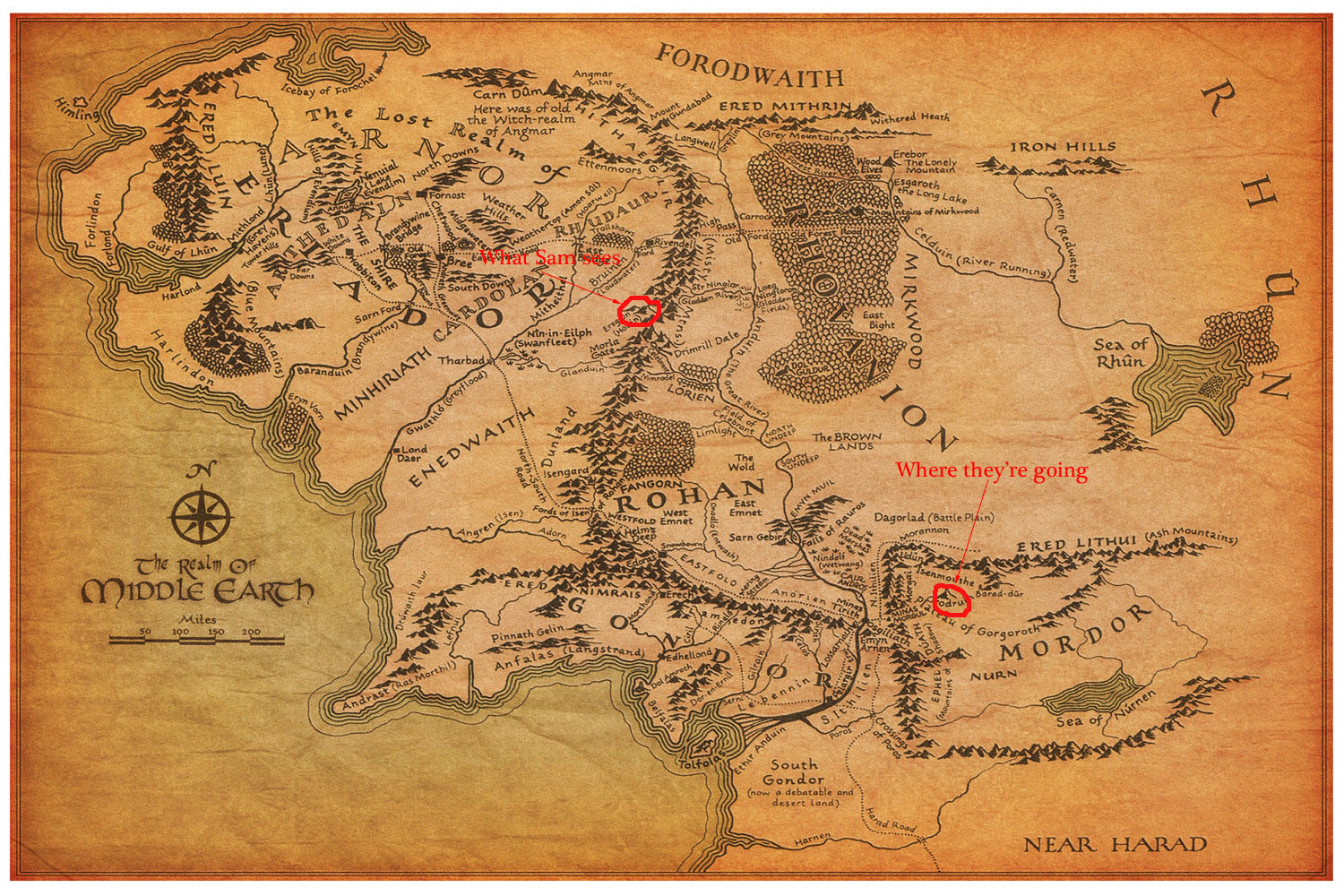
It’s one of those fish-out-of-water moments, of which Bilbo has many over the course of the novel. It also emphasizes his parochialism and his complacent ignorance of the wider world. In itself, it is not much worth dwelling on, except that it is replicated by Samwise Gamgee in The Lord of the Rings. As the Fellowship journeys south they come in sight of a spur of the Misty Mountains, prompting confusion on Pippin’s part, who assumed that the mountains should be to their left and not directly ahead. Exasperated, Gandalf says, “There are many maps in Elrond’s house, but I suppose you never thought to look at them.” And once again they are set aright by a dwarf, as Gimli comes forward, declaring, “I need no map” and naming all of the mountains in view. A little bit later Sam, unknowingly echoing Bilbo, says “I’m beginning to think it’s time we got a sight of that Fiery Mountain, and saw the end of the Road, so to speak. I thought at first that this here Redhorn, or whatever its name is, might be it, till Gimli spoke his piece.” Tolkien wryly observes that “Maps conveyed nothing to Sam’s mind, and all distances in these strange lands seemed so vast that he was quite out of his reckoning.”

We can hardly blame Sam or Bilbo, for either their geographical ignorance or their wistful hope that the respective objectives of their journeys are much closer than they actually are. There might have been maps at Rivendell, but how useful would they have been to people who lack an understanding of the scope and scale of the wider world? In The Hobbit, Bilbo is excited by the appearance at his unexpected party of Thror’s map because he loves maps—and then we are informed that he had a large map framed in his hallway of the local land around him, with all his favourite hiking trails drawn in red ink. The juxtaposition of what is literally a treasure map depicting a mountain hundreds of miles away with one highlighting local hiking trails is almost touching, so great is the difference between the two—like a map of local parks placed alongside the map of a military campaign (which, when you consider how The Hobbit ends, is not an inapt comparison). By the same token, after Bilbo’s departure at the beginning of The Lord of the Rings, “Frodo began to feel restless, and all the old paths seemed too well-trodden. He looked at maps, and wondered what lay beyond their edges: maps made in the Shire showed mostly white spaces beyond its borders.” It is hard (for me, at least) not to read this passage without thinking of Heart of Darkness and Marlow’s fascination with “the white spaces on the map.” (Indeed, when talking about maps in my Tolkien class, I allude to Conrad’s novel enough that I’m starting to wonder if there’s an article there to be written).

Maps play a significantly different semantic role in fantasy fiction, however, insofar as they reverse the standard relationship between maps and the territory they depict. One way or another, maps are inherently fictional, in that they necessarily distort the material they seek to represent, even as they strive for scientific or mathematical accuracy. The actuality of the world, with all its intricacies, is translated into a set of lines on a flat surface, alongside a set of such overt fictions as national borders, other political designations, and place names. (To be clear: in calling borders and place names “fictional,” I am not saying they are not real, just that they are invented—they are fictions agreed upon by a consensus, and as such, are always subject to change). Mountains become gradations of colour or concentric lines on a relief map, cities and towns are rendered as dots, different nations are designated by a palette of striking colours and circumscribed by dotted lines. In this respect, maps are not dissimilar from fiction proper, which similarly seeks to render a given interpretation of reality but must needs deform it for specific purposes.

It is at this point in discussing maps that I like to pause and show a clip from The West Wing.

Maps in fantasy fiction, by contrast, are not depictions of extant territory. How could they be? They are rather outright inventions, but therefore have a drastically different relationship to their worlds than our maps. They are, in a word, deterministic. That is to say, the map determines the territory.

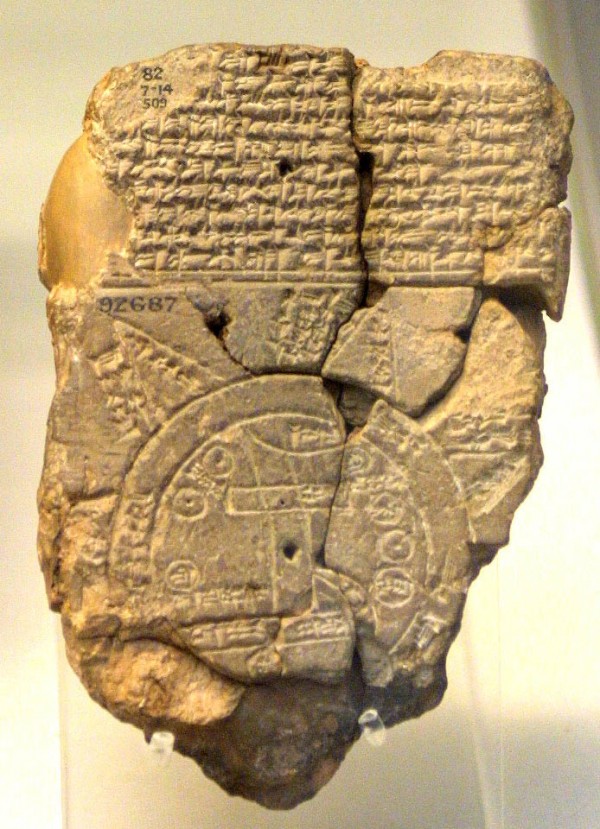
Consider the history of maps of our world. The earliest known attempt to present a map of the world is one from Babylon, around 600 BCE. It essentially depicts the world as a disc, with a handful of lands and cities and landmarks surrounding Babylon, all of which is surrounded by a circle of ocean.

babylon_world-map

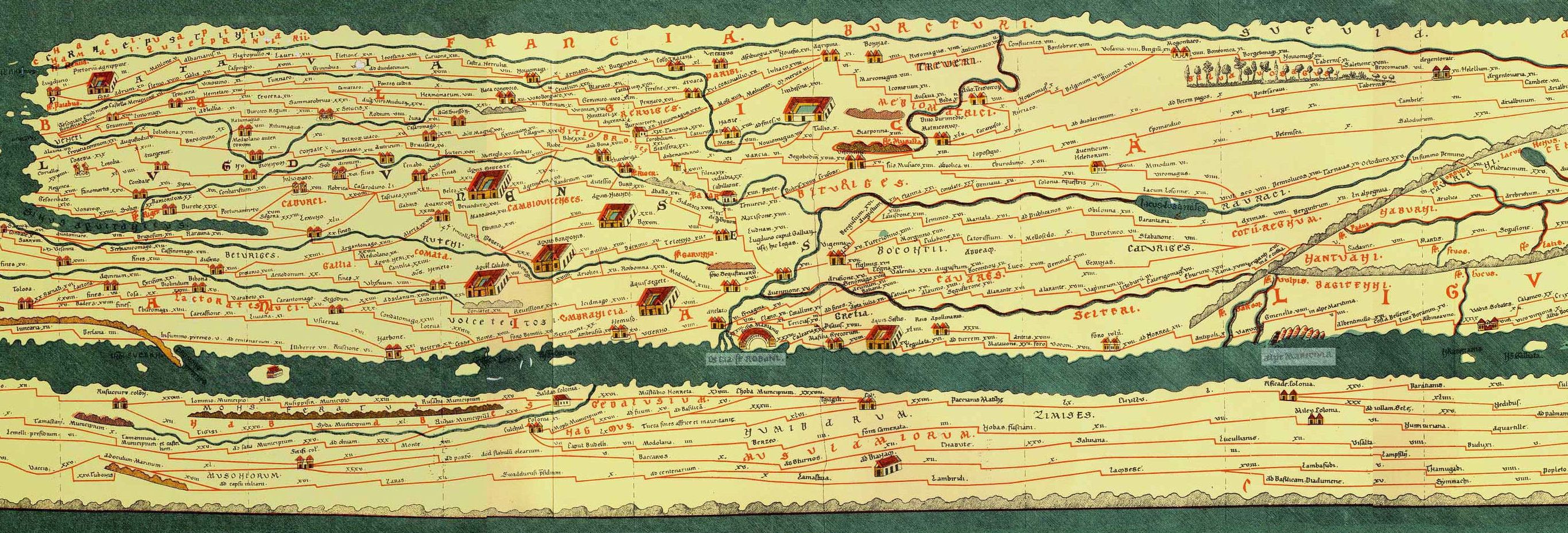
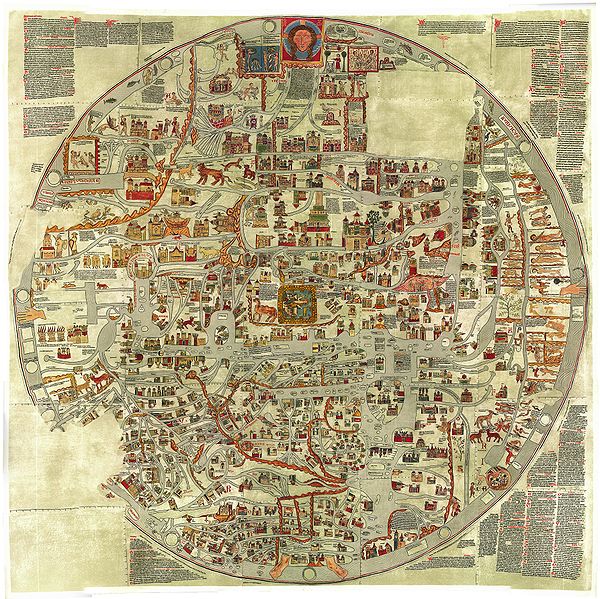
Consider, in turn, a series of maps down through the ages:

TabulaPeutingeriana2

The Tabula Peutingeriana (ca. AD 500), a Roman illustrated itinerarium (road map) showing the cursus publicus, the road network in the Roman Empire.

Ebstorf_map

The Ebstorf Map (ca. 13th century), a medieval map of the world.

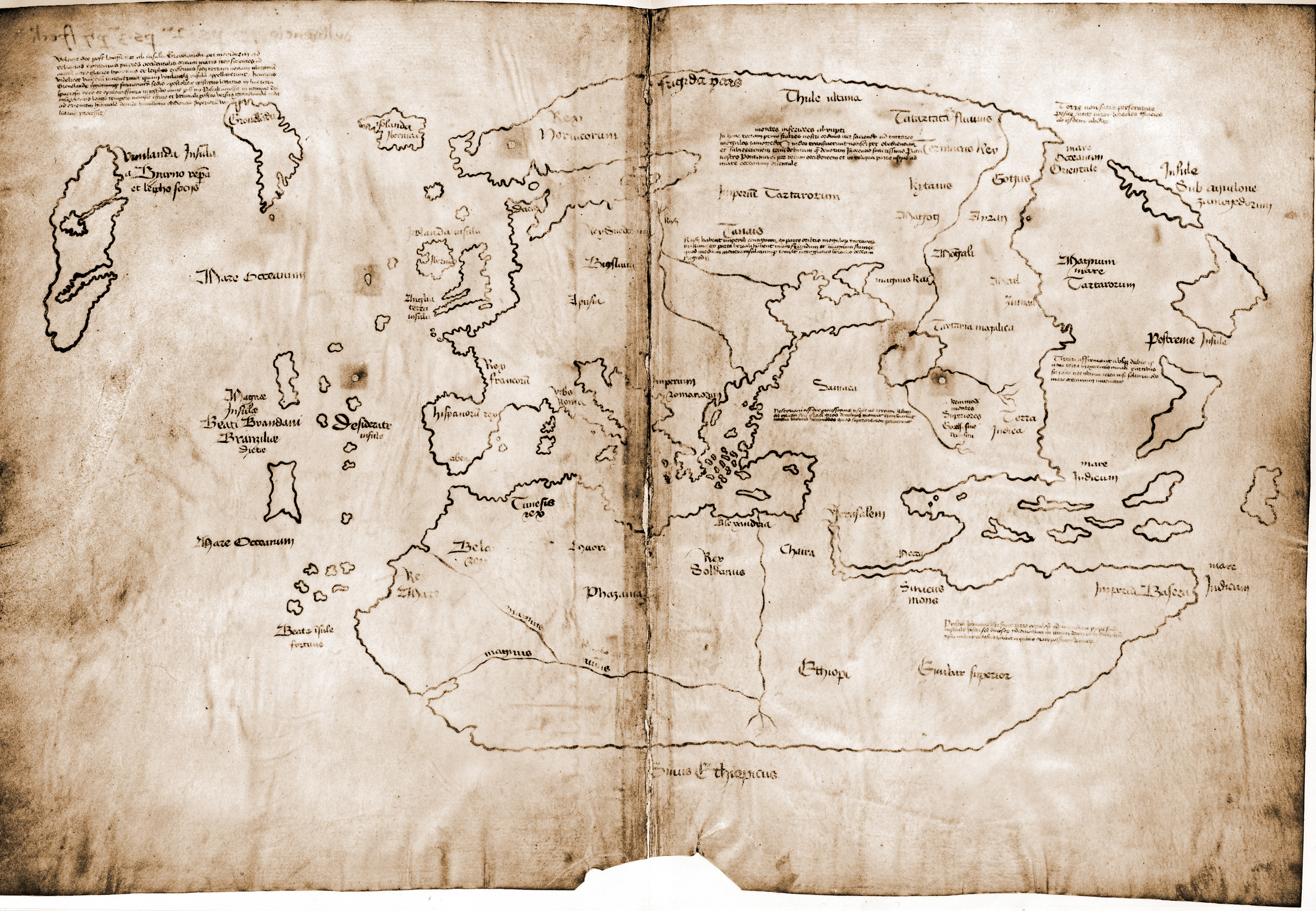
Vinland_Map_HiRes

A map purporting to show Vinland (Newfoundland and the Maritimes–upper left corner), based on Viking exploration in the tenth century.

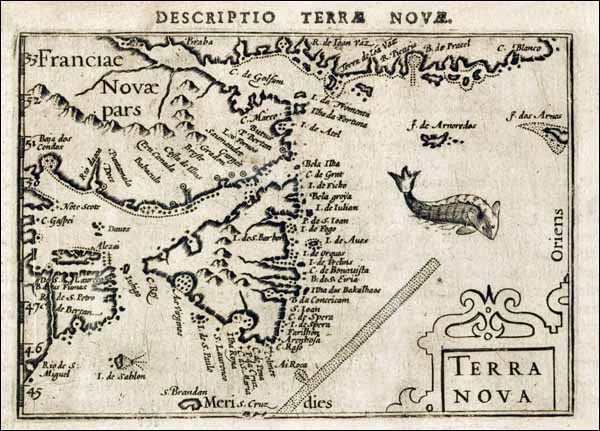
barent_langenes_map_600

Can you see my house?

I suppose it could be argued that the movement of maps toward increasing accuracy contradicts my premise that maps are inherently fictional, but I would disagree; accuracy and reality are not the same thing. And as the (fictional) Organization of Cartographers for Social Equality would point out, the conflation of accuracy with reality can and has been deployed in the service of the powerful.

But I digress. Maps in fantasy fiction are paratextual, which is to say that—like prefaces, indices, appendices, annotations, title pages, afterword, and so forth—they work to circumscribe and define the text of the story. And by the same token, we are privy to them in a way the characters of the narrative are not. So when Sam grumbles about Caradhras not being Mount Doom, as he’d hoped, it is a moment not unlike dramatic irony—assuming, of course, the reader is anything like myself and obsessively consults the maps provided in order to know where in the world the characters are at any given point.

(This is not, I have been given to understand, a pervasive tendency—indeed, last year when I taught The Hobbit in my first-year English class, I polled the students to find out how many of them consulted the maps while reading. To my considerable shock, two-thirds of them did not look at the maps at all. And suddenly the more general geographical ignorance of our undergraduate population became a little bit more comprehensible).

The (quasi) dramatic irony of Sam and Bilbo’s misapprehension lies in the fact that readers know, far more indelibly than the characters, the geography of the world they inhabit.

middle-earth3
Of course, such characters as Bilbo and Sam and Pippin are contrasted with Elrond and Gandalf and Aragorn (for example), all of whom presumably have a much greater and more thorough grasp of the extant maps of Middle-earth. But for a long time I have wondered—and yes, this is entirely speculative—do they consult the same maps as the readers? Over the Christmas holidays this past year I read Creation by Gore Vidal, which is about a Persian diplomat named Cyrus, a boyhood friend of the Emperor Xerxes, who over the course of his life travels from Persia to India, to China, and at the end of his life to Greece. At one point as he consults with the Emperor Darius about his first embassy to India, a map of the known world—etched onto copper shields—is produced. Part of Cyrus’ mission is to map the territory into which he ventures, with an obvious emphasis to be put on trade routes. His description of the maps makes it clear that they are only slightly more accurate than the Babylonian map pictured above.

However, the novel provides maps at the beginning, one depicting the entirety of the Persian empire around 500 BCE, and a detail map depicting Greece and the Greek colonies on Asia Minor. Maps of such accuracy are not of course available to Cyrus. And when we read histories of, for example, the Wars of the Roses or the Roman conquest of Gaul, we similarly have maps that the Yorks and Lancasters did not have; and the Romans were sojourning into (literally) unmapped territory. All of which is by way of observing that, if fantasy is in part a nostalgic escape to premodern, neo-medieval settings, I think it is a fair assumption that Middle-earth’s cartographers were no more accomplished than their medieval European counterparts.

Again, this is entirely speculative: I can no more determine the accuracy of the maps in Rivendell than I can definitively tell you how many children Lady Macbeth had. The point here is more to draw attention to the dissonance between the maps with which Tolkien provides us, and his characters’ experience of the territory those maps determine. (It makes me think that someone needs to write a fantasy novel that unfolds as a series of increasingly-accurate maps, with disputes over their validity and the theological arguments over the shape of the world providing the main conflicts for the narrative).

The point is also the epistemological certainty the maps of various fantasy novels afford. One could argue that a fantasy map isn’t meant to be seen as accurate, that it is in fact meant to be understood as replicating the distortions and inaccuracies of medieval maps … except that I cannot think of any reason The Lord of the Rings or any other fantasy novel gives us to make that assumption. Rather, maps of Middle-Earth, Westeros, Pern, Earthsea, and so forth—take your pick—provide a privileged perspective that is consonant with fantasy’s relationship to history. As Farah Mendlesohn observes in her book Rhetorics of Fantasy, the genre tends toward a scholastic conception of the past—which is to say, like medieval Scholasticism, it treats historical accounts as straightforward fact rather then with historiographic skepticism. However much Tolkien characterized his writing of the tales that would become The Silmarillion (and the countless subsequent books edited by his son Christopher) as “creating a mythology,” in the context of The Lord of the Rings they comprise its history. Beren and Luthien, the voyage of Earendil, the fall of Gil-Galad—all of which we encounter in The Lord of the Rings through song—are not mere myth or legend like Gilgamesh or Odysseus, or legend embellished from history, like the Trojan War, but are indelible history. (In case we doubt their validity, we have such literally immortal figures as Elrond and Galadriel, who were actually around for much of Middle-earth’s “mythic” origins).

The question of history versus myth in Tolkien is one I will return to in a future post. For now, let me return to his maps: I know I am not alone in having been enthralled by the geography of Middle-earth; certainly, the hugely popular multiplayer Lord of the Rings Online game exploits the detailed topography of Middle-earth to great effect (I recently signed up for an account, but haven’t yet had much chance to play—more on that when I have). I unfortunately don’t have anything resembling a proper conclusion to this post—like most of them, this is mostly my musings and little more—but I do mean to return to this topic in the future. Stay tuned.

Leave a comment

Filed under Uncategorized

Tolkien and the Magic of Home

ring_edited-2This week in my Tolkien class we arrived at Rivendell, where Frodo and company have a well-deserved rest. I introduced our discussion of Rivendell by positing to the class the significance, indeed the necessity of periodic safe havens in adventure narratives—and the more harrowing the adventure, the more important it is for the protagonists to have occasional respite, for it is a respite for the reader/viewer as well. The emotional relief of momentary security balances the anxiety, fear, or terror to which we and our heroes are otherwise subjected.

Of course, part of the emotional and thematic power of safe havens is the certainty of their ephemerality: either (1) we know our heroes will be obliged to move on sooner rather than later, (2) their safety will inevitably be breached, or (3) the safe haven isn’t quite as safe as first imagined, because those with whom we share it are themselves a threat (any fellow zombie film aficionado will be intimately familiar with this last one).

Nevertheless, the ability to pause and take a breath comprises its own odd form of catharsis. The most striking example of this, for me, is in Cormac McCarthy’s bleak post-apocalyptic novel The Road, possibly one of the most harrowing books I’ve ever read. A father and son (simply referred to as the Man and the Boy) travel across a blasted landscape that makes Mordor look like the Salinas Valley, avoiding cannibalistic gangs and searching for sustenance. Around the middle of the story they discover a Cold War-era bomb shelter, stocked with imperishable food and boasting beds with clean, warm blankets. My relief when they made it to this temporary safety would have been comical if it wasn’t so deeply felt.

Frodo waking in Rivendell to Gandalf’s voice isn’t quite the same thing, but there is a similar degree of relief, amplified by the idyllic quality of Rivendell itself—“a perfect house,” Bilbo had once said, “whether you like food or sleep or story-telling or singing, or just sitting and thinking best, or a pleasant mixture of them all.” Simply being there “was a cure for weariness, fear, and sadness.” Perhaps more importantly, it comes to feel to Frodo like home, not least because he is reunited with Bilbo, and because he allows himself to believe that his task is done. Just before he volunteers to carry on as Ring-Bearer, “An overwhelming longing to rest and remain at peace by Bilbo’s side in Rivendell filled his heart.” It is telling that, on imagining his burden has passed on, he does not think of returning to the Shire, a fact that anticipates his later emotional distance when his task is truly done, and his decision to leave Middle-Earth forever. (I suppose I should have prefaced that with “Spoilers!”) His apparent inability at that point to take pleasure in the Shire and in his post-Ring life deeply bothers Sam, for whom the Shire was always the beloved home to which he desired to return. That Frodo never really returns is, perhaps, first hinted at while he is in Rivendell.

rivendell-film

Frodo looks out at Rivendell in The Fellowship of the Ring.

Home and its different conceptions and figurations are a crucial theme in The Lord of the Rings; which is perhaps utterly unsurprising, considering that home—or a point of return, at any rate—is a crucial element in most quest romances, that space of safety from which the hero journeys into the space of adventure. Certainly, that was its thematic role in The Hobbit. We learn a lot less of the Shire and its denizens there, as Bilbo is thrown into his adventure with unseemly haste. In Rings, it takes the hobbits five chapters to get a leg on and finally depart, and in the process we learn a lot more about it, its qualities, its people. In The Hobbit, the Shire is what Bilbo thinks of wistfully while sleeping in the rain or skipping yet another meal. In The Lord of the Rings, however, we learn enough about the Shire to have a deeper sense of its worth and its meaning, and it becomes one of several figurations of home.

Why is this at all significant? Well, aside from mere curiosity, I’d argue that home as an idea and a reality as we understand it in the novel is connected to Tolkien’s figurations of power and magic. In a novel that is otherwise exhaustively detailed with regards to the history, mythology, and languages of its various peoples and societies, the nature of magic remains infuriatingly opaque. Tolkien does not deign to outline the laws and nature of magic as practiced by Gandalf, Elrond, or Sauron; aside from a few instances when Gandalf sets things on fire, magic appears as a nebulous, usually unseen force. Such coyness on Tolkien’s part sets him apart from those who followed him: fantasists such as Ursula K. Le Guin, Patrick Rothfuss, J.K. Rowling, and Lev Grossman turn magic into something that, while there must needs be an inborn talent for it, must be exhaustively studied and practiced. Each of the writers I mentioned incorporate magical schools or universities, where the students must commit thousands of details to memory and pass rigorous examinations.

Possibly Gandalf and the other istari had to undergo some such training back in Valinor, but the more acute sense communicated by Tolkien is that magic is innate. Of the rare glimpses into its workings we get, it also appears to be connected to contact to the “other realm,” a parallel or simultaneous reality that Frodo glimpses whenever he puts on the Ring. I will have another post soon on that subject; but for now …

*

Gandalf has something interesting to say to Frodo not long after he wakes up. When Frodo asks him if Rivendell is safe from Sauron, Gandalf replies “Indeed there is a power in Rivendell to withstand the might of Mordor, for a while: and elsewhere other powers still dwell. There is power, too, of another kind in the Shire.” Given that he doesn’t go on to say anything more about the Shire and what it’s “other kind” of power is, it’s an interesting comment. Obviously, the Shire is by no means as powerful as Rivendell or Lothlorien; and as we discover at the end of the novel, it was by no means prepared to repulse even the assault of a deeply weakened Saruman.

But there is power there: in class this week, we queried why the Nazgul are so much less fearsome in the Shire and Bree? At the Council of Elrond, Boromir describes the rout of Gondor’s forces: “[It] was not by numbers that we were defeated. A power was there that we have not felt before … Some said it could be seen, like a great black horseman, a dark shadow under the moon. Wherever he came a madness filled our foes, but fear fell on our boldest, so that horse and man gave way and fled.” Later on, we will see such fear deployed as the Nazgul’s main weapon—but while they are still Black Riders in the Shire, all they seem to do is creep out Frodo’s neighbours. In Bree, they become somewhat more menacing, actually attacking what they think are the hobbits in their beds—only to discover that they have been deceived by the illusion of pillows and bolsters underneath the bedclothes, in a ruse that could have been devised by Ferris Bueller.

maxresdefault

See? You can hardly tell the difference.

On one hand, it is tempting to think that Tolkien wasn’t sure who these villains were just yet when he wrote them. On another hand—and this was the class consensus—perhaps they lack the power they show elsewhere (such as the attack at Weathertop) while in a place of community. In both the Shire and Bree, they are objects of fear and suspicion—very obviously outsiders and strangers. It could be argued that they preferred stealth at such moments; but it could also be argued that, well, they’re Ringwraiths! Who needs stealth? Except that Gandalf tells Frodo that the Shire has its own kind of power. He does not, of course, elaborate on what the nature of that power might be, but the fact that he feels compelled to mention it at all is significant.

So what is the power of the Shire? This is not a question I have previously asked myself in my rereadings of The Lord of the Rings. I do think that my class is on the right track with this one: if there is power in Rivendell to withstand Mordor (for a time),  part of that power manifests itself in the peace and contentment its visitors feel, both in terms of obvious relief to be in such a secure place, but also in terms of the magic that sustains it. In Tolkien, landscape is frequently an expression of the mind or minds that inhabit it, and comes to manifest the dominant power for good or ill. Mirkwood was Greenwood the Great before Sauron took up residence in Dol Goldur in the guise of the Necromancer; his pernicious influence turned it into the dark and forbidding wood we see in The Hobbit, choking out sunlight and populated with such terrifying beasts as the giant spiders. Likewise, Mordor is a dire hellscape, and Saruman is in the process of turning the vale of Isengard into a comparably post-apocalyptic space when he meets his defeat. The cleansing of Isengard by the Ents in The Two Towers is, in my opinion, one of the things Peter Jackson got spectacularly right:

In contrast, Rivendell and Lothlorien are idyllic expressions of their masters’ benign power. On the first leg of their journey from Rivendell, the Fellowship reaches the land of Hollin, which used to be called Eregion when Elves dwelled there. Though they have been gone from the land for several thousand years, it is still a fair and pleasant place. Gandalf notes that, “There is a wholesome air about Hollin. Much evil must befall a country before it wholly forgets the Elves.” By the same token, the Shire is the embodiment of hobbit-society: pleasant, complacent, well-tended, and eminently comfortable.

It is in the experience of Rivendell however that Frodo and company have their first real encounter with the power of place. Rivendell—Imladris, in Elvish—is referred to as “The Last Homely House” (variously, “The Last Homely House East of the Sea” or “The Last Homely House West of the Mountains,” which tells us pretty emphatically that it is the only Homely House, at least on this latitude). In the first draft of The Hobbit, Tolkien initially refers to Rivendell as “the Last Decent House,” though he changes his mind about a page and a half on and changes “decent” to “homely,” and makes a marginal notation beside “decent” to change it later. The change is a sensible one, as “decent” conjures up connotations on one hand of moral propriety, and on the other of a certain snobbishness (as in “there’s no decent hotel in this city”). But “homely”? Why? It’s obvious we can dismiss our common contemporary understanding of homely as blandly unattractive (assuming Rivendell didn’t earn that name for poor design choices). It’s also obvious that the term can be understood, in part, as “homey,” but it does seem odd to call the home of Elrond Halfelven, son of Earendil the Mariner, “homey,” however much it might be so. Besides the obvious alliteration, why “homely”?

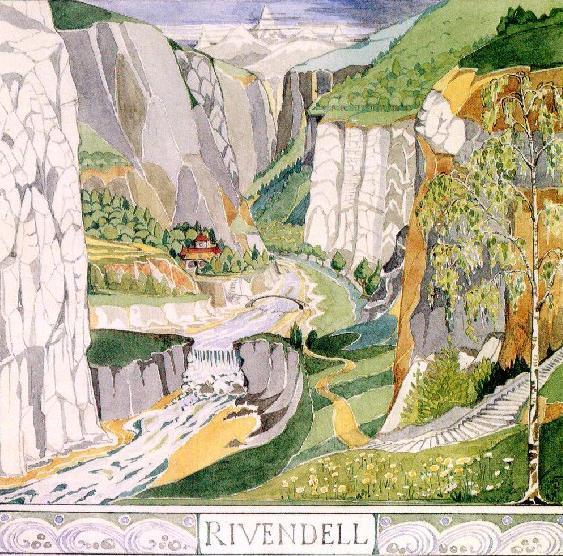
Rivendell_illustration

Tolkien’s own illustration of Rivendell.

To the OED!

“Homely” as it turns out is a far more textured and loaded term than one might at first assume. According to the Oxford English Dictionary, it comes to us by way of German and Dutch. Heimlike is Middle Dutch for belonging to a household or a home; hemelik is Middle Low German for “friendly or intimate”; and heimlich is Middle High German meaning either “belonging to a person’s own country” or “familiar and intimate.” So far, nothing surprising—all of these definitions are in line with “at home with” or other such uses of “home” to designate a place of safety and comfort, in which individuals sharing that space similarly share intimacy.

What immediately struck me however was the paradoxical way in which the German heimlich features crucially in Sigmund Freud’s essay on the uncanny. The word he uses is unheimlich, which though we translate that as “uncanny,” it more literally translates as “unhomely.” As Freud notes at the start of his essay, this understanding of the uncanny as that which makes us feel metaphorically not at home—unfamiliar, weird, unsettling—has been the one that traditionally obtained. But heimlich, in addition to meaning what is known and familiar, also carries the meaning of “Concealed, kept from sight, so others do not get to know about it, withheld from others.” And in the OED entry for “homely,” there is also this note: “In several cognate Germanic languages, the parallel adjective shows a semantic development from ‘private’ to ‘secret, clandestine’ or ‘mysterious’.”

Freud’s explication of the uncanny is largely focused on this seeming paradox, wherein heimlich and unheimlich come to have a significant semantic overlap. His thesis, moving beyond the simplistic understanding of the uncanny as merely weird and unfamiliar, posits that the unheimlich, the uncanny, has as much to do with revelation as it does with the unfamiliar. That is to say, the revelation of what is private and hidden; and most crucially, that which is hidden from the self as much as from others.

But what, you might ask, does this have to do with Rivendell? Quite a lot, I would argue. Tolkien might not have had much use for Freud, but he certainly had a lot of use for the OED (working as an editor on it was one of his first academic jobs), and one has to assume that given “homely’s” affinities with and roots in Germanic languages, he would have been well aware of its variegated meanings. Rivendell embodies both meanings of heimlich, in terms of its hominess, familiarity, and comfort—but also in terms of its secrecy and concealment. It is literally concealed, hidden among the valleys of the Misty Mountain foothills. This quality is less obvious in The Lord of the Rings, as Frodo is unconscious during the last leg of his journey from the Ford of Bruinen to Rivendell itself, and so has no memory of the hidden trail—unlike Bilbo’s experience In The Hobbit, in which the way to Rivendell is depicted as extremely tricky, with even Gandalf not entirely certain of his route. But Rivendell is also a place of concealment and secrets in a variety of other ways, not least of which is what it hides from the eye of Sauron: most prominently, Elrond (spoiler), as we discover in the final pages, is the wearer of one of the three Elven-Rings; Elrond’s ring however we can also read as representative of the practices and qualities of Elven-magic—felt but not seen, sensed but not grasped by those who are not themselves imbued with such power. Though Rivendell is advertised as the “Last” Homely House, we encounter a similar space when the Fellowship arrives in Lothlorien—and there the uncannier qualities of magic and power are more forcefully felt. Indeed, one of the significant moments of those chapters comes when Galadriel meets the gaze of each of the Fellowship in turn: “And with that word she held them with her eyes, and in silence looked searchingly at each of them in turn. None save Legolas and Aragorn could long endure her glance. Sam quickly blushed and hung his head.” Sam admits later that “She seemed to be looking inside me and asking me what I would do if she gave me the chance of flying back home to the Shire with a nice little hole with—with a bit of a garden of my own.” The rest of the company uneasily admits to having been similarly tempted; Sam’s embarrassed discomfiture, to my mind, perfectly expresses that aspect of the uncanny in which something previously hidden is revealed to the self. Galadriel’s test (which is turned around on her when Frodo offers her the Ring) is uncanny precisely because it makes explicit repressed desire to the self. That Sam’s unheimlich moment was precisely a desire for home articulates the way in which Tolkien’s figurations of home and power are really rather complex, if not in fact fraught.

*

I’ll end this post here, as it has grown well beyond what I had originally intended. Suffice to say, this particular thesis is still embryonic but evolving. I will continue this line of inquiry, as promised, with a post about what that “other world” I mentioned earlier might entail. Na lû e-govaned vîn, novaer.

Beyond the Old Forest by Ted Nasmith

Rivendell as illustrated by Ted Nasmith.

Leave a comment

Filed under course readings, Return to Middle-Earth