Monthly Archives: July 2013

Of deck renovation, podcasts, and the art of lecturing

IMG_0371

The deck, in process.

A few posts ago I mentioned that I’ve been renovating my home’s back deck and reminisced about the art of the mixed tape—an exercise largely lost in the world of MP3s and iPods, in which a playlist can be thrown together in minutes. As nostalgic as I got—exactly nostalgic enough to write a blog post about it, apparently—I do reiterate my protestation that I do not regret this particular evolution of technology. At all. Certainly, there is a lingering affection for handwritten playlists on those always-too-small card inserts in blank tapes, and the time and care that went into making them … but nostalgia is a dangerous thing, as it tends to elide the less-than-excellent elements of the past, in this case the crappy sound quality, heavy, chunky walkmans, the tapes that tended to get chewed up and tangled, and the space they occupied. As a friend of mine observed, people who grew up with iTunes will likely find excuses to be nostalgic about a time when you actually chose what MP3s you wanted rather than having Apple anticipate, based on an algorithm, what your next favourite songs would be. (Actually, I have a feeling that might be happening very soon).

So, the massive library of music at my fingertips? All on a device so small, granted, I worry I might inhale it by mistake? Yeah, that doesn’t bother me so much.

But there’s also the amazing fact of podcasts. In the last several years I have become a podcast addict, discovering and downloading a whole assortment of stuff, political discussions and arguments, dramatic and comedic series, food shows, literary shows—and what’s so great about the medium is how, while many of these are professionally done by institutions like the CBC or Slate Magazine, many are also just done out of some guy’s basement … and often, the latter prove to be just as good or better.

I’m thinking as I write this that I’ll start doing a weekly podcast recommendation … starting with this one.

I listen to podcasts in the car, or when I’m doing dishes or housework. I like having something to occupy my mind at such times. I will also listen to them when playing Civilization V or a comparable strategic game on the computer, or when I’m working on something that doesn’t require me to write or comprehend sentences. And while the process of tearing up my old deck was best accompanied by eclectic mixes of heavy metal and Korean dance music, the process of framing and laying decking is much better accompanied by podcasts.

And because I’m a dork, many of the things I listen to are quasi-educational: podcasts about books and writers, about politics, and, most recently, I have discovered the joy that is iTunesU.

For the uninitiated, iTunes has a section dedicated to all things academic—or, well, some things academic. There is a lot of dreck to wade through, as many if not most universities posting channels have used it principally for advertising purposes. But there are some gems in there, and my favourite so far is Open Yale … which has put up podcasts of entire courses, mostly (so far as I can see) undergraduate survey courses. Which makes sense: a seminar course would not work on podcast, whereas as a series of lectures delivered to large classes fits the bill nicely. There have been two I’m listening to, a course on European history after 1645 by John Merriman, and an introduction to ancient Greece by Donald Kagan. I’ve only listened to a few of Merriman’s lectures so far; I’ve been entirely sucked in by Kagan’s. I’ll get back to Europe when my sojourn in ancient Greece is done. For now, I’m thoroughly enjoying the endearingly cantankerous Kagan’s narrative of Greece from the dark ages to the twilight of the city-state—not least because it reminds me of my time as a first-year university student taking a very similar class. For the record, Kagan is an academic rock star (a number of years ago, I read his magisterial account on the Peloponnesian War, and was entranced), but that doesn’t necessarily translate into being a good lecturer. Kagan? Great lecturer. He may have a lot of harrumphs, both bronchial and political (he likes to refer to the contemporary university as the “Politburo”), but the story he tells of the rise and fall of Greek society is wonderfully compelling.

(Credit where it’s due: I learned of Open Yale by way of the blog of Ta-Nehisi Coates, who blogs for The Atlantic—someone whom, if you’re at all interested in American politics, you should read. One of the smartest and best writers currently blogging. The link is to your right).

Kagan had one lecture that sent me to YouTube, in which he uses students in his class to demonstrate the arrangement of a hoplite phalanx. This had me wracking my brain to think of novels I could teach that would allow me to make a similar demonstration. The fun stuff starts to happen at 17:30:

I like to think I’m a good lecturer, but then I listen to such things and am reminded that I can always get better.

So: Open Yale. My podcast recommendation for the week.

I can’t quite let this go, however, without a little more nostalgia—even though I inveighed against nostalgia at the start of this post. As I said, one of the things I love about listening to these podcasts is remembering how amazed I was by some of the lecturers I encountered in my undergrad. I really hope people reading this post had similar experiences, because there is really nothing, nothing, like sitting in a lecture hall and listening to someone who knows his or her craft blowing your mind with their account of, well, anything. I don’t discriminate: some of the best lectures I had in my first year were on the history of science. I suppose that is one of the things—or perhaps the thing—that makes me a dork. I just love learning stuff. Which is why I am so happy to be out under the blazing sun (well, sun that blazes as much as it can in Newfoundland) building a deck while listening to the vagaries of ancient Athenian politics. IF … and this, granted, is a big if … it can be done in an engaging and compelling way. If it can be done so that the story is good (see how I brought that around to this blog’s theme?).

On that note, I leave you with something I recently discovered. My undergraduate alma mater, York University, has discovered YouTube … and while much of its postings are of an advertising nature, they have also posted some lectures by prominent professors—including my favourite professor ever, and my first real academic mentor, Arthur Haberman. Arthur is now retired, but he is one of those people who affected me profoundly. Every time I teach—and I am not exaggerating there—I sense his influence. He was, and is, an extraordinary educator and academic, and a wonderful person. York has posted a lecture of his on Impressionism and society, broken into nine parts. Here is the first.

I watch this and think: students of mine will probably see echoes in my teaching. Believe me when I say they are just echoes. I could never live up to Arthur’s example.

Leave a comment

Filed under Uncategorized

Pacific Rim, or I Want the Sequel to be Set on the Grand Banks

pacific-Rim-1

Giant robots know they’re cool.

Spoilers ahead.

I went to see Pacific Rim on opening night, and I’m happy to report that it was pretty much everything I’d hoped for. I enjoyed it thoroughly; what follows isn’t so much a review as a consideration of those elements that could have really benefited from closer attention to detail. Ultimately, the balance of my complaints are all concerned with narrative and story … because visually and viscerally, this film was awesome. And I mean that in the truest sense of the word.

Because really, all you need to know about Pacific Rim is that it’s giant robots fighting sea monsters. Like snakes on a plane or a sharknado, it’s a pretty unbeatable concept. It’s also a concept that, without knowing context, you’d be entirely forgiven for assuming was a Michael Bay or Jerry Bruckheimer joint.

Except that as everyone who hasn’t been living in a cave in Nepal for the past year knows, Pacific Rim was the brainchild of Guillermo de Toro. And while his vitae does include a few less-than-stellar forays (Hellboy II, Blade II), he also gave the world Pan’s Labyrinth—which means he could also give us a shot-for-shot remake of Heaven’s Gate starring Gilbert Gottfried and Lindsay Lohan, and he’d still be forgiven. He is not unlike Ridley Scott in this respect, who gets a lifetime pass for having directed Alien and Blade Runner … but where Scott seems determined to stretch our patience to the breaking point, de Toro’s films are never irredeemable.

But de Toro is akin to Ridley Scott in another way, in that he is first and foremost a visual and not a narrative artist—and like Scott, his best work tends to happen when he marries his visual talents to an excellent script. And as much as I enjoyed Pacific Rim—and I really did enjoy it because, hello, giant robots versus sea monsters!—he was not working from anything resembling a good script for this one. We had an inkling of this from the very first trailer when Idris Elba declares “Tonight, we are cancelling the apocalypse!” Even the magnificent Elba, who has more gravitas in his little finger than a small town’s worth of motivational speakers, can’t make the line work. Cancelling the apocalypse? Really? They couldn’t come up with a better phrasing? (It does make we want to see Idris Elba play Henry V, if for no other reason than to see him deliver a well-written troops-rallying speech.) So the dialogue is mostly forgettable, and there are plot holes you could drive one of those giant robots through. But I will get to those presently.

MOV_PacificRim_2378

By now, most people know the premise, whether you’re interested in seeing the film or not: sometime in the near future, humanity comes under attack from giant, Godzilla-like alien sea monsters—which become known as “kaiju,” the Japanese word for “beast”—who enter our world through a dimensional rift in the floor of the Pacific ocean. In order to fight back, the nations of the world pool resources to build “jaegars” (German for hunter), giant robots operated by pilots who merge mentally with the machine. And here we come to a crucial pivot-point, as we learn that these mechanical monsters are simply too much for a single pilot’s neurons to deal with. The solution is to have two pilots, who mentally link with one another in a mind-meld called “the Drift.” In the Drift, they share thoughts and memories, and essentially inhabit each other’s minds. So no secrets from your co-pilot.

The film begins with all this narrated by Raleigh Becket, a hotshot jaegar pilot played by Charlie Hunnam of Sons of Anarchy fame. He and his brother Yancy operated an American jaegar called Gypsy Danger … until they were defeated by a kaiju and Yancy was killed. This was the first of a series of defeats the kaiju inflict on the jaegar program as they grow and evolve into bigger and more efficient killers, until the giant robots are in full retreat everywhere and the politicians have decided to abandon the program in favour of building a giant wall.

Yes, a giant wall. Bear with me. This all comes to pass five years after Raleigh loses his brother, and though the jaegar program is still alive, it is only barely so, and the remaining pilots and crews are gearing up for a final assault on the dimensional rift. Idris Elba plays the man in command of it all, with the unlikely name of Stacker Pentacost (yes, the names get a wee bit ridiculous), and he tracks down Raleigh to where the former pilot is a construction worker building the Alaskan section of the wall. After a hilariously abbreviated discussion in which Pentacost convinces Raleigh to overcome his trauma and grief (which really almost comes down to “Hey, come and fight for me again.” “Can’t. Too traumatized.” “Come on.” “Oh, all right.”), Raleigh returns with Pentacost to Hong Kong. There we meet Mako Mori (which I think is Latin for “blue shark of death”), a young Japanese woman who (it turns out) has been Stacker Pentacost’s ward since he saved her from a kaiju attack. She has also been trained as a pilot, and very obviously wants to be teamed up with Raleigh. Which of course, in spite of Pentacost’s reluctance, she is. (“Let me pilot with him!” “No, you’re too inexperienced.” “But everyone else sucks!” “Oh, all right. Go on, then.”)

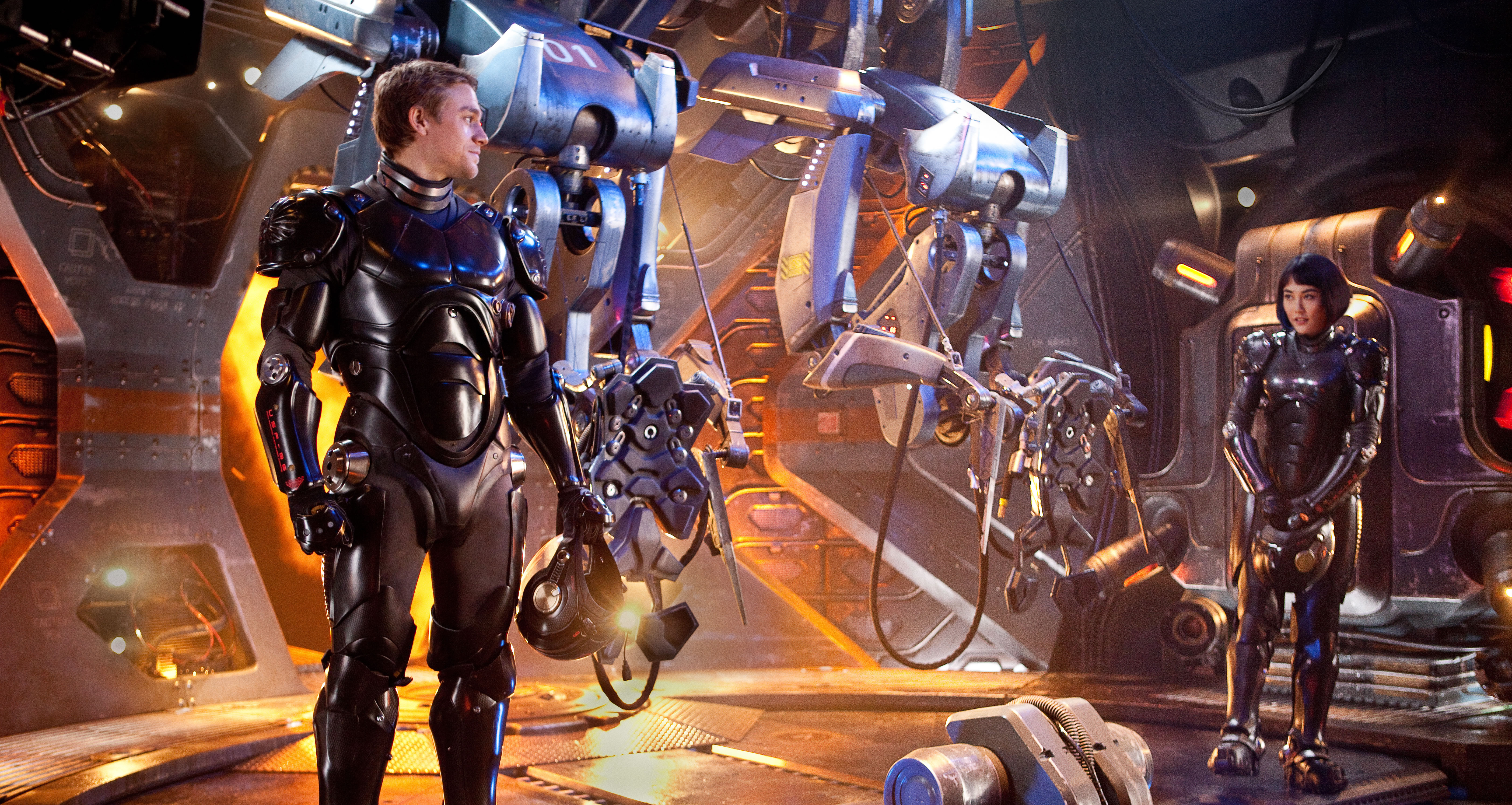
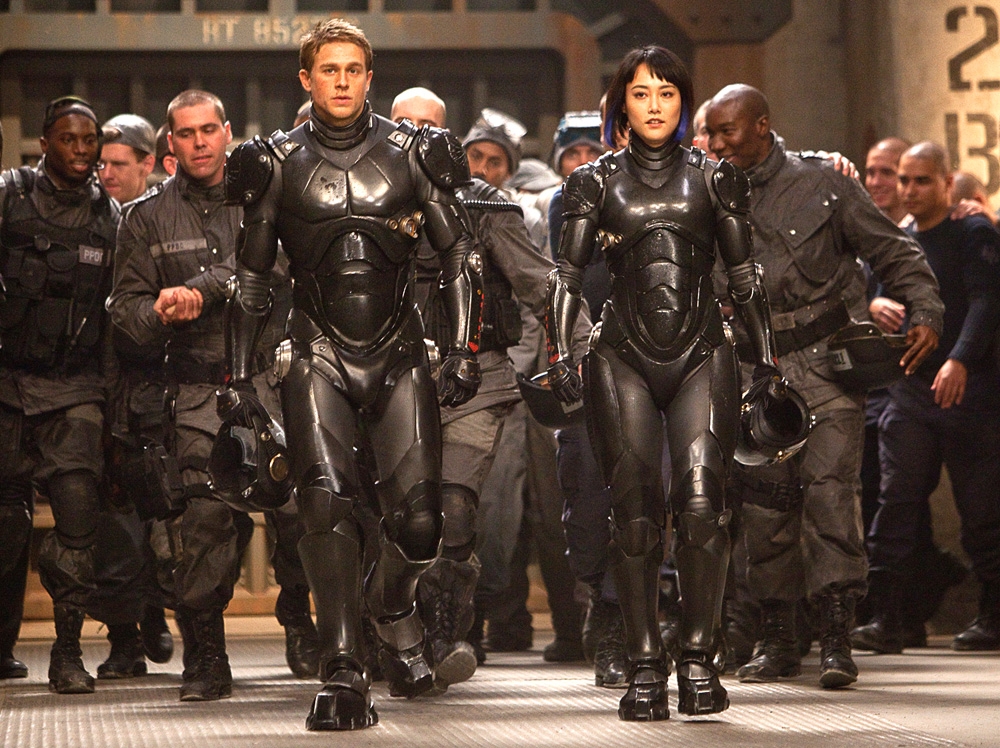
3166992-pacific-rim-charlie-hunnam-rinko-kikuchi2
However, the first time they enter the Drift together, Mako is caught up in her memories and loses control, almost launching her jaegar’s weapons while still docked.

OK, that’s all I’ll say on the plot, aside from the fact that the ultimate mission is to close the rift by dropping a thermonuclear bomb into it, which of course they succeed in doing (after a fashion). Peace and democracy reign again.

Did I mention I really enjoyed this film? I just want to reiterate that because I can feel myself getting snarky. It was visually stunning, and all the fight sequences were brilliantly done. Del Toro brings a kind of brutal intimacy to the clashes while still emphasizing their massive scale. And because it can’t be emphasized enough: there is something deeply satisfying in watching a giant robot punch a sea monster.

That being said, here are a handful of plot holes that bugged me before I move on to a more careful critique:

  • As the title suggests, the kaiju threat is indeed specific to the Pacific Rim. All of the sites attacked are coastal cities in this area. So … living as I do in Atlantic Canada, I wouldn’t have to worry about giant sea monsters so much? What does the rest of the world think? And what if you lived in, say, Saskatchewan? The speed and urgency of the film, and the attitude of its characters, communicate apocalyptic immediacy. Presumably, seeing as how the kaiju are evolving and emerging at a geometric rate, they would soon be making inroads into the middle of continents and spreading beyond the Pacific … but that is still just a possibility at the end of Pacific Rim when Tony Stark flies the nuke through the dimensional portal Raleigh Beckett blows up the portal. What does the rest of the world think about what’s happening?
  • On a similar note, why are there still densely populated cities on the coasts? Who thought that was a good idea?
  • The co-pilot selection process seems entirely limited to having prospective candidates fight Raleigh Beckett, further evidence that proficiency at martial arts makes you qualified for anything.
  • Mako is the only one who can match his mad kung fu skills, and ergo is a suitable co-pilot. Um, what? If you’re trying to match people for mind-melding compatibility, wouldn’t there be a series of in-depth, you know, psychological and/or neurological tests?
  • By the same token, wouldn’t they have at least one dry run where they enter the Drift together in a safe space, i.e. one in which someone freaking out isn’t connected to a huge nuclear-powered weapon?
  • If these pilots are in fact mind-melding, why are they constantly talking to each other? There’s a lot of one pilot ordering the other to “arm the plasma cannon!” and things like that. Wouldn’t that be unnecessary if you’re sharing thoughts?

It can be frustrating when SF films introduce a potentially very cool, very intriguing speculative concept whose implications pose significant philosophical questions, and then neglect to follow through on it at all. To be fair, there are occasions of pedantry and excessive exposition—I’m thinking most specifically of The Architect from The Matrix Reloaded here—but more often than not it is treated as incidental to the main story. Even when, as in the case of the Drift, it is in fact a central premise.

Pacific-Rim-Robot-Pilots

I think Alyssa Rosenberg puts her finger on it when she argues that this should have been two films. We begin in media res, with a pretty quick background—monsters emerge from a dimensional rift, start attacking cities, and then for a time are successfully repulsed by the jaegers. Until they evolve and start defeating the jaegers, the first instance of which is the battle in which Raleigh loses his brother.

While I appreciate the narrative economy, it occurs to me that there is a huge missed opportunity here. The story of how the monsters appear and humanity figures out how to fight back would have made for a great film, with huge dramatic potential—especially in the early days as the jaegers were first developed and the bugs in the Drift worked out. There would be, on has to assume, a significant human toll in working through the technology and evolving it to the point where it’s effective (there is a brief gesture toward this with Stacker Pentacost, who still suffers the ill effects of his time piloting the early jaegers). You could have ended the first film with the battle where Raleigh loses his brother, and spent a good chunk of the second film showing how the jaegers were losing and the strife that emerges amongst the partner nations.

Above all, the characters and their development would not have received such short shrift. The key device in this film is this mind-melding technology: as mentioned above, the Drift is potentially brilliant SF material, as it adds a very human dimension to the giant robot trope, making piloting jaegers not just a fundamentally cooperative exercise, but one that necessitates the subordination of the self to that of the team. There has been a lot of talk about the influence on del Toro of everything from Godzilla movies to mecha anime to Voltron to even The Mighty Morphin Power Rangers; I have to wonder however if the story was not at least in part influenced by Joe Haldeman’s novel Forever Peace. In it, the western world in the future maintains its colonial holdings and fights its short wars with robotic soldier-drones operated remotely by individuals plugged in to a collective consciousness (the novel is, among other things, totally prescient about drone warfare). Linked in together, the soldiers share thoughts, memories, loves, hates, and so forth—there are no secrets. And as it turns out, staying connected with others for too long leads to some interesting side effects (which I won’t spoil—read the book!).

Del Toro’s jaegers seem to operate on a similar premise, albeit not remotely—the pilots are inside the robot’s “head.” And in Forever Peace, though the operators are mentally linked, each pilots their own robot. The implications of a single unit being piloted simultaneously by two linked individuals is a fantastic speculative device, as it carries all sorts of questions about how differing, contrasting, conflicting, or competing personalities and impulses can work together in unity.

Unfortunately, aside from some very truncated gestures toward these questions, the film effectively ignores them and instead gives us a very familiar pilot / co-pilot dynamic in all the jaegar cockpits we see. Yes, we see the pilots move in unison as they walk, we see them punch and strike in tandem as they fight the kaiju, but there is otherwise very little sense of them having actually merged consciousness. They speak individually, carry out separate actions in the cockpit, shout encouragement at each other. As mentioned above, why would you even need to speak? Yes, they sometimes have to speak on the radio with command, but how uncanny, then, to have had them speak in perfect unison?

On top of all this is the obvious fact of asymmetrical power relationships between the pilots depicted: though Mako is ostensibly the best match for Raleigh, she is obviously his subordinate in every way. The other jaegar team of significance are the Australians, who are father and son and possess the same experienced elder / brash youth dynamic. Perhaps this is the best sort of pairing, as their respective strengths complement each other? That would have been a brilliant point to explore.

(The other two teams have very little to do: a Russian man and women with weird hair who look like villains from a 70s Bond film, and Chinese triplets—who are in fact indistinguishable, which raises a whole host of disturbing racial and ethnic overtones I don’t want to get into right now. Suffice to say neither of the other teams have much to do before they are kaiju kibble).

Perhaps this all seems like me totally overthinking what is essentially just a big, shiny summer blockbuster—perhaps I should just enjoy the film without nitpicking? Perhaps … except that, as I’ve repeated several times, I did enjoy the film. I loved it, as a matter of fact. Which is why these problems make me grind my teeth in frustration so much. The film is good, and the ideas behind it (while borrowing from just about every SF monster trope in existence) are intriguing. Believe me when I say I never spared a thought about the philosophical implications of Transformers.

2 Comments

Filed under what I'm watching

Fantasy and Cruelty I: A Preamble

One of the things I want to do on this blog is air snippets of the research and writing I’m doing, stuff that’s still only partially thought out and in process. Hopefully it won’t be as garbled as all that—the idea here is more thinking out loud, as it were, working through some of my key ideas and (hopefully) getting some feedback and (even more hopefully) starting a conversation. This post is my first attempt.

I’ve been thinking for some time now about fantasy’s odd appeal—odd, because when you think about it, only those among us with absolutely no sense of history would willingly be zapped back in time to the middle ages. And yet that is what fantasy (imaginatively) does, and arguably is part of its great appeal to many readers. One of the larger questions I’m trying to address is the nature of this appeal, and the ways in which fantasy operates in dialogue with our contemporary historical moment (or the historical moments in which different narratives were composed). And one of the questions within that is the persistence of cruelty as a theme and motif.

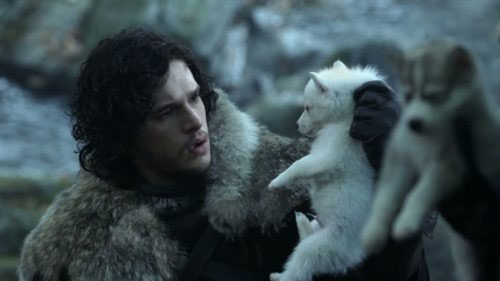
This post is the first of a series looking at the knotty (and naughty) presence of cruelty, torture, sexual violence, and misogyny in fantasy fiction. Given that this preamble enters the subject by way of a discussion of misogyny in Game of Thrones, I found myself stuck for a banner image. On one hand, a picture of Ros’ cleavage or Daenerys naked and soot-covered would be appropriate to the topic and wholly inappropriate to the tone I hope this post conveys; then I thought of trying to balance the preponderance of female flesh in the series a bit by posting something like a shirtless Robb Stark, but that might go too far in the other direction. So in the interests of splitting the difference, here’s a picture of Jon Snow holding a direwolf puppy. Everyone wins.

jon-snow-ghost-puppy

When I was visiting London, Ontario in May, I had drinks with one of my favourite people in the world, a professor at my doctoral alma mater who was the second reader on my dissertation; but more importantly, she is simply one of the smartest, coolest, and most level-headed academics I’ve ever known. So imagine my delight when I discovered that she had become a huge Game of Thrones fan.

This delight exists on several levels. First is the lovely experience of having someone you love and respect share an enthusiasm—always gratifying, like when a good friend finally reads that novel you’ve been recommending and is an instant convert. But with something like Game of Thrones, there’s a satisfying feeling of vindication, because both the novels and the series come in at times for the sneering or dismissive criticism that genre fiction often receives. So when someone whose critical acumen you respect and admire effectively endorses something you love that others dismiss, there’s no small feeling of triumph.

With Game of Thrones there is a further dimension, however. While I disagree with a certain amount of the criticism the series receives, there’s not much I can say when it is attacked for overdoing the gratuitous nudity, for throwing in unnecessary amounts of naked female flesh for what are often purely salacious reasons. It is bothersome to me for a host of reasons, not least of which is the straightforward misogyny of it. But it is also bothersome because, to my mind, the show is (or should be) better than that. The story is compelling, the characters vivid, and the sword-and-sorcery elements subordinated to a more specifically historical sensibility. Unlike the Starz series Spartacus, which combines softcore porn and the worst excesses of 300’s sepia-tinged violence, Game of Thrones actually has a story worth watching. And what’s more, sometimes nudity, violence, and cruelty are thematically crucial … a fact that gets obscured when yet again we are treated to wholly unnecessary sexposition.

In all my blog posts on Game of Thrones with Nikki, I skirted these discomforting elements, aside from snarking at a few of the more ridiculous instances—in part because it’s easy enough to focus on the good stuff, but also because I’d never framed a decent answer to the implied question, “Sure, it’s a good series, but how do you deal with the misogyny?”

So when I discovered that my friend, whom we’ll call Alison (because, well, that’s her name), was a fan, I was doubly delighted because she’s someone with pretty solid feminist street cred. Understand, I did not think to myself “Excellent! If a feminist likes GoT, I’m off the hook!” … or, well, I didn’t think so in so many words. But Alison doesn’t give out hall passes, and somewhere in the middle of geeking out about the show, she asked “But how do you deal with the misogyny?” Because of course, it bothered her too—and neither of us being baby-with-bathwater types, the solution of dismissing the series of out hand wasn’t an option.

As an aside: what follows is the first post of several teasing out some of the broader implications of this straightforward question, which ultimately does not give a straightforward answer. The straightforward answer goes something like this: the gratuitous nudity on display in Game of Thrones makes me cringe, and at times makes me angry, and I wish they’d ratchet it back—not least because, as I just said above, it cheapens those instances when it is thematically significant. I would argue, for example, that Daenerys’ nude scenes fall into this category, wherein her nakedness has moved progressively from symbolizing her vulnerability and exploitation at others’ hands to her growing strength and confidence. By contrast, pretty much every scene in Littlefinger’s bordello has been excessive and unnecessary.

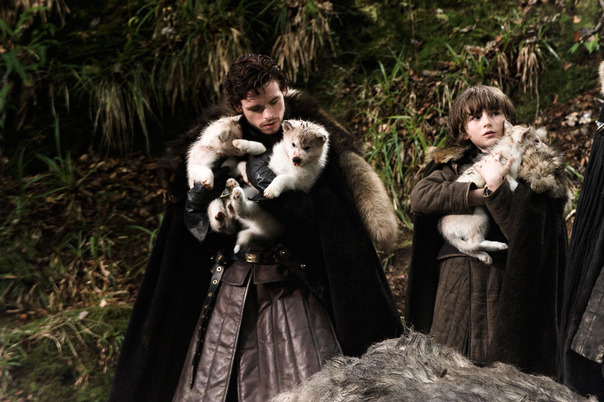
Robb,_Bran_and_wolves

More puppies.

So, that’s the straightforward answer, for what it’s worth. It’s not perfect, but hopefully the more extended meditations that follow will fill in the gaps. There are of course several other simple answers to the question, none of which are satisfying. “At least it has strong and nuanced female characters”; “Well, brothels are a recurrent setting in the novels, and you can’t really expect an HBO series to be prudish”; “But sometimes the nudity and sexual violence is thematically significant!”; or, worst of all, a shrug and “I try not to think about it.” There’s something to all of these answers (except the last, which is a cowardly cop-out), but none really address the question properly, any more than a wholesale condemnation of the series is fair.

Part of the problem—and what makes the question interesting—is that it gets at a larger question inherent to fantasy as a genre. For about ten minutes or so after Alison asked the question, I essayed a half-assed attempt to frame it within what I see as the bigger picture of cruelty as a structural motif in fantasy. My convoluted response (a little bit straightened out here) went something like this: fantasy tends to walk a line between gothic and romantic irrationalism on one hand, and historical realism on the other. Which is to say: it is a genre rooted in medieval romance and the capital-R Romantics’ rejection of modernity, and a certain nostalgic fascination with medieval Europe. Hence the mixing of magic and the supernatural with displaced historical realities. These tendencies were generally inchoate until the mid-twentieth century, when they were conflated (or, if you’re uncharitable, calcified) into the works that, for all intents and purposes, created fantasy as a genre: C.S. Lewis’ Narnia Chronicles, and J.R.R. Tolkien’s The Lord of the Rings.

(Please note: this is an extremely reductive account of fantasy’s history. I’ll be more expansive in future posts).

The result is a speculative genre—much, of not all, of fantasy can be read as asking “what if?”—grafted onto a fascination with medievalism, a fascination that is in no small measure nostalgic for a premodern, pre-industrial world. Tolkien epitomizes this pastoral sensibility, with all of his virtuous characters being identified in some capacity with nature (whether agrarian hobbits or forest-dwelling elves), and the villains identified with industrialism and its depredations.

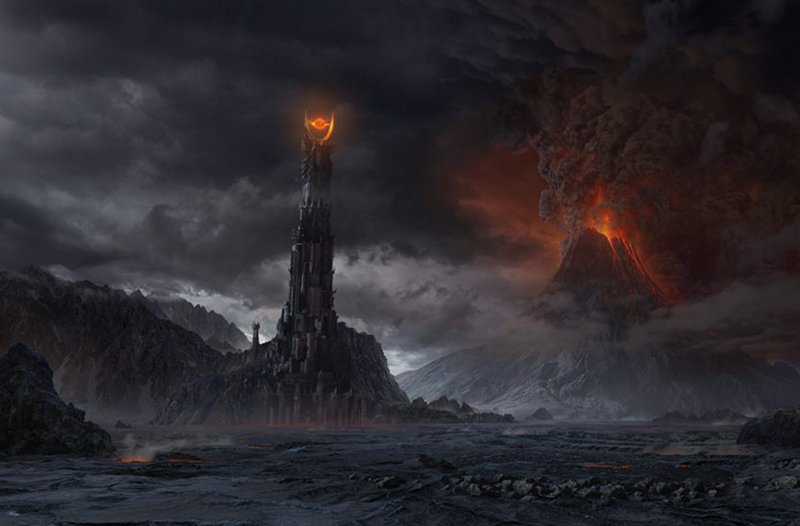
Mordor1

The Alberta Tar Sands, replete with the Eye of Harper.

There is thus a tension built into fantasy, between its supernatural and romantic elements on one hand and its need to make its settings recognizably medieval (however vaguely). Always at question is its degree of historical fidelity, or, to put it another way: just how medieval does the story want to be? How much squalor, filth, disease, and appalling hygiene does it want to depict? (I find it somewhat ironic that the most honest depiction of medieval squalor is Monty Python and the Holy Grail, wherein the king is recognizably a king because “He hasn’t got shit all over him”).

By the same token, how much of medieval political and social mores does the story want to include? Perhaps unsurprisingly, these tend to get more play than the gritty, grimy textures of medieval life—if for no other reason than that an unrelentingly accurate depiction of the age’s hygiene (or lack thereof) would sooner or later prove repellent. But divine right and absolute monarchy? Rigid caste systems? The disenfranchisement of women? Valorization of warrior culture? Rapine as a weapon of war? Roving bands of ruthless bandits? Torture as an accepted fact of life? Yup. That’ll do for much fantasy. At its best, the genre uses these historical realities in intelligent and thought-provoking ways, at times discomfiting audiences, at times reflexively making us question why precisely we are drawn to these scenarios. At its best, fantasy proceeds speculatively, suturing the imaginative freedom of an invented world onto historical actualities in such a way that reflects back on our own contemporary moment.

And at its worst? Well, while I am an avid reader of fantasy, and have been since first reading Lewis and Tolkien, I am not undiscriminating. There is much that has been written in the genre that I find simply unpalatable, which embraces the social mores as enumerated above uncritically and unironically, expressing nostalgia for regressive social and political structures. (As with any genre or art form, often the unpalatable elements are present in its greatest works: while Tolkien will always be one of my favourite authors, I would never attempt to defend his treatments of race and gender.)

Which is one of the reasons why the sexposition in Game of Thrones irks me: the series, and the novels on which it is based, is otherwise a remarkable example of how fantasy employs its neo-medieval setting to great thematic and critical effect.

I’ll bring this to a close here; I’ll be continuing this line of discussion with a few more posts. My next installment will deal a little more specifically with fantasy’s tendency toward lurid and exploitative representations of women, apropos of the fact that I am currently reading the Conan stories (the barbarian, not the late-night host) for the first time (yup, I’ve somehow avoided that all these years—part of that selective fantasy reading I mentioned above). I will then have posts on rapine and warfare, and torture and the dungeon as imaginative space. So, y’know … stay tuned.

Leave a comment

Filed under what I'm working on

Of Mixed Tapes and Deck Renovation

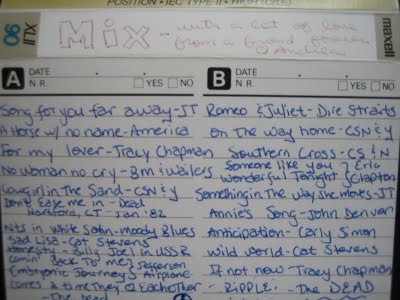
Mixed Tape 017

Warning to young people: this post deals with old technology, and the vaguely luddite maunderings of someone who has found reason to be nostalgic about it.

I’m currently ripping up my back deck so I can rebuild it, something that is at least two years overdue. Next door, my neighbours are having the clapboard on their house replaced and repainted. Actually, they’ve been having their clapboard redone for almost a year—their last contractor did the contractor dick move, i.e. left the job half done and never came back, except (finally) to reclaim their decrepit scaffolding. Now they have a much more conscientious bunch working on their place, which seems to be a family affair—at least three generations represented.

Seeing them work makes me remember my undergrad summers, when I worked for my uncle doing painting and reno work. And today as I worked ripping up my deck, while they did their thing painting and nailing in clapboard, I remembered that staple of summers past—my mixed tapes.

This is one of those generational things … it has occurred to me more than once to photograph my iPod Nano, which is precisely two and a half centimeters square and about five millimeters thick, beside stacks of ninety-minute tapes that would approximate the amount of music my pill-sized device contains. Which is to say that that I have more music at my fingertips—by a magnitude—than I had in my teenage record collection at its apogee. Prior to working on the deck, I attacked the jungle that my backyard tends to become in the summer with my weed whacker while listening to one of my playlists—and in the process realized that “Gagnam Style” is actually a pretty awesome song to do yard work to (a discovery I of course posted to Facebook and Twitter as soon as I took a break).While I had lunch, it occurred to me that I should make a dedicated “deck destruction playlist,” which I did … and which took me all of ten minutes to do.

Please understand: when I worked for my uncle, I had dedicated mixed tapes that I’d listen to while I painted, tapes that were specifically designed to see me though an otherwise tedious day of edging rooms or painting siding or rolling out ceilings. Each tape marked out ninety minutes of the day, and each was calibrated to a given mood. Was I mellow that day? Irritated? Hyper? Did I feel like punk, or grunge? Was it a Pogues kind of day, or U2? Of course, things could change. A day that started with me feeling angry and angsty, necessitating some Rage Against the Machine and Front 242, could change if my fellow painter was in the mood to smoke a joint on our break … at which point, Bob Marley would become the order of the day.

The point is that I was obliged to have backups in my bag. And all of those mixed tapes necessitated a certain investment of time and thought. As did all mixed tapes: even the most casual of mixes meant spending the time to sit beside the stereo stopping and starting the tape as you recorded things. And when you were making a mixed tape for someone? Well, that was another order of thought and effort entirely.

By contrast, the creation of my deck destruction mix involved plugging my iPod into my computer, scrolling through my library, and transferring songs that seemed appropriate. Then there was an added minute or two of arranging the order, and done! I had my music.

For the record: I do rather love this brave new world of technology. I’m not complaining. My iPod is my favourite device, if for no other reason than it makes running a palatable exercise. All of this would not have occurred to me today were it not for the guys working on my neighbours’ house, reminding me of my own time spent similarly occupied. But I will admit to a vague sense of loss, which I suspect I hold in common with those who watched the 8-track eclipsed, with those who watched television supersede radio, with those who saw the printing press proliferate through Europe (because the transition from mixed tape to MP3 is almost exactly the experience of the monastic scribe watching the Guttenberg revolution).

Leave a comment

Filed under maunderings