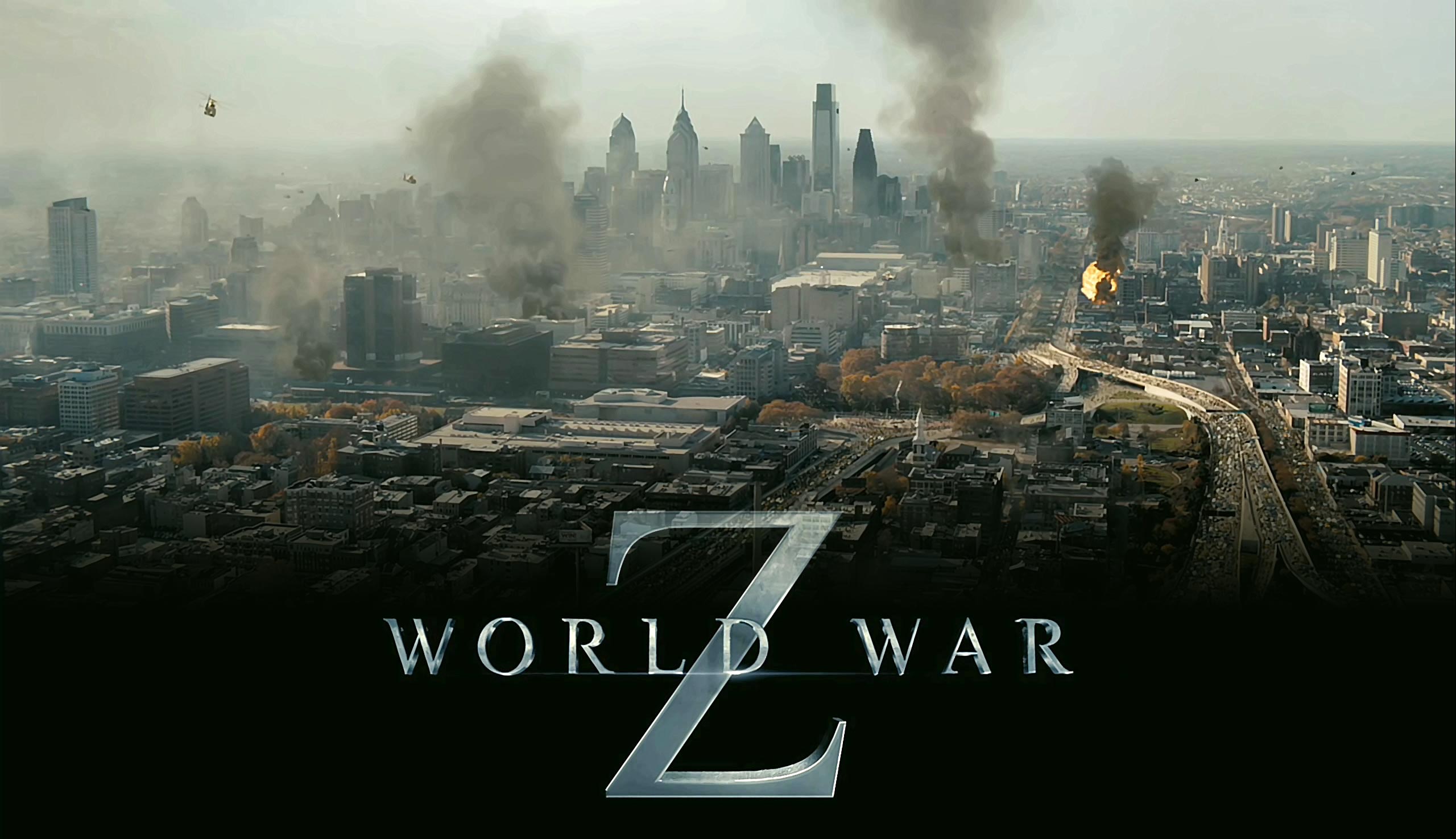
World War Z, or A Spectacular Vindication of my Zombie Thesis

world-war-z1

I’ve been making some notes toward a future post that will ask the question “how do you know when a genre reaches saturation point?” If I write it as I’m currently conceiving it, I will look specifically at vampires and zombies and their current glut in popular culture … mainly because that way I get to title the post “vampires vs. zombies!”, but also because, well, it’s hard to think of better examples of saturation. How do we know when we reach that point?

Well, to offer a preview on the zombie end of the equation: beyond simply seeing a new zombie film every week, you’re probably reaching critical mass when there are almost as many quasi-parodies relying on audiences’ familiarity with the principal tropes as there are straight-up examples (Shaun of the Dead, Zombieland); the genre begins to acquire critical respectability by, say, migrating to prestige television (The Walking Dead); the figure of the monster becomes domesticated into a romantic hero (Warm Bodies).

Or … Brad Pitt produces and stars in a high-end zombie film. Yup. When the A-Listers get involved, we’ve reached some sort of tipping point.

Like many, many people, I have been waiting for the release of World War Z with both excitement and trepidation. I read Max Brooks’ novel about four years ago, and loved it. I was actually surprised at how good it was—completely serious and thoughtful, and also remarkably well-written. It is also—for reasons I’ll get into below—a significant revision of the standard zombie/walking dead narrative. It developed, very quickly and deservedly, a devoted following, and probably did more than any other text (including Max Brooks’ earlier book The Zombie Survival Guide) to spur discussion and argument in the multitudinous online zombie forums.

So when there was word that a film was in the works, that of course inspired all kinds of excitement … and then dread, as rumours of struggles with the scripts, with filming, and internecine studio fights accumulated. When the first trailer was aired, a large proportion of Z fans collectively lost their shit, predicting that the film would be absolutely nothing like the novel.

To which I said: well, obviously.

I went to see it this weekend, and though I doubt there are many among those fans who have not get gone themselves, I will say two things. First, if you’re hoping for an utterly faithful adaptation, do not go see this film. Second, if you’re hoping (or were hoping) for an utterly faithful adaptation, you’re delusional and probably need to seek help.

This review, such as it is, will be in three parts. In part one, I’ll be talking about the novel, and why there is no way under heaven a film adaptation could work. In part two, I’ll talk about the film … and, well, how it kinda works. (Yes, I was surprised too). And in part three, I will talk about my thoughts on how this all fits, thematically and otherwise, into the ongoing cultural phenomenon that is the zombie genre.

I didn’t mean for this post to get so long. So, anyone who has read the novel and/or doesn’t care about my thoughts on it might want to just read part two.

1. Zombies Go Global

As anyone even vaguely familiar with the zombie genre knows, the drama is almost invariably localized—by which I mean, the world of the embattled survivors shrinks down to their immediate environment fairly early on. There are often flashes of a broader crisis caught from sporadic television or radio broadcasts, but before long the wider world goes dark and the scope of the action is reduced to the island of illumination cast by the protagonists. Yet underneath it all is the almost-invariably-unanswered-question of is there anyone else, and if so, where? In many cases, part of the plot hinges on finding the way to safe haven; but even when haven (safe or not) is found, the plight of the broader world remains unknown.

World War Z is a deeply impressive novel for the simple reason that that Max Brooks sat down and—systematically and exhaustively—thought through the twinned questions how would a zombie apocalypse happen? and how would the world respond? What he then produced was a series of “testimonials” from around the globe. The conceit of the novel is that an investigator for the U.N., tasked with compiling an “after-action report” some ten years after the end of the zombie war, finds half of what he compiled deleted from the official document as being too influenced by the “human factor,” i.e. too personal and subjective. The “present book” is then a compilation of those deleted elements—personal stories from people around the world telling of their experiences of the zombie war.

As I say, the novel is impressive for its scope of extrapolation: proceeding from present-day political and technological realities and producing a fairly convincing portrait of how a zombie apocalypse might fall out. But it is doubly impressive for how well written it is, for Brooks commits himself to telling the stories of no fewer than forty stories—each with a distinct narrator. He doesn’t go all As I Lay Dying on us or anything (which is a blessing), but makes each testimonial subtly different in tone and narration—enough to distinguish between the characters, not so much as to distract from their stories. What emerges is a convincing patchwork of human survival stories, at the heart of which is the (mostly) common theme of community and civic responsibility.

This theme is at once subtle and strikingly at odds with the genre at large. More often than not, the post-apocalyptic scenarios depicted in zombie narratives present harsh ethical questions about survival and sacrifice: who is worthy of inclusion in the survivors’ group, what kind of behaviour becomes dangerous and threatening, what lengths are we willing to go as a societal microcosm to survive? These questions are familiar to anyone who watches The Walking Dead, and they are by no means absent from World War Z—a significant number of early testimonials outline measures taken by governments and agencies the world over to contain and isolate the threat, and then contain and isolate the survivors, including the sacrifice of entire populations and cold-eyed calculations about who is valuable and who is not.

(As an aside, I have little illusion about my own value to society, post-apocalyptically. It occurred to me a long time ago that those best suited to survive are the antithesis of liberal academic types—if there ever is a zombie apocalypse, those who make it through will likely be anti-government paramilitaries and end-timer fundamentalists who all have walled compounds in remote areas well-stocked with canned goods. Evolution weeps).

But while such cold calculations are present in World War Z, the novel tends to concern itself more with the massive reorientation of society and economy necessary to combat the undead threat. A few characters become central voices in this respect, key among them Arthur Sinclair, the director of the United States’ Department of Strategic Resources—formed specifically for this purpose. He says:

[“Tools and talent”] … A term my son had heard once in a movie. I found it described our reconstruction efforts rather well. “Talent” describes the potential workforce, its level of skilled labor, and how that labor could be utilized effectively. To be perfectly candid, our supply of talent was at a critical low. Ours was a postindustrial or service-based economy, so complex and highly specialized that each individual could only function within the confines of its narrow, compartmentalized structure. You should have seen some of the “careers” listed on our first employment census; everyone was some version of an “executive,” a “representative,” an “analyst,” or a “consultant,” all perfectly suited to the prewar world, but all totally inadequate for the present crisis. We needed carpenters, masons, machinists, gunsmiths. We had those people, to be sure, but not nearly as many as were necessary. The first labor survey clearly stated that over 65 percent of the present civilian workforce were classified F-6, possessing no valid vocation. We required a massive job retraining program. In short, we needed to get a lot of white collars dirty.

Sinclair, it is worth noting, is described as the son of an inveterate New Dealer; and though he had rejected his father’s lessons and run “as far away as Wall Street to shut them out,” he found himself using them to harvest “the right tools and talent.” (As an aside: it is beautifully serendipitous that, in the audiobook of World War Z, Arthur Sinclair is voiced by Alan Alda). Sinclair has a recurring voice in the novel, and is reflective of Brooks’ larger communitarian preoccupations.

This hopeful and indeed vaguely utopian dimension to the novel (spoiler: humanity wins) is effectively unique in the genre; while some narratives end on a note of hope (28 Days Later), in many such endings are deeply ambiguous (the original Dawn of the Dead) or at times ironic (Shaun of the Dead). World War Z is, in its very framework, an account of victory and lessons learned.

But it doesn’t get to that point without a significant number of harrowing and thrilling stories told alongside its entirely pragmatic and methodical formulae for fighting the undead hordes. There is a huge amount of dramatic fodder here … but the earliest misgivings about a prospective film echoed my own, specifically: how do you recreate the scale and scope of this global narrative in a two-hour movie?

Well, the bottom line is you can’t. Not to sound like a broken record or anything, but cinema is the wrong medium for anything resembling a faithful adaptation of this novel. The big screen doesn’t work, because everything is necessarily accelerated—the meditative, reflective quality of the novel, to say nothing of its reams of different stories, voices, and interlaced narratives. The better vehicle for Z—and I know you see where I’m going with this—would be television. Ideally, HBO or one of the other prestige cable stations … though I suppose a major network might not make too big a hash of it (theoretically). Brooks’ novel, given its shifting voices and narratives, would be much more amenable to episodic, long-form storytelling. One can easily imagine (or I can, anyway) a television series in which each episode features a different testimonial, intercut with the interviewer’s difficulties in traveling around a depleted, post-zombie world.

Of course, such a format would not be amenable to Brad Pitt—not if he was determined to star in it, at any rate.

2. But if you must cram it all into two hours …

Warning: spoilers ahead.

All that being said, World War Z was surprisingly good. As I said above, it will almost certainly offend anyone who demands fidelity to the novel … but as far as it went, it did a remarkable job of splitting the difference.

How does it accomplish this feat? Well, as already mentioned, cinema tends to accelerate things—and a ticking clock is one of the best ways to ratchet up the tension. Rather than have Gerry Lane, Brad Pitt’s doughty and rugged U.N. inspector, travel the world when all has been won to collect stories, you have him racing against the pandemic to collect stories—in the hopes of finding “patient zero” and figuring out how all this began. All things being equal, it’s not that bad a device (and if I can be smug for a moment, I’d more or less figured that much out from the trailer). So chasing what few thin leads he has, he flies with a team of Navy Seals and a brilliant young virologist to South Korea, and then then Israel, and then … well, I won’t spoil everything. Not yet. Suffice to say he loses his team, including the virologist, by increments along the way.

We begin with the comfortingly domestic images of Gerry Lane’s suburban life. (The opening scene is actually a nice little nod to the beginning of the 2004 Dawn of the Dead, with an eerily silent entrance into the parental bedroom—except that the children are obnoxiously energetic rather than undead). Traveling later in gridlocked downtown Philadelphia, the family is overtaken by the vanguard of the zombie apocalypse; but fortunately Gerry, only recently retired from the U.N.—and, as it turns out, wanted by them to seek out the origins of the infection—has connections enough to get extracted by a navy helicopter and brought to an aircraft carrier off the east coast.

More Brad Pitt-620x

From there begins his sort-of-global quest to seek out the grail of patient zero. Some of the novel’s flavour of international crisis is retained, though not much—after all, Lane only travels to South Korea, Israel, and finally Wales. The only true fidelity to the novel comes when he visits Israel and interviews a senior Mossad agent, who accounts for Israel’s seemingly-too-convenient zombie preparedness (among other things, completing their wall) by outlining a philosophy of intelligence-gathering I won’t bother to repeat. Indeed, Israel seems like an oasis of peace in the midst of a world gone mad—protected by a high wall, but allowing all uninfected in. The spectre of a common enemy would appear to have obviated hatreds, as we see Arabs and Muslims in significant numbers among the refugees, and one group is happy enough with their saviours to burst into song over a sound system while waving Israeli flags.

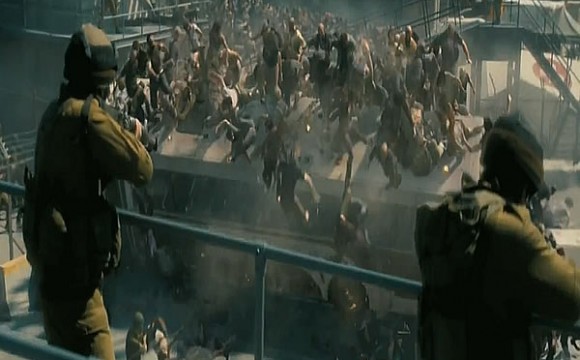
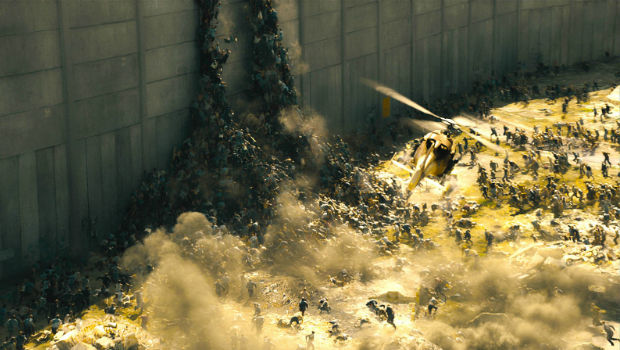
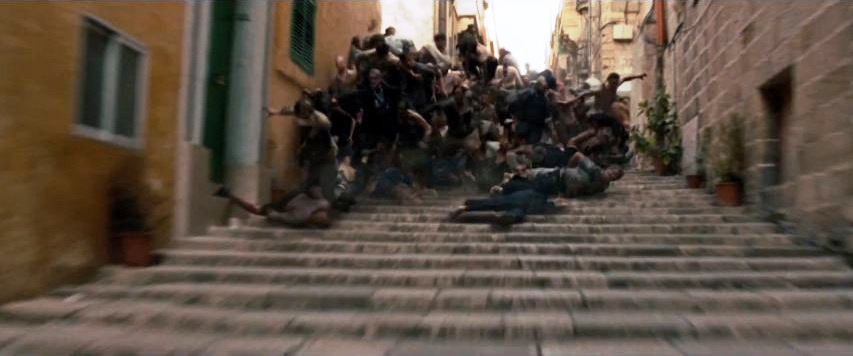
Alas, as Gerry Lane learned in South Korea, the undead are attracted by noise. (Lessons he has picked up by this point: the time between infection and zombification is about twelve seconds; infection is spread by bites but not, oddly, by transference of bodily fluids; and the best way to avoid the undead is by keeping quiet). As the grateful refugees’ song swells in volume, the undead swarm the other side of the wall, antlike, creating that ladder of bodies that we saw in the trailers, and which excited such harrumphing among devotees.
WWZ 1-620x

The breaching of the Israeli sanctum is at once utterly at odds with the novel, and the most remarkable sequence of the film. Anyone who is a firm advocate for Romero-esque “slow zombies” will probably want to give this film a pass. Not only do the undead sprint as fast or faster than the infected in 28 Days Later and the zombies in the 2004 Dawn of the Dead, they are veritable acrobats, leaping through the air to take down fleeing humans and turning at times into literal tidal waves of undead. (This, too, is at odds with the novel: Max Brooks’ zombies are the classic shuffle-and-moan types).

So, purists may wince, but the Z-film zombies’ speed and tendency toward insectile swarming makes for some truly thrilling cinema. In the film’s third act we revert to a more standard zombie-evasion sequence; if World War Z contributes anything new to the genre, however, it is this imagery of antlike swarming that takes the concept of the “undead horde” to a new level. But I will speak more about that in my third section.

At this stage Gerry Lane has already lost his brilliant young virologist, but that proves to not really matter. For one thing, he discovers that the hunt for patient zero is pretty much a futile endeavour—things have progressed too far too discern the pandemic’s epicenter, and much of the world is, his Mossad contact informs him, “a black hole.” However, the virologist did not die in vain, for he managed to impart some wisdom about the nature of viruses in an elaborate metaphor about how Mother Nature is a serial killer who, “like all serial killers, wants to get caught.” Gerry Lane notices that the zombie hordes puzzlingly ignore some individuals, passing them by like rocks in a stream while attacking others. In a handful of rather overwrought flashbacks, he makes the intuitive leap that zombies will ignore diseased prey … so if people can be infected with dire but not fatal illnesses, they will be safe.

Of course, he has to test this theory, and so (using his U.N. connections) manages to convince his flight out of Jerusalem to change course and head for a World Health Organization lab in Cardiff. But nothing can be that easy—as anyone who has seen the trailer knows, at some point in the film Pitt is on a plane that becomes overrun by zombies, and which experiences explosive decompression when part of the fuselage blows out. Fortunately, the plane goes down close enough to Cardiff for Gerry Lane and a young female Israeli soldier he saved from infection by lopping off her hand (shades of The Walking Dead, but whatever), to walk from the plane crash to the nearby World Health Organization facility, in spite of his injuries and, y’know, her massive blood loss . They make it to the WHO facility, are treated for their injuries, and manage to make contact again with Gerry Lane’s U.N. overlords. Gerry convinces the resident doctors of the viability of his theory … and of course, being a WHO facility, they have tons of terribly infectious bacteria and viruses squirreled away in a secure lab.

It is here that the film takes its turn into zombie movie cliché … because of course, guess where the lab they need to get to is? If you guessed “in the bowels of a labyrinthine, zombie-infested wing of the facility,” you have just leveled up as a cinema nerd. Congratulations!

Yes, the “B” wing of the WHO facility, which has been cordoned off by the survivors, contains about eighty zombified medical personnel, all of whom are visible on the facility’s closed-circuit cameras. (It was at this point that watching The Walking Dead interfered with the movie experience. Eighty walkers? Send in Rick Grimes and Darryl. They’ll clear those dead sumbitches in a jiff). While I give credit to the film that the sequence that follows—in which Gerry Lane, his new Israeli friend, and one of the WHO doctors (heh) make their way as silently as possible into B wing—is pretty tense and scary, it highlights for me one of the main failings of trying to bring this novel to the big screen: namely, that the larger scope of the novel, its great complexity and nuance, is necessarily lost in the name of making the film, recognizably, a zombie film. Though the sequence is well done, it is not just reminiscent of every other zombie movie, but (perhaps more significantly) all of the video games that have invaded the genre as well. That it all comes down to the protagonist in a series of Resident Evil­-esque antiseptic, institutional hallways evading the undead is unsurprising, but something of a letdown after the genuinely innovative Israel sequence.

A few last thoughts before I move on:

  • Mireille Enos is criminally underused in this film. Criminally. Whatever your thoughts on the series The Killing, or on her damaged character therein, she’s a pretty remarkable actress. She really only gets to do anything interesting in the first act as she and Brad Pitt flee with their daughters. But after that, all she does in languish on a naval vessel, looking longingly at the satellite phone he gave her, waiting for it to ring (and at one point nearly killing him when she calls and his phone rings at a really, really bad time).
  • Attention Lost fans: some of the film’s publicity mentions that Matthew Fox, aka Dr. Jack Shepherd, is in the film. Which he is. For all of about twenty seconds.
  • Gerry Lane has almost superhuman powers of perception. Besides making the intuitive leap about the camouflaging qualities of disease, he also figures out the twelve-section infection rule when he watches someone get reanimated in the middle of the mayhem in Philadelphia.
  • There is almost no blood in this film. Some zombie devotees have complained about this fact, but I frankly don’t miss it. Gore certainly has its place in this genre, but the most frightening parts of this film had less to do with the prospect of violent disemboweling than with the specter of the horde itself.


3. The Masses as Weapon of Destruction

I’ve been cultivating a theory about the zombie genre and its massive popularity for several years now … which is a little bit like saying I have an idea about why people like ice cream. Zombies are an infinitely adaptable movie monster, and a theory that asserts that the genre is popular because it depicts the nightmare of conformity is no more or less correct than one starting people love zombie films because they offer survivalist fantasies. So as long as we can agree that zombies can be anything to anyone (depending on the selection of texts), let me make my case.

Simply put, zombies are a manifestation of our ambivalent and fraught relationship to mass culture itself.

While Zack Snyder’s 2004 remake of George A. Romero’s Dawn of the Dead (1978) bears only a passing resemblance to its source material, it does maintain one crucial element largely absent from the genre at large: boredom. In both versions, survivors of the zombie plague manage to barricade themselves in suburban shopping malls securely enough that they have the leisure to get bored. With all of the malls’ bounty available to them, they want for nothing, and indeed take advantage of it to indulge in Rabelaisian carnival. In both cases these interludes are bookended by crisis and terror, but are for that reason even more gratifying as depictions of unchecked consumption.

In Snyder’s version, after a gratuitous montage of the survivors at play in the mall, the boredom asserts itself as we watch them lounging on the roof, playing a game with the owner of a gun shop down the road. Too far apart for spoken communication, they trade messages via text scrawled on white boards. Having played chess in this manner, they now play a different game in which the mall survivors scan the undead horde milling about below with binoculars, seeking out celebrity lookalikes. Andy, the gun shop owner, then attempts to find the doppelganger and kill it with his rifle. After Jay Leno and Burt Reynolds have been dispatched in this manner, Ana (Sara Polley) admonishes the loathsome Steve (Ty Burrell):

ANA: You guys had really rough childhoods, didn’t you? A little bit rocky?

STEVE: Hey, sweetheart … let me tell you something. You have my permission, I ever turn into one of those things? Do me a favour. Blow my fuckin’ head off.

ANA: Oh yeah, you can count on that.

Of course, because of the immutable laws of dramatic narrative (the gun on the wall in the first act, as it were), we know that Steve will in fact turn into “one of those things,” and Ana will in fact be the one to blow his fucking head off. But there is a more serendipitous dimension to the sequence now: actor Ty Burrell, a relative unknown when he made Dawn, has since seen great success with the sitcom Modern Family, and has in fact been transformed—not into a zombie, but a celebrity.

While that observation may seem somewhat glib, the celebrity-shooting sequence is deeply suggestive in the context of zombie-saturation in pop culture. One way to read the sequence is as revenge against mass culture, a symbolic expression of the hatred and resentment of celebrity that is the flip side of our fascination with it. The rise of the internet and social media has created a culture of celebrity-shaming that the victims of tabloid rags even twenty years ago could not have imagined, an airing of the collective id that is as pernicious as it is pervasive. That one of the consistent tropes of zombie films is the necessary eschewal of contemporary connectivity and the technology that makes it possible is suggests this very hostility to it—but in a rather spectacular form of the return of the repressed, mass culture won’t stay dead, but mobs us and seeks to consume us anew.

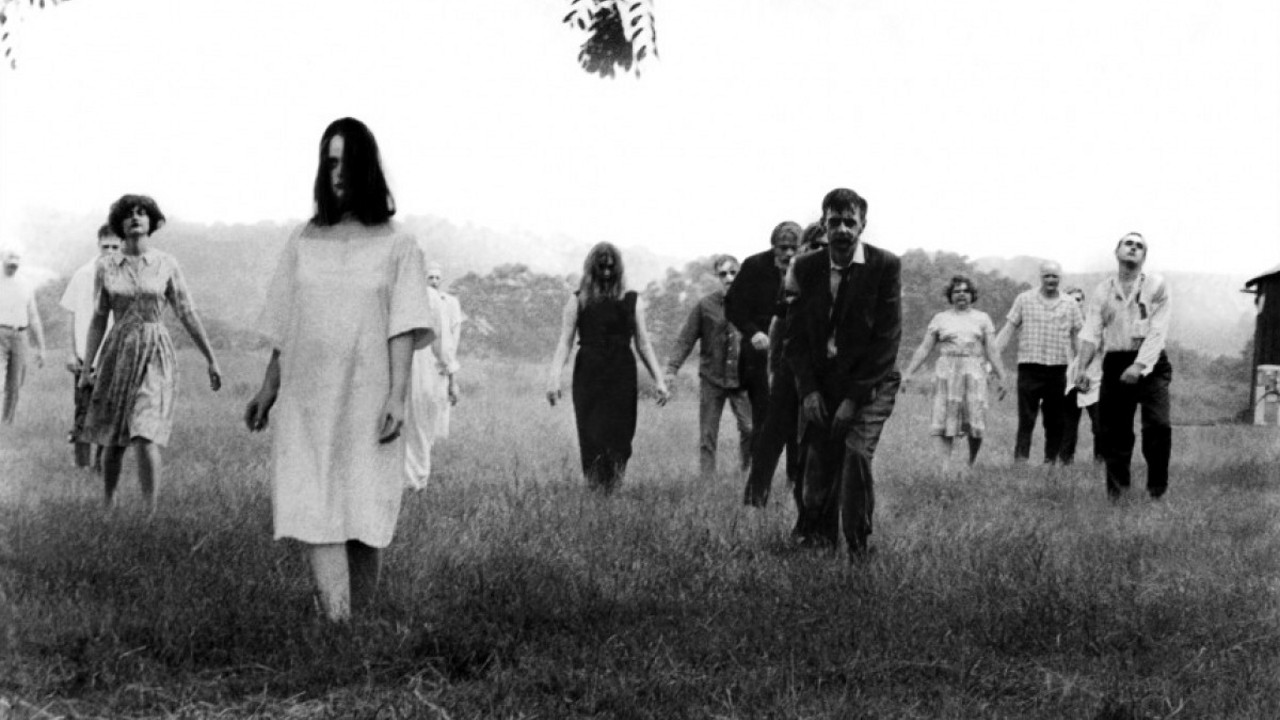
This is why the true nightmare of zombie films is not the prospect of a lone ghoul lurking around the corner, but the critical mass of the dead surrounding and swarming the living. Dark corridors and blind corners are a necessary trope in zombie films (case in point, the third act of World War Z as discussed above), but in and of themselves a zombie or two has nothing to really distinguish them from any other movie monster lurking in the shadows ahead. Their threat, ever since George A. Romero transformed them from the golem-like automatons of voodoo legend into the flesh-eating hordes in Night of the Living Dead (1968), rests in their weight of numbers.
night_of_the_living_dead_3

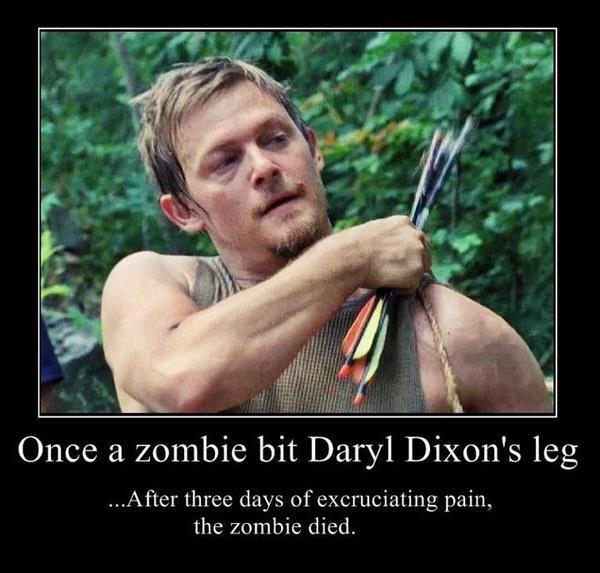
Which is why they share a symbolic lineage with other dystopic figurations of the masses, from Shakespeare’s Roman mobs to such philosophical warnings as found in Matthew Arnold’s Culture and Anarchy or Ortega y Gasset’s The Revolt of the Masses. Granted, none of them were overly concerned with zombies per se, but all characterized the mob mentality as mindless, voracious, and dangerous. Again, it is thus not surprising that a consistent trope in the zombie genre is the common apocalyptic gesture of culling, the purging of society that leaves only a handful of survivors. Apocalyptic narratives provide the space for the spectacular individual to emerge, which is a big reason why (I would argue) so many people love to go on at length about how they would survive, what they would do, and share their plans with like-minded fantasists: everyone wants to imagine that he or she is just that person who would survive and kick some serious zombie ass in the process.
wd-daryl-meme7

At the heart of the zombie genre is an individualist ethos, one that plays out in tension with the necessity of living within an ad hoc community of survivors—who, if they are in fact to survive, tend to need to keep to themselves. There is little to be gained in the zombie genre by actually finding one’s way to the remnants of military or civic authority—in 28 Days Later it proved disastrous; in The Walking Dead, everyone nearly died when they found safe haven at a CDC facility at the end of season one, and the most recent season pitted the ragged Grimes band against “the Governor,” whose facade of civic peace in the community of Woodbury proved to be a despot’s kindly mask; an encounter with the police in the British series Dead Set ended badly (for the police, fortunately). Wondering whether there is actually a zombie film out there in which encounters with military or political authority doesn’t end badly, I posed the question to friends on Facebook (hey, I don’t use research shortcuts for this blog), and (1) apparently, I must immediately watch Cemetery Man and Carnival of Souls; (2) the other three suggestions were Shaun of the Dead and I Am Legend—the first of which is a fair point, as the army shows up at the end to save the day (oops, spoiler); and the second of which has a more ambivalent relationship to the structures of official power, but does end with some of the survivors making it to safe haven (um, spoiler again)—and World War Z itself.

Which brings me back to the ostensible subject of this post. What set World War Z apart to start with, and what it does manage to retain to a small degree in the film, is the rejection of the overtly individualist ethos pervading the genre. The novel is all about a certain global collectivity. Tellingly, at one point Max Brooks has one of his characters allude to his book The Zombie Survival Guide as useful, but too focused on American contexts. And as he makes clear, while sacrifices are made in the name of saving civilization, the point is that civilization is saved. And perhaps more importantly, civilization is shown as being worth saving.

I will defend the film against those who say (to quote one random commenter I read just today), that the film “shits all over the source material.” Is it faithful? Of course not. How can it be? But it does a pretty good job of keeping the key themes in place. That being said, the most disturbing aspect of the film is the one I’ve already said is the best—the breaching of the Israeli perimeter. It is in this sequence that, as the title of this post suggests, I found a spectacular vindication of my zombie thesis. In the film’s opening credits, we see a montage of television clips, some from news programs and some from what look like nature shows. Again, I find an echo of the 2004 Dawn of the Dead, which manages to give a glimpse of the global crisis before everything goes dark and the perspective is limited to survivors:

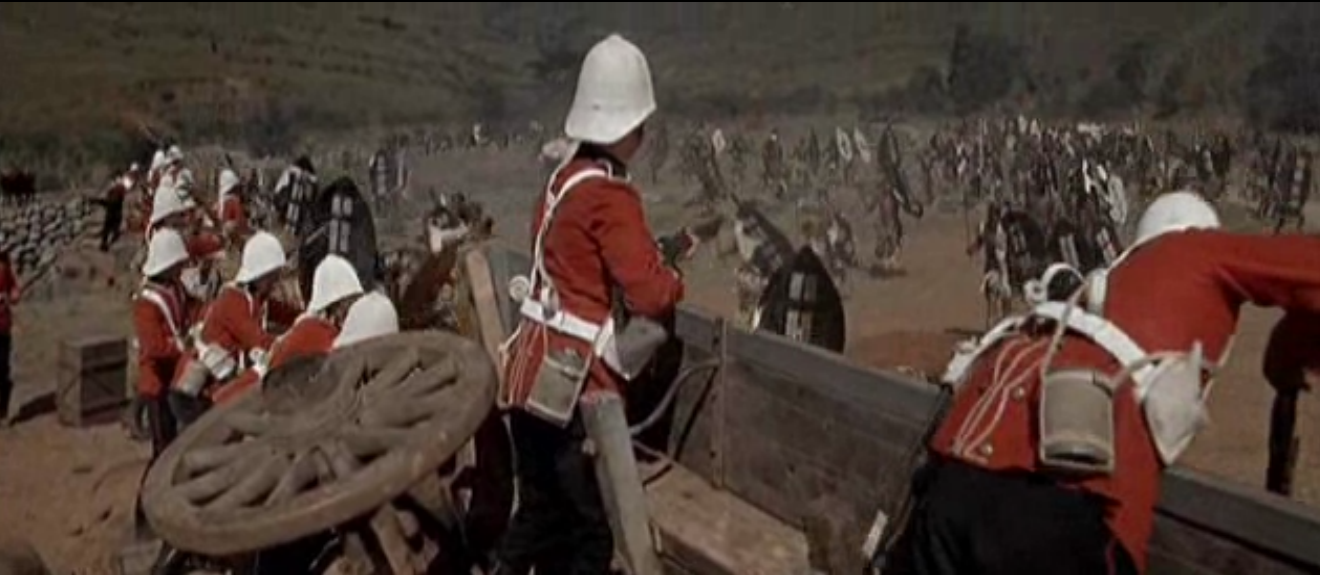
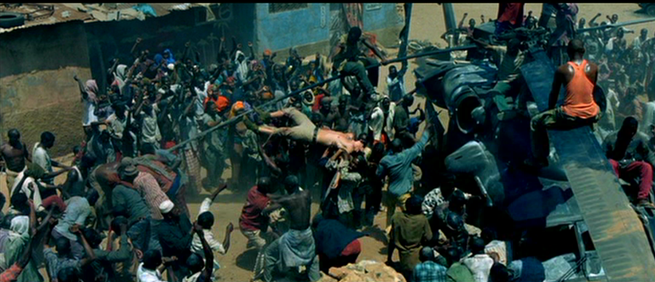
Present in the World War Z opening credits are images of swarming ants, which obviously become significant later in the film. (Does anyone else remember that short story “Leiningen Versus the Ants”?) The undead swarm, and become an unstoppable horde; but what is pernicious is the consonance of these scenes with other such films in which well-equipped, technologically advanced soldiers find themselves fending off the mindless masses of an undifferentiated mob. The Israel scenes in World War Z, effectively, are visually of a piece with films like Black Hawk Down, Aliens, and Zulu.
Zulu_40black hawk down
world_war_z-580x360

The Middle Eastern setting visually cues the (white, North American) viewer to the stereotypes of third world cityscapes, and the sequence—consciously or not—cites images of embattled first world warriors fending off (in this case literally) a rabid horde. As Raymond Williams astutely observed way back when he first published Culture and Society (1958), once people started to mass in urban spaces, “mass” very quickly became synonymous with “mob” and the best way to dehumanize people in the modern world was to associate them indelibly with the masses. In the novel, the Israeli solution is a victory for humanity; in the film, as Hendrik Hertzberg points out, the Israeli largess is repaid with what we assume is annihilation—“The scrambling West Bank zombies just keep coming,” he says, and “we are left to infer that everything probably would have still been O.K. if only the gates had been kept shut.”
World-war-Z-03

The political overtones of this sequence aside, the swarming hordes of the undead comprise the other side of the mass culture coin. If Dawn of the Dead revenges itself on celebrity culture, that revenge is short-lived, as the survivors don’t actually, you know, survive (oops, spoiler). And if the horde of zombies present in Dawn, or Shaun of the Dead, or 28 Days Later, or Zombieland all represent the stultified lives of first world consumers, the swarm in World War Z is of a piece with the denizens of Mogandishu in Black Hawk Down—an undifferentiated mass of racial, geographical, and cultural others.

So if I may begin to conclude what is certainly the longest blog post I have ever written … the film adaptation of World War Z retains some key elements of the novel to the point where it does not in fact “shit all over the source text” … but it loses much of Brooks’ innovation. His novel is not quite sui generis—Mira Grant’s “Newsflesh” trilogy (Feed, Deadline, and Blackout) depicts a (more or less) function post-zombie society—but it remains, as far as I have read and watched thus far, the sole zombie narrative that does not devolve into anti-establishment, absolute individualism. And while the film tries very hard, it does slip unfortunately into zombie cliché.
Leave a comment

Filed under film, what I'm watching

Thoughts on The Great Gatsby II; or, Spectacular Excess

eyes

The thing that struck me most on re-reading Gatsby was how much it felt like a novel written not long after 1929. The scathing indictment of excess and acquisitiveness—and the use of Gatsby as a dark parody of Horatio Alger—seems prescient in light of the stock market crash that came four years after it was published. Gatsby would work well taught alongside The Big Money, the third novel in John Dos Passos’ USA Trilogy. Except that where Dos Passos published his novel in 1936 and wrote with the benefit of hindsight, Fitzgerald’s critique was aimed at the culture of excess and hedonism while it was at its apogee. With our benefit of hindsight, it is tempting to see Gatsby’s violent end as prophetic.

As I suggested in my last post, Gatsby’s principal figure of speech is understatement—but not even Nick Carraway’s tendency to be laconic (albeit elegantly and sometimes baroquely so, which is quite the needle to thread when you think about it) obviates the splendor and mind-numbing displays of wealth at Gatsby’s mansion. In many ways, Fitzgerald gives us a familiar contrast, between new money and old. The property and possessions of the Buchanans are impressive, but Fitzgerald’s description of the house articulates the comfort and complacency of inherited, dynastic wealth:

Their house was even more elaborate than I expected, a cheerful red-and-white Georgian Colonial mansion, overlooking the bay. The lawn started at the beach and ran toward the front door for a quarter of a mile, jumping over sundials and brick walks and burning gardens—finally when it reached the house drifting up the side in bright vines as though from the momentum of its run. The front was broken by a line of French windows, glowing now with reflected gold and wide open to the warm windy afternoon, and Tom Buchanan in riding clothes was standing with his legs apart on the front porch.

hotel de ville

An example of an Hotel de Ville.

The first description of Gatsby’s mansion, by contrast, calls it “colossal affair by any standard” which was “a factual imitation of some Hôtel de Ville in Normandy, with a tower on one side, spanking new under a thin beard of raw ivy.” Fitzgerald never calls Gatsby’s mansion gauche or tacky in so many words; but the evocation of a palatial French manse, still so new that the “raw ivy” can’t hide its youth,” is in stark contrast with the easy elegance of the Buchanan home—whose ivy is so venerable that it is of a piece with the manicured lawn.

Beyond this initial description, however, Fitzgerald does not devote much time to the objective appearance of the house. Rather, the lion’s share of his descriptions of Gatsby’s home, over the course of the novel, is devoted to Gatsby’s stuff—most startlingly later on when Gatsby starts pulling his tailored, imported shirts giddily off his shelves where they’re piled dozens deep and throwing them to Daisy (I’ll have more to say about that later)—but the first party Nick attends begins not with the festivities but the goodies brought in to stock them:

Every Friday five crates of oranges and lemons arrived from a fruiterer in New York—every Monday these same oranges and lemons left his back door in a pyramid of pulpless halves. There was a machine in the kitchen which could extract the juice of two hundred oranges in half an hour if a little button was pressed two hundred times by a butler’s thumb.

At least once a fortnight a corps of caterers came down with several hundred feet of canvas and enough colored lights to make a Christmas tree of Gatsby’s enormous garden. On buffet tables, garnished with glistening hors d’oeurve, spiced baked hams crowded against salads of harlequin designs and pastry pigs and turkeys bewitched to a dark gold. In the main hall a bar with a real brass rail was set up, and stocked with gins and liquors and cordials so long forgotten that most of his female guests were too young to know one from another.

And it goes on … The reason I belabor this point is to emphasize the subtitle of this post: that Gatsby’s displays of wealth and excess are, quite literally, spectacular: that is to say, the very point of them is as spectacle, an answering beacon to the green light at the end of Daisy’s dock, in the hopes that she’ll see his display and eventually make her way over to one of his parties.

I’ll talk about that symbolic gesture in a moment—and more when I talk about the recent film version of Gatsby in my next post—but for now I’m interested in what Fitzgerald leaves unspoken. I concluded my previous post with a favourable comparison of Fitzgerald’s technique to Hemingway’s, namely, the calculated elision of detail. Gatsby, is, after all, a pretty economically written novel: my edition runs to 180 pages. I’d argue that it’s as much what Fitzgerald leaves out as what he puts in that fascinates so many readers. What exactly did he do to make his money? Who’s on the end of all those phone calls he takes? How did he manage to accumulate such vast wealth in a mere three years? At the very beginning of the novel Fitzgerald signals Gatsby’s “mysteriousness” by having so many random party-goers spin increasingly elaborate stories about him. And even though we do eventually get his backstory, we’re still only privy to a fraction of the story proper: namely, Gatsby’s obsessive, childlike, and ultimately doomed love for Daisy.

The untold account of his meteoric rise, however, is the foundation for the novel’s critique. Wealth in Fitzgerald’s novel—huge wealth, at any rate—is consonant with moral and spiritual carelessness. That is, in the end, Carraway’s verdict on Tom and Daisy: “It was all very careless and confused. They were careless people … they smashed up things and creatures and then retreated back into their money and their vast carelessness.” And while these damning words are directed at Tom and Daisy, they resonate with the memory of Gatsby too—for he is in his own way careless, reckless in his pursuit of enough wealth that Daisy will notice him there across the sound and see him as worthy of her love.

His parties are symbolic expenditure, and are symbolically wasteful; the aforementioned “pyramid of pulpless halves” leaving his house after every weekend is as apt a metaphor for his expenditures as any. But given the ephemeral nature of his spending, it begs readers to speculate on just how solid his wealth is. On reading the novel this time around, I kept coming back around to how literally unbelievable his riches are—for we know, once we have his backstory, that he came out of the war penniless. So if he was demobbed in early 1919, and then spent five months at Oxford, he had less than three years to accumulate the money he spends in the summer of 1922. In a recent New York Magazine article, Kevin Roose crunches the numbers, tallying up the likely costs of Galsby’s mansion and possessions and the amount he would have had to spend on his parties. His conclusion is that, even allowing for Gatsby to earn far more than was likely for a bootlegger to earn in the early years of Prohibition, he would have been experiencing significance shortfalls, and would most likely have gone into debt.

How much of this Fitzgerald worked out for himself is largely beside the point—and nor is it strictly necessary to apply the relevant numbers to the novel in a “how many children did Lady Macbeth have?” fashion. While there is more than enough there in the novel to suggest that Gatsby was living well beyond his means, he was manifestly living metaphorically well beyond his means. As already mentioned, Gatsby plays out the old chestnut of old money’s solidity versus new money’s upstart tactlessness; Gatsby himself is a paragon of hyperactive, conspicuous consumption. One of his most striking characteristics is his childishness, and his childlikeness: he has throughout the vaguely pathetic faith that his “success”—or perhaps more significantly, the outward signs of his success—will ultimately dazzle and woo Daisy.

If Gatsby is prescient in its vilification of the mindless drive toward wealth and accumulation that resulted in the stock market crash of 1929, it is more subtly prescient of the rise of a popular film genre during the Great Depression: the mobster film. Indeed, even if one didn’t know that Gatsby was written in the mid-twenties rather than in the midst of the Depression, one big clue lies in the person of Gatsby’s partner in crime. Modelled loosely on the Jewish gangster Arnold Rothstein, Meyer Wolfsheim is about as ugly an anti-Semitic caricature as one is likely to find, a figure right out of fevered late-19th century paranoia—and indeed right out of Tom Buchanan’s “scientific” books about the coming “colored empire.” At first glance, Tom’s enthusiasm for geopolitical race theory reflects back on his jealously guarded privileges of race and class, but the depiction of Wolfsheim goes a long way toward giving credence to what Carraway calls his “impassioned gibberish.” Gatsby, it becomes clear toward the end, is not the sole architect of his own doom—Wolfsheim is the puppeteer, playing the role of the scheming Jew as he preys vampirically on Gatsby’s whiteness.

(I’ll have more to say about Wolfsheim in my next post, vis à vis Baz Lurhmann’s casting versus the Wolfsheim of the Redford version).

This dynamic between Gatsby and Wolfsheim, as I say, is more a product of late-19th century thoughts and fears than what we see in the mobster genre of the 1930s—in which the (anti-)hero is more in the Horatio Alger mode, a scrappy young(ish) immigrant—usually Italian—who makes his way in the world of organized crime through his native intelligence and audacity. The mobster was a popular figure in Depression-era film specifically because he effected a critique of “legitimate” capitalism—he was the dark mirror to the robber barons, while at the same time offering the fantasy of wealth and excess.

Gatsby thus straddles a significant cultural line—the novel is a reflection of unease and anxiety about affluence and ready wealth, while anticipating its glaring absence. When I say the novel is prescient about the coming rise of the mobster film, it is because I can too well imagine a dramatization of the flip side of Gatsby’s story: the chronicle of his meteoric rise under Meyer Wolfsheim’s tutelage, his ruthless and single-minded dealings, and the other lives he ruined in his pursuit of wealth enough to impress Daisy. Consider this exchange between Tom and Gatsby, after Tom has done some research:

“I found out what your ‘drug-stores’ were.” He turned to us and spoke rapidly. “He and this Wolfsheim bought up a lot of side-street drug-stores in Chicago and sold grain alcohol over the counter. That’s one of his little stunts. I picked him for a bootlegger the first time I saw him, and I wasn’t far wrong.”

“What about it?” said Gatsby politely. “I guess your friend Walter Chase wasn’t too proud to come in on it.”

“And you left him in the lurch, didn’t you? You let him go to jail for a month over in New Jersey. God! You ought to hear Walter on the subject of you.”

“He came to us dead broke. He was very glad to pick up some money, old sport.”

“Don’t you call me ‘old sport’!” cried Tom. Gatsby said nothing. “Walter could have you up on the betting laws too, but Wolfsheim scared him into shutting his mouth.”

That unfamiliar yet recognizable look was back again on Gatsby’s face.

“That drug-store business was just small change,” continued Tom slowly, “but you’ve got something on now that Walter’s afraid to tell me about.”

This is about as explicit as the novel gets about Gatsby’s business, but it’s enough to cast a pall over what has been tactfully glossed before as phone calls from Chicago or Philadelphia. We come at this point to see Gatsby in vaguely schizophrenic terms: he must be a ruthless bastard to have done as well as he obviously has in the world of organized crime, but we only get hints of it. Even here, confronted by Tom, Gatsby is mild and unruffled. It is only in his struggle to get Daisy to admit she never loved Tom that the veneer starts to crack—which is arguably the biggest insight we get into his character. There is something almost sociopathic about that need, like a child who has never been properly socialized, who on the cusp of getting most of what he desires will only be satisfied with total victory.

In my penultimate post on my last blog, I wrote at length about how HBO has ruined me: how I have become addicted to its long-form, complex narratives and character studies that unfold over hours and hours. With Gatsby I imagine a series that begins with him being demobbed, returning to the U.S. and setting his sights on Daisy … the three-year slog in the trenches of Wolfsheim’s cabal, and all of the ruthless decisions and lives he destroys, all of the parcels of his soul he ransoms for the wealth he imagines will win Daisy for him. The series (which only need run a season) could end with him meeting Nick Carraway at that party and his words “I’m Gatsby.”

Leave a comment

Filed under course readings

Thoughts on The Great Gatsby I; or, the Art of Understatement

One of the features of my new blog will be discussions of the course texts I’m teaching, though not necessarily as I’m teaching them. The first novel I’ll be doing in English 2213: Twentieth-Century U.S. Fiction is The Great Gatsby by F. Scott Fitzgerald. I reread it just recently, apropos of the new film adaptation, and so am posting about it now. This post is the first of three.

This will be the first of three posts on The Great Gatsby, and will consider the novel’s stylistic elements, and Fitzgerald’s ostensible place amongst his fellow American modernists. The second post, which will hopefully be up in a few days, looks at the themes of excess and expenditure in Gatsby, and speculates on the nature of Gatsby’s apparently inexhaustible wealth. And finally, the third post will look at the recent film version directed by Baz Lurhmann, and consider what he got right and wrong, and how it reflects on our understanding of the novel

A caveat: these posts are not meant to be scholarly essays, nor are they prettied-up lecture notes. I’m more interested in approaching the texts from a slightly more personal and subjective perspective, and ideally starting a conversation. Undoubtedly some of what I write here will get recycled in lecture, but if you’re a student who has found your way to this blog, you absolutely should not treat these posts as me putting my lecture notes online. You have been warned.

eyes

Before picking up the novel at the beginning of May, it had been twenty-three years since I’d last read The Great Gatsby. Like many people, I read it in high school—in my case, for OAC English (OAC = Ontario Academic Credit, the now-defunct year five of high school for those planning on going to university). That was the first and only time I read it, and I realized that with the exception of two short stories it was the only fiction of F. Scott Fitzgerald I’d ever read.

This really should be an embarrassing admission for someone whose avowed specialty is twentieth-century U.S. fiction (and to a certain extent it is), but the truth of the matter is that Fitzgerald never loomed large, or really at all, in the firmament of my studies. No one I knew, professors or grad students, worked on him in any scholarly way; he did not show up on courses during my undergrad or grad years; and I have never felt much compulsion to include him in the courses I have taught. Part of this absence proceeded from that fact that most everyone I knew had read The Great Gatsby in high school, and it had taken on that stigma of being a “high school book.” When Fitzgerald got mentioned, it was usually in the context of his wife Zelda, who was and has been in the process of undergoing scholarly recuperation, or in terms of his friendships within the 1920s Paris scene.

I confess that, until picking up Gatsby again, his place amidst his Paris peers has largely been how I have thought of him these long years. I did not read him again after high school, but I read those peers voraciously in undergrad and glutted myself on the expat Parisian scene: Joyce, Pound, Hemingway, Gertrude Stein, Henry Miller, and so forth. In addition to reading their works, I also read a slew of memoirs and biographies of the period, which is mostly where Fitzgerald made his appearances. He has thus been, in my mental map of modernism, the dipsomaniac butt of Hemingway’s jokes whose wife was either crazy or more talented than him or both (depending on whom you spoke to).

Reading him again today, his prose still feels oddly out of step with his fellow moderns: the writing is lush and elevated, almost Edwardian in its manners. And his subjects—the wealthy and feckless scions of the jazz age—are effectively an alien species when held up to Hemingway’s brittle, damaged men and women, Faulkner’s haunted vestiges of the Old South, Woolf’s complex and psychologically daunting character studies … At first glance (and indeed, in my vague memory before picking the book up again), Gatsby seems obsessed with surfaces: the characters are described in pungent detail, and the descriptions of their behaviour slots them into a set of types. Only Jay Gatsby appears to have much of an inner life, and that is only because he comes with a ready-made air of mystery fostered and furthered by everyone else’s rampant speculations.

On second and third glance however, it becomes apparent that the novel is preoccupied with surfaces—which I italicize to emphasize a fine distinction between superficial writing and writing about superficiality, which may itself take the guise of shallowness. One of the criticisms often leveled against the novel is that the prose is beautiful but empty—that Fitzgerald is quite brilliant at writing exquisite sentences that do not, ultimately, mean much of anything. Certainly, that was Jared Bland’s assertion in his May 3rd column in The Globe and Mail, where he writes:

Consider the following passage from the novel’s closing pages: “He must have looked up at an unfamiliar sky through frightening leaves and shivered as he found what a grotesque thing a rose is and how raw the sunlight was upon the scarcely created grass. A new world, material without being real, where poor ghosts, breathing dreams like air, drifted fortuitously about … like that ashen, fantastic figure gliding toward him through the amorphous trees.” This isn’t simply a question of taste. It’s a question of emptiness. Amorphous trees? Ghosts breathing dreams like air? Scarcely created grass? None of these things actually means anything, just as there’s really no such thing as “riotous excursions with privileged glimpses into the human heart,” just as “the full bellows of the earth” don’t really blow “frogs full of life.” This is all lyricism, all metaphor, yes. But it is void lyricism, hollow metaphor.

I don’t know that I agree with his argument—“amorphous trees” seems a perfectly crumulent image to me, and the figuration of ghosts that breathe dreams like air is one I could spend a long time unpacking, both in the context of the novel and out. But let’s provisionally grant Bland’s premise, because, truth be told, there are a lot of moments in the novel when it feels like Fitzgerald is performing a charlatan’s magic trick, or offering a fireworks display, all in the name of dressing up emptiness and vacuity as something spectacular; he does seem, to paraphrase an obscure Irish poet, to spend the novel sliding across the surface of things. But I differ with Jared Bland’s assessment of “void lyricism”—the metaphors are not themselves hollow, not when Fitzgerald employs them as he does in the passage Bland quotes. Rather, it feels as though he spends his precious prose on objects and characters not worth his skill.

But this dissonance between his prose and its objects, of course, is the novel’s ironic center. And for all the occasional flourishes Fitzgerald employs (his occasional “spectroscopic gayety,” to use an appropriate example), I’d argue that the novel’s most marked figure of speech is understatement. Perhaps that seems counter-intuitive at first glance, considering the frequent descriptions of excess and frivolity, but what struck me most consistently as I re-read the novel was how often Fitzgerald blandly drops comments or observations that beg to be unpacked and expanded on.

For example: right at the beginning, as he briefly tells the story of his own background, Nick Carraway says: “I graduated from New Haven in 1915, just a quarter of a century after my father, and a little later I participated in that delayed Teutonic migration known as the Great War. I enjoyed the counter-raid so thoroughly that I came back restless.” Take a moment to reread those two sentences. He dispenses with the traumatic experience of the First World War so casually, it barely seems worth mentioning—except that the culture of the 1920s, in America and in Europe, was fundamentally shaped by the memory of war. (And yes: this will be something I belabour in class, considering that our second novel will be A Farewell to Arms). Though Fitzgerald himself did not fight in the war—he enlisted and was stationed in Alabama, but the war ended before he was shipped overseas—he was friends with Hemingway, and moreover spent a lot of his time in France, where memory of the war was somewhat more acute than in the U.S. It would be easy to dismiss his dismissive characterization of the war, except that the war is a subtle presence in the novel. He met Gatsby overseas, and whatever other lies Gatsby tells himself and others, his experiences in the trenches (and ostensible heroism) appear in the novel with the burnish of truth. Couple that with the fact that the near-hysterical partying at Gatsby’s mansion functions almost as an apotheosis of the “Jazz Age” hedonism that was itself a desperate attempt to forget the war’s trauma (potential students: at this point in class, expect an extended riff on Paul Fussell’s book The Great War and Modern Memory, and possibly Modris Ekstein’s The Rites of Spring).

But in Carraway’s economical retelling, the war was an exhilarating “counter-raid.” That Carraway comes back “restless” begs speculation. Restless how? He says it moved him to “go East and learn the bond business.” There is such a careful detachment in Carraway’s narration—of which his tendency toward understatement is a big part—disaffection from all those with whom he interacts (including and especially Gatsby) that it is not hard to infer emotional damage. In the end, Carraway describes Gatsby and the Buchanans—and everyone else he meets in their orbits—with the disconnected distaste of an alien, at first slightly (but only slightly) enamoured of their beauty and manners, but in the end completely disgusted with them all.

I find it rather amusing and perhaps a little ironic that, in the end, what I admire most about The Great Gatsby’s style is a trait most often attributed to Hemingway: the tendency to leave the vast majority of the material and substance of the story unsaid. Hemingway’s reputation was that of the great leaver-outer of things (it’s a literary expression. Look it up). He’d write a story that was two thousand words and then pare it down, pare it down, until it was half the length, or less. To give Scott Fitzgerald his due, however, where his buddy’s prose was so self-consciously spare—you can’t really read Hemingway without being aware of what he’s not telling you—The Great Gatsby manages to be exactly that pared down and spare, while seeming baroque and excessive. That`s a pretty impressive line to navigate, I must say.

We’ll be revisiting this comparison when I post on A Farewell to Arms. But for now, advantage: Fitzgerald.

Next up: leaving behind this whole question of understatement and considering Gatsby’s (literally) spectacular wealth!

1 Comment

Filed under course readings

Fall Readings

One of the things I want to do with this blog is post about what I’m teaching. The plan, more generally, is to offer commentary on whatever I’m reading of interest anyway, but I intend to post more extended thoughts on those texts I’m covering in class. Which is not, I hasten to say, that I will just be posting tidied-up lecture notes—rather, I hope to inspire discussion about those texts I’m covering in the classroom.

I’m looking forward to teaching this fall, even though it will be pretty insanely busy. I have three classes: English 2213: Twentieth Century U.S. Fiction; English 2815: Introduction to Literary Theory and Criticism; and a graduate seminar titled The Banality of Magic: Fantasy, Myth, and Humanism.

It probably seems premature to talk about this now, but I don’t intend to post my thoughts just when I’m covering the books in class. Rather, I’ll post as I read the texts … and at this point, the first of those posts will probably go up in a few days. I’m also not sure what I hope to accomplish by talking about this now, unless people reading this blog feel inclined to read what I’m covering and talk back to my thoughts in the comment sections. For the record: that would be awesome. As I said in my opening post, I’m all about narrative … but I’m also all about conversation. Philosophically speaking, that is what I love most about the humanities, about the arts and about literature: it’s all about taking part in a big conversation. Think of it like a MOOC—a Massive Open Online Course—except, you know, not massive. And not evil. And you won’t be graded.

I should at this point offer a caveat for my (actual) students: some of you will almost certainly find your way to this blog (hallo!) and if you do, you need to know that my posts on course material are not the equivalent of me posting lecture notes online. There will certainly be overlap. But these meditations here are not definitive, and will not cover everything covered in class.

That being said, please feel free to respond and comment. It will not count toward class participation, and you’re welcome to post anonymously if you’re shy (please refrain from character assassination and trolling). But please: join the conversation.

I won’t say anything for now about the theory and crit course—I’ll speak to it when I’ve settled on the theorists we’re covering. But here are the reading lists for the other two courses.


Twentieth-Century U.S. Fiction

The reading list is (in the order we’ll do it):

F. Scott Fitzgerald, The Great Gatsby
Ernest Hemingway, A Farewell to Arms
William Faulkner, The Sound and the Fury
Flannery O’Connor, The Violent Bear it Away
Toni Morrison, Song of Solomon
Julia Alverez, In the Time of the Butterflies

2213 is a course I have taught every year since I started at Memorial, and one I have had an awful lot of fun with. The main problem it poses is in trying to cover a century of fiction in thirteen weeks. Which of course cannot be done: as I tell my students, survey courses like this one are like a greatest hits album. They give you a sense of the material, but a very shallow and un-nuanced one. I have figured out that six novels is about the optimum number of texts to cover in a semester—five if one or more is really chunky, seven if one or more is really short, but the average is about six.

Knowing you can’t cover all the bases, and that it’s futile to try, is liberating … but it still poses a few organizational difficulties in terms of coverage and representation. As tempting as it would be to scrunch the entire course into six post-1980 novels, that would be cheating (I save that sort of thing for my fourth-year seminars). So you want to get an even spread (more or less) across the century, and you want to aim for balance in terms of men vs. women writers, white versus writers of colour, and so on.

This year, apropos of Baz Lurhmann’s adaptation, it occurred to me that I’ve never taught The Great Gatsby—until recently I had not, in fact, even read it since high school. The thought prompted me to add other classic novels I have not read in years and years, and before long I’d settled on The Great Gatsby, A Farewell to Arms by Ernest Hemingway, and The Sound and the Fury by William Faulkner (nope, never taught The Sound and the Fury—my go-to text there is As I Lay Dying, and I once taught Light in August).

gatsby-2

Of course, now half the course was very white, very canonical, and very dead. So to balance things, the second half of the course will be a trio of extraordinary women writers: Flannery O’Connor, Toni Morrison, and Julia Alvarez.

violent bear it away

One of the issues one deals with in teaching survey courses is coverage—six novels doesn’t really give you a lot of room for movement, and in trying for a representative selection of twentieth-century fiction, you really want to try to be actually representative of American voices. And alas, with only six novels to work with, there is absolutely no way under heaven to cover all your bases. It simply cannot be done. So you try for symbolic victories.

It’s always a balancing act, and in my opening lecture I always give a long list of the novelists we won’t be covering … in the hopes that my students understand that a thirteen-week course makes them about as much of an expert on twentieth-century American fiction as someone who likes “Hey Jude” is a Beatles expert.


The Banality of Magic: Fantasy, Myth, and Humanism

I really, really hope some people reading this saw the title of this course and had a moment of either confusion, anger, or just a general “WTF?” Hopefully, someone thought “The banality of magic? Isn’t magic by definition the opposite of banal?”

If anyone thought anything along those lines, that makes me happy. The title is of course a nod to Hannah Arendt’s phrase “the banality of evil,” the main trope of her book Eichmann in Jerusalem. My topic is far less significant, but the rhetorical gesture is the same. The course looks at contemporary fantasy’s tendency to articulate a markedly secular, humanist perspective—which is somewhat counter-intuitive for a genre that has traditionally been preoccupied with supernaturally-infused neo-medieval stories and settings. But when one reads Neil Gaiman or George R. R. Martin—or even J.K. Rowling—one finds an inversion of the relationship between the supernatural and the mortal, the magical and the mundane, than was typical in the defining texts of the genre.

I won’t belabor the course’s overarching thesis here. Suffice to say, I foresee many posts to come in which I work through these questions, given that this course is representative of my current research … there is an awful lot I have to say on the topic. So without further ado, here is the reading list, again in the order we’ll likely cover it in class:

Neil Gaiman, American Gods
Terry Pratchett, Witches Abroad
Bernard Cornwell, The Winter King
J.K. Rowling, Harry Potter and the Prisoner of Azkaban
Lev Grossman, The Magicians
George R.R. Martin, A Game of Thrones
Richard K. Morgan, The Steel Remains

There’s a lot I could say about this right now, but I’ll refrain. As I said before, there will be an awful lot of posts on fantasy and how we define in it in the coming weeks.

Leave a comment

Filed under course readings

Blog 2.0

Welcome.

Some eight years ago I started a blog called An Ontarian in Newfoundland, on the occasion of being hired at Memorial University and moving from London, ON, to St. John’s, NL. Its purpose was to record my thoughts and impressions both of my move to Newfoundland and into the career I’d spent eight years of graduate school training for. And for some time, the blog filled its purpose, giving me a forum to record key events in my life and a place for my friends and family to read them at their leisure, without the annoyance of that intrusive (now thankfully obsolete) practice of the mass email.

Since then, two things happened to make the blog a lot less relevant: one, Facebook. Somehow, using a blog to keep one’s acquaintances apprised of major life events came to seem quaint, and even (bizarrely) a little narcissistic (perhaps because it’s so easy to post reams of minutiae about your life on Facebook with no effort, whereas writing a blog positively reeks of effort). Two, Newfoundland went from being a strange and fascinating new place to live, to becoming my home. I can’t really put my finger on when that happened … perhaps when I bought a house, or when I got tenure. Or perhaps when it just ceased being a novelty and became Where I Live. Someday I will peruse all my old posts and see if I can locate the moment of transformation.

In the interim, my posts became increasingly few and far between; and when I did post, it almost never had to do with living in Newfoundland and almost always had to do with whatever political, literary, academic, or cultural events roused me enough to sit at the keyboard. Mostly in the past few years I have been writing about books and television, with the occasional enraged response to one of Margaret Wente’s columns; and while the blog was a fine enough forum for such posts, it lacked a raison d’être.

Hence the reboot. After a lot of thought and even more procrastination, I have arrived at this new space and theme.

It’s all narrative. I mean that rather literally. I stress two things to my first-year English students (I stress these points to all my students, really, but I really try to pound it home with the ducklings): first, telling stories is how we enter the world. Or to put it another way, our principal mechanism of understanding is narrative. We tell stories to put things in comprehensible order, to grasp the nature of causality, to make meaning. These narratives are invariably incomplete and provide us with biased and selective pictures of the world. They are also frequently compelling and entertaining. This is why we need to understand how they work.

Second, all language is rhetorical. That is to say, all language is designed to persuade. There is no such thing as absolutely precise language, just better and worse ways of communicating ideas. (I say this as if it’s a broadly accepted fact, when in reality it’s one side of a bitterly contested philosophical debate. But hey, my blog, my reality). And narrative, especially compelling narrative, is perhaps the most convincing rhetorical device there is.

I am a narrative junky. I love good stories told well. This can be something of a failing at times for someone who is ostensibly a professional literary critic, as I am somewhat too easily caught up in a good story. It also means I privilege such gauche elements as plot over symbol and metaphor (another rather unfashionable thing for English professors. Good thing I have tenure).

So if this revamped blog is to have a theme, it will be just that: narrative. There will almost certainly be deviations from this theme (probably when Margaret Wente plagiarizes another screed), but we’ll mostly be preoccupied with stories of one form or another—novels, film, television. I want to talk about what I’m reading, what I’m watching, what I’m reading, and what I’m writing about … which is to say, more or less the say as the last blog, but with more focus.

Stay tuned.

2 Comments

Filed under blog business

Nothing to see here.

Not yet. Check back soon.

Leave a comment

Filed under blog business