Zone One, Part One: Slumming in Genre-Town

Revenge of the Genres

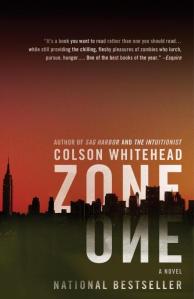
zone-one-paperbackWhy Zone One?

If Neil Gaiman is a genre author who has attained a certain level of (sometimes grudging) literary acclaim, Colson Whitehead is an eminently literary author who threw a spanner in the works by writing a zombie apocalypse novel. Prior to Zone One, which came out in 2011, he wrote The Intuitionist (1999), John Henry Days (2001), Apex Hides the Hurt (2006), and Sag Harbor (2009); I’ve read all but Apex, and can comfortably say I agree with many of the critics that he is one of the best American novelists of the twenty-first century. His writing is gorgeous, dense but lyrical, and he has a remarkable ability with turns of phrase and a penchant for employing unusual or rarely used words.

His novels prior to Zone One all deal in varying capacities with questions of race and identity in America, employing both realism (in John Henry Days and Sag Harbor), as well as, at times, an almost quirky absurdist sensibility: The Intuitionist is set in a parallel New York in which elevator mechanics are an elite and celebrated group, and the protagonist of Apex Hides the Hurt is a “nomenclature consultant” whose job is to act as an expert in naming things. His most recent novel is The Underground Railroad—currently sitting in my “to read” stack—which is set in an alternate antebellum America in which the underground railroad is not a figurative term referring to slaves’ escape route, but a literal subterranean locomotive.

Can’t wait to get to that one.

Zone One is unusual in Whitehead’s oeuvre insofar as it does not seem at first glance to be concerned with race at all. Indeed, we don’t learn the protagonist’s race until the last fifty pages or so; at that point, however, the revelation has a retroactive effect that colours (pardon the pun) our prior experience of the story and its key themes.

But I’ll address that in a later post.

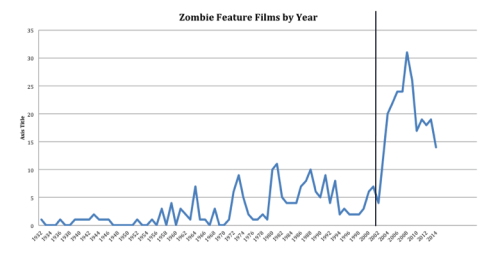
Why Zone One? Not just because it’s a “literary” author slumming it in genre-town, which is an increasingly frequent occurrence (Margaret Atwood, Kazuo Ishiguro, and Michael Chabon come to mind), but because of what he does with genre, in this case the ubiquitous zombie apocalypse narrative. I think it’s safe to say we’ve reached peak zombie: there was a ten-year surge in the undead’s presence on film, television, and in fiction, with Zone One serendipitously published at the apogee. The vagaries and themes of the zombie genre will also be fodder for a future post, but suffice it to say that stories of the living dead have emerged from the realm of horror sub-genre to become genre in their own right. And Colson Whitehead toys with the genre’s conventions beautifully.

zombie-graph

Literary Zombies

Reviewing Zone One for the New York Times, Glen Duncan makes recourse to a somewhat cringe-inducing analogy: “A literary novelist writing a genre novel is like an intellectual dating a porn star. It invites forgivable prurience: What is that relationship like? Granted the intellectual’s hit hanky-panky pay dirt, but what’s in it for the porn star?” To start with, I don’t know that such prurience is forgivable; understandable, perhaps, but only if one makes the same assumptions about genre as tends to be made about porn stars: that they’re mindless, intellectually shallow, and solely concerned with pleasure. It’s an unfortunate analogy, not least because it conflates porn stars with their physicality and obviates their potential as thinking, intelligent people.

More specific to my discussion, it’s unfortunate because it betrays an either/or mentality on Duncan’s part that hampers a nuanced reading of what Whitehead is actually doing with genre. Sadly, he also doubles down on this attitude with regard to those readers potentially drawn to the novel because of its subject matter:

Colson Whitehead is a literary novelist, but his latest book, “Zone One,” features zombies, which means horror fans and gore gourmands will soon have him on their radar. He has my sympathy. I can see the disgruntled reviews on Amazon already: “I don’t get it. This book’s supposed to be about zombies, but the author spends pages and pages talking about all this other stuff I’m not interested in.” Broad-spectrum marketing will attract readers for whom having to look up “cathected” or “brisant” isn’t just an irritant but a moral affront. These readers will huff and writhe and swear their way through (if they make it through) and feel betrayed and outraged and migrained. But unless they’re entirely beyond the beguilements of art they will also feel fruitfully disturbed, because “Zone One” will have forced them, whether they signed up for it or not, to see the strangeness of the familiar and the familiarity of the strange.

Speaking as an academic who has, for four years running, delivered quasi-lectures at “Sci-Fi On The Rock,” St. John’s equivalent of Comic-Con, I can cheerfully say that Glen Duncan has no fucking clue what he’s talking about when he characterizes “genre” fans in this way. True, there are a significant number of voices in the fan enclaves of social media that resist the encroachments of “literary” interlopers and anything that reeks of diversity or simple change (see my post from last year on the Sad Puppies), but these are a small number of loud voices. In my experience, fan culture is, broadly speaking, curious, inquisitive, and intelligent—my SFOTR audiences (on two of the four occasions standing-room-only) were more attentive and engaged than most of the classes I have taught over the years. Granted, I was speaking on topics (maps in fantasy fiction, Game of Thrones and The Wire, Terry Pratchett+Neil Gaiman+Joss Whedon, and world-building) in which they had a deep and abiding interest, but I was doing so in a decidedly professorial manner.

A more astute review is the Guardian’s, by Patrick Ness, who offers a far more useful analogy. A novel, he writes, is not a song—it is the performance of a song:

Genre fiction, literary partisans might say, may indeed have interesting songs, but they tend to be sung by the tone-deaf. Who cares how brilliant a sci-fi premise is if you have to wade through pages of indigestible prose to get to it? Literary fiction, on the other hand, is accused by genre lovers of being so concerned with performance alone that it’s devolved into an echo chamber for a diminishing number of elitists.

Here is something we can work with, not that it’s a new distinction: content versus execution, plot versus style. To be “literary” in this estimation is to achieve a certain virtuosity of prose, with less concern paid to content; to be “genre” is to be preoccupied with content at the expense of aesthetics. The latter, says Ness, risks abandoning quality, while the former risks disappearing “up its own arse.” As someone who has read plenty of exemplars of both tendencies, I’m inclined to agree with Neil Gaiman when he invokes Sturgeon’s Law: that ninety percent of anything is crap, be it genre or “literary.”

I’m more than inclined to put Zone One, both as a work of literature as a work of genre fiction, into the other ten percent.


The Triumph of Mediocrity

Why? Well, aside from being exemplary of Whitehead’s extraordinary prose, this ain’t your typical zombie story—and indeed, it goes out of its way to subvert expectations, even as it delivers everything we’ve come to expect from the genre, from terror and gore to the inevitable crumbling of barricades before the onslaught of the dead. Of the various reviews I read of Zone One, it was perhaps unsurprising that the best was by a genre aficionado—Charlie Jane Anders at i09.com—who opens her discussion with the observation that “Post-apocalyptic stories are chock full of wish-fulfillment. Rugged individualism holds sway. Every survivor is as special as Harry Potter, just by virtue of being alive.” The fantasy of apocalypse is almost always the fantasy of winnowing—of paring down the world by excising the excess, the unworthy. In my popular culture class this week we’re looking at Independence Day, which is about as explicit on this point as these narratives get: you can practically keep a checklist of the expendable characters as they get killed off (the gay dude, the dumb stripper, the undisciplined pilot, the disobedient wife), while at the end there’s symbolic unity among the caricatures of three traditionally factious dimensions of the American experience (the white leader, the black warrior, the Jewish scientist).

Zombie narratives complicate such clean apocalyptic purges simply by dint of the fact that the dead return to prey on the living, and those who were unworthy can still come back and chomp on your meaty bits. They also tend to be somewhat more nihilistic in the end than your average disaster/alien invasion film, such uplifting examples as World War Z notwithstanding. But as Anders points out, one of the principal attractions of the genre is the survivalist fantasy, in which some innocuous schlub finds his (almost always his) niche when, liberated from the banal sturm und drang of office life or retail purgatory, he realizes a hidden talent as implacable killer and leader of the dispossessed. Shaun of the Dead lampoons this beautifully, not least because Shaun immediately reverts to his slacker ways the moment the zombie threat is eliminated (I’ll have more to say about Zone One and Shaun of the Dead in a future post, but will refrain here because one of my students will be doing a seminar presentation comparing the two tomorrow, and I’d hate to step on her toes or steal her thunder).

Charlie Jane Anders goes on to point out one of the key elements that makes Zone One distinct: the novel, she says, “is about the only thing worse than living through the apocalypse—taking part in a heroic effort to rebuild civilization afterwards.” While the protagonist, a survivor with the unlikely nickname “Mark Spitz” (which is the only name we know him by), provides plenty of standard zombie-horror stories by way of his flashbacks, the present moment of the narrative follows him over the course of three days as he and the two other member of his “sweeper” unit do building-by-building searches in “Zone One,” clearing out the undead missed by the military juggernaut that massacred the zombie hordes. “Zone One” is Lower Manhattan south of Canal Street, where a tall Trumpian concrete wall has been erected. Sweeper teams have the tedious task of securing the area in advance of resettlement.

Mark Spitz is at once the epitome of the zombie genre’s ordinary-joe-turned-undead-killer, and a mordant critique of the very concept. He attributes his survival to the fact that all his life he had been aggressively mediocre, that in school “he staked out the B or the B chose him; it was his native land, and in high school and college he did not stray over the county line.” He assiduously kept to the middle, not that he really seemed to have much choice in the matter:

He was not made team captain, nor was he the last one picked. He sidestepped detention and honor rolls with equal aplomb. Mark Spitz’s high school had abolished the yearbook practice of nominating students the Most Likely to Do This or That, in the spirit of universal self-esteem following a host of acrimonious parent-teacher summits, but his most appropriate designation would have been Most Likely Not to be Named the Most Likely Anything, and this was not a category. His aptitude lay in the well-executed muddle, never shining, never flunking, but gathering himself for what it took to progress past life’s next random obstacle. It was his solemn expertise.

It’s a testament to Colson Whitehead’s talents that Mark Spitz is simultaneously a nuanced and textured character, and a total cipher; he has depth and individuality, but also functions as a neutral screen upon which we can project our own selves into the post-apocalyptic landscape. More significantly, our vicarious experience of the undead-stricken world is necessarily tinged with Mark Spitz’s morbid fatalism. If the pleasure of apocalypse in fiction, as Charlie Jane Anders suggests, is in the singularity of survival—and the thrill of surviving in a world reverted to primitivism—Whitehead systematically denies us that pleasure in giving us a protagonist whose everyman qualities ironically frustrate our desire to take pleasure in the fantasy of survival.

Leave a comment

Filed under teaching

American Gods Part Three: Gaiman’s Mendicant Gods

I said I had been writing up a storm. This post emerges from a little epiphany I had in the middle of class discussion on Thursday. Because I wanted to get it done before we move on to Colson Whitehead’s Zone One, I’m putting it up without doing anything more than the most cursory research into its main premise, namely, that Gaiman’s old gods comprise an interesting retread of a classic figure in American literature and popular culture: the drifter, the vagabond, the hobo. Actually, I’m pretty confident of that assertion–what I’m less confident of is how I historicize that figure. What I say feels right, but as I tell my students, that’s usually when you tend to drive your argument off a cliff. So know I’m totally prepared to be completely wrong on certain points.

Revenge of the Genres

americangodsWhile some of the gods Shadow meets are sedentary, like Mr. Ibis and Mr. Jaquel in their Cairo, Illinois funeral home, or Czernobog and the Three Sisters in Chicago, the novel itself is decidedly peripatetic and conveys a powerful sense of rootlessness. To be certain, this perambulatory quality is predominantly communicated by Shadow’s constant movement, crisscrossing the continent in Mr. Wednesday’s tow. But between his constant road-tripping and the depiction of the various old gods as marginal and forgotten, eking out an existence on what they can beg, scrape, swindle, or steal, the novel reimagines a common pre-WWII trope in American literature and popular culture: the romanticized figure of the drifter, the vagabond, the hobo.

I’ve only had this idea in my head for about forty-eight hours, and so haven’t devoted any real research to it yet, but it seems to me that the drifter—the sort who rode the rails during the depression, or “lit out for the territories” during frontier days, or for that matter literally drifted on a raft down the Mississippi River—met his end as an American staple after WWII. The world war was a pivot-point for America, transforming it from a middling world power with isolationist tendencies into a superpower that assumed the mantle of global cop, and whose intact manufacturing sector transitioned seamlessly from building tanks and jeeps to building Buicks and refrigerators. The single greatest building project in U.S. history, the construction of the massive interstate highway system, took place under Eisenhower’s presidency; this era similarly saw the growth of suburban sprawl into thousands of formerly rural areas.

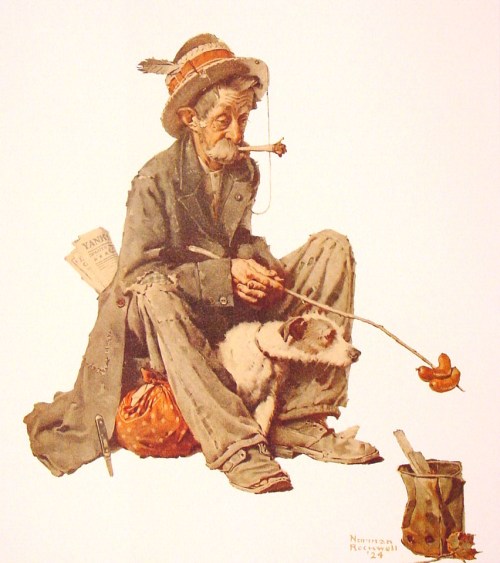
hobo-rockwell

When I say that the figure of the hobo or drifter has been romanticized or sentimentalized, I mean that even Norman Rockwell saw fit to make him a piece of nostalgic Americana.

The drifter did not disappear per se; rather, he settled behind the wheel of a car in On the Road or on a motorcycle in Easy Rider, or into the low-rent bohemias of big cities. But the rail-riding hobo, the Tom Joad-esque leftist agitator, or the roving loner who just needs to escape the stultifying conventions if civilization? They effectively disappeared. And though I have no doubt that there are any number of instances I’m not thinking of that contradict this notion, I would still argue that the postwar drifters are different in kind, bounded by an America that has coloured in what Joseph Conrad’s Marlowe called “the white spaces of the map.” It’s telling that in Jack Kerouac’s On The Road, Sal Paradise and Dean Moriarty’s search for the “real America” ultimately takes them to Mexico, as their blinkered conception of American “authenticity” can no longer reside within its borders.

But what does this have to do with American Gods? Honestly, still working that one out. But it strikes me that if we look at Mr. Wednesday et al in this context, they appear as degraded, disaffected manifestations of the drifter—not the hopeful, romantic sentiment giving voice to “This Land is Your Land,” but figures long alienated by the very newness of a land not amenable to their kind (as discussed in my last post). That America’s “newness,” as compared to their Old World stomping grounds, is part of the problem, reads in this context as vaguely ironic, as it was the putative newness of America that inspired the loners seeking empty landscapes and “that ribbon of highway” that leads off Pete Seeger’s anthem; and it was that “newness” that romanticized their wanderlust.

If the transformation of the U.S. from a frontierland into urban/exurban sprawls interspersed with farmland industrialized by agribusiness have comparably transformed the drifter into an alienated figure seeking escape, Gaiman’s gods appear to us always already alienated by a land that marginalizes and forgets them almost immediately. Indeed, have more in common with the alienation of the Beats, echoing the lost and forgotten human detritus littering the landscape of Allen Ginserg’s “Howl,” the “angelheaded hipsters burning for the ancient heavenly connection to the starry dynamo in the machinery of night.” As Mr. Wednesday says to the assembled old gods when trying to persuade them to take up arms against the new,

This land is vast. Soon enough, our people abandoned us, remembered us only as creatures of the old land, as things that had not come with them to the new. Our true believers passed on, or stopped believing, and we were left, lost and scarred and dispossessed, to get by on what little smidgens of worship or belief we could find. And to get by as best we could.

So that’s what we’ve done, gotten by, out on the edges of things, where no one was watching too closely.

We have, let us face it and admit it, little influence. We prey on them, and we take from them, and we get by; we strip and we whore and we drink too much; we pump gas and we steal and we cheat and we exist in the cracks at the edges of society. Old gods, here in this new land without gods.

It is difficult not to read American Gods in the present moment without having in mind the systematic depredations of neoliberalism—the gutting of manufacturing, destruction of unions, erosion of the social safety net, diminution of the middle class, and dramatic increase in income inequality—that have brought the U.S. to a point of such radical disaffection that Donald Trump actually seems like a viable candidate to 40% of voters. While Gaiman’s gods serve to allegorize this disaffection and alienation, the novel also depicts the decline of opportunity and community in the Midwest and the Rust Belt, such as the declining town of Cairo, Illinois (a town that has, since the publication of American Gods, been effectively abandoned).

Nowhere does the novel depict this declination more than in contrast, with the literally preternatural Lakeside: an idyllic, perfect little berg that is prosperous, friendly, and optimistic, free of the scourges of rampant drug use and crime. As noted in my previous post, Shadow realizes that this unusually perfect town can only be so by way of human sacrifice. When Shadow confronts him, Hinzelmann says defiantly, “This town … I care for it. Nothing happens here that I don’t want to happen. You understand that? Nobody comes here that I don’t want to come here.” When Shadow asks if anyone else knows how he maintains the town’s protection, he replies, “They know that they live in a good place. While every other town and city in this county, heck, in this part of the state, is crumbling into nothing. They know that.” When the Sherriff overhears them and kills Hinzelmann, Shadow tells him, “this town is going to change now. It’s not going to be the only good town in a depressed region any more. It’s going to be a lot more like the rest of this part of the world. There’s going to be a lot more trouble. People out of work. People out of their heads. More people getting hurt. More bad shit going down.”

These glimpses of America in decline are not central to American Gods, but nor are they incidental to the map Gaiman draws. On returning to this novel yet again, I am impressed anew by the richness of its critique: as I said in my previous post, we can read it both as an indictment of modernity’s (and especially postmodernity’s) capacity to run roughshod over cultural idiosyncrasies and assimilate them into a monolithic culture industry, and as a guarded endorsement of American Exceptionalism and the United States’ capacity to make good on the promise of blank slates. At the same time, it functions as a critique of the country’s inherent tendency to alienate certain populations and obviate the possibilities for the very dream associated with its most prominent national myth.

***

It’s something of a shame we really do have to move on—I feel like I’m just getting started here. Tune in tomorrow when we shift gears and talk zombies.

(though I will probably put up a post mid-week that started out as a discussion of American Gods but ended up focusing more on Harry Potter and Buffy the Vampire Slayer. These things happen when you live in my mind).

1 Comment

Filed under Revenge of the Genres, teaching

American Gods Part Two: Gaiman, Pratchett, and the Nature of Belief; Or, Where in America is Jesus?

So, I fell a little behind the eight-ball with the blogging this week, but I have been writing up a storm since yesterday. Today’s post is a little like closing the barn door, as we finished up American Gods this past Thursday, and start Zone One next week … but as I said to my students, a course like this is cumulative; which is to say, it takes a couple of weeks to start getting some traction, but once there’s a few texts under our belt, and our understanding of the key themes and ideas gets more thorough, there will be more meat on the course bones. All that is by way of saying, I have little doubt we’ll have more to say about American Gods going forward.

Which is good, because I have at least one more post on Gaiman to put up before the weekend is out.

Revenge of the Genres

americangodsOne of the novel’s mantras, an observation made numerous times, is that America “is not a good land for gods”—compared to elsewhere in the world, it is infertile, difficult for the seed of true belief (that which creates gods and gives them power) to take root. Why this is the case, and what the novel means by “true belief,” was a question we tossed back and forth in class this week. One of the things the novel makes fairly clear is the connection between faith and sacrifice, that the “old gods” primarily derived their power from blood rites, which were a devotion literally made flesh: the killing of animals or other humans.

Gaiman is canny about this: he never explicitly or exhaustively explains the logical apparatus of his mythology, which is probably one of the reasons American Gods is such a good novel. An overabundance of exposition is a trap too many fantasy narratives fall into. But there is the distinct suggestion that the gods, both the new and the old, specifically require sacrifice, for something to be given up. In this respect, the new gods—of technology, highways, media, internet, credit cards, and so forth—have a significant advantage, for while people don’t necessarily focus their worship in the same way as when we personify divinity, they nevertheless sacrifice part of themselves: their money, their time, their attention, or in the case of cars and highways, sometimes their lives. As a class, we agreed that the quality of such worship was inferior to what the old gods received in their day (as it was unfocused and inadvertent), the sheer volume of it more than made up for that.

While some of this sort of speculation falls into the same realm as speculating on how many children Lady Macbeth had—which is to say, sweating speculative details that are ultimately unknowable, and anyway far less significant than the broader themes of the story—it is still useful in helping divine some of the thematic and allegorical nuances. Why is America a bad land for gods? One reason might lie with the unfocused and self-centered nature of the worship of the new gods, i.e. that this is not a nation given to physical or substantive sacrifice in the name of faith. When Wednesday explains to Shadow about “places of power,” he says that in other places of the world, people would be drawn to them and “they would build temples, or cathedrals, or erect stone circles.” In America, people would be similarly drawn to such places but would

respond to it by building a model out of beer bottles of somewhere they’ve never visited, or by erecting a gigantic bat-house in some part of the country that bats have traditionally declined to visit. Roadside attractions: people feel themselves being pulled to places where, in other parts of the world, they would recognize that part of themselves that is truly transcendent, and buy a hot dog and walk around, feeling satisfied on a level they cannot truly describe, and profoundly dissatisfied on a level beneath that.

When Shadow protests that “there are churches all across the States,” Wednesday agrees, tellingly, adding that that made them “about as significant, in this context, as dentists’ offices.”

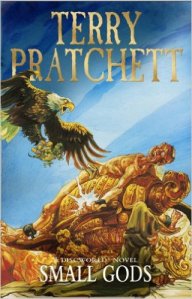
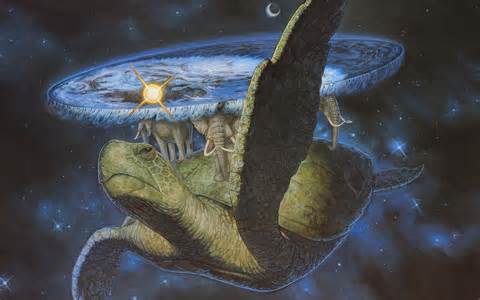
small-godsWednesday’s almost offhand dismissal of Christianity’s ubiquity speaks to a question I raised in class: if gods exist by way of people’s worship, then where—in a nation in which 70% of people identify as Christian, and over a third of them as Evangelical—where, I asked, is Jesus and the Christian God in Gaiman’s American pantheon? When first I read American Gods, I thought this a big plot hole and something of a cheat: since having an appropriately powerful Jesus would throw the story somewhat askew, I assumed Gaiman just conveniently ignored the question. But on subsequent readings, I’ve amended that opinion, and would now argue that the novel offers a subtle critique on the nature of professed belief, one consonant with Terry Pratchett’s Small Gods. The Discworld novels have the same inversion of humanity and divinity we see in American Gods; in Small Gods, Pratchett’s analogue of fundamentalist Christianity, Omnianism (which worships the great god Om, declares him to be the one and only god in the Discworld firmament, is rooted in the theocratic nation of Omnia, and further holds as an article of dogma that the world is round in opposition to the heretical view that it is a flat plate on the backs of four elephants standing on a space turtle), has become such a monstrous bureaucratic labyrinth in which functionaries are preoccupied with the thousands of pages of commentaries, annotations, and catechism, rather than the original holy scriptures, that the god Om has dwindled in power to the point that he lives trapped in the body of a tortoise.

discworld

Silly Omnians. Everyone knows it’s turtles all the way down.

Jesus isn’t completely ignored in American Gods, but it’s pretty obvious that he’s not a player in the U.S. landscape. Why? Well, I would suggest that, as in Om’s predicament, actual belief has become incidental to the performance of belief: the ubiquitous churches pervading the American landscape, Wednesday would seem to suggest, lack affect. One is tempted to speculate that the megachurches, with their music and laser shows and evangelical pyrotechnics, do more to feed the maw of the new gods of technology and media. One is further tempted to speculate that, in an updated version of Gaiman’s mythology, Jesus and God have been subsumed into the new god of Partisanship, specifically the Red Avatar.

In all seriousness, however, I have come around to a reading of American Gods in which it comprises a fairly pointed critique of American religiosity along these lines. Which is not to disparage the many, many people of sincere faith who work hard to hew to the directives of the Gospels to be charitable, generous, and to comfort the afflicted; it is rather to observe that this critique is directed at those whose mantle of Christianity is worn hypocritically, in direct contradiction of the values just enumerated.

But I digress.

A key thematic moment, which I quoted in my first American Gods post, comes when Wednesday takes Shadow to San Francisco. Shadow, who has been spending a frozen idyll in the Wisconsin town of Lakeside, looks around at San Francisco’s colourful houses, its steep hills, and mild weather, and remarks, “It’s almost hard to believe this is the same country as Lakeside.” To which Wednesday irritably replies,

“It’s not. San Francisco isn’t in the same country as Lakeside, any more than New Orleans is in the same country as New York or Miami is in the same country as Minneapolis.”

“Is that so?” said Shadow, mildly.

“Indeed it is. They may share certain cultural signifiers—money, a federal government, entertainment; it’s the same land, obviously—but the only things that give it the illusion of being one country are the greenback, The Tonight Show, and McDonald’s.”

Wednesday’s irate little speech, as stated above, is one of the novel’s thematic lynchpins, and, I would argue, key to understanding America’s “infertility” as regards the gods. The country is too large, too heterodox to support a national identity that is itself anything more than myth or fiction. That is, indeed, enshrined among the nation’s founding documents in John Adams’ assertion that the U.S. have “a government of laws, and not of men.” One of the most basic tenets underpinning the doctrine of American Exceptionalism is the historical and geographical serendipity that allowed it to benefit from the scientific and philosophical revolutions of the Enlightenment without suffering from the centuries of tribal and religious strife that preceded them, while putting a wide ocean between itself and the Old World’s scars. Wednesday’s rejection of a unitary “America” as an identifiable place is, on one hand, just an acknowledgement of the nation’s deliberately factious architecture: the Jeffersonian dream of disparate, quasi-autonomous states.

On the other hand, we can also read in Wednesday’s irritation (beyond the fact that he was simply being stroppy with Shadow at this point in the novel) a deeper and longer-standing disaffection with America. The formulation of “laws and not men” establishes the need to have a stable intellectual and ideological architecture that can survive the erratic and irrational tendencies of the flawed human beings who have a bed tendency toward oppression and capricious violence when allowed to rule by fiat.

However, as suggested above, “true belief” of the kind that creates and feeds the gods is clearly established in American Gods as something that requires bodies. John Adams’ formulation removes individual, corporeal people from the figuration of national identity, specifically as a bulwark against tribal, ethnic, or racial determining factors in what determines an “American.”

(Which isn’t to say that the actual America as envisioned by John Adams et al has ever completely, or even mostly, succeeded in hewing strictly to the “laws not men” dictum—not least because the language of that crucial distinction elides half the population, or that America’s authors tacitly endorsed the institution of slavery. These fissures are ever more obvious today: as I said in class, it is an odd experience to reread American Gods and think through it in these terms while at the same time bearing witness to an election cycle that has given voice to the ugliest manifestations of American nativism and hatred. My comment above about the God of Partisanship was only slightly ironic).

The kind of belief that creates and sustains Gaiman’s gods is anathema to a large, broad, and diverse population, given its roots in tribalism and superstition. A key moment speaking to this principle comes toward the end of the novel, when Richard Hinzelmann, the eccentric but charming old man who basically acts as Shadow’s host in Lakeside, reveals himself as a Teutonic tribal god:

Where Hinzelmann had been standing stood a male child, no more than five years old. His hair was dark brown, and long. He was perfectly naked, save for a worn leather band around his neck. He was pierced with two swords, one of them going through his chest, the other entering at his shoulder, with the point coming out beneath the ribcage. Blood flowed through the wounds without stopping and ran down the child’s body to pool and puddle on the floor. The swords looked unimaginably old.

In that moment, Shadow instinctively knows Hinzelmann’s story, and sees in his mind’s eye the blood ritual that would sacrifice a child to create a tribal god. “Shadow wondered which of the people who had come to northern Wisconsin a hundred and fifty years ago, a woodcutter, perhaps, or a mapmaker, had crossed the Atlantic with Hinzelmann living in his head.” And Hinzelmann, incarnation of whatever vestigial god had made that trip, founded Lakeside and cultivated it and loved it, and protected it as a perfect and unchanging space through the same means that created him: the sacrifice of youth.

Shadow’s return to Lakeside functions as a coda to the novel. He comes back because he has figured out the connection between the yearly disappearance of preteens or teens, and the betting pool the town has in which people guess what day and time a clunker pushed out on the frozen lake breaks through the melting ice in spring. The murdered children, Shadow realizes, are in the trunks: the sacrifice Hinzelmann chooses to make in exchange for keeping his town safe and protected.

On one hand, one can read American Gods as a critique of modernity’s erasure of cultural idiosyncrasies. One of the other reasons America is a bad land for gods is its very ahistorical qualities, the assimilation of “authenticity” into a culture industry that flattens and denudes cultural specificities into Taco Bell or the Olive Garden. In this respect, the novel allegorizes the immigrant experience, in which successive generations grow increasingly distant from the myths and narratives of their origins, and discard the old gods to wander the margins of America. On the other, one can read Wednesday et al as anachronisms best forgotten, if the cost of “true belief” is that dear.

2 Comments

Filed under Revenge of the Genres, teaching

From the Decay of Lying to the Velocity of Mendacity, or, The Fiction that is Donald J. Trump

C YRIL. Lying! I should have thought that our politicians kept up that habit.
V IVIAN. I assure you that they do not. They never rise beyond the level of misrepresentation, and actually condescend to prove, to discuss, to argue. How different from the temper of the true liar, with his frank, fearless statements, his superb irresponsibility, his healthy, natural disdain of proof of any kind! After all, what is a fine lie? Simply that which is its own evidence. If a man is sufficiently unimaginative to produce evidence in support of a lie, he might just as well speak the truth at once.
—Oscar Wilde, “The Decay of Lying”

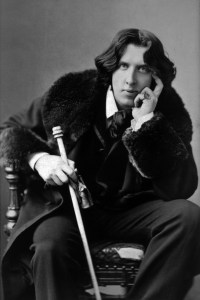
oscar_wilde_portraitLike most people, as I have watched the U.S. election, I have frequently wondered what Oscar Wilde would make of it. And more specifically, what he would make of Donald Trump.

Wilde published his elegant essay “The Decay of Lying” in 1889, and then again with significant revisions in 1891. He composed it as a dialogue between aesthete Vivian and skeptic Cyril, and argues (through Vivian) that a preoccupation with reality and realism has corrupted and denuded art. What, he asks, has happened to the beautiful lie? He laments,

Facts are not merely finding a footing-place in history, but they are usurping the domain of Fancy, and have invaded the kingdom of Romance. Their chilling touch is over everything. They are vulgarising mankind. The crude commercialism of America, its materialising spirit, its indifference to the poetical side of things, and its lack of imagination and of high unattainable ideals, are entirely due to that country having adopted for its national hero a man, who according to his own confession, was incapable of telling a lie, and it is not too much to say that the story of George Washington and the cherry-tree has done more harm, and in a shorter space of time, than any other moral tale in the whole of literature.

Like much of Wilde’s writing, the apparent frivolity of his tone and glib assertions of his narrators are just window-dressing for profound insight into our relationship to and with art and literature. What is fiction and poetry, he basically asks, if not a series of beautiful lies? Lies which, Vivian is careful to observe, transform reality itself: it is in this essay that Wilde formed his famous axiom that “life imitates art.” A superficial reading of this aphorism suggests the ways in which people chase after the latest trends in fashion as created by popular culture. Wilde’s point is however more nuanced, and makes a semiotic argument decades before semiotics was all the rage in English departments: namely, that art and literature facilitate and expand a vocabulary of expression that potentially transforms the way we perceive the world. Challenged by Cyril to prove his point, Vivian responds,

Where, if not from the Impressionists, do we get those wonderful brown fogs that come creeping down our streets, blurring the gas-lamps and changing the houses into monstrous shadows? To whom, if not to them and their master, do we owe the lovely silver mists that brood over our river, and turn to faint forms of fading grace curved bridge and swaying barge? The extraordinary change that has taken place in the climate of London during the last ten years is entirely due to this particular school of Art.

Again, we have the distinct impression of a tongue stuck firmly in a cheek, but Wilde’s argument—lurking subtly underneath Vivian’s high-handed and ostensibly absurd assertion—troubles the assumption of art as straightforward representation, of Hamlet’s pompous direction to the players that the purpose of art “both at the / first and now, was and is, to hold, as ’twere, the / mirror up to nature.” Hamlet comes in for some excoriation from Vivian for this line, as do those who quote it unironically, not understanding “that this unfortunate aphorism is deliberately said by Hamlet in order to convince the bystanders of his absolute insanity in all art-matters.”

But what does this have to do with Donald Trump? Well, that goes to my musing about what Wilde (or his mouthpiece Vivian) would make of this moment’s most magnificent liar. I think we might be operating now outside of Wilde’s wheelhouse, for it isn’t so much that Trump lies as that he embodies untruth. Wilde, I suspect, would be less concerned with the decay of lying than with the sheer velocity of Trump’s mendacity.

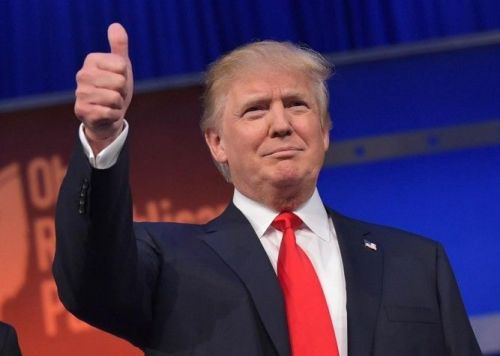
donald-trump-flashes-the-thumbs-up-jpg-crop_-promo-xlarge2-667x476

Donald Trump Did Not Take Place

One of the greatest frustrations supporters of Hillary Clinton and those with an affection for Civilization As We Know It have had in this campaign is the double standard for honesty being applied to her and Trump. By any objective measure, as was observed by Ruth Marcus on Slate magazine’s most recent Political Gabfest, “Hillary wins the transparency Olympics.” Which isn’t to say she hasn’t prevaricated, embellished or downplayed the truth, or outright lied—just that when you tally up her untruths and juxtapose them with Trump’s, it’s a molehill dwarfed by a mountain. For a long time it seemed to me as if the media was grading the respective candidates’ honesty on a curve, with Trump benefiting and Clinton suffering from different standards applied across the board.

I’m no longer convinced by that analogy, however, because it suggests that Trump and Clinton exist on the same epistemic continuum, one in which truth and falsity are givens. To be certain, that’s where Clinton is. Trump, however, is no longer there, and it’s doubtful whether he ever was. Rather, he has come to be the embodiment of the postmodernist moment when a fictional character steps off the page or screen into reality, and in so doing troubles “reality” as stable category. As the saying goes, if Donald Trump didn’t exist, we would have to invent him. Except—and here’s the rub—we did.

Donald Trump is a fictional character, and this is why the normal epistemic rules we apply to presidential candidates have been more or less irrelevant to his candidacy. I want to be clear: when I call Trump fictional, I am being wholly unironic. I’m not questioning his empirical, physical reality—he is a person with a history, a body, a passport and (we assume—he’s never showed us) a birth certificate—but asserting that his candidacy, and the frighteningly real possibility that he may be elected, can only be properly understood in terms of fiction.

It’s not that Hillary Clinton is being held to a different standard of truth so much as inhabiting a different epistemic paradigm entirely. She traffics in reality, and is preoccupied with policy and the quotidian details of governance, preoccupied with politics in its classic definition as the “art of the possible.” The experience she has accrued as First Lady, Senator for New York, and Secretary of State is matched by a comparable accrual of secrets, lies, gaffes, scandals (real and imagined), half-truths and embellishments, enmities and connections, losses and victories—in other words, the baggage that anyone of her prominence with so long a tenure in public life amasses. The arguments made about her dishonesty, or her cozy relationship with the 1%, or any of the other issues arising from her life spent in politics are however different in kind from the most basic principle animating Trump’s rump: that it is precisely this experience, which tars her as “establishment,” that is her disqualifying quality. Trump will fix things because he says he will. Nothing factual pertaining to his history of bankruptcies, grifting, shafting contractors and investors and banks, his mob ties, or to the very real likelihood that his net worth is nowhere near what he claims, gains any traction with his supporters, because in the end he is a fictional character.

To help explain what I mean, it’s worth remembering that Hillary and Bill Clinton have a fictional dimension themselves, but one that ultimately serves to solidify their place in the world of truth and falsity. The Clintons have provided fodder for a host of filmic and televisual depictions of the presidency, from direct fictionalizations like Primary Colors and Political Animals, to shows that have been more obliquely informed by the Clinton political saga like The West Wing and House of Cards. Such parallels don’t make Hillary Clinton herself a fiction in the same way as I’m characterizing Trump, however. Indeed, they provide a contrast to reality in the way they idealize (The West Wing), satirize (Veep), or dystopianize (House of Cards) the political life (no, “dystopianize” wasn’t a word, but it is now. Use it in good health). This contrast serves to reinforce the distinction between fiction and reality: these narratives are by turns fantasies of what we wish the Clintons could be, or what we suspect they really are.

Trump, on the other hand, emerges on the political stage fully fictional, built out of the many mendacities of his life-long self-fashioning: posing, over the phone, as his own publicist in order to mythologize his supposed playboy lifestyle; his transformation from builder to brand; his serial marriages to women whose beauty flatters his image; his emergence as a reality TV star. Trump as a human being is about as real as his hair. His persona is a carefully wrought bit of artifice that employs extant, popular American tropes that serve to paper over the inconvenient truth of his silver-spoon upbringing. He’s Horatio Alger and P.T. Barnum, and about as honest as both of them combined. But like Alger and Barnum, he has the innate ability to enthrall an audience, even those who might actively loathe the spectacle. Let’s be honest: we can’t discount the fact that at least part of Trump’s success resides in the same horrified fascination that fuels the box office numbers for disaster films. Even those of us objectively appalled at the prospect of him in the Oval Office kind of want him to win in November, just to see what happens. But that’s because we’re narrative junkies, and that’s one of the reasons for his success: he’s a fictional juggernaut now, writing a story as he goes that none of us—Doonesbury and The Simpsons excepted—could have predicted, but which continues its postmodern encroachment of fiction into reality every day.

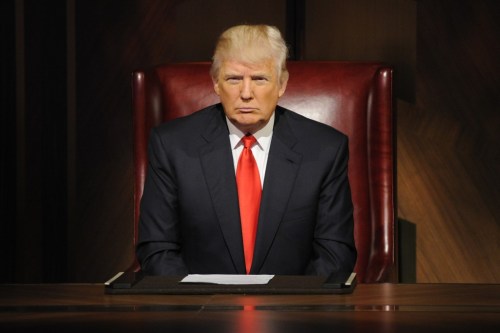
I won’t be the first person to ascribe Trump’s candidacy to the pernicious effects of reality TV, and it’s safe to say that his ascendancy is a perfect storm of historical and cultural factors (something made risibly clear by Andrew Coyne in his recent National Post op-ed, in which he literally blames everyone). But it is painfully obvious that Trump is the embodiment of the dissolution of entertainment into reality, something reality TV has been priming us for since it first declared that it wasn’t here to make friends. Every reality TV competition has a villain and a blowhard—those characters that drive up the ratings—and Trump is both. He operates according to those rules, which have nothing to do (ironically, I suppose) with reality, and everything to do with besting the other contestants. The problem in this election cycle is the mind-numbing number of voters who are more than willing to give credence to this logic.

But why? In part because, more than anything else, Trump’s ongoing reality TV candidacy speaks to what people feel is reality rather than any empirical knowledge.


GOP 2016 Trump Echoes of Wallace

Make America Great White Trump Again

One can argue endlessly about whether elections have always been more about emotion than thought, truthiness rather than truth, but it is hard to deny that Trump is the ultimate candidate for feelings over facts. The entirety of the 2016 Republican National Convention was given over to how America “feels”—the speeches by the Republican not-so-luminaries who deigned to participate did not cite statistics about a crumbling economy or rampant crime, but asserted instead that Americans feel the economy is tanking, and how they feel threatened by rising crime rates. When confronted in an interview with the objective fact that crime rates are at a thirty-year low, Newt Gingrich doubled down, saying, “As a political candidate, I’ll go with how people feel, and you can go with the theoreticians.”

And when the people delivering speeches weren’t saying that people felt afraid, they went out of their way to scare the shit out of them. “The vast majority of Americans today do not feel safe,” Rudy Giuliani thundered at the start of his speech, and then went on to suggest that Obama’s tenure emboldened terrorists and criminals, and that Clinton would, if elected, blithely allow terrorists to enter along with a massive flood of Syrian refugees. “The cost of Hillary’s dishonesty,” declared Newt Gingrich, “could be the loss of America as we know it.”

“America as we know it” is an instructive phrase. It is of a piece with the “America” of Trump’s slogan “Make America Great Again.” The America that people “know” is invariably different from the America that is, for the simple fact that it is too big, too complex, too disparate in every category from income to ideology, for any one person to have an objectively true perspective. But the closest one can come requires empathy, an open mind, and a grasp of history, something actually demonstrated by the current president when he addressed the blinkered nostalgia animating Trump’s slogan:

Here, President Obama puts into historical context the nostalgic idea of America evoked by Trump: the ascendant, dominant America, with a thriving manufacturing sector in which his aggrieved white supporters would have found well-paying blue-collar jobs. The problem with nostalgizing this Golden Age is twofold: first, it represents a fleeting moment in U.S. history, about thirty years—or 12.5% of America’s lifetime. The suggestion that it was some sort of prelapsarian moment ignores all of the historical factors enumerated by President Obama: that the U.S. emerged from WWII unscathed, with all of its manufacturing capabilities intact, while the other major powers in the world lay devastated by the war. (If you want to talk about American Exceptionalism, this was a time when the U.S. was genuinely exceptional, for the simple reason that its cities had not been pounded into dust). There was an economic vacuum into which the U.S. stepped, overturning its prior inclination to isolationism and embracing and facilitating the expansion of globalization. And in so doing, it prospered hugely—but sooner or later, its dominance would inevitably by challenged as other world powers dug themselves out of their postwar holes. Or in Trump parlance, they started “winning.”

Secondly, the tacit idealization of this period ignores one crucial factor, something a former professor of mine pithily summed up in the axiom “the ‘good old days’ were inevitably bad for someone.” Yes, the postwar years comprised a time of great opportunity and prosperity, provided you were white and male. Even if you ignore the blatantly racist drivel that has dropped from Trump’s mouth, his supporters have embraced a nostalgia for white America.

All that being said, Trump has been entirely vague on what version of America was “great” compared to his depiction of a fallen, postlapsarian nation that has forgotten how to “win.” Again, it’s all about the feelings: the historical facts and the contemporary reality of lower crime and a growing economy are irrelevant to a narrative of decline and fall requiring a strong man to turn the nation around. All of Trump’s critics who modify his slogan to “Make America White Again” aren’t wrong, at least not where his supporters are concerned; but for Trump himself, the slogan should really be “Make America Trump Again,” and the fact that it never was is entirely beside the point.

trump-apprentice

A Probable Impossibility

I keep coming back to Aristotle’s principle than a writer of fiction “should prefer probable impossibilities to improbable possibilities” (Poetics XXIV). By which he means it is better to have something unreal behaving logically (a faster-than-lightspeed spaceship, for example, inhabited by believable characters) than something real behaving in unlikely fashion (an everyday Joe winning the lottery three times in as many days). Readers and audiences accept impossibilities, provided they obey the laws of story and narrative.

For some time now I’ve viewed Trump’s success as an improbably possibility: all the way along it has been technically possible for him to rise to the top of the Republican ticket and have a realistic shot at the White House, but possible in the same way that if I started training tomorrow I could win the Boston Marathon in five years. Possible, but infinitesimally unlikely.

I have now changed my thinking. A Trump presidency—or for that matter an America in which 40% of its voters think a mendacious, self-aggrandizing businessman with four bankruptcies and the attention span of a goldfish is qualified to be president—should be impossible. And indeed, the very prospect of his nomination was almost universally considered absurd on the face of it by the media’s brain trust. Those few people, like Rep. Keith Ellison, who warned that it could happen were literally laughed at.

But in the present moment, Trump’s rise has all the implacable inevitability of a disaster film. For a candidacy that privileges feeling over thought, “President Trump” feels probable, as impossible as it should be. It is tempting to joke that “he’s not the president America needs, but he is the president America deserves,” but there would be too much collateral damage in that eventuality. Whether the electorate deserves it or not, American popular political culture has been laying the groundwork for years. Keith Ellison defends his warning by citing the fact that in Minnesota, they elected Jesse Ventura in defiance of all common sense; he could just as well have pointed to the nomination of Sarah Palin as a VP candidate, the two-term reign of the Governator in California, and of course that time the country elected a former B-movie actor as president—twice.

Jorge Luis Borges’ story “Tlön, Uqbar, Orbis Tertius” allegorizes what happens when fiction becomes all-consuming and persuasive. When the imaginary world of Tlön captures the world’s imagination, its fiction trespasses into reality:

Almost immediately, reality yielded on more than one account. The truth is that it longed to yield. Ten years ago any symmetry with a resemblance of order – dialectical materialism, anti-Semitism, Nazism – was sufficient to entrance the minds of men. How could one do other than submit to Tlön, to the minute and vast evidence of an orderly plant? It is useless to answer that reality is also orderly.

Donald Trump, as I have argued in this post, is wholly fictional. He does not merely lie, he is a lie, one that operates according to the rules of the “reality” of reality television. With this in mind, however, there is one ray of hope: the villains and the blowhards of reality TV may get the most attention and drive up ratings, but statistically they rarely win. Most often, the winners are the innocuous contestants, the ones who stay off the radar while working hard to make themselves valuable without drawing attention. Blowhards and villains eventually piss too many people off, and find themselves voted off the island or out of the house … or fired.

Fingers crossed for that kind of narrative inevitability.

2 Comments

Filed under politics, wingnuttery

American Gods Part One: Neil Gaiman’s Legendarium

Revenge of the Genres

Why American Gods?

Every first post I do on a new course text, I’ll ask this question. Why are we studying this? How does it fit into the course? I’d like to think that most, if not all, of my selections are more of less self-explanatory; still, some are more self-explanatory than others, and I’ve always subscribed to the teaching philosophy that self-reflection on the logic underlying a course is a good thing.

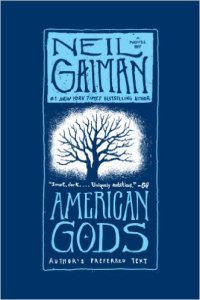
americangodsSo: why American Gods? We may well ask this question more pointedly than with other texts for the simple reason that this course is (technically) “American Literature after 1945,” and Neil Gaiman is British. Given however that much of this course will be given over to the dissolution of such boundaries as highbrow lowbrow, literature and genre, to say nothing of the boundaries and distinctions between and within genres, it makes a certain amount of sense to begin the course thinking about the ways in which we divvy up the field of literary study into national literatures, ethnic or cultural literatures, historical periods, and the usefulness of such distinctions. Considering that American Gods is about the tension between mythologies of worship and mythologies of nation, it similarly gives us a set of useful insights into the ways in which genre functions as its own form of myth.

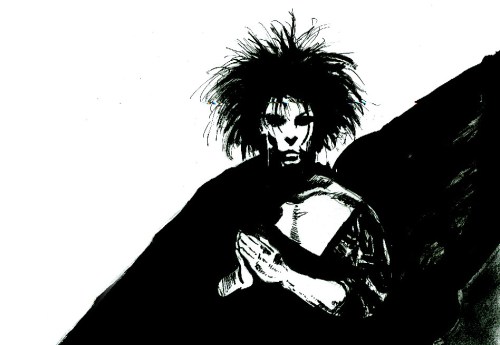
There’s also just the fact of Neil Gaiman himself, a prolific and brilliant author who cut his teeth first as a journalist, and then as an acclaimed writer of comic books. I first read Neil Gaiman in high school when my best friend, himself a comics enthusiast, turned me on to The Sandman—the story of Dream, one of the seven Endless, the embodiments of mortal qualities and behaviours (Destiny, Death, Dream, Desire, Despair, Delirium, and the prodigal Destruction). I have never been much of a comics reader—really, the one enclave of nerdiness that I never cared for—but I was amazed by the dark genius of the stories and the intelligence of the writing. (Also, it didn’t hurt that the titular character looked an awful lot like Robert Smith of the Cure, long one of my favourite bands).

sandman-003

Gaiman’s career has been a gleefully promiscuous mixing, matching, and crossing of genres: comics, children’s books, television writing (Doctor Who, Babylon 5), radio plays, screenplays, novels, YA fiction, live performance—and while most or all of that would once upon a time have been dismissed as the provenance of a hack, not an artist, you would be hard-pressed to find voices in the American or British literati who don’t have at least a grudging respect for his work.


Defining Mythology

Mythology is a tricky term, because it comes freighted with a variety of meanings and connotations, not all of which are necessarily consonant with one another. For our purposes, there are three uses I’ll be discussing:

  1. Its association with religion, worship, and the divine—both in the sense of what J.R.R. Tolkien called mythopoeia (more on that below), and in its etiological function of providing a narrative explanation for creation and existence—in creating a pantheon of gods and their interactions with humanity.
  2. Roland Barthes’ designation as “a form of speech”; a metalanguage that emerges when, to quote Barthes, we “confuse history for nature.” That is to say, we create mythologies when we start to see the products of human thought, invention, and discourse as naturally occurring and innate; the assumption that concepts like “justice” or “perversity” are transcendent categories as opposed a cultural consensus.
  3. Finally, the more colloquial use of the term to describe the backstory and history of a given alternate reality. As best as I can divine, this use of the term came into popular use to describe those episodes of The X-Files that expanded upon the show’s conspiratorial prehistory. It has now become common to employ “mythology” in this respect, especially with television franchises like Supernatural or the Whedonverse.

I should hope it goes without saying that American Gods deploys the first two definitions in a host of interesting ways; the third definition is less relevant to us here at first, but worth establishing because we will be talking about it again.


American Gods and Fantasy

Neil Gaiman is one of a handful of fantasists whom I’ve been working on for about two years now, looking at the ways in which they’ve (re)deployed the genre of fantasy (loosely defined) to articulate a secular, humanist world-view (others include Lev Grossman, George R.R. Martin, Terry Pratchett, N.K. Jemisin, J.K. Rowling, and Joss Whedon). Fantasy—both in terms of such defining works as The Lord of the Rings and the Narnia chronicles, and in its proto-forms in late Victorian faery-stories and medieval romance—tends to be deeply religious in structure. By this I mean it is often imbued with Christian allegory, such as in C.S. Lewis, but more so that it is predicated on an extrinsic understanding of power as divine and transcendent. Fate and destiny are key watchwords, dictating rigid limits for narrative and character. What is more, as Farah Mendlesohn points out in her book Rhetorics of Fantasy, there is a powerful tendency to treat history as absolute and as transcendent as the powers that be: fantasy, especially portal-quest fantasies, more often than not begin with a “download of legend,” delivered to the protagonist by an authoritative voice—the “story until now,” as it were, whose truth value is unquestioned (think Mr. Tumnus, the faun whom Lucy Pevensie meets in The Lion, the Witch, and the Wardrobe, or for that matter Gandalf telling Frodo the history of the Ring in “The Shadow of the Past”; or, briefer but still working within this custom, Rupert Giles’ portentous narration in early episodes of Buffy the Vampire Slayer, laying out Buffy’s divinely ordained role: “In every generation there is a Chosen One. She alone will stand against the vampires, the demons, and the forces of darkness. She is the Slayer”).

I will return to this topic in a future post on American Gods; for now what is important is to distinguish between the traditional strictures of fantasy and what Tolkien called “mythopoeia,” and what Gaiman does in his novel. “Mythopoeia” is the title of a poem that Tolkien wrote in 1931 and dedicated to C.S. Lewis back in Lewis’ militant atheist days, when Lewis dismissed myth and mythology as “mere lies.” They might be beautiful lies, he told Tolkien, “breathed through silver,” but they were lies nonetheless; and thus, from a strictly Platonic perspective, had no place in intellectual inquiry or discourse.

Tolkien—devoutly Catholic and by this point in his life already knees-deep in the myth-building that would one day resolve itself in The Lord of the Rings and The Silmarillion (to say nothing of the twenty-odd books edited by Christopher Tolkien of his father’s apparently infinite notes)—predictably took issue with Lewis’ dismissive comments, and wrote a poem that celebrates the inventiveness of the mythic imagination compared to the poverty of materialism.

He sees no stars who does not see them first
of living silver made that sudden burst
to flame like flowers beneath and ancient song,
whose very echo after-music long
has since pursued. There is no firmament,
only a void, unless a jeweled tent
myth-woven and elf-patterned; and no earth,
unless the mother’s womb whence all have birth.

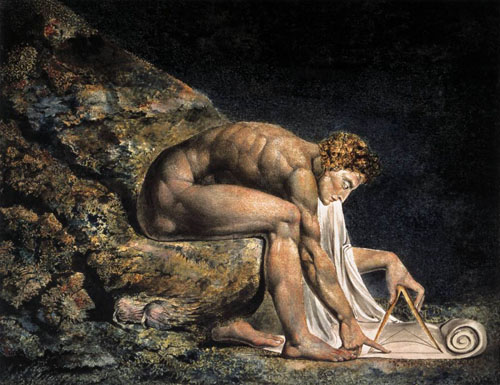
He goes on to declare that “I will not walk with your progressive apes / erect and sapient” (a line that always makes me think of Terry Pratchett’s famous mantra, “I’d rather be a rising ape than a falling angel”). Tolkien’s poem echoes a certain Romantic sentiment, such as expressed in Keats’ “Lamia” when he laments that “Philosophy will clip an Angel’s wings, / Conquer all mysteries by rule and line, / Empty the haunted air, and gnomèd mine— / Unweave a rainbow …” Or in other words, materialism’s drive for empirical knowledge might show us the natural world’s inner workings, but will in the process “unweave” its beauty. “We murder to dissect,” was William Wordsworth’s comparable assertion in “The Tables Turned,” in which he begs a friend to leave his books and go outside to see the glory of nature. And of course, there is William Blake’s notorious, mocking rendering of Isaac Newton as a small-minded man absorbed by his compasses and equations, his back turned to the wonders of the world without.

blake-newton

I think if Isaac Newton ever saw this, he wouldn’t care that Blake was mocking him because of how ripped he looks here.


Gaiman’s Humanism

As grandiose as some of Gaiman’s visions have been in his work—the landscape of Dream’s kingdom and the rendering of Hell in Sandman both gesture to a Miltonic sensibility—even when in the company of the Endless, his stories are preoccupied with quotidian human qualities. Dream (or Morpheus, or the Sandman, or Oneiros—he has many names) is a meticulous and conscientious craftsman, often irked by his sister Death’s pert glibness, or the venal machinations of Desire, at once deadly serious and humourless in carrying out his duties, but also given to depression and brooding.

American Gods is consonant in a host of ways with the “mythology” (there’s definition #3 for you) of Sandman, though it brings the figures of various pantheons—some of whom, like Odin and Loki, Bast, and Ishtar, show up in Sandman—out of the realms of myth and into the grubby, unexotic, and utterly unglamourous life of everyday people scrabbling a living in Middle America. These gods have been brought to America and forgotten, left to find what meager worship they can eke out by being grifters, con men, whores, or (in the case of Czernobog and the Three Sisters) simple pensioners. As Wednesday says to Shadow,

We have, let us face it and admit it, little influence. We prey on them, and we take from them, and we get by; we strip and we whore and we drink too much; we pump gas and we steal and we exist in the cracks at the edges of society. Old gods, here in this new land without gods. (123)

Gaiman’s brilliant inversion is one he shared with Terry Pratchett: both authors depicted worlds in which human existence is not a function of the gods, but vice versa. Gods come into being based on our worship of and sacrifice for them; their power rises and falls based on the volume and intensity of that worship. In Terry Pratchett’s Small Gods, the great god Om has become ancillary to his people’s theocracy, lost in the midst of bureaucracy and dogma, reduced to the point where he is trapped in the body of a tortoise and sustained solely by the guileless belief of a single, vapid parishioner.

So too are Gaiman’s American gods lost to the fickle vicissitudes of humanity’s memory. I want to make an observation here, which I’ll pick up on in a later post: Gaiman and Pratchett’s inversion of humanity and divinity is a profoundly humanist gesture. Pratchett’s mantra about Rising Ape > Falling Angel is of a piece with both the Discworld novels and American Gods, and a repudiation of Tolkien’s mythopoeiac argument: as he says in this wonderful interview with The Guardian, he finds the story of evolution “far more remarkable than any in the Bible.” It teaches us that stars are uninteresting compared to streetlamps, as, so far as we know, there are only a few million of the latter in the universe. “And they were built by monkeys!” There is more wonder to be found, Pratchett maintains, in the fact that we stopped hurling feces at each other long enough to build civilization, than in the prospect that we may be of divine creation and descent—which would itself imply that we have been in steady decline since the days when we first communed with gods, as opposed to slowly, imperfectly, but steadily improving ourselves as a species.

But again, more on that in a later post.

Gaiman’s mythologies in American Gods are twofold: the mythologies of various forgotten pantheons, and the mythologies of America. A key premise of the novel, which I’ll come back to in later posts, is that America “is not a land for gods.” Why that might be the case is an interesting point of discussion, which, again, I will return to later. It is a land ripe for myth, however; one of the key ideas I raise when I teach my second year course on 20thC American fiction is “the idea of America”—how the United States isn’t an innate thing, but a set of often conflicting myths, narratives, and beliefs. This does not differentiate it in kind from any other nation in the world—the very concept of “nation” is necessarily an arbitrary set of consensual delusions—but the U.S. amplifies its fictional nature by dint of its lack of a unitary ethnic sense of self, its relatively short history, and the longstanding philosophy of American Exceptionalism. At the heart of American Gods is the recognition that any nation as large as the U.S. is necessarily a collection of interesting fragments only loosely sutured. Traveling with Mr. Wednesday from the small Michigan town of Lakeside to San Francisco, Shadow looks around at the city and remarks, “It’s almost hard to believe that this is in the same country as Lakeside.”

Wednesday glared at him. Then he said, “It’s not. San Francisco isn’t in the same country as Lakeside any more than New Orleans is in the same country as New York or Miami is in the same country as Minneapolis.”

“Is that so?” said Shadow, mildly.

“Indeed it is. They may share certain cultural signifiers—money, a federal government, entertainment; it’s the same land, obviously—but the only things that give it the illusion of being one country are the greenback, The Tonight Show, and McDonald’s.” (270)

The kind of fault lines implicit in Wednesday’s irritable speech are only too visible at the present moment: if the 2016 election has been about anything, it has been about increasingly recalcitrant American mythologies, and what identifies it as a nation. The New Gods in Gaiman’s legendarium comprise something of a cultural cohesion—tech, internet, media, highways, etc.—but it’s interesting (if deeply disheartening) to see how they’re also serving as the agents of fissure and fracture.

catesby_gaiman

Catesby shows good taste in books.


OK, I’ve once again managed to ramble longer than planned. So much for ending on a rhetorical flourish. Watch this space for the third installment of my “gentrification” maundering mid-week.

1 Comment

Filed under Revenge of the Genres

The Gentrification of Genre, Part Two

Revenge of the GenresAs I mentioned in a previous post, I’m trying something new with this blog over the next few months. I’m incorporating it into my fourth-year seminar, which is to say I’ll be posting on about a weekly basis on the texts and subjects we cover. The idea is to use it as a jumping-off point for class discussion, as a substitute for me lecturing in class. The idea is I’ll post on Sundays—and hopefully at some points mid-week—raising issues and questions about the texts we’re covering. I joked in our first class today that I’ve never gotten around to writing a textbook that I can force my students to buy, so I’ll have to settle for artificially inflating my blog readership.

In seriousness, though, some of my favourite blog posts have been ones tied to my teaching—most specifically, my Lord of the Rings class. Given that I am hugely excited about this fourth-year seminar, as I described it in my previous post, I’m hoping for a similarly fruitful cluster of posts.

Also, hopefully this just forces me to blog more, and make up for the wasteland of the past year.

So without further ado … at least the first part of this post was my introductory lecture. I apologize (especially to my students, who are obliged to read this) for this post’s rambling quality—it went on rather longer than I had planned.


Genre’s Fluidity

My name is Christopher Lockett, and I am a huge nerd.

This should come as a great galloping shock to precisely no one, as the Venn diagram of academics and nerds has a significant overlap to start with. You kind of have to be a nerd to subject yourself to the kind of obsessive studying and research we bring to our different fields.

But several months ago I was sitting in my campus office, lost in thought, when I suddenly realized just how much geek paraphernalia I had accumulated. I have:

  • A mug with the TARDIS on it.
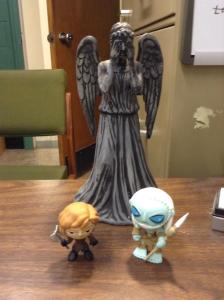
  • A weeping angel, on my desk facing where students sit (just to freak out the ones who know what weeping angels are).
  • A magnet featuring Dr. Seuss’ Whos from Whoville dressed up as the twelve doctors (thirteen including the War Doctor), holding hands and singing in circle around the TARDIS.
  • A Buffy the Vampire Slayer lunch box.
  • A little Tyrion Lannister figurine.
  • A White Walker figurine.
  • A map of Westeros rendered as a subway map.
  • An as-yet to be assembled cutout paper doll of Inigo Montoya.
  • An old Lord of the Rings
  • An old Discworld calendar.
  • A Ranma ½
  • And my prize possession, a large and handsomely framed map of the Shire, which hangs over my writing desk.

This list of course does not include the numerous works of SF/F littering my bookshelves, some of which I’ve actually taught.

tyrion-et_al

A Lannister never blinks.

I offer all this by way of introduction, because it seems the best way to establish how we’re defining “genre” for this course. There are literally hundreds of books and essays that have been written theorizing the question of genre, a not-insignificant portion of which deal with film studies. Much of this body of work is often quite fascinating, and consider the ways in which genres tend to be provisional categories, given to promiscuous overlap, borrowing, and frequent reinvention. We’ll certainly be talking about overlaps and borrowing as we go on.

Another approach to genre, however, is the one that draws a distinction between highbrow and lowbrow, and which tends to sniff at works of “genre” as formulaic and derivative, inferior to works of serious art and literature. In The Political Unconscious, Fredric Jameson likened the emergence and evolution of genres to the process of sedimentation. All genres, he argues, begin as genuinely revolutionary and subversive new forms of expression. At these early stages they are not genres per se—genre comes about through repetition, as subsequent writers and artists imitate and reiterate the key elements of the original texts, with necessarily less originality and imagination than before. The process, Jameson suggests, is like the laying down of layer after layer of silt, until the form calcifies into something rigid that lacks the revolutionary quality of its earlier incarnations.

As analogies go, this is a pretty good one, and quite useful: we can think of a host of examples, such as the way the revolutionary energies of Romantic poetry ossified into the rigid banalities of late Victorian verse. For some time now, I have been nibbling around the edges of an essay on the way in which Romantic tropes and preoccupations find themselves similarly ossified in The Lord of the Rings, but also the way in which LotR then effectively invents the genre of fantasy as we know it. (Really, the main reason I want to write this essay is so I can title it “Romantic Sediments”).

Jameson’s metaphor has limited applicability, however, once we start to think of genre in the former manner, as provisional and fluid. Like Harold Bloom’s theory of the anxiety of influence, it provides a useful rubric that breaks down once you stop thinking in terms of linear progression. If we begin and end with the figuration of sedimentation, it doesn’t really allow for what we see all the time, these days—namely, the reinvigoration of rigid formulae, and the popular elevation of genre texts out of the basements of disdain, and into serious consideration, academic and otherwise.

Bloom’s theory of influence is instructive in this respect, as in The Anxiety of Influence and A Map of Misreading (and more cantankerously in The Western Canon), Bloom posits a strictly lineal progression in which authors of “genius” struggle with their precursors and produce work that reproduces and revises key elements, but in wholly original and creative ways. The cliché example is John Milton agonizing over Shakespeare’s genius, appropriating the qualities of his great villains (Richard III, Iago, Edmund), and through the alchemy of his own genius producing the Satan of Paradise Lost.

Like Jameson’s sedimentation metaphor, this model is useful but limited, and we can probably easily rattle off a dozen authors and the ways in which they were profoundly influenced by writers of genius who preceded them. It probably goes without saying, however, that Bloom’s model endorses not just the principle of literary canon, but a particular exclusivity in the “genius” club, one that tends to favour white dudes, or when it lets in women or people of colour, it’s because they imbibed the lessons of white dudes of genius (hence, Toni Morrison, in a Bloomian estimation, can credit her own genius to the influence of William Faulkner, as much as anything else).

It doesn’t take too much effort to break down Bloom’s patrilineal Descent of Literature and point out that while great (and not so great) authors have always been influenced by prior Great Writing, they have also been influenced by a host of other societal, cultural, and historical factors: James Joyce might have set himself the lofty task of forging in the smithy of his soul the uncreated conscience of his race, but Ulysses (which is honestly one of the funniest novels ever written, if you read it closely) is peppered with the equivalent of pop songs and contemporary trivia; his protégé Samuel Beckett incorporated vaudeville and music-hall acts into his plays; Charles Dickens was the original SJW; and Shakespeare? Don’t get me started on Shakespeare. Dude was a veritable sponge, sopping up literally everything, and was less concerned with besting Marlowe and Jonson than making a buck.

All of which reaches a certain critical mass in the second half of the twentieth century, as the media and communication revolution amplified these cultural vagaries by way of radio, television, cinema, and so forth. While there are still any number of prominent authors who wear their literary influences proudly—and sometimes defiantly—on their sleeves, and openly disdain our variegated media (Jonathan Franzen, I’m looking at you), many others enthusiastically mix and match the popular culture they grew up with into their writing. Insofar as we can establish a canon of postmodernist fiction, Thomas Pynchon’s Gravity’s Rainbow has to be on that list—a novel that, as the saying goes, “contains multitudes,” but is as influenced by classic cinema as by any literary traditions. Another canonical pomo dude is Don DeLillo, whose eminently “literary” novels have more to do with advertising and popular culture than literature.

The second text we’re doing on this course is Zone One by Colson Whitehead. Whitehead is as “literary” as a contemporary novelist comes these days, celebrated by the New Yorker set for The Intuitionist, John Henry Days, and Sag Harbor (among others)—exquisitely written novels that deal with race and blackness in America in subtle and nuanced ways. And then comes Zone One, a zombie apocalypse novel. In an interview with The Atlantic, he says that he grew up “devouring horror comics and novels, and being inspired to become a writer because of horror novels, movies, and comic books.” The advent of the VCR, he says, had a profound influence in him in this respect:

[J]unior high, for me, was the rise of all kinds of horror movies, whether it was splatter flicks like Prom Night and other Jamie Lee Curtis classics, or Dario Argento, or John Carpenter. In ’82 and ’83, that was the rise of the VCR. Every Friday, my brother and I would go to Crazy Eddie’s—which was a video store in Manhattan—and rent five horror movies. And that’s basically what we did basically for three years.

Whatever his early fictional forays, he says, “I always knew I was going to write a horror novel.”

The openness to genre fiction and genre forms has been slowly spreading through the liberal arts in the academy by way of a similar generational shift, as scholars reared on the same kind of media and popular culture as described by Whitehead—such as myself, but also like almost every single one of my colleagues in my age range—fill jobs vacated by retirees of more traditional ilk. I work in a department in which, forty years ago, “Canadian Literature” was considered an oxymoron; in my eleven years here, I have taught courses on film, television studies, fantasy and science fiction, The Lord of the Rings … and this course, which in some ways is very much the product of all the preceding ones. We’ve come a long way.

(This is what I remind myself whenever I’m feeling hard done by or irritated by work frustrations. I really do have the best job).


New Kids on the Block

All of which is a long and circuitous way of coming around to this post’s main point, which is to explicate what I mean by my title: the “gentrification of genre.” It’s an expression I use advisedly, in all of its freighted connotations. Several years ago I wrote a short piece about The Walking Dead and the irony that the zombie genre, so long relegated to the B-movie ghetto, had emerged into mainstream recognition by way of a medium, television, that had for the better part of its existence been the embodiment of lowbrow culture. I titled the piece “Zombie Gentrification,” without much thought to the term’s broader implications. In the time leading up to this course, I have found myself circling back around the word, thinking through the ways in which it is appropriate to my approaches to the course material.

On one hand, the term implies or entails rejuvenation—the “fixing up” of heretofore marginalized properties, imbuing them with “quality” and making them attractive to more upscale audiences. On the other hand, gentrification also tends to entail erasure—erasure of that which had given certain properties a unique or idiosyncratic character, chasing out those who had inhabited them and alienating those who had loved the properties not in spite of but for their decrepit glories.

(I should add as a caveat the limitations of this metaphor. The “neighbourhoods” of genre and fan culture are virtual, imaginary spaces, and never actually go away: whatever the contemporary landscape of, say, zombie apocalypse stories looks like, the widespread appeal of something like The Walking Dead does not erase the schlocky glory days of B-movie zombie films in the same way the influx of Silicon Valley capital has overwritten entire communities in San Francisco.)

The mainstreaming of genre has tended to entail this sort of “upscaling.” There was an ad in The New Yorker in its December 2007 issue, heralding the fifth and final season of The Wire, which was basically a Q&A with Pulitzer Prize winning playwright Tony Kushner. In it, Kushner gushes over how much he loves The Wire, and how the series is “a great work of art.” Whenever I’ve taught television studies, I’ve started by showing students this ad: it is such a perfect example of HBO going out of its way to give highbrow audiences leave to unapologetically watch television. The creator of Angels in America thinks The Wire is great art? Sign me up!

kushner-wire-ad

The Wire, of course, was just one among many of the new crop of television series that brought the “prestige” to prestige television: The Sopranos, Deadwood, Six Feet Under, Mad Men, Breaking Bad, Game of Thrones, House of Cards, Orange is the New Black—many shows of which, not incidentally, reinvented generic conventions. But while television entered its renaissance, genre was having a heyday in other media: the Marvel comics universe vaulting to cinematic blockbusters, the already-mentioned mainstreaming of the living dead, and of course the academic attention being paid to everything from comic books to the oeuvre of Joss Whedon.

Genre has become big business, with more money at stake than ever before, but this gentrification has had a not dissimilar effect to that of urban areas—that is to say, the previous inhabitants are not always keen on the newcomers, and question the authenticity of their fandom. This tendency has been most glaringly on display over the past few years with the Hugo awards. I posted a little over a year ago about the efforts of a group calling themselves the Sad Puppies to “reclaim” the Hugo Awards—which are awarded based on popular votes rather than the decisions of a committee of experts or luminaries—from what they perceived as the encroachments of “literary” and politically correct authors, whom they charge with the slow murder of “old-fashioned” SF/F. The Hugos are ground zero for them specifically because they are given based on the voices of fans, members of Worldcon who nominate and then vote. Given that the Hugos were established to give voice to populist tastes rather than literary pretensions, they should reflect that and privilege unreconstructed space opera, adventuresome fantasy, gritty space marines, and the like. Puppy co-founder Brad Torgersen offers a eulogy for the days when you could still judge a books by its cover:

A few decades ago, if you saw a lovely spaceship on a book cover, with a gorgeous planet in the background, you could be pretty sure you were going to get a rousing space adventure featuring starships and distant, amazing worlds. If you saw a barbarian swinging an axe? You were going to get a rousing fantasy epic with broad-chested heroes who slay monsters, and run off with beautiful women. Battle-armored interstellar jump troops shooting up alien invaders? Yup. A gritty military SF war story, where the humans defeat the odds and save the Earth. And so on, and so forth.

Given that I’ve already offered a lengthy and pointed critique of Torgersen’s argument, I won’t rehash it here other than to reiterate a point I made a year ago: whatever else the Sad Puppies, Rabid Puppies, and #Gamergate types claim—whether they’re ostensibly worried about listening to the voices of populism or concerned about ethics in gaming journalism—there is a definitive whiff of resentment at girls entering the treehouse and new kids moving into a neighbourhood that used to be exclusively theirs.

The opening up of genre and the mainstreaming of what used to be fan enclaves is, to my mind, a net positive: it facilitates a lot of creativity and inventiveness, producing many of the sort of texts that are on my course reading list. It also offers a great opportunity to further crack open the carapace of our “literary” designations and think around the ways in which genre itself becomes not just a signifier but a vessel of critique.

But in the process, the neighbourhood’s gonna look a lot different than it used to.

1 Comment

Filed under Revenge of the Genres

The Gentrification of Genre, Part One

As I mentioned in my previous post, I’m teaching a fourth-year seminar this autumn that I’m titling “Revenge of the Genres.” Here, again, is my hastily mocked-up poster:

Revenge of the Genres

Yes, that’s the poster from Hamilton that I’ve stolen and over-written; and yes, that means I’ll be including Hamilton on the course. It will be the last thing we cover, in part because it’s the most recent text, but also because I’m keeping my fingers crossed that Lin-Manuel Miranda’s promise to film a performance for posterity makes it onto DVD or iTunes before we get to it in class.

This course is the product of several intersecting influences in my own reading and viewing habits, as well as a lot of thought I’ve devoted in the past few years to how genre has come to function in mainstream culture, and how it has come to be regarded in scholarly contexts. My doctoral dissertation, which was on conspiracy theory and paranoia, jumped gleefully between such capital-L literary texts like Gravity’s Rainbow, to classic films like Doctor Strangelove and The Manchurian Candidate, to episodes of The X-Files and Buffy the Vampire Slayer. Anyone who has read this blog more than just occasionally will know of my love for such genres as SF/F, and my addiction to prestige television. And while the traditional canons of literary study still comprise the core of most English departments, not only are interdisciplinary crossovers into different media and popular texts increasingly acceptable, but increasingly expected.

More and more we see cross-pollination between fiction, film, television, poetry, theater, music, and social media; more than perhaps at any point in history, literary influence has been shattered from Harold Bloom’s almost exclusively patrilineal (and white) “anxiety of influence,” which posits that writers of genius emerge out of an agon with the great writers preceding them, into a constellation of cultural forms and texts in which a poet is as likely to borrow imagery from classic Hollywood or post-structuralist theory as from Keats or Yeats.

Purists may wince, and often do, and conservative pundits fill column inches decrying the feckless drift of humanities degrees (if Margaret Wente hasn’t written something on this point recently, she will soon—that’s simply inevitable). But part of the point is that in this expanded universe (to borrow an expression from one particular genre canon), there’s still plenty of room for purists (whatever they may look like these days) and unreconstructed literary curmudgeons who don’t think anything of value was written after 1922.

Meanwhile, this cross-pollination and the general acceptance of forms and media formerly dismissed as lowbrow has opened up an intriguing space in which we can look at how many of these texts use generic conventions—or shrewd critiques or subversions of them—to expand our literary and cultural vocabularies. This space—or rather, these spaces—are what my course will be examining. And as I said in my previous post, I am keen to get this blog back into gear, so one of the things I will be trying to do is write one or two posts a week dealing with whatever text we’re looking at. These posts will be designed in part to foment class discussion (I’ve never written a textbook I can make my students buy, so the least I can do is force them to read my blog).

That being said, I’m also hoping that this course might interest people enough to read along at home, as it were, or to contribute to the discussion if we cover something you particularly love.

Fingers crossed. Meanwhile, here are our readings, in order that we will be covering them:

AmericanGodsNeil Gaiman, American Gods. If you’re anything like me, you’ve been nerding out hard over the last few days with the release of the trailer for the television adaptation. I was concerned at first that STARZ is the network doing it, as they’ve tended to be far more erratic than, say, HBO or AMC. But the team they’ve assembled is stellar: the showrunners are Bryan Fuller, who brought us Hannibal, and Michael Green, whose nerd cred is pretty strong with such shows as Heroes and Smallville. But beyond the showrunners, the cast they’ve assembled so far is mind-blowing: Ricky Whittle (The 100) as Shadow Moon, Emily Browning as Laura Moon, Gillian Anderson (!) as Media, Pablo Schreiber (Nick Sobotka on The Wire, Pornstache on Orange is the New Black) as Mad Sweeney, Crispin Glover as Mr. World, Jonathan Tucker as Low Key Lyesmith, Orlando Jones as Mr. Nancy, Kristen Chenowith as Easter, Peter Stormare as Czernobog … but of course if none of those people were involved, I’d still watch to see Ian McShane as Mr. Wednesday.

Sorry. Didn’t mean to have that nerd braingasm.

Ahem. Putting Gaiman on the course is a bit of a cheat, as this is an American Lit course, and he’s very much a Brit. He does live in the U.S., however, and the novel is manifestly about America. Gaiman is an example of a literary jack-of-all-trades, moving with alacrity from comic books to prose fiction to children’s literature to TV writing (two episodes for Doctor Who); and all his work is profoundly influenced by myth and legend, and gothic horror. He is a genre author who has attained an enviable level of literary acclaim, and as we’ll discuss on the course, one way to read his figuration of gods and divinity is as an allegory of genre itself.


zone-one-paperbackColson Whitehead, Zone One. If Neil Gaiman is a genre author who has garnered literary acclaim, Colson Whitehead is a literary star who confused the literati and intelligentsia of the New Yorker set by writing a zombie apocalypse novel. I’d read his novels The Intuitionist, John Henry Days, and Sag Harbor, and was blown away by all of them: Whitehead writes with extraordinary lyricism about race and blackness in America in all three, but Zone One elides race as a factor until a key moment late in the narrative. It is instead preoccupied with images of a desolate and empty Lower Manhattan. His main character is a “sweeper,” someone tasked with clearing out zombie stragglers in order to secure the city south of Canal Street so that business and industry can return. As with his previous novels, the writing is gorgeous; Whitehead has an extraordinary talent for language, an ability to introduce unexpected and startling metaphors into the description of the most quotidian things.


StationElevenEmily St. John Mandel, Station Eleven. I should point out that each of these texts has something bridging it to the next. Gaiman and Whitehead have the literary/genre inversion linking them; Station Eleven picks up from Zone One as a post-apocalyptic novel. In Mandel’s case, the world is wiped out by a virulent influenza, and we follow around a group of traveling actors who make their way performing Shakespeare for the pockets of survivors two decades after the Fall. Why Shakespeare? Because in this post-apocalyptic world, it seems to be the great works that feed the souls of the survivors—and because, as is written on the side of part of the troupe’s caravan, “Survival is Insufficient”—there must be something to survive for.

The fact that the motto specifically comes from an episode of Star Trek: Voyager speaks to the novel’s broader preoccupation with genre, and its juxtaposition with art in the form of Shakespeare. The title refers to a graphic novel called Station Eleven, about a space station shaped like a planet fleeing an alien invasion. The graphic novel becomes something of a talismanic object for the survivors, as its themes come to intersect with their own preoccupations.


FunHomeAlison Bechdel, Fun Home. I must confess, of all the geeky obsessions and indulgences I have owned in my life, I have never been a reader of comic books or graphic novels. I don’t know why I find it an effort to read them. But Fun Home had me rapt. I knew I wanted to have a graphic novel on this course, as doing a class on genre in this way without bringing in a visual narrative would be a big elision. Fun Home is particularly appropriate, not just because it is a beautifully drawn and written memoir, but because it leapt genres to become a successful musical on Broadway.

Bechdel’s story of her childhood, of her queer awakening, and the realization that her father—who dies, possibly suicidally, not long after she comes out to her parents—was a closeted gay man, is a poignantly told story that grounds itself in the traditions of Joyce and Proust.


OscarWaoJunot Diaz, The Brief Wondrous Life of Oscar Wao. Truth told, this is the novel that really got me thinking about doing a course like this. I’ve taught it several times now in a handful of classes, and it is always a joy to introduce it to students. It tells the story of a hapless young Dominican man named Oscar, who embodies all the negative geeky qualities: overweight, myopic, socially awkward, obsessed with women but incapable of interacting with them, and addicted to every kind of fantasy and science fiction film or novel that crosses his path. The narrator, Yunior, is a closet nerd but corresponds to the masculinist Dominican ideal; his narration is peppered with Hispanic slang juxtaposed with Lord of the Rings references. The novel is, above all else, about the collision of worlds: of male and female worlds, of immigrant worlds with America, of nerd culture and everything else.


Lin-Manuel Miranda, Hamilton. I so, so hope we’ll be able to watch the filmed stage performance. Failing that, though, the cast recording is not something I ever see myself getting tired of.

Considering how much has been said and written about Miranda’s work of genius, it feels redundant to offer my pale commentary. Instead, here’s their performance at the Tony Awards.

1 Comment

Filed under Revenge of the Genres, teaching

Blogging, or The Intrinsic Value of Shouting at an Empty Room

I’ve been a very bad blogger. Every so often I go through a burst of energy and put up a handful of posts in quick succession, but it’s been some time since I posted on a regular basis. Certainly this past year has seen a lot of inaction on this site. If it weren’t for my Game of Thrones posts with Nikki Stafford, I’d have put up next to nothing.

Which isn’t for lack of wanting to. I have journals full of notes chronicling my thoughts on a host of topics, many prefaced with the hopeful header “possible blog post”; and I have a folder on my desktop containing an embarrassing number of half-completed posts that I just couldn’t make work to my satisfaction, or which languished until their subject was no longer current.

One of the reasons for my blogging absence has been one of the more epic cases of writer’s block I’ve experienced in my adult life. There have been a variety of factors contributing to that (which I won’t get into here), but one of them is the way in which writer’s block gets worse the more you don’t write. I haven’t posted much this past year because of writer’s block; but one of the reasons I’ve had writer’s block is because I haven’t been posting to this blog.

I wouldn’t go so far as to say that my level of blogging activity is a bellwether of my productivity more broadly—sometimes I just don’t really have anything to say here, but am getting a lot of writing done in other arenas—but there’s something to be said for keeping the pump primed by posting relatively clear and coherent arguments or meditations.

What is this blog for? It certainly isn’t aimed at a large audience. If my ambition was to write for thousands of people, I’ve failed miserably here. Fortunately, that has never really been a concern. Most of my posts garner in the neighbourhood of fifty readers, which likely corresponds to the number of my Facebook friends actually interested in what I might have to say on a given topic. The Game of Thrones posts tend to top out at about one hundred and twenty readers. Three years ago, I made it to three hundred and fifty with a pair of posts about that whole David Gilmour thing, and Margaret Wente’s entirely predictable response to it. And the most readers I’ve ever had was for a post I wrote, apropos of the events in Ferguson, Missouri, about The Wire and police militarization, which garnered twelve hundred readers—mainly because a friend of mine posted the link to Reddit.

So, I’m hardly swaying anyone’s opinion on such matters as Donald Trump, as I can say with a great deal of confidence that everyone who read my previous point probably agrees with everything I said. The fact that I’m almost invariably preaching to a (very small) choir has occasionally bothered me. Why go to the effort of parsing my thoughts if I’m not reaching people who will disagree with me, or whom I can engage in substantive, meaningful debate?

That thought underpinned a lot of my more self-defeating capitulations to writer’s block, at least as far as this blog was concerned. But lately I’ve been thinking about it in a different way: less as a means of engaging in a broader conversation, than as a conversation with myself. What I’ve been missing this past year is the exercise of thinking out loud. On my old blog I once compared blogging to shouting at your empty kitchen to something you hear on the radio. I think that analogy holds: articulating thoughts, giving them form and shape, is a valuable exercise even when no one is listening. The difference between writing things out in my journal and composing a post is that the latter is technically public—meaning that the act of composing takes precedence. Only a handful of you are actually reading this, and fewer still will have read this far. For those who have: Hello! I am happy that you’re interested enough in my thoughts that you’re still with me.

Don’t get me wrong: a large audience would be nice, but I’m not about to do all the things necessary to broaden my appeal. To be honest, I’m not even sure I know what those things would be (aside from employing more clickbait-y titles and keeping my posts more succinct. Yeah, that’s not happening).

I do however want to do more with the blog, and write more, and more frequently. One of my favourite series of posts I’ve done is when I taught a course on The Lord of the Rings two years ago, and did a series based on my lectures. I intend to do something similar this fall: I’m teaching a fourth-year seminar course I’m titling “Revenge of the Genres,” which will deal with texts that play with the “genre” appellation in a variety of ways. I’m planning to do a series of posts for each of the texts we cover, which will hopefully fuel discussion both in and out of the classroom. I’ll say more about that course closer to when we begin in September.

Revenge of the Genres

I’ve also got, I’m sorry to say, a cluster of Trump-themed posts on the back burner. Yes, I know … we’re all suffering from Trump fatigue, and I encourage people to actively avoid reading them. They’re more for my own benefit, to clarify my own thoughts more than to make specific arguments.

And I’ll be picking up the threads of research I had intended to do over the past few months. I won’t say much about that now, other than that it involves zombies, crowds, and soldiers.

That’s all for now.

1 Comment

Filed under blog business, maunderings

Winners and Losers

I watched all four nights of the Republican convention in Cleveland. All four. I did it in part so I could follow along as Andrew Sullivan liveblogged it: since he retired his epic blog The Dish, I’ve been in serious withdrawal from Sullivan’s incisive, insightful, and often entertainingly cantankerous perspective on politics, American and otherwise. But mostly I did it to bear witness to history in a way not available to those who watched the Reichstag burn down. They could not have known what was coming, that a comical Chaplinesque clown would use his influence over populist rage to vanquish the forces of the moderate establishment. The Junkers and the bourgeois conservatives assumed that Hitler would be malleable once in power, that he would be a useful cudgel to hammer the socialists, and that ultimately they could use him to their own ends.

Well, we know how that worked out.

Don’t go calling down Godwin’s Law on me. Smarter people than I have pointed out the similarities between Trumpism and fascism, including Adam Gopnik (twice) and the aforementioned Andrew Sullivan. Read them and come back to me with a denial on this point.

But that’s not my primary concern in this post. In this post, I want to talk about the idea of winners and losers, something near and dear to Donald Trump and his idiosyncratic rhetoric.

donald-trump-1080x608

After everything that went down over the four nights of the RNC, I find it interesting that one of the things that continues to rankle for me is his Beyonce-like entrance on the first night to the strains of Queen’s “We Are The Champions.” I’m not alone: there was a chorus of anger that the putative figurehead of the Republican Party would appropriate Freddie Mercury to his own ends. Trump’s brief shout-out to the LGBT community in his keynote speech on Thursday night does nothing to obviate the GOP’s systematic opposition to, and attempts to roll back, gay rights; it certainly does nothing to counter the fact that he chose one of the Republicans’ worst offenders to be his running mate. That he would use the music of a gay icon to accompany his entrance is tone-deaf at best, and actually obscene at worst.

queen

All that aside, it is utterly unsurprising that Trump would favour “We Are The Champions.” Taken entirely out of context, the song articulates what is quite obviously something close to Trump’s sense of self. If I had to guess what his favourite lyric is, I’d have to say “No time for losers!” Even if you ignore his biography to the point of his announcement on June 16th, 2015, there is no avoiding the fact that Donald Trump’s primary method of interacting with the world is to divide it into winners and losers. He, obviously, is a winner. Those people he likes and approves of are also winners (though this is a redundant observation, as one assumes being a winner is a prerequisite for the Donald’s approbation). His opponents and enemies, just as obviously, are losers. He chose to run for president because America is no longer a winner, and that is unacceptable. America has been losing for too long: to China, to Mexico, to Russia, to ISIS. His entire candidacy is about being a winner again. “We’re gonna win so much,” he famously declared at a rally, “we’re gonna win at every level, we’re gonna win economically, we’re gonna win with the economy, we’re gonna win with military, we’re gonna win with health care and for our veterans, we’re gonna win with every single facet, we’re gonna win so much, you may even get tired of winning!”

The rhetoric is childish and risible, and has justifiably come in for a great deal of mockery, but we make a mistake to dismiss it out of hand. It is less Trump’s actual words than his world-view that resonates: there are winners and losers, and if you stand with me you’ll be a winner like I am. Trump is essentially the schoolyard bully writ large, who inevitably attracts a sniggering entourage of toadies eager for the bully’s approval, people who really are just desperate to not be the objects of bullying themselves. There is no sense that making common cause with the others being bullied is an option, because winners vs. losers is a zero-sum game: if you are to win, someone else must lose, so best to hitch your wagon to the hugest, most bombastic star in your firmament.

The irony of Trump’s use of “We Are The Champions” is that, in spite of its soaring anthemic chorus, the song contains a distinct measure of pathos in its slower, quieter moments. It speaks of paying dues and suffering, of making mistakes, and—that great mark of the loser!—having sand kicked in one’s face. And let us not forget that the struggle is ongoing: “We’ll keep on fighting till the end!” Mercury sings, suggesting that “champion” is less an achieved status than a state of mind, and that the struggle never ends—a sentiment made all the more poignant by his high-profile death at the height of the AIDS epidemic.

Perhaps if Freddie Mercury was still alive, still touring with Queen and headlining shows alongside the Rolling Stones; perhaps if “The Show Must Go On,” which now indelibly inflects “Champions” with an elegiac quality, wasn’t the last song Mercury recorded before succumbing to his illness; perhaps if his career had not been a great, glorious, campy fuck-you to the voices of censure, of disapprobation, of authority; perhaps then “We Are The Champions” might fit a bit better into Donald Trump’s ethos.

freddie-mercury

But of course none of those things are true, and we can add Trump’s use of Queen to the long list of politicians completely misapprehending the nuances of songs they use while campaigning (the ultimate example of which is perhaps Ronald Reagan’s use of Springsteen’s “Born in the USA” in 1984, though Paul Ryan’s professed love of Rage Against the Machine is even more cognitively dissonant). And in the long run, playing “Champions” to accompany his entrance on stage is small beer compared to his countless other outrages: fomenting anti-Islamic and anti-Hispanic sentiment, playing upon people’s fears and anxieties to further his personal brand, and basically reinventing the Gish gallop by an order of magnitude such that fact checkers quite simply can’t keep up with his mendacity, all of which have immediate and pernicious real-world effects.

But the rhetoric of winners and losers as a zero-sum game really should disqualify anyone seeking high office—or really, office at any level. If government has a responsibility, it is to the “losers.” This has been the guiding principle of all our great humanitarians and humanists, and is the central tenet of almost every single religion in history—including the Christian faith to which Trump pretends. I am an atheist, but was raised Catholic, and to this day the part of the Gospels that resonates most for me is Matthew 5:3-11, the Sermon on the Mount, in which Jesus celebrates the meek, the poor, the peacemakers, and so on. As a witness to American politics, I have yet to see the right wing square their devout Christianity with their dismissal of the people Christ specifically sought to elevate.

Despite his ultimate fame, Freddie Mercury was a loser: a shy young man born as Farrokh Bulsara in colonial Africa (in the British protectorate of Zanzibar) to Parsi parents, whose savant-like musical skills made themselves obvious at an early age. As his fame grew, his sexuality asserted itself more and more, becoming something akin to an open secret. But it was something he reveled in in his public persona, and he was as frequently vilified as he was celebrated. In the world of social conservatism, Mercury is doubly suspect: not just gay, but foreign. And not just foreign, but born in Africa to parents of Iranian extraction.

It is perhaps no wonder that the music of Queen speaks so frequently to the underdog. Not that this is unusual in the history of rock and roll, which has so often given voice to society’s losers, as has so much of rap and hip hop. And what is blues music, if not the cri de coeur of the downtrodden? It puts me in mind of the wonderful speech Jon Stewart delivered on the occasion of Bruce Springsteen receiving the Kennedy Center Honor. He talks about working in a bar in central New Jersey, hinting at his aimless and angst-ridden youth, but that when he listened to the music of Bruce Springsteen, “everything changed … and I never again felt like a loser.” When you listen to Bruce’s music, he says, “you aren’t a loser. You are a character in an epic poem … about losers.”

I have no pithy end to this post, no rhetorical flourish. At one point I thought I could end on something like “But if Trump wins, we’re all losers,” but I think if I wrote a sentence like that in earnest I might actually have to stab myself in the eye with a knitting needle.

I came relatively late to the music of Queen: they weren’t on my radar in high school for the simple fact that no one I knew listened to them (or admitted to it). I chalk this up in part to the fact that a Catholic high school in the 1980s is about as homophobic a place as you’re likely to find. I watched the Freddie Mercury tribute concert in 1992 almost in its entirety, largely because of all the guest musicians, and ended up being transported by the Queen songbook.

After night four of the GOP convention, as I thought about going to bed, I felt I needed a life affirming anthem.

Leave a comment

Filed under politics, wingnuttery

Game of Thrones 6.10: The Winds of Winter

gameofthrones_teaser02_screencap10

Greetings all! Welcome to the final recap/review/exegesis on Game of Thrones season six, as executed by myself and my wonderful friend Nikki Stafford. It’s hard to believe, but the season is now over … how quickly it flew. The finale did not disappoint, however, and it gives us a whole lot to look forward to in season seven.

It was a long episode—the longest yet aired—so we have a lot to get through. So, without further ado …
 cersei_cityscape

Christopher: Game of Thrones has gotten us used to having a pretty spectacular penultimate episode, followed by a finale that is more about housekeeping than anything else, with perhaps one or two “Holy shit!” moments to prime us for the next season (see: Jon Snow, murder of). But I think it’s safe to say that this finale was wall-to-wall holy shit moments. To wit: Cersei blows up EVERYBODY real good; Tommen offs himself; Varys shows up in Dorne; Jon Snow’s lineage is CONFIRMED, and he’s named King in the North (much to Littlefinger’s, and possibly Sansa’s, dismay); Arya, having presumably left Braavos with a bunch of spare faces in her carry-on, feeds Walder Frey’s sons to him and cuts his throat; Daenerys finally sets sail for Westeros; and Cersei, dressed like every evil sorceress from every 80s fantasy film, is crowned the MOTHERFUCKING QUEEN OF WESTEROS.

All I can say is: enjoy it while you can, Cersei. Dragons a-comin’.

We begin with a rather lovely view of King’s Landing, as Cersei looks down from her rooms over the city, peering specifically at the Sept of Baelor. Then follows an interesting musical montage of several key individuals dressing (or in the case of everyone but the Sparrow, being dressed). Knowing as we do that Cersei and Loras’ trials are nigh, this sequence feels not unlike the sequence in a sports film when the athletes don their gear. It is, in essence, a pre-battle scene, except that two of the four people pictured do not show up: only the Sparrow (clad in what I assume is his formal burlap) and Margaery go to the sept. Tommen remains broodingly in his chambers, and Cersei is well into her morning wine.

I loved the use of music in this sequence. It was just this side of verging on overdone, but the rather anachronistic piano score lent the scenes a melancholic, almost dirge-like quality—especially when, as Lancel is stabbed, it changes from piano to pipe organ. And it’s worth noting that there was a lot more cutting between scenes than this show tends to employ: usually we have little parlor dramas that go on for five to ten minutes before cutting away to a different story. In this case however, we get the scene in the sept, Cersei in her chambers, Tommen in his, Pycelle’s murder, and Lancel’s discovery of the wildfire. All of which is brought together as we watch Cersei watch the Sept of Baelor go up in flames.
pycelle

I should note that there is an interestingly tangential intersection with A Dance With Dragons in terms of Qyburn’s use of murderous children to do away with both Lancel and Pycelle. Two episodes ago, Varys departed from Meereen for unspoken reasons, referring cryptically to a “mission” he was undertaking. I, and presumably everyone else who has read the novels, speculated that perhaps he was heading to King’s Landing to stir the pot. Dance’s epilogue has Ser Kevan Lannister (who is a far more sympathetic character in the novels) cautiously optimistic: having done her walk of shame, Cersei seems properly contrite and sedate, and unlikely to rock the boat; and after a long period of unrest, things seem to be settling down in King’s Landing, and in the Seven Kingdoms more generally. He receives a message from Grand Maester Pycelle asking to see him, but when he arrives at his chambers he finds him dead. He is himself shot with a crossbow … shot by Varys, in the eunuch’s first appearance since he abetted Tyrion’s escape in A Storm of Swords, two novels ago.

Why has he killed Kevan? Because he was “threatening to undo all the queen’s good work,” by which he means Cersei’s catastrophic misrule that has continued the chaos of the war. In bringing stability, Kevan threatens to undermine Varys’ ultimate goal—the re-installation of Targaryen rule in Westeros. And while Varys has shot him with a crossbow, it is not the eunuch that deals the killing blow:

Ser Kevan was cold as ice, and every labored breath sent a fresh stab of pain through him. He glimpsed movement, heard the soft scuffling sound of slippered feet on stone. A child emerged from a pool of darkness, a pale boy in a ragged robe, no more than nine or ten. Another rose up behind the Grand Maester’s chair. The girl who had opened the door for him was there as well. They were all around him, half a dozen of them, white-faced children with dark eyes, boys and girls together. And in their hands, the daggers.

But as it turns out, Varys has gone to Dorne, to stir the pot in an entirely other fashion. More on that later.

Meanwhile, the children with daggers are in the employ of Qyburn, and visit death first upon Pycelle in a manner that very closely mirrors Ser Kevan’s death in Dance. Qybrurn’s apology, indeed, is almost identical to Varys’ in the novel. And one of the children lures Lancel away into the vaults in what is, unfortunately, a rather contrived sequence. Why does he follow the child? What does he care if some urchin runs down the cathedral steps? His task, after all, is to go and bring Cersei, kicking and screaming if necessary, to her own trial. I have to imagine this is a task he relishes. But no, he follows the kid down into the basement of the sept, only to discover that part of Bran’s wildfire vision was not of the past, but the future.
marg_warning

Margaery, meanwhile, gets the screaming heebie-jeebies when Cersei doesn’t show, and when she attempts to share her fears with the Sparrow, is condescendingly mansplained to. It is unthinkable to him to end or postpone the trial—this, after all, is his moment of triumph. He has cowed and humbled two great houses, robbing one of its heir; he makes it clear that he’s entirely prepared to level judgment on Cersei whether she shows up or not.

And then … BOOM.

What did you think of this episode’s opening, Nikki?
wildfire_plosion

Nikki: I’ve often referred to episodes of television that cause one to feel all kinds of emotions (sorry, I can’t bring myself to use the term “all the feels”) as the best kinds of rollercoasters. But if other TV episodes are rollercoasters, this is the Leviathan. I don’t recall ever screaming, gasping, and throwing my hands up in the air as often as I did with this one. There were no tears, so I guess that would be the only thing it was lacking, but to use the word “lacking” with any part of this episode would be nitpicking in the extreme. I think the episode was damn near perfect.

In the previous episode, as Daenerys talked about burning her city down, Tyrion calmly reminded her that her father had once stuffed all of King’s Landing’s underground tunnels with wildfire, and that the reason her father was truly the Mad King is that he was willing to burn to death every man, woman, and child, every innocent person in the way, just to get to the few people he wanted to kill. Only a truly mad person would do such a thing. I wondered why they were repeating this story — just last season he told the same story to Daenerys as the two of them sat across a table and he explained what her father was really like, and how in her quest to become queen she must never, ever be like him. And now I realized they needed that story fresh in our minds, because as Tyrion is warning Daenerys about her father planting the explosives in the first place, it never even occurs to him that his own sister might be the one to use it.
wildfire_casks

And use it she does. My GOD when Lancel looked up and I saw the glowing green goop on the ground I dropped my pen and gasped aloud. “WILDFIRE!!!” And immediately the consequences of the action — before it had even been set off — were in my head. She’s going to kill everyone in the Sept of Baelor.

Now, I will admit to some, um, stupidity on my part. It never occurred to me that the sept and the castle were in two completely different locations — for some reason I always pictured them as adjacent to one another. They always seem to be in their chambers, then say, “Walk with me” in an Aaron Sorkin sort of way and then… they’re in the sept. I thought the buildings were pretty much attached. And yet now I realize well DUH, Cersei had to have done her walk of atonement from the sept to the castle, and therefore they must be in two different spots. But I never realized they were THAT far apart. That was one long walk of atonement.
tommen_mountain

I also had a horrifying moment when the Mountain stopped Tommen in his doorway that Cersei — bedecked in her black dress as if vying for the role of Evil Queen in some King’s Landing Disney musical production — had actually ordered her own son’s death in retaliation for him removing her right to choose a champion and have a trial by combat. And I was baffled: no matter what Tommen would do, she would NEVER kill one of her children. They mean everything to her. Of course, she wasn’t going to kill Tommen — she was just going to destroy him emotionally and psychologically, and kill everyone he ever loved. No big.

We go from the wildfire killing everyone and everything to Cersei waterboarding a nun (or maybe “wineboarding” would be the more accurate word), and I couldn’t help but think, “Cersei, seriously, you’re OK with wasting all that wine?” The only person worse than Cersei in this scene is Septa Unella, who has been a hateful, horrible character from the moment we first saw her. Despite everything Cersei had done, watching Unella ring that bell and shouting, “Shame!” in that holier-than-thou voice of hers put our sympathies with a Lannister, and for that alone, she should be punished. Cersei tells her to confess that she enjoyed torturing Cersei, before Cersei happily lists all of her favourite things. And no, they don’t include whiskers on kittens or snowflakes that stay on her nose and eyelashes.

I drink because it feels good to be drinking
I killed my husband because he was stinking
I fucked my brother and clipped Sparrow’s wings,
These are a few of my favourite things!

But she can’t reach Unella and her piousness. The nun just looks at her smugly and says she’s ready to meet her god. To which Cersei has a hearty chuckle, and in lumbers Ser Gregor Clegane. I was chatting about what to expect in this week’s episode with another parent at my son’s soccer game last week, and both of us thought they were going to show the Mountain’s face this week. I didn’t want to see it; he totally did. “This is Ser Gregor Clegane,” says Cersei as she walks out, leaving Septa Unella to untold amounts of torture. “He is your god now.” And with the tiniest bit of joy she can muster, Cersei begins chanting, “Shame! Shame! Shame!” as she shuts the door.
cersei_wineboarding

If I must be tortured, I would choose wineboarding.

And we cut to Tommen looking out over the city. You mentioned the gorgeous score in this episode, Chris, and because it’s so different than the music we heard before, you’re right in that it stands out a lot. It was gorgeous. But in this scene, there’s no music whatsoever — the only score is the screaming coming from the streets below as green smoke billows out of the Sept of Baelor. Which is why no one was prepared for what happened next. When Tommen removes his crown and turns to leave, the camera holds on the window for what seems like too long a time, I suddenly gasped in horror about two seconds before Tommen came back into view, realizing exactly what was going to happen. It’s a horrifying moment, and he acts quickly before he can think his way out of it. And there’s no heightened drama in the moment at all — no music, no sound effects, no opening of his arms and screaming, nothing. He simply walks back to the window, steps up onto the windowsill, and falls forward silently, like a log.

His mother has just killed his wife without a second thought. And his wife’s father and brother. And the High Sparrow and the acolytes — to which Tommen had just pledged his fealty. He loved Margaery, even if she didn’t love him, and he was willing to change his entire belief system to match hers. And now he realizes his mother is a monster. That his personal happiness doesn’t mean anything to her because if she doesn’t like someone, she will have them killed. It doesn’t matter if it happens to be Tommen’s beloved wife.

And with that, Cersei has lost all three of her children. Joffrey died because he was a sadistic tit, but he had always been that way, urged on by Cersei, who never said no to him and who encouraged his evil ways. Myrcella died because Cersei made the ill-fated decision to have the Mountain squash Oberyn’s head like a melon, and it forced Ellaria to wreak her revenge on Cersei in the most painful way. And now Tommen, her youngest, who was just a kindergartner when this whole story began, is gone. All their deaths were caused by her desire for power, but we know she would do anything for her children. They’re all gone. How does a mother continue after this? What is there left to even live for? Any piece of humanity that Cersei had left in her body went out the window with Tommen, and her heart is nothing but a sliver of flint now. She wept and screamed and raged at Joffrey’s death. She cried quietly when Myrcella died and wondered if she’d just lost the only thing that reminded her she was a good person. And now, with Tommen’s death, she bears it without even changing her demeanour. “Burn him and bury his ashes where the sept once stood,” she says.

And all of THAT, our dear readers, was just the opening of the episode. Jeepers. The only downside to all of this? Now we’ll never know what Margaery had been planning all this time. But one thing’s for sure: Grandma Tyrell is gonna be pissed.

And now we’re back over to Riverrun and Walder Frey, who is aligned with the Lannisters. (Snicker.) What did you think of Jaime and Bronn’s verbal sparring here, Chris?
serving-girl

Christopher: It was a lot different on rewatching as I realized that the girl Bronn’s initially ogling, whom he assumes is all hot and bothered for Jaime, is actually Arya in disguise. The first time around, the scene was just vaguely annoying—I love Bronn as a character except when he goes all frat-boy—but the second time around the coy look the serving girl gives Jaime is vaguely chilling. Knowing that’s Arya, in my head I was imagining her calculation: “Can I kill Walder Frey AND the Kingslayer? Nah, best to stick with Frey. Jaime was never on my list.” That little shiver up Jaime’s back is his lizard brain being suddenly grateful that Arya doesn’t know he shoved Bran out a window.

I’m beginning to think that the worst fate in Westeros is to be born a Frey, as it seems to entail being congenitally petty, incompetent, and jealous of other people’s successes. Walder Frey’s little speech at the beginning of this scene is quite possibly the most insufferable bit of oration we’ve heard in this series, and I’m including all of Joffrey’s pronouncements. His suggestion that from this day forth, everyone in that room should accompany killing blows to their enemies with the words “The Freys and the Lannisters send their regards!” is a bit of piggybacking self-aggrandizement that would make Erlich from Silicon Valley blush.
walder_toast

(Walder Frey is one of those characters I can insult just because of whom he played in another fantasy franchise. During his speech I kept thinking, “Oh, just shut the fuck up Argus Filch, you fucking squib wizard wannabe”).

Jaime is quite obviously unimpressed. Wait, did I say unimpressed? I think I mean he would sooner cut off his other hand and use it to gouge out his eyes than listen to another word from Walder Frey. But these are the tasks nobility drops on the 1%, I suppose. His indifference to Bronn’s frat-boy banter is one indicator of his desire to be Anywhere But Here. He manages to divest himself of Bronn by being wing-man extraordinaire, but must immediately regret his helpfulness when Bronn’s seat is immediately taken by none other than Frey the Elder himself.

I loved Nikolaj Coster-Waldau in this scene. I think he’s done a fantastic job of realizing Jaime Lannister anyway, but in this moment he’s the audience’s proxy, radiating contempt for this useless cocknapkin of a lord, and finally expressing what we’re all thinking throughout the scene: precisely what fucking use ARE you, Walder Frey? The expression on his face as Frey tries to equate himself with Jaime is priceless. “Here we are now. Two kingslayers! We know what it’s like to have them grovel to our faces, and snigger behind our backs. We don’t mind, do we? Fear! It’s a marvelous thing.” If we recall Jaime’s account of what led him to kill the Mad King, it’s a bit of miraculous self-control that he doesn’t just beat Frey to death with his golden hand. Instead, he settles for pointing out that no one fears the Freys—they fear the Lannisters, and if the Lannisters have to ride north to recapture the Riverlands every time the Freys lose them, “then why do we need you?”
jaime_unimpressed

We cut from a discomfited Walder Frey to Sam, Gilly, and Little Sam as they arrive at Oldtown—which is a moment probably somewhat more poignant for readers of the novels, as this ancient southern city has been imbued with so much myth and legend and significance. It is the site of the Citadel, the university (basically) that trains maesters, as well as being one of the oldest cities in all of Westeros. It’s worth noting that as Sam and Gilly arrive, they see a flight of white birds leaving the city—one of which we later see gliding into Winterfell. Theses are the white ravens, which in the GoT world are sent from the Citadel when the Maesters agree that yes, in fact, winter has arrived.
oldtown

I loved this scene, as Sam’s first view of the Citadel’s library is essentially book lovers’ porn. I remember having a similar expression to Sam’s the first time I walked into the Robarts Library Rare Books Collection at U of T … except that the stacks there are far less impressive than what CGI has done for the Citadel. I also loved that Sam’s nascent feminism founders on the shoals of books. “No women or children!” the functionary at the desk thunders at Gilly, and Sam’s expression—in which apology wars with excitement—is priceless. “Sorry, babe. I’d express solidarity with you, but … BOOKS!”
sam_stacks

I hope that next season we just cut from whatever momentous events are happening to Sam reading an ever-growing stack of books. Just for a few seconds. DRAGONS LAYING WASTE TO LANNISTERS! Sam reading. WHITE WALKERS ASSAULTING THE WALL! Sam reading. CERSEI DRINKING WINE! Sam reading.

Repeat as necessary, GoT writing room. You’re welcome.

We then cut to one of those white ravens Sam and Gilly see (Jeebus, these birds fly as fast as Yara’s ships can sail) gliding down to Winterfell. Jon is having a bit of difficulty adjusting to his new position, observing to Melisandre that he was never permitted to sit at the high table during feasts. “It could have been worse, Jon Snow,” she points out. “You had a family. You had feasts.” Good observation, murderous red woman! It’s that kind of common-sense advice we’ll miss because you thought it was a good idea to burn the innocent child of the would-be king whom you thought, erroneously, was the child of prophecy.
davos_angry

How awesome was Liam Cunningham in this scene? Twelve years ago I saw Much Ado About Nothing at Shakespeare in the Park in New York, with Sam Waterston as Leonato. The speech he delivers to Claudio, in which he accuses Claudio of essentially killing his daughter, Hero, from grief, was spoken with such spitting, shuddering, barely contained rage that even sitting in the back row I felt it in my bones. That’s what I thought of while watching Davos put Melisandre on the spot. “If he commands you to burn children, your lord is evil!” You know what? That’s a fantastic rule of thumb when it comes to choosing your deity. “I loved that girl!” Davos thunders. “Like she was my own! She was good, she was kind, and you KILLED her!” Honestly, my heart was breaking in these moments. Davos has lost everything—his sons, his family, the man he believed should be king. And he’s lost Shireen, the little girl who taught him to read and who might have given Lyanna Mormont a run for her precocious money.

In a promising moment of wise compromise, Jon Snow sends her south. He can’t ignore the fact that he’s only alive because of Melisandre, but he also cannot ignore the enormity of her trespass. I doubt Davos thinks it sufficient, but it’s a good first gesture for the man who’ll become the King in the North by the end of the episode.

Jon watches her ride away from the battlements, and is joined by Sansa, who addresses the fact that she hadn’t shared her communications with Littlefinger with him. In our last post, I said that Sansa’s omission was bad writing; others have suggested that Sansa is actually far more savvy and ruthless than I was giving her credit for. What did you think of her apology, re: Knights of the Vale, Nikki?
sansa_jon_battlements

Nikki: First I just have to concur that Sam walking into that room of infinite books almost made me forget every other moment of the entire series. If you get to choose your heaven where you will spend all of eternity, the showrunners just gave everyone a glimpse of mine. I pictured Gilly and little Sam sitting out in the waiting room for YEARS as little Sam grows up, hits puberty, moves out of the Citadel, all while Sam Tarly just stood in that same spot, mouth agape, staring at the wonder and beauty that surrounded him. And Chris, I thought EXACTLY the same thing when I saw it: I had the same reaction you did when I walked into the Robarts Rare Book room (maybe you and I were in the same bibliography class?) and when they pulled out the original Shakespeare folio I thought I was going to faint. I remember putting on the gloves to slowly turn the pages of a first edition of Dickens, and my eyes kept glancing upwards at all of the stacks of books around me all the time. GLORIOUS.

People always imagine what character they’d want to be on Game of Thrones. In that moment, it was clear to me: I want to be Samwell Tarly.

But now back over to our Sansa. Yes, you said Sansa’s omission was bad writing, others said it was just more evidence of Sansa’s stupidity and that Rickon’s death was on her head, while I held my ground that we all know Littlefinger is a complete dick so why are we assuming that Sansa knew he was coming and that she is the bad guy? And of course this scene didn’t really answer anything. All she said is that she’s sorry she didn’t tell him, but she didn’t elaborate what there was to tell: that she’d sent the raven to Littlefinger? That she’d gotten a raven back saying he was coming? That she knew all along or that it was a mere possibility? Either way, Jon is clearly far more forgiving than the fans, and has a much longer memory and knows they’re stronger as a family than breaking apart. He knows what his sister has been through, and he knows that where he was shuffled off to the Wall, she was betrothed to Joffrey, mocked by the court, ridiculed by Cersei, watched her own father’s execution, became a prisoner, thought she would die at the Battle of Blackwater, heard of the deaths of her mother and brother, assumed Arya was dead, was married to a monster against her own will, escaped at the last minute before she could be executed for standing nearby while Joffrey died, was brought to the Eyrie and was there when her aunt died, had creepy Uncle Baelish come on to her, then was shuffled off to House Bolton where she discovered what a REAL monster was and where her memories of Winterfell would forever be tarnished, thought her two brothers had been murdered, was raped and beaten repeatedly before finding the fortitude to escape, found out what her ward/brother had gone through at the hands of Ramsay, escaped through the snow chased by Ramsay’s dogs, and THEN was reunited with Jon. So yeah, she’s been through some stuff, and while the men have been trained in weaponry and war from the moment they were big enough to pick up a wooden sword, she was trained in embroidery and how to curtsey, and yet by osmosis this little girl has grown into a woman who can help strategize against the enemy.

In that moment he realized the fault was as much his as it was hers — she didn’t tell him about Littlefinger, and he didn’t listen to her when he should have. He tells her they have to trust each other, because right now, they’re all the other one has. He tells her that he’s going to have the lord’s room made up for her — she should have the chamber that had previously been occupied by Ned and Catelyn. She says he should have the room, because he’s the lord. (It wasn’t clear to me if their chamber was the same one in which Ramsay had repeatedly raped her — if it was, I can imagine it’s not a room she’s keen on having.) He shakes his head and says no, he can’t, because he’s not a Stark. “You are to me,” she says, and for all they know, she’s the last surviving Stark, and if she says he’s a Stark, he’s a Stark. (Even though we know he’s also something else, but more on that later.) She tells him that a white raven has come from the Citadel: “Winter is here.”

I don’t know about you, but that line elicited a gasp from me that was as loud as anything else in the episode. For SIX YEARS we’ve heard that “Winter is coming,” which was something Ned Stark said all the time. And it seemed like it would never come — it was just that thing that everyone warned about, but I started to wonder if the show would end with winter still on the horizon. Here come the white walkers.

But as the snowflakes swirl in the air above Winterfell, we now move to Dorne, where Lady Olenna is dressed all in black, showing us that she knows, and she is FURIOUS. And she’s gone to the one place where she knows she has a bunch of women with a SERIOUS beef against the Lannisters, and most importantly, Cersei. Olenna has never hidden her disdain for Cersei Lannister, as if she knew if House Tyrell ever had a downfall, it would be at Cersei’s hand. But of all the Tyrells Cersei killed, she left the most powerful one still standing, which is her biggest mistake. As I said earlier, everything that has happened to Cersei happened because of her own mistakes — the deaths of her children, the rise of the High Sparrow — and two of the three children died because someone took revenge on them to get back at Cersei. And in the case of the first child, it was Lady Olenna who did it. And now she’s back. She can’t come at Cersei through her children, so she needs to think bigger. Cersei took away her future — she killed her son and both grandchildren. What does Cersei have left? King’s Landing and Westeros. OK, let’s take that from her. Ellaria looks at Olenna (who is not threatened one bit by the Sand Snakes, telling them to shut the hell up and telling Elbara she looks like an angry little boy) and tells her that she will give Olenna her heart’s desire. “And what is my heart’s desire?” asks Olenna, with an eyeroll and a pfft. “Vengeance,” says Ellaria.
varys_shadows

“Justice.”

varys

Varys.

Last week the soccer dad and I were discussing where Varys could have gone, and we both agreed it was Dorne. If he basically lives to see Daenerys Stormborn take back Westeros, who are the people who hate Cersei the most? Who are powerful enough to topple empires like they did in Dorne? Who are, like Daenerys, women? (Her alliances now are with the Sand Snakes and Yara Greyjoy.)

“Fire and blood,” he says as he emerges from the shadows, all Doctor Evil–like. And…

We cut to the fire: Daenerys Targaryen. Guys, it is ALL COMING TOGETHER!!! Daenerys is making her plans to go to Westeros, and tells Daario that he has to stay to keep peace in Meereen, but he’s having none of it. And she’s having none of him having none of it. She holds her ground and tells him she needs to think politically now, and needs to marry someone with power to gain power, but Daario loves her fiercely, and won’t let her go. She just stares at him coolly and tells him his instructions are awaiting him, there shall be no more dalliances with this dragon. It’s a heartbreaking scene, mostly because of the lack of emotion she shows and Daario having nothing but emotion. He blames Tyrion, and she says this isn’t Tyrion, it’s her decision (it’s Tyrion’s) and Daario pleads with her. “Let me fight for you,” he says. But Tyrion knows Daenerys really does have a single-minded purpose, and Cersei didn’t: Cersei wanted the power, but she loved her children so much she allowed her enemies to get at her through them. When you love someone, they will become your greatest weakness. And Daenerys can’t afford any weaknesses right now. “You’ll get the throne,” says Daario. “I hope it brings you happiness.” He tells her that he pities the lords of Westeros right now, for they have no idea what’s coming for them.

She shows far more emotion with Tyrion, and tells him that she just said goodbye to a man she loved and felt nothing. And we realize what she just didn’t wasn’t some tough love act to save Daario’s life — she truly never loved him the way he loved her. Tyrion says this is all happening right now: all she’s ever wanted are ships, armies, and dragons, and now she has all of them. “You’re in the great game now,” he tells her. “And the great game is terrifying.”
tyrion_hand

And then, like Spike to Buffy in the penultimate episode of Buffy the Vampire Slayer, he looks at her and tells that he’s never believed in anything in his life. He was taught to believe in certain gods, in family, in power, in the monarchy, in the military, in his father, in his brother and sister, even in himself, and believing in any of those things never got him anywhere. “And yet, here I am,” he says. “I believe in you. It’s embarrassing, really… I’d swear you my sword, but… I don’t actually have a sword.” And with that she makes him the Hand of the Queen, even pinning the brooch on him that Ned Stark wore back in season one. The pin didn’t get Ned anywhere positive. And when Tyrion himself wore it as Joffrey’s Hand, things were just as bad. But he’s not following Robert Baratheon, or Joffrey Baratheon — he’s the Hand of Daenerys Stormborn, a woman who has shown herself to be an excellent leader, and who has learned to listen to her advisors, which is something no other monarch in Westeros has done in recent memory. He looks genuinely touched, and bows before her.

And from there we cut to Walder Frey eating what looks to be a delicious pie! How much were you squeeing in this scene, Chris??

walder_serving-girl

Christopher: Squeeing and throwing up a little in my mouth. That finger in the pie didn’t look like it had been washed. That’s how you end up with the Norwalk virus, you know.

It occurs to me that Arya’s actually done a pretty impressive job of checking the names off her death list. A man wonders if she’ll be the one to finally take Cersei off the board? Wouldn’t that piss off Olenna and the Dorne women!

There isn’t much to say about this scene aside from how perfect it is. As revenge killings go, it’s almost as satisfying and poetic as Ramsay’s. Walder Frey spent his long life obsessed with the status of his family, creating many Freys with his succession of young wives, to the point where he’s not sure if the serving girl is his daughter. And when he is assured that she is not, he proceeds to be gross and gropey. Ick. That just kind of puts the cherry on the vengeance cake, though, as the random girl he feels so entitled to take liberties with fools him into literally eating his family legacy before revealing the face of a Stark Who Got Away. It’s particularly satisfying that he dies while sitting in the very same seat from which he presided over the Red Wedding.

A lot of viewers have expressed dissatisfaction with Arya’s sojourn in Braavos. Two seasons worth of apprenticeship to the Faceless Men, only to finally reject them and head home? Isn’t that just a whole lot of wasted storyline? I must admit, I felt a little like this myself … until this moment. If the payoff of the Braavos storyline is that Arya becomes an uber-assassin who starts knocking off Stark enemies, starting with the man who killed her mother and brother, then I say that was time well spent. It’s almost a little sad that Joffrey is no longer around for her to kill.
arya

From one Stark daughter to the other, we cut from Arya’s satisfied smile to the Winterfell godswood, where Littlefinger finds Sansa hanging out under the weirwood tree, reflecting on all the times as a child she’s prayed to be elsewhere. She’s come full circle, returning to one of the sites of her childhood, and in this moment we see how much she has grown, learned, and matured. She has certainly learned enough not to trust Littlefinger. “What do you want?” she asks him, and he responds with one of the more shocking revelations of the season. “Every time I’m faced with a decision,” he tells her, “I close my eyes and see the same picture. Every time I consider an action, I ask myself: will this action help to make this picture a reality? Pull it out of my mind and into the world? And I only act if the answer is yes.” As he speaks he leans in closer to her, his voice dropping conspiratorially, suggesting that he’s about to confess his love and desire for Sansa. But what is the picture in his head? “A picture of me on the Iron Throne, and you by my side.”

Wow. I’m not surprised or shocked that Littlefinger’s end game will be a play for the crown; I’m gobsmacked that he would say it out loud, and make clear his overweening ambition to Sansa. We’ve always known, as Varys once put it, that Littlefinger would watch the world burn if he could be king over the ashes, but it seems at least a little presumptuous to declare as much when there’s really no path for him to claim the throne outside of outright conquest.
littlefinger_denied

Sansa has learned enough to take everything he says with a boatload of salt, and the moment she pushes him away when he goes in for the kiss made me cheer almost as much as I did when Arya pulled off her disguise. He might have told her that the picture in his head includes her at his side, but Sansa knows too well by now that if he had a choice between the Iron Throne but no Sansa, or Sansa but no Iron Throne, you wouldn’t get the sentence out before he plunked his arse down on the ugly old chair. “It’s a pretty picture,” she says dismissively, and when he points out that he has very publicly allied himself with House Stark, she says, “You’ve declared for other houses before, Lord Baelish. It’s never stopped you from serving yourself.”

I think it’s safe to say that this is the season in which Sansa came into her own (and I may or may not have said “You go, girl!” when she tells him off), but Petyr Baelish is not so easily ignored. “Who should the North rally behind?” he asks her. “The trueborn daughter of Ned and Catelyn Stark of Winterfell? Or a motherless bastard born in the south?” Sowing the seeds of dissension already … I have a feeling that next season will see a lot of that sort of thing.

Maybe Arya will arrive and take care of him.

We then cut to “the motherless bastard born in the south” by way of a quick scene far to the north as Benjen brings Meera and Bran to the Wall. He cannot pass the Wall, he tells them, as it has ancient spells carved into its foundations. “And while it stands,” he says, “the dead cannot pass.” Which raises an interesting question for the coming war: will we see the destruction of the Wall when the Night King and his minions come south in force? Because if they’re just kind of stymied by the Wall, standing there saying “Well, fuck,” that would be a bit anticlimactic.
coldhands

But having arrived at a weirwood tree, Bran is like an impatient binge-watcher who’s been away from the DVR too long, and just has to get back to the interrupted story of his father. “I’m the Three-Eyed Raven now,” he tells Meera, “I have to be ready for this,” but really, he’s just saying “Let me get back to my stories already!”

Which, let’s admit it, is what we were all thinking, and what we have been thinking since Bran first had his vision of the Tower of Joy. FINALLY, we basically have confirmation of the most pervasive fan theory about Jon Snow’s parentage. Or … well, mostly.

To back up a moment for those casual viewers who somehow missed all the hints (but honestly, I doubt that any of those strange creatures would be reading this blog), it’s always been suggested that Jon Snow is not, in fact, Ned Stark’s son. Rather, it’s believed by almost everyone now that he is in fact the child of Rhaegar Targaryen (Daenerys’ brother) and Lyanna Stark—the latter of whom we see in this scene. The “official” narrative put about after Robert Baratheon took the throne was that Rhaegar kidnapped and raped Lyanna, and that she died from his abuse. Is however more popularly believed (and there are a lot more hints to this effect in the novels than in the show) that Rhaegar did not kidnap Lyanna; that the two of them were in fact in love, and she willingly ran off with him; and furthermore that the child she births in the Tower of Joy is Jon Snow, whom Ned pretends—at Lyanna’s desperate plea—to be his own bastard fathered on a nameless woman in the south.

This he does to protect Jon. Remember, the Targaryen dynasty is toppled, and Robert Baratheon has a very acute and specific loathing for them—he sends assassins after Viserys and Daenerys, and later Ned attempts to resign the Handship when Robert tries to have Daenerys murdered. Anyone with Targaryen blood would be a threat to the crown, and therefore in danger.

It is one of the sticking-points of Ned’s character in the novels that Mr. Honour would have dishonoured himself and his new bride (he married Catelyn to cement the allegiance between Houses Stark and Tully) by fathering and acknowledging an illegitimate son. It is the one grievance held by Catelyn in their marriage. If you’ll recall, way back at the start of season one, just as Ned heads south to King’s Landing and Jon heads north to the Wall, Ned promises that when he sees Jon next, they’ll have a long and serious talk. Presumably, he meant to reveal to him his parentage.

But of course, Joffrey put an end to that when he peremptorily decided to execute Ned rather than let him take the black. Can Qyburn resurrect him too, so that Arya can kill him all over again?

jon_snow-baby

jon_snow

Of course, the scene does not unequivocally establish, as the equation on the interwebs has gone, that R + L = J. We don’t hear what Lyanna whispers to Ned, but the graphic match edit that cuts from the face of the baby to that of Jon Snow makes it pretty damn clear that he’s not Ned’s son, but Lyanna’s. The scene that follows, in which the northern houses pledge their loyalty to the new King in the North, plays a little ironically on what we now know. Littlefinger has planted the first seed of doubt for Sansa, and we see her smile fade when she meets his gaze at the end of the scene. The North rallies around a “motherless bastard” whom they all assume is Ned Stark’s son; but we (think we) know that he is in reality equal parts Stark and Targaryen, which would seem to signal that he will be one head of the three-headed dragon when Daenerys finds out his parentage and discovers that he is, in fact, her nephew.

Which probably means she’ll marry him. To paraphrase something Sterling Archer once said, Westeros sometimes seems like the Alabama of fantasy worlds.

lyanna_mormont

I love that it’s everyone’s new favourite character, Lyanna Mormont, who consolidates Jon’s leadership. As the crowd grumbles and rumbles, we get a quick shot of Littlefinger’s calculating expression, and Jon’s own blank one as he peers out over the room. But young Lyanna isn’t taking anyone’s shit, and calls out all the other lords who did not stand with the Starks against the Boltons. The scene ends with a callback to season one, when all of Robb Stark’s bannerman acclaim him “King in the North.” It’s a stirring scene, but also a worrisome one, for that very reason … and because we don’t quite know how to interpret the look that passes between Sansa and Littlefinger.

From the King in the North to the Queen in the South—Jaime Lannister rides up to King’s Landing and is treated to the sight of smoke rising over the city, and the episode ends with images of rival queens.

Take us home, Nikki.

jaime_city-burning

Nikki: I have my money on Daenerys and Podrick, for the record. Ahem.

Yes, I agree that the scene of all of the houses of the North chanting, “King in the North!” was meant to hearken back to Jon Snow’s brother — er… cousin? — Robb when he was proclaimed the same.

While Daenerys, Cersei, and Littlefinger have their eye on the Iron Throne, Jon is looking no further than to unite the north and help lead them in their battle to defeat the white walkers. Cersei and Daenerys don’t have a clue about the white walkers, so they can continue their little battle to the south, but for now, they have a much bigger problem on their hands in the north. And if the white walkers manage to get past them… gods help those who live in warmer climes. The problem is, he’s seen them — as far as the other houses are concerned, the white walkers are just bogeymen they use to scare their children out of staying in their beds at night. He’s going to have his work cut out for them on that front, but he can’t even get them to unite behind him. They all grumble and complain about the winter coming, and since no one thought to put winter chains on their horses’ hoofs they’re itching to get home right now. And as you said, Chris, it’s Lyanna Mormont — Lyanna Stark’s namesake, we shouldn’t forget — who stands up and tells off the room. Here is a room full of the leaders of ancient houses, of Free Folk and warriors, of men who just fought in a battle and who are now weary, all arguing amongst themselves, and sitting in the middle, quietly surveying the room, is a 10-year-old girl.

Let’s just ponder that for a second: she’s 10. The first time we heard of her was last season, when Stannis was at Castle Black and trying to get the northern houses to rally around him, and Lyanna sent a raven to him basically telling him to fuck right off, that she would only bend at the knee for House Stark. And she has stayed absolutely true to her word. She stands up and reminds the first dissenter, Manderly, that his son had been killed at the Red Wedding. “But you refused the call.” She then turns to Glover, and reminds him that despite his fealty to House Stark, “In their hour of need, you refused the call.” Then she turns to the young head of House Cerwyn, and tells him that his father had been flayed by Ramsay. “Still, you refused the call.”

“But House Mormont remembers. THE NORTH REMEMBERS. We know no king but the king in the north whose name is Stark. I don’t care if he’s a bastard, Ned Stark’s blood runs through his veins. He’s my king, from this day until his last day.” And then she sits. YAAAAAAASSSSSS!!!!! Oh how I love this young woman. All these men do is fight in every meeting, and then a girl stands up, tells them exactly who each one of them is (and she’s right on all counts, including suggesting that Stark blood runs in Jon’s veins), and they begin to respond, and agree they’ve all been pretty shit at running the houses of the north, and that they should have bent the knee to Jon Snow long ago. Jon just looks gobsmacked, like he doesn’t know where this girl came from but maybe SHE should run the North.

Fiercest 10-year-old EVER.

And then Jaime returns to King’s Landing to see it burning to the ground, and his face is a mix of shock, confusion, and “Oh my god, she didn’t” all over it.
cersei_rearview

We cut to Cersei Lannister walking solemnly and singlemindedly into the throne room, marching straight for the throne with purpose. And can I just pause to comment on that outfit? I don’t know what sort of Badass Queens R Us boutique just showed up in King’s Landing, but I’m so glad she opened an account there. Black leather dress punctured with holes that make it look like metal studs are over it, with actual metal shoulder pads and a chain connecting them in the front, that outfit was ca-ray-zee, and SO PERFECT for this moment. “The Rains of Castamere” begins playing somberly in the background as Jaime wanders into the gallery, and listens to Qyburn make the announcement. “I now proclaim Cersei of the House Lannister, first of her name, queen of the Andals and the First Men, protector of the Seven Kingdoms.” Some people die on battlefields to become the ruler of Westeros. Some are simply born into it. Others burn down the whole fucking city and walk into the room.

As she sits on the Iron Throne and glances over to the gallery and sees Jaime standing there, her face doesn’t change at all. And we know what he must be thinking: his son is dead. The only way Cersei could be sitting on that throne is if their son is dead. What a way to find out you no longer have any children. And not only that, but there’s nothing behind her eyes but complete deadness. He knows the Cersei he has loved for so long is gone, and what is left is this black-leather-clad person who once loved him and their children. Now all she has is that throne.

And, as I wrote in my notes, “Don’t worry, Cersei, Daenerys will soon be there to ruin everything.” For here she comes, riding across the waves in the fleet of ships that Yara and Theon brought to her
cersei_coronation

Long ago, when Robert Baratheon wanted to have Daenerys killed because he found out she was pregnant, Ned Stark talked him out of it. He said there was nothing to fear with the Dothraki, because, as he said, “I’ll fear the Dothraki the day they teach their hoses to run on water.”

They didn’t have to teach them to run on water; they’ve simply boarded them onto the ships that are now making their way over to King’s Landing.

As the majestic music swirls over this glorious final scene, we see the Greyjoys and their armies on the ships, we see the Dothraki and the Unsullied steering others, and we pan up into the sky to see Drogon, Rhaegal, and Viserion flying freely over the water, where we finally zero in on the front ship, where Daenerys stands proudly at the prow, Tyrion by her side, and Varys and Missandei right behind her.

Winter has come to the North, and fire is coming to the South.

And with that, we end what is probably the best episode of Game of Thrones ever… and now we have to wait another 10 months for more. Uggggghhhhh… What will be next? Will Arya come straight to Winterfell or will she sneak her way through the countryside, being the girl of many faces? Or could she come to Winterfell not as Arya but as another person, just to check up on her family and see where their loyalties still lie? Speaking of loyalties, will Sansa remain loyal to Jon Snow or could there be dissension between the two? After all, he was named King of the North when she is actually the true heir of Ned and Catelyn’s (as far as they’re concerned) and she was the one who brought the army that won back Winterfell. What will happen between Jaime and Cersei? He already killed one mad monarch for threatening to burn down King’s Landing — will he be forced to kill another for actually following through with it? The Sand Snakes weren’t on any of the ships; are they going to be pulled out as Olenna’s wild card later in the game

All of these questions and many more will be answered… in approximately 300 more days. Sigh.
daenerys_westeros-bound

Thank you to everyone for reading our posts week after week, especially this 8600-word one (yeesh). And thank you, as always, to my partner Christopher Lockett, who peppers his brilliant commentary with phrases like “formal burlap” that have me spit out my tea laughing every time we pass these back and forth. I can’t believe we’ve already come to the end of another season. Until next time, Valar Morghulis.
 

Leave a comment

Filed under Game of Thrones, television