Category Archives: wingnuttery

Political Dystopias and Half-Baked Hegelianism

I’m no expert on German philosophy (or any philosophy, really), but the current state of U.S. politics has come to seem to me a rather spectacular vindication of Hegel’s theory of history.

As I watch the drama of the U.S. government shutdown unfolding, I do so with a feeling of incredulity I’m certain I share with many, if not most, of my fellow Canadians. This incredulity takes a variety of forms, not least of which is the bafflement at the apocalyptic terms with which a relatively mild and definitively conservative form of health care is being described. To listen to Ted Cruz and the rest of his “suicide caucus,” you’d think that what was on the table was a proposal to replace the Pledge of Allegiance with daily readings from Das Kapital.

That’s the larger-scale incredulity. On a procedural scale, the question is, depending on the questioner, “How is this happening?” or “Why has this never happened before?” The latter question is better framed as “why has this never happened in this way or on this scale before,” as government shutdowns have occurred several times in the past, most famously when Newt Gingrich’s Republican-majority House sought to punish Bill Clinton in 1995. The House of Representatives has periodically shut down the government for various reasons at various times, and were that all that was happening now, it would not be as worrisome as it actually is. It is worrisome now in a way it has never been before, because it is emblematic of dysfunction that has been growing at an alarming rate since the Clinton presidency. The answer to the first question, “How is this happening?” is simple: it is built into the parliamentary rules of the U.S. government. The shutdown is only symptomatic: in the last five years, we have seen parliamentary procedure in the form of the filibuster being used more than in all of U.S. history combined (well, OK, not that much—but as the graph shows, it has been used a lot); and for those who have the romantic image of Jimmy Stewart in Mr. Smith Goes to Washington, you should know that actual physical filibusters are rare—the “filibuster” now entails cloture motions, which simply use the threat of filibustering to prevent a motion from coming to a vote. (Ezra Klein explains it much better than I can here).
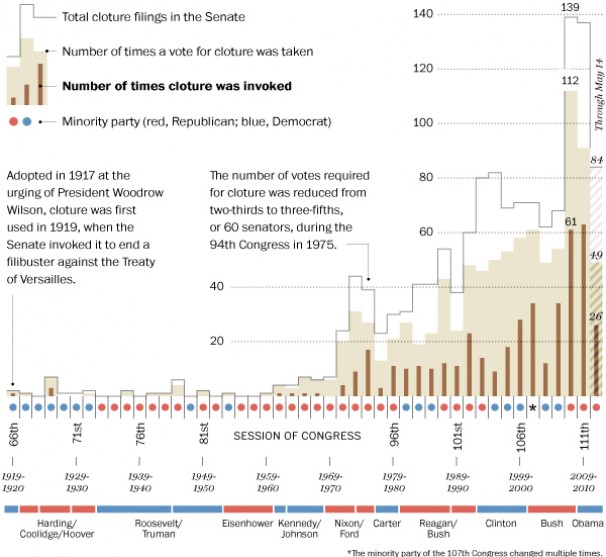
filibuster graph

That’s as far as I’m going to go in explaining American governmental dysfunction, because it’s been hashed out ad nauseum elsewhere, and besides, if you don’t believe me on the face of it, nothing else I’m going to say here will make sense. I will go one step further however and say that, as much as I’d love to do a “plague on both your houses” thing, I can’t. Because it’s the Republicans who are to blame—more specifically, a rump of the party that has receded so far into its epistemic closure that it has become genuinely delusional, and it has the cohort of the party that might otherwise be reasonable running scared.

And so: all of the parliamentary problems built into the U.S. constitution that have rarely, if ever, provided impediments to the functioning of government because lawmakers were too genteel to employ them? They’re now in play. All of the tacit understanding of unwritten rules that has informed executive and legislative behaviour for the balance of U.S. history has been abandoned. I’m no tipadgippergreat fan of MSNBC host Chris Matthews—I think he’s a blowhard and a bully whose political inclinations bend toward whatever president sends a thrill up his leg—but he has a new book that interests me about his time as a staffer for Tip O’Neill, the Democratic Speaker of the House during the Reagan years. The subtitle is “When Politics Worked,” and the overarching premise seems to be that politics “worked” back then because politicians observed those unwritten rules—that Tip O’Neill, as Joan Walsh observes, “recognized that Reagan had won a big mandate and ought to be able to enact much of his program—and then be stuck with the results if they turned out badly.” Though ideologically at odds with Reagan, O’Neill was willing to acknowledge the will of the people in electing him, and by the same token let Reagan own the consequences of his policies, good or bad. As has been repeated by many people lately: Obama won the election. The Affordable Care Act has been made law, and was effectively ratified by the Supreme Court. Perhaps, as so many Republicans are claiming, it will be utterly disastrous. But rather than letting that play out, they are doing quite literally everything in their power to kill it with fire.
Which brings us back to Hegel.

My crude understanding of Hegel goes precisely this far: each society at its inception has embedded within it contradictions either invisible or ignorable; but as it develops, these contradictions become more and more glaring, harder and harder to ignore, until they develop into a conflict (which might be violent but not necessarily so), the resolution of which provides a new synthesis … and this new synthesis has its own minor contradictions, which eventually become glaring, and so on. The example I give my theory students when teaching this is that famous line from the United States’ Declaration of Independence: “We hold these truths to be self-evident, that all men are created equal …” And I ask: what are the two problems with this assertion? One, it leaves out women; and two, the author of this document, Thomas Jefferson, owned slaves. The great African-American novelist Ralph Ellison pointed to this when he said of the Declaration that “In the beginning was the word, and in the word was the contradiction.” Almost a century before that, Frederick Douglass wrote one of the most poignant essays in the history of American letters, “What to the Slave is the Fourth of July?”, observing that the great American narrative of revolution and independence was effectively meaningless to an indentured population. It is pretty simple to offer an Hegelian reading of American history: its founding documents contain some pretty profound contradictions, which came to a head in the Civil War; the resolution of the Civil War, with the indignities of Reconstruction and implementation of Jim Crow, was far from perfect, and brought about a new set of conflicts with the Civil Rights Movement. Each time there were improvements, moving the U.S. forward, but also the seeds of new conflicts and problems.

In this vein, it is difficult to not see the antipathy of Tea Party conservatism as the most recent manifestation of these contradictions. The election of Barack Obama was seen by many (myself included) as a moment of both historical and symbolic closure; my favourite editorial cartoon after the election was by Tom Toles, which featured Obama walking up to the White House under the Declaration’s assertion of all men being equal, with the footnote “Ratified November 4, 2008.” At the same time however, the lingering unresolved racial divide in the U.S. was exacerbated by Obama’s election—and however much Fox News and their fellow travelers howl in outrage whenever one of us lefties plays “the race card,” the particularly vicious vitriol directed at Obama has edged into race-baiting too often—and the Tea Party right is far too monochromatic—for it to not be based at least in part in unreconstructed white panic.

Obama cartoonThat being said, the implicit and explicit racism underlying the backlash against Obama is just one of the contradictions being exacerbated by the present conflict. What underwrites the current legislative showdown, as I suggested above, is the fact that the system has provided the means for a stubborn and uncompromising minority to bring the government to a screeching halt—and if the debt ceiling is breached, it won’t just be the government. Hopefully I’m not overextending the metaphor too much when I characterize this as a perfect Hegelian storm, wherein the social and cultural contradictions have managed to employ the systemic contradictions. One way or another, I find it difficult to imagine that the U.S. government is going to look the same when all is done … my lefty heart is gladdened to see that Obama et al seem to be determined to hold fast, come hell, high water, or default, having come at last (I hope) to the realization that any compromise now only leads to further hostage-taking in the future (as it were).

The problem (one of them) with Hegel however is that he has a pretty relentlessly upbeat conception of history as inevitably progressive. The “syntheses” emerging from conflict, he suggests, are invariably positive … perhaps this is my deficient understanding of his work, but I don’t think he tends to account for the possibility of devolution, or a new synthesis that resolved previous contradictions in a negative or regressive manner. Andrew Sullivan, one of my favourite political bloggers, says again and again that the current Republican party should be ashamed to call itself conservative, as they are anything but. As he says in a recent post, “[Republicans] are the real Alinskyites and Obama is the real conservative,” i.e. Republicans have become a party of radicalism and revolution, the antithesis of traditional conservatism. I agree with that to a point, but beyond that point I think the radical Republicans are quite literally ultra-conservative: they demand stasis, absolute and paralytic cultural stasis, but want it to be of a sort they imagine to have existed fifty or one hundred years ago. Or possibly even before that: the rollback of gay rights, civil rights, the New Deal, scientific advances, and general social progress they seem to desire is really nothing short of terrifying.

And who knows? The direst predictions about breaching the debt ceiling say it will precipitate a global economic meltdown; in my more cynical moments, I wonder if the suicide caucus is genuinely suicidal, desiring precisely that kind of crisis, which could blackmanpotentially dissolve the federal government’s authority and fracture the union. Perhaps I’m being overly bleak, but then, as someone steeped in dystopian fiction, my mind has some well-trodden pathways it can take. The novel that keeps popping up for me now is Richard Morgan’s Black Man, which I wrote about on my old blog, and which I taught in my SF class last winter. In his imagined future, the United States has fractured into three parts: the Union, which is closely associated with the U.N. and Europe, and which comprises the northeastern states; the Rim States, the western states on the Pacific, which have entered into a loose federation with the rest of the Pacific Rim; and the Republic, the main swathe of Middle America, what we would call “Red States.” In the novel it also goes by the derogatory name “Jesusland,” and is precisely what that name suggests: a theocracy that rejects evolution, gay rights, women’s rights, where teaching creationism is the law and abortion a felony.

At times like these, it’s hard to think of Morgan’s vision of the future without feeling a little shiver of recognition.

2 Comments

Filed under wingnuttery

Wente on Gilmour (because none of us saw that coming)

ab-Toni-Morrison

For the record, Toni Morrison could totally kick Hemingway’s ass.

Once the scope and scale of the reaction to David Gilmour’s comments became clear, is was also clear that the chances Margaret Wente would not put in her two cents in her weekly column were slim to none. Huge surprise: she’s pro-Gilmour, anti-feminist, and if you weren’t certain what her response would be, her opening sentences put that uncertainty to rest: “How does an obscure Canadian author become an international sensation overnight?” she asks, and answers: “Easy. Just insult some feminists!”

Yes. Some feminists. Because the range of responses was limited to a narrow, shrill band of men-haters who haunt Wente’s imagination and, presumably, the imaginations of her devoted readers. And for the record, it is this latter group that makes me inclined to say something more on this topic: however often I promise myself I’m just going to ignore her—to avoid feeding the troll, as the saying goes these days—I can’t help but remember that there are people out there who take her words as unalloyed truth and imagine that she is a brave and besieged voice of reason in the midst of leftist hate, as opposed to a lazy, sinecured columnist who writes the same argument over and over, and even then sometimes can’t be bothered to use her own words and ideas.

Or perhaps the horde of Wente admirers is just what haunts my imagination.

Nevertheless, no matter how much I know she’s just poking us with a stick to goad a response, I can’t help pointing out where she’s being misleading, mendacious, or simply wrong. Take for example this seemingly mild defense of Gilmour, which is actually just an excuse to reiterate her biggest complaint about current English curricula:

Frankly, I was surprised and glad to learn that there remains one small testosterone-safe zone at U of T (although I guess it’s not safe any more). As anyone who’s set foot on campus in the past 30 years ought to know, courses in guy-guy writers are vastly outnumbered by courses in women writers, queer writers, black writers, colonial writers, postcolonial writers, Canadian writers, indigenous writers, Caribbean, African, Asian and South Asian writers, and various sub- and sub-subsets of the above. But if you’re interested in Hemingway, good luck. No wonder male students are all but extinct in the humanities.

If by “testosterone-safe zone,” she means courses devoted exclusively to male writers, you don’t actually have to look too hard to find them—you just have to look early, as in chronologically, to find numerous courses on the U of T 2013-2014 undergraduate schedule dedicated entirely to dudes. That their names are Chaucer, Shakespeare, Spenser, and Milton doesn’t exactly obviate their gender. After that? Well, the women start to creep in. They’re sneaky that way. But what Wente doesn’t say (as I’m sure it never occurred to her) is that the presence of names like Austen, Gaskell, Eliot, and the Brontës on nineteenth-century literature courses isn’t some feminist conspiracy to eclipse the dudes, but an honest and scrupulous attempt to construct curricula that offer a representative range of authors well-regarded and widely-read in their own times (even if George Eliot and the Brontë sisters did have to assume male pseudonyms). Ditto for the twentieth century.

Her suggestion that people wishing to study Hemingway at university are shit out of luck comes as rather a surprise, as I just wrapped up a unit on A Farewell to Arms. Before that? The Great Gatsby, another Gilmour-approved novel. And on Tuesday, we start The Sound and the Fury … and while Gilmour had nothing to say about Faulkner, I have to imagine he wouldn’t complain about that one. But here’s the thing: having devoted the first half of my C20 American Fiction course to a holy trinity of the American fiction canon, I was compelled to offer some balance, and the second half will be Flannery O’Connor, Toni Morrison, and Julia Alvarez. Not out of some politically-correct, milquetoast liberal guilt, but because I owe it to my students to offer some sort of representative balance. Filling out a survey course is always a mug’s game, especially when you have thirteen weeks to cover an entire century. So you do the best you can, and in the end there is always room to teach your passion.But it’s not about what the professor loves, it’s about how best to give your students a wide range of ideas, styles, voices, experiences, personalities, worldviews, and vocabularies. That, ultimately, is why the humanities are so crucial: they offer the opportunity, to paraphrase critic Denis Donaghue, to encounter lives more richly imagined than our own. And, I would add, lives we would not otherwise encounter unless we devote our own to traveling all over the world.

But to return to Wente’s harrumph, re: Hemingway. As I said, I just taught one of his novels. But I suspect she’s using Papa metonymically here, having him stand in for the broad range of proud literary masculinity currently getting the short shrift. Is what she says true, my own class notwithstanding? Are these white hetero men, as Patrick Buchanan suggested in another context, an endangered species? Let’s check out the current undergraduate course offerings for U of T English’s 2013-2014 school year.

Well, OK … I don’t see any listings for “Testosterone 101” or “Guy-Guy Lit.” And yes, many of these courses include women authors. Well, not the first-year course “The English Literary Tradition.” Nary a woman to be seen on that list. Or how about “Literature in Our Time”? Seven authors listed, but only two women, Virginia Woolf (whom we’ll call an honourary guy-guy, as she is Gilmour-approved) and Sylvia Plath. Moving on to second-year classes, “The Novel” gets a little more estrogen-heavy with five women (Anne Radcliffe, Jane Austen, Emily Bronte, Virginia Woolf, Toni Morrison) elbowing onto the course with seven men. Then we come to three sections of  the course “American Literature,” whose C20 readings do not, in fact, include Hemingway but do feature William Faulkner, Richard Brautigan, Cormac McCarthy, and such Gilmour-approved guy-guys as Fitzgerald and Philip Roth. Moving on to third-year courses, “Modern Fiction to 1960” gives us yet more Faulkner, as well as Malcolm Lowry, whom I suspect is a guy-guy. (Just so it’s clear, I’m not mentioning every hetero male on these courses, just the ones I imagine Gilmour would approve of. Nor, for that matter, am I mentioning most of the actual courses offered). In “Twentieth Century American Literature,” hey—Hemingway! As well as even more Faulkner (wow, U of T loves it some Faulkner), more Richard Brautigan, more Philip Roth, as well as Thomas Pynchon, Ishmael Reed, and Raymond Carver. “Contemporary American Fiction” features more Roth, more Cormac McCarthy, and Don DeLillo. Fourth year course offerings, admittedly, seem to feature fewer guy-guys, except for the fact that there is one course devoted exclusively to Ezra Pound, who was perhaps the ultimate stereotype of the guy-guy (once comparing the pen to the penis and ink to semen. Ick).

All of which is by way of pointing out that Margaret Wente, once again, really needs to do a little research before she honks off. Does the U of T undergraduate English curriculum—as well as most in the country—make a point of offering women’s literature? Yes. Does it attempt to balance canonical, male writers with women, with authors or colour, and with other traditionally marginal groups? Yes. Does it do so to the utter exclusion of the aforementioned canonical male writers?

No. No, in thunder. And if people like Margaret Wente would spend the five minutes it would take to actually peruse course offerings rather than screaming in outrage the moment they saw courses with titles like “Gynocentric Approaches to Modern Literature,” (not actually a course) they would know that.

*

One more thing (he said, putting on his Columbo voice).

Did anyone else notice Wente’s little bit of implicit racism in the passage I quoted above? To repeat, (italics mine) she says that courses in “guy-guy” writers are “vastly outnumbered by courses in women writers, queer writers, black writers, colonial writers, postcolonial writers, Canadian writers, indigenous writers, Caribbean, African, Asian and South Asian writers.” Catch it? Apparently “guy-guy” also means emphatically white and, weirdly, non-Canadian. There are no macho, straight-up hetero black authors? (paging Richard Wright). Caribbean authors? (V.S. Naipaul would be surprised by that one). African, Asian, South Asian, or Canadian authors? (Because on this last one, I can think of at least one Governor-General award-winner who would protest). To “testosterone-safe zone” I suppose we must also append the sign “whites only.”

1 Comment

Filed under maunderings, thrice-yearly responses to Margaret Wente's columns, wingnuttery

Some thoughts on that whole David Gilmour thing

I’m not interested in teaching books by women. Virginia Woolf is the only writer that interests me as a woman writer, so I do teach one of her short stories. But once again, when I was given this job I said I would only teach the people that I truly, truly love. Unfortunately, none of those happen to be Chinese, or women. Except for Virginia Woolf. And when I tried to teach Virginia Woolf, she’s too sophisticated, even for a third-year class. Usually at the beginning of the semester a hand shoots up and someone asks why there aren’t any women writers in the course. I say I don’t love women writers enough to teach them, if you want women writers go down the hall. What I teach is guys. Serious heterosexual guys. F. Scott Fitzgerald, Chekhov, Tolstoy. Real guy-guys. Henry Miller. Philip Roth.

—David Gilmour

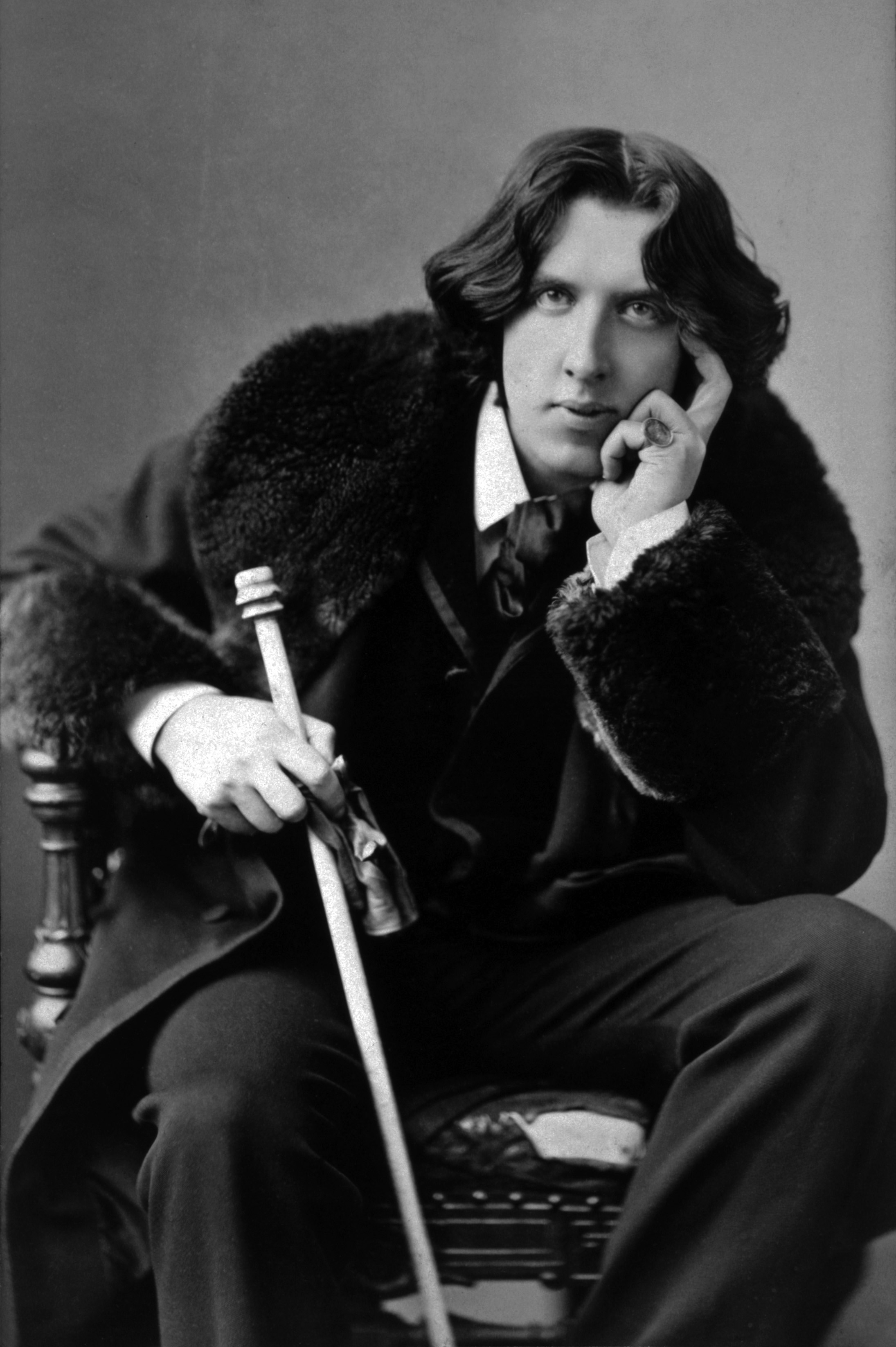
Oscar_Wilde_portrait

My own favourite guy’s guy.

I should begin by saying that I don’t think David Gilmour should be fired or otherwise shouldered out of his U of T job. If professors were banned from teaching for being arseholes, there wouldn’t be many of us. And for what it’s worth, I don’t think a course that teaches his brand of literary machismo is necessarily a bad thing; in and of itself, which is to say, taken in isolation from other courses, reading lists, and approaches, it is a manifestly terrible thing, but your average English degree and English department (especially one as huge as U of T’s) is capacious enough to take all kinds. I would go further and say that if, in the course of an English degree, you don’t have at least one class with a hoary old unreconstructed literary curmudgeon who doesn’t believe that anything worthwhile was written after 1922 (or 1622), you’re missing a key English Lit experience.

The point is that there is room in the pedagogical firmament for the David Gilmours of the world, more so now that they find themselves in the minority. Which isn’t to say that I agree with, endorse, or otherwise tolerate his particularly arrogant brand of literary chauvinism—just that sometimes such characters (I’m looking at you too, Harold Bloom) can be inadvertent catalysts for fruitful and beneficial argument and discussion.

Case in point: though I am writing this the morning after Gilmour’s ill-conceived assertions in Hazlitt, and his even more ill-conceived follow-ups in The National Post, I am coming very late to the party, so much so that I wasn’t sure there was any point to actually putting in my two cents. So far I have read three blog posts taking issue with his comments, and one very funny parodic biography of a Chinese Virginia Woolf by “David Gilmour” (to say nothing of the many, many articles popping up on various news sites). These pieces do a lovely job of showing just how simple-minded and indeed closed-minded Gilmour’s comments are, so I won’t waste my energy or your time rehashing them, other than to say that Lucia Lorenza’s comments (the second blog post I link to) are particularly worth reading, and are a wonderfully elegant discussion of just why Gilmour’s pedagogical approach is unbelievably myopic.

The copia of response over social media, from outrage to snark to tentative defenses of Gilmour, is to my mind an example of when social media works to intellectual and social advantage—the speed and critical mass of the responses, the ongoing arguments, and the overall attention being paid to the otherwise innocuous question of the contents of English syllabi, all of this puts certain crucial questions and issues that are always-ongoing in literary study front and center, and gives it an immediacy that otherwise does not exist, that otherwise would not be possible.

As has been pointed out by several people, Gilmour is free to choose what he teaches. Academic freedom is, among other things, the right of the professoriate to organize readings and classes without interference. Academic freedom does not, however, guarantee one against criticism, mockery, and/or derision when one loudly and arrogantly trumpets one’s opinions in the public square. As I said, I don’t think he should lose his job over this, but I am heartened by the response to his words. From what he says in the original article and the follow-up interview, I suspect he is not nearly as good a teacher as he imagines—but he has certainly provided us all with a very teachable moment.

*

OK, I lied … I said I wasn’t going to rehash the arguments against Gilmour’s idiocy, and I won’t—not much—but I do have one thought I feel compelled to voice.

When all is said and done, what I find most appalling about Gilmour’s statements isn’t his insult to his colleagues “down the hall,” who, he implies, obviously do not teach worthy texts; it isn’t his blinkered suggestion that the number of texts worth studying can be counted on one hand; it isn’t the breathtaking arrogance of a second-tier novelist dismissing the need to read outside one’s comfort zone; it isn’t even his overt misogyny. No, what appalls me is his smug assertion of his excellence as a teacher, when everything he says provides evidence to the contrary.

Whatever my theoretical defense of Gilmour’s class, I feel sorry for his students and hope they learn, through a broader exposure to various conceptions of literature and various approaches to its study, just how narrow and impoverished Gilmour’s approach is. Which isn’t to say I don’t think we should study the writers he celebrates—there is no one on his list (with the exception of Proust—I’m ashamed to say, I have never made that attempt) that I do not endorse as worthy of study. But I really have to wonder: he says “I teach only the best,” which I suppose is fair enough. But what qualifies as “the best”? He does not say. I hope he explicates that in his classes, though from his comments I’m not hopeful on that front. Apparently, it’s standard at the start of his courses for some student to ask why there are no women on the course, and he responds that “I don’t love women writers enough to teach them, if you want women writers go down the hall.” I think it’s safe to say that much of the outrage that has proliferated in the last day is rooted in the unbelievably dismissive arrogance of this comment. Gilmour goes on at length about what an awesome teacher he is, how “impeccable” he is in the classroom, and how much passion he has for it. And yet in sneeringly suggesting that his students “go down the hall,” he gives the lie to these pretensions, for he makes it obvious that he has no interest at all in actually teaching. You want to teach macho hetero dead white men? That is entirely your prerogative (see above, freedom, comma, academic). But if you have serious, genuine academic and intellectual reasons for doing so, that question you get—if you’re lucky enough to get it!—is a gift. “Why no women? Let me tell you …” Honestly, I have difficulty imagining an explanation that won’t enrage me and all the other people currently bashing Gilmour on Facebook, but for the love of literature, have a better reason than “I don’t like women authors.” Presumably there is some reason for this antipathy … presumably, you have a well-thought-out rationale for such exclusive reading lists.

Apparently not, though. Such a response suggests a complete and utter lack of intellectual content to these choices, to say nothing of a reactionary refusal to defend them. But what is worst is the way in which such a response functions as a figurative slap in the face to whoever is brave enough to ask the question. A student asking you a question deserves the respect of a real answer, especially when it is one as fundamental as asking about reading selection. At one point in the original Hazlitt piece, Gilmour says “I’m a natural teacher, I was trained in television for many years. I know how to talk to a camera, therefore I know how to talk to a room of students.” The “therefore” in the second sentence here is dumbfounding and yet entirely enlightening. Never mind the fact that some of the best professors I have had hemmed and hawed and digressed and stuttered and otherwise would have made utterly useless TV personalities—the idea that students are like a camera is rather appalling. That’s not teaching—that’s self-congratulatory, masturbatory performance.

And really, that’s all I have to say on the matter.

3 Comments

Filed under maunderings, wingnuttery

Two Discussions about Orson Scott Card

Apologies for this blog’s inadvertent hiatus. I actually have an awful lot of things in the hopper, and once classes start I’ll be posting more frequently, with regard to what we’re reading. I’ve got a Breaking Bad post in the works, as well as the long-promised follow-ups to my initial post on fantasy and cruelty. What can I say? It’s summer.

But for today, it’s all about everyone’s favourite SF homophobe, Orson Scott Card.

Why I’ll Go See Ender’s Game

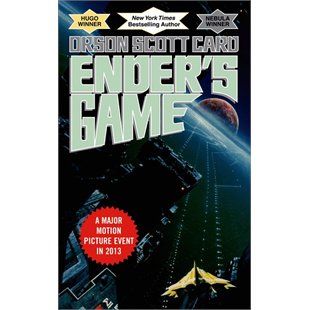
enderThis past winter I taught Orson Scott Card’s novel Ender’s Game for the first time in my science fiction class (which I was also teaching for the first time). I put it on the course list without thinking, by which I mean its inclusion was something of a no-brainer for me. I’d first read the novel about twelve years before and reread it several times since, and I looked forward to the chance to discuss it in a classroom setting. I knew, vaguely, that Orson Scott Card (OSC from here on in) was something of a religious conservative, but as there was no suggestion of that in the novel it never bothered me.

The true scope of OSC’s political and religious conservatism came glaringly to light after I’d put in my book orders for the term, when a number of articles he’d written advocating, among other things, armed revolt against the “gay agenda” and for the recriminalization of homosexuality, received a storm of publicity. Between the buzz about the film adaptation of Ender’s Game in progress and the series of court decisions in favor of gay marriage, OSC’s anti-gay opinions became impossible to ignore, as did his political crusading.

It raised an interesting but fraught problem, one which we addressed at length in class: how do we approach a novel that, in itself, has a great deal of merit, when its author not only holds opinions we find vile and reprehensible, but actively uses his not-inconsiderable wealth and fame to try and marginalize and disenfranchise a certain segment of the population? The opinions themselves are not so much the issue—if we eliminated from our reading and viewing all the work of artists we thought were assholes, we wouldn’t be left with much. But the inescapable fact about OSC is that purchasing his books contributes to his bottom line, both rewarding him financially and augmenting his influence.

There has been a great deal of discussion and argument about this question online—Alyssa Rosenberg, as usual, has some excellent thoughts here and here—with some people advocating for a boycott of the film of Ender’s Game. Though I’ve gone back and forth on the question, I know I will myself go see the film. I’m reluctant to put money in OSC’s pocket, but the past few months have convinced me that all of the publicity isn’t actually doing OSC any favours. Gay marriage, as the expression goes, is an idea whose time has come—and OSC’s very vocal opposition has raised his profile in a way that is starting to impact him negatively. While SF and fantasy fandom is hardly a hotbed of pro-gay activism, it does possess a significant and vocal constituency in that respect, which managed to scuttle a Superman story arc that DC Comics had hired him to write. And Summit Entertainment is being very conspicuous in keeping OSC inconspicuous in the lead-up to the release of Ender’s Game, leaving him off the publicity slate. He has actually become quite toxic, a fact he can’t be unaware of, especially in light of the current popular disgust with Russia’s anti-gay laws and the IOC’s timidity. It makes me wonder how an unreconstructed American religious conservative feels, knowing he’s making common cause with Vladimir Putin?

(He recently resigned from the board of directors of the National Organization of Marriage. It’s nice to imagine that this storm of bad publicity led to this resignation, and that he’s retreating from being so vocal in his homophobia, but I suspect not.)

One of the arguments for boycotting Ender’s Game, besides the fact that it will enrich a bigot, is that if the film is a great success, it will validate OSC. I’m far more sympathetic to the first position; far from validating OSC and his opinions, the potential popularity of Ender’s Game will, I suspect, create a cognitive dissonance between that story’s basic humanity and its author’s hateful politics. I say this with a certain amount of confidence, as I know that already happens with the novel—in my SF class, many of my students expressed shock that the person who created Ender Wiggin and craft such a compelling story could also be so paranoid and irrational. There is always the possibility that some people are or will be so taken with Ender’s Game that they’ll give his anti-gay rants (and his particular species of paranoid batshit generally—see below) some credence. But I have hope that OSC’s raised profile, coupled with an idea whose time has come, will do him and his opinions more harm than good.

Unlikely Events that will Totally Happen

As Dave Weigel observed recently in Slate, OSC’s attempt to keep a lower profile has led the furor over his anti-gay writings to subside somewhat. But, Weigel maintains, this is good, for “the gay marriage foofarah was a distraction from Card’s much more fascinating political paranoia.” He points to a blog post OSC wrote in May titled “Unlikely Events” in which he promises in the first sentence to predict “how American democracy ends.”

Except not really. “No, no,” he protests in his next sentence, “it’s just a silly thought experiment! I’m not serious about this! Nobody can predict the future! It’s just a game. The game of Unlikely Events.” What follows is a lengthy prevarication about the differences between fiction and history. Fiction, he says, depends on plausibility, and the task of the fiction writer is to make a causal series of events not just likely but inevitable. Historians, conversely, require evidence, and the reason prognostication almost invariably ends up being wrong is because history does not have fiction’s convenient form of causation.

Fair enough, I suppose. He goes on to point out that historical lies have a great persistence, because they almost always reinforce some people’s story they tell themselves about history. Also fair, though the trio of examples he offers are somewhat head-scratching:

Historical lies have great persistence. There are still people who think that Winston Churchill “failed” at Gallipoli; who believe that Richard III murdered his nephews, though the only person with a motive to kill them was Henry Tudor; who believe that George W. Bush lied about WMDs in Iraq.

Oh … where to begin? Right here OSC demonstrates, inadvertently, that the distinction he wants to make between history and fiction is far more nebulous than he allows. Gallipoli was an unmitigated disaster, and it was Churchill’s brainchild. I have yet to read anything claiming that the operation was actually a success, but I’m sure such arguments are out there; and while a lot has been done to recuperate the reputation of Richard III, the question of whether he murdered his nephews is far from settled—it is, indeed, the object of much debate still. (Ironically for OSC’s blithe assertion, the single most influential argument for RIII’s innocence was a novel—the wonderful Daughter of Time by Josephine Tey). In both of these cases, the “lies” OSC cites have been, and continue to be, matters of debate and discussion.

And the less said about the WMD claim, the better. Moving on.

All of this is in the service of a rather disingenuous throat-clearing—fiction is about causation, history about evidence, and anyone who predicts the future is doomed to get it wrong. BUT … that being said, of course, there is a dire end to American democracy, and OSC, SF writer extraordinaire, has seen it. Or, to quote his post,

Yet this doesn’t mean prediction is useless or meaningless. There were plenty of people who foretold the disaster that Hitler would bring to the world if he came to power in Germany, and those predictions were exactly fulfilled … The only reason people were taken by surprise was that they simply refused to believe (a) what Hitler himself said he would do, and (b) the previous related examples from history.

Hmm. Interesting example to use. Never mind the fact that Obama’s most vociferous opponents love comparing him to Hitler—what I want lock in here is the idea of people doing what they promise to do. I wish Obama had done what he promised in the 2008 campaign—or, well, more of it. But he hasn’t. And there is a huge, delusional wing of the American right—including our friend OSC—who want to find him guilty of a host of things he hasn’t done, and never promised to do. But keep the thought of promises and avowed intentions in mind, because I’ll be coming back to it.

For now, I just want to laugh with the mirth of the damned at OSC’s dystopian scenario. To quote The Princess Bride, let me explain … no, there is too much—let me sum up. Basically, Michelle Obama will be the president after Barack, and he will continue to reign through her.

Seriously:

Michelle Obama is going to be Barack’s Lurleen Wallace. Remember how George Wallace got around Alabama’s ban on governors serving two terms in a row? He ran his wife for the office. Everyone knew Wallace would actually be pulling the strings, even though they denied it.

Michelle Obama will be Obama’s designated “successor,” and any Democrat who seriously opposes her will be destroyed in the media the way everyone who contested Obama’s run for the Democratic nomination in 2008 was destroyed.

Of course, this is an unlikely scenario—even with the willing and slavish assistance of the mainstream media, which OSC maintains have always been in Obama’s camp—so Obama will need assistance in seeing his dictatorial vision through.

As OSC admits, unlikely. But plausible! Plausible, if you buy the canard that the mainstream media is entirely in the pocket of the Obama Administration, and that their unthinking acquiescence to his every whim translates into similar acquiescence on the part of every member of the Democratic Party (including, presumably, Hilary Clinton—but OSC seems to think that Obama completely destroyed her chances by hanging her out to dry on Benghazi). Of course, this nefarious plan runs up against the fact that there are many right-thinking Americans like OSC. However will Obama overcome their opposition?

By mobilizing inner-city (i.e. black) gangs into a national police force. Seriously:

Where will he get his “national police”? The NaPo will be recruited from “young out-of-work urban men” and it will be hailed as a cure for the economic malaise of the inner cities.

In other words, Obama will put a thin veneer of training and military structure on urban gangs, and send them out to channel their violence against Obama’s enemies.

Instead of doing drive-by shootings in their own neighborhoods, these young thugs will do beatings and murders of people “trying to escape”—people who all seem to be leaders and members of groups that oppose Obama.

Already the thugs who serve the far left agenda of Obama’s team do systematic character assassination as a means of intimidating their opponents into silence. But physical beatings and “legal” disappearances will be even more effective—as Hitler and Putin and many other dictators have demonstrated over and over.

And thus does the Republic die. I read these lines over and get weary at the thought of pointing out the basic flaws in OSC’s scenario, so fortunately I can just like to Dave Weigel’s succinct and searing demolition  of it in Slate. I’m less interested here in how absurd it all is than with just how disingenuous OSC is in setting it up. He titles the post “Unlikely Events,” and is careful to point out the fact that prognostication is almost always wrong. BUT … as a fiction writer, etc. etc., and as a student of history—again, etc. etc.—he is peculiarly situated to offer a plausible scenario. Or to put it more succinctly: this will never happen, except that it totally will.

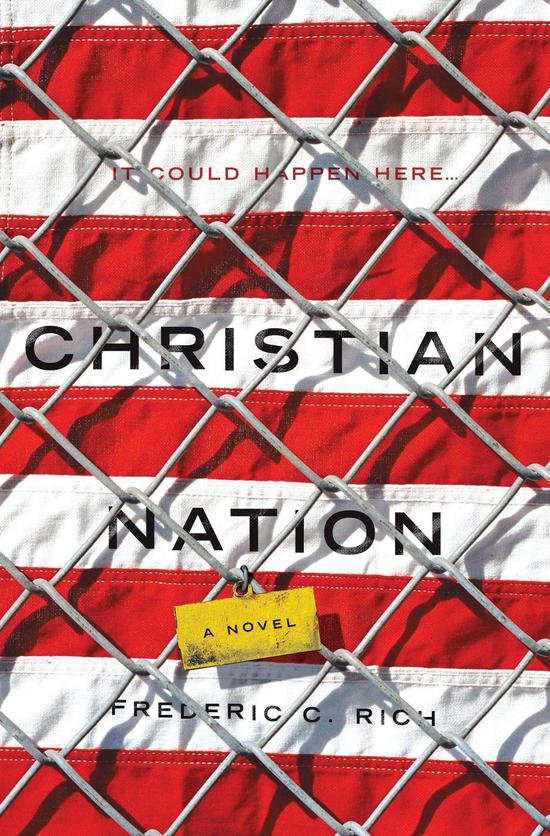
xtian nationI wouldn’t have thought twice about this piece of paranoid scribbling had it not been for the fact that I’d recently read the new novel Christian Nation by Frederic Rich. The premise is alternative history, positing what might have happened if John McCain had won the 2008 election and, mere months into his presidency, died of an aneurism. Under President Palin (shudder), the United States finds itself on the road to Christian theocracy, culminating in civil war in 2020 and a totalitarian evangelical government.

As a novel, Christian Nation is a miserable failure—principally because it is poorly written, with one-dimensional characters, and a hackneyed and shaky narrative. The premise is intriguing, but requires too much exposition: Rich gives us as one of his principal characters a preternaturally serene and intelligent gay Indian man named Sanjay, who plays the Cassandra role in the years leading up to and immediately following the rise of Sarah Palin to the presidency (again: shudder). I have to assume that the vast majority of people who read this novel, like me, will do so because of the premise and because they bear great antipathy to militant evangelicals. But I promise you that, however much you agree with Sanjay and however much he warnings alarm you, you will be so pissed off with him … because for the first third of the novel, everything he says starts with “But did you know …” and proceeds to enumerate yet another little-known fact about Christian fundamentalist political ambition.

At the same time, as annoying as he gets, Sanjay’s screeds are why you should read the novel. Rich has done his research: the best thing I can say about Christian Nation is that it doesn’t unfold as a liberal fabulation about how we fear evangelical theocracy might happen so much as a point-by-point explication of what they want to do. Sanjay’s irritating conversational tic is the author’s way (clumsily) of communicating the fact that nothing he depicts after Palin’s ascendancy (third time: shudder) is actually out of step with what numerous Christianists from the 1960s onward have called for in books or from the pulpit.

Which brings us back to the OSC statement I highlighted, about how people were only surprised by Hitler because they hadn’t expected him to actually do the things he promised he’d do. This distinction is important, for it emphasizes (ironically) everything wrong with OSC’s post and everything right about Rich’s novel. I confess, when I read Christian Nation, I kept thinking “this is like Left Behind, just for liberals” (and, I’m sad to say, not much better written). The frustrating thing about Christian Nation, in hindsight, is that it would have worked much better as non-fiction … or as a two-part endeavour, which outlined the background of evangelical political desires, and then proceeded to say “let’s imagine …” At least that way, we could have avoided the inane characters and Sanjay’s irritating conversational gambits.

By which I mean to say, at least Rich has based his “unlikely events” in the voluminous series of marching orders evangelicals have been giving the faithful for years. OSC’s fantasy, for all his prevarications about knowing history, is just fantasy. Oh, he gives one piece of “evidence” for his prognostication, vis à vis his urban enforcers:

Obama called for a “national police force” in 2008, though he never gave a clue about why such a thing would be necessary. We have the National Guard. We have the armed forces. The FBI. The Secret Service. And all the local and state police forces.

The trouble is that all of these groups have long independent histories and none of them is reliably under Barack Obama’s personal control. He needs Brown Shirts—thugs who will do his bidding without any reference to law.

I think I’ll let Dave Weigel repudiate this:

This is a revealing bit of craziness, and one you occasionally hear from members of Congress. Obama never called for a “national police force.” In a July 2008 speech he used the words “civilian national security force” to describe how he’d “expand AmeriCorps to 250,000 slots,” “double the size of the Peace Corps,” and “grow our foreign service.” That was five years ago, and he actually failed to do it.

Not to be a snob about it, but anyone looking logically at the Obama record from then to now might notice that he hasn’t actually created a civilian strike force answerable only to him. (How its budget would exist outside of congressional appropriations I do not know).

You know what? Now that I get to the end of this discussion of OSC’s batshit wingnuttery, I’m seriously rethinking paying ten bucks to see Ender’s Game.

Huh.

Leave a comment

Filed under film, maunderings, wingnuttery