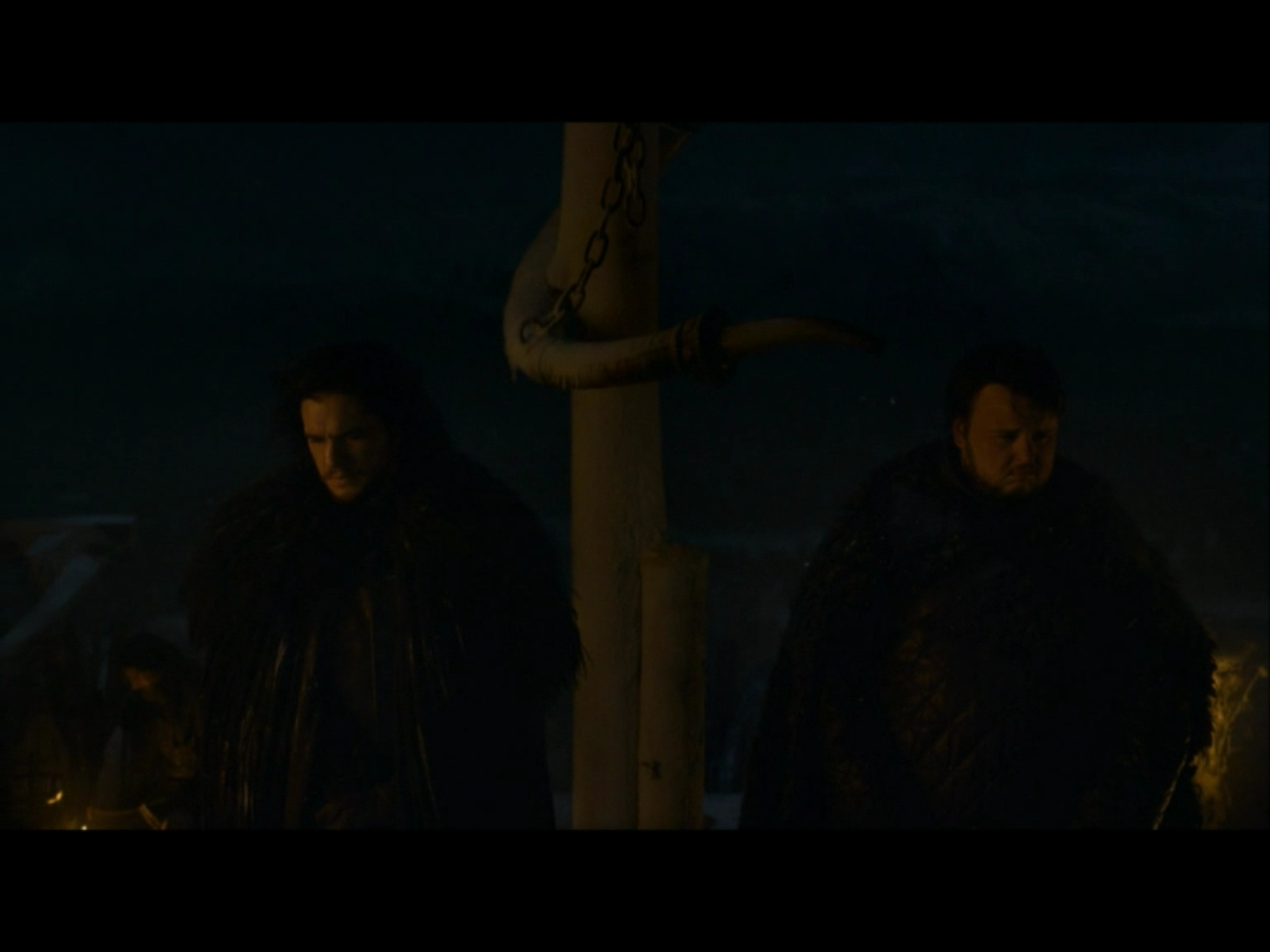
Category Archives: television

Game of Thrones 6.04: Book of the Stranger

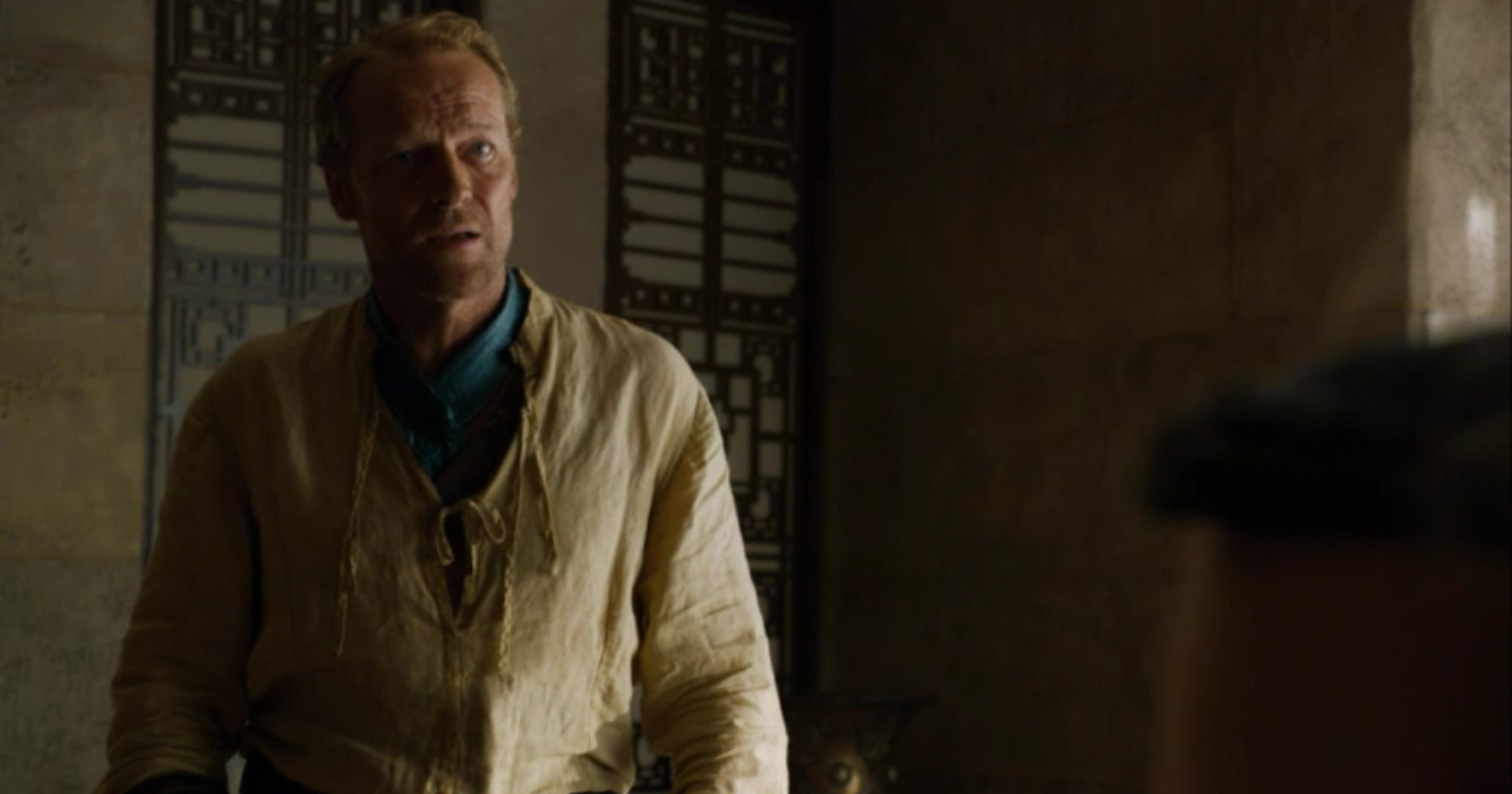
gameofthrones_teaser02_screencap10

Greetings and welcome dear friends to episode four! This week was all about brothers and sisters, with three reunions: one joyful, one painful, and one angry and tearful. We also had some great eye-rolling action from the Queen of Thorns, a parable of wealth and sin from the High Sparrow, some creative use of fire by Daenerys, and we wonder if Natalie Tena has now gone to her agent and demanded a role in a franchise where her character doesn’t get horribly killed. I once again have the pleasure of sharing the stage here with my good friend Nikki Stafford. It’s my turn to lead us off, so without further ado …

longclaw

Christopher: While there have been a handful of gasp-worthy and/or fist-pumping moments in the first three episodes, the consensus thus far on the interwebs seems to have been that this season started slowly. More than a few reviews I’ve read have been chomping at the bit for some of Game of Thrones’ patented operatic moments.

Well, now we know. The last three episodes have been building to this one.

Or not entirely. But mostly. Or at least, that’s how it felt watching this episode.

Am I not making sense? That might be because I’m writing this mere moments after watching that final, climactic scene. Let me take a deep breath and focus.

I had a couple of friends over to watch tonight’s episode, and we were speculating about what might transpire based on the trailer, which suggested strongly that Brienne and Sansa would arrive this week at Castle Black. As we’ll recall, last week’s episode ended with Jon Snow handing over the mantle of Lord Commander to Edd Tollett, saying “My watch has ended,” and seeming to walk out through the main gates. Did that mean he has departed? Would Sansa come looking for sanctuary from her half-brother, only to find he had deserted? It was, we decided, precisely the kind of thing Game of Thrones would throw at us.

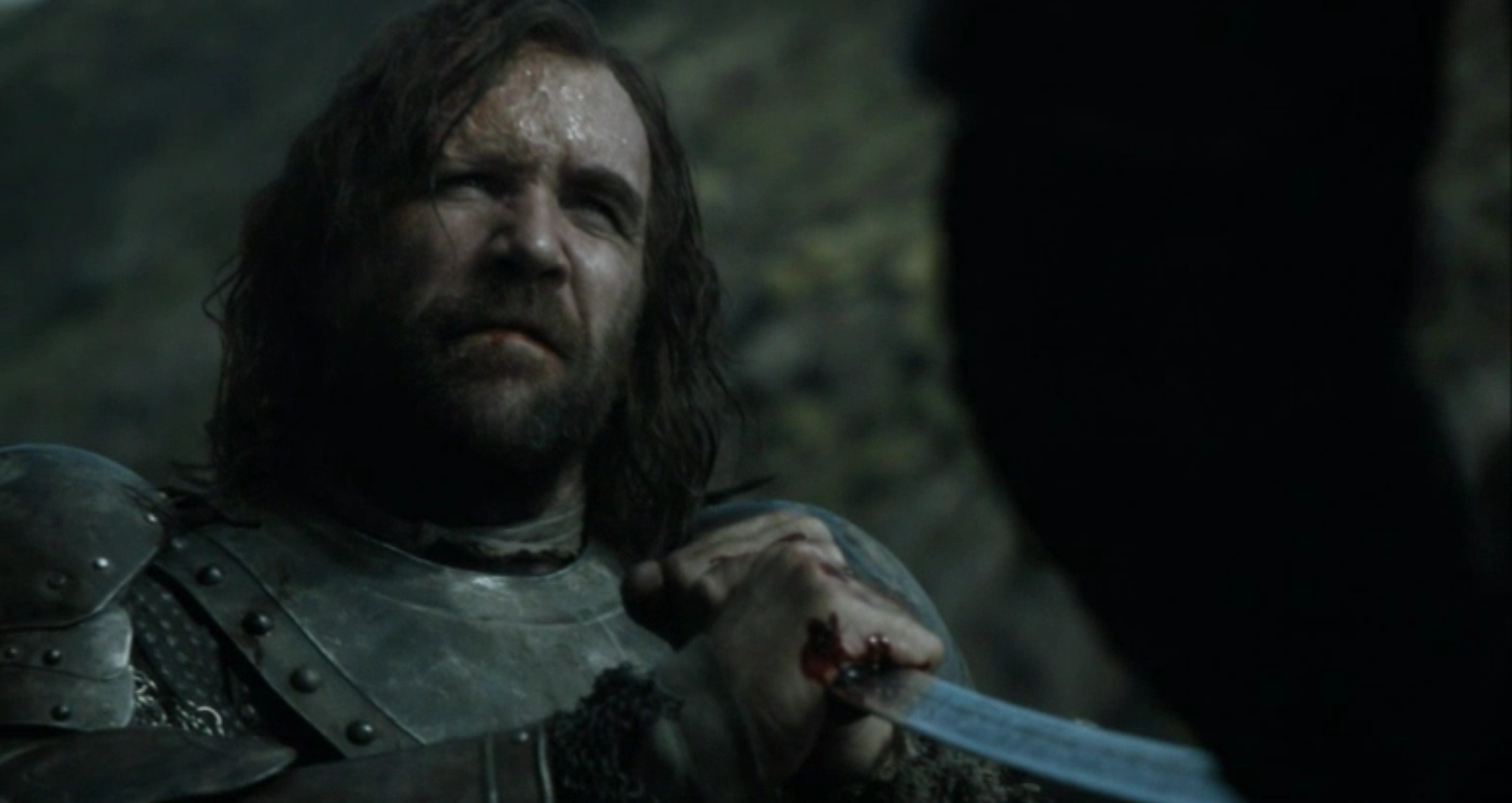
With that in mind, the first shot had me confused: Jon’s sword Longclaw, given to him by his predecessor Jeor Mormont, sitting in the foreground. It is picked up by Edd Tollett. My first thought was that Jon had been wearing the sword as he seemed to leave Castle Black, but seeing Edd holding the sword made me wonder for just a second whether Jon had left it with Edd as part of the Lord Commander’s outfit. But no—a moment later we see Jon, and Edd grills him about what he means to do, and where he means to go. Jon’s answer is at once glib and heartfelt—he means to go south, so he can get warm again—but Edd is having none of it. He reminds him about Hardhome, saying, “You know what’s out there. You know what’s coming here. How can you leave us now?”

It’s a powerful question, as it goes right to the heart of Jon’s reasoning behind the very actions that got him murdered, that is, granting passage south of the Wall for the wildlings. Everything he did in the final episodes of last season was in the name of drawing a line between whom he saw as the true combatants in the wars to come: between the living and the dead.

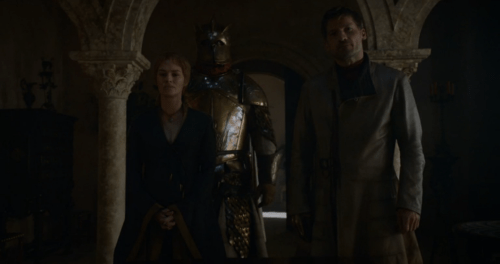
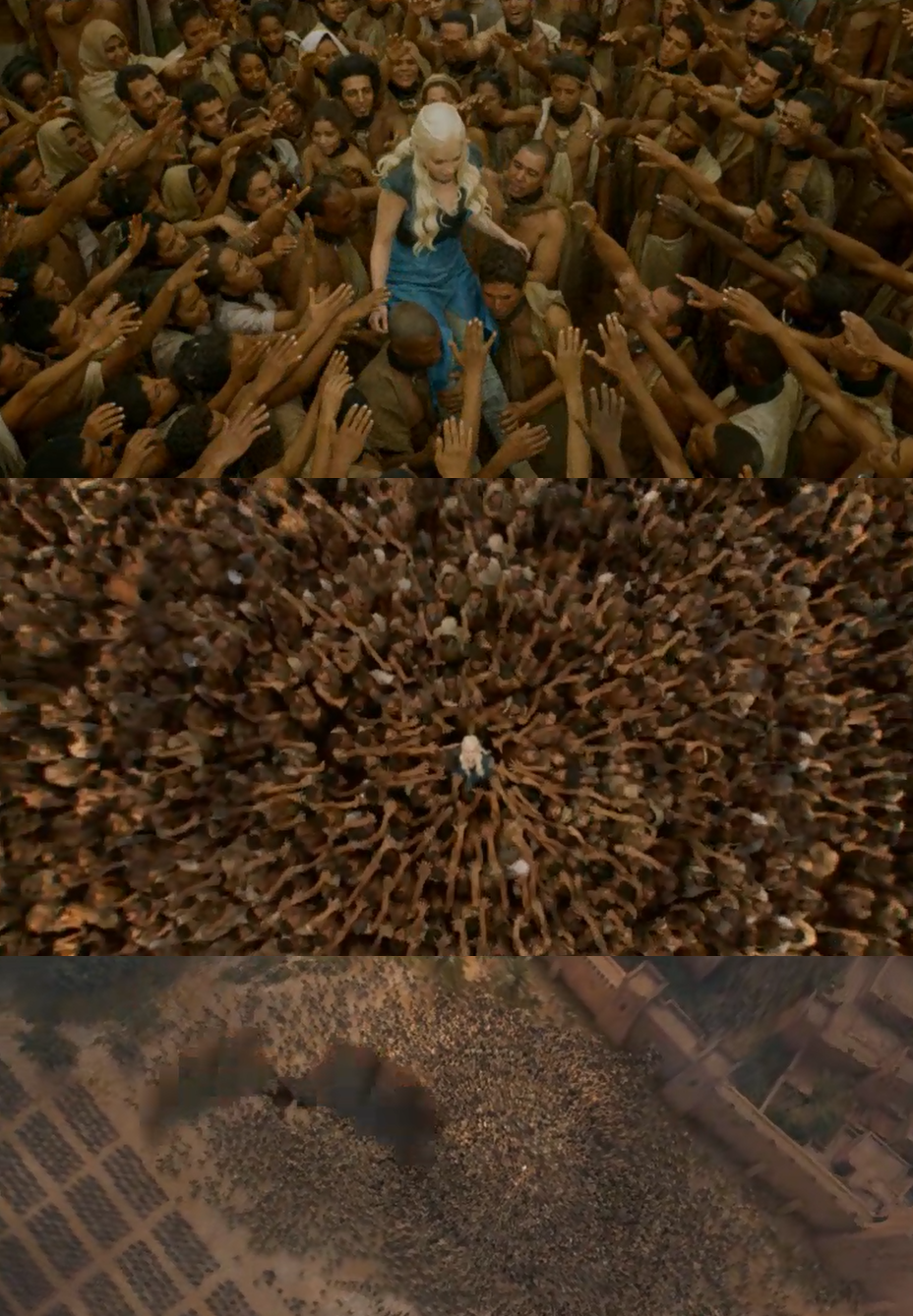
It strikes me that this episode is very much about the drawing of battle lines. Later we see an uneasy truce between Cersei and Olenna, drawing a line between their houses and the High Sparrow; Theon pledges himself to his sister in her bid for the Iron Islands’ throne; and the spectacular ending of this episode is essentially Daenerys drawing a line between herself and the world.

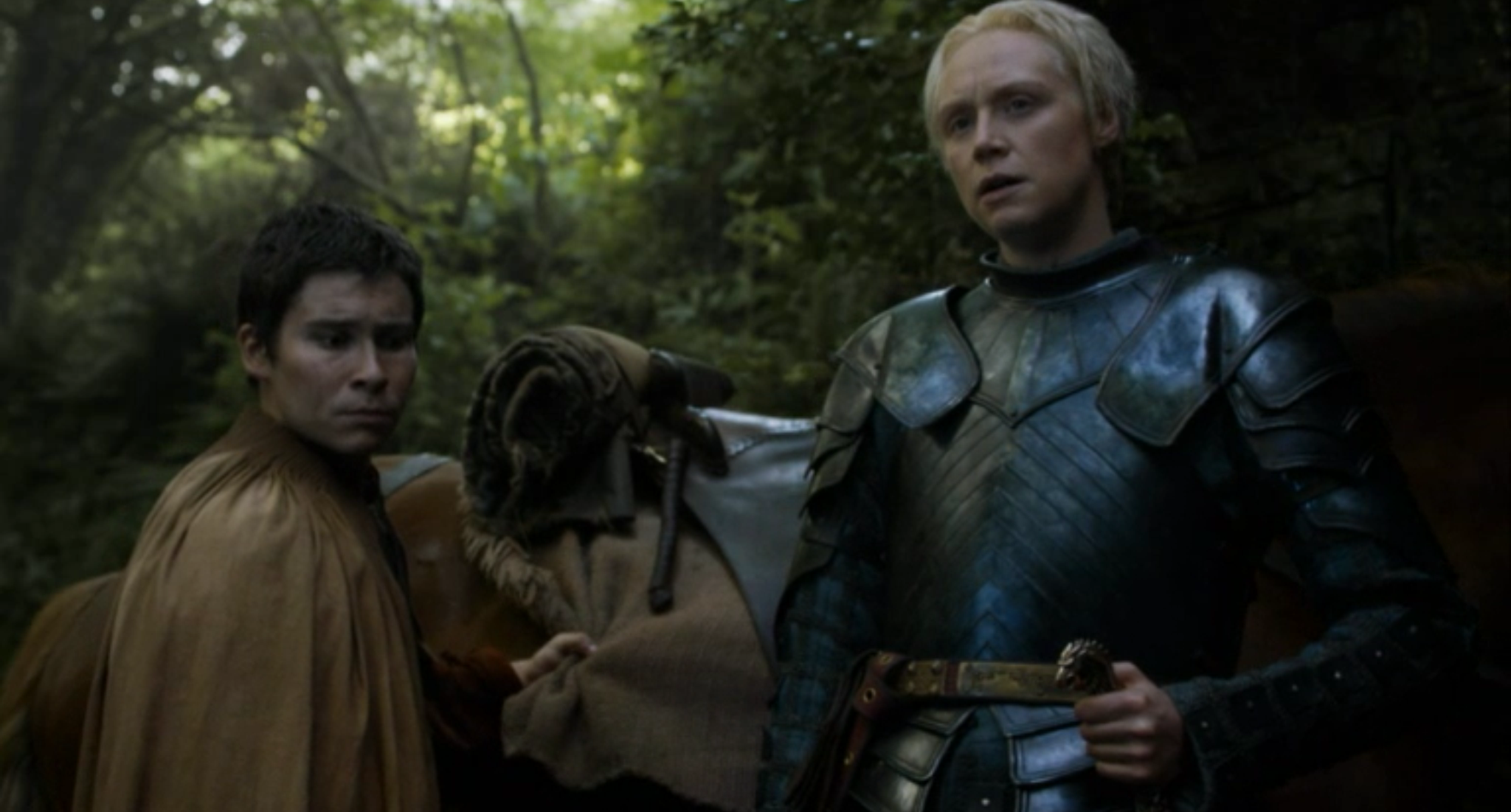
sansa_brienne

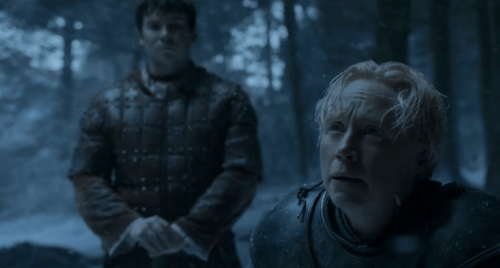
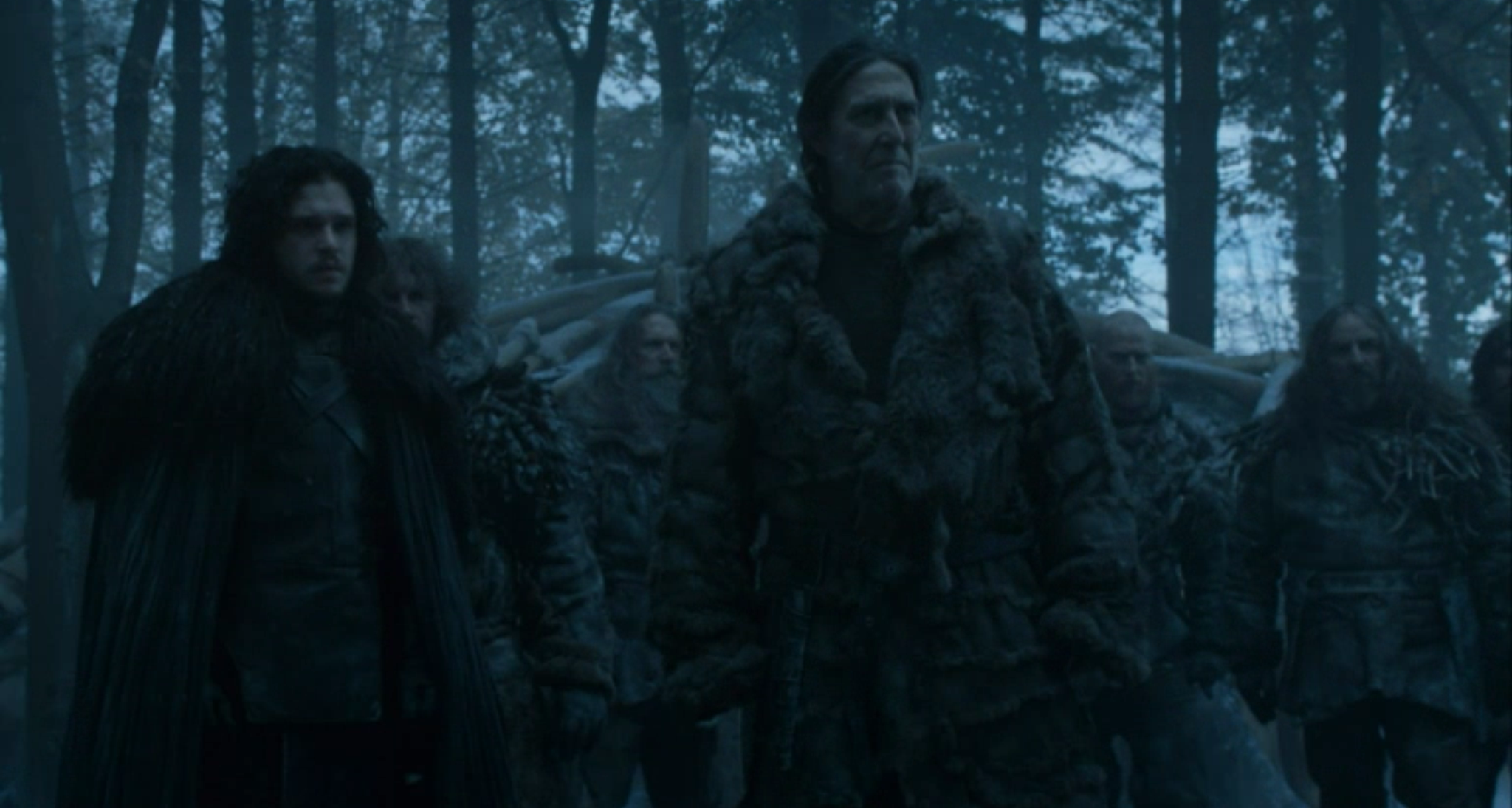
Jon Snow, by contrast, is initially reluctant to re-enter the fray. When Edd asks him, “How can you leave us now?” Jon reminds him that he was murdered by his brothers. “You want me to stay here after that?” he demands, but once again Castle Black offers up a very timely knock at the door—though instead of a furious giant this time, it is a horn announcing the arrival of visitors, as my and my friends’ dour speculations are very happily proven wrong. For Brienne and Sansa (and Pod, of course) have arrived, and they ride into Castle Black’s courtyard to stares of consternation—some, we assume, directed at Sansa, but most at the tall and imposing figure of Brienne. Tormund in particular seems quite gobsmacked, something that will be played to comic effect later in the episode.

Like a cracker given to a starving man, the scene of Jon and Sansa’s reunion is overwhelming. Game of Thrones consistently offers action, thrills, triumph, and not a little bit of humour mixed in with what is more often than not an onerous and cripplingly dire set of circumstances. Tyrion and Varys’ banter leavens the mix; Brienne riding to the rescue makes us cheer; and sometimes there are dragons, and sometimes Joffrey dies. But there are precious few moments of genuine love and joy: the moment of recognition when Sansa looks up to see Jon, and their subsequent desperate embrace, was a balm to the soul of this show that, at this point, I didn’t realize it needed—so inured was I to the bleakness. And full credit to the actors: Sophie Turner and Kit Harrington so inhabit Sansa and Jon now, that their reunion is genuinely a thing of joy on the screen.

But to return to Edd’s question: “How can you leave us now?” he asks, and Sansa is, if not the answer, certainly an answer. “Where will you go?” she asks Jon, and he corrects her, “Where will we go?” They are family, they are reunited, and the argument that ensues—in which Jon professes his battle fatigue and unwillingness to fight any more—is understandable but perhaps somewhat disingenuous in the circumstances. We can certainly empathize with Jon’s fatigue, but Sansa—who, incidentally, in spite of not dying, arguably suffered far more than Jon—sees things more pragmatically. She tells him that Winterfell is their only home, and that she will take it with or without him, but the gist of what she says is plain: there simply is no way forward without fighting.

davos_mel

And as we sense battle lines being drawn, we begin to see factions emerging. Melissandre, we are utterly unsurprised to learn, will follow wherever Jon Snow goes. As will Davos, probably, but he has some questions he wants answered. What happened to Stannis? It seems odd that he has waited this long to ask her, but then perhaps her prior moping precluded such discussions. What happened to Stannis? He was defeated, she replies. What happened to Shireen? he then demands, a somewhat trickier question for her to answer … and she receives the mixed blessing of an interruption from Brienne. “I saw what happened,” she says, in a little moment of misdirection, as what she has to say is about Stannis and the battle, and not Shireen. But really, Brienne is there to say that she served in Renly’s Kingsguard and saw him killed at the hands of “blood magic.”

brienne_davos_mel

Uncomfortable silence. “That’s … in the past now,” says Davos. “Doesn’t mean I forget,” Brienne replies. “Or forgive.”

BRIENNE: He admitted it, you know.
DAVOS: Who did?
BRIENNE: Stannis. Just before I executed him.

Brienne turns and walks away, and in my notes I wrote MIC DROP. Battle lines are being drawn, but on this front we’re looking at some strange bedfellows. Jon and Sansa are now together one way or another, but Brienne, sworn to Sansa, has more or less thrown down the gauntlet to Melissandre, who will walk into fire for Jon (perhaps literally). I suspect we will see some tension in this northern alliance down the road.

But then we turn to the Vale and—finally!—the return of everyone’s favourite sleaze, Littlefinger. Were you happy to see Mayor Carcetti again, Nikki?
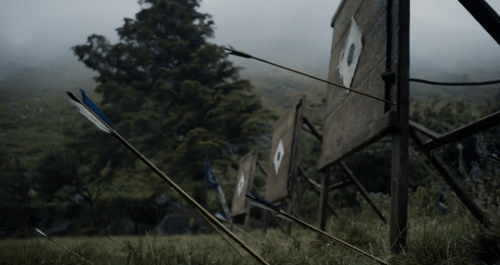
arrows

Nikki: Ha! I loved your opening because I thought Jon had walked out on Castle Black, too, and was confused about that opening. It’s like having a huge argument with a boyfriend and going, “That’s IT! I am OUT OF HERE!!” and slamming the door and leaving the house dramatically… only to realize you left your shoes, coat, and car keys inside. And for a second I thought, Did Jon just storm out of the place and then go, “Oh crap, forgot me clothes” and have to sneak back? It was definitely a bit of misdirection at the end of last week’s ep. I also thought it was very strange when Davos asked after Stannis and Shireen. Wha?! How is it bloody possible that the ravens deliver news of everything from imprisonments to the latest euchre results in King’s Landing and yet he hasn’t yet heard what happened to Stannis and Shireen? What the hell did he think Melisandre was all mopey about? It seemed a bit of a blunder on the part of the writers.

And now over to Brave Sir Robin, the sweet little inbred imbecile who runs the Vale. Throughout his scenes I was thinking he reminded me of someone. And then, dear readers, our Christopher went and posted something on Facebook that had me HOWLING with laughter, and 100% nailed exactly whom I’d been thinking about:

arryn-spleen

It’s the Shpleen!

HAHAHA!!

Anyway, Lord Baelish is back and showing that just as Tywin stepped in, put his arm around Tommen and immediately began teaching him how to be a king, Littlefinger has shown up, handed Brave Sir Robin a falcon, and won him over. On a whim I googled, “Falcon symbolism,” and got this back: “In Christian symbolism, the wild falcon represents the unconverted, materialistic soul and its sinful thoughts and deeds. The tamed bird symbolizes the Christian convert pursuing his lofty thoughts, hopes, and aspirations with courage.”

And from what we know of Brave Sir Robin and Littlefinger, they would definitely fall under the second category.

Cough.

So! A wild falcon, then. Ahem.

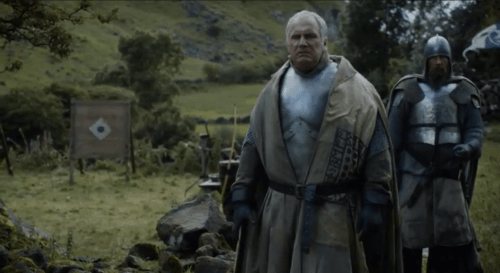
Littlefinger’s arrival interrupts an archery lesson Robin is having with Lord Royce, where Robin is showing some keen marksmanship… if his target had actually been the ant in the grass about three feet in front of him. If so? NAILED IT. As Baelish begins immediately manipulating the stupid creature, Royce instantly gleans what is happening. He wants to know where Sansa is, and Baelish plays dumb, saying they’d been attacked on their way by Bolton’s people and no matter what he did, Littlefinger simply couldn’t stop it. Royce immediately adopts a “Dude, I’m not Sir Robin so you can cut the bullshit” look on his face and tells him that sounds about as plausible as Brave Sir Robin being a Rhodes scholar, but Baelish doesn’t back down. He says actually, only one person knew exactly where they were going, and that was Lord Royce. Then he stands back and twirls his evil villain mustache while a couple of neurons spark in Sir Robin’s head, and a dim lightbulb switches on (before immediately cutting out again) registering with Robin, “Waaaaitaminute, you is traitor?!” and Baelish helps the poor creature out a bit more, and says, “My goodness, Robin, what shall we do with someone like this?” Robin, whose maturity hasn’t inched forward one iota since his mom was still breastfeeding him (which, granted, was when he was like 17 or something, but anyway…), repeats the same mantra he did back then: “Shall we throw him through the moon door?”
royce

Despite the underlying hilarity of the scene, it’s actually quite serious and ominous. Baelish can’t control the Lannisters or the Starks, so he’s come at this a different way. Make Brave Sir Robin an orphan, and then control the poor idiot boy and essentially take the Vale. Meanwhile you see the look on Royce’s face, where he realizes his life of fidelity to the Arryns will end in betrayal. But that would be too easy for Baelish, so instead he says to Robin that if they could trust Royce’s loyalty, he would make a capable commander, and maybe they should give him a second chance. Robin agrees.

Baelish is officially ruling the Vale now. Surmising that Sansa is heading to Castle Black, he declares, “Gather the knights of the Vale — the time has come to join the fray!”

Meanwhile, over in Slaver’s Bay, Tyrion is negotiating with the slavers, something that has made Grey Worm and Missandei very uneasy. The slavers want their old lives back, and they explain Daenerys is no different than they are; she’s simply the new master of Meereen, and slavery will never end. Tyrion lobs back that he’s not here to change the world, but that, interestingly, there haven’t been slaves in Westeros for hundreds of years. So he comes up with his compromise: slavery will cease effective immediately in Meereen, but will be allowed to carry on for seven more years as they gradually end the practice in other areas. The slaveholders will be compensated, and need to cut off ties with the Sons of the Harpy.

miss_grey

Grey Worm and Missandei are saddened by the turn of events, but when challenged by the former slaves in the Hall, Grey Worm simply says he wants peace, and Missandei quotes Tyrion: “A wise man once said, ‘We make peace with our enemies, not our friends.’” Tyrion smiles to think they both have his back, but as they walk away from the slaves, they tell him what they really think: that seven years might not seem like a long time to him, but it’s an eternity to a person in chains. Grey Worm explains, “When they look at me, they see a weapon. They look at her, they see a whore.” Tyrion counters, “They look at me and they see a misshapen little beast. Their contempt is their weakness.” Tyrion is confident that once again, his intelligence will get them through this. But Missandei and Grey Worm have been enslaved their entire lives, and they see it very differently. Tyrion thinks he has the upper hand, but Grey Worm warns him, “You will not use them: they will use you.” Tyrion was able to use his knowledge to trick his own family and throw all of King’s Landing into turmoil, but that’s because he understood the politics of the Lannisters. This is a very different situation altogether.

And then it’s off to Jorah and Daario, who actually seemed like a more entertaining duo this week. What did you think of their discussion in the hills overlooking Vaes Dothrak, Chris?

daario_jorah-2

Christopher: I think the most telling line in this scene is Daario’s resigned, “We’ll all disappoint her before long.” I found his fairly constant needling of Jorah about his age revealing; he doesn’t want to fight him, because he loses either way, either the guy who kills an old man or is killed by one; and he taunts Jorah over the fact that he has slept with Daenerys, suggesting that, however much Jorah loves and desires her, that the sheer exertion of her carnal attentions would likely overwhelm him. “It was hard enough for me,” he says, “and I’m a young man.” There has always been a rivalry between these two men, but Daario’s need to taunt Jorah, to constantly point out the disparity in their age, and to remind him that he’s known Daenerys’ bed, gives the lie to his cockiness—and shows the pathos of a man who loves a woman he knows has limited use for him. It’s less a matter that he’ll disappoint her than that she’ll ultimately need something far greater than he can offer.

His macho braggadocio thus comes across as somewhat pathetic, and when the time comes to surrender his weapons, the knife hilt carved in the shape of a wanton, naked woman has an adolescent quality to it. I cannot remember now if we’ve seen that dagger hilt before so clearly, or if such attention has been drawn to it. Certainly, the Daario of the novels frequently has his sword hilts described, but there they are very much of a piece with a character who is far more flamboyant, dangerous, and mercurial. Michael Huisman’s Daario retains elements of the novel Daario’s audacity and recklessness, but is ultimately more muted, and actually rather more nuanced.

We also have a moment in which Daario sees Jorah’s greyscale, which I thought was handled with a deft hand—very few words, and the expression on Huisman’s face was a lovely, subtle recognition of the fact that his cracks about Jorah’s age were perhaps a bit close to the bone, as the older man’s days were numbered.

I wonder, too, if they’re making Jorah more vulnerable and fragile as a function of his affliction: we open the scene with him panting and wheezing, only keeping up to Daario with difficulty; and in his fight with the Dothraki, at no point does he have the upper hand, ultimately needing rescue from Daario and the dagger he decided to bring after all.

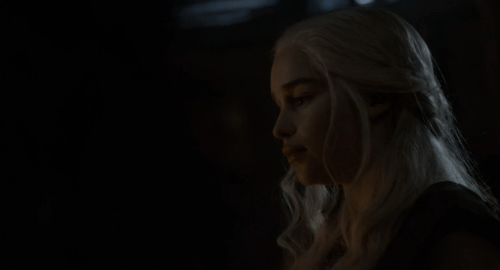
Adding insult to injury (for Jorah, at least), is the fact that their “rescue” of their queen was, if not strictly unnecessary, was at least redundant, as once again Daenerys demonstrates her own ingenuity. I don’t want to steal your thunder, Nikki, as you’ll be playing us out this post with your discussion of the final scene, but I do want to raise one of the show’s more problematic issues, which starts to show itself in the Dosh Khaleen scene: namely, its racial politics. Sitting with the other widows, Daenerys listens to the elder who had been so stern with her on her arrival, now speaking in more conciliatory and friendly tones, trying to make her feel welcome by dismissing the belief of some that Dothraki should only marry Dothraki. She suggests a sort of melting pot view of their history, though hardly in utopian or even positive terms. She introduces her to a Lhazareen girl who survived the slaughter of her village only to be taken by a khal at twelve, who then a year later gave birth and was beaten for the sin of having a girl. Moments later, Daenerys finds out the girl was widowed at sixteen—not soon enough, Daenerys observes, eliciting a sad laugh from her.

In contrast, the elder tells her, the widows of the Dosh Khaleen have a better and more meaningful life than many, as their wisdom is valued. Here, we might surmise, is where Daenerys has the first stirrings of her plan: acknowledging that their lot is better than most, but with the unspoken sentiment that (a) their lot is still pretty dire, as they are literally prisoners to a patriarchal tradition, and (b) that this speaks to the brutal injustice experienced by the vast majority. “That is more than most have,” Daenerys agrees with the elder, though the word she elides in this sentence is “women.” The Dosh Khaleen are afforded respect and something resembling a comfortable life, but only within very strict parameters, and only as the widows of powerful men, and only in the service of powerful men. Daenerys is a revolutionary: as she said last season, she wants to “break the wheel,” to destroy the set of assumptions and practices on which life in the Dosh Khaleen can be seen as an honour and privilege.

In this, her motivations are admirable. But here also is where it gets somewhat cringe-worthy, in that she steps into the all-too-familiar role of the white saviour: the hero who not only liberates people of colour from their chains, but also from their ignorance, who tells them that there is another way to live because they cannot be expected to arrive at such thoughts on their own. The story told by the Lhazareen girl reminds Daenerys of her revolutionary instincts, but also serves to characterize the khals as essentially bestial and savage, the better to prime us for Daenerys’ fiery retribution in the end.
daenerys

There is a degree to which both the novels and the series work to undermine this mythos, by having Daenerys play the role of the white saviour with lofty ideals and high-handed tactics only to become mired in the practical imperatives of ruling in the aftermath of her conquests, in which arrogance and ignorance of local nuances prove pernicious. But this episode feels a little like the showrunners are hitting the reset button: while Tyrion, Varys, Grey Worm, and Missandei struggle to deal with the mess that is Meereen, Daenerys gets to start over with a new mass of non-white people in yet another spectacular display. The apt analogy of the moment would be to say that she campaigns brilliantly, but is utterly unsuited to ruling.

I think that in some ways, Game of Thrones—both the novels and the series—has become something of a victim of its own success. When he started writing the novels, GRRM was actually doing a number of innovative and progressive things in the context of the fantasy genre, which by the late 1980s had become somewhat moribund and regressive. A Song of Ice and Fire introduced a far more nuanced conception of power and politics into a genre that, as I commented in a previous post, tended to equate virtue with birthright and depict monarchy as a perfectly fine system provided the right arse is on the throne. Further to that, he broke down a lot of the genre’s clichés, and peppered the voluminous character roster with complex, strong, three-dimensional female characters. If the books had been merely successful, their more regressive tendencies would not, perhaps, have rankled quite so much. But in becoming an international phenomenon—coupled with the fact that the television show’s visuals make the racial dynamic that much starker—these elements become inescapable.

I’ll throw that particular ball high in the air for you to dunk, Nikki, when you deal with the episode’s final scene. For the time being, what did you make of the King’s Landing scenes this week?

sparrow

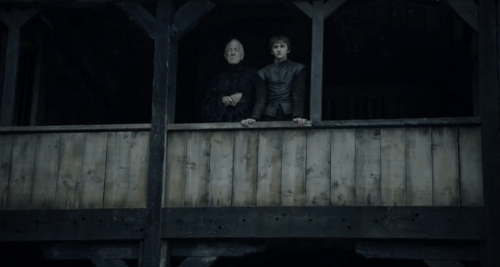
Nikki: You commented last week on how beautifully the High Sparrow’s dialogue is always written, and this week was no exception. Margaery is taken before him, where she sits at his feet as he tells her the story (which may be true, may be a parable, it’s never clear with him) of how he had once been a shoemaker, creating the most beautiful pairs of shoes for the highborn. He explains that people are always in pursuit of finery, money, and power — and that by saying she wants to see her brother and family, she’s pursuing exactly those things — but the real precious commodity each of us has is time. And it took so much time to make a single pair of shoes, and then the highborn wore his time on their feet. They wore someone else’s time on their backs, drank the wine of another’s time. It’s a beautiful conceit, and beautifully told, and one that makes you seriously think about what your time is worth, and is anyone taking advantage of it? And then he tells her how he had wine and pretty girls, and one night was with friends at a rather bacchanalian gathering, where they all ended up naked and drunk, lying amongst one another, next to the fine clothes that represented the time and hardship of someone else. And in that moment, he saw all of them naked, and realized without our clothes, without our fine shoes and robes, without the time of others that we wear, we are no different than they are. And with that he turned and walked out of the place, barefoot, and has remained so ever since.

He took on the mantle of the beggar, realizing that beggars are closer to the truth than he was. And with that, he offers his hand to Margaery and says he will take her to see Loras. She has listened to his story, interjecting only once to demonstrate an understanding of the stories the High Sparrow and his followers believe (and then explaining that it’s because Septa Unella likes to read them at her), but when he proffers his hand, she looks at it with astonishment. For all the ways she thought the story was going to end, finally going to see Loras — the pinnacle of decadence and depravity, as far as the Sparrows are concerned — was not one of them.
loras_marg

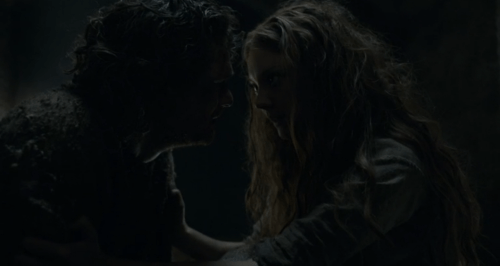
Not surprisingly, Loras is broken, an empty shell that has been no doubt mistreated and tortured, his immorality questioned and dissected for weeks, his very character degraded over and over again. If Margaery had to put up with Septa Unella reading at her, one can only imagine what Unella did to Loras, what she said to him, told him. In many scenes with Cersei and Margaery, the Sparrows have said they should be ashamed of themselves chiefly for caring about Loras.

And by the looks of it, it’s worked. Margaery remains strong and determined to cut down this new obstacle, but Loras has nothing left. He begs her to just give in to them, make it all stop, just let them win, take what they want, and let him go. She reasons with him and tells him that he’s the future of the family, and he says no, he just wants it to stop. As she embraces her brother — the only person for whom I believe she has ever felt even a modicum of fondness — there’s a look on her face much like the one Melisandre has been wearing all season long. Maybe she’s been going about this all wrong, and protecting Loras to help further her own cause, when in fact, if proving that she no longer has any fidelity to Loras will help her position with the High Sparrow…

Meanwhile, Pycelle continues to not die, which is surprising in itself (I swear he will outlive everyone on this show) and is attempting to windbaggingly advise Tommen. As usual, he gets caught talking about Cersei just as Cersei enters the room, and she tells him to leave. He takes three years to finally get out of there, and then Cersei turns to her last remaining child, who tells her that they must be careful around the High Sparrow and confesses that he’s spoken to him, and that he told her something. He asks if she even likes Margaery, and Cersei tells the truth: that it doesn’t matter whether or not she likes Margaery, all that matters is getting rid of this infestation that she herself brought to King’s Landing. As the mournful cello sounds of “The Rains of Castamere” begin to sound, Cersei tells him that whatever the High Sparrow told him, he can tell her: “I am your mother — you can always trust me.”

Cut to Cersei marching into the Small Council, where Olenna rolls her eyes as only Olenna can do, where she has finally figured out the card she needs to play to win over the head of House Tyrell: Margaery. She tells them all that while they might have been rather thrilled by Cersei’s own Walk of Atonement, Margaery is set to do the same, and they are scheduling the walk to happen immediately. And like that, Olenna forgets how much she despises Cersei and the Lannisters and says NO, she will not. She orders the Tyrell army to King’s Landing, and will join forces with the king. Ser Kevan (Cersei’s uncle, Tywin’s brother, for those keeping score at home), says the Kingsguard cannot be seen entering the fray with the Sparrows, and Cersei, like she just did with Olenna, appeals to his own filial ties. “Don’t you want to save Lancel?” she asks (Lancel being his son, Cersei’s cousin that she was sleeping with in season one — as one does in this family — and the one who administered the wine who killed Robert Baratheon… and now one of the High Sparrow’s chief Sparrows). She explains that the king can’t do anything against the Sparrows, but he can do nothing. He can let the Tyrell army overrun King’s Landing and take out the Sparrows. As she speaks and Kevan listens and Olenna agrees to support her, the strains of “The Rains of Castamere” get louder and louder, until it’s almost overpowering the scene. Once again, Cersei proves she won’t stay down for long.

And speaking of families coming together to find strength, Theon has made his way back to the Iron Islands and to his sister. What did you think of the scenes in Pyke this week, Chris?

yara_theon_hearth

Christopher: This episode was a whole lot of brothers and sisters, wasn’t it? Jon and Sansa, Margaery and Loras, and then Theon and Yara—three very, very different reunions, to be sure, but a persistent enough motif that it puts family at the heart of the story.

The Pyke scene wasn’t much in itself, beyond being a setup for what is to come—namely, the Kingsmoot at which the Ironborn elect their king (which is a very progressive political system for a society whose economy seems largely based on looting and pillaging). But I appreciated the way it worked thematically with the other two scenes that come before our return to Daenerys. All that really happens here is Theon apologizing, Yara telling him to stop apologizing, Theon crying, Yara telling him to stop crying, Yara being suspicious of Theon’s motives and the serendipity of his return on the eve of the Kingsmoot, and Theon finally pledging himself to her cause. But the callback in this scene to Yara’s failed rescue attempt—which failed because Theon was too broken to go with her—and all that Theon suffered at Ramsay’s hands gives a thematic bridge into the next scene, at Winterfell.
ramsay_osha

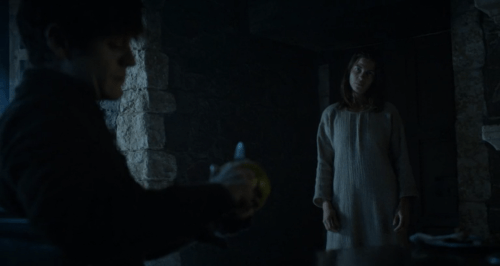
From the moment we saw Osha and Rickon unhooded last week, we knew their lives were about to get really shitty really quickly. My stomach sank when I saw Osha ushered into Ramsay’s presence; to be honest, my stomach sinks whenever Ramsay’s on screen, but the dread he evokes is vastly worse when he’s in the company of a sympathetic character.

The scene begins well for Osha, as she actually seems to give Ramsay momentary pause:

RAMSAY: You’ve seen my banners?
OSHA: The flayed man.
RAMSAY: Does that worry you at all?
OSHA: Do you eat them after?
RAMSAY: [pause] No.
OSHA: Then I’ve seen worse.

ramsay_pause

Both of them are putting on a show here: Ramsay mentions his banners as he peels an apple, a bit of business meant to be intimidatingly suggestive. Osha’s no fool and most likely sees through it, but she makes a mistake in thinking she has the upper hand. Ramsay puts down the knife and the apple. Is the knife a deliberate temptation for Osha? One way or another, her eyes briefly flit to it before she begins her attempt to seduce Ramsay.

OSHA: I can give you what you want.
RAMSAY: And you’re sure you know what that is?
OSHA: Same thing men always want.

Oh, Osha. You should have listened more carefully to the rumours about this monster.

The way these scenes are linked provides a subtle and cruel irony. We have just come from hearing Theon talk about Ramsay’s torments; we know Osha is willing to strategically seduce men, because we have seen her do it before—with Theon, as a means of distracting him so that she, Bran, Rickon, and Hodor could escape. Theon was an easy mark back then, easier than most because of his preening vanity. But Ramsay, as we know all too well by now, is not so simple. He has set a trap: he knows that Osha was instrumental in Bran and Rickon’s escape and that her pretense of self-interested cynicism is a façade, precisely because he broke Theon and learned these details from him.

And with that, Osha joins the ranks of GoT’s butcher’s bill—a mercy, in some respects, as a quick death under the Bolton roof is preferable to the alternatives (in my notes, I’ve written “Tonks had to die AGAIN?”). It was still shocking and had the same feel as the Sand Snakes’ murder of Doran and Areoh—that is, that the writers are seeking to cull the flock somewhat.

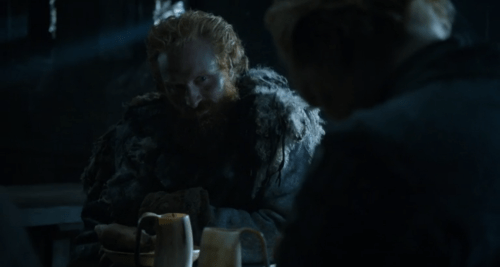
At the same time, Ramsay’s casual brutality and his mention of his banners links to the episode’s penultimate scene, as we see the Bolton sigil on the back of a messenger arriving at Castle Black under a flag of parley—an ominous sign, though before the message is received we are granted a few moments of levity. Sansa and Brienne appear mildly unimpressed (which is to say, revolted) by the food before them and the table manners of the wildlings and Night’s Watch, but make a herculean effort to be polite. This effort is not made easier for Brienne by the scrutiny of Tormund, who if we remember was visibly gobsmacked at the sight of her in the episode’s opening moments.
tormund

“How YOU doin’?”

brienne

“Um …”

edd_weird

“This is exactly why I don’t want Jon’s gig.”

If this episode provided a close-to-tears moment with the reunion of Jon and Sansa, it also provided my biggest belly laugh of the season so far with the image of Tormund the Giantsbane making googly-eyes at Brienne of Tarth. I’m not the only one to think so, as GoT fandom has already started ‘shipping these two, speculating about whether they’ll get together and make huge babies.

Of course Tormund would be rapt at the sight of Brienne. All of her qualities that make her undesirable among genteel Westerosi—her height, her strength, her refusal to play the lady, her ability to take you apart with her bare hands and put you back together like a deformed Voltron—would be catnip to this dude, who in the novels is constantly bragging about once having slept with a bear.

I do so hope we have a scene of Brienne handing his ass to him in the training yard, and him falling ever more deeply in love because of it.
jon_whip

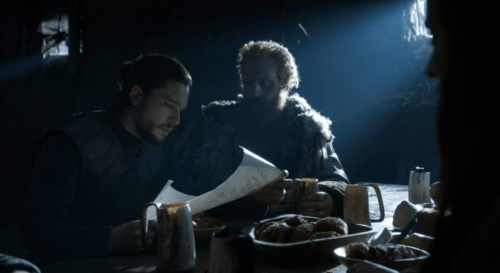
Our moment of levity is broken however by the arrival of Ramsay’s letter to Jon Snow, and it is just as awful as we all assumed it would be. Its tone is taunting and arrogant, but is also literally apocalyptic. The refrain “come and see” is a direct allusion to Revelations 6:1-8 in the King James Bible, in which the four seals are opened and St. John the Divine sees the four horsemen of the apocalypse emerge:

And I saw when the Lamb opened one of the seals, and I heard, as it were the noise of thunder, one of the four beasts saying, Come and see.
And I saw, and behold a white horse: and he that sat on him had a bow; and a crown was given unto him: and he went forth conquering, and to conquer.
And when he had opened the second seal, I heard the second beast say, Come and see.
And there went out another horse that was red: and power was given to him that sat thereon to take peace from the earth, and that they should kill one another: and there was given unto him a great sword.
And when he had opened the third seal, I heard the third beast say, Come and see.
And I beheld, and lo a black horse; and he that sat on him had a pair of balances in his hand.
And I heard a voice in the midst of the four beasts say, A measure of wheat for a penny, and three measures of barley for a penny; and see thou hurt not the oil and the wine.
And when he had opened the fourth seal, I heard the voice of the fourth beast say, Come and see.
And I looked, and behold a pale horse: and his name that sat on him was Death, and Hell followed with him.

Whatever Jon Snow’s reluctance prior to receiving Ramsay’s missive, he is now committed to the fight—not least because Ramsays arrogation of the titles of Lord of Winterfell and Warden of the North to himself.

As I said before, this is an episode of battle lines. Before you get into the episode’s final scene, Nikki, what did you think of this moment at Castle Black?
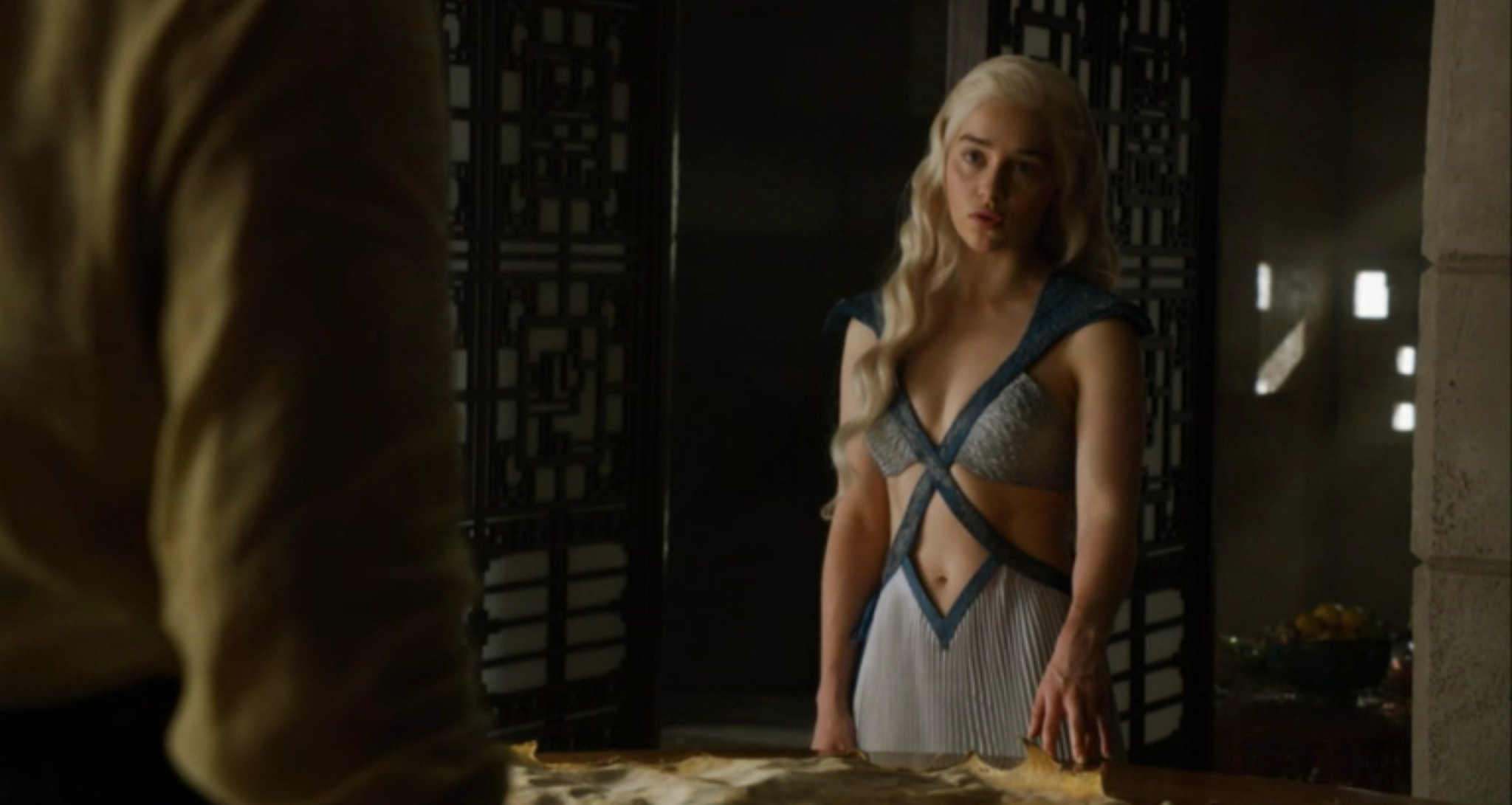
daenerys_khals

Nikki: First, this — her height, her strength, her refusal to play the lady, her ability to take you apart with her bare hands and put you back together like a deformed Voltron—would be catnip to this dude, who in the novels is constantly bragging about once having slept with a bear — might be my favourite thing you have ever written.

The scene of Tormund looking at Brienne like she was a juicy steak after years of porridge was hysterical, made better only by the WTF look on Brienne’s face the entire time. She looked like she’d just smelled a bad smell (and considering the conditions at Castle Black and the fact these are all a bunch of bachelors with no actual showering area, that could very well be the case) but I was instantly shipping them in my head, too. Brimund? Thorienne? THIS NEEDS TO HAPPEN. Mostly just so we can watch her utterly dominate him to the point where he has little Looney Tune pink hearts in his eyes.

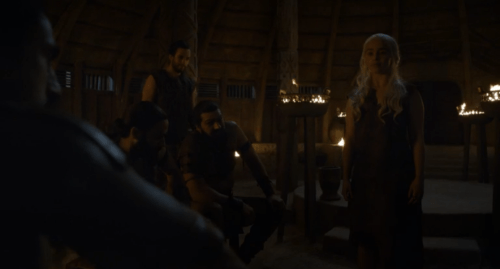
And now back to Vaes Dothrak, where Daenerys is about to stand trial and they’ll decide what to do with her. They keep saying the best-case scenario would be for her to live out her days with the other khaleesis in the temple, and haven’t exactly articulated the worst-case scenario: until now.

And then it’s a whirl of insanity for the next few minutes, the Cliff’s notes version being: blonde hair, Dothraki talk, angry guys, macho threats, fire fire fire, people bowing, boobs.

But if our readers know anything about us, it’s that we don’t resort to Cliff’s notes (as much as they probably would like us to at times). I really liked your assessment of the issues with the scene at the end, Chris, where you talked about how there’s this sense of colonialism that we can’t exactly avoid when watching or discussing it. On the surface one can read it as: white person comes in, kills the bad brown men, tells the other brown people they will from now on be ruled by the white person.

But in another sense, I don’t read this scene that way. This isn’t about colour, this is about gender. Daenerys, despite her very white skin, is an outsider, alone, the last of her kind. Her people have been conquered and wiped out, and now she walks among the other races and people, other languages and customs. She has seen the worst that the world has to give to people — she has seen Grey Worm and Missandei mistreated by slavers who have whiter skin than they do. But more than that, she has seen what the world does to women. She has seen them beaten down, raped, dismissed, killed. She knows that Sansa could be the head of her household, but that’s not going to stop some bastard from raping her. She knows that Brienne could knock down any wildling, and yet even she is now seen as a piece of ass. Jaime Lannister will never be stripped down, beaten, and forced to walk in shame down the street: that honour is reserved for his sister. She was nothing but a bartering chip to her brother, and the books of legend and history are filled with the names of men, not women. She knows that she will have to work twice as hard to earn half as much, and she’s pretty pissed that Hollywood actresses aren’t being paid as much as their male counterparts. She is woman, and you will fucking hear her roar.

And roar she does.

daenerys_smile

She reminds them of the great plans her husband once had, and how he was going to do the things she’s now doing. She reminds them that while the world is in turmoil, and evil people are on the throne, the “Great Khals” all sit together talking about what little villages they will raid, what women they will rape, and what horses they will plunder. “You are small men,” she says to them, standing confidently among the firepits as they stare at her, gobsmacked that this little girl is actually trying to take on an entire room of men. Every word she says to them is true, and true not only of this series but everywhere. How dare these men decide the fates of the women? How dare they suggest the wives of these great leaders — wives who are every bit as brave and strong as their male counterparts — get shoved into a temple to live out the rest of their days? Why should the world of men continue to decide the fates of the world of women? She holds up a mirror so they can all see exactly how small they are. “None of you are fit to lead the Dothraki,” she says. “But I am.”

She smiles. “So I will.”

And they laugh. And he tells her that the Khals will take turns raping her, and the bloodriders will rape her, and then when they’re all finished, they’ll let the horses have a turn.

And Daenerys’s smile just gets wider and wider. Look at these little men, she thinks. I’m showing them that they need to start thinking with their heads and not their dicks, and they respond by telling her how they will think, act, and live by their dicks. You can just see it in her eyes. They are so puny, so insignificant, and yet have somehow convinced everyone that they are the leaders and they must be obeyed. He tells her he will not serve her.

“You will not serve,” she says. “You will die.” And with that, she turns the firepits over, setting the temple on fire. The Khals all run, screaming, trying to escape, but the doors have been locked from the outside. Daenerys stands, unharmed, in the centre of the fire, and turns the last of the firepits over to incinerate all of them.

daenerys_fire

Outside the temple, as the bloodriders and their long-suffering women all rush to see the carnage, the door caves in, and Daenerys emerges, naked and unharmed. Even her silver hair is inflammable. The Dothraki all fall to their knees, as well as the widows, and she stands there, nose in the air, staring at all of them as they worship her. As Daario and Jorah approach, her face doesn’t change. Daario looks at her, mouth agape. He’s heard the stories, but now he sees it. He thought he’d been sleeping with a queen, but now he realizes she’s a god.

It’s a glorious scene, beautifully filmed and scored. On the one hand, Daenerys has pretty much proven 100% that she’s not one of the people, that she stands above all mortals and is not killed by fire, by cleansed by it. But on a symbolic level, she’s done it as a woman. She’s shown them that women are to be honoured and respected as much as the men, if not more. They are the bringers of life, they weather emotional and physical storms that the khals can’t even imagine, and they are the mothers of dragons. Some dragons literally fly and breathe fire; other dragons have so many soccer, baseball, and fastball practices that they make Mom late on her blog post every week. But on a show where we have seen women beaten, raped, degraded, and murdered, Daenerys is that woman who shows it doesn’t have to be that way. And she stands there before men, fully naked, as if daring them to suggest there’s something wrong with doing so, the way women have been told that since the dawn of time.

fire_distance

And now that we’ve written a post longer than all of the scripts this season put together, I shall stop here and thank you very much for having read so far! We will see you next week!
1 Comment

Filed under Game of Thrones, television

Game of Thrones 6.03: Oathbreaker

gameofthrones_teaser02_screencap10

Hello all, and welcome once again to the great Game of Thrones co-blog, in which I and my friend and boon companion Nikki Stafford recap and review the latest offering from the old gods and the new. We apologize for being up a little later than usual this week. Nikki wants me to tell you it’s her fault. And, well, it is … but lately her schedule is more insane than that of a character on your average Aaron Sorkin show, and I frankly don’t know how she manages to write anything at all, never mind her brilliant insights into the beautiful clusterfuck that is Westeros.

On the other hand, she finally has HBO up and running again, so she leads us off. What did you think of this week’s episode, Nikki?


jon-waking

Yeah. I’ve had mornings like that.

Nikki: After the one-two-three punch of last week’s episode, it stood to reason that this week’s would be a bit slower, and it definitely was. With the exception of a couple of gasps, it was pretty much a bridge episode, but it still had some great stuff. In an episode called “Oathbreaker,” I thought Brienne would play a larger role, but she didn’t even appear.

We’ve been waiting all week to see what the reaction will be at Castle Black to the Christ-like resurrection of Jon Snow. And it was one of my favourite moments of the episode. First we see the awakening of Jon, as he gasps for air before sitting up, and then gaping with shock and horror at his Saint Sebastian–like wounds. He doesn’t know why he’s alive, and while the Red Woman has brought him back to life, she clearly hasn’t taken the pain of the wounds away. Davos’s eyes are saucer-like as he slowly, carefully, makes his way back over to Jon Snow’s side, unsure of what rough beast has just awakened on the table. Even Ghost isn’t so sure about things, as he whimpers in the corner and stares at the person who should be Jon Snow, but couldn’t possibly be Jon Snow.

And yet, it is Jon Snow. This isn’t some creation of Victor Frankenstein, cobbled together with pieces of flesh and organs, this is the same man who was stabbed to death by his traitorous men, and the first thing he says to Davos is, “Ollie, he put a knife in my heart.” It’s the boy who’s hurt him the most, the boy he thought he was helping, the boy he wasn’t noticing seething in the corner at every turn. And the fact that Jon pinpoints this as the worst part of the incident told me that that, without doubt, was still Jon.

Melisandre comes rushing back into the room and, like a light switch, her faith instantly reignites. She wants to know what he saw, and you can see her eyes shining with hope. Moments ago, she was staring despondently into a fire, mourning the loss of her faith and coming to terms with a world in which the Lord of Light does not exist. But now that Jon is sitting there, impossibly back from the dead through the power of the Lord of Light, she has her proof. And she asks him what he saw. You can tell she wants to hear that he saw the Lord’s face, or a beautiful world shining where it was no longer dark and full of terror. But he disappoints her. “Nothing. Nothing at all,” he says. But she’s undaunted. “The Lord let you come back for a reason,” she says, her resolve strengthening by the second. She declares she was wrong about Stannis, that he wasn’t the prince: it was Jon.

But Jon doesn’t have time for this. To him, no time has passed: moments ago he was being stabbed to death and now he’s sitting here. “I did what I thought was right, and I got murdered for it. Now I’m back. Why?” While Davos still isn’t clinging to any Lord of Light crap — he knows a miracle has happened, but he’s not about to attribute it to some unseen god — he does agree with Melisandre that perhaps Jon is some sort of Chosen One who is destined to save them all. Davos sits with him and tells Jon, “Fight for as long as you can. Clean up as much shit as you can.” But Jon says he’s failed.

Davos: “Good. Now go fail again.”

I love the idea of Davos teaming up with Jon Snow, and I hope, despite the end of this episode, that that will be the case. Davos has always been one of my favourite characters, marred only by the fact that he aligned himself with someone like Stannis Baratheon. Now that both he and Melisandre have switched gears and are backing Jon instead, it promises to be a much more interesting group.

But now Jon has to show his face to everyone else, and he steps out onto the wooden staircase in front of the courtyard of wildlings, who stare at him in utter silence and disbelief. As Jon slowly and painfully walks through the group, they part, staring at him as if he’s a ghost, until he reaches Thormund, who had been in the room when Melisandre was working her mojo. Thormund tells him that they all think he’s some kind of god now. “I’m not a god,” says Jon bluntly. “I know,” Thormund reassures him. “I saw your pecker. What kind of god would have a pecker that small?”

tormund

He then moves to Eddison, who stares at Jon with apprehension and awe, and asks if it’s really him. Jon reassures him that it is, and jokes, “Hold off on burning my body for now.” “That’s funny,” Edd retorts. “Are you sure that’s still you in there?” And then he gives him a bear hug, one that clearly hurts a LOT by the look on Jon’s face.

It’s a great opening, where all signs point to the man before us as Jon Snow. Of course, the end of the episode will take away that certainty.

And from here it’s off to Sam and Gilly, sailing for the Citadel. It’s lovely to see them again, and clearly the sea air is good for Gilly, since she looked brighter and happier than I think I’ve ever seen her. Sam, on the other hand, is not handling the waves well, and hangs his face over a bucket (I know I’ve said it before, but my #1 pet peeve of TVs and movies is showing someone vomiting. I cannot handle it AT ALL. Blergh.) It’s a brief scene, where he tells her she can’t go into the Citadel so instead he’s taking her to his mother and sister, who will take care of her. And she, in turn, refers to him as the father of her son. It’s a lovely little moment before we move back to the past once again.

Christopher, did your jaw equally hit the ground when you saw the actor playing a young Ned Stark? WOW! I feel like I had gone back in time!

young-ned

Christopher: Unfortunately, no, given that that scene has had the life promo-ed out of it, and has further been painstakingly dissected by fandom … one of the unfortunate results of which is that it was something of a disappointment.

Let me back up: one of the key mysteries of A Song of Ice and Fire, as we know, is that of Jon Snow’s parentage. Was he really Ned Stark’s bastard, or the product of some other union? I don’t think it’s a spoiler any more to say that the good money for a long while now has been on Jon being the son of Rhaegar Targaryen and Lyanna Stark—the latter of whom’s ostensible abduction and rape by the former was the spark that lit the powderkeg of Robert Baratheon’s rebellion. There are innumerable clues scattered throughout the novels suggesting that Rhaegar did not abduct Lyanna, but that she was in love with him and went willingly.

By the same token, Ned Stark has a number of dreams and flashbacks in A Game of Thrones, in which he remembers holding a dying Lyanna in his arms as she pleads “Promise me, Ned …” He further has memories of facing down Ser Arthur Dayne and another member of the Kingsguard; he has six men with him against their two, but in the end only Howland Reed (Jojen and Meera’s father) survives with him. These memories are fragmentary and unspecific, but hint powerfully that the “official” narrative of Robert’s Rebellion, in which Rhaegar is a monstrous figure and Lyanna a tragic victim, is not entirely—or even remotely—true.

All this is by way of saying that, five seasons and five novels into this series, fans have arrived at the firm belief that “R+L=J,” and so the snippets of this scene shown in the trailers have evoked more than a little excitement … and the speculation was that this episode was going to reveal Jon Snow’s true parentage.

I admit to hoping as much myself, but really we all should have known better. Of course the show is going to tease this out over several episodes, if not in fact the entire season. I just wish this scene hadn’t been so prominent in the trailers—it would have been amazing to watch it unfold without having been forewarned.

All that being said, the scene was well done: tense and kinetic, with some nice fight choreography. And the actor playing young Ned (Robert Aramayo) is a great bit of casting—not only does he look like Sean Bean, but he gets the inflections of Bean’s Yorkshire accent precisely right. If I have a quibble, it’s that <nerd voice> while Ser Arthur Dayne, the “Sword of the Morning,” was famous for being the greatest swordsman of his age, he was just as famous for his Valyrian steel greatsword Dawn. He would not have fought with two swords, but with his single, two-handed sword. </nerd voice> Lack of fidelity to the books notwithstanding, watching Dayne dispatch Ned’s men in quick succession, it’s easy to believe his (dead) comrade’s boast that if they had been at the Battle of the Trident, where Rhaegar met his doom, it would have been Robert Baratheon pushing up the daisies. There’s a nice moment as young Ned finds himself facing Dayne alone, and his expression is a fine little bit of face-acting: a mingling of determination and the recognition that he will not survive this fight.

tower-of-joy

Though of course he does, but only through the dishonourable action of Howland Reed, who stabs Dayne in the back, much to Bran’s shock and confusion. “I’ve heard the story a hundred times,” he had said just moments before, and the expression on his face calls to mind so many of Sansa’s in seasons one and two, as she repeatedly learned the hard lesson that stories and reality often bear little resemblance. Ned then deals the finishing blow, an action whose motivation is ambiguous at best: was he dealing Arthur Dayne a merciful end? Was it a moment of vengeful rage, as his expression might suggest? Did he do it so when he claims in the future that he killed Arthur Dayne, there will be a germ of truth in the tale?

Whatever his motive, his brief reverie is broken by the sound of a woman’s agonized cry, whom we assume to be Lyanna. Bran of course wants to follow and see what is in the tower, ignoring at first the Three-Eyed Raven’s admonitions. He calls out to Ned, and for a moment it seems as though he is heard: Ned pauses, and turns to look at nothing. Back under the tree, Bran insists that his father heard him, and the Raven appears to grant the possibility, though he insists that “The past is already written. The ink is dry.” But is it? His warning to Bran that “Stay too long where you don’t belong, and you will never return,” suggests that their astral voyaging into the past is rather more involved than merely screening scenes from some magical archive, that Bran is more than a passive observer when he travels to these remotes times and places.

What is Bran? He is a warg, able to inhabit Summer’s body (and sometimes Hodor’s); he has apparently sorcerous abilities, and seems to be turning into that ubiquitous fantasy trope, the Chosen One: one thousand years the Raven has endured his solitary, static existence, because he’s been waiting for Bran. Not because Bran is the heir apparent, his replacement to operate the Tree of Seeing Things—no, Bran will ultimately leave and return to the world, though for what purpose we do not know. And heavens forbid the crusty old mentor should ever speak in anything other than stern and cryptic riddles.

daenerys-outdoors

Speaking of Chosen Ones, we’re now up to three of them in one episode: Jon Snow, Bran, and of course Daenerys, though her status as a former Khaleesi apparently earns her no respect. She is not granted the dignity of a horse, and is kicked and told to move her ass. Here we are again in Vaes Dothrak, which we saw in season one, when she came here with Khal Drogo to consecrate her marriage by eating a raw horse’s heart, and Drogo finally gave Viserys a golden crown—though one that sat somewhat more uncomfortably on his head than he’d hoped.

(There’s a lot of full-circle moments so far this season, by which I mean there’s been two—last week’s echo of the opening scenes in Winterfell, and now Daenerys’ own déjà vu at being back in the Dothraki “city.” I don’t having anything insightful to say about this, just that it will be interesting, going forward, to see whether we continue getting echoes of season one).

Her humiliations continue at the hands of the other Khals’ widows, stripping her of her queenly garb and dressing her in simple leathers. She is sternly reminded of the fact that she broke Dothraki custom in going out into the world rather than immediately returning to the Dosh Khaleen, and that for this transgression her fate might be more dire than living our her days with the other widows.

I admit that, when this episode ended, I was momentarily at a loss as to why it was titled “Oathbreaker.” Like you, I thought it might have something to do with Brienne and her sword, but I think it’s a more general descriptor: in this case to Daenerys’ failure to conform to Dothraki law (for which we can hardly blame her), but also to her apparent abandonment of Meereen. What did you think of the Meereen scenes in this episode, Nikki?

varys

Nikki: Just to jump back a bit, yes, I’ve been in the R+L=J camp for quite some time, which is why Jon Snow’s death at the end of last season felt like such a kick in the head. Everything I believed, the direction I thought the story had been going the whole time, had just been destroyed and now I had to start over. (I guess I understand a bit how Melisandre felt…) However, I’m a spoilerphobe of such epic proportions I’m only realizing now that I am apparently a complete master of it, because I knew nothing about what was happening this season. I didn’t know about the casting of young Ned, didn’t know about this scene in particular, and I don’t even watch the “Next Week On” previews at the end of the episodes, so I guess I shall happily sit alone as the single Unsullied Game of Thrones fan. Publicity is great, but man, surprise can be SO much better.

Meanwhile, in Meereen, Varys wonders how the guards can stand all that leather while he waits for Vala to arrive. This is the prostitute who lured White Rat into her chambers before he was massacred by the Sons of the Harpy in the last season. Vala is clever, refusing to speak: she tells Varys that Daenerys has come in to Meereen and is destroying their history, and ruining everything. But Varys is cleverer, and he knows her weak spot: her son, Dom. He tells her that her perspective is a valid one, and he will try to see things her way, but then he mentions her son… “Dom, is it?” And the smug look on her face suddenly disappears. Her eyes widen, and Varys knows he’s once again caught a poor fly in his web. He explains that he’s not exactly threatening her son, but she conspired against Daenerys’s soldiers, and there’s really only one way that can play out. How will poor Dom get on without his mother, he wonders aloud, “especially with that breathing problem.” Suddenly she’s begging him, explaining that she can’t talk or they’ll kill her, and Varys once again arranges for a ship to take her away with some silver. And suddenly, she’s singing like one of Varys’s favourite birds.

Meanwhile, waiting in the next room is Tyrion, Missandei, and Grey Worm, having the world’s most boring conversation, if one could even call it a conversation. As Tyrion realizes that every icebreaker he’s ever tried involves heavy drinking or sex games, and he’s looking at two non-drinkers who aren’t interested in the latter, he has nothing to talk about. So he asks Grey Worm to spark a conversation, and he says he could talk about his patrol, what he sees on patrol, people on patrol, what he learned on patrol, and one thinks wow… he and Missandei need a television. “A wise man once said a true history of the world is a history of great conversations in elegant rooms,” Tyrion tells them. “Who said this?” they ask. “Me, just now,” he answers, pouring himself another drink.

tyrion-conversation-2

It’s a very funny moment in the episode, and a chance for the writers to give Tyrion a witty throwaway line, but it also shows just how different they all are. Tyrion comes from a world so far removed from that of Missandei and Grey Worm that he can’t even talk to them for 10 seconds without getting bored. There’s no common ground here, and their conversation is simply a microcosm of the much bigger problem in Meereen: that Daenerys has come in to give the people what she thinks is best for them, without really knowing them at all.

And then Varys enters and tells them that the Sons of the Harpy have been bankrolled by the masters of Astapor, Yunkai, and Volantis — Astapor was the city of the Unsullied; Yunkai was the city Daenerys conquered where all of the slaves called her Mhysa, and Volantis is a city with Valyrian ties: Aegon Targaryen invaded the city with his dragons. All three of these cities rely heavily on slave labour and the divide between haves and have-nots, and as such, they see Daenerys as a major threat. Knowing where the threat is, the group can now figure out a way to fight against it. “Men can be fickle, but birds I always trust,” Varys says, and with that we’re back over in King’s Landing with the creepy Victor Frankenstein guy himself.

What did you think of Cersei adopting one of Varys’s best methods of spywork, Chris?

jaime_mountain

Christopher: Ha! In Cersei’s hands it becomes rather more dystopian than when Varys was the spymaster … Varys, while always more or less inscrutable in the early seasons, at least communicated a sense of balance, and loyalty to something greater than himself—especially in contrast to Littlefinger, beside whom Varys was a model of civic responsibility. On one hand, Cersei’s use of Varys’ former network (by way of Qyburn) marks an evolution in her character, an acknowledgement that subtlety can be preferable to blunt force; but then, her checklist of information she wants makes clear that she’s more interested in punishing slights against her and her family than in building a genuinely useful intelligence dossier. If Varys was always a charming but vaguely creepy snooper, Cersei makes it clear she wants to be the NSA.

I do have to say, I think my favourite little moment in this scene is where Jaime tries to goad the Mountain—in the process making it clear that he never had much esteem or respect for the hulking thug even before he was a reanimated Frankenstein’s monster.

We move from Cersei’s audience with Qyburn to the Small Council, and the welcome reappearance of the Queen of Thorns. Grand Maester Pycelle is in the process of holding forth (at length) about the iniquities of Qyburn and the monstrosity he has created (interesting to note that they’re just calling him Ser Gregor now, as opposed to his AKA “Ser Robert Strong”—I guess reanimating a man whose moniker “the Mountain” was an understatement doesn’t leave much room for disguises), which of course dictates that the object of his scorn will enter while he blathers on obliviously.

Here is a rare moment of Cersei and Jaime being the most reasonable people in the room: the most pressing matter at hand is the declaration of war by Dorne in the form of Myrcella’s murder. “Do you consider the murder of your own blood a ‘troublesome issue’?” Cersei asks her uncle, and Jaime points out that Dorne has essentially undergone a coup d’etat by a cabal that would cheerfully murder all Lannisters. But Ser Kevan is having none of it, and walks out with the rest of the Council, leaving Jaime and Cersei alone with the Mountain.

cersei_jaime

The person to watch in this scene—which should surprise no one—is Lady Olenna. She has little to say beyond the barbs she trades with Cersei, and yet is the most dominant presence in the room. The camera cuts to her reaction shots at a few key moments, and the expression she wears is one of interested evaluation—however much she might loathe Cersei, we get the distinct sense she sees more in her assertions than in anything Kevan or Pycelle have to say (and has a few lovely eye-rolls when her son speaks). She departs with the Council when they go, but I suspect there will be an uneasy truce between her and Cersei soon (and I’d think that even if I hadn’t watched the trailer for next week’s episode).

Next up is Tommen accosting the High Sparrow at his prayers, and demanding that Cersei be allowed to see Mycella’s resting place. After rewatching this scene several times, I have decided that it is my favourite of the episode. It makes me want to know what the dynamic of the GoT writers’ room is like: is there someone, or a handful of someones, who consistently write the High Sparrow scenes? Because while I have had much cause to praise Jonathan Pryce’s acting and the gravitas he brings to this character, he’s hardly had to make a silk purse out of a sow’s ear. The lines they give him have a depth and subtlety that stand out in a show that so often distinguishes itself for its writing. And as so frequently happens with him, we are treated to a discourse that is simultaneously inspiring and deeply manipulative … which I suppose is fair enough coming from an inspiring religious leader.

I also want to know if there was any consideration given to the timing: did someone, way back when this episode was being scripted, say “Hey! Do you think this might air on Mother’s Day?” Between the Sparrow’s disquisition on motherhood and the hint that Lyanna was in the Tower of Joy birthing Jon Snow, this was something of a mother-centric episode.

But back to Tommen and the Sparrow: last week we saw Tommen despairing of the fact that he wanted to be strong but wasn’t, and this week we see him desperately trying to present a tough visage to the High Sparrow. And, well, failing … he’s still a little kid, after all, and so his attempts to be commanding are by turns adorable and pathetic. His main problem, of course, is that he lacks a subtle enough mind to match the Sparrow’s preaching; one could easily imagine Tyrion at that age doing a much better job (and indeed, in my notes I wrote “Octavian from Rome would totally outclass this dude”).

sparrow

There were two elements in this scene at war with each other for me as I watched it: the first was my growing irritation with the Sparrow’s arrogation of the gods’ will to himself, his blithe insistence that he knows their minds, which with the backup of his armed thugs trumps (apparently) any royal decree. The revolt of the poor should be a galvanizing and cathartic narrative for us the viewers; I can only speak for myself of course, but the fact that it is grounded in an explicitly patriarchal and misogynist (and fundamentalist) religious movement makes it decidedly dystopian, something emphasized by the High Sparrow’s sententious pronouncements.

The second element, however, is the fact that the Sparrow’s faith is rooted in a conception of humanity’s good nature, even as he deploys it in manipulative fashion. He deflects Tommen’s anger about his treatment of Cersei with a powerful disquisition on mother’s love. “There’s a great deal of falsehood in Cersei,” he says, “but when she speaks of you, the mother’s love outshines it all. Her love for you is more real than anything in this world, because it doesn’t come from this world. But you know that. You’ve felt it.” Tommen agrees, and the Sparrow notes that he did not himself ever know a comparable mother’s love. “Envy,” he says, wistfully. “One more sin to atone for.” At which point, citing the pain in his knees, he begs the king’s leave to sit. One can well imagine Tywin Lannister or Daenerys denying him, forcing him to acknowledge their authority, but Tommen of course grants his wish … and at the Sparrow’s behest, also sits, and cedes whatever last vestige of kingly presence he’d brought.

What did you think of Tommen’s attempt to cow the Sparrow, Nikki?

tommen

Nikki: I agree with you 100%. In my notes for this scene, I wrote, “If conquest of King’s Landing fails, High Sparrow has future writing Mother’s Day cards for Hallmark.” As you say, this is a brilliantly written scene, crackling with energy and power plays, where Tommen has arrived to wield his kingly power, but the High Sparrow knows dealing with a young and inexperienced king is basically swatting away a pesky fly. When he sat on the bench and patted the seat beside him, I was mumbling, “Don’t sit… don’t sit…” and… he sat. In doing so, he not only acquiesced that they were equal, but that the High Sparrow now had the upper hand, in that the king obeyed his request. Poor Tommen. His brother was a sadistic little shit, his sister has been murdered, his uncle has murdered his grandfather and chief advisor and is now on the run, and his other uncle is actually his father, and deep down he knows it. His wife is being tortured and he can’t stop it and knows that should he ever get her back, she will neither love nor respect him, and his mother is the one who brought this evil into his city in the first place. How can this kid possibly win?

From our brave but ineffective little king we return to Arya, where the waif is slowly turning her into Daredevil. Blind but now able to anticipate the next blow, Arya has proven herself to be a willing fighter, but has also consistently refers to “Arya” in the third person, in the past, as someone who perhaps was once her, but is no longer. We hear her speak dispassionately about the very people who had enraged her before. We see her speaking to the waif, answering each of her questions, and she lists off the people on her list: Cersei Lannister, the Hound, Ser Gregor, Walder Frey. We know that list is much longer than that, although names like Joffrey and Meryn Trant have disappeared because they are dead. But Melisandre is not there, nor is Ilyn Payne. The waif notices the list seems short now, and asks her about the missing names. “Which name would you like a girl to speak?” she replies, rather than simply telling the waif what she wants to know. And the waif looks slightly taken aback, as if knowing Arya has figured out the game, mastered it, and is beginning to regain control. In the fighting ring she stands up again where before she’d fallen quickly. And by the end of the training, she’s smelling the various powders and mixing them properly; she’s able to anticipate the waif’s blows and return them in kind… and she seems to have removed all of Arya Stark from her person. Then, and only then, does Jaqen restore her sight.

arya-eyes

One of our readers pointed out last week that it would be a shame if we ultimately DO get the reunion of the Starks, but Arya remains hidden and watches her remaining siblings pass her by. But we’ve already seen one person — Theon — be apparently stripped of everything he is, tested by Ramsay, and proven himself to be Reek, a physical shell of who he once was with no Theon Greyjoy left. And after months of proving that to both Ramsay and the viewers at home, Theon suddenly shifted and showed that no, he could not erase who he was, and that Theon Greyjoy will always reside in there. When it came to his “sister” Sansa, Theon returned and did what he could to save her. I believe Arya is in there, too, and always will be. She can trick the Faceless Men, but doesn’t need to become one of them.

Speaking of Ramsay, he begins looking for loyalists, and comes up against something he’s not used to: resistance. Times change, and the loyalties are beginning to change, and when Smalljon Umber shows up, he’s not willing to give in to the bullshit ceremonies that have proven useless in the past. As Ramsay waxes on about his “beloved father,” Jon cuts him off, saying, “Your father was a cunt, and that’s why you killed him. I might have done the same to my father if he had not done me the favor of dying on his own.” It’s a fantastic moment where the camera flips back to the WTF expression on Ramsay’s face. Smalljon refuses to bend his knee before Ramsay, and tells him straight up that he hates House Bolton and had sided with the Starks. But now, out of necessity, he needs to align with House Bolton to protect the North against the wildlings. His castle, Last Hearth, is the one closest to the Wall, and the first one attacked should the wildlings come south. He wants Ramsay’s help, but will not swear fealty to House Bolton, nor will he perform any of the other redundant rituals that would be traditional in this sense. No, he won’t give in to that, because it has proved meaningless, as other people have gone down on bended knees before houses and then turned traitor on them later.

umber

No, instead he’ll give Ramsay what he really wants: Rickon Stark. And with that, he brings him in with Osha, and Ramsay just stares in shock (as did I: we haven’t seen this kid since season 3! He’s, uh… grown.) When we last saw Rickon, he had ben sent away by Bran for his own protection, with Osha leaving to help protect him. They said they were headed for Last Hearth, a place that, as Smalljon says in this meeting, had remained loyal to the Starks, and was therefore a safe haven. But Greatjon Umber is dead, and his son clearly doesn’t have the same fealty to the Starks, and so he simply offers these two refugees up as bait. It’s a shocking moment that suddenly turns heartbreaking when, to prove to Ramsay that this is indeed Rickon, they bring in the head of Rickon’s direwolf, Shaggydog, on a spike.

I swear the deaths of the direwolves is as upsetting to me as the deaths of the people. They were one of my favourite aspects of the early seasons, and we’ve seen so many of them die. Sansa’s wolf was killed first, by the orders of Robert Baratheon. Robb’s was killed at the Red Wedding. And now we see the head of Shaggydog. The only wolves left are Ghost, who accompanies Jon, Summer, who is with Bran Stark, and Nymeria, Arya’s wolf, whom she let go back in the first season after Nymeria bit Joffrey.

God help Rickon, is all I can say now.

And that brings us to the final scene of the episode, and I’ll let you handle that one, Chris.

jon-wary

Christopher: For the past year, since we saw the life drain out of Jon Snow in the final seconds of last season’s final episode, there has been rampant speculation about how Jon Snow might be resurrected. Few people (understandably) seemed willing to accept his death, but the mechanics of him coming back were speculated upon endlessly. Would he live on in Ghost’s consciousness? Would he come back as a wight, or a White Walker? Would Melissandre revive him, as Thoros of Myr did with Beric Dondarrion? And now that he has been brought back, in perhaps the most predictable fashion, the question has become an echo of Edd Tollett’s: is that really Jon? What can we expect from someone who has looked into the abyss?

It is worth looking back at season three, and Arya’s encounter with Ser Beric Dondarrion and Thoros of Myr (unfortunately, the embedding on the clip has been disabled). Ser Beric lost his life six times, each time being revived by the dissolute red priest Thoros. But it was not something that happened without a cost. “Every time I come back,” Beric tells Arya, “I’m a bit less. Pieces of you get chipped away.” What aspects of Jon Snow have been “chipped away”? There has been speculation that perhaps Jon will become harsher, crueler; perhaps even that he will turn evil. The former seems more likely than the latter, and not necessarily as a by-product of soul erosion: his despairing words to Davos in this episode’s opening scene may come to seem like an epiphany in the days to come. One wonders if whether Ned Stark, if he could have been brought back (as Arya wistfully imagines in the Beric scene) would have continued to be the same bastion of honour, or whether he would have adopted a more cynical outlook. Jon may well be making that very sort of change, considering that for all his attempts to do right, he was murdered by his own people.

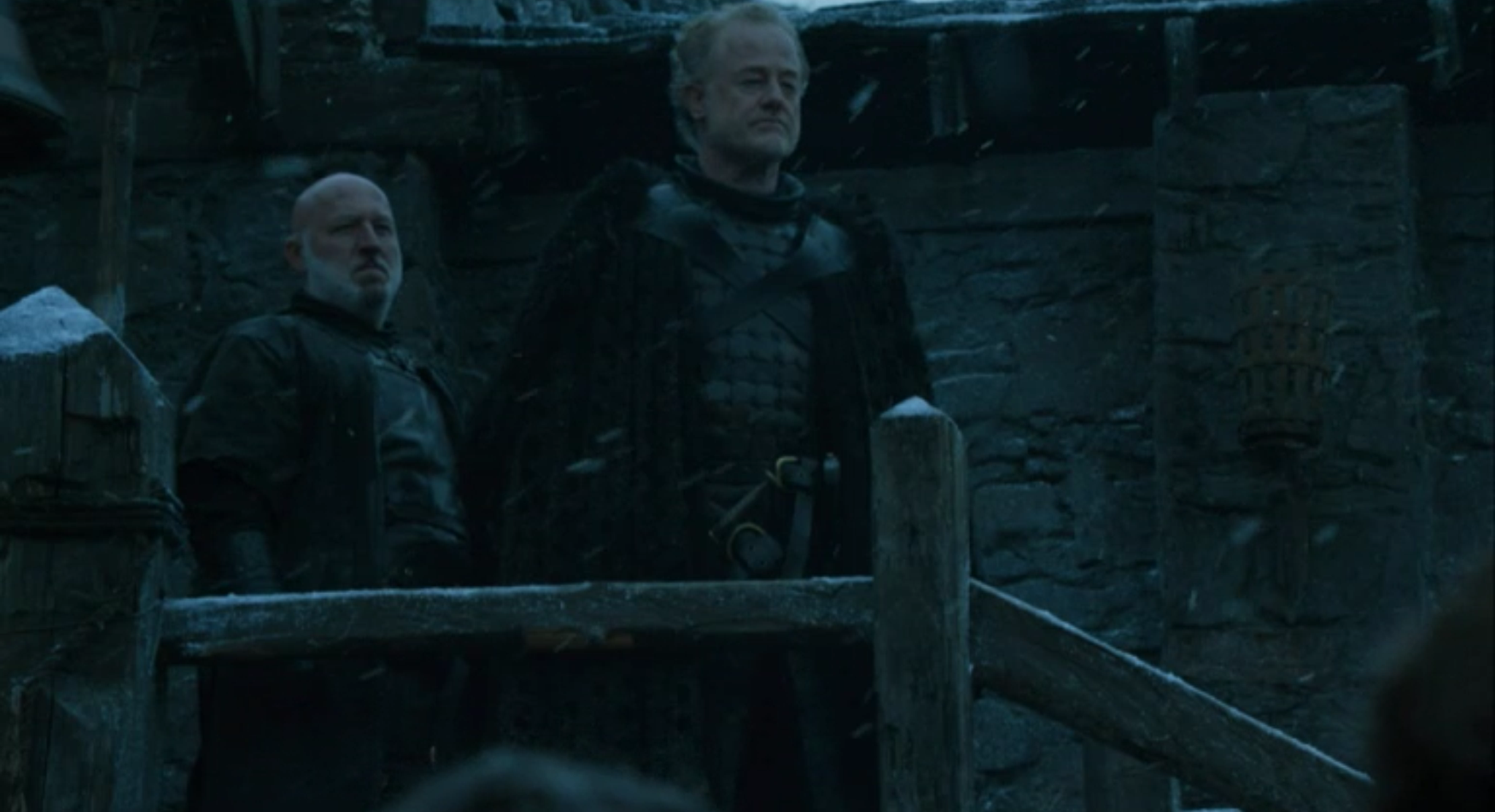
The scenes at Castle Black bookending this episode are about faith: not religious faith per se, but people’s beliefs in the world, in what is right and wrong, in what actions will be virtuous and beneficial. Alliser Thorne is given a moment of dignity before his death. “I had a choice, Lord Commander. Betray you, or betray the Night’s Watch,” he tells Jon. “If I had to do it all over, knowing where I’d end up, I pray I’d make the right choice again.” He is confident in his principles. Melissandre very nearly had her faith broken by Stannis’ defeat and death, and then Jon’s; his return breaths new, if desperate, hope back into her. But Jon’s own faith has been sorely shaken.

It is Davos who offers the most pragmatic way forward—Davos, whom we would not fault for saying “Fuck this shit” and taking the fastest horse south. His sons have been killed, his king shows himself to be as monstrous as those he fights before he himself gets killed, and the cause to which he committed himself is in tatters. His stoicism reaches existentialist levels:

DAVOS: You go on. You fight for as long as you can. You clean up as much of the shit as you can.
JON: I don’t know how to do that. I thought I did, but … I failed.
DAVOS: Good. Now go fail again.

When Davos said this, my friend and I immediately quoted Samuel Beckett to each other. “Fail again! Fail better!” This line, which has (so, so very ironically) been adopted as a mantra by billionaires everywhere, comes from the novella Worstward Ho!, one of the very last works Beckett penned before his death: “All of old. Nothing else ever. Ever tried. Ever failed. No matter. Try again. Fail again. Fail better.” I have no idea whether this was a deliberate allusion, but it is weirdly apposite. Leaving aside for the moment that Castle Black and the Wall would be ideal for staging a Samuel Beckett theatre festival, “Oathbreaker” is at least in part about its characters’ existential crises.

alliser

I said earlier in this post that I wasn’t certain what the episode’s title referred to, but that it possibly resided in Daenerys’ lack of fidelity to Dothraki tradition and her apparent abandoning of Meereen. I think that still holds, but that we can also read a more subtle allusion to the Castle Black scenes. In the final moments, Jon abdicates not only the position of Lord Commander, but also his role as a sworn brother of the Night’s Watch. Does this constitute the breaking of his oath? Considering that the second sentence of that oath is “It shall not end until my death,” perhaps we can assume Jon is on solid, if unprecedented, legal ground. But oaths are tenuous things anyway, grounded as they are in the character and honour of those swearing the oaths to begin with. In so much classic fantasy, individual honour stands in for such modern notions as jurisprudence (which, before my medievalist friends go all Alliser Thorne on me for saying so, I hasten to add is a conceit of fantasy that ignores the very real judicial systems of the Middle Ages); and honour is an absolute quality in the Aragorns of the fantasy world, but in GRRM’s retread of such tropes, honour is a more fickle beast—and the breaking of oaths is what drives so much of the action in Westeros. Robert Baratheon rising up against his liege lord, Jaime Lannister killing that same king, Roose Bolton and Walder Frey betraying Robb Stark. If Smalljon Umber’s refusal to bend the knee to Ramsay is an acknowledgement of this fact, is Jon Snow’s departure at the end a progression or regression for his character? I guess we’ll have to wait and see.

Well, that’s all for us this week—until next episode, my friends, stay warm and don’t let your direwolves talk to strangers.

Leave a comment

Filed under Game of Thrones, television

Game of Thrones 6.02: Home

gameofthrones_teaser02_screencap10

Greetings once again, my fellow Westrosi, and welcome to the great Chris and Nikki Game of Thrones co-blog™. This episode was quite the ride, replete with time travel, skull smashing, deus ex wildlings, a pretty profound display of filial disrespect, and Tyrion providing about the pithiest professorial CV I’ve yet encountered.

And something to do with Jon Snow.

Normally Nikki would lead us off here, as I went first last week, but she’s been having some issues with Bell getting her HBO up and running (there may have to be some skull smashing on that front), so I took the first pass while she yelled at them over the phone … Ned&amp;Rodrik

Christopher: The general consensus about last week’s premiere has been that it was a decent enough episode, but a slow start—which really shouldn’t surprise anyone who has been watching Game of Thrones since the beginning. Season openers have tended to be a little lugubrious, as their main job is usually to resituate us in this world after ten months away. But they always end with a bang, with a shock or a revelation: season one saw Jaime push Bran out the window, season two was the massacre of Robert Baratheon’s bastards and the realization that Gendry is one of them; in season three, Barristan the Bold saves Daenerys from assassination, Arya kills Polliver with Needle in season four, and last season saw Mance Rayder burned at the stake—and mercifully killed with an arrow by Jon Snow. And of course last week was the Melissandre reveal.

After which, we’re usually off to the races, and this week’s episode should have satisfied people’s need for action and surprise: the wildling rescue of the Jon Snow loyalists, Ser Robert Strong’s showing what happens to those who tell tales about Cersei, the appearance of Euron Greyjoy and sudden dispatch of Balon … to say nothing of everything that went down among the Boltons.

Oh, and that little ending bit.

There were also a lot of lovely moments that were by turns quiet or tense, like Tommen’s reconciliation with Cersei or Tyrion freeing the dragons. But I think I most loved where this episode began. After an entire season plus one episode away, we finally meet up with Bran & co. again, more or less where we left them, in the caves under the weirwood tree of Bran’s visions. There are any number of questions left unanswered about the timeline, though the unavoidable fact that Bran has grown since last we saw him suggests that he has spent however long last season was supposed to have lasted underground, training with the Three-Eyed Raven. (Who, we should point out, is being played now by legendary actor Max von Sydow). And whatever training he has had seems to have paid off, as he can now travel through time.

His vision of Winterfell past lends the start of this episode a sense of déjà vu, as this was where the series effectively began: with Bran in this same yard practicing his archery with the encouragement of his brothers and his father. Here he sees his father at around the age he was when the series began, sparring with Benjen. “They were all so happy,” Bran says with something like wonder in his voice. “So were you, once,” the Three-Eyed Raven reminds him, and we recall that brief moment of peace with which the series opened, shattered along with Bran’s spine at the end of episode one.

Bran_Raven

Ned&amp;Catelyn

Little bit of deja vu.

We also see the infamous Lyanna, whose abduction at the hands of Rhaegar Targaryen precipitated the end of the Dragons’ dynasty, show here young and wild and obviously more confident in the saddle than her brothers (“Stop showin’ off!” young Ned says petulantly); we see the young version of Rodrik Cassel, already rocking the mutton chops; and most touchingly and surprisingly we see Hodor when he was still called Willas and capable of speech. I love how obvious it is that, even back then, he was a gentle soul, and obviously well-loved by the Starks.

But just as we, along with Bran, become sentimental for the past, it is time to return to the troubled present. Ignoring his plea to stay longer, the Raven brings Bran back to the cold cave and his useless legs, admonishing him that such journeying is like swimming under the sea, in that “if you stay too long, you drown.”

“I wasn’t drowning,” retorts Bran. “I was home.” This episode is titled “Home,” so it’s interesting to think of the ways that motif wends its way through the story. What is home for these displaced characters? Bran has a vision of Winterfell, but all of the surviving Starks are scattered around the world, and Winterfell itself has been stolen by the Boltons. Theon decides that he must needs return to his home in the Iron Islands, Tyrion is doing his level best to adopt Meereen, and Tommen has the realization that without his mother he is missing the better part of himself. Home is a safe space, but there are vanishingly few of them in this world.

What did you think of this episode, Nikki?

Davos et al

Nikki: Well, now that I’ve been able to sit for a moment after dancing merrily around my house for hours, I can say this episode was a spectacular return to the action we’ve come to know and love with Game of Thrones, and as you beautifully pointed out, it does so right from the very beginning. The Bran material was well handled, and for a moment, as you mentioned, I actually thought we were back in the beginning of episode 1 of the series. I expected to see a very young and surly Arya looking out the window as she longed to be wielding a sword and not wasting her time in embroidery lessons. I loved it, and especially loved seeing a young Hodor, who reminded me of Samwell Tarly.

But then we’re back at Castle Black, and a still dead Jon Snow, with Davos behind the door as Thorne, lying through his teeth, stands outside and promises him safe passage if they simply come out with their hands up. Even Ghost isn’t buying that one. As they all unsheathe their swords as a not-so-subtle message to Thorne that they will not, in fact, go quietly into that good night, and Ghost braces himself between all of them, teeth bared and growling, Thorne has one of his men begin to break down the door. And just as I started to wonder if this might be the end of Davos (please no!) while at the same time REALLY looking forward to watching Ghost go straight for Ser Alliser’s throat, there’s a second banging that stops the current action and pivots everyone’s attention to the outside walls. I fist-pumped. “Wildliiiiiiiiings!” I sang quietly from the couch, tense with anticipation. And then it was even better: Wildlings + giant. And when the wiener on the parapet decided to shoot his tiny, tiny arrow that bounced off the giant’s neck with a wee little *ping* sound, what the giant did next made the Hulk’s throttling of Loki in The Avengers look amateur in comparison. And the rest of Thorne’s army dropped their weapons quickly, eliciting an almost whiny “Oh COME ON, GUYS!” from Thorne that was hilarious in its frustration and expression of broken dreams. Off to prison with Thorne and the Annoying One (Buffy reference) and… it’s over to King’s Landing.

And we open on King’s Landing with this Eric Idle type standing in the street doing his version of Monty Python’s “nudge nudge wink wink” sketch involving an unlikely story about Cersei giving him the eye, a little monologue that causes the Mountain to smash the Facebook angry dislike button so hard that even I made a noise of disgust. (“Say no more!!”) This is the most we’ve seen of the Mountain since he was raised from the dead and has turned into nothing more than a meat-based killing machine (which, granted, is only a sidestep from what he was before he died), and that thick neck, grey face, and deadened eyes behind the mask lend a particularly horrifying element to him. I hope he never takes off that mask, because it’ll give me nightmares for life. But the appearance of the Mountain and what he does here looms large over the rest of the episode, so by the time we get to the events at the end, we’re not quite so sure about this whole raising from the dead thing.

Mountain

One does not merely piss on the Mountain’s feet.

As Cersei descends from the Red Keep with the Mountain at her back, she’s stopped by King Tommen’s guards, who stand before her in a YOU SHALL NOT PASS manner and explain, heads bowed, that despite her being the king’s mother and despite her destination being the funeral of her daughter, she is not allowed to leave the Red Keep. This is possibly the lowest we ever see Cersei, and despite everything she has done, you can’t help but feel badly for a mother who cannot say goodbye to her own daughter.

The show then takes us to Jaime and Tommen, standing at Myrcella’s side. Those creepy rocks with the wide-open eyes painted on them are lying on her face, and we remember that less than two years ago, they were standing in the same spot. Only when it was Joffrey on the slab, Cersei was standing at his side, cursing Tyrion’s name and convincing her twin brother that the imp had been behind it, as Tywin put his arm around Tommen’s shoulders and led the young boy away, establishing himself as Tommen’s chief advisor. How the times have changed: Cersei has been humbled to the point where she can’t even attend the funeral, Jaime has calmed down and it’s uncertain whether he still thinks Tyrion killed Joffrey, Tommen is a reasonable king who listened to the advice given him and is still making his way through everything, and Tywin is dead, by Tyrion’s hand.

Tommen confesses to Jaime that the reason he has yet to visit his mother is simple: shame. He should have stopped what the High Sparrow did to her, he should be stopping what they’re doing to Margaery now, and he doesn’t know how to face either woman when he’s let them down so colossally. And right on cue, the High Sparrow emerges from his perch and begins to descend to where Myrcella’s cold body lay on a slab, as Jaime sends Tommen away to speak to his mother.

What did you think of the conversation between the High Sparrow and Jaime, Chris?

Sparrow

Christopher: As always, I am in awe of certain actors on this show, and Jonathan Pryce is a prime example. Jaime, we can see, is coming close to a breaking point: reunited with Cersei, having seen his daughter die and his family under siege, he seems ready to return to his violent tendencies and familial retrenchment. His fury at the High Sparrow is chilling in how cold and controlled it is, but for all intents and purposes the High Sparrow calls his bluff.

Not that Jaime doesn’t call out his hypocrisies. “Your sister,” says the Sparrow, “sought the gods’ mercy and atoned for her sins.” “What about my sins?” Jaime demands, and provides a litany of his misdeeds, from the killing of the Mad King to setting Tyrion free. “What atonement do I deserve?” It is the one moment in which the High Sparrow has no answer—for what could he say to that? The subtext of this conversation is the uneven dolling out of punishment, which disproportionally hurts women, and which is more preoccupied with sexual transgression. Cersei and Margaery suffer torture and humiliation, and we’re not certain of what is being inflicted on Loras. But Jaime’s laundry-list of sins has not garnered him anything more than the label Kingslayer.

Jaime’s mistake is overplaying his hand: he should have let the silence deepen, and let the High Sparrow attempt an answer that would have further shown his hypocrisy. But Jaime is not Tyrion, and so before the High Sparrow can become properly discomfited by his question, he grasps his dagger in a threatening manner, allowing the High Sparrow to deflect his words. “You would spill blood in this holy place?” he asks. Jaime’s response, that the gods are bloodier than all mortals put together, is a nice piece of rhetoric but comes off, ultimately, as empty bravado. Better to have pointed out that he has spilled blood in the throne room of King’s Landing and bring the question back around to what atonement he deserves.

faith-militant

One way or another, Jaime’s implied threat effectively summons the High Sparrow’s muscle, who array themselves around the sept but do not approach. And it is here that the High Sparrow stares down the Kingslayer, daring him to kill him. The face acting between these two is on point here: Coster-Waldau has a wonderful look of surprise and consternation when he’s invited to kill his foe; and Pryce very subtly communicates an instant of trepidation in making the challenge, replaced by his mounting confidence as he looks over Jaime’s shoulder to see that his Faith Militant have arrived. The Sparrow is still in danger from Jaime Lannister, should the latter choose to roll the dice and wager that he could fight his way out of the sept; but he knows that the calculus has changed, and it is far more likely that the Kingslayer will choose to fight another day.

And more importantly, it gives him fodder for one of his speeches: “No doubt many of us would fall,” he says of the prospect of Jaime cutting his way out. “But who are we? We have no names, no family … every one of us is poor and powerless. And yet, together? We can overthrow an empire.” The look he gives Jaime as he takes his leave falls short of open disdain, but it’s clear he knows he’s just owned the Kingslayer—and Jaime knows it too.

It does seem, however, that the High Sparrow’s estimation of his nameless, poor legions of the Faith Militant will be put to the test. Heeding Jaime’s advice, Tommen visits his mother to make his own atonement. He apologizes, and in the substance of his words we see a Lannister-in-training: “I should have executed all of them. I should have pulled down the sept onto the High Sparrow’s head before I let them do that to you.” Certainly, that would have been the path taken by the late-not-quite-lamented Lord Tywin; hearing the words from Tommen emphasizes again the familial retrenchment of the Lannisters, and the danger this could pose both to themselves and to the kingdom at large. “You raised me to be strong,” he continues. “I wasn’t. But I want to be.” In this moment, Cersei gets something resembling recompense for all her humiliations, but it does raise a few questions, re: Margaery. They’re still married, after all; she is still, in fact, the queen. If Tommen is returning to his mother’s tutelage, what kind of relationship can we expect him to have with his wife, assuming he manages to break her out? Cersei’s plotting late in last season effectively turned Margaery into her devoted enemy, and Margaery is hardly someone who will humbly accept the role of submissive wife. What role does House Tyrell have in the context of the Lannister wagon-circling?

We then segue to Meereen, where Tyrion’s alcoholism elicits Varys’ disapproval, which itself provokes Tyrion to make eunuch jokes, and banter ensues. As so often happens, Tyrion has my favourite lines of the episode, the first of which I’m seriously thinking of putting on my business cards. When Missandei asks him how he knows so much about dragons, he replies, “That’s what I do. I drink, and I know things.”

But as it turns out, he does more than just drink, venturing into the dungeon to unchain the dragons … presumably because no one else was willing to do so. What did you think of our time in Meereen, Nikki?


Tyrion-Varys

Yes. This is a GOOD idea, Tyrion.

Nikki: Tyrion and Varys were a highlight in an episode full of highlights. Just when you think you’re starting to know Tyrion, he surprises everyone with a lot of talk about dragons. He’s certainly expressed his awe of them before — witness the look on his face when he first saw Drogon flying overhead when he was in the boat with Ser Jorah. But now we discover he knows far more about them than the myths and legends: he knows how to actually take care of them. He explains that, like many animals in our world, in the wild dragons are massive creatures, but in captivity they can be quite small — he says in the great time of dragons, when they were all in captivity, they were the size of cats. (Cats!! I want a cat dragon!) And his explanation makes perfect sense. Our family actually has a pet bearded dragon. When he was little, we had to keep increasing the size of his cage or he would actually stop growing so he would never exceed his environment. I’m happy to report that at some point they do stop growing, but last year my son and I went to a reptile show, and there was a bearded dragon there from the wild that was four times the size of ours, and ours was considered full-grown. So the writers have actually culled this little fact from real-world creatures.

As Missandei, Grey Worm, and Varys look on, stunned, Tyrion explains to them that the dragons must be unchained, or they will die, and he will be the one to do it. “I am their friend!” he proclaims. “Do they know that?” Varys understandably replies.

The scene in the dungeon was so tense I could barely blink. Tyrion slowly descends the staircase as Varys stays safely by the door, and confronts the two dragons who have been left behind. Drogon, Daenerys’s favourite (and the largest of the three) is the one that’s out on the loose, and Tyrion slowly walks up to Rhaegal and Viserion. It’s interesting, in a sense, that there were three dragon siblings: Rhaegal are the smaller and more contemplative of the three, whereas Drogon is the largest and most aggressive. Tyrion’s family was the opposite: the two older ones were larger and more aggressive, while he was the smaller and more thoughtful of the three. Where Drogon, the large one, has left the nest, Tyrion, the smallest, is the one that’s been banished. And now he approaches the dragons. First we see four glowing eyes in the darkness, followed by a large head and a furnace burning brighter in the back of one of the throats… but the pilot light quickly goes out, as the dragons don’t have the energy to breathe fire at the moment. Tyrion, wide-eyed, is like a little boy coming face to face with the creatures of his wildest imagination, as he bows his head and begins speaking to them with great reverence. He is at once terrified, yet astonished to be in their presence. “I’m friends with your mother,” he tells them. “I’m here to help. Don’t eat the help.”

He explains that the only thing he ever asked for on his name day was a dragon, but everyone laughed at him. “My father told me the last dragon had died a century ago. I cried myself to sleep that night… but here you are.” He reaches out a hand and oh-so-tentatively touches its head before suddenly reaching out and grabbing the nail holding the chain together. At which point the other dragon bends its head forward, extending it so Tyrion can do the same. And the moment they are freed, the dragons lumber to the back of the cave. Tyrion stands, amazed, for one moment, before hustling it back to Varys. “Next time I have an idea like that,” he says, “punch me in the face.” It’s a brilliant, beautiful scene, where our favourite character meets our favourite creatures. Wow, what a combination they could make.

Jaqen

And speaking of punching in the face, a girl with no name is attacked once again by the waif, and this time the girl formerly known as Arya is pissed. She grabs that staff and swings in every direction, screaming and yelping… until the staff is suddenly stilled by the hand of Jaqen. I was thrilled to see him (I thought we’d seen the last of him) and in a very biblical moment, he tempts her with shelter, food, and even her sight if she’ll just tell him her name. “A girl has no name,” she replies, and then he leads her away. Will Arya see again? I can only imagine what Jaqen has in store for her next (but I hope she gets a good knock or two at the waif beforehand…) 😉

And then we get to the Boltons, the most depraved lot on a show filled with depravity. Once again Ramsay wants to do something drastic — in this case, storm Castle Black — because he’s thinking ahead and knows that’s where Sansa is going (and he’s right). Clearly no one has sent out a raven yet, and word that Jon Snow is dead has not been sent out as quickly as word like that usually moves (I swear the ravens in Westeros are faster than Twitter) but Roose, as usual, is cautious, and thinks moving on Castle Black is neither the right nor the politically astute choice at the moment. And just then it’s announced that Lady Walda has just given birth to a baby… boy. The child who will take the throne away from Ramsay, for a legitimate child always trumps a bastard, even if that bastard has been given his father’s last name. Roose looks to Ramsay, and embraces him, saying, “You’ll always be my first-born,” in a surprisingly touching moment… which is immediately cut down by Ramsay plunging a dagger into his father’s chest and killing him on the spot. This moment was definitely one of the most shocking I’ve seen on the show — I didn’t see that coming at all, despite everything that had happened leading up to it. And when Ramsay calls for Lady Walda and the baby, it just gets worse. We know what he’s done to Theon, and we know what he’s done to Sansa. We know how he uses those hounds, and when he lures Lady Walda into the kennel, it’s so much worse than the fate his father endured. I couldn’t move as I watched this scene, at once horrified and hoping against hope in my mind that this one time might be the moment Ramsay lets someone go (seriously, Nikki, do you ever learn??) I imagined standing there in the same way, and how, knowing how this would play out, it would probably be more merciful to smother the child on the spot than let the hounds take him. And in the final moment we see on screen, it looks like that might be exactly what she does. Notice how she turns away from the camera and falls forward, and you never hear a baby’s scream in that scene. I was incredibly thankful the directors didn’t show us that moment.

What did you think of what happened at Winterfell, Chris? Was it a complete surprise or were you suspicious it was going to move in this direction?


Roose_Ramsay

Ramsay being sentimental should always raise a red flag.

Christopher: I had a brief moment of confusion when Ramsay stabbed Roose, thinking at first it was the other way around—that with the birth of a son, Roose had no need for his bastard any more. That would have been shocking, but of course it would have ended Ramsay’s storyline, and I have a slight suspicion the showrunners want him around for some time yet, and will presumably (hopefully) give him a properly gruesome death. Perhaps we can start taking odds on who gets to kill him in the end? I’m saying Jon Snow 10:1, Brienne 5:1, his own hounds 3:1. Sansa? Even money.

But no, it’s too early in the season for Ramsay to go, but not too soon for Roose. It was still a surprise, though to quote a Buffyism, as justice goes it’s not unpoetic. In the world of GoT, certain things are sacrosanct, among them the laws of hospitality and the taboo against kinslaying. In aiding and abetting the Red Wedding, Roose violated the former—and one of the reasons the Boltons’ hold on the North is precarious at best is that many of the other houses look upon the Boltons as cursed for that transgression (a point emphasized more in the novels than in the series). That Roose loses his life to the monster he has cultivated, and who—as the rest of the scene demonstrates—is quite happy to kill his kin, is about as close to justice as we’re likely to get in Westeros.

And as we have seen, things in Westeros always get worse before they get better (wait—do they ever get better?). It is doubtful that the psychotic Ramsay can hold together the alliance he will need to win the North (and potentially defend against a Lannister army), but he can do a whole lot of damage in the meantime.

Meanwhile, Brienne, Sansa, et al seem to be in a bit of a holding pattern: of all the scenes in this episode, this one feels like the most extraneous, as its main purpose seems to be for Brienne to tall Sansa about her encounter with Arya, and for Theon to announce that he’ll be leaving them. The logic behind his reasoning isn’t entirely clear, but then I don’t know that logic is necessarily going to obtain with Theon at this stage. The only thing that is clear is that after all he has done, there is only one place left for him.

Balon_Yara

When he says “Home,” we then cut to the castles of Pyke, the seat of power in the Iron Islands, where Balon Greyjoy is in the midst of an argument with Yara, Theon’s sister. The gist of their dispute is Yara’s pragmatism in the face of Balon’s stubbornness, with her pointing out that islanders are ill-equipped to take and hold mainland fortresses. He will have none of it, storming out (ha!) onto what seems to me to be a rather rickety bridge between buildings. And here we meet a new character, Balon’s younger brother Euron, whom we glean has been away for many years, sailing to the ends of the earth. His time away seems to have … well, affected him somewhat. Which is to say he’s batshit, referring to himself as both the Drowned God and the storm itself before committing this episode’s second instance of kinslaying.

I’m not sure what I think of this new story line. In the fourth novel of the series, A Feast for Crows, GRRM introduces both the Iron Islands and the Dorne subplots. Given that Feast eschewed the Jon Snow and Daenerys storylines (thus making it the least favourite of the books among fans), these new dimensions in the Ice & Fire world could be presented with an economy of storytelling (or what passes for economy of storytelling in this series); but they came to complicate book five, A Dance With Dragons, making it the most shambolic of the books so far. Reading Dance, a friend of mine said in an apt analogy, was like pulling taffy. Given the difficulty of teasing out all these threads in a novel meant that the television show was ill-suited to take all of them on, and there was a general assumption when we undertook the Dorne plot last season that the series would ignore the Iron Islands.

Balon_funeral

Is it just me, or are Iron Islands funerals really lame? I mean, won’t that just wash up on shore somewhere else?

But here we are, and I’m worried—in part because the Dorne storyline was so clumsily mishandled, and we’re still stuck with it. And now the Iron Islands on top of it? Fingers crossed, but I’m worried we’re hitting Peak Narrative right now.

On the bright side, they will likely be mining A Feast for Crows for content, so at least there will be one storyline I’ll have an inkling about this season.

Which brings us to this episode’s final scenes, which I assume you have one or two thoughts about, Nikki. But before that, a few final thoughts on this episode:

  • Davos apologizing to the others for what they’re about to see as he draws Jon’s sword is classic, and a perfect line for that character.
  • The showrunners really want to be a bit more sparing with their deus ex machinas. Brienne riding to the rescue last week was great, but the wildlings’ appearance at Castle Black was so utterly predictable you could have set your watch to it. I found myself thinking “I wonder how many blows they’ll get on that door before Edd returns with Tormund?” Which isn’t to say it wasn’t a thrilling sequence, just that it’s not necessarily a good pattern to fall into.
  • It’s official: crushing skulls is the Mountain’s preferred method of killing. Dude doesn’t even need a sword.
  • “Next time I have an idea like that, punch me in the face” is my other favourite Tyrion line of the episode, though “Don’t eat the help!” is pretty good too.
  • I’m REALLY happy they cut away from Walda when the hounds attack, but the sound effects were almost as bad as seeing it.

That’s it for me. What did you think of the episode’s ending, Nikki?

Melissandre_Jon

Nikki: I’m sure there were a lot of people out there who thought the final three seconds of the episode were as predictable as it gets, but I’m not one of them. This show has thwarted hopes and expectations more often than not, and because it was so drawn out, with Melisandre making numerous attempts to raise Jon and failing every time, I thought there was a possibility that we would end with a quiet camera hold on Jon, fade to black.

Of course, that was while I was in the moment. In retrospect, fans would have stormed the HBO studios over it, and they knew that. They couldn’t have possibly gone in that direction, and so of course it had to end the way it did, but in that moment, I just wasn’t sure if they were going to go for it or not.

The final scene began with Melisandre sitting gloomily in her room listening to country music — the music of pain. (Dude, that’s three Buffy references in a single recap, this is some kind of record for us!!) Fans have been up and down with Melisandre from the beginning. I think she’s the most stunning looking person in the entire series, and I absolutely love the way the actress carries herself and speaks. Some other viwers find her grating. I found her rather unsettling in the beginning, when we first found her with Stannis, and she’s been utterly unpredictable in her actions every step of the way except in one aspect: her unwavering belief that her convictions are correct. She never questioned that the Lord of Light was leading the way, and that Stannis was his vessel on earth, and that he’d lead them all to glory. And when Stannis died, she stumbled, and went to Castle Black and said, “OK now I’ve got it right, it’s… Jon Snow!” and then Jon Snow was killed, and she doesn’t know what to believe anymore. She’s wasted so much of her life having faith in one thing that when it collapses, she has nothing more to live for. (To the point where last week, one of our readers wondered if Melisandre removed the necklace so she could lie down and die, a notion I confessed I’d also considered when I saw that scene.)

Many of us have had that feeling, whether it’s in a relationship or a job or anything you’ve been involved in for several years. But it’s one thing to say, “Aw, man, I worked at that company for 12 years and I should have moved on years ago”; it’s quite another to have devoted your entire being to worshiping a god for centuries, only to realize you were a wee bit incorrect on that one. She’s utterly despondent as she sits in her room, and the old, confident Melisandre has turned to ashes in the fire. “I assume you know why I’m here,” Davos says. “I will after you tell me,” she replies. The old Melisandre would have chided him for even questioning what she knows, and of course she would always know why he’s there.

But Davos won’t let her wallow, and he pushes her. He wants to know if she knows any magic that can bring back the dead, and she tells him that she met a man once who came back from the dead, but it shouldn’t have been possible. She knows the implications of this (anyone who’s seen any genre TV or movies knows the consequences are never good). She stares ahead, unblinking. “Everything I believed, the great victory I saw in the flames, were lies.”

Davos will have none of it. He steps forward, and tells her you know what? He’s not looking for the bloody Lord of Light, master of nothing, he’s asking for help from the woman who showed him that miracles do exist. The Lord of Light might be a lie, but she’s not. And she is pretty incredible. And with that, Melisandre finds the tiniest glimmer of hope within her, and follows him to Jon’s side. She cleans all of his wounds, like Mary washing the body of Christ, until they are just red half-moons all over his body. She cuts his hair (I’ll admit to wincing through that, like, I know you’re trying to bring him back from the dead and all, but do you really have to cut his hair?) and throws it into the fire, along with some of his blood. Ghost sleeps through the entire process, which I found a little odd: you’d think the direwolf would be standing at the ready, even knowing that Jon was dead. (And at one point I was yelling, “Put some of Ghost’s fur into the fire!”) She lays her hands upon him, and says the incantation, and… nothing. She tries it again, nothing. We watch the hope fade from her face as she tries it again and again. Tormund turns and walks out of the room, waving them off like he couldn’t believe he’d gotten caught up in this stupid charade in the first place, but Davos’s face remains steadfast. He doesn’t take his eyes off Jon, waiting for something to happen. Melisandre’s chant becomes more and more feeble, with less and less conviction, until finally she just gives up. Head hanging, shoulders low, she turns and leaves the room, as one by one they all leave. And only Jon and Ghost are left behind.

And then, Ghost stirs. And, I will admit, I went, “Oh my god, his spirit went into GHOST!!” but as soon as the words were out of my mouth I thought wait, no, that would just be weird. Even weirder than this show usually is. And as the camera closes in on Jon as Ghost begins making noises, we all know what’s going to happen, and it does.

Didn’t stop me from fist-pumping the air and going, “YAAAAAAAAASSSS!!” And my joy was so full that I didn’t turn to the person beside me and say, “YOU were wrong and I was right because I never wavered in my conviction that he was coming back and HA-ha ha-hahaha.” Oh wait, no… that’s totally what I did.

Thanks again for reading, and I look forward to chatting again next week!

resurrection


Leave a comment

Filed under Game of Thrones, television

Game of Thrones 6.01: The Red Woman

gameofthrones_teaser02_screencap10

Greetings all, valar morghulis, and welcome back for season six of the great Chris and Nikki Game of Thrones co-blog, in which we recap/review the episodes as they air!

This promises to be an interesting season for us: when we first started this five years ago, I was one of those smug arseholes who had read all the novels in A Song of Ice and Fire, and so had a reasonably good idea of what was coming next; and Nikki had not read the books at all. And so we thought that would make a good dynamic, bouncing between a veteran and a neophyte as we discussed the way the series adapted the novels.

But no more! George R.R. Martin, the “great bearded glacier” (to borrow an epithet from Paul and Storm), has done what everyone has feared and let the series catch up to the novels … which means I have no more idea what this season will hold than Nikki. So here we are to hold hands and leap into the unknown, much as if we were jumping from a castle’s ramparts … but don’t worry, if this episode is any indication, doing so won’t hurt at all.

So without further ado …

jon-dead-03

Christopher: Well, we begin precisely where we left off last season, with the lifeless body of Jon Snow in the courtyard of Castle Black. We’re treated to an artful overhead shot skimming the edge of the Wall and craning down into the yard, coming in close on Jon’s lifeless face. Wolves howl in the distance, and the silent emptiness of the yard is broken by the rattling of a locked door. And then we see Ghost: locked in a room, in answer to your question, Nikki, in our last post of season five. Where was Jon’s direwolf as he was stabbed to death? Safely imprisoned, apparently.

As openings go, this was pretty deftly done: not least because every single fan of this show ended last season in a state of either trauma, denial, or rage (or all of the above) at the thought that Jon Snow was to be added to Game of Thrones’ butcher’s bill. If they’d been cute and started this episode anywhere else, I have to imagine that rage would have been volcanic. But no … we close in on Jon, deserted by his assassins who, we will shortly glean, have scarpered to the mess hall in order to justify their mutiny to their fellows.

Leaving poor Jon to be discovered by … Davos. There, the Onion Knight is joined by Jon’s friends, and together they carry the body indoors. That it is Davos who first finds him and takes command in short order is significant. Here is a man who has quite literally lost everything: his sons killed at the Battle of Blackwater, himself sidelined by his king to stay at Castle Black, and subsequently left without a king or an army after Stannis’ calamitous defeat at the hands of the Boltons. Yet here he is, siding with a small handful of Jon Snow loyalists. I have had many occasions to praise the casting on this show, and I can think of few actors who have better inhabited GRRM’s characters than Liam Cunningham as Davos Seaworth. He radiates gravitas, and so beautifully and subtly communicates the pathos of a man whose loyalty and service were undeserved by the object of his devotion, Stannis Baratheon.

All of which is at least a little beside the question that everyone waiting breathlessly since last year has been asking: is Jon Snow really dead? Well, yes. Quite dead. But will he remain dead? Will he become a wight? Had he thrown his consciousness into Ghost? Will Melissandre resurrect him? This last question will rebound on us when we discuss this episode’s final moments, but for now we can safely say: Jon Snow is dead. At least for the entirety of this episode.

What’s interesting is the possible battle lines that have been drawn: Dolorous Edd Tollett has been dispatched, presumably, to recruit the wildlings to the cause of Jon Snow’s friends. Davos makes it clear that he has no truck with Jon’s assassins. Ghost is seriously pissed. Meanwhile, Alliser Thorne and his co-conspirators paraphrase Brutus’ post-assassination speech from Julius Caesar in the mess hall, apparently successfully. The stage has been set for some serious shit to go down at the Wall, with or without a live Jon Snow.

What did you think of this season’s opening salvo, Nikki?

davos

Nikki: I loved it (all except that part where Jon Snow didn’t magically come back to life, of course). But I’m also glad they’ve kept it a secret. Season 5 ended with the death of Jon Snow; perhaps season 6 will end with him coming back to life. It would be really interesting if they draw it out, either to keep our hopes up or to divert our attention elsewhere. The thought of Tollett returning with a band of wildlings is exciting — as Davos says, “You’re not the only ones who owe your lives to Jon Snow” — and I wonder if this might be where Bran could re-enter the picture this season.

Meanwhile, over in the Super Happy Fun Times Castle, Ramsay strokes the face of his dead lover before declaring that she’s “good meat” that should be fed to the hounds (we all, um, grieve in our own way, I suppose?) before Roose takes him out into the hallway to chastise him for the way he handled his ragtag battle. He’s lost Sansa and Theon, and he says the North will never back them if they don’t have Sansa Stark, and they’ve lost the heir to the Iron Islands. And then he hints that perhaps the newest Lady Bolton is carrying a son, which once again reminds Ramsay that he’ll be once again relegated to bastard status: heir of nothing.

Meanwhile, Sansa and Reek have been running from Ramsay Bolton’s castle and forge an icy stream (where Sansa, for some reason, doesn’t remove the 100-pound cloak from her back and hold it over her head so they can use it later as a blanket) before finding solace under a felled tree. I LOVED the scene where we saw another glimmer of Theon, where Sansa is both so physically and emotionally numb she can’t move, and he embraces her, rubbing her back to keep her warm, but also to let her know that her “brother” is back. And when Ramsay’s hunters catch up to them, Theon throws himself in their path as a sacrifice, trying to save the girl who was raised as his sister and right all the wrongs he’s done to the Starks. It doesn’t work, however, and juuuuuust when you think oh NO, they have to head back to that bastard’s castle… along comes Brienne and Pod.

brienne-oath

You know a show is great when you’re cheering for joy on the couch and it’s less than 15 minutes into the premiere episode. The fight scene was fantastic, where Brienne holds her own, but not without some trouble. She’s large, she’s strong, and she’s an excellent fighter, but these men have horses, and — not to put too fine a point on it — they’re men. And she still manages to better them, with the help of Podrick and Theon, who guts one of them. She ignores their cries for mercy because she has one goal and one goal only: to save Lady Stark, whose life she has pledged to keep safe. And when she kneels before Sansa and once again gives her that pledge — and I was half expecting her to say, “NOW will you come with me, you jerk?!” — and Sansa accepts it (with some help from Podrick when she can’t remember the formal language), it’s a joyous moment. And to be honest, I couldn’t help but think to myself, I would love a Brienne:

“See that woman over there, Brienne? She told me off at the PTAmeeting, and is one of those moms who volunteers for everything and lords it over the rest of us. And her daughter’s a bully who made my daughter cry last week. Deal with her.”

“Yes, m’lady!”

Sssshhhhhink!!

Ah.

OK, back to reality.

From here we move to King’s Landing and the Lannisters. What did you think of the reunion of Jamie and Cersei, Chris?

cersei-realization

Christopher: On a purely emotional level, it was my favourite scene of the episode. I too was fist-pumping as Brienne rode to the rescue, was aghast at the events in Dorne, loved the buddy comedies unfolding in and adjacent to Meereen, and was gobsmacked by the episode’s final moments … but in this reunion I think we got some of the finest acting we’ve seen from Lena Headey and Nikolaj Coster-Waldau yet—which is saying a lot, as neither of them have exactly been slouches in the previous five seasons.

If there’s something this show does well, it’s making us sympathize with otherwise hateful characters, and making us cringe when the supposedly likable characters do hateful things (the obvious exceptions being the requisite sociopaths like Joffrey and Ramsay, whom we just loathe unreservedly and with the white-hot intensity of a thousand suns). We know what’s coming—we know as soon as Cersei receives word that her twin has returned that her joy at the prospect of seeing him and her daughter will turn to ash. And while she’s a character for whom we would be well justified for indulging in some schadenfreude, the scene is instead heartbreaking, for reasons Cersei herself identifies. “She was good,” she weeps. “From her first breath, she was so sweet. I don’t know where she came from. She was nothing like me. No meanness, no jealousy. Just good … I thought if I could make something so good, so pure … maybe I’m not a monster.” Her grief in this moment is wildly different from her grief for Joffrey, which was almost feral in its rage and fear. We might interpret that as Cersei valuing her male child over the female, but I think not—it was, I’m inclined to believe, her unspoken recognition of her son’s monstrosity, seeing herself reflected in it, and her visceral reaction to being attacked.

Her grief for Myrcella is quieter, more fatalistic, the shock at the death of innocence. It is a moment of rare self-reflection on Cersei’s part, in which she sees her own machinations and ruthlessness rebound upon her. Except that we know her well enough to know she would not be surprised to have the revenge of her numerous enemies visited upon her: Myrcella’s death at the hands of the Sand Snakes is yet one more innocent lost in the larger war, and we soon see her erstwhile fiancée similarly dispatched back in Dorne—dead for the sin of having the wrong parents. It was a moment that called to mind the murder of all Robert Baratheon’s bastards in season one.

cersei

As I’ve mentioned many times in the past five years, Lena Headey as Cersei was always one of the few bits of casting that never entirely sat right with me—not because she’s not a good actor, but because her portrayal is dramatically at odds with how Cersei is described in the novels, and for that reason she’s had more of an uphill battle in this role than almost everyone else in the show. But I must say, she has come to own this role, and in moments like this brings more nuance to the character than GRRM gives her in the books.

And she’s well matched in this scene by Nikolaj Coster-Waldau, whose impassioned “Fuck prophecy! Fuck fate, fuck everyone who isn’t us!” is one of the more eloquent employments of the f-bomb I’ve seen since Deadwood ended. A point I raised several times last season is the way in which this show depicts radicalization: the way in which circumstances drive certain characters and groups of characters to extremes. The rise of the sparrows is the most obvious example, but we see it also in the scenes in Mereen, where the red priests look to be getting traction with the disenfranchised ex-slaves. Jaime’s “fuck everyone who isn’t us!” mirrors such sentiments on a smaller and more intimate scale, a reactionary clenching in the face of fear and loss.

Speaking of the sparrows, we segue from Cersei and Jaime to where Margaery remains imprisoned, subjected to the shaming of a septa who seems to take a little too much pleasure in her duties. What think you of the fortunes of House Tyrell, Nikki?

marg

Nikki: Oh, Margaery. Just as you said with Cersei, there’s a part of me that wants to see her suffer for everything she’s done to the people around her. But then you see her on the ground being badgered by a nun, and… actually, yeah, I’m still OK with her suffering at this point. When the High Sparrow enters the room after Sister Ratchet has been ordering her to confess, Margaery once again tells him that she has nothing to confess. “You believe you are pure, perfect, wholly without sin?” he says to her. “None of us are,” she replies, and despite the cringe-worthy grammatical error in that line (move on, Nikki, MOVE ON) it’s one that sums up every person on this show. Everyone is seeking revenge on someone else for harms that person has done to them, all the while harming other people. Margaery was justified in the actions she took against the House of Lannister, but she’s been so awful and bitchy that I just couldn’t stand her anymore. Meanwhile, Cersei and Jaime in the previous scene are lamenting what’s been done to them by everyone, and yet Cersei is the one who brought the High Sparrow to King’s Landing in the first place, and she’s also the one who had Oberyn killed, which led to the murder of her daughter.

And the Sand Snakes aren’t stopping there. Now that they’ve gotten to Cersei through her daughter, they turn their sights to the House Martell. Prince Oberyn’s brother Doran, the ruler of Dorne, is a quiet, pensive leader who is a lot calmer and more calculating than his younger brother, whose head was smooshed like a cantaloupe when he got too cocky in the midst of battling the Mountain. When Ellaria Sand raced to Dorne to tell Doran what had happened to her lover, Doran did not rush to exact revenge on the House of Lannister — he knew doing so would simply start a war that he wanted to avoid. And so he said no, let’s wait, come up with a plan, and find a way to fix all of this. The problem is, this isn’t the first time the Lannisters — and, specifically, the Mountain — had torn their family apart. Remember that before the events of the series, Rhaegar Targaryen — Daenerys’s beloved older brother — had been married to Elia Dorne, and when Robert Baratheon’s army moved on Rhaegar, with Baratheon himself killing the Targaryen, Tywin Lannister then moved his army into Rhaegar’s castle, and the Mountain not only killed Elia’s older child, followed by her infant son, before her very eyes, but then raped her violently before killing her, too.

The effect this would have had on Oberyn was immense, as he was very close to his sister, and Ellaria vowed revenge on that day, but Prince Doran refused to move against the Lannisters. Now that they’ve killed both his brother and his sister and he still refuses to move, Ellaria can no longer wait for something to happen. “Your son is weak, just like you, and weak men will never rule Dorne again.” And as Doran lies on the ground, gasping for breath after Ellaria has stabbed him through the lung, his last thought is that his son is next.

obara

And he is. In one of the gorier moments on Game of Thrones — and one most viewers probably saw coming, since A) no one turns their back on Obara and gets away with it, and B) Obara would like nothing more than to take a satisfying kill away from Nymeria — Obara pushes her spear diagonally through Trystane’s back and up through his face. Thus endeth the House of Martell.

And from there we move to Meereen, where Tyrion and Varys return (and there was much rejoicing… yaay…) and Varys stops Tyrion from a potentially embarrassing baby-eating incident. What did you think of the return of our favourite twosome, and the rumblings of rebellion in Meereen?

tyrion_varys

Christopher: I would be happy with a Game of Thrones spin-off that was just Tyrion and Varys on a road trip. To say that these two actors have amazing chemistry might suggest that they don’t have great chemistry with everyone else in the cast, which they do; but there’s a particularly good match between these characters that the series has exploited to much greater effect than the novels. They are both marginalized figures who more than compensate for their outsider status with their shrewd intellects; and both work for a greater good in spite of the fact that they receive no gratitude for it. I’m reminded of the moment in season two’s final episode, after the Battle of the Blackwater, when Varys sits beside the gravely wounded Tyrion’s bed and informs him that he cannot expect any commendations for his valiant defense of the city. “There are many who know that, without you, the city would have faced certain defeat,” Varys says sadly. “The king won’t give you any honours, the histories won’t mention you … but we will not forget.” That “we” is vague, but suggestive, hinting at a silent majority—the people themselves, the forgotten, who are so often crushed by the great wheel Daenerys spoke about last season.

This little scene is one of the subtler bits of writing we’ve seen: one of the things this show is good at is depicting the monumental difficulty of ruling in a just and equitable manner. Nothing is easy, and this in a genre that has so frequently figured the difference between bloody war and utopian peace as merely a matter of sitting the right arse on the throne: whether it’s Aragorn’s coronation at the end of Lord of the Rings, the Pevensie children ascending to Cair Paravel in The Lion, the Witch, and the Wardrobe, or young Arthur pulling the sword from the stone, ruling is a matter of destiny rather than statesmanship and diplomacy. Game of Thrones dispenses with this trope almost entirely.

Almost—there is still the vague sense of destiny floating in the air, especially in terms of Daenerys’ ostensibly inevitable return to Westeros, but the sojourn in Meereen has proved such a catastrophe so far that the mere rightness (or what seems like rightness) of Daenerys’ motives falls far short of what is needed to actually run a kingdom.

Tyrion’s first line in this scene—“We’re never going to fix what’s wrong with this city from the top of an eight hundred foot pyramid”—sums this point up rather pithily. Daenerys arrived in Meereen with noble intentions, but ruled in a literally top-down fashion that ignored nuance. Tyrion brings Varys down to ground level, but his drab merchant’s garb can’t efface his privileged background: “You walk like a rich person,” Varys says, skeptical. “You walk as though the paving stones were your personal property.” Tyrion may have excommunicated himself from his family and fortune and been subjected last season to a host of indignities, but he is still a Lannister. The bit of comic business in which Tyrion inadvertently offers to eat the destitute woman’s baby is emblematic of the serial miscommunications that marred Daenerys’ reign, and as he and Varys continue through the city, there is a palpable sense of imminent danger. The red priest urges the people to take things in their own hands rather than wait for the queen’s return; graffiti highlights Daenerys’ own conflicted status, and the disillusionment of the people she sought to save; and as Tyrion and Varys enter what appears to be a deserted part of the city, the apparent absence of people is belied by their unseen watcher lurking in the shadows. The sense of a city holding its breath is broken by tolling bells and the screams and cries of people in flight, and we see what appears to be the Sons of the Harpy’s next attack: the burning of the fleet in the harbor. “We won’t be sailing to Westeros anytime soon,” Tyrion grimly observes. Given that Daenerys’ absence and the city’s chaos mean that her return to the Seven Kingdoms was a ways off in the future, the burning of the ships is more significant for the fact that it obviates the possibility for escape.

Which brings us to a somewhat more awkward buddy narrative as Jorah and Daario find the site of Daenerys’ capture, and Jorah finds the ring she left behind. Of course, we also get a requisite glance at Jorah’s forearm to remind us of his creeping greyscale, whose progress says tempus fugit—his days are numbered, and the time he has to find Dany is limited.

Speaking of the erstwhile Mother of Dragons, she is back in the familiar context of a khalasar, except this time as a captive and slave. What did you think of Daenerys’ scenes in this episode, Nikki?

daenerys01

Nikki: Agreed on that scene being one to rush over. I like Daario, but I like him more when he’s in Clone Club.

The scenes with Daenerys were fantastic. First, as she’s being pulled along in the dust and desert while the two riders speak Dothraki in front of her, assuming she can’t understand a word (all the while with her face showing the “as soon as I get the upper hand again, you two asshats will be the first to be flame-broiled by my dragon” look), and then when we get to the tent where Khal Moro unwittingly enters a Spanish Inquisition sketch.

Moro: The absolute BEST thing in life is seeing a naked woman for the first time. Seeing a naked woman and killing another Khal okay the TWO best things in life are seeing a naked woman for the first time… and killing another Khal.

Moron #1: And conquering a city and taking people as slaves.

Moron #2: And removing the idols back to Vaes Dothrak…

Moro: OK THE FOUR, FOUR best things in life are seeing a naked woman for the first time, killing another Khal, conquering a city and taking the people as slaves, AND taking her idols back to Vaes Dothrak. And breaking a wild horse and forcing it to submit to your will OK AMONG THE BEST THINGS IN LIFE… is seeing a naked woman for the first time.

moro

Actor Joe Naufahu is brilliant in this scene, simply by tilting his head and looking off into the distance while his yahoos try to outwit him and prevent him from making a very brief and terrifying point to his prisoner, and it’s hilarious. And completely unexpected in the midst of a Dothraki scene. Meanwhile Daenerys has this “are… you… kidding… me…” look on her face the entire time that makes the scene even better.

But on a more serious note, throughout this scene we can’t help but move back in our memories to a very similar scene in season one, when she was first trotted out to Khal Drogo, who similarly looked at her like another possession, was taunted by his fellow riders and women sitting nearby, and was terrified. Her brother Viserys had put her up to it back then, but this is a very different Daenerys who is facing them this time. This one is a queen, a mother of dragons, a woman who not only conquered Viserys, but made Khal Drogo worship her, who has loved and lost and risen above everything, who commands armies and who has a very serious shot at taking back the throne of Westeros. This isn’t the young girl from season one (only 13 years old in the books when it happens). This is a powerful woman. And it’s no surprise when he suddenly steps back, cuts her bonds, asks her forgiveness, and acquiesces to the power of Daenerys…

…except that’s not exactly what happens. Instead of being let go, she’s told that as a widow, she will be forced to live out her days in the Temple of Dosh Khaleen, a place where widowed khaleesis go to live out the rest of their days. (And… apparently as he was dying a horrible, painful death, Khal Drogo didn’t think to mention this to his wife? Yeesh. Men.)

Things are about to get interesting.

Meanwhile, as the show continues in its quite anti–Happily Ever After vein, Arya is now blind and begging for coins on the streets when she’s met with her old roomie from the House of Black and White, who beats the utter living snot out of her with a staff in what appears to be the beginning of a truly violent series of lessons that will teach Arya to see in a very different way (think blindfolded Luke in lightsaber training as he tried to block the shots coming from the Marksman-H… only imagine it if Luke missed every shot and came away half-dead). Just as Daenerys’s scene reminded us of how far she’s come since season one, this scene reminds us of a young Arya as she had her “dancing” lessons with Syrio Forel… all these years later, the training is far more vicious, and Arya is no longer the little girl she was back then.

What did you think of the “training” scene with Arya, Chris?

arya

Christopher: I think one of the best lines of this episode was when Daario says he hopes to live a long life, because he wants to see what the world looks like when Daenerys is done conquering it. That’s a sentiment that resonates on a host of levels with this series, both the macro and the micro. What will Westeros look like after it gets the Daenerys treatment? But on the micro level, what will survival of these tempestuous, indeed catastrophic times mean for all of these characters?

It’s a question I find myself asking at each stage in Arya’s evolution—from tomboy daughter of a noble house, to a fugitive cutpurse, to a girl suddenly faced with the fact of her family’s destruction, to an assassin-in-training required to surrender her sense of self in the name of becoming Faceless. What is being required of her in the House of Black and White is nothing less than the dissolution of her selfhood, to truly become “no one” in order that she can assume myriad identities. That loss of self is chilling enough a prospect to consider in the abstract, but even more so when it is a character so compelling and complex as Arya. I don’t want her to become no one! I always want her to be Arya Stark in all of her stubborn idiosyncrasies.

And it is difficult to watch her broken down and humiliated in this way. On one hand, it is reminiscent of every kung fu movie ever made in which an apprentice suffers at the hands of a master, and perhaps we shouldn’t be surprised that entry into the most elite society of assassins is slightly more brutal than becoming a Navy SEAL. On the other hand, a man wonders what will be left of Arya when all is said and done (assuming she survives).

One way or another, the writers aren’t really giving us any room to sympathize with “the waif” (which is apparently what we’re calling that tween girl version of R. Lee Ermey).

But speaking of loathsome characters, we haven’t yet talked at any length about Ser Alliser Thorne doing his very best Brutus-addressing-the-mob impersonation back at the Wall. A quick note of correction: you suggested that perhaps Edd Tollett’s mission to go bring the wildlings back might bring Bran back into the picture, but the point is that the wildlings are now south of the Wall—that was the mutineers’ main quarrel with Jon, that he let the Night Watch’s traditional enemy through to settle the lands that they had always raped and pillaged in the past.

“He forced a choice on us, and we made it,” thunders Thorne, at once acknowledging that he broke his oath in killing Jon, and justifying that act as Jon’s own fault. Here as elsewhere in this world, there is a tension between tradition and revolution, between the way things have been and what they have to be. Jon Snow recognized that the enmity between the Watch and the wildlings was small beer compared to the imminent war between the living and the dead, but Thorne and his ilk are too stuck in old hatreds to remember that the Wall was not built to keep wildlings out, but to defend against a far more profound threat.

Perhaps unsurprisingly, it takes an outsider to recognize as much. Davos sees what Jon Snow saw, and what Alliser Thorne cannot. But the battle lines have been drawn, with Davos and his fellow loyalists given an ultimatum that they all recognize as false: “In my learned opinion, if we open that door,” Davos begins, and one of Jon’s friends finishes, “And they’ll slaughter us all.” Their only hope is with the wildlings—or is it? “There’s always the red woman,” Davos counters, and is met with skepticism. But, “You haven’t see her do what I’ve seen her do.”

Cut to a despondent Melissandre in her chamber: all the bets she’s staked seemed to have failed. Stannis is dead; Jon, whom she saw in the flames “fighting at Winterfell,” is dead. She stands before her stained mirror and—surprise!—opens her dress. My friend with whom I watched this episode snarked with mock surprise that it had taken them a whole fifty minutes to get to their first boob flash of the season.

But then … well, I’ll leave it to you, Nikki, to play us out with this episode’s closing shocker.

mel-young

Nikki: Ha!! Sounds like your friends and I were on exactly the same page. As Melisandre stood looking at her mirror, completely bereft, I said out loud, “Undo the dress, Melisandre… there’s no way HBO would have greenlit this episode without at least one boob.” And she complied. To which I said to my husband, “Man, no matter how many seasons this show is on, that woman’s breasts are spectacular and perky.”

And then she removed her necklace.

And I immediately said, “Ohmygod I take that back.” Because, turns out, Melisandre is old. Like, beyond elderly… we’re talking fairy tale witch old. That gorgeous ubiquitous ruby necklace has actually had a purpose in keeping Melisandre looking young, but in fact, she looks like she could be quite ancient, give or take a century or two.

And of course the mind begins to run back to her seduction of Stannis and Jon Snow, of the fact that her way of speaking is always slow and measured, wise and mature. She speaks like someone who not only believes in the Lord of Light, but knew the guy personally at one time. And now that we see her remove the necklace to go to bed, I wonder if she has to do this every night? What magic beyond the necklace creates the illusion that Melisandre is indeed a young, beautiful woman? Does it take an enormous amount of strength? Where did she get the necklace? Who created it for her? How many years has she been doing this, and why?

mel-old

Regardless, this episode left me with only one really major thought: please tell me there’s some sort of WesterEtsy shop where I can buy one for myself…

Thanks for reading, everyone, and please join us again next week!
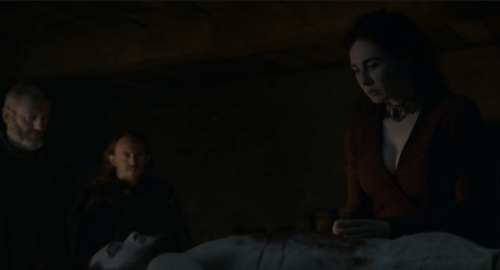
Leave a comment

Filed under Game of Thrones, television

The Wire and Police Militarization

There is a moment in the final episode of season one of The Wire, when the police are about to raid drug kingpin Avon Barksdale’s headquarters, a low-rent strip club. A SWAT team in full military regalia arrays itself on the street, to the contempt of both the criminals inside, and the cops outside. “Look at these Delta-Force motherfuckers, man,” scoffs Barksdale as he watches the SWAT officers on his security cameras as they scurry around outside with their assault rifles. “This isn’t as much fun as I thought it would be,” gripes Jimmy McNulty as he watches from the car, to which Lieutenant Daniels responds, “The SWAT guys do love to break out their toys, don’t they?” “They think they’ve got Tony Montana up there?” McNulty asks, and after a moment he and Daniels leave the car and walk up to the door over the protests of the SWAT members, enter the building, and arrest Barksdale (who knows perfectly well what’s coming) without any fuss.

wire
None of which is to suggest that highly-trained and heavily-armed police aren’t sometimes a necessary evil; but the mockery on display in this brief scene is remarkable for being more or less sui generis in film and television today. Not all cop shows celebrate the paramilitary dimension of law enforcement, but it is practically unheard-of for it to be openly derided. And more and more, this militarization of police forces has become a prominent feature in the depiction of police, whether in the all-too-frequent recourse to assault weapons in shows like Hawaii Five-O, or as the focus of shows like Flashpoint. Since 9/11, the line between films and series about counter-terrorism, and police procedurals has grown quite blurry.

hawaii-five-Oflashpoint dallas_swat
Sadly, this does seem to be one of those cases in which popular culture, as opposed to creating a delusional fantasy about the nature of police forces, is actually just reflecting the current reality, at least in part. On one hand, the diabolical, conspiratorial villains that require Steve McGarrett and company to suit up every week in Maui (who knew Hawaii was such a hotbed of organized paramilitary crime?) are in fact delusional fantasies; but the reflexive recourse by American police to military weaponry is all too real. The New York Times recently posted an interactive map showing counties to which the Pentagon has sold surplus military firearms, armoured vehicles, grenade launchers, helicopters, assault rifles, and other gear. It is truly disturbing.

assault-rifles
Alyssa Rosenberg
has a very astute blog post about the gradual transformation in popular culture of the depiction of the police and policing. In particular, she considers that utopian gem of small-town nostalgia, The Andy Griffith Show, in which Griffith played Andy Taylor, the sage sheriff of the idyllic small town Mayberry. She writes:

Even when it began, executives acknowledged that The Andy Griffith Show was a nostalgic portrait of small-town life. But it expressed an ideal that has leached out of American pop culture and public policy, to dangerous effect: that the police were part of the communities that they served and shared their fellow citizens’ interests. They were of their towns and cities, not at war with them.

In case it’s not painfully obvious from this quotation, the impetus for Rosenberg’s post is the current dire state of affairs in Ferguson, Missouri, which has seen the county police there respond to the civil unrest following the shooting of Michael Brown with what can only be called disproportionate force. What has been most striking—and disturbing—about the images proliferating across the media is not just police militancy, but police militarization: assault rifles, armoured vehicles, and, bizarrely, camouflage fatigues. As comedian John Oliver ironically noted, military camouflage is not exactly functional in an urban space (if they want to blend in with their environment, he snarks, “they should dress like a dollar store”).

Outrage In Missouri Town After Police Shooting Of 18-Yr-Old Man
The ongoing events in Ferguson are deeply depressing, not least because they are bringing so many issues plaguing the U.S. into stark relief, issues that flare up into the public eye from time to time but tend to disappear unless one makes a point of paying attention: racial inequality, systemic racism, police brutality and an increasing lack of accountability for it, the rampant militarization of police departments across the country, and the general obliviousness of white America to all of the foregoing. If Ferguson seems at times bewildering, I suspect it is (in part) because all of these ugly factors are on full display.

I am hardly an expert on any of this. What professional interest I have in writing this post is the same as Alyssa Rosenberg’s, which is to say how popular culture reflects and inflects what we’re seeing on the news. Her point about Andy Griffith and Mayberry admittedly deals with a utopian image of America that likely never actually existed for anyone but oblivious prepubescent white boys in rural towns, but her central observation is spot on: that what we’re missing in the present day is the conception of police as being of their communities as opposed to against them.

In a trio of blog posts about Ferguson, David Simon quotes Orson Welles’ terribly apposite adage that police work is only easy in a police state; I’m tempted to say that “police state” is in fact a contradiction in terms, as what it really refers to is a state in which martial law is the status quo, and that is the antithesis of policing. And I cite David Simon here, because I don’t think there has been a more eloquent and trenchant argument for this principle than The Wire. In what is perhaps my favourite moment from the show, police Major Bunny Colvin (Robert Wisdom) dresses down Sergeant Ellis Carver (Seth Gilliam) for not understanding this basic principle of policing. He tells Carver that he’s a good man and a decent administrator, “But from where I’m sitting, you ain’t shit when it comes to policing.” Why? Because Carver is all about making petty arrests, cracking heads on the corners, and keeping his numbers up … but he knows nothing of the neighbourhoods, about who is running things, or what is generally going on. He has no informants and no allies. “Don’t take it personal,” says Colvin. “It’s not just you, it’s all our young police … the whole generation.”

The speech that follows—which happens toward the end of season three, just past the midpoint of the series as a whole—is as close to an articulation of The Wire’s main thesis as we get. Click the link above and watch the clip (embedding, unfortunately, is disabled on it), but it is worth writing it out:

This drug thing, this ain’t police work. No. It ain’t. I mean, I can send any fool with a badge and a gun up on them corners to jack a crew and grab vials … but policing … I mean, you call something a war, and pretty soon everyone’s gonna be running around acting like warriors. They’re gonna be running around on a damn crusade, storming corners, slapping on cuffs, racking up body counts. And when you’re at war, you need a fucking enemy! And pretty soon, damn near everybody on every corner’s your fucking enemy. And soon, the neighbourhood you’re supposed to be policing, that’s just occupied territory …
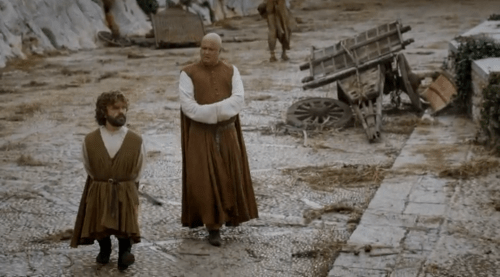
Soldiering and policing, they ain’t the same thing. And before we went and took a wrong turn and started up with these war games, the cop walked a beat. And he learned that post. And if there were things that happened up on that post, be they a rape, a robbery, a shooting—he had people out there helping him, feeding him information. But every time I come to you, my DEU sergeant, for information, for finding out what’s going on out in those streets? All that came back was some bullshit. You had your stats, you had your arrests, you had your seizures. But don’t none of that amount to shit when you’re talking about protecting a neighbourhood, now.

The Wire is, specifically, about the War on Drugs and its lamentable failures, but it is also a show about the dissolution of community bonds that begins to negate the very concept of community. What’s happening in Ferguson right now has little to do specifically with the War on Drugs, but everything to do with the way in which that transformation of the relationship between police and neighbourhoods has made the current unrest not so much possible as inevitable.

7 Comments

Filed under maunderings, television

24, the CIA, and the Fantasy of Hyper-Competence

I’ve been watching 24: Live Another Day, a so-called “event series” of 24 that brings back everyone’s favourite gravelly-voiced secret agent, Jack Bauer. I’ve watched 24 since its third season (and have since watched the first two on DVD), and it is difficult to pinpoint when my interest morphed from “hey, exciting TV show” to something more academic. Certainly, it was the academic interest that saw me through some of its terrible later seasons, for even when the show got repetitive and (oddly) lugubrious, it always functioned as a fascinating window into a terrified zeitgeist that imagined terrorist threats in increasingly absurd and outlandish ways.

new-trailer-and-poster-arrive-for-24-live-another-day-159450-a-1395819178-470-75

“So, what does it take to be an uber-agent? Training? Tactical brilliance? Ruthlessness?” “No, it’s mostly just shouting.”

Watching the newest season (really a half-season, though I suppose they can’t very well rebrand it as 12), I am struck anew by the way the show rests on the foundation of a sort of symbolic arms race, in which the terrorists possess increasingly sophisticated technology and apparently unlimited funds, which they employ in increasingly, ludicrously, complex and intricate plots against America. Arrayed against such threats is the CTU (Counter Terrorist Unit) and, in Live Another Day, the CIA, which possess something resembling omniscient surveillance capabilities and the technological savvy to instantly hack almost any electronic system for information and/or more surveillance. This panoptical apparatus and its operators’ preternatural technological ability (as embodied in the savant-like Chloe O’Brian) is tacitly justified by the terrorist du jour’s own sophistication and resources. A typical 24 plot would never be concerned with a bunch of foreign nationals attending flight school in, say, Florida; it would instead feature terrorist hackers taking over air traffic control communications, or, in the case of the current season, taking control of American drones.

Michelle Fairley, aka Catelyn Stark, as the most recent alpha-terrorist on 24. See? I told them there's be serious blowback from the Red Wedding.

Michelle Fairley, aka Catelyn Stark, as the most recent alpha-terrorist on 24. See? I told them there would be serious blowback from the Red Wedding.

All of the apparatus of an electronic surveillance state is present but unremarked: 24 would be unthinkable without it. And yet, it is invariably vulnerable. In every single season of 24, CTU’s omniscient technology proves insufficient to deter whatever attack is afoot. It falls instead to the indomitable Jack Bauer, whose instincts and intuition almost always trump the conclusions of legions of intelligence analysts.

24 has such an odd paradox at its center, one that is something Fredric Jameson would call a symbolic resolution, in fiction, of an intractable real-world contradiction. On one hand you have the implicit faith in the panoptical surveillance state—and not just faith, but the tacit understanding that such apparatus is necessary and indeed a given, something so universally understood as reality that there is no question of it being, well, questioned. And let’s be clear on what this means: though all we ever see of it are the dim offices of a subterranean CTU station, it represents a vast and omnipresent governmental reach with apparent impunity to spy on both citizens and foreigners. On the other hand, I don’t believe there has been a single season of 24 in which Jack Bauer hasn’t gone rogue in some capacity, because working within the confines of the “law” (however egregiously attenuated it might be) straitjackets Jack and prevents him from doing what has to be done.

Hence, 24 has always been equally invested in pervasive and invasive government and the need to escape it. It’s really no surprise that 24 is a favourite of neoconservatives, as it articulates that contradiction at the heart of their creed: the desire for American omnipotence co-existing with an ideological antipathy to “big government.”

And while the series’ main ongoing controversy—and its most egregious and troubling element—has been the use of torture as a legitimate means of extracting actionable intelligence, more subtly pernicious is the depiction of Jack Bauer’s preternatural competence, as well as that of CTU. This is not, of course, anything different from the dozens and hundreds of films and television shows about espionage and clandestine military ops—from James Bond to the Smoking Man to every film about elite commandos ever, the appeal of these stories lies in their illusion of mastery and control and the unerring accuracy of intelligence, intuition, and interpretation.

Legacy_smpbAll of which is, of course, a patent fallacy. I probably wouldn’t be writing about all this if I hadn’t recently read a history of the CIA, Legacy of Ashes (2007), by Tim Weiner. It might as well have been subtitled “A History of Abject Failure,” given that it is a brutal chronicle of the CIA’s chronic ineptitude, from the opening salvos of the Cold War to the clusterfuck that was the catastrophic intelligence failures of Iraq. Much of Weiner’s source material is reams of documents that were declassified in 2004-2005, so the story he tells is not only a new one but decidedly at odds with the way the agency has been depicted in popular culture, and how it depicted itself. Depending on when the CIA has been depicted in film, fiction, or television largely determines whether it is portrayed as malevolent or heroic; but one way or another it has tended to appear as a ruthlessly efficient operation, sometimes riven by internal rivalries and discord, but always a terribly efficacious tool in the service of either good or evil.

The reality of its history as detailed by Weiner is one in which failure, incompetence, and willful institutional blindness are the norm. If the agency has been consistently good at one thing, it is the ability to whitewash those failures, spin them as successes, and burnish its reputation as an omniscient and omnipotent force for American security and freedom.

Weiner starts his book by noting that the CIA was founded for the sole purpose of intelligence aggregation and analysis. Harry Truman basically wanted a small agency whose job would be to present him on a daily basis with a snapshot of what was going on in the world. The agency that developed, however, was very quickly hijacked by men far more interested in covert operations: who instead of keeping tabs on international communism and other threats, saw themselves as freebooters whose job was to actively combat these threats and work to roll them back. As the Cold War took shape and the USSR emerged as the United States’ principal antagonist, their energies went into clandestine skirmishes. They never succeeded in providing the president with what he most desired: a window into Soviet operations and a reliable intelligence that would warn of an imminent nuclear threat.

In fact, the first two hundred pages of Legacy of Ashes reads not so much as a comedy of errors as a tragic farce. It took the CIA over a decade to realize that the Soviets had spies riddling both American and British intelligence. In operation after operation, they trained refugees from behind the Iron Curtain (and in the Korean War, South Korean nationals) in combat and intelligence gathering and dropped them into enemy territory. The failure rate for these operations was one hundred percent, as the enemy knew precisely when and where these drops would take place and often had men there waiting for them. The hapless agents were imprisoned and tortured (if they weren’t summarily shot on sight), and either turned by the KGB or executed. Ten years the CIA bloody-mindedly continued … and that is only a single story from Weiner’s six hundred page litany of incompetence. As he remarks about the early, enthusiastic forays of the fledging agency, the United States was childishly blundering into a world of espionage that Russia had been playing like a chess master for two centuries.

homeland

When I watched Homeland for the first time, my initial thought was that here was a series that functioned in part as a corrective to 24—it approached the questions of nation, identity, faith, and loyalty (as well as the business of intelligence-gathering more generally) with a nuance and complexity alien to 24. And yet in the aftermath of reading Weiner’s book, it becomes obvious that even Homeland manages to completely overestimate the CIA’s efficacy and competence.

The figure of the elite soldier or agent backed by a technologically sophisticated agency has become increasingly commonplace in popular culture. James Bond might have blazed the trail, but you see his progeny strewn throughout film and television. I don’t care to speculate on why precisely—that’s a post for another day—but we’ve moved far away from the images of the grunt and the common soldier which dominated war films until the first post-Vietnam movies introducing us to the likes of John Rambo started to focus on the elite, hypercompetent soldier to the exclusion of mere mortals. On one hand, such musclebound commandos as portrayed by Stallone and Schwartzenegger were an obvious overcompensation for America’s symbolic emasculation in Vietnam; but I’m also tempted to say it becomes bound up in the delusions of conspiracy theory that pervaded the 1970s and afterward, so beautifully summed up by Don DeLillo in his novel Libra:

If we are on the outside, we assume a conspiracy is the perfect working of a scheme. Silent nameless men with unadorned hearts. A conspiracy is everything that ordinary life is not. It’s the inside game, cold, sure, undistracted, forever closed off to us. We are the flawed ones, the innocents, trying to make some rough sense of the daily jostle. Conspirators have a logic and a daring beyond our reach. All conspiracies are the same taut story of men who find coherence in some criminal act.

Certainly this figuration of conspiracy is what animates 24—the specter of such “cold, sure, undistracted,” perfect schemes perpetrated by “silent nameless men with unadorned hearts,” which cannot be countered with anything so wishy-washy as legal or democratic means.

That is the fantasy, and yet everything we learn from history teaches us otherwise. I’ve never actually met a real 9/11 Truther (at least none who have declared themselves as such), but my counter-argument would have nothing to do with the ostensible physics of building collapses, and everything to do with the simple question “Do you honestly think that the Bush Administration would be competent enough to pull something like that off?” In the aftermath of 9/11, Elaine Scarry wrote a remarkable essay titled “Citizenship in Emergency” which did a wonderful job of taking down all our assumptions about the “fast response” capabilities of the military and civil defense and arguing that there was only one response to the terrorists’ attack that succeeded: the ad-hoc resistance of the passengers on United 93.

The more I dwell on this topic, the more it bothers me, and the more I come to believe that the fantasy of hypercompetence, while appealing as a popular trope, is also culturally pernicious. It affords the delusion of precision and exactitude in spheres of action that are inherently chaotic and unpredictable. It is why Wayne LaPierre’s mantra “the only thing that can stop a bad guy with a gun is a good guy with a gun” is just so much horseshit. It assumes that the good guy with the gun will unerringly put down the bad guy as opposed to adding to the carnage with shots that go wide of the target. Even highly trained peace officers or soldiers, when put in the crucible of a firefight, can’t shoot with the innate accuracy of a nickelodeon gunslinger; what are we to expect of a well-meaning citizen whose only experience firing his weapon has been on the gun range? When two police officers in Manhattan fire sixteen rounds at a man with a gun and succeed in wounding nine bystanders, the comforting idea that a firefight can be contained sort of goes out the window.

On the other hand, if we all get together and be reasonable about the topic, we can come to the comforting conclusion that the uber-terrorists of 24 are just as much of a fantasy.

Leave a comment

Filed under maunderings, television, what I'm reading

Game of Thrones 4.10: The Children

GameOfThrones_Teaser02_Screencap10All men must die, and all television seasons must end. Alas.

Welcome to the final installment of this season’s Chris and Nikki Game of Thrones co-blog, in which we take the most recent episode, pick it up by its ankles, and shake all the golden dragons and silver stags out of its pockets.

Let us all observe a moment of silence for all the newly dead characters.


OK. Done? Good. Are you seated comfortably? Then we’ll begin.

mance_jon

Christopher: Well, as finales go, this one was pretty sweet. One of the first responses I read claimed to have found it “underwhelming,” and all I could think was “were you watching the same episode as me?” SO MUCH happened, and with the exception of the fight between Brienne and the Hound, it was all more or less faithful to the novels. Brienne and Sandor’s confrontation is nowhere to be found in the books, but I thought it was a brilliant invention. And one awesome, knock-down, drag-out fight.

My notes have a lot of all-caps and exclamation points.

But more on that later. Before I start by talking about the opening sequence at the Wall, it occurs to me that it might be useful to take stock of where we are in the books. While watching the episode, I realized that Bran’s storyline has just about reached the limit of what has been written, almost to the end of his thread in A Dance With Dragons (book five). Which raises an interesting question: does this mean we don’t get any Bran next season? Or will the series race ahead of the novel? Will the series end up being a spoiler for the novel? I say this on the entirely reasonable assumption that GRRM won’t have produced The Winds of Winter before next April. But I invite George, nay, beg him to prove me wrong on that point …

Jon Snow isn’t anywhere near the end of his story yet—there’s room left in A Storm of Swords (book three) and quite a lot to get through in Dragons. Ditto for Stannis, as his storyline is now basically interlaced with Jon’s. Brienne’s case is a bit harder to discern, as her encounter with the Hound is invented; but I’d say she’s about halfway through A Feast for Crows (book four), which is actually quite far along, as she only features in Dragons for about a nanosecond.

The King’s Landing crew have a lot of story to go, as we’ve basically come to the end of Swords. There’s a lot of Jaime and Cersei to get through in Crows, and Tyrion still has all of his story in Dragons yet to come. Daenerys et al are now about a quarter of the way into Dragons; and Arya has just finished Swords, so she has all of Crows still to go. Theon is about halfway through Dragons; and … I think that’s all? Dear gods, but there are a lot of characters in this series.

All right, enough accounting! to the Wall! Turns out I was dead wrong in predicting that Jon Snow disappearing through the gate would be the last we’d see of him this season (though as one of your commenters pointed out, that much was made clear in this episode’s preview. Oops). And we FINALLY see Mance Rayder again. Ciaran Hinds is so good in the role, it’s a shame they’ve used him so sparingly: his entire parley with Jon Snow was understated but powerful. I seem to recall repeatedly using the term “gravitas” to describe him last season, and that is still the case. He’s got Morgan Freeman levels of gravitas.
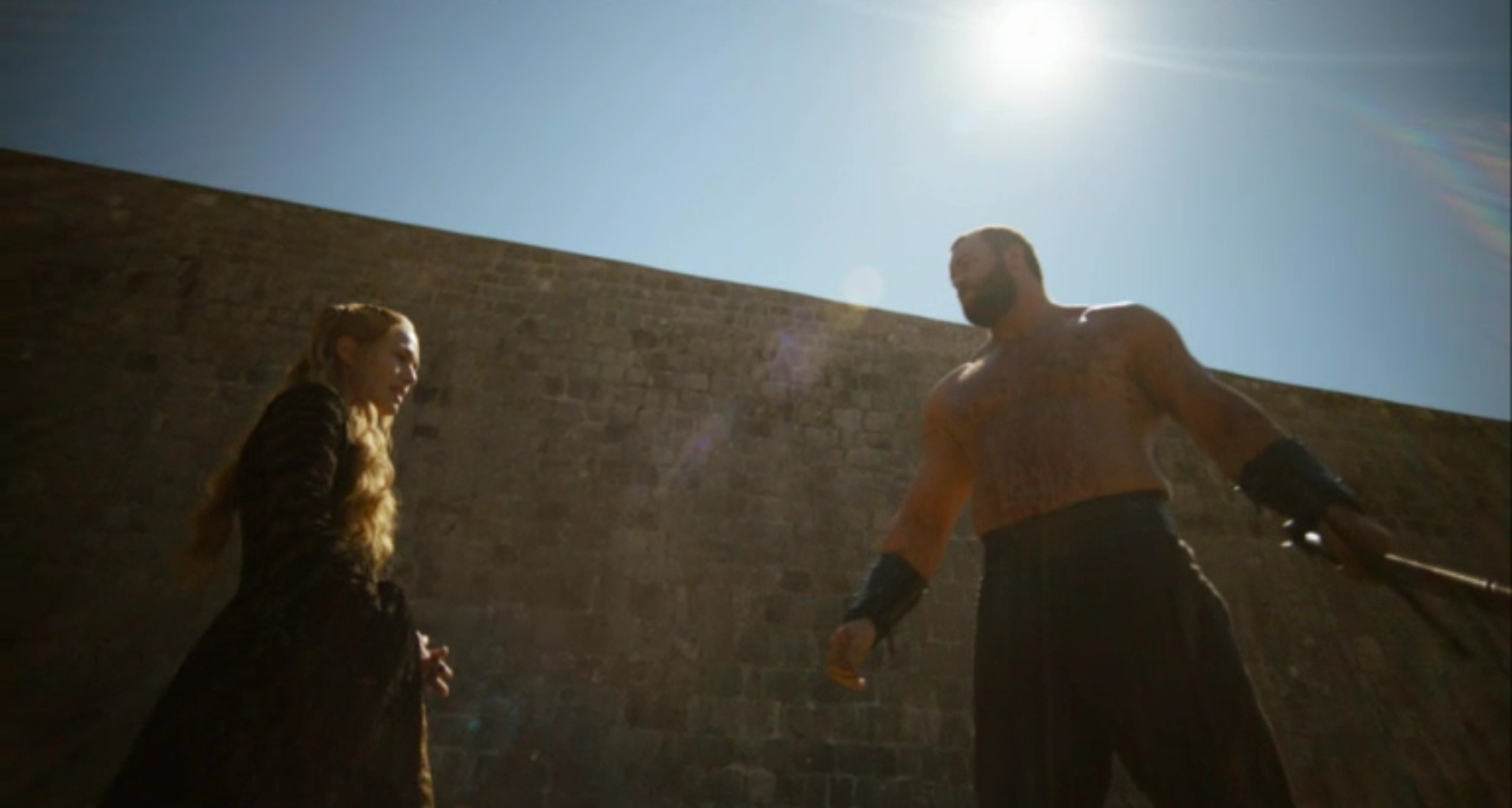
The scene between Jon and Mance unfolds more or less the way it does in the novel, with Mance being surprisingly calm when he sees the man who betrayed him. He does not behave peremptorily or rashly, but sits down to the parley as if with a guest, and drinks to the memory of Ygritte. We soon learn the reason for his calm: he knows now just how weak the Watch are, and is confident in his eventual victory. But he also raises a terrifying truth that has been lost in the buildup to this battle: that the wildlings do not seek conquest, but “to hide behind your Wall.” Mance was able to unite his factious army because they are all terrified of what is coming. And he makes Jon an offer that is at once reasonable and impossible: let his people come through the gate, and he promises peace.

Of course, it isn’t long before Mance gleans Jon Snow’s true intent, just in time for the deus ex machina to descend. Stannis! I didn’t mention it last week, but the simulated crane shots have been extraordinary: last week we were treated to a god’s-eye view of the Wall on both sides of the battles; this week, a beautiful shot of Stannis’ forces trapping Mance in a pincer maneuver.

I’m curious: how much of a surprise was this for people who haven’t read the novels? It’s a surprise in the book, but one where you remember an earlier scene and think “Oh, right …” While Davos is learning to read, he reads one of the pleas for help the Night’s Watch sent out to the Seven Kingdoms, and so we know he brought it to Stannis. Was there a similar moment I missed in the series? Or was there no hint that Stannis et al would be heading north?

Thoughts, Nikki?

stannis-inquisition

Nikki: It was a COMPLETE surprise to me. I’d like to preface my part here by saying I’m on vacation in San Francisco right now, and ended up having to watch the episode on my laptop at an airport gate in Detroit, gasping and clapping my hand over my mouth and trying to cover the screen because my travelling companion has only seen to the end of season 3 and I didn’t want to reveal anything. So my bits this week might be unfortunately short because I’m trying to fit them in between sightseeing, but I do hope we’re able to spark some interesting conversation amongst all of you, and I hope to get involved in that with you!

Anyway! Back to the episode. YES it was a complete surprise and thank you for mentioning the overhead shots, Chris; I actually paused to write in my notes: “overhead view of the army’s approach is GORGEOUS.” I’ve really enjoyed the CGI overhead views, even if they are a wee bit sped up (if you consider the actual speed of the movement from the air, they should be moving a little slower than they are, but they have them moving at about 300 miles per hour. As they approached the Wall last week they were going about 100 metres per second) but otherwise it’s just amazing.

riders01riders02riders03Ciaran Hinds is amazing, as you say. He tells Jon Snow that his people have bled enough, and when Stannis’s army comes barrelling into the forest, he screams it and demands his men stand down: “I said my people have bled enough, and I meant it.” Davos does his usual bow before the one true king of the Seven Kingdoms spiel, but Mance will have none of it, telling them in no uncertain terms, “We do not kneel.” But then Stannis sees Jon Snow, and when he discovers exactly who this man of the Night’s Watch is, he speaks to him with respect; a respect that is returned by Jon.

And from there we move to the Lannisters. Cersei demands once and for all that she not be betrothed to Loras, because she needs to stay with Tommen. For everything we’ve thought and said about Cersei all along, for everything she has done and all of the misled actions she’s taken (not the least of which is her hatred for Tyrion and the utterly ridiculous origin of it), her impassioned speech about her children and what they mean to her, and how she will NOT have Tommen taken from her really made me sympathize with her. She might be a terrible sister and a complicated lover and a terrible wife, but she is a devoted mother, and always has been. In that, she has never wavered.

And now she will do anything to keep them, including coming clean with Tywin and finally telling him what he did not want to hear: that she and Jaime are lovers, that the children all belong to him, that not a one of them is a Baratheon, and “YOUR LEGACY IS A LIE.” A brilliant scene that was a long time coming, that even had some humour in it when Tywin begins one of his fables and Cersei cuts him off, sying, “I’m not interested in hearing another one of your smug stories about the time you won.” Ha!! A lot has been done this season to make us sympathize with her in the face of her demonizing her brother and putting him on trial, and this scene was the best.

cersei

However, it’s sandwiched between two other scenes: a mysterious scene where they seem to be Frankensteining The Mountain back to health, where Pycelle is begging them to stop and Cersei and her medic kick Pycelle out of his own laboratory.

And then after Cersei has done her bit to reanimate The Creature, and does her best to give Tywin a stroke (and, in the moment, put a nail in her own coffin, I thought) she goes to visit Jaime to tell him what she’s just done. As he tries to push her away she tells him that she loves him, that she wants to stay in King’s Landing with him, that she will not marry Loras and the two of them will raise Tommen. And Jaime melts before her, immediately throwing her down upon a table and having her the way he once did. Is she manipulating him? At this point she’s pissed off Tywin epically, and needs someone on her side, and who better than the Kingslayer, even if he only has one hand? The Lannister stories this week were obviously the biggest game changers, consisting of the Cersei arc contained in these three scenes, followed by… well, we’ll get to those ones.

Just as things are shifting in King’s Landing, Daenerys has more people complaining in her court, realizing she’s brought more destruction and hardships to the people through her “freedom” than they perhaps lived with before. What did you think of these scenes? And is it just me who watches these dragons and thinks they act like my cat? 😉

dragons02

Christopher: Oh, I’ve always thought the dragons are catlike—which makes them all the more terrifying. I’m totally a cat person, have loved cats all my life, but have few illusions about the fact that the only thing that prevents my cat from eating me is that he’s too small (which isn’t to say he doesn’t try). It was a bitter finale for Daenerys: confronted with her failings as a leader and compelled to chain up her children. I actually threatened to tear up a bit as she walked out of the catacombs: she knows exactly what she’s doing, what she has to do, but that isn’t exactly something that’s going to be clear to the two dragons she’s just put iron collars on and left in the dark. It’s a lot like that confused look your cat gives you through the cage door of his carrier when you leave him at the vet (yes, almost exactly like that).

But the problem of dragons rampant—which, after all, was not exactly unpredictable—is actually the lesser of Daenerys’ problems this episode. She’s learning a hard lesson that any casual student of history could have told her, namely that revolutions have a bad habit of turning into their opposites, and the more radical the revolution the more violent the regression. She has upended a way of life centuries old—it’s not going to conform to her idea of how it should be just because she demands it.

supplicant

This is one of the places where George R.R. Martin is at his most discomfiting: in making Daenerys the champion of freedom and scourge of slavers, he gives us what appears at first blush to be an unequivocal good. We are so primed by popular culture to reflexively celebrate any and all chain-breaking—and how can we not?—that it’s an easy narrative trick. It’s why Django Unchained is so viscerally satisfying but, on reflection, so deeply problematic; and it’s why so many narratives of this sort, from Glory to Mississippi Burning function more as symbolic salves to white guilt than any sort of substantive discourse on race and the unhealed wound of slavery. Both GRRM and Game of Thrones have come in for criticism on this front, as last season seemed to leave us in an all-too-typical white saviour story, with silver-haired Daenerys literally afloat on a sea of adoring brown bodies.

daenerys 2

It was a cringeworthy moment. But to GRRM’s credit, he doesn’t end there, as so many of these narratives do—Daenerys has her triumphs, but now has to face the uncomfortable fact that simply saying “you’re free!” doesn’t automatically make everyone’s lives better, but opens up a whole bunch of new cans of worms. The plight of the elderly tutor speaks directly to this: what is he to do now? Daenerys’ new order, he laments, is the domain of the young. And even if she is able to better police her city, what use is freedom to a man who has never known anything but bondage? It is a quandary more fully described in A Dance With Dragons—the fact that, while many slaves have labored in pain and monotonous torment, many others have led relatively privileged lives as tutors, servants, and concubines and courtesans. Still others are the Mereen equivalent of gladiators, and have known fame and glory in the fighting pits. All of which is further confused by the simple fact of a culture-wide version of Stockholm syndrome: the elderly tutor, he avows, has grown to love the children he teaches and the family that owned him.

And Daenerys is also learning one of the other cruel lessons of leadership: soul-destroying compromise. She allows the man to effectively sell himself back to his former owners, with the proviso that it is only for a year—an entirely symbolic gesture, as Barristan is quick to point out, saying that “the men will be slaves in all but name.” The sequence of her locking up her dragons bitterly echoes her compromise with the old tutor, with its long, lingering shot of the chains she’ll use to imprison her children—the breaker of chains resorting to chains.

Meanwhile, north of the Wall, Bran and company finally arrive at their long (long!) sought-after destination … and in the process give us some truly thrilling moments as a small army of really dessicated ice zombies burst from the snow. This is where caps and exclamation points really start peppering my notes: “Ice zombies! SKELETAL ice zombies! HODOR! FIREBALLS! WTF?” (as you can see, my measured and thoughtful responses to any given episode only come when I’ve had a lot of time to reflect). What did you think of Bran’s “arrival”?

skeleton2

Nikki: Jeebus Creebus. My notes are: “Bran – Hodor – WTF moment!!” I have no idea what the hell any of that was, and it was clear this will be the new thing that will be explained more next season (they always drop one of those babies in there for us in the finale). I thought the image of the tree was breathtaking, with the leaves moving in an almost unearthly way, with the sun hitting them just right.

And then, of course, the path to that tree was fraught with Skeletor’s outcasts. What. The. Hell. Was anyone else thinking Ray Harryhausen in that moment?

I thought the scene itself was spectacular; the fight scenes were extraordinary (my GOD they’ve kept all their big-budget stuff til the end of the season, haven’t they?! As you pointed out, we also got the tabby dragons). As Jojen gets mortally attacked and Bran transfers his soul into Hodor to fight the baddies, we suddenly get Firestarter standing in the mouth of the cave, shooting fire bombs at the skeletons and ending them.

Who the heck is she?

Why did she wait so long to fight back?

How does she know who they are?

Are the children a group of supernaturals who remain perpetually young like little fire-throwing vampires? I’m really looking forward to finding out.

“The first men called us The Children, but we were born long before then,” she tells Bran. When they came into the cave and the Flamethrower told them that Jojen knew all along he wasn’t going to make it, and that he was leading Bran to the thing he’d lost, I half-expected to see Ned Stark sitting in the winding tree (I’ll admit a tiny bit of regret when he wasn’t). Instead we see an ancient man who has been watching him “with a thousand eyes and one” all their lives, who tells him that he will never walk again, but he will fly. Bran’s story is at times the most boring and uneventful in both the books and the show, but it also leans to the supernatural the most (along with the Wall stories), and this twist sent it into a new realm of possibility.

As did the scene with Arya/Hound/Brienne/Podrick. I’m disappointed that the Hound and Arya were just back wandering the countryside, and as you said last week, that they weren’t actually taken up to the Eyrie. You pointed out that they never get that far in the books, so now it becomes some clumsy writing served to get Arya super close and take it away from her again.

But you know what, none of that matters, because how much did I love Arya and Brienne meeting for the first time?! FANTASTIC.

I loved last week’s battle, but frankly I think the throw-down this week between the Hound and Brienne was FAR more fun to watch. And it was tense, because I kept hoping that one of them wouldn’t die, that he’d gain respect for Brienne’s fighting skills, or that Arya would see she’s a good person or Podrick would speak to Arya or SOMETHING but it was still amazing to watch. I mean… she bloody well Holyfields him, for goodness’ sake!!

I think I could hear you cheering as I watched it, Chris. I’m sure you adored that fight scene as much as I did.

brienne

Christopher: Of all the changes the series has made to the books, this one was easily the best. And it was heartbreaking … however much the Hound has, against all odds, ended up being Arya’s protector, I doubt there is anyone who would doubt that Brienne would be better. Their initial conversation before the Hound shows up shows just how good a fit they would be—women who reject the role the world would impose on them and embrace a life of fighting and violence. Brienne’s story about her father actually brings a smile to Arya’s face … and then the Hound appears, and it becomes obvious that a fight is unavoidable.

Brienne’s moment of recognition is a wonderful bit of subtle acting by Gwendoline Christie. “You’re Arya Stark,” she says softly, and her voice and facial expression are both wondering, even a bit awestruck. However seriously she takes her oath to Catelyn, she of course recognizes what a fool’s errand this quest to find the Stark girls is. And yet, here is Arya—and she knows a moment of triumph she never has in the novels (thus far), only to have it snatched away by Arya herself.

Because of course nothing is simple. We know precisely how honourable she is (she has Stark-levels of honour), and how dedicated she would be to keeping Arya safe. Jaime Lannister himself wants her find the Stark girls and keep them far, far away from his sister and the dangers of King’s Landing. But the very name of Jaime Lannister is toxic and poisons beyond repair any hope Brienne had of winning Arya’s trust—as does the simple fact that she failed in her job to protect Catelyn.

BRIENNE: I wish I could have been there to protect her.
ARYA: You’re not a Northerner.
BRIENNE: No. But I swore a sacred vow to protect her.
ARYA: Why didn’t you?
BRIENNE: She commanded me to bring Jaime Lannister back to King’s Landing.
HOUND: You’re paid by the Lannisters. You’re here for the bounty on me.
BRIENNE: I’m not paid by the Lannisters.
HOUND: No? Fancy sword you’ve got there. Where’s you get it? I’ve been looking at Lannister gold all my life. Go on, Brienne of fucking Tarth—tell me that’s not Lannister gold.

A meta version of this scene might include Brienne cursing the name of George R.R. Martin for having made these interwoven stories so complex that there is no easy answer to the Hound’s accusation. Yes, it’s Lannister gold. But no, I’m not in their pay. Though when you get down to it, I’m out here looking for the Stark girls because Jaime Lannister urged me to. And he’s actually not so bad a guy when you get to know him. Did I mention he saved me from a bear? And he gave me this priceless Valyrian steel sword because he was pissed off at his dad? Which … oh, this is awkward … it’s actually made from your dad’s sword, Arya. Oops.

Yeah … kind of a hard thing to talk around.

And then there’s the Hound, whose motives are pretty inscrutable at this point. What precisely does he want? He’s pretty much out of ways of monetizing Arya at this point. He could sell her back to the Lannisters, but that would mean his own death; he could take her to the Wall and Jon Snow, but there’d be no payday for him. When Brienne promises to take Arya to safety, he all but laughs in her face: “Safety? Where the fuck’s that? Her aunt in the Eyrie is dead. Her mother’s dead. Her father’s dead. Her brother’s dead. Winterfell is a pile of rubble. There’s no safety, you dumb bitch. You don’t know that by now, you’re the wrong one to watch over her.” And is that what the Hound is doing, Brienne asks with an incredulous curl of her lip. “Aye, that’s what I’m doing.”

Is that what the Hound is doing? Does he honestly now see himself as her protector? Would a more caring relationship have developed? Is he genuinely protecting Arya from what he believes is a Lannister flunky? Or is he just so vindictive when it comes to the Lannisters that he can’t countenance letting them have the victory of capturing Arya? We will never know.

The fight that ensues is at once thrilling and horrifying, with none of the finesse of Oberyn’s ninja-like leaps or Syrio’s elegant water dancing. This is sheer strength and brutality, and is likely far more realistic than anything you’re likely to see in popular film and television … and when it comes down to life and death, there are no holds barred. The Hound grasping the blade of Oathkeeper while the blood runs down over his wrist was nothing if not a representation of the lengths he’ll go to win, and Brienne’s long, sustained scream as she repeatedly pounds the rock into the Hound’s face sent chills down my spine.

hound_sword

And the ear-biting? Yikes. I’m very glad, in hindsight, that I did not see this bit of interview with Gwendoline Christie earlier in the season, or I’d have been wondering precisely when the ear-biting would happen in this episode. I’m rather glad that came as a surprise.

And she loses Arya, who unsurprisingly doesn’t trust her … but who also seems to prefer to strike out on her own. And we see here just how cold Arya has become: calmly watching the Hound suffer, not flinching at all the terrible things he says in an effort to goad her into killing him … or possibly make her feel less guilty about killing him? He knows he’s dying, that there is no saving him “Unless there’s a maester hiding behind that rock.” But she doesn’t move, just watches him, as he passes from trying to anger her to encouraging her to end it, and finally to abject begging. But Arya chooses to let him die slowly, and I think a lot of us died a little inside to see that she has learned to be cruel.

Which is only appropriate, as the final shot of the season is her on a ship bound for Braavos, presumably to seek out Jaqen H’ghar and start her apprenticeship as an assassin …

arya_ship

“I’m on a boat!”

Which brings us to the last two big scenes of the episode. Tyrion is rescued by his brother, and sent on his way to freedom in the Free Cities by Varys, who finally makes good on his promise to remember Tyrion’s heroism in saving the city. This is a slight deviation: in the novel, Varys is forced by Jaime.

The larger deviation is how Tyrion leaves things with his brother. Remember way back, when Tyrion told the story of how he impulsively married a village girl named Tysha when he was thirteen, but after a week of connubial bliss, Tywin caught them and revealed that she was a whore Jaime had paid so Tyrion would lose his virginity? And then had an entire guard-room of Lannister soldiers take turns with her for a silver a fuck? And made Tyrion go last and pay a gold piece, because Lannisters are worth more? Remember that horrifying story?

In the novel, just before they part, Jaime reveals to Tyrion that Tysha wasn’t actually a whore—she was just what Tyrion had believed her to be, a girl who had genuinely fallen in love with him. Jaime had lied to him back then at Tywin’s behest. So … well, their parting in the novel is somewhat more acrimonious.

But then, Tyrion does not go directly to Varys, but detours instead through the chambers of the Hand. Aaaaaand I think I’ll turn it over to Nikki for the wrap-up, as this is one of those moments eagerly anticipated by readers of the books when we get to see those who haven’t read them lose their shit.

Nikki?

tyrion_shae

Nikki: The viewers weren’t the only ones who were losing their shit. (And no, that’s not the last of the Tywin-on-the-toilet jokes I plan to make.)

WOW. What an ending. First, Tyrion ventures into Tywin’s bedroom and finds none other than Shae entwined in the sheets, which actually made me think of the Tysha story in that moment (perhaps that’s how they were trying to bring that story back into the fold but keep Jaime a sympathetic character?) Just as Tywin took Tyrion’s new bride and then had his soldiers gang-rape her, now he has brought her back to King’s Landing just to have her betray Tyrion, break his heart, and make him lose any desire for living, before taking her back to his chambers and turning her into his own whore, with her lying languorously on the bed and purring “my Lion,” thinking it was Tywin who had come back into the room.

Aaaaawwwkward ...

Aaaaawwwkward …

But it’s those two words that prove her undoing. For as much as Tyrion might have been able to forgive her for what she did in the courtroom — after all, the last time he’d seen her he told her he didn’t love her and she was nothing but a common whore — seeing her turn to his father and sleep with him as willingly as she’d ever slept with Tyrion is the final blow. Not only does he kill her, but he does so with his own hands, using the very gold that Tywin had no doubt laced around her neck as a reward for betraying Tyrion.

And Tyrion’s not done. He goes to Tywin and finds him in the “privy,” in a very vulnerable position. And then his Number Two son points a crossbow at him (I told you I’d get another toilet joke in there…). Just as Cersei tried to unnerve him earlier by telling him that his legacy was dead and that his only two “honourable” children were in fact incestuous lovers who’ve given life to three children — one of them a monster — Tywin looked calm, and simply said it wasn’t true. He didn’t leap forward or grab her by the throat . . . that’s not Tywin’s style. Nah, he was just going to send some men out later and have her done away with, or poison her (unlike Mance Rayder, I could see him pulling such a “woman’s weapon” on her), or worse, find out something that gives him the upper hand, and then force her to sit by while he slowly takes over as the true king of Westeros and just uses Tommen as his puppet.
tyrion_crossbow

But Tyrion isn’t going to give him the chance. He finds him on the toilet and tells him that he just killed Shae with his own bare hands. Tywin practically rolls his eyes as he tries to pull up his pants, once again dismissing one of his children as being useless. Cersei never had the guts to fight back at him as he sent Myrcella away or calmly lectured Tommen on what makes a good king while standing over the corpse of her other son. She had no say when he demanded she marry Loras. Jaime takes the verbal blows from Tywin on a regular basis, begging for Tyrion’s life and banishing himself to Casterly Rock, the way his father needs him hidden away because of his physical deformity. And Tyrion has been brought down again… and again… and again… and AGAIN… by Tywin, and never fights back.

Not any more.

Tyrion: All my life, you’ve wanted me dead.
Tywin: Yes, but you refused to die. I respect that, even admire it. You fight for what’s yours. I’d never let them execute you, is that what you fear? I’d never let Ilyn Payne take your head. You’re a Lannister. You’re my son.
Tyrion: I loved her.
Tywin: Who?
Tyrion: Shae.
Tywin: Oh, Tyrion, put down that crossbow.
Tyrion: I murdered her, with my own hands.
Tywin: Doesn’t matter.
Tyrion: Doesn’t… matter?
Tywin: She was a whore.
Tyrion: Say that word again.
Tywin: And what, you’ll kill your own father in the privy? No. You’re my son. Now, let off of this nonsense—
Tyrion: I am your son, and you sentenced me to die. You knew I didn’t poison Joffrey, but you sentenced me all the same. Why?
Tywin: Enough. Go back to my chambers and speak with dignity.
Tyrion: I can’t go back there. She’s in there.
Tywin: You afraid of a dead whore—
SHUNK!!

When that first arrow zinged out of the crossbow, with Tyrion looking no more unnerved than Tywin ever does, I gasped out loud and clapped a hand over my mouth. Tywin can’t believe it. With his pants still around his ankles, he falls off the commode and onto the floor as Tyrion calmly loads his weapon a second time. “You shot me!!” Tywin says, completely shocked. Finally, one of his children has the guts to stand up to him, but it’s only to send an arrow through his heart. “You’re no son of mine,” he hisses. “I am your son. I have always been your son,” he says, then sends a second, fatal arrow into his father as the mournful strains of “The Rains of Castamere” begin to play in the background.

Sorry, I just have to say it: Tywin is having a truly shitty day.

An absolutely astounding scene that changes everything. Who will be the Hand of the King now? Will it be Jaime? Will Cersei and Jaime be able to do something better for King’s Landing with Tommen as king? Or will it be worse?

Varys greets Tyrion with a tense, “What have you done?” before quickly leading him into a shipping crate. “Trust me, my friend. I’ve brought you this far.” He loads him onto a ship and begins to walk back to King’s Landing before hearing the alarm bells go off. And then he quickly calculates the hope he has of surviving there with all of the death throughout the castle — ie, none — and walks onto the ship to sit next to Tyrion’s crate.

Tyrion has been let go, and any outsider will take one look at Tywin’s chambers and believe Tyrion really was the monster they said he was. Cersei wanted Tyrion dead, and she’s now aligned with Jaime, but it was Jaime who broke him out. How will that go? Where is Tyrion headed? Will Brienne ever find Arya? If she does, will Arya be too far gone by that point?

Will Hodor ever learn a second word?

A brilliant, spectacular ending to an incredible episode.

Thank you to everyone who has been following us thus far. We’ve written some pretty long posts here, and maybe next season we’ll aim to shorten these puppies a tad. I really appreciate everyone tuning in to the trials and tribulations of Westeros. We will meet again for season 5.

Valar Morghulis.

1 Comment

Filed under Game of Thrones, television

Game of Thrones 4.09: The Watchers on the Wall

GameOfThrones_Teaser02_Screencap10

Welcome once again to the Great Chris & Nikki Game of Thrones Co-Blog™, wherein we take the most recent episode and spread it out against the sky like a patient etherized upon a table. This week: it’s All The Wall All The Time, as the long-expected attack by Julius Caesar Mance Rayder descends on the Band of Buggered known as the Night’s Watch. It was an episode that featured some pretty impressive visuals, some awesome fist-pumping moments, and the writers snuck in some equally impressive writing. Those scamps.

But without further ado—want to lead us off, Nikki?

jon_sam

Nikki: You know, I never thought I’d see anything more impressive than Legolas sliding down the side of a tower while shooting arrows at the enemies at Helm’s Deep, but seeing the Night’s Watch guys suddenly pull a gigantic scythe that had been long hidden in the side of the Wall and pummel the hell out of the wildlings scaling the side of it? Holy hell. Turns out the reason we haven’t seen much of the dragons this season (I mean, seriously, where DOES Daenerys keep those beasts? Do they just fly around randomly through Meereen scaring the hell out of the local children?) is because they poured 92% of their CGI budget into this one episode. And what an incredible sequence it was.

I don’t recall another episode of Game of Thrones that focused entirely on one area, one battle; they always touch on other things and then come back to the battle at the end of the episode. I could be wrong, but I think this is the first time we get to focus on one story and one story only, Chris, and it was a nail-biter.

With the death of Oberyn looming over us from last week, I kept wondering who was going to die in this one. Samwell Tarly? Jon Snow? Ygritte? Gilly? Someone had to die, after all. After we discussed last week how GRRM has upended our expectations over and over again, does his flipping of convention actually become the new expectation? Do we now go into every scene thinking, “Um… yeah. Jon Snow ain’t walking away from this one…” and then GRRM manages to flip THAT expectation? I just don’t know how to handle any of it anymore, but in creating this “will he or won’t he” atmosphere around his writing, GRRM has effectively managed to make his episodes seem very realistic. Just as in real life, you never know who’s going to return from battle and who won’t. He will take out the main character just as easily as the guy playing “Sentry #13.”

I'm starting to think the Night's Watch should really institute a "shoot all birds of prey on sight" policy for the sentries atop the Wall.

I’m starting to think the Night’s Watch should really institute a “shoot all birds of prey on sight” policy for the sentries atop the Wall.

Aside from the awesome effects in this episode (the giant had a bow that shot spears like they were arrows WHAT THE HELL) I think my favourite scene may have been the one between Maester Aemon and Sam. This is when Sam still thinks Gilly is dead from the attack on Mole’s Town, and Aemon tells him how difficult it is to see straight when you are in love. “Love is the death of duty,” he tells him, and he’s pointing specifically to Jon Snow falling in love with Ygritte, or Sam falling in love with Gilly. He tells Sam that he was in love with, and in this gorgeous moment he looks off in the distance and says that he can still see her in front of him, “she’s more real than you are.” Aemon is legally blind, from what I can tell (I believe he can still see shadows and such) and because he can no longer see the world around him in the present, he instead looks upon the beauty of his past. And in the midst of this moment of calm before the storm, he says to Sam, “Nothing makes the past a sweeter place to visit than the prospect of imminent death.”

This one scene then has a huge impact upon our expectations of the rest of the episode. Will Jon see Ygritte and fail to do his duty? Will Sam shirk his duty for Gilly? And whose death will be imminent?

Though she be small, she is fierce.

Though she be small, she is fierce.

And yet, not surprisingly, love is not the death of duty for Sam. He loves Gilly and hides her and the baby away in a locked room, but refuses to stay with her. He has made a vow, and he intends to stick by it, even as a man lay dying in his lap with blood gushing from his mouth. He knows he also has a duty to Gilly, but his vow as a man of the Night’s Watch comes first, and he never runs off to hide, unlike Janos Slynt, who goes into shock and rushes into the room. (And to be honest, I felt like if he’d jumped into the fray the Night’s Watch might have accidentally mistaken his bald pate for a Thenn, so… he was probably better off cowering in that room.)

And similarly, we saw Jon Snow abandon Ygritte despite his feelings for her, because he had to get back to the Night’s Watch and tell them what he’d seen. Love wasn’t the death of duty for him, either, although we do see in this episode that when he should have laid waste to the wildling girl, he hesitates.

The flip side of Aemon’s speech is Tormund talking about sex rather brutally, and Ygritte staying focused on her one and only task at hand: killing Jon Snow. As Tormund talks about “Sheila” and Sam asks Jon, “So… what’s it like?” in a very Monty Pythonesque way (nudge nudge wink wink) we realize that when it’s time to go into battle, the mind turns to that from which it derives pleasure: namely sex and love. Do those things make us weaker in the face of battle, or stronger?

What did you think of this episode, Chris? Did it play out in a similar fashion in the book?


I wonder how many men of the Night's Watch have had their lips get frozen to this horn ...

I wonder how many men of the Night’s Watch have had their lips get frozen to this horn …

Christopher: Well, to start with, you’re forgetting season two’s spectacular episode “Blackwater,” which focused exclusively on Stannis’ attack on King’s Landing and Tyrion’s brilliant defense of the city. So we do have precedent for Game of Thrones ignoring all storylines but one in order to depict a massive battle. And I think you’re right about the dearth of dragons this season: this episode outdid “Blackwater” by a mile, and treated us to the kind of eye-poppingly sophisticated CGI one rarely sees on television, but that doesn’t come cheaply.

As for its consonance with the book, it changes a few key details. For one, Toramund’s assault on Castle Black is not coordinated with the assault on the Wall. In the books, there is no stockade on the south side of the Wall, and so Jon Snow and the Watch defend themselves from the tops of scattered towers, and from a makeshift barricade at the base of switchback stairs built into the Wall (in the novels, the “elevator” is not the only means of getting to the top). Ygritte dies in the fight, but we don’t see it happen. Jon finds her afterward just as she dies—with just enough time to remember the cave and say one last “you know nothing, Jon Snow”—and wonders whether it was his arrow that killed her.

"Perhaps I will introduce you to the Hammer. And by 'hammer,' I mean ... well, actually, this literal hammer."

“Perhaps I will introduce you to the Hammer. And by ‘hammer,’ I mean … well, actually, this literal hammer.”

Also, his friends Pyp and Grenn don’t die in the book: that one took me by surprise, and saddened me somewhat. Neither of them plays a large part in the series, and if you haven’t read the books you could be forgiven for not noticing them as distinct from any of the other watchmen. But as with so much of the casting on this show, the actors playing them were perfect for the parts, and I will miss them. (And it raises a question we’ve asked before about whether choices in the series are spoilers for the unwritten books—does this mean that Grenn and Pyp play no significant roles in the end? Or perhaps GRRM planned for them to, but will now incorporate their deaths into his writing? I’m pretty certain we’re in unprecedented territory here. It’s pretty fascinating, really).

The other significant difference is that in the novels the battle takes place over several days, with Jon Snow proving his mettle as a battle commander. When there is a lull in the fighting and Mance Rayder settles in for a protracted siege, that is when Janos Slynt arrives from King’s Landing with Alliser Thorne, who had been at Eastwatch-by-the-Sea, one of the Night’s Watch’s other fortresses, and takes arrogant and preemptory command. On Thorne’s urging, he has Jon Snow thrown in chains for having betrayed his oaths with the wildlings; and it is Slynt (again, on Thorne’s urging) who sends Jon to parley with Mance Rayder with the suicidal mission of killing him—in order, he smugly says, to prove Jon’s loyalty.

jon_alliser

So the series has compressed the action somewhat, which is not a bad thing, and in having Janos Slynt arriving at the Wall MUCH earlier, they turn him into a quivering, cowardly lump. Ser Alliser, by contrast, is made somewhat more sympathetic: I quite like what they did with him in this episode, having him admit to Jon Snow his error in not heeding his advice to block the tunnel, and then delivering a short speech on the nature of leadership that, in the absence of Maester Aemon’s speech, would have been the best bit of writing in the episode:

Do you know what leadership means, Lord Snow? It means that the person in charge gets second-guessed by every clever little twat with a mouth. But if he starts second-guessing himself, that’s the end—for himself, for the clever little twats, for everyone. This is not the end. Not for us. Not if you lot do your duty for however long it takes to beat them back. And then you get to go on hating me, and I get to go on wishing your wildling whore had finished the job.

I loved this—there’s no love lost between Thorne and Jon Snow, and if they survive the battle there will be no sudden bonds of affection and friendship between them. But Thorne, unlike his ally Janos Slynt, is a true soldier, and will put aside his petty hatreds in the name of duty. It is actually the flip side of the coin of Maester Aemon’s speech to Sam: love is the death of duty, but then so are other passions. Say what you will about Alliser Thorne, but he understands that hatred will sabotage his ability to do his duty as much as Sam’s love of Gilly, or Jon’s of Ygritte.

And then he goes on to show that he’s a guy you totally want having your back in a fight.

Like “Blackwater,” this was an episode that balanced some fine writing against some pretty spectacular action sequences. There were a number of fist-pumping moments for me, most notably when the burning oil lights the giants up like a torch, and when Jon Snow mashes the Thenn’s head in with a hammer. What got you cheering in this episode, Nikki?

The very definition of an "oh, shit" moment.

The very definition of an “oh, shit” moment.

Nikki: As I was typing the words “I don’t recall another episode of Game of Thrones that focused entirely on one area…” I thought to myself, “Did Blackwater just focus on that battle?” If I’d looked up our review of it that week, I would have seen that yes, indeed, it did. My mistake.

The enormous scythe probably got the biggest gasp from me, as did that spear the giant shot (that sent a man sailing through the air, off the side of the Wall, down several hundred feet, and impaled onto the ground on the other side… WOW). The two moments you mention were certainly spectacular and brilliantly handled on the show. I loved the archers leaning out and standing horizontally against the Wall, appearing to defy gravity as they shot their arrows straight down at the wildlings scaling the side of it (and when the oil exploded and broke the one man’s rope I will admit a scream emitted from my mouth). The sheer numbers of the wildlings as they appeared in front of the Wall, complete with their “fairy-tale” allies, made me think this was going to be a very quick battle, and I was thrilled that the Night’s Watch managed to stand their ground, even if it’s for one night only, as Jon Snow proclaims.

I agree entirely with your assessment of Ser Alliser. For everything I was saying a few weeks back on what a prick he is and what a dumbass he is for not listening to Jon Snow when Jon told him to seal the tunnels, he not only admits to his mistakes here, but fights like a true warrior when he hits the ground.

Yep, Ser Alliser's got some game.

Yep, Ser Alliser’s got some game.

Probably the biggest fist-pumping scene for both my husband and me is when Sam unleashed Ghost. YES. The direwolves are always exciting to watch and have been since back in season 1, and the doggie-cam style of showing him working his way through the action and then choosing one guy to take down was brilliant.

I also wanted to mention that I thought the music was phenomenal in this episode: they reused that long scary blast music that first played as the Thenn came marching through the valley toward the wildlings, and it was overlaid with bits of the Game of Thrones theme music, the wildling music, and the music often used for the Night’s Watch. Just utterly brilliant music here.

I will admit there were times when we were a tad confused by the layout of everything (so… Mole’s Town must be north of the Wall because the wildlings were already there and massacred it, which means Castle Black is also north of the Wall? So from the south all you can see is the Wall itself, but the Castle is located on the northern side, is that correct?) but it didn’t stop the action one bit.

Jon Snow, leading. Not to be confusing with Jon Snow, brooding. Or Jon Snow, constipated.

Jon Snow, leading. Not to be confusing with Jon Snow, brooding. Or Jon Snow, constipated.

So, with the Night’s Watch’s numbers depleted but Castle Black still standing, Tormund in captivity, Ygritte and the Thenn leader dead, Slynt in severe shock, Ser Alliser wounded but still alive, Gilly safe in Castle Black for now, Sam having had his first kiss (awwww), and the giants dead after the men of the Night’s Watch held the gate, as Jon Snow had asked them to do… Jon is going to head off into the wilds north of the Wall and find Mance Rayder and end all of this, he says. Earlier in the episode, Gilly made Sam promise to come back, and he made that promise… and kept it. Now Sam watches Jon go — sans sword — and says to him, “Jon? Come back.” Part of me is terrified Jon won’t. But I’m assuming with so much focus on the Wall and what’s north of it in this episode, this might be the last we see of Jon Snow until season 5, and next week we’ll conclude the rest of the action in Westeros.

Of course, this final back-and-forth between Sam and Jon had me asking one very big question: where the hell was Mance Rayder? I remember when Ciaran Hinds was introduced as Mance last season and you were giddy, Chris (not least because he’s Julius Caesar to us) and then… nothing. He’s never there, he’s utterly absent from the battle, and he’s just disappeared from the action all this season. I haven’t read this book, so perhaps there some explanation there I’m missing, but it just felt like he should have been there in some capacity. If he was the one who brought them all together, after all, why isn’t he there fighting with them?

Any final thoughts, Chris?

mammoth

Christopher: Mance is there, just not leading from the front. I assume that was, in part, just an issue of scheduling and pay … there wouldn’t have been much Mance this season anyway, so why pay an actor for a few-minute cameo in the penultimate episode? I say that, of course, knowing that we might see him in the finale, but I’m going to guess that you’re correct—we won’t see the Wall again until next season, as there is simply too much to tie up in the rest of our storylines.

I think you’re confused about the geography because you’ve momentarily forgotten that Tormund, Ygritte, et al are in fact south of the Wall. They climbed over the Wall last season with Jon Snow (as he reminds us in this episode) and have ranged pretty far south in the raiding as they wait for Mance’s signal. Castle Black is south of the Wall; Tormund’s group comes up on them from the south.

I too was thrilled by Sam releasing Ghost. We haven’t seen much of him this season, but he’s had two really great moments—taking out Rast at Craster’s Keep, and then again in this episode. Having a direwolf on your side goes a long way to evening the odds.

ghost

One thing I quite liked about this episode is Sam’s evolution as a character. John Bradley has never played him precisely like the Samwell Tarly of the novels—he’s always been more gregarious, less timid, and far less cowardly. Though I like the Sam of the novels, his incessant cringing and whining makes him difficult to take at times … and while on one hand it’s a welcome change from uniformly dour and courageous male heroes, one does start to lose patience with him. But Bradley’s Sam has evolved—starting out cringy and whiny, but slowly coming into his own as he endures hardships and dangers that would reduce most of us to jelly. They’re precisely the same hardships and dangers he endures in the novels, but Sam as written never quite toughens up. His speech to Pyp as they wait at the gates for the wildlings to attack is another lovely moment of writing, imbued with Sam’s self-awareness of how he’s changed. In the moment he killed the White Walker, he was “nothing”—and that is when fear disappears. So why was he afraid now? “I’m not nothing anymore,” he replies, and those words speak both to Sam coming into his own as a character, but also his realization that he loves Gilly. In other words, he has something now to live for.

In many ways, this was a very deftly written episode for one that was basically a massive battle. The themes of love, leadership, and duty run through it, and far from being three separate concepts they are shown to be inextricably entwined. Jon Snow’s fumbling attempt to explain how sex and love feels at the start is inadvertently quite eloquent: “It’s this whole other person … you’re wrapped up in them, they’re wrapped up in you … for a little while you’re more than just you … Oh, I don’t know, I’m not a bleeding poet!” Oh, Jon—you were almost there. You almost had it. Jon’s description is the opposite of Sam’s when he tells Pyp about becoming nobody. It makes me think of the final line of Philip Larkin’s poem “An Arundel Tomb,” in which the otherwise cynical and bleak poet concludes that “What will survive of us is love.” Maester Aemon might characterize love as the death of duty, but he acknowledges its power … and we see that on Jon Snow’s face when he’s confronted by Ygritte pointing an arrow at his chest. The smile the crosses his face is enigmatic—at once chagrined but, as you observe Nikki, also delighted. It’s as if he’s thinking “Of course you’re the one who’s going to kill me,” but at the same time acknowledging that if he’s going to die, he’s happy she’s the one to do it.

ygritte-bow

Would she have shot him if Olly hadn’t beaten her to it? I had halfway expected her to put an arrow into Alabaster Seal while Jon was fighting him, at once saving his life but also following through on her earlier threat. We’re never given the answer of whether she’d actually have killed Jon this time … but then, perhaps, some questions should not be answered.


Well, that’s it for this week, folks! Thanks for reading, and always remember to uncage your direwolf before the battle. Tune in next week as Nikki and I put our fourth season of Game of Thrones to bed. And I promise you this much: once again, the internet’s gonna get broke.

jon-gate

1 Comment

Filed under Game of Thrones, television

Game of Thrones 4.08: The Mountain and the Viper

 GameOfThrones_Teaser02_Screencap10Well, my fellow Westerosi, we’re almost all the way through now … two more episodes to go, and as always we wonder just how much more killin’ GRRM has in store for us. So once again, here we are again–that is to say, me, and my dear friend whose house sigil is the crossed stakes under a mysterious island, the one and only Nikki Stafford–to murder and dissect another installment of Game of Thrones. And in Nikki’s case, have a small tantrum.

So, without further ado …

ygritte

Christopher: This episode gave us some really lovely moments, albeit moments bookended with blood and brutality. The attack on Moletown unfolded with predictable violence and gore, with Ygritte being as ruthless as any of her fellow wildlings … until she sees Gilly hiding with Little Sam, at which point she chooses to spare the mother and her child. Would she have been so merciful without the presence of the infant? My guess is no, but it is also likely that she alone among her company would have acted in this way. One can only be relieved the infant was not discovered by one of the Thenns. ::::shudder::::

Ygritte’s moment of mercy is important on two fronts: first, it reminds us that however determined she is to revenge herself on Jon Snow, she is a basically decent person and not, unlike some of her comrades, an outright psychopath. But secondly, it also reminds us of how interconnected all these characters are. Nothing in Westeros happens in a vacuum, and everything ultimately touches everyone in some way or another—and, as we see later with Ser Jorah, past sins can still burn you. Ygritte’s act of mercy is done in ignorance of whom Gilly is, but in this moment we see the woman in love with Jon Snow saving the life of the woman Jon Snow’s best friend saved (and, let’s be fair, is in love with), along with the life of the child who bears Sam’s name. Again, would she have been so merciful had she known? Or would Gilly have found herself taken as a bargaining ship? Fortunately, we don’t have to find out.

It is a moment that does not occur in the novel. This episode’s departures have been very interesting, for reasons I’ll get to as we go. In this case, it is just a little deviation, one presumably designed to keep Ygritte sympathetic (not that hard, personally speaking—she’d have to become a lot more evil for me not to like her). But when we cut to the black brothers morosely sitting around a mess table berating themselves for their helplessness and reminding themselves that they can’t ride out to meet the wildlings, it does make you wonder: what was Sam thinking? It’s not like he didn’t know there were wildlings south of the Wall when he sent Gilly to Moletown, and it’s not as if the attack WASN’T COMPLETELY INEVITABLE. I understand his fear that Gilly was in danger from assault from the less honourable members of the Night’s Watch, but Moletown wasn’t much better—and as we saw in the first few minutes of this episode, it doesn’t appear that the women of Moletown were inclined to be kind and protect her. Considering Sam’s obvious ambivalence about sending her away, it makes no sense to have done it—except that it gives Ygritte her moment of humanity. A nice moment, to be certain, but in the end an unusually clumsy stumble on the part of the writers.grey worm

They do however redeem themselves. An unlikely romance seems to be developing among Daenerys’ people (the West Wing watcher in me wants to call them her “senior staff”). In a weirdly crocodilian moment, Grey Worm peers over the surface of the water at Missandei as she bathes. After a moment, she becomes aware that she is observed. You know how there are so many moments when this show employs gratuitous nudity? This, I would argue, is a good example of thoughtful, thematically significant nudity, and it all rests in Nathalie Emmanuel’s wonderful face acting, as she moves from innocent surprise to confident display to the sudden thought that perhaps she should be more modest. I can only speak for myself, but I found this scene far more touching than it was titillating. And the later scene in the throne room when Grey Worm apologizes in broken English (or, I suppose, broken Westrosi) is superb. It could have easily gone the other way—it could have easily been cheesy or twee or just hamfisted, but the writers got it right, and the actors played it with such dignity and subtle emotion that it made for one of the most heartwarming scenes in the series so far.

Because why shouldn’t it be? The obvious question, as tacitly assumed by Daenerys, is “how can a eunuch love a woman? how can a woman love him back?” Coming on the heels of Varys’ blithe assertion of his antipathy to desire (and Oberyn’s bafflement at such an assertion), Grey Worm and Missandei’s obvious feelings for each other continue to complicate assumptions about love, sex, and what is “necessary” to both. Why shouldn’t Grey Worm and Missandei fall in love? Both are products of an institution that systematically dehumanizes people, treats them like beasts and property, and is in and of itself fundamentally unnatural.

What did you think of that scene, Nikki?

missandei_greyworm

Nikki: It’s only reading your take on it that I suddenly realized there was nudity in this episode. How remarkable is that? I watched that scene, but like you didn’t think it was the usual “woman-being-taken-from-behind-as-Baelish-speaks-in-the-foreground” sort of gratuitousness that Game of Thrones is known for. It serves the plot, and isn’t there for our benefit (despite the fact that she is, without a doubt, stunning) but suddenly shows the Unsullied as having a little more depth than we’d been led to believe. I did love Daenery’s comment, though, wondering aloud if when they castrate the Unsullied, do they take the pillar as well as the stones? Ha!

The scene where Grey Worm comes to speak to Missandei to apologize to her for looking at her was lovely. She tells him that she’s sorry he was cut, but he doesn’t see it that way: if being cut was central to him being one of the Unsullied, and therefore someone who could become Daenerys’s soldier, and therefore someone who could free the people of Meereen from their masters, and therefore someone who is at Daenerys’s side, and therefore is close enough to Missandei to see her in all her beauty… then he’s happy he was cut. Missandei seems torn. She likes Grey Worm, and he shows her respect, and you can tell she’s attracted to him, pillar and stones or no. And so she says, “I am glad you saw me,” and he replies, without any hesitation, “So am I.” Just a perfect little scene in the midst of all this war and treachery.

And… on the flip side of loveliness and light we have Ramsay and Reek. What a scene that was. Good Christ. There was actually a moment in there when I thought maybe — just maybe — Theon is actually playing Ramsay, just a tad. As in, he’s crazy, but not looney-bin batshit crazy.

I was wrong.

reek

After Ramsay pats down his armour and reminds him “Remember what you are and what you’re not,” he tells him to bring him Lord Kenning, who is holding down the place. Theon strides into the castle grounds and it was in that instant I thought, “Reek couldn’t possibly pull this off; he’s still Theon.” And then Kenning questions that this sniveling creature before him could possibly be the son of Balon Greyjoy . . . and the veil drops and we see he really was acting. His eyes dart all over the place, he can’t look Kenning in the eye, he hands over the piece of paper without looking at him, he talks about Balon Greyjoy like he’s someone else. And at one point, if you listen closely, Kenning tells him to go back to his people and tell them he won’t deal with him, “whoever you really are” and you can hear Theon sputter and mutter “Reek” … just as Kenning’s man embeds an axe in the back of his head and takes the deal.

You know I’m not a fan of Theon, and never have been, and much of that has been simply not really liking the actor who plays him very much. (I don’t like him in the books, either… he’s a bit of a twat as a character.) At the beginning of this season you said to me that I MUST find sympathy for him now that he’s been reduced to such a deplorable state, and while I thought it was horrible that this was being done to him, I never felt my heart go out to him. Even when Yara tried to save him and realized her brother was dead, and what was left was this pathetic shell, I just shook my head at what had been done to him but that’s about it.

It was that one word that changed everything for me. The way he just said, “Reek” in that tiny little voice when Kenning asked him who he really was… he couldn’t even keep up the ruse, and almost got himself killed by making them think he really wasn’t Theon. And Alfie Allen delivers the line brilliantly, underneath the conversation, at the very moment the axe comes down, and then he jumps as if he’s been jolted out of this moment of clarity. It was the single best Theon scene in the show so far for me. Allen is brilliant (I said it!), and when he returns to Ramsay, it’s like a dog returning to his master, happy to be going home.

Ramsay, on the other hand, is victorious in this scene due to the actions of his misshapen creature, and his father does the unthinkable and makes him a Bolton. No longer a Snow, Pinocchio just became a real boy: Ramsay Bolton, son of Roose Bolton, warden of the North. This scene is significant not just because Bolton dares to do what Ned Stark never did with Jon Snow, but because Roose actually outlines just how gigantic the North really is, and that if you rule the North, you have the largest area in Westeros. Not population, mind you (he only mentions territory) but still, that’s why “King of the North” was such an important title for Robb Stark.

While it turns out Reek wasn’t acting at all, and really has become this pathetic, sniveling creature, Sansa, on the other hand, has shown herself to be a remarkable actor, much to Baelish’s delight. Just as Alfie Allen finally convinced me that he can be brilliant in this role, Sophie Turner — in a single episode — stops being one of Ned Stark’s little girls and becomes an adult, a Lady Macbeth character if ever there was one. You must have loved that scene with her and Littlefinger up against the judges.

sansa

Christopher: It was my favourite scene in this episode, and probably ranks as one of my favourite scenes in the entire series now. This is one of those moments when I should clarify the difference between how the death of Lysa played out in the novel versus how they’ve done it in the show. In the novels, there was a young musician named Marillion who had insinuated himself into Lysa’s service, and who immediately started sniffing around Sansa the moment he saw her. Thinking she was a bastard child of Littlefinger (her cover story in the book), and hence lowborn, he was bold in the advances he made on her, just shy of actually sexually assaulting her. He was present when Littlefinger shoved Lysa through the Moon Door, and he was the one on whom Littlefinger pins the murder—and in the interim between Lysa’s death and the arrival of the Lords of the Vale, has him tortured within an inch of his life until he is so broken that he willingly confesses.

Hence I was curious to see how Littlefinger dealt with Lysa’s death, what story he would come up with. And … I have to say, I found it odd that he went with so lame a story as suicide. One would imagine he would have been more shrewd. So when Sansa launches into her story, telling the Vale Lords the (almost) truth, I totally assumed this was Littlefinger’s play. Certainly, it was masterful: it gave Sansa’s account more gravitas, it depicted Littlefinger as a much-abused hero and saviour, and it left the interrogators with no leg to stand on politically, unless they wanted to ally themselves with the Lannisters.

Beautiful. Masterfully done. Which is why I was utterly gobsmacked when we discover that this wasn’t Littlefinger’s play, but Sansa’s. And in learning that, we realize just how much she has grown and how much she has learned. She reads the Vale Lords perfectly—she knows how to protect herself and how to protect Baelish, and how to, basically, make them an offer they cannot refuse. Perhaps what is most brilliant about her story was how she cleverly exploits the lords’ misgivings about Lysa. She never crosses the line into slander, but just speaks suggestively: “You knew her well, my lords, my lady,” she says. “You knew she was a troubled woman.” And then she proceeds to tell the story pretty much exactly as it happened (except for Littlefinger’s kiss, which was more than just a peck), until the very end. And breaks down in tears.

Applause for Sophie Turner—Sansa has been one of the more thankless roles on this show, but she has played it well so far. And now we see what both Sansa and Sophie have to offer. This speech was pitch-perfect, as was the cryptic look she gives Littlefinger over the old woman’s shoulder. We immediately see how well it all worked in the following scene, as the Vale Lords lose their antagonism to Littlefinger and start slagging Lysa’s memory. “You could see it in the way she raised that boy,” says Lord Royce, suddenly all pompous and authoritative on the topic, “feeding him from her own teats when he was ten years old.” Littlefinger doesn’t miss a trick: he sees his advantage and presses it, reminding them that, once upon a time, the Vale was a force to be reckoned with. Jon Arryn rode to war with Ned Stark and Robert Baratheon. “Since then,” he needles, “all the great houses of the Vale watched from the corner like a timid boy at a tavern brawl.” When Lord Royce bristles, he is quick to defuse the insult, pinning the blame on Lysa’s paranoia and fear—but the suggestion has been planted, and the lords’ honour has been pricked. “Who would you have us back?” he is asked, and he replies “Robin Arryn,” reminding them that sickly boys can grow to be powerful men (and if there is any doubt about the truth of that, look who’s talking). He says what the lords have been longing to hear for years: that it is time Robin was taken with a firm hand and taught to be a man. Whether Littlefinger will succeed is uncertain; what is certain is that he has just made himself the de facto Lord of the Vale, setting himself up as Robin’s regent.

And then! And then we discover that Sansa’s speech had been her idea, and makes possible all of Littlefinger’s subsequent maneuvering. Lady Macbeth, indeed … “Do you know me?” Littlefinger asks her. “I know what you want,” she replies, and the episode leaves what that might be somewhat ambiguous. Does Littlefinger want Sansa? Well, obviously he does—but does he mean to take her as his own, or will they plot together to secure the Vale? When she appears later as Littlefinger tutors Robin, looking more beautiful than she yet has, it is unclear whether she is dressing for Littlefinger’s benefit or Robin’s. Or possibly both—she knows what Littlefinger wants, but will she also be working her charms on Robin? Will she be playing Margaery to his Tommen?

Meanwhile, across the Narrow Sea, Tywin Lannister has thrown a monkey wrench into Daenerys’ inner circle, sending Jorah’s royal pardon to Ser Barristan. The anguish on Jorah’s face as he reads the scroll is heartbreaking. “Let me speak with her privately,” he begs. “You’ll never be alone with her again,” Barristan replies, and so it is to be. What did you think of Jorah’s banishment, Nikki?

jorah02

Nikki: When I watched the Sansa speech, for some reason I believed all along it was her doing. Perhaps it was the look on Baelish’s face. He looked genuinely shaken when she looked at him, apologized, and said she had to tell the truth. And then at the end as she was being embraced, and she looked up at him and he couldn’t even hide the “Wow, you are MUCH more than I thought you were!” look on his face, I just knew it was her doing. How strange that it never even crossed my mind it could have been Littlefinger’s plot the whole time. It makes more sense that viewers would have been led to believe that this was just one more of Littlefinger’s devious plots, or that we’re so used to Sansa being controlled by others that she would continue to be controlled by Baelish, and yet somehow I just immediately assumed this was her stepping up, taking the reins, and realizing after SO long being held captive by the Lannisters that it’s her turn to make the rules. I loved the scene of her walking down the stairs in that dress: it put her in charge, regardless of whom she was doing it for. She’s recognized that she and Littlefinger are the same: alone in the world, and using their cunning to survive.

sansa_stunning

As for Ser Jorah’s banishment, I found it frustrating as hell (not from a writing standpoint, but one of those yelling at the characters to stop what they’re doing moments). Once again Tywin is wielding power from afar by sitting at a desk and writing his horrible letters. The last bunch of letters he sent (that we saw, at least) landed at The Twins, in Walder Frey’s lap, and led to the massacre at the Red Wedding. Recently we saw the Small Council talking about Daenerys’s position and that she had two advisors: Ser Barristan and Ser Jorah. So clearly this is his way of unseating one of them, and leaving her in a vulnerable position. And she takes the bait.

“Why did The Usurper pardon you?!” she demands, and more importantly, “Did you tell them I was carrying Khal Drogo’s child?” Even though she doesn’t say it, you can tell her mind begins working overtime, wondering if the baby and Khal perhaps died because of something Jorah had leaked to her enemies.

jorah

Poor Ser Jorah. We’ve known for some time that he’d been spying (or, at least, some of us gleaned that because my husband, on the other hand, seemed utterly shocked) but that he had also changed by developing feelings and respect for Daenerys, and was now firmly on her side, in her camp. That doesn’t reverse the damage that he’s already done, but he’s far more useful to her as an ally than as an outcast. While she doesn’t always follow his advice, she certainly takes it to heart. In my notes I simply wrote, “Tywin wins again.” For all the mastery she has shown politically and on the battlefield, she’s still a child who can get caught up in emotions. She’s so hurt by his betrayal she doesn’t call for his execution or imprisonment, but banishes him from her sight. I wished she had kept him there in chains and discovered he really was trying to work for her, not against her. When she tells him not to call her Khaleesi, it hurt my heart. I loved those two together, him pining for the thing he can’t have but still loving her and protecting her every step of the way, and she resisting his advice but keeping him close because she always feels safer with him by her side. Jorah’s gone, and Barristan is getting older. Who will be her advisor once they are both gone? Argh, Daenerys. You had this. You had this. You let Tywin take it away. Argh.

Back over to the Eyrie, just as a (now bottle-fed?) bleary-eyed Robin is being led away from the nest, the Hound and Arya are making their way up to see Lysa. It’s just a short scene, but still a standout for Arya’s reaction to the ludicrous events happening around her.

arya_laugh

Christopher: Arya’s hysterical laughter was brilliant. It was also cryptic: whether she’s laughing at the absurdity of the situation, at the Hound for failing to capitalize on his captive, or just at the series of unfortunate events her life has become. The scene is a little odd, however, given that the implicit suggestion is that they’ve been turned away and the Arya-Hound road show will continue … when in reality, having announced her identity as a surviving Stark, wouldn’t she be taken up to the Eyrie no matter what had happened to Lysa? Even the dullest dullard on sentry duty at the Bloody Gate should know that you don’t just let a scion of the North wander off. Perhaps I’m wrong and we’ll see them taken captive by the numerous guards surrounding them, but I don’t see how that happens without a massive deviation from the novels. In the books, the Hound is in fact taking Arya to the Eyrie, but they never get as close as they do in the series.

It was a brief interlude with Arya and the Hound, but we always get quality for our money with them. Their banter is both hilarious and chilling, with Arya lamenting the fact that she wasn’t present to witness Joffrey’s death. “I wanted to see the look in his eyes when he knew it was over,” she said. “Aye,” the Hound agrees, “nothing in the world beats that look.” What an adorable moment of bonding for these two as they agree on the sweetest aspect of killing. Indeed, it seems that killing has become Arya’s main form of satisfaction, enough that she cannot take pleasure in Joffrey’s death at a distance:

ARYA: I thought it would make me happy. But it doesn’t, really.
HOUND: Nothing makes you happy.
ARYA: Lots of things make me happy.
HOUND: Like what?
ARYA: Killing Polliver. Killing Rorge.

The Stark girls would make a good team now: Sansa with the plotting, Arya as the muscle. What is chilling is how she has obviously been devoting a lot of thought to the business of killing: she goes on to call out the Hound’s pride when he declares “Poison’s a woman’s weapon … men kill with steel.” Perhaps she has taken the lesson she learned a few episodes ago to heart: however skilled she becomes with a blade, she cannot overcome armour and brute force with steel. “That’s why you’ll never be a great killer,” she says disdainfully. She has learned a certain brutal pragmatism: use whatever means you have at your disposal.

Speaking of the failure of speed and skill in the face of brute force, we have come at last to this episode’s climactic scene. But before we get to the titular fight between the Mountain and the Viper, we’re treated to a fairly lengthy discussion between Jaime and Tyrion, in which Tyrion remembers his simple beetle-smashing cousin and arrives at a fairly bleak existential conclusion of life and death. The first time I watched this episode, all I could think about was the fight I knew had to happen at the end, and got impatient with Tyrion’s Jean-Paul Sartre schtick. I felt like Milhouse in the Poochie episode of The Simpsons: “When are they gonna get to the fireworks factory!?” But on re-watching, I was impressed with the writing, and with the depth of Peter Dinklage’s soliloquizing. What did you make of this scene, Nikki?

tyrion_kuhn

Nikki: See, because I didn’t know what was going to happen next in that battle scene, I adored this scene between Jaime and Tyrion (but if I’d known what was coming, I would have been exactly like you and Milhouse!). The whole story of his cousin Orson smashing beetles was a brilliant little side story, where we really see the camaraderie between Tyrion and Jaime as they remember their youth. It’s quite the opposite sort of memory than the one we got in the previous episode, where Oberyn talked about how Cersei had tortured Tyrion as an infant. “Laughing at another person’s misery was the only thing that made me feel like everyone else,” he says, and it’s yet another look into Tyrion’s past… one that, if I thought GRRM were actually some sort of sadistic prick, I would think was a clear indicator that Tyrion’s about to get it. But GRRM would never do that to us, right? Ahem.

The story is just left hanging, even as it adds some humour to an otherwise very dark episode. “Far too much has been written on great men,” Tyrion says, commenting on the very centralized theme of Game of Thrones: that it’s about men and women vying for power. “And not nearly enough on morons,” he adds, much to our delight. But just because his cousin was clearly brain-damaged didn’t mean that there wasn’t some purpose to his daily beetle-smashing, at least as far as young Tyrion was concerned. Tyrion had become obsessed by Orson’s actions. “I was the smartest person I knew, certainly I had the wherewithal to unravel the mysteries that lay at the heart of a moron.” He studied him daily, sitting nearby, watching the beetle carcasses just pile up and wondering, why? Why does his cousin do what he does?

And then… the scene just ends. No doubt everyone has their own theory for what Tyrion’s scene meant. Even my husband looked at me and said, “What were we supposed to take from that?!”

But no time for that now, the big fight’s starting! There’s Prince Oberyn, the Viper of Dorne, spitting in the face of the gods and saying that maybe they think it’s his time to die, to which he responds, “Not today.” There’s The Mountain, looming over the action, terrifying Ellaria, who cannot believe someone that massive is actually human. Tyrion is shaking, Oberyn is filled with confidence, the Mountain is focused on murder, and Ellaria begs him not to leave her alone in this world. He ain’t scared: he’s hellbent on revenge.

ellaria_oberyn

Yes, yes, yes, I know I should have learned my lesson by now. Take the convention, flip it on its head, and you can pretty much predict where GRRM is going to take the scene. Ned Stark will NOT be saved at the last minute. Main character? Bah. GRRM farts in the general direction of main characters. Arya Stark will NOT be reunited with her family at the Frey wedding. Butbutbut we’ve watched her try to be with them for so long; even if he massacres them, couldn’t she just, you know, say hello? You son of a silly person, GRRM says, your mother was a hamster, and your father smelled of elderberries. Be off with you.

But I get tricked Every. Damn. Time. And this time, I knew how it was supposed to play out. Prince Oberyn has been waiting for this moment. He’s been roaming the countryside, training, with only one thing in mind: killing The Six-Fingered Man The Mountain. And when he finally gets his chance, he’s supposed to dance around him (check), he’s supposed to shock everyone that he might actually win this one (check). He’s supposed to repeat the same mantra over and over again: “My name is Prince Oberyn, Viper of Dorne. You killed my sister. Prepare to die.” (check… with paraphrasing) He’s supposed to knock him on his back (check) and he’s supposed to kill him.

I said… HE’S SUPPOSED TO KILL HIM. I’m sorry, is this thing on? He. Is. Supposed. To. Kill. Him.

See us? The viewers sitting out here in the audience? In my case, it’s my husband and I, literally on the edge of the couch, cackling and laughing and cheering on Prince Oberyn, knowing he’s the most charismatic and amazing character they’ve introduced since Brienne. We cheer as he knocks him on his back. We chuckle knowingly as Tyrion relaxes for the first time in weeks, as Jaime sits forward and smiles, realizing with shock and awe that David will indeed take down Goliath.

Until Goliath reaches out and reminds Oberyn that he’s nothing more than a beetle. That The Mountain has no mercy. And he will take David’s slingshot and smash it under his baby toe. He will take Inigo Montoya’s sword and break it in half. And then he will take his own thumbs and push them so far into Prince Oberyn’s face that he not only creates what is possibly THE most painful death I’ve seen on the show so far, but then he smashes his head like a fucking melon.

And suddenly the levity of the episode — the scenes with Arya/Hound and Tyrion/Jaime — have new meaning. Arya says that she wishes she could have seen Joffrey die, and is upset that she’s missed it. For her, his death wasn’t enough: she wanted to watch him suffer. But it’s that kind of emotional attachment that makes you lose. Oberyn needed to hear the Mountain fess up, and if he hadn’t pushed the issue and just killed him when he had the chance, he still would have been victorious, and Tyrion would be off the hook (that is, unless the Mountain was playing him the whole time, which is possible but unlikely, since that big hunk of muscle seems to just want to win quickly). Is this some sort of foreshadowing that Arya’s not as safe as I hope she is? And to return to Tyrion and Jaime: Why did Orson smash the beetle? Because he could. The Mountain holds no grudge against Tyrion or Oberyn, and held no grudge against Oberyn’s sister or children. He did what he did because he could, with no more thought in his brain than “Kuhn, Kuhn” just like Orson did.

I forgave you Ned Stark, Mr. Martin. I forgave you the Red Wedding. You made up for it with Joffrey and Lysa, after all. Those were funny deaths. But this. This.

As I said when I sent my first pass to you, Chris, I fucking hate George RR Martin today. It will pass, for it is he who has created this glorious world and I can’t wait to see what happens next, but The Mountain just crushed all hope from the show.

I can’t see how Tyrion could possibly die. Before this episode aired, my husband and I made a (very short) list of people who are the key players, and realized everyone else is just a catalyst, including everyone who has died so far. Our list was Tywin, Stannis, Daenerys, Arya, Bran, and Tyrion. But after this week, who knows. Yes, I’ll still be shocked if Tyrion really is executed after this — he’s the best character on the show — but I probably shouldn’t be.

I know this is usually the final pass on our back and forth, but I wanted to throw it back to you one last time if you had any final thoughts on this, Chris, since this was a key moment in the series.

mountain_viper

Christopher: Well, just to lead off, let me say: I don’t know how much of that fight was done by Pedro Pascal and how much by a fight double, but wow—the Viper has some moves.

In an episode that has some notable deviations from the novels, the trial by combat unfolded almost precisely as GRRM wrote it, right down to the Mountain’s correcting the sequence of his crimes as he crushes the life out of Oberyn. And I reflected, on watching the fight, the same thing I did when I first read it in the novel: that the very lust for revenge that made Oberyn stand for Tyrion is also what causes his downfall. As you say, he can’t let it go—can’t just finish him off and be done with it, but must elicit a confession. Well … he gets the confession, and an entire audience of King’s Landing’s elite hears him say it. But it comes at the price of his life and (we assume) Tyrion’s.

The overtones of Inigo Montoya are so strong in this scene that it seems unlikely GRRM wasn’t being deliberate. Which, when you consider how it ultimately plays out, is very clever … ruthlessly, cruelly, pitilessly clever. In The Princess Bride, Inigo is gravely wounded by the Six-Fingered Man and looks about to lose, but brings himself together in what is one of the great fist-pumping moments in film. Oberyn, by contrast, is never really perturbed—there are one or two moments when the Mountain gets the upper hand, but things never look dire for him until the very end.

As I mentioned above, GRRM has a pretty clear-eyed view of what brute force can do. There was no miraculous escape for Syrio Forel, Arya might as well have been a mosquito when she stabs the Hound, and though Oberyn comes close to defeating the Mountain, all it took was a moment’s inattention. Gregor Clegane is a terrifying manifestation of brutal, unthinking violence. “Do you know who I am?” Oberyn demands. “Some dead man,” he grunts in reply, in an echo of his conversation with Cersei: “Who am I fighting?” “Does it matter?” To which he simply shakes his head. No, it does not matter. The Mountain’s role in the series has been (until now) somewhat more understated than in the novels. It is clearer in the novels that Gregor and his men are one of the weapons in Tywin Lannister’s arsenal. When he wishes to be subtle, he sends letters and wreaks havoc half a world away. When he needs to terrorize his enemies, he sends the Mountain. “Unleash Gregor Clegane and his reavers,” he says at one point in the novels, knowing full well that they will kill, rape, burn, and plunder until the countryside lives in abject terror.

What was cousin Orson doing? He was mindlessly killing, and presumably taking some perverse pleasure in the impunity with which he could do so. I don’t think the point of that story was so much Orson playing the Mountain with beetles, so much as Tyrion’s abject failure to comprehend it. Hopefully Oberyn’s spear proves to be the proverbial mule-kick that ends the Mountain’s mindless smashing.

Any last thoughts, Nikki?

tyrion_despair

Nikki: When my husband first asked me what Tyrion’s scene meant, I said I think it meant that sometimes, things just happen. Orson is pushing at beetles because, well, he’s pushing at beetles. Just as Tywin ended up in King’s Landing while Ygritte is a wildling. We want to attribute meaning to things, we want to say the gods wanted this to happen, but things just happen. Why does one person die of cancer while another one overcomes it? Why do some people feel driven by ambition while others are content with whatever will be, will be? Because they are. Sometimes you have to stop trying to find meaning in things, and know that the gods aren’t playing with us; shit happens. Oberyn could have won that fight, and The Mountain did. Orson doesn’t ask why he smashes the beetles, he just does. The real question that comes out of that scene is, why was Tyrion so obsessed with understanding why?

Maybe he can ask his gods. Because we’re being led to believe, at this point, that he’ll be meeting them soon.

But no matter how many times GRRM Joss Whedons me into sadness, I will still believe relentlessly that Tyrion’s gonna get himself out of this one. He just has to.

3 Comments

Filed under Game of Thrones, television

Game of Thrones 4.07: Mockingbird

GameOfThrones_Teaser02_Screencap10

I think my academic title for this episode would be “Mockingbird: Lysa Arryn and the Effects of Rapid Deceleration Syndrome.” And let me be the first to say, it couldn’t have happened to a nicer gal.

Yup, it’s that time again kids, in which Nikki Stafford and myself throw the most recent episode of Game of Thrones into the mass spectrometer that is our shared brain and emerge with a scientific breakdown of the contents. For real, this is Science™.

Want to lead us off, Nikki?

tyrion

Nikki: This week opens with the Kingslayer and He Who Is Accused of Being a Kingslayer. Poor Tyrion is still reeling from his treatment at the hands of Shae, and doesn’t seem to be clear enough yet to realize that she did what she did out of heartbreak. “Yes, I fell in love with a whore,” he tells Jaime, “and I was stupid enough to think she’d fallen in love with me.” She really did give her heart to Tyrion, despite what he thinks, and he doesn’t realize that he took that heart and shattered it into a million pieces, because if he’d held onto it the way he’d wanted to, she’d be dead. But SHE doesn’t know that he was sacrificing himself to save her, and so she committed her act of pure revenge.

Tyrion had declared at the end of last week’s episode that he wants a trial by combat, and he wants a champion, and that becomes the theme of this week’s episode. Jaime was the one he wanted, and Jaime turns him down. He’s scared, and through his lessons he knows he’s no match for anyone anymore. He was cocky and self-assured at the beginning of the season, knowing he could fight with his other hand better than most people fight with their regular hand, but his lessons have taught him differently. And the Mountain, as we saw in that one grotesque scene, is quite the formidable foe. Poor Tyrion is lost, and tries one last feeble joke on his brother, telling him he’s the golden child, and wouldn’t it be funny to see their father’s face as the family name is snuffed out with one blow. Jaime actually considers it for a moment, but realizes he values his own life, and were he to step into the ring, both he and Tyrion would be dead.

And so Tyrion tries Bronn, the man who was his champion the last time. But Bronn isn’t the sellsword that he once was, willing to step up and fight for Tyrion for a few pieces of silver. Now he’s dressed in fancy clothes and betrothed a woman who will ensure him a castle (as long as he gets rid of the older pesky heir, of course) and has no need for Tyrion and his shekels. “I like you . . . I just like myself more,” he tells Tyrion, reminding him that despite theirs being a friendship that is actually important to him, Tyrion has never risked his life for Bronn. Tyrion resignedly accepts Bronn’s refusal. It’s easy to hate Bronn in this scene — after all, he was nothing but a sellsword wandering the lands before he took Tyrion’s challenge and saved his life at the Eyrie, and made a lot of money doing so. Since then he’s been at Tyrion’s side, receiving favours and being given higher positions of power at King’s Landing due to Tyrion’s continued favours, and along the way has mocked Tyrion’s every move and talked about what a ridiculous family the Lannisters are. And . . . actually, yeah, it is easy to hate Bronn in this scene. And for a moment, I thought they were going to actually attempt a David and Goliath thing when Tyrion joked that he could go up against the Mountain himself. “Wouldn’t that make for a great song?” he says.

I know they're playing with the camera angles here to exaggerate things, but still: holy CRAP that guy is huge.

I know they’re playing with the camera angles here to exaggerate things, but still: holy CRAP that guy is huge.

Until the real champion enters the room. We talked about Oberyn last week, Chris, and what a fantastic character he is, both funny and casual, yet cunning and as full of political maneuvering as the next guy. But there’s a deeper purpose behind Oberyn’s actions: he knows what the Lannisters did to him, and specifically what horrors the Mountain enacted upon his sister, a sister he loved very much. The scene where he tells Tyrion about seeing him for the first time as a baby, a tiny misshapen thing that young Cersei had told him was a monster, is heartbreaking. We all talked about Dinklage’s incredible performance last week, but the one he gives during this scene might have topped it: he doesn’t say a word as Oberyn tells the story, but instead sits there, eyes welling with tears, jaw moving in fixed, clenched hatred of a sister who seemed to have despised him from the beginning, a little girl who would come in and pinch his pink cock, as Oberyn put it, until he thought she’d squeeze it right off and Jaime would have to stop her. Tyrion knows that Cersei has hated him for as long as he can remember, but it’s during this story he realizes she’s hated him even longer. At the trial he told Tywin he was on trial for being a dwarf. Now he realizes that as far as Cersei is concerned, he’s on trial for murdering her mother as well as her son.

“It’s rare to meet a Lannister who shares my enthusiasm for dead Lannisters,” Oberyn says of Cersei. But he’s not on her side. She’s a true Lannister, and one who backs the Mountain as her champion. And if the man who killed his niece and nephew before brutally raping his sister Elia (before slicing her in half with his giant sword) is going to be the Lannister’s champion, he will be the one to fight him.

What a song that will make. I hope they’re singing it for centuries afterwards.

If he does win, I wish he could head north to the Wall and take out Ser Alliser while he’s at it. That guy drives me nuts. What did you think of the non-celebration upon Jon Snow’s return, Chris?

alliser

Christopher: GRRM’s talent for writing hateful characters is nowhere more evident than with Ser Alliser Thorne (well, and Joffrey). His sustained animosity toward Jon Snow is as consistent as it is vaguely baffling … especially when it flies in the face of common sense, as with Jon’s suggestion that they block the tunnels through the Wall. Tunnels can be re-built, but a massive wildling army south of the Wall would do more damage than Thorne seems to want to admit, to say nothing of leaving the Wall breached for the inevitable invasion of ice zombies.

The scenes at the Wall, however infuriating Ser Alliser is, felt a little like a placeholder—we’re in a holding pattern at the Wall, waiting for the arrival of Mance’s army. But then the rest of this episode felt like a placeholder. It was all quite good, don’t get me wrong, unlike the previous two episodes, not much actually happened (until the very end—but we’ll get to that). We do however get a new installment in the saga of Arya Stark’s unsentimental education, and another example of the common folk suffering in the aftermath of the war. “Who were they?” Arya asks the wounded farmer. “I stopped asking a while ago,” he replies, and his calm resignation in the last minutes of his life speaks less to stoicism than to exhaustion. Who were they? It matters not at all whether Lannister or Stark, Ironborn or Northmen is burning your home and plundering your coin. As we learned a few episodes ago, if the farmer had not already been attacked, the Hound would not have been adverse to relieving him of whatever meager wealth he possessed. The war might be over for the nobility, but the common folk still suffer.

The Hound performs what he considers an act of kindness, putting the man out of his misery … only to be attacked by the men who (presumably) are responsible for sacking the farm, one of whom shared a cage with Jaqen H’ghar—a particularly nasty piece of work named Rorge. I was wondering if we were going to see him again, considering that he actually plays a somewhat more substantial role in the novels than he has so far in the series. I was wondering to myself, as he stood facing off against the Hound, “How is he going to escape this now so he can … Oh. OK, Arya killed him.” Apparently she took the Hound’s anatomy lesson to heart (get it? to “heart”? Oh, I kill me), and I think I was even more surprised than Rorge at Arya’s quick little thrust to his chest. I guess they’ll have to introduce another psychopathic killer to play the role Rorge plays later in the story …

What did you think of the ongoing Hound and Arya story, Nikki?

hound-arya

Nikki: Ooh, I’m intrigued by the fact there’s another psychopath later in the books, whether he be Rorge or not. As you say, with the exception of the conclusion a lot of the episode felt like exposition to get us to whatever’s going to happen next, but what I did like about the scenes with the Hound and Arya is that it moved their relationship a little further. As we discussed a few episodes ago, they can’t make the Hound completely sympathetic or he’ll lose the danger he’s supposed to pose to Arya at every turn. However, they can certainly give us some insight into his character and allow us to see things from his perspective. Yes, he could turn on Arya or anyone who does him wrong at any moment, but at least as an audience we’ll understand why.

In season one, at the jousting tournament for Robert Baratheon, Baelish sat with Sansa and told her the story of the Mountain and the Hound. He said it like he was telling a ghost story around a campfire, turning the Monster into a true monster, and it wasn’t clear if he was just telling a story to scare the shit out of Sansa or if it was actually true. (I believe in the books it’s simply stated by the narrator, so you know it to be true, but in the show it wasn’t as clear.) Now we have it stated by the Hound himself: his own brother stuck his face in the fire because Sandor was playing with Gregor’s toy. And much like with Tyrion hearing the story about himself as a baby, here we are reminded that the Hound was a mere child once, being horribly abused by his own brother, and we’re also reminded that he’s human, and that he can be hurt emotionally. As he tells Arya, the pain was bearable, the smell was worse, but it was the fact that his own brother did it — and that his own father covered it up by telling everyone that his bedding had caught on fire, thus letting Gregor off the hook — that showed him where his place was in the world. He has always been alone.

brienne_pod

For me one of the best parts of the episode was when Podrick, of all people, figured out where the Hound might actually be headed after he and Brienne discover that Arya is really and truly alive. I was thrilled when Brienne complimented the cook on his kidney pie and then the camera turned to reveal Hot Pie standing there! We see he’s doing well and thriving as a cook in this pub, and has been able to hone his craft (the bread direwolf that he sends with Brienne is much better than the one he’d made for Arya before). Where before Brienne and Podrick were presented as a comic duo, now we see just how well they work together. Brienne tells Hot Pie the truth about their quest, and where Podrick correctly thinks they should hold their cards closer to their chest, Brienne is the one who’d correctly asserted that Hot Pie was not their enemy and could be trusted. We’ve seen that Podrick is incredibly loyal, worthy in battle when he defended Tyrion and saved his life, and apparently very good with the ladies, but now we see just how brilliant he is when he deduces that if the Hound has Arya he must be taking her to the Eyrie because that’s the only place where he’d get a ransom.

Of course, now all I can think of is that if it’s like any other scene where Starks are about to come together (see Red Wedding and Bran and Jon a couple of episodes ago), either the Hound isn’t going to make it up the hill to the Eyrie or Sansa will have disappeared before he gets there, and Brienne and Podrick will be captured. Oh GRRM, how you frustrate us so!!

Speaking of frustrated, poor Selyse walks in upon Melisandre in her bath and not only has to continue to show her unwavering devotion, but must do so while gazing on the gorgeous body of the woman who has been with her husband. What did you make of that discussion?

mel_selyse

Christopher: Well, first and foremost I was impressed with just how much Tara Fitzgerald has allowed herself to be so dowdied up. Carice van Houten is an extremely beautiful women, to be certain, but so is Fitzgerald—when I first heard she was cast as the unattractive Selyse—who is described as plain, dowdy, and chinless—I wondered why they were departing from the novels in casting someone with Fitzgerald’s striking looks. But they’ve chosen to make Selyse severe and angular, turning her into an ascetic as well as a fanatic. We haven’t seen much of Selyse so far in the series; this encounter went a long way to explicating the power dynamic between the priestess and the would-be queen.

My initial reaction to this scene was to roll my eyes a little, as it first appears to be yet more classic Game of Thrones sexposition (without the actual sex), an excuse to let the camera linger on Melissandre’s naked form while she and Selyse talk. But I think you put your finger on it (that’s what she said) in observing that it works as a goad to poor Selyse, whom we assume to have taken to Melissandre’s religion with such passion to compensate for the fact that there is utterly no passion in her marriage to dutiful, cold Stannis. As I’ve noted previously, in the novels there is no sex between the priestess and Stannis, and I was dubious when, in a moment of rather hamfisted symbolism, she did him on the giant map of Westeros. Then I had about the same thought I had in this scene: that they were introducing this plot point as an excuse to get Carice van Houten naked (as with her seduction of Gendry). To be certain, it does seem that the writers have a bit of a crush on van Houten, as she has replaced Esme Bianco (Ros) as Character Most Likely To Get Naked. But upon reflection, I think that the series has made the relationships on Dragonstone somewhat more complex, and made Melissandre at once more human and more inscrutable. In the books, she is painfully beautiful but also aloof, operating (from what we gather) entirely according to whatever religious impetus brought her to Stannis to start with. The series’ Melissandre appears as slightly more self-interested. Sleeping with Stannis, we begin to suspect, wasn’t merely a religious rite; she has insinuated herself into the life of the man she wishes to place on the Iron Throne, and her conversation with Selyse delineates exactly how the power dynamic now works. Yes, it was a typical bit of Game of Thrones gratuitous nudity; but while van Houten’s nudity means to titillate the audience, Melissandre’s means to intimidate Selyse. As I’ve said before, there are many moments when this show uses female nudity as an assertion of power, such as the scene between Brienne and Jaime in the baths, or when Daenerys defiantly stands and stares down Daario Naharis 1.0. It is significant that part of Melissandre’s monologue deals with the trickery a priestess like her has to engage in: what powders and potions will put on a show for the credulous, but also which ones actually have power. The larger meaning here isn’t exactly subtle: Melissandre knows how to dazzle, how to impress, how to seduce … some tasks require magical assistance, some do not.

Melissandre: A drop of this in any man’s wine will drive him wild with lust.
Selyse: Did you use it with Stannis?
Melissandre: No.

I confess to a sharp intake of breath at this exchange, in spite of the fact that you can see Melissandre’s answer a mile off. Here she asserts her power over Selyse, which is the simple fact that she has power over Stannis, that she inspires in him the lust and desire that Selyse never has. And she goes on to exercise that power, more or less ordering her to bring Shireen with them when they sail. Why? Why does Melissandre want Stannis and Selyse’s unfortunate child with them?

Actually, I’m really asking … because this exchange (to the best of my memory) never happens in the novels.

But from one cauldron of sexual politics to another: it seems that Daenerys has allowed herself to succumb to Daario’s charms. And that’s quite the outfit she’s wearing in the scene: I have written in my notes that I can’t wait to see what Gay of Thrones has to say about it.


Let's just go ahead and call this outfit Daenerys' post-coital lounging duds.

Let’s just go ahead and call this outfit Daenerys’ post-coital lounging duds.

Nikki: HAHAHAHA!!! OMG, I have in my notes, “Well, there’s one more outfit I’ll never be able to cosplay.” I don’t think I’ve ever seen Daenerys in an outfit as revealing as that one, save her birthday suit. And also, no offense to Liam from Nashville, but I just felt like this scene might have made more sense with Daario 1.0. The new guy seems a little too hamfisted to be a Lothario. (That said, when he dropped trou I immediately said to my husband, “So THAT’S what Rayna James has been gettin’.”) Like Melisandre, Daenerys telling Daario to undress comes across as an order — one with which he is all too willing to comply — showing that even the most powerful woman has needs. She will not allow him to control her any more than Stannis controls Melisandre, but she will enjoy her time with him and then send him on his way, which, in the case of Daario, is pretty much all he was looking for anyway. Poor Ser Jorah then sees him leaving the room, and when we talk about sexual frustrations on Game of Thrones, Ser Jorah’s picture really needs to be sitting beside it. It’s clear he’s been in love with his Khaleesi from the get-go, which is why he stays at her side and why he dislikes Daario and anyone else who gets too close to her.

Poor Lord Friendzone.

Poor Lord Friendzone.

In this case, at first Daenerys seems to have learned nothing from Loraq’s visit in the last episode, telling her about how ill-gotten her attempt was to free the slaves of Meereen, and that she’d hurt his father, who was a master but a fair one who tried to get others to treat their slaves fairly. (To which Dany never asked, “But did your father pay his slaves?” If only to have the guy look around and say, “Uhhhhh… oh look over there!” and then run away.) She tells Jorah that she’s sending the Second Sons to Yunkai to slaughter all the masters and free the slaves again. Jorah argues for moderation, she says she wants an end to slavery and will do whatever it takes to get it. However, she tells him, she’s going to send Loraq as an ambassador so he can tell them that “they can live in my new world or they can die in their old one.”

Can this work? We’ve seen what Daenerys has done in Yunkai, Astapor, and Meereen, and word travels quickly in Westeros. Her name will be known far and wide if it isn’t already, and it’s one thing to free the slaves in Yunkai, leave, and have the masters try to restore order even worse than it was before, but it’s quite another to go back to Yunkai, remind everyone who’s boss, slaughter all the masters, and once again free the slaves by showing them someone is looking out for her. Jorah tries to advise her on moderation, and on the one hand he’s absolutely right: the world is not black and white, and there are even slaves who are terrible people, and masters who are good and righteous, but Daenerys isn’t looking to deal with individual will here. As far as she’s concerned there is a world with slavery, and a world without it. Sacrifices have to be made, and if a few good men die along the way to eradicating slavery, so be it: the greater good will endure.

And last but certainly not least we come to the Eyrie, a place of sexual frustration if ever there was one. First we have the exchange between Sansa and her super-creepy cousin, who asks her what kind of a place Winterfell could possibly have been if it didn’t have a moondoor that made people fly, and then Littlefinger reveals the intentions he has on Sansa that we kind of saw coming, and then there’s that spectacular ending.

I will leave the final discussion on this to you, my friend, and will just say that A) I thought the scene between Sansa and Robin was a dream at first because who the hell can pack snow that perfectly (???!!!), B) Sansa’s hair is an even more remarkably red than I thought it was, and C) what I love most about this season is that we’re not having to suffer through a lot of good people dying, but instead we’re getting some true karma here. Although, for as weird and effed-up a child as Robin is, part of me feels sorry for how he’s going to take this news. After all, he still appears to be breastfeeding. :::shudder:::


If she starts singing "Let it Go," I'm outta here.

If she starts singing “Let it Go,” I’m outta here.

Christopher: You’re quite right to observe that the lion’s share of the deaths this season have been people we won’t miss—but they’ve still been quite shocking, most of them, none more so than Lysa. And we’ve still got three episodes left, so expect that butcher’s bill to be added to.

This episode is titled for Littlefinger’s affected sigil: he wears a mockingbird, an eminently appropriate symbol for him, as they mimic the songs of other birds. Littlefinger has proven to be a master of dissembling, of being different things to different people and giving people the songs they want to hear. We see however in this episode that he is also playing the part of the cuckoo, insinuating himself into the Eyrie with Sansa as his ward and, after marrying Lysa—and thus giving himself title to the Eyrie—he disposes of her. We know from hard experience that Littlefinger is playing the long game, and for the most part he plays it utterly unsentimentally (recall his speech, re: chaos, ladder). What’s remarkable about his resurfacing this season is that he seems to be betraying genuine, deep feelings … When Sansa asks him why he really killed Joffrey, he replies “I loved your mother more than you could ever know. Given the opportunity, what do we do to those who’ve hurt the ones we love?” Sansa’s response is to smile: a moment ago when she asked the question, we could see her steeling herself, obviously ill at ease with Littlefinger, on guard. But when he characterizes his murder of Joffrey as vengeance, she allows herself a bit of complicitous satisfaction. She is still guarded, but there is a sense here that Littlefinger has said precisely the right thing. “In a better world,” he continues, “one where love can overcome strength and duty, you might have been my child.”

Engaging ick factor in 3 ... 2 ... 1 ...

Engaging ick factor in 3 … 2 … 1 …

I have previously voiced my ambivalence about the way in which the series has been portraying Littlefinger as an utterly unsentimental, utterly calculating player for whom all those around him are disposable. He has that dimension in the novels, to be certain, but there was always visible a minute chink in that armour where Catelyn was concerned, as well as his past humiliations. That has largely been absent until now, and the Littlefinger we see in this episode proves to be far more complex than he has let on.

None of which is to suggest he isn’t being supremely creepy here. I’m not sure what’s more disturbing—the prospect that everything he has done has been all one big long con of almost algorithmic precision, or that it all proceeds from a perverse psychodrama in which Littlefinger has decided to resolve his past hurts by replacing Catelyn with Sansa. “But we don’t live in that world,” he tells Sansa. “You’re more beautiful than she ever was.” And he kisses her while audiences the world around squirm uncomfortably in their seats … and Lysa witnesses it.

What I like about Littlefinger in this episode is that he manages to be at once sympathetic and creepy, heartfelt and cruel. He doesn’t just shove Lysa out the Moon Door, he makes certain she knows she’s been terribly deceived. “I have only loved one woman,” he assures her, “only one, my entire life,” and for a brief moment she looks mollified. But of course he then stabs her metaphorically through the heart before literally killing her, giving her a terrible last thought to run through her head on the long, long way down.

On the bright side, we’ll never again have to watch her breastfeed her son.

moon-door

Well, that brings us to the end of another episode. Three more to go! As always happens, this season is flying by. So on behalf of Nikki Stafford and myself, have a wonderful week of anticipation.

Spoilers?

Spoilers?

Leave a comment

Filed under Game of Thrones, television