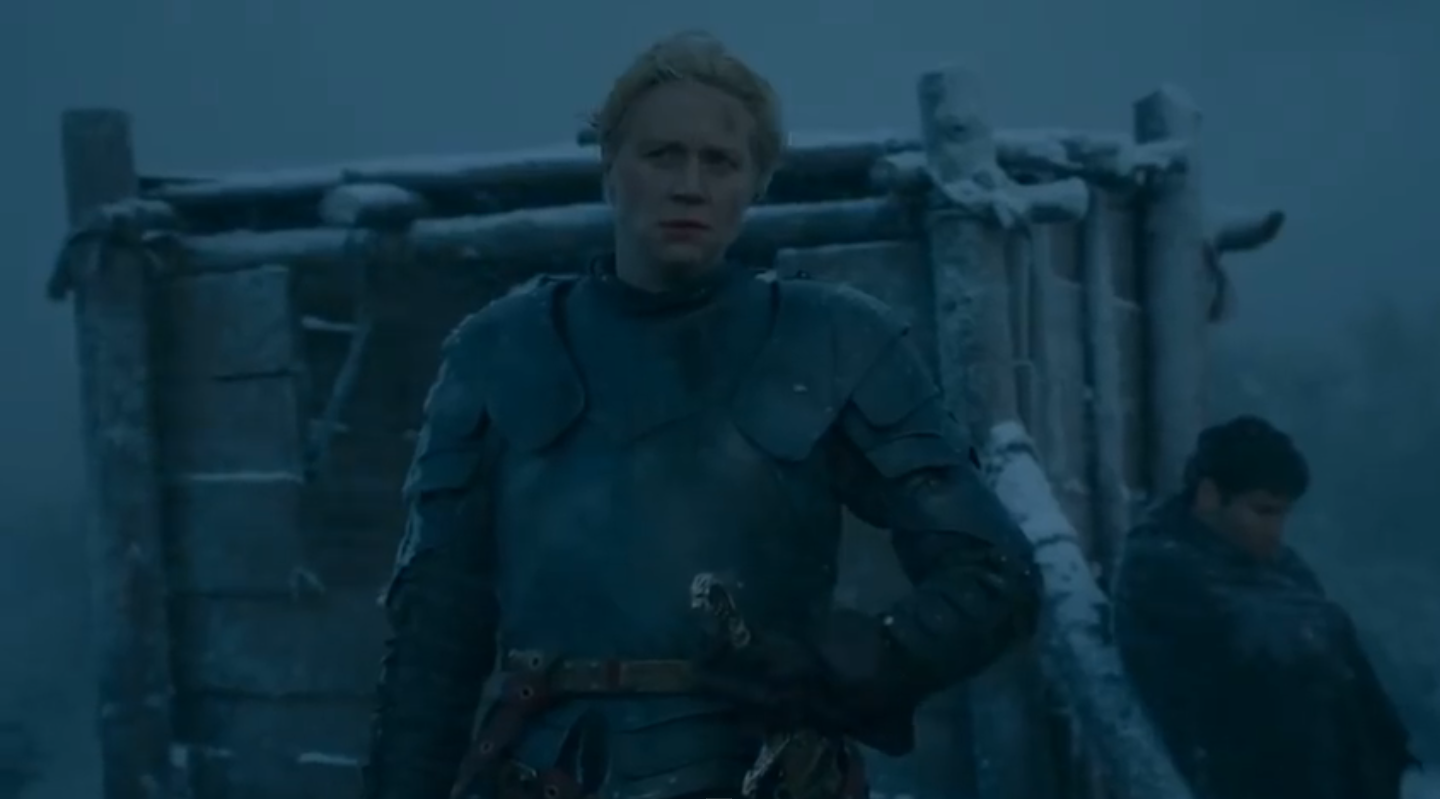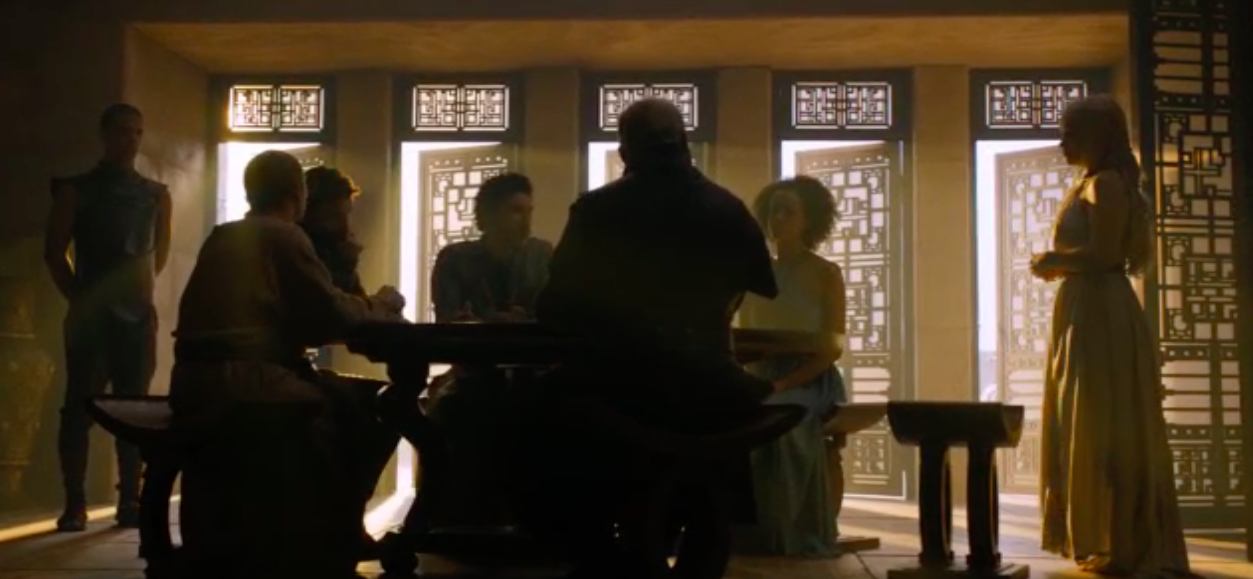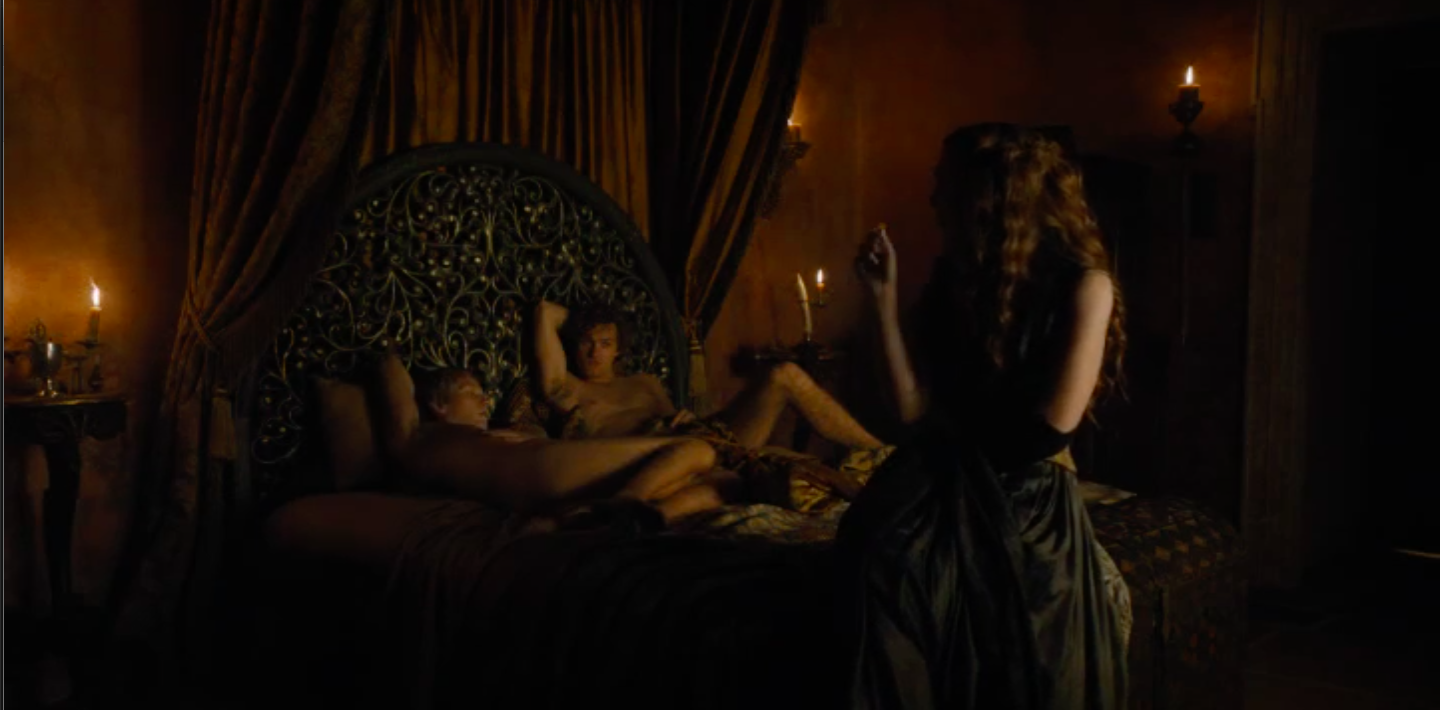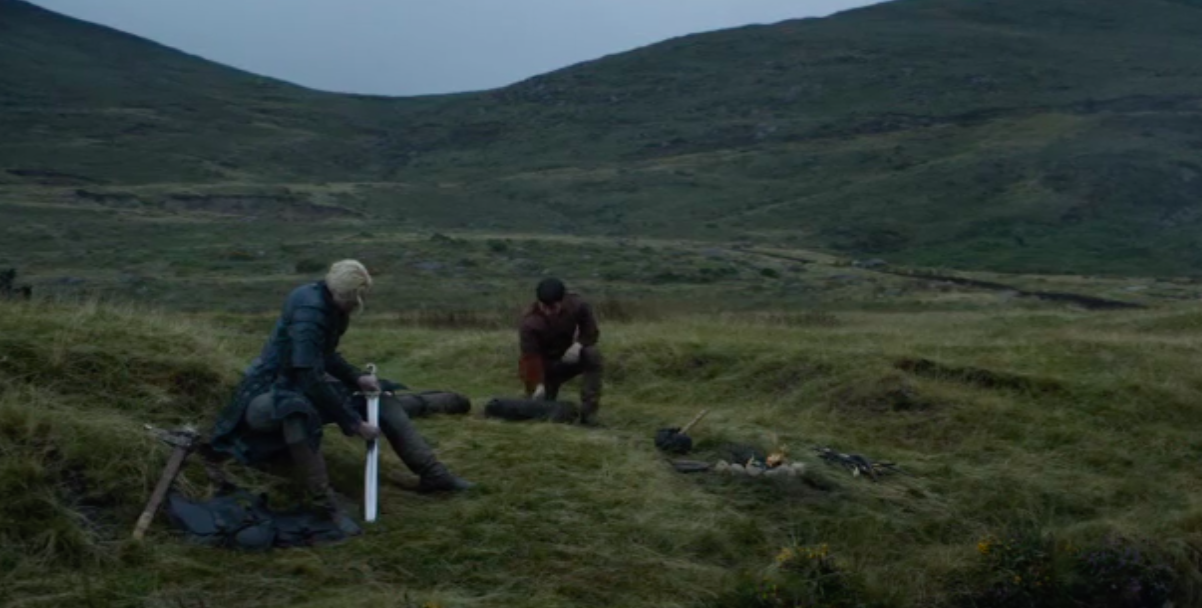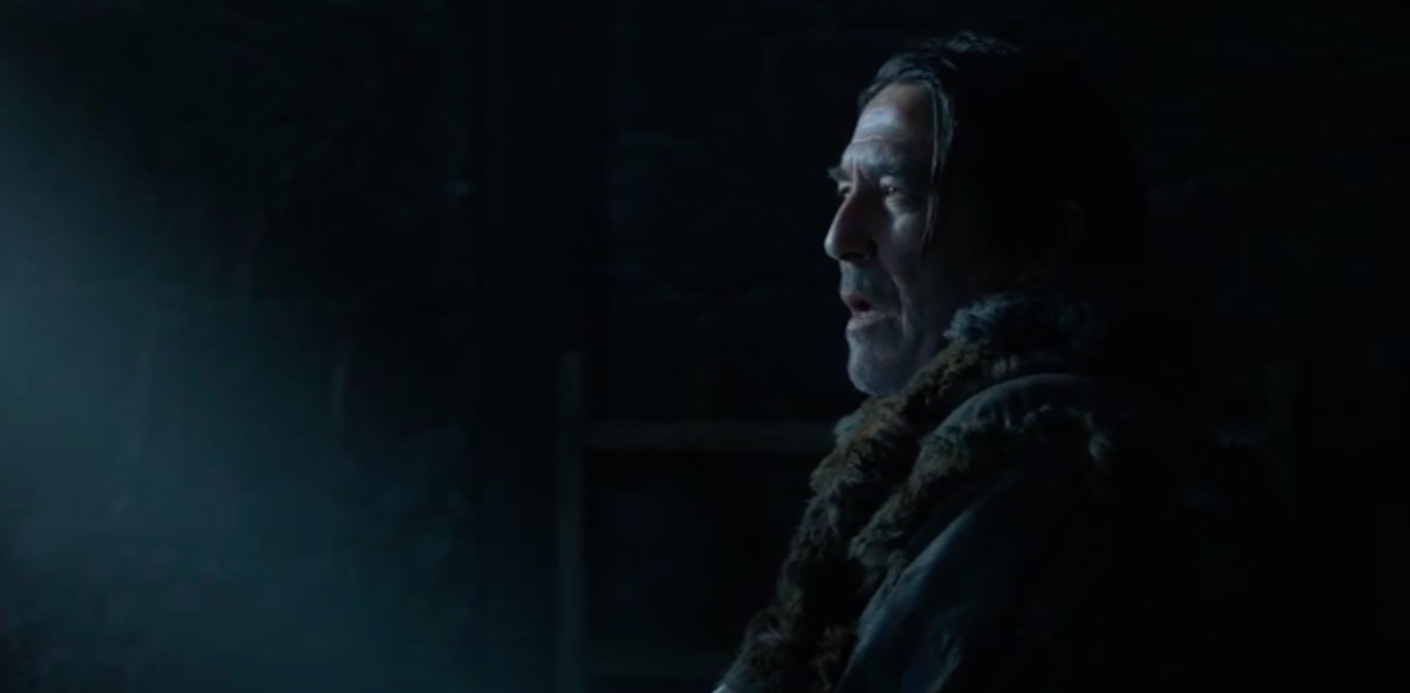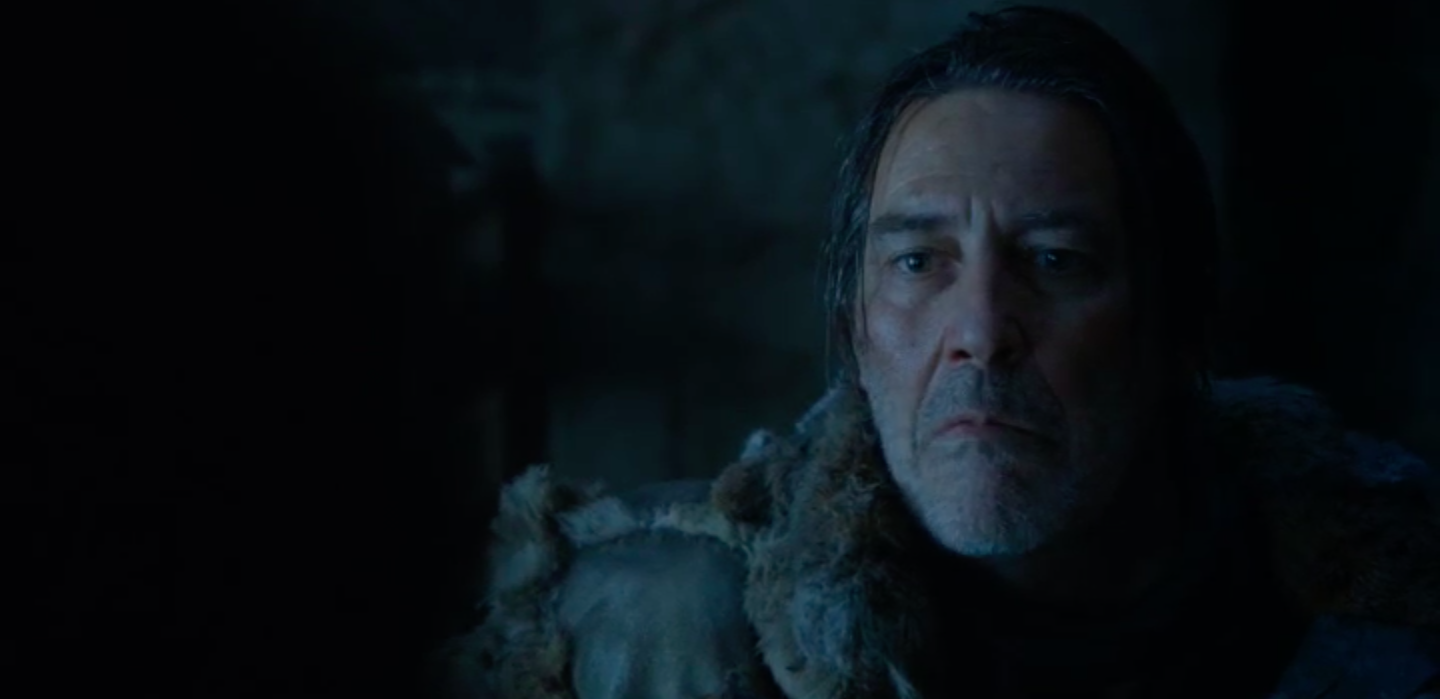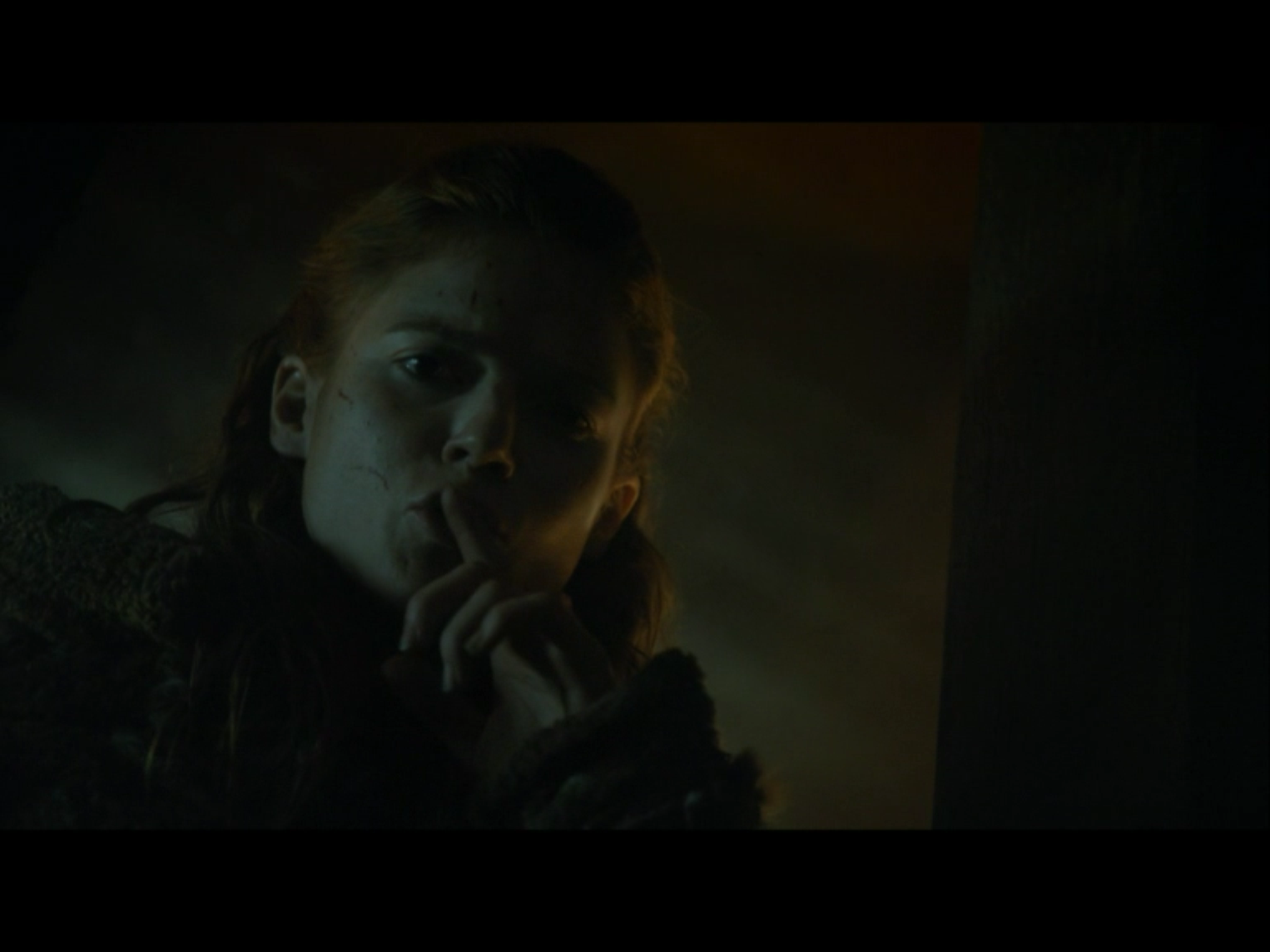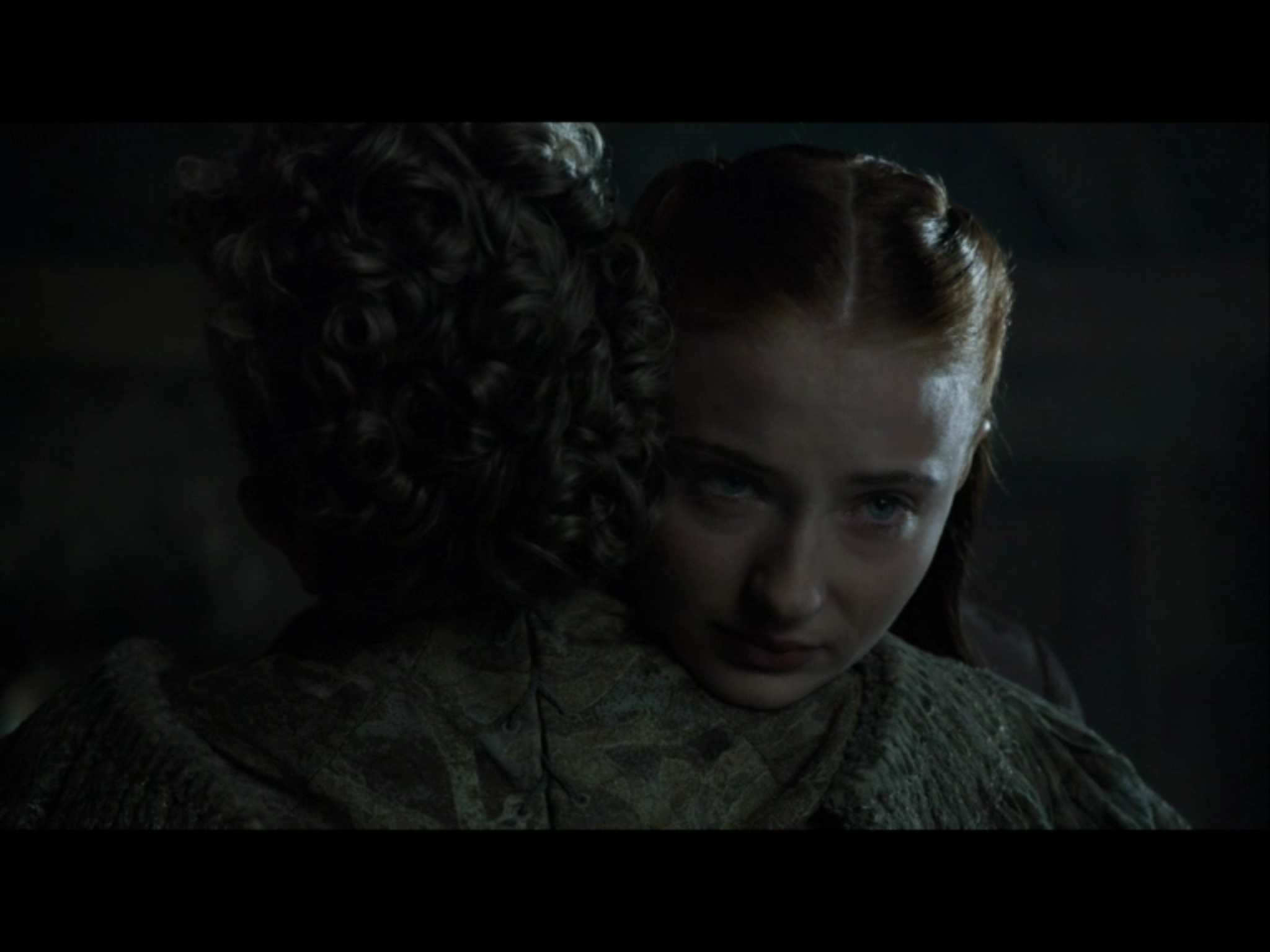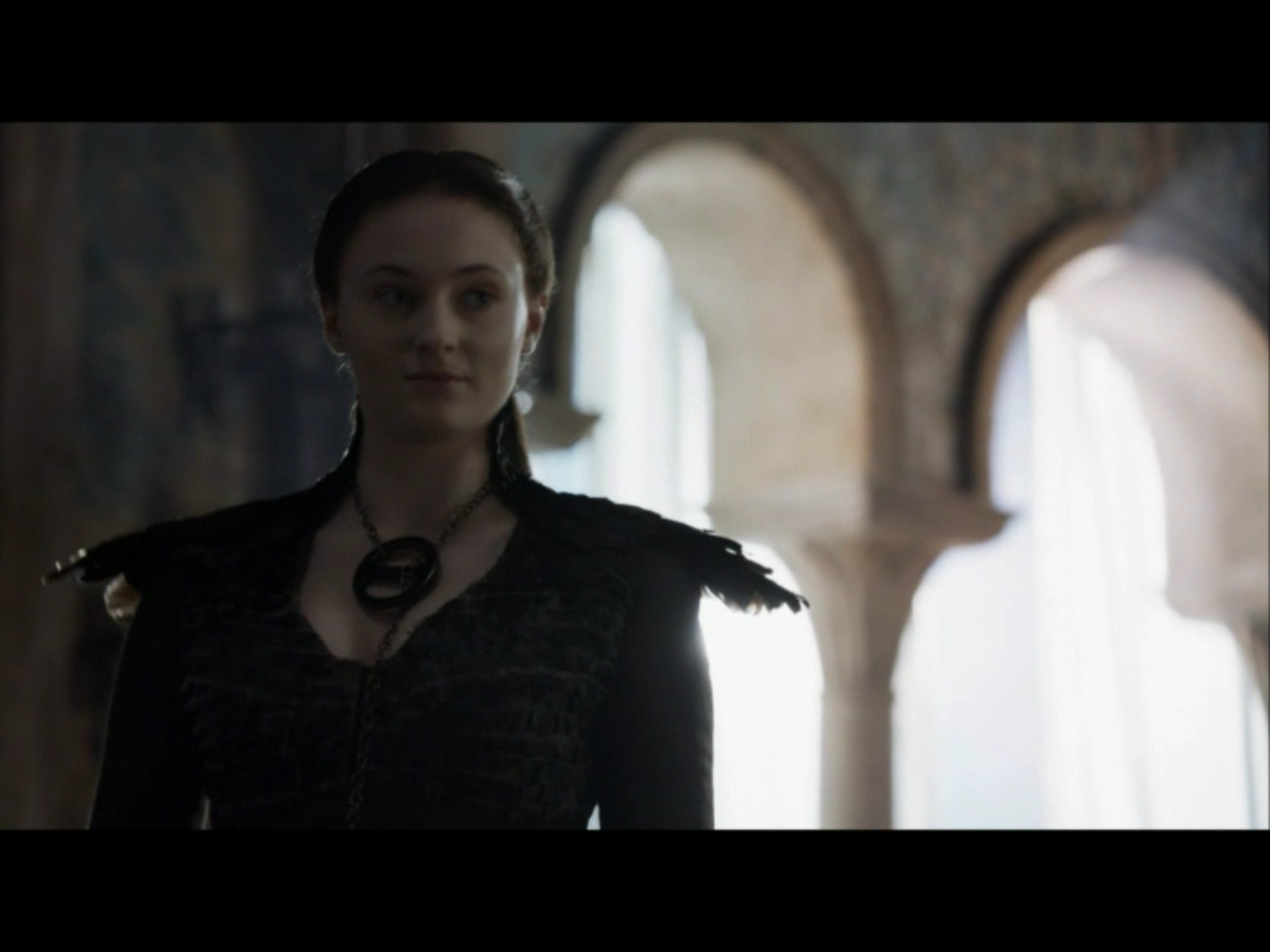
Category Archives: Game of Thrones

Game of Thrones 5.09: The Dance of Dragons

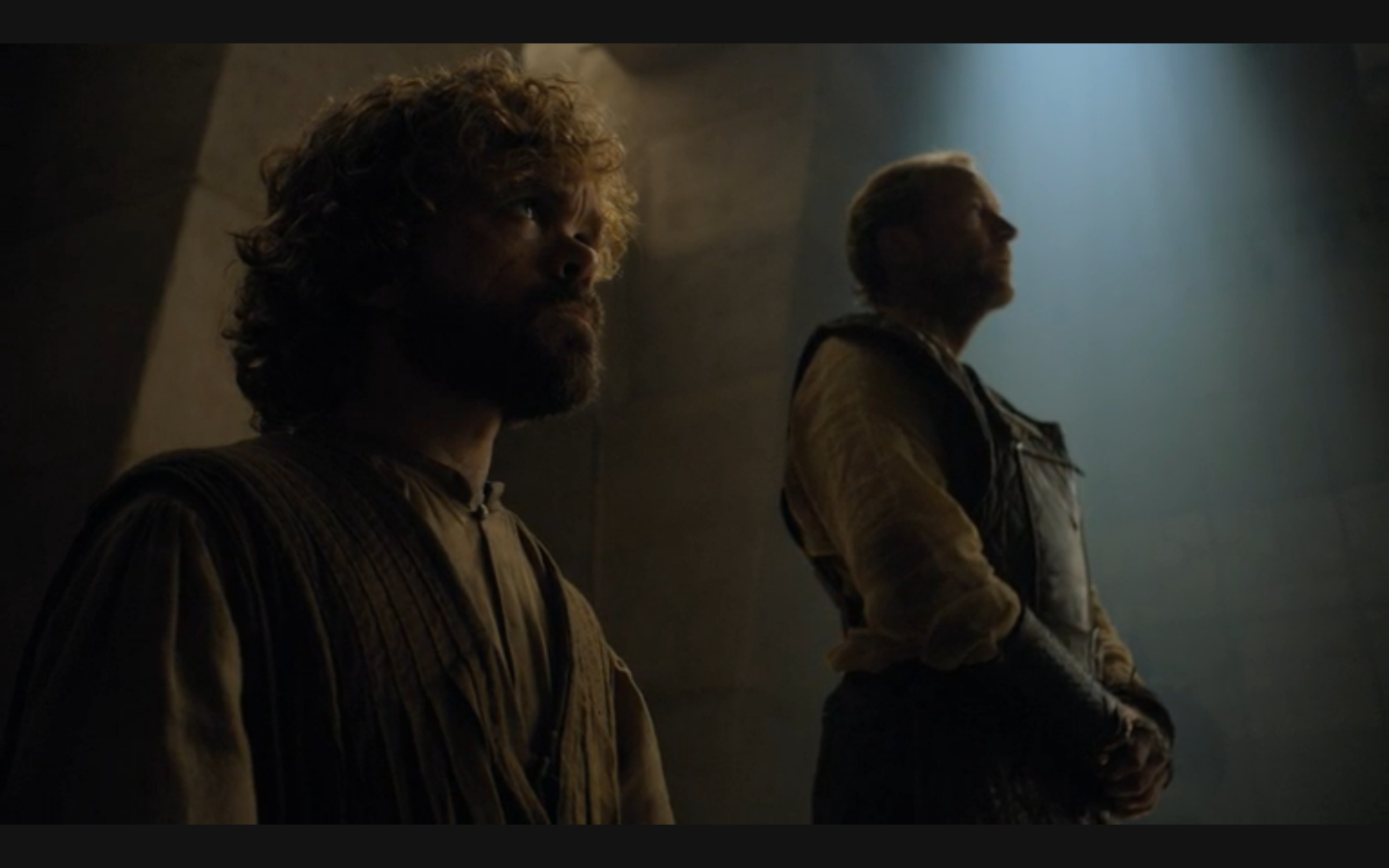
gameofthrones_teaser02_screencap10

Greetings once again, and welcome to the great Chris and Nikki co-blog on Game of Thrones. We’re almost through another season, if you can believe it—this was the second-to-last, and we’ll be tying up season five with a bow this time next week.

Well, the showrunners have established the precedent of ending the penultimate episodes with something shocking, spectacular, or both … and in this case it’s definitely both as fiery death is visited on a lot of characters—both those who deserve it, and one who most definitely does not.

It’s my turn to lead us off, but a word of warning—hic sunt draconis.

fire_camp

Christopher: The past two episodes have really ratcheted up the stakes, haven’t they? It feels like a payoff moment—after almost five seasons of hearing that “winter is coming” and the promise of the “mother of dragons,” finally we’re starting to see the significance of those coinages. Last week, speculating on what if anything could realistically defeat the implacable force of the Night King and his vast undead army, I said—with my tongue only slightly in my cheek—that it would probably involve dragons. Now that Daenerys has fulfilled a crucial element of being a Targaryen and ridden Drogon into the clouds, that does not seem like such a distant possibility.

Or to put it another way, let’s remember that GRRM’s series is called “A Song of Ice and Fire.” Last week we got the ice. This week we got the fire.

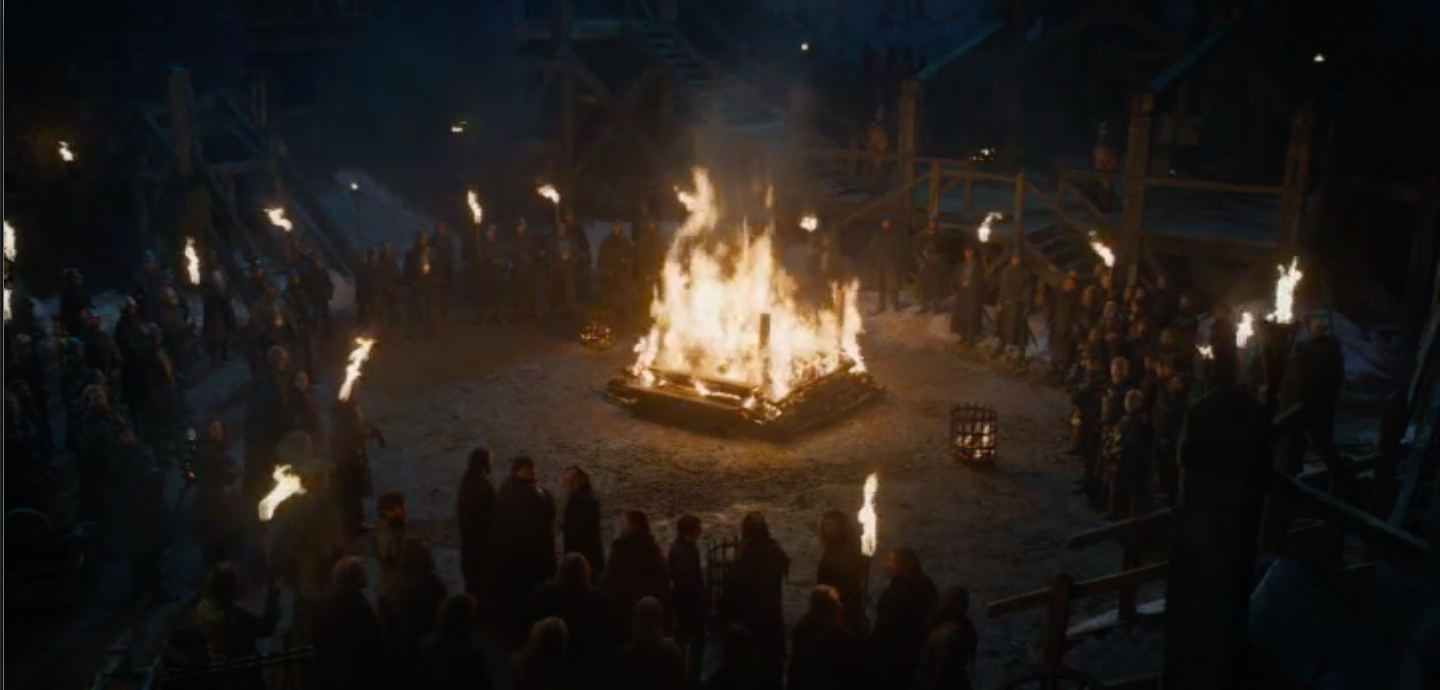
Unfortunately, we got fire in a number of different ways. First, Ramsay’s guerrilla attack on Stannis’ camp was terribly effective, burning tents, supplies, and horses (the image of a panicked horse entirely aflame was particularly affecting). Secondly …

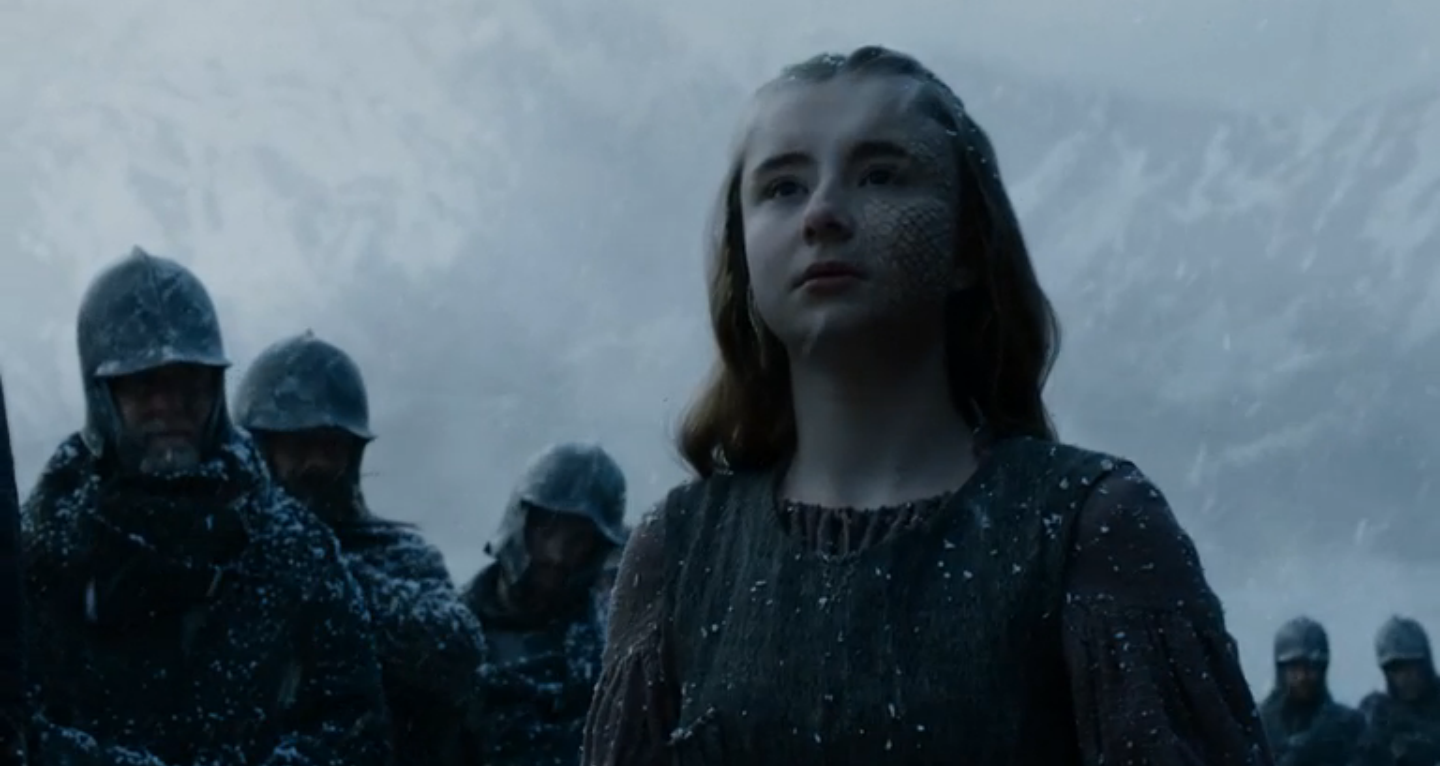
In my notes for a specific scene in this episode, I’ve written “it’s like the showrunners are trying to turn off viewers.” Several episodes ago, Nikki, we saved discussion of a controversial scene until the end. I think this time we should address it at the beginning. I’m speaking, of course, of the horrific death of Shireen Baratheon, sacrificed by her father at Melisandre’s behest.

stannis_tent

Predictably, a lot of reviews and commentaries on this episode have asked the same question they did with Sansa’s rape: Why? Why include this awful, deeply distressing plot twist, especially considering it doesn’t appear in the novels? Why, especially after we were treated to a scene several episodes ago in which Stannis expressed his love for Shireen in terms that humanized him far more than he ever is in the novels?

As my comments on the Sansa scene might indicate, I tend to find this particular line of questioning wrong-headed. The “what ifs” of storytelling can make for interesting speculations on how it all might have fallen out otherwise, or considerations of the authors’ intentions, but it doesn’t make for good criticism. Like it or loathe it (and based on my casual perusal of reactions to this episode, there are many in the latter camp), Stannis has sacrificed a crucial element of his humanity on the altar of his ambition, in the belief that being king is his destiny. And once again we see that the show is playing the long game, that in fact his touching scene with his daughter a few episodes back was not a matter of humanizing Stannis, but humanizing him enough that we are even more shocked and horrified than we would have been otherwise. We really ought to know by now to be on our guard when Game of Thrones gives us moments of sentiment and warmth.

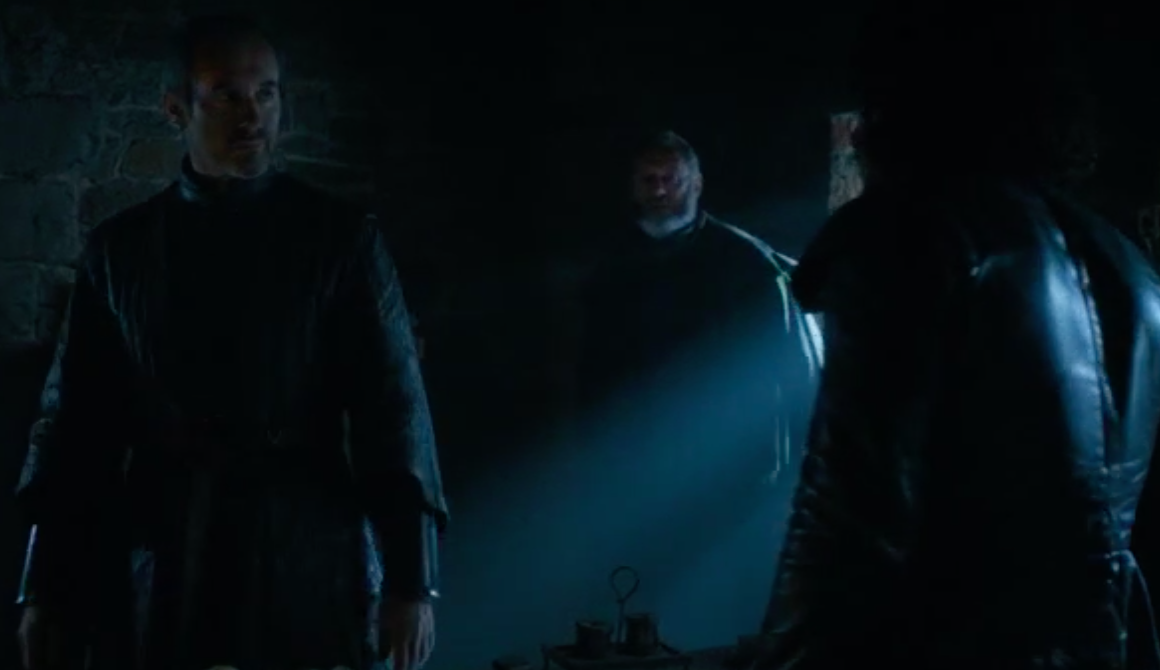
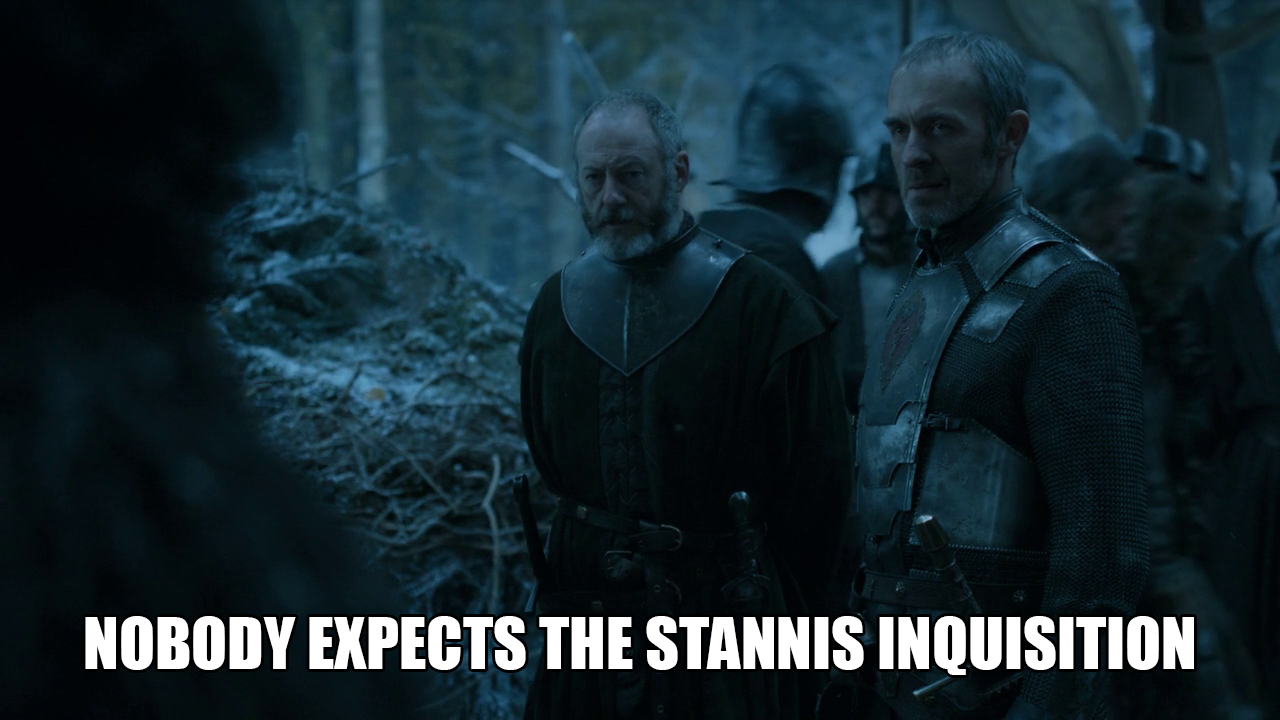
And as with Sansa’s wedding night, the show layers on the dread by signaling what is to come. As soon as Stannis refuses the very possibility of returning to Castle Black, we know something is off. “Forgive me, Your Grace,” says Davos, “I never claimed to be an expert in military matters, but if we can’t march forward and we won’t march back—” He cuts himself off to follow Stannis gaze behind him and sees Melisandre and Queen Selyse standing there. A look then passes between him and his king, who curtly orders him to butcher the dead horses for meat and walks away, followed by the two women. Later, he orders Davos to return to Castle Black for supplies over Davos’ objections, and further refuses to send Shireen with him. We begin to discern Stannis’ design here: remove the one man with conscience and standing enough to protect Shireen.

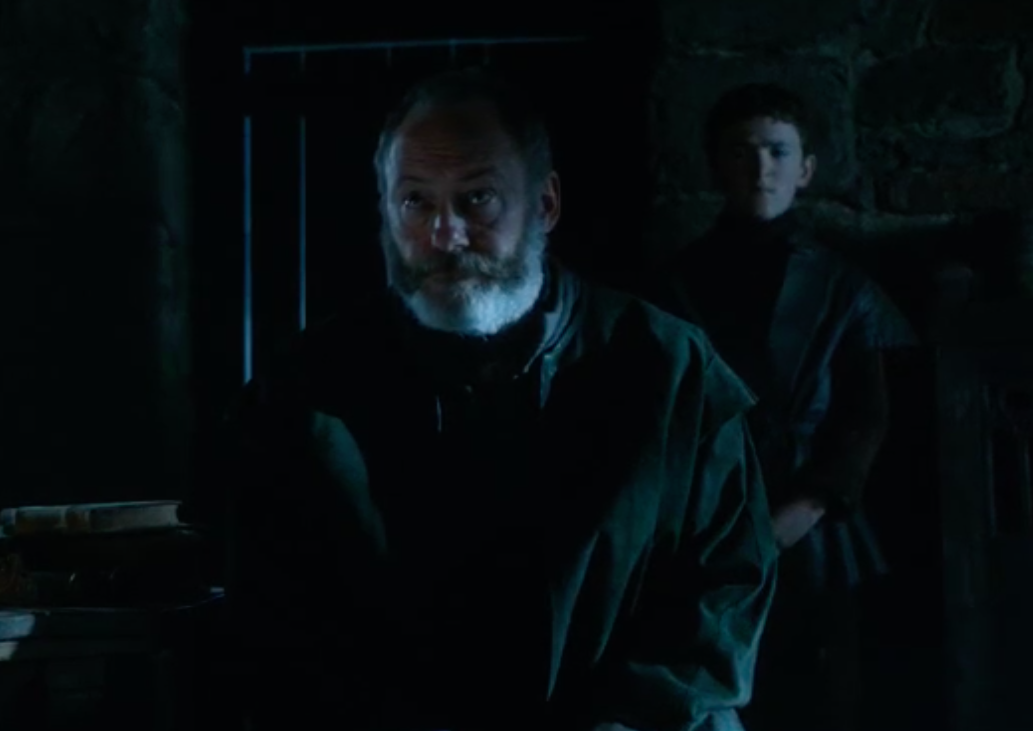
What is doubly heartbreaking is the sense that Davos knows this—that he has an inkling of the king’s mind, but is perhaps in denial about it. His scene with Shireen, in which he gives her the carved stag and thanks her for helping him grow up, has a certain finality to it. Is he in denial about Stannis’ intentions? Are his feelings too vague for him to act on them? Or is he that steadfast in his loyalty that he willingly absents himself from camp?

Whatever the case, he is now complicit. Stannis’ crime thus compromises more than just his own soul, but those of every one of his followers.
shireen_pyre

Sansa’s rape was devastating for many viewers because she was perceived as the last innocent. That may be true, but at least Sansa agreed to her marriage pact with her eyes open. She might not have known the abject depths of Ramsay’s depravity, but she knew the Boltons well enough to know she was agreeing to something humiliating and unpleasant. Shireen is genuinely the last innocent of the show, and she has no idea what her father plans when she tells him she’ll do anything to help.

Stephen Dillane is one of the unsung heroes of this show, playing one of the more thankless roles—Stannis is rigid and uncompromising, with an iron sense of right and wrong. His rationale is simple and straightforward: his older brother was king, Robert’s children are illegitimate, and therefore he is the true king. He cannot step away from that fact any more than he could cut off his own limb. “If a man knows what he is and remains true to himself, the choice is no choice at all,” he tells Shireen. “He must fulfill his destiny and become who he is meant to be … however much he may hate it.”

Fantasy has traditionally had a deep investment in the power of prophecy and destiny; unsurprisingly then, GRRM undercuts its logic. Melisandre, in proclaiming Stannis a prophesied hero—Azor Ahai the Lightbringer reborn—marries her religious fervor to Stannis’ sense of his own destiny. But having come so far only to court defeat in the Northern winter, Stannis does not see any other choice. Not even when his fanatical wife breaks down and tries to save Shireen does he waver, though her breakdown goes a long way to expose the hollowness of his reasoning. It was Selyse who brought Stannis to the worship of the Lord of Light, and if anyone would cheerfully sacrifice Shireen to him, we’d expect it to be her. From a simple, eminently logical starting point of his drive to be king, he has arrived at a place of profound irrationality and indeed madness.

What did you think, Nikki?
selyse_distraught

Nikki: The television shows I watch always seem to be rife with shitty parents: Lost was a show about a bunch of people on an island with serious mommy and daddy issues. On Buffy one of the greatest characters on the show was Giles, who for all intents and purposes was a father to Buffy after her own father abandoned her and her mother for his secretary. Fairytales are filled with absentee or dead parents and evil, horrid, stepmothers.

And then there’s Game of Thrones. Where one son kills his father while Dad’s taking a crap; where the best mother on the show is the mother of dragons and slaves, not children; where the strong and determined Catelyn Stark still can’t find it in her heart to love an innocent baby who’s her husband’s bastard; where Craster kills his sons and lets his daughters reach an age where they’re old enough to rape for more daughters and sons;… and where Stannis Baratheon, who gave the most moving speech about the lengths a father will go to save his only child, just had her burned alive at the stake to feed his own ambition.

I hope he and Selyse are haunted by those screams for the rest of their days.

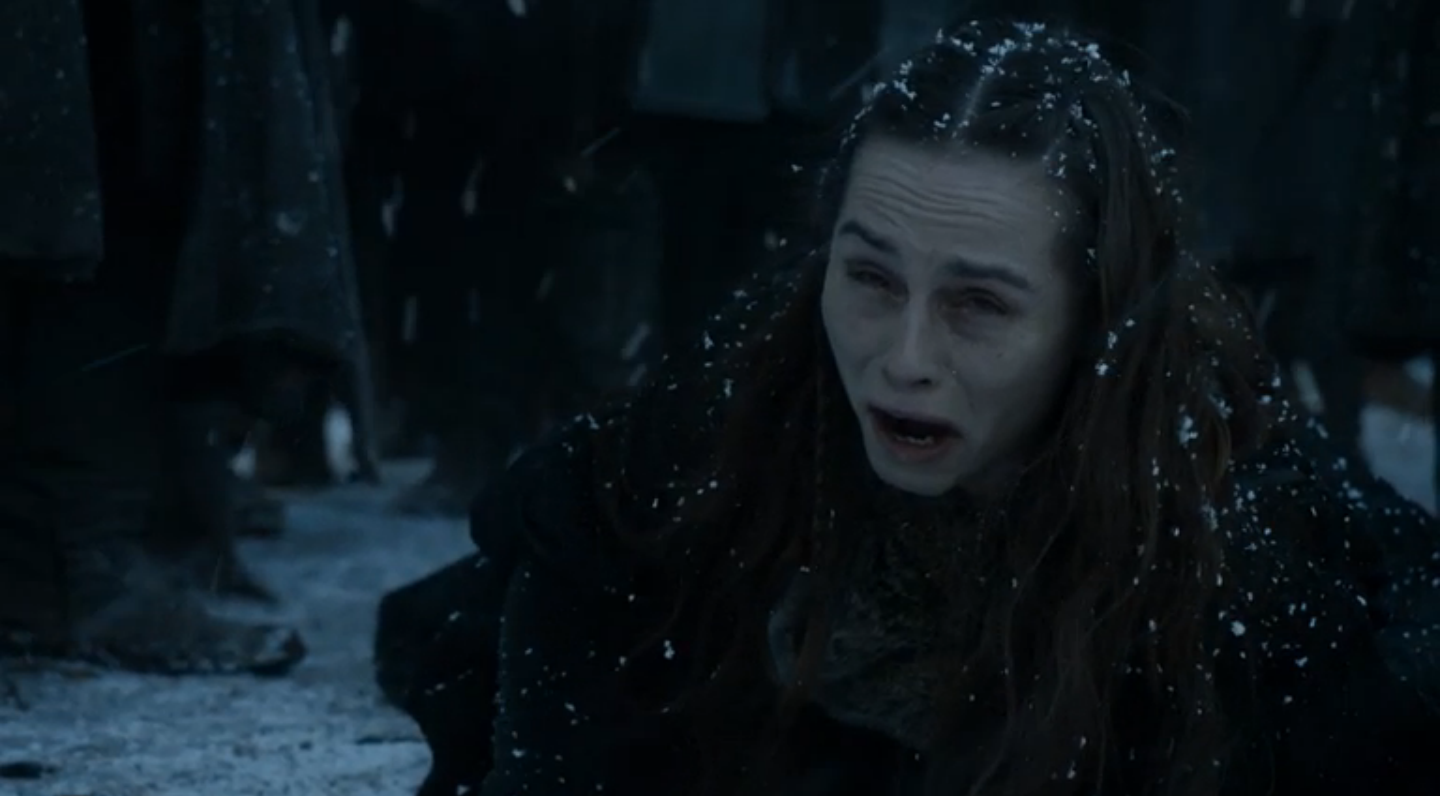
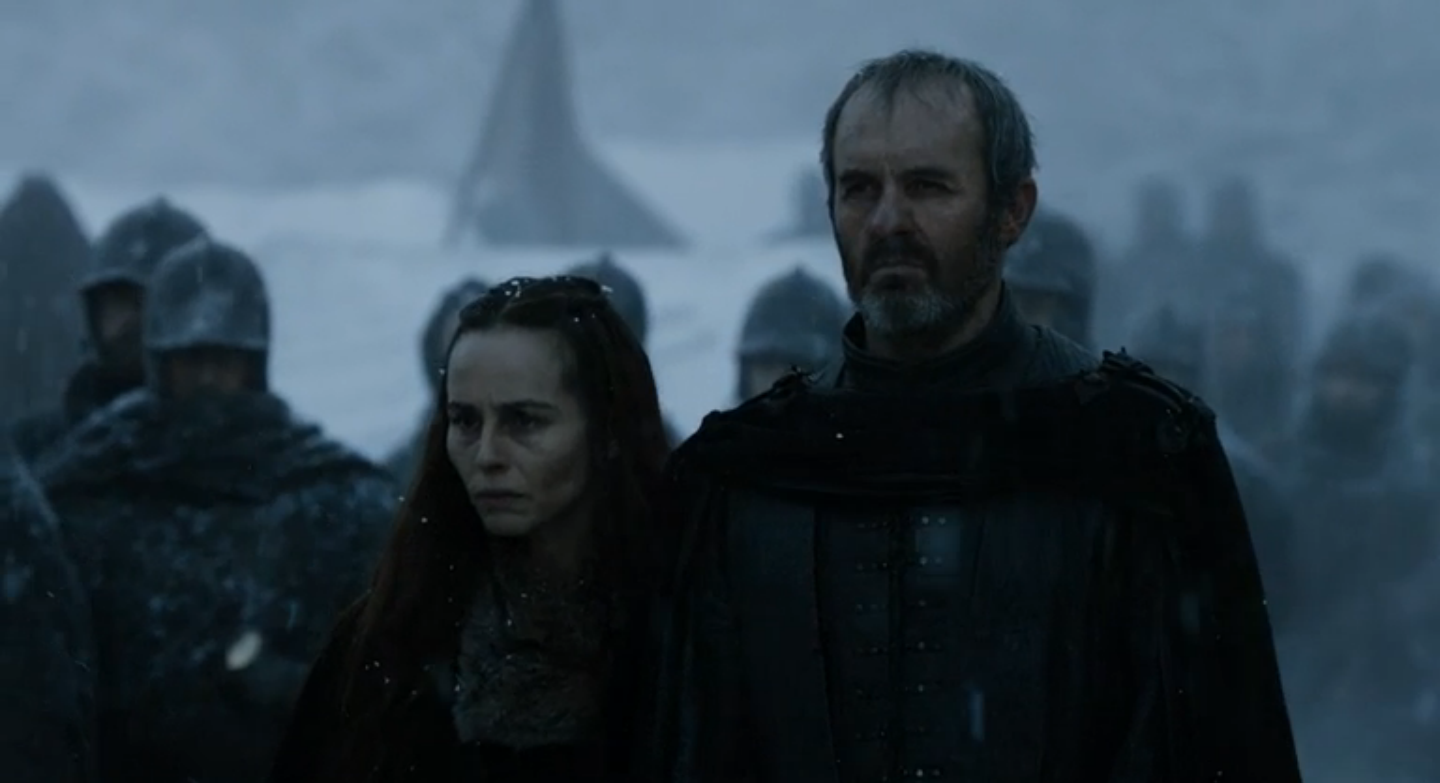
I’ve always seen Selyse as a cold, heartless woman, and at first, when she steps out, she has that same callous face that she’s always had. Interestingly, she seems to be completely on board with everything that’s happening until Stannis says that she has the blood of a king in her, and therefore this must be done. Only then does this look of horror cross her face, and she rushes at the stake. And I couldn’t help but think… is it possible Shireen does not have king’s blood in her? Has Selyse been keeping some secret from her husband all these years and only now does she realize her daughter’s about to be sacrificed for no reason?
stannis_selyse

The thought was only a fleeting one, however, as Selyse rushes forward and begs for mercy for her daughter. It was a shocking moment — Stannis is the one who’s always treated his daughter like she was worth more than others did, while his wife had nothing but cold words for her, and now he stares at her burning to death and screaming in abject pain and does nothing, while his wife begs for it to stop. Melisandre, on the other hand, is a cold-hearted bitch who doesn’t seem to have an ounce of humanity in her whatsoever, and she stands nearby with that same smug look on her face that she wore when Mance Rayder was being burned alive. But at least someone showed Mance some mercy by shooting him with an arrow. No one was there to save this little girl from the feeling of flames burning her flesh as her heart fell to pieces within her, knowing what her parents were allowing to happen to her.

We can’t forget that Stannis has gone along with hiding this child away all these years; in a dungeon, in an old library in the basement. And even in that scene where he proclaims what he did to save her life, she throws her arms around him with unbridled love, and he stands there, stiff, like he can’t embrace her back. And when he does, he looks like he means it.

But his love for her is no match for his ambition.

stannis_watching

Before her horrifying death — the thought of which fills me with so much grief as a mother that I wanted to push my way through the flames just to embrace her as she burned to death, just so she wouldn’t have to die alone — she was reading the Dance of the Dragons, the story of the Targaryen wars, which not only is the second time in as many weeks that the title of a George RR Martin book has been referenced — last week Ramsay said Stannis’s army would become a feast for the crows — but it’s a line that came full circle by the end of the episode. But let’s hold off on talking about THAT moment for a bit.

I wanted to add that when the tents in Stannis’s camp catch fire — fulfilling the “Fire” half of the saga that this episode represents as you demonstrated so well in your commentary, Chris — it’s carrying out the plan that Ramsay Bolton had in the previous episode. Roose Bolton is a formidable military man, and he saw that Stannis’s army had no way of winning with it being so cold, so he figured he could just starve them out. Ramsay, on the other hand, requested 20 men, and with those men he somehow found a way to sneak into their camp with ninja-like precision and light several tents — and people and horses — on fire. It’s a brilliant strategy on so many levels: Roose’s plan would have taken ages, and Ramsay would rather end this now so they don’t have to waste precious time looking over their shoulder in the direction of the Baratheon sigil any longer than they have to. But it also seems to take the very thing that Stannis bows to — the Lord of Light — and throws it back in his face. The night is dark and full of terrors indeed, dude. Ramsay Bolton is a loathsome character in so many ways, but in this moment, he showed that he’s a cunning strategist, which should raise his profile in his dad’s eyes several notches.

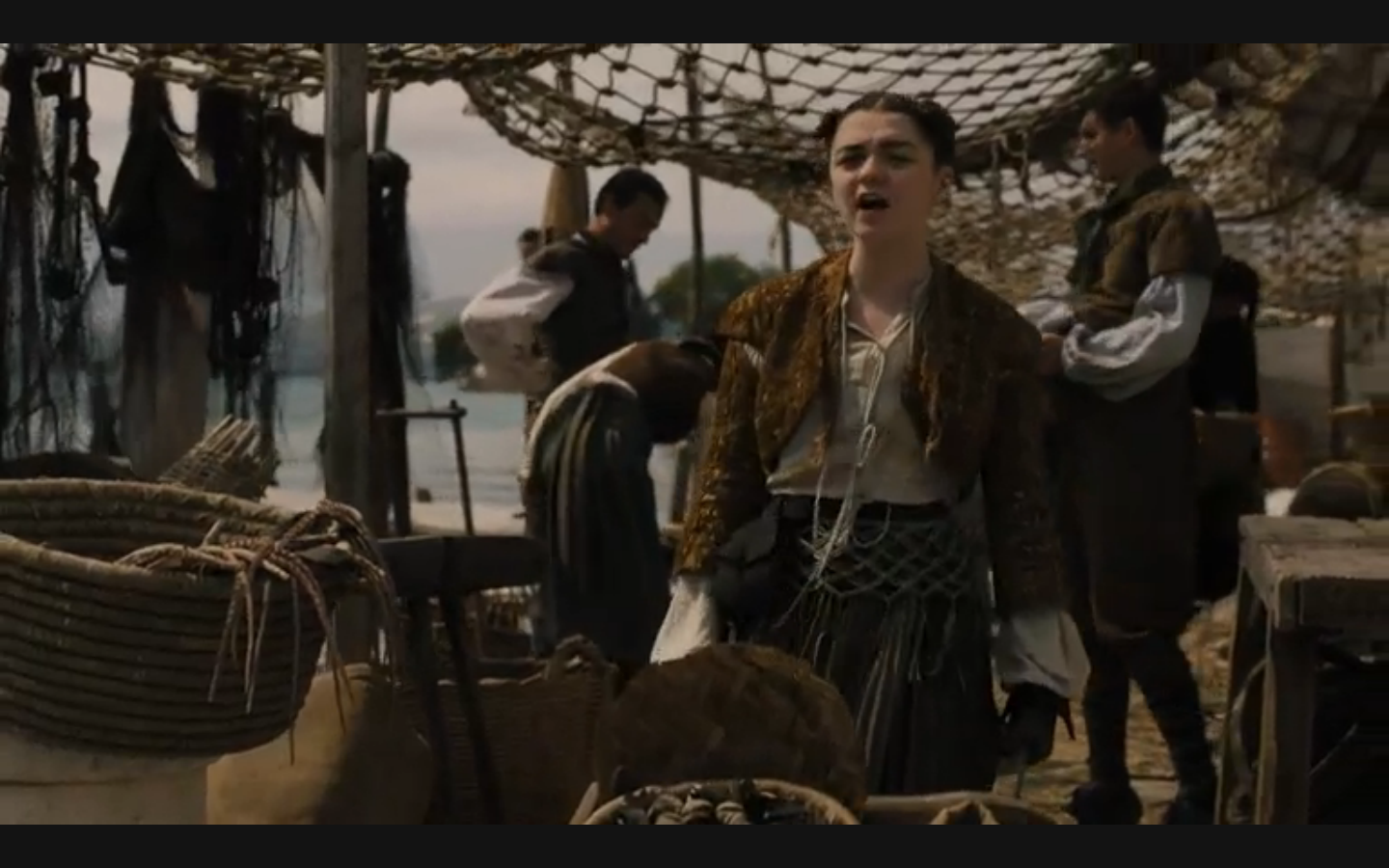
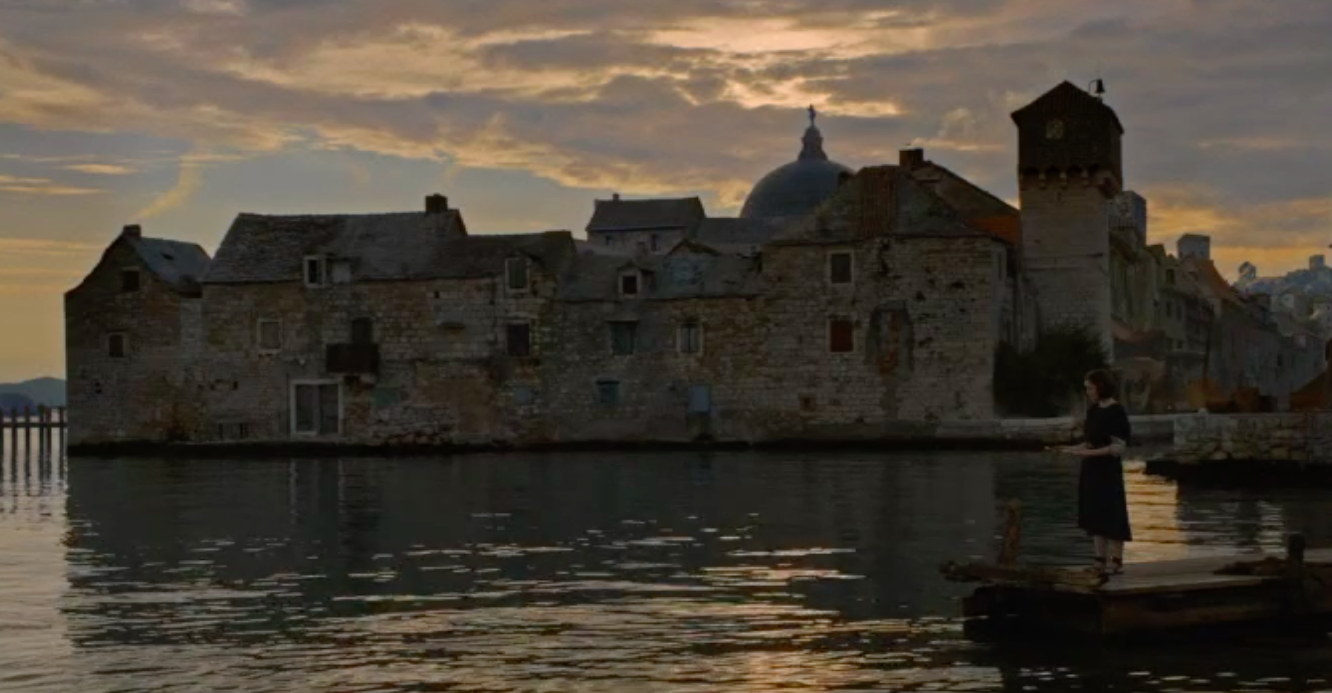
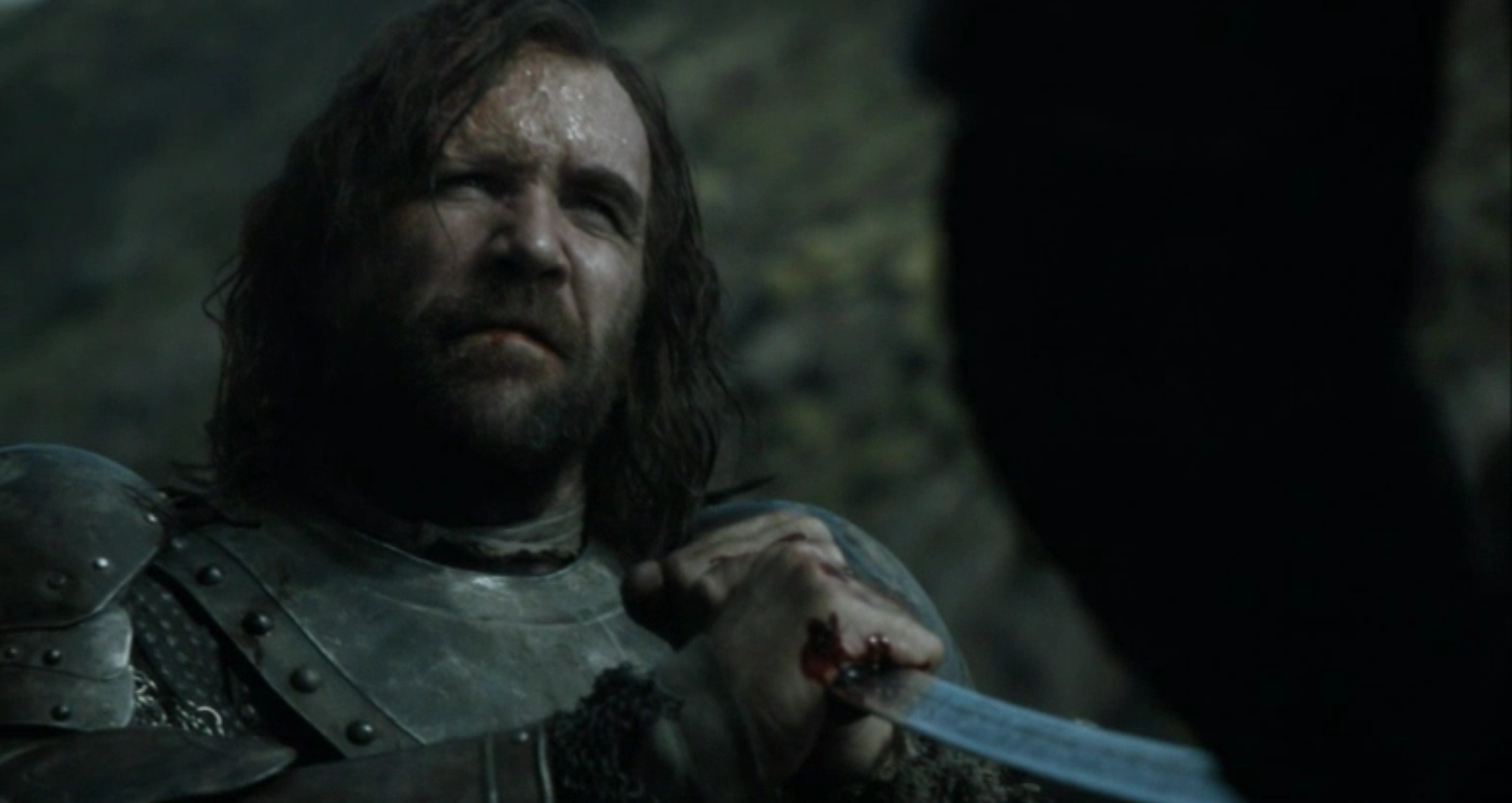
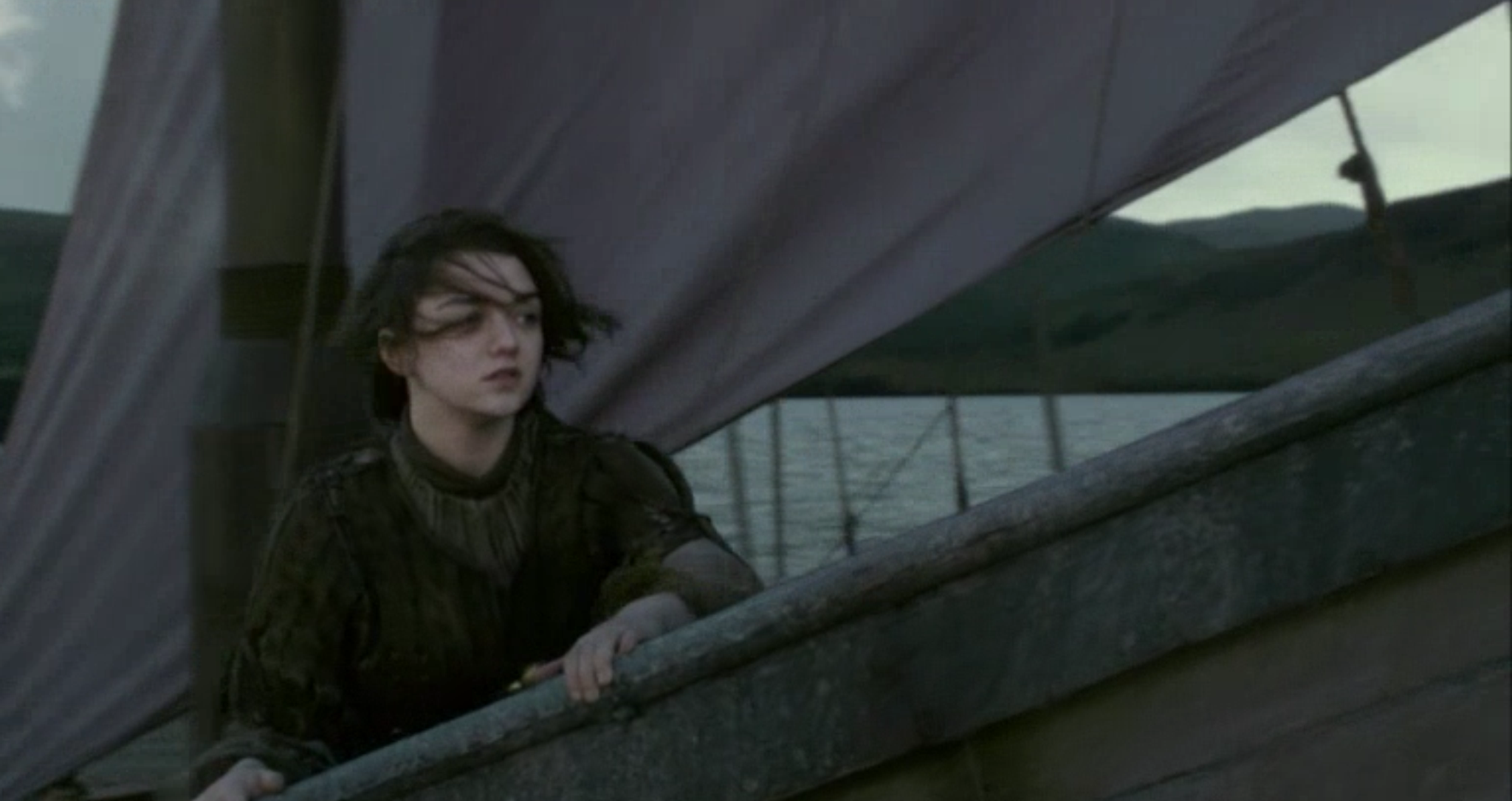
Now let’s move over to Braavos, where Arya is playing the oyster girl and about to fulfill the task asked of her by Jaqen when she spots none other than Mace Tyrell… or the Mayor of Munchkinland, as I like to think of him. Oh wait, no, she’s not looking at Mace… she’s looking at Meryn Trant standing behind him. If you’re like my husband, who went, “Who he?” when she started focusing on him and following him through the square, Meryn is one of the people on Arya’s Kill List, and was the man who killed her “dance instructor” all the way back in season 1.

I can’t believe that when Cersei assigned Meryn to follow Mace to Braavos to meet with Mycroft that I didn’t figure out he’d cross paths with Arya. Duh. What did you think of this scene, Chris?

arya_seeing-meryn

Christopher: I think it confirms what we pretty much knew all along, namely that Arya has a long way to go before she can put aside her identity as Arya Stark and honestly say she is “no one.” One of the things we can surmise from her training thus far is that a girl cannot truly be a Faceless Man if a girl still clings to her own loves and hates, and especially not if a girl still nurses vengeance in her heart. The Many-Faced God dispenses death with equanimity, and his servants must have the same even-handedness.

This is presumably why they seem to hate pronouns so much.

It is something of a relief, however, to know Arya’s still there: the thought of losing her rather distinct personality is distressing, even though it probably means she’s in for some punishment from Jaqen—it’s obvious from his expression he knows she’s lying when she says the thin man wasn’t hungry.

They’ve telegraphed where this is going pretty clearly: Meryn Trant likes his girls young, so I’m guessing Arya will pose as a prostitute in order to kill him. This storyline actually follows one of the sample chapters from The Winds of Winter that GRRM has posted on his website. Unfortunately it has been replaced by another sample chapter, so I can’t link to it, but here is the synopsis on the Song of Ice and Fire Wiki. In it Arya is posing as a girl named Mercy in a theatre troupe, which is about to stage a play loosely modeled on the events of King’s Landing. They have a special guest: an envoy from the Iron Throne in Braavos to negotiate with the Iron Bank (not Mace Tyrell), and Arya sees that one of his guards is a man on her kill list (not Meryn Trant, but a fellow named Raff the Sweetling, who doesn’t appear in the TV show). She tempts him into a secluded alcove with the promise of sex and kills him.

Again, this was pretty clearly telegraphed in the show. The question will be: what will be her punishment? I have a pretty clear idea, as she transgresses in a similar way in A Feast for Crows, so it will be interesting to see if her story continues to hew more or less closely to the novel.

Also, it’s a delight to see Mycroft Tycho Nestoris again, especially in contrast to the buffoonish Mace Tyrell.

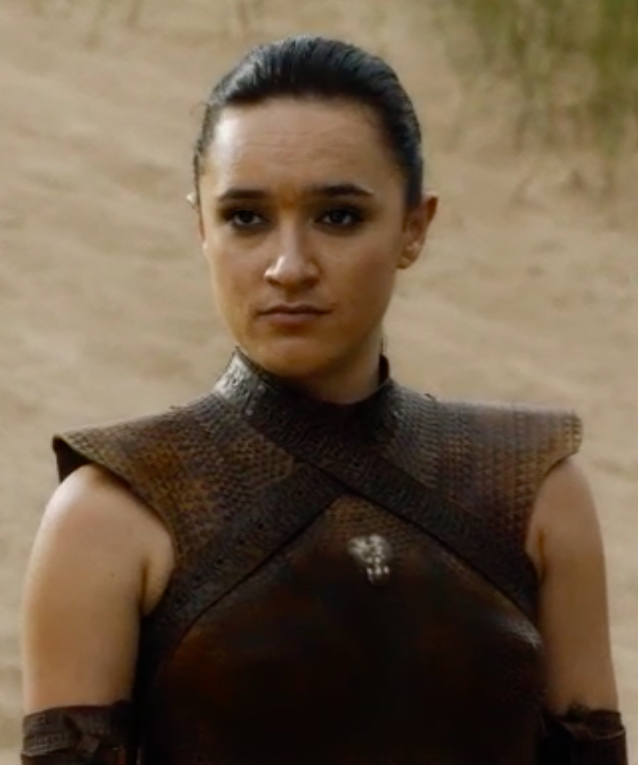
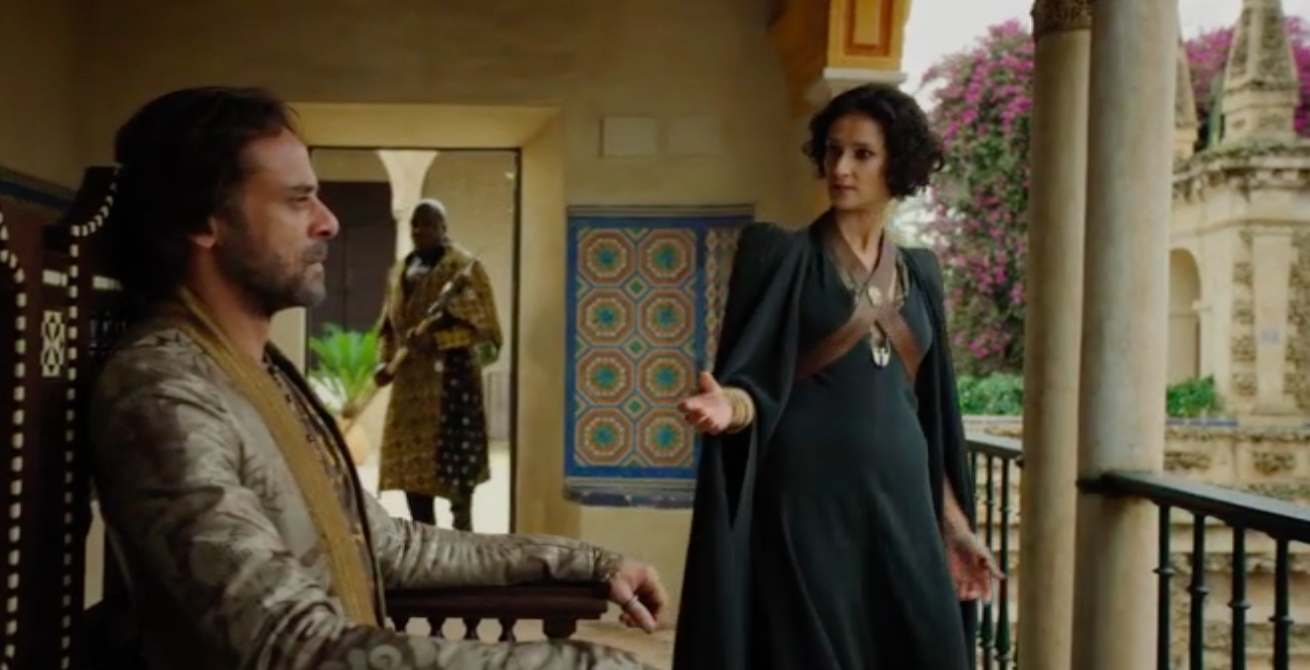
ellaria_throwing-shade

Meanwhile, things all seem very civilized in Dorne, compared to the rest of Westeros. I quite enjoyed these scenes, as we’re finally getting a more nuanced sense of the characters involved here. I do still think they’ve done it back-asswards: a fuller understanding of the personalities at work, and the underlying tensions and enmities and loyalties would have improved the Sand Snakes’ story immeasurably and invested us in the fate of their plot more deeply. Instead, we’re getting after-the-fact exposition—still engrossing, but it makes me wonder where they’re going with the Dorne narrative. I’ve read a few commentaries on the episode opining that the Dorne storyline has been pointless, simply a side-journey to give Jaime Lannister something to do, far away from his sister’s plight.

I’m not so sure. With Trystane returning to King’s Landing with Myrcella, their engagement intact, It may be that Benioff and Weiss have some ideas for how to use their Dornish characters in ways that will now necessarily deviate dramatically from the novels.

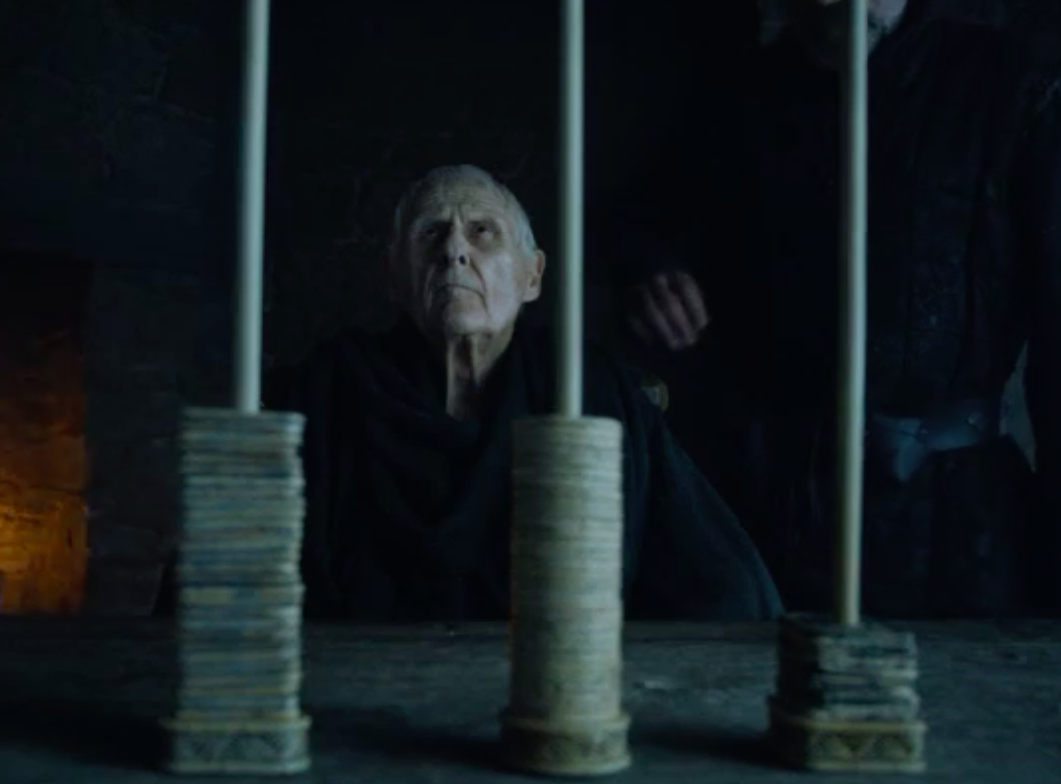
I particularly liked Prince Doran in these scenes. As I’ve said before, I think Alexander Siddig is a great actor, and it doesn’t hurt that he has ST:DS9 geek cred. But I love the way he plays this character, in such stark contrast to Ellaria and the hot-headed Sand Snakes. He is calm and measured, thoughtful, but radiates command. Not someone I’d want to face across a poker table. His brief moment of ire as Ellaria attempts to storm from the room is more dangerous than all of Cersei’s threats to her captors, as is his later comment that “I believe in second chances; I don’t believe in third chances.” I think we can add him to the running list of characters whose actors endow them with extraordinary gravitas, alongside Tywin, Mance, Olenna, and the High Sparrow.

doran_gravitas

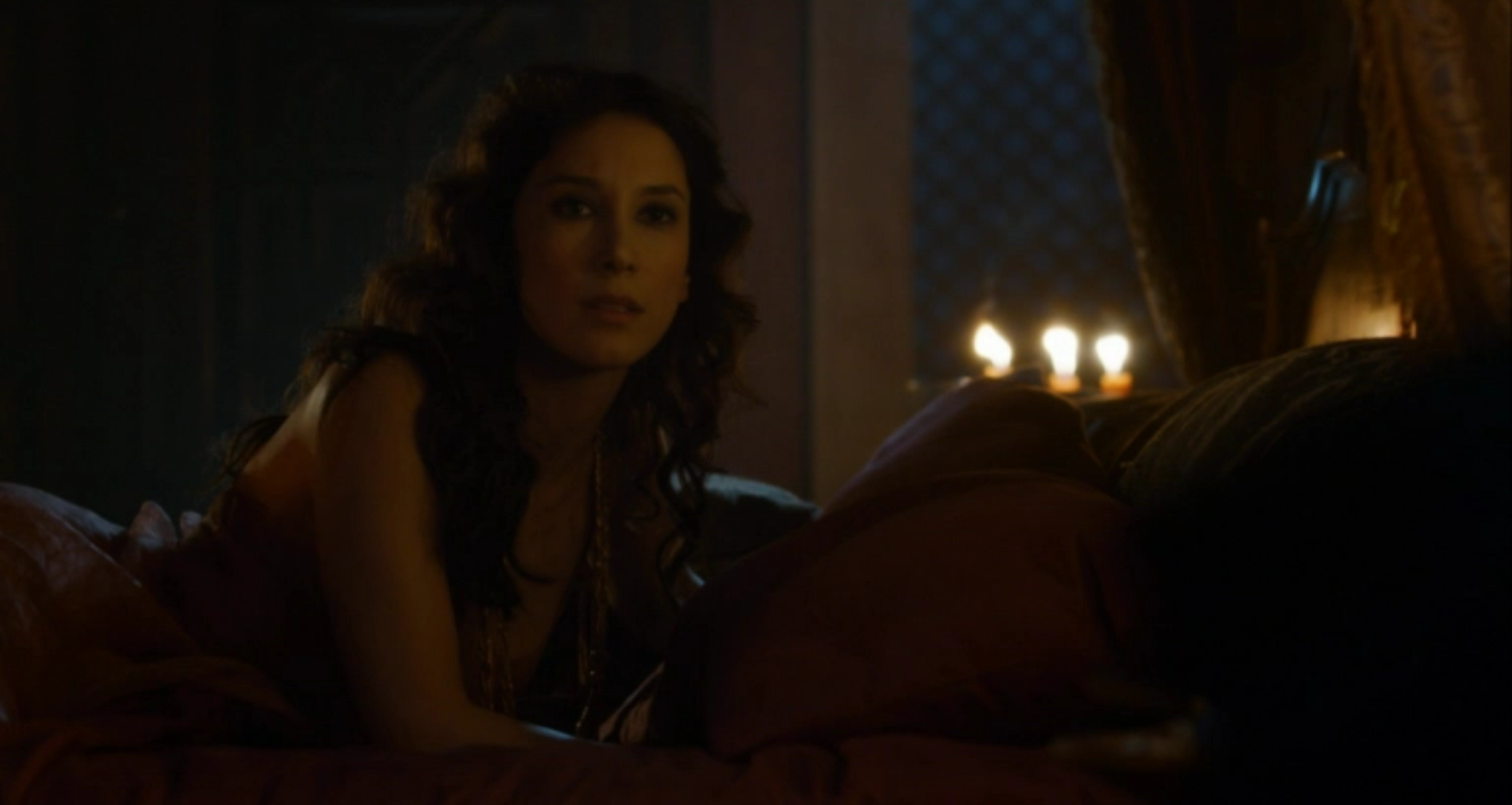
Perhaps most interesting in this Dorne sequence is Ellaria’s apparent rapprochement with Jaime, in which she tells him she knows the truth of his relationship with Cersei, and the fact that in Dorne “no one blinked an eye.” Social mores about who we’re allowed to love, she says, are constantly changing, but “the only thing that stays the same is we want who we want.”

It’s an odd and interesting moment, considering her previously implacable hatred for all things Lannister. Is she signaling a détente? Or is she reminding Jaime that the man she wants is now dead, at least in part due to Lannister scheming?

What do you think, Nikki?
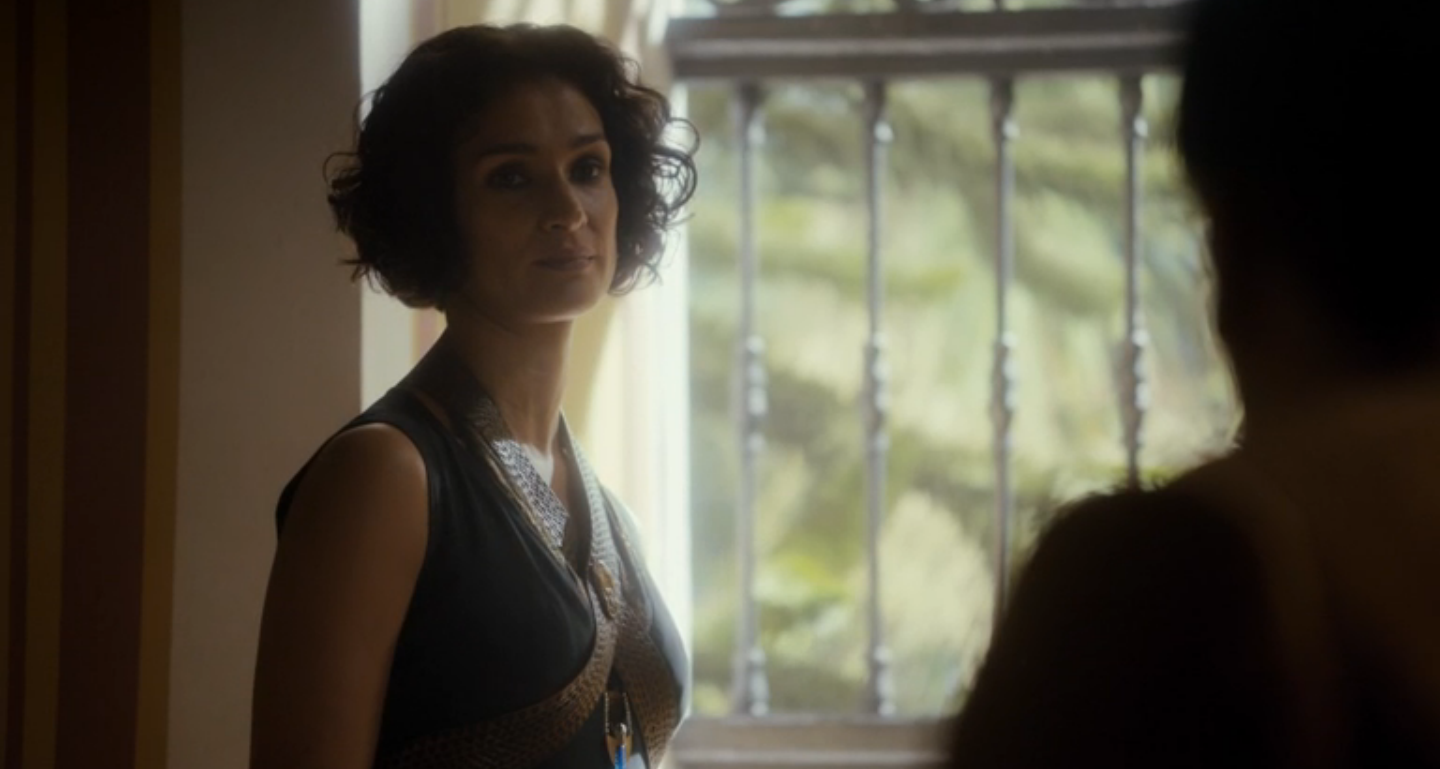
ellaria_detente

Nikki: I found it a strange scene indeed; she seems to be almost setting up an alliance with Jaime in a sense of, “Hey, bro, don’t fret. You had sex with your sister, gave her a bunch of kids; I’m a bastard daughter of a nobleman and had five bastard daughters of my own with Oberyn, whom I loved to watch have sex with other people. It’s like we were made to work together.” Back in season four, Ellaria and Oberyn were a breath of fresh air, I thought; these people who sweep in from Dorne and seek pleasure where they can get it, who don’t judge others for any sexual proclivities because they’ve tried it all — let’s just say in Dorne, the High Sparrow would have been beheaded by now and Loras upheld as a hero. What is normal to Ellaria and her people is loathed and judged in King’s Landing, a place where Jaime and Cersei have to lie about their children, and where Loras and Margaery are in a jail because one is a homosexual and the other one knew about it.

Jaime is the brother/lover of Cersei, the woman who got Oberyn killed by the Mountain. Ellaria loathes her. What better way to come at Cersei than to bed the man she loves? Things haven’t exactly been hunky dory in Lannister land lately, as we know. The last time Jaime was intimate with Cersei was when he raped her on the floor next to their son’s corpse — not exactly candlelight and roses — and Cersei has shown him nothing but disdain ever since he arrived with one hand fewer than before. But we know that despite Cersei pushing him away, she’s not going to let anyone else come near him. If she found out that Jaime had been intimate with Ellaria, she would fly into a rage of epic proportions.

I’m starting to think Ellaria’s simply moved on to a Plan B.

I agree with you that the Sand Snakes had a spectacular entrance when we first saw them on the beach, and then in their next scene, when they’re summarily beaten by Doran’s guards, I pretty much just heard this:

But since then, as you say, we’ve been watching them develop almost backwards, and perhaps that’s a sneaky way of making them explode onto the scene enveloped by their own legend, only to break down that legend and build them back up again. One thing that I must say I actually like about them — but I know a lot of fans might be up in arms about it — is that they use their bodies and physical attractiveness for their own means. I suspect Ellaria is trying to lure Jaime into a sexual tryst. I could be completely wrong, and, as you say, she’s just telling him this as a frame story to send the real message: I know about you and your sister, and that your children are illegitimate, and by the way your lover killed mine, and I WILL have my revenge.” But it seemed more intimate than that, especially the way she was slinking around the room as she talked to him.

nymeria

Similarly, Tyene believes she’s conquered Bronn by forcing him to tell her that she’s the most beautiful woman in the world, again using her body and sexual wiles to dominate him. In the slapping fight we see in the jail cell, the girls have a lot of sibling rivalry, whether it’s physical, where Tyene smacks Nymeria in the face right after Nymeria brags that Tyene’s reaction time is too short, or verbal, where Obara — the one who seems to have no time for either one of them — simply rolls over to face the wall, muttering “slut” under her breath at her younger sibling. These women will stand together to fight, despite their infighting, because they all believe in a common cause. And, interestingly, when they watch Ellaria groveling before Doran, kissing his hand and begging his forgiveness, they’re united in their repulsion at watching her do so. The question is, watching their reaction to her in this scene, will they continue to follow her commands?

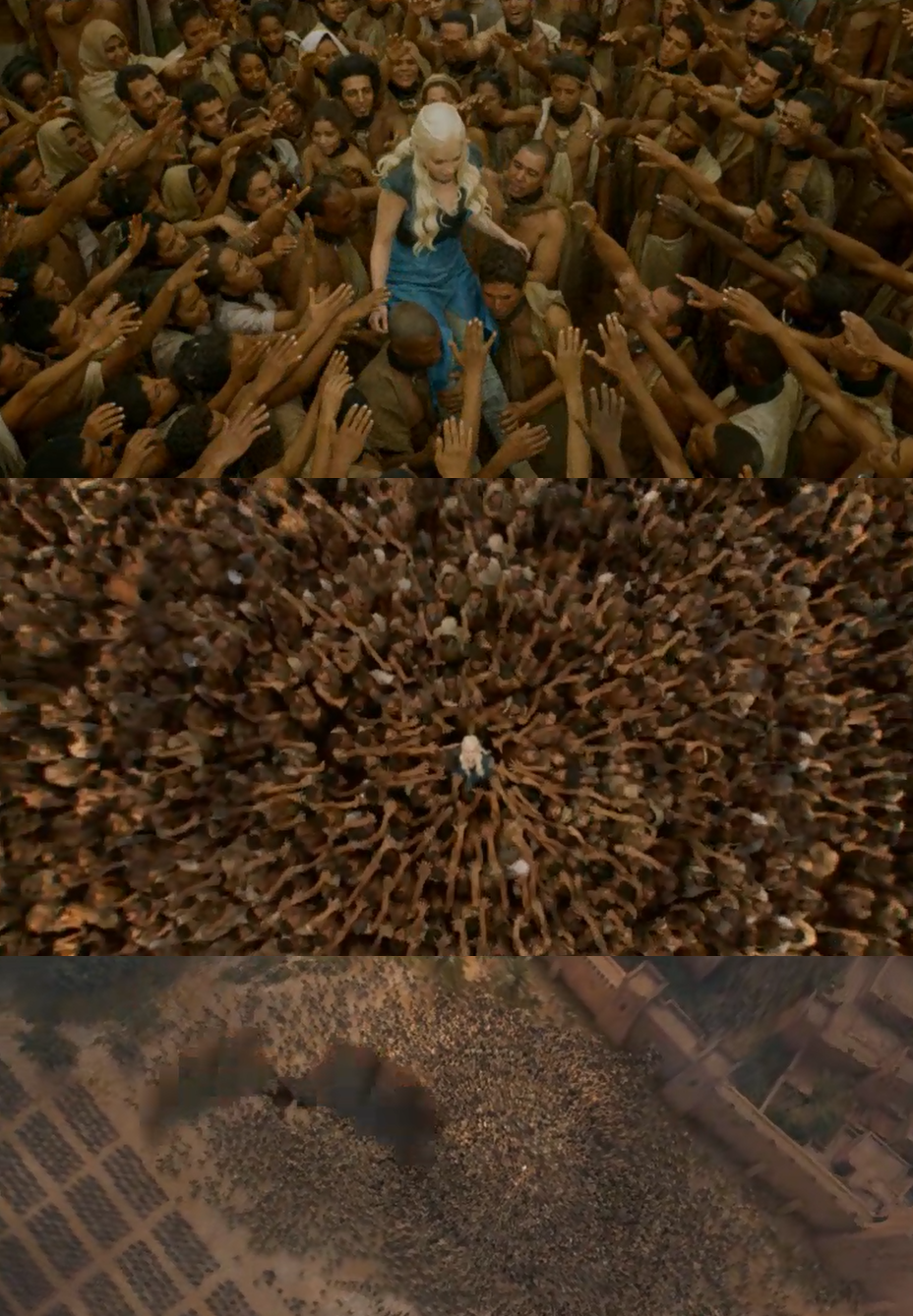
But now it’s time to talk about the scene we’ve both been waiting to discuss: DRAGONS!! I, for one, had no idea that dragon-riding was going to enter into this show, and jokingly said to my husband near the end, “She should just climb on Drogon’s back and get the hell out of there.” And then OH MY GOD SHE DID.

But you must have known this scene was coming, and once again the readers haven’t spoiled dragon-riding for the rest of us! Tell me about your thoughts of the final scenes in Meereen.

owners_box

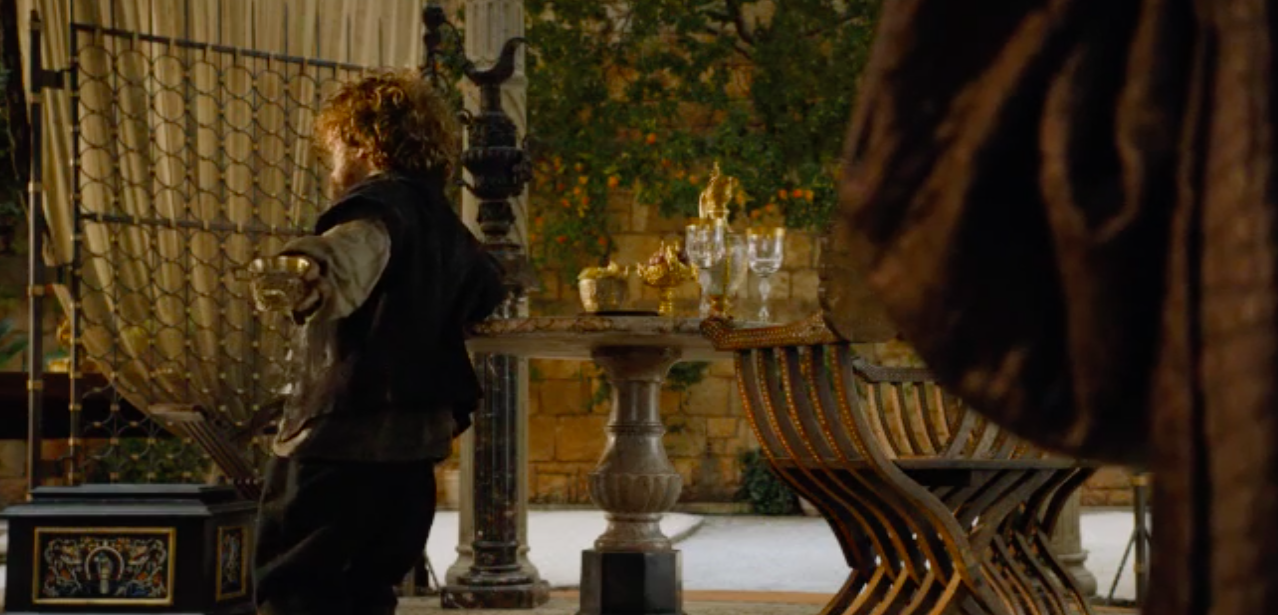
Christopher: I don’t think you needed to be a reader of the books to suspect, once the odds looked hopeless, that there was about to be a deus ex draconis. As our heroes grew increasingly outnumbered and pressed back into the defensive circle, I was muttering under my breath “Any time now, Drogon …” And when Daenerys closes her eyes, waiting for the end, and we suddenly hear the dragon’s distinctive squawk in the distance … and as he makes his spectacular entrance in a ball of flame … well, let’s just say there was some fist-pumping happening on my end. I may or may not have shouted “Boom!”

Ahem. Before I get too excited about the final sequence to lose the capacity for speech, I suppose I should outline the differences and similarities with the novel. Toward the end of A Dance With Dragons, Daenerys has married the unctuous Hizdahr zo Loraq and agreed to re-open the fighting pits. There is a great celebration on the first day—much as we see in this episode—with much food and drink in the royal box. Daenerys is unimpressed with the displays in the pit, and after a fight between a female gladiator and a huge boar—which the fighter loses—decides she’s had enough. As she attempts to leave, Hizdahr protests. Meanwhile, one of her men (a former pit fighter named Strong Belwas, who does not make it onto the show) has eaten too many honeyed locusts and is noisily sick on the floor. As it turns out, the locusts were poisoned, likely intended for Daenerys. While Daenerys argues with Hizdahr, Drogon makes his appearance, descending on the dead pit fighter and live boar, and proceeds to eat them both. Spearmen converge on the dragon, with Hizdahr exhorting them to kill the beast. Daenerys leaps into the pit without thinking, and for a moment it is touch and go—she does not know whether he’ll immolate her as well. But of course he doesn’t, and she rides him out of the city.
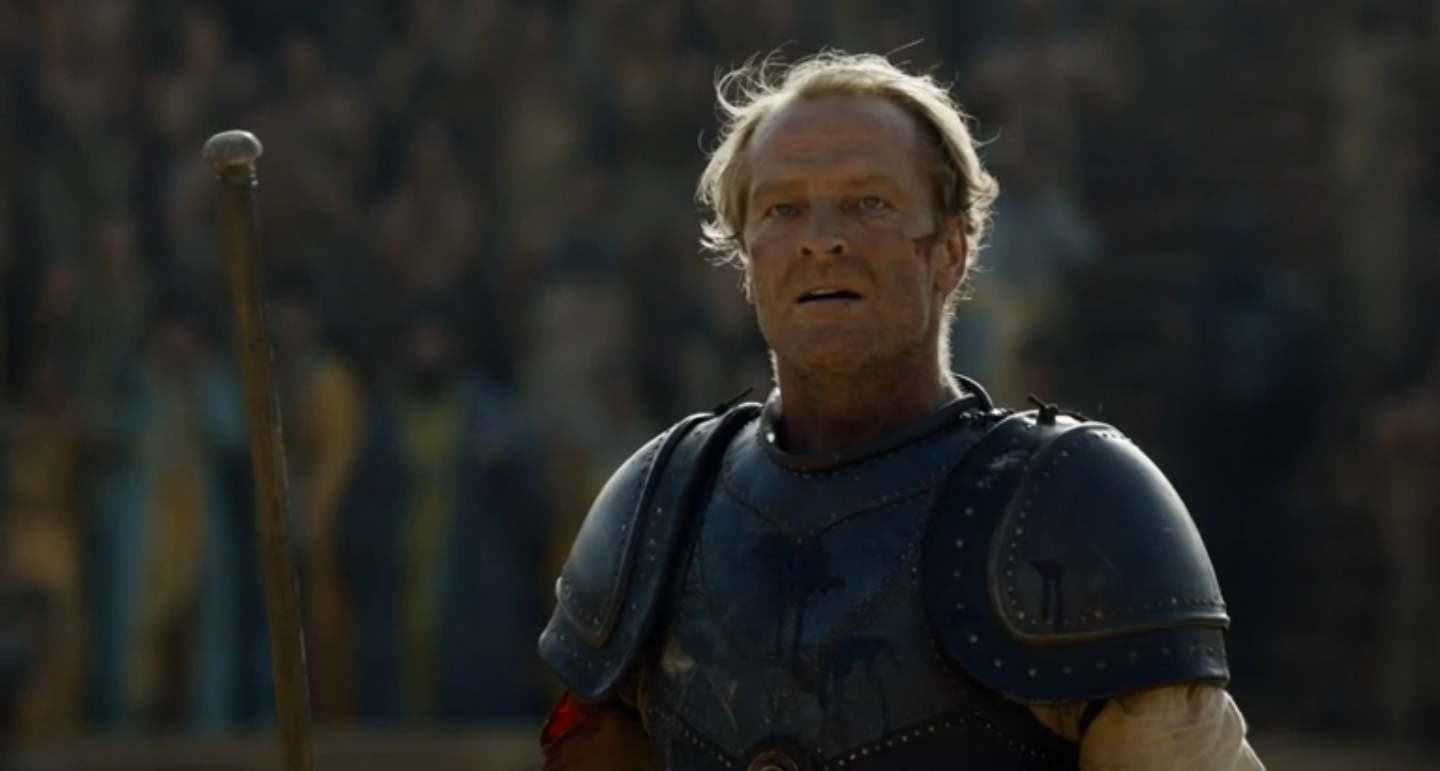
jorah_spear

So … some similarities, but the show has played up Drogon as her rescuer rather than uninvited guest.

There’s a lot going on in the final sequence, which I want to unpack in a moment. But first, a few random points and observations:

  • I love how Daario just doesn’t give a fuck. He’s the honey badger of third wheels, gleefully insinuating himself between his lover and her new fiancée.
  • The next time I find myself talking about ideology and privilege in one of my classes, I am totally going to quote Tyrion’s brilliant line “It’s easy to confuse ‘what is’ with ‘what ought to be,’ especially when ‘what is’ has worked out in your favour.”
  • The Unsullied don’t really seem to be living up to their reputation, do they? The last time the Harpies attacked them in force, they were hardly indomitable, and once again they’re dying in large numbers here. Lestways, this is a complaint I have read in a bunch of other reviews … which I don’t think is entirely fair. The Unsullied were billed as a formidable fighting force, as soldiers who subsume everything to standing in an unbreakable shield wall. Certainly in the novels their prowess has far more to do with standing firm on the battlefield than in individual combat. In both this sequence and the one where we lost Ser Barristan (sob!), the Unsullied are outnumbered and outflanked. They do pretty well, considering.
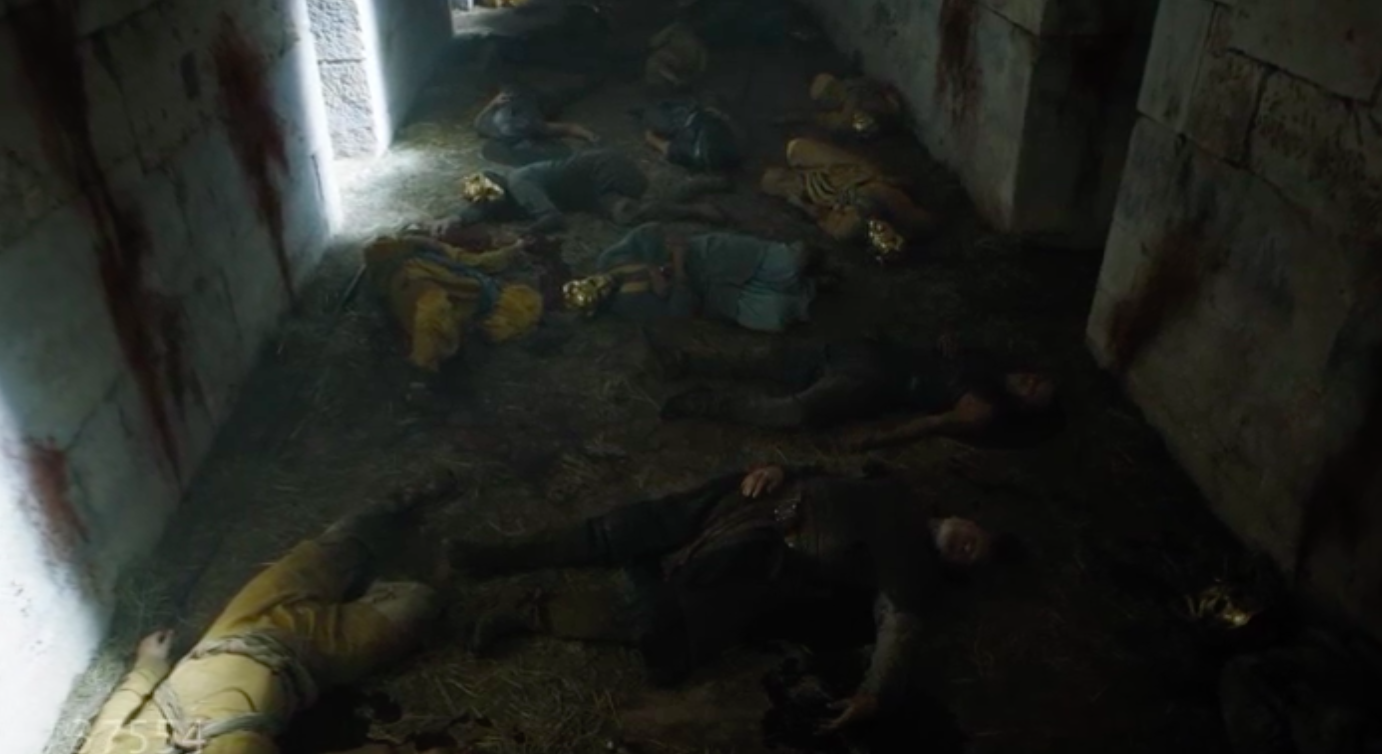
  • My first thought on watching this scene was “Holy crap, how many Harpies are there?” It seems like half the city owns sinister gold masks, but on rewatching, it occurred to me that this is an illusion created by the relatively small numbers of people present (compared to the city at large). I suppose it’s possible that this is all of them, thinking that if they come out in force at this one event they can overwhelm the queen’s bodyguard. Well played, Harpies … too bad about the dragon.
  • Did you notice that the lineup of fighters with Jorah looked like a model U.N.? There was a Mereenese champion, a Braavosi water dancer (who nearly defeated Jorah), a Dothraki, a bare-chested barbarian type whose origin I can’t guess; and the first person Jorah fights is a black man wielding a weapon very similar to that of Prince Doran’s bodyguard Areo Hotah—which, based on Areo’s heritage in the novel, would indicate that this fellow comes from the Free City of Norvos.

But on to the most interesting stuff: what I liked best about this sequence, aside from DragonRescue 911, was Hizdahr’s rhetorical question, “What great thing has ever been accomplished without killing or cruelty?” It is a question that underwrites this series, and the books on which it is based. Hizdahr’s question made me think immediately of Orson Welles’ iconic performance as the amoral Harry Lime in The Third Man, in which he famously makes a similar claim:

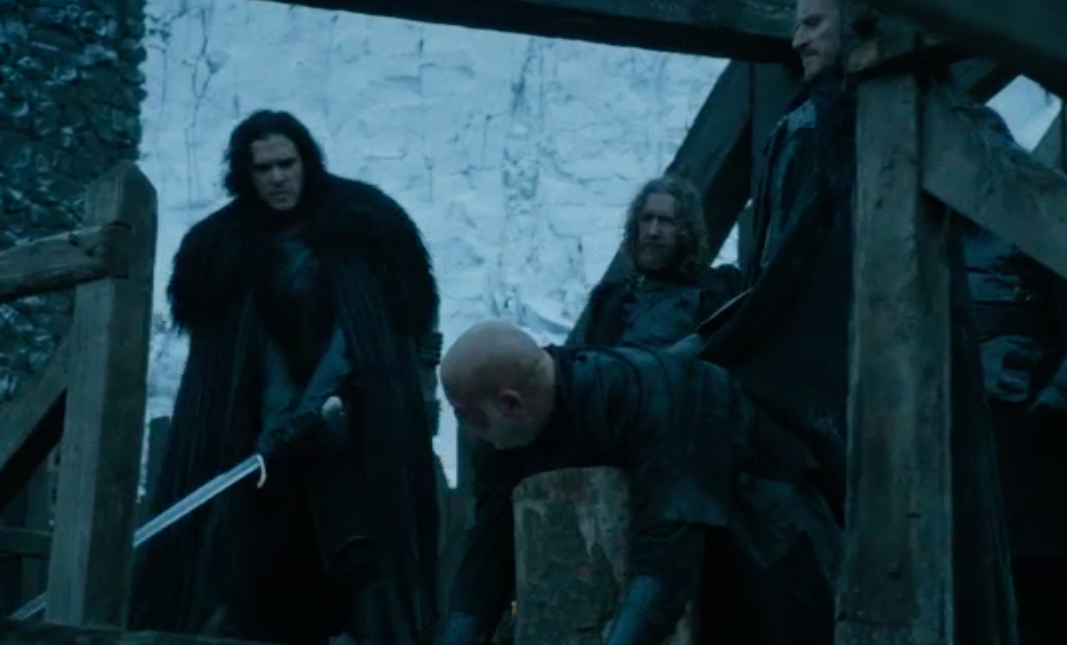
You asked the question a few posts ago, Nikki, about why Daenerys seemed so queasy about men killing each other in gladiatorial combat when she’d witnessed—and caused—so much death herself. I think Tyrion’s observation that “There’s always been more than enough death in the world for my taste. I can do without it during my leisure time,” serves as at least a partial answer to that. The question of what is unavoidable or necessary violence versus what is cruelty is one of the things that animates this show, not least because we start to become queasy when characters we love, like Arya, start to take pleasure in killing; in contrast, we grow more sympathetic to a character like Jaime Lannister as he sheds his killer’s glee and appears to develop (or reveal) a conscience. And as we see in this episode, what is right may not be the smartest course. “You have a good heart, Jon Snow,” Ser Alliser says as they watch the wildlings pass through the gate. “It will get us all killed.”

Stannis also does what he believes is right, or at the very least necessary in order to attain what he believes is his right. Daenerys negotiates the same fraught landscape. But this show does not reward those who hew to an abstract sense of right or justified, more often than not rewarding the opportunists and schemers like Littlefinger or the Boltons. Whatever good intentions Daenerys has had, she still finds herself surrounded by enemies in the middle of a fighting pit, dead but for the timely intervention of Drogon.

What did you think of this episode’s final scene, Nikki?

dracharys

Nikki: After this episode was finished, it’s the first time in a long time my husband immediately said, “Back that up; let’s watch that scene again.” We were both freaking out and cheering when she climbed onto Drogon’s back.

Although my favourite Twitter comment was this one:

tweet

But let’s back up. My notes, not surprisingly, stop just as the Harpy ambush begins, because even though I’ve watched this scene several times now, I just can’t take my eyes off the screen. I think Hizdahr is — oh no wait, was, heh — a condescending prick. Until now he’s always been a groveler who tries to maintain reason in every scene by explaining to Daenerys the way things were (mostly because he wants things to return to the way things were) but now that she’s betrothed to him, he turns into a holier-than-thou asshat. He scoffs at Tyrion, who he may have recognized is a far more reasonable advisor than he’ll ever be, making comments about how large men will always triumph over smaller men (camera zoom on Tyrion’s unamused face), and pushing his own Machiavellian agenda so much throughout the conversation that Tyrion finally wearies of him and simply says, “My father would have liked you.”

I found it strange that Hizdahr just happened to show up late, then made no move to protect Daenerys, and seemed completely unsurprised when the Sons of the Harpy showed up. But then he got killed in the attack. Did he set it up? Perhaps. And then they realized, “Yeah, Hizdahr may have set up this whole thing and helped us get rid of that silver-haired bitch, but he’s a d-bag, so let’s kill him while we’re at it.”

(That right there is Reason #741 why I’ll never be allowed to write dialogue for Game of Thrones.)

I agree with you on Daario, Chris — you are right on the money by calling him the honey badger of Meereen, haha!! I loved the way he just kept sticking his face between Daenerys and Hizdahr and making his snide remarks, even if he did turn out to be wrong in the moment. But we know that in the long run, comments like where he says large people tend to have nothing but muscle in their heads, and the smaller man has intelligence, will prove to be true.

And I also agree on the Unsullied. As I said in that post for episode 4, the Unsullied are trained to fight in perfect lines in battle, much like the British were. That’s why, when the British were fighting in the American Revolution, they were so outweighed by a bunch of people hiding in the woods with muskets — they were not trained for an ambush. The Sons of the Harpy fight like they’re in a gladiator ring, and perhaps some of them were (though that would suggest they were slaves, and why would slaves want a return to slavery?) It’s not exactly clear how these noblemen became such admirable street fighters, but let’s just suspend our disbelief on that one for a bit, and say there’s a reason the Unsullied always seem to be outnumbered in these instances: it’s because they are.

arena_overwhelmed

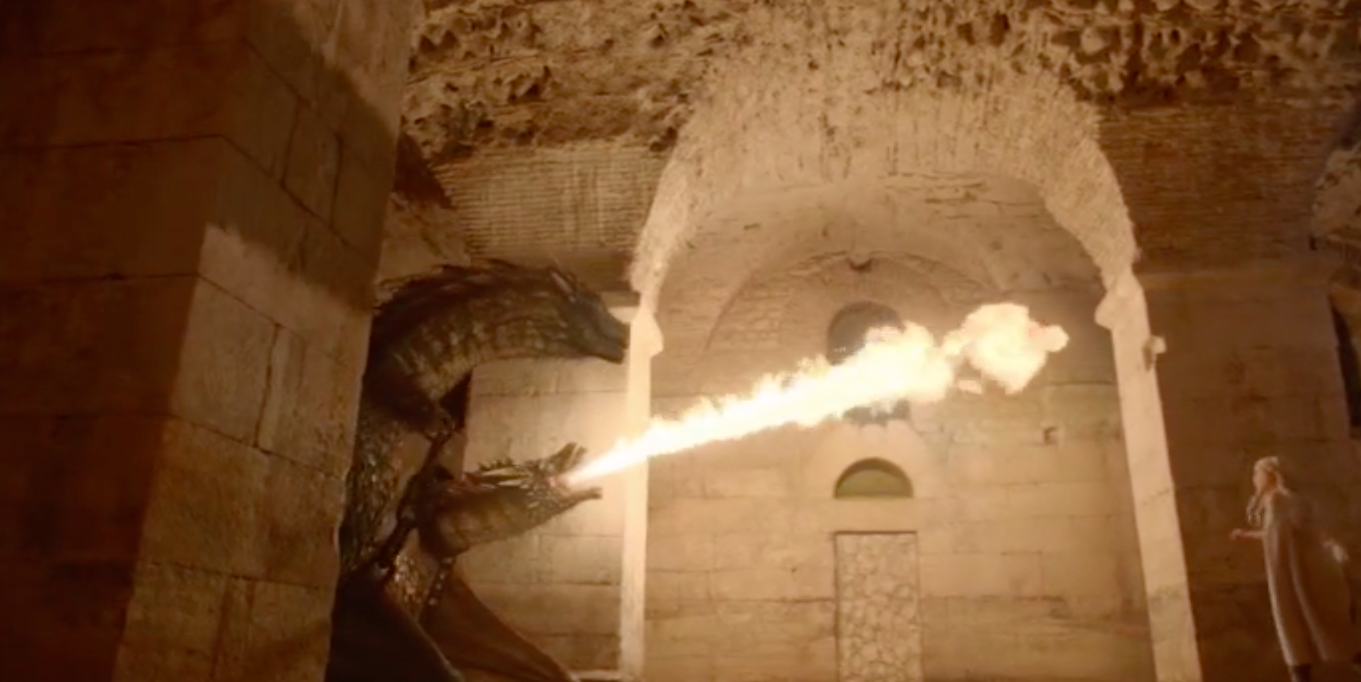
But now on to Drogon. The last time Daenerys saw him was when he perched above her on her balcony. She reached out a hand to him tentatively, and there was a moment where he seemed to acknowledge her with his eyes before suddenly taking to the air and leaving again. Then Tyrion saw him sailing over Valyria, and it’s the first time he actually sees a dragon. Drogon is the largest of the three, and has always been Dany’s favourite. In the terrible moment where they are surrounded by the Harpies and it appears there’s no way out, Daenerys suddenly closes her eyes, using that telepathic messaging service she used when the dragons were babies, and to her shock — and ours — it actually works. As you said, Chris, that faraway screech is SO exciting that I was literally — and that, kids, is the correct use of that word — sitting on the edge of my seat, gasping and screaming throughout the rest of it. My husband was cheering… it was a glorious moment. From immolating dozens of Sons of the Harpy in one go, to grabbing a man and shaking him the way a dog shakes a stuffy just to get the squeaker out (and, similarly, Drogon makes the man’s stuffing come out), to simply crawling around menacingly and hissing at them the way my cats do when they’re around each other, he was fantastic. When the spears began flying through the air I was worried — if the Sons of the Harpy all began throwing spears at once, could that kill a dragon? My husband was confident that Drogon would be OK. He kept saying there was no way spears could kill a dragon, that their hides are probably like rocks and they are probably nearly indestructible. But Daenerys is still devastated when it happens, because she knows there must be some pain. As he slinks around the ring in a fury, barbequing some of the people while eating others, she walks up to him and pulls the spear out of his side. The looks on the faces of Daario, Tyrion, and Jorah at that point are priceless. They’ve all seen the dragons, but they’ve seen just how wild they’ve become.

howtotrainyourdragon happy_drogon

In his rage, Drogon could have just as easily turned to her and accidentally set her on fire (though it wouldn’t have actually hurt her at all) but instead he simply screams in her face, turning the fire off momentarily. And then he stops. He tilts his head, and like a wild horse being tamed, sits quietly as an idea suddenly comes to her, and she walks around and mounts his back. The CGI as he lifts her off the ground isn’t so hot — you can instantly tell that was all green-screened and done so badly — but once he gets into the air it’s spectacular.

Though, just like the dude on Twitter, I couldn’t help but think, “Uh, Dany? You, um, forgot three people back there. The Sons of the Harpy aren’t all dead, you know…”

But something tells me they’ll be fine.

final_shot

Thanks once again for reading all of this! Next week we shall return with the finale! Wherein Sansa lops off Ramsay’s penis and feeds it to Arya’s direwolf, which she happens to find in the woods behind Winterfell; where Daenerys takes Drogon to see Viserion and Rhaegal and the three dragons are reunited and forgive Mama and head off to burn some White Walkers; where Jon Snow rises up to rule the North after the giant stomps on Ser Alliser’s head and Sam and Gilly kill Stannis and Melisandre; and where the Starks are all reunited and rule King’s Landing when Cersei is pecked to death by a crow.*

(*Nik at Nite cannot guarantee any of the above will happen.)
Leave a comment

Filed under Game of Thrones

Game of Thrones 5.08: Hardhome

gameofthrones_teaser02_screencap10Hello again and welcome to the epic Chris and Nikki co-blog, in which we recap and review the most recent Game of Thrones episode. We apologize for this one going up late, but I have been in Ottawa this past week at the Congress of Humanities, and apparently Ottawa has no reliable wireless anywhere, so it took me awhile before I could watch the episode. Also, I was busy conferencing (by which I mean drinking beer with colleagues I haven’t seen for a while).

But here we are, and wow was this week’s episode a barn-burner. Literally. I think a barn might have been burning in the background at one point. It is Nikki’s turn to kick us off, so I will cede the stage to her …

 Tyrion_Jorah

Nikki: Wow. The last 15 minutes of this episode were so intense that I’m writing this the next day, and my stomach feels like I did 100 crunches.

So, as we always do, let’s start somewhere else and lead up to that moment.

I’ll start at the beginning, with Tyrion and Daenerys. Last week I had high hopes for this moment, and it was as wonderful as I thought it was. Tyrion and Ser Jorah appear before Dany and her guards, and she asks Tyrion why she should believe that he is who he says he is. Using that silver tongue of his, he talks his way through everything, from her questioning why, if he’s from the House that killed her family, she should allow him to live — “I am the greatest Lannister killer of all time,” he replies — or where he finally silences her when he begins telling the story of Daenerys the way he has always heard it. He recounts the story of a baby that was in peril its entire life, who grew up into a young woman who was married off to the Dothraki and he thought that would be the last he’d hear of her, until she rose up and suddenly had armies and respect and people following her. “I thought you were worth meeting at the very least,” he says with his usual wit.

He explains to her that she doesn’t understand the Houses the way he does, and that he could become her advisor. Daenerys is quiet, calm, and listens to him closely throughout this scene, and she’s as smart in her silence as Tyrion is in his loquaciousness. Remember: her longtime advisor betrayed her and was sent away, and the advisor who took over from him has just been slaughtered. She’s been making her own decisions for the past couple of weeks, and trying her best to do the right thing, but her missteps have always happened when she didn’t listen to counsel as closely as she could. Tyrion has always been so good at captivating a listening audience that he naturally commands this scene, and she listens to him.

And… she gives him his first task. He has to advise her on what to do with Ser Jorah, and his advice is spot-on: you can’t murder a man who is devoted to you, because that will deter the devotion of others. And yet, he betrayed her. And yet, he changed his mind about her and would give his life for her now. And yet, he had opportunities to confess his crime to her and he chose not to, so even when he was most devoted to her, he was withholding very important information. Therefore, let him live, but he cannot be at her side. Daenerys looks astonished, and then impressed, and without a moment’s hesitation tells her guards to get Jorah out of the city. As we later see, Jorah will not go quietly into that good night, because with the death sentence growing ever more rapidly on his arm, he feels he’s got nothing to lose.

tyrion_wine

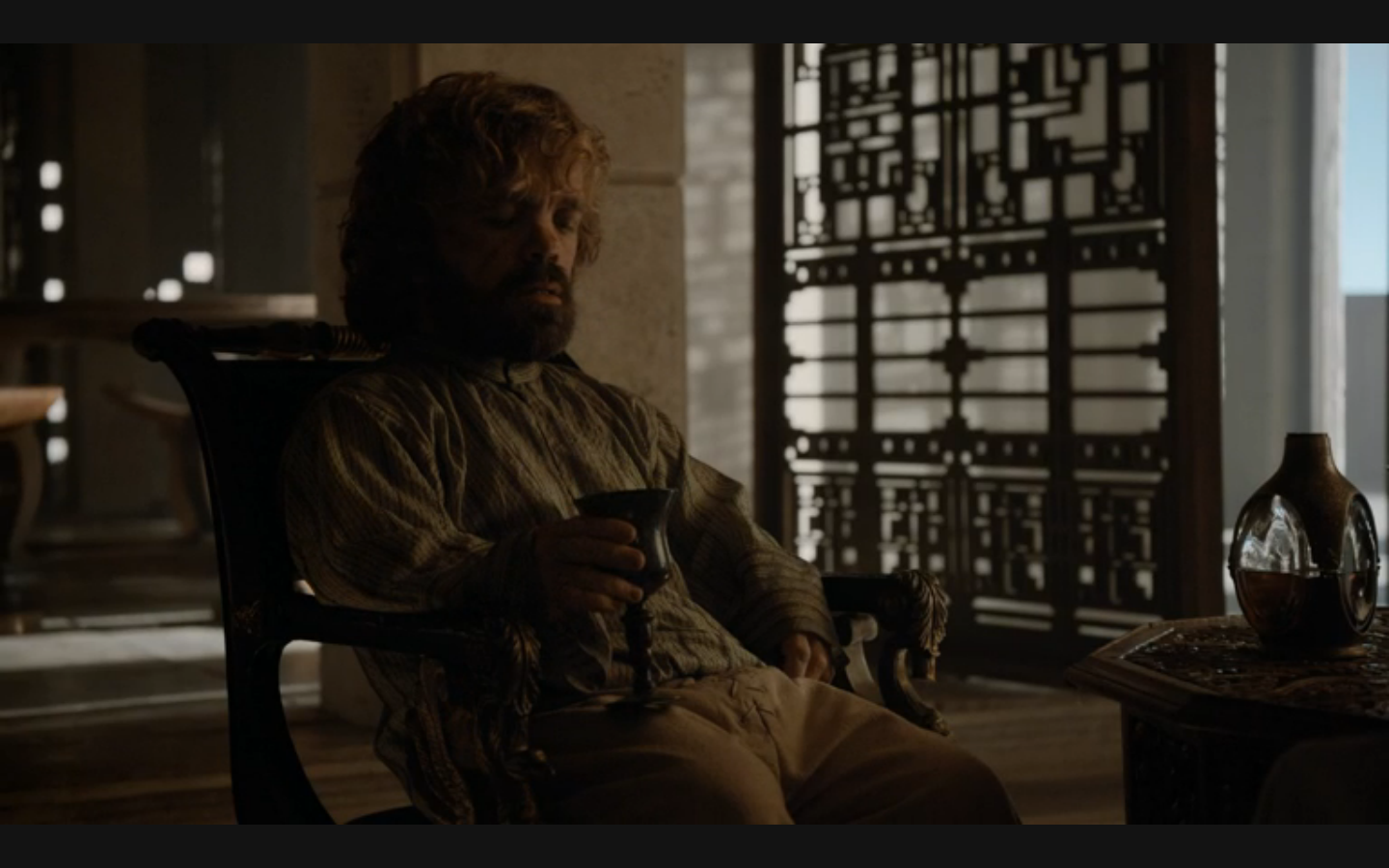
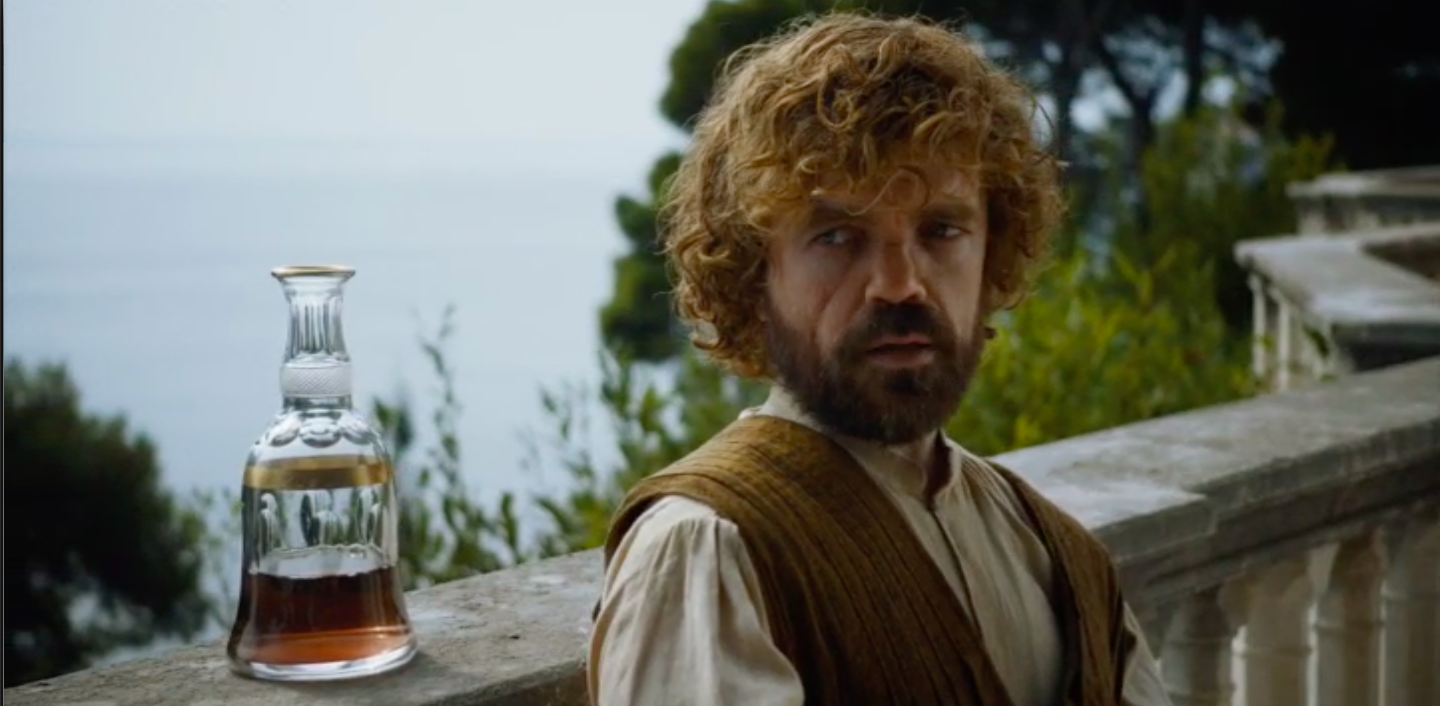
The next time we see Tyrion and Dany, they’re enjoying some wine (I imagine Tyrion must have been in some serious withdrawal, since he hasn’t had any wine since Jorah kidnapped him) and having a discussion. He begins to explain the Houses and their various loyalties to her, and I loved this scene because it felt like he was summing up The Show So Far. He sets the record straight on the Spider, explaining to Dany that it’s because of Varys that she probably wasn’t killed in her crib a hundred times. He’s still being a tad careful around her, asking if she’s going to lop off his head, and after a few jokes of how close he’s come to losing it before, she finally tells him that he will be her advisor, and no one’s going to be losing their heads today. Amusingly, she says, “You can advise me” then takes the wine goblet from his hand “while you can still speak in complete sentences.” Ha! Perhaps Dany will be the one to help wean Tyrion from his greatest weakness (after women, of course).

But after Tyrion begins his new vocation by suggesting that perhaps the Iron Throne is overrated, and Dany might be better here, in Meereen, where she’s running the place, where she’s loved and respected and finally has things under control, she waves him off, and tells him that Meereen isn’t her home — King’s Landing is (which is so interesting to us viewers, since we’ve never seen her in that place, and yet she’s right). He explains the tumultuous conditions over in Westeros, with the Houses all at war and stabbing each other in the back, so intent on grabbing the throne for themselves that no one will actually help her. She simply retorts that the Houses are spokes on a wheel, and Tyrion sits back like he’s looking at a naive little girl, and says stopping the wheel is nothing but a beautiful dream and she’s not the first person to have it. Daenerys turns to him with confidence and says, “I’m not going to stop the wheel; I’m going to break the wheel.”
Now it’s Tyrion’s turn to look impressed.

daenerys_lounging

These opening scenes set up a recurring motif in this episode, which is the power of language. Tyrion saves his own life — and that of Jorah’s — through his words. In fact, he’s made it this far on words alone (and is the only Lannister not dead or imprisoned at the moment). If only Cersei would confess — she doesn’t have to mean it, she just has the say the words — they say they’d let her out of her prison. Ramsay undercuts Roose’s plans to have a giant army by suggesting that strategy would work more than numbers. The discussion between Sam and Ollie — and the words Sam uses without realizing the effect they have on the boy — could spell doom in the future. And the speeches that Tormund and Jon Snow give at the end of the episode are the ones that ring out throughout the battle that follows.

If it’s intelligence and words over sheer military might that will win the Iron Throne, Daenerys and Tyrion have the best chance of all of them at this point.

One of the most fascinating scenes follows the opening one, where Arya reinvents herself using only speech and a new backstory, as Jaqen gives her an initial mission. What did you think of the House of Black and White storyline this week, Chris?

arya_close

Christopher: Considering how much the show is now diverting from the source material, it is an odd comfort to have one storyline at least hew closely to the novels. Arya’s story continues to fall out much as GRRM wrote it, with a handful of changes for the sake of economy. What I liked about her story in this episode is that, in an episode largely—as you observe—about talking, Arya’s bit is very much about seeing, both in terms of Arya seeing and at the same time not being seen. As Lana the oyster-girl, she is all but invisible, and from this position is able to observe very astutely and acutely.

One thing I should point out is that in A Feast for Crows, her apprenticeship as oyster-girl is more protracted and more literally an apprenticeship, as she is instructed to work for and live with a family who harvest and sell shellfish (and who take her in from the Faceless Men without question). The slight change the show makes in not drawing this out is an obvious one, but it is worth pointing out the novel’s treatment because it helps highlight the way in which our understanding of the faceless men has evolved.

The Faceless Men are a remarkable invention by GRRM, a society of assassins that ultimately comes to eschew all the clichés that usually attach to such characters. In A Game of Thrones, we first hear of them when Robert Baratheon demands that the newly pregnant Daenerys be killed, and the Faceless Men are floated as a possible means to this end—only to be ruled out by Littlefinger on the grounds that their services are monumentally expensive. Littlefinger later placates a furious Ned Stark, saying that in offering a general reward for her death (as he had suggested), it was unlikely that anyone would succeed in killing her—whereas, had they hired the Faceless Men, she’d be as good as dead.

jaqen

Then we meet Jaqen H’ghar in season two and in A Clash of Kings, who seems to embody some of the aforementioned assassin clichés: suave, mysterious, preternaturally capable of dealing death. But this season he bears more resemblance to Yoda than anyone else, and the further we go into the House of Black and white (literally and figuratively), the more we come to understand the Faceless Men as a religious order rather than a mysterious order of assassins, who do not exist in isolation from society but in continuity with it. How they choose their victims remains a little mysterious, as does the precise method of remuneration. Littlefinger laments how expensive they are, but a man begins to wonder if that is perhaps the going rate for the rich and powerful, for whom assassination isn’t about giving the gift of death but a calculated move—whereas vengeance against a cynical insurance adjuster by an impoverished widow, who certainly could not afford the Littlefinger rate, would cost something more commensurate with the man’s crime and the widow’s means.

This is of course highly speculative, but it makes sense with regards to everything we have seen thus far. Arya’s apprenticeship to Jaqen has been about the dissolution of ego and concomitant ability to dissolve oneself into the world at large, to swim in its currents without being noticed, and above all to be able to see people for what they are.

arya_selling

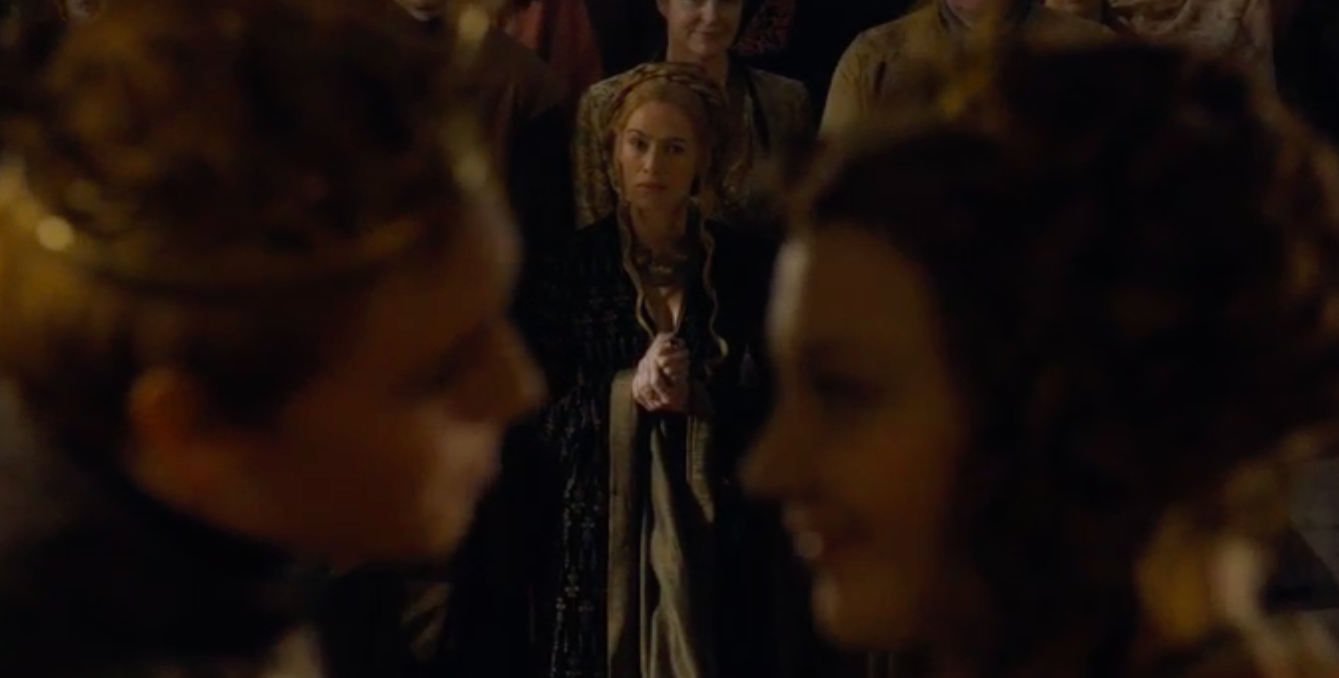
In this respect, Arya’s story stands in stark (ha!) contrast to Cersei’s, who currently suffers the consequences of her blindness. All her life she has had two weapons: her beauty and her name, and they have never failed her before. As a result, she has been able to delude herself into believing herself a shrewd player in the game of thrones, whereas in reality she has been little more than a bungler. She now finds herself in a position where all she can do is rail and threaten, for she has put power in the hands of the one body that trumps the crown, and she did so in the mistaken belief that the High Sparrow understood the process as a transaction, as a quid pro quo. “I made him,” she tells Qyburn when he suggests that confession is one way out of her quandary. “I rose him up from nothing. I will not kneel before some barefooted commoner and beg his forgiveness.” This assertion reveals more about Cersei than her stubborn pride: it betrays the fact that she still just doesn’t get it, that she has arrived at a place and time where the Lannister name is not a get out of jail free card, does not entitle her to others’ fear and respect, and does not grant her authority.

There’s a nice little resonance here with Tyrion’s speech to Daenerys in which he enumerates why the various great houses will oppose her. Tyrion, though far smarter and shrewder than his sister, is nevertheless still captive to the same fallacy as Cersei, one that Daenerys is determined to upend. Daenerys understands one of the central truths of The Wire—“the game is rigged.” But she does not mean to play by the usual rules.

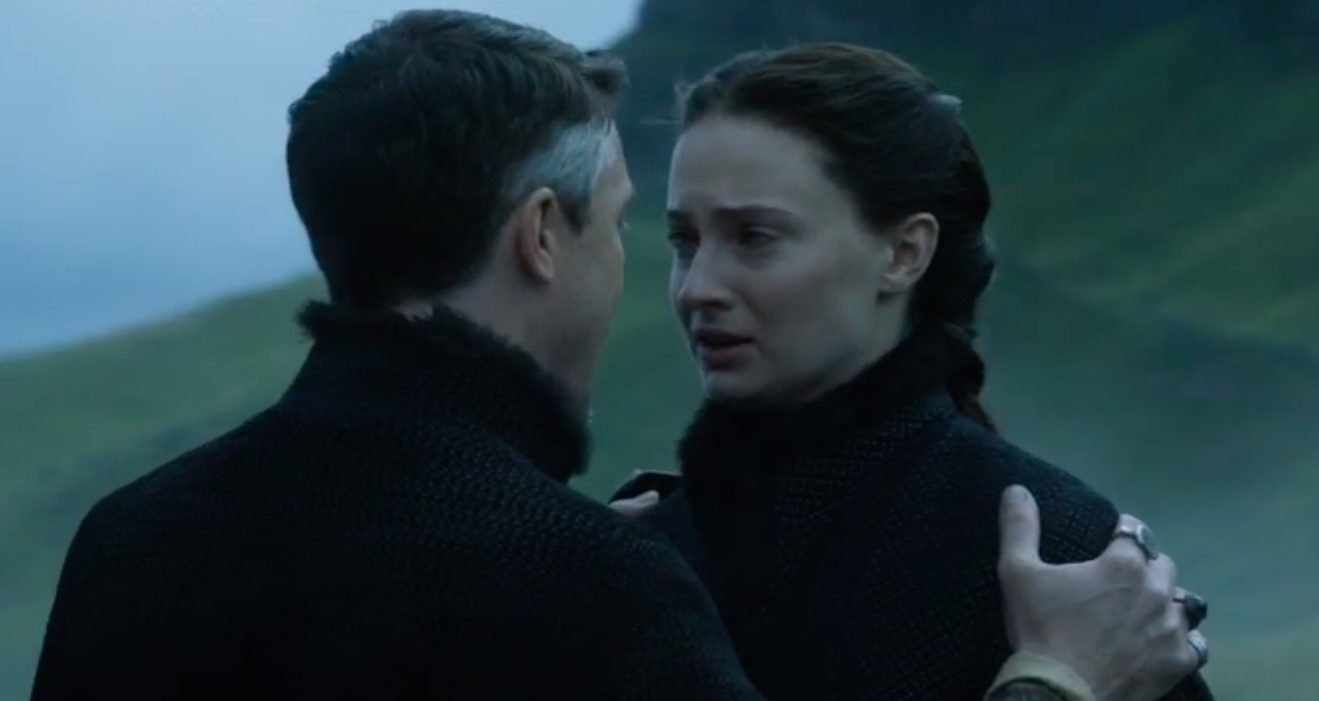
It will be interesting to see how Littlefinger fares.

Meanwhile, in the North, Sansa hears the first good news she’s had in a very, very long time. What did you think of the Winterfell story in this episode, Nikki?

sansa_room

Nikki: Oh, I’ve been waiting so long for Sansa to hear anything good about her family, and this moment was wonderful. It’s a quiet one, hidden in the middle of the episode and certainly overshadowed by the high drama happening in the King’s Landing prisons (for which I must give major kudos to Lena Headey, who is brilliant as Cersei this week) and the beyond spectacular battle scene at the end. As you called it last week (and I bungled as badly as Cersei has screwed up with the Sparrows), Reek did indeed turn to his master rather than try to help Sansa. But in this episode he pleads with her that in not trying to carry out her plan, he was helping her. She thinks because she’s somehow escaped the clutches of Joffrey she’s seen the worst Westeros has to offer. Turns out a bastard Bolton is far more dangerous than an inbred Lannister. (The Westerosians need to make bumper stickers with that motto just to spread the word.)
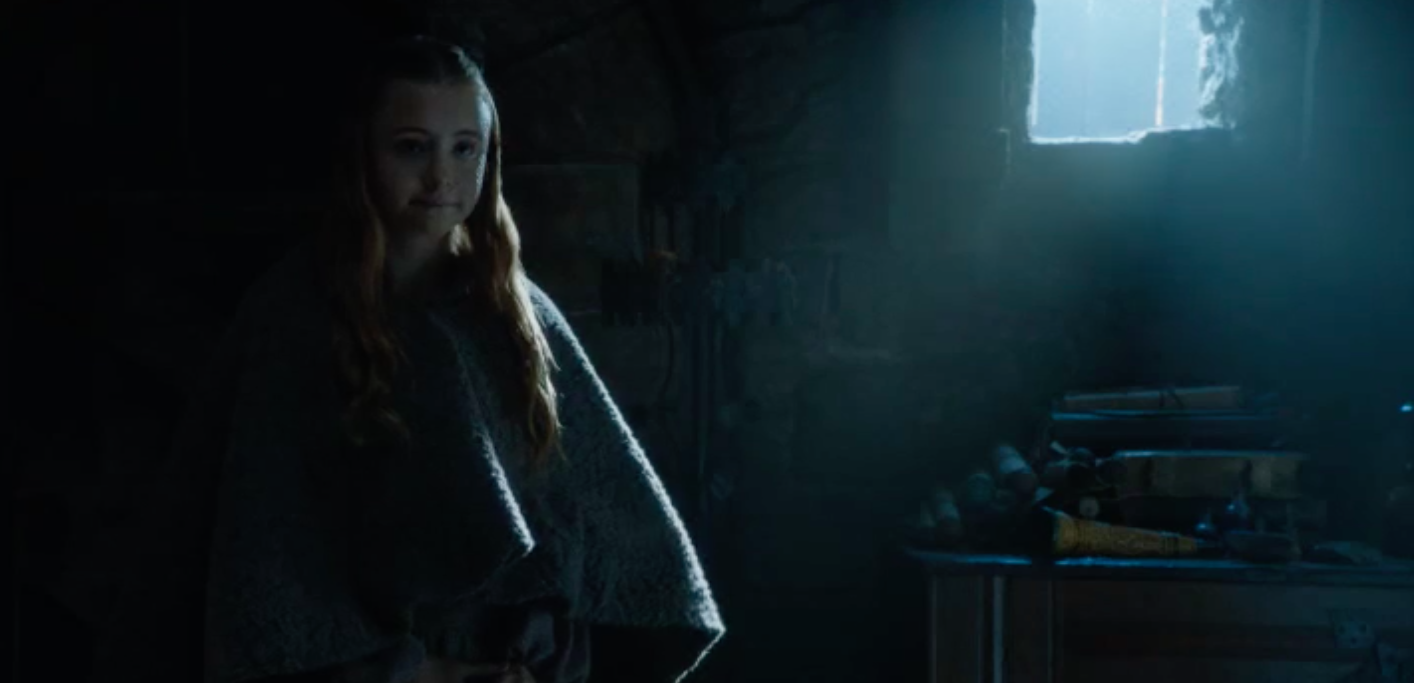
Reek tries to explain his motives to Sansa, but she won’t have any of it. He’s utterly broken; sadly, he’s not rising up to fight Ramsay the way I thought he might. I’m still not ruling it out, but it’s going to take something major to switch the Theon in him back on. In this episode he speaks of Theon in the third person, and says he’s absolutely not him any longer (which renders him answering to Theon two episodes ago a bit of a continuity error, in my eyes). He tells Sansa, “Theon Greygoy tried to escape.” He explains that “the master” knew, and “he cut away piece after piece until there was no Theon left.” Sansa simply looks at him and says, “Good.” She says if Ramsay hadn’t done those things to him, she would have done all of them and worse, or at least wished she had. She’s getting no argument from Reek, who tells her that he deserved everything he got.

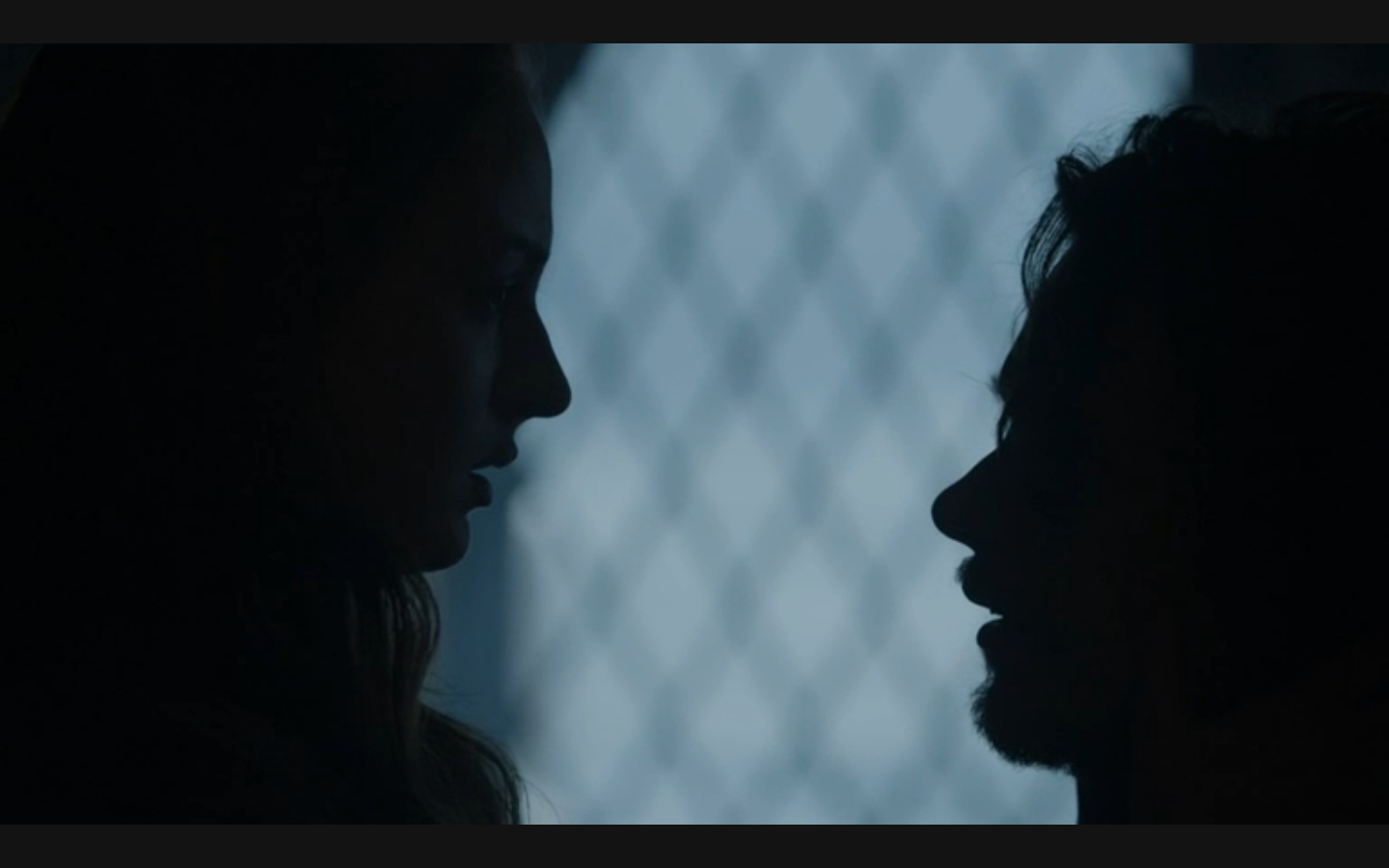
But then she demands to know why, and how, could he have done what he did with her little brothers. He grew up with Rickon and Bran, how could he do those terrible things to them? And for a split second, Theon returns, and he says it wasn’t— and then stops short. Sansa catches him, though, and won’t let him walk away. She pushes and pushes until he finally admits he never killed her brothers, he couldn’t find them. He killed two innocent farmboys. The look on Sansa’s face was worth the price of admission. Just imagine this news for her. She watched her father be beheaded by the man to whom she was betrothed. She heard that her mother, brother, sister-in-law, and their unborn child were slaughtered by the Boltons. Arya has gone missing and is presumed dead. And then she hears that her two little brothers have been burned alive by a man who was raised like one of her brothers. The only relation she believes she has left is Jon Snow, and he’s been banished to the Wall and isn’t a Stark. She’s gone from having a family of eight, including Theon the ward, to it just being her. Even the Theon she knew is gone. And now it’s as if two of the dead have come back to life. She doesn’t know where they are, but they’re out there somewhere, and she might see them again one day. It’s a wonderful, wonderful moment, filmed with the two faces in profile, silhouetted against a grated window, as Sansa clutches the sides of Reek’s face, trying to catch her breath. I absolutely loved the art direction of this moment.

sansa_theon

This scene moves to the Boltons planning their strategy against Stannis Baratheon’s army. Roose says he’s prepared for the siege and Stannis’s men are outnumbered. They simply hold out, wait for Stannis’s men to starve or mutiny, et voila, they win. But Ramsay’s got another idea up his sleeve. Or, as he says in an obvious shout-out to the title of the fourth book, he believes they need to take an offensive strategy and force Stannis’s army to become a Feast for the Crows. Roose (whose profile made me realize for the first time that his nose has clearly been broken at some point, for it has absolutely no curve to it whatsoever) argues that if you have the clear defensive advantage, why would you go on the offensive with an army, especially considering how deep the snow will be? Ramsay says he can do this with 20 good men. Whatever he’s up to, I’m assuming it’s not what any good military man would expect. And probably involves the removal of fingernails at some point.
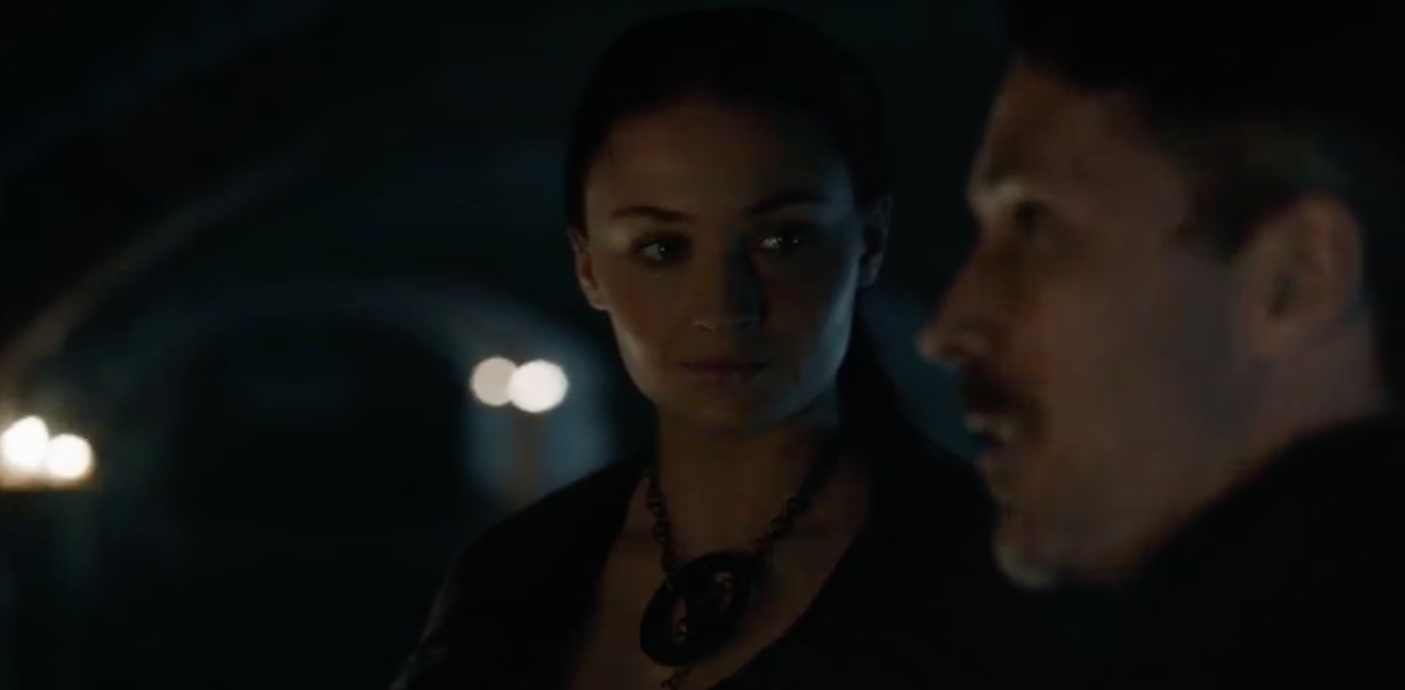
Meanwhile, at the Wall, Sam is recovering from his injuries with Gilly (whose baby, as someone commented to us last week, is still a baby, despite the fact it was born three years ago, something that never occurred to me!) and is visited by Ollie. This is the second scene where Ollie has argued with a man of the Night’s Watch about the plan, and it feels ominous to me. What did you think of Sam and Gilly’s conversation, and then Ollie’s?

sam

Christopher: I think this was a very tight little scene that speaks to the truth of Sam’s words: here we are in the heart of Castle Black, and Sam feels compelled to grab a blade when someone knocks at the door. “Wildling are people,” he tells Ollie. “Just like us, there are good ones and bad ones.” Given that Sam has had a recent run-in with some of the bad ones who are supposedly on his side, who would have beaten him to death and raped Gilly were it not for Ghost, he has a better sense of this than does Ollie. Ollie can hardly be faulted for hating the wildlings, and Tormund in particular, but it is worth noting that if his village had been north of the wall it might well have suffered a similar fate at the hands of Karl Tanner and his renegade crows.

Not that Sam makes this point, or that Ollie would accept it. The tensions and the conflicts in the Castle Black storyline this season are very much about hatreds and enmities so deeply rooted than many people simply cannot see past them, even if it’s a matter of their own survival.

ollie

Which is what makes Sam’s well-meaning words—as you say—so very ominous. “Sometimes, a man has to make hard choices,” he says, “choices that might look wrong to others, but you know are right in the long run.” It’s obvious that while Sam is talking about Jon Snow, Ollie is thinking about what he thinks is right, and what hard choice he might make in the future. “Try not to worry, Ollie,” Sam says. “I’ve been worrying about Jon for years. He always comes back.” Not quite what’s on Ollie’s mind, Samwell—a man suspects that Ollie is hoping he won’t come back with ships stuffed with wildlings.

Cue Jon Snow’s crossing the Delaware moment, as his men row him into the docks at Hardhome, where he’s greeted by a wall of faces all wearing expressions not dissimilar to Ollie’s.

I think it’s fair to say that the ending of this episode is one of the most spectacular sequences Game of Thrones has given us … and that’s saying a lot. What did you think of it, Nikki?

tormund

Nikki: Oh wow, you’re right! I’d completely forgotten about this ending. NOT.

Wow… every year the production crew of Game of Thrones is faced with some insane battle in the books, and they have to try to up the ante of what they did the year before. And as I immediately said on Twitter at the end of this one, this episode = Rome + The Walking Dead. We saw the spectacular battle at Castle Black last season, which followed the Battle of Blackwater, the Red Wedding, the mutiny at Craster’s… they’ve all been beautifully choreographed and the budgets are so big, you can just imagine hundred-dollar bills shooting out of a cannon in the background. This battle resembles the Red Wedding more than Blackwater or Castle Black, simply because it’s less a battle and more a full-on slaughter. First we have wildlings and Thenns vs. Tormund and Jon Snow, then wildling on wildling (those who agree with Tormund, and those who are on the side of the Thenns), then the wights show up, the skeletal zombies of the wildling dead, and then the white walkers show up (thanks, by the way, GRRM for calling them wights and white walkers, because THAT is not confusing when we’re hearing it and not reading it)… it’s just a madhouse. The CGI on the skelezombies was terrifying, and they move so fast they made The Walking Dead look like a rom-com in comparison.

I loved Karsi (whose name I had to look up because I never caught anyone calling her by name on the show), the wildling who actually listens to John and Tormund and trusts them enough to hand over her children to them. She’s played by Birgitte Hjort Sørenson, whom I immediately recognized as a Danish actress, though I couldn’t put my finger on what I knew her from. And yet, as I kept saying to my husband, I swear I saw her in something recently where she wasn’t playing a Dane. And then IMDb tells me she was the German Kommissar in Pitch Perfect 2, which I’d just seen the day before with my daughter.

Sadly, there were no a capella battles in this episode (I bet she and Jon Snow could have done a mean “Islands in the Stream”) and instead in the melée it becomes an every man for himself situation. The moment Karsi handed off her children, my husband and I assumed she was a goner. Then she became a formidable comrade on the battlefield and I was excited that she might actually live and become a great new female character in the North. And then… she faces off against the child wights. Since they were only in beginning stage of decomposition it would seem they’ve been killed recently, and the shocked look on Karsi’s face led me to believe they may have been her children. Paralyzed in the moment, and unable to hurt them, she dies in battle, eaten alive by the kinderskelezombies.

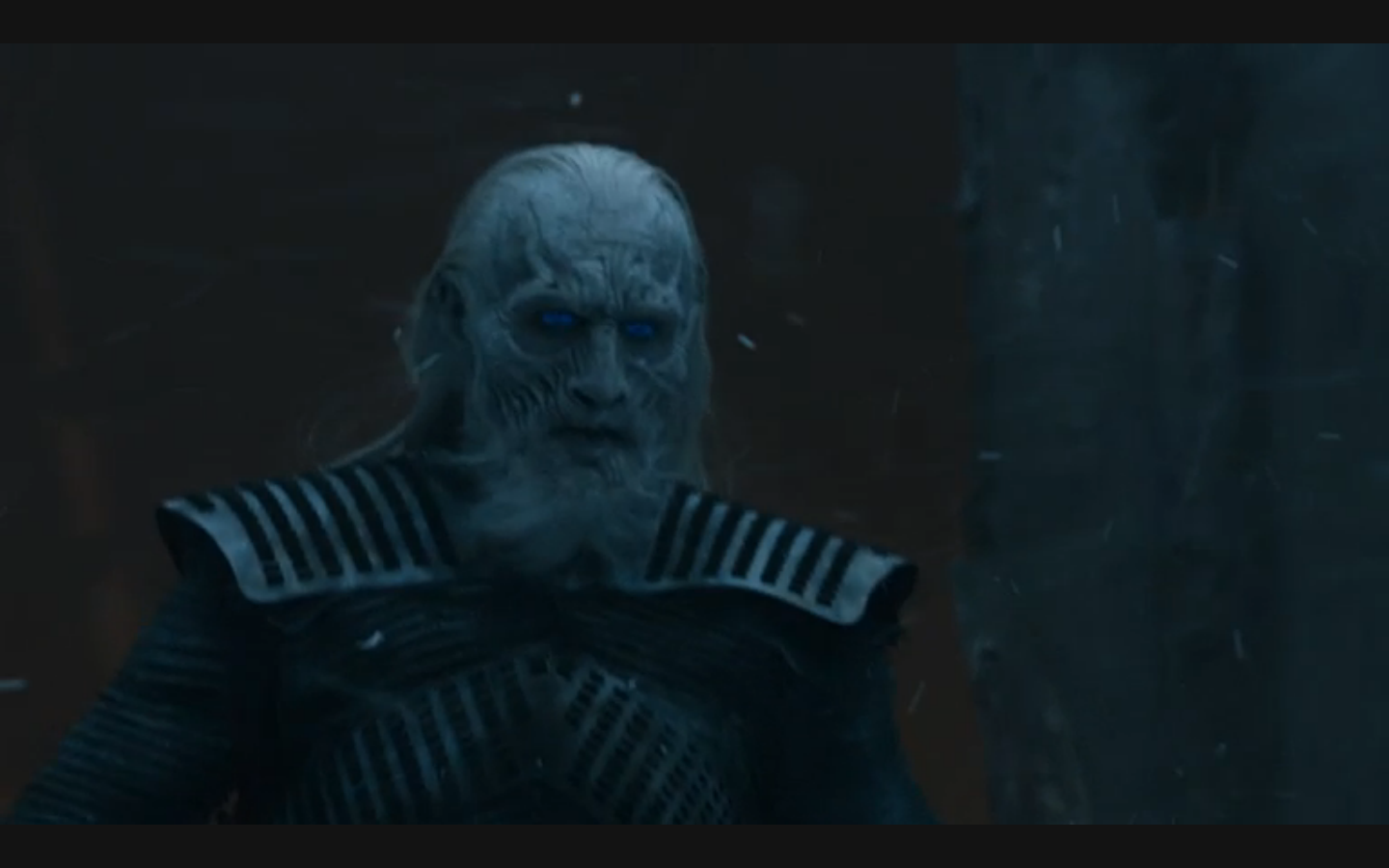
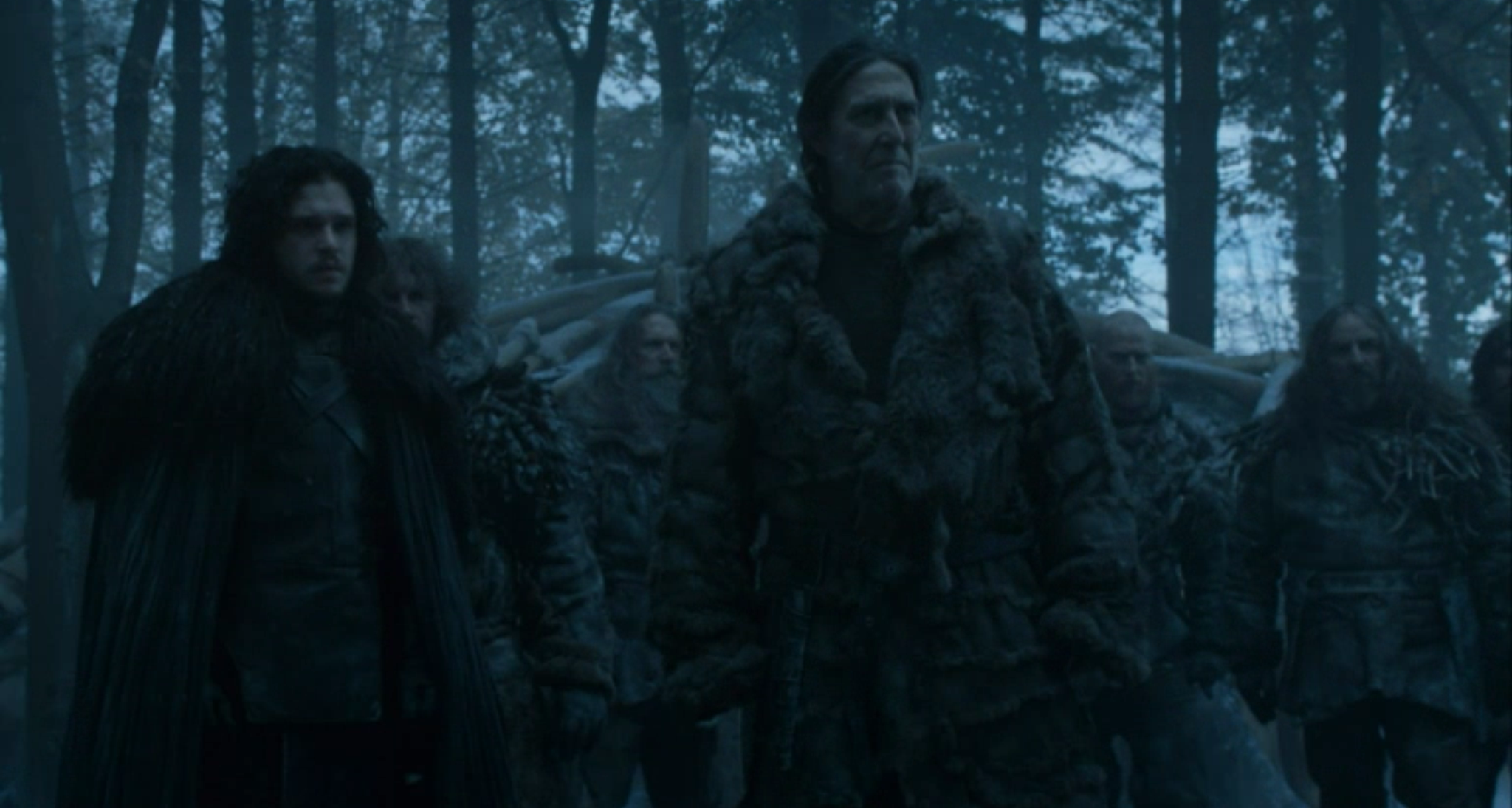
As if the politics and wars going on in Westeros and beyond aren’t unsettling enough, by the end of this episode it’s clear that no matter where they go, men will die — Valar Morghulis, after all. And when those men die, they will be reanimated by the white walkers and become wights, forced to obey the wishes of the Night’s King — the spiky-headed dude who brought them all to life at the end — and become an unstoppable army. Which suddenly begs the question in that horrible eerie silence at the end of the episode: what’s the point of anything else? The Baratheons, Lannisters, Targaryens, Boltons, Tyrells, and Martells can fight all they damn well please, but in the end, the white walkers will win because nothing can stop them. Or… can something stop them?

Jon_shock

Did Jon Snow just become the single most important character of the series? As someone who hasn’t read the books, I read this ending as a twist that might have changed the direction of the entire series to this point. Jon has Valyrian steel. Valyrian steel can kill a white walker. Ned Stark’s Ice sword was made of Valyrian steel, and it was melted down into two swords — one given to Jaime, the other to Joffrey. Joffrey did dick-all with his sword — he was too busy being poisoned to death right after — and then his was given to Tommen, while Jaime gave his sword to Brienne. The Targaryens would have had Valyrian steel swords, but Daenerys wouldn’t still have those. There was that dagger way back near the beginning of the series that was apparently made of Valyrian steel and was used to try to kill Bran and then blamed on Tyrion, but I don’t know where that dagger ended up.

So. If some of the Houses have Valyrian steel — and I’m assuming more, just ones I either don’t remember or they haven’t been brought up — what if the white walkers become the thing that actually unites Westeros? They all have to get together with their swords and stop these things, and that’s the only thing that will do it.

Hm… now I’m thinking too far ahead, but the white walkers just made me forget every other battle that’s either currently being planned, because they all pale in comparison to the scope of what Jon Snow just saw at the very end.

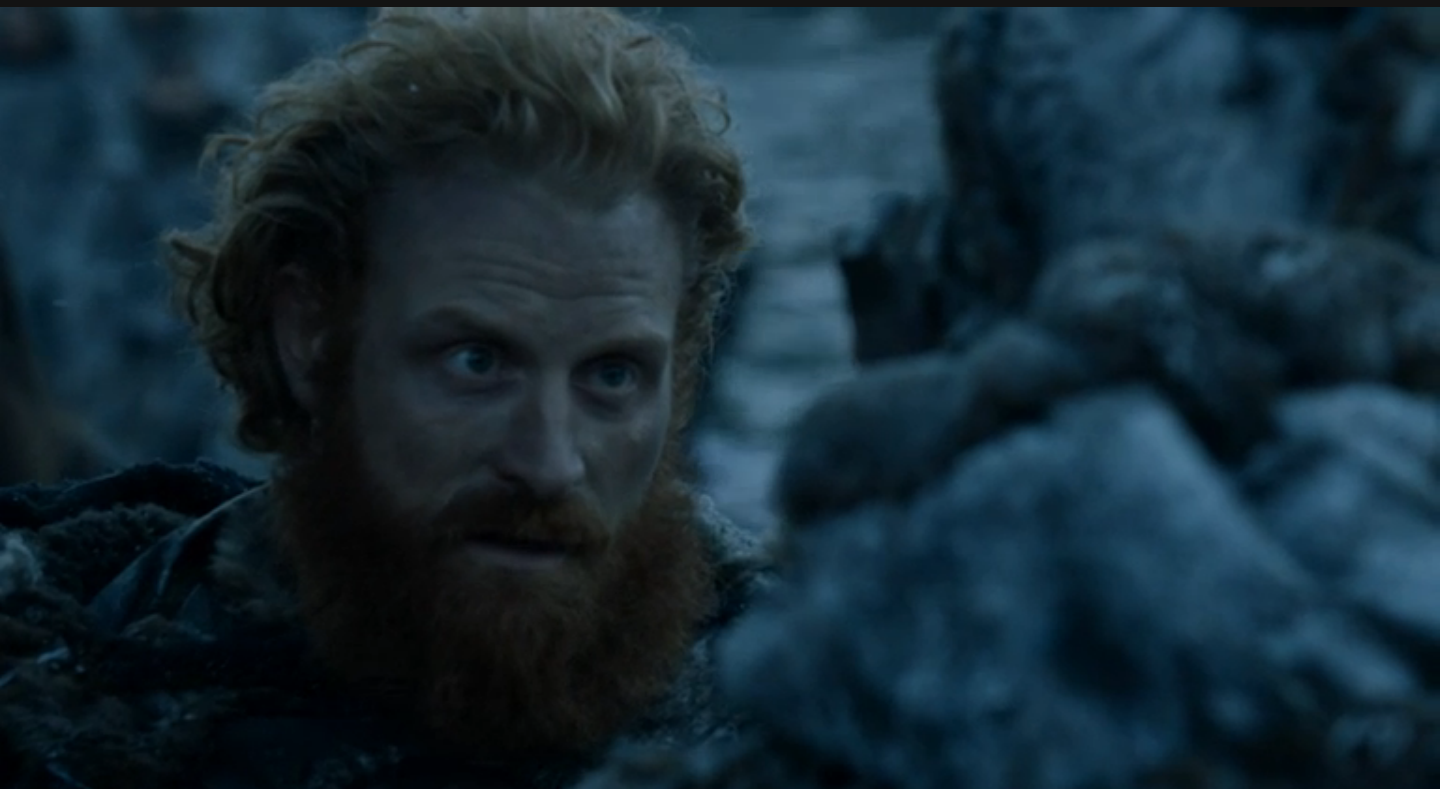
When John and Tormund first arrive at Hardhome, they’re met by a group of hostile people who see Tormund as a traitor and Jon as the one who killed their leader, and yet they find a way not to be killed on the spot. The battle itself was spectacular, but it’s these scenes in the huts that everything else rested upon. What did you think of those, Chris, and could you tell us something more about the giants? I still don’t follow where their loyalties lie or how many of them are even left.

wight_children

Christopher: Kinderskelezombies. That is awesome.

Well, the first thing I should say is that this whole scene is a major departure from the books … so in some ways I’m as at sea as you. In A Dance With Dragons, Jon Snow sends an expedition to rescue the wildlings at Hardhome, but does not go himself. The fleet of ships he sends runs into bad weather, and a number of them are lost. The ships’ captain sends a message by raven to Jon, begging for help. Jon at first plans to lead an overland rescue, then ends up sending it under Tormund’s command.

Hence, the action and events in the second half of this episode are wholly the invention of the show.

I’m wracking my brain to try and remember whether the anti-walker qualities of Valyrian steel are known or not … I think yes? Or perhaps it’s suspected? (I’m writing this post on the road, and so don’t have access to my copies of the books to consult). I seem to think that because of its origins as steel forged with magic by dragonlords, that it was assumed to be the natural enemy of the White Walkers.

We’re given to understand in the books that there are a few hundred blades forged of Valyrian steel in Westeros, and that they are mostly prized heirlooms among families of note. We learn at one point that the Lannisters, in spite of their wealth, never possessed a Valyrian sword until Tywin “appropriates” Ice—that in fact he had long attempted to acquire one, offering large sums of money to impoverished houses, but that however much they might need the cash, no one would ever part with their Valyrian steel. So theoretically, if you could ever get those people in possession of such weapons to fight together, you could have a pretty effective shock unit to face off against the Walkers. Of course, based on what we saw in this episode, their strategy seems to be to hang back and let their undead hordes do all the dirty work for them, and then add the newly dead to their ever-growing army. Which at this point is very formidable indeed.

walker-lieutenant

I really loved the council of elders scene, especially Tormund’s line re: Jon Snow, “Well, he’s prettier than my two daughters …” If I have a quibble with it all, it’s what you mentioned above: that it was obvious from the outset that Karsi was marked for death. I suspected as much when she made her presence at the meeting known so overtly, and was inclined to trust Tormund and join her people to Jon’s cause. When she promises her children that she’ll be along shortly, I wrote in my notes, “She might as well be wearing a red shirt.” I was a little annoyed that the writers chose to go with the cliché of the disposable character—confounding expectations by letting her escape with Jon would have given us a new and compelling character.

That being said, her death was heartrending, especially as, as you suggest Nikki, the sense is that she sees a child of her own among the child-wights. It’s a chilling moment, if you’ll pardon the pun. And it’s worth noting that one of them bears more that a passing resemblance to the child-wight we saw in the very first episode of this show four years ago and eight weeks ago.

Overall, this entire sequence was brilliant. I’m not sure what the deal with the giants is, Nikki, or how many of them there are. The books say that the giants are a dying race, and there are very few of them left. Wun Wun might well be the last of his kind, as far as the show is concerned—though now that the wildlings are allies rather than enemies, that’s too bad. He shows pretty clearly that having a giant on your side is somewhat advantageous. I loved watching him stomping the wights and pulling them off him like mere irritants.

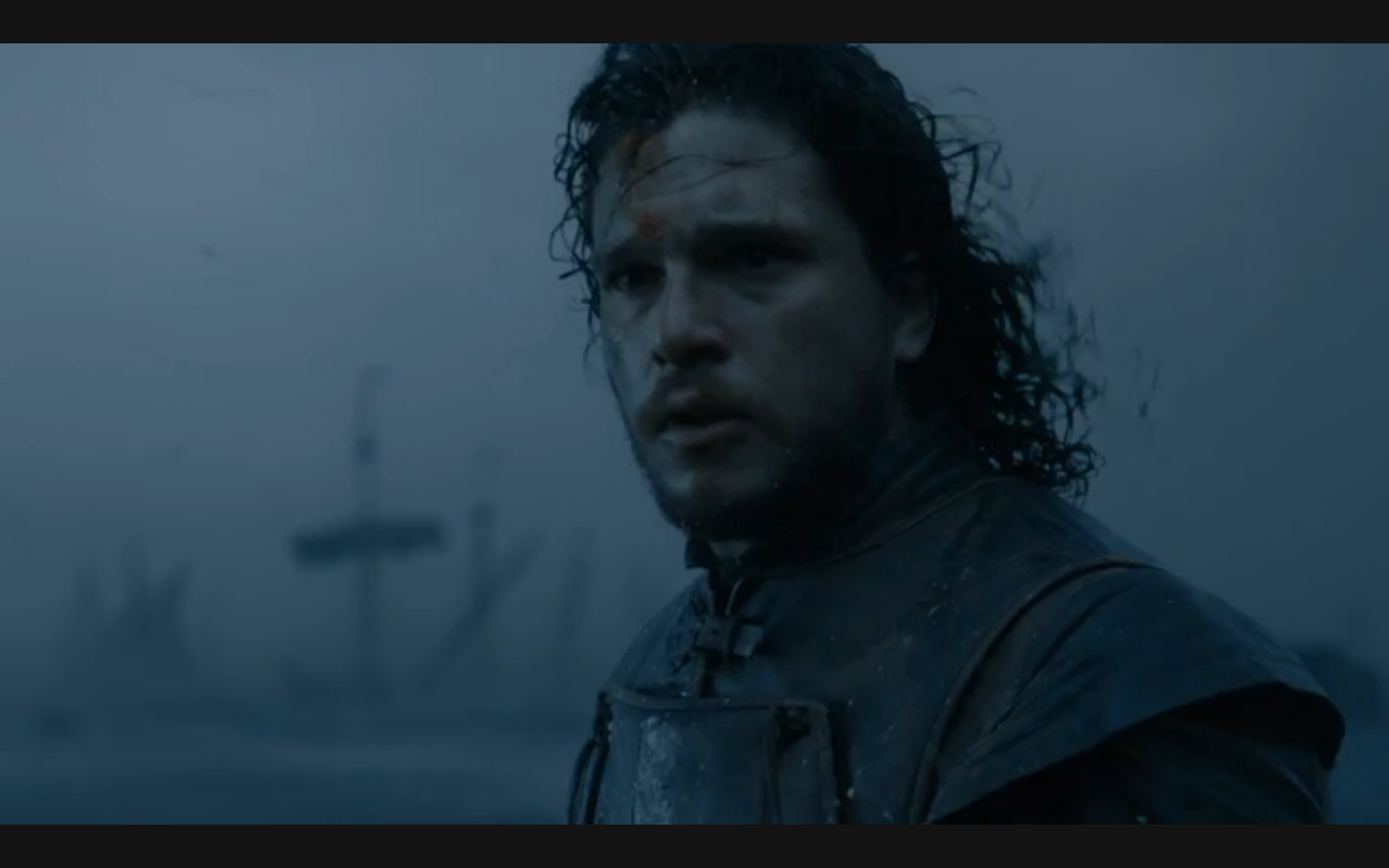
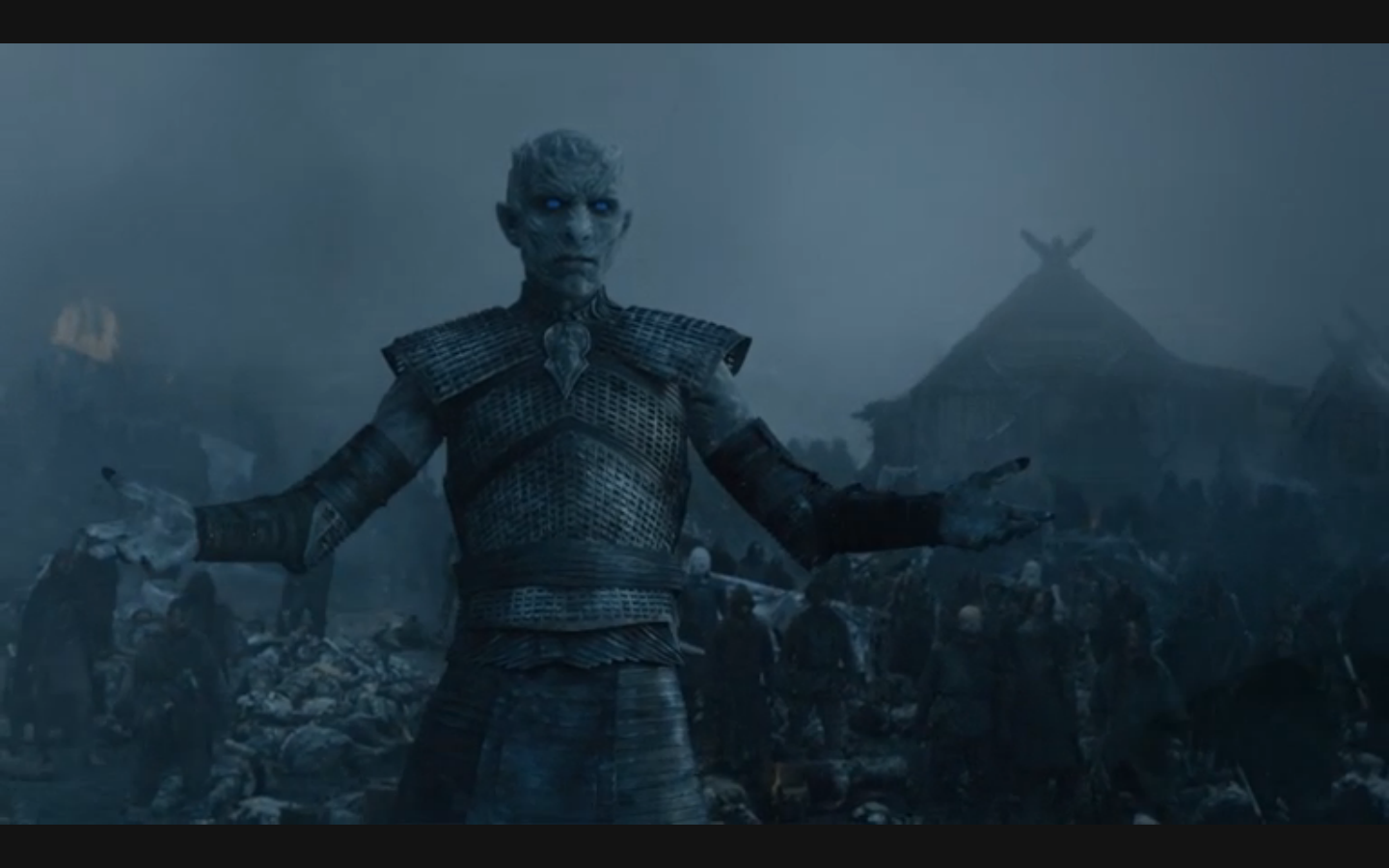
The final moments as Jon Snow’s boat drifts away from the docks and the Night King was haunting. I think you put your finger on it, Nikki: in that few seconds as the Night King defiantly brings hundreds, perhaps thousands of the dead back to reanimated “life,” the look on Jon Snow’s face is one of stupefaction and despair. How indeed do they fight that enemy?

winter-king

I’m going to go out on a limb and wager that dragons will be involved.

Well, that’s it for us for another week, sports fans. We’ll see you soon when we do our review of the penultimate episode. In the meantime, stay warm, keep your Valyrian steel close, make sure that palisade will withstand zombie attack, and keep Carl in the goddamn house.

1 Comment

Filed under Game of Thrones

Some extra thoughts on “Unbowed, Unbent, Unbroken”

gameofthrones_teaser02_screencap10I have three follow-up thoughts to our previous post; because Nikki and I decided to focus mainly on the episode’s final scene, some things had to be left out—including, in my case, some extra thoughts on the episode’s final scene. Two of my three considerations here are largely complaints about how, even with the series’ unsparing pruning of storylines, we’re starting to experience compression problems, in which what otherwise might be thoughtful and nuanced elements of the show suffer from being rushed.

On the other hand, my final addendum is a closer reading of how the show does manage to get things exactly right much of the time.

bronn_jaime

The Sand Snakes

Fan consensus tends to rate book four, A Feast for Crows, as the least favourite. It could hardly be otherwise, coming as it did on the heels of A Storm of Swords, which contains the Red Wedding, the Purple Wedding, the saga of Jaime and Brienne, Daenerys’ conquest of Slavers Bay, Stannis’ attack on the Wall, and Jon Snow’s election as Lord Commander. That, coupled with the fact that GRRM hived off the Jon Snow and Daenerys storylines for A Dance with Dragons, meant that A Feast for Crows was inevitably going to disappoint a large contingent of readers.

It didn’t disappoint me, largely because of the Dorne storyline. The inside politics of Westeros’ southernmost kingdom were (to my mind) a good counterbalance to losing Jon and Dany. But of course the series has to make hard choices, or else risk packing in way too many characters and story threads at the expense of audience interest and the ability to actually tell these stories with a measure of nuance. In choosing to feature a Dorne narrative, Weiss and Benioff discarded the Iron Islands narrative also featured in book four, in which Theon’s sister Asha (or Yara, as she’s known in the series) negotiates the dangerous politics of succession after her father, Balon Greyjoy, dies.

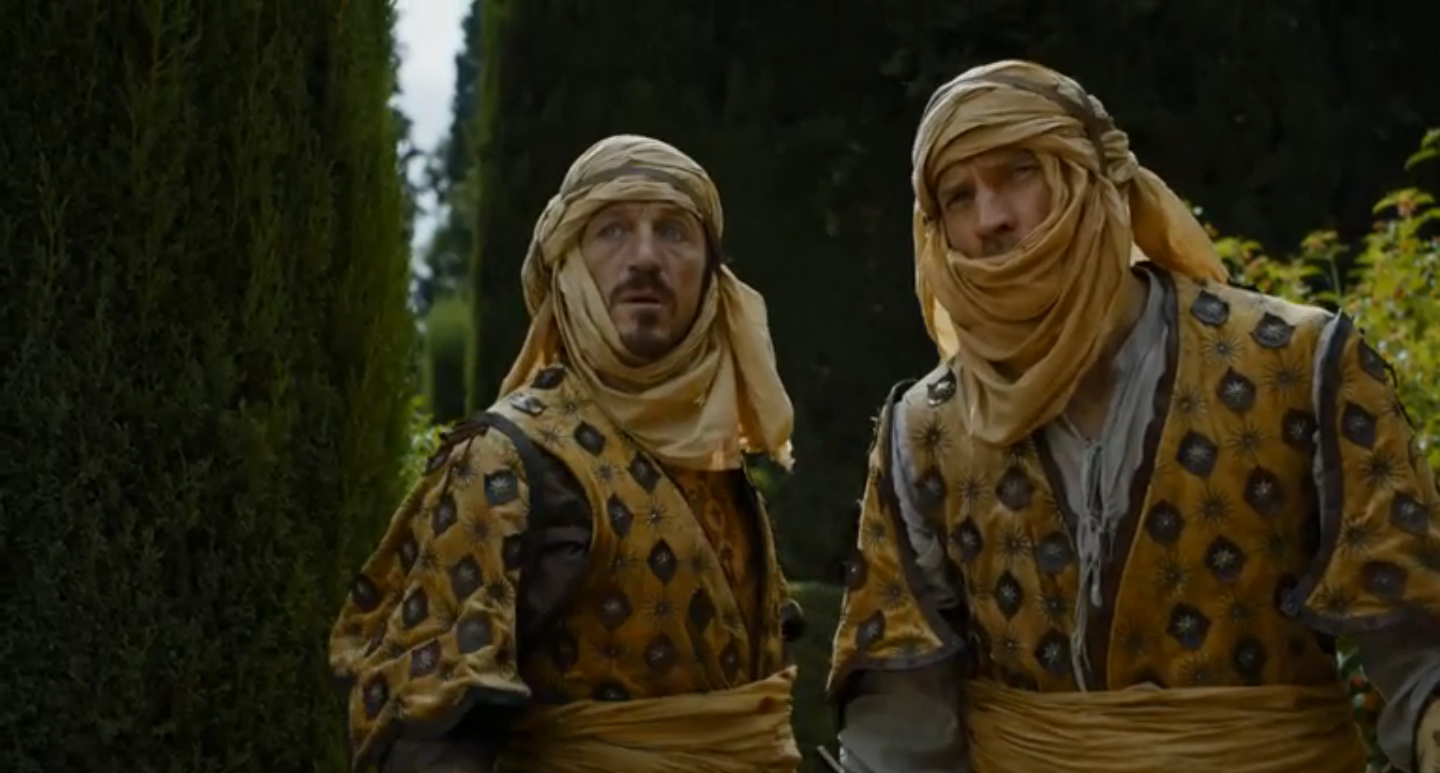
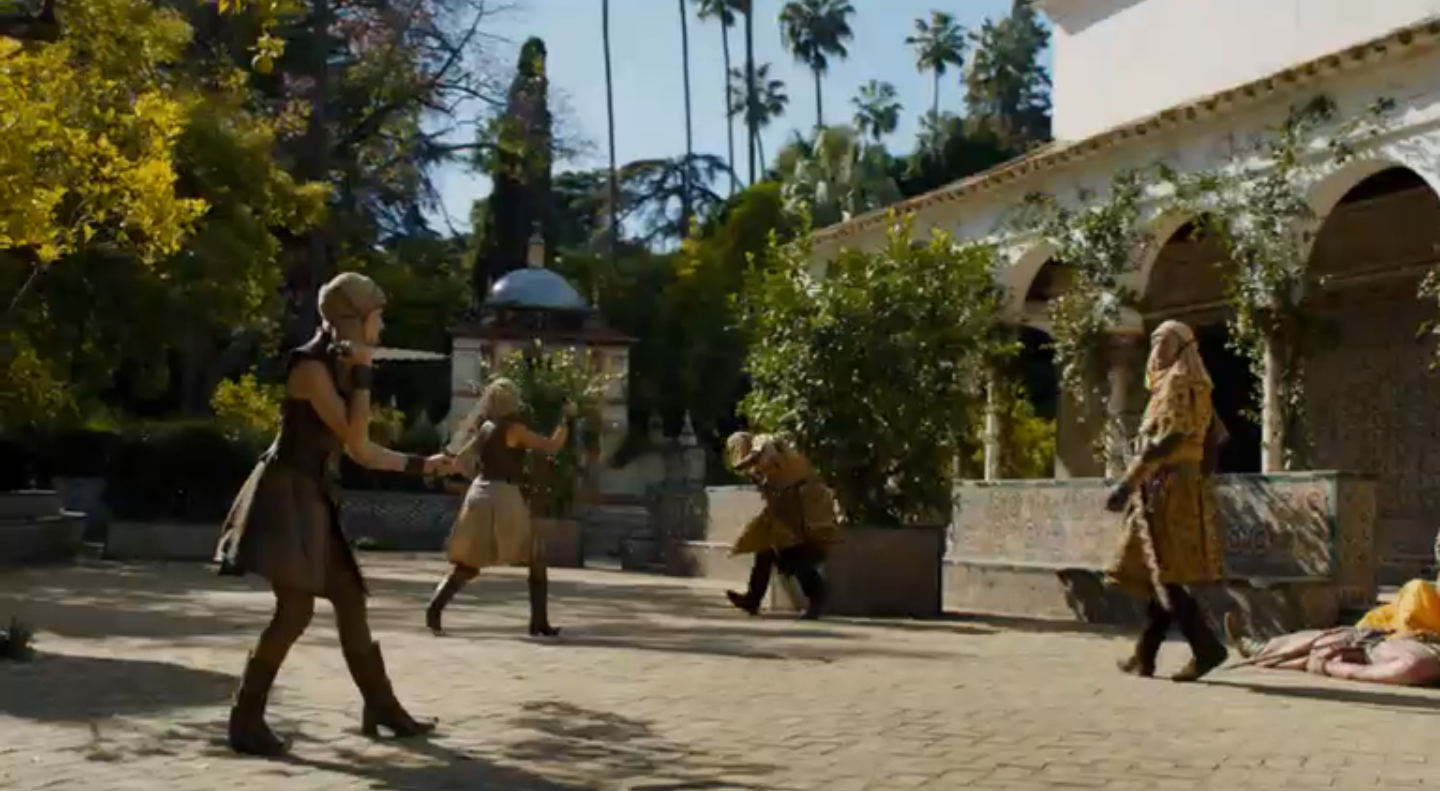
sand-snakes_fightEven with this wholesale dumping of a story thread, there’s still a lot of balls to be kept in the air, and it’s a shame that the Sand Snakes suffer as a result … especially considering how impressive they were on first encountering them. Their scene in this episode is disappointing on a variety of levels: first, the fight isn’t that well shot or choreographed; second, the convenient timing of Bronn and Jaime’s arrival made me roll my eyes; and finally, the pat end to the Sand Snakes’ plot is too easy, too cheap, and unworthy of a trio of characters who were poised to join Game of Thrones’ ranks of nuanced, compelling, and strong female characters.

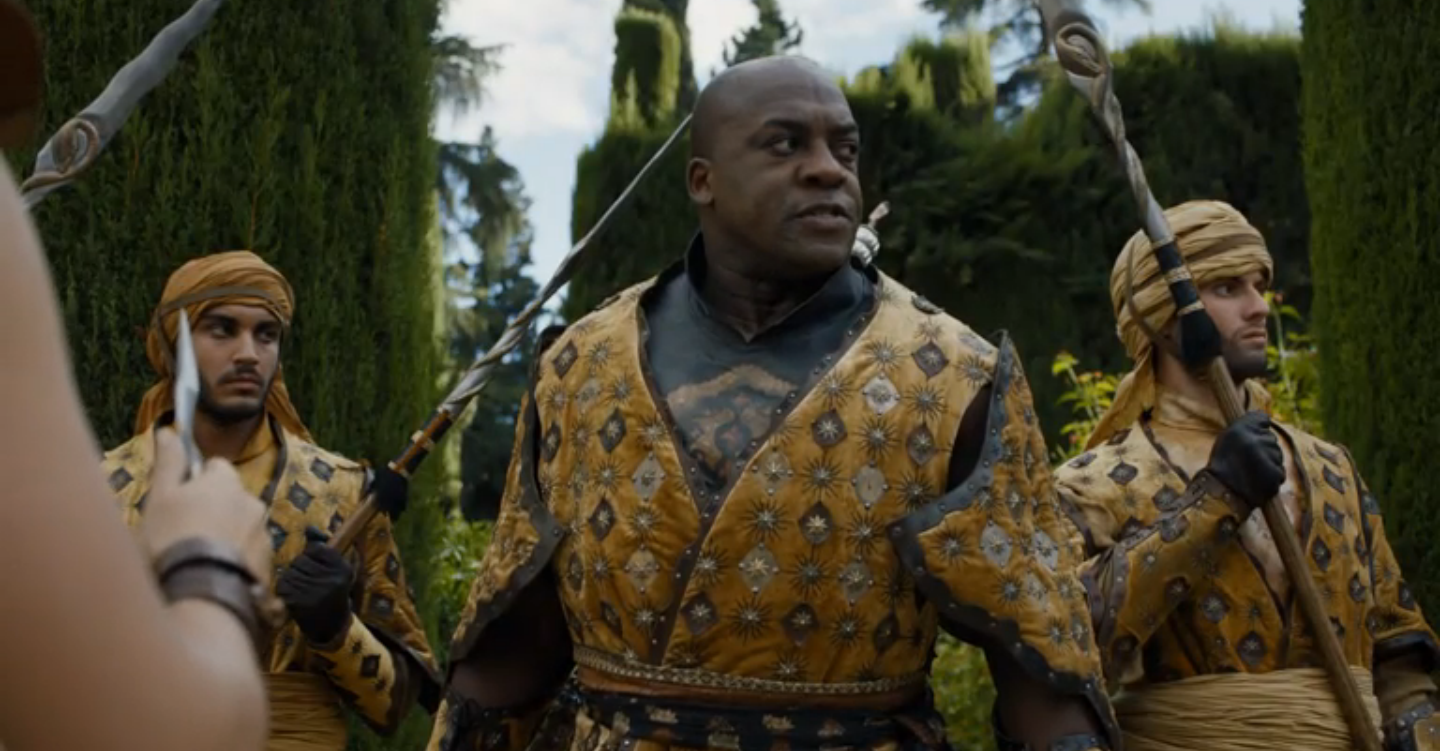
Their plot in the novel is more protracted and allows for more development not just of their characters but those of Prince Doran and his inscrutable bodyguard Areo. In the novel, the plot is foiled because, as it turns out, Doran had always been one step ahead of them and always knew what was going on. Something of the sort happens on the show too … but without more time spent with the main players, it loses all of its dramatic tension, and the payoff is just a cheat.

GRRM has frequently complained about HBO’s insistence that every season be limited to ten episodes—arguing that one or two more episodes would let the show do more with the capacious source material. I agree with him, though I understand HBO’s ironclad rule; the show is already hugely expensive to produce, and even with its popularity, those extra episodes might be too much. What I wonder is why don’t they run longer episodes? In the early days of HBO’s new dramas, you never knew when an episode of The Sopranos might run to seventy or eighty minutes (or sometimes pull up short at fifty). Episode length was a lot more elastic in those days, and it’s something I think GoT could benefit from.

I'm particularly sad that Areo Hotah seems to have been given short shrift, as he's an amazing character in the novel.

I’m particularly sad that Areo Hotah seems to have been given short shrift, as he’s an amazing character in the novel.

Loras and the Sparrows

I read a good article in Salon yesterday lamenting the way in which Loras Tyrell has gone from being a strong character, acting as something of a Lady Macbeth for a less-than-ambitious Renly, to being a caricature of a closeted gay man, providing winking humour at Sansa’s obliviousness during her brief engagement to him, and simple awkwardness when he’s betrothed to Cersei. All of which makes his arrest at the hands of the Sparrows less affecting than it would be if we had any emotional stake in his character. By the same token, the fact that he becomes the focus of the Faith Militant’s hatred—and by extension all gay men and women—is a clumsy shorthand to allegorically connect the Sparrows to contemporary Christian conservatism, rather than providing a more nuanced portrait of how the Sparrows emerged to begin with.

lorasOne very astute point made in the Salon article is the suggestion that the series’ depiction of the Sparrows is crafted for an audience that cannot conceive of how religious evangelicism and fundamentalism could evolve out of what is essentially an egalitarian movement—the Sparrows, initially, are Occupy King’s Landing, though that is something made clearer in the novels. It seems odd to the contemporary sensibility, but rural evangelicism in the U.S. in the first half of the twentieth century was largely wedded to leftist, not to say socialist, politics. Some of the most vocal proponents of leftist populism were ardent Christians, most famously William Jennings Bryan—who besides being the Democratic Party’s presidential candidate three times, is most famous for being the antagonist in the Scopes Monkey Trial.

The puzzling shift of rural states from leftist populism—a politics that specifically focused on the interests of largely working-class populations—to red state social and fiscal conservatism is a tangled narrative much better dealt with by Thomas Frank in his book What’s the Matter with Kansas? The point here is that in the present moment, conservative Christianity is most easily associated with homophobia. The populist and egalitarian dimension of the Sparrows has been, at best, only vaguely gestured at before they are transformed into fanatical thugs. In A Feast for Crows, they converge on King’s Landing as refugees from the war-torn countryside to place the bones of their dead at the Sept of Baelor as a symbolic plea that the crown honour its sacred obligation to the people. The crown is unsurprisingly unsympathetic, and it is only when Cersei sees them as a means to an end that they receive any consideration at all.

high-sparrowAt this point, the fury boiling beneath the surface of the populace, the rage at the privation, violence, exploitation, and the rapine of the noble houses’ armies, has had no salve or outlet. When Cersei re-establishes the Faith Militant, they do what angry mobs have done throughout history when given the chance: they enact vengeance on anyone and everyone they imagine has been their tormentors.

All this is by way of saying that the too-quick transformation of the Sparrows from suffering supplicants to club-wielding morality police elides one of the more interesting political critiques in A Song of Ice and Fire; similarly, after introducing Loras as an explicitly gay character in seasons one and two, the writers lost the script on him, and in so doing missed a golden opportunity to have him be more than a humorous caricature. And that loss resonates in the moment of his arrest and trial, because we haven’t had the chance to be invested in him.

loras_trial_everyone

That Final Scene

One thing I wanted to write about, but didn’t because the post was already overlong, is the imagery and camerawork. With the obvious exception of the actual rape itself, the rest of the final scene is hauntingly beautiful, but it is a beauty that makes everything that much more painful to watch. And perhaps more crucially, the entire sequence is a betrayal of all the dreams young and innocent Sansa cherished at the beginning of the series.

At this point it is hard to remember that Sansa was (aside from Joffrey) season one’s most-hated character: whiny, petulant, haughty, and so caught up in her dreams of romance that she betrayed her father rather than let him take her away from King’s Landing and her dream wedding to Joffrey. Way back then, Sansa was the representative voice of romantic fantasy, which views the world in terms of good and evil, beauty and ugliness, and the absolute correlation between the former and latter. She loved the pageantry of it all, the knights in their bright armour, the sumptuous feasts, and the (so she believed) handsome and noble prince to whom she was betrothed.

As we know, Sansa’s road since then has been the systematic destruction of all those dreams and illusions. And so it is a particularly cruel turn of events that her wedding to Ramsay unfolds like a fairy-tale.

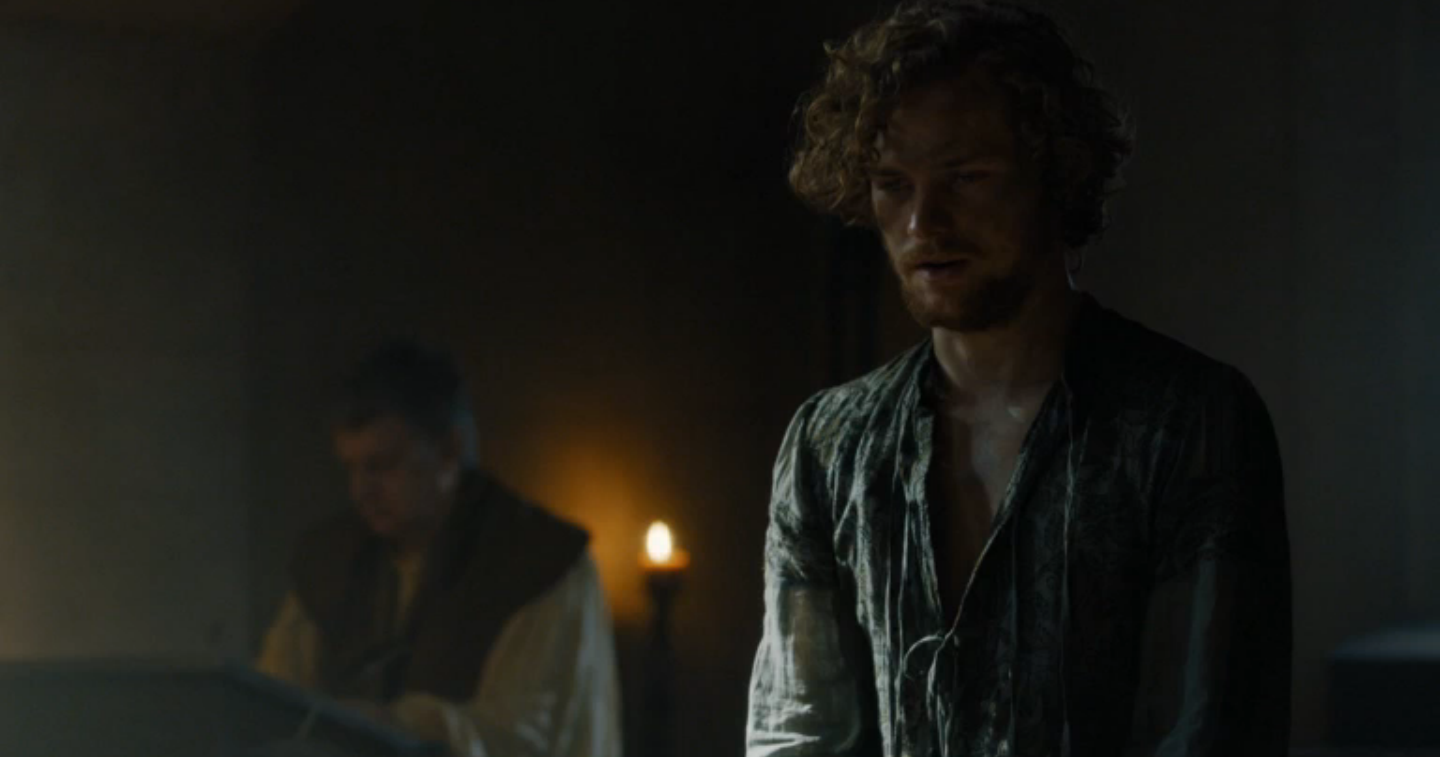
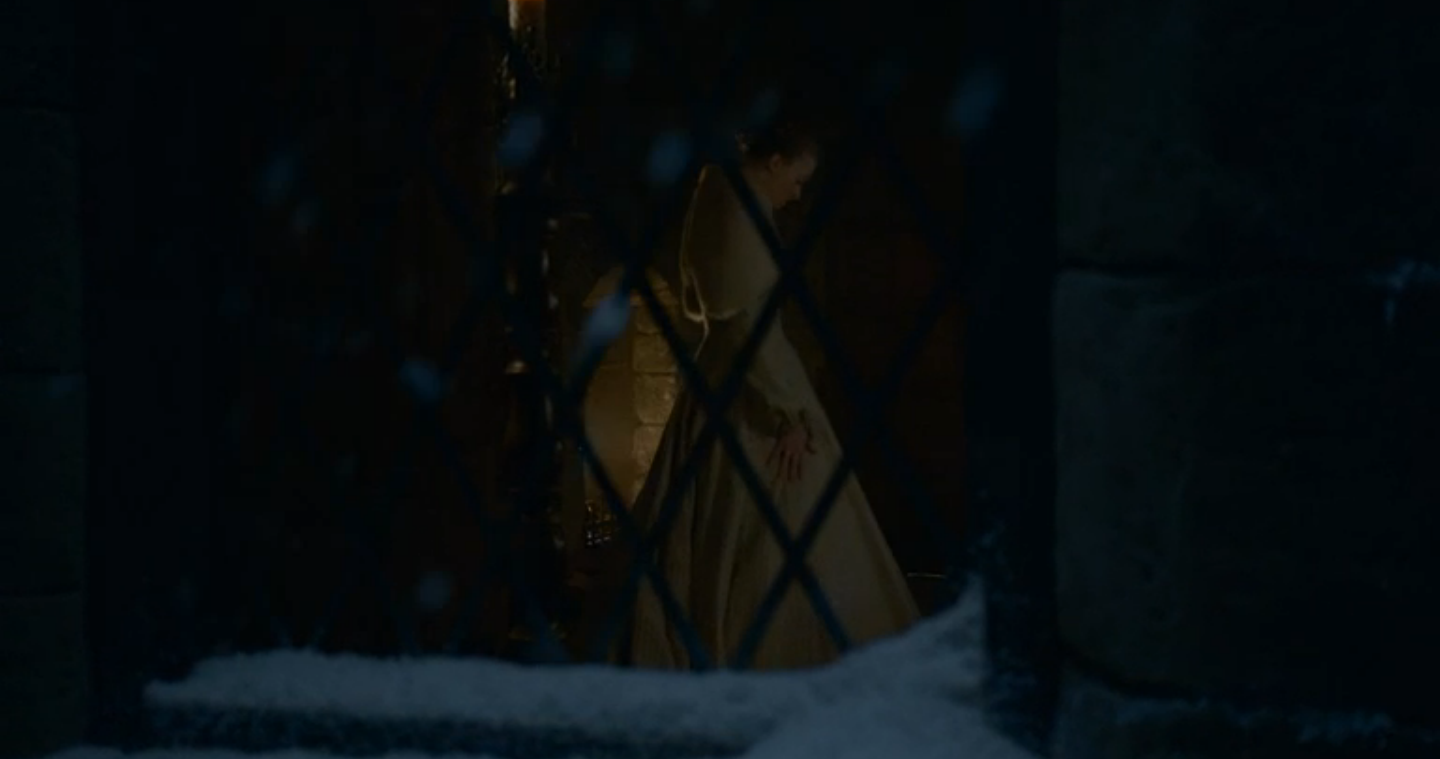
sansa_towerThe first shot of Sansa in her wedding-dress is from outside, through the casement in her tower: it is soft-focus, or perhaps softened by the window-glass, with snow drifting prettily past. This brief shot evokes the trope of the princess imprisoned in her tower, waiting for her prince to rescue her. But the prince who comes is the broken shell of a man who, though he once styled himself the crown prince of the Iron Islands, is now a slave who sleeps in the kennels—and a man who, she believes, killed her two younger brothers.

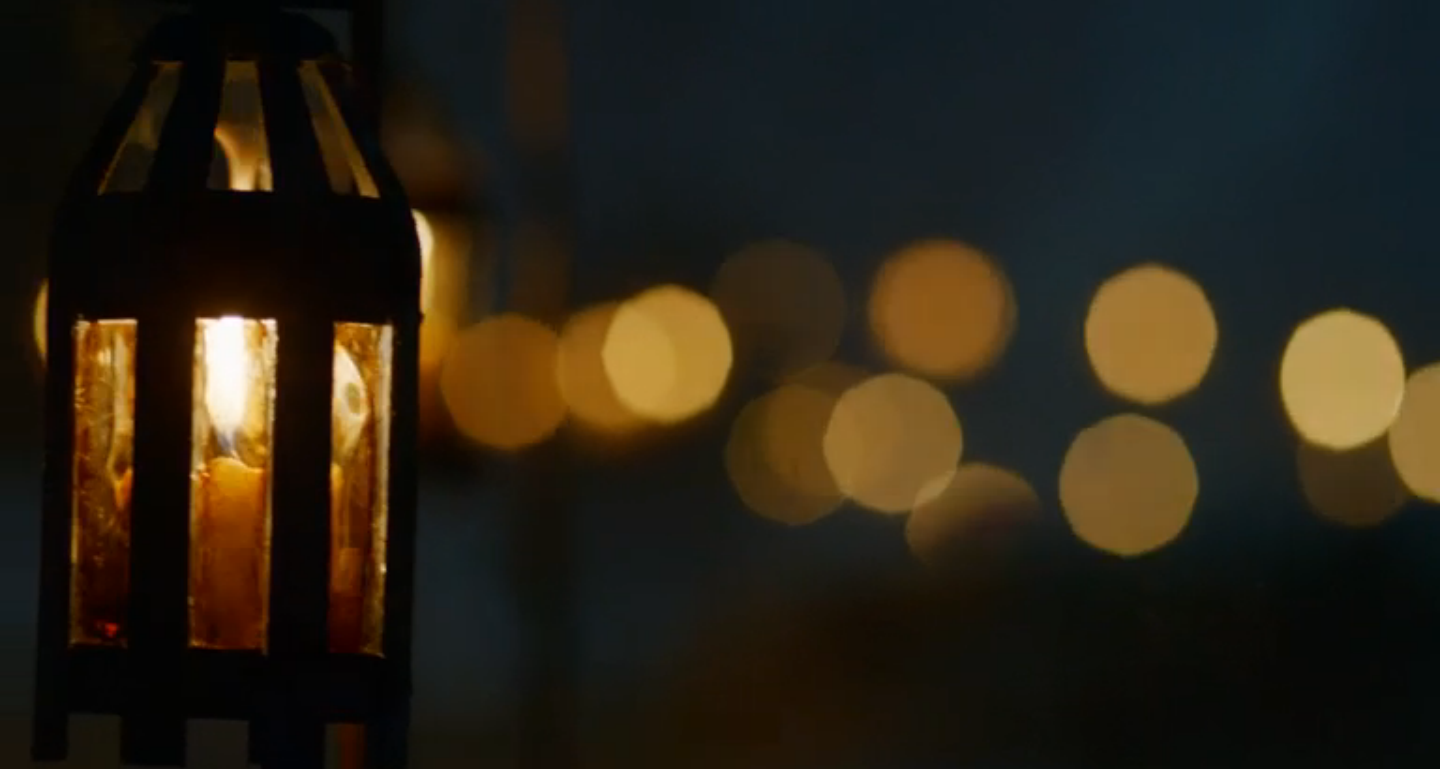
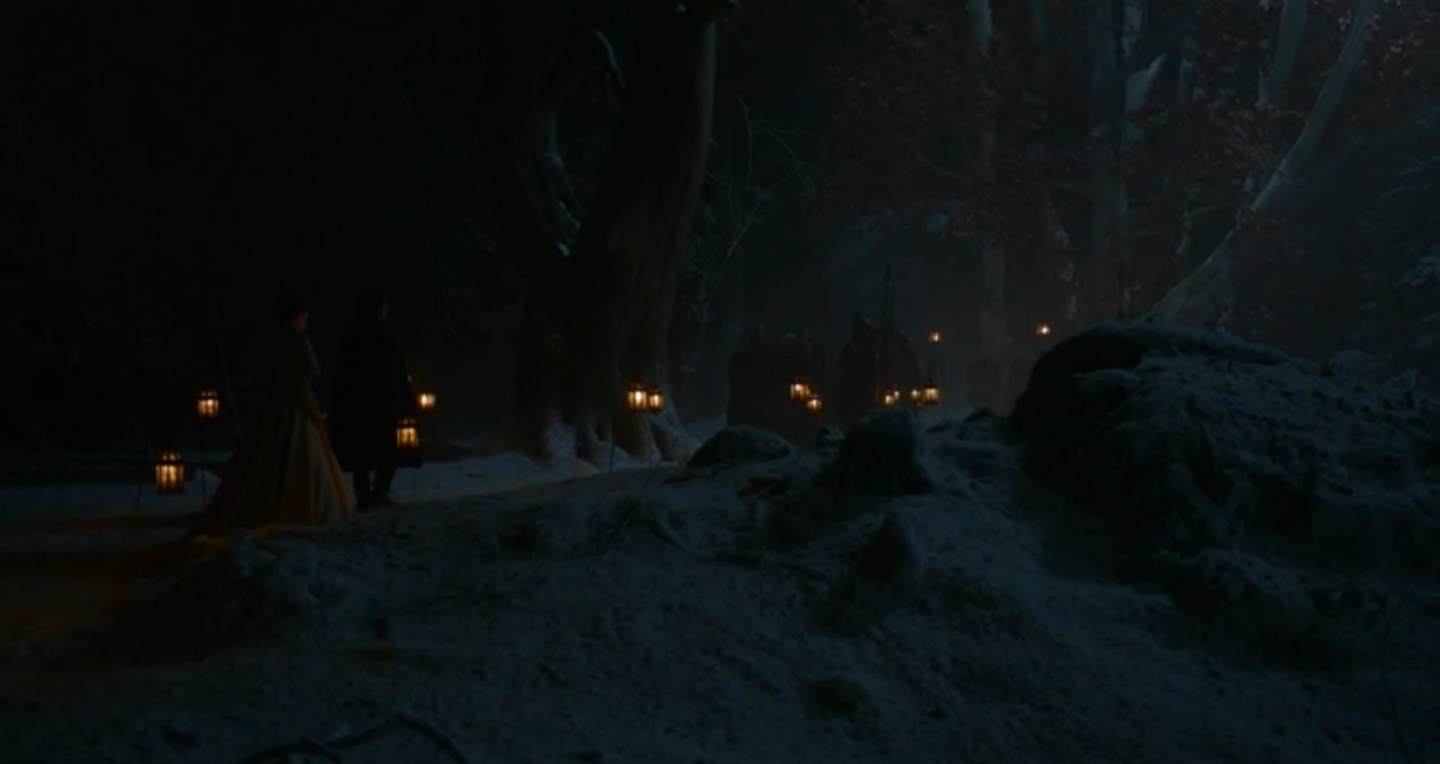
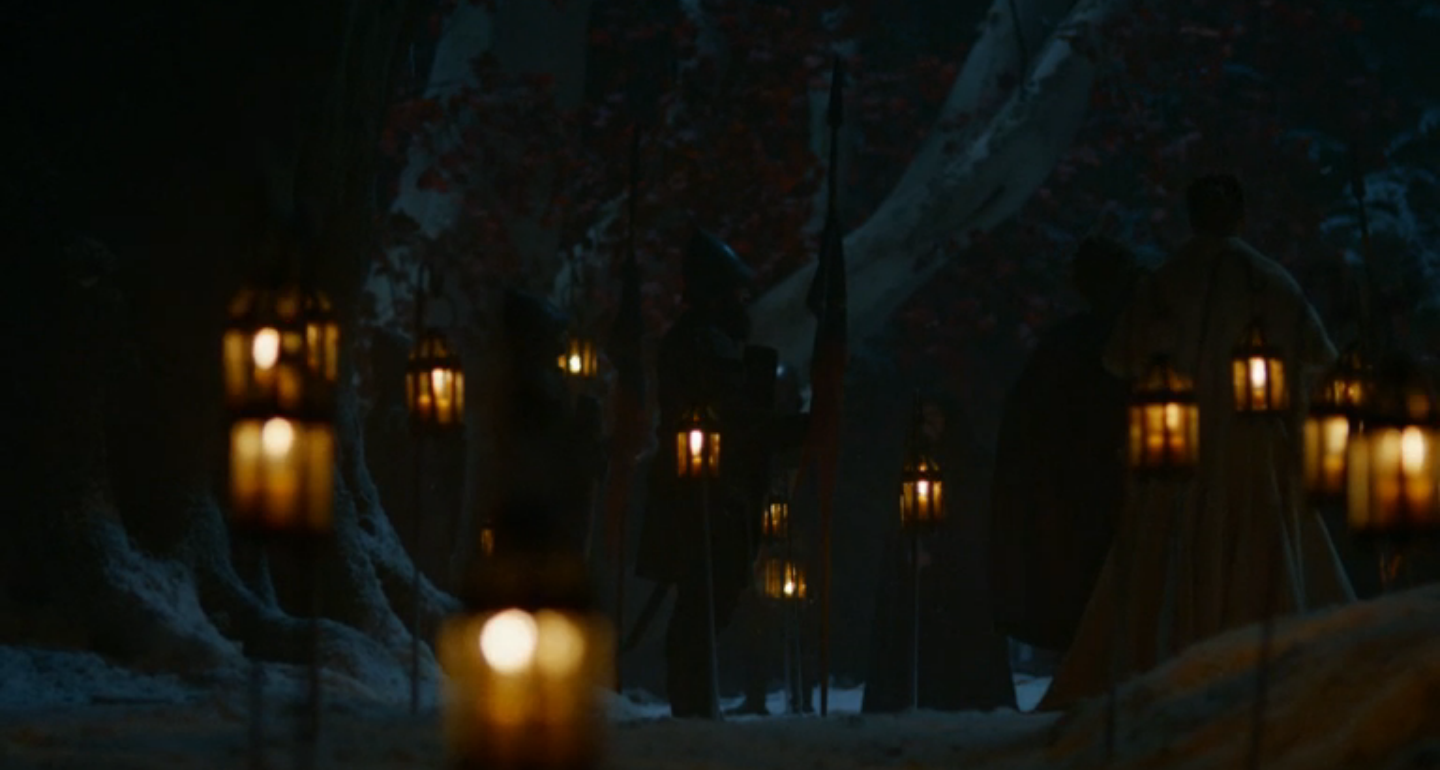
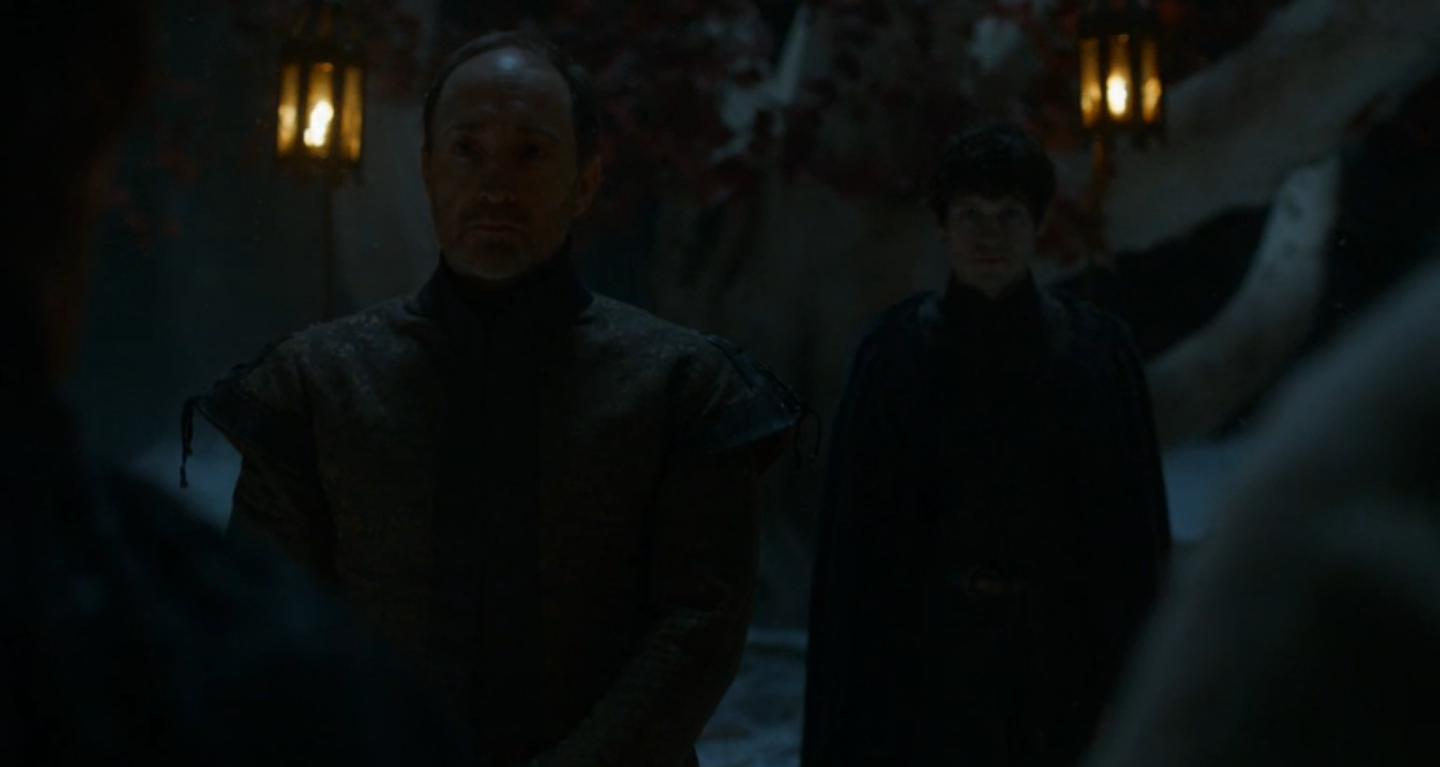
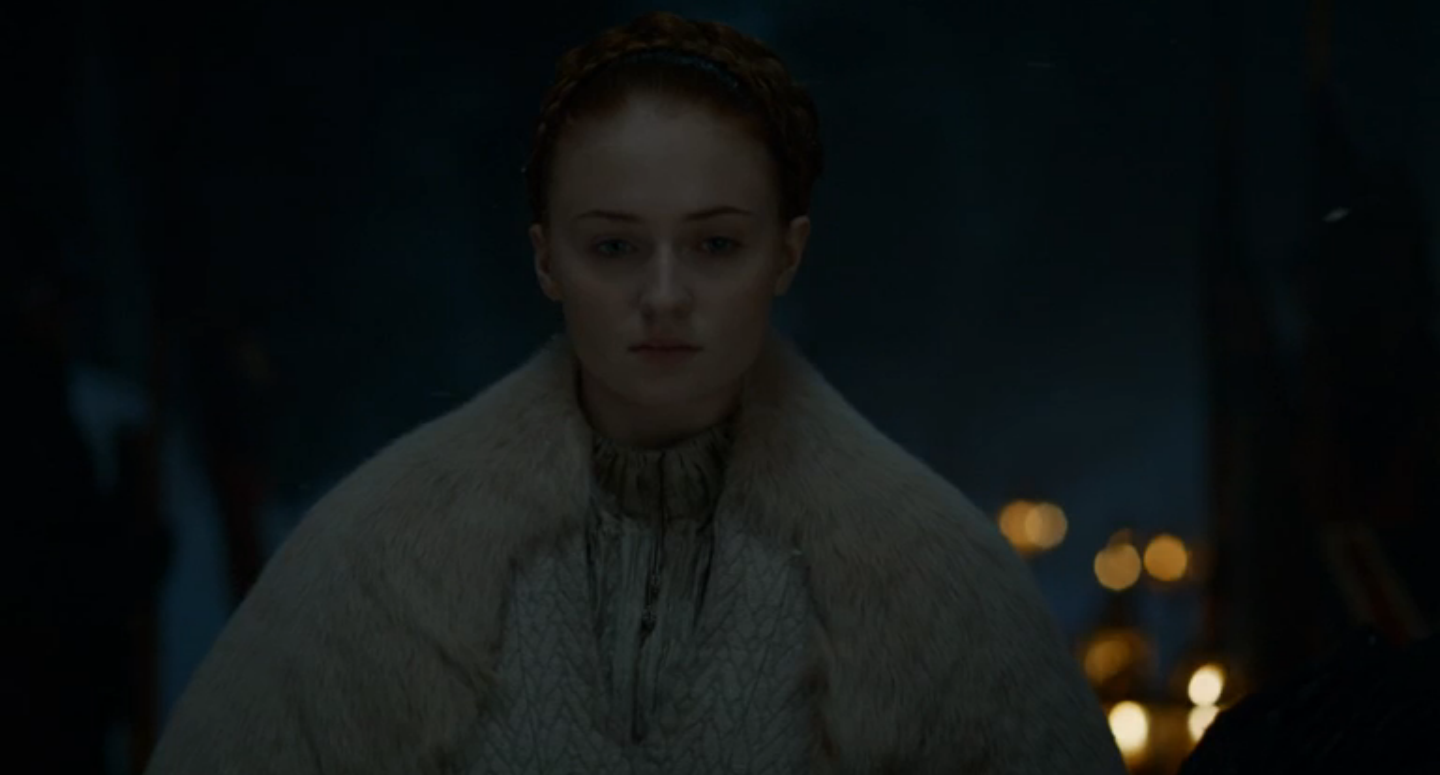
The wedding itself is like a dream: lanterns light the way to the Godswood, seeming to hover like faery-lights over the snow. One is hard-pressed not to think that, of the numerous wedding ceremony fantasies young Sansa almost certainly had, this comes pretty damn close to what she’d imagined.

lanterns01lanterns02

lanterns03Her journey has been one in which all the things she once thought beautiful have had their ugliness exposed: knights in shining armour are ruthless, bloody killers; beautiful queens like Cersei are cruel and manipulative; her handsome prince was a sociopathic monster; and traits like honour and loyalty can and will get you killed. And so here at the heart of the dream wedding, in the heart of her home, is the man who killed her brother, and his monstrous heir.

roose_ramsayAs Nikki observed, a last-minute rescue by Brienne or some other saviour would have been a betrayal of a show that—like its source material—has been primarily about subverting the fairy-tale tropes that are common in fantasy. The pageantry and romantic veneer of Sansa’s wedding is a reminder of how often ceremony, ritual, and romance are employed to obscure the cruel realities of power and politics.

sansa

1 Comment

Filed under Game of Thrones

Game of Thrones 5.04: The Sons of the Harpy

gameofthrones_teaser02_screencap10

Greetings friends once again for the great Game of Thrones co-blog. Season five continues apace, and what a pace it is in this episode—Jaime and Bronn arrive in Dorne, we finally meet the notorious Sand Snakes, Cersei rolls the dice and arms the Faith Militant, Melisandre tests her fiery wiles on Jon Snow (who still, apparently, knows nothing), and we see just how much game Barristan the Bold had (spoiler: LOTS).

With me as always is my friend and bantery roadshow companion Nikki Stafford, the Brienne to my Jaime. Or is it the Varys to my Littlefinger? Hard to say. It changes.

But without further ado …

 dorne_map

Christopher: Well, to start with, we finally get Dorne in the opening credits. Though if I can offer a geographical quibble, this is the first time the credits name an entire region rather than a specific castle or city. But I guess that’s neither here nor there.

We open this episode with a wordless scene picking up from where we left off: Ser Jorah knocking a hapless fisherman unconscious and stealing his boat. He leaves a couple of coins in the prone man’s body, though I somehow don’t think it’s quite enough for the poor guy to buy himself a new boat. And he unceremoniously—and rather callously—dumps a bound and gagged Tyrion in the bilges to start them on their quest to take him to the “queen.”

I read an article yesterday in which the author praised Game of Thrones for its dramatic use of editing, specifically its use of blunt cuts to drive the narrative forward: a great example from last week being the cut from Roose Bolton telling Ramsay that he’d found him an ideal bride who could solidify the North for him, to Littlefinger and Sansa riding along an escarpment under a gloomy sky. That gave us, the viewers, the heads up on the plot twist before Sansa twigged to it: a moment of shock for both those who have read the books and those who haven’t, one that heightens the dramatic tension of watching Littlefinger’s scheme dawn on Sansa.

jaime_boat

Here we have a lovely transition that provides a certain thematic symmetry: the cut from Jorah’s stolen boat to a proper ship, which houses another Lannister. The brothers are both embarked on treacherous journeys (though Tyrion does so under protest), but away from each other—literally and figuratively, a fact emphasized by Jaime when he tells Bronn that Tyrion “murdered my father … if I ever see him, I’ll split him in two.”

Initially, the Jaime and Bronn road show is rather more moribund than Bronn’s travails with the shorter Lannister brother. Bronn doesn’t understand Jaime’s strategy, and Jaime is not inclined to spell it out for him. All he will say is “It has to be me”—from which Bronn deduces that it was Jaime who freed Tyrion. Jaime maintains that it was Varys, but it’s obvious Bronn knows he’s sniffed out the truth. Presumably he assumes that Jaime has embarked on this fool’s errand as a form of atonement for the act that led to the murder of Tywin … but of course we know it’s more complicated than that.

Once again, this is uncharted territory: Jaime makes no such journey in the novels. And while there is almost certainly a measure of atonement for Tywin here, there is also the fact of Mycella’s parentage, something he of course cannot divulge to Bronn. Not that I think Bronn would care one way or another, but it was obvious in the scene when Cersei shows him the intricately-packaged threat from Dorne that his necessary denial of his daughter and the distance he has had to put between himself and all his children weighs on him. Cersei’s accusation that he was never a father to his children was petty and disingenuous, but we begin to see in this episode the emotional damage it has done to Jaime. This is in itself something of a departure from the novels, though a subtler one: in Jaime’s POV chapters, he makes his relative indifference to his children clear, reflecting at points that the only person who has ever mattered to him—the only person he’s loved—is his twin sister. “It has to be me,” is atonement, yes, but also perhaps his vestigial paternal instincts asserting themselves.

Though the banter between Jaime and Bronn is tepid aboard ship, things get more interesting once they’re ashore … actually, before they get ashore, as we see what will almost certainly be one of the running jokes of their partnership: Bronn hauls laboriously at the oars, panting, and when he pauses to give Jaime a pointed look, Jaime just raises his false hand. “Sorry dude. Can’t very well row with this thing.”

What I’m enjoying about this partnership is the subtle and not-so-subtle ways in which the differences between Jaime and Bronn emerge. Bronn’s relationship with Tyrion was always far more cut-and-dried; even though it was obvious that Bronn had a great deal of affection for Tyrion (and vice versa), it was always clear that their main relationship was financial—in part because Tyrion’s stature necessitated the hiring of a bodyguard. Less his sword hand, Jaime Lannister is no longer the brilliant fighter he was, but there is at least (at first) the illusion of parity between these two. But their breakfast conversation begins to highlight the significant class differences between the two. With a pragmatism born of want, Bronn does not hesitate to chow down on his snake kebab; Jaime eyes his suspiciously and puts it aside. And he voices surprise that Bronn’s ideal death is “In my own keep, drinking my own wine, watching my sons grovel for my fortune.” Why not something more exciting, Jaime asks? “I’ve had an exciting life,” Bronn says. “I want my death to be boring.”

"You want your death to be boring. OK ... I know what all those words mean, but when you put them together it makes no sense to me."

“You want your death to be boring. OK … I know what all those words mean, but when you put them together it makes no sense to me.”

Jaime, raised in a castle as the golden son of Westeros’ richest and most powerful family, thinks nothing of the comforts Bronn desires. Bronn however, who has probably spent his life impoverished more often than not, is far more practical. He is, to paraphrase Liam Neeson, a man with a specific set of skills—and unlike those who would seek glory, he employs his talents as a means to an end. Which shortly after breakfast is simple survival: in yet another amazing fight scene, he dispatches three out of their four attackers, while the formerly fearsome Jaime Lannister is humiliated by a mere guardsman, saved only by chance by that which nearly doomed him—his false hand. And once again Bronn is reminded that he is as much servant as partner, as Jaime’s false hand means the burying of the bodies is left to him.

And then another nice piece of editing: after Bronn extols the virtures of Dornish stallions, we see a veiled rider galloping through the surf. As it turns out it is Ellaria, meeting up with Oberyn’s bastard daughters to plot against both the Lannisters and their own prince.

What did you think of our first encounter with the Sand Snakes, Nikki?

sand_snakes

Nikki: They were everything I’d hoped they would be. As I know by pinging it on the Google, “Sand” is the surname given to noble-born bastard children in the south, much as “Snow” is the name given in the north. If I understand correctly (and you can correct me if I’m wrong, Chris), the Sand Snakes are all Oberyn’s daughters, and there are actually eight of them. The one with the short brown hair — Tyene — is Ellaria’s daughter with Oberyn. Ellaria has also mothered several of the others who aren’t shown. But perhaps on the show the Sand Snakes will consist of only the three, and the other five will remain literary characters only.

For years before I had children, I used to attend the Toronto International Film Festival with my best friend. We would take the week off work and attend 30 films, sending long emails to friends who had signed up for our email list, in an early version of blogging that predated actual blogs. In 2002, our top film of TIFF was Whale Rider, starring a then-12-year-old Keisha Castle-Hughes. She was transcendent in the film, at one point having to deliver a stirring speech in a school play on the verge of tears, and the entire audience was bawling. It was the world premiere of the film, and afterwards Castle-Hughes and several other cast members got up in front of the room. She was so young, so sweet, grinning the entire time (this was her first time watching that movie, and first time seeing an audience’s reaction to her work), and yet there was a fierceness to her even then, a toughness that made you think this is going to be one of those child stars who transcends child stardom.

keisha-castle-hughesAnd she has. While she’s mostly taken small parts, you can see what a fantastic actress she is in everything she does. And it’s no different here, where, as Obara Sand, the eldest of the Sand Snakes, she is very devoted to her father, and will stop at nothing to avenge his death. Ellaria explains to the Snakes that their uncle, Prince Doran, will not start a war to avenge his brother’s death. So, she concludes, they must do it themselves. They have Myrcella, and that’s a major bargaining chip against the Lannisters. Nymeria explains that they have a problem, and with one crack of her whip, she flips a nearby cannister up in the air to reveal a man’s head. He’s alive, but has been buried up to his neck in the sand, and has three giant scorpions crawling on his face. He had approached Obara and told her that he had information (seeing his current predicament, methinks he should have kept his mouth shut). He told the girls that he had brought Jaime Lannister over from King’s Landing. This puts a new wrench in the plan. Ellaria says, matter-of-factly, that the girls must make a choice: “Doran’s way and peace, or my way, and war.” Tyene immediately joins her mother, while Nym nods a quiet agreement. Ellaria turns to Obara, and in a magnificent speech, where she tells of her father taking her from her mother at an early age and telling her she had to choose between one of two weapons — the “manly” spear, or her mother’s “womanly” tears. And with that, she picks up a spear, and in one throw lands it directly in the centre of the skull of the man in the sand. Looking back at Ellaria, she says, “I made my choice long ago.”

As we’ve said many times while talking about this show, this is a series where women are not subservient to men. Yes, Daenerys was taken by her vicious brother and married to the terrifying Khal Drogo, but she stepped up, took over, made him love her, and then became the Khaleesi. Her brother? Dead. Brienne is every bit the knight that any man is, if not more. Sansa might be manipulated at every turn, but despite that, she is stepping into a new role now as vengeance for her family, and something tells me she’s got this. Arya is embarking on a life where she has almost always been in complete control. Gilly was raped and impregnated by her father, yet now she lives confidently within a town of all men, and shows no fear. Stannis makes his decisions based on what Melisandre tells him to do. His daughter is brilliant. Robert Baratheon, Ned, Tywin, and Joffrey are all dead: Cersei and Margaery are still standing, and hold all the power.

Yes, this is still a show where women have to “overcome” being women to show they’re strong, and yet it feels like that’s more for us, as an audience, and less for the people in this world, who accept that Daenerys, Cersei, Ellaria, and Melisandre are in charge.

I adored this scene, where the women basically shrug and say, “All right, if the menfolk aren’t up to it, I guess WE have to do it,” as if they assumed that was going to be the way the entire time. I also loved the outfits, the shoes with the upturned toes, the way the horse was dressed, the simple tent — everything about that scene was perfection. These sisters are doin’ it for themselves.

But now let’s move away from the warm climes of Dorne and back to the land of the ice and snow, where Melisandre — whom I think is absolutely gorgeous, regardless of how evil she is — discovers that Jon Snow might not be into all redheads. What did you think of the seduction scene, Chris?

mel_jon_02

Christopher: Before I answer that question, Nikki, I just want to address your excellent point about the women of Game of Thrones. In many ways the depiction of women on this show is a bit fraught, largely because it has taken advantage of HBO’s now-signature freedom to show full frontal female nudity. Last week’s scene with the High Septon in the brothel was a case in point: yet more sexposition, with nothing like parity for male nudity (lots of asses, no dongs). I wish they’d either tone down the former or ratchet up the latter for the simple reason that it detracts from what you’ve pointed out: this is a show that depicts any number of nuanced, complex, ambitious, and capable female characters—you can see I’m trying to avoid using the cliché “strong,” which has effectively become meaningless—who, despite their pseudo-medieval environment have as much as (if not more) agency than many of the key male characters.

This, I must say, is one of the things I love about HBO in general. I’m teaching a graduate seminar this fall titled “Difficult Men,” which looks at prestige television’s tendency to create dramas centering around mercurial, brilliant, and, well, difficult men: The Sopranos, Mad Men, Breaking Bad, Sons of Anarchy, Deadwood, and so forth. One of the questions to be asked is: why this masculinist turn in television so loved by the intelligentsia? But of course what makes so many of these shows notable is not so much the masculine center as the female counter-narratives that provide dramatic and narrative tension and undercut the logic of what are unavoidably masculine economies of power (whether it’s the mafia, 1960s Madison Avenue, the drug trade, and so forth).

Game of Thrones is a bit too much of an ensemble piece to make it onto my syllabus, but this dynamic is baked into its DNA.

To return to your question about Melissandre: we sort of knew a moment like this was coming since her flirtatious elevator ride with Jon Snow in episode one. Melissandre is quite literally a femme fatale—she possesses enormous power, and much of it is bound up in her sexuality. The Lord of Light does not seem to preside over a particularly austere or prudish church: Melissandre’s attempted seduction employs the rhetoric of free love and the naturalness of sex. “The Lord of Light made us male and female,” she purrs, “Two parts of a greater whole. In our joining, this power—the power to make life, power to make light, the power to cast shadows …” Given the persecution of Ser Loras by the sparrows in this episode, to say nothing of the serendipitous coincidence of this episode airing while the Supreme Court of the U.S. hears a case on marriage equality, one wonders what Melissandre thinks about sexual coupling that falls outside the male-female paradigm?

Of course, her whole point is to tempt Jon away from Castle Black, first by showing him how tenuous his oath to the Night’s Watch is, and second by reminding him of the pleasures he could enjoy as a free man and a Stark. And if her quarry were almost anyone else in the world, she’d likely have succeeded. The beautiful little irony in this scene is that, in the end, it’s not so much his vow as a Night’s Watchman that makes him hold firm as the memory of the time he’d broken that vow. He remains true to Ygritte. “I swore a vow,” he protests, and follows that with “I loved another.” “The dead don’t need lovers, only the living,” Melissandre responds. “I know,” he says, with finality. “But I still love her.” To that Melissandre has no riposte, and abandons her seduction attempt. But as she exits, she echoes Ygritte’s favourite mantra: “You know nothing, Jon Snow.”

mel_jon

Coincidence? Or does Melissandre know more about Ygritte than she lets on? One way or another, the comment devastates Jon, and he sits behind his desk with a distraught expression. It was a moment that gave me pause, as I reflected that Jon Snow, more than anyone else on this show, has what he “knows” derided. But it occurred to me that, whatever his real parentage, he really is Ned’s son in this respect: “as stubborn as he is honourable,” as Stannis said last week, which the would-be king did not mean as a compliment. Eddard Stark knew nothing, or rather he knew just enough to underestimate Cersei and let himself be betrayed by Littlefinger. But then, Ned was unwise enough to take on the role as Hand of the King, which requires a shrewder political mind than he possessed. As Lord Commander of the Night’s Watch, Jon Snow has found his level.

Perhaps.

That being said, I loved the poignancy of the scene preceding Melissandre’s seduction attempt. We’d just watch Stannis et al watching Jon training men to fight—and listened to Queen Selyse’s blinkered prejudices against bastards and cripples—but here we see him playing the tedious role that every administrator knows: paperwork. Sending out requests for men to a legion of petty lords, few of whom Jon has heard of. But he balks at sending a letter to Roose Bolton in a moment that ironically parallels Sansa’s anguish of last episode. There was little in the series to hint at Jon and Sansa’s relationship; in the novels, when Sansa thinks of him, it’s in dismissive terms. He’s just the bastard. Arya of course loves Jon, because she does not care about the social niceties that preoccupied pre-King’s Landing Sansa. But Sansa had basically a milder version of her mother’s antipathy. So it makes for an interesting twist that they’re both in a position of needing to kowtow to the new Warden of the North, and that both of them do so with murder in their hearts.

Speaking of Sansa, she’s being left alone at Winterfell by the only person who qualifies as a friend. Littlefinger apologizes, but fills her (and us) in on his larger plans. So remember that time, last week, when I speculated about how Baelish had miscalculated? Turns out I was wrong. Turns out he wasn’t forgetting about Stannis, he was counting on Stannis marching on Winterfell. Huh.

What did you think of the Sansa scene, Nikki?

sansa_candle

Nikki: Your excellent analysis of Melisandre as one with a single-minded purpose, pulling people over to her dark side by brainwashing them but at the same time probably not accepting of the idea of same-sex coupling just made me realize something I hadn’t before: she’s the Michele Bachman of Westeros. Now I’m looking forward to the inevitable scene, when her empire crumbles and she’s standing in the ashes, looking upwards, shaking her fist and angrily yelling, “This is your fault, Obama!”

Also, you and I should do a post on the treatment of women on TV. And I need to come out and audit your course.

Before we leave the Wall, I just wanted to add that I loved the scene between Stannis and his daughter. Yet another thing I constantly love about this show is that they make these characters so complicated. There are characters whom we’d love to see as evil, but with almost no exceptions (let’s just set Joffrey, Ramsay, and Craster aside for the moment), they are still human, and capable of earning our sympathy. Stannis is someone who claims to have the blood right to the throne, and frankly, he’s not wrong. If his brother died, and Robert had no legitimate children of his own, then the succession should have been the same as before Robert was married — it automatically goes to the brother (one need look no further than the current royal family and what happened when Edward VIII abdicated to see evidence of that). On the other hand, his devotion to Melisandre and the Lord of Light makes his judgement suspect. In this scene with his daughter, he’s a loving father, devoted even more to her than to anything else — I feel like he’d throw this entire “heir to the throne” thing to the direwolves if he thought it would rid his daughter of the greyscale on her face. In a moving story, he admits that it was he who caused it, by buying a little doll for her that had been infected with it. His act of love had gone awry, and infected the one person he loved more than anyone. Everyone told him that she was a goner — just think of Gilly’s sad story in last week’s episode, where she told of two of her sisters getting greyscale, and how her horrible father put them outside to separate them from everyone else, rather than attempting to treat the condition. (Considering his daughters were nothing more than sex toys to him, one is unsurprised.) Last week’s story was in there to show viewers just how horrible the greyscale could have gotten for Shereen, but for her father’s relentless belief that he could make her better and save her life.

shireen

And he did. He put his mind to it, gathered up everyone he could, and managed to stave off the spreading of the disease on her face. She will forever be marred by it — and her repugnant mother reminds her of her ugliness at every turn — but he doesn’t see the greyscale. He sees only the way in which he failed his beloved daughter. His similarly relentless pursuit of the Iron Throne seems to have been fueled by this failure: if he can attain that Throne and rule the Seven Kingdoms, he will have made his daughter a princess. “You are the princess Shereen of the House Baratheon,” he says to her. “And you are my daughter.” In this moment, I was willing to burn my Targaryen sigil and follow him into battle.

Stephen Dillane has always played Stannis with such solemnity and sadness that I can’t help but sympathize with him. Even when he was burning Mance Rayder at the stake, I saw that as something he 100% believed in at the moment. It’s that sense of conviction that makes him such a dangerous foe, but also an invaluable ally. What a mesmerizing character.

But back to Winterfell. Sansa is in the crypt below the castle, paying her respects to the dead. She’s painfully aware that both of her parents and her brother Robb (and his wife) should also be buried there, but they aren’t. She lights the candles, ending with the one she puts in the hand of the statue of Lyanna — her aunt, her father’s sister, and the woman whom Robert Baratheon loved so much he never recovered from losing her. I squealed out loud when Sansa reaches down and finds a dusty feather sitting on the ground next to Lyanna’s feet. This hearkens back to a scene way back in season one, when Robert and Ned go to the crypts to pay their respects:
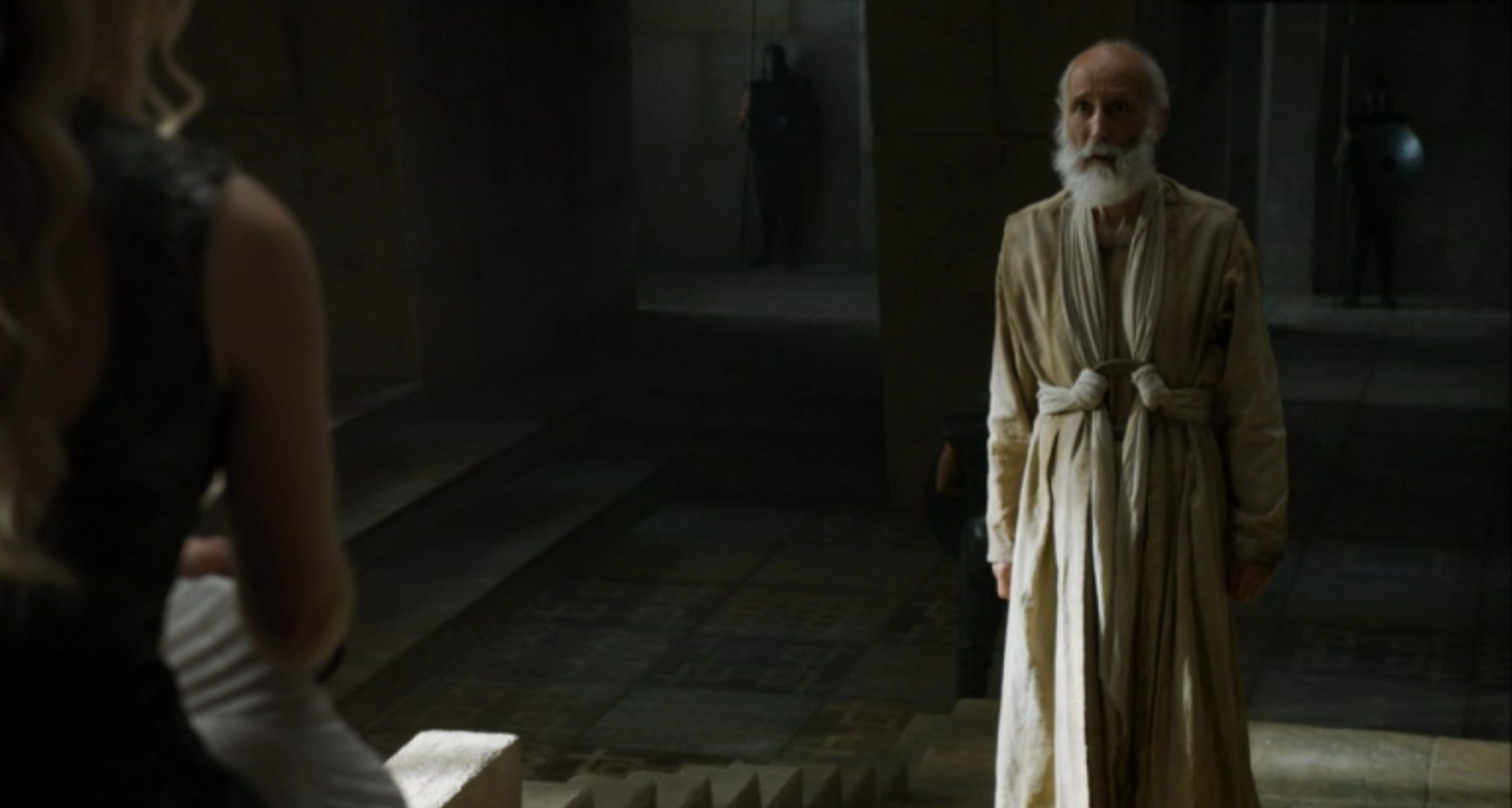


How fantastic that they reminded us of how much had changed in so short a time. Just holding that feather in her hand links her to that earlier discussion, where Robert Baratheon places the feather on the hand of the statue and tells Ned, “In my dreams I kill him every night.” He is king because he swore a vengeance that Rhaegar Targaryen would die for what happened to Lyanna. And she, similarly, is about to help Baelish wreak vengeance on the House Bolton for killing her family.

And then Baelish suddenly shows up, like the Oirish Batman he is, lurking in the shadows, and takes us back even further, to when he was a child and he got to see a tournament at Harrenhal, where Robert Baratheon and Rhaegar Targaryen and several other men were jousting. He tells the story of how, when Rhaegar won, he rode past his own wife, Elia Martell — for those keeping score at home, she was the sister of Prince Doran and Oberyn Martell, and the sister-in-law of Daenerys — and instead laid the crown of winter roses in Lyanna’s lap, as a hush fell over the crowd. Baelish looks back at the statue: “How many tens of thousands had to die because Rhaegar chose your aunt?”

Sansa reminds Petyr that he did choose her . . . right before he kidnapped and raped her. He smiles knowingly. They then begin walking away from the tombs and he explains his plan to her. He’s heading to King’s Landing, leaving her at Winterfell (I would panic if I didn’t know that Brienne was waiting in the hills outside the castle), but he knows that Stannis and his army are headed south. First, he explains, they have to take Winterfell, and his army is stronger than Bolton’s. Once he wins, he’ll have the north behind him and will take the Iron Throne. “A betting man would put his money on Stannis,” he says. “As it happens, I am a betting man.” Then, if all goes to plan, Baelish says Stannis will rescue Sansa from the clutches of the Boltons, and to repay her father for having supported his claim to the throne, he will name her Wardenness of the North. If, by chance, the Boltons are victorious, Baelish tells Sansa to simply make Ramsay hers, in much the same way Daenerys did with Khal Drogo. Ramsay’s attracted to her already, and Petyr reminds her that she learned political maneuvering from the best of them — i.e., him. And then he stands on his tippy-toes and kisses her because he’s a foot shorter than she is, reassuring her, “The North will be yours. Do you believe me?” She nods, and reminds him she’ll be a married woman the next time she sees him.

sansa_baelish

It’s a lovely fairy tale, but will any of it come true? Does Baelish actually believe any of it? I noticed in this scene one slip that he made, something he said that differed from the previous episode. When he’s reassuring Sansa that this will all work out in her favour, he says, “You’re the last surviving Stark.” But in the previous episode he’d said, “You’re the eldest surviving Stark,” as if he somehow knew about Bran and Arya being out there somewhere. Did he slip then? Is he slipping now? Is he playing her? One must always remember that with Baelish, no matter what, he never puts another person before his own political maneuverings. She’s right: she did learn from the best of them. But will her learning be enough to win over Ramsay Bolton? He, after all, is inhuman.

It’s not just Baelish I’m beginning to wonder about, but Reek. Last season I was pretty convinced that Theon Greyjoy was 100% gone, and that Reek was now here. But in the past couple of episodes, the way he appears to be listening to Ramsay and Roose as they talk, and the way he seems to be a little less shaky and more focused — while hiding himself from Sansa, as if remembering that he was raised almost like a brother of hers, something Reek shouldn’t have remembered — is making me wonder what’s up with him. He could turn out to be a wild card we didn’t see coming.

But now, as Baelish heads to King’s Landing, let’s go there, too. The Sparrows have become a malicious army that is wreaking havoc in the city. Cersei has given the High Sparrow full power, but in doing so, she’s allowed her own son’s power to be undercut, since her single-minded purpose at this point is to imprison Loras to punish Margaery. Last week I said that poor Tommen is caught in the crossfire between these two, and is being emasculated in the process, and that was clearly evident in this episode, as Margaery demands that he DO something, and Cersei makes it impossible for him to perform. Freud would be having a field day with this plotline.

What did you think of the way the Sparrows are taking over King’s Landing, Chris?


Wasn't this a scene in The Untouchables?

Wasn’t this a scene in The Untouchables?

Christopher: There’s an old saying about reaping and sowing. I forget how it goes.

I think it’s safe to say that Cersei is playing with fire. Absent her father or for that matter any competent allies besides Dr. Frankenstein Qyburn, she’s making a power play by arming the Sparrows, assuming that their leader will adopt a quid pro quo attitude in exchange for this alliance. It becomes pretty obvious that this is a dangerous assumption when Tommen is refused entrance to the Sept. He’s just a boy, and has little idea how to properly exercise his royal power (his one lesson in governance from Tywin being “do everything I tell you”). But more important than this is the reminder that the Lannisters aren’t exactly loved in King’s Landing—and that the pervasive rumours that the Queen’s children were born of incest have not gone away. “Bastard!” the crowd shouts at Tommen. “Abomination!” What before were salacious rumours that gave the commons license to mock the Lannisters in secret are something dramatically different in the hands of a mob of religious fanatics. They feel completely comfortable shouting out in public what was previously whispered in private.

tommen

And if this is the reception the king gets … what will they have to say about the woman who birthed these “abominations”? How inclined will the High Sparrow be to play Cersei’s game then? After all, in giving them Ser Loras, Cersei has essentially given them license to beat, punish, and imprison anyone they suspect of sexual deviance—or, really, anyone they suspect of sinning against the Seven, and the Jesus-in-the-Temple sequence shows that they’re casting a pretty wide net.

And Cersei isn’t doing herself any favours in her attempts to consolidate her power. She alienates her uncle Kevan, who decamps to Casterly Rock; and in this episode she denudes the power of the Tyrells at court by sending Margaery’s father away on the pretext of making him an emissary to the Iron Bank. Mace Tyrell is a fool and a buffoon, absurdly honoured by the mission rather than seeing it for the ploy it is. Whatever she has planned for Margaery can now happen without her father to stand in front of her. And the fact that she has sent Meryn Trant along to “guard” him might well mean he’s not meant to return from the trip.

But in the process, Cersei has managed to isolate herself. “The Small Council grows smaller and smaller,” Grand Maester Pycelle observes. “Not small enough,” Cersei retorts, making it obvious that she wants to shoulder the old man out too.

It is plain that she hopes to win her son back to her influence. And in the short term at least she has made progress: whatever havoc ensues from the now-armed Sparrows, in having Ser Loras taken she has driven a wedge between Tommen and Margaery. How quickly the worm turns … just last episode he was ecstatic about his new bride, and with the enthusiasm (and randiness) of adolescence imagined things would always be the sexy romp of their wedding night.

Poor Tommen. So oblivious, and so utterly confused when Margaery deserts his bed. How long before he returns to his mother for help?

The maneuvering between Cersei and Margaery reminds me a great deal of the war between Caesar’s niece Atia and his lover Servilia on Rome. That show did a wonderful job of undermining the whole “great man theory of history,” in part because it depicted those groups marginalized by history—the underclasses and women—as actually being the people who shaped history’s course. Male and female power is even more complex on Game of Thrones because there isn’t such a clear distinction between the two. Daenerys is as powerful and competent as any of the male kings or would-be kings, but is an explicitly matriarchal figure. With the symbolic emasculation of Jaime when he lost his hand, it is now clear that the single greatest fighter on the show is Brienne, a woman who has chosen to embody all the trappings of traditionally male power. Arya has also chosen the route of eschewing traditional female roles, and at this point has gone farther than anyone else in agreeing to divest herself of (almost) all the trappings of her previous identity. And if Cersei, Margaery, and Sansa seek agency within their circumscribed roles as highborn women, our sojourns this season to Dorne and our introduction to the Sand Snakes open new possibilities entirely.

tyrion_jorah_boat

But whatever other small victories Cersei might be savouring in the short term, mounting Tyrion’s head on a pike won’t be one of them. “You’re going the wrong way,” he tells Ser Jorah. “My sister is in Westeros.” But instead of taking Tyrion west for the certainty of a pardon and a lordship, he’s taking him east, gambling that handing Daenerys a scion of the Lannisters will atone for his sins. “A risky scheme,” Tyrion observes. “One might even say desperate.”

Suffice to say, Jorah is not happy with Tyrion’s observations.

But it raises the question: Lannister or not, Tyrion made Daenerys’ life easier by taking one of her most formidable foes off the board when he killed Tywin. Why would she exact her revenge on someone who did that, and was furthermore just a child during the war that killed her family and exiled her?

One way or another, the Jorah/Tyrion road show promises to be a whole lot less entertaining than the one with Varys. One suspects that Tyrion’s wit will be lost on Lord Friendzone, and will probably result in a few more beatings.

Which brings us to our rather dramatic conclusion … what did you think of the Rise of the Harpies, Nikki?

harpies

Nikki: What I find so interesting about the Jorah/Tyrion debacle is that at the end of the third episode, when Jorah said that he was taking him to the queen, my husband immediately said, “Well, he’s about to see his sister a lot sooner than he expected to.” And I looked at him, baffled, and said, “No, he’s going to Daenerys; she’s the only person Jorah would ever refer to as queen.” And neither of us had even considered there was more than one “queen.” It’s amazing that, again, the show is so complicated it would elicit two completely different responses. (This is also me relaying that story to boast that I WAS RIGHT. Hehe…)

The end of the episode, where we see the Harpies rise up against the Unsullied, is a heartstopping scene. It’s preceded by Ser Barristan regaling Daenerys with the story of her brother Rhaegar, whom she’d always been told was a vicious killer — the one who, as we were reminded at the beginning of this episode, loved Lyanna Stark only to kidnap, rape, and kill her. But now, after hearing that story, the audience hears Ser Barristan tell a very different one. Rhaegar had a beautiful singing voice, he loved singing, and hated the killing. People lavished money on him, which he gave to charities and orphanages. Daenerys sits and listens to Ser Barristan with a starry look in her eye, as amused and thrilled by this story as she was revolted and ashamed of the story that Ser Barristan told her in the second episode of this season about her father. We’re reminded in this scene of how loyal Ser Barristan has been to the Targaryens, and how long he has served her. When she’s called away by Daario, Daenerys smiles at the aged knight. “Go, Ser Barristan,” she says. “Sing a song for me.”

barristan_dany

We didn’t know she meant swansong.

As Daenerys sits and listens to another plea by nobleman Hizdahr Zo Loraq, once again arguing that she should allow the fighting pits, we see what the Harpies are doing out on her streets. With the help of the same prostitute who helped kill White Rat, the Unsullied run after the Harpies as the latter embark on their killing spree, only to be cornered in a stone hallway on both sides. Grey Worm is a brilliant fighter, as are all the Unsullieds, but they’re outnumbered.

I have to say that, at first, I felt a little betrayed by this scene. The Unsullied are the most experienced and adept army in the Seven Kingdoms. From the moment they are toddlers, they are taught to focus on absolutely nothing but fighting. Ten thousand Unsullied, we have been led to believe, could take on an army 10 times their size. So a bunch of men — whom I suspect, though I could be wrong, are the noblemen who are angry with Daenerys for unseating them — corner them in an alleyway and they somehow manage to beat them? Shouldn’t 15 Unsullied be able to fell 100 noblemen? Perhaps these men aren’t who I think they are. If the scene is introduced by the words of Hizdahr Zo Loraq talking about how badly they want the fighting pits back, perhaps the Harpies are in fact the men who have achieved champion status fighting in those pits. And if that’s, in fact, who they are, then I can believe they are a mighty force. But even that shouldn’t rival an army of men with one single-minded purpose in life, I thought.

However, the one thing we need to remember is that the Unsullied are taught to fight like an army. And the Harpies aren’t fighting with any sort of order or training, but ambushing them. And that’s a VERY different fighting style. You have men stabbing you in the side with daggers, rather than forming a line and coming straight at you on the battlefield. And every time they kill one, two more seem to run into the room.

The fight itself is awesome. Grey Worm is a formidable foe, taking down as many as four men at a time, sustaining serious stab wounds and continuing to fight with the focus of a true warrior. Blood is splattered all over the walls, heads are rolling, but it’s still too much. There are 15 men bearing down on him and he can’t take them all on.

Barristan the Badass.

Barristan the Badass.

And then Ser Barristan finally shows up to sing his song — and what an epic, glorious aria it is. He comes flying into the room like Obi Wan Kenobi, unsheathes his sword and effortlessly begins making a Harpy shishkebob with it. He stabs one in the back, then takes out NINE men in a row before splitting the tenth one right up the middle (ew). Meanwhile, Grey Worm hasn’t gone down, and now sees his chance, as several Harpies run over to take on Ser Barristan instead. But then Ser Barristan is stabbed. He swings and takes out a man. He’s stabbed again, in the leg. He takes out another. He’s stabbed in the shoulder. He kills that guy. And then he’s stabbed in the abdomen, and he falls forward. As that man runs around behind him and is about to give him the Catelyn Stark treatment, Grey Worm stabs that man in the back. Ser Barristan falls, and Grey Worm falls to lie beside him.

Noooooooooooooo!!! Daenerys’s strength just dwindled considerably if they’re actually dead. Maybe they’re not dead, I’m thinking… but this is Game of Thrones. George RR Martin isn’t exactly known for his generosity when it comes to NOT letting characters die. Ahem.

I should probably mention to everyone here that TV critics everywhere were given the first four episodes, and we watched them a month ago and have been hanging on that cliffhanger ever since. It feels like such an inordinately long time since that episode already — let’s just say next week’s episode cannot come soon enough.

the_end

Just a note that this will be the last episode recap that will appear immediately following the end of an episode. As of next week, Christopher and I will be watching live with everyone else, and our recap will probably go live on Tuesdays. Thanks for reading what might be the longest recap we’ve done yet!! See you next week…

1 Comment

Filed under Game of Thrones

Game of Thrones 5.03: The High Sparrow

gameofthrones_teaser02_screencap10

Welcome once again friends to the great Game of Thrones co-blog, featuring myself and the fearsome Nikki Stafford, Destroyer of Worlds.

This week was a corker, there can be no doubt about that. Purists, presumably, are fuming at the way in which Weiss and Benioff (peace be upon their names) have continued to wander off-script, but I have to say: I’m kind of digging the changes they’re making. This week we get a weirdly un-bloody wedding, a supremely smug Margaery, a supremely scandalized Sansa, militant Gandhi, Arya getting totally Mr. Miyagi-ed by Jaqen, Jon Snow getting badass, and a bit of totally undignified dwarf-napping.

Are you seated comfortably? Then we’ll begin …

cersei-wedding

“Nope. Nope. Nope. Nope. Nope. Nope. Nope. Nope. Nope. Nope. Nope. Nope.”


Nikki: Well, shockingly for Game of Thrones, one of the least notable moments of the episode was a wedding — ! — that didn’t involve any deaths of any kind — !!.

Unless, um, you count la petite mort that happens afterwards. #frenchhumor

Yes, the boudoir scene that follows the wedding — where one swears you can see Cersei two-fisting goblets of phantom wine just to take the sting off the fact that that whore has married yet ANOTHER ONE OF MY SONS — is uncomfortable, to say the least, mostly because Margaery appears to be much older than Tommen, who looks 12, and who giggles his way into the bed as if to say, “OMG, I’m gonna get some!” Afterwards, he doesn’t seem to know what hit him, while his more worldly wife tweaks his nose and commends him on doing a pretty good job. “It all happened so fast!” he says, and we know that that must have been a magical experience for Margaery.

This picture needs to be in the dictionary next to "smug."

This picture needs to be in the dictionary next to “smug.”

Post-wedding, the gloves are off with Margaery when she sees Cersei the next day, and I admit that I actually felt rather sorry for Cersei in that moment, as Margaery’s ladies-in-waiting all titter around her as she first apologizes for not being able to offer some wine to Cersei, it’s just that the rest of them tend not to drink so early in the morning (ha!), before launching into details of the wedding night that NO mother wants to hear, not even one who used to bang her own brother. Then Margaery manages to manipulate her son little brother husband (I just can’t get used to this) into attempting to talk his mother into leaving King’s Landing and returning to Casterly Rock, where she’ll stop babying him and allow him to become a man once and for all. Or, you know, allow him to prepare to become a man… but dammit once that puberty arrives he will be SET.

But don’t cry for the Dowager Queen (ouch!) just yet, for she has quite the counter-move up her sleeve.

The main victim in all of this is poor Tommen himself. He doesn’t see it yet (I mean, how many other little boys have a woman who looks like THAT in their bed?), but Margaery condescends to him, manipulates him, and only married him as a power play, whereas Cersei will go to any lengths to bury his wife, emasculating him in the process when both women remind him of just how powerless he is.

You mentioned in our first week of season five, Chris, that you were looking forward to the arrival of the Sparrows, and this week we meet their leader, played by the inimitable Jonathan Pryce. What did you think of the introduction of the High Sparrow?

high-sparrow

Christopher: Well, as always, the casting is great. Pryce is an incredibly accomplished actor, and can do bombast (think of his scenery-chewing Rupert Murdoch-esque Bond villain in Tomorrow Never Dies) and subtlety with equal facility. Here, he’s doing subtlety, providing an understated and quiet performance in which he comes across as something of conflation of Jesus and Gandhi. And again, in casting Pryce, the showrunners have yet again given us an actor capable of communicating profound gravitas—like Tywin, Mance Rayder, the Queen of Thorns, and now Doran Martell, the show keeps giving us these amazing characters whose very presence on the screen radiates self-possession and innate strength.

The sparrows and their leader provide an interesting dimension to the novels, so I’m very happy they’re remaining faithful to them on the show. The squalor and want Cersei witnesses as she seeks out an audience with the High Sparrow reminds us of the devastation wrought by the wars between the great houses: with farmland burned and pillaged and villages razed, those common folk who survived find themselves homeless and starving and come to the capital in the hope of finding succor. The High Sparrow ministers to the people and wears the badges of humility—again like Gandhi or Jesus—but it is significant that the lead-in to his appearance is Lancel and a group of other sparrows invading Littlefinger’s brothel to beat and humiliate the High Septon. Lancel’s words to Cersei in the first episode were the first ominous indication that the sparrows have no interest in non-violence. However Gandhi-esque the High Sparrow appears, his rhetoric about lancing boils, however euphemistic, is violent.

And yet, Cersei seems to believe this is a man she can work with, refusing the High Septon’s demands for justice and instead incarcerating him for soiling his high office. Cersei has a track record of overestimating her own ability to scheme and play politics, though she’s mostly oblivious to her failures, as with the way in which Littlefinger gamed her so deftly (resulting in the death of her son). She wears the blinders of privilege, almost certainly seeing in this shoeless, filthy man someone she can easily bully and manipulate.

This will get interesting. The arrival of the sparrows is like a microcosmic allegory about religious extremism: how it arises, flourishes, and shocks the powerful with its force and tenacity. For four seasons, the great houses played the game of thrones with little concern for all of the common people being hurt, impoverished, and disenfranchised. The starving masses descend on King’s Landing in desperation, not just for physical sustenance but spiritual sustenance as well, something that the Lannisters and Tyrells are particularly ill-equipped to provide. The scene in the brothel with the High Septon dramatizes this dissonance in the way it very specifically echoes the kind of hedonism enjoyed by the upper echelons of the papacy on the eve of the Protestant Reformation. The faux-religious pantomime played out by the High Septon could easily be a scene from The Borgias.

high-septon

There’s an interesting resonance in this episode between the High Sparrow’s denial of self (I have to add that his line “I tell them I’m nothing special … and they think that I’m special for telling them so” totally made me think of The Life of Brian) and what Arya learns at the House of Black and White. It too is a house of worship, and the god they worship is death. And in order to join their ranks, Arya is enjoined to lose all of the things that make her Arya Stark, to truly become “no one.” “A man wonders,” says Jaqen, “how ‘no one’ came to be surrounded by Arya Stark’s things?”

What did you think of the continuation of Arya’s Braavos adventure, Nikki?


"What the hell do you mean, 'wax on, wax off'?"

“What the hell do you mean, ‘wax on, wax off’?”

Nikki: Life of Brian, ha! I totally agree. I knew that scene was reminding me of something, but couldn’t put my finger on it. You hit the nail on the head.

Jaqen’s assertion that in order to lose oneself, one must divest oneself of all personal possessions is something that most of us would be unable to do. But not only would I be throwing my hands up and saying, “Well, it’s been nice knowing you, my friends” as I run back home and surround myself with my books, promising them that I will never, EVER be rid of them, I found I was also attached to Arya’s belongings. I’ve watched many a character die on this show, and it was sad, yet the moment of Arya standing above the water and holding Needle out like she was going to throw it? I didn’t think I was going to make it. I watched this on my own first, then with friends, and their reaction was the same. “Don’t do it!” we were shouting at the television. One friend said, “Just bury it somewhere, he’ll never know!!!” Amazing how much attachment we have to this sword, but it’s the one physical thing Arya has left of her father, besides herself, of course. Every time we see Needle we’re reminded of him sitting on the bed beside her and giving her the sword in the first place. No matter how strong and defiant Arya seems, in that one moment, as she looks out at the water while holding Needles, tears welling up in her eyes, she’s a little girl again. You can practically see her daddy standing next to her, his arm around her shoulder. In some ways, I believe she derives her self-confidence and power from that sword, the same way Samson derived it from his hair. I can’t tell you what a relief it was to see her putting it in the stone wall, even if I’m worried that Jaqen will know.

arya-pier

When Jaqen first revealed himself last week I thought to myself, Oh please let him still talk like Yoda. And he doesn’t disappoint in this episode. Very carefully avoiding any personal pronouns, he never says “I” or “you,” but instead “a man” and “a girl,” once again absolving him and Arya of any sense of self. My friend John was watching the episode with me, and he has read the books (sorry, Chris, I almost feel like I was cheating on you!) and he reminded me that Jaqen first claimed back in season 2 to be from Lorath. He later emailed me an excerpt from The World of Ice and Fire, the companion book to GRRM’s series, where he explained why this is significant:

The Free City of Lorath stands upon the western end of the largest in a cluster of low, stony islands in the Shivering Sea north of Essos…the isles were home to the mysterious race of men known as the mazemakers, who vanished long before the dawn of true history…Others followed the mazemakers on Lorath in the centuries that followed…a small, dark hairy people…[and] Andals…afterward the dragonlords flew onward, bringing blood and fire to the isles of Lorath…not a man, woman, or child survived the Scouring of Lorath…When men at last returned to the isles to live, they were…a sect of religious dissidents…worshippers of Boash, the Blind God….An essential part of their doctrine was an extreme abnegnation of self; only by freeing themselves of human vanity could men hope to become one with godhoods.  Accordingly, the Boash’i put aside even their own names, and spoke of themselves as “a man” or “a woman” rather than say “I” or “me” or “mine.” Though the cult of the Blind God withered and died out more than a thousand years ago, certain of these habits of speech endure even now in Lorath, where men and women of the noble classes regard it as unutterably vulgar to speak of one’s self directly.

Forgive me if you already laid this out in season two, Chris. But anyway, I found this fascinating, and it gives us some insight into this strange man. It also reminded me of Divergent, where, in a dystopian future, people must divide themselves into one of five factions based on social and personality-based features, and one of them is Abnegation (where our heroine finds herself at the beginning of the book). These people wear potato sacks, never look in a mirror, live to serve others and never themselves, and are made to believe it’s because they don’t exist as selves.

Meanwhile, back at John Locke’s house, the other girl — nameless, presumably — with Arya is particularly vile, but she also seems to endure Jaqen’s scorn at times. I must admit, however, that I wasn’t quite clear what happened to that man who drank the water. I’m assuming I’ve missed something. In any case — and I’ll try to write this the way Jaqen sees the world — after a girl disposes of a girl’s belongings, a girl returns to the House, where a girl is washing a man, and a girl asks a girl what two girls should do after two girls wash a man. A girl simply glares at a girl, and a man or a woman, sitting and watching a man or a woman’s television at a man or woman’s house, watches and wonders, “What DO two girls do with a man after two girls wash a man?”

OK, seriously, I’m assuming there are no books in Lorath.

Last week, Chris, you speculated on where Brienne and Pod were following Sansa, and this week we discover it was Winterfell, containing bodies that look like Dark Willow had dealt with them (“Bored now…”) and an increasingly disturbed Reek. Now THAT adds an interesting wrench into the story! What did you think of everything happening there?

brienne_pod

Christopher: I suspected I’m not the only follower of the novels who had a huge “HOLY SHIT HE’S MARRYING SANSA TO RAMSAY” moment. This is the moment for me where I had an image of Weiss and Benioff chucking all five of the novels out of the boat.

To clarify: in the novels, Roose Bolton schemes to solidify his hold on the North by marrying his now-legitimate psychotic son to a Stark girl. Except that he means to marry Ramsay to Arya. But Arya’s in Braavos, you protest? Well, the actual authenticity of the “Arya” in question isn’t really a major concern for the Boltons, who find a brown-haired girl with a vague resemblance and declare to the world that, look, Arya is alive! And she’s marrying Ramsay! As for Sansa’s narrative arc in the novels, Littlefinger does hatch a marriage scheme for her, but it involves a whole lot of labyrinthine genealogy that would have Sansa marrying a young man with a soupcon of Targaryen blood—an even more tenuous claim to the throne than Henry Tudor had when he deposed Richard III, but a claim that would have more force when he marries the heir to Winterfell.

Once again, we see significant changes being made here in the name of expediency: eliminating Littlefinger’s byzantine plot in the novel, and by the same token giving the faux-Arya’s story more pitch and moment, as it now involves not a peripheral character but a central one (and, if I may venture, a well-loved character—Sansa started out as everyone’s annoyance, but I think it’s safe to say that Sophie Turner’s portrayal of her has earned our respect and affection). And it also means that faux-Arya’s storyline (which I’m obviously not about to spoil here) will have way more tension and drama.

anguished_sansa

I absolutely loved the scene between Sansa and Littlefinger when she realizes what he has planned, both for the power of Sophie Turner’s performance, but also as yet another example of Littlefinger’s vile cunning. I suppose we can give him the benefit of the doubt and grant that perhaps he has no idea just what a psychopath Ramsay is (though I find it hard to believe that he wouldn’t know), but he’s still planning to marry Sansa into the family that betrayed and murdered hers. And as his little speech to her makes clear, he’s maneuvered her into a position where she quite simply has no other choice. He might genuinely care for her, but as has been made clear over the previous seasons, he is a man willing to sacrifice anything and anyone on the altar of his own ambition—or as Varys astutely said of him, he’d burn the realm to the ground so he could be king over the ashes.

“Every ambitious move is a gamble,” he tells Roose Bolton when Bolton (rather sensibly) questions his motives. But he has moved his pieces with consummate skill, placing himself out of reach of the ever-weaker Lannisters, and (it seems) gearing up to repeat history. “The last time the lords of the Eyrie formed an alliance with the lords of the North,” he reminds Roose, “they brought down the greatest dynasty the world has ever known.” Is he really proposing a new war? If so, who does he imagine sitting on the Iron Throne? Himself?

We’re in uncharted territory here. I honestly have no idea what his plans are.

But for all of his gamesmanship, the flaws in his plan become ever more apparent. His ignorance of Ramsay’s sociopathy will almost certainly come around to undermine his well-laid plans; and when Ramsay greets Sansa and kisses her hand, the camera pans around to show us the jealous face of his erstwhile girlfriend. Even if Ramsay manages to keep his worse tendencies in check (not holding my breath), I can’t imagine that woman will be at all inclined to make Sansa’s life easier. And there is also the reminder that while the Boltons won the North and hold it with an iron fist, there are many people who see their rule as illegitimate. “The North remembers,” Sansa’s chambermaid says feelingly, a simple mantra that resonates back through everything Sansa has endured.

There is also, of course, that blonde woman on the other side of the world who, if she ever gets her dragons back in line, could be something of a spoiler for Littlefinger’s dreams of power. The “greatest dynasty the world has ever known” isn’t quite dead.

But more immediately, there is a sword hanging above Winterfell’s head at the Wall. Stannis informs Jon Snow that he means to march on Winterfell within a fortnight, so Roose and Littlefinger might have a little discomfort in the short term. And once again, Jon respectfully declines Stannis’ offer to make him Lord Stark of Winterfell, embracing instead his new position as Lord Commander. And … well, he doesn’t waste time in asserting his authority. What did you think of our first taste of Lord Commander Snow, Nikki?

stannis_davos_jon

Nikki: Whew. What a scene. Every episode of the season thus far has ended with an execution: Mance Rayder by Stannis; Mossador by Daenerys, and now Janos by Jon. And what a powerful scene it is.

But let’s back up. I loved the scene between Jon and Stannis, where Stannis is offering him for the last time the name Jon Stark, a name Jon has wanted his entire life. But he already went through the agony of choosing to decline in the previous episode, and here he resolutely — and, as you point out, Chris, respectfully — says no. He has a new purpose as the Lord Commander, and it’s a title he earned, not one that was just bestowed upon him by someone who wants to use Jon to help him avenge the Baratheon name. What is interesting is that, like Sansa, Jon is being asked to accept a new name in order to help another man gain power, with the carrot of Winterfell being dangled before him. Similarly, Sansa is being told to help take back Winterfell by changing her name and doing Petyr’s bidding. It’s a fantastic parallel scene.

His first job as Lord Commander is to let Stannis know that they don’t have enough supplies to keep feeding both Stannis’s men and the wildling prisoners — “Winter is coming,” after all… an apparently perpetual state in Westeros that has been going on for five years now — and Stannis assures him they’ll be gone within a couple of weeks. As for the wildlings themselves, though, he says he’ll leave it up to Jon to decide what to do with them.

Jon shows deference and respect for Stannis, but he doesn’t listen to him. Davos, on the other hand, has always been a reasonable man, and he hangs back as Stannis leaves, telling Jon that Stannis isn’t just blowing smoke; he actually believes in Jon Snow and knows what a powerful man he could be. He reminds him of his pledge as a man of the Night’s Watch, that he is “the shield that guards the realms of men.” And he explains to him that sitting up here at the Wall, away from the politics and bloodshed that’s happening in the Seven Kingdoms, might not be the most effective use of his talents, nor the most helpful he could be here. As he leaves, he says forebodingly that “as long as the Boltons rule the North, the North will suffer.”

davos

Later, at the first Council meeting — where Maester Aemon is noticeably absent, which worries me — Jon immediately shows that he will be a fair ruler, and one the men will follow. When he assigns a man to oversee the rebuilding the latrines — “seems like a good job for a ginger — the man simply laughs along with everyone else, but does so without argument. Ser Alliser has a look on his face as if he thought that was going to be the task Jon would assign him. But Jon isn’t looking for revenge; he wants the most effective team of men he could possibly have. Instead, Jon makes him First Ranger, telling everyone that he’s proved his worth and valour. Alliser looks surprised, but immediately chuffed. Jon has made a cunning move — in one swoop, he puts the best man on the job, but also pulls that man over to his side by praising him before all the other men.

Lord Janos, on the other hand, doesn’t fare so well. And again, it’s because Jon is honest: he wants the men on his side, but not at the cost of the Night’s Watch. And he knows that Janos is a snivelling coward, unable to take on anything but the most menial of tasks. While he doesn’t put him as captain of the latrines, he does place him as Commander of Greyguard. This is a castle located further along the Wall that has been largely abandoned, and is falling apart. In other words, the perfect fortress for a coward.

Unlike the ginger, Janos is not going to go quietly into that good night. Jon calmly and reasonably explains to him, as if he’s a toddler, that he is the Lord Commander, and that was an order. “I will not have it!” says Janos. “Do you hear me, boy? I will NOT have it!!” Jon, once again calmly, asks him if he’s refusing to obey an order. And Janos, much to the delight of the viewers — because who doesn’t want to see bad things happen to Janos? — tells Jon to stick that order “up your bastard ass.” Ser Alliser smilingly looks in the direction of Jon, waiting to see what the boy will actually do. Does he have the stones to be the Lord Commander? Is he willing to do what it takes? Jon tells his men to get Janos outside and to grab his sword. The men do so willingly. For one moment, Ser Alliser stands between Janos and the men, but then steps aside. He’s on Jon’s side, and will, for now, follow the Lord Commander who has given him this new honour.

Jon walks meaningfully to the executioner’s block outside, as Stannis watches from the balcony, and stands before Janos, both hands folded on the handle of his sword.

janos_beheadingned

The very scene reminds the viewer of our first scene with Ned Stark, all the way back in the pilot episode. A deserter from the Night’s Watch is brought before Ned, and pleads with him that he really did see white walkers, something that Ned and every other sane man of the North believes is a lie. As the man is put on the executioner’s block, Ned pulls Ice from its sheath (held by Theon Greyjoy) and says he is doing this is the name of King Robert. Jon Snow leans over to Bran, and tells him not to look away, because Father will know if he does. Robb stands silently, watching intently, and Bran very carefully does not close his eyes.

All these years later, so much has changed from that now-quiet scene, and Jon knows that Ned was wrong in his assessment. The white walkers are real, and that man wasn’t a deserter, but was telling the truth. Janos, on the other hand, is not innocent, and Jon must do this to earn the respect and fear of his men.

Earlier, when Stannis made his offer for Jon to take the Stark name, take back Winterfell, and rule the North, he says in response to Jon’s refusal: “You’re as stubborn as your father. And as honorable.” Jon replies, “I can imagine no higher praise.” Stannis replies tersely, “I didn’t mean it as praise — honour got your father killed.”

Now, unlike the deserter a lifetime ago, who refuses to back down on his story, Janos immediately takes back everything, apologizes, says he was wrong and that he’ll do Jon’s bidding. But Jon knows better: if he lets him go, Janos will see how weak he is. He pulls back the sword, and Janos begs for mercy — in a way Mance Rayder refused to do two episodes ago. Jon pauses as Janos snivels that he’s afraid, and has always been afraid. Jon’s face is a complicated mix of sympathy and loathing. He’s disgusted by Janos, and yet Janos is begging for mercy. Does he grant him that mercy, and banish him in disgrace? The problem is, the Night’s Watch is, in itself, a banishment. And so he does the only thing he believes he can: he chops off Janos’s head in a MUCH more graphic close-up than the one Eddard had four seasons ago. Stannis, standing on the balcony, nods almost imperceptibly, but Jon sees it. He showed no mercy, just as Joffrey showed none for his father when Ned lied and took back everything on the executioner’s block. Just like Daenerys showed no mercy to Mossador. Just as Stannis showed none to Mance (not that Mance was asking for it). Jon has now shown that he has what it takes to be a leader in Westeros, for better or worse. And you can tell just by looking at his face, that having Stannis’s approval makes him wary of whether or not he did the right thing.

And finally, the Varys and Tyrion road show disembarks and Tyrion gets to see real humans with hair once again as he dresses in an Obi Wan Kenobi robe to blend in. Do you think Tyrion took a chance he shouldn’t have taken, Chris?


Jedi Tyrion.

Jedi Tyrion.

Christopher: That’s a difficult question to answer, in part because we sort of meet up with the novels’ storyline here again: Tyrion’s journey to Volantis is dramatically abbreviated, but his abduction by Ser Jorah is consistent with GRRM’s version. So to answer your question: well, yes … given that he ends the episode with a hood over his head and a noose around his neck, perhaps it would have been better to stay in the wheelhouse. On the other hand, of all the possible problems of which they might have run afoul, being recognized by a disgraced Westerosi knight in his cups at the brothel they just happen to choose seems like something of an infinitesimal eventuality.

Whatever else one thinks of the Volantis interlude, once again the designers have outdone themselves. That long bridge stretching across the bay, piled high with buildings, is a magnificent rendering of how GRRM describes it in A Dance with Dragons. I remember that last season you commented about the odd dearth of high-end CGI in the first two-thirds of the season, which was seemingly explained by the massive expenditure that must have gone into the creation of the battle at the Wall. They’re not being so parsimonious in the early stages of this season … I wonder if the powers that be at HBO have just decided to give Weiss and Benioff whatever toys they desire.

There are several notable moments during this sequence aside from the sudden re-appearance of Lord Friendzone. The view of the massive bridge encrusted with precariously tall structures is one. Another is Varys’ exposition on the way in which the Volantines brand and organize their slaves, by the small but unavoidable tattoos they all have on their cheeks. We begin to see something that has not yet made its way to Westeros, namely the spread of the Daenerys legend. Until this moment, we have either known her as a rumour, a gnat in the ear of people like Tywin Lannister—who, half a world away, can’t bring themselves to take her seriously—or we have been immersed in her story. We haven’t had this halfway experience: far enough away that she is more legendary than real, but close enough that people take her seriously. The tales of her conquests, we realize, must be so very tantalizing to the huge slave population of Volantis, and rumours of her beauty are palpable enough that a prostitute with white-blonde hair can style herself reasonably well as Daenerys, and be in great demand by the brothel’s clientele. The street sermon by the red priestess reminds us that the reappearance of dragons in the world must be quite the thrill for those who worship the “Lord of Light,” but there’s also the added dimension here that she was obviously herself once a slave—the appearance of an abolitionist queen with dragons must be like the signs of the End Times.

hot-priestess

One wonders what Melissandre would think.

One thing I found interesting in the brothel scene was Tyrion’s sudden, surprising inability to hire the whore he’d been chatting up. The show has gone out of its way to make Tyrion an appealing character, starting from the casting of Peter Dinklage. The Tyirion of the novels is far more repulsive in appearance than the handsome Dinklage, especially after his wounding at the Battle of the Blackwater (which leaves Dinklage-Tyrion with a fetching scar as opposed to losing most of his nose). By the same token, the Tyrion of the novels, while charming, is also given to more repulsive behavior at times, never more than when he arrives in Volantis. Rather than suddenly suffering from uncharacteristic inhibition, he gets blind drunk, and has sex with a prostitute with whom he is verbally and borderline physically abusive.

I’m not saying the Dinklage-Tyrion isn’t preferable, just that it looks as though the series is keen to sanitize his behaviour rather a lot—right down to his reason for preferring the brunette to the faux-Daenerys, because she has a “skeptical mind.”

Which of course leads us to the moment where his series storyline merges again with the novels. We see Ser Jorah briefly before the final moment, obviously drinking away his misery as best he can … and presumably not succeeding as he watches faux-Daenerys flirting with a bunch of drunken louts. One wonders if he’d paid for the trade of this particular prostitute; as he watches her basically giving a guy a lap dance, I was wondering if he would go over and pick a fight with the louts, or possibly drag her away for his own pleasure.

But of course he does neither, having instead spotted Tyrion and recognized him. And we end with his snarled promise that he will bring him to the queen.

But … which queen?


Uh oh.

Uh oh.


Well, for that answer, check in with us next week … for now, on behalf of Nikki and myself, I say: stay warm, make sure to feed your direwolves, and be wary in strange brothels.

Leave a comment

Filed under Game of Thrones

Game of Thrones 5.02: The House of Black and White

gameofthrones_teaser02_screencap10

Willkommen, bienvenue, valar morghulis!

Welcome to the second installment of the fifth season of the great Chris and Nikki Game of Thrones co-blog. With me as always is the beautiful and brilliant Nikki Stafford, who has not read the books, and will offer the perspective of one who does not know what’s coming. HOWEVER, as mentioned last week, this season looks primed to depart from GRRM’s script in significant ways, and this episode makes those departures more emphatic.

But enough preamble. Forward!

titan

Titan of Braavos upskirt!


Christopher: I just want to begin by saying: wow, they weren’t kidding when they said this season was going to diverge far more significantly from the books. We have a number of crucial changes here, ones that very likely can’t be mere narrative side-trips that then link up with the main story again (such as Jon Snow’s raid on Craster’s last season). Sansa and Littlefinger’s departure from the Vale, their encounter with Brienne at the inn—which effectively obviates Brienne’s narrative through A Feast for Crows, as she now has no mission—Jaime’s mission to Dorne with Bronn in tow, all of these plot points open up uncharted territory for anyone who has read the books.

I think it’s safe to say that the message boards and discussion threads will become very heated as fans argue themselves hoarse. For myself, I am cautiously optimistic, but also somewhat realistic about where we’ve arrived in the show versus the novels. When A Dance With Dragons first came out, I tore through it in a day and a half, reading it like a starving man at a Vegas buffet. When I reread it some time later, taking my time, it was a much more ambivalent experience: it became, as a friend of mine said, like pulling taffy. There were still a lot of amazing sequences, but the overall feeling was that GRRM had let the story get away from him. ADwD boasts no fewer that sixteen POV characters, which is double that of A Game of Thrones. So I think it’s not just fair, but necessary, that Weiss and Benioff venture off on their own, presumably with GRRM’s blessing.

But I’ll speak more to the divergences as they come up in this post. For now, let’s begin at the beginning with something that, until its final moment, falls out roughly in line with the novels: Arya’s arrival in Braavos, and her induction into the House of Black and White. We’ve seen Braavos before, though mostly from the perspective of the inside of Mycroft’s Tycho Nestoris’ impressive bank. Now we get something more of a street—or canal—view, and see more clearly the specifically Venice-like quality with which GRRM has imbued this city. I halfway expect to see Salerio and Salanio hailing Arya with “What news on the Rialto?”

arya_boat

Arya, in spite of her assertion that she’s not afraid, is obviously at the least rather trepidatious, startling when the Titan hails her ship’s arrival with a massive horn blast. The ship captain ferries her to the House of Black and White, waving off Arya’s thanks with “Any man of Braavos would have done the same.” That being said, he is by no means inclined to hang around and make sure everything works out for her, immediately rowing off as soon as he’s said his goodbyes. It’s made a little clearer in the book that the captain has fulfilled something resembling a sacred obligation, but that, his duty done, wants nothing more to do with Arya or her destination. Which makes sense: if this is indeed a house of assassins, I certainly wouldn’t want to linger.

And … Arya is rather coldly turned away. “I have nowhere else to go!” she protests to creepy robed man. “You have everywhere else to go,” he responds cryptically, and closes the door in her face.

What is Arya to do? Well, besides camp out in front of the House of Black and White, fingering Jaqen’s coin and reciting her kill list? After an indeterminate amount of time, which seems to be at least a day or two, she despairs and throws the coin in the canal. Exit, stage left … and when we next see her, she is quite deftly decapitating pigeons in the narrow streets of Braavos because, well, holding a several day vigil culminating in despair makes a girl hungry. But she runs afoul of a bunch of local thugs—and we see just how fearless Arya has become, telling them to walk away without flinching or any hint of nervousness. Traveling across half of Westeros in the company of the Hound makes a few street louts small beer, apparently. It would have been interesting to see how the fight proceeded, and whether Arya was justified in her bravado; but she is saved by the reappearance of creepy robed guy, whose very presence makes the thugs run away (not like little girls though, as it’s the little girl who has the stones to hold her ground).

She follows him back to the House, and gets back her coin—which considering that it was last seen sinking to the silt of the canal, is an impressive piece of prestidigitation. And then comes the moment that, as I watched it, the disturbance I felt in the Force was presumably Nikki squeeing.

What do you think of the return of your favourite assassin, Nikki?

jaqen_returns

A man always maintains his highlights.


Nikki: Your premonition was correct, sir. My notes reflect it with the “JAQEN!!!!!!” that’s written in huge letters across the bottom of one page. Oh, how I have missed him. Or, should I say, oh how a woman has missed a man.

I must add that the Lostie in me couldn’t help but snicker when Arya walked up to the doorway. Watching with a group of friends, I said, “Two doors, two sides: one is white, one is black.” I was convinced John Locke was going to be on the other side of that door.

The special effects they used to show us Braavos were magnificent. I did wonder why, in Arya’s kill list, she’d left off Ilyn Payne. He was always one of the ones she was after. Or why she hasn’t added Roose Bolton to the list. Joffrey’s gone, so clearly word has leaked to her that he’s dead, so one would think that she’d hear little voices giving her other updates.

brienne_sansa

Meanwhile, in the north, Brienne has caught up with Sansa and Baelish, as you pointed out, and she is totally badass, as I love my Brienne being. She has lost her purpose when Arya turned down her offer of protection, and now she’s two for two with being rejected by Stark girls. Unlike with Arya, however, Brienne intuits that Sansa isn’t acting of her own volition, and she cuts loose the horses of Baelish’s men, races through the forest with them on her heels, gets separated from poor Pod, turns around, and still manages to save Pod, take out a knight or two, and get back on the trail of Baelish’s men. She is amazing. Gwendoline Christie continues to up her game every year with this character. She’s meant to be this lumbering giant of a woman, who is unattractive yet exceedingly loyal, and Christie — who is gorgeous outside of the character — pulls it off, giving Brienne this stubborn resolution that when she makes a promise, she damn well keeps it. Her loyalty to Catelyn Stark is unyielding, and in a show where every character switches sides several times an episode, Brienne’s allegiance never wavers. It’s hard to tell if Sansa is scared of Baelish, as Brienne believes she is, or if she’s just made yet another wrong decision in a long line of wrong decisions by turning her down, but in any case, Brienne isn’t giving up this mission.

Meanwhile, way over in Dorne, Ellaria, Oberyn’s lover, is super pissed at what has happened to him. She appeals to the Prince of Dorne that they torture Myrcella in retaliation, and she is clearly the one behind the threatening pendant that gets sent to Cersei. Also, she mentions the Sand Snakes; thanks to Entertainment Weekly, I not only know who they are, but I’m ca-RAY-zee excited to see their debut. What did you think of our glimpse of Dorne?

bashir&niobe

Christopher: As with Braavos, they’re not scrimping on the sets and effects budgets. The Water Gardens, Prince Doran Martell’s favourite place to hang, has been rendered in nothing less than exquisite detail. Dorne is one of the more interesting places in the Seven Kingdoms, not least because it is the one region that does not conform to the typical fantasy convention, bequeathed by Tolkien, of an alternative world that bears a striking resemblance to medieval northern Europe. Sad to say that GRRM does indulge in some typical clichés: the hotter climes are inhabited by similarly hot people, both in terms of their looks and temperaments, but even so it makes for a welcome change from the usual mail-clad Saxons that have pervaded the story so far. Oberyn and Ellaria added depth and complexity to season four—I look forward to seeing what their broader families bring to season five.

I’m delighted that Indira Varma is reprising her role as Oberyn’s paramour, and not just because I think she’s one of the most beautiful women ever. Her rage and intensity in her scene with Prince Doran was a great bit of almost-but-not-quite scenery chewing, and wonderfully offset by the prince’s steely calm.

And if I may nerd out for a moment: GoT continues with its spectacular casting with Alexander Siddig as Doran Martell. The all-caps in my notes when he first appears are “DR. BASHIR!” I was a big fan of Star Trek: Deep Space Nine, which I think is my sentimental favourite of all the Star Treks, and I always loved his character on that show.

He is himself a pretty extraordinary actor, and you see that in his understated performance in this brief scene, playing against the cliché: he is all icy restraint in the face of Ellaria’s simmering rage, and his expression communicates to the audience that which Ellaria is apparently, in her rage, blind to: that he too desires revenge against the Lannisters, but is too smart to take his vengeance in the most obvious and immediate way. “We do not mutilate little girls for vengeance,” he says, “Not here. Not while I rule.” When he said this, I immediately remembered Oberyn’s conversation with Cersei in the previous season, when he assured her that in Dorne they do not hurt little girls. “Everywhere in the world,” Cersei replied bitterly, “they hurt little girls.” But not, apparently, on Prince Doran’s watch; and his admonition to Ellaria is just one of the myriad little signals of the similarities between brothers.

I too am excited to see the Sand Snakes. I think the only thing I’ve ever seen Keisha Castle-Hughes in was her Oscar-winning performance in Whale Rider; I loved that film, and was utterly blown away that a thirteen-year-old girl could pull off such a powerful performance. And her she is, all grown up, and the publicity shots HBO has circulated make it clear she is every inch her father’s daughter and the undisputed leader of the Sand Snakes.

sand-snakes

Keisha Castle-Hughes, Jessica Henwick, and Rosabell Laurenti Sellers as the Sand Snakes: Obara, Tyene, and Nymeria.


There is a lot more I could say about these characters apropos of the novels, but I will resist until they have actually appeared on the show. But wow, do I want to talk about them.

If I can just return for a moment to Brienne’s encounter with Sansa: I can’t emphasize how much of a change this is from the novels, not least because it completely obviates her entire storyline in A Feast for Crows. She’s now found and been rejected by both of the girls she was sworn to protect. In the novels so far she finds neither of them, but has a road-trip tragicomedy with Pod. Now … what? presumably she tries to follow Sansa, as seems to be her intention at the end of this episode, but that doesn’t seem wise. I think I know where she’s heading, however, based on a split second image in one of the trailers. Speculating might seem a bit spoilery, so I’ll just show you the screen cap.

cold-brienne

From Dorne … wait, one more point. We went to Dorne in this episode, but it wasn’t in the credits! What’s up with that?

Ahem. From Dorne, we go to Mereen, where Daario schools Grey Worm on the finer points of undercover investigation. And what transpires can really only be called a clusterfuck. What do you make of the Mother of Dragons’ increasing difficulties in managing her provisional kingdom, Nikki?

council

Nikki: I was surprised not only that Dorne wasn’t in the credits, as you point out, but that the golden harpy continues to be on the top of the palace of Meereen in the opening credits, despite it being taken out in quite astonishing fashion in the previous episode. Usually they’re really good with keeping the credits in line with the episodes themselves. Maybe that’ll be corrected before the end of the season.

But oh, Daenerys. I said in last week’s post that Tyrion could be the perfect advisor for her, but at this point, the problem isn’t who advises her — it’s how she interprets that advice. Earlier in the episode Ser Barristan tells her about the Mad King — her father — who was so ruthless, so brutal, that he more than earned the negative name by which he’s now known. After listing off the tortures that Aerys imposed on people — and the pleasure he derived from it — Ser Barristan says, “His efforts to stem dissent led to a rebellion that killed every Targaryen… except two.” Daenerys listens to every word, her chin falling as her eyes remain on Ser Barristan, almost looking like a little girl again for a moment, and you see her take a nervous swallow at one point as she processes everything he’s telling her. “I’m not my father,” she says. He agrees, but adds that the Mad King “gave his enemies the justice he thought they deserved,” and despite it making him feel more powerful, his reign came to a bloody end.

Ser Barristan delivers his speech immediately following a Council session, where Daenerys and her advisors discuss what to do with the man who killed White Rat. The table is split down the middle between those who want him killed, and those who want a fair trial. Mossador, the former slave, argues that this is Meereen, and here, when he was a slave, he worked under people who showed no mercy. Anyone who kills should be shown the same, he says. This man does not deserve a trial, and should be killed to teach a lesson.

Oh, how prophetic his words will become.

In the previous episode, when Mossador asked why Daenerys would annoy the nobility to search out who had killed White Rat, she replied that when angry snakes are bothered and lash out, it’s easier to cut off their heads. And so, in this episode, even when he finds out that Daenerys has decided to offer a fair trial to the murderer, Mossador goes down to his jail cell. The man is rude, tells him Daenerys doesn’t deserve to be there, that she will never be his mother no matter how many times they call her “Mhysa.” With the help of the Unsullied, Mossador kills him and stands him up in the street for all to see. He believes that he’s doing what Daenerys wants, that she’s being pushed to offer a fair trial when what she really wants is justice for her children.

But Daenerys is furious. He tells her that he did it for her, that the masters will never allow the slaves to rise up into positions of power. Daenerys, naive as always, says there are no more masters or slaves, as if people’s very ideology can be changed overnight. He argues that the Golden Harpy is killing her children. We cannot forget that when Daenerys first came to Meereen, Mossador was the slave who stood up and argued for the other slaves to join her, to rise up against their masters and fight. He reminds her of this, and that he lost his own father in the fight that he helped lead to allow Daenerys her victory. But despite everything he says, despite his pleas, she resolutely states, “The law is the law.” The look on Mossador’s face is one of utter disbelief: how could the woman who was there to free him offer a trial to the murderer, but execute one of her “children” in front of all the others?

Yeah. THIS will end well.

Yeah. THIS will end well.

The Mad King acted out of sadism; Daenerys acts out of a sense of teaching discipline. Despite their different intentions, the end result is the same. Daenerys stands as the mother before her children, explaining that Mossador acted wrongly. The people have accepted her as their Mhysa, and they call Mossador their “Brother” as he kneels before Daenerys. They assume they’re here to see a whoopin’, but when Daarios pulls out a scythe dagger and holds it next to Mossador’s neck, their adoration suddenly turns to horror. They beg her, they cry, they hold out their arms and plead with her. Mossador quietly pleads for his own life, but it’s too late. With one swipe, Daenerys commits infanticide in the eyes of her people, and they begin hissing at her.

She’s provoked the angry snakes, all right, but they turned out to be her own children.

The Unsullied are no longer there to protect her people against those who would oppress them, but are now there to protect her against her people, who see her as a turncoat who promised one thing and turned out to be quite another. Just as her two dragons — her other children — attacked her when she went to check on them in the previous episode, now these people who see her as their mother have turned on her. As their Mhysa, she freed them from their chains. In order to keep them safe, she had to chain up her other children. But in trying to teach them a lesson, she’s taken things too far. At the end of the episode, when Drogon returns and leans down to her, she smiles in surprise, and reaches up — tentatively — to his face. Drogon was always her favourite dragon, but he’s also the most dangerous. He’s wreaked more havoc than anything or anyone else who has pledged fealty to her. Will he turn out to be an asset, or more of a detriment? Can she get out of this one?

Meanwhile, up in the land of the ice and snow, Gilly is learning to read thanks to Shireen, and the Happy Lords of the Night’s Watch are choosing a new leader. Was the vote for Jon (which is, no doubt, a Vote for Change) consistent with the novels, Chris?

gilly_shireen

Christopher: Vaguely consistent, but carried out (mercifully) with far more brevity. In A Storm of Swords, the voting is a protracted affair that proceeds like a presidential primary: a multitude of candidates, some popular and some not, an interminable series of ballots, some candidates pulling out of the running and throwing their support behind someone else, and so forth … all while Stannis fumes at how long it’s taking.

One of the key differences is that Janos Slynt is the key antagonist here, with Ser Alliser backing him, as opposed to vice versa as they have it on the show. In terms of differences from the novels, I should point out here that Janos was actually a much bigger antagonist in the book: he arrived at Castle Black just as Jon made his way back from his sojourn with the Wildlings. Taking provisional command of the Night Watch, Janos threw Jon in a cell, branding him a traitor. And he remained Jon’s implacable enemy from that day forward, even after Jon was exonerated and released.

The whole voting process (which, though protracted, wasn’t actually that tedious) unfolds mostly from Sam’s perspective, and he manages to work behind the scenes to convince some of the major players to endorse Jon Snow. When the final vote happens, it is overwhelmingly in his favour.

That being said, I appreciate how they’ve tightened it up here; I loved Sam’s speech about Jon; and I loved even more that it was Maester Aemon who cast the deciding vote.

Maester Aemon goes all in.

Maester Aemon goes all in.

All of which takes place while Jon has to decide whether or not to accept Stannis’ offer to legitimize him as a Stark and give him Winterfell. Which on one hand is of course a betrayal of his vows; on the other, it’s everything he’s ever wanted. His decision in the novel is more agonized, and effectively decided by his elevation to Lord Commander. There’s also the added dimension that, in the novels, Mance Rayder has a wife and a sister-in-law. His wife dies in childbirth as Stannis’ forces descend on the Wildlings, but the child lives. Gilly becomes wet nurse to the King-Beyond-the-Wall’s heir. And the sister-in-law is a strikingly beautiful blonde woman named Val. Given that she is Wildling “nobility” (and gorgeous besides), a not-insignificant number of Stannis’ knights start to imagine that she would make a good and profitable marriage. But to sweeten his offer to Jon Snow, Stannis says that he would give him Val as a wife, thus cementing by marriage an alliance between the North and the Farther North.

Of course, Jon turns Stannis down. He is his father’s son, after all (or is he?). Honour and duty define his actions, whatever his previous dreams and desires.

Which I believe brings us to Tyrion and Varys, who have wasted no time in getting on the road to Volantis. And at the risk of repeating myself: thank the gods. Way too much time was spent in A Dance with Dragons with Tyrion moping about Illyrio’s mansion, getting really drunk and feeling sorry for himself. He’s still feeling sorry for himself, but at least he’s doing it on the road, and being quite funny at the same time. One of the things I’ve loved about this series is the way it always manages to give us at least one odd couple per season, paired characters whose personalities provide tension comic, dramatic, or both: Varys and Littlefinger, Jaime and Brienne, Brienne and Podrick, Arya and the Hound, Tyrion and Bronn.

What do you think of the comic potential for the Varys and Tyrion roadshow, Nikki?


Life in a box is better than no life at all. I expect.

Life in a box is better than no life at all. I expect.

Nikki: Every season I’ve said I would absolutely watch a spinoff of one of the roadshows, all ones that you’ve mentioned above. And Varys and Tyrion are no different. You have Varys, who always remains eerily calm — we have never seen him lose him temper or even raise his voice — even when prying the lid off a box containing the whimpering man who had castrated him so long ago. Tyrion, on the other hand — much like his sister — is looking for some sort of solace at the bottom of a bottle, and he’s a mess. Put them together, and you have the Imp being as obnoxious as he possibly can be, whining and stomping his feet that he wants out of the box (and, by the way, understandably so, since he just crossed the sea while crammed into one), and Varys, rolling his eyes and putting up with everything Tyrion does; the Felix to Tyrion’s Oscar. You mentioned last week that Tyrion spends far too long in the books feeling sorry for himself, and it seems they’ll definitely be truncating that for the show, though what we’ve seen is no doubt entertaining.

Also entertaining is the new Bronn/Jaime pairing, which as you’ve said above, doesn’t take place in the books. As viewers will recall, in season 4 Bronn was going to be Tyrion’s champion against the Mountain, but Cersei bribed him with a marriage offer that would raise his station. The price? He wasn’t allowed to help Tyrion. He took the bribe, but was up front with Tyrion that he did so. Tyrion, sitting in his cell, assured Bronn that there were no hard feelings, because Bronn had never hidden the fact that he was an opportunist, and that that quality is what Tyrion liked about him.

jaime_bronn

And so now we see Bronn with his new lady love, Lollys Stokeworth, or as I like to think of her, the Lady Edith of Stokeworth Abbey. She’s plain, and the barely-thought-of second daughter, though this one seems to be a bit of an idiot, blubbering about how her sister is so mean to her but that she’ll never inherit the castle (which seems to come as some surprise to Bronn, since Cersei had reassured him the sister would never lay claim to the castle and instead it would fall to him). When Jaime shows up, she’s like a 12-year-old at a One Direction meet and greet, fawning all over him, flirting, giggling, and generally acting like even more of an idiot than she had been before. Jaime tells him that Bronn is coming on a mission with him to rescue Myrcella from Dorne, and in return he’ll give him an even better marriage. Like the guy selling Christmas trees in A Christmas Story, who, after praising the virtues of a scrawny tree suddenly looks at it, says, “Hell, this ain’t no tree!” and tosses it aside, Bronn leaves without a second thought. And, just like her poor Downton counterpart, Lady Lollys is left alone once again, dealing with her awful sister.

Next week: Jon Snow is the new commander, Jaime and Bronn begin their own road trip, Tyrion continues his journey inside a box (or goes crazy enough that he finally breaks out of it), and Daenerys deals with the fallout of the execution of Mossandor. Or, as we like to think of it, just another day in Westeros!

1 Comment

Filed under Game of Thrones

Game of Thrones 5.01: The Wars to Come

gameofthrones_teaser02_screencap10

April has arrived, the sun is shining, and the temperatures have started to creep upward, which can only mean one thing.

Winter is coming!

And we’re back with the great Chris and Nikki Game of Thrones co-blog, now entering its fifth iteration. My partner for these posts, as always, is the beautiful and talented Nikki Stafford, Duchess of House Hale. As those of you who have been following us lo these four years know, Nikki comes at the series having (to date) only read the first novel, whereas I read A Game of Thrones when it was in hardcover, and have thus become one of those sad, sad people whose lives are but sloughs of despond in the ever-lengthening years between new books.

BUT. This season should prove interesting, as our respective roles of reader and non-reader might start proving less relevant. The series has more or less caught up to the books, but there is also a lot of talk about how this season will begin to deviate more and more from the source material—and in some cases give spoilers for the as-yet-unpublished novels in progress. We shall see.

But before I hand the mic to Nikki, I first give you why you never invite Jon Snow over to dinner:


Nikki: Let’s start at the very beginning, a very good place to start. In the opening credits sequence (which my husband insists will be 10 minutes long by the time the show is in its tenth season, but which I always love to watch), you are always given the places that will feature in that episode. In this one, we are shown King’s Landing, The Eyrie, Winterfell, The Wall, Pentos, and Meereen. Winterfell is finally no longer spewing out smoke, but notice it now contains the rack upon which we see Reek (formerly Theon Greyjoy) tied to when Ramsay Bolton wants to torture him. The new place, Pentos, is shown only sideways in this episode, and considering Tyrion approaches the city while lying on his side, and then is off-balance and drunk the entire time he’s there, this angle makes perfect sense.

young-cersei

We open with two girls wandering through the woods, one wanting to turn back lest they get into trouble, and the other, golden-haired one a haughty little thing who forges ahead, insisting her father is not a man to be feared. It doesn’t take long to guess that the defiant one is a young Cersei, as much a peach in childhood as she is when she’s grown up, and she’s going to see a witch who will predict her future. She will marry a king, and will become queen. When she asks if they will have children, the witch replies, “No,” and then says he will have 20, and she will have three. The child looks baffled and says that doesn’t make any sense, but we viewers at home nod knowingly — of course they won’t have children, but she will have three children with her brother Jaime, while Robert will populate King’s Landing with his bastards. But her reign as queen will be short-lived: she will be displaced by someone younger and more beautiful, who, she is told, “will cast you down and take everything you hold dear.”

You can just feel the adult Cersei clenching her fists, gritting her teeth and muttering, “Margaery…”

What Cersei holds dear are her children, and her family’s power. Margaery Tyrell displaced her as queen by marrying Joffrey, and Margaery’s grandmother saw to it that that marriage wouldn’t even make it to the wedding night (thank GOD for that). Now Margaery is about to marry Tommen, displace her a second time, and we can only imagine what that will mean. Olenna’s murder of Joffrey put the blame on Tyrion, who was locked up and ultimately killed Tywin, so, knowing Cersei’s mind, she will eventually twist the events in such a way as to trace the blame for her “beloved” father’s death back to Margaery. One could be grateful that Cersei’s daughter, Myrcella, is safe in Dorne, except for the fact that she’s in Dorn, which is the homeland of Oberyn, the man who was slaughtered by the Mountain at Cersei’s insistence. Knowing that her daughter was being married into his family, Cersei clearly didn’t think that one through.

“Gold will be their crowns,” the witch tells her, “gold… their shrouds.”

cersei-steps

And now we are in the present, with Cersei climbing the stairs to see her father’s body, as it’s laid out just like her son’s was, with Jaime standing guard nearby, “The Rains of Castamere” gloomily playing, the statues of the Seven surrounding the corpse, and Tywin’s face adorned with those stones that make him look like he’s still staring up at you, and are about as effective and creepy as Richard Harrow’s mask on Boardwalk Empire. She blames Jaime for Tywin’s death at the moment, because he freed Tyrion, which allowed him to commit the act. “Our father is dead and that little monster is out there roaming free,” she hisses at him. She tells him that the other families aren’t their enemies (wrong) — it’s Tyrion. She shames Jaime, calls him stupid, that he doesn’t think through the consequences of his actions (rich considering the position in which she’s placed her daughter), and tells Jaime that their father loved him most of all as she kisses the top of his head.

If there’s one thing Cersei is a master of, it’s kidding herself.

And from there we move to a new place on the map of Westeros: Pentos. Our diminutive hero has escaped the clutches of Cersei, but he’s looking a little worse for the wear. Thankfully we have Varys there to deliver the episode’s best lines, as always. What did you think of our introduction to Pentos, Chris?

pentos

Christopher: Ah, but we’ve been to Pentos once before, with the same skew-wiffy map view, way back in the very first episode when we met a young and scared Daenerys and her psychotic brother Viserys … in the very same manse to which Varys brings Tyrion. Varys talks about his friend Illyrio, who owns the place, and who has been his co-schemer in trying to save Westeros from itself. (I was a little disappointed that Illyrio doesn’t make a reappearance, as he was played by the lovely Roger Allam, whom some of you might know from his role on the BBC radio comedy Cabin Pressure, in which he plays sage and world-weary co-pilot to Benedict Cumberbatch’s arrogant but inept captain).

Anyway … here we have one of our first big divergences from the novels. In them, Varys does not accompany Tyrion to Pentos—he just sends him on his way and disappears. Tyrion arrives in Pentos and is delivered to Illyrio’s house, and it takes somewhat longer for him to be read into the scheme. (In truth, I kind of like the brevity of this episode versus the novel—Tyrion’s drunkenness and self-pitying gets very tedious very quickly, and it goes on a long while). But here we have Varys to give his new ward the 411.

I have to say, I really loved how they introduced this scene, with Tyrion’s claustrophobic POV through one of the holes in his crate. I can’t say I blame him for heading straight for the wine. And the way in which Varys releases him to tumble onto the ground in a mound of straw made me think of The Hobbit when Bilbo releases the thirteen dwarves from the barrels after making their escape from the Elven king.

And we get a handy little bit of exposition here from Varys as Tyrion stumbles his way to the wine. From early on there has been the hint of a conspiracy at work: if you’ll remember from season one, there’s a scene in which Arya—chasing cats as part of her training with Syrio—chases one into a basement room where they store the dragon skulls. There she overhears Varys and Illyrio talking about the animus between the Starks and the Lannisters, and worrying over the timing of the inevitable war in Westeros, as Khal Drogo “will not make a move until his son is born.”

Now we learn more: there has always been a cabal of plotters, “a group of people who saw Robert Baratheon for the disaster he was,” who have been working behind the scenes to save Westeros from itself.

Tyrion, unsurprisingly perhaps, is having none of it. It’s questionable whether he’s even listening to Varys, only responding to him to contest his status as a lord. “I don’t think I am any more … a lord,” he growls. “Are you a lord if you kill your father?” As I already said, I’m happy that we move through Tyrion’s self-pity briskly—what’s on display here is to be expected and, to a certain extent, darkly entertaining. We hardly expect him to pop out of the crate bright-eyed and bushy-tailed, but GRRM really kind of overdid it in A Dance With Dragons. Here instead we get a few moments of Dinklage-quality comedy and pathos, and I quite enjoy the contrast between his cynicism and Varys’ earnestness. “Why stop now?” he asks when Varys observes that he drank all the way from King’s Landing. “Because we are talking about the future of our country,” Varys chides him.

Me after a departmental meeting.

Me after a departmental meeting.

I need to pause there and note how rare such a sentiment is in this series: people talk about the “realm” at times, but mostly what’s at issue there is the Iron Throne and the power it confers. Besides that, the preeminent thing with which people identify themselves is family—or with whatever major family they are sworn to. “Country” is not a term or concept that has really appeared on this show, which is keeping with GRRM’s fidelity to history—and the fact that such concepts as country and nation were more or less alien to feudal societies. So to hear Varys speaking in such terms sets him apart from the squabbling factions he’s hoping to unite, and shows us that, for all of his scheming, he’s really quite the lofty thinker (certainly much more altruistic than his erstwhile foe Littlefinger).

But again, Tyrion is having none of it. “The future is shit,” he says, “just like the past.” And as if to punctuate his words, he proceeds to puke up the wine he’s just drunk. And pours himself another drink.

But then we cut to Mereen and the rather spectacular toppling of the harpy statue, a moment of ecstatic symbolism—the new queen ushering in a new order—almost immediately undercut by the murder of an Unsullied at the hands of a masked assassin. What did you think of where we’re at in Mereen, Nikki?

harpy-falling

Nikki: Well, as you know, I pledged fealty to House Targaryen back in season 1, so Daenerys has always been my Khaleesi, my Mhysa. Until last season, she seemed to be the shoo-in for that Iron Throne. Who cares if you have the family name or believe it’s your hereditary right or you have an army? This woman’s got dragons. She has taken on the role of The Mother wherever she goes: she’s the mother of dragons, and the mother of her people. She frees slaves, they pledge loyalty to her and her alone, and she builds up armies this way. She seemed unstoppable.

But if it were that easy, everyone would be doing it. Turns out, when you free the slaves, you piss off the masters. Oh, and they don’t live side by side very nicely. The slaves have nowhere to go, no way of making money, no roofs over their heads. The slave-owners can’t function without the help and the economy tanks. And those dragons? Freakin’ HUGE and out of control. They’re swooping down from the sky and picking goats right out of the fields. When Drogon, the biggest and fiercest (and, named after her husband, the one to whom she is closest) went AWOL, Daenerys did the only thing she could think of, and chained up her other two children in a dark cellar, for their own good.

And now, things are falling apart. The people want the fighting arenas back: it makes the slaves feel powerful, and gives the slave-owners something to watch. Daenerys says no: it’s degrading and she’ll have none of it, regardless of what anyone, including Daario, tells her to the contrary. She doesn’t need to appeal to the lowest common denominator, she tells Daario; she has power in other ways. But she is now finding violent resistance in the form of the Sons of the Harpy — whom I’m assuming are made up of the nobility who have lost their power — who are attacking the Unsullied.

As she points out, she has the Unsullied patrolling the streets to remind people of her army. He scoffs, and tells her that any wealthy person could buy an army of the Unsullied. “You’re not the mother of the Unsullied; you’re the mother of dragons.” She tells him she can’t find Drogon, and can’t control the other two. “A dragon queen with no dragons?” he says. “Not a queen.” She descends into the cavern to find Rhaegal and Viserion, the two dragons named after her late brothers — who, similarly, could not be contained — and they attack her, breathing fire, screaming, and yanking at their chains. They’ve gone feral, and see her not as their mother, but the one who trapped them in this dark place.

A scene from the new Pixar film How NOT to Train Your Dragon

A scene from the new Pixar film How NOT to Train Your Dragon

Can Daenerys regain the strength she had in earlier seasons? The episode opened, as you say Chris, with that stunning sight of them taking down the golden harpy statue, which she means to be an act signifying that the slaveowners no longer run this place, but her. However, the statue is of a golden woman with wings — like a dragon — and I couldn’t help but fear that it was foreshadowing what was to come: she will come crashing to the ground just like that statue if she can’t find a way to regain control. The harpy statue wasn’t the only moment of symbolism in the episode: In a particularly brutal scene, we see a member of the Unsullied visiting a brothel. As part of their training years earlier, the Unsullied were ripped from their families, and stripped of anything that would ever make them enjoy sex. So he’s not there for that; no, he’s there for something else. Later Missandei asks Grey Worm what a member of the Unsullied would be doing at a brothel, and he says he has no idea. But it’s clear from the act what this man wants: to be mothered. He wants the woman to keep her clothes on and not make this act sexual in any way, so let him lie at her breast as she strokes his head and sings him a lullaby, to make him think that everything in the world will be fine. This is perhaps why Daenerys casts herself in the role of the mother — she is telling her people she will take care of them, that they have nothing to worry about, that she will be the safety net around them as long as they remain loyal to her. But, just as her motherly tie to her dragons has been snapped, so too does White Rat lull himself into a false sense of security in the arms of the prostitute, just as his throat is slit open.

Hipster Tyrion.

Hipster Tyrion.

Later, in the episode, Tyrion and Varys are speaking, once Tyrion has cleaned himself up and is trying to drink himself to death. (And thank you for correcting me on Pentos, Chris! The interesting thing is, during this scene with Tyrion and Varys standing on that ledge, I said to my husband that it looked exactly like the place where Daenerys had been standing with Viserys! I just assumed it was similar, and didn’t realize it was the same place.) He tells Tyrion that he is a compassionate man, and that what the land needs is peace, to be a place where the powerful don’t prey on the powerless. He asks Tyrion if he’d spread misery throughout the land were he to take the Iron Throne. Tyrion scoffs and says he’ll never sit on it. No, Varys agrees, but he says, “You could help another climb those steps and take that seat. The Seven Kingdoms need someone stronger than Tommen, but gentler than Stannis, a monarch who can intimidate the high lords and inspire the people, a ruler loved by millions with a powerful army and a right family name.”

Me during departmental meetings.

Me during departmental meetings.

Tyrion scoffs again. “Good luck finding him,” he sneers. Varys stands up straight and replies, “Who said anything about him?” Daenerys has everything it could take to be a good, strong leader of Westeros. What she lacks is a proper advisor who is cunning and knows exactly how to maintain that power. The thought of her joining forces with Tyrion — the first time Daenerys’s character would ever actually share screen time with another character from another family on the show — makes me giddy with excitement. Now, if they could just get Brienne and Arya over there, it would be a perfect union.

As for that other Stark, Sansa’s hair is jet black and she has assumed a new air of confidence as she stands by Baelish’s side. What do you make of how our little girl has grown up, Chris?

bored-sansa02

Christopher: As I have said many, many times over the four years we’ve been doing these posts, Sophie Turner has done a yeoman’s job in what is easily the most thankless role in the GoT firmament. She started coming into her own at the end of season one, and spent most of seasons two and three undergoing the painful process of growing up in a hard, harsh world that is effectively the antithesis of all her dreams of princesses and knights. And then last season was yet another gauntlet, which she endured with poise and imagination, having learned some crucial lessons from Littlefinger. And now she seems to read the people around her well, and to carry herself with a confidence born of hard lessons.

And it is here that we find another divergence from the novels: Littlefinger’s plan to take her far away, not just from potentially treacherous people in the Vale, but far enough away to elude the long reach of the Lannisters, is new. In the novels, Sansa and Littlefinger stay in the Vale and she remains disguised as his bastard daughter Alayne. So where are they now going? Wherever, it will be news to me.

(And I’m curious to know what you think of this other tease, as Sansa’s coach passes by where Brienne and Pod have stopped at the roadside. Poor Brienne).

coach-ride

Which brings us back to Cersei, who is drinking rather heavily at her father’s wake and enduring a painfully insincere monologue from Loras Tyrell, telling her what a force he was. And we have our first glimpse of a new religious order in the person of Cersei’s cousin and erstwhile lover Lancel: he comes dressed in penitent’s robe, barefoot, and seeks her out, alone, to offer her his apologies for having tempted her into their “unnatural relations.” And we all snicker a little: as if Cersei was the weak, tempted woman in that relationship. And she herself cannot contain a laugh when Lancel promises to pray for Tywin’s soul. “The day Tywin Lannister’s soul needs your help …” she trails off and sips her wine.

I’ll be very interested to see how the show deals with the infestation of Sparrows. This is our first taste of the “bloody fanatics” who begin to descend on King’s Landing. Like much else in Game of Thrones, this austere, rigid religious order speaks to a larger sociohistorical truth: that fanaticism breeds out of despair. We’ve seen stark images of a countryside ravaged by war, people’s livelihoods ruined, families destroyed by violence, villainy, and rapine as the armies of the warring factions sweep back and forth across the continent. None of the great houses are innocent of barbarism, as Brienne’s fight with rogue Stark soldiers showed in season three. And out of all this death and despair rises a new order of people who attach themselves to whatever can give them meaning. “Their world is at hand,” Lancel tells Cersei ominously, referring to the Seven Gods, but we can also interpret that as meaning Lancel’s fellow Sparrows.

Of course, Cersei Lannister is not one to take a barefoot penitent seriously or for one moment imagine that a rag-tag band of fanatics possesses any power.

the-penitent-and-the-queen

Nikki: And Cersei also has an enemy in the form of her widowed daughter-in-law, who’s about to marry Son #2. We see Loras in bed with Oliver, discussing plans to move to Dorne, when Margaery just breezes into the room and plops down on the side of the bed as if she has every right to be there. Just as she doesn’t kowtow to social conventions when it comes to her brother and his lover, she’s not going to bow before Cersei, and is clearly planning something. Loras says he doesn’t have to marry Cersei now, but it’s in Margaery’s best interests for him to do so because he’d take her away from King’s Landing. Otherwise, she’ll stick around and make Margaery’s life miserable. “Perhaps,” says the young queen, as she pops a fig into her mouth. “Perhaps.” What does she have up her sleeve?

margaery-et-al

Thanksgiving dinner at the Tyrells must be interesting.


Lancel has played a relatively small role in the series so far, and some of the non-reader fans might not recognize him or remember him (I had to jog my husband’s memory when he wondered aloud who he was). Viewers will remember him from the first season as the meek guy with the long hair who was always at Robert Baratheon’s side, whom he constantly mocked. He was his constant wine-pourer, and in one scene he is helping Robert put on his armour, which doesn’t fit, and then makes the mistake of suggesting that perhaps it’s too small. Just when it looks like Robert is going to have him executed, Ned shows up and says the armour isn’t too small, it’s that Robert has gotten too fat. Robert laughs and sends Lancel out to get his breastplate stretcher, and Lancel rushes out of the room to do so, completely oblivious to the fact there’s no such thing. Knowing that Lancel is Robert’s wine-pourer, Cersei sets him up by having him give the poisoned wine to the king, killing him on the hunt. When Jaime is taken away, she begins having a sexual fling with Lancel, who always comes off as a dolt whenever he opens his mouth to speak. Now, with his head shaven and his clothes gone, he looks and sounds completely different. He’s been abused and treated badly by the Lannisters and Robert Baratheon, and he’s changed his ways. We don’t know too much about the Sparrows yet, but I’m assuming there will be more explanation for us non-readers in the episodes to come.

brienne&pod01

As for Brienne and Podrick, their scene is brief, but important for exactly the reason you mention. As Brienne is licking her wounds from having lost Arya Stark, the one thing she thought still gave her life purpose, a coach goes by that contains Sansa and Baelish. I definitely squeed… now that Brienne has lost Arya (and is asking Pod to leave her alone), what if she were to find Sansa? Will she discover that another Stark girl is alive? Could this renew her sense of purpose? I’m VERY intrigued by the fact that the scene of Sansa and Baelish heading away from the Eyrie diverges from the books, as you have told us. I wonder how much it will stray from the story you know?

Of course, one of the best moments of this episode is the ending, which takes place in the Nawth, up at the Wall. Mance Rayder has been captured by Stannis, who asks him to bow before him and pledge fealty. But Rayder will do no such thing. I know how much you love Ciarán Hinds, the actor who plays him, so I’ll leave this last section to you, my friend.

mance

Christopher: I do love Ciarán Hinds. He’ll always be Julius Caesar to me, but he has done an extraordinary job as Mance Rayder. And like many great actors, he brings out the best in those he works with: Kit Harrington’s best moments, to my mind, have been in the scenes between Jon and Mance. And as good as those other scenes have been, this one might well be the best.

It is an impossible situation, which Jon doesn’t quite grasp as intuitively as Mance does. He wants to save his people, but cannot do it by bending the knee. His one play had always been an all-or-nothing gamble: taking the Wall and Castle Black on his terms and letting his people escape the coming horrors of the north. His people won’t see the nuances—they’ll see their erstwhile leader surrendering and doing that which runs against their very identity of wildlings, and there vanishes whatever authority and respect he’d possessed.

ciarin-acting

Hinds is brilliant in this scene. If you want to see a subtle moment that communicates volumes silently, watch his face when Jon tells him he is to be burned alive. Until now, he has been implacable; here, a little twitch under the eye on hearing the news offers a brief but telling indication of the powerful emotions roiling beneath. “Bad way to go,” he says, laconically, but that brief moment tells us everything we need to know about the terror he’s feeling. And it makes the speech that follows that much more powerful: “I’ll be honest with you—I don’t want to die, and burn to death. I don’t want people to remember me like that. Scorched, and screaming. But it’s better than betraying everything I believe.” Jon still does not understand, not entirely: “I think you’re making a terrible mistake.” And Mance responds with what could very well serve as his epitaph, and his people’s: “The freedom to make my own mistakes is all I’ve ever wanted.”

The execution sequence is excruciating, even before the fires are lit: Mance’s slow walk out of his cell, his point-of-view shot as he sees the pyre, the ever so slight hitch in his step as he approaches his death. But he possesses more dignity than any of the kings south of the Wall we’ve met, as he responds to Stannis’ offer of mercy by simply saying “I wish you good fortune in the wars to come.” It is a simple but powerful statement, and serves to remind us that he truly bears the southerners no ill will or malice, and understands better than anyone the dangers they face if they remain divided in their petty power struggles.

We see then the fear in his face as the guards lead him up on the pyre and tie him to the stake. This scene I found difficult to watch, and not just because it is difficult not to imagine oneself in Mance’s place. It was difficult because you see Mance’s struggle, as the flames lick higher and he feels them scorching him, to not surrender to the pain, to keep his implacable demeanour for the sake of his people present … and for the sake of not being remembered that way. The reaction shots as he starts to break down are telling: Melissandre’s smug satisfaction, Queen Selyse’s almost erotic religious fervor, the anger and sorrow on the faces of his people, especially Tormund.

And then … Jon Snow gives him the parting gift of an arrow in the heart, so he will not suffer and his people won’t have to see it.

All of this falls out more or less precisely as it does in the novel. There is, however, one small detail I was watching for that I did not see. Which means that there might be a somewhat significant divergence from GRRM’s version. I can’t say for certain—we’ll just have to wait and see.

mance's-pyre

Well! That ends the first installment of the great Chris and Nikki Game of Thrones co-blog for season five, and I have to say I think the show is off to a promising start. We’ll see you next week for number two. In the meantime everyone, stay warm, and keep that door barred against ice zombies!

Leave a comment

Filed under Game of Thrones

Game of Thrones 4.10: The Children

GameOfThrones_Teaser02_Screencap10All men must die, and all television seasons must end. Alas.

Welcome to the final installment of this season’s Chris and Nikki Game of Thrones co-blog, in which we take the most recent episode, pick it up by its ankles, and shake all the golden dragons and silver stags out of its pockets.

Let us all observe a moment of silence for all the newly dead characters.


OK. Done? Good. Are you seated comfortably? Then we’ll begin.

mance_jon

Christopher: Well, as finales go, this one was pretty sweet. One of the first responses I read claimed to have found it “underwhelming,” and all I could think was “were you watching the same episode as me?” SO MUCH happened, and with the exception of the fight between Brienne and the Hound, it was all more or less faithful to the novels. Brienne and Sandor’s confrontation is nowhere to be found in the books, but I thought it was a brilliant invention. And one awesome, knock-down, drag-out fight.

My notes have a lot of all-caps and exclamation points.

But more on that later. Before I start by talking about the opening sequence at the Wall, it occurs to me that it might be useful to take stock of where we are in the books. While watching the episode, I realized that Bran’s storyline has just about reached the limit of what has been written, almost to the end of his thread in A Dance With Dragons (book five). Which raises an interesting question: does this mean we don’t get any Bran next season? Or will the series race ahead of the novel? Will the series end up being a spoiler for the novel? I say this on the entirely reasonable assumption that GRRM won’t have produced The Winds of Winter before next April. But I invite George, nay, beg him to prove me wrong on that point …

Jon Snow isn’t anywhere near the end of his story yet—there’s room left in A Storm of Swords (book three) and quite a lot to get through in Dragons. Ditto for Stannis, as his storyline is now basically interlaced with Jon’s. Brienne’s case is a bit harder to discern, as her encounter with the Hound is invented; but I’d say she’s about halfway through A Feast for Crows (book four), which is actually quite far along, as she only features in Dragons for about a nanosecond.

The King’s Landing crew have a lot of story to go, as we’ve basically come to the end of Swords. There’s a lot of Jaime and Cersei to get through in Crows, and Tyrion still has all of his story in Dragons yet to come. Daenerys et al are now about a quarter of the way into Dragons; and Arya has just finished Swords, so she has all of Crows still to go. Theon is about halfway through Dragons; and … I think that’s all? Dear gods, but there are a lot of characters in this series.

All right, enough accounting! to the Wall! Turns out I was dead wrong in predicting that Jon Snow disappearing through the gate would be the last we’d see of him this season (though as one of your commenters pointed out, that much was made clear in this episode’s preview. Oops). And we FINALLY see Mance Rayder again. Ciaran Hinds is so good in the role, it’s a shame they’ve used him so sparingly: his entire parley with Jon Snow was understated but powerful. I seem to recall repeatedly using the term “gravitas” to describe him last season, and that is still the case. He’s got Morgan Freeman levels of gravitas.

The scene between Jon and Mance unfolds more or less the way it does in the novel, with Mance being surprisingly calm when he sees the man who betrayed him. He does not behave peremptorily or rashly, but sits down to the parley as if with a guest, and drinks to the memory of Ygritte. We soon learn the reason for his calm: he knows now just how weak the Watch are, and is confident in his eventual victory. But he also raises a terrifying truth that has been lost in the buildup to this battle: that the wildlings do not seek conquest, but “to hide behind your Wall.” Mance was able to unite his factious army because they are all terrified of what is coming. And he makes Jon an offer that is at once reasonable and impossible: let his people come through the gate, and he promises peace.

Of course, it isn’t long before Mance gleans Jon Snow’s true intent, just in time for the deus ex machina to descend. Stannis! I didn’t mention it last week, but the simulated crane shots have been extraordinary: last week we were treated to a god’s-eye view of the Wall on both sides of the battles; this week, a beautiful shot of Stannis’ forces trapping Mance in a pincer maneuver.

I’m curious: how much of a surprise was this for people who haven’t read the novels? It’s a surprise in the book, but one where you remember an earlier scene and think “Oh, right …” While Davos is learning to read, he reads one of the pleas for help the Night’s Watch sent out to the Seven Kingdoms, and so we know he brought it to Stannis. Was there a similar moment I missed in the series? Or was there no hint that Stannis et al would be heading north?

Thoughts, Nikki?

stannis-inquisition

Nikki: It was a COMPLETE surprise to me. I’d like to preface my part here by saying I’m on vacation in San Francisco right now, and ended up having to watch the episode on my laptop at an airport gate in Detroit, gasping and clapping my hand over my mouth and trying to cover the screen because my travelling companion has only seen to the end of season 3 and I didn’t want to reveal anything. So my bits this week might be unfortunately short because I’m trying to fit them in between sightseeing, but I do hope we’re able to spark some interesting conversation amongst all of you, and I hope to get involved in that with you!

Anyway! Back to the episode. YES it was a complete surprise and thank you for mentioning the overhead shots, Chris; I actually paused to write in my notes: “overhead view of the army’s approach is GORGEOUS.” I’ve really enjoyed the CGI overhead views, even if they are a wee bit sped up (if you consider the actual speed of the movement from the air, they should be moving a little slower than they are, but they have them moving at about 300 miles per hour. As they approached the Wall last week they were going about 100 metres per second) but otherwise it’s just amazing.

riders01riders02riders03Ciaran Hinds is amazing, as you say. He tells Jon Snow that his people have bled enough, and when Stannis’s army comes barrelling into the forest, he screams it and demands his men stand down: “I said my people have bled enough, and I meant it.” Davos does his usual bow before the one true king of the Seven Kingdoms spiel, but Mance will have none of it, telling them in no uncertain terms, “We do not kneel.” But then Stannis sees Jon Snow, and when he discovers exactly who this man of the Night’s Watch is, he speaks to him with respect; a respect that is returned by Jon.

And from there we move to the Lannisters. Cersei demands once and for all that she not be betrothed to Loras, because she needs to stay with Tommen. For everything we’ve thought and said about Cersei all along, for everything she has done and all of the misled actions she’s taken (not the least of which is her hatred for Tyrion and the utterly ridiculous origin of it), her impassioned speech about her children and what they mean to her, and how she will NOT have Tommen taken from her really made me sympathize with her. She might be a terrible sister and a complicated lover and a terrible wife, but she is a devoted mother, and always has been. In that, she has never wavered.

And now she will do anything to keep them, including coming clean with Tywin and finally telling him what he did not want to hear: that she and Jaime are lovers, that the children all belong to him, that not a one of them is a Baratheon, and “YOUR LEGACY IS A LIE.” A brilliant scene that was a long time coming, that even had some humour in it when Tywin begins one of his fables and Cersei cuts him off, sying, “I’m not interested in hearing another one of your smug stories about the time you won.” Ha!! A lot has been done this season to make us sympathize with her in the face of her demonizing her brother and putting him on trial, and this scene was the best.

cersei

However, it’s sandwiched between two other scenes: a mysterious scene where they seem to be Frankensteining The Mountain back to health, where Pycelle is begging them to stop and Cersei and her medic kick Pycelle out of his own laboratory.

And then after Cersei has done her bit to reanimate The Creature, and does her best to give Tywin a stroke (and, in the moment, put a nail in her own coffin, I thought) she goes to visit Jaime to tell him what she’s just done. As he tries to push her away she tells him that she loves him, that she wants to stay in King’s Landing with him, that she will not marry Loras and the two of them will raise Tommen. And Jaime melts before her, immediately throwing her down upon a table and having her the way he once did. Is she manipulating him? At this point she’s pissed off Tywin epically, and needs someone on her side, and who better than the Kingslayer, even if he only has one hand? The Lannister stories this week were obviously the biggest game changers, consisting of the Cersei arc contained in these three scenes, followed by… well, we’ll get to those ones.

Just as things are shifting in King’s Landing, Daenerys has more people complaining in her court, realizing she’s brought more destruction and hardships to the people through her “freedom” than they perhaps lived with before. What did you think of these scenes? And is it just me who watches these dragons and thinks they act like my cat? 😉

dragons02

Christopher: Oh, I’ve always thought the dragons are catlike—which makes them all the more terrifying. I’m totally a cat person, have loved cats all my life, but have few illusions about the fact that the only thing that prevents my cat from eating me is that he’s too small (which isn’t to say he doesn’t try). It was a bitter finale for Daenerys: confronted with her failings as a leader and compelled to chain up her children. I actually threatened to tear up a bit as she walked out of the catacombs: she knows exactly what she’s doing, what she has to do, but that isn’t exactly something that’s going to be clear to the two dragons she’s just put iron collars on and left in the dark. It’s a lot like that confused look your cat gives you through the cage door of his carrier when you leave him at the vet (yes, almost exactly like that).

But the problem of dragons rampant—which, after all, was not exactly unpredictable—is actually the lesser of Daenerys’ problems this episode. She’s learning a hard lesson that any casual student of history could have told her, namely that revolutions have a bad habit of turning into their opposites, and the more radical the revolution the more violent the regression. She has upended a way of life centuries old—it’s not going to conform to her idea of how it should be just because she demands it.

supplicant

This is one of the places where George R.R. Martin is at his most discomfiting: in making Daenerys the champion of freedom and scourge of slavers, he gives us what appears at first blush to be an unequivocal good. We are so primed by popular culture to reflexively celebrate any and all chain-breaking—and how can we not?—that it’s an easy narrative trick. It’s why Django Unchained is so viscerally satisfying but, on reflection, so deeply problematic; and it’s why so many narratives of this sort, from Glory to Mississippi Burning function more as symbolic salves to white guilt than any sort of substantive discourse on race and the unhealed wound of slavery. Both GRRM and Game of Thrones have come in for criticism on this front, as last season seemed to leave us in an all-too-typical white saviour story, with silver-haired Daenerys literally afloat on a sea of adoring brown bodies.

daenerys 2

It was a cringeworthy moment. But to GRRM’s credit, he doesn’t end there, as so many of these narratives do—Daenerys has her triumphs, but now has to face the uncomfortable fact that simply saying “you’re free!” doesn’t automatically make everyone’s lives better, but opens up a whole bunch of new cans of worms. The plight of the elderly tutor speaks directly to this: what is he to do now? Daenerys’ new order, he laments, is the domain of the young. And even if she is able to better police her city, what use is freedom to a man who has never known anything but bondage? It is a quandary more fully described in A Dance With Dragons—the fact that, while many slaves have labored in pain and monotonous torment, many others have led relatively privileged lives as tutors, servants, and concubines and courtesans. Still others are the Mereen equivalent of gladiators, and have known fame and glory in the fighting pits. All of which is further confused by the simple fact of a culture-wide version of Stockholm syndrome: the elderly tutor, he avows, has grown to love the children he teaches and the family that owned him.

And Daenerys is also learning one of the other cruel lessons of leadership: soul-destroying compromise. She allows the man to effectively sell himself back to his former owners, with the proviso that it is only for a year—an entirely symbolic gesture, as Barristan is quick to point out, saying that “the men will be slaves in all but name.” The sequence of her locking up her dragons bitterly echoes her compromise with the old tutor, with its long, lingering shot of the chains she’ll use to imprison her children—the breaker of chains resorting to chains.

Meanwhile, north of the Wall, Bran and company finally arrive at their long (long!) sought-after destination … and in the process give us some truly thrilling moments as a small army of really dessicated ice zombies burst from the snow. This is where caps and exclamation points really start peppering my notes: “Ice zombies! SKELETAL ice zombies! HODOR! FIREBALLS! WTF?” (as you can see, my measured and thoughtful responses to any given episode only come when I’ve had a lot of time to reflect). What did you think of Bran’s “arrival”?

skeleton2

Nikki: Jeebus Creebus. My notes are: “Bran – Hodor – WTF moment!!” I have no idea what the hell any of that was, and it was clear this will be the new thing that will be explained more next season (they always drop one of those babies in there for us in the finale). I thought the image of the tree was breathtaking, with the leaves moving in an almost unearthly way, with the sun hitting them just right.

And then, of course, the path to that tree was fraught with Skeletor’s outcasts. What. The. Hell. Was anyone else thinking Ray Harryhausen in that moment?

I thought the scene itself was spectacular; the fight scenes were extraordinary (my GOD they’ve kept all their big-budget stuff til the end of the season, haven’t they?! As you pointed out, we also got the tabby dragons). As Jojen gets mortally attacked and Bran transfers his soul into Hodor to fight the baddies, we suddenly get Firestarter standing in the mouth of the cave, shooting fire bombs at the skeletons and ending them.

Who the heck is she?

Why did she wait so long to fight back?

How does she know who they are?

Are the children a group of supernaturals who remain perpetually young like little fire-throwing vampires? I’m really looking forward to finding out.

“The first men called us The Children, but we were born long before then,” she tells Bran. When they came into the cave and the Flamethrower told them that Jojen knew all along he wasn’t going to make it, and that he was leading Bran to the thing he’d lost, I half-expected to see Ned Stark sitting in the winding tree (I’ll admit a tiny bit of regret when he wasn’t). Instead we see an ancient man who has been watching him “with a thousand eyes and one” all their lives, who tells him that he will never walk again, but he will fly. Bran’s story is at times the most boring and uneventful in both the books and the show, but it also leans to the supernatural the most (along with the Wall stories), and this twist sent it into a new realm of possibility.

As did the scene with Arya/Hound/Brienne/Podrick. I’m disappointed that the Hound and Arya were just back wandering the countryside, and as you said last week, that they weren’t actually taken up to the Eyrie. You pointed out that they never get that far in the books, so now it becomes some clumsy writing served to get Arya super close and take it away from her again.

But you know what, none of that matters, because how much did I love Arya and Brienne meeting for the first time?! FANTASTIC.

I loved last week’s battle, but frankly I think the throw-down this week between the Hound and Brienne was FAR more fun to watch. And it was tense, because I kept hoping that one of them wouldn’t die, that he’d gain respect for Brienne’s fighting skills, or that Arya would see she’s a good person or Podrick would speak to Arya or SOMETHING but it was still amazing to watch. I mean… she bloody well Holyfields him, for goodness’ sake!!

I think I could hear you cheering as I watched it, Chris. I’m sure you adored that fight scene as much as I did.

brienne

Christopher: Of all the changes the series has made to the books, this one was easily the best. And it was heartbreaking … however much the Hound has, against all odds, ended up being Arya’s protector, I doubt there is anyone who would doubt that Brienne would be better. Their initial conversation before the Hound shows up shows just how good a fit they would be—women who reject the role the world would impose on them and embrace a life of fighting and violence. Brienne’s story about her father actually brings a smile to Arya’s face … and then the Hound appears, and it becomes obvious that a fight is unavoidable.

Brienne’s moment of recognition is a wonderful bit of subtle acting by Gwendoline Christie. “You’re Arya Stark,” she says softly, and her voice and facial expression are both wondering, even a bit awestruck. However seriously she takes her oath to Catelyn, she of course recognizes what a fool’s errand this quest to find the Stark girls is. And yet, here is Arya—and she knows a moment of triumph she never has in the novels (thus far), only to have it snatched away by Arya herself.

Because of course nothing is simple. We know precisely how honourable she is (she has Stark-levels of honour), and how dedicated she would be to keeping Arya safe. Jaime Lannister himself wants her find the Stark girls and keep them far, far away from his sister and the dangers of King’s Landing. But the very name of Jaime Lannister is toxic and poisons beyond repair any hope Brienne had of winning Arya’s trust—as does the simple fact that she failed in her job to protect Catelyn.

BRIENNE: I wish I could have been there to protect her.
ARYA: You’re not a Northerner.
BRIENNE: No. But I swore a sacred vow to protect her.
ARYA: Why didn’t you?
BRIENNE: She commanded me to bring Jaime Lannister back to King’s Landing.
HOUND: You’re paid by the Lannisters. You’re here for the bounty on me.
BRIENNE: I’m not paid by the Lannisters.
HOUND: No? Fancy sword you’ve got there. Where’s you get it? I’ve been looking at Lannister gold all my life. Go on, Brienne of fucking Tarth—tell me that’s not Lannister gold.

A meta version of this scene might include Brienne cursing the name of George R.R. Martin for having made these interwoven stories so complex that there is no easy answer to the Hound’s accusation. Yes, it’s Lannister gold. But no, I’m not in their pay. Though when you get down to it, I’m out here looking for the Stark girls because Jaime Lannister urged me to. And he’s actually not so bad a guy when you get to know him. Did I mention he saved me from a bear? And he gave me this priceless Valyrian steel sword because he was pissed off at his dad? Which … oh, this is awkward … it’s actually made from your dad’s sword, Arya. Oops.

Yeah … kind of a hard thing to talk around.

And then there’s the Hound, whose motives are pretty inscrutable at this point. What precisely does he want? He’s pretty much out of ways of monetizing Arya at this point. He could sell her back to the Lannisters, but that would mean his own death; he could take her to the Wall and Jon Snow, but there’d be no payday for him. When Brienne promises to take Arya to safety, he all but laughs in her face: “Safety? Where the fuck’s that? Her aunt in the Eyrie is dead. Her mother’s dead. Her father’s dead. Her brother’s dead. Winterfell is a pile of rubble. There’s no safety, you dumb bitch. You don’t know that by now, you’re the wrong one to watch over her.” And is that what the Hound is doing, Brienne asks with an incredulous curl of her lip. “Aye, that’s what I’m doing.”

Is that what the Hound is doing? Does he honestly now see himself as her protector? Would a more caring relationship have developed? Is he genuinely protecting Arya from what he believes is a Lannister flunky? Or is he just so vindictive when it comes to the Lannisters that he can’t countenance letting them have the victory of capturing Arya? We will never know.

The fight that ensues is at once thrilling and horrifying, with none of the finesse of Oberyn’s ninja-like leaps or Syrio’s elegant water dancing. This is sheer strength and brutality, and is likely far more realistic than anything you’re likely to see in popular film and television … and when it comes down to life and death, there are no holds barred. The Hound grasping the blade of Oathkeeper while the blood runs down over his wrist was nothing if not a representation of the lengths he’ll go to win, and Brienne’s long, sustained scream as she repeatedly pounds the rock into the Hound’s face sent chills down my spine.

hound_sword

And the ear-biting? Yikes. I’m very glad, in hindsight, that I did not see this bit of interview with Gwendoline Christie earlier in the season, or I’d have been wondering precisely when the ear-biting would happen in this episode. I’m rather glad that came as a surprise.

And she loses Arya, who unsurprisingly doesn’t trust her … but who also seems to prefer to strike out on her own. And we see here just how cold Arya has become: calmly watching the Hound suffer, not flinching at all the terrible things he says in an effort to goad her into killing him … or possibly make her feel less guilty about killing him? He knows he’s dying, that there is no saving him “Unless there’s a maester hiding behind that rock.” But she doesn’t move, just watches him, as he passes from trying to anger her to encouraging her to end it, and finally to abject begging. But Arya chooses to let him die slowly, and I think a lot of us died a little inside to see that she has learned to be cruel.

Which is only appropriate, as the final shot of the season is her on a ship bound for Braavos, presumably to seek out Jaqen H’ghar and start her apprenticeship as an assassin …

arya_ship

“I’m on a boat!”

Which brings us to the last two big scenes of the episode. Tyrion is rescued by his brother, and sent on his way to freedom in the Free Cities by Varys, who finally makes good on his promise to remember Tyrion’s heroism in saving the city. This is a slight deviation: in the novel, Varys is forced by Jaime.

The larger deviation is how Tyrion leaves things with his brother. Remember way back, when Tyrion told the story of how he impulsively married a village girl named Tysha when he was thirteen, but after a week of connubial bliss, Tywin caught them and revealed that she was a whore Jaime had paid so Tyrion would lose his virginity? And then had an entire guard-room of Lannister soldiers take turns with her for a silver a fuck? And made Tyrion go last and pay a gold piece, because Lannisters are worth more? Remember that horrifying story?

In the novel, just before they part, Jaime reveals to Tyrion that Tysha wasn’t actually a whore—she was just what Tyrion had believed her to be, a girl who had genuinely fallen in love with him. Jaime had lied to him back then at Tywin’s behest. So … well, their parting in the novel is somewhat more acrimonious.

But then, Tyrion does not go directly to Varys, but detours instead through the chambers of the Hand. Aaaaaand I think I’ll turn it over to Nikki for the wrap-up, as this is one of those moments eagerly anticipated by readers of the books when we get to see those who haven’t read them lose their shit.

Nikki?

tyrion_shae

Nikki: The viewers weren’t the only ones who were losing their shit. (And no, that’s not the last of the Tywin-on-the-toilet jokes I plan to make.)

WOW. What an ending. First, Tyrion ventures into Tywin’s bedroom and finds none other than Shae entwined in the sheets, which actually made me think of the Tysha story in that moment (perhaps that’s how they were trying to bring that story back into the fold but keep Jaime a sympathetic character?) Just as Tywin took Tyrion’s new bride and then had his soldiers gang-rape her, now he has brought her back to King’s Landing just to have her betray Tyrion, break his heart, and make him lose any desire for living, before taking her back to his chambers and turning her into his own whore, with her lying languorously on the bed and purring “my Lion,” thinking it was Tywin who had come back into the room.

Aaaaawwwkward ...

Aaaaawwwkward …

But it’s those two words that prove her undoing. For as much as Tyrion might have been able to forgive her for what she did in the courtroom — after all, the last time he’d seen her he told her he didn’t love her and she was nothing but a common whore — seeing her turn to his father and sleep with him as willingly as she’d ever slept with Tyrion is the final blow. Not only does he kill her, but he does so with his own hands, using the very gold that Tywin had no doubt laced around her neck as a reward for betraying Tyrion.

And Tyrion’s not done. He goes to Tywin and finds him in the “privy,” in a very vulnerable position. And then his Number Two son points a crossbow at him (I told you I’d get another toilet joke in there…). Just as Cersei tried to unnerve him earlier by telling him that his legacy was dead and that his only two “honourable” children were in fact incestuous lovers who’ve given life to three children — one of them a monster — Tywin looked calm, and simply said it wasn’t true. He didn’t leap forward or grab her by the throat . . . that’s not Tywin’s style. Nah, he was just going to send some men out later and have her done away with, or poison her (unlike Mance Rayder, I could see him pulling such a “woman’s weapon” on her), or worse, find out something that gives him the upper hand, and then force her to sit by while he slowly takes over as the true king of Westeros and just uses Tommen as his puppet.
tyrion_crossbow

But Tyrion isn’t going to give him the chance. He finds him on the toilet and tells him that he just killed Shae with his own bare hands. Tywin practically rolls his eyes as he tries to pull up his pants, once again dismissing one of his children as being useless. Cersei never had the guts to fight back at him as he sent Myrcella away or calmly lectured Tommen on what makes a good king while standing over the corpse of her other son. She had no say when he demanded she marry Loras. Jaime takes the verbal blows from Tywin on a regular basis, begging for Tyrion’s life and banishing himself to Casterly Rock, the way his father needs him hidden away because of his physical deformity. And Tyrion has been brought down again… and again… and again… and AGAIN… by Tywin, and never fights back.

Not any more.

Tyrion: All my life, you’ve wanted me dead.
Tywin: Yes, but you refused to die. I respect that, even admire it. You fight for what’s yours. I’d never let them execute you, is that what you fear? I’d never let Ilyn Payne take your head. You’re a Lannister. You’re my son.
Tyrion: I loved her.
Tywin: Who?
Tyrion: Shae.
Tywin: Oh, Tyrion, put down that crossbow.
Tyrion: I murdered her, with my own hands.
Tywin: Doesn’t matter.
Tyrion: Doesn’t… matter?
Tywin: She was a whore.
Tyrion: Say that word again.
Tywin: And what, you’ll kill your own father in the privy? No. You’re my son. Now, let off of this nonsense—
Tyrion: I am your son, and you sentenced me to die. You knew I didn’t poison Joffrey, but you sentenced me all the same. Why?
Tywin: Enough. Go back to my chambers and speak with dignity.
Tyrion: I can’t go back there. She’s in there.
Tywin: You afraid of a dead whore—
SHUNK!!

When that first arrow zinged out of the crossbow, with Tyrion looking no more unnerved than Tywin ever does, I gasped out loud and clapped a hand over my mouth. Tywin can’t believe it. With his pants still around his ankles, he falls off the commode and onto the floor as Tyrion calmly loads his weapon a second time. “You shot me!!” Tywin says, completely shocked. Finally, one of his children has the guts to stand up to him, but it’s only to send an arrow through his heart. “You’re no son of mine,” he hisses. “I am your son. I have always been your son,” he says, then sends a second, fatal arrow into his father as the mournful strains of “The Rains of Castamere” begin to play in the background.

Sorry, I just have to say it: Tywin is having a truly shitty day.

An absolutely astounding scene that changes everything. Who will be the Hand of the King now? Will it be Jaime? Will Cersei and Jaime be able to do something better for King’s Landing with Tommen as king? Or will it be worse?

Varys greets Tyrion with a tense, “What have you done?” before quickly leading him into a shipping crate. “Trust me, my friend. I’ve brought you this far.” He loads him onto a ship and begins to walk back to King’s Landing before hearing the alarm bells go off. And then he quickly calculates the hope he has of surviving there with all of the death throughout the castle — ie, none — and walks onto the ship to sit next to Tyrion’s crate.

Tyrion has been let go, and any outsider will take one look at Tywin’s chambers and believe Tyrion really was the monster they said he was. Cersei wanted Tyrion dead, and she’s now aligned with Jaime, but it was Jaime who broke him out. How will that go? Where is Tyrion headed? Will Brienne ever find Arya? If she does, will Arya be too far gone by that point?

Will Hodor ever learn a second word?

A brilliant, spectacular ending to an incredible episode.

Thank you to everyone who has been following us thus far. We’ve written some pretty long posts here, and maybe next season we’ll aim to shorten these puppies a tad. I really appreciate everyone tuning in to the trials and tribulations of Westeros. We will meet again for season 5.

Valar Morghulis.

1 Comment

Filed under Game of Thrones, television

Game of Thrones 4.09: The Watchers on the Wall

GameOfThrones_Teaser02_Screencap10

Welcome once again to the Great Chris & Nikki Game of Thrones Co-Blog™, wherein we take the most recent episode and spread it out against the sky like a patient etherized upon a table. This week: it’s All The Wall All The Time, as the long-expected attack by Julius Caesar Mance Rayder descends on the Band of Buggered known as the Night’s Watch. It was an episode that featured some pretty impressive visuals, some awesome fist-pumping moments, and the writers snuck in some equally impressive writing. Those scamps.

But without further ado—want to lead us off, Nikki?

jon_sam

Nikki: You know, I never thought I’d see anything more impressive than Legolas sliding down the side of a tower while shooting arrows at the enemies at Helm’s Deep, but seeing the Night’s Watch guys suddenly pull a gigantic scythe that had been long hidden in the side of the Wall and pummel the hell out of the wildlings scaling the side of it? Holy hell. Turns out the reason we haven’t seen much of the dragons this season (I mean, seriously, where DOES Daenerys keep those beasts? Do they just fly around randomly through Meereen scaring the hell out of the local children?) is because they poured 92% of their CGI budget into this one episode. And what an incredible sequence it was.

I don’t recall another episode of Game of Thrones that focused entirely on one area, one battle; they always touch on other things and then come back to the battle at the end of the episode. I could be wrong, but I think this is the first time we get to focus on one story and one story only, Chris, and it was a nail-biter.

With the death of Oberyn looming over us from last week, I kept wondering who was going to die in this one. Samwell Tarly? Jon Snow? Ygritte? Gilly? Someone had to die, after all. After we discussed last week how GRRM has upended our expectations over and over again, does his flipping of convention actually become the new expectation? Do we now go into every scene thinking, “Um… yeah. Jon Snow ain’t walking away from this one…” and then GRRM manages to flip THAT expectation? I just don’t know how to handle any of it anymore, but in creating this “will he or won’t he” atmosphere around his writing, GRRM has effectively managed to make his episodes seem very realistic. Just as in real life, you never know who’s going to return from battle and who won’t. He will take out the main character just as easily as the guy playing “Sentry #13.”

I'm starting to think the Night's Watch should really institute a "shoot all birds of prey on sight" policy for the sentries atop the Wall.

I’m starting to think the Night’s Watch should really institute a “shoot all birds of prey on sight” policy for the sentries atop the Wall.

Aside from the awesome effects in this episode (the giant had a bow that shot spears like they were arrows WHAT THE HELL) I think my favourite scene may have been the one between Maester Aemon and Sam. This is when Sam still thinks Gilly is dead from the attack on Mole’s Town, and Aemon tells him how difficult it is to see straight when you are in love. “Love is the death of duty,” he tells him, and he’s pointing specifically to Jon Snow falling in love with Ygritte, or Sam falling in love with Gilly. He tells Sam that he was in love with, and in this gorgeous moment he looks off in the distance and says that he can still see her in front of him, “she’s more real than you are.” Aemon is legally blind, from what I can tell (I believe he can still see shadows and such) and because he can no longer see the world around him in the present, he instead looks upon the beauty of his past. And in the midst of this moment of calm before the storm, he says to Sam, “Nothing makes the past a sweeter place to visit than the prospect of imminent death.”

This one scene then has a huge impact upon our expectations of the rest of the episode. Will Jon see Ygritte and fail to do his duty? Will Sam shirk his duty for Gilly? And whose death will be imminent?

Though she be small, she is fierce.

Though she be small, she is fierce.

And yet, not surprisingly, love is not the death of duty for Sam. He loves Gilly and hides her and the baby away in a locked room, but refuses to stay with her. He has made a vow, and he intends to stick by it, even as a man lay dying in his lap with blood gushing from his mouth. He knows he also has a duty to Gilly, but his vow as a man of the Night’s Watch comes first, and he never runs off to hide, unlike Janos Slynt, who goes into shock and rushes into the room. (And to be honest, I felt like if he’d jumped into the fray the Night’s Watch might have accidentally mistaken his bald pate for a Thenn, so… he was probably better off cowering in that room.)

And similarly, we saw Jon Snow abandon Ygritte despite his feelings for her, because he had to get back to the Night’s Watch and tell them what he’d seen. Love wasn’t the death of duty for him, either, although we do see in this episode that when he should have laid waste to the wildling girl, he hesitates.

The flip side of Aemon’s speech is Tormund talking about sex rather brutally, and Ygritte staying focused on her one and only task at hand: killing Jon Snow. As Tormund talks about “Sheila” and Sam asks Jon, “So… what’s it like?” in a very Monty Pythonesque way (nudge nudge wink wink) we realize that when it’s time to go into battle, the mind turns to that from which it derives pleasure: namely sex and love. Do those things make us weaker in the face of battle, or stronger?

What did you think of this episode, Chris? Did it play out in a similar fashion in the book?


I wonder how many men of the Night's Watch have had their lips get frozen to this horn ...

I wonder how many men of the Night’s Watch have had their lips get frozen to this horn …

Christopher: Well, to start with, you’re forgetting season two’s spectacular episode “Blackwater,” which focused exclusively on Stannis’ attack on King’s Landing and Tyrion’s brilliant defense of the city. So we do have precedent for Game of Thrones ignoring all storylines but one in order to depict a massive battle. And I think you’re right about the dearth of dragons this season: this episode outdid “Blackwater” by a mile, and treated us to the kind of eye-poppingly sophisticated CGI one rarely sees on television, but that doesn’t come cheaply.

As for its consonance with the book, it changes a few key details. For one, Toramund’s assault on Castle Black is not coordinated with the assault on the Wall. In the books, there is no stockade on the south side of the Wall, and so Jon Snow and the Watch defend themselves from the tops of scattered towers, and from a makeshift barricade at the base of switchback stairs built into the Wall (in the novels, the “elevator” is not the only means of getting to the top). Ygritte dies in the fight, but we don’t see it happen. Jon finds her afterward just as she dies—with just enough time to remember the cave and say one last “you know nothing, Jon Snow”—and wonders whether it was his arrow that killed her.

"Perhaps I will introduce you to the Hammer. And by 'hammer,' I mean ... well, actually, this literal hammer."

“Perhaps I will introduce you to the Hammer. And by ‘hammer,’ I mean … well, actually, this literal hammer.”

Also, his friends Pyp and Grenn don’t die in the book: that one took me by surprise, and saddened me somewhat. Neither of them plays a large part in the series, and if you haven’t read the books you could be forgiven for not noticing them as distinct from any of the other watchmen. But as with so much of the casting on this show, the actors playing them were perfect for the parts, and I will miss them. (And it raises a question we’ve asked before about whether choices in the series are spoilers for the unwritten books—does this mean that Grenn and Pyp play no significant roles in the end? Or perhaps GRRM planned for them to, but will now incorporate their deaths into his writing? I’m pretty certain we’re in unprecedented territory here. It’s pretty fascinating, really).

The other significant difference is that in the novels the battle takes place over several days, with Jon Snow proving his mettle as a battle commander. When there is a lull in the fighting and Mance Rayder settles in for a protracted siege, that is when Janos Slynt arrives from King’s Landing with Alliser Thorne, who had been at Eastwatch-by-the-Sea, one of the Night’s Watch’s other fortresses, and takes arrogant and preemptory command. On Thorne’s urging, he has Jon Snow thrown in chains for having betrayed his oaths with the wildlings; and it is Slynt (again, on Thorne’s urging) who sends Jon to parley with Mance Rayder with the suicidal mission of killing him—in order, he smugly says, to prove Jon’s loyalty.

jon_alliser

So the series has compressed the action somewhat, which is not a bad thing, and in having Janos Slynt arriving at the Wall MUCH earlier, they turn him into a quivering, cowardly lump. Ser Alliser, by contrast, is made somewhat more sympathetic: I quite like what they did with him in this episode, having him admit to Jon Snow his error in not heeding his advice to block the tunnel, and then delivering a short speech on the nature of leadership that, in the absence of Maester Aemon’s speech, would have been the best bit of writing in the episode:

Do you know what leadership means, Lord Snow? It means that the person in charge gets second-guessed by every clever little twat with a mouth. But if he starts second-guessing himself, that’s the end—for himself, for the clever little twats, for everyone. This is not the end. Not for us. Not if you lot do your duty for however long it takes to beat them back. And then you get to go on hating me, and I get to go on wishing your wildling whore had finished the job.

I loved this—there’s no love lost between Thorne and Jon Snow, and if they survive the battle there will be no sudden bonds of affection and friendship between them. But Thorne, unlike his ally Janos Slynt, is a true soldier, and will put aside his petty hatreds in the name of duty. It is actually the flip side of the coin of Maester Aemon’s speech to Sam: love is the death of duty, but then so are other passions. Say what you will about Alliser Thorne, but he understands that hatred will sabotage his ability to do his duty as much as Sam’s love of Gilly, or Jon’s of Ygritte.

And then he goes on to show that he’s a guy you totally want having your back in a fight.

Like “Blackwater,” this was an episode that balanced some fine writing against some pretty spectacular action sequences. There were a number of fist-pumping moments for me, most notably when the burning oil lights the giants up like a torch, and when Jon Snow mashes the Thenn’s head in with a hammer. What got you cheering in this episode, Nikki?

The very definition of an "oh, shit" moment.

The very definition of an “oh, shit” moment.

Nikki: As I was typing the words “I don’t recall another episode of Game of Thrones that focused entirely on one area…” I thought to myself, “Did Blackwater just focus on that battle?” If I’d looked up our review of it that week, I would have seen that yes, indeed, it did. My mistake.

The enormous scythe probably got the biggest gasp from me, as did that spear the giant shot (that sent a man sailing through the air, off the side of the Wall, down several hundred feet, and impaled onto the ground on the other side… WOW). The two moments you mention were certainly spectacular and brilliantly handled on the show. I loved the archers leaning out and standing horizontally against the Wall, appearing to defy gravity as they shot their arrows straight down at the wildlings scaling the side of it (and when the oil exploded and broke the one man’s rope I will admit a scream emitted from my mouth). The sheer numbers of the wildlings as they appeared in front of the Wall, complete with their “fairy-tale” allies, made me think this was going to be a very quick battle, and I was thrilled that the Night’s Watch managed to stand their ground, even if it’s for one night only, as Jon Snow proclaims.

I agree entirely with your assessment of Ser Alliser. For everything I was saying a few weeks back on what a prick he is and what a dumbass he is for not listening to Jon Snow when Jon told him to seal the tunnels, he not only admits to his mistakes here, but fights like a true warrior when he hits the ground.

Yep, Ser Alliser's got some game.

Yep, Ser Alliser’s got some game.

Probably the biggest fist-pumping scene for both my husband and me is when Sam unleashed Ghost. YES. The direwolves are always exciting to watch and have been since back in season 1, and the doggie-cam style of showing him working his way through the action and then choosing one guy to take down was brilliant.

I also wanted to mention that I thought the music was phenomenal in this episode: they reused that long scary blast music that first played as the Thenn came marching through the valley toward the wildlings, and it was overlaid with bits of the Game of Thrones theme music, the wildling music, and the music often used for the Night’s Watch. Just utterly brilliant music here.

I will admit there were times when we were a tad confused by the layout of everything (so… Mole’s Town must be north of the Wall because the wildlings were already there and massacred it, which means Castle Black is also north of the Wall? So from the south all you can see is the Wall itself, but the Castle is located on the northern side, is that correct?) but it didn’t stop the action one bit.

Jon Snow, leading. Not to be confusing with Jon Snow, brooding. Or Jon Snow, constipated.

Jon Snow, leading. Not to be confusing with Jon Snow, brooding. Or Jon Snow, constipated.

So, with the Night’s Watch’s numbers depleted but Castle Black still standing, Tormund in captivity, Ygritte and the Thenn leader dead, Slynt in severe shock, Ser Alliser wounded but still alive, Gilly safe in Castle Black for now, Sam having had his first kiss (awwww), and the giants dead after the men of the Night’s Watch held the gate, as Jon Snow had asked them to do… Jon is going to head off into the wilds north of the Wall and find Mance Rayder and end all of this, he says. Earlier in the episode, Gilly made Sam promise to come back, and he made that promise… and kept it. Now Sam watches Jon go — sans sword — and says to him, “Jon? Come back.” Part of me is terrified Jon won’t. But I’m assuming with so much focus on the Wall and what’s north of it in this episode, this might be the last we see of Jon Snow until season 5, and next week we’ll conclude the rest of the action in Westeros.

Of course, this final back-and-forth between Sam and Jon had me asking one very big question: where the hell was Mance Rayder? I remember when Ciaran Hinds was introduced as Mance last season and you were giddy, Chris (not least because he’s Julius Caesar to us) and then… nothing. He’s never there, he’s utterly absent from the battle, and he’s just disappeared from the action all this season. I haven’t read this book, so perhaps there some explanation there I’m missing, but it just felt like he should have been there in some capacity. If he was the one who brought them all together, after all, why isn’t he there fighting with them?

Any final thoughts, Chris?

mammoth

Christopher: Mance is there, just not leading from the front. I assume that was, in part, just an issue of scheduling and pay … there wouldn’t have been much Mance this season anyway, so why pay an actor for a few-minute cameo in the penultimate episode? I say that, of course, knowing that we might see him in the finale, but I’m going to guess that you’re correct—we won’t see the Wall again until next season, as there is simply too much to tie up in the rest of our storylines.

I think you’re confused about the geography because you’ve momentarily forgotten that Tormund, Ygritte, et al are in fact south of the Wall. They climbed over the Wall last season with Jon Snow (as he reminds us in this episode) and have ranged pretty far south in the raiding as they wait for Mance’s signal. Castle Black is south of the Wall; Tormund’s group comes up on them from the south.

I too was thrilled by Sam releasing Ghost. We haven’t seen much of him this season, but he’s had two really great moments—taking out Rast at Craster’s Keep, and then again in this episode. Having a direwolf on your side goes a long way to evening the odds.

ghost

One thing I quite liked about this episode is Sam’s evolution as a character. John Bradley has never played him precisely like the Samwell Tarly of the novels—he’s always been more gregarious, less timid, and far less cowardly. Though I like the Sam of the novels, his incessant cringing and whining makes him difficult to take at times … and while on one hand it’s a welcome change from uniformly dour and courageous male heroes, one does start to lose patience with him. But Bradley’s Sam has evolved—starting out cringy and whiny, but slowly coming into his own as he endures hardships and dangers that would reduce most of us to jelly. They’re precisely the same hardships and dangers he endures in the novels, but Sam as written never quite toughens up. His speech to Pyp as they wait at the gates for the wildlings to attack is another lovely moment of writing, imbued with Sam’s self-awareness of how he’s changed. In the moment he killed the White Walker, he was “nothing”—and that is when fear disappears. So why was he afraid now? “I’m not nothing anymore,” he replies, and those words speak both to Sam coming into his own as a character, but also his realization that he loves Gilly. In other words, he has something now to live for.

In many ways, this was a very deftly written episode for one that was basically a massive battle. The themes of love, leadership, and duty run through it, and far from being three separate concepts they are shown to be inextricably entwined. Jon Snow’s fumbling attempt to explain how sex and love feels at the start is inadvertently quite eloquent: “It’s this whole other person … you’re wrapped up in them, they’re wrapped up in you … for a little while you’re more than just you … Oh, I don’t know, I’m not a bleeding poet!” Oh, Jon—you were almost there. You almost had it. Jon’s description is the opposite of Sam’s when he tells Pyp about becoming nobody. It makes me think of the final line of Philip Larkin’s poem “An Arundel Tomb,” in which the otherwise cynical and bleak poet concludes that “What will survive of us is love.” Maester Aemon might characterize love as the death of duty, but he acknowledges its power … and we see that on Jon Snow’s face when he’s confronted by Ygritte pointing an arrow at his chest. The smile the crosses his face is enigmatic—at once chagrined but, as you observe Nikki, also delighted. It’s as if he’s thinking “Of course you’re the one who’s going to kill me,” but at the same time acknowledging that if he’s going to die, he’s happy she’s the one to do it.

ygritte-bow

Would she have shot him if Olly hadn’t beaten her to it? I had halfway expected her to put an arrow into Alabaster Seal while Jon was fighting him, at once saving his life but also following through on her earlier threat. We’re never given the answer of whether she’d actually have killed Jon this time … but then, perhaps, some questions should not be answered.


Well, that’s it for this week, folks! Thanks for reading, and always remember to uncage your direwolf before the battle. Tune in next week as Nikki and I put our fourth season of Game of Thrones to bed. And I promise you this much: once again, the internet’s gonna get broke.

jon-gate

1 Comment

Filed under Game of Thrones, television

Game of Thrones 4.08: The Mountain and the Viper

 GameOfThrones_Teaser02_Screencap10Well, my fellow Westerosi, we’re almost all the way through now … two more episodes to go, and as always we wonder just how much more killin’ GRRM has in store for us. So once again, here we are again–that is to say, me, and my dear friend whose house sigil is the crossed stakes under a mysterious island, the one and only Nikki Stafford–to murder and dissect another installment of Game of Thrones. And in Nikki’s case, have a small tantrum.

So, without further ado …

ygritte

Christopher: This episode gave us some really lovely moments, albeit moments bookended with blood and brutality. The attack on Moletown unfolded with predictable violence and gore, with Ygritte being as ruthless as any of her fellow wildlings … until she sees Gilly hiding with Little Sam, at which point she chooses to spare the mother and her child. Would she have been so merciful without the presence of the infant? My guess is no, but it is also likely that she alone among her company would have acted in this way. One can only be relieved the infant was not discovered by one of the Thenns. ::::shudder::::

Ygritte’s moment of mercy is important on two fronts: first, it reminds us that however determined she is to revenge herself on Jon Snow, she is a basically decent person and not, unlike some of her comrades, an outright psychopath. But secondly, it also reminds us of how interconnected all these characters are. Nothing in Westeros happens in a vacuum, and everything ultimately touches everyone in some way or another—and, as we see later with Ser Jorah, past sins can still burn you. Ygritte’s act of mercy is done in ignorance of whom Gilly is, but in this moment we see the woman in love with Jon Snow saving the life of the woman Jon Snow’s best friend saved (and, let’s be fair, is in love with), along with the life of the child who bears Sam’s name. Again, would she have been so merciful had she known? Or would Gilly have found herself taken as a bargaining ship? Fortunately, we don’t have to find out.

It is a moment that does not occur in the novel. This episode’s departures have been very interesting, for reasons I’ll get to as we go. In this case, it is just a little deviation, one presumably designed to keep Ygritte sympathetic (not that hard, personally speaking—she’d have to become a lot more evil for me not to like her). But when we cut to the black brothers morosely sitting around a mess table berating themselves for their helplessness and reminding themselves that they can’t ride out to meet the wildlings, it does make you wonder: what was Sam thinking? It’s not like he didn’t know there were wildlings south of the Wall when he sent Gilly to Moletown, and it’s not as if the attack WASN’T COMPLETELY INEVITABLE. I understand his fear that Gilly was in danger from assault from the less honourable members of the Night’s Watch, but Moletown wasn’t much better—and as we saw in the first few minutes of this episode, it doesn’t appear that the women of Moletown were inclined to be kind and protect her. Considering Sam’s obvious ambivalence about sending her away, it makes no sense to have done it—except that it gives Ygritte her moment of humanity. A nice moment, to be certain, but in the end an unusually clumsy stumble on the part of the writers.grey worm

They do however redeem themselves. An unlikely romance seems to be developing among Daenerys’ people (the West Wing watcher in me wants to call them her “senior staff”). In a weirdly crocodilian moment, Grey Worm peers over the surface of the water at Missandei as she bathes. After a moment, she becomes aware that she is observed. You know how there are so many moments when this show employs gratuitous nudity? This, I would argue, is a good example of thoughtful, thematically significant nudity, and it all rests in Nathalie Emmanuel’s wonderful face acting, as she moves from innocent surprise to confident display to the sudden thought that perhaps she should be more modest. I can only speak for myself, but I found this scene far more touching than it was titillating. And the later scene in the throne room when Grey Worm apologizes in broken English (or, I suppose, broken Westrosi) is superb. It could have easily gone the other way—it could have easily been cheesy or twee or just hamfisted, but the writers got it right, and the actors played it with such dignity and subtle emotion that it made for one of the most heartwarming scenes in the series so far.

Because why shouldn’t it be? The obvious question, as tacitly assumed by Daenerys, is “how can a eunuch love a woman? how can a woman love him back?” Coming on the heels of Varys’ blithe assertion of his antipathy to desire (and Oberyn’s bafflement at such an assertion), Grey Worm and Missandei’s obvious feelings for each other continue to complicate assumptions about love, sex, and what is “necessary” to both. Why shouldn’t Grey Worm and Missandei fall in love? Both are products of an institution that systematically dehumanizes people, treats them like beasts and property, and is in and of itself fundamentally unnatural.

What did you think of that scene, Nikki?

missandei_greyworm

Nikki: It’s only reading your take on it that I suddenly realized there was nudity in this episode. How remarkable is that? I watched that scene, but like you didn’t think it was the usual “woman-being-taken-from-behind-as-Baelish-speaks-in-the-foreground” sort of gratuitousness that Game of Thrones is known for. It serves the plot, and isn’t there for our benefit (despite the fact that she is, without a doubt, stunning) but suddenly shows the Unsullied as having a little more depth than we’d been led to believe. I did love Daenery’s comment, though, wondering aloud if when they castrate the Unsullied, do they take the pillar as well as the stones? Ha!

The scene where Grey Worm comes to speak to Missandei to apologize to her for looking at her was lovely. She tells him that she’s sorry he was cut, but he doesn’t see it that way: if being cut was central to him being one of the Unsullied, and therefore someone who could become Daenerys’s soldier, and therefore someone who could free the people of Meereen from their masters, and therefore someone who is at Daenerys’s side, and therefore is close enough to Missandei to see her in all her beauty… then he’s happy he was cut. Missandei seems torn. She likes Grey Worm, and he shows her respect, and you can tell she’s attracted to him, pillar and stones or no. And so she says, “I am glad you saw me,” and he replies, without any hesitation, “So am I.” Just a perfect little scene in the midst of all this war and treachery.

And… on the flip side of loveliness and light we have Ramsay and Reek. What a scene that was. Good Christ. There was actually a moment in there when I thought maybe — just maybe — Theon is actually playing Ramsay, just a tad. As in, he’s crazy, but not looney-bin batshit crazy.

I was wrong.

reek

After Ramsay pats down his armour and reminds him “Remember what you are and what you’re not,” he tells him to bring him Lord Kenning, who is holding down the place. Theon strides into the castle grounds and it was in that instant I thought, “Reek couldn’t possibly pull this off; he’s still Theon.” And then Kenning questions that this sniveling creature before him could possibly be the son of Balon Greyjoy . . . and the veil drops and we see he really was acting. His eyes dart all over the place, he can’t look Kenning in the eye, he hands over the piece of paper without looking at him, he talks about Balon Greyjoy like he’s someone else. And at one point, if you listen closely, Kenning tells him to go back to his people and tell them he won’t deal with him, “whoever you really are” and you can hear Theon sputter and mutter “Reek” … just as Kenning’s man embeds an axe in the back of his head and takes the deal.

You know I’m not a fan of Theon, and never have been, and much of that has been simply not really liking the actor who plays him very much. (I don’t like him in the books, either… he’s a bit of a twat as a character.) At the beginning of this season you said to me that I MUST find sympathy for him now that he’s been reduced to such a deplorable state, and while I thought it was horrible that this was being done to him, I never felt my heart go out to him. Even when Yara tried to save him and realized her brother was dead, and what was left was this pathetic shell, I just shook my head at what had been done to him but that’s about it.

It was that one word that changed everything for me. The way he just said, “Reek” in that tiny little voice when Kenning asked him who he really was… he couldn’t even keep up the ruse, and almost got himself killed by making them think he really wasn’t Theon. And Alfie Allen delivers the line brilliantly, underneath the conversation, at the very moment the axe comes down, and then he jumps as if he’s been jolted out of this moment of clarity. It was the single best Theon scene in the show so far for me. Allen is brilliant (I said it!), and when he returns to Ramsay, it’s like a dog returning to his master, happy to be going home.

Ramsay, on the other hand, is victorious in this scene due to the actions of his misshapen creature, and his father does the unthinkable and makes him a Bolton. No longer a Snow, Pinocchio just became a real boy: Ramsay Bolton, son of Roose Bolton, warden of the North. This scene is significant not just because Bolton dares to do what Ned Stark never did with Jon Snow, but because Roose actually outlines just how gigantic the North really is, and that if you rule the North, you have the largest area in Westeros. Not population, mind you (he only mentions territory) but still, that’s why “King of the North” was such an important title for Robb Stark.

While it turns out Reek wasn’t acting at all, and really has become this pathetic, sniveling creature, Sansa, on the other hand, has shown herself to be a remarkable actor, much to Baelish’s delight. Just as Alfie Allen finally convinced me that he can be brilliant in this role, Sophie Turner — in a single episode — stops being one of Ned Stark’s little girls and becomes an adult, a Lady Macbeth character if ever there was one. You must have loved that scene with her and Littlefinger up against the judges.

sansa

Christopher: It was my favourite scene in this episode, and probably ranks as one of my favourite scenes in the entire series now. This is one of those moments when I should clarify the difference between how the death of Lysa played out in the novel versus how they’ve done it in the show. In the novels, there was a young musician named Marillion who had insinuated himself into Lysa’s service, and who immediately started sniffing around Sansa the moment he saw her. Thinking she was a bastard child of Littlefinger (her cover story in the book), and hence lowborn, he was bold in the advances he made on her, just shy of actually sexually assaulting her. He was present when Littlefinger shoved Lysa through the Moon Door, and he was the one on whom Littlefinger pins the murder—and in the interim between Lysa’s death and the arrival of the Lords of the Vale, has him tortured within an inch of his life until he is so broken that he willingly confesses.

Hence I was curious to see how Littlefinger dealt with Lysa’s death, what story he would come up with. And … I have to say, I found it odd that he went with so lame a story as suicide. One would imagine he would have been more shrewd. So when Sansa launches into her story, telling the Vale Lords the (almost) truth, I totally assumed this was Littlefinger’s play. Certainly, it was masterful: it gave Sansa’s account more gravitas, it depicted Littlefinger as a much-abused hero and saviour, and it left the interrogators with no leg to stand on politically, unless they wanted to ally themselves with the Lannisters.

Beautiful. Masterfully done. Which is why I was utterly gobsmacked when we discover that this wasn’t Littlefinger’s play, but Sansa’s. And in learning that, we realize just how much she has grown and how much she has learned. She reads the Vale Lords perfectly—she knows how to protect herself and how to protect Baelish, and how to, basically, make them an offer they cannot refuse. Perhaps what is most brilliant about her story was how she cleverly exploits the lords’ misgivings about Lysa. She never crosses the line into slander, but just speaks suggestively: “You knew her well, my lords, my lady,” she says. “You knew she was a troubled woman.” And then she proceeds to tell the story pretty much exactly as it happened (except for Littlefinger’s kiss, which was more than just a peck), until the very end. And breaks down in tears.

Applause for Sophie Turner—Sansa has been one of the more thankless roles on this show, but she has played it well so far. And now we see what both Sansa and Sophie have to offer. This speech was pitch-perfect, as was the cryptic look she gives Littlefinger over the old woman’s shoulder. We immediately see how well it all worked in the following scene, as the Vale Lords lose their antagonism to Littlefinger and start slagging Lysa’s memory. “You could see it in the way she raised that boy,” says Lord Royce, suddenly all pompous and authoritative on the topic, “feeding him from her own teats when he was ten years old.” Littlefinger doesn’t miss a trick: he sees his advantage and presses it, reminding them that, once upon a time, the Vale was a force to be reckoned with. Jon Arryn rode to war with Ned Stark and Robert Baratheon. “Since then,” he needles, “all the great houses of the Vale watched from the corner like a timid boy at a tavern brawl.” When Lord Royce bristles, he is quick to defuse the insult, pinning the blame on Lysa’s paranoia and fear—but the suggestion has been planted, and the lords’ honour has been pricked. “Who would you have us back?” he is asked, and he replies “Robin Arryn,” reminding them that sickly boys can grow to be powerful men (and if there is any doubt about the truth of that, look who’s talking). He says what the lords have been longing to hear for years: that it is time Robin was taken with a firm hand and taught to be a man. Whether Littlefinger will succeed is uncertain; what is certain is that he has just made himself the de facto Lord of the Vale, setting himself up as Robin’s regent.

And then! And then we discover that Sansa’s speech had been her idea, and makes possible all of Littlefinger’s subsequent maneuvering. Lady Macbeth, indeed … “Do you know me?” Littlefinger asks her. “I know what you want,” she replies, and the episode leaves what that might be somewhat ambiguous. Does Littlefinger want Sansa? Well, obviously he does—but does he mean to take her as his own, or will they plot together to secure the Vale? When she appears later as Littlefinger tutors Robin, looking more beautiful than she yet has, it is unclear whether she is dressing for Littlefinger’s benefit or Robin’s. Or possibly both—she knows what Littlefinger wants, but will she also be working her charms on Robin? Will she be playing Margaery to his Tommen?

Meanwhile, across the Narrow Sea, Tywin Lannister has thrown a monkey wrench into Daenerys’ inner circle, sending Jorah’s royal pardon to Ser Barristan. The anguish on Jorah’s face as he reads the scroll is heartbreaking. “Let me speak with her privately,” he begs. “You’ll never be alone with her again,” Barristan replies, and so it is to be. What did you think of Jorah’s banishment, Nikki?

jorah02

Nikki: When I watched the Sansa speech, for some reason I believed all along it was her doing. Perhaps it was the look on Baelish’s face. He looked genuinely shaken when she looked at him, apologized, and said she had to tell the truth. And then at the end as she was being embraced, and she looked up at him and he couldn’t even hide the “Wow, you are MUCH more than I thought you were!” look on his face, I just knew it was her doing. How strange that it never even crossed my mind it could have been Littlefinger’s plot the whole time. It makes more sense that viewers would have been led to believe that this was just one more of Littlefinger’s devious plots, or that we’re so used to Sansa being controlled by others that she would continue to be controlled by Baelish, and yet somehow I just immediately assumed this was her stepping up, taking the reins, and realizing after SO long being held captive by the Lannisters that it’s her turn to make the rules. I loved the scene of her walking down the stairs in that dress: it put her in charge, regardless of whom she was doing it for. She’s recognized that she and Littlefinger are the same: alone in the world, and using their cunning to survive.

sansa_stunning

As for Ser Jorah’s banishment, I found it frustrating as hell (not from a writing standpoint, but one of those yelling at the characters to stop what they’re doing moments). Once again Tywin is wielding power from afar by sitting at a desk and writing his horrible letters. The last bunch of letters he sent (that we saw, at least) landed at The Twins, in Walder Frey’s lap, and led to the massacre at the Red Wedding. Recently we saw the Small Council talking about Daenerys’s position and that she had two advisors: Ser Barristan and Ser Jorah. So clearly this is his way of unseating one of them, and leaving her in a vulnerable position. And she takes the bait.

“Why did The Usurper pardon you?!” she demands, and more importantly, “Did you tell them I was carrying Khal Drogo’s child?” Even though she doesn’t say it, you can tell her mind begins working overtime, wondering if the baby and Khal perhaps died because of something Jorah had leaked to her enemies.

jorah

Poor Ser Jorah. We’ve known for some time that he’d been spying (or, at least, some of us gleaned that because my husband, on the other hand, seemed utterly shocked) but that he had also changed by developing feelings and respect for Daenerys, and was now firmly on her side, in her camp. That doesn’t reverse the damage that he’s already done, but he’s far more useful to her as an ally than as an outcast. While she doesn’t always follow his advice, she certainly takes it to heart. In my notes I simply wrote, “Tywin wins again.” For all the mastery she has shown politically and on the battlefield, she’s still a child who can get caught up in emotions. She’s so hurt by his betrayal she doesn’t call for his execution or imprisonment, but banishes him from her sight. I wished she had kept him there in chains and discovered he really was trying to work for her, not against her. When she tells him not to call her Khaleesi, it hurt my heart. I loved those two together, him pining for the thing he can’t have but still loving her and protecting her every step of the way, and she resisting his advice but keeping him close because she always feels safer with him by her side. Jorah’s gone, and Barristan is getting older. Who will be her advisor once they are both gone? Argh, Daenerys. You had this. You had this. You let Tywin take it away. Argh.

Back over to the Eyrie, just as a (now bottle-fed?) bleary-eyed Robin is being led away from the nest, the Hound and Arya are making their way up to see Lysa. It’s just a short scene, but still a standout for Arya’s reaction to the ludicrous events happening around her.

arya_laugh

Christopher: Arya’s hysterical laughter was brilliant. It was also cryptic: whether she’s laughing at the absurdity of the situation, at the Hound for failing to capitalize on his captive, or just at the series of unfortunate events her life has become. The scene is a little odd, however, given that the implicit suggestion is that they’ve been turned away and the Arya-Hound road show will continue … when in reality, having announced her identity as a surviving Stark, wouldn’t she be taken up to the Eyrie no matter what had happened to Lysa? Even the dullest dullard on sentry duty at the Bloody Gate should know that you don’t just let a scion of the North wander off. Perhaps I’m wrong and we’ll see them taken captive by the numerous guards surrounding them, but I don’t see how that happens without a massive deviation from the novels. In the books, the Hound is in fact taking Arya to the Eyrie, but they never get as close as they do in the series.

It was a brief interlude with Arya and the Hound, but we always get quality for our money with them. Their banter is both hilarious and chilling, with Arya lamenting the fact that she wasn’t present to witness Joffrey’s death. “I wanted to see the look in his eyes when he knew it was over,” she said. “Aye,” the Hound agrees, “nothing in the world beats that look.” What an adorable moment of bonding for these two as they agree on the sweetest aspect of killing. Indeed, it seems that killing has become Arya’s main form of satisfaction, enough that she cannot take pleasure in Joffrey’s death at a distance:

ARYA: I thought it would make me happy. But it doesn’t, really.
HOUND: Nothing makes you happy.
ARYA: Lots of things make me happy.
HOUND: Like what?
ARYA: Killing Polliver. Killing Rorge.

The Stark girls would make a good team now: Sansa with the plotting, Arya as the muscle. What is chilling is how she has obviously been devoting a lot of thought to the business of killing: she goes on to call out the Hound’s pride when he declares “Poison’s a woman’s weapon … men kill with steel.” Perhaps she has taken the lesson she learned a few episodes ago to heart: however skilled she becomes with a blade, she cannot overcome armour and brute force with steel. “That’s why you’ll never be a great killer,” she says disdainfully. She has learned a certain brutal pragmatism: use whatever means you have at your disposal.

Speaking of the failure of speed and skill in the face of brute force, we have come at last to this episode’s climactic scene. But before we get to the titular fight between the Mountain and the Viper, we’re treated to a fairly lengthy discussion between Jaime and Tyrion, in which Tyrion remembers his simple beetle-smashing cousin and arrives at a fairly bleak existential conclusion of life and death. The first time I watched this episode, all I could think about was the fight I knew had to happen at the end, and got impatient with Tyrion’s Jean-Paul Sartre schtick. I felt like Milhouse in the Poochie episode of The Simpsons: “When are they gonna get to the fireworks factory!?” But on re-watching, I was impressed with the writing, and with the depth of Peter Dinklage’s soliloquizing. What did you make of this scene, Nikki?

tyrion_kuhn

Nikki: See, because I didn’t know what was going to happen next in that battle scene, I adored this scene between Jaime and Tyrion (but if I’d known what was coming, I would have been exactly like you and Milhouse!). The whole story of his cousin Orson smashing beetles was a brilliant little side story, where we really see the camaraderie between Tyrion and Jaime as they remember their youth. It’s quite the opposite sort of memory than the one we got in the previous episode, where Oberyn talked about how Cersei had tortured Tyrion as an infant. “Laughing at another person’s misery was the only thing that made me feel like everyone else,” he says, and it’s yet another look into Tyrion’s past… one that, if I thought GRRM were actually some sort of sadistic prick, I would think was a clear indicator that Tyrion’s about to get it. But GRRM would never do that to us, right? Ahem.

The story is just left hanging, even as it adds some humour to an otherwise very dark episode. “Far too much has been written on great men,” Tyrion says, commenting on the very centralized theme of Game of Thrones: that it’s about men and women vying for power. “And not nearly enough on morons,” he adds, much to our delight. But just because his cousin was clearly brain-damaged didn’t mean that there wasn’t some purpose to his daily beetle-smashing, at least as far as young Tyrion was concerned. Tyrion had become obsessed by Orson’s actions. “I was the smartest person I knew, certainly I had the wherewithal to unravel the mysteries that lay at the heart of a moron.” He studied him daily, sitting nearby, watching the beetle carcasses just pile up and wondering, why? Why does his cousin do what he does?

And then… the scene just ends. No doubt everyone has their own theory for what Tyrion’s scene meant. Even my husband looked at me and said, “What were we supposed to take from that?!”

But no time for that now, the big fight’s starting! There’s Prince Oberyn, the Viper of Dorne, spitting in the face of the gods and saying that maybe they think it’s his time to die, to which he responds, “Not today.” There’s The Mountain, looming over the action, terrifying Ellaria, who cannot believe someone that massive is actually human. Tyrion is shaking, Oberyn is filled with confidence, the Mountain is focused on murder, and Ellaria begs him not to leave her alone in this world. He ain’t scared: he’s hellbent on revenge.

ellaria_oberyn

Yes, yes, yes, I know I should have learned my lesson by now. Take the convention, flip it on its head, and you can pretty much predict where GRRM is going to take the scene. Ned Stark will NOT be saved at the last minute. Main character? Bah. GRRM farts in the general direction of main characters. Arya Stark will NOT be reunited with her family at the Frey wedding. Butbutbut we’ve watched her try to be with them for so long; even if he massacres them, couldn’t she just, you know, say hello? You son of a silly person, GRRM says, your mother was a hamster, and your father smelled of elderberries. Be off with you.

But I get tricked Every. Damn. Time. And this time, I knew how it was supposed to play out. Prince Oberyn has been waiting for this moment. He’s been roaming the countryside, training, with only one thing in mind: killing The Six-Fingered Man The Mountain. And when he finally gets his chance, he’s supposed to dance around him (check), he’s supposed to shock everyone that he might actually win this one (check). He’s supposed to repeat the same mantra over and over again: “My name is Prince Oberyn, Viper of Dorne. You killed my sister. Prepare to die.” (check… with paraphrasing) He’s supposed to knock him on his back (check) and he’s supposed to kill him.

I said… HE’S SUPPOSED TO KILL HIM. I’m sorry, is this thing on? He. Is. Supposed. To. Kill. Him.

See us? The viewers sitting out here in the audience? In my case, it’s my husband and I, literally on the edge of the couch, cackling and laughing and cheering on Prince Oberyn, knowing he’s the most charismatic and amazing character they’ve introduced since Brienne. We cheer as he knocks him on his back. We chuckle knowingly as Tyrion relaxes for the first time in weeks, as Jaime sits forward and smiles, realizing with shock and awe that David will indeed take down Goliath.

Until Goliath reaches out and reminds Oberyn that he’s nothing more than a beetle. That The Mountain has no mercy. And he will take David’s slingshot and smash it under his baby toe. He will take Inigo Montoya’s sword and break it in half. And then he will take his own thumbs and push them so far into Prince Oberyn’s face that he not only creates what is possibly THE most painful death I’ve seen on the show so far, but then he smashes his head like a fucking melon.

And suddenly the levity of the episode — the scenes with Arya/Hound and Tyrion/Jaime — have new meaning. Arya says that she wishes she could have seen Joffrey die, and is upset that she’s missed it. For her, his death wasn’t enough: she wanted to watch him suffer. But it’s that kind of emotional attachment that makes you lose. Oberyn needed to hear the Mountain fess up, and if he hadn’t pushed the issue and just killed him when he had the chance, he still would have been victorious, and Tyrion would be off the hook (that is, unless the Mountain was playing him the whole time, which is possible but unlikely, since that big hunk of muscle seems to just want to win quickly). Is this some sort of foreshadowing that Arya’s not as safe as I hope she is? And to return to Tyrion and Jaime: Why did Orson smash the beetle? Because he could. The Mountain holds no grudge against Tyrion or Oberyn, and held no grudge against Oberyn’s sister or children. He did what he did because he could, with no more thought in his brain than “Kuhn, Kuhn” just like Orson did.

I forgave you Ned Stark, Mr. Martin. I forgave you the Red Wedding. You made up for it with Joffrey and Lysa, after all. Those were funny deaths. But this. This.

As I said when I sent my first pass to you, Chris, I fucking hate George RR Martin today. It will pass, for it is he who has created this glorious world and I can’t wait to see what happens next, but The Mountain just crushed all hope from the show.

I can’t see how Tyrion could possibly die. Before this episode aired, my husband and I made a (very short) list of people who are the key players, and realized everyone else is just a catalyst, including everyone who has died so far. Our list was Tywin, Stannis, Daenerys, Arya, Bran, and Tyrion. But after this week, who knows. Yes, I’ll still be shocked if Tyrion really is executed after this — he’s the best character on the show — but I probably shouldn’t be.

I know this is usually the final pass on our back and forth, but I wanted to throw it back to you one last time if you had any final thoughts on this, Chris, since this was a key moment in the series.

mountain_viper

Christopher: Well, just to lead off, let me say: I don’t know how much of that fight was done by Pedro Pascal and how much by a fight double, but wow—the Viper has some moves.

In an episode that has some notable deviations from the novels, the trial by combat unfolded almost precisely as GRRM wrote it, right down to the Mountain’s correcting the sequence of his crimes as he crushes the life out of Oberyn. And I reflected, on watching the fight, the same thing I did when I first read it in the novel: that the very lust for revenge that made Oberyn stand for Tyrion is also what causes his downfall. As you say, he can’t let it go—can’t just finish him off and be done with it, but must elicit a confession. Well … he gets the confession, and an entire audience of King’s Landing’s elite hears him say it. But it comes at the price of his life and (we assume) Tyrion’s.

The overtones of Inigo Montoya are so strong in this scene that it seems unlikely GRRM wasn’t being deliberate. Which, when you consider how it ultimately plays out, is very clever … ruthlessly, cruelly, pitilessly clever. In The Princess Bride, Inigo is gravely wounded by the Six-Fingered Man and looks about to lose, but brings himself together in what is one of the great fist-pumping moments in film. Oberyn, by contrast, is never really perturbed—there are one or two moments when the Mountain gets the upper hand, but things never look dire for him until the very end.

As I mentioned above, GRRM has a pretty clear-eyed view of what brute force can do. There was no miraculous escape for Syrio Forel, Arya might as well have been a mosquito when she stabs the Hound, and though Oberyn comes close to defeating the Mountain, all it took was a moment’s inattention. Gregor Clegane is a terrifying manifestation of brutal, unthinking violence. “Do you know who I am?” Oberyn demands. “Some dead man,” he grunts in reply, in an echo of his conversation with Cersei: “Who am I fighting?” “Does it matter?” To which he simply shakes his head. No, it does not matter. The Mountain’s role in the series has been (until now) somewhat more understated than in the novels. It is clearer in the novels that Gregor and his men are one of the weapons in Tywin Lannister’s arsenal. When he wishes to be subtle, he sends letters and wreaks havoc half a world away. When he needs to terrorize his enemies, he sends the Mountain. “Unleash Gregor Clegane and his reavers,” he says at one point in the novels, knowing full well that they will kill, rape, burn, and plunder until the countryside lives in abject terror.

What was cousin Orson doing? He was mindlessly killing, and presumably taking some perverse pleasure in the impunity with which he could do so. I don’t think the point of that story was so much Orson playing the Mountain with beetles, so much as Tyrion’s abject failure to comprehend it. Hopefully Oberyn’s spear proves to be the proverbial mule-kick that ends the Mountain’s mindless smashing.

Any last thoughts, Nikki?

tyrion_despair

Nikki: When my husband first asked me what Tyrion’s scene meant, I said I think it meant that sometimes, things just happen. Orson is pushing at beetles because, well, he’s pushing at beetles. Just as Tywin ended up in King’s Landing while Ygritte is a wildling. We want to attribute meaning to things, we want to say the gods wanted this to happen, but things just happen. Why does one person die of cancer while another one overcomes it? Why do some people feel driven by ambition while others are content with whatever will be, will be? Because they are. Sometimes you have to stop trying to find meaning in things, and know that the gods aren’t playing with us; shit happens. Oberyn could have won that fight, and The Mountain did. Orson doesn’t ask why he smashes the beetles, he just does. The real question that comes out of that scene is, why was Tyrion so obsessed with understanding why?

Maybe he can ask his gods. Because we’re being led to believe, at this point, that he’ll be meeting them soon.

But no matter how many times GRRM Joss Whedons me into sadness, I will still believe relentlessly that Tyrion’s gonna get himself out of this one. He just has to.

3 Comments

Filed under Game of Thrones, television