Category Archives: Game of Thrones

Game of Thrones 6.09: Battle of the Bastards

gameofthrones_teaser02_screencap10

Greetings and valar morghulis, friends. Welcome to the great Chris and Nikki co-blog in which we pore with exegetical fervor over Game of Thrones on an episode by episode basis.

Where did the season go? We’re at the penultimate episode, and as in every season of this show, the second-last episode features some pretty spectacular stuff, both narratively and visually: the death of Ned Stark, the Battle of the Blackwater, the Red Wedding, the wildlings’ assault on the Wall, and last season we saw Drogon immolate a whole bunch of harpy sons.

But I think this season might be the best yet. What do you think? Nikki?
 daenerys_surrender

Nikki: Welp, in true Game of Thrones fashion, the penultimate episode was SPECTACULAR. Which means next week’s will probably be a wrap-up episode with a lot of exposition in the first half, a few surprises in the second, and something huge happening in the final two minutes.

As is often the case, this episode leaned heavily on the battle (I think every even-numbered season has a battle in episode 9, and the odd-numbered seasons have shocking deaths in episode 9). We all knew this episode would feature the showdown between Jon Snow and Ramsay Bolton (I love that on Father’s Day the show featured a fight between two men whose fathers wouldn’t legitimize them, ha!) but first, we start off in Meereen and another battle that’s already waging.

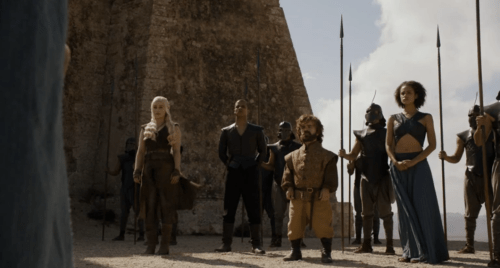
The episode opened with the men working for the slavers (seriously, that word to me looks like slayers with the y having been cut off) loading catapults on their ships, which they are expertly aiming at various sites on Meereen. Meanwhile, inside the pyramid, Tyrion is discussing the state of affairs with Daenerys. When she was taken away, it seemed she had some grumblings happening, but things were mostly under control. Now she comes back and after a few weeks under Tyrion’s control, the place appears to have gone to shit. The thing is, as he explains, it’s like many cases of new leadership. A new leader is nominated to come in and clean up a country’s mess, but when he first comes in, he encounters so many problems he’s suddenly blamed for everything. But it’s not necessarily his fault — it was the previous leader who caused all the problems, and now it’s his job to use his cunning and patience to actually fix them. Daenerys didn’t fix the city’s problems by freeing the slaves, she simply created new ones by angering the masters for destroying their way of life. As he tells her, the rebirth of Meereen is the cause of all the violence. If her way succeeds, it sends a message to all that a city without slavery proves that no one needs a master. And the masters can’t have that little tidbit getting out, now, can they?
tyrion_nervous

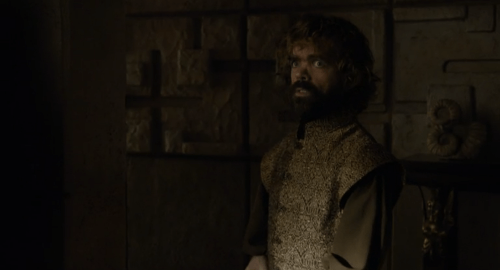
So, Daenerys has a simple solution. She will crucify the slavers, she will destroy their ships, she will go to their cities and burn each one to the ground, and she will win. And so Tyrion must once again stop her and remind her — as he did last season — about who Aerys Targaryen really was. He reminds her that the Mad King had buried wildfire throughout King’s Landing and was planning to set the city on fire, to kill every man, woman, and child in order to get to the few leaders he needed to wipe out. And so Jaime Lannister had to stop him in order to prevent a mass slaughter. If she follows through with her plan, she’ll be no different than the monster her father was, and they need to rise above that.

And so, he says, they need to come up with another plan. Cue the meeting at the top of the pyramid with the three masters Tyrion already spoke to. They tell the slavers they’re here to discuss the terms of surrender. With a smug smile, the masters begin explaining the terms they want Daenerys and Tyrion to follow, before Daenerys cuts them off and apologizes for miscommunicating — what she meant was, they’re here to discuss the terms of the masters’ surrender. Cue faces ranging from shocked to angry to amused. That last one doesn’t last for long.

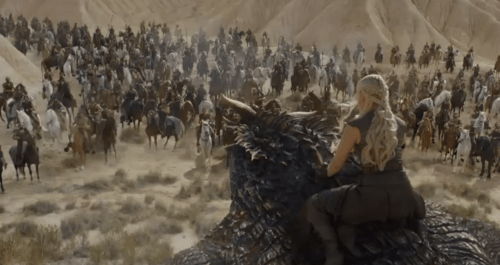
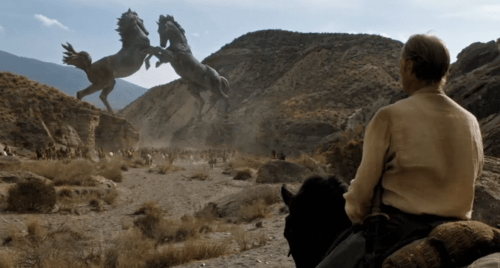
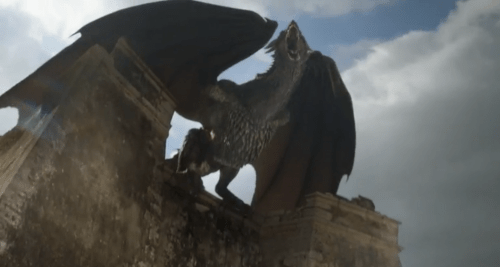
As we all knew would happen, Drogon shows up and Daenerys climbs on his back. Watching him grow for six seasons is totally worth it (well, it was always worth it) just seeing the looks on the masters’ faces when he lands in front of them. She flies off and Viserion and Rhaegal emerge from the chamber where they’ve remained all season despite the fact Tyrion let them go several episodes ago, but perhaps they needed the scream of Drogon to draw them out through the wall of the place. And now that they’re flying for the first time in months, they get to have some playtime, flying around the harbour and burning everything in sight. It’s a beautifully shot scene as Daenerys, stone-faced, leads her children through the skies and orders them to immolate everyone working for the slavers.
drogon_checkmate!

Checkmate, bitches!

Of course, this only takes care of the people on the ships — the Sons of the Harpy are on the ground, getting all stabby with the slaves and Daenerys followers on the ground. Hm… if only Daenerys had someone loyal to her who could handle th—

Cue Dothraki. We can only imagine the fate of the Sons of the Harpy, but I think it’s a safe guarantee that what’s left isn’t gonna be pretty.

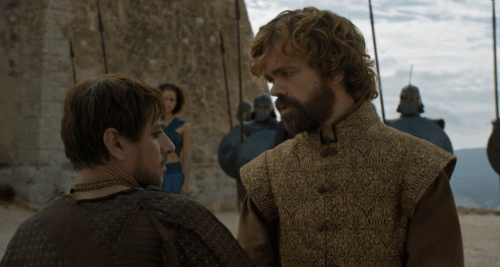
Meanwhile, back up on the pyramid, the masters watch in horror and realize they’ve lost. Tyrion gives them a chance to help him choose one master who will die, and two of them immediately push a third one forward, mentioning he’s low-born and not one of them. As the third one bows and begs for mercy, Grey Worm steps forward and in one motion, slashes the throats of the other two masters. Tyrion steps over to the third one and places a hand on his shoulder. He tells him they will let him go, and he needs to go and find the others, and “remind them what happened when Daenerys Stormborn and her dragons came to Meereen.”
tyrion_slaver

This isn’t just an episode about battles, but about preparation for and strategy within those battles. Daenerys was just going to push headlong into pure destruction before Tyrion calmed her down and explained that there was a better way to handle this, and he was right. We’ll see more scenes in this episode of discussions for what to do in battle, where not everyone will be as open to the proposed strategies as Daenerys was.

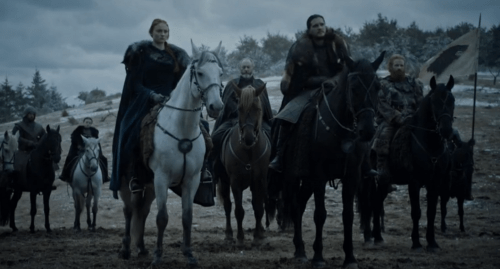
From here we move over to Jon Snow meeting his monstrous brother-in-law for the first time (a scene that included my new favourite character, Lyanna Mormont). What did you think of the initial meeting between the bastards, Chris?
sansa_jon_parley

Christopher: I thought it set a particular theme and tone that ran throughout the episode, which might be best summed up as the sins of the fathers. Bastardy versus trueborn, illegitimate versus legitimate sons, as we’ve seen over the course of six seasons, is a fraught and freighted issue in Westeros. In this respect, GRRM is more indebted to Shakespeare than anyone else: Edmund in King Lear and Falconbridge in King John are two of the most compelling of his creations, both of them attractive villains whose villainy proceeds from a grievance with the universe—and their fathers—that they were born “base,” and therefore ineligible to inherit wealth or titles. “Why bastard? wherefore base? / When my dimensions are as well compact,” Edmund asks, “My mind as generous, and my shape as true, / As honest madam’s issue?” Jon Snow has always nursed resentment that he was the odd one out, but of course has given the lie to the charge of bastardy’s “taint.”

Indeed, he has never been more his father’s son than in this episode, and by the same token neither has Ramsay. Ramsay himself might seem to be an argument for the corruption of the bastard; Roose himself explained his proclivities as its product, but it is hard to make the argument that Ramsay is somehow different in kind from his father, or from his family’s historical fondness for cruelty and torture. Roose rebuked him at the beginning of the season for letting his “habits” occlude his strategic common sense where Sansa was concerned, but it has been obvious from the moment Ramsay murdered him that his cold cunning and ruthlessness has metastasized into Ramsay’s sociopathy. Like Jon, Ramsay is very much his father’s son, bastard or not.

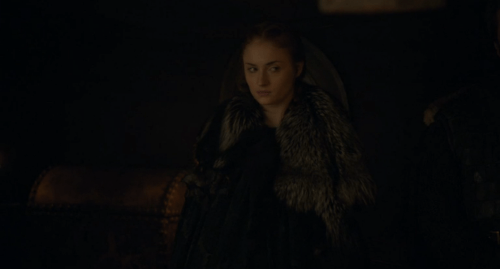
The parley between Jon and Ramsay is itself broadly symbolic of the traits that originally set the narrative rolling way back when: courage versus cunning, honour versus calculation, justice versus ambition. Or to phrase it another way, Stark versus Lannister. In spite of the fact that the former categories have not fared well, in Jon Snow we see their distillation, and that should give us pause. It certainly does for Sansa, who explodes in anger and frustration at Jon when they’re alone. In the preceding war council, both Jon and Davos lay out a sound strategy. Let them come to us. With any luck, anger and confidence will send them charging full tilt. Hold your ground. “They’ve got the numbers,” Davos says. “We need the patience.” He then lays out what has often been a winning strategy for inferior forces: let the center give, and surround them on three sides.

Sansa, however, raises a crucial point that Jon is unwilling, or more likely unable, to grasp: that Ramsay is unpredictable, and whatever Jon thinks he understands about him is simple delusion. Sansa understands him in the most horrible and terrifying ways possible. Jon does not, and cannot.

Jon, however, so completely misunderstands Sansa’s concerns that I want to shake him by his man-bun. “I’ve fought beyond the Wall against worse than Ramsay Bolton,” he retorts. “I’ve defended the Wall from worse than Ramsay Bolton.” Oh, Jon—this isn’t about your honour, courage, or masculine pride. Of course he’s fought worse than Ramsay, at least in terms of scale (defending the Wall), and in terms of the enemy’s implacable malevolence (Hardhome). But in both of these cases, he fought an enemy singular of purpose and uncomplicated in motive—the White Walkers, who seek the destruction of all that is living, and the wildlings, who just wanted to get the fuck away from the White Walkers. It’s worth noting that the only time he’s fought an enemy with nuanced motives, they murdered him.
parley_longshot

Ramsay, by contrast, has no desire or purpose beyond the accrual of power to better facilitate his own pleasure and cruel entertainment. He will play with enemies for the sheer fun of playing with them. Jon is thus as uniquely unfit to deal with Ramsay as his father was with Littlefinger and Cersei Lannister. In this respect, for all his experience with battle, Jon is little better than a naïf beside Sansa, who brings not only her knowledge of Ramsay, but her experience of watching her father executed, her torment at Joffrey’s hands, and her confusing sojourn with Littlefinger at the Eyrie. At this stage in the game, she has the equivalent of a postgraduate degree in power and its abuses, while Jon has yet to pass his GED.

If we were unclear on this point, Sansa’s brutally realistic assessment of Rickon’s life expectancy shows us how much she has learned: “We’ll never get him back. Rickon is Ned Stark’s trueborn son, which makes him a greater threat to Ramsay than you, a bastard, and me, a girl. As long as he lives, Ramsay’s claim to Winterfell will be contested, which means … he won’t live long.” Sansa’s words prove prescient, as it is precisely with Rickon that Ramsay will taunt Jon into abandoning his careful battle plan. Two Starks with one stone, one might say.
sansa_war-council

I thought Sansa was pretty magnificent in this episode, save for one crucial inconsistency. Why has she not told Jon about Littlefinger and the Lords of the Vale? It is understandable that she would have held back that information when she was determined to reject Littlefinger’s help—shortsighted and selfish, perhaps, but understandable considering the hatred she must feel for the man who married her to a monster. Considering that we know she’s sent a raven asking for his help after all, why would she not tell Jon? It’s not as though he’s ecstatic about attacking a force three times the size of his. “No, it’s not enough!” he shouts, a tinge of despair entering his voice. “It’s what we have!” It really makes no sense to withhold this from him, and that one point nagged at me throughout what was otherwise one of this show’s best episodes ever.

But whatever her reason, her heart or her shoes, she refuses to give Jon Littlefinger’s news. Which leads to bleak parting words that hearken back to season four. Sansa avows that she will not go back to Ramsay alive. When Jon promises to protect her, she says bitterly, “No one can protect me. No one can protect anyone.” I don’t know about you, Nikki, but this line made me think of Cersei’s sad reply to Oberyn’s claim that they don’t hurt little girls in Dorne: “Everywhere in the world,” she says, “they hurt little girls.” Jon’s promise is no doubt sincere, but again, she knows more of the world than he does, and he can never understand what she’s been through. He’s been murdered, and he can’t grasp what she’s been through.

She leaves Jon alone in his tent, brooding, and Davos’ question to Tormund gives us a sound bridge over the edit: “So do you think there’s hope?” War makes for strange bedfellows, none stranger than these two. “You loved that cunt Stannis,” Tormund growls, “and I loved the man he burned … I believed in him. I believed he was the man to lead us through the Long Night. But I was wrong, just like you.” Perhaps, Davos counters, believing in kings is the mistake. Between Mance’s failure and the (not literal) demons whispering the Stannis, between Tyrion’s remind to Daenerys about her father’s madness and Daenerys’ acknowledgement that she, Tyrion, and Theon and Yara all had terrible fathers who left the world a worse place … we get a mini-seminar in this episode about the potentially corrosive aspects of power, and how desiring, getting, and possessing it can deform the mind.

And speaking of the demons whispering in Stannis’ skull, our next stop on our Night Before Battle Tour is Jon visiting Melisandre. Before you comment on that, Nikki, I’m curious: when Tormund thought Stannis’ demons were literally real, did you flash to Guardians of the Galaxy and Drax the Destroyer’s inability to understand metaphor? Or was that just me?
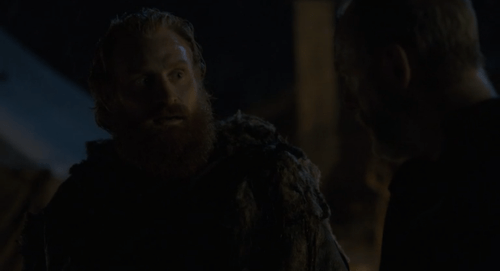
tormund_davos

Nikki: Hahahaha!! Tormund was the BEST in this episode. When Davos says Stannis had demons talking to him, and Tormund says matter-of-factly, “And did you see those demons?” I laughed and laughed. I want to see Davos and Tormund do “Who’s on First” together. Though… I guess then you’d have to explain the concept of baseball to the guy and… yeah, probably wouldn’t be as funny as Abbott and Costello doing it. (Though Abbott and Costello never finished a routine with the punchline, “Happy shitting.”)

And one quick word about Sansa: I could be completely wrong on this one, but my thinking is, Sansa didn’t know Littlefinger was coming until the day of the battle. We saw her send a raven; we never saw her receive one. I’m sure many fans are probably coming down hard on Sansa (though it never occurred to me they would until I just read your thoughts above) but when I watched this episode, I automatically assumed she brought in Littlefinger’s troops the moment they arrived. And leave it to that cock to show up at the last minute after Rickon was already dead. I don’t think Sansa would risk Jon being killed because she wanted to make a dramatic entrance. Petyr? Yes. Sansa? No. I think she was hoping Jon would reconsider the battle, and part of her desperation in begging him to do so is that she hadn’t yet heard back from Baelish.

And why didn’t he RSVP? He received the Facebook invitation saying the battle would be happening on Saturday, and by god he wasn’t going to show up a full night early and have to pay for all of his soldiers to stay at the Best Westeros, so instead he just brought them in the day of, and they showed up a wee bit late. But just in time to stop things from becoming atrocious. Besides, I don’t think I have to go out too far on a limb to assume Baelish is going to want something in return (duh) and that something is Sansa Stark. And since he ALSO wants the North, I would assume he would be quite happy if every other Stark kid died off so Sansa would be the last heir, and he would become king. If Sansa knew he was coming, she would be able to warn Jon to hold off on the beginning of the battle, thus possibly saving Rickon’s life and ensuring Jon wouldn’t die. Baelish ensured the youngest Stark would die and was probably hoping Jon had already been crushed by the time he showed up.

It never occurred to me that Sansa was withholding information — I don’t think she had a clue Baelish was actually coming until he rang her doorbell on Battle Day.

But we’re getting ahead of ourselves here.

Back to the night before the battle, Jon Snow goes to the Red Woman to seek her advice on the battle, but more importantly to ask her not to bring him back if he should die. She tells him it’s not within her control; if the Lord of Light wants her to bring Jon back, she must do it. “What kind of god would do something like that?” Jon asks. “The one we’ve got,” she replies.

Meanwhile, Davos goes on his traditional walk the night before battle, and finds Shireen’s stag. It’s a gut-wrenching moment where you can see the wheels turning in his head, and he turns back to the camp with only one thought: what monster have I brought into this fray? The same one who gave life to Jon Snow and is vowing to follow him to the end took Shireen’s life when she had vowed to follow another. Remember, it was last season’s penultimate episode where Shireen died, so the show took an entire season to bring it full circle. Also, on a purely production note, as Davos stood on the hill with that gorgeous sunrise behind him and the dark, dark sky above, I thought how long did it take them to line up that perfect shot?
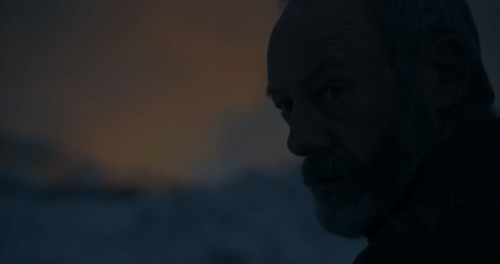
davos_sunrise_closeup

And these two quick scenes bring us back over to Meereen, where Tyrion and Daenerys are meeting with Theon and Yara. As you mentioned, Chris, apparently they took a TARDIS to get there that fast, but hey, let’s give the writers some artistic license. After all, we really can’t rule out that the Doctor may have spent some time in Westeros.

I really loved this scene. Tyrion won’t let Theon get off easily after making the remarks about his height way back in season one. A Lannister might always pay his debts, but it also seems that a Lannister never forgets. He reminds him of some of the ruder things he said about his dwarfism before telling him how unoriginal they are, and topping it off with a, “So how have things been going with you since then?” Ha! I know Theon has been through hell, and he’s actually become a character I quite like, but I despised him in season one as much as Tyrion despises him now, so I understand why Tyrion would have held onto his resentment.

But the far more important connection in this scene was that between Yara and Daenerys. Half girl-power, half flirtiness, the little smiles and knowing looks between the two were priceless. Theon explains that he’s handing rule of the Iron Islands over to his sister because he’s not fit to rule, but she is. Daenerys looks surprised, and asks Yara, “Has the Iron Islands ever had a queen before?” “No more than Westeros,” says Yara, cunningly. And Daenerys gives her quite the sly smile when she says it. Yara and Theon explain that their uncle Euron plans to come to Meereen and give her his cock in the form of a marriage proposal, and if they were to pledge the Iron Islands back to Yara, that wouldn’t happen. “I imagine your offer is free of marriage demands?” asks Daenerys flirtily. “I wouldn’t demand it, but I’m open to anything,” says Yara. And the two queens smile knowingly at each other again.
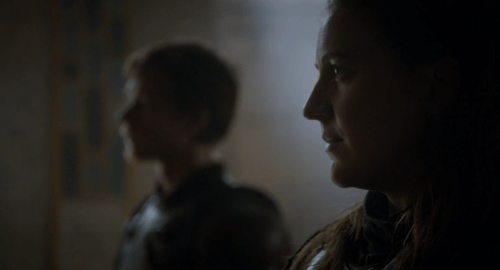
yara

This bit of banter ranked right up there with meeting Lyanna Mormont for the first time.

Daenerys acknowledges that everyone in the room had shitty fathers who were shitty leaders, and that it’s up to the four of them to bring about change in the world. Again, the Father’s Day is about learning to be better than the piece of crap their fathers were. (Now if that doesn’t have the trappings of a Hallmark card, I don’t know what does.) Daenerys steps up to Yara and tells her they have a deal under the condition that the Ironborn can no longer rape, raid, or pillage. “But that’s our way of life,” says Yara, without even the slightest touch of irony. But if she wants to leave the world a better place than her father did, she must change. And with that, Daenerys and Yara grasp hands, and the Daenyara/Yarnerys ship is born.

Before we get to the play-by-play of the final battle, were you as thrilled with this scene as I was, Chris?
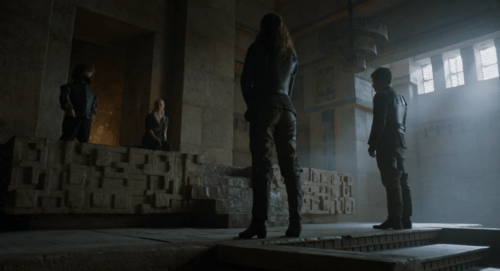
daenerys_greyjoys_low-angle

Christopher: I thoroughly enjoyed it, TARDIS and/or jet-powered longships notwithstanding. I was particularly pleased that Daenerys seems to be learning. At least, that is what I took from her willingness to grant the Iron Islands a measure of self-determination in exchange for Yara’s loyalty. She corrects Tyrion when he voices his concern that other regions might demand their independence as well, saying, “She’s not demanding, she’s asking. The others are free to ask as well.” It’s early days, of course, but Daenerys appears to be thinking in terms of alternative political models—perhaps this is part of what she had in mind when she spoke of “breaking the wheel.”

Which brings us to the final battle, which is easily the most spectacular and well-shot of the entire series. And, unsurprisingly, the most expensive—between the dragons routing the slavers’ fleet and the Battle of the Bastards, this episode cost around $10 million to make, the most the show has spent to date. It was money well spent, especially in the latter battle. While the fight for Meereen was necessarily CGI-heavy, for the Jon and Ramsay throw-down, the director (Miguel Sapochnik, who last season gave us “Hardhome”), went a much more Lord of the Rings direction, eschewing the CGI for a far more tactile depiction, employing a legion of extras rather than an army of computer animators. CGI was of course employed, but it is far harder to see where it ends and real people begin than at any other point in the series so far. Though the battle took twenty-four days to shoot, it pays off in one of the dirtiest, bloodiest, and most realistic battles I’ve seen outside of the beginning of Gladiator.

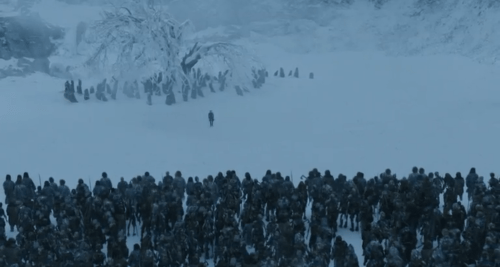
It actually has a bit of the Gladiator feel to it, especially in the opening moments when we see the serried ranks of the forces facing them across the field, as Jon Snow walks his horse to the front. Jon, alas, is no Maximus however, and this battle demonstrates the truth of Ygritte’s repeated charge: he really does know nothing.
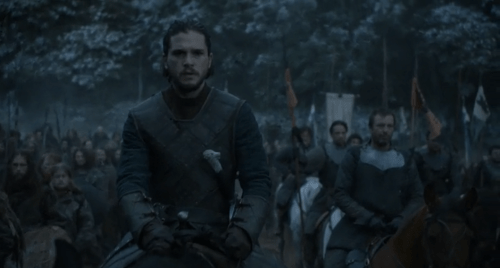
jon_command

Before getting into a discussion of Jon’s rash stupidity and respond to your thoughts on Sansa’s silence about the Vale knights, Nikki, I just want to point out something that should have been obvious to me but wasn’t until I happened across this article. Namely, this is the first time Game of Thrones has treated us to a proper set-piece battle. By that I mean a battle in which opposing forces draw themselves up on opposite sides of a battlefield and close on one another, with the various stages of the battle itself shown in some detail. All of the other battles we’ve seen on Game of Thrones have been sieges and/or assaults on fortresses, such as the Battle of Blackwater or the wildlings’ attack on the Wall; ambushes or routs, like Stannis’ attack on the wildling or his defeat by the Boltons; or small but bloody skirmishes, like Jon’s attack on Craster’s Keep. In fact, the show has done a scrupulous job of keeping all of the other set-piece battle off-screen, usually just showing us the aftermath—perhaps most notably in season one, when Tyrion gets knocked out just as the Lannister army is about to take on the Starks, and he wakes up afterward.

This reluctance to depict large-scale battles in all their brutal glory is understandable. Such spectacles are extremely expensive to shoot, as this episode’s price-tag attests, and can too often end up being underwhelming when not done well (the Battle of Phillipi in season two of Rome comes to mind).

But they got this one right, from start to finish, and as the article I mentioned above points out, it demonstrates a solid grasp of historical military tactics, to the point where the original conception was based on the Battle of Agincourt, with Jon &co. playing the part of the beleaguered English. Though this idea had to be abandoned because of the ever-niggling question of budgets, the prominence of longbows as a crucial weapon lingers on in the thick flights of arrows punctuating the battle.

In fact, never mind Gladiator. It occurs to me just now that this battle’s closest filmic cousin is Kenny B’s Henry V.

The difference of course being that Henry V was not a raging idiot, and was not goaded into a suicidal charge by the Dauphin.

Oh, Jon Snow. You really do know nothing. I wrote in my notes “LISTEN TO SANSA!” as soon as Rickon appeared at the end of Ramsay’s rope. There’s that moment of tension as he raises his dagger over Rickon’s head, but it’s only tense for the characters in the scene and anyone who, for whatever reason, just started watching Game of Thrones with this episode—all the rest of us know that Ramsay’s not going to make things so simple.

And Jon, not unpredictably, falls for it. Sigh. As I said, he is his father’s son. Can we imagine a scenario in which Ned Stark would stand still when a loved one is in danger? Sansa’s dire prediction about Rickon is realized the moment we see him at the end of that rope. The one chance Rickon had of surviving, we realize, was to have been left moldering in the Winterfell dungeon by an overconfident Ramsay.
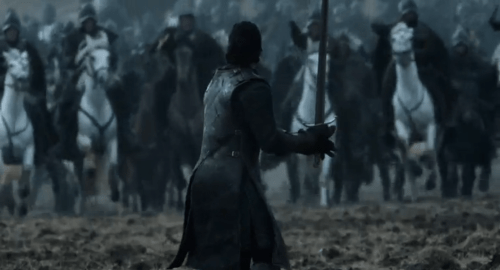
jon_alone

Well … shit.

Again, this battle proves to be a distillation of Jon and Ramsay’s characters. Jon is honourable and brave to a fault; Ramsay is cruelly cunning, but also cowardly. He remains comfortably ensconced in his rearguard, from which vantage he can enjoy watching the blood and brutality of the battle. And his weapon of choice throughout this episode is the longbow, which symbolizes both his precision and unwillingness to close the distance between himself and his foe. It is worth remembering that among our first encounters with Ramsay were his “hunting” escapades, when he and the late unlamented Miranda shot fugitives like deer.

By contrast, none can fault Jon for his courage—nor for his skill. While he seems to have a preternatural capacity for avoiding arrows, he is in the thick of the battle from the start. When we’re on the ground and in the midst of the blood and mud, here the filmic analogue is more Saving Private Ryan than anything else. The chaos and confusion is visceral, and Jon’s struggle to escape the press of bodies was not good for my claustrophobia. The sequence did a fine job of shifting between shots establishing the overall shape and geography of the battle, and the ground-level anarchy of the melee.

Before handing it back to you, Nikki, I just want to say another word or three on Sansa’s recalcitrance, re: Littlefinger and the Vale knights. Considering just the story in and of itself, it seems likely that yes, Sansa did not want to say anything because she didn’t know if (a) her message would bring allies, or (b) her message was received at all. But that still makes no sense, mainly because this is no longer the naïve Sansa of season one. Which is why in this case I have to step outside of the story itself and just say that this was bad writing. I understand the need to bring things to a keen dramatic pitch, but in a season that has over-relied on deus ex machinas anyway, this was just hamfisted … especially when there was a way to have the Vale cavalry ride to the rescue and keep Sansa’s behavior consistent. Basically, the arrival of the Vale forces could have been revealed as something orchestrated by Jon and Sansa. If they’d had their fierce argument about the paucity of their forces just one episode ago rather than at the eleventh hour—perhaps ending with Sansa saying something like “There is one possibility …”—we could have had the Vale cavalry summoned by a signal from Davos after Ramsay committed all his men. In this scenario, the battle would have been won by strategy rather than mere chance, it would have been consistent with both Sansa’s character and, well, LOGIC, and it wouldn’t have been yet another deus ex machina but a clever tactical coup.

End rant. Thoughts?
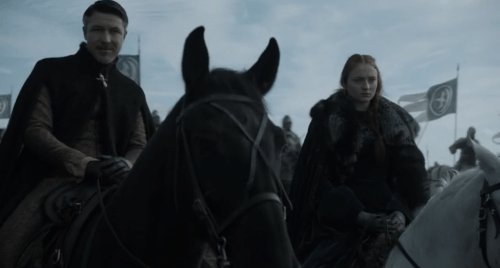
littlefinger_sansa

Nikki: I so agree with you on the Gladiator comparison, and Branagh’s Henry V. I kept expecting to hear the soaring music from Gladiator in this scene (and while we didn’t get it, the score was gorgeous, and kept our hearts pounding throughout the sequence). I’m going to stand my ground that Sansa didn’t know Littlefinger was coming, and yes, she could have mentioned something about having sent the raven, and that in itself was a mistake not to have said something (even Brienne commented on that) but I don’t believe she knew he was coming. I, of course, could be proven 100% incorrect on this in the next episode and if so I’ll admit my mistake, but for now, I’m going to say that one of the themes of this episode was about leaders and advisors. Daenerys wanted to go in headlong and kill them all, but when Tyrion suggested an alternative, she listened to him. Jon Snow wanted to go in headlong and kill them all, but when Sansa suggested an alternative… he disagreed with her. As you pointed out, he believes he knows battle, and as much as he loves Sansa, she’s a girl. What does she know? Daenerys easily and handily wins her battle. And while Jon Snow ultimately wins his, it’s at a very grave cost, and only after Sansa saves them from annihilation at what I’m going to continue to contend was an 11½th hour arrival by Baelish.

But you’re right, Chris, in evoking the modern-day war imagery in what Jon Snow goes through on the ground. We always get the sweeping overviews in these medieval battles, with men on horses and men with arrows and swords. But in WWII epics we get the men in the trenches, in the mud, covered in the blood spatter of their victims while trying not to sink in the muck that surrounds them. This episode featured both.

And I’m going to take this opportunity to announce that my husband has NO FAITH in Jon Snow whatsoever. After Rickon met his horrible and inevitable death at the hands of Ramsay (my notes are just a frantic scribbling of ZIG ZAG… DAMN YOU, ZIG ZAG!!! Isn’t that how you outrun an alligator? Wouldn’t it have worked to throw off Ramsay? Sob…), Ramsay unleashed his army and they went headlong at Jon. “Well, that’s the end of Jon Snow,” said my husband. “No it’s not,” I replied, with an “are you effing KIDDING me?!” tone to my voice. “He doesn’t stand a chance, that’s the end of him,” he persisted.
jon_crushed

So I guess they had SOME viewers convinced he was going to die. I wasn’t one of them. From a purely writerly standpoint, it doesn’t make sense to bring him back to life, wander around the north for a few episodes, and then kill the guy again. That would be terrible writing, and then what? Just bring the dude back to life again? Even I would consider giving up the show if they pulled a stunt like that. That said, this scene was BRILLIANTLY filmed, where you don’t see Jon’s army at all, and when they come it’s an utter shock. Just beautiful. I can’t remember seeing anything like that in any other show. And then the choreography of Jon Snow dodging the horses and swords as he spins throughout the chaos — incredible. Yes, yes, I have no doubt it was green screened but I don’t care. Short of having Lyanna suddenly ride in with a Xena yell and kill them all with her superpower sonic hand cannons, this was everything I could have hoped for in the scene.

The episode didn’t back down on the gore, as you said, Chris. The pile of bodies that form a human death wall is enormous (and I couldn’t help but think, man, whoever ends up taking Winterfell in the end is going to have to deal with one hell of a stench in a day or two) and Jon ends up falling beside a horse just on the edge of the body wall. As the men use him to climb over, not realizing he’s not a dead body, he begins to roll under the actual dead bodies, quickly buried (once again my husband figured this was it for the bastard), and one can see how easily something like this could happen in battle. How often throughout history have men died in battle, not from a gunshot wound or an arrow or a sword, but simply being buried under the dead bodies of their fellow men? The idea is horrific.

And then Smalljon Umber’s men come flying down the hill, and for one brief hopeful moment I thought they were going to turn traitor, and actually mow down Ramsay’s men in fealty to House Stark. Sadly, that wasn’t the case, and his men suddenly make the death tally in Snow’s column rise even more quickly than before.

But before Snow can be completely suffocated, he manages to pull himself free, and uses the shoulders of his comrades to pull himself up on top of them. But by this point, Ramsay’s men have surrounded them with shields, and are pushing inward, bit by bit, until they’re being crushed like people in the front row at a Morrissey concert. At this point, I’m yelling, “STOMP THEM, WUN WUN!! STOMP THEM!!” But our poor last giant on earth is being slowed down by the vast number of swords that are hitting him. And then Sansa shows up with Baelish’s men, and they make mincemeat of Ramsay’s men. Or, in the case of Tormund, he, like, eats one of their faces. AAAHHH!!
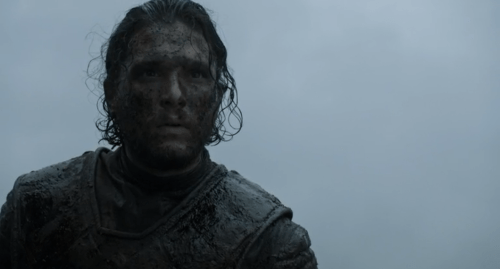
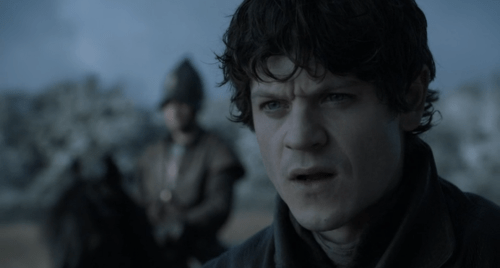
jon_muddy

ramsay_uh-ohAnd just as you said, Chris, what happens next? Ramsay turns and runs as fast as he can in the opposite direction, because he’s a coward. And Jon—who is the opposite of a coward— is in hot pursuit, along with Wun Wun and Tormund. I just want to pause here and say that this season has not been kind to the giants of the show, whether literal (Wun Wun) or gentle (Hodor). And in both cases, a door is involved right before they die. Hodor dies holding the door, and Wun Wun dies opening it. There was a part of me that wondered if this might have been a merciful end to the creature; after all, there are no other giants alive besides him, if the legends can be believed, and therefore he is alone. He doesn’t sit around campfires gabbing with the Free Folk; he sits apart. They only want him for battles, where he can take out 15 men in the time it takes them to kill one. Otherwise, I imagine he’s pretty alone. But it’s because of him that everything that happens next, happens.

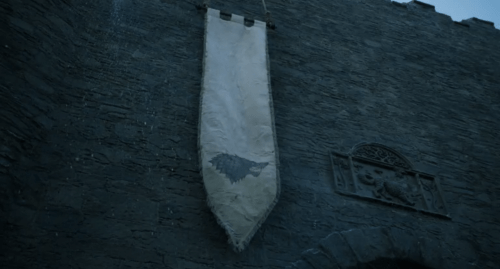
And I will leave you to break down what happens next, and the very end of the episode, Chris. My last words on this episode are twofold: when the direwolf banner unfurled along the wall of Winterfell, I thought I was going to weep tears of joy. What a beautiful thing, even if at such a cost. And secondly, I think someone got off easy at the end—they could have funded the next 10 years of Winterfell upkeep just selling tickets for people to come and take one thwack at him like a pinata.

Chris, take us through the rest of it.
stark_banner

Christopher: The simple image of the Stark banner is perhaps the most poignant visual in this episode, much more so than that of Daenerys’ dragons burning the slavers’ fleet—precisely because of what it cost. By the same token, the retaking of Winterfell is far less triumphal than Daenerys’ victory. Her victory was quite literally unequivocal, both in terms of how completely she crushed the slavers, and also because (whatever Tyrion’s mitigating influence) it came without compromise. Indeed, Daenerys returned to Meereen more powerful than ever, as the Sons of the Harpy learned when the khalasar came thundering around the corner.

However many problems she had in ruling Meereen, Daenerys nevertheless comprises a sort of revolutionary ideal, or, perhaps more accurately, an idealized revolutionary. Breaker of chains, freer of slaves, she is an unequivocal saviour and hero.
aftermath_winterfell

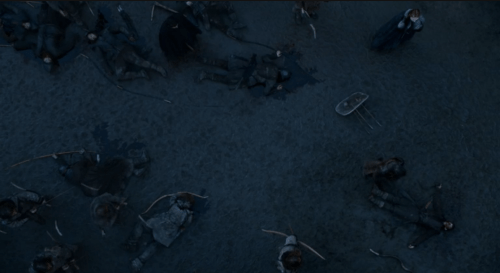
By contrast, Winterfell represents the accrual of blood and pain and sacrifice that comes with war. The Starks limp into Winterfell battered and nearly broken. The defeat of Ramsay came at a staggering cost, and everyone is somehow compromised. Winterfell is Sansa’s home, yet it will also always be the site of her rape and systematic brutalization at Ramsay’s hands. For all they know, Jon and Sansa are the last of the Stark children. Rickon was killed. Robb and Catelyn were murdered by the people who took Winterfell from them. Jon came within a hairsbreadth of losing everything. The last of the giants gave his life for people who, a mere year ago, would have happily seen him dead. Davos looks with loathing at Melisandre, who he now knows was Shireen’s murderer. And lest we forget, victory came at the cost of Sansa putting her trust in the man who handed her over to Ramsay to start with. We don’t know what the cost of that compromise will be—what will Littlefinger name as his price?
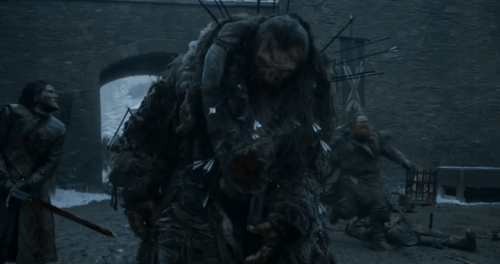
wunwun_arrows

That being said, it is not as though the final moments of this episode, from the appearance of the Arryn forces to Ramsay’s ultimate demise, don’t possess a significant number of deeply satisfying elements. Ramsay’s face as the scope of his defeat dawns on him was definitely worth the price of admission; ditto for Jon advancing implacably through his hail of arrows to beat him bloody. And of course his final fate. A few episodes ago, a friend and I started gaming out the Ramsay Death Odds, figuring that there was a reasonably good chance he wouldn’t make it out of this season alive. Given that most of the big bads’ deaths have been at the very least ironically appropriate, I put Sansa killing him at 2:1, and being eaten by his own hounds at even money.

How about that? Called it! As big bads’ deaths go, I rate it Five Tywins On The Shitter.

The final scene was a testament both to Sansa’s evolution as a character, and the quiet strength and dignity Sophie Turner brings to her. She remains silent as Ramsay speaks, until he says “You can’t kill me. I’m part of you now.” His words reflect his particularly pernicious species of evil, which is not merely his penchant for cruelty and torture, but his need to break people, as he did in turning Theon into Reek. It was obvious he had similar plans for Sansa. When she stands outside his cell, with the guttering torches in the background and snowflakes drifting by, it is a visual callback to last season and the shot of her through the cross-hatched casement window as she prepares for her wedding. Though she still carries the trauma of that night and the many that followed, she has survived. The shot through the window turned her tower into a figurative prison cell, but now she looks in on Ramsay in his literal one. The tableau could only have been improved by letting Ramsay know that, as they speak, Theon is on the other side of the world, bargaining with a queen to win his sister a throne.
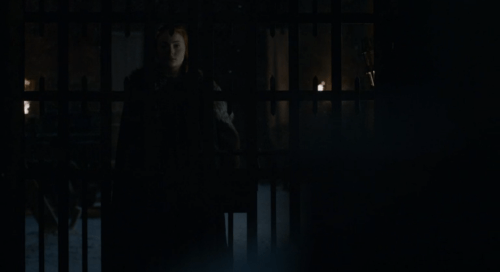
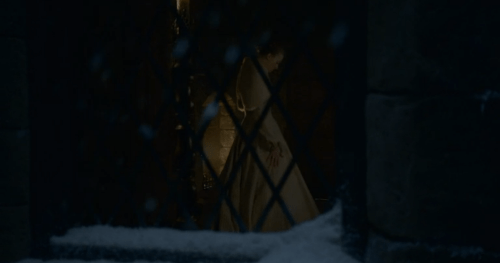
sansa_cell_full

sansa_tower

“Your words will disappear,” Sansa tells him. “Your house will disappear. Your name will disappear. All memory of you will disappear.” As she speaks, the camera pans down Ramsay’s battered profile, until we see the hound framed in the open door beside him. “They’re loyal beasts,” Ramsay protests. “They were,” she corrects him. “Now they’re starving.”

As I tweeted after watching this episode: to quote Buffy Summers, as justice goes it is not unpoetic.
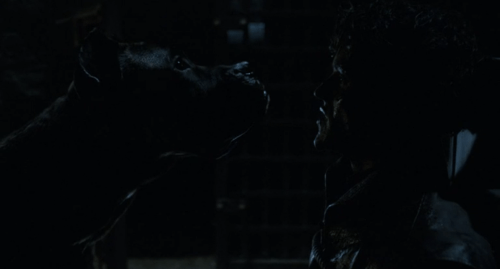
ramsay_hound

Well, that’s it for now. Join us next week as we wrap up yet another season of Game of Thrones. Thanks for reading, and remember: it’s never a good idea to starve your pets for a week. Not hounds, and especially not dragons.
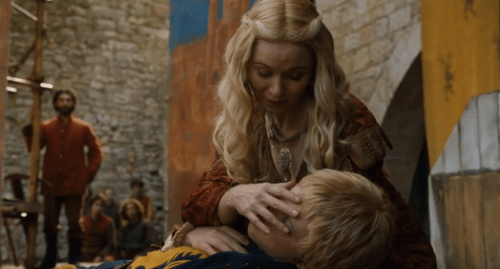
3 Comments

Filed under Game of Thrones, television

Game of Thrones 6.08: No One

gameofthrones_teaser02_screencap10

Hello, friends—it is that time again, when Nikki and I recap, review, interrogate, analyze, and generally pontificate over the latest episode of Game of Thrones. Can you believe that this was episode eight? That we have only two more episodes to go this season before Nikki and I are again frozen in carbonite until next year, when we’ll be thawed for season seven?

At any rate, this week we saw the Hound go on a rampage, Varys depart for mysterious reasons, Cersei being mildly impious, the happy reunion of Jaime and Brienne, a Daenerys ex machina, and Arya’s best impression of the film Face/Off. Excelsior!

lady_crane

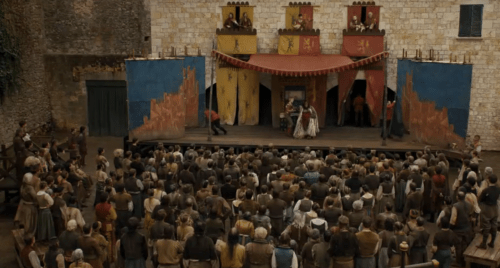
Christopher: We begin with yet another theatrical retread of the Purple Wedding, this time focusing on Lady Crane’s portrayal of Cersei’s grief over Joffrey’s death. Much of what we have seen of this play has been broad and crude, with a reliance on fart jokes and highly stylized acting, and a great deal of mugging for the audience. But “Cersei’s” speech is much closer of what modern audiences expect of a stage play: though the speech is written in verse, and declamatory in delivery, Lady Crane nevertheless brings a measure of naturalism to her performance that conveys a palpable sense of grief and brings much of the audience to tears.

The fact that we have now seen segments of this play several times develops several themes, not least of which is a greater sense of how the events in Kings Landing have developed into a narrative divorced from historical reality. The first time we watched the play along with Arya, we felt the profound disconnect: between the play’s presentation of an oafish Ned, murderous Tyrion, noble Joffrey, and maligned Cersei, and our own experience as audience to the “actual” events. There was ironic humour to be found in just how wrong the play gets things, but we were also given pause by the parallel between the play’s broken-telephone storytelling and the truth of Ned’s fight with Ser Arthur Dayne, as witnessed by Bran. And this moment, where Lady Crane channels Cersei’s grief at her son’s death, reminds us of how powerful truths can emerge from fabulation and fiction.

audience_crying

Cersei did not, of course, deliver a moving speech over Joffrey’s body. She was, in fact, all but inarticulate until she started hurling accusations at Tyrion. But her grief was real, and in this moment of stage acting, Lady Crane communicates a mother’s grief well enough to move an audience; and I cannot speak for anyone but myself, but I was impressed with her performance-within-a-performance, not least because it evoked one of Cersei’s few redeeming features. We might laugh when the Queen of Thorns muses about whether or not Cersei is in fact the worst person ever, but we cannot doubt the love she has for her children.

As it turns out, Lady Crane’s eulogy for “Joffrey” effectively sets the key theme for this episode. Coming away from it, I reflected that the title is a red herring: Arya’s erstwhile process of becoming “No One” was all about divesting herself of worldly attachments, of leaving behind name, family, loves and hates, and (apparently) any sense of morality or ethics. But this episode is very much about such attachments, the way in which individuals’ attachments to their very personal wants and needs—whether they be about love of another, the desire for vengeance, a sense of honour, hatred or grievance—drive the affairs of state. Jaime will do anything to get back to Cersei; the Hound thirsts for vengeance, and damn all who stand in his way; the Blackfish will not sacrifice his ancestral home to aid his niece; Brienne will fight Jaime if need be, in order to remain true to her oath to Sansa.

And Arya will desert the Faceless Men at her own peril, to embrace her name and her idiosyncratic sense of self.

I kind of love the fact that, in fleeing the Faceless Men, Arya finds her way to the theatre troupe as a way-station, and that Lady Crane ends up being her saviour, after a fashion. The show has used the theatre and the play (and the players) to good thematic effect this season, not just in terms of highlighting the role played by story and narrative, but also as an interesting parallel to Arya’s apprenticeship with the Faceless Men. The role of an actor is not to become “no one” per se, but to dissolve one’s ego into a role; hence, the best actors are often those who can be literally unrecognizable when playing a part. Acting mimics the way in which the Faceless Men go about their business, and so when Lady Crane tells Arya, “I’ve got a feeling you’d be good at this sort of work,” we’re a little obliged to nod in agreement. (Just as an aside, she adds that they’ll be needing a new actress, as she did something horrible to Bianca; were Arya to join them, would she end up playing Sansa? Weird to think about).

So Arya’s safe—for the moment—and falls asleep in Lady Crane’s care. But on the other side of the sea, the man she left for dead begins his <Archer voice>RAMPAAAAAAGE!</Archer voice>. What did you think of the Hound once again embracing a wee bit of the ultra-violence, Nikki?


Nikki: You hit the nail on the head with that introduction, Chris. People commented back near the beginning of this season that the episode on Mother’s Day felt like it had been written for Mother’s Day, but to me, this episode spoke even more to that. The best shows, in my mind — Buffy, Angel, Lost, Babylon 5, Breaking Bad, The Sopranos, Six Feet Under, just to name a few — use plot as a device to convey the deep connections people have to one another, and the sacrifices they are willing to make for those people. Interesting that it was Arya who told Lady Crane to change those words in the opening, and it was only on relying on her imagination of Cersei’s connection to Joffrey — connection being the very thing Arya was supposed to divest herself of — that Crane turns the Punch and Judy show into emotional theatre.

But then we have the Hound, the first of the Clegane brothers who has a very busy day this week. Yeesh, I don’t know what Mama Clegane fed these boys for breakfast, but man… As we see the four men sitting and talking like drunken high schoolers, in the background you can see the Hound coming up on them quickly with the axe in his hand, already swinging, and it’s equal parts thrilling and terrifying to watch. He cuts down the first two in no time, before taking out the third and finally burying the axe in the single most painful place one can imagine (I’m a woman, and it still had me crossing my legs and squealing in imagined pain). And before he finishes him off, he allows the man a final word. And when the guy fails at that, Sandor gives him another chance at a final word. And when even that comes from the Al Swearengen Big Book of Final Words, Sandor gives up, kills him with one blow and says, “You’re shit at dying, you know that?”

hound_rampage

Oh, how I’ve missed the Hound.

Meanwhile, over in Meereen, Tyrion is patting himself on the back for welcoming the Lord of Light acolytes into Meereen and bringing peace to all. “You made a pact with fanatics,” says Varys. “And it worked,” Tyrion replies.

“Yeah, that’s what your sister said, too,” says all of the viewers at home. Varys tells Tyrion that he’s heading off on a secret mission, but that he’ll return soon. But in order to do so he needs to take leave of Tyrion, because his mission won’t be so secret if he’s seen being accompanied by the most famous dwarf in the city. Tyrion corrects him — “the most famous dwarf in the world” — and in doing so, made me realize that Dinklage himself might actually hold that honour.

And speaking of Lannisters who allowed religious fanatics into the city and perhaps later regretted it, we’re off to the Red Keep with Cersei and that other Clegane brother who’s come back from the dead. What did you think of the Mountain v. Sparrows death match, Chris?

cersei_mountain_qyburn

Christopher: As I mentioned last week, something that Game of Thrones is quite good at doing is tweaking the audience’s hierarchy of hatred. Cersei for a long time was one of the bad guys (and in some ways still very much is), and of course we hate the Mountain for crushing Oberyn’s head like a melon—to say nothing of the fact that we’re really creeped out by Frankenmountain. But for many, many episodes now, the Sparrows have been infuriatingly untouchable, and the High Sparrow too smug by half. So when Cersei forces a confrontation and chooses violence, there is a certain guilty satisfaction to it, especially considering that Margaery’s gambit denied us the viewing pleasure of watching the Tyrell soldiers storm the sept.

There is, however, a certain amount of pathos to the scene, as we’re all too aware that Tommen has ceded yet more ground to the High Sparrow, and that with every yard he yields, it takes him that much farther out of Cersei’s orbit and influence. For a scene that ended so bloodily, it began with great stillness: Cersei sitting alone at a table with her back to the door, her ever-present glass of wine at her elbow. The news that members of the Faith Militant have entered the Red Keep means, as Cersei divines, that Tommen continues to allow the High Sparrow to dictate to him. The Red Keep, after all, is the seat of the Crown in King’s Landing: Tommen allowing the Sparrows to enter is a surrender of sovereignty, and the High Sparrow’s newfound arrogance in summoning Cersei speaks to his worrisome influence over the king.

That new influence is not lost on Cersei, nor is the knowledge that if she leaves the Red Keep and enters the Sept of Baelor, she surrenders what little protection she has left. “I choose violence,” she says, but she hasn’t actually been left much of a choice—and backing Cersei into a corner isn’t precisely the wisest of courses, as one poor (now headless) Sparrow learns.

lancel_uh-oh

“Uh-oh.”

I do hope her moment of smug satisfaction as she watches the Sparrow’s blood run into the drain was worth it. “Please tell his High Holiness he’s always welcome to visit,” she adds as a parting shot in classic Cersei fashion, but her defiance looks to have some negative consequences. Arriving at a royal announcement for which she was apparently left off the email list, she has to suffer the dual humiliation of being relegated to the gallery “with the other ladies of the court,” and seeing the loathed Grand Maester Pycelle whispering in her son’s ear. And then the boom comes down: after consulting with the High Sparrow, Tommen has decided to outlaw trial by combat … Cersei’s one ace in the hole, the means by which she was to avoid the humiliation of being found guilty, by unleashing the Frankenmountain on whatever hapless knight they send against her.

But no more … and the pathos of the earlier tableau is deepened as we watch Cersei watch her son depart the throne room, unable to make eye contact, unable to reach him any longer. All she has left now is the Frankenmountain … and Qyburn, who cryptically tells her that the “rumour” she had mentioned to him was something much more than just a rumour. Is this her new ace in the hole? One of the things I like about this season being off book is that I honestly have no idea. It will be interesting to see what Qyburn has up his voluminous sleeves.

brienne_pod

The Cersei scenes are juxtaposed with Brienne’s arrival at the Lannister camp, and her tete-a-tete with Jaime. The serried rows of red tents are not what she had expected or hoped for. “Looks like a siege, m’lady,” observes Podrik. “You have a keen military mind, Pod,” Brienne replies sardonically, as she scans the camp and espies Jaime. This much is a boon: one imagines that if they had arrived before the Lannisters invested the castle, the Freys would not have been very welcoming. She sends word down, and is cordially received, leaving Pod outside to be tormented by Bronn.

This was one of those moments from the trailer for this season that looked more threatening than it was: Pod suddenly grabbed from behind, which had some fans speculating that he might be joining the ranks of the GoT dead. But no … just Bronn, having a bit of fun, and reminding us that, once upon a time, they had both been in the service of Tyrion.

“I never thought you’d find her,” we hear Jaime say while Bronn coaches Pod in the art of dirty fighting. “I just assumed Sansa was dead.” In answer to Brienne’s incredulity about the question, he shrugs, “In my experience, girls like her don’t live that long.” Brienne’s observation—“I don’t think you know many girls like her”—is quite possibly my favourite line from this episode. It is freighted with everything we have seen Sansa endure, and Gwendoline Christie delivers it with a deadpan gravity that similarly articulates both Sansa’s hard-won resilience and Brienne’s respect, admiration, and devotion to her.

brienne_jaime

Despite the fraught situation without Jaime’s tent, this reunion is a guardedly happy one—though Jaime reminds us that nothing is simple, given that Cersei still wants Sansa’s head on a pike in the belief that she was complicit in Joffrey’s death. But Jaime is not Cersei, and he is quite open to being reasonable. Hence he agrees to Brienne’s proposal that, if she can convince the Blackfish, he will allow the Tully army to march north unmolested to join Jon Snow’s forces.

Oh, what a beautiful dream … how perfect would it have been for everything to have fallen out precisely that way? Jon would get the men he needs, the Tullys would avoid bloodshed, Jaime would fulfill his mission. But as I said in my opening comments, the movement of the pieces on the board are far more subject to the vicissitudes of personal passions, attachments, and desires. The Blackfish will not be moved, not even by the words of his grand-niece who has, as he says, become very much like her mother. “Find a maester,” Brienne tells Pod. “We need to get a raven north to Sansa.” With what message? he asks. “Tell her I failed.”

Not all matters of state are quite so weighty, however … what did you think of Tyrion’s efforts to get Grey Worm and Missandei to drink and tell jokes, Nikki?

tyrion_jokes

Nikki: Poor Tyrion, stuck with the two unfunniest people in Westeros. I couldn’t help but think, I don’t drink, but I think I’ve been to this party. (And I might have been Missandei in that situation…) Like Missandei, I’m a teetotaler, mostly because wine makes me feel funny, and unlike 99% of the population, I don’t like the funny feeling. But according to Tyrion, “That’s how you know it’s working.”
We’ve always looked to Tyrion as the voice of reason and intelligence on the show, the man who, though small in stature, often stands above everyone. And yet it’s in moments like this one we’re reminded he’s the family joke not just because of his size, but because he long ago turned to prostitutes and alcohol as a way to dull the pain of being emotionally abandoned by his father and loathed by his sister, of being the one whose very birth caused the death of his own mother. He has a weakness, and he gives into it time and time again. While he possesses a mind that could win the Iron Throne, he instead dreams of one day having a wine called “The Imp’s Delight” that he would give only to his friends. And once Grey Worm rejects the wine — “it tastes like it’s turned” — and Missandei discovers that the red stuff isn’t so bad after all, Tyrion settles in and asks them both to tell him a joke. So Missandei tries her hand at it, and it’s surprisingly humorous. Grey Worm one-ups her by telling her it’s the worst joke he’s ever heard… and then has to explain the punchline that it’s the only joke he’s ever heard, having been a member of the Unsullied, where jokes are few.

It’s all fun and games until someone screams, and when that happens, Grey Worm runs from the room to find out what’s going on. These scene stands in stark contrast to when we’ll return to this group, where Tyrion — the leader, who urges them to give in to his favourite pastimes — shows that his political cunning isn’t so hot after all, and it’s the terrible joke-tellers who end up taking over and leading them all.

edmure_torch

But now back over to Riverrun, where Jaime and Edmure have a chat inside the tent where Eddie is being kept prisoner. I was glad they had a lengthy Tobias Menzies scene; Menzies has become quite a sought-after British actor, and Game of Thrones nabbed him relatively early, so I wondered if we were just going to get quick scenes with him. But the scene between Jaime and Edmure is excellent, and ties in to what you talked about in your opening, Chris. Edmure might be ineffectual as a Tully, as a fighter, even as a man, but despite only being his with his wife for a single night, he cares for her, and the baby that their single night of lovemaking produced. Jaime comes into the tent and acts sympathetic towards Edmure, telling him that he’ll make sure he’s made more comfortable. But Edmure’s having none of it. “Do you understand you’re an evil man?” he asks Jaime. Jaime is smug and aloof throughout this scene, but despite the humour of last week’s fake-out throat-cutting scene, Edmure has been tortured for the past three years while other events have been playing out. His wedding ended with the murder of his sister, nephew, and nephew’s wife and unborn child. He thought he was marrying a rare beauty, only to have her snatched from him as he was thrown into prison. And it was all due to the Lannisters and Boltons aligning with the Freys to get back at the Starks. He asks Jaime how he lives with himself, how he tells himself he’s a decent man.

Jaime tells Edmure that he was once imprisoned by Catelyn, who hit him with a rock. He says that she hated him, but he admired her because she’s a mother, and everything she did was for her children, whom she adored more than anything. And in Catelyn he saw the same devotion he’d always known of his sister, Cersei, who, as you pointed out earlier, Chris, and as we’ve discussed many times in these posts, is unfailingly devoted to her children. She would do anything for them. Lady Crane’s portrayal of Cersei at the outset of this episode was truthful in her devotion to Joffrey, and we know the pain with which she endured the death of Myrcella. Now we’re seeing Tommen going down a rocky path, and the internal struggle Cersei is going through — will she end up betraying the only child she has left? How will she get out of this one?

But it’s in that devotion to one’s children that Jaime comes at Edmure. He knows that Edmure cares about the child he’s never seen, and by mentioning his anger that he’s never gotten to see his son, Edmure accidentally shows his hand. Jaime has also lost his children, and he has one left, but there’s only one person he’s ever been 100% devoted to, and that’s Cersei. And as he says to Edmure, he will slaughter every Tully who ever lived to get back to her, if that’s what he has to do. He threatens Edmure’s child, saying he will strap the baby to a catapult and launch it into Riverrun just to get the Blackfish’s attention. He doesn’t care about filial ties—all he cares about is Cersei.

And that’s when he gives Edmure an offer he can’t refuse. What did you think of Edmure going to the gates as the Lord of Riverrun, Chris? Was that something that was in the books?

blackfish

Christopher: That was indeed something that happened in A Feast for Crows—right down to the threat to launch Edmure’s child from a catapult. I was wondering how they meant to play this, whether they would sync this narrative up with the novels, or make another departure.

And, well, they’ve mostly been faithful to the text here: Edmure was indeed responsible for negotiating the surrender of Riverrun, though it did not proceed as it does in this episode. Edmure orders the castle’s surrender, but arranges for the Blackfish to make his escape by swimming down the river—something that angers Jaime, as the Blackfish’s freedom is something that could be a problem down the road. Instead, he allows Brienne and Pod to escape (or rather, they make their escape before anyone notices their departure), and Jaime sees them as they row off down the river. Further, the Blackfish ostensibly dies fighting—though given that that happens offscreen, it leaves open the possibility that he also escaped. A possibility, but not a likely one, as it seems improbable that Jaime’s men would lie to him about that, and it would be suspicious if a body could not be produced.

The Riverrun scenes were ultimately more about Jaime and Brienne than they were about Edmure, the Blackfish, or the Tully fortunes. We’ve come a long way from the original Jaime & Brienne roadshow, with her suffering his jibes and mockery with every step, and him the subject of her withering contempt. There is now a deep and mutual respect: Bronn’s idle speculation to Pod on whether or not they were having sex serves as a comic, if crude, contrast to the actual regard they have for each other. Brienne might protest to the Blackfish that Jaime Lannister is not her friend, and it’s entirely likely that she still doesn’t actually like him, but she sees past the simplistic labels he’s been marked with and grasps the complexity of his character, just as Jaime sees past the negative connotations that attach to a woman wearing armour. He refuses to take his sword back, which is a huge gift considering the rarity and value of Valyrian steel; but it is the salute they share as she floats down the river that speaks volumes.

brienne_boat

From one siege to another, we move from the fall of Riverrun to where Meereen is under assault from the masters of Astapor and Yunkai. I don’t have much to say about this scene, aside from that it was my least favourite in the episode—both perfunctory and predictable, it at least means that we won’t have a protracted siege of Meereen played out over several episode. Daenerys is back, her dragons will make short work of the attacking ships, and she has an entirely new army to add to the men she already has. With Yara’s ships making their suspiciously fast way from the Iron Islands, I’m laying even money on Daenerys’ departure for Westeros as the final shot of the season.

More interesting is the Hound’s encounter with the Brotherhood Without Banners, which answers my lingering question from last episode: namely, had this formerly altruistic band of do-gooders gone bad? Had the endless, soul-destroying task of fighting the power driven them onto the Dark Side?

hanging_tree

To which this episode replies: well, some of them. But Beric Dondarrion and Thoros of Myr are still with the living, and pass sentence on their men who rape and pillage. Their sentence is too lenient for the Hound’s liking, but he doesn’t say no to hanging two out of the three. Considering how messily he butchered the others, these ones got off easy.

Thoros and Beric make the case for joining the Brotherhood, and though Clegane is skeptical, it’s fairly obvious this is how things will go. They appeal to his sense of idealism, which is perhaps the wrong tack. “Lots of horrible shit in this world,” he retorts, “gets done for something larger than ourselves.” Having seen the Faith Militant at work, as well as Melisandre’s numerous excesses, it’s not a sentiment we can necessarily disagree with. But having passed through a life of indiscriminate violence, through atonement, and now vengeance again, there is one dimension to the Hound that Beric identifies unerringly, and one that Clegane cannot deny: “You’re a fighter,” he says. That he is in spades, and it looks pretty obvious that he’ll be continuing in that capacity alongside Beric and Thoros.

beric_lem

This episode, and indeed the previous few episodes, develop the strong sense of the pieces being arranged on the playing board. The die is cast for the battle of the bastards, which may or may not feature the Vale armies playing Rohan to Jon Snow’s Gondor; Daenerys is back and, we assume, ready to make her return to Westeros; the Hound will likely rejoin the fight on the side of the angels; and one other key character is ready to reclaim her birthright and also go home.

What did you think of the climactic showdown between the Waif and Arya, Nikki? And what did you think of her embracing her name and home again?


arya_leap

And the award for Game of Thrones episode that most resembles a Jason Bourne film goes to …

Nikki: I loved the final Arya story of the episode. We begin back at Lady Crane’s flat, where she has given Arya a sleeping draught and is reaching up to the top shelf to grab something else (it’s unclear what it is, since we know the milk of the poppy is already sitting on the side table). And no sooner had I written in my notes, “Boy who looks like waif appears” then the boy who looks like the waif kills Lady Crane in a rather grotesque fashion — and, naturally, it turns out to be the waif herself.

I was sad to see the death of Lady Crane, but it was a strong symbol for Arya and her story. Until now she’s been playing a role. We knew the moment she buried Needle and refused to give it up that there was no way she ever become a selfless, faceless person. She could walk around calling herself “a girl” and pretending to be one of the faceless assassins, but Arya cares too much for her family, her name, and who she is. If she had given up her very self, she’d be turning her back on Sansa, Bran, Rickon, Jon, and the memory of her parents. She’d betray the memory of her brother Robb, who became King of the North and was the first Stark to do so. The Starks are a strong family, and it’s arguable that Arya is the strongest of the bunch — for her to give up her very self would be giving up everything. And besides, after this season word has it they’re pulling a Breaking Bad and giving us two shorter 7-episode seasons, so it’s not like they have a ton of time to take Arya on a journey of utterly losing herself and then finding it again. It’s time to get Arya back.

Lady Crane was a woman who played another woman on stage, an actress who was caring and kind to those who showed her the same, but, from what she says earlier in this episode, wreaks ruthless vengeance on anyone who doesn’t. (Much like the woman she plays.) Arya was the one who told her she needed to introduce a tone of vengeance into Joffrey’s death speech, and in doing so, perhaps she instilled the very idea into Lady Crane. Lady Crane played a character, and then began to embody parts of that character.

So, too, has Arya been playing a character all this time, and yes, she’s taken on parts of who that character is. Before she met Jaqen, Arya had a death list, and she would soothe herself by repeating the names on that list to herself over and over again. But it was only when Jaqen arrived and she saw what it actually meant to be an assassin that she first questioned her future as a cold-hearted killer, and then embraced parts of it. Arya resists doing things she doesn’t believe in — she couldn’t bring herself to poison Lady Crane, for example — but when she believes it’s right, Jaqen has taught her how to get the job done.

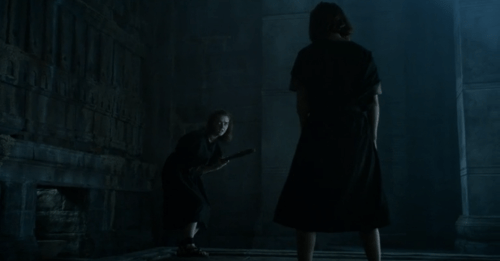
The dead actress in the apartment signals the end of Arya’s acting, and she runs for her life, away from the waif who is hellbent on killing her. A theory had been going around the internet recently (I only read the headline and didn’t bother with the theory itself; if it’s true, I don’t want to be that spoiled) that the waif doesn’t actually exist, and that this would turn out to be some Fight Club–inspired thing where the waif is simply another side of Arya, part of her imagination at war with her. Thankfully, that didn’t turn out to be true (I don’t think that scenario would be suited to the world of Game of Thrones) and Arya leads the waif on a long, painful journey right to Needle’s nest. And then, just like a blind Audrey Hepburn smashing all the lights in Wait Until Dark when an intruder comes into her apartment, Arya cuts out the candle. She knows how to fight whilst blind — and the waif doesn’t.

arya_needle_waif

I’ve had the sense for some time that Arya is a favourite of Jaqen’s, despite him being so hard on her. He never has a smile for the waif, who is filled with hatred and jealousy at every turn. He knows the waif believes she is selfless, but this constantly loathing she has prevents her from truly being one of the faceless men, because she feels that hatred too strongly. Jaqen doesn’t kill out of hate: he kills because the person whose name has been chosen… has been chosen. And he needs no more reason than that. He holds nothing personal against those whom he kills. With Arya, I think he saw someone he could shape and mould, but I was never convinced that he believed she could become one of the faceless, nor did he want her to be. When the waif asks to kill Arya, and he makes her promise to do it quickly, I wonder if he meant for her to die quickly, as if he already knew Arya would best her. Did he blind her so she could learn how to fight in the dark? Did he strip her of everyone so she would find the will and the power to overcome the waif in their final battle? Did he know she would triumph and then head back to Westeros to help take back Winterfell?

He knows when a new face has been added to the wall. He descends the stairs amidst the firepots (who keeps all of those going, by the way? Seems a wee bit excessive, but anyway…) And when the face turns out to be the waif’s, and Arya comes up behind him, he looks neither surprised nor disappointed. “You told her to kill me,” Arya says, as she holds Needle out to him.

“Yes, but here you are, and there she is,” he says, moving his body against the tip of her sword. “Finally, a girl is no one.”

“A girl is Arya Stark of Winterfell,” she says, “and I’m going home.” And with that, a small smile plays at the corner of Jaqen’s lips, as if he knew this was how it was to play out the whole time. As if he’s actually proud of Arya for refusing to slough off her very self, and for returning to the place she should have been this whole time. It’s a fantastic moment, and one of the highlights of this season so far.

And with that, as you say, Chris, we seem to be putting the pieces in order. As the credits rolled I said to my husband that things are moving very quickly now. I wondered aloud if next season was going to be the fight for Winterfell, and the final season the battle for all of Westeros. And then the “Previously on” section showed after the credits and I realized oh. Maybe we don’t have to wait so long for one of those things to happen.

Thanks to everyone for reading, and we’ll see you next week for the penultimate episode!

Leave a comment

Filed under Game of Thrones, television

Game of Thrones 6.07: The Broken Man

gameofthrones_teaser02_screencap10

Greetings and valar morghulis, once again dear friends. Welcome as I and the inestimable Nikki Stafford recap, dissect, and expound upon the most recent episode of Game of Thrones.

This week saw the return of everyone’s favourite Scottish breed, the Jon-and-Sansa Tour of the North, an argument for why all of the Seven Kingdoms should be run by ten-year-old girls, and we finally get an answer to that timeless question: what does it take to kill Al Swearengen?

Westeros. You just bring him to Westeros.

It’s Nikki’s turn to lead us off, so …

 ray_mcshane_better

Nikki: The episode begins with what we thought was a technical problem: where’s the epic opening credit sequence? We had already zipped past the “Previously On” bit, and suddenly we’re in the episode. We backed it up again, nope, we didn’t appear to have missed it, and just as my husband is asking if they’ve ever had an episode without the credit sequence and we’re watching some Tower of Babel–type building going on, who should come striding towards us but Ian McShane!!

And I swear, in that moment, I heard the loudest squeeeeee, followed by a thunk, from my writing partner Christopher Lockett as he fainted with joy several provinces to the east of me.

Last week we joked about what it would be like if Swearengen played Randyll Tarly, and suddenly, as if we conjured him by wishing very hard, here he is. And the writers didn’t disappoint: in the first full minute of his speech, he says the words “shit” and “fuck,” though I was a little disappointed they didn’t throw in a single gratuitous “cocksucker” for all of us Deadwood fans. But I guess we can’t have everything.
And also last week, when discussing Benjen, I mentioned that if GRRM doesn’t actually show someone die, they probably aren’t dead. And once again, that statement came through this week with the reveal of The Hound. The thing is, we thought we did see him die. Arya sat there and watched him die, as you pointed out in our discussion of the episode at the time, Chris. And only after she watches him die slowly — refusing to give him the mercy of pushing a sword into him herself — she gets up and leaves. She removed him from her list, and moved on.

ray_hound

And when Brother Ray (McShane) finds him, he thinks he’ll just be there to bury him… and then Sandor coughed. “What kept you goin’?” Brother Ray asks him. “Hate,” Sandor replies. But that hate has turned into shame, and it seems Sandor has been doing his own Walk of Atonement these last few months/years (it’s very hard judging how much time has passed on this show, to be honest…) He doesn’t lie about what happened to him — he could have embellished and said it took an entire army of men to bring him down, but instead he fesses up that it was one… woman. Brother Ray laughs and laughs, and Sandor goes back to chopping wood. Sandor has done terrible things in his time, and he knows it. They talk about religion (Brother Ray appears to be heading up some sort of group of penitents, including himself), and Brother Ray doesn’t subscribe to any one belief — as he says, maybe the Seven are real, maybe they’re not, maybe the Lord of Light is real, who knows. All he knows is whatever god(s) is out there, it has big plans for Sandor Clegane. “If the gods are real,” Sandor asks, “Why haven’t they punished me?” Brother Ray glances over at him. “They have,” he replies, and leaves him alone to continue eating his food.

I couldn’t help but wonder if the “god” who has big plans for Sandor Clegane might have the initials GRRM, and if so, I can’t wait to see what they do with him next. He is clearly the Broken Man of the title of this episode, but he’s going to take that brokenness and turn it into something useful.

While the Hound is going through his own walk of atonement, Margaery continues to brilliantly pull the wool over the High Sparrow’s eyes. I’m actually loving her character in these scenes, because I haven’t fallen for her crap once, and always assumed she’s playing him like a fiddle (I’m just sad to see Tommen caught in the middle of all of it). What did you think of our fair maiden this week, Chris?

marg

Christopher: I will confess, she actually had me going a bit … last week I observed that her little maneuver with Tommen and the High Sparrow actually left her and House Tyrell in an advantageous position, with the Lannister’s sidelined, Cersei awaiting trial, Jaime sent off to Riverrun, and Tommen effectively functioning as Margaery’s puppet. It seemed unlikely that her conversion was genuine, and yet this week there were one or two moments when I found myself thinking “Wait … she doesn’t really believe any of this, right?” Of course, as soon as she passed her little note with the Tyrell flower on it to Olenna, we knew she’s still the same Margaery, just somewhat more subtle.

Before I go on with the intrigues at King’s Landing, however, I want to acknowledge my squee upon seeing Ian McShane grace the screen. He’s such an amazing actor, and while his turn as Al Swearengen remains my favourite role of his, I have yet to see him be anything less than mesmerizing on the screen.

I should also point out that, while Game of Thrones has certainly been parsimonious with its cold opens, there have been a few down through the seasons, most obviously with the very first episode when we get our first glimpse of the White Walkers. There were also cold opens for episode 3.01, “Valar Doheris,” which features Sam fleeing through a blizzard and attacked by a wight; and 4.01, “Two Swords,” in which Tywin watches as the Stark sword Ice is melted down to make new swords for Jaime and Joffrey. I seem to think there might have been one or two others, but cannot call them to mind.

This episode’s opening was done for dramatic effect, but also to take viewers by surprise, so they saw the resurrected Hound before they saw Rory McCann’s name in the credits.

hound_soulful

But back to Margaery … we come upon her in the High Sparrow’s favoured chapel, apparently deep in study, reading the Book of the Mother—reading a verse whose premise is that it is the woman’s role to smooth out man’s rough and jagged edges. “As water rounds the stones,” the Sparrow begins to recite, but Margaery takes over, “smoothing what was jagged, so does a woman’s love calm a man’s brute nature.” It is a lovely bit of contrast: the Sparrow, didactic and sententious, is pleased when she proves to have memorized the verse herself, while remaining oblivious to the nuances of her words. Here and there in this episode I wondered if the Sparrow has truly been taken in by Margaery’s pretense, or whether he’s playing along for tactical reasons; but in this moment he seems entirely taken with her, and perhaps even a little too pleased with himself for making such a significant convert.

The subtleties of power at play in the room are completely at odds with the simplistic sentiment of the scripture, which is such unreconstructed religious misogyny that it plays to contemporary audiences quite simply as cliché. The metaphor of the water and the rocks rehearses all-too-typical conceptions of gender roles: men are hard, women soft; women’s role is to smooth down men’s jagged edges; men are brutes by nature, and women are obliged to accept that fact and do what they can to soothe their savage tendencies as best they can. Hearing Margaery of all people mouth these platitudes introduces a profound dissonance into ideas that are already (I would devoutly hope) entirely discordant with today’s audiences.

But the scene does not stop there: the Sparrow’s business is to address Margaery’s absence from the marriage bed since her reunion with Tommen. It is her duty, the Sparrow tells her. But Margaery counters by saying that the desires that once drove her are now absence. To which the Sparrow asserts: “Congress does not require desire on the woman’s part … only patience.”

In my mind I imagined a chorus of disgust hurled at millions of television and computer screens around the world in response to the Sparrow’s words. Certainly, there were a handful of scornful harrumphs in my living room at this moment. It was, I thought, a clever gesture by the writers to taint the High Sparrow’s broader message of equality and humility and to undo whatever sympathy he might have garnered by this point. Mind you, if we pull back for a wider-angle view, it’s not as though women have much in the way of rights and agency in Westeros at large; the women of GoT who do are among the privileged elite who either have the ability to play the game (Margaery, Olenna, Cersei), the strength and skill to disrupt social mores (Brienne), the will to persevere with the help of provisional support systems (Arya, Sansa), or in the case of Daenerys, possess a talismanic family name, preternatural charisma … and, well, dragons. The dragons are important.

With this in mind, the argument could be made that the Sparrow’s world-view, while scripturally reinscribing women’s subordinate place in society, nevertheless would eliminate the larger economic inequalities in Westeros. To which I would say: interesting thought, but you don’t think the Sparrow ultimately gets to win, do you? After the show just made us viscerally hate him? This is one of those moments when the possible broader socio-economic implications of the scene are at least somewhat besides the point: more significant here in the way the scene plays thematically is watching Margaery play the penitent and rehearse scriptural words so completely at odds with the character we’ve come to know (and in Nikki’s case, instinctively dislike).

olenna

Margaery’s audience with the Sparrow ends with an implied threat against her grandmother: he speaks admiringly of Lady Olenna’s strength and character, while calling her “an unrepentant sinner.” It is Margaery’s obligation, he says, to teach her the new way, “Or I fear for her safety … body and soul.” In this warning, he makes clear the newfound confidence and audacity of the Faith Militant, with the King and Queen under his sway: confident enough, he implies, to wrest august lords and ladies out of their homes and subject them to the same punishment Cersei, Margaery, and Loras have endured.

Segue to the irascible Queen of Thorns herself, grating against the fact that Margaery is accompanied by an unsmiling, implacable septa, whose expression does not change even when Olenna threatens her with a beating. It is quickly obvious there can be no private conversation, and throughout Margaery maintains her calm and pious demeanour in the face of her grandmother’s ire—even when Loras is mentioned. And Loras’ only recourse makes clear just how much power the Sparrow has arrogated to the faith: he can confess his sins and repent, but as part of his repentance he must surrender his family name and live out his days as a penitent.

This, to Olenna, is madness of course. It is only when Margaery begs her to return to Highgarden, a note of pleading entering her voice, that she seems to listen. Unfolding the paper Margaery slipped into her hand, she sees the charade she has been playing, and hears the true warning in her words.

From the penciled image of a flower to the frozen north, where Tormund pleads Jon’s case to the wildlings. What did you think of the Giantsbane’s speech, Nikki?

rose_note

Nikki: I’ve never wished more for Brienne to be present in a scene than I did that one. Maybe she wouldn’t be so disgusted by the guy after all. The various stories in this episode are broken up by Jon Snow, Sansa, and Ser Davos gathering as many pledges of fealty as they can so they can lay a siege upon Winterfell and take back the North. And they begin with the Free Folk, arguably the strongest army they know, and the one with which they have the greatest chance of aligning themselves. At Castle Black, it seemed that the Free Folk were a no-brainer, but now that the battle lines are being drawn and armies are being formed, they’re not so sure. Dim argues with Jon that they were willing to help the Night’s Watch when they were fighting White Walkers and wights, but that’s because it was on their turf, and it was their battle. This, he argues, isn’t their battle.

Tormund steps up and argues that Jon Snow was the one who saved them all, and without him they’d be dead or captured by the king. Dim spreads his arms to show the extent of the wildling army, and says they were once legion, and there’s barely anyone left, so why should they go with Jon? He says if they fight, they’ll be the last of the Free Folk. Jon argues that if they don’t join forces with him, they will definitely be the last of the Free Folk. He agrees: it’s not their fight, they shouldn’t have to join him, but he needs them. “I need you with me, if we’re going to beat them, and we need to beat them if we’re going to survive.” Tormund tells them Jon Snow died for the wildlings because he was sticking up for them. And if they’re not willing to die for him, then they deserve to be the last of the Free Folk.

It’s a fantastic scene, with some of the best courtroom back-and-forth of the episode, and what makes it so great is that everyone is right. Dim is correct — they’ve been decimated because of joining forces with the south, and generations of Free Folk have been wiped out completely. But Jon is correct in saying that it’s in their best interests to help them. And Tormund is correct in his argument that Jon Snow has sacrificed everything for them, so their sacrifices were merely a return favour. This last argument seems to be the most convincing one, and suddenly the giant stands up. Wun Wun looks around, then stares right at the former Lord Commander, and simply says, “SNOW.” And with that vote cast, everyone else falls in line. Jon has secured his wildling army.

wunwun

Back at King’s Landing, Olenna is sitting and writing letters, presumably letting her family know she’s coming home. Cersei enters the room with the Mountain, and demands to know why Olenna would leave, when her son is rotting in a jail. “Loras rots in a cell because of you. The High Sparrow rules this city because of you. Our two ancient houses face collapse because of you and your stupidity.” And Cersei… agrees with her. She says she made a mistake, she led an army of fanatics to their doorstep, but now they must fight them together. Olenna looks up. “I wonder if you’re the worst person I’ve ever met,” she says. “At a certain age it’s hard to recall. But the truly VILE do stand out through the years. Do you remember the way you smirked at me when my grandson and granddaughter were dragged off to their cells? I do. I’ll never forget it.” Cersei tries another tactic. She agrees that Olenna loves her grandchildren, just like Cersei loves her own children. “It’s the only truth I know,” she says. She says they must defend them. But Olenna will not be coaxed. She’s leaving King’s Landing before that “shoeless zealot” throws her into a cell, and warns Cersei that if she’s half as smart as she thinks she is, she’ll do the same. Cersei says she’ll never leave. But Olenna says her brother is gone, her family has abandoned her, her people hate her, her enemies are all around her. “You’ve lost, Cersei. It’s the only joy I can find in all this misery.”

I adore whoever writes Olenna’s dialogue. Cersei has an answer for everything. But now Olenna has a new purpose: she knows her granddaughter is planning something, and she knows there will be an end to this torment. She’s received Margaery’s warning, and is leaving, knowing that Cersei will NOT win. Cersei brought the High Sparrow to King’s Landing for the sole purpose of landing Margaery and Loras in jail, and ridding herself of both of them. Now she’s stuck having to fight with the Tyrells to get them out because she must save her son and get the High Sparrow out of the city. But Highgarden is no longer going to be played that way. Two episodes ago, Cersei entered the High Council with her brother and the Mountain, and convinced the Tyrells to join forces with her. That backfired spectacularly when Margaery had other plans, and pulled Tommen over to the side of the High Sparrow whilst planning her own escape from him. And now Cersei is stuck: her son is aligned with the High Sparrow, the Tyrell army is leaving her behind, Margaery is going to leave all of them high and dry while she finds a way out, and Jaime has headed off to Riverrun. She truly is alone, and it’s unclear how she’s going to get out of this one.

Meanwhile, in Riverrun, it’s the Blackfish versus, well, everybody. What did you think of the scenes of Frey’s army coming up against the Lannisters, Christopher?

blackfish

Christopher: Can I say how much I loved this scene? Not least because, out of a season where we’ve gone off map, this one scene unfolded almost precisely the way it did in A Feast for Crows, and the series captures it perfectly. The ineptitude of the Freys, Jaime’s towering contempt for them, the towering contempt of the Blackfish for Jaime … yup, it was all good.

One exception to the overall fidelity of this scene to the text is the presence of Bronn—who by this point has more or less faded into the background of the novels. I’m glad the writers have made the obvious choice to keep him around, considering that Jerome Flynn’s portrayal of the cheerfully cynical sellsword has been one of the best performances of the series (and that is saying a LOT). One of the delightful things about the way he’s been written and played is that, unlike his novelistic other, he has developed and evolved. Jaime, like Tyrion, sees his worth—but Jaime, unlike Tyrion, can give him a more significant role to play in the larger affairs of war and peace. “Now that is a sorry attempt at a siege,” Bronn says as he surveys the deportment of Frey forces. “Someone needs to teach those fat twats how to dig trenches.” To which Jaime replies, with a suggestive sidelong look, “Someone certainly does.”

bronn_jaime_siege

Bronn’s irritation is hilarious: reminding Jaime of everything he’s been promised, he interrupts him when Jaime begins to repeat the Lannister mantra, re: debts and payment. “Don’t say it,” Bronn says, disgusted. “Don’t even fucking say it.” This would easily be the funniest line of the episode, were it not the episode in which we meet the ten-year-old Lady Mormont of Bear Island. But more on her later.

The little tableau in which the Freys threaten to hang Edmure while the Blackfish looks on plays out almost exactly as it does in the novel, and it serves to cement our sense of the Freys as shrewd and opportunistic, but inconstant and militarily hapless. Oh, and whiny. Did I say whiny? As they shout their threats at the walls of Riverrun, we get our first glimpse of the Blackfish, played with understated strength and gravity by Clive Russell, since season three. He is unmoved by the Freys’ threats to Edmure. “Go on, then,” he says contemptuously. “Cut his throat.”

(I’m using the word “contempt” a lot in describing this scene, aren’t I? Well, I think if we had to identify the dominant emotion expressed between the characters involved, “respect” or “affection” wouldn’t exactly make the list).

Does the Blackfish have the measure of the Freys, or does he just not have much regard for his nephew? Considering the dressing-down he gave Edmure back in season three, and the irritation with which he snatched the longbow out of his hands after Edmure three times missed his shot to ignite Hoster Tully’s funeral boat, I have to imagine he doesn’t think his nephew’s life is a fair exchange for a castle. But as the scene progresses, we come to understand that the Freys in charge of this travesty of a siege don’t exactly grasp the basics of making effective threats. In what would otherwise be my favourite moment of the episode (again, but for Lady Mormont), Jaime calmly says, “Only a fool makes threats he’s not prepared to carry out. Let’s say I threatened to hit you unless you shut your mouth … but you kept talking. What do you think I’d do?”

BAM. Again, precisely as it occurred in the novel, and it was just as satisfying to see it play out on the show as it was to read it.

There aren’t many occasions when Lannister arrogance evokes sympathy, or for that matter fist-pumping exultation, but in the hierarchy of audience hate in the Game of Thrones world, the Freys may rank below Ramsay and Joffrey, but above Lannister entitlement. Watching Jaime and Bronn high-handedly take command of the siege and put the Freys in their place is deeply satisfying—not least because we see the Freys learning something they should have known already, namely, if you ally yourself with House Lannister, don’t ever expect to remain in command.

But even as we’re happy to see Jaime humiliate Catelyn Stark’s murderer, his Lannister arrogance founders on the rock of the Blackfish’s contempt.

Before we get to that charged confrontation, however, we cut to the next stop on the Jon and Sansa tour, and the introduction of the best new character since … well, I’m not sure whom. But before I get to young Lady Mormont, I do want to observe that the pacing and the plotting of this episode is a refreshing change from how this season has been trending. In many past episodes, while we often have a unifying theme, narratively it has felt like the writers have been checking boxes: we get our ten minutes of Sansa, ten minutes of Daenerys, ten minutes of Arya, and so on … with whatever the most important storyline is that week getting two, perhaps three, installments. This week was much tighter, with shorter scenes and more of them. It served the rhythms of the episode well: Jon and Sansa’s attempts to flesh out their army thread their way through like a connective tissue, almost acting as a counterpoint to the four scenes featuring the Hound. The only standalones are Theon and Arya, but the pace of the episode is such that they don’t feel like the writers ticking boxes.

lady_mormont

Now that she’s everyone’s new favourite character, that doesn’t bode well for her life expectancy.

At any rate … Lady Lyanna Mormont! I don’t know where the casting directors of this show go to find their child actors, but they are batting one thousand. I haven’t seen this many talented preteen and tween actors since season four of The Wire. Though but a ten year old girl, she is formidable, and precociously smart. She does not seem inclined to risk her few fighting men, until of course Davos addresses her.

I love Liam Cunningham’s portrayal of Davos for many, many reasons, but one of the biggest has to be his ability to communicate both Davos’ humility and his sharp intelligence. He knows well enough how to treat Lady Mormont—he knows not to talk down to her. He loved Shireen Baratheon like his own child, but he also respected her intelligence, submitting to her tutelage in reading and writing, something a prouder or less self-effacing man would never do. He brings these qualities to the table on Bear Island as he addresses Lyanna:

I’m here because this isn’t someone else’s war. It’s our war … Your uncle, Lord Commander Mormont, made that man his steward. He chose Jon to be his successor because he knew he had the courage to do what was right. Even if it meant giving his life. Because Jeor Mormont and Jon Snow both understood that the real war isn’t between a few squabbling houses—it’s between the living and the dead. And make no mistake, my Lady: the dead are coming.

This isn’t the first time his common sense and simple, no-nonsense demeanour has proved persuasive when others’ aristocratic miens failed to impress. We recall especially his intervention at the Iron Bank of Braavos when Stannis’ prickly pride and sense of royal entitlement fell flat with the pragmatic bankers. I think if I were to assemble a dream team of Game of Thrones characters for the fantasy equivalent of fantasy football (fantasy fantasy?), I’d always be sure to have Davos in my corner.

And from here we switch back to Jaime’s confrontation with the Blackfish … but considering how long I’ve gone on here, I’ll throw that back over to you, Nikki. What did you think of their meeting?

drawbridge

You know, for a show full of knights and castles, this might be the first time we’ve seen a proper moat and drawbridge.


Nikki: First, I wanted to concur that the Lady Lyanna Mormont scene was my favourite one of the season thus far. The actress playing her — Bella Ramsey — is stunning, and I rushed off to google her after the episode to find out who the heck this glorious actress was. And she has only a couple of (impressive) credits to her name, and wasn’t, as I had wrongly suspected, a girl who had played Matilda in the London West End musical. But she is STUNNING. And like you say, Ser Davos is the only one who knows how to talk to her. He doesn’t talk down to her the way Lady Sansa compliments her beauty, and instead treats her as if she were the head of any other house. And it’s only when he does that she pledges her allegiance to them. I love when they go to all the effort to procure her army and then she declares that the army consists of a total of 62 men, each of which, she adds, fights with the strength of 10 men of any other army. To which Ser Davos replies, “If they are half as ferocious as their lady, the Boltons are doomed.” Best line in the episode.

But now, as you say, back over to Jaime and his discussion with the Blackfish. As you pointed out, Chris, the Blackfish has basically given up on Edmure (why wouldn’t you?) and says his nephew’s been marked for death already, so just slit his throat already and be done with it. Jaime tries to bully him into submission, pointing out their forces compared to Brandon’s, and the Blackfish merely smiles and says they have enough provisions to last everyone in the castle two years without ever having to come out, so if the Frey/Lannister armies are simply going to wait to starve them out, they have a long wait ahead of him. Jaime falters, because of all of the responses he’d envisioned, he wasn’t expecting that one. And then the Blackfish delivers the crushing blow, when he leans in and says he really wanted to see Jaime Lannister — the Kingslayer — in person so he could get the measure of him. The result? “I’m disappointed.”

blackfish_jaime

You know when your parents used to rail and scream and send you to your room or spank you or whatever they did because they were angry? The WORST — absolute WORST — punishment was when they did nothing, and simply said, “I’m disappointed in you.” I don’t think there was a more brutal thing he could have said to Jaime. And with that, he turns on his heel and walks back into the castle.

And we return once again to the Continuing Adventures of Jon Snow and Company, as this time they go to House Glover. What I liked the most about this storyline (aside from Lady Mormont) was that you really got to see the effects of this ongoing war on the other houses. Since season one, we’ve seen the effects on the key houses — the Starks, Lannisters, Boltons — but what about all of the smaller houses. Lyanna Mormont mentions that she lost her mother in battle (a mother who clearly taught her daughter everything she needed to know about being fierce). The Free Folk argue that under Mance Rayder their numbers were legion, and now they’re but a fraction of who they once were. This isn’t their war, Dim argues… until Jon Snow says actually, it is. When they visit Lady Mormont, she echoes Dim’s words: “Why should I sacrifice one more Mormont life for a war that isn’t mine?” she asks. And Davos, as you quoted above, Chris, explains, much like Jon Snow did with the wildlings, that it actually IS their war. It’s everyone’s war. And as with Dim, Lady Mormont agrees and hands over her army.

And now Jon, Sansa, and Davos face the head of House Glover. Like the others, he refuses. As they’ve done before, Jon and Davos argue that this is everyone’s war, and that they should help. And then Sansa steps in and reminds him that his house is pledged to House Stark, and he needs to keep that oath. Robett Glover turns and strides right back over to Sansa, and asks where was King Robb Stark when the Iron Born took his family, imprisoning his wife and children and leaving him all alone? Oh right, he was marrying a foreign “whore,” he spits at her. “I served House Stark once, but House Stark is dead.” And with that, they’ve lost Glover’s army. He’s right: perhaps House Stark no longer shares his values, but considering the alternative — Ramsay Bolton as King of the North — maybe it’s best to just unify the houses to make sure HE doesn’t get in.
Cripes, Game of Thrones is feeling more and more like the U.S. election every day.

theon_twitchy

And now we head over to Theon and Yara, where she’s taken him to a brothel because, like many a soldier before her, she wants to get it on with a beautiful woman before heading into battle, and she tells him that she’s not worried about what’s going to happen to them. But Theon is. And that’s when Yara finally has The Talk with her brother. I mentioned earlier that The Hound was the broken man of the title of this episode, but Theon Greyjoy was broken long before The Hound was, and it’s not clear if he will ever be able to put himself back together. The only chance he has is Yara believing in him. She tells him to drink his ale, and he does, and she says he must enjoy himself. She says that she needs the real Theon Greyjoy back, because she wants to sail to Meereen, make a pact with the Dragon Queen, and take back the Iron Islands. And the only way she can do that is with her brother by her side, and not a shell of her brother, but her brother and who he used to be. He looks her in the eye and promises that he will be that person. And then she orders him to drink again.

I really liked this scene because we’ve never really seen much tenderness between Yara and Theon. But what was truly unsettling about the scene is, Yara ends the scene confident that she’s going to get Theon back, and she strides into the brothel with all the confidence in the world. But the Theon she used to know is gone. Watch how, throughout this scene, every time she orders him to “DRINK” he immediately picks up the cup of ale and does so, just like Reek would have followed every order Ramsay gave him. He’s a shivering mess of a man, not the confident jerk he used to be. The old Theon would have pushed Yara out of the way to get to the brothel and would have already drunk most of a keg of ale before even getting there. And then he would have been too shit-faced the next day to actually engage in battle. That was the old Theon. And to be honest, despite what she says, she does NOT want the old Theon at her side.

theon_yara

For now we have the new Theon. The guy who has been humbled, who knows the dangers of being overly confident, who has had his own arrogance stripped away to the point where he no longer thinks of himself at all. He worries about everyone around him. He takes orders from her, and she’s an excellent leader. His focus is on their future, the battles ahead of them, and their uncle who is coming to get both of them. He is not distracted by the beautiful women around him, or by the ale in his cup. He is entirely focused on the obstacles all around them. His recovery will be a slow and long one, and he’ll never truly be healed emotionally, but Theon was a despicable character in the early part of the series, and now he’s one of the most sympathetic characters on the series. That’s not because Ramsay did something wonderful; it’s because Theon’s true character has been able to come to the fore in the face of the atrocities that Ramsay foisted upon him. And I’m really intrigued about what’s in store for him.

And now it’s back over to Jon in the North once again, before we head back to the Hound and a scene involving something Dead hanging from the Wood. (Didja see what I did there?!) Jon, Sansa, and Davos have time to go over what they’ve achieved and what they’ve lost in their campaign. What did you think of their conversation and what Sansa does next, Chris? Any thoughts on who she’s writing to?

sansa_seal

Christopher: Two things before I answer that: while I was watching the scene with Robett Glover, I kept thinking, “Who is that actor?” He looked so familiar … and then it came to me. Tim McInnerny! A venerable British actor with a ton of dramatic roles under his belt, but whom I most fondly remember in the recurring role of Lord Darling in Blackadder. Robett Glover has somewhat more gravitas than Darling ever did, but he doesn’t seem to have much of a sense of humour.

tim-mcinnerny

“Darling, you’ve aged horribly!”

Second thing: what the hell kind of ships did Yara and Theon steal? They’re in Volantis already? That must have been one hell of a following wind. The show has often fudged the geography of GRRM’s world, which would be more forgivable if the opening credits weren’t a FREAKING MAP. To give the casual viewer a sense of the distance traveled:

iron--&gt;volantis

If their ships were US Navy frigates, that still would have been an amazingly fast journey.

Ahem. But to get back to your question, Nikki …

Having made camp in the same location as Stannis once did seems to have spooked Jon. Davos is sanguine about it, pointing out its defensibility and practicality; but Jon can only think of Stannis’ failures, and worry about the threat of a winter storm. “Aye,” Davos admits. “The snows defeated Stannis as much as the Boltons did.” (Well, that, and the fact that half his men deserted him for burning his daughter at the stake). Sansa is naturally concerned about their numbers; Jon is naturally concerned about time, and has obviously come to the conclusion that continuing to woo the smaller northern houses would take too long for too little return.

We see the anxiety in Sansa’s face as Davos and Jon storm off to intercede in a fight—anxiety, and the fact that she traded away an army in her rage at Littlefinger. Not that she wasn’t totally justified in hating the man who sold her to the Boltons, but she was still uneasy in her dishonesty to Jon in not telling him, as emerged in her answers to Brienne’s questions a few episodes back. The most obvious answer to the question of whom she has addressed her letter to is Littlefinger—swallowing her pride and anger in the name of taking back her ancestral home. I honestly can’t imagine who else it could be, and I’m dying of curiosity to see how this plays out.

ray_preaching

We move from Sansa’s letter-writing back to where Brother Ray preaches to his flock, confessing his war crimes from his days as a soldier. There was a lot of speculation within A Song of Ice and Fire fandom that we would hear the now-famous “broken man” speech that appears in A Feast for Crows. In the early stages of Brienne’s search for Sansa, she falls in with an assortment of other travelers, one of whom is a mendicant septon named Meribald. It is the aftermath of the War of the Five Kings; the countryside has been ravaged, and outlaws and broken men prey on unwary travelers. When Podrik asks the difference between broken men and outlaws, Septon Meribald says that while outlaws “are evil men, driven by greed, soured by malice, despairing of the gods, and caring only for themselves.” Broken men, by contrast, “are more deserving of out pity, though they may be just as dangerous.” The speech is lengthy, so I won’t quote it all, but the gist is this: broken men are almost always commoners, called to arms by their liege lord, for whom the thought of war at first is attractive, “a fine adventure, the greatest most of them will ever know.”

But when they taste battle, it changes for them as they experience its blood and horror. Some men break right away, others are worn down by countless battles, new wounds taken before the old ones heal. And one day, a man breaks.

He turns and runs, or crawls off afterward after the corpses of the slain, or steals away in the black of night, and he finds some place to hide. All thought of home is gone by then, and kings and lords and gods mean less to him than a haunch of spoiled meat that will let him live another day, or a skin of bad wine that might drown his fear for a few hours. The broken man lives from day to day, from meal to meal, more beast than man.

The title of this episode made many assume and/or hope that we would be treated to this speech. But while the writers acknowledge it, and Brother Ray’s speech gestures toward it, they have tailored his words to be, not about the trauma of violence inflicted, but the violence one inflicts—in other words, sentiments more specific to the Hound. “It’s never too late to come back,” Brother Ray says, looking directly at him. Brother Ray confesses his own atrocities; and if we only get Ian McShane for one episode, I’m glad they gave him a character worthy of his talents. As we’ve observed, he would have made a particularly terrifying Randyll Tarly, but there is something particularly poignant and nuanced in his portrayal of a man hollowed out by war and blood. His words are powerful, but it is his haunted eyes that speak volumes.

ray10

It is a particularly clever bit of casting, too, because those of us who loved Deadwood see the tortured soul of Al Swearengen lurking beneath this surface, and Brother Ray’s confession of a brutal past is that much more present.

The Hound hasn’t quite got religion yet, however. When Ray tells him, “Violence is a disease. You don’t kill a disease by spreading it to more people,” he replies with a fairly unavoidable truth. “You don’t cure it by dying, either,” he says. We assume that the Hound is the broken man of the title, but in another sense he is one of many: Brother Ray, the brigands from the Brotherhood Without Banners, and perhaps to a lesser extent … Arya.

arya_titan

Arya is not broken, though one could argue that the process of dissolving her sense of self into “no one” was precisely about breaking her. How do you come to kill indiscriminately? By losing yourself, by detaching from your humanity. “We weren’t animals,” says Brother Ray. “Animals are true to their nature, and we had betrayed ours.” Arya might have learned to kill, out of anger and vengeance and the need to survive—but she balks at killing someone whose only crime is being a better actor. And in the waif, we see someone who, though she has apparently passed all of the Faceless Men’s tests, is not so “faceless” that she has transcended petty hatred and jealousy. Her dislike of Arya has been palpable, and the delight she takes in shanking her on the bridge too obvious for anyone to believe she’s genuinely dispassionate (especially considering she has ignored Jaqen’s directive that Arya should not suffer). In this moment she is not an assassin but a straight-up killer who gives the lie to the Faceless Men’s ethos.

waif_shiv

Arya escapes, albeit with a grievous wound, and the last we see of her, she disappears into the crowds of Braavos. Does she find her way to the theatre troupe? Does she make her ship’s dawn departure? Is there a doctor in the house? Stay tuned.

We end with the (mercifully) offscreen massacre of Brother Ray and his followers while the Hound is far enough away that he can only return for the aftermath. The perpetrators, we assume, were the Brotherhood Without Banners, which raises at least one pertinent question: what the hell has happened to these guys? The last we saw of them, they were genuinely the protectors of the common folk, and had a reasonable sense of justice. What has happened in the interim? Have they become such fanatical devotees of the Lord of Light that they will cheerfully kill nonbelievers? Or have they, in the process of fighting endless battles and skirmishes, themselves become broken men?

Perhaps we will learn as much in the next few episodes, but for now it is enough to note that they would seem to have interrupted the Hound’s process of atonement. The last shot of the episode is him striding purposefully off, only pausing to grab an axe—a symbolic moment in which a tool of peace becomes a weapon of war.

hound_axe

Phew. That one went on a bit long, but in our defense, there was an awful lot going on in this episode. Thanks for reading, and we’ll see you again next week!

Leave a comment

Filed under Game of Thrones, television

Game of Thrones 6.06: Blood of My Blood

gameofthrones_teaser02_screencap10

Welcome friends once again to the latest installment of the great Chris and Nikki Game of Thrones co-blog, in which we recap, review, squee, shudder, and throw shade at the Randyll Tarlys and Walder Freys of the world. Well, of that world, anyway. For what felt when I watched it like a middling episode, a lot actually went down this week—including but not limited to the return of a Stark, the origin of Samwell’s insecurity issues, Arya’s possible career change, and an object lesson in how best to deliver rousing speeches (hint: on the back of a dragon).

 bran_warging

Christopher: It occurred to me at a certain point during this episode that we need to do a special retrospective blog post when The Winds of Winter comes out, in which we talk about the deviations from GRRM’s story the series has made, but also what aspects of the novel the series has now revealed in advance (I don’t want to say “spoiled,” because that’s not entirely accurate). This week’s episode has revealed a whole bunch of plot twists that may or may not be consonant with the novels, so it will be interesting to see which ones bear out. Do Margaery and Tommen embrace the Faith and side with the High Sparrow against their houses? Does Arya rebel against the Faceless Men and reassert her own sense of self? Will Daenerys turn her and her dragons’ noses toward Westeros after her capture by the Dothraki?

The one twist that rings true, if for no other reason than that it has long been fan speculation, is that Bran’s mysterious benefactor Coldhands (as he is called in the novels) is actually his long-lost Uncle Benjen. We first meet Coldhands in A Storm of Swords as a strange, almost wight-ish figure riding an elk, who aids Sam and Gilly in their escape south from Craster’s Keep. Sam and Gilly make their way south of the Wall through a secret passage under the Nightfort, encountering Bran and his entourage as they do. This of course also happens on the show (episode 3.10), with Sam showing Bran et al the way north and promising not to tell Jon; in the novels, however, Coldhands is there to meet Bran and guide him north.

coldhands

The absence of this character from the series was broadly assumed to be yet another instance where the show chose to pare down the novels’ ever-increasing ensemble, so his appearance at this late stage makes me wonder if any other elided characters will be making surprise appearances. It also makes me wonder, as I write this, whether or not GRRM intended for Coldhands to be Benjen—might this be an instance of the series listening to fan speculation and deciding that it was expedient to satisfy us on this one point and bring back a character to be this week’s deus ex machina? Did it just happen that the actor in question (Joseph Mawle) was available to step back into the role after a five-year hiatus?

Like I said: we need to do a special Winds of Winter post, which at this point will probably be around 2025.

I think I said something a few posts ago, apropos of the wildling rescue of the Snow loyalists, that the writers need to be more parsimonious with their use of the deus ex machina. Such is the case here: we know that Hodor bought Bran and Meera a few minutes with his heroic sacrifice, but not much more than that. Meera is not Hodor: she is struggling rather desperately to drag Bran’s sledge, but her strength is flagging, and Bran is meanwhile stuck in his visionary stupor. It’s pretty obvious that they’re about to need rescuing, and I have written in my notes “Coldhands?” And lo and behold, here he is, though sadly not riding an elk (perhaps because he was too embarrassed to do so after watching The Hobbit: The Battle of Five Armies), but armed with a sweet flaming morningstar.

Thranduil_in_Elk

Thranduil kind of ruined elks for everyone else. Thanks a lot, dude.

(Can I argue a point of logic here? Meera pauses in mid-flight to desperately try to wake Bran up. Is this really the best use of her energies? Not to sound ableist, but it’s not as though there’s anything more he can do while awake).

Bran himself seems to be stuck in information overload, bombarded by a welter of images from the past—many of which we’ve seen in the course of the show, and some of which he experienced (such as his fall from the broken tower)—but many of which he was not present for, such as the execution of his father. And we see some new scenes: most notably, we get a glimpse of the Mad King Aerys sitting on the Iron Throne, shouting “Burn them all!”, along with images of wildfire being poured into vessels and being detonated. Hopefully this means that in future episodes we’ll be treated to scenes of the last days of the Mad King, whose paranoia and insanity brought down the Targaryen dynasty. Until now, we’ve only had stories: most memorably, the story Jaime told Brienne back in season three. Once again, the embedding on the video is disabled, but it’s worth revisiting. Jaime asks Brienne if she’s familiar with wildfire. “Of course,” she retorts, and he says,

The Mad King was obsessed with it. He loved to watch people burn. Have their skin blackened, burnt, melted off their bones. He burned lords he didn’t like, he burned Hands who disobeyed him, he burned anyone who was against him. Before long half the country was against him. Aerys saw traitors everywhere. So he had his pyromancer place caches of wildfire all over the city. Beneath the Sept of Baelor. The slums of Fleabottom. Under houses, stables, taverns. Underneath the Red Keep itself. Finally, the day of reckoning came. Robert Baratheon marched on the capital after his victory at the Trident. But my father arrived first, the whole Lannister army at his back, promising to defend the city against the rebels. I knew my father better than that. He’s never been one to pick the losing side. I told the Mad King as much. I urged him to surrender peacefully. But the king didn’t listen to me. He didn’t listen to Varys … But he did listen to Grand Maester Pycelle … ‘You can trust the Lannisters,’ he said. ‘The Lannisters have always been true friends of the crown.’ So, he opened the gates. My father sacked the city. Once again, I came to the king, begging him to surrender. He told me to bring him my father’s head. Then he turned to his pyromancer. ‘Burn them all!’ he said. ‘Burn them in their homes! Burn them in their beds!’

mad king

He seems like a nice man.

Apologies for the lengthy quotation. I transcribed it with the thought of editing it down to its pith, but it occurs to me that this moment is germane to this episode—not just because it calls back to that moment Bran sees in his vision, but because this episode is fairly explicitly about family and blood. “Blood of my Blood” is the title, which references the Dothraki bloodriders’ oath to their khal, and which Daenerys invokes in the episode’s final scene. But blood and family, in all its fraught incarnations, is at the center of this episode: Sam returning to his family home, to his mother’s love and his father’s contempt; Tommen and Margaery taking sides against their families; Arya choosing her own sense of self as a Stark against the Faceless Men; Walder Frey revealing that he means to use his hostage Edmure Tully against the Blackfish; and of course in this moment, Bran being reunited with a long-lost uncle who is not, strictly speaking, the same uncle he last saw five seasons ago.

At any rate, after Coldhands/Benjen lays waste to a slew of wights and has his John Connor moment (seriously, did anyone else hear him say “Come with me” and mouth the words “if you want to live”? Or is that just me?), we segue from the white north to the green south, and catch up with Sam and Gilly. What did you think of Sam’s homecoming, Nikki?

gilly_wagon

Nikki: As always, Sam and Gilly just have a knack of making me smile every time they’re on screen; they’re just so darn sweet together. He’s bouncing little Samwell on his lap as he talks incessantly about the kinds of trees that grow around his home, what they look like in summer, what the colours look like in the autumn, and Gilly gleans right away that he’s nervous as hell, hence the jabbering. The last he saw of his family, he was being banished to the Night’s Watch as a convenient way for his father, Randyll, to be rid of him. His father, a military man, gave him a choice: go to the Night’s Watch or be put to death. The reason? Because Sam was overweight and loved books, rather than being the muscular military man that his father wanted him to be. There was no way Randyll was going to allow Sam to be his heir, but he couldn’t skip him and give it to his other children, because Sam was the eldest. Banish him to the Night’s Watch, et voila: Sam divests himself of the Tarly name and any claims he has to the household.

And… now he’s back. And his father is furious. But as they approach the ENORMOUS castle (like, seriously, did anyone else gasp aloud and scream some obscenity about the freakin’ city that is their home?!) Sam makes a deal with Gilly: little Sam is his son, and Gilly is most certainly not a wildling. Little Sam will get a good education, and Gilly will have a place to stay while Sam travels to Oldtown to become a Maester. But let’s just go over this again: whatever Gilly does, don’t… mention… the war!! she can NOT say that she’s a wildling!

They arrive at the castle and Sam’s mother Melessa is over the moon to see him, and one minute with this character and you realize where Sam gets all of his goodness from. His little sister Talia is also standing there, immediately complaining about the fact that she’s going to be married off to some horrible man that she hates, before her mother lovingly shushes her. Melessa addresses Gilly as if she’s wearing a royal gown — not the animal skin she has thrown over her — and welcomes her and little Sam into the castle. Melessa is that rare character in Game of Thrones who seems to be nothing but goodness. How she ended up with Randyll is utterly baffling.

gilly_baby

Except not really, not in this world. Talia complaining about her impending arranged marriage is still echoing in our heads as we move to King’s Landing. Tommen is now friendly with the High Sparrow, and rather than condemning him for forcing Margaery to do the Walk of Atonement, Tommen is explaining that he doesn’t quite know how to deal with it. The High Sparrow allows Tommen to finally see Margaery, and I wrote in my notes, “Margaery is pretending to be pious.” We saw her in Loras’s cell, where she explained that they can’t let the Sparrows see them broken. Loras, on the other hand, said, “Just give them what they want, and make my pain end.” At the time I took the look on Margaery’s face to be one that suggested she was giving up on her brother, but now I see it as a light going on in the attic, where she suddenly thought wait, that’s the answer. Give them what they want. If I let them think I’ve atoned and have become one of them, they’ll let Loras go. And so, she’s doing exactly that. And she’s doing a damn good job of it.

I’m often hard on Margaery (she can be a rather annoying character), but she’s also a woman in this world, and as we’ve seen with Daenerys, and Brienne, and Yara, and Sansa, and Arya, and Cersei, and even Melessa… it’s not easy being a woman in this world. You have to fight hard to rise up, but the thing is: the women ARE rising up. Brienne and Sansa have joined forces; Arya is proving she will not be controlled by the Faceless Men; Daenerys has won over the Dothraki, Yara has stolen all of her uncle’s ships and might be heading for Daenerys right now to see if she could join her; Cersei has another trick up her sleeve; and Melessa maintains her goodness in spite of her husband being a complete and utter boob. Margaery is a manipulator, but clearly she learned at a very early age that it was her only choice in this world. Go along with everything and reap the rewards. She married Renly, who was gay, and allowed her gay brother into their bedroom so he could fulfill her husband’s needs while she got to wear the crown. Not ideal, but better than many women have fared in Westeros. Then she ended up betrothed to Joffrey, but Olenna took care of things there — Olenna probably did the same things Margaery did to rise up, and she wasn’t about to let a monster destroy her granddaughter. And now she’s with Tommen, and that’s not going so well, but she’s going to figure out a way out of this mess just like she has every other time.

marg_tommen

As she speaks with Tommen, there isn’t an ounce of anger or vengeance in her voice, despite the fact that he’s been utterly ineffectual at getting her out of her predicament, and instead she smiles sweetly at him and makes him believe 100% that she’s a convert. She tells him that Loras needs to atone, and comes off as completely legit. She’s learned quickly that Tommen is about as malleable as a ball of play-doh, and she knows this will be an easy one. What she intends to do with him only becomes clearer later in the episode.

And then we’re back with the Tarlys at a friendly dinner party, where Gilly tries to use cutlery and everyone is staring at her. It made me remember the first time I visited the UK in my late twenties, and I was at dinner with my friend’s family, and I suddenly became aware that someone was staring at me. I looked up, and there was my friend’s grandmother staring at me, horrified, and she said, “You… hold your fork like… an… AMERICAN.” I immediately looked around the table and noticed I was holding my cutlery slightly differently than everyone else, and immediately amended what I was doing, cheeks bright red and feeling like I’d just been disciplined like a child. So I know how Gilly felt in that moment. (The next day, by the way, the family ordered Chinese takeout and it turns out they’d never done so before. As they sat around poking at the chicken balls not knowing what to do with them, and one of them went to smash a fortune cookie with his fist because he wasn’t sure how else to get to the piece of paper inside, I was relieved that, as it turned out, I wasn’t the only barbarian at their table.)

And what did you think of this happy family gathering, Chris?

randyll

Christopher: Aside from being utterly painful to watch, it was a beautifully executed scene—not least because we see all of Sam’s personal growth and development completely negated by simply being in his tyrannical, contemptuous father’s presence again. I’ve had a small handful of friends in my life who are ebullient, outgoing, the life of the party, and the biggest personality in the room, but who crumple into mouselike diffidence in the presence of a certain parent for whom nothing they do can ever be good enough. On such occasions when I saw it happen, it was always baffling and disheartening—but it always drove home the power that parents can wield, especially for people who crave approval or affirmation. Watching Sam—who was never, of course, the biggest personality in the room, but who earned the respect of his Brothers on the Wall, to say nothing of finding courage in the face of foes who would (literally) freeze the souls of most people—crumble in such a manner before Randyll Tarly was like a kick in the gut.

We haven’t gotten to this point in the novels (if we ever do), but we have met Randyll Tarly: Brienne meets him in A Feast for Crows as she searches for Sansa, at a town Tarly had “liberated” from the Northerners, where he now sits and dispenses harsh judgment on petty crimes. Randyll has, as we would expect, little more than contempt for her: “You never should have donned mail, nor buckled on a sword,” he sneers at her. “You never should have left your father’s hall. This is a war, not a harvest ball. By all the gods, I ought to ship you back to Tarth.”

Except that Brienne has a writ from Jaime Lannister to carry out “the King’s business.” She tells him she is searching for Sansa Stark, and means to go to the Vale to speak with Lysa Arryn.

Lord Randyll gave her an contemptuous look. ‘Lady Lysa is dead. Some singer pushed her off a mountain. Littlefinger hold the Eyrie now … though not for long. The lords of the Vale are not the sort to bend their knees to some upjumped jackanapes whose only skill is counting coppers.’ He handed her back her letter. ‘Go where you want and do as you will … but when you’re raped don’t look to me for justice. You will have earned it with your unjust folly.’

Aside from this one encounter (he does appear once or twice more, but this is the clearest picture we get of him), he has a reputation as one of the best soldiers in the Seven Kingdoms, and for being iron-willed and uncompromising. It is also generally known that he is responsible for all of House Tyrell’s military successes, though Mace Tyrell (shown in this episode in all his self-important oafish glory) has always been happy to take credit.

As always, the casting here is spot on. When the announcement was made that Ian McShane would be appearing in a brief but significant role this season, all of the good money was that he would be playing Lord Randyll. And seriously: can you just imagine how terrifying Al Swearengen would have been in this scene?

But that being said, the actor they did cast—James Faulkner—is simply perfect, capturing Randyll’s taciturn, unyielding contempt for anyone who doesn’t live up to his martial, masculine code, as well as the way in which he weds that code to the feudal system of class and status. He would accept a “Moletown whore” for the simple reason that it means his son acted at least once “like a man,” but a wildling is simply beyond the pale—and this from a man who has lived his life in the warm and fecund south, with no experience or knowledge of wildlings besides his conviction that they are barely human. “Is this your way of getting back at me, boy? Bringing that to my table,” he snarls, “and making me dine with it?” In Randyll’s eyes she is barely more than an animal, to the point where young Sam is “a half-breed bastard!”

(One can only imagine what he’d think if he knew that Sam’s ostensible bastard is in fact Craster’s son.)

One of the other things Faulkner captures is Randyll’s brute intelligence. He may loathe the idea of his son with his nose in books, “reading about the achievements of better men,” and the less-than-manly career of a maester (in the novels, Sam reveals that once, when he had voiced his desire to be a maester, his father had said “If it’s chains you want, then come with me,” and manacled him in the Tarly dungeon for three days, declaring that no son of his would don the maester’s chain, a symbol of servitude); but Randyll misses nothing, watching and listening carefully, and instantly picking up on Gilly’s slip. “Your way down to Castle Black?” he says, and we know the game is up.

Also, can I take a moment to laud Hannah Murray’s performance as Gilly in this scene? She is wonderful as she stands up to Randyll on Sam’s behalf, even though she does inadvertently give the game away; but I was impressed with how well she communicated her discomfort and awkwardness in the finery she’s given to wear. She does it without the clumsier expedient of an ill-fitting dress. The colours aren’t particularly flattering, but the dress fits her well. She is, as Sam gushes, beautiful—but what this fish-out-of-water moment manages to say is that she was actually more beautiful before, dressed in her shapeless woolens and with her hair unstyled. When you see images of Hannah Murray rocking the red carpet, it’s clear that the actress is no stranger to finery, but Gilly most certainly is.

Gilly_Hannah

Sam’s ultimate decision to leave with Gilly is stirring and lovely, though I confess I balked at him taking the Tarly sword. “It’s my family sword,” he tells Gilly, and defiantly says his father can bloody well come and get it … but I’m reasonably sure he has no legal leg to stand on here. It is his family sword, and ownership passes to the next Lord of Horn Hill—which, because joining the Night’s Watch entails surrendering one’s birthrights and family name, means it will never be him. And there’s also the fact that his father is still alive. Presumably, Randyll won’t care that Sam has fled with Gilly and the baby—no wildling and bastard to take care of any more—but somehow I imagine the theft of the sword will upset him. Just a little.

And with that we cut from Sam sheathing an ancient and priceless Valyrian steel sword, to a stage prop sword being swung by the actor playing Joffrey, and we get to relive the events of the Purple Wedding. Which, if I recall correctly, Nikki, you greeted two years ago with a squee and a variation on “Ding-dong, the witch is dead!” What did you think of The Ongoing Story of Westeros (Redux), as told by Richard E. Grant and friends?

arya_laughing

Nikki: That was an excellent recap of that scene, Chris, and thank you for linking it back to the book. I could totally picture this actor delivering those lines to Brienne — I agree with you that it’s pitch-perfect casting. (Though, if Ian McShane had been cast as Randyll, it would have upped the “cocksucker” quotient in that scene.)

And now we move over to the play and get to relive the Purple Wedding and Tywin’s Death Whilst Dumping scenes. The Girl Who Has No Name watches the show and, at Joffrey’s death, is the only one laughing while the others watch solemnly. Even though everyone seems to know that Joffrey is the result of incest, that the Lannisters are generally terrible people, and that Joffrey was a wretched king, it’s interesting that they still show gravitas and some respect at his death scene and look at The Girl With No Name with such scorn for giggling through it. The events in Game of Thrones are meant to hearken back to some sort of medieval time, when news was passed orally by town criers, and yet this scene still felt very much like a comment on who we are today. The town criers are the people on Facebook who post stories, or the people who comment on them. They’re the first ones on Twitter with RIP announcements when celebrities die. It’s CNN having to fill a 24-hour news cycle and giving you bare bones and wrong information before they have time to fact-check it. When celebrities break up, we say, “Ooh, it’s because he cheated with the nanny,” or “Ooh, she’s a gold-digger and that’s why she’s making these allegations,” or “How DARE you say that, she said she was abused and therefore she was abused,” or “The only reason he cheated with the nanny is because I heard she refused to have sex with him anymore.” How much of this is true? Probably less than zero percent, but hey, if everyone is saying it and it’s been verified on Wikipedia and Twitter, then it MUST be true.

faux_joffrey

Yup. Never get tired of this part of the story.

And the same goes for this audience. We have seen everything happening behind the scenes, but these people see a deformed imp and they assume he’s the killer of Joffrey, the molester of Sansa, and has no moral centre whatsoever. We watch Tyrion and we see an intellect, a man who is braver than he seems, a man who has a kind and gentle side, but those who simply see him in royal portraits see a monstrosity, and therefore he MUST be blamed for everyone.

But the Girl With No Name knows the truth. She knows Joffrey was scum, and she questions Tyrion’s guilt, and for god’s sakes I hope she and Sansa are reunited at some point soon because I would love for them to be able to catch up the way Sansa has with Jon.

arya_mirror

Backstage, The Girl With No Name puts the poison into “Queen Cersei’s” cup and then waits for things to happen… until “Queen Cersei,” actually Lady Crane (played by Essie Davis from The Babadook and Miss Fisher’s Mysteries), begins to talk to her, and she realizes she is human. When Richard E. Grant’s character, Izembaro, begins badmouthing her and treating her like crap, while Fake Sansa is a young thing who sees Lady Crane as standing in the way of her getting bigger roles, it’s clear that the backstage politics of a travelling acting troupe are no different than the main stage backstabbing going on throughout Westeros. Men keep the women under their boots, no matter how smart and capable those women are, while younger women do their best to push the older women out of the way, stomping on them on their way to the top… a top that includes being beaten back down by the men. The theatre troupe simply acts as a microcosm for the very people they’re parodying on stage.

And it’s when The Girl With No Name sees this, she snaps, knocks the cup out of Lady Crane’s hand (as the Waif watches), and once again becomes our Arya. She goes back to the waterfront and fishes Needle back out of its hiding place (YES!!!!) before returning to a hiding place, where she sits and waits for the Waif to come. And the Waif hasn’t hesitated in rushing back to Jaqen and telling him what she’s seen, getting permission to kill Arya. He betrays that he does have some (limited) tenderness for Arya when he asks that the Waif do it quickly without pain. I think we all know it’ll be the Waif who feels the pain in this match-up.

And now it’s back over to King’s Landing, where Margaery is NOT going to do that Walk of Atonement if the Mayor of Munchkinland has anything to say about it!! What did you make of the scene with the Tyrell army facing off against the Sparrows, Chris? (And also, I’m pretty sure that was actually Nikolaj Coster-Waldau riding the horse up the stairs for that stunt, and if so, IMPRESSIVE!!)

lollipop_guild

Christopher: HA! Mace Tyrell DOES look like he represents the Lollypop Guild, doesn’t he?

My thoughts on this scene are pretty consonant with yours, re: Margaery and her shrewd maneuverings. Even though Olenna bitterly says “He’s beaten us, that’s what’s happening!” to her clueless son, I wonder if perhaps she isn’t giving Margaery credit. Do we really think she’s had a come-to-Jesus moment, or is she playing the hand she thought she had? Her expression as she watches the Tyrell army arrive is interesting: surprise, with a little intake of breath, and then a glance at where the Sparrow stands a few steps in front and beside her. It’s hard to tell the meaning of that look, but my guess is that Margaery had (1) given up on being rescued, and (2) given up on her brother, disappointed by this weakness; and faced with the humiliation of the Walk of Atonement, she plays the one card she has—Tommen. I think your read on their earlier scene together was spot-on, Nikki; she plays the young king like a cheap banjo.

Is that expression on her face as her father’s soldiers file into the square a moment of thinking, “Oh, crap—they did come for me after all!” Even if it is, she can’t be too displeased with the way she’s moved the pieces on the board. Even if Lady Olenna isn’t pleased with the prospect of a born-again granddaughter, she’ll have to recognize the fact that Margaery has effectively empowered the Tyrells while marginalizing the Lannisters—all without bloodshed. Next week’s episode will (hopefully) tell, but for now it seems that Tommen is disinclined to blame his wife’s family for the confrontation in front of the sept and instead punishes his uncle, ejecting him from the Kingsguard and sending him away from King’s Landing to retake Riverrun from the Blackfish.

marg_surprised

It is worth noting in this scene that the Lannisters aren’t entirely marginalized: Kevan Lannister apparently remains Hand of the King, and stands at Tommen’s right. He does not seem particularly sympathetic to Jaime, however, and we know the amount of contempt he has for Cersei. Even with him advising the king, however, Lannister power looks completely fractured.

One small detail: when Tommen emerged from the sept, surrounded by members of the Kingsguard, all of them are now wearing cuirasses bearing the seven-pointed star of the Faith; Jaime, by contrast, wears the former sigil, a crown. This as much as anything signals the substantive shift of power: Tommen has essentially merged the Faith and the crown, something further communicated by the smug look of triumph the Sparrow gives Jaime.

So, if we’re right and Margaery is making a power move, things will get interesting: let’s not forget that the High Sparrow and the Faith Militant were initially empowered by Cersei in her mistaken belief that she could manipulate them to her own ends. Now Margaery seems to want to ride that tiger. Will she learn from Cersei’s errors? Will the Sparrow outmaneuver her as well? He is, after all, no fool—does he believe her conversion to be genuine, or is he playing her?

frey

We shift from Jaime’s (literal) dressing-down in the throne room to Walder Frey, whom we haven’t seen in some time, dressing down his sons over the loss of Riverrun. Casual viewers of the show might be forgiven for asking “Wait, didn’t he get thrown off a bridge?”, as there’s not a lot of daylight between Balon Greyjoy and Walder Frey in how they’re depicted on the show. Frey is somewhat more petulant, but no less unreasonable in his demands. Yes, losing Riverrun was something of a gaffe, but it’s not as though Frey seems to have done anything beside sit at his high table, drink, enumerate his grudges, and terrify his child bride. This scene didn’t do much besides set up next week’s confrontation at Riverrun and the return of the Blackfish, and reintroduce the hapless Edmure into the mix (he’ll always be Brutus from Rome to me), who has evidently spent the last three seasons rotting in a Frey dungeon.

But given the fact that the Freys are not strong enough to retake Riverrun themselves, they appeal to the Lannisters, giving Tommen a convenient way to effectively exile Jaime. I should point out that with Jaime heading out to the Riverlands with an army, the series squares up again with the novels. Jaime’s entire storyline from the moment he frees Tyrion has been a deviation from the books: in the novels, he does not voyage to Dorne, nor does he have a romantic reconciliation with Cersei in King’s Landing. He basically spends the second half of A Feast for Crows at the head of a Lannister army tying up the war’s loose ends—including the siege of Riverrun, which has been held by the Blackfish under Stark banners. It will be interesting to see if the siege plays out as it does in the novels.

Before we get to the climactic scene of the episode and Daenerys’ St. Crispin’s Day speech, we’re treated to something that this season seems to be specializing in: a Stark that isn’t actually dead! What did you think of the return of Uncle Benjen, Nikki?

benjen_close

Nikki: So many older characters are being reintroduced it’s enough to make a viewer’s head spin. Viewers will remember Edmure Tully, the nitwit brought in before Walder Frey, as Catelyn’s brother, who, at their father’s funeral was supposed to shoot the flaming arrow to light his father’s funeral pyre on fire. After three failed shots that simply kerplunked into the river, his uncle — the Blackfish — pushed him aside and lit it up with one clean shot. We last saw Edmure at the Red Wedding — which was actually his wedding — when Walder Frey married him off to one of his daughters. If you’ll recall, Walder wanted to marry one of his daughters to Robb Stark in order for him to join his house to that of House Stark. Robb was already married, so he offered up Edmure, his uncle, who immediately assumed Walder was going to marry him off to one of his, erm, less attractive daughters. But at the wedding he was pleasantly surprised to see that she was, in fact a beauty, and he happily married her… only to be taken away and thrown into a dungeon on his wedding night, where he has remained for three seasons. I’ve often thought that House Tully isn’t exactly bursting with promise: between Edmure and his sister Lysa (whom we last saw sailing through the moon door), Catelyn’s siblings are pretty ineffectual.

I swear that casting Tobias Menzies in a role is simply casting director shorthand for “this guy is a sleazebag.” See Rome, Outlander, The Night Manager… I swear the moment he shows up on screen in any series or movie, I think, “Ah… and here is the villain, then.”

But now off to Benjen. You did an excellent job of bringing us up to speed on him in your opening, Chris, so I don’t have much more to add to what you said. Benjen was always that quiet hero in the background of the show. In season one, when Ned beheads that man for abandoning his post (and accuses him of lying by saying he’d seen a White Walker), it’s Benjen who shows up at Winterfell and says actually, the man wasn’t lying, and Ned had killed a good man. He’s the one who suggests Jon Snow join the Night’s Watch, and accompanies him north to the Wall. Benjen heads north of the Wall on a ranger expedition, but only his horse comes back, and later his two men are found dead. But no Benjen. Since then we’ve only heard his name a couple of times, but with no hard evidence that he was dead, many fans have speculated he’s still up there somewhere (when GRRM kills someone, he SHOWS you that he’s killed someone).

We saw little Benjen in one of the visions that Bran had with the Three-eyed Raven, when he was swordfighting with little Ned, so that was an early hint that we were going to see him again, since they were putting his name back into our heads in those scenes.

And now he’s back. And he looks, um, a little worse for the wear. But his story is incredible: he’d been attacked by White Walkers, and one of them had impaled him on an ice sword, but before he could turn into a wight he was found by the Children of the Forest, who pushed a piece of dragonglass into his chest. Once again reminding us of the name of GRRM’s book series, and that the end of this story is going to come down to a war between Ice and Fire.

dany_spider-sense

And speaking of fire, Daenerys and Daario are riding from Meereen to go to Westeros (FINALLY) because, as she insists, she’s going to take back what is hers. Daario isn’t sure this is the best use of her time. “You weren’t made to sit on a chair,” he tells her. “You’re a conqueror, Daenerys Stormborn.” And he’s right. So many long to capture the Iron Throne, but once you have it, it’s one hell of an uncomfortable hunk of metal and wood, and after only a few days of listening to people gripe, you’re probably wishing you’d just stayed at home the day of the Conquering. There must have been something good on TV that day, right?

But she wants what is hers, and then she shows the blood riders exactly how she’s going to get it when she disappears into the canyon and comes back riding a truly ENORMOUS Drogon. Man, when Tyrion talked about how much more the dragons grow when they’re not in captivity, I had no idea he meant THAT big. He must be three times bigger than he was when we last saw him saving Daenerys from the gladiator ring.

The blood riders have never followed a woman in their history, so their immediate and wholehearted pledge of fealty to Daenerys seems a little disingenuous, but then again, she IS on the back of a dragon, so… I’m sure High Sparrow would be bowing and scraping by now, too. But as much as I loved the reappearance of Drogon, and the fact that we’re another step closer to House Targaryen taking back the throne, I wasn’t a huge fan of this ending of the episode. SO MANY episodes end with some spectacular, epic scene of Daenerys — usually accompanied by a dragon — giving some epic speech and being loved by all around her, that it’s really losing its flavour for me. Season one ended with her stepping out of the fire with dragons on her shoulder, and THAT was freakin’ cool. Season three ended with her being carried on the shoulders of the Yunkish people as they shouted “Mhysa!” over and over. We’ve had her epic speeches to the Unsullied, her epic speeches to the Yunkai people, her epic speeches to the people of Meereen. One episode ended with Drogon swooping in and taking her away from the gladiator ring. Another ended with her naked before a fiery temple that she’d just burned down. I love Daenerys, and I find this focus on her seems to be hinting to her right as the head of Westeros (which I think she’ll share with Jon Snow, fulfilling the Ice and Fire quotient of the book’s promise) but she always has to be standing in the midst of some epic moment, with that stalwart look on her face as fire rages around her and the dragons swoop in as some sort of deus ex machina, and for the first time, I found Drogon swooping in to be a little anticlimactic. And her speech even more so. And the fealty of the bloodriders even more so. Mostly because I’ve seen it all before: slightly different speech with the same tone; different race but same loyalty; same dragon who was larger than the last time I saw him. So as much as I loved seeing ginormous Drogon, I hope they can come up with a new shtick for Daenerys before she becomes Queen.

dany_speech

And that’s it for another week! We will see you next time, in Riverrun.

Leave a comment

Filed under Game of Thrones, television

Game of Thrones 6.05: The Door

gameofthrones_teaser02_screencap10

Hello hello once again friends, and welcome to this installment of the Chris and Nikki co-blog of Game of Thrones. This week, believe it or not, brings us to the mid-point of this season. Halfway! And episode five is easily on the best so far–though as we all know, Game of Thrones is a fickle mistress, and is not about to deliver an excellent episode without also ripping us apart inside.

Hold the door. That’s all I have to say. Nikki?

mockingbird_seal

Nikki: The first thing that must be pointed out about this fantastic episode is who directed it. You should have seen the look on my face when “Directed by Jack Bender” flashed across the screen. For those of you who didn’t obsess over every moment of Lost (in which case, how, exactly, did you come to read my blog?!), Jack Bender was the lead director and one of the executive producers of the show. He’s responsible for most of the best episodes of that series, and the images that we remember most vividly from it. He directed the series finale, as well as every season finale that preceded it. He directed 30 other episodes, including “Walkabout” and “The Constant” — in other words, when you have a key episode that could change everything, you bring in Jack Bender.

And considering the revelations, lies, and that devastating ending, this was definitely a key episode.

We begin with Sansa and Brienne as they face Littlefinger, who has sent Sansa a raven to meet up with him in Mole’s Town. We last saw this place when the wildlings, led by Tormund and Styr, attacked the town and killed everyone in it. Gilly has been hiding out in the brothel with Sam, and she huddled in the back where Ygritte found her and told her to stay quiet. She survived (obviously) and escaped back to Castle Black.

Now Sansa, Brienne, and Baelish stand amidst the wreckage left behind, and she gets to confront him in a glorious scene of retribution we’ve been waiting for. With Brienne having her back, Sansa glares at Littlefinger and dares him to tell her if he knew what he was getting her into by leaving her there. Of course, Baelish wants to skip by the answer, so he stammers his way through a round of shrugging before Brienne holds her sword and says menacingly, “Lady Sansa asked you a question.” Sansa then helps him out: “If you didn’t know, you’re an idiot,” she says, “And if you did know, then you’re my enemy.” We watch Baelish staring at Sansa, knowing he betrayed the daughter of the woman he’s loved his entire life, a girl who is the spitting image of her mother. Despite the fact Littlefinger’s heart is made of stone now, in this moment we catch a glimpse of him actually appearing to feel a tiny ounce of remorse for what he put her through.

sansa_brienne

She tells him she can still feel what Ramsay did to her, not just in her heart but in her physical body. She tells him over and over again to imagine exactly what Ramsay did to her: mind, body, and soul. He didn’t touch her face, because he needed that, but he destroyed every other part of her body that could be covered up. Sansa stands like stone, as Brienne looks more enraged by the second yet maintains that cold glare.

“I’m… so… sorry,” Baelish says with phony empathy, and says he had wanted to protect her, and will do anything to protect her now. “You wouldn’t even be able to protect yourself if I told Lady Brienne to cut you down right now,” she spits back.

“You freed me from the monsters who murdered my family, and you gave me to other monsters who murdered my family.” And in that one sentence, she sums up exactly the hell she has lived through for years. The Starks were just a quiet family living in the North who had the misfortune of being chosen to be the Hand of the King, and in doing so became the target for every other family jostling for position. Baelish saved Sansa from the Lannisters, who had murdered her father, and he handed her off to the Boltons, who had murdered her mother, brother, and a sister-in-law she’d never met. He tells her that he will do anything to undo what’s been done to her, but you can tell from the look on Sansa’s face, there is no undoing what’s been done to her. But what it HAS done is made her stronger, willing to fight. She’s a strategist now, now some girl doing embroidery in the background while the men do the real fighting.

littlefinger

And as he leaves, realizing she’s not going to come with him (not that he ever thought that — I always feel like Baelish is 10 steps ahead of everyone) he tells her that he’s been in contact with her uncle, Bryndan the Blackfish, and that he’s gathered an army that would be willing to fight with her. She says, “I have an army.” Oh right, he says sarcastically as he passes her in the doorway, “Your brother’s army…” and then he corrects himself, “Half brother.”

Someone needs to push this guy through the moon door.

Sansa was my hero in this episode. Of course, what she does with Littlefinger’s information is suspect, and I can’t help but picture Admiral Ackbar jumping out of a doorway and yelling, “It’s a TRAP!!” but let’s give her a round of applause for making Baelish pause for even three seconds to actually consider what he’s done to Catelyn’s daughter.

And from there we move over to Arya, where she’s forced to watch a rather difficult reel of “Previously, on Game of Thrones.” In verse. What did you think of our Arya this week, Chris, and that very brief but squee-inducing cameo?

play

Christopher: To be honest, I completely missed Withnail on my first viewing—it was indeed very brief, and I must have been looking at my notes. When I rewatched the scene, I was thinking “what cameo?” … and then I saw him. Good old Richard E. Grant—he never disappoints.

I loved the Arya scenes this week. She hasn’t had very much to do this season yet, so it was great to see her story moving along. What was interesting was the way in which her identity as a Stark continues to stick to her, however much she might protest that she is “no one.” What precipitates this uncertainty is her poor showing against the Waif in their fight training; indeed, the Waif is so superior to Arya that one wonders if she was feeling ill on the day when Arya bested her in spite of her blindness. Plot inconsistencies aside, however, the Waif’s insistence that “You’ll never be one of us … Lady Stark” segues into Jaqen’s acknowledgement that this might, in fact, be the case. “She has a point,” Jaqen says, and proceeds to expound on the history of the Faceless Men: that they were a society founded by former slaves, who fled Valyria after—he seems to suggest—they killed all their masters and overseers. “Where did they go?” Arya asks, and Jaqen reveals that the free city of Braavos was in fact founded by the Faceless Men.

Arya’s struggle to lose herself has become an interesting reflection of the significance of naming and names, especially when her scene is juxtaposed with Sansa’s determination to win back the North, and Littlefinger’s snide observation that Jon Snow is only Sansa’s half brother. It’s a seemingly throwaway aside that cuts as only Littlefinger knows how: at once reminding Sansa of how she mistreated Jon in the past because she didn’t consider him a true Stark, while also pointing to the issue of his legitimacy: he might putatively be Ned Stark’s son, but as a bastard he lacks the legal rights of a trueborn, and unlike Ramsay was never legitimized by his father or by a reigning monarch. While Sansa and Jon will struggle to assert the rightfulness of the Stark name in the North, Arya struggles to set her legacy aside, but it clings to her like a burr.

arya_waif

All of which is made even more glaring by the play she attends. Did Jaqen know what the play was about when he sent Arya off to reconnoiter her assignment? If so, it’s a cruel little twist of the knife and, I would assume, one more test for Arya. The recapitulation of the events of season one calls to mind Karl Marx’s assertion that history repeats itself first as tragedy, then as farce: the tragedy that Arya experienced first hand is repeated for her as a crude pantomime replete with farts, slapstick, and gratuitous nudity (all right, so that bit was accurate). It would appear that the Lannister propaganda machine has worked well: Cersei and Joffrey are depicted as fair and generous, Ned Stark as an oafish usurper, and Tyrion as the ultimate villain of the piece who arranges for Ned’s execution in spite of Joffrey’s leniency, humiliates Sansa, and slaps the new king (which, I must admit, is still deeply satisfying to watch even though it’s a fake Tyrion and Joffrey).

Maisie Williams does some lovely face-acting throughout the play, communicating that, however much she has committed herself to the Faceless Men, she is in fact still Arya Stark—and seeing her father misrepresented on stage obviously pains and angers her. These events are still very much a part of her, and she is a product of her personal history. Shucking all that to become “no one” is not easy.

As I’ve mentioned in previous posts, this season is doing a lot of calling back to the first season, giving us echoes of where all of this started. “Don’t you wish we could go back to the day we left?” Sansa asked Jon last week. “I want to scream at myself, ‘Don’t go, you idiot!’” Unbeknownst to Sansa, her brother Bran has been doing something close to that, momentarily distracting young Ned Stark as he starts to climb the Tower of Joy. It’s hard not to read Arya experience of this pantomime as thematically parallel to Bran’s astral travelling, especially considering the way in which the play shows history as fungible: it distorts the facts of Robert Baratheon’s death, Ned’s execution, and the Lannister seizure of power, but for all intents and purposes that has become the standard narrative as it is popularly understood. By the same token, we get confirmation this week of something only suggested previously: that Bran’s virtual travels are not merely passive viewership, but can and do affect and change the past and therefore the present. The broken-telephone telling and retelling of Ned’s execution that produces a comic play broadly correct in the narrative but profoundly wrong on the details presages the way in which an imperative given to Hodor in his youth transforms into his only word and, as it turns out, his one mission in life.

fake_cersei_ned

But I’m getting ahead of myself. The pantomime Arya watches is the most overt call-back of the season so far, and as anyone who has done Theatre Studies 101 knows, any time you see a play-with-a-play (or in this case, a play within a TV show), it’s a meta-theatrical gesture calling attention to the play’s very theatrical framing and artifice. And much like “The Murder of Gonzago” in Hamlet, this pantomime catches the conscience—not of a king, of course, and not just of Arya in her desire to dissolve herself into no one, but also that of the audience. I might be alone in this, but watching the play as Arya watches it, and seeing the distortions time and distance lend to the story, made me think of the increasing disparities between the novels and the series, and the ways in which the viewing experience is transformed for me now that we’re past the point where I, as an avid reader of the novels, had a narrative roadmap.

This sense was only heightened by the fact that this episode offers a handful of revelations, and a man wonders whether these will be consonant with the novels, or whether the showrunners are taking liberties. The first of these revelations happens after Arya’s scenes. What did you think of the fact that the White Walkers were created by the Children of the Forest as a weapon to fight humans, Nikki?

forest_child

Nikki: That was certainly a shock. The Children of the Forest are far more fleshed out in the books, and have only been touched on in the show, occasionally mentioned by others as a race that had died out and has been forgotten. Now that Bran is with them, we see some of them survived.

I saw some confusion on social media the day after this episode aired, and some of it was directed at the Children of the Forest. Who are these tree women, and where did they come from? The Children of the Forest, according to the legend depicted on the show, were the first inhabitants of Westeros, and lived in harmony with the weirwood trees… until man came along. The legend that has been told to us so far is that they engaged in battle with the White Walkers, and were killed off, with this small handful of Children driven north to where Bran is. The White Walkers not only slaughtered the Children of the Forest, but the giants. The key figure you see with Bran is Leaf, and she seems to act as a de facto leader of the Children of the Forest. So when she reveals that the White Walkers — the enemies of the Children — were created by the Children themselves, it’s a shock. Think back to when Sam Tarly killed one of the White Walkers with that piece of dragonglass. He says in that episode that the Children of the Forest used to carry dragonglass daggers. Now his anecdote comes full circle and we discover that they are created by dragonglass, and it is dragonglass that destroys them.

night_king-eyes

I remember once visiting Barbados, and a local man was telling me a story of how settlers first arrived in Barbados and brought rats with them. Soon the island was overrun with rats so they brought in snakes to eat the rats. When the snakes got the rat population under control, the island suddenly had a snake problem. So they brought in green monkeys to rid of them of the snakes, but the green monkeys multiplied so quickly they were soon everywhere. They have yet to figure out how to get rid of the monkeys.

I thought of that anecdote when I was watching this scene last night. The Children of the Forest were living in relative harmony until man came along and destroyed that peace (typical). So they created a monster to eradicate the humans, but that monster ended up killing the Children of the Forest instead, then the giants, and then turned on man. It was a shock to learn, but in retrospect, it made total sense.

We shall return to Leaf, Bran, and Hodor. (sniffle… Hodor…) But now we turn to the Iron Islands, and Yara making a play for the throne. These men will not follow her, they say. They’ve never had a queen and they don’t plan to start now. She rolls her eyes and says no one pays attention to them anymore, and she will bring attention to them on a world stage. But they argue that they shouldn’t have to follow her as long as Balon Greyjoy’s male heir has returned.

theon_glum

Cue camera on Theon, who was gorging himself on the canape table and didn’t realize everyone was about to look at him — “ye mean me?!”… OK, not really, it’s more like Theon standing there hoping they weren’t going to look at him, because he knows what they must be thinking about him, and how it must look that Balon’s son has returned, and yet it’s his daughter who is vying for the throne. The newly shorn Theon steps up, clears his throat, and addresses them. “I am Theon Greyjoy, last living son of Balon Greyjoy… and she is the rightful ruler.” He tells them she is a leader, a warrior, and iron born. “This is our queen,” he says, on the verge of tears. Theon wanted to rule the Iron Islands, and Ramsay has taken away his dignity (among other things) and he can barely show his face here, but at least pushing his sister to the forefront might make up for his misdeeds.

And… then the dickhead shows up. Euron Greyjoy steps forward and says HE is the rightful ruler of the Iron Islands, and through his travels he has learned everything about this world and will help them rule it. Yara is shocked; the moment she sees him she knows he was her father’s murderer, and announces it in front of everyone — to which Euron basically says, “Yeah, what of it.” He points out how useless Balon was (no argument here) and that he was leading them nowhere. Theon speaks up and says Euron was gallivanting around the world while Yara and Balon were here ruling the Iron Islands and led them thus far. But Euron knows exactly what’s happened to Theon, and tells everyone, including the loss of Theon’s member. It’s a devastating moment — Theon is only just barely holding it together throughout this scene just with the thought that they might know something of what happened to him when he was Reek, but now there’s no doubt that they all know. The laughter and hissing from the crowd is like another finger being removed, and Theon winces at it. Euron turns to the crowd and says he will build a fleet of a thousand ships, and tells them of Daenerys. He says he will sail across the channel and give her the fleet, along with something else (he grabs his crotch) and in that moment I thought, “Ah. You are not long for this world, my friend.” If this show has taught us anything about women, and especially Daenerys, a cock who shows up waving his cock is swept away before you can sing the theme song (which, granted, is about half an hour long, but you catch my drift…)

euron

And so, they make him king, baptizing him by killing him (this is clearly not a very advanced people) and chanting, “What is dead may never die” while Yara and Theon sneak off with Pyke’s best ships. Euron puts on his crown — which appears to be a piece of driftwood? — and announces that his first act as king is to murder his niece and nephew, before he realizes they’re already gone. And so he orders them all to build him those thousand ships, because he has some vengeance he needs to wreak.

I loved that Yara and Theon are now sticking together; we’ve seen them at each other’s throats so much, but if one tiny good thing came out of Ramsay’s abuse of Theon, it’s that Theon has been humbled by everything, and is finally following the right person. Though I do feel like Professor Marvel at the beginning of the Wizard of Oz film, looking off into the distance as the storm brews and saying, “Poor kid… I hope she’s all right.”

Before we move to the next scene, I just wanted to mention that the casting director for this episode was brilliant, especially with matching characters with their relatives. Euron looked like a dead ringer for an older Alfie Allen (Theon) — I couldn’t believe how much they looked alike. And when you see the flash of Ned Stark’s father, it looked so much like Sean Bean it was uncanny.

From the Iron Islands we sail to Vaes Dothrak, where Daenerys has a quiet and lovely scene of reconciliation that made me very happy. What did you think of the scene with her and Ser Jorah, Chris?

dany_daario_jorah

Christopher: It was a very sweet and powerful scene right up to the moment when Daenerys commanded Jorah to find a cure for his disease. And that last moment was made even more annoying by just how touching the preceding moments were: Daenerys’ affectionate frustration with Jorah’s stubbornness (“I banished you. Twice. You came back. Twice.”), giving way to concern and grief when he shows her his greyscale. “I’m so sorry,” she says, and we hear the tears in her voice. “Don’t be,” he replies. “All I’ve ever wanted to do was serve you.” At this moment in Jorah’s face we see regret eclipsed by a momentary happiness that shows the truth of his words: faced with certain death, he can take comfort in the fact that he has in fact served Daenerys, and served her well—and here, facing his end, he can admit that he loves her. He is ready to head off and face his fate. “Goodbye, Khaleesi.”

But she calls him back, refusing to release him from his vow to serve and obey her. Except, not really—he must still go, but with her command to find a cure and return to serve her.

Seriously? She is a queen with a whole host of new subjects, as well as her people in Meereen, and—I’ve got to assume—hundreds of message ravens they can send to all corners of the continent. What about, “We will send for the finest doctors in all the land to tend to you!” And yes, greyscale is contagious, but what about giving him a comfortable apartment in a remote part of the pyramid while healers are brought in to help him? She’s sending him off—alone!—in an inhospitable wilderness with what I’m assuming is not very much money, in an attempt to find a brilliant physician who can cure a deadly disease. And even if he finds it, the doctor will help him out of an overdeveloped sense of charity?

Nope. That didn’t work for me, and it was made worse by the fact that it was the one weak point in an otherwise wonderful espisode.

jorah_vaes-dothrak

“Well … fuck.”

We shift from Daenerys riding from Vaes Dothrak, presumably toward Meereen, to Meereen itself, where Varys asks Grey Worm to recount the instances of violence in the city since their pact with the Masters. A fragile peace has taken hold, he observes with some satisfaction. “For now,” says Grey Worm darkly. “For now is the best we get in our profession,” Varys points out, but Tyrion is not satisfied: “It’s not enough for Meereen to have peace,” he argues, “They need to know Daenerys is responsible for it.”

What it boils down to for Tyrion is a question of story—the Sons of the Harpy have a good story, he says, a simple and straightforward one: resist the foreign invader. Daenerys’ is even better, more heroic and grandiose. But in and of itself, it is not enough. “The people know who brought them freedom,” says Missandei, obviously a little offended at Tyrion’s perceived slight to her queen. Tyrion, however, is more pragmatic: freedom needs to be coupled with security, and the newfound peace has to be indelibly associated with Daenerys. As we have seen, and as we have commented over the past few episodes, Daenerys is far better on the campaign trail than actually holding office—as a ruler she tends toward a top-down managerial style and is given to authoritarian tendencies at times. She makes for spectacular symbolism; Tyrion would like to see her associated with a few more humble but profound accomplishments, something best accomplished by someone perceived as honest and incorruptible.

There’s a lovely echo from last season when Tyrion is able to repeat Varys’ line—“Who said anything about him?”—and we shortly learn that he means to employ the red priests and priestesses of R’Hllor as his propaganda outfit.

His decision to ally them with the Red Priestess Kinvara is shrewd, but risky. Kinvara is only too eager to take up Daenerys’ banner, as Tyrion knew she would be, having overheard (as she cannily observes) the street sermons being delivered in Volantis. Her speech about Daenerys, her accomplishments, and her dragons makes it clear that the red priests and priestesses of R’Hllor see in Daenerys everything they could desire in a Chosen One: freer of slaves, born in fire, dragons at her (sort of) command to immolate unbelievers.

Her evangelicism, however, makes Tyrion somewhat nervous.

KINVARA: The dragons will purify nonbelievers by the thousands. They will burn their sins and flesh away.
TYRION: Ideally, we’d like to avoid purifying too many nonbelievers. The Mother of Dragons has followers of many different faiths.

kinvara

Kinvara promises to send for her most eloquent priests, but Varys is skeptical. He reminds her of Stannis, of his failure at King’s Landing, and his most recent defeat in which he was killed. “It’s most hard for a fanatic to admit a mistake,” he says. “Isn’t that the whole point of being a fanatic? You’re always right. Everything is the Lord’s will.” I loved this little speech of Varys’—not least because it very pithily sums up my own dislike of fanatics, religious or otherwise—but Kinvara’s response reminds us that there is more at work here than mere power politics. There is also magic, ancient magic at that, and her offer to tell Varys who spoke from the fire that fateful day a sorcerer mutilated him says that there is more on heaven and earth than is dreamt of in Varys’ philosophy.

A point that is brought home rather powerfully when Bran decides to go astral surfing without his guide. What did you make of his encounter with the Night King and his army of ice zombies, Nikki?

bran_horde

Nikki: I mentioned earlier that the casting in this episode was particularly excellent, and that includes Kinvara (or, as I think of her, Idina Menzel… or, as John Travolta thinks of her, Adelle Dazeem), who carried herself very much like Melisandre, right down to that very specific accent she uses when she speaks. I noticed Kinvara was also wearing the same necklace that Melisandre wears, so presumably she is also much older than she appears to be.

But now over to Bran, who wargs alone, and somehow turns into Carl on The Walking Dead (and should have just stayed in the fucking cave). This time, without his guide, winter has come. At first, as has been the case in his other warg adventures, he appears to be unseen, moving among the wights as they stand like statues and pay him no attention… until, in one terrifying moment, the Night King spots him, and then suddenly, all of the wights turn around and can see him. The scene abruptly transforms into the “Thriller” video, with the camera swirling around him as he turns back to the Night King, who’s now standing right beside him and grabs his arm. Bran screams, and wakes up.

bran

It’s too late. He has the silvery mark on his wrist, and they have seen him. The three-eyed raven tells Bran that the Night King knows they’re here, and the mark on Bran’s arm is their entry pass to the cave, which, until now, has magically kept them out. He, Meera, and Hodor must leave. Meera begins frantically packing, while Hodor sits, immobilized, just muttering, “Hodor,” over and over again, quietly. The three-eyed raven tells Bran that it’s time he become him, and when Bran looks at him and says, “Am I ready?” the raven looks at him, and quite matter-of-factly says, “No.” And with that, Bran wargs one more time.

I’m going to let Chris take that final scene when we get there, but I wanted to bring things back around to my opening bit, and say this episode felt more like a Lost episode than any other before it, not least because Bender is directing. In season 5, when the Losties travelled back in time to the mid-70s, it took a while for Hurley to come to grips with the basic concept of time travel that diverged from what he thought he knew in Back to the Future — when time travelling, anything that happens back then always happened. Keep that in mind when watching that final scene: on Lost, the Losties learned that they had always gone back in time, and that their actions always happened. They weren’t changing the past — they has always gone back to the past and had been a part of it. Lost was always about love, loss, connections with people, and a general WTFness pervaded every episode, and this episode of Game of Thrones carried with it that same sense of an emotional rollercoaster.

westeros_risk

Is this really the best time to play Risk, guys?

But before I sent Chris into the fray to dissect that moment (I don’t think I’d be capable of doing it without dissolving into tears), let’s stop over at Castle Black for a second, where Jon has a map on the table and says they must take Winterfell and they need more men. The Umbers and the Karstarks have aligned themselves with Ramsay, he says, and he also mentions the Mormonts and the Tullys. The Tullys are Catelyn’s family (who would certainly help Sansa, but it’s unclear if they would help Jon) but I was more intrigued by the mention of the Mormonts. Could this be the tie between Jon and Daenerys that I’ve been waiting for?

tormund_googly-eyes

Because none of these posts is ever going to be complete again with a picture of Tormund making googly-eyes at Brienne.

brienne_wtf

…or without one of Brienne making her WTF face.

Sansa tells the table that her uncle, the Blackfish, has an army, and then lies about where she got the information. Brienne immediately shifts in her seat and looks uncomfortable (it won’t be the last time in this episode that Brienne makes that face), because she knows exactly who gave them the information, and she doesn’t trust him as far as she could throw Tormund. Brienne confronts Sansa outside, and Sansa sends Brienne to Riverrun so she can check things out.

But Sansa


Sigh. Brienne isn’t worried about her own safety, but is more concerned about leaving Sansa behind. “With Jon?” asks Sansa. “Not him. I think he’s trustworthy. A bit… brooding, perhaps.” It’s Davos and Melisandre she’s concerned about. We can’t forget that for as much as we love Davos, she saw him help Stannis cut down Renly, whom she loved as a knight and perhaps as a woman. She cut down Stannis herself, but he was alone, already abandoned by Melisandre.

“And that wildling fellow with the beard…!!!” she adds, with a look of disgust on her face.

But Sansa knows Jon, and she reassures Brienne that he will keep her safe. “Then why did you lie to him when he asked how you learned about Riverrun?” she asks. Sansa has no answer. Out in the courtyard, the sister gives her brother a coat that was modelled after the one Ned used to wear, while Tormund gives Brienne the eye in an instantly gifable moment that is equal parts hilarity and awesomeness.

And as they all leave — Brienne to Riverrun, and the others to find Houses that will pledge fealty to the Starks — Edd realizes he’s suddenly the de facto Lord Commander, and immediately embraces the task.

And with that, we go back to Bran and the others at the cave, and the part you’ve all been waiting for. And with a gentle “Hodor,” I pass the reins over to you, my friend.

night-king-attack

Christopher: You night have had your Lost moment with this episode, but afterward I couldn’t help imagining the whining, grinding noise of the TARDIS appearing, either back at Winterfell, or as Meera runs with Bran off into the winter storm … because at this point in my life, anything involving time travel invariably makes me think of the Doctor. “Can we go back … and save Hodor?” “Fixed point in time and space. Nothing I can do. I am. So. Sorry.”

I’ll get to Hodor’s final act of heroism in a moment, but first I want to just run through a few details from this final scene.

First: knowing that the Night King is on his way, why are Bran and the Raven lost in visions of Winterfell past? (Possible answer below).

Second, I can’t say I’m entirely down with the Children of the Forest’s weaponry. They made for some impressive explosions, but I couldn’t stop thinking of them as Holy Hand Grenades. Also: while they were only moderately effective against the ice zombies (and totally useless against the Walkers), they would have been devastating against the bronze age humans they were ostensibly fighting when they created the White Walkers to begin with. Or was this weapons technology they devised in the interim years?

Third: R.I.P. Summer. Barring some unseen deus ex machina, this episode saw the death of yet another Stark direwolf. This means that, of the original six, there are only two left—and of those two, only one, Ghost, is still with his human (Arya having chased Nymeria off to spare her Lady’s fate).

Now onto the main event.

I rewatched this scene about five times (and cried each time) just to make sure I got the sequence of things right:

  1. After seeing the Night King and his hordes, Meera tries to wake Bran from his reverie, saying “We need Hodor!”, as Hodor has fallen into a panicked, very nearly fetal paralysis of hodors.
  2. Bran hears her voice in this midst of his vision of Winterfell, and the Three-Eyed Raven says “Listen to your friend.”
  3. Bran looks over at young Hodor; in the cave, present-day Hodor’s eyes go briefly milky.
  4. Hodor stands and grabs Bran’s sledge, and they start to make their escape.
  5. The Night King walks up to the Raven and swings his scythe; at Winterfell, Bran sees the Raven’s demise as him shattering into a thousand dark shards and swirling into nothing (at a certain point, it becomes hard not to start making analogies to The Matrix).
  6. Hodor, Meera, and Leaf—with Bran in tow—are now basically in the midst of a zombie chase, replete with sound effects that sound like they were lifted from The Walking Dead.
  7. Hodor, Meera, and Bran escape through the back door (Leaf having sacrificed herself), and Hodor hauls it shut. As she runs off with Bran, Meera cries repeatedly, “Hold the door!”
  8. At Winterfell, Bran hears Meera’s entreaties. Looking over at young Hodor, he sees his eyes roll back and he falls into a seizure, all the while crying desperately “Hold the door!” Which becomes … well, you know the rest.

The main question, as I ask above, is why were Bran and the Raven warging right then, when they knew full well the Night King was on his way? And why were they in so deep that Bran couldn’t bring himself out, even after he’d been parted from the tree roots? Why didn’t the Raven send him back before he died?

raven

I wasn’t being entirely glib when I brought up the Doctor Who chestnut of a “fixed point in time and space,” as it strikes me that a possible answer to this question is that it was necessary for Bran to be virtually at Winterfell as all this went down. What becomes painfully, heart-wrenchingly obvious in the final moments of this episode is that Hodor’s entire self has been focused on this one act of heroism: that the hijacking of his mind, his agency, his very capacity for speech—and as we saw in Bran’s earlier visions, though he is big and humble, he had a nimble mind and a wry sense of humour—occurred so that one day he could save Bran Stark.

It is a heartbreaking moment, not least because Hodor has always been the embodiment of the gentle giant, guided by little other than simple love and loyalty. The two instances of him being possessed in this episode—in the present and in the past—made me think of season four, episode five, “First of His Name,” which featured Jon Snow’s attack on the mutinous watchmen, who had killed the Lord Commander and taken over Craster’s Keep. If you’ll recall, the mutineers had also taken Bran, Meera, Jojen, and Hodor captive—and while Jon’s men carried out their attack, Bran warged into Hodor when Locke (Roose Bolton’s agent) tried to carry him off. (There’s a link here to the video—unfortunately, embedding was disabled). Possessed by Bran, Hodor breaks his bonds and gives chase, running down Locke and killing him with his bare hands. He then comes to, seeing the dead body at his feet and the blood on his hands; as you put it in our post, Nikki, “Bran turns Hodor into a killer, which resonates so deeply as Hodor stares at the blood on his hands in confusion and heartbreak.” It resonates so deeply because we know too well what a gentle soul Hodor is, and in that moment the liberty taken by Bran in possessing him is deeply discomforting.

hodor_seizure

As it is in this episode—but even more, by a magnitude more, because it isn’t just a few moments of possession in this instance but the better part of a lifetime. One of the things I love about Game of Thrones and its source material, as I love about other contemporary fantasists like Neil Gaiman, Terry Pratchett, and Lev Grossman, is that the standard fantasy trope of fate and destiny tends to get upended. And in those cases where we see a certain determinism at work, as in Hodor’s death, it upsets the apple cart. We see Hodor’s end not so much as a grand fate, as his subjugation to forces we might otherwise consider benign—in this case, Bran’s fledgling flights of vision, which accidentally appropriate young Willas’ life and turn him into Hodor.

None of which detracts from Hodor’s final act of heroism, or the sorrow with which we bid him adieu.

hold-the-door-01

So that’s it for this week, friends. Be well, stay warm, and hold that door.

Leave a comment

Filed under Game of Thrones, television

Game of Thrones 6.04: Book of the Stranger

gameofthrones_teaser02_screencap10

Greetings and welcome dear friends to episode four! This week was all about brothers and sisters, with three reunions: one joyful, one painful, and one angry and tearful. We also had some great eye-rolling action from the Queen of Thorns, a parable of wealth and sin from the High Sparrow, some creative use of fire by Daenerys, and we wonder if Natalie Tena has now gone to her agent and demanded a role in a franchise where her character doesn’t get horribly killed. I once again have the pleasure of sharing the stage here with my good friend Nikki Stafford. It’s my turn to lead us off, so without further ado …

longclaw

Christopher: While there have been a handful of gasp-worthy and/or fist-pumping moments in the first three episodes, the consensus thus far on the interwebs seems to have been that this season started slowly. More than a few reviews I’ve read have been chomping at the bit for some of Game of Thrones’ patented operatic moments.

Well, now we know. The last three episodes have been building to this one.

Or not entirely. But mostly. Or at least, that’s how it felt watching this episode.

Am I not making sense? That might be because I’m writing this mere moments after watching that final, climactic scene. Let me take a deep breath and focus.

I had a couple of friends over to watch tonight’s episode, and we were speculating about what might transpire based on the trailer, which suggested strongly that Brienne and Sansa would arrive this week at Castle Black. As we’ll recall, last week’s episode ended with Jon Snow handing over the mantle of Lord Commander to Edd Tollett, saying “My watch has ended,” and seeming to walk out through the main gates. Did that mean he has departed? Would Sansa come looking for sanctuary from her half-brother, only to find he had deserted? It was, we decided, precisely the kind of thing Game of Thrones would throw at us.

With that in mind, the first shot had me confused: Jon’s sword Longclaw, given to him by his predecessor Jeor Mormont, sitting in the foreground. It is picked up by Edd Tollett. My first thought was that Jon had been wearing the sword as he seemed to leave Castle Black, but seeing Edd holding the sword made me wonder for just a second whether Jon had left it with Edd as part of the Lord Commander’s outfit. But no—a moment later we see Jon, and Edd grills him about what he means to do, and where he means to go. Jon’s answer is at once glib and heartfelt—he means to go south, so he can get warm again—but Edd is having none of it. He reminds him about Hardhome, saying, “You know what’s out there. You know what’s coming here. How can you leave us now?”

It’s a powerful question, as it goes right to the heart of Jon’s reasoning behind the very actions that got him murdered, that is, granting passage south of the Wall for the wildlings. Everything he did in the final episodes of last season was in the name of drawing a line between whom he saw as the true combatants in the wars to come: between the living and the dead.

It strikes me that this episode is very much about the drawing of battle lines. Later we see an uneasy truce between Cersei and Olenna, drawing a line between their houses and the High Sparrow; Theon pledges himself to his sister in her bid for the Iron Islands’ throne; and the spectacular ending of this episode is essentially Daenerys drawing a line between herself and the world.

sansa_brienne

Jon Snow, by contrast, is initially reluctant to re-enter the fray. When Edd asks him, “How can you leave us now?” Jon reminds him that he was murdered by his brothers. “You want me to stay here after that?” he demands, but once again Castle Black offers up a very timely knock at the door—though instead of a furious giant this time, it is a horn announcing the arrival of visitors, as my and my friends’ dour speculations are very happily proven wrong. For Brienne and Sansa (and Pod, of course) have arrived, and they ride into Castle Black’s courtyard to stares of consternation—some, we assume, directed at Sansa, but most at the tall and imposing figure of Brienne. Tormund in particular seems quite gobsmacked, something that will be played to comic effect later in the episode.

Like a cracker given to a starving man, the scene of Jon and Sansa’s reunion is overwhelming. Game of Thrones consistently offers action, thrills, triumph, and not a little bit of humour mixed in with what is more often than not an onerous and cripplingly dire set of circumstances. Tyrion and Varys’ banter leavens the mix; Brienne riding to the rescue makes us cheer; and sometimes there are dragons, and sometimes Joffrey dies. But there are precious few moments of genuine love and joy: the moment of recognition when Sansa looks up to see Jon, and their subsequent desperate embrace, was a balm to the soul of this show that, at this point, I didn’t realize it needed—so inured was I to the bleakness. And full credit to the actors: Sophie Turner and Kit Harrington so inhabit Sansa and Jon now, that their reunion is genuinely a thing of joy on the screen.

But to return to Edd’s question: “How can you leave us now?” he asks, and Sansa is, if not the answer, certainly an answer. “Where will you go?” she asks Jon, and he corrects her, “Where will we go?” They are family, they are reunited, and the argument that ensues—in which Jon professes his battle fatigue and unwillingness to fight any more—is understandable but perhaps somewhat disingenuous in the circumstances. We can certainly empathize with Jon’s fatigue, but Sansa—who, incidentally, in spite of not dying, arguably suffered far more than Jon—sees things more pragmatically. She tells him that Winterfell is their only home, and that she will take it with or without him, but the gist of what she says is plain: there simply is no way forward without fighting.

davos_mel

And as we sense battle lines being drawn, we begin to see factions emerging. Melissandre, we are utterly unsurprised to learn, will follow wherever Jon Snow goes. As will Davos, probably, but he has some questions he wants answered. What happened to Stannis? It seems odd that he has waited this long to ask her, but then perhaps her prior moping precluded such discussions. What happened to Stannis? He was defeated, she replies. What happened to Shireen? he then demands, a somewhat trickier question for her to answer … and she receives the mixed blessing of an interruption from Brienne. “I saw what happened,” she says, in a little moment of misdirection, as what she has to say is about Stannis and the battle, and not Shireen. But really, Brienne is there to say that she served in Renly’s Kingsguard and saw him killed at the hands of “blood magic.”

brienne_davos_mel

Uncomfortable silence. “That’s … in the past now,” says Davos. “Doesn’t mean I forget,” Brienne replies. “Or forgive.”

BRIENNE: He admitted it, you know.
DAVOS: Who did?
BRIENNE: Stannis. Just before I executed him.

Brienne turns and walks away, and in my notes I wrote MIC DROP. Battle lines are being drawn, but on this front we’re looking at some strange bedfellows. Jon and Sansa are now together one way or another, but Brienne, sworn to Sansa, has more or less thrown down the gauntlet to Melissandre, who will walk into fire for Jon (perhaps literally). I suspect we will see some tension in this northern alliance down the road.

But then we turn to the Vale and—finally!—the return of everyone’s favourite sleaze, Littlefinger. Were you happy to see Mayor Carcetti again, Nikki?

arrows

Nikki: Ha! I loved your opening because I thought Jon had walked out on Castle Black, too, and was confused about that opening. It’s like having a huge argument with a boyfriend and going, “That’s IT! I am OUT OF HERE!!” and slamming the door and leaving the house dramatically… only to realize you left your shoes, coat, and car keys inside. And for a second I thought, Did Jon just storm out of the place and then go, “Oh crap, forgot me clothes” and have to sneak back? It was definitely a bit of misdirection at the end of last week’s ep. I also thought it was very strange when Davos asked after Stannis and Shireen. Wha?! How is it bloody possible that the ravens deliver news of everything from imprisonments to the latest euchre results in King’s Landing and yet he hasn’t yet heard what happened to Stannis and Shireen? What the hell did he think Melisandre was all mopey about? It seemed a bit of a blunder on the part of the writers.

And now over to Brave Sir Robin, the sweet little inbred imbecile who runs the Vale. Throughout his scenes I was thinking he reminded me of someone. And then, dear readers, our Christopher went and posted something on Facebook that had me HOWLING with laughter, and 100% nailed exactly whom I’d been thinking about:

arryn-spleen

It’s the Shpleen!

HAHAHA!!

Anyway, Lord Baelish is back and showing that just as Tywin stepped in, put his arm around Tommen and immediately began teaching him how to be a king, Littlefinger has shown up, handed Brave Sir Robin a falcon, and won him over. On a whim I googled, “Falcon symbolism,” and got this back: “In Christian symbolism, the wild falcon represents the unconverted, materialistic soul and its sinful thoughts and deeds. The tamed bird symbolizes the Christian convert pursuing his lofty thoughts, hopes, and aspirations with courage.”

And from what we know of Brave Sir Robin and Littlefinger, they would definitely fall under the second category.

Cough.

So! A wild falcon, then. Ahem.

Littlefinger’s arrival interrupts an archery lesson Robin is having with Lord Royce, where Robin is showing some keen marksmanship… if his target had actually been the ant in the grass about three feet in front of him. If so? NAILED IT. As Baelish begins immediately manipulating the stupid creature, Royce instantly gleans what is happening. He wants to know where Sansa is, and Baelish plays dumb, saying they’d been attacked on their way by Bolton’s people and no matter what he did, Littlefinger simply couldn’t stop it. Royce immediately adopts a “Dude, I’m not Sir Robin so you can cut the bullshit” look on his face and tells him that sounds about as plausible as Brave Sir Robin being a Rhodes scholar, but Baelish doesn’t back down. He says actually, only one person knew exactly where they were going, and that was Lord Royce. Then he stands back and twirls his evil villain mustache while a couple of neurons spark in Sir Robin’s head, and a dim lightbulb switches on (before immediately cutting out again) registering with Robin, “Waaaaitaminute, you is traitor?!” and Baelish helps the poor creature out a bit more, and says, “My goodness, Robin, what shall we do with someone like this?” Robin, whose maturity hasn’t inched forward one iota since his mom was still breastfeeding him (which, granted, was when he was like 17 or something, but anyway…), repeats the same mantra he did back then: “Shall we throw him through the moon door?”

royce

Despite the underlying hilarity of the scene, it’s actually quite serious and ominous. Baelish can’t control the Lannisters or the Starks, so he’s come at this a different way. Make Brave Sir Robin an orphan, and then control the poor idiot boy and essentially take the Vale. Meanwhile you see the look on Royce’s face, where he realizes his life of fidelity to the Arryns will end in betrayal. But that would be too easy for Baelish, so instead he says to Robin that if they could trust Royce’s loyalty, he would make a capable commander, and maybe they should give him a second chance. Robin agrees.

Baelish is officially ruling the Vale now. Surmising that Sansa is heading to Castle Black, he declares, “Gather the knights of the Vale — the time has come to join the fray!”

Meanwhile, over in Slaver’s Bay, Tyrion is negotiating with the slavers, something that has made Grey Worm and Missandei very uneasy. The slavers want their old lives back, and they explain Daenerys is no different than they are; she’s simply the new master of Meereen, and slavery will never end. Tyrion lobs back that he’s not here to change the world, but that, interestingly, there haven’t been slaves in Westeros for hundreds of years. So he comes up with his compromise: slavery will cease effective immediately in Meereen, but will be allowed to carry on for seven more years as they gradually end the practice in other areas. The slaveholders will be compensated, and need to cut off ties with the Sons of the Harpy.

miss_grey

Grey Worm and Missandei are saddened by the turn of events, but when challenged by the former slaves in the Hall, Grey Worm simply says he wants peace, and Missandei quotes Tyrion: “A wise man once said, ‘We make peace with our enemies, not our friends.’” Tyrion smiles to think they both have his back, but as they walk away from the slaves, they tell him what they really think: that seven years might not seem like a long time to him, but it’s an eternity to a person in chains. Grey Worm explains, “When they look at me, they see a weapon. They look at her, they see a whore.” Tyrion counters, “They look at me and they see a misshapen little beast. Their contempt is their weakness.” Tyrion is confident that once again, his intelligence will get them through this. But Missandei and Grey Worm have been enslaved their entire lives, and they see it very differently. Tyrion thinks he has the upper hand, but Grey Worm warns him, “You will not use them: they will use you.” Tyrion was able to use his knowledge to trick his own family and throw all of King’s Landing into turmoil, but that’s because he understood the politics of the Lannisters. This is a very different situation altogether.

And then it’s off to Jorah and Daario, who actually seemed like a more entertaining duo this week. What did you think of their discussion in the hills overlooking Vaes Dothrak, Chris?

daario_jorah-2

Christopher: I think the most telling line in this scene is Daario’s resigned, “We’ll all disappoint her before long.” I found his fairly constant needling of Jorah about his age revealing; he doesn’t want to fight him, because he loses either way, either the guy who kills an old man or is killed by one; and he taunts Jorah over the fact that he has slept with Daenerys, suggesting that, however much Jorah loves and desires her, that the sheer exertion of her carnal attentions would likely overwhelm him. “It was hard enough for me,” he says, “and I’m a young man.” There has always been a rivalry between these two men, but Daario’s need to taunt Jorah, to constantly point out the disparity in their age, and to remind him that he’s known Daenerys’ bed, gives the lie to his cockiness—and shows the pathos of a man who loves a woman he knows has limited use for him. It’s less a matter that he’ll disappoint her than that she’ll ultimately need something far greater than he can offer.

His macho braggadocio thus comes across as somewhat pathetic, and when the time comes to surrender his weapons, the knife hilt carved in the shape of a wanton, naked woman has an adolescent quality to it. I cannot remember now if we’ve seen that dagger hilt before so clearly, or if such attention has been drawn to it. Certainly, the Daario of the novels frequently has his sword hilts described, but there they are very much of a piece with a character who is far more flamboyant, dangerous, and mercurial. Michael Huisman’s Daario retains elements of the novel Daario’s audacity and recklessness, but is ultimately more muted, and actually rather more nuanced.

We also have a moment in which Daario sees Jorah’s greyscale, which I thought was handled with a deft hand—very few words, and the expression on Huisman’s face was a lovely, subtle recognition of the fact that his cracks about Jorah’s age were perhaps a bit close to the bone, as the older man’s days were numbered.

I wonder, too, if they’re making Jorah more vulnerable and fragile as a function of his affliction: we open the scene with him panting and wheezing, only keeping up to Daario with difficulty; and in his fight with the Dothraki, at no point does he have the upper hand, ultimately needing rescue from Daario and the dagger he decided to bring after all.

Adding insult to injury (for Jorah, at least), is the fact that their “rescue” of their queen was, if not strictly unnecessary, was at least redundant, as once again Daenerys demonstrates her own ingenuity. I don’t want to steal your thunder, Nikki, as you’ll be playing us out this post with your discussion of the final scene, but I do want to raise one of the show’s more problematic issues, which starts to show itself in the Dosh Khaleen scene: namely, its racial politics. Sitting with the other widows, Daenerys listens to the elder who had been so stern with her on her arrival, now speaking in more conciliatory and friendly tones, trying to make her feel welcome by dismissing the belief of some that Dothraki should only marry Dothraki. She suggests a sort of melting pot view of their history, though hardly in utopian or even positive terms. She introduces her to a Lhazareen girl who survived the slaughter of her village only to be taken by a khal at twelve, who then a year later gave birth and was beaten for the sin of having a girl. Moments later, Daenerys finds out the girl was widowed at sixteen—not soon enough, Daenerys observes, eliciting a sad laugh from her.

In contrast, the elder tells her, the widows of the Dosh Khaleen have a better and more meaningful life than many, as their wisdom is valued. Here, we might surmise, is where Daenerys has the first stirrings of her plan: acknowledging that their lot is better than most, but with the unspoken sentiment that (a) their lot is still pretty dire, as they are literally prisoners to a patriarchal tradition, and (b) that this speaks to the brutal injustice experienced by the vast majority. “That is more than most have,” Daenerys agrees with the elder, though the word she elides in this sentence is “women.” The Dosh Khaleen are afforded respect and something resembling a comfortable life, but only within very strict parameters, and only as the widows of powerful men, and only in the service of powerful men. Daenerys is a revolutionary: as she said last season, she wants to “break the wheel,” to destroy the set of assumptions and practices on which life in the Dosh Khaleen can be seen as an honour and privilege.

In this, her motivations are admirable. But here also is where it gets somewhat cringe-worthy, in that she steps into the all-too-familiar role of the white saviour: the hero who not only liberates people of colour from their chains, but also from their ignorance, who tells them that there is another way to live because they cannot be expected to arrive at such thoughts on their own. The story told by the Lhazareen girl reminds Daenerys of her revolutionary instincts, but also serves to characterize the khals as essentially bestial and savage, the better to prime us for Daenerys’ fiery retribution in the end.

daenerys

There is a degree to which both the novels and the series work to undermine this mythos, by having Daenerys play the role of the white saviour with lofty ideals and high-handed tactics only to become mired in the practical imperatives of ruling in the aftermath of her conquests, in which arrogance and ignorance of local nuances prove pernicious. But this episode feels a little like the showrunners are hitting the reset button: while Tyrion, Varys, Grey Worm, and Missandei struggle to deal with the mess that is Meereen, Daenerys gets to start over with a new mass of non-white people in yet another spectacular display. The apt analogy of the moment would be to say that she campaigns brilliantly, but is utterly unsuited to ruling.

I think that in some ways, Game of Thrones—both the novels and the series—has become something of a victim of its own success. When he started writing the novels, GRRM was actually doing a number of innovative and progressive things in the context of the fantasy genre, which by the late 1980s had become somewhat moribund and regressive. A Song of Ice and Fire introduced a far more nuanced conception of power and politics into a genre that, as I commented in a previous post, tended to equate virtue with birthright and depict monarchy as a perfectly fine system provided the right arse is on the throne. Further to that, he broke down a lot of the genre’s clichés, and peppered the voluminous character roster with complex, strong, three-dimensional female characters. If the books had been merely successful, their more regressive tendencies would not, perhaps, have rankled quite so much. But in becoming an international phenomenon—coupled with the fact that the television show’s visuals make the racial dynamic that much starker—these elements become inescapable.

I’ll throw that particular ball high in the air for you to dunk, Nikki, when you deal with the episode’s final scene. For the time being, what did you make of the King’s Landing scenes this week?

sparrow

Nikki: You commented last week on how beautifully the High Sparrow’s dialogue is always written, and this week was no exception. Margaery is taken before him, where she sits at his feet as he tells her the story (which may be true, may be a parable, it’s never clear with him) of how he had once been a shoemaker, creating the most beautiful pairs of shoes for the highborn. He explains that people are always in pursuit of finery, money, and power — and that by saying she wants to see her brother and family, she’s pursuing exactly those things — but the real precious commodity each of us has is time. And it took so much time to make a single pair of shoes, and then the highborn wore his time on their feet. They wore someone else’s time on their backs, drank the wine of another’s time. It’s a beautiful conceit, and beautifully told, and one that makes you seriously think about what your time is worth, and is anyone taking advantage of it? And then he tells her how he had wine and pretty girls, and one night was with friends at a rather bacchanalian gathering, where they all ended up naked and drunk, lying amongst one another, next to the fine clothes that represented the time and hardship of someone else. And in that moment, he saw all of them naked, and realized without our clothes, without our fine shoes and robes, without the time of others that we wear, we are no different than they are. And with that he turned and walked out of the place, barefoot, and has remained so ever since.

He took on the mantle of the beggar, realizing that beggars are closer to the truth than he was. And with that, he offers his hand to Margaery and says he will take her to see Loras. She has listened to his story, interjecting only once to demonstrate an understanding of the stories the High Sparrow and his followers believe (and then explaining that it’s because Septa Unella likes to read them at her), but when he proffers his hand, she looks at it with astonishment. For all the ways she thought the story was going to end, finally going to see Loras — the pinnacle of decadence and depravity, as far as the Sparrows are concerned — was not one of them.

loras_marg

Not surprisingly, Loras is broken, an empty shell that has been no doubt mistreated and tortured, his immorality questioned and dissected for weeks, his very character degraded over and over again. If Margaery had to put up with Septa Unella reading at her, one can only imagine what Unella did to Loras, what she said to him, told him. In many scenes with Cersei and Margaery, the Sparrows have said they should be ashamed of themselves chiefly for caring about Loras.

And by the looks of it, it’s worked. Margaery remains strong and determined to cut down this new obstacle, but Loras has nothing left. He begs her to just give in to them, make it all stop, just let them win, take what they want, and let him go. She reasons with him and tells him that he’s the future of the family, and he says no, he just wants it to stop. As she embraces her brother — the only person for whom I believe she has ever felt even a modicum of fondness — there’s a look on her face much like the one Melisandre has been wearing all season long. Maybe she’s been going about this all wrong, and protecting Loras to help further her own cause, when in fact, if proving that she no longer has any fidelity to Loras will help her position with the High Sparrow…

Meanwhile, Pycelle continues to not die, which is surprising in itself (I swear he will outlive everyone on this show) and is attempting to windbaggingly advise Tommen. As usual, he gets caught talking about Cersei just as Cersei enters the room, and she tells him to leave. He takes three years to finally get out of there, and then Cersei turns to her last remaining child, who tells her that they must be careful around the High Sparrow and confesses that he’s spoken to him, and that he told her something. He asks if she even likes Margaery, and Cersei tells the truth: that it doesn’t matter whether or not she likes Margaery, all that matters is getting rid of this infestation that she herself brought to King’s Landing. As the mournful cello sounds of “The Rains of Castamere” begin to sound, Cersei tells him that whatever the High Sparrow told him, he can tell her: “I am your mother — you can always trust me.”

Cut to Cersei marching into the Small Council, where Olenna rolls her eyes as only Olenna can do, where she has finally figured out the card she needs to play to win over the head of House Tyrell: Margaery. She tells them all that while they might have been rather thrilled by Cersei’s own Walk of Atonement, Margaery is set to do the same, and they are scheduling the walk to happen immediately. And like that, Olenna forgets how much she despises Cersei and the Lannisters and says NO, she will not. She orders the Tyrell army to King’s Landing, and will join forces with the king. Ser Kevan (Cersei’s uncle, Tywin’s brother, for those keeping score at home), says the Kingsguard cannot be seen entering the fray with the Sparrows, and Cersei, like she just did with Olenna, appeals to his own filial ties. “Don’t you want to save Lancel?” she asks (Lancel being his son, Cersei’s cousin that she was sleeping with in season one — as one does in this family — and the one who administered the wine who killed Robert Baratheon… and now one of the High Sparrow’s chief Sparrows). She explains that the king can’t do anything against the Sparrows, but he can do nothing. He can let the Tyrell army overrun King’s Landing and take out the Sparrows. As she speaks and Kevan listens and Olenna agrees to support her, the strains of “The Rains of Castamere” get louder and louder, until it’s almost overpowering the scene. Once again, Cersei proves she won’t stay down for long.

And speaking of families coming together to find strength, Theon has made his way back to the Iron Islands and to his sister. What did you think of the scenes in Pyke this week, Chris?

yara_theon_hearth

Christopher: This episode was a whole lot of brothers and sisters, wasn’t it? Jon and Sansa, Margaery and Loras, and then Theon and Yara—three very, very different reunions, to be sure, but a persistent enough motif that it puts family at the heart of the story.

The Pyke scene wasn’t much in itself, beyond being a setup for what is to come—namely, the Kingsmoot at which the Ironborn elect their king (which is a very progressive political system for a society whose economy seems largely based on looting and pillaging). But I appreciated the way it worked thematically with the other two scenes that come before our return to Daenerys. All that really happens here is Theon apologizing, Yara telling him to stop apologizing, Theon crying, Yara telling him to stop crying, Yara being suspicious of Theon’s motives and the serendipity of his return on the eve of the Kingsmoot, and Theon finally pledging himself to her cause. But the callback in this scene to Yara’s failed rescue attempt—which failed because Theon was too broken to go with her—and all that Theon suffered at Ramsay’s hands gives a thematic bridge into the next scene, at Winterfell.

ramsay_osha

From the moment we saw Osha and Rickon unhooded last week, we knew their lives were about to get really shitty really quickly. My stomach sank when I saw Osha ushered into Ramsay’s presence; to be honest, my stomach sinks whenever Ramsay’s on screen, but the dread he evokes is vastly worse when he’s in the company of a sympathetic character.

The scene begins well for Osha, as she actually seems to give Ramsay momentary pause:

RAMSAY: You’ve seen my banners?
OSHA: The flayed man.
RAMSAY: Does that worry you at all?
OSHA: Do you eat them after?
RAMSAY: [pause] No.
OSHA: Then I’ve seen worse.

ramsay_pause

Both of them are putting on a show here: Ramsay mentions his banners as he peels an apple, a bit of business meant to be intimidatingly suggestive. Osha’s no fool and most likely sees through it, but she makes a mistake in thinking she has the upper hand. Ramsay puts down the knife and the apple. Is the knife a deliberate temptation for Osha? One way or another, her eyes briefly flit to it before she begins her attempt to seduce Ramsay.

OSHA: I can give you what you want.
RAMSAY: And you’re sure you know what that is?
OSHA: Same thing men always want.

Oh, Osha. You should have listened more carefully to the rumours about this monster.

The way these scenes are linked provides a subtle and cruel irony. We have just come from hearing Theon talk about Ramsay’s torments; we know Osha is willing to strategically seduce men, because we have seen her do it before—with Theon, as a means of distracting him so that she, Bran, Rickon, and Hodor could escape. Theon was an easy mark back then, easier than most because of his preening vanity. But Ramsay, as we know all too well by now, is not so simple. He has set a trap: he knows that Osha was instrumental in Bran and Rickon’s escape and that her pretense of self-interested cynicism is a façade, precisely because he broke Theon and learned these details from him.

And with that, Osha joins the ranks of GoT’s butcher’s bill—a mercy, in some respects, as a quick death under the Bolton roof is preferable to the alternatives (in my notes, I’ve written “Tonks had to die AGAIN?”). It was still shocking and had the same feel as the Sand Snakes’ murder of Doran and Areoh—that is, that the writers are seeking to cull the flock somewhat.

At the same time, Ramsay’s casual brutality and his mention of his banners links to the episode’s penultimate scene, as we see the Bolton sigil on the back of a messenger arriving at Castle Black under a flag of parley—an ominous sign, though before the message is received we are granted a few moments of levity. Sansa and Brienne appear mildly unimpressed (which is to say, revolted) by the food before them and the table manners of the wildlings and Night’s Watch, but make a herculean effort to be polite. This effort is not made easier for Brienne by the scrutiny of Tormund, who if we remember was visibly gobsmacked at the sight of her in the episode’s opening moments.

tormund

“How YOU doin’?”

brienne

“Um …”

edd_weird

“This is exactly why I don’t want Jon’s gig.”

If this episode provided a close-to-tears moment with the reunion of Jon and Sansa, it also provided my biggest belly laugh of the season so far with the image of Tormund the Giantsbane making googly-eyes at Brienne of Tarth. I’m not the only one to think so, as GoT fandom has already started ‘shipping these two, speculating about whether they’ll get together and make huge babies.

Of course Tormund would be rapt at the sight of Brienne. All of her qualities that make her undesirable among genteel Westerosi—her height, her strength, her refusal to play the lady, her ability to take you apart with her bare hands and put you back together like a deformed Voltron—would be catnip to this dude, who in the novels is constantly bragging about once having slept with a bear.

I do so hope we have a scene of Brienne handing his ass to him in the training yard, and him falling ever more deeply in love because of it.

jon_whip

Our moment of levity is broken however by the arrival of Ramsay’s letter to Jon Snow, and it is just as awful as we all assumed it would be. Its tone is taunting and arrogant, but is also literally apocalyptic. The refrain “come and see” is a direct allusion to Revelations 6:1-8 in the King James Bible, in which the four seals are opened and St. John the Divine sees the four horsemen of the apocalypse emerge:

And I saw when the Lamb opened one of the seals, and I heard, as it were the noise of thunder, one of the four beasts saying, Come and see.
And I saw, and behold a white horse: and he that sat on him had a bow; and a crown was given unto him: and he went forth conquering, and to conquer.
And when he had opened the second seal, I heard the second beast say, Come and see.
And there went out another horse that was red: and power was given to him that sat thereon to take peace from the earth, and that they should kill one another: and there was given unto him a great sword.
And when he had opened the third seal, I heard the third beast say, Come and see.
And I beheld, and lo a black horse; and he that sat on him had a pair of balances in his hand.
And I heard a voice in the midst of the four beasts say, A measure of wheat for a penny, and three measures of barley for a penny; and see thou hurt not the oil and the wine.
And when he had opened the fourth seal, I heard the voice of the fourth beast say, Come and see.
And I looked, and behold a pale horse: and his name that sat on him was Death, and Hell followed with him.

Whatever Jon Snow’s reluctance prior to receiving Ramsay’s missive, he is now committed to the fight—not least because Ramsays arrogation of the titles of Lord of Winterfell and Warden of the North to himself.

As I said before, this is an episode of battle lines. Before you get into the episode’s final scene, Nikki, what did you think of this moment at Castle Black?

daenerys_khals

Nikki: First, this — her height, her strength, her refusal to play the lady, her ability to take you apart with her bare hands and put you back together like a deformed Voltron—would be catnip to this dude, who in the novels is constantly bragging about once having slept with a bear — might be my favourite thing you have ever written.

The scene of Tormund looking at Brienne like she was a juicy steak after years of porridge was hysterical, made better only by the WTF look on Brienne’s face the entire time. She looked like she’d just smelled a bad smell (and considering the conditions at Castle Black and the fact these are all a bunch of bachelors with no actual showering area, that could very well be the case) but I was instantly shipping them in my head, too. Brimund? Thorienne? THIS NEEDS TO HAPPEN. Mostly just so we can watch her utterly dominate him to the point where he has little Looney Tune pink hearts in his eyes.

And now back to Vaes Dothrak, where Daenerys is about to stand trial and they’ll decide what to do with her. They keep saying the best-case scenario would be for her to live out her days with the other khaleesis in the temple, and haven’t exactly articulated the worst-case scenario: until now.

And then it’s a whirl of insanity for the next few minutes, the Cliff’s notes version being: blonde hair, Dothraki talk, angry guys, macho threats, fire fire fire, people bowing, boobs.

But if our readers know anything about us, it’s that we don’t resort to Cliff’s notes (as much as they probably would like us to at times). I really liked your assessment of the issues with the scene at the end, Chris, where you talked about how there’s this sense of colonialism that we can’t exactly avoid when watching or discussing it. On the surface one can read it as: white person comes in, kills the bad brown men, tells the other brown people they will from now on be ruled by the white person.

But in another sense, I don’t read this scene that way. This isn’t about colour, this is about gender. Daenerys, despite her very white skin, is an outsider, alone, the last of her kind. Her people have been conquered and wiped out, and now she walks among the other races and people, other languages and customs. She has seen the worst that the world has to give to people — she has seen Grey Worm and Missandei mistreated by slavers who have whiter skin than they do. But more than that, she has seen what the world does to women. She has seen them beaten down, raped, dismissed, killed. She knows that Sansa could be the head of her household, but that’s not going to stop some bastard from raping her. She knows that Brienne could knock down any wildling, and yet even she is now seen as a piece of ass. Jaime Lannister will never be stripped down, beaten, and forced to walk in shame down the street: that honour is reserved for his sister. She was nothing but a bartering chip to her brother, and the books of legend and history are filled with the names of men, not women. She knows that she will have to work twice as hard to earn half as much, and she’s pretty pissed that Hollywood actresses aren’t being paid as much as their male counterparts. She is woman, and you will fucking hear her roar.

And roar she does.

daenerys_smile

She reminds them of the great plans her husband once had, and how he was going to do the things she’s now doing. She reminds them that while the world is in turmoil, and evil people are on the throne, the “Great Khals” all sit together talking about what little villages they will raid, what women they will rape, and what horses they will plunder. “You are small men,” she says to them, standing confidently among the firepits as they stare at her, gobsmacked that this little girl is actually trying to take on an entire room of men. Every word she says to them is true, and true not only of this series but everywhere. How dare these men decide the fates of the women? How dare they suggest the wives of these great leaders — wives who are every bit as brave and strong as their male counterparts — get shoved into a temple to live out the rest of their days? Why should the world of men continue to decide the fates of the world of women? She holds up a mirror so they can all see exactly how small they are. “None of you are fit to lead the Dothraki,” she says. “But I am.”

She smiles. “So I will.”

And they laugh. And he tells her that the Khals will take turns raping her, and the bloodriders will rape her, and then when they’re all finished, they’ll let the horses have a turn.

And Daenerys’s smile just gets wider and wider. Look at these little men, she thinks. I’m showing them that they need to start thinking with their heads and not their dicks, and they respond by telling her how they will think, act, and live by their dicks. You can just see it in her eyes. They are so puny, so insignificant, and yet have somehow convinced everyone that they are the leaders and they must be obeyed. He tells her he will not serve her.

“You will not serve,” she says. “You will die.” And with that, she turns the firepits over, setting the temple on fire. The Khals all run, screaming, trying to escape, but the doors have been locked from the outside. Daenerys stands, unharmed, in the centre of the fire, and turns the last of the firepits over to incinerate all of them.

daenerys_fire

Outside the temple, as the bloodriders and their long-suffering women all rush to see the carnage, the door caves in, and Daenerys emerges, naked and unharmed. Even her silver hair is inflammable. The Dothraki all fall to their knees, as well as the widows, and she stands there, nose in the air, staring at all of them as they worship her. As Daario and Jorah approach, her face doesn’t change. Daario looks at her, mouth agape. He’s heard the stories, but now he sees it. He thought he’d been sleeping with a queen, but now he realizes she’s a god.

It’s a glorious scene, beautifully filmed and scored. On the one hand, Daenerys has pretty much proven 100% that she’s not one of the people, that she stands above all mortals and is not killed by fire, by cleansed by it. But on a symbolic level, she’s done it as a woman. She’s shown them that women are to be honoured and respected as much as the men, if not more. They are the bringers of life, they weather emotional and physical storms that the khals can’t even imagine, and they are the mothers of dragons. Some dragons literally fly and breathe fire; other dragons have so many soccer, baseball, and fastball practices that they make Mom late on her blog post every week. But on a show where we have seen women beaten, raped, degraded, and murdered, Daenerys is that woman who shows it doesn’t have to be that way. And she stands there before men, fully naked, as if daring them to suggest there’s something wrong with doing so, the way women have been told that since the dawn of time.

fire_distance

And now that we’ve written a post longer than all of the scripts this season put together, I shall stop here and thank you very much for having read so far! We will see you next week!

1 Comment

Filed under Game of Thrones, television

Game of Thrones 6.03: Oathbreaker

gameofthrones_teaser02_screencap10

Hello all, and welcome once again to the great Game of Thrones co-blog, in which I and my friend and boon companion Nikki Stafford recap and review the latest offering from the old gods and the new. We apologize for being up a little later than usual this week. Nikki wants me to tell you it’s her fault. And, well, it is … but lately her schedule is more insane than that of a character on your average Aaron Sorkin show, and I frankly don’t know how she manages to write anything at all, never mind her brilliant insights into the beautiful clusterfuck that is Westeros.

On the other hand, she finally has HBO up and running again, so she leads us off. What did you think of this week’s episode, Nikki?


jon-waking

Yeah. I’ve had mornings like that.

Nikki: After the one-two-three punch of last week’s episode, it stood to reason that this week’s would be a bit slower, and it definitely was. With the exception of a couple of gasps, it was pretty much a bridge episode, but it still had some great stuff. In an episode called “Oathbreaker,” I thought Brienne would play a larger role, but she didn’t even appear.

We’ve been waiting all week to see what the reaction will be at Castle Black to the Christ-like resurrection of Jon Snow. And it was one of my favourite moments of the episode. First we see the awakening of Jon, as he gasps for air before sitting up, and then gaping with shock and horror at his Saint Sebastian–like wounds. He doesn’t know why he’s alive, and while the Red Woman has brought him back to life, she clearly hasn’t taken the pain of the wounds away. Davos’s eyes are saucer-like as he slowly, carefully, makes his way back over to Jon Snow’s side, unsure of what rough beast has just awakened on the table. Even Ghost isn’t so sure about things, as he whimpers in the corner and stares at the person who should be Jon Snow, but couldn’t possibly be Jon Snow.

And yet, it is Jon Snow. This isn’t some creation of Victor Frankenstein, cobbled together with pieces of flesh and organs, this is the same man who was stabbed to death by his traitorous men, and the first thing he says to Davos is, “Ollie, he put a knife in my heart.” It’s the boy who’s hurt him the most, the boy he thought he was helping, the boy he wasn’t noticing seething in the corner at every turn. And the fact that Jon pinpoints this as the worst part of the incident told me that that, without doubt, was still Jon.

Melisandre comes rushing back into the room and, like a light switch, her faith instantly reignites. She wants to know what he saw, and you can see her eyes shining with hope. Moments ago, she was staring despondently into a fire, mourning the loss of her faith and coming to terms with a world in which the Lord of Light does not exist. But now that Jon is sitting there, impossibly back from the dead through the power of the Lord of Light, she has her proof. And she asks him what he saw. You can tell she wants to hear that he saw the Lord’s face, or a beautiful world shining where it was no longer dark and full of terror. But he disappoints her. “Nothing. Nothing at all,” he says. But she’s undaunted. “The Lord let you come back for a reason,” she says, her resolve strengthening by the second. She declares she was wrong about Stannis, that he wasn’t the prince: it was Jon.

But Jon doesn’t have time for this. To him, no time has passed: moments ago he was being stabbed to death and now he’s sitting here. “I did what I thought was right, and I got murdered for it. Now I’m back. Why?” While Davos still isn’t clinging to any Lord of Light crap — he knows a miracle has happened, but he’s not about to attribute it to some unseen god — he does agree with Melisandre that perhaps Jon is some sort of Chosen One who is destined to save them all. Davos sits with him and tells Jon, “Fight for as long as you can. Clean up as much shit as you can.” But Jon says he’s failed.

Davos: “Good. Now go fail again.”

I love the idea of Davos teaming up with Jon Snow, and I hope, despite the end of this episode, that that will be the case. Davos has always been one of my favourite characters, marred only by the fact that he aligned himself with someone like Stannis Baratheon. Now that both he and Melisandre have switched gears and are backing Jon instead, it promises to be a much more interesting group.

But now Jon has to show his face to everyone else, and he steps out onto the wooden staircase in front of the courtyard of wildlings, who stare at him in utter silence and disbelief. As Jon slowly and painfully walks through the group, they part, staring at him as if he’s a ghost, until he reaches Thormund, who had been in the room when Melisandre was working her mojo. Thormund tells him that they all think he’s some kind of god now. “I’m not a god,” says Jon bluntly. “I know,” Thormund reassures him. “I saw your pecker. What kind of god would have a pecker that small?”

tormund

He then moves to Eddison, who stares at Jon with apprehension and awe, and asks if it’s really him. Jon reassures him that it is, and jokes, “Hold off on burning my body for now.” “That’s funny,” Edd retorts. “Are you sure that’s still you in there?” And then he gives him a bear hug, one that clearly hurts a LOT by the look on Jon’s face.

It’s a great opening, where all signs point to the man before us as Jon Snow. Of course, the end of the episode will take away that certainty.

And from here it’s off to Sam and Gilly, sailing for the Citadel. It’s lovely to see them again, and clearly the sea air is good for Gilly, since she looked brighter and happier than I think I’ve ever seen her. Sam, on the other hand, is not handling the waves well, and hangs his face over a bucket (I know I’ve said it before, but my #1 pet peeve of TVs and movies is showing someone vomiting. I cannot handle it AT ALL. Blergh.) It’s a brief scene, where he tells her she can’t go into the Citadel so instead he’s taking her to his mother and sister, who will take care of her. And she, in turn, refers to him as the father of her son. It’s a lovely little moment before we move back to the past once again.

Christopher, did your jaw equally hit the ground when you saw the actor playing a young Ned Stark? WOW! I feel like I had gone back in time!

young-ned

Christopher: Unfortunately, no, given that that scene has had the life promo-ed out of it, and has further been painstakingly dissected by fandom … one of the unfortunate results of which is that it was something of a disappointment.

Let me back up: one of the key mysteries of A Song of Ice and Fire, as we know, is that of Jon Snow’s parentage. Was he really Ned Stark’s bastard, or the product of some other union? I don’t think it’s a spoiler any more to say that the good money for a long while now has been on Jon being the son of Rhaegar Targaryen and Lyanna Stark—the latter of whom’s ostensible abduction and rape by the former was the spark that lit the powderkeg of Robert Baratheon’s rebellion. There are innumerable clues scattered throughout the novels suggesting that Rhaegar did not abduct Lyanna, but that she was in love with him and went willingly.

By the same token, Ned Stark has a number of dreams and flashbacks in A Game of Thrones, in which he remembers holding a dying Lyanna in his arms as she pleads “Promise me, Ned …” He further has memories of facing down Ser Arthur Dayne and another member of the Kingsguard; he has six men with him against their two, but in the end only Howland Reed (Jojen and Meera’s father) survives with him. These memories are fragmentary and unspecific, but hint powerfully that the “official” narrative of Robert’s Rebellion, in which Rhaegar is a monstrous figure and Lyanna a tragic victim, is not entirely—or even remotely—true.

All this is by way of saying that, five seasons and five novels into this series, fans have arrived at the firm belief that “R+L=J,” and so the snippets of this scene shown in the trailers have evoked more than a little excitement … and the speculation was that this episode was going to reveal Jon Snow’s true parentage.

I admit to hoping as much myself, but really we all should have known better. Of course the show is going to tease this out over several episodes, if not in fact the entire season. I just wish this scene hadn’t been so prominent in the trailers—it would have been amazing to watch it unfold without having been forewarned.

All that being said, the scene was well done: tense and kinetic, with some nice fight choreography. And the actor playing young Ned (Robert Aramayo) is a great bit of casting—not only does he look like Sean Bean, but he gets the inflections of Bean’s Yorkshire accent precisely right. If I have a quibble, it’s that <nerd voice> while Ser Arthur Dayne, the “Sword of the Morning,” was famous for being the greatest swordsman of his age, he was just as famous for his Valyrian steel greatsword Dawn. He would not have fought with two swords, but with his single, two-handed sword. </nerd voice> Lack of fidelity to the books notwithstanding, watching Dayne dispatch Ned’s men in quick succession, it’s easy to believe his (dead) comrade’s boast that if they had been at the Battle of the Trident, where Rhaegar met his doom, it would have been Robert Baratheon pushing up the daisies. There’s a nice moment as young Ned finds himself facing Dayne alone, and his expression is a fine little bit of face-acting: a mingling of determination and the recognition that he will not survive this fight.

tower-of-joy

Though of course he does, but only through the dishonourable action of Howland Reed, who stabs Dayne in the back, much to Bran’s shock and confusion. “I’ve heard the story a hundred times,” he had said just moments before, and the expression on his face calls to mind so many of Sansa’s in seasons one and two, as she repeatedly learned the hard lesson that stories and reality often bear little resemblance. Ned then deals the finishing blow, an action whose motivation is ambiguous at best: was he dealing Arthur Dayne a merciful end? Was it a moment of vengeful rage, as his expression might suggest? Did he do it so when he claims in the future that he killed Arthur Dayne, there will be a germ of truth in the tale?

Whatever his motive, his brief reverie is broken by the sound of a woman’s agonized cry, whom we assume to be Lyanna. Bran of course wants to follow and see what is in the tower, ignoring at first the Three-Eyed Raven’s admonitions. He calls out to Ned, and for a moment it seems as though he is heard: Ned pauses, and turns to look at nothing. Back under the tree, Bran insists that his father heard him, and the Raven appears to grant the possibility, though he insists that “The past is already written. The ink is dry.” But is it? His warning to Bran that “Stay too long where you don’t belong, and you will never return,” suggests that their astral voyaging into the past is rather more involved than merely screening scenes from some magical archive, that Bran is more than a passive observer when he travels to these remotes times and places.

What is Bran? He is a warg, able to inhabit Summer’s body (and sometimes Hodor’s); he has apparently sorcerous abilities, and seems to be turning into that ubiquitous fantasy trope, the Chosen One: one thousand years the Raven has endured his solitary, static existence, because he’s been waiting for Bran. Not because Bran is the heir apparent, his replacement to operate the Tree of Seeing Things—no, Bran will ultimately leave and return to the world, though for what purpose we do not know. And heavens forbid the crusty old mentor should ever speak in anything other than stern and cryptic riddles.

daenerys-outdoors

Speaking of Chosen Ones, we’re now up to three of them in one episode: Jon Snow, Bran, and of course Daenerys, though her status as a former Khaleesi apparently earns her no respect. She is not granted the dignity of a horse, and is kicked and told to move her ass. Here we are again in Vaes Dothrak, which we saw in season one, when she came here with Khal Drogo to consecrate her marriage by eating a raw horse’s heart, and Drogo finally gave Viserys a golden crown—though one that sat somewhat more uncomfortably on his head than he’d hoped.

(There’s a lot of full-circle moments so far this season, by which I mean there’s been two—last week’s echo of the opening scenes in Winterfell, and now Daenerys’ own déjà vu at being back in the Dothraki “city.” I don’t having anything insightful to say about this, just that it will be interesting, going forward, to see whether we continue getting echoes of season one).

Her humiliations continue at the hands of the other Khals’ widows, stripping her of her queenly garb and dressing her in simple leathers. She is sternly reminded of the fact that she broke Dothraki custom in going out into the world rather than immediately returning to the Dosh Khaleen, and that for this transgression her fate might be more dire than living our her days with the other widows.

I admit that, when this episode ended, I was momentarily at a loss as to why it was titled “Oathbreaker.” Like you, I thought it might have something to do with Brienne and her sword, but I think it’s a more general descriptor: in this case to Daenerys’ failure to conform to Dothraki law (for which we can hardly blame her), but also to her apparent abandonment of Meereen. What did you think of the Meereen scenes in this episode, Nikki?

varys

Nikki: Just to jump back a bit, yes, I’ve been in the R+L=J camp for quite some time, which is why Jon Snow’s death at the end of last season felt like such a kick in the head. Everything I believed, the direction I thought the story had been going the whole time, had just been destroyed and now I had to start over. (I guess I understand a bit how Melisandre felt…) However, I’m a spoilerphobe of such epic proportions I’m only realizing now that I am apparently a complete master of it, because I knew nothing about what was happening this season. I didn’t know about the casting of young Ned, didn’t know about this scene in particular, and I don’t even watch the “Next Week On” previews at the end of the episodes, so I guess I shall happily sit alone as the single Unsullied Game of Thrones fan. Publicity is great, but man, surprise can be SO much better.

Meanwhile, in Meereen, Varys wonders how the guards can stand all that leather while he waits for Vala to arrive. This is the prostitute who lured White Rat into her chambers before he was massacred by the Sons of the Harpy in the last season. Vala is clever, refusing to speak: she tells Varys that Daenerys has come in to Meereen and is destroying their history, and ruining everything. But Varys is cleverer, and he knows her weak spot: her son, Dom. He tells her that her perspective is a valid one, and he will try to see things her way, but then he mentions her son… “Dom, is it?” And the smug look on her face suddenly disappears. Her eyes widen, and Varys knows he’s once again caught a poor fly in his web. He explains that he’s not exactly threatening her son, but she conspired against Daenerys’s soldiers, and there’s really only one way that can play out. How will poor Dom get on without his mother, he wonders aloud, “especially with that breathing problem.” Suddenly she’s begging him, explaining that she can’t talk or they’ll kill her, and Varys once again arranges for a ship to take her away with some silver. And suddenly, she’s singing like one of Varys’s favourite birds.

Meanwhile, waiting in the next room is Tyrion, Missandei, and Grey Worm, having the world’s most boring conversation, if one could even call it a conversation. As Tyrion realizes that every icebreaker he’s ever tried involves heavy drinking or sex games, and he’s looking at two non-drinkers who aren’t interested in the latter, he has nothing to talk about. So he asks Grey Worm to spark a conversation, and he says he could talk about his patrol, what he sees on patrol, people on patrol, what he learned on patrol, and one thinks wow… he and Missandei need a television. “A wise man once said a true history of the world is a history of great conversations in elegant rooms,” Tyrion tells them. “Who said this?” they ask. “Me, just now,” he answers, pouring himself another drink.

tyrion-conversation-2

It’s a very funny moment in the episode, and a chance for the writers to give Tyrion a witty throwaway line, but it also shows just how different they all are. Tyrion comes from a world so far removed from that of Missandei and Grey Worm that he can’t even talk to them for 10 seconds without getting bored. There’s no common ground here, and their conversation is simply a microcosm of the much bigger problem in Meereen: that Daenerys has come in to give the people what she thinks is best for them, without really knowing them at all.

And then Varys enters and tells them that the Sons of the Harpy have been bankrolled by the masters of Astapor, Yunkai, and Volantis — Astapor was the city of the Unsullied; Yunkai was the city Daenerys conquered where all of the slaves called her Mhysa, and Volantis is a city with Valyrian ties: Aegon Targaryen invaded the city with his dragons. All three of these cities rely heavily on slave labour and the divide between haves and have-nots, and as such, they see Daenerys as a major threat. Knowing where the threat is, the group can now figure out a way to fight against it. “Men can be fickle, but birds I always trust,” Varys says, and with that we’re back over in King’s Landing with the creepy Victor Frankenstein guy himself.

What did you think of Cersei adopting one of Varys’s best methods of spywork, Chris?

jaime_mountain

Christopher: Ha! In Cersei’s hands it becomes rather more dystopian than when Varys was the spymaster … Varys, while always more or less inscrutable in the early seasons, at least communicated a sense of balance, and loyalty to something greater than himself—especially in contrast to Littlefinger, beside whom Varys was a model of civic responsibility. On one hand, Cersei’s use of Varys’ former network (by way of Qyburn) marks an evolution in her character, an acknowledgement that subtlety can be preferable to blunt force; but then, her checklist of information she wants makes clear that she’s more interested in punishing slights against her and her family than in building a genuinely useful intelligence dossier. If Varys was always a charming but vaguely creepy snooper, Cersei makes it clear she wants to be the NSA.

I do have to say, I think my favourite little moment in this scene is where Jaime tries to goad the Mountain—in the process making it clear that he never had much esteem or respect for the hulking thug even before he was a reanimated Frankenstein’s monster.

We move from Cersei’s audience with Qyburn to the Small Council, and the welcome reappearance of the Queen of Thorns. Grand Maester Pycelle is in the process of holding forth (at length) about the iniquities of Qyburn and the monstrosity he has created (interesting to note that they’re just calling him Ser Gregor now, as opposed to his AKA “Ser Robert Strong”—I guess reanimating a man whose moniker “the Mountain” was an understatement doesn’t leave much room for disguises), which of course dictates that the object of his scorn will enter while he blathers on obliviously.

Here is a rare moment of Cersei and Jaime being the most reasonable people in the room: the most pressing matter at hand is the declaration of war by Dorne in the form of Myrcella’s murder. “Do you consider the murder of your own blood a ‘troublesome issue’?” Cersei asks her uncle, and Jaime points out that Dorne has essentially undergone a coup d’etat by a cabal that would cheerfully murder all Lannisters. But Ser Kevan is having none of it, and walks out with the rest of the Council, leaving Jaime and Cersei alone with the Mountain.

cersei_jaime

The person to watch in this scene—which should surprise no one—is Lady Olenna. She has little to say beyond the barbs she trades with Cersei, and yet is the most dominant presence in the room. The camera cuts to her reaction shots at a few key moments, and the expression she wears is one of interested evaluation—however much she might loathe Cersei, we get the distinct sense she sees more in her assertions than in anything Kevan or Pycelle have to say (and has a few lovely eye-rolls when her son speaks). She departs with the Council when they go, but I suspect there will be an uneasy truce between her and Cersei soon (and I’d think that even if I hadn’t watched the trailer for next week’s episode).

Next up is Tommen accosting the High Sparrow at his prayers, and demanding that Cersei be allowed to see Mycella’s resting place. After rewatching this scene several times, I have decided that it is my favourite of the episode. It makes me want to know what the dynamic of the GoT writers’ room is like: is there someone, or a handful of someones, who consistently write the High Sparrow scenes? Because while I have had much cause to praise Jonathan Pryce’s acting and the gravitas he brings to this character, he’s hardly had to make a silk purse out of a sow’s ear. The lines they give him have a depth and subtlety that stand out in a show that so often distinguishes itself for its writing. And as so frequently happens with him, we are treated to a discourse that is simultaneously inspiring and deeply manipulative … which I suppose is fair enough coming from an inspiring religious leader.

I also want to know if there was any consideration given to the timing: did someone, way back when this episode was being scripted, say “Hey! Do you think this might air on Mother’s Day?” Between the Sparrow’s disquisition on motherhood and the hint that Lyanna was in the Tower of Joy birthing Jon Snow, this was something of a mother-centric episode.

But back to Tommen and the Sparrow: last week we saw Tommen despairing of the fact that he wanted to be strong but wasn’t, and this week we see him desperately trying to present a tough visage to the High Sparrow. And, well, failing … he’s still a little kid, after all, and so his attempts to be commanding are by turns adorable and pathetic. His main problem, of course, is that he lacks a subtle enough mind to match the Sparrow’s preaching; one could easily imagine Tyrion at that age doing a much better job (and indeed, in my notes I wrote “Octavian from Rome would totally outclass this dude”).

sparrow

There were two elements in this scene at war with each other for me as I watched it: the first was my growing irritation with the Sparrow’s arrogation of the gods’ will to himself, his blithe insistence that he knows their minds, which with the backup of his armed thugs trumps (apparently) any royal decree. The revolt of the poor should be a galvanizing and cathartic narrative for us the viewers; I can only speak for myself of course, but the fact that it is grounded in an explicitly patriarchal and misogynist (and fundamentalist) religious movement makes it decidedly dystopian, something emphasized by the High Sparrow’s sententious pronouncements.

The second element, however, is the fact that the Sparrow’s faith is rooted in a conception of humanity’s good nature, even as he deploys it in manipulative fashion. He deflects Tommen’s anger about his treatment of Cersei with a powerful disquisition on mother’s love. “There’s a great deal of falsehood in Cersei,” he says, “but when she speaks of you, the mother’s love outshines it all. Her love for you is more real than anything in this world, because it doesn’t come from this world. But you know that. You’ve felt it.” Tommen agrees, and the Sparrow notes that he did not himself ever know a comparable mother’s love. “Envy,” he says, wistfully. “One more sin to atone for.” At which point, citing the pain in his knees, he begs the king’s leave to sit. One can well imagine Tywin Lannister or Daenerys denying him, forcing him to acknowledge their authority, but Tommen of course grants his wish … and at the Sparrow’s behest, also sits, and cedes whatever last vestige of kingly presence he’d brought.

What did you think of Tommen’s attempt to cow the Sparrow, Nikki?

tommen

Nikki: I agree with you 100%. In my notes for this scene, I wrote, “If conquest of King’s Landing fails, High Sparrow has future writing Mother’s Day cards for Hallmark.” As you say, this is a brilliantly written scene, crackling with energy and power plays, where Tommen has arrived to wield his kingly power, but the High Sparrow knows dealing with a young and inexperienced king is basically swatting away a pesky fly. When he sat on the bench and patted the seat beside him, I was mumbling, “Don’t sit… don’t sit…” and… he sat. In doing so, he not only acquiesced that they were equal, but that the High Sparrow now had the upper hand, in that the king obeyed his request. Poor Tommen. His brother was a sadistic little shit, his sister has been murdered, his uncle has murdered his grandfather and chief advisor and is now on the run, and his other uncle is actually his father, and deep down he knows it. His wife is being tortured and he can’t stop it and knows that should he ever get her back, she will neither love nor respect him, and his mother is the one who brought this evil into his city in the first place. How can this kid possibly win?

From our brave but ineffective little king we return to Arya, where the waif is slowly turning her into Daredevil. Blind but now able to anticipate the next blow, Arya has proven herself to be a willing fighter, but has also consistently refers to “Arya” in the third person, in the past, as someone who perhaps was once her, but is no longer. We hear her speak dispassionately about the very people who had enraged her before. We see her speaking to the waif, answering each of her questions, and she lists off the people on her list: Cersei Lannister, the Hound, Ser Gregor, Walder Frey. We know that list is much longer than that, although names like Joffrey and Meryn Trant have disappeared because they are dead. But Melisandre is not there, nor is Ilyn Payne. The waif notices the list seems short now, and asks her about the missing names. “Which name would you like a girl to speak?” she replies, rather than simply telling the waif what she wants to know. And the waif looks slightly taken aback, as if knowing Arya has figured out the game, mastered it, and is beginning to regain control. In the fighting ring she stands up again where before she’d fallen quickly. And by the end of the training, she’s smelling the various powders and mixing them properly; she’s able to anticipate the waif’s blows and return them in kind… and she seems to have removed all of Arya Stark from her person. Then, and only then, does Jaqen restore her sight.

arya-eyes

One of our readers pointed out last week that it would be a shame if we ultimately DO get the reunion of the Starks, but Arya remains hidden and watches her remaining siblings pass her by. But we’ve already seen one person — Theon — be apparently stripped of everything he is, tested by Ramsay, and proven himself to be Reek, a physical shell of who he once was with no Theon Greyjoy left. And after months of proving that to both Ramsay and the viewers at home, Theon suddenly shifted and showed that no, he could not erase who he was, and that Theon Greyjoy will always reside in there. When it came to his “sister” Sansa, Theon returned and did what he could to save her. I believe Arya is in there, too, and always will be. She can trick the Faceless Men, but doesn’t need to become one of them.

Speaking of Ramsay, he begins looking for loyalists, and comes up against something he’s not used to: resistance. Times change, and the loyalties are beginning to change, and when Smalljon Umber shows up, he’s not willing to give in to the bullshit ceremonies that have proven useless in the past. As Ramsay waxes on about his “beloved father,” Jon cuts him off, saying, “Your father was a cunt, and that’s why you killed him. I might have done the same to my father if he had not done me the favor of dying on his own.” It’s a fantastic moment where the camera flips back to the WTF expression on Ramsay’s face. Smalljon refuses to bend his knee before Ramsay, and tells him straight up that he hates House Bolton and had sided with the Starks. But now, out of necessity, he needs to align with House Bolton to protect the North against the wildlings. His castle, Last Hearth, is the one closest to the Wall, and the first one attacked should the wildlings come south. He wants Ramsay’s help, but will not swear fealty to House Bolton, nor will he perform any of the other redundant rituals that would be traditional in this sense. No, he won’t give in to that, because it has proved meaningless, as other people have gone down on bended knees before houses and then turned traitor on them later.

umber

No, instead he’ll give Ramsay what he really wants: Rickon Stark. And with that, he brings him in with Osha, and Ramsay just stares in shock (as did I: we haven’t seen this kid since season 3! He’s, uh… grown.) When we last saw Rickon, he had ben sent away by Bran for his own protection, with Osha leaving to help protect him. They said they were headed for Last Hearth, a place that, as Smalljon says in this meeting, had remained loyal to the Starks, and was therefore a safe haven. But Greatjon Umber is dead, and his son clearly doesn’t have the same fealty to the Starks, and so he simply offers these two refugees up as bait. It’s a shocking moment that suddenly turns heartbreaking when, to prove to Ramsay that this is indeed Rickon, they bring in the head of Rickon’s direwolf, Shaggydog, on a spike.

I swear the deaths of the direwolves is as upsetting to me as the deaths of the people. They were one of my favourite aspects of the early seasons, and we’ve seen so many of them die. Sansa’s wolf was killed first, by the orders of Robert Baratheon. Robb’s was killed at the Red Wedding. And now we see the head of Shaggydog. The only wolves left are Ghost, who accompanies Jon, Summer, who is with Bran Stark, and Nymeria, Arya’s wolf, whom she let go back in the first season after Nymeria bit Joffrey.

God help Rickon, is all I can say now.

And that brings us to the final scene of the episode, and I’ll let you handle that one, Chris.

jon-wary

Christopher: For the past year, since we saw the life drain out of Jon Snow in the final seconds of last season’s final episode, there has been rampant speculation about how Jon Snow might be resurrected. Few people (understandably) seemed willing to accept his death, but the mechanics of him coming back were speculated upon endlessly. Would he live on in Ghost’s consciousness? Would he come back as a wight, or a White Walker? Would Melissandre revive him, as Thoros of Myr did with Beric Dondarrion? And now that he has been brought back, in perhaps the most predictable fashion, the question has become an echo of Edd Tollett’s: is that really Jon? What can we expect from someone who has looked into the abyss?

It is worth looking back at season three, and Arya’s encounter with Ser Beric Dondarrion and Thoros of Myr (unfortunately, the embedding on the clip has been disabled). Ser Beric lost his life six times, each time being revived by the dissolute red priest Thoros. But it was not something that happened without a cost. “Every time I come back,” Beric tells Arya, “I’m a bit less. Pieces of you get chipped away.” What aspects of Jon Snow have been “chipped away”? There has been speculation that perhaps Jon will become harsher, crueler; perhaps even that he will turn evil. The former seems more likely than the latter, and not necessarily as a by-product of soul erosion: his despairing words to Davos in this episode’s opening scene may come to seem like an epiphany in the days to come. One wonders if whether Ned Stark, if he could have been brought back (as Arya wistfully imagines in the Beric scene) would have continued to be the same bastion of honour, or whether he would have adopted a more cynical outlook. Jon may well be making that very sort of change, considering that for all his attempts to do right, he was murdered by his own people.

The scenes at Castle Black bookending this episode are about faith: not religious faith per se, but people’s beliefs in the world, in what is right and wrong, in what actions will be virtuous and beneficial. Alliser Thorne is given a moment of dignity before his death. “I had a choice, Lord Commander. Betray you, or betray the Night’s Watch,” he tells Jon. “If I had to do it all over, knowing where I’d end up, I pray I’d make the right choice again.” He is confident in his principles. Melissandre very nearly had her faith broken by Stannis’ defeat and death, and then Jon’s; his return breaths new, if desperate, hope back into her. But Jon’s own faith has been sorely shaken.

It is Davos who offers the most pragmatic way forward—Davos, whom we would not fault for saying “Fuck this shit” and taking the fastest horse south. His sons have been killed, his king shows himself to be as monstrous as those he fights before he himself gets killed, and the cause to which he committed himself is in tatters. His stoicism reaches existentialist levels:

DAVOS: You go on. You fight for as long as you can. You clean up as much of the shit as you can.
JON: I don’t know how to do that. I thought I did, but … I failed.
DAVOS: Good. Now go fail again.

When Davos said this, my friend and I immediately quoted Samuel Beckett to each other. “Fail again! Fail better!” This line, which has (so, so very ironically) been adopted as a mantra by billionaires everywhere, comes from the novella Worstward Ho!, one of the very last works Beckett penned before his death: “All of old. Nothing else ever. Ever tried. Ever failed. No matter. Try again. Fail again. Fail better.” I have no idea whether this was a deliberate allusion, but it is weirdly apposite. Leaving aside for the moment that Castle Black and the Wall would be ideal for staging a Samuel Beckett theatre festival, “Oathbreaker” is at least in part about its characters’ existential crises.

alliser

I said earlier in this post that I wasn’t certain what the episode’s title referred to, but that it possibly resided in Daenerys’ lack of fidelity to Dothraki tradition and her apparent abandoning of Meereen. I think that still holds, but that we can also read a more subtle allusion to the Castle Black scenes. In the final moments, Jon abdicates not only the position of Lord Commander, but also his role as a sworn brother of the Night’s Watch. Does this constitute the breaking of his oath? Considering that the second sentence of that oath is “It shall not end until my death,” perhaps we can assume Jon is on solid, if unprecedented, legal ground. But oaths are tenuous things anyway, grounded as they are in the character and honour of those swearing the oaths to begin with. In so much classic fantasy, individual honour stands in for such modern notions as jurisprudence (which, before my medievalist friends go all Alliser Thorne on me for saying so, I hasten to add is a conceit of fantasy that ignores the very real judicial systems of the Middle Ages); and honour is an absolute quality in the Aragorns of the fantasy world, but in GRRM’s retread of such tropes, honour is a more fickle beast—and the breaking of oaths is what drives so much of the action in Westeros. Robert Baratheon rising up against his liege lord, Jaime Lannister killing that same king, Roose Bolton and Walder Frey betraying Robb Stark. If Smalljon Umber’s refusal to bend the knee to Ramsay is an acknowledgement of this fact, is Jon Snow’s departure at the end a progression or regression for his character? I guess we’ll have to wait and see.

Well, that’s all for us this week—until next episode, my friends, stay warm and don’t let your direwolves talk to strangers.

Leave a comment

Filed under Game of Thrones, television

Game of Thrones 6.02: Home

gameofthrones_teaser02_screencap10

Greetings once again, my fellow Westrosi, and welcome to the great Chris and Nikki Game of Thrones co-blog™. This episode was quite the ride, replete with time travel, skull smashing, deus ex wildlings, a pretty profound display of filial disrespect, and Tyrion providing about the pithiest professorial CV I’ve yet encountered.

And something to do with Jon Snow.

Normally Nikki would lead us off here, as I went first last week, but she’s been having some issues with Bell getting her HBO up and running (there may have to be some skull smashing on that front), so I took the first pass while she yelled at them over the phone … Ned&amp;Rodrik

Christopher: The general consensus about last week’s premiere has been that it was a decent enough episode, but a slow start—which really shouldn’t surprise anyone who has been watching Game of Thrones since the beginning. Season openers have tended to be a little lugubrious, as their main job is usually to resituate us in this world after ten months away. But they always end with a bang, with a shock or a revelation: season one saw Jaime push Bran out the window, season two was the massacre of Robert Baratheon’s bastards and the realization that Gendry is one of them; in season three, Barristan the Bold saves Daenerys from assassination, Arya kills Polliver with Needle in season four, and last season saw Mance Rayder burned at the stake—and mercifully killed with an arrow by Jon Snow. And of course last week was the Melissandre reveal.

After which, we’re usually off to the races, and this week’s episode should have satisfied people’s need for action and surprise: the wildling rescue of the Jon Snow loyalists, Ser Robert Strong’s showing what happens to those who tell tales about Cersei, the appearance of Euron Greyjoy and sudden dispatch of Balon … to say nothing of everything that went down among the Boltons.

Oh, and that little ending bit.

There were also a lot of lovely moments that were by turns quiet or tense, like Tommen’s reconciliation with Cersei or Tyrion freeing the dragons. But I think I most loved where this episode began. After an entire season plus one episode away, we finally meet up with Bran & co. again, more or less where we left them, in the caves under the weirwood tree of Bran’s visions. There are any number of questions left unanswered about the timeline, though the unavoidable fact that Bran has grown since last we saw him suggests that he has spent however long last season was supposed to have lasted underground, training with the Three-Eyed Raven. (Who, we should point out, is being played now by legendary actor Max von Sydow). And whatever training he has had seems to have paid off, as he can now travel through time.

His vision of Winterfell past lends the start of this episode a sense of déjà vu, as this was where the series effectively began: with Bran in this same yard practicing his archery with the encouragement of his brothers and his father. Here he sees his father at around the age he was when the series began, sparring with Benjen. “They were all so happy,” Bran says with something like wonder in his voice. “So were you, once,” the Three-Eyed Raven reminds him, and we recall that brief moment of peace with which the series opened, shattered along with Bran’s spine at the end of episode one.

Bran_Raven

Ned&amp;Catelyn

Little bit of deja vu.

We also see the infamous Lyanna, whose abduction at the hands of Rhaegar Targaryen precipitated the end of the Dragons’ dynasty, show here young and wild and obviously more confident in the saddle than her brothers (“Stop showin’ off!” young Ned says petulantly); we see the young version of Rodrik Cassel, already rocking the mutton chops; and most touchingly and surprisingly we see Hodor when he was still called Willas and capable of speech. I love how obvious it is that, even back then, he was a gentle soul, and obviously well-loved by the Starks.

But just as we, along with Bran, become sentimental for the past, it is time to return to the troubled present. Ignoring his plea to stay longer, the Raven brings Bran back to the cold cave and his useless legs, admonishing him that such journeying is like swimming under the sea, in that “if you stay too long, you drown.”

“I wasn’t drowning,” retorts Bran. “I was home.” This episode is titled “Home,” so it’s interesting to think of the ways that motif wends its way through the story. What is home for these displaced characters? Bran has a vision of Winterfell, but all of the surviving Starks are scattered around the world, and Winterfell itself has been stolen by the Boltons. Theon decides that he must needs return to his home in the Iron Islands, Tyrion is doing his level best to adopt Meereen, and Tommen has the realization that without his mother he is missing the better part of himself. Home is a safe space, but there are vanishingly few of them in this world.

What did you think of this episode, Nikki?

Davos et al

Nikki: Well, now that I’ve been able to sit for a moment after dancing merrily around my house for hours, I can say this episode was a spectacular return to the action we’ve come to know and love with Game of Thrones, and as you beautifully pointed out, it does so right from the very beginning. The Bran material was well handled, and for a moment, as you mentioned, I actually thought we were back in the beginning of episode 1 of the series. I expected to see a very young and surly Arya looking out the window as she longed to be wielding a sword and not wasting her time in embroidery lessons. I loved it, and especially loved seeing a young Hodor, who reminded me of Samwell Tarly.

But then we’re back at Castle Black, and a still dead Jon Snow, with Davos behind the door as Thorne, lying through his teeth, stands outside and promises him safe passage if they simply come out with their hands up. Even Ghost isn’t buying that one. As they all unsheathe their swords as a not-so-subtle message to Thorne that they will not, in fact, go quietly into that good night, and Ghost braces himself between all of them, teeth bared and growling, Thorne has one of his men begin to break down the door. And just as I started to wonder if this might be the end of Davos (please no!) while at the same time REALLY looking forward to watching Ghost go straight for Ser Alliser’s throat, there’s a second banging that stops the current action and pivots everyone’s attention to the outside walls. I fist-pumped. “Wildliiiiiiiiings!” I sang quietly from the couch, tense with anticipation. And then it was even better: Wildlings + giant. And when the wiener on the parapet decided to shoot his tiny, tiny arrow that bounced off the giant’s neck with a wee little *ping* sound, what the giant did next made the Hulk’s throttling of Loki in The Avengers look amateur in comparison. And the rest of Thorne’s army dropped their weapons quickly, eliciting an almost whiny “Oh COME ON, GUYS!” from Thorne that was hilarious in its frustration and expression of broken dreams. Off to prison with Thorne and the Annoying One (Buffy reference) and… it’s over to King’s Landing.

And we open on King’s Landing with this Eric Idle type standing in the street doing his version of Monty Python’s “nudge nudge wink wink” sketch involving an unlikely story about Cersei giving him the eye, a little monologue that causes the Mountain to smash the Facebook angry dislike button so hard that even I made a noise of disgust. (“Say no more!!”) This is the most we’ve seen of the Mountain since he was raised from the dead and has turned into nothing more than a meat-based killing machine (which, granted, is only a sidestep from what he was before he died), and that thick neck, grey face, and deadened eyes behind the mask lend a particularly horrifying element to him. I hope he never takes off that mask, because it’ll give me nightmares for life. But the appearance of the Mountain and what he does here looms large over the rest of the episode, so by the time we get to the events at the end, we’re not quite so sure about this whole raising from the dead thing.

Mountain

One does not merely piss on the Mountain’s feet.

As Cersei descends from the Red Keep with the Mountain at her back, she’s stopped by King Tommen’s guards, who stand before her in a YOU SHALL NOT PASS manner and explain, heads bowed, that despite her being the king’s mother and despite her destination being the funeral of her daughter, she is not allowed to leave the Red Keep. This is possibly the lowest we ever see Cersei, and despite everything she has done, you can’t help but feel badly for a mother who cannot say goodbye to her own daughter.

The show then takes us to Jaime and Tommen, standing at Myrcella’s side. Those creepy rocks with the wide-open eyes painted on them are lying on her face, and we remember that less than two years ago, they were standing in the same spot. Only when it was Joffrey on the slab, Cersei was standing at his side, cursing Tyrion’s name and convincing her twin brother that the imp had been behind it, as Tywin put his arm around Tommen’s shoulders and led the young boy away, establishing himself as Tommen’s chief advisor. How the times have changed: Cersei has been humbled to the point where she can’t even attend the funeral, Jaime has calmed down and it’s uncertain whether he still thinks Tyrion killed Joffrey, Tommen is a reasonable king who listened to the advice given him and is still making his way through everything, and Tywin is dead, by Tyrion’s hand.

Tommen confesses to Jaime that the reason he has yet to visit his mother is simple: shame. He should have stopped what the High Sparrow did to her, he should be stopping what they’re doing to Margaery now, and he doesn’t know how to face either woman when he’s let them down so colossally. And right on cue, the High Sparrow emerges from his perch and begins to descend to where Myrcella’s cold body lay on a slab, as Jaime sends Tommen away to speak to his mother.

What did you think of the conversation between the High Sparrow and Jaime, Chris?

Sparrow

Christopher: As always, I am in awe of certain actors on this show, and Jonathan Pryce is a prime example. Jaime, we can see, is coming close to a breaking point: reunited with Cersei, having seen his daughter die and his family under siege, he seems ready to return to his violent tendencies and familial retrenchment. His fury at the High Sparrow is chilling in how cold and controlled it is, but for all intents and purposes the High Sparrow calls his bluff.

Not that Jaime doesn’t call out his hypocrisies. “Your sister,” says the Sparrow, “sought the gods’ mercy and atoned for her sins.” “What about my sins?” Jaime demands, and provides a litany of his misdeeds, from the killing of the Mad King to setting Tyrion free. “What atonement do I deserve?” It is the one moment in which the High Sparrow has no answer—for what could he say to that? The subtext of this conversation is the uneven dolling out of punishment, which disproportionally hurts women, and which is more preoccupied with sexual transgression. Cersei and Margaery suffer torture and humiliation, and we’re not certain of what is being inflicted on Loras. But Jaime’s laundry-list of sins has not garnered him anything more than the label Kingslayer.

Jaime’s mistake is overplaying his hand: he should have let the silence deepen, and let the High Sparrow attempt an answer that would have further shown his hypocrisy. But Jaime is not Tyrion, and so before the High Sparrow can become properly discomfited by his question, he grasps his dagger in a threatening manner, allowing the High Sparrow to deflect his words. “You would spill blood in this holy place?” he asks. Jaime’s response, that the gods are bloodier than all mortals put together, is a nice piece of rhetoric but comes off, ultimately, as empty bravado. Better to have pointed out that he has spilled blood in the throne room of King’s Landing and bring the question back around to what atonement he deserves.

faith-militant

One way or another, Jaime’s implied threat effectively summons the High Sparrow’s muscle, who array themselves around the sept but do not approach. And it is here that the High Sparrow stares down the Kingslayer, daring him to kill him. The face acting between these two is on point here: Coster-Waldau has a wonderful look of surprise and consternation when he’s invited to kill his foe; and Pryce very subtly communicates an instant of trepidation in making the challenge, replaced by his mounting confidence as he looks over Jaime’s shoulder to see that his Faith Militant have arrived. The Sparrow is still in danger from Jaime Lannister, should the latter choose to roll the dice and wager that he could fight his way out of the sept; but he knows that the calculus has changed, and it is far more likely that the Kingslayer will choose to fight another day.

And more importantly, it gives him fodder for one of his speeches: “No doubt many of us would fall,” he says of the prospect of Jaime cutting his way out. “But who are we? We have no names, no family … every one of us is poor and powerless. And yet, together? We can overthrow an empire.” The look he gives Jaime as he takes his leave falls short of open disdain, but it’s clear he knows he’s just owned the Kingslayer—and Jaime knows it too.

It does seem, however, that the High Sparrow’s estimation of his nameless, poor legions of the Faith Militant will be put to the test. Heeding Jaime’s advice, Tommen visits his mother to make his own atonement. He apologizes, and in the substance of his words we see a Lannister-in-training: “I should have executed all of them. I should have pulled down the sept onto the High Sparrow’s head before I let them do that to you.” Certainly, that would have been the path taken by the late-not-quite-lamented Lord Tywin; hearing the words from Tommen emphasizes again the familial retrenchment of the Lannisters, and the danger this could pose both to themselves and to the kingdom at large. “You raised me to be strong,” he continues. “I wasn’t. But I want to be.” In this moment, Cersei gets something resembling recompense for all her humiliations, but it does raise a few questions, re: Margaery. They’re still married, after all; she is still, in fact, the queen. If Tommen is returning to his mother’s tutelage, what kind of relationship can we expect him to have with his wife, assuming he manages to break her out? Cersei’s plotting late in last season effectively turned Margaery into her devoted enemy, and Margaery is hardly someone who will humbly accept the role of submissive wife. What role does House Tyrell have in the context of the Lannister wagon-circling?

We then segue to Meereen, where Tyrion’s alcoholism elicits Varys’ disapproval, which itself provokes Tyrion to make eunuch jokes, and banter ensues. As so often happens, Tyrion has my favourite lines of the episode, the first of which I’m seriously thinking of putting on my business cards. When Missandei asks him how he knows so much about dragons, he replies, “That’s what I do. I drink, and I know things.”

But as it turns out, he does more than just drink, venturing into the dungeon to unchain the dragons … presumably because no one else was willing to do so. What did you think of our time in Meereen, Nikki?


Tyrion-Varys

Yes. This is a GOOD idea, Tyrion.

Nikki: Tyrion and Varys were a highlight in an episode full of highlights. Just when you think you’re starting to know Tyrion, he surprises everyone with a lot of talk about dragons. He’s certainly expressed his awe of them before — witness the look on his face when he first saw Drogon flying overhead when he was in the boat with Ser Jorah. But now we discover he knows far more about them than the myths and legends: he knows how to actually take care of them. He explains that, like many animals in our world, in the wild dragons are massive creatures, but in captivity they can be quite small — he says in the great time of dragons, when they were all in captivity, they were the size of cats. (Cats!! I want a cat dragon!) And his explanation makes perfect sense. Our family actually has a pet bearded dragon. When he was little, we had to keep increasing the size of his cage or he would actually stop growing so he would never exceed his environment. I’m happy to report that at some point they do stop growing, but last year my son and I went to a reptile show, and there was a bearded dragon there from the wild that was four times the size of ours, and ours was considered full-grown. So the writers have actually culled this little fact from real-world creatures.
As Missandei, Grey Worm, and Varys look on, stunned, Tyrion explains to them that the dragons must be unchained, or they will die, and he will be the one to do it. “I am their friend!” he proclaims. “Do they know that?” Varys understandably replies.

The scene in the dungeon was so tense I could barely blink. Tyrion slowly descends the staircase as Varys stays safely by the door, and confronts the two dragons who have been left behind. Drogon, Daenerys’s favourite (and the largest of the three) is the one that’s out on the loose, and Tyrion slowly walks up to Rhaegal and Viserion. It’s interesting, in a sense, that there were three dragon siblings: Rhaegal are the smaller and more contemplative of the three, whereas Drogon is the largest and most aggressive. Tyrion’s family was the opposite: the two older ones were larger and more aggressive, while he was the smaller and more thoughtful of the three. Where Drogon, the large one, has left the nest, Tyrion, the smallest, is the one that’s been banished. And now he approaches the dragons. First we see four glowing eyes in the darkness, followed by a large head and a furnace burning brighter in the back of one of the throats… but the pilot light quickly goes out, as the dragons don’t have the energy to breathe fire at the moment. Tyrion, wide-eyed, is like a little boy coming face to face with the creatures of his wildest imagination, as he bows his head and begins speaking to them with great reverence. He is at once terrified, yet astonished to be in their presence. “I’m friends with your mother,” he tells them. “I’m here to help. Don’t eat the help.”
He explains that the only thing he ever asked for on his name day was a dragon, but everyone laughed at him. “My father told me the last dragon had died a century ago. I cried myself to sleep that night… but here you are.” He reaches out a hand and oh-so-tentatively touches its head before suddenly reaching out and grabbing the nail holding the chain together. At which point the other dragon bends its head forward, extending it so Tyrion can do the same. And the moment they are freed, the dragons lumber to the back of the cave. Tyrion stands, amazed, for one moment, before hustling it back to Varys. “Next time I have an idea like that,” he says, “punch me in the face.” It’s a brilliant, beautiful scene, where our favourite character meets our favourite creatures. Wow, what a combination they could make.

Jaqen

And speaking of punching in the face, a girl with no name is attacked once again by the waif, and this time the girl formerly known as Arya is pissed. She grabs that staff and swings in every direction, screaming and yelping… until the staff is suddenly stilled by the hand of Jaqen. I was thrilled to see him (I thought we’d seen the last of him) and in a very biblical moment, he tempts her with shelter, food, and even her sight if she’ll just tell him her name. “A girl has no name,” she replies, and then he leads her away. Will Arya see again? I can only imagine what Jaqen has in store for her next (but I hope she gets a good knock or two at the waif beforehand…) 😉

And then we get to the Boltons, the most depraved lot on a show filled with depravity. Once again Ramsay wants to do something drastic — in this case, storm Castle Black — because he’s thinking ahead and knows that’s where Sansa is going (and he’s right). Clearly no one has sent out a raven yet, and word that Jon Snow is dead has not been sent out as quickly as word like that usually moves (I swear the ravens in Westeros are faster than Twitter) but Roose, as usual, is cautious, and thinks moving on Castle Black is neither the right nor the politically astute choice at the moment. And just then it’s announced that Lady Walda has just given birth to a baby… boy. The child who will take the throne away from Ramsay, for a legitimate child always trumps a bastard, even if that bastard has been given his father’s last name. Roose looks to Ramsay, and embraces him, saying, “You’ll always be my first-born,” in a surprisingly touching moment… which is immediately cut down by Ramsay plunging a dagger into his father’s chest and killing him on the spot. This moment was definitely one of the most shocking I’ve seen on the show — I didn’t see that coming at all, despite everything that had happened leading up to it. And when Ramsay calls for Lady Walda and the baby, it just gets worse. We know what he’s done to Theon, and we know what he’s done to Sansa. We know how he uses those hounds, and when he lures Lady Walda into the kennel, it’s so much worse than the fate his father endured. I couldn’t move as I watched this scene, at once horrified and hoping against hope in my mind that this one time might be the moment Ramsay lets someone go (seriously, Nikki, do you ever learn??) I imagined standing there in the same way, and how, knowing how this would play out, it would probably be more merciful to smother the child on the spot than let the hounds take him. And in the final moment we see on screen, it looks like that might be exactly what she does. Notice how she turns away from the camera and falls forward, and you never hear a baby’s scream in that scene. I was incredibly thankful the directors didn’t show us that moment.

What did you think of what happened at Winterfell, Chris? Was it a complete surprise or were you suspicious it was going to move in this direction?


Roose_Ramsay

Ramsay being sentimental should always raise a red flag.

Christopher: I had a brief moment of confusion when Ramsay stabbed Roose, thinking at first it was the other way around—that with the birth of a son, Roose had no need for his bastard any more. That would have been shocking, but of course it would have ended Ramsay’s storyline, and I have a slight suspicion the showrunners want him around for some time yet, and will presumably (hopefully) give him a properly gruesome death. Perhaps we can start taking odds on who gets to kill him in the end? I’m saying Jon Snow 10:1, Brienne 5:1, his own hounds 3:1. Sansa? Even money.

But no, it’s too early in the season for Ramsay to go, but not too soon for Roose. It was still a surprise, though to quote a Buffyism, as justice goes it’s not unpoetic. In the world of GoT, certain things are sacrosanct, among them the laws of hospitality and the taboo against kinslaying. In aiding and abetting the Red Wedding, Roose violated the former—and one of the reasons the Boltons’ hold on the North is precarious at best is that many of the other houses look upon the Boltons as cursed for that transgression (a point emphasized more in the novels than in the series). That Roose loses his life to the monster he has cultivated, and who—as the rest of the scene demonstrates—is quite happy to kill his kin, is about as close to justice as we’re likely to get in Westeros.

And as we have seen, things in Westeros always get worse before they get better (wait—do they ever get better?). It is doubtful that the psychotic Ramsay can hold together the alliance he will need to win the North (and potentially defend against a Lannister army), but he can do a whole lot of damage in the meantime.

Meanwhile, Brienne, Sansa, et al seem to be in a bit of a holding pattern: of all the scenes in this episode, this one feels like the most extraneous, as its main purpose seems to be for Brienne to tall Sansa about her encounter with Arya, and for Theon to announce that he’ll be leaving them. The logic behind his reasoning isn’t entirely clear, but then I don’t know that logic is necessarily going to obtain with Theon at this stage. The only thing that is clear is that after all he has done, there is only one place left for him.

Balon_Yara

When he says “Home,” we then cut to the castles of Pyke, the seat of power in the Iron Islands, where Balon Greyjoy is in the midst of an argument with Yara, Theon’s sister. The gist of their dispute is Yara’s pragmatism in the face of Balon’s stubbornness, with her pointing out that islanders are ill-equipped to take and hold mainland fortresses. He will have none of it, storming out (ha!) onto what seems to me to be a rather rickety bridge between buildings. And here we meet a new character, Balon’s younger brother Euron, whom we glean has been away for many years, sailing to the ends of the earth. His time away seems to have … well, affected him somewhat. Which is to say he’s batshit, referring to himself as both the Drowned God and the storm itself before committing this episode’s second instance of kinslaying.

I’m not sure what I think of this new story line. In the fourth novel of the series, A Feast for Crows, GRRM introduces both the Iron Islands and the Dorne subplots. Given that Feast eschewed the Jon Snow and Daenerys storylines (thus making it the least favourite of the books among fans), these new dimensions in the Ice & Fire world could be presented with an economy of storytelling (or what passes for economy of storytelling in this series); but they came to complicate book five, A Dance With Dragons, making it the most shambolic of the books so far. Reading Dance, a friend of mine said in an apt analogy, was like pulling taffy. Given the difficulty of teasing out all these threads in a novel meant that the television show was ill-suited to take all of them on, and there was a general assumption when we undertook the Dorne plot last season that the series would ignore the Iron Islands.

Balon_funeral

Is it just me, or are Iron Islands funerals really lame? I mean, won’t that just wash up on shore somewhere else?

But here we are, and I’m worried—in part because the Dorne storyline was so clumsily mishandled, and we’re still stuck with it. And now the Iron Islands on top of it? Fingers crossed, but I’m worried we’re hitting Peak Narrative right now.

On the bright side, they will likely be mining A Feast for Crows for content, so at least there will be one storyline I’ll have an inkling about this season.

Which brings us to this episode’s final scenes, which I assume you have one or two thoughts about, Nikki. But before that, a few final thoughts on this episode:

  • Davos apologizing to the others for what they’re about to see as he draws Jon’s sword is classic, and a perfect line for that character.
  • The showrunners really want to be a bit more sparing with their deus ex machinas. Brienne riding to the rescue last week was great, but the wildlings’ appearance at Castle Black was so utterly predictable you could have set your watch to it. I found myself thinking “I wonder how many blows they’ll get on that door before Edd returns with Tormund?” Which isn’t to say it wasn’t a thrilling sequence, just that it’s not necessarily a good pattern to fall into.
  • It’s official: crushing skulls is the Mountain’s preferred method of killing. Dude doesn’t even need a sword.
  • “Next time I have an idea like that, punch me in the face” is my other favourite Tyrion line of the episode, though “Don’t eat the help!” is pretty good too.
  • I’m REALLY happy they cut away from Walda when the hounds attack, but the sound effects were almost as bad as seeing it.

That’s it for me. What did you think of the episode’s ending, Nikki?

Melissandre_Jon

Nikki: I’m sure there were a lot of people out there who thought the final three seconds of the episode were as predictable as it gets, but I’m not one of them. This show has thwarted hopes and expectations more often than not, and because it was so drawn out, with Melisandre making numerous attempts to raise Jon and failing every time, I thought there was a possibility that we would end with a quiet camera hold on Jon, fade to black.

Of course, that was while I was in the moment. In retrospect, fans would have stormed the HBO studios over it, and they knew that. They couldn’t have possibly gone in that direction, and so of course it had to end the way it did, but in that moment, I just wasn’t sure if they were going to go for it or not.

The final scene began with Melisandre sitting gloomily in her room listening to country music — the music of pain. (Dude, that’s three Buffy references in a single recap, this is some kind of record for us!!) Fans have been up and down with Melisandre from the beginning. I think she’s the most stunning looking person in the entire series, and I absolutely love the way the actress carries herself and speaks. Some other viwers find her grating. I found her rather unsettling in the beginning, when we first found her with Stannis, and she’s been utterly unpredictable in her actions every step of the way except in one aspect: her unwavering belief that her convictions are correct. She never questioned that the Lord of Light was leading the way, and that Stannis was his vessel on earth, and that he’d lead them all to glory. And when Stannis died, she stumbled, and went to Castle Black and said, “OK now I’ve got it right, it’s… Jon Snow!” and then Jon Snow was killed, and she doesn’t know what to believe anymore. She’s wasted so much of her life having faith in one thing that when it collapses, she has nothing more to live for. (To the point where last week, one of our readers wondered if Melisandre removed the necklace so she could lie down and die, a notion I confessed I’d also considered when I saw that scene.)

Many of us have had that feeling, whether it’s in a relationship or a job or anything you’ve been involved in for several years. But it’s one thing to say, “Aw, man, I worked at that company for 12 years and I should have moved on years ago”; it’s quite another to have devoted your entire being to worshiping a god for centuries, only to realize you were a wee bit incorrect on that one. She’s utterly despondent as she sits in her room, and the old, confident Melisandre has turned to ashes in the fire. “I assume you know why I’m here,” Davos says. “I will after you tell me,” she replies. The old Melisandre would have chided him for even questioning what she knows, and of course she would always know why he’s there.

But Davos won’t let her wallow, and he pushes her. He wants to know if she knows any magic that can bring back the dead, and she tells him that she met a man once who came back from the dead, but it shouldn’t have been possible. She knows the implications of this (anyone who’s seen any genre TV or movies knows the consequences are never good). She stares ahead, unblinking. “Everything I believed, the great victory I saw in the flames, were lies.”

Davos will have none of it. He steps forward, and tells her you know what? He’s not looking for the bloody Lord of Light, master of nothing, he’s asking for help from the woman who showed him that miracles do exist. The Lord of Light might be a lie, but she’s not. And she is pretty incredible. And with that, Melisandre finds the tiniest glimmer of hope within her, and follows him to Jon’s side. She cleans all of his wounds, like Mary washing the body of Christ, until they are just red half-moons all over his body. She cuts his hair (I’ll admit to wincing through that, like, I know you’re trying to bring him back from the dead and all, but do you really have to cut his hair?) and throws it into the fire, along with some of his blood. Ghost sleeps through the entire process, which I found a little odd: you’d think the direwolf would be standing at the ready, even knowing that Jon was dead. (And at one point I was yelling, “Put some of Ghost’s fur into the fire!”) She lays her hands upon him, and says the incantation, and… nothing. She tries it again, nothing. We watch the hope fade from her face as she tries it again and again. Tormund turns and walks out of the room, waving them off like he couldn’t believe he’d gotten caught up in this stupid charade in the first place, but Davos’s face remains steadfast. He doesn’t take his eyes off Jon, waiting for something to happen. Melisandre’s chant becomes more and more feeble, with less and less conviction, until finally she just gives up. Head hanging, shoulders low, she turns and leaves the room, as one by one they all leave. And only Jon and Ghost are left behind.

And then, Ghost stirs. And, I will admit, I went, “Oh my god, his spirit went into GHOST!!” but as soon as the words were out of my mouth I thought wait, no, that would just be weird. Even weirder than this show usually is. And as the camera closes in on Jon as Ghost begins making noises, we all know what’s going to happen, and it does.

Didn’t stop me from fist-pumping the air and going, “YAAAAAAAAASSSS!!” And my joy was so full that I didn’t turn to the person beside me and say, “YOU were wrong and I was right because I never wavered in my conviction that he was coming back and HA-ha ha-hahaha.” Oh wait, no… that’s totally what I did.

Thanks again for reading, and I look forward to chatting again next week!

resurrection


Leave a comment

Filed under Game of Thrones, television

Game of Thrones 6.01: The Red Woman

gameofthrones_teaser02_screencap10

Greetings all, valar morghulis, and welcome back for season six of the great Chris and Nikki Game of Thrones co-blog, in which we recap/review the episodes as they air!

This promises to be an interesting season for us: when we first started this five years ago, I was one of those smug arseholes who had read all the novels in A Song of Ice and Fire, and so had a reasonably good idea of what was coming next; and Nikki had not read the books at all. And so we thought that would make a good dynamic, bouncing between a veteran and a neophyte as we discussed the way the series adapted the novels.

But no more! George R.R. Martin, the “great bearded glacier” (to borrow an epithet from Paul and Storm), has done what everyone has feared and let the series catch up to the novels … which means I have no more idea what this season will hold than Nikki. So here we are to hold hands and leap into the unknown, much as if we were jumping from a castle’s ramparts … but don’t worry, if this episode is any indication, doing so won’t hurt at all.

So without further ado …

jon-dead-03

Christopher: Well, we begin precisely where we left off last season, with the lifeless body of Jon Snow in the courtyard of Castle Black. We’re treated to an artful overhead shot skimming the edge of the Wall and craning down into the yard, coming in close on Jon’s lifeless face. Wolves howl in the distance, and the silent emptiness of the yard is broken by the rattling of a locked door. And then we see Ghost: locked in a room, in answer to your question, Nikki, in our last post of season five. Where was Jon’s direwolf as he was stabbed to death? Safely imprisoned, apparently.

As openings go, this was pretty deftly done: not least because every single fan of this show ended last season in a state of either trauma, denial, or rage (or all of the above) at the thought that Jon Snow was to be added to Game of Thrones’ butcher’s bill. If they’d been cute and started this episode anywhere else, I have to imagine that rage would have been volcanic. But no … we close in on Jon, deserted by his assassins who, we will shortly glean, have scarpered to the mess hall in order to justify their mutiny to their fellows.

Leaving poor Jon to be discovered by … Davos. There, the Onion Knight is joined by Jon’s friends, and together they carry the body indoors. That it is Davos who first finds him and takes command in short order is significant. Here is a man who has quite literally lost everything: his sons killed at the Battle of Blackwater, himself sidelined by his king to stay at Castle Black, and subsequently left without a king or an army after Stannis’ calamitous defeat at the hands of the Boltons. Yet here he is, siding with a small handful of Jon Snow loyalists. I have had many occasions to praise the casting on this show, and I can think of few actors who have better inhabited GRRM’s characters than Liam Cunningham as Davos Seaworth. He radiates gravitas, and so beautifully and subtly communicates the pathos of a man whose loyalty and service were undeserved by the object of his devotion, Stannis Baratheon.

All of which is at least a little beside the question that everyone waiting breathlessly since last year has been asking: is Jon Snow really dead? Well, yes. Quite dead. But will he remain dead? Will he become a wight? Had he thrown his consciousness into Ghost? Will Melissandre resurrect him? This last question will rebound on us when we discuss this episode’s final moments, but for now we can safely say: Jon Snow is dead. At least for the entirety of this episode.

What’s interesting is the possible battle lines that have been drawn: Dolorous Edd Tollett has been dispatched, presumably, to recruit the wildlings to the cause of Jon Snow’s friends. Davos makes it clear that he has no truck with Jon’s assassins. Ghost is seriously pissed. Meanwhile, Alliser Thorne and his co-conspirators paraphrase Brutus’ post-assassination speech from Julius Caesar in the mess hall, apparently successfully. The stage has been set for some serious shit to go down at the Wall, with or without a live Jon Snow.

What did you think of this season’s opening salvo, Nikki?

davos

Nikki: I loved it (all except that part where Jon Snow didn’t magically come back to life, of course). But I’m also glad they’ve kept it a secret. Season 5 ended with the death of Jon Snow; perhaps season 6 will end with him coming back to life. It would be really interesting if they draw it out, either to keep our hopes up or to divert our attention elsewhere. The thought of Tollett returning with a band of wildlings is exciting — as Davos says, “You’re not the only ones who owe your lives to Jon Snow” — and I wonder if this might be where Bran could re-enter the picture this season.

Meanwhile, over in the Super Happy Fun Times Castle, Ramsay strokes the face of his dead lover before declaring that she’s “good meat” that should be fed to the hounds (we all, um, grieve in our own way, I suppose?) before Roose takes him out into the hallway to chastise him for the way he handled his ragtag battle. He’s lost Sansa and Theon, and he says the North will never back them if they don’t have Sansa Stark, and they’ve lost the heir to the Iron Islands. And then he hints that perhaps the newest Lady Bolton is carrying a son, which once again reminds Ramsay that he’ll be once again relegated to bastard status: heir of nothing.

Meanwhile, Sansa and Reek have been running from Ramsay Bolton’s castle and forge an icy stream (where Sansa, for some reason, doesn’t remove the 100-pound cloak from her back and hold it over her head so they can use it later as a blanket) before finding solace under a felled tree. I LOVED the scene where we saw another glimmer of Theon, where Sansa is both so physically and emotionally numb she can’t move, and he embraces her, rubbing her back to keep her warm, but also to let her know that her “brother” is back. And when Ramsay’s hunters catch up to them, Theon throws himself in their path as a sacrifice, trying to save the girl who was raised as his sister and right all the wrongs he’s done to the Starks. It doesn’t work, however, and juuuuuust when you think oh NO, they have to head back to that bastard’s castle… along comes Brienne and Pod.

brienne-oath

You know a show is great when you’re cheering for joy on the couch and it’s less than 15 minutes into the premiere episode. The fight scene was fantastic, where Brienne holds her own, but not without some trouble. She’s large, she’s strong, and she’s an excellent fighter, but these men have horses, and — not to put too fine a point on it — they’re men. And she still manages to better them, with the help of Podrick and Theon, who guts one of them. She ignores their cries for mercy because she has one goal and one goal only: to save Lady Stark, whose life she has pledged to keep safe. And when she kneels before Sansa and once again gives her that pledge — and I was half expecting her to say, “NOW will you come with me, you jerk?!” — and Sansa accepts it (with some help from Podrick when she can’t remember the formal language), it’s a joyous moment. And to be honest, I couldn’t help but think to myself, I would love a Brienne:

“See that woman over there, Brienne? She told me off at the PTAmeeting, and is one of those moms who volunteers for everything and lords it over the rest of us. And her daughter’s a bully who made my daughter cry last week. Deal with her.”

“Yes, m’lady!”

Sssshhhhhink!!

Ah.

OK, back to reality.

From here we move to King’s Landing and the Lannisters. What did you think of the reunion of Jamie and Cersei, Chris?

cersei-realization

Christopher: On a purely emotional level, it was my favourite scene of the episode. I too was fist-pumping as Brienne rode to the rescue, was aghast at the events in Dorne, loved the buddy comedies unfolding in and adjacent to Meereen, and was gobsmacked by the episode’s final moments … but in this reunion I think we got some of the finest acting we’ve seen from Lena Headey and Nikolaj Coster-Waldau yet—which is saying a lot, as neither of them have exactly been slouches in the previous five seasons.

If there’s something this show does well, it’s making us sympathize with otherwise hateful characters, and making us cringe when the supposedly likable characters do hateful things (the obvious exceptions being the requisite sociopaths like Joffrey and Ramsay, whom we just loathe unreservedly and with the white-hot intensity of a thousand suns). We know what’s coming—we know as soon as Cersei receives word that her twin has returned that her joy at the prospect of seeing him and her daughter will turn to ash. And while she’s a character for whom we would be well justified for indulging in some schadenfreude, the scene is instead heartbreaking, for reasons Cersei herself identifies. “She was good,” she weeps. “From her first breath, she was so sweet. I don’t know where she came from. She was nothing like me. No meanness, no jealousy. Just good … I thought if I could make something so good, so pure … maybe I’m not a monster.” Her grief in this moment is wildly different from her grief for Joffrey, which was almost feral in its rage and fear. We might interpret that as Cersei valuing her male child over the female, but I think not—it was, I’m inclined to believe, her unspoken recognition of her son’s monstrosity, seeing herself reflected in it, and her visceral reaction to being attacked.

Her grief for Myrcella is quieter, more fatalistic, the shock at the death of innocence. It is a moment of rare self-reflection on Cersei’s part, in which she sees her own machinations and ruthlessness rebound upon her. Except that we know her well enough to know she would not be surprised to have the revenge of her numerous enemies visited upon her: Myrcella’s death at the hands of the Sand Snakes is yet one more innocent lost in the larger war, and we soon see her erstwhile fiancée similarly dispatched back in Dorne—dead for the sin of having the wrong parents. It was a moment that called to mind the murder of all Robert Baratheon’s bastards in season one.

cersei

As I’ve mentioned many times in the past five years, Lena Headey as Cersei was always one of the few bits of casting that never entirely sat right with me—not because she’s not a good actor, but because her portrayal is dramatically at odds with how Cersei is described in the novels, and for that reason she’s had more of an uphill battle in this role than almost everyone else in the show. But I must say, she has come to own this role, and in moments like this brings more nuance to the character than GRRM gives her in the books.

And she’s well matched in this scene by Nikolaj Coster-Waldau, whose impassioned “Fuck prophecy! Fuck fate, fuck everyone who isn’t us!” is one of the more eloquent employments of the f-bomb I’ve seen since Deadwood ended. A point I raised several times last season is the way in which this show depicts radicalization: the way in which circumstances drive certain characters and groups of characters to extremes. The rise of the sparrows is the most obvious example, but we see it also in the scenes in Mereen, where the red priests look to be getting traction with the disenfranchised ex-slaves. Jaime’s “fuck everyone who isn’t us!” mirrors such sentiments on a smaller and more intimate scale, a reactionary clenching in the face of fear and loss.

Speaking of the sparrows, we segue from Cersei and Jaime to where Margaery remains imprisoned, subjected to the shaming of a septa who seems to take a little too much pleasure in her duties. What think you of the fortunes of House Tyrell, Nikki?

marg

Nikki: Oh, Margaery. Just as you said with Cersei, there’s a part of me that wants to see her suffer for everything she’s done to the people around her. But then you see her on the ground being badgered by a nun, and… actually, yeah, I’m still OK with her suffering at this point. When the High Sparrow enters the room after Sister Ratchet has been ordering her to confess, Margaery once again tells him that she has nothing to confess. “You believe you are pure, perfect, wholly without sin?” he says to her. “None of us are,” she replies, and despite the cringe-worthy grammatical error in that line (move on, Nikki, MOVE ON) it’s one that sums up every person on this show. Everyone is seeking revenge on someone else for harms that person has done to them, all the while harming other people. Margaery was justified in the actions she took against the House of Lannister, but she’s been so awful and bitchy that I just couldn’t stand her anymore. Meanwhile, Cersei and Jaime in the previous scene are lamenting what’s been done to them by everyone, and yet Cersei is the one who brought the High Sparrow to King’s Landing in the first place, and she’s also the one who had Oberyn killed, which led to the murder of her daughter.

And the Sand Snakes aren’t stopping there. Now that they’ve gotten to Cersei through her daughter, they turn their sights to the House Martell. Prince Oberyn’s brother Doran, the ruler of Dorne, is a quiet, pensive leader who is a lot calmer and more calculating than his younger brother, whose head was smooshed like a cantaloupe when he got too cocky in the midst of battling the Mountain. When Ellaria Sand raced to Dorne to tell Doran what had happened to her lover, Doran did not rush to exact revenge on the House of Lannister — he knew doing so would simply start a war that he wanted to avoid. And so he said no, let’s wait, come up with a plan, and find a way to fix all of this. The problem is, this isn’t the first time the Lannisters — and, specifically, the Mountain — had torn their family apart. Remember that before the events of the series, Rhaegar Targaryen — Daenerys’s beloved older brother — had been married to Elia Dorne, and when Robert Baratheon’s army moved on Rhaegar, with Baratheon himself killing the Targaryen, Tywin Lannister then moved his army into Rhaegar’s castle, and the Mountain not only killed Elia’s older child, followed by her infant son, before her very eyes, but then raped her violently before killing her, too.

The effect this would have had on Oberyn was immense, as he was very close to his sister, and Ellaria vowed revenge on that day, but Prince Doran refused to move against the Lannisters. Now that they’ve killed both his brother and his sister and he still refuses to move, Ellaria can no longer wait for something to happen. “Your son is weak, just like you, and weak men will never rule Dorne again.” And as Doran lies on the ground, gasping for breath after Ellaria has stabbed him through the lung, his last thought is that his son is next.

obara

And he is. In one of the gorier moments on Game of Thrones — and one most viewers probably saw coming, since A) no one turns their back on Obara and gets away with it, and B) Obara would like nothing more than to take a satisfying kill away from Nymeria — Obara pushes her spear diagonally through Trystane’s back and up through his face. Thus endeth the House of Martell.

And from there we move to Meereen, where Tyrion and Varys return (and there was much rejoicing… yaay…) and Varys stops Tyrion from a potentially embarrassing baby-eating incident. What did you think of the return of our favourite twosome, and the rumblings of rebellion in Meereen?

tyrion_varys

Christopher: I would be happy with a Game of Thrones spin-off that was just Tyrion and Varys on a road trip. To say that these two actors have amazing chemistry might suggest that they don’t have great chemistry with everyone else in the cast, which they do; but there’s a particularly good match between these characters that the series has exploited to much greater effect than the novels. They are both marginalized figures who more than compensate for their outsider status with their shrewd intellects; and both work for a greater good in spite of the fact that they receive no gratitude for it. I’m reminded of the moment in season two’s final episode, after the Battle of the Blackwater, when Varys sits beside the gravely wounded Tyrion’s bed and informs him that he cannot expect any commendations for his valiant defense of the city. “There are many who know that, without you, the city would have faced certain defeat,” Varys says sadly. “The king won’t give you any honours, the histories won’t mention you … but we will not forget.” That “we” is vague, but suggestive, hinting at a silent majority—the people themselves, the forgotten, who are so often crushed by the great wheel Daenerys spoke about last season.

This little scene is one of the subtler bits of writing we’ve seen: one of the things this show is good at is depicting the monumental difficulty of ruling in a just and equitable manner. Nothing is easy, and this in a genre that has so frequently figured the difference between bloody war and utopian peace as merely a matter of sitting the right arse on the throne: whether it’s Aragorn’s coronation at the end of Lord of the Rings, the Pevensie children ascending to Cair Paravel in The Lion, the Witch, and the Wardrobe, or young Arthur pulling the sword from the stone, ruling is a matter of destiny rather than statesmanship and diplomacy. Game of Thrones dispenses with this trope almost entirely.

Almost—there is still the vague sense of destiny floating in the air, especially in terms of Daenerys’ ostensibly inevitable return to Westeros, but the sojourn in Meereen has proved such a catastrophe so far that the mere rightness (or what seems like rightness) of Daenerys’ motives falls far short of what is needed to actually run a kingdom.

Tyrion’s first line in this scene—“We’re never going to fix what’s wrong with this city from the top of an eight hundred foot pyramid”—sums this point up rather pithily. Daenerys arrived in Meereen with noble intentions, but ruled in a literally top-down fashion that ignored nuance. Tyrion brings Varys down to ground level, but his drab merchant’s garb can’t efface his privileged background: “You walk like a rich person,” Varys says, skeptical. “You walk as though the paving stones were your personal property.” Tyrion may have excommunicated himself from his family and fortune and been subjected last season to a host of indignities, but he is still a Lannister. The bit of comic business in which Tyrion inadvertently offers to eat the destitute woman’s baby is emblematic of the serial miscommunications that marred Daenerys’ reign, and as he and Varys continue through the city, there is a palpable sense of imminent danger. The red priest urges the people to take things in their own hands rather than wait for the queen’s return; graffiti highlights Daenerys’ own conflicted status, and the disillusionment of the people she sought to save; and as Tyrion and Varys enter what appears to be a deserted part of the city, the apparent absence of people is belied by their unseen watcher lurking in the shadows. The sense of a city holding its breath is broken by tolling bells and the screams and cries of people in flight, and we see what appears to be the Sons of the Harpy’s next attack: the burning of the fleet in the harbor. “We won’t be sailing to Westeros anytime soon,” Tyrion grimly observes. Given that Daenerys’ absence and the city’s chaos mean that her return to the Seven Kingdoms was a ways off in the future, the burning of the ships is more significant for the fact that it obviates the possibility for escape.

Which brings us to a somewhat more awkward buddy narrative as Jorah and Daario find the site of Daenerys’ capture, and Jorah finds the ring she left behind. Of course, we also get a requisite glance at Jorah’s forearm to remind us of his creeping greyscale, whose progress says tempus fugit—his days are numbered, and the time he has to find Dany is limited.

Speaking of the erstwhile Mother of Dragons, she is back in the familiar context of a khalasar, except this time as a captive and slave. What did you think of Daenerys’ scenes in this episode, Nikki?

daenerys01

Nikki: Agreed on that scene being one to rush over. I like Daario, but I like him more when he’s in Clone Club.

The scenes with Daenerys were fantastic. First, as she’s being pulled along in the dust and desert while the two riders speak Dothraki in front of her, assuming she can’t understand a word (all the while with her face showing the “as soon as I get the upper hand again, you two asshats will be the first to be flame-broiled by my dragon” look), and then when we get to the tent where Khal Moro unwittingly enters a Spanish Inquisition sketch.

Moro: The absolute BEST thing in life is seeing a naked woman for the first time. Seeing a naked woman and killing another Khal okay the TWO best things in life are seeing a naked woman for the first time… and killing another Khal.

Moron #1: And conquering a city and taking people as slaves.

Moron #2: And removing the idols back to Vaes Dothrak…

Moro: OK THE FOUR, FOUR best things in life are seeing a naked woman for the first time, killing another Khal, conquering a city and taking the people as slaves, AND taking her idols back to Vaes Dothrak. And breaking a wild horse and forcing it to submit to your will OK AMONG THE BEST THINGS IN LIFE… is seeing a naked woman for the first time.

moro

Actor Joe Naufahu is brilliant in this scene, simply by tilting his head and looking off into the distance while his yahoos try to outwit him and prevent him from making a very brief and terrifying point to his prisoner, and it’s hilarious. And completely unexpected in the midst of a Dothraki scene. Meanwhile Daenerys has this “are… you… kidding… me…” look on her face the entire time that makes the scene even better.

But on a more serious note, throughout this scene we can’t help but move back in our memories to a very similar scene in season one, when she was first trotted out to Khal Drogo, who similarly looked at her like another possession, was taunted by his fellow riders and women sitting nearby, and was terrified. Her brother Viserys had put her up to it back then, but this is a very different Daenerys who is facing them this time. This one is a queen, a mother of dragons, a woman who not only conquered Viserys, but made Khal Drogo worship her, who has loved and lost and risen above everything, who commands armies and who has a very serious shot at taking back the throne of Westeros. This isn’t the young girl from season one (only 13 years old in the books when it happens). This is a powerful woman. And it’s no surprise when he suddenly steps back, cuts her bonds, asks her forgiveness, and acquiesces to the power of Daenerys…

…except that’s not exactly what happens. Instead of being let go, she’s told that as a widow, she will be forced to live out her days in the Temple of Dosh Khaleen, a place where widowed khaleesis go to live out the rest of their days. (And… apparently as he was dying a horrible, painful death, Khal Drogo didn’t think to mention this to his wife? Yeesh. Men.)

Things are about to get interesting.

Meanwhile, as the show continues in its quite anti–Happily Ever After vein, Arya is now blind and begging for coins on the streets when she’s met with her old roomie from the House of Black and White, who beats the utter living snot out of her with a staff in what appears to be the beginning of a truly violent series of lessons that will teach Arya to see in a very different way (think blindfolded Luke in lightsaber training as he tried to block the shots coming from the Marksman-H… only imagine it if Luke missed every shot and came away half-dead). Just as Daenerys’s scene reminded us of how far she’s come since season one, this scene reminds us of a young Arya as she had her “dancing” lessons with Syrio Forel… all these years later, the training is far more vicious, and Arya is no longer the little girl she was back then.

What did you think of the “training” scene with Arya, Chris?

arya

Christopher: I think one of the best lines of this episode was when Daario says he hopes to live a long life, because he wants to see what the world looks like when Daenerys is done conquering it. That’s a sentiment that resonates on a host of levels with this series, both the macro and the micro. What will Westeros look like after it gets the Daenerys treatment? But on the micro level, what will survival of these tempestuous, indeed catastrophic times mean for all of these characters?

It’s a question I find myself asking at each stage in Arya’s evolution—from tomboy daughter of a noble house, to a fugitive cutpurse, to a girl suddenly faced with the fact of her family’s destruction, to an assassin-in-training required to surrender her sense of self in the name of becoming Faceless. What is being required of her in the House of Black and White is nothing less than the dissolution of her selfhood, to truly become “no one” in order that she can assume myriad identities. That loss of self is chilling enough a prospect to consider in the abstract, but even more so when it is a character so compelling and complex as Arya. I don’t want her to become no one! I always want her to be Arya Stark in all of her stubborn idiosyncrasies.

And it is difficult to watch her broken down and humiliated in this way. On one hand, it is reminiscent of every kung fu movie ever made in which an apprentice suffers at the hands of a master, and perhaps we shouldn’t be surprised that entry into the most elite society of assassins is slightly more brutal than becoming a Navy SEAL. On the other hand, a man wonders what will be left of Arya when all is said and done (assuming she survives).

One way or another, the writers aren’t really giving us any room to sympathize with “the waif” (which is apparently what we’re calling that tween girl version of R. Lee Ermey).

But speaking of loathsome characters, we haven’t yet talked at any length about Ser Alliser Thorne doing his very best Brutus-addressing-the-mob impersonation back at the Wall. A quick note of correction: you suggested that perhaps Edd Tollett’s mission to go bring the wildlings back might bring Bran back into the picture, but the point is that the wildlings are now south of the Wall—that was the mutineers’ main quarrel with Jon, that he let the Night Watch’s traditional enemy through to settle the lands that they had always raped and pillaged in the past.

“He forced a choice on us, and we made it,” thunders Thorne, at once acknowledging that he broke his oath in killing Jon, and justifying that act as Jon’s own fault. Here as elsewhere in this world, there is a tension between tradition and revolution, between the way things have been and what they have to be. Jon Snow recognized that the enmity between the Watch and the wildlings was small beer compared to the imminent war between the living and the dead, but Thorne and his ilk are too stuck in old hatreds to remember that the Wall was not built to keep wildlings out, but to defend against a far more profound threat.

Perhaps unsurprisingly, it takes an outsider to recognize as much. Davos sees what Jon Snow saw, and what Alliser Thorne cannot. But the battle lines have been drawn, with Davos and his fellow loyalists given an ultimatum that they all recognize as false: “In my learned opinion, if we open that door,” Davos begins, and one of Jon’s friends finishes, “And they’ll slaughter us all.” Their only hope is with the wildlings—or is it? “There’s always the red woman,” Davos counters, and is met with skepticism. But, “You haven’t see her do what I’ve seen her do.”

Cut to a despondent Melissandre in her chamber: all the bets she’s staked seemed to have failed. Stannis is dead; Jon, whom she saw in the flames “fighting at Winterfell,” is dead. She stands before her stained mirror and—surprise!—opens her dress. My friend with whom I watched this episode snarked with mock surprise that it had taken them a whole fifty minutes to get to their first boob flash of the season.

But then … well, I’ll leave it to you, Nikki, to play us out with this episode’s closing shocker.

mel-young

Nikki: Ha!! Sounds like your friends and I were on exactly the same page. As Melisandre stood looking at her mirror, completely bereft, I said out loud, “Undo the dress, Melisandre… there’s no way HBO would have greenlit this episode without at least one boob.” And she complied. To which I said to my husband, “Man, no matter how many seasons this show is on, that woman’s breasts are spectacular and perky.”

And then she removed her necklace.

And I immediately said, “Ohmygod I take that back.” Because, turns out, Melisandre is old. Like, beyond elderly… we’re talking fairy tale witch old. That gorgeous ubiquitous ruby necklace has actually had a purpose in keeping Melisandre looking young, but in fact, she looks like she could be quite ancient, give or take a century or two.

And of course the mind begins to run back to her seduction of Stannis and Jon Snow, of the fact that her way of speaking is always slow and measured, wise and mature. She speaks like someone who not only believes in the Lord of Light, but knew the guy personally at one time. And now that we see her remove the necklace to go to bed, I wonder if she has to do this every night? What magic beyond the necklace creates the illusion that Melisandre is indeed a young, beautiful woman? Does it take an enormous amount of strength? Where did she get the necklace? Who created it for her? How many years has she been doing this, and why?

mel-old

Regardless, this episode left me with only one really major thought: please tell me there’s some sort of WesterEtsy shop where I can buy one for myself…

Thanks for reading, everyone, and please join us again next week!

Leave a comment

Filed under Game of Thrones, television

Game of Thrones 5.10: Mother’s Mercy

gameofthrones_teaser02_screencap10

Hello friends, and valar morghulis. All men must die, and all television seasons must come to an end. It has been four years and five seasons of Game of Thrones that the beautiful and talented Nikki Stafford and I have reviewed and recapped, and I couldn’t ask for a better writing partner in this endeavor. So thanks to you, Nikki, for your forbearance and your insight, as we once more put a season of Starks, Lannisters, Targaryens, and everyone in between to bed.

I’m going to go out on a limb and guess that every dedicated watcher of the show who has not read the novels is still lying on the floor in the fetal position after this episode. I know this because I have read the novels, and I’m lying on the floor in the fetal position. It makes typing extremely difficult though, so perhaps you should begin, Nikki.

jon_sam 

Nikki: I have begun this first pass 15 different times… I don’t even know where to begin. (I even tried one that was simply, “Wow, that was quite the episode, what did you think, Chris?” just to avoid having to go first…)

We’ll get to the ending of this episode in good time, although I can’t promise that I won’t mention it once or twice. I mean, for god’s sakes, I’d invested so much in that character! I thought everything was going to come down to him!! It’s one thing to kill off Ned Stark after one season as a big shocking ending, but to build up Jon Snow as this man of mystery with a big secret in his past and then… ah, we were just kidding folks, sorry you took so much time theorizing who his real parents were: he was just a red herring. Run along, now. I honestly thought he was the son of Lyanna Stark, Ned’s sister, with Rhaegar Targaryen. I thought he was the last male Targaryen, with lineage leading to the Starks after all.

Bah.

But more on that later. Let’s open with the fallout of What Stannis Did last week to Shireen. I don’t have to remind you of the horrific action he took in the name of becoming even more powerful than he already was. And even as we were watching it, you couldn’t help but see the look of disgust and horror on the faces of Stannis’s followers. So, despite the episode opening with a triumphant Melisandre, noting that the ice is beginning to melt and that must be a sign from the Lord of Light that Stannis’s sacrifice was a worthy one, he can’t exactly do much fighting if half his army has deserted him. Without sellswords — or horses, for that matter — Stannis isn’t exactly going to be a formidable foe on the battlefield. When Stannis gets the news and darts a look at Melisandre, she looks confused, then closes her eyes as if wondering if she might have made a wee error in judgment last week. When another soldier approaches Stannis with news — “It can’t be worse than a mutiny,” says Stannis naively — he’s led to Selyse’s body, where she’s hanged herself either out of agony of losing her daughter to her husband’s ambition, or to avoid having to tell him that whoopsie, she wasn’t actually your baby and therefore had no king’s blood… or both. AND THEN, while he’s watching his wife’s lifeless corpse get chopped down from a tree, a third messenger informs Stannis that Melisandre has apparently decided she hitched her cart to the wrong horse and has abandoned him, too.

mel_icicles

Well THIS is turning out to be a terrible, horrible, no good, very bad day for Stannis, now, isn’t it? (Maybe you shouldn’t have tied your daughter to a fucking wooden stake and burned her, you dickhead.)

And so, like the Monty Python knights, Stannis’s army marches on Winterfell sans horses — though, sadly, no one thought to click some coconut shells together for mere effect — and think they’ll somehow scare the Boltons into surrendering. Stannis has given up at this point: you can see the look of resignation on his face, the lack of determination as he practically shrugs before drawing a sword to run to his inevitable death.

A few minutes and several thousand deaths later, the Boltons are victorious, but Stannis has somehow persevered, and we watch how, if he just hadn’t been taken in by Melisandre and her Lord of Light voodoo, he could have been unstoppable. But after getting stabbed in the gut and the leg, he’s unable to go any further, and falls against a tree.

And that’s where Brienne finds him.

brienne_stannis

I’ve been waiting for most of the season for Brienne of Tarth to play a more major role in the goings-on, and instead she’s spent most of the season leaning against a wall, staring at a window for any sign of a distress light (I found it rather cheesy that the very moment she turns her back, the window lights up with Sansa’s candle…) but in this incredible scene, she shows that the name of her sword — Oathkeeper — is an apt one indeed. For not only has she found herself on the edge of Winterfell to keep an oath she made to a woman who is now dead, but she kills Stannis Baratheon in the name of Renly Baratheon, to whom she made an oath that predated the one she made to Catelyn, and she now gets to follow through. Stannis looks up at her, and one can only imagine what is running through his head — My seat on the throne was compromised by that blonde harpy in King’s Landing whose bastard son is now sitting on it. My main foe is a silver-haired mother of dragons in Meereen. I gave up everything I had, everything I loved, for a redheaded madwoman who promised me everything. And now I’m about to be killed by a giant woman in a suit of armour. Well colour me thrilled.

But he no longer has anything to live for; if anything, the sudden arrival of Brienne is merciful for Stannis; his only other option was to lie there bleeding out, or, more likely, to be captured and tortured by the horrific Boltons. With the knowledge of the unforgiveable thing he did to his daughter — her screams still echoing in his head — and the desertion of his men, his wife, and his god, he has been reduced to nothing.

Now, with Stannis gone, there’s one less person in line for the Throne, and the puzzle pieces once again realign. My money would have been on Jon Snow except for ONE LITTLE THING. Later, later.

Meanwhile, over in Winterfell, we finally get the return of Theon and a hint that he just might have some balls after all. What did you think of these scenes, Chris?

brienne_watchful

Christopher: Like you, I thought it more than a little contrived that Brienne would desert her post just seconds before Sansa’s candle became visible. Of course, once Podrick sees Stannis’ army on the march, you know exactly what is about to happen. Quite frequently the writing on this show has been surperb … this was not one of those moments, but was rather totally hackneyed and hamfisted. I would have preferred Brienne seeing Sansa’s candle just as Podrick brought the news, and having her make a painful choice between oaths—for after all, which one is more sacred to her? Her oath to Catelyn, or her oath to Renly’s memory? How much more dramatic tension would ensue if we’d seen her struggle and then say “She’ll still be there,” and run off to kill Stannis? For a show that, at its best, is often about impossible choices, they missed a great chance to put one to Brienne.

It’s funny that you took so many tries to get started on this post—my principal thought when the credits rolled was “well, thank the gods Nikki has to lead us off.” The one thing that did occur to me as I reflected on everything that happened was that, aside from Tyrion and Varys’ muted but happy reunion, the happiest ending in this episode was Cersei’s. Think about that: though she endured unspeakable humiliation and indeed torture as she made her naked walk from the sept to the Red Keep, she was welcomed with an embrace, the relief in knowing that she wouldn’t have to endure another moment in her cell, and hope. Whereas Daenerys ends up surrounded by a circling Dothraki horde, Arya pays for her assassination with blindness, Sansa and Theon leap off a very tall wall, Jaime Lannister watches his daughter die in his arms, Stannis watches his ambitions crumble before him, Brienne has her revenge at the expense of losing Sansa, and Jon Snow …

Yeah, you’re right—we’ll come to that last one in a little bit.

For a show that has never hesitated to leave us with our stomachs in our mouths and the prospect of spending nine and a half months waiting for the next season in the fetal position, they’ve pretty much outdone themselves. By a magnitude. The number of people in my Facebook feed saying “Fuck you, Game of Thrones!” or something to that effect was quite amazing (if unsurprising).

That being said, I don’t think all things are quite as dire as we may imagine. But I will come back to that thought.

I’m reasonably certain that people will agree when I say that one of the most satisfying moments in this episode was when Theon knocks Myranda off the walkway to her death. In an episode with somewhat uneven writing, I thought they hit all the right notes here. The question until now has been what would shock Reek out of his stupor and let him be Theon again? We’ve seen some of Theon burble up to the surface here and there this season, such as when he’s required to name himself properly at Sansa’s wedding and, more importantly, when he confesses to her that her brothers are actually alive. But these moments have been ephemeral, overshadowed by his betrayals.

theon_sansa

But Myranda’s gloating speech to Sansa detailing how dire her future would be once she tattled on her was too. “If I’m going to die,” Sansa says, looking over Myranda’s shoulder at Theon, “let it happen while there’s still some of me left.” But no, Myranda says: Sansa’s father was Warden of the North; Ramsay needs her. “Though I suppose he doesn’t need all of you. Just the parts he’ll use to make his heir—until you’ve given him a boy or two, and he’s finished using them. Then, he’s got incredible plans for those parts.”

If anything was to break Reek out of his reverie and bring back Theon, it was this threat. In her moment of sadistic triumph, Myranda inadvertently said the very words necessary to re-masculate Theon, rehearsing for Sansa the very hell he endured at Ramsay’s hands and finally cracking the façade of Reek. After throwing her down to the distant ground below, he and Sansa take hands and make their own leap on the other side of the wall—but theirs is a leap of faith. And though he dispensed with Myranda’s threat, it isn’t a heroic rescue: they jump together, hands entwined, siblings once more.

One only hopes that there is a big-ass snowdrift beneath.

If Myranda’s death was one of the satisfying moments of the show, Arya’s dispatching of Meryn Trant has to be another. This scene was not what I was expecting, not exactly—certainly it was bloodier and more brutal than I’d thought, and it was followed by Arya’s punishment for taking a life she had no sanction to take. Here it squares up with the novel: after killing someone on her own whim, she is rendered blind. But in A Feast for Crows, she merely wakes up without sight. Here, the scene—as she rips face after face off the corpse at her feet, finally coming upon her own—is far more fraught (and indeed terrifying). What did you think of Arya’s scenes in this episode, Nikki?

arya_brothel

Nikki: And even if you DON’T subscribe to the idea that Jon Snow is a Targaryen, wouldn’t those black locks insinuate he’s perhaps Robert Baratheon’s son? Maybe Robert consummated his love with Lyanna after all? I mean… come on.

Now, I will admit, as soon as it happened, my husband immediately said, “Welp. There goes Jon Snow,” and I simply would have none of it. I said no, there’s no way there goes Jon Snow, he’s going to live through this one because he is too damn important. And then Olly — the one I knew was trouble as soon as first Jon and then Sam dismissed him with a chuckle and a ruffle of his hair when he was trying to explain to them what it’s like to watch his parents be slaughtered in front of him — stuck that dagger right in Jon’s heart (the appropriate spot for it, coming from a boy Jon has come to care about) and my husband went, “Nope. Jon Snow is deader than dead.” I still can’t accept it.

Anyway… let’s not discuss that just yet, of course. (Ahem.)

Arya’s scenes were stunning. First you see the despicable Meryn Trant whipping the little girls while planning to do unspeakable things with them, and the third one doesn’t even flinch. With her head down, her hair swirled around her face, it was clear they were hiding her identity, and I said to my husband, “Heeeeere’s Arya!” in my best Shining impression. And then she looked up, and he said, “Nope.” And I was confused but then at the same time we were like, “Ooh, ooh, what if she’s a faceless person now??” and sure enough… theeeeeere’s Arya! The swiftness with which she leapt on Trant, stabbing him in the eye (which was awesome), before pulling out the knife and stabbing him in the other eye (HAHAHAHA!) and then stabbing him everywhere made me wonder if this was actually a dream sequence, because how often on Game of Thrones does something actually happen that you WANT to happen? But the scene kept going, not pausing to cut to Arya sitting up in bed, covered in sweat. Instead, she continues stabbing Meryn before finally pulling an Inigo Montoya, pausing to tell him, “My name is Arya Stark. You killed my dance instructor. Prepare to die” and then slicing his throat. Wow. Five years of promise that Arya’s character has had, from her lessons in swordfighting to the way she somehow stayed alive all this time despite all the odds, paid off in this one scene.

jaqen_displeased

Not that Jaqen was thrilled about it. She owes the Many-Faced God a debt for Jaqen having been her saviour all the way back in season two, and she’s here in the House of Black and White to pay that off. She wants to become a Faceless Person (is it Man? I’m confused by the gendering of this term when the only other person there besides Jaqen is a female) but as long as she has hatred for someone because of what that someone did to Arya Stark, she cannot be No One. And so he takes away the one person to whom Arya still has a tie in this world — himself. (Me: “NOOOOOOOO!!!”) Or so she thinks. As Arya begins flipping the faces off the corpse, one by one — in a brilliant effect that is one of the more startling things I’ve seen on this show — it runs through the people she’s washed, the people whose faces she’s seen, until finally resting on her own. And in that moment she discovers what Jaqen means when he says a debt must be paid — an eye for an eye. She stabbed Meryn Trant in the eyes so he was blind in his final moments, and now she’s afflicted with blindness for the rest of her life. It was horrifying, and something I didn’t see coming. How will Arya survive now? Is it possible she’d have any of the abilities of her brother Bran, who can “see” in a way other than using his eyes?

OK, so. Selyse is dead, Stannis is dead, Myranda is dead, and Arya is blinded. And somehow these are footnotes compared to what happened at the end. So let’s continue this Happy Fun Parade of Death by moving over to Dorne. What did you think of what happened there? Was it consistent with the books?

ellaria_snakes

Christopher: In no way whatsoever. At this point, the Dorne story bears about as much resemblance to the books as Tyrion does to the Mountain.

Last week I suggested that those saying the Dorne storyline was pointless were likely mistaken—that it looked as though, with Trystane and Myrcella’s engagement firm and him promised a place on the Small Council, that Dorne had secured a not-insignificant niche in the story to come. Well … one way or another, I think Dorne has a substantive role to play in seasons to come, but for obviously very different reasons now. Unless Myrcella makes a surprising recovery in season six, the marriage pact between Lannister and Martell is just so much dust; and I doubt it would take a genius to deduce that Myrcella’s poisoning was the fault of Ellaria (certainly not if they’ve ever watched the episode of Firefly when Saffron uses her drugged lipstick to knock out Mal). One way or another, I suspect war between Lannister and Martell is imminent.

And once again, Weiss and Benioff appear determined to one-up their source material in terms of giving and taking away. Last week, Stannis betrayed the loving conversation he’d had with Shireen several episodes earlier. This week, Jaime has all of seconds to rejoice in his daughter’s recognition and acknowledgement of his paternity. It really is a poignant scene, made all the more so by Jaime’s bumbling attempts to preface his revelation. But Myrcella stops him mid-bumble: she knows, she tells him; she’s known for some time. “I’m glad that you’re my father,” she tells him, and the look on Jaime’s face is heartbreaking … or rather, it shortly becomes heartbreaking as Ellaria’s poison takes effect, and she collapses into his arms.

myrcella_nosebleed

Cut back to the dock where Ellaria and the Sand Snakes silently watch the boat recede in the distance. Ellaria’s own nose starts to bleed, and is impassively tended to by her daughter. Last week we pondered whether Ellaria’s comments to Jaime—in which she said that Dorne cared not a whit that he and Cersei were lovers—signaled a détente or hinted at a deeper threat. Well, now we know … and I have to wonder now if Myrcella’s certainty of her parentage was cemented in Dorne, by Ellaria or similar people who told her in the guise of open-mindedness of her mother’s incestuous relationship.

One way or another: I really, really want to see these characters in future seasons.

After Dorne we move to a dejected throne room in Meereen, where Tyrion, Daario, and Jorah engage in a collective mope. “You love her, don’t you?” Tyrion asks, and it is obvious the question is directed at both of them. “How could you not? Of course, it is hopeless for the both of you—a sellsword from the fighting pits, and a disgraced knight? Neither one of you is a fit consort for a queen.” They are joined by Missandei and a still-wounded Grey Worm, and after a bit more comic banter (my favourite line from this episode is “My Valyrian is a bit nostril”), they get down to the big question, the elephant in the room—what to do with Daenerys gone? How to run the city?

Well, at least they’ll have Varys with them. What did you make of the Meereen scenes, Nikki?

mope_trio

Nikki: Haha! I was texting a friend today and we were both like, “Our Mrs. Reynolds!!” regarding the lipstick scene. I wonder how many other fans noted the Firefly moment there.

Speaking of fiery redheads (didja see what I did there??), I can’t help but think a certain redhead on this show might be the one to change the fate of our poor dead friend at the end of the episode. It can’t be a coincidence that she showed up at Castle Black hours before the guy was killed. (Yes, this is what absolute denial looks like.)

But anyway, as you mentioned, the Meereen scenes were the short moments of humour we got in an episode that didn’t otherwise have much of it. We have here the man who loved her but it was unrequited, the one who bedded her, and the one who wants to help her topple his own family. As they stand up and begin to bicker, it’s like watching a Three Stooges routine. Tyrion’s the only one who doesn’t have a torch for Daenerys, and therefore the other two vote him off their road trip. At first Tyrion looks shocked, until Daario asks him if he’s ever tracked animals (no), can he fight (not really), is he good on a horse (middling). “So… mainly you talk,” Daario concludes. Tyrion nods his head, “…and drink. I’ve survived so far!” Daario illustrates for everyone present that Tyrion simply wouldn’t be an asset to the search party. But he would be useful as someone left behind to govern Meereen in Dany’s place, since, among all of them, he’s the only one who knows anything about actually governing a people. And he’s proven himself to be good and fair (Mormont is pissed that Tyrion had him exiled once again, but seems to have forgotten that he successfully negotiated for Jorah’s life to be spared).

Jorah disagrees at first — “He’s a foreign dwarf that barely speaks the language, why would anyone listen to him?!” — but Daario proves he’s more than just muscle when he continues to convince everyone that this is the right thing to do. He assures them that Grey Worm is the one whom the Meereenese people will listen to. (I agree that the “nostril” line is hilarious, but my favourite line of the episode is Daario saying that Grey Worm is the “toughest man with no balls I’ve ever met.”) Missandei is the woman Daenerys trusts above all others, so she completes the new triumvirate.

tyrion_varys

I thought at first this was how we were going to leave our favourite imp, until he walks outside and sees the beginning of the Daario and Mormont road show beginning on the road below. And then the line, from behind Tyrion, in an unmistakable voice, “Hello, old friend.” You know, I didn’t know how much I missed Varys until I heard his voice. I squeed very loudly when that happened. Remember: the last time we saw Varys this season was in episode 3, right before Tyrion was captured by Ser Jorah and taken away. When he’s on screen, he’s scintillating, but because he’s not a major player in the game of thrones, we can forget him when he’s not there. Now, I realized the only thing better than Daenerys ruling with Tyrion by her side would be Tyrion ruling with Varys by his side. Tyrion asks for his advice on the spot, and Varys says basically, know the difference between your friends and your enemies. “If only I knew someone with a vast network of spies,” Tyrion jokes. “If only,” Varys echoes, his head tilted comically.

“A grand old city, choking on violence, corruption, and deceit. Who could possibly have any experience managing such a massive, ungainly beast?” says Varys with a twinkle in his eye. Tyrion looks at him, and back out over the city with a smirk. “I did miss you,” he says. And so did we. I think seeing these two manage Meereen might be the thing I’m most looking forward to in season six. (Aside from the resurrection of Jon Snow, of course…)

And from there, we see where Dany ended up, and I must admit, her story left me with a ton of questions: were those Dothraki who surrounded her? And why did she drop Khal’s ring on the ground? Was it to hide the fact that she was the Khaleesi in case these were enemies of his, or was she leaving a signal to someone else on how to find her?

Either way, I’m thinking she’ll need some bleach for that dress.

daenerys_cliff

Christopher: They’ve ended Daenerys’ story on a slightly different note than in the novel. In A Dance With Dragons, she’s just sort of along for the ride as Drogon wanders around the countryside. The first indication of the approaching khalasar is a herd of wild horses preceding the riders, one of which Drogon burns and proceeds to eat. Daenerys, at this point starving (she’s been gone from the city for at least two days) helps herself to some of the charred horseflesh. It is in this way, with her dragon beside her, that the Khal and his men find her.

In the novel, the Khal in question is Jhaqo, who was one of Khal Drogo’s lieutenants, and who claimed a sizable chunk of Drogo’s people after he died. Here, we’re not certain: the Dothraki come on Daenerys suddenly, catching her alone. I have to imagine she drops Drogo’s ring so they do not identify her, though it could also be a signal to whoever searches for her. One of the things we learned about Dothraki culture in A Game of Thrones was that a khaleesi was expected, on the death of the khal, to go and live out her years in the Dothraki city Vaes Dothrak as part of the dosh khaleen, a group of widows who also function as seers. That Daenerys refused to do so was a great point of contention with her bloodriders … until she survived the fire and found herself with three dragons, which kind of changed the calculus.

Finding her out in the middle of the Dothraki Sea, rather than in her proper place, Khal Jhaqo will undoubtedly be confused and angry, but then with Drogon beside her, he can hardly complain. But that’s the novel: in the show, they’ve separated Daenerys from her dragon (who has gone from being a fearsome beast to a sulky cat), and we don’t know who the leader of these Dothraki is … or whether any of them are from Drogo’s fractured khalasar and will recognize her. I don’t know where they plan to go from here. I suppose the obvious thing will be that the Dothraki abduct her and ride off, and we’ll have an episode or two that plays out like the chase scene in The Two Towers, with Jorah and Daario playing the parts of Aragorn et al to Daenerys’ Merry and Pippin; during which, presumably, Drogon will be conveniently absent, and they will find Drogo’s ring in much the same way Aragorn finds Pippin’s brooch (if Jorah says something that’s a variation on “Not idly do the leaves of Lorien fall!” my head might actually explode).

Or … maybe she’s recognized and something else happens entirely. I’m just spitballing here.

daenerys_drogon

We have, however, come definitively to the end of Daenerys’ story in the novels. Similarly, we’re more or less at the end of Cersei’s as well. Her long, humiliating walk from Baelor’s Sept to the Red Keep is depicted almost precisely as it is described in the novel. And once again the show demonstrates that it is able to shift our sympathies quite deftly: for many episodes we waited eagerly to see if Cersei would get her comeuppance, and it was deeply satisfying to see that smug smirk of hers wiped off. But somewhere early on in her walk of shame, it is difficult not to feel sorry for her and to hate the self-righteousness of the Sparrows (well, hate it even more than we already did).

And kudos to Lena Headey for going the full monty, especially considering that there was nothing sexual about her nudity in this scene. Indeed, this was one of the rare sequences on this show where nudity is employed not to titillate but to engage our sympathy. We’ve written previously about how Cersei has lost everything: her beauty and her name were her weapons in the past, but here she is literally stripped of everything, and however beautiful she is, her exposure before the hateful mob is appalling to watch.

What did you think of Cersei’s ritual humiliation, Nikki?

cersei_sparrow

Nikki: This is a scene that’s really tough for me to write about, actually. The internet exploded in outrage over Sansa’s rape, and you and I tried to write a reasonable piece about how the camera was used brilliantly, not actually showing things but making us realize what was happening, and that it was a representation of a very real thing that still happens today. When Shireen was killed the internet exploded with outrage and once again the cries of “I am never watching this show again!” rang out across the land, and you and I discussed how this was horrifying to watch and changes our view entirely of Stannis, and clearly it set up the massive one-fell-swoop downfall he underwent in this week’s episode.

And then we come to this moment. What a moment it was. It was like something out of Ken Russell’s The Devils, so over the top and almost surreal. The camera angles were different than anything else on the show, right from the moment we join Cersei in her cell and that horrible nun-like woman comes in once again to tell her to CONFESS. (I can’t even count how many films and TV shows I’ve seen where there’s a scene of someone representing the Catholic church or some sort of religious order meant to evoke it, screaming “Confess!” where it’s played out like a horror film.) And Cersei does. (Mostly.) As she prostrates herself before the High Sparrow, there’s a moment, as you said Chris, where we as viewers start to think of everything this horrible woman has done to people around her, and we smirk, happy that she’s finally being brought down off that high horse of hers. In season one she ordered Jaime to push Bran out the window and he did. Then she tried to have Bran killed. She arranged the murder of her husband, then convinced Joffrey to kill Ned Stark, then was absolutely horrible to Sansa. She knew her son was a psychopath, and encouraged his behaviour at every turn. She tried to have her little brother killed, and now she’s stupidly put a religious cult in charge so she can nail Margaery and the Tyrells.

cersei_shorn

And now it’s come back to bite her in the ass.

There’s another side to Cersei. The woman may have been part of one of the most powerful families in the kingdom, but where her twin brother was lauded as a great knight and her little brother allowed to be a drunken lout, she was married off to a despicable man who never loved her, who pined after Lyanna Stark and openly caroused right in front of her. The man she loved was her own brother, and she’s kept this dark secret close to her chest, having to watch her children grow up and be called bastards by everyone who knows how to add two and two together. And when she finally stands up and gets rid of that drunken, whoring husband of hers and puts her beloved son on the throne, her father arranges for her to marry a man that everyone knows is gay. She loves her children more than anything, and her son is killed in a political manoeuvre, her daughter shipped off to marry an enemy just as she’d been forced to do (and she’s about to get the terrible news of how THAT ended).

And so we come to the long walk of shame. After we see Cersei “confess,” we can’t help but snigger that she thought she was going to shame Margaery and Loras for his homosexuality when what she’s done in her life — murder, conspiracy to murder, attempted fratricide, incest — makes Loras look like the High Sparrow. But we can’t help but think that Cersei has been used and abused by a thoughtless father and culture that doesn’t exactly uphold women, and it’s not surprising that in those few moments where she doesn’t feel powerless, she takes advantage of them to rise up over the others.

cersei_steps02

And here she is, hoist by her own petard, brought out before the people of King’s Landing, the very fleabags stuck in Fleabottom, who’ve despised her and her family for years as they lorded over them, as Cersei would always hold her hankie over her nose when having to walk amongst them, living her excessive and depraved life while these people are desperate for food and water. Now they get the chance to show the Lannisters what they really think of them — who can blame them for what they end up doing to her? Her beloved golden locks, which have always been such a big part of her character, have been nastily shorn from her head, and then her potato sack is yanked off her and she stands before them, naked.

cersei_steps

The walk itself was hard for me to watch. Oddly, it was harder for me than watching the Sansa rape or even… no, actually, I don’t think anything could be harder than watching Shireen’s death. But in a way, it was. Because in both of those instances, the people were acting. The camera pulls away from Sansa so she doesn’t have to actually be in a rape scene. Shireen wasn’t actually burning at a stake. But Lena Headey had to parade down a street filled with extras who were told to throw things at her, and had to do it over and over and over for hours on end. And the scene goes on forever, as Cersei first walks with her head held high, as if to say, “Fuck all of you. Check out my hotness.” And it’s utterly silent, except for that witch behind her ringing the bell and chanting, “Shame! Shame! Shame!” Cersei continues along the cobblestone streets, the jagged rocks slowly cutting into her feet, and then finally one person has the balls to yell a pejorative term at her that I just can’t bring myself to type (there are, like, three words in the English language I just can’t say, and that’s one of them, though my British friends are brilliant at using it), and the rest of the crowd unleashes on her. They call her a whore, and a bitch, and a slut. Someone spits on her, then mud comes flying, then various bits of rotten food. By the next street people are dumping their chamber pots on her, and Cersei can no longer hold her head high. She falls at one point, the rocks having cut her feet to shreds. Suddenly her back is slouching, her head dropped, as she tries not to cry but can no longer keep from doing so. This is humiliation beyond anything she could have imagined, and how the High Sparrows and his fucking legions somehow think they’re better than the people they shame is beyond me, but what’s done is done.

Did the scene have to go on so long? I was saying to my husband that by the time it’s in its third minute, I was very uncomfortable. I imagined Headey having to film the same areas over and over. Having to wash off and start over, having to descend those steps. It seemed to be veering into the territory of a Lars von Trier film, the director who’s known for treating his actresses so badly that Björk accused him of sucking out her very soul. What made this scene so vastly uncomfortable was that, unlike Sansa’s rape and Shireen’s death, this was moving from fiction into non-fiction. Sophie Turner wasn’t acually raped; Kerry Ingram wasn’t burned at the stake. But in this scene, we were watching an actress who was actually completely naked, having things thrown at her, people spitting in her face and shouting nasty things at her. And we watched her do it for what seemed like an eternity. Yes, they were abusing a fictional construct called Cersei, but the actress herself had to actually go through the agony of filming the scene.

Now, I should probably say here (because I know 10 people will say so in the comments if I don’t) that I noticed a moment — just a glimmer — at one point as Cersei was coming down the street where it looked like her head moved in a strange way. So I checked online, and sure enough . . . turns out that wasn’t Lena Headey. She has a no-nudity clause in her contract, and refused to do the scene. So a body double was brought in, and that’s who you see from behind and above. When you see her in front, they’ve CGI’d Headey’s head onto her body. And now that I’ve gone back and watched the scene one more time, I think they did a rather brilliant job. With the exception of that one moment where the head bobbed in a funny way that wasn’t consistent with the neck, which was the tip-off for me, you wouldn’t have known if you hadn’t, um, been staring at her head. (When I was chatting with a friend, he said he knew it definitely wasn’t her from behind because apparently Headey has a large tattoo on her back.)

cersei_dirty

So does that make it easier to take? Headey was able to do the scene over and over, probably wearing a nude-coloured bathing suit like the one Maddie Ziegler wears in Sia’s “Chandelier” video. But the body double? She was naked. And that still means, whether it was Headey or someone else, a woman had to actually go through that to ensure that the scene was caught on video for all of us to watch and be reviled by it. So I found the scene very unsettling.

But… there’s always a but… just as I argued with Sansa, it’s because of how difficult it is for us to watch that this scene is just so damn effective. They paraded the High Septon through the streets and he kept his bits covered with his hands, even if they kept whacking his hands away, and his scene lasts only a few seconds. Cersei’s scene, on the other hand — she’s disrobed at the 45-minute mark, when they wash her body (watch how the body double keeps Cersei’s hair in her face the entire time), then her hair is chopped, and then she’s brought out before the people and walks to the Red Keep. When she finally arrives and has a blanket thrown over her, we’re at 53:30. Eight and a half minutes. That’s a really, really, long time. Cersei keeps her head up and never covers herself with her hands because that’s who Cersei is. She believes she has nothing to hide and shows it in her very body language. We, the audience, must endure this scene because we’ve reviled her for so long, but we need to watch the slow destruction of this character. In eight and a half minutes, she’s brought from Cersei Lannister to someone lower than the lowest peasant in Fleabottom. We need to watch her shoulders begin to slump, her feet bleed, the way she begins to trip and fall. Her cries of pain, her whimpering, the constant call of “Shame!” and the bell ringing. Our sniggers turn to sympathy, and we’re made to feel the way Cersei is feeling. And we watch the extraordinary depths of the sadism of the Sparrows. You just wouldn’t get that if they’d shown her descending the steps, going through the first street, and then cutting to her arriving at the Red Keep covered in shit and bleeding. We needed to watch every painful step.

Were they turning Cersei into a Christ figure? Perhaps; there’s certainly something about the way she bears her cross through the streets. The difference is, Cersei never gets a Simon. No one ever comes out of the crowd to help lift her up and carry her the rest of the way. No one in King’s Landing feels a smidge of sympathy for Madame Lannister.

cersei_qyburn

And when she arrives at the Red Keep, she’s a shadow of her former self. Bowed, bleeding, and weeping, she falls into the arms of Doctor Frankenstein, who introduces her to the resurrected Mountain, who doesn’t have much to say, as creepy Qyburn admits, but is dressed all in armour, picks up Cersei effortlessly, and carries her to safety. And the look on her face suddenly transforms to peace and determination. They tried to shame her and break her, but despite it all, she’s just seen a way out, and I have a feeling Fleabottom is about to burn.

Which brings us to the credits. Yay! Thanks for reading our recaps each week and OK FINE. Dammit.

Which brings us back to the Wall, to Jon Snow. Last week when I was sending the last pass over to Chris I mentioned offhandedly that we hadn’t mentioned Jon Snow, but nothing much happened there. He didn’t even respond. I had no idea that’s because he knew something massive was coming and I didn’t know. Thanks for sparing my feelings, Chris, but I can’t remember being so distraught, shocked, and betrayed by a death. Which is why, unlike those who have declared they’re jumping ship and will never watch again, I instead live with my denial that he’s only mostly dead, and he’ll be back. Entertainment Weekly posted an interview immediately following the broadcast where Kit Harington declared Jon Snow was deader than dead, and wasn’t coming back. But he’s also a prankster who’s being paid to say that wherever he goes, so I don’t believe that for one second. You know nothing, Jon Snow!!

So Chris… take it away. I’m leaving this scene for you to dissect while I go off and sob some more.

jon-dejected

Christopher: Well, I think it’s pretty obvious that Jon Snow is dead; the question, rather, is whether he’ll stay dead. If he does, well, that’s par for the Game of Thrones course (your husband is a golfer, Nikki—would he play a Game of Thrones course?). I find it difficult to imagine, however, especially if the most prominent fan theory about his parentage is correct.

You’re right that I knew this was coming, as did everyone who read A Dance With Dragons. But unlike all the other shocking deaths, I was never convinced that this one would stick. Because Melisandre. We’ve seen the red priest Thoros of Myr resurrect Beric Dondarrion, which apparently he’d done half a dozen times previously. And there are other instances of this particular magic in the novels. Given Melisandre’s particular interest in Jon Snow, I have to imagine she’ll be on hand to breathe life back into him.
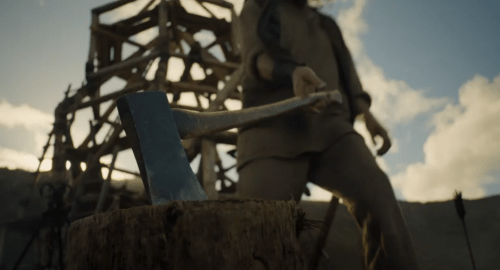
Again, this is just speculation, but this episode went a long way to making me more confident in this prediction. In the novel, Melisandre stays behind at Castle Black when Stannis marches. When instead, on the show, she goes with Stannis, part of me wondered “Oh, crap—how’s she going to save Jon?” But instead she deserts her would-be hero and rides back to Castle Black. Why she chose there instead of, well, anywhere else is puzzling … or perhaps not. Perhaps she wants to be on the front lines when the Walkers come; perhaps, losing faith in Stannis, she sees Jon Snow now as the vehicle of destiny. But the fact that she came back just in time for Jon to get all Caesar-on-the-capitol-steps, seems to suggest that she’ll be the one to bring him back.
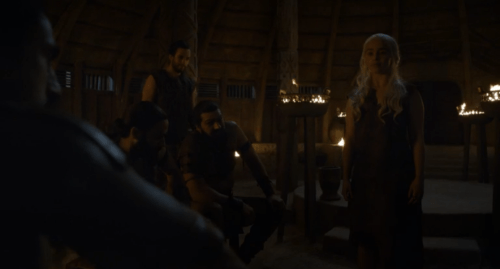
Anyway … that’s my theory. So sob no more for Lord Snow … weep and wail instead for the fact that we now have to wait nine and a half months to see whether my prediction holds true.

The scene, I must say, was well done—and I think I speak for those of us who knew it was coming when I say knowing made it almost worse. Because it is far more obviously a conspiracy than in the novel. In the novel, a handful of knights stay behind with the queen, Shireen, and Melisandre, and for some reason one of them attacks the giant Wun Wun (and is literally torn to pieces for his efforts). During the commotion, while Jon attempts to cool everyone down and prevent the other knights from provoking the giant further, he is set upon by a handful of the more querulous watchmen, men who have been antsy about the wildlings from the start.

Here, it’s a set-up from start to finish. The scene begins with Jon in his study reading messages sent by ravens, discarding them one by one in a discouraged manner that suggests they’re all negative replies to his requests for more men and supplies. Then Olly bursts in excitedly with a piece of news that is guaranteed to bring Jon running: one of the wildlings can tell him about his Uncle Benjen, who disappeared early in the first season. Outside, they are joined by Alliser Thorne, who says the wildling “saw your uncle at Hardhome at the last full moon.” He leads Jon to a cluster of men with torches, and when Jon shoulders his way through he finds not a wildling, but what looks like a grave marker with “traitor” written on it.

And then Act Three, Scene One of Julius Caesar, complete with Jon’s “Et tu, Brute?” moment as a stricken-looking Olly delivers the final blow.

et-tu-olly

So: Jon Snow is assassinated, which is consonant with the novel; the difference between how it happens in the book and on the show, however, has huge implications (assuming, of course, that Melisandre resurrects him—always allowing for the Ned Stark factor, in which case I might have to burn down GRRM’s house personally). In the novel his assassins appear to be a handful of panicking wimps who just can’t even with the wildlings. Here, however, it looks as those most of the Night’s Watch are in on the plot—including Ser Alliser, who is effectively the Watch’s second in command. In the first scenario, a resurrected Jon would just have to deal with a few conspirators. In the show’s version, however, what happens if he comes back? How does he face a unified front of antagonists? Does this mean he’s still part of the Night’s Watch? After all, the oath enjoins you to remain in the Watch until you die—does the assassination mean his watch is now ended? Is this the get-out-of-jail card that frees Jon Snow up for a new destiny, one more in line with the most common theory about his parentage? (Sorry to be coy on this front, but I’m not sure if it’s kosher yet to say it out loud).

Again, we must now wait nine and a half months to find all this out.

Just a few more random thoughts before I close things out on my end:

  • I’m not convinced that Stannis is dead. I watched that scene a few times, and I find it suspicious they don’t show him die, but instead cut from Brienne’s downstroke to Ramsay’s as he kills someone. Why would she spare him? Where did her sword go? I don’t know, but killing Stannis at this point is either (1) a MASSIVE deviation from the novels, or (2) a MASSIVE spoiler for what we can expect in The Winds of Winter. Both are eminently possible, but I’m remaining skeptical until the novel comes out or the next season of the show … whatever comes first.
  • I had assumed that the show was simply dispensing with Sam’s journey to the Citadel. It’s one of the main story threads in A Feast for Crows, with Jon sending Maester Aemon along to keep the oldest living Targaryen away from Melisandre and her hankering for king’s blood. Aemon dies on the journey, but Sam makes it to Oldtown, the city at the southeastern end of Westeros, where the Citadel is located. Jon’s premier reason is so Sam can take up the maester’s duties at the Wall. Sam makes the same argument, but the timing at this point is a bit off: one assumes training to be a maester takes several years, but we got pretty powerful evidence two episodes ago that the Walkers’ attack on the Wall will be sooner rather than later. Still, it at least indicates that Sam’s travails at the Citadel will be a significant enough storyline to keep in the show.

And there we have it. What did everyone think of this season? Nikki? Myself, I thought it was, with the exception of a few hiccups (the Sand Snakes’ hackneyed conspiracy, for example), about the best we’ve seen so far. Certainly it pushed the envelope more than any previous season, and almost certainly caused more viewers to wash their hands of the show than ever before. But the flip side of that was its audacity, both in terms of going off script in a host of creative ways, and in the execution of most of the storylines.

And now we wait. Valar morghulis.

jon-surprise

Nikki: And here’s my final expression of bafflement over Jon Snow: where the hell was Ghost? That dog has always been there when Jon needed him to be, and he’s gone. I’m concerned that Ghost jumped the men who were trying to hurt Gilly, and they knew enough to imprison him somewhere… or at least they’d better make that part of the storyline because otherwise it makes no sense that Jon’s direwolf would abandon him when he needed it the most. (And he’s not dead.)

I agree with you on this season. The way the characters have finally begun coming together — Daenerys and Tyrion, in particular — and storylines are crossing over and converging is something we’ve been waiting for for a very long time. I hate to admit it, but I haven’t missed Bran and his merry band one whit, but it’ll be nice to check in with them next season, which I assume we’ll be doing. Arya’s story just took a dark turn; I’ll be interested in how Cersei takes revenge on the Sparrows, and what will be the future of King’s Landing, including Tommen, Loras, and Margaery. I’m intrigued by your suggestion that Stannis isn’t dead! Strange how that never occurred to me, and usually if it happens off-screen, I don’t believe it happened. Now I’m very intrigued by the possibilities of Stannis and Brienne together, and what that could mean.

But perhaps I’m most excited about the Tyrion and Varys Show coming back.

This has been a rollercoaster of a season filled with our typically VERY long posts, and I wanted to thank our readers for hanging in there with us, and a huge thank-you to Christopher Lockett, who manages to do this year after year and lure me back to a blog that otherwise seems to have tumbleweeds blowing through it. Thank you, sir, and here’s to the long nine-and-a-half-month wait! Ours is the fury, indeed.

Leave a comment

Filed under Game of Thrones