Well, it’s Labour day–which to me is the real New Year’s Eve. My calendar has been tied to the cycle of the academic year since kindergarten, so the desperate festivities that happen on December 31 always have seemed to me … well, misguided.
This September is of particular note in my family, as my niece Morgan is starting university. My brother Matt, his wife Michelle, and my nephew Zachary (himself just two years out from that big step) drove Morgan out to Kingston, Ontario to get her settled at Queens for the next great adventure of her life. As Matt noted, “It was a silent three-hour drive home.” By all reports, Morgan is already thriving, making new friends and signing up to try out for the women’s baseball team. She asked my mother whether it was OK to be both terrified and excited; my mom told her that combination of emotions always signifies something momentous and memorable.
Morgan starting university has an odd symmetry for me. She was born eighteen years ago. I went to meet my new niece at the hospital and then, three days later, hopped in my car to drive to Newfoundland to start my new job at Memorial University. Which means my university career is now old enough … to go to university.
Eighteen years in this job! You’d think that in all that time, as well as the eight years as a TA and sessional lecturer through my PhD at Western, I would have taught a poetry course. But no–this fall will be the first time, as I gear up for ENGL 3262: American Poetry 1922-1968. I was worried it would be undersubscribed, as poetry courses often have been in years past, but it’s full. There’s even one student on the waitlist.
At any rate, I wrote a post on Medium I’ve titled “The Opposite of Poetry.” What, might you ask, is the opposite of poetry? Well, you’ll just have to read it. It’s basically a variation on the introductory lecture I’ll be delivering this week.
I am really looking forward to this course, but also a bit sad. This summer a former professor of mine passed away. I say “former professor,” but I didn’t actually take any classes with Stephen Adams … Stephen was more of an informal mentor, a kind and generous presence. He was technically a specialist in 20th Century American poetry, with an emphasis on such modernists as Ezra Pound, but really his remit was just poetry in general. All of it. He had an encyclopedic mind and an unmatched ear for the music of verse–something he put to use in his book Poetic Designs, which is to my mind the best guide to poetic structure and prosody there is. What’s more, it’s an eminently readable book, no mean feat when your subject is rhyme and meter.
After he retired, Stephen continued researching and writing, producing the book The Patriot Poets just a few years ago. I designed my course syllabus cover in homage:
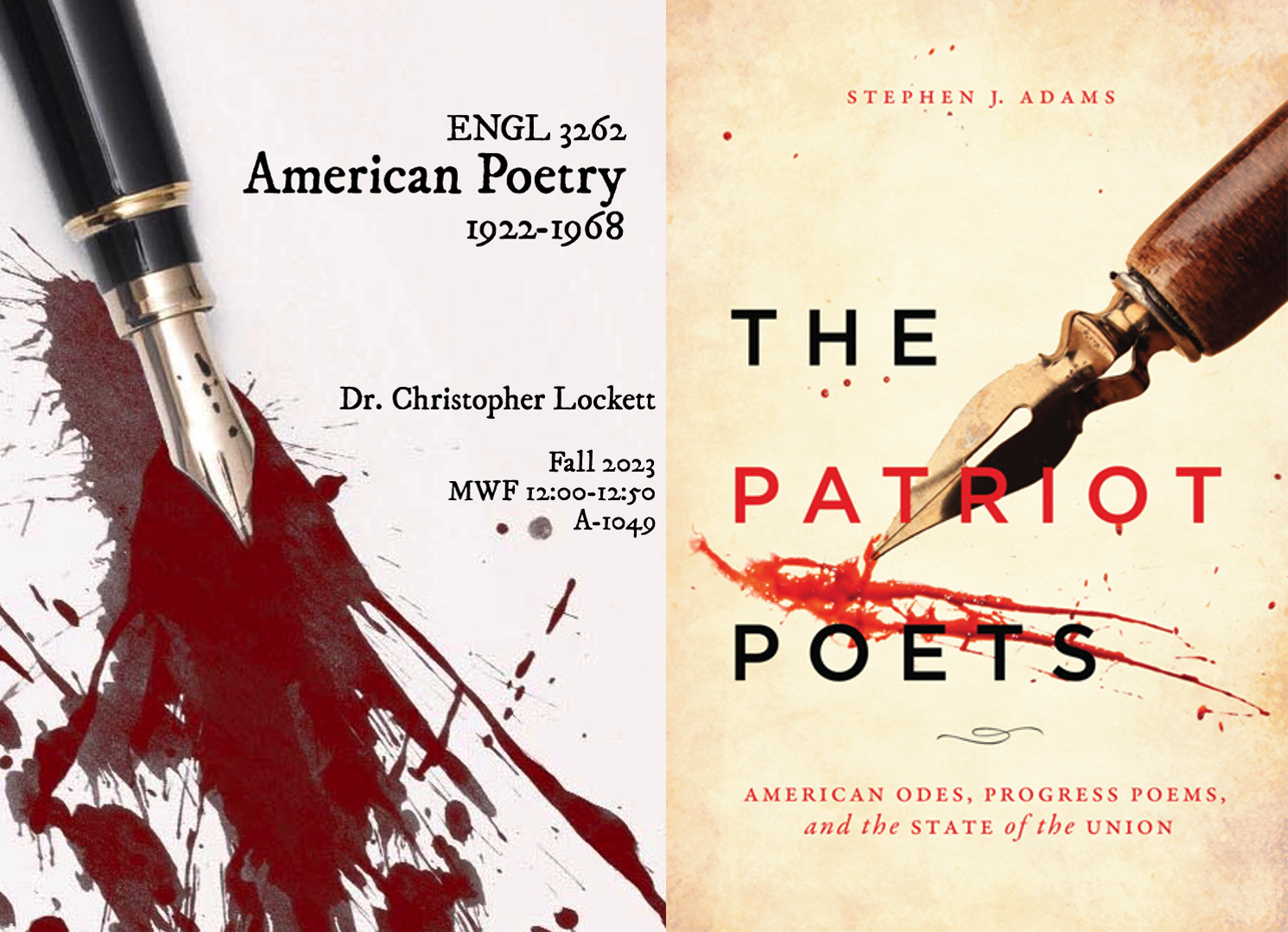
The course, indeed, is dedicated to Stephen. There’s an “In Memorium” section in the syllabus. He and I corresponded quite frequently over the past few years, often when I wanted to pick his massive brain over various poetic topics. I was looking forward to telling him about the course as it unfolded. I’ll have to be happy with carrying his memory forward into the course, both because I’ve assigned Poetic Designs as required reading, but more importantly in the wisdom he shared with me that I can pass on to my students.


 it's all narrative