Haven’t done one of these in a while and was thinking I need to get back into the habit of posting shorter things on a more regular basis, just to keep the pump primed her for the handful of people who actually read my blog (you few, you happy few).
Each of the items I’m mentioning here is worthy of a longer, deeper dive, and indeed I jotted notes in my journal to that end. But discretion being the better part of something or other, I acknowledged to myself that were I to attempt three ambitious posts I would almost certainly end up writing none, and the other more ambitious posts I have in the hopper would also probably fall by the wayside. So without further ado …
My dissertation is now old enough to vote, but it’s not gonna ‘cause it’s all RIGGED, man! I suddenly realized that this past Saturday was the eighteenth anniversary of my doctoral dissertation defense. That day remains one of my fondest memories of which I have little memory—the three hours of the defense itself is muddled in my mind because of the intellectual exhaustion that sets in after a certain point, which was then almost certainly compounded by the drinking that ensued.1
It is however a serendipitous bit of timing. My dissertation was titled “The Conspiratorial Imagination,” and was a study of conspiracy theory and paranoia as expressions of American postmodernity. This week we get into my fourth-year seminar on 21st century apocalypticism in earnest, and we’re diving into the novel Fight Club, the cultural earthquakes caused by 9/11, and the conspiracism endemic to both.
This class is a new iteration on a graduate class I taught in winter 2021; that class began mere days after the January 6 assault on the U.S. Capitol, a concurrence that seemed uncannily appropriate. In one of my more inspired off-the-cuff classroom riffs, I drew a line between Jacob Chansley—aka the QAnon Shaman, aka the most bonkers and thus most indelible image to emerge from a day replete with bonkers and indelible images—and the 1990s-era “crisis of masculinity.” This putative crisis inspired some men, influenced by Robert Bly’s book Iron John (1990), to go on men’s retreats into the woods where they donned loincloths, painted their faces, banged drums, and otherwise attempted to get in touch with some sort of elemental, primal, “authentic” manhood that had been erased by a combination of apathy, an excess of civilization, feminism, and a culture in general that repressed or denigrated “traditional” masculinity.
Then as now, the first novel we did was Fight Club—then it was fortuitous, now it is deliberate. As much as I dislike the novel, it’s a little too apt to my topic not to cover.
That class I titled “The Specter of Catastrophe,” which referred to the post-9/11 shift in disaster narratives from the spectacle of apocalyptic destruction (e.g. the alien ships blowing up New York and L.A. in Independence Day) to a specter haunting the devasted and/or depopulated landscapes of The Road or The Walking Dead. The current version of the course is mostly unchanged, but my focus has shifted slightly. It is now titled “Hopeful Nihilism,” which is partly an inversion of Lauren Berlant’s conception of “cruel optimism,” and a way of characterizing the burn-it-all-down ethos of Trumpism: the inchoate rage at a system perceived as broken coupled with the vague sense that its destruction will bring about better circumstances.2
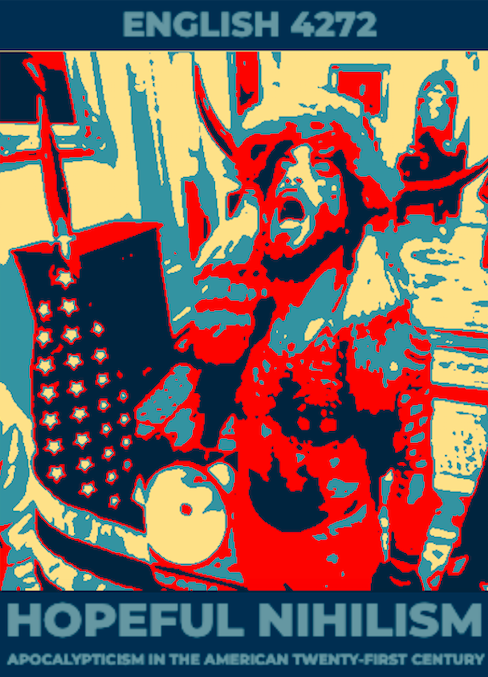
I was at a loss for what image to use for a course poster until it occurred to me to run an image of the QAnon Shaman through the Obama “Hope and Change” poster filter:
It seems appropriate to lean into the conspiracy theory dimension of these topics, especially considering …
Trump unequivocally embraces QAnon. Yup. At a rally in Ohio last week for Hillbilly Elegy author, Republican senate candidate, and shameless political panderer J.D. Vance, Trump delivered a somewhat more scripted speech than is his usual wont while portentous music played underneath his words and a clot of rallygoers saluted him with a gesture that looked as though a bunch of people sieg heiling were also saying “Over there!” That is, a bunch of people raised their arms at an angle with their index fingers pointed, which is apparently a salute that has been adopted by QAnon enthusiasts. The single raised finger is a reference to the Q slogan “Where we go one, we go all” (itself adopted, weirdly, from White Squall, Ridley Scott’s most forgettable film). The music playing beneath Trump’s speech is also, apparently, music specific to the QAnon movement, titled “WWG1WGA,” an acronym for the above slogan.
Trump has been flirting with QAnon for at least as long as journalists have been asking him about it. As with most things that fall into Trump’s orbit, it’s difficult to know whether he actually knows much about it, or whether he just automatically gloms onto it because the adoration of deranged people is impossible for him to resist (the true Q believers refer to Trump as their “God Emperor,” and you can be 100% certain he loves that). But he’s been coy about it—or as coy as someone as unsubtle as Trump can be, anyway—teasing it with his showman’s instincts, but never explicitly going all in with it.
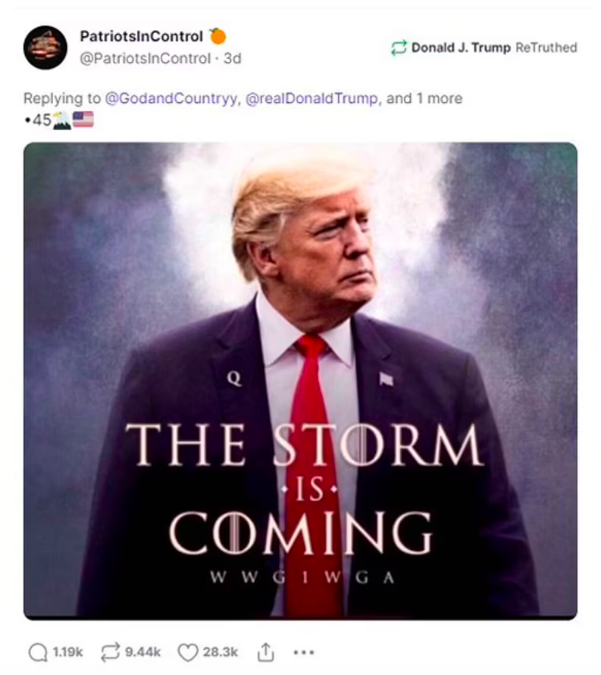
Until now, that is. On Truth Social, his MAGA Twitter knockoff, he retweeted—sorry, “re-truthed”—a post featuring a stern and heroic-looking image of him overlaid with the words “the storm is coming.” For those less familiar with QAnon parlance, the “storm” is key to their mythology—referring to the long-deferred comeuppance for the Deep State and liberal elites (who are all, let’s not forget, human-trafficking pedophile cannibals) in which Trump will reveal his master plan by arresting all the malefactors and re-assuming his rightful place as President of the United States.3
To be clear, Trump isn’t openly accusing Biden and Hillary Clinton of being sex-trafficking pedophiles (yet), but it is notable that he’s now gone as far as he has. He is not a subtle thinker, to put it mildly, but he has a very canny instinct for running a con: he knows how to string his marks along, whether they be MAGA enthusiasts, Republican pols desperate to tap into his base’s enthusiasm, or deranged conspiracists like the Q people (there’s a Venn diagram for you!). Much of that entails not giving more away than you have to, so it’s interesting that he seems to be leaning into it now.
Part of me finds this new development vaguely hopeful, even as it presages worse to come in terms of possible violence and mayhem. The true believers will almost certainly be roused to action of one sort or another, but this also makes it more difficult for his apologists to ignore his worse excesses. It may all indicate that Trump is losing relevance: out of office, off Twitter, ensconced in his Florida retirement home, and subject to ever-escalating investigations over which he has no control, and with ambitious rivals like Florida governor Ron DeSantis (who stars in the third section of this post) smelling weakness, this might be him trying to regain traction. But part of the problem with being outrageous is that you need ever-larger displays of outrageousness to keep the focus on you, especially when others have learned your lessons and deploy them more deftly. And that brings us to …
The politics of cruelty. Though Terry Pratchett’s voluminous Discworld series of over forty novels articulates a sophisticated moral philosophy, one of its principal axioms is a simple premise. Though it is present throughout the novels, it is articulated most specifically by the curmudgeonly witch Granny Weatherwax: evil, she says, comes from treating people—oneself included—like objects. When the earnest young missionary with whom she’s speaking4 protests that surely there are worse crimes than that, she agrees, but points out that most such crimes start with treating people as objects.
Every so often I circle back around to wanting to write an article on the consonance between Pratchett’s philosophy and American pragmatism as defined by thinkers like John Dewey, Judith Shklar, and Richard Rorty. Granny Weatherwax’s assertion is of a piece with Shklar and Rorty’s premise that liberal thought proceeds from the understanding that cruelty is the worst thing we do. This premise informs much of Pratchett’s fiction, so it is perhaps unsurprising that I have taken enormous comfort in rereading his work at the various nadirs of the past several years.
The most dispiriting episodes of what I assume we must needs call the Trump Era have all been those instances that have demonstrated the appetite for cruelty not as an occasional gambit or the collateral damage of a given policy shift, but as a new normal in which cruelty is business as usual. One of the most astute insights on this front was Adam Serwer’s Atlantic essay that observed the cruelty of Trumpism isn’t incidental: the cruelty is the point. This recent idiocy in which Ron DeSantis put asylum seekers fleeing Venezuela on a chartered flight to Martha’s Vineyard is just the most recent iteration of a political ethos more concerned with disruption and “owning the libs” than with any coherent ideological project. The whole exercise was an effort to expose the hypocrisy of affluent liberals, who were supposed to react with horror at having migrants suddenly in their midst. The people of the Vineyard did react with horror, but at DeSantis’ callous use of the refugees (who, as refugees, were in fact in the U.S. legally) as pawns in his political stunt. (The refugees were themselves welcomed and treated well, given food and shelter). Whatever one’s position on the current fraught state of immigration in the U.S., the basic, irreducible humanity of migrants—be they legal or illegal immigrants, refugees or asylum seekers—should always be the central factor in any consideration. Instead, we’re treated once again to the spectacle of a cruel man treating people as objects in the name of scoring points with a rump of the populace mobilized by Trump’s performative cruelty, all in the hope that he might one day take Trump’s place as their venerated leader. All of which tells us that the Trump Era is far from over.
NOTES
1. There was, conveniently, a departmental function that afternoon at the Grad Club, a meet & greet for new graduate students, current ones, and faculty. One of the few vivid memories I have of that day is the newest hire—a young Shakespearean I had become good friends with—come scurrying over with a pen to edit my nametag, putting “Dr.” in front of my name.
2. I proposed an article on this subject for The Conversation apropos of the first anniversary of January 6th. It was published, but the editorial process was laborious and I was profoundly unsatisfied with the finished product … but still, might be worth a read.
3. Depending on who you talk to, the malefactors will either be subjected to humiliating show trials and imprisoned or summarily executed. Like all mythologies, there are variant versions, many of which have been necessitated by the fact that “the storm” has now been promised for six or seven years and has yet to occur.
4. The novel in which this exchange occurs is Carpe Jugulum (1998), the twenty-third Discworld novel; and the missionary in question is named Mightily Oats—which is the short version of his full name, “The Quite Reverend Mightily-Praiseworthy-Are-Ye-Who-Exalteth-Om Oats.” There’s a book to be written just about Sir Terry’s character names.
Having watched the first three episodes of The Rings of Power, I can, with relief and delight, say that I love it so far. It has its problems, which I may or may not talk about in future posts, but the end of episode three left me wishing I could binge the whole season in a day. Always a good sign. Whether it rises to the level of Peter Jackson’s Lord of the Rings films remains to be seen, but it has that potential.1
So, I won’t be talking about the episodes in detail. Nor do I particularly want to talk about the entirely predictable furor that has become commonplace when something like The Rings of Power is released—namely, the howls of protest that arise from the revanchist precincts of a given fan community when the new product is perceived to have been tailored for “woke” political sensitivities. That particular drumbeat has been pounding since the release of the first Rings trailer revealed that the series would feature elves, dwarves, hobbits, and, yes, humans who were not white—something perceived by the usual suspects as a rank betrayal of the source material in the name of political correctness.2
I don’t want to talk about that backlash … but given what I am talking about, I can’t ignore it entirely. Not that it should be ignored, mind you—but there have beenenoughgoodpiecesdealingwithit that I would just be repeating other people’s principal points.
For the moment what I want to try and do is articulate some thoughts on fantasy and mythology, and the perennial compulsion to adapt, refine, revisit, revise, and expand upon stories that are profoundly meaningful to us one way or another. These thoughts are at the front of my mind for two reasons, the first being the recent embarrassment of riches on television of stories meaningful to me: The Rings of Power’s illumination of earlier histories of Middle-earth; House of the Dragon’s return to Westeros; and just a few weeks ago, Netflix’s release of Neil Gaiman’s The Sandman, the only comic book I’ve ever read obsessively.
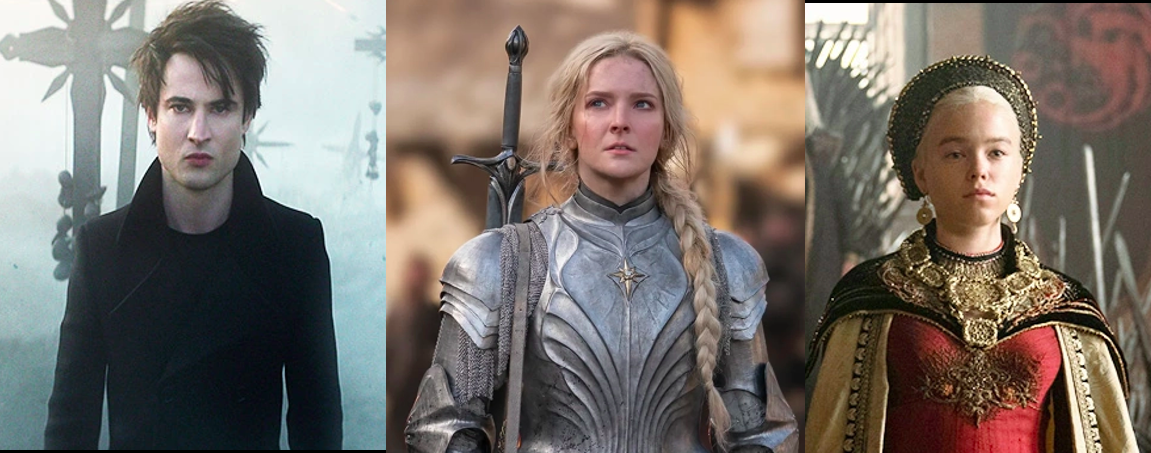
From left: Tom Sturridge as Morpheus in The Sandman; Morfydd Clark as Galadriel in The Rings of Power; and Milly Alcock as Rhaenyra Targaryen in House of the Dragon. I believe I said something in a previous post about the divine right of cheekbones?
The second reason is that this fall I’m teaching a first-year English course called “Imagined Places.” My variation on its theme is modern and contemporary rewritings of Greek myths.3 As part of my preparation I’ve been rereading The Iliad and The Odyssey, which started as an exercise in refreshing my memory of their finer points and has become a joyful reunion with texts I first read in high school, and then again in an intro to classics course I took in my first year of university.
Few works in the history of western literature have inspired quite as much imitation and revision. Keep that in mind as we go, because it’s something I’m going to circle back around to.
My entry point to this discussion is a recent New York Times column by Tolkien scholar Michael Drout, titled “Please Don’t Make a Tolkien Cinematic Universe.” I’ll get into the particulars as I go, but the gist of his argument is that the subtle complexities of Tolkien’s moral universe are beyond the scope of contemporary film and television; unfortunately, the franchise model of cinema that has come to dominate the current entertainment market likely sees Tolkien as a wealth of source material to be exploited. Should Amazon (or, presumably, any other corporate media entity) turn Tolkien’s legendarium into something akin to the Marvel Cinematic Universe, it will inevitably miss, mangle, or pervert the moral vision at the heart of Tolkien’s work.
To be clear, that last sentence is my extrapolation from Drout’s argument—he does not himself say as much in so many words, but it is an accurate summary of his concern. “Is it fair to the legacies of writers like Tolkien,” Drout asks, “to build franchises from their works without their knowledge or permission?” There were attempts to adapt The Lord of the Rings to film while Tolkien was still alive; initial, wary interest on Tolkien’s part turned fairly quickly into antipathy to the whole idea as he rejected one spec script after another, finally declaring that his work was unsuited for film. His biographer recounts a time Tolkien attended a staged version of The Hobbit, at which he frowned every time the play departed from the novel. “So it is hard to believe,” Drout concludes, “that he would have approved of a team of writers building almost entirely new stories with little direct basis in his works.”
Here of course Drout means The Rings of Power, which is drawn from the appendices of The Lord of the Rings.4 It is true that the series is taking a big swing, building out a multi-season story arc from some short summaries and chronologies of the Second Age. Such a sketchy basis, Drout suggests, is a poor foundation on which to build—but then, from what he says, it’s a reasonably good chance Tolkien would similarly have disapproved of Peter Jackson’s films (whose absence from his discussion is an odd omission to which I’ll return). Tolkien’s imagined approval or disapproval is at least somewhat beside the point, however; it is strange to suggest that adaptations and retellings of a given author’s work are somehow “unfair” to their legacy, considering that entire cottage industries thrive on adapting authors like Shakespeare and Jane Austen. Possibly Austen might have liked Clueless, but would probably have looked askance at Pride and Prejudice with Zombies. Does a spectral Shakespeare burn with anger at all the distortions of Hamlet, from Rosencrantz and Guildenstern are Dead to The Lion King?
Or is fifty years not long enough? (Tolkien died in 1973). Must we wait for copyright to expire?
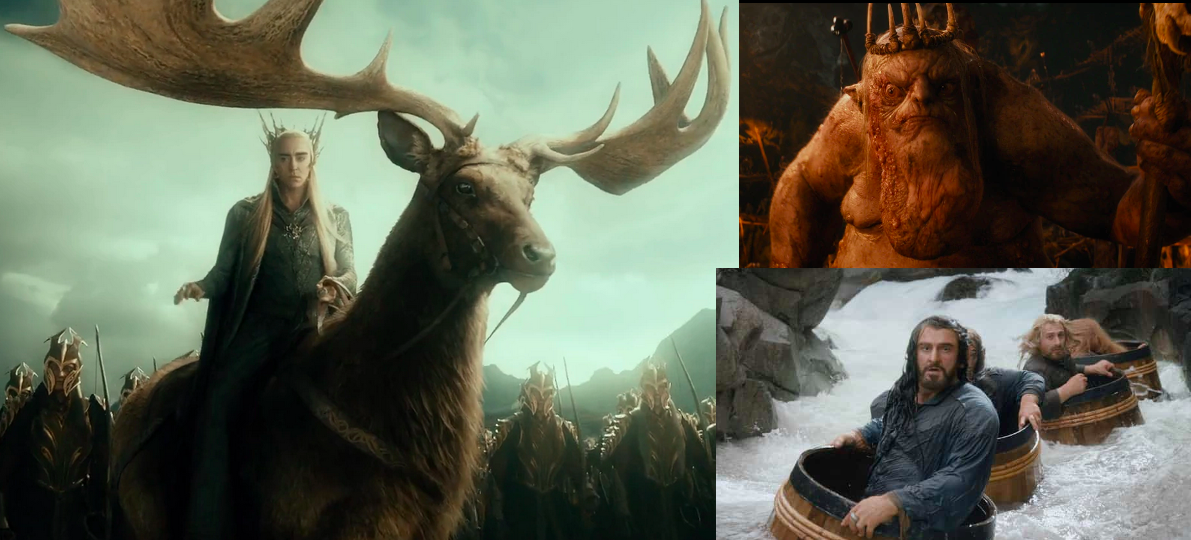
I pose these questions with my tongue only partly in my cheek: I’m trying to read Drout’s concerns generously but can’t help but find them a little disingenuous. Especially considering—as I mentioned above—that he elides any mention of Peter Jackson’s films, except to acknowledge that they exist. This omission is passing strange if for no other reason than that we already have a Tolkien cinematic universe, helpfully spanning the extremes of good and bad—with The Lord of the Rings films displaying both profound respect for their source material and moments of brilliant filmmaking, while The Hobbit films are a hot mess of poor directorial impulse control.
A few of the lowlights from The Hobbit–though I must confess I have always liked Tharanduil’s battle moose.
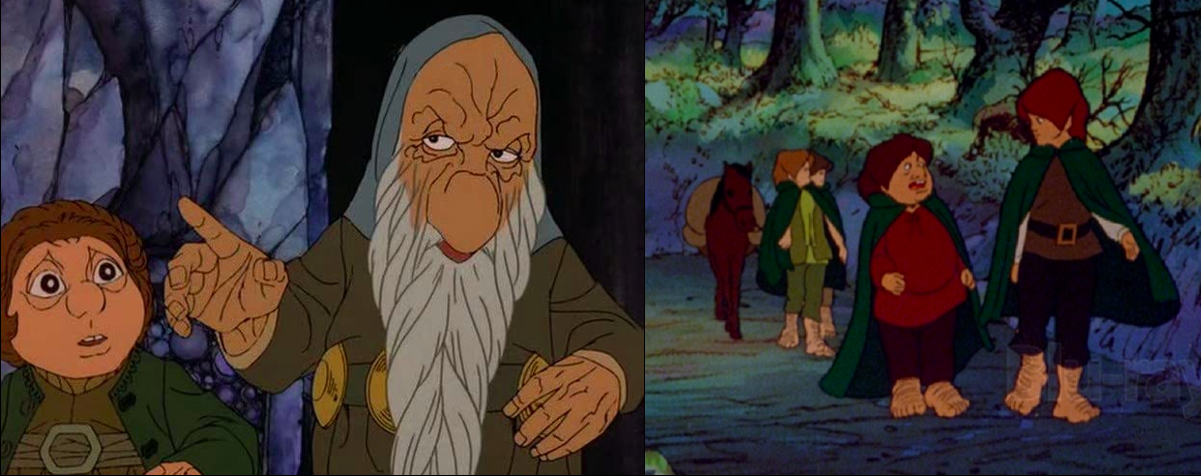
There have also been a handful of animated adaptations, most notably Ralph Bakshi’s somewhat trippy 1978 Lord of the Rings that blended traditional animation with rotoscoping.4
The animated 1977 film of The Hobbitand Ralph Bakshi’s 1978 The Lord of the Rings.
There is also a Lord of the Rings stage musical—of which I was somehow unaware until one of my students in my Tolkien class last year sent me a YouTube link, destroying my blissful ignorance.
And while we’re at it, there have also been a significant number of video games set in Middle-earth, perhaps most notably Lord of the Rings Online, an MMORPG in the mold of World of Warcraft, whose fidelity to the geography, story, and lore of Tolkien’s work would probably impress even Michael Drout.
A still from Lord of the Rings Online. Not sure what’s happening here, but it looks heroic.
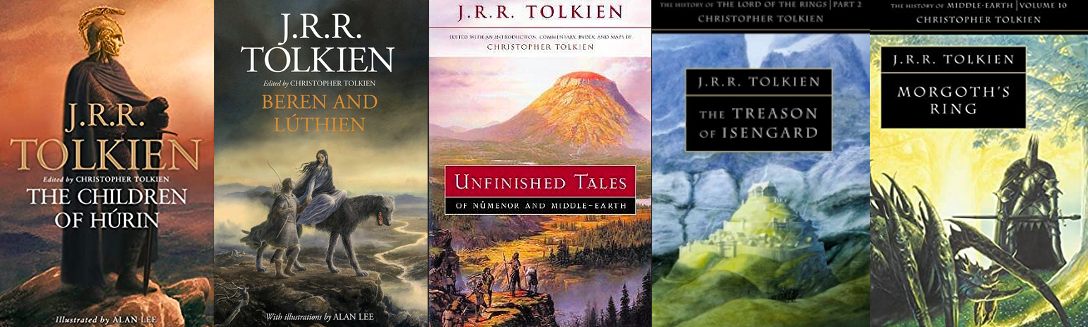
And though Drout’s quibble is with the prospect of a Tolkien cinematic universe, there is also the inescapable fact that there has always been the Tolkien expanded universe. Created initially of course by the man himself with his “mythology”—into which The Hobbit and The Lord of the Rings were folded—it was then enlarged with The Silmarillion and the further eighteen volumes edited by his son Christopher that provided readers with world-building akin to that of the mad encyclopedists of Jorge Luis Borges’ story “Tlön, Uqbar, Orbis Tertius.”
Given this already-existing critical mass of material, it makes me wonder why Drout draws the line at The Rings of Power; why choose this moment to stand athwart the expanding Tolkien universe to yell stop?
The uncharitable reading would be to suggest that this is of a piece with the more overtly revanchist backlash, just more delicately articulated; the more generous reading is to take him at his word and presume that he’s concerned that Amazon will take Tolkien down the same road as Marvel comics have gone, or—and this was a pretty widely shared worry, though now mostly allayed—that TheRings of Power showrunners would feel compelled to create a Game of Thrones clone. Drout, indeed, alludes to both these apprehensions while asserting that “the groupthink produced by the contemporary ecosystems of writers’ rooms, Twitter threads and focus groups” of the “Hollywood of 2022” is innately out of step with Tolkien’s unique sensibility:
The writing that this dynamic is particularly good at producing—witty banter, arch references to contemporary issues, graphic and often sexualized violence, self-righteousness—is poorly suited to Middle-earth, a world with a multilayered history that eschews tidy morality plays and blockbuster gore.6
Citing the fact that the quest of The Lord of the Rings is not the attainment of power but its destruction, and that in bearing the Ring Frodo is too wounded, physically and psychically, to return to his life as it was before, Drout asks, “Can a company as intent upon domination as Amazon really understand this perspective—and adapt that morality to the screen?” While I’m not unsympathetic to anyone taking issue with Amazon as a cultural and societal blight, I find this line of argument bewilderingly obtuse—as if Jeff Bezos were the one writing, casting, costuming, and doing art direction.7
Ultimately, however, my interest in Drout’s argument is that its inconsistencies speak to a broader, more significant issue with Tolkien’s mythology—or rather, with Tolkien as mythology. In the end, whether or not Amazon does a good job with The Rings of Power, or whether they do attempt to build out an expanded cinematic universe on par with Marvel, really matters very little for a fairly simple reason: that Tolkien in fact succeeded in realizing his lifelong goal. He created an enduring mythology.
I will come to that in a moment. But first, for the sake of argument, let’s take some of the protests over The Rings of Power casting of nonwhite actors on their merits. One strain of the “I’m not racist, but—” arguments is that Tolkien’s world is explicitly modeled on Northern European geography, cultures, and ethnicities, and so introducing obviously non-European-looking characters disrupts Tolkien’s design and intent. A refinement on this line of thinking says “OK, sure, introduce Black elves, but make it clear how it serves the story!” In other words, offer an explanation of how there came to be Black elves (and hobbits, and dwarves, and humans).
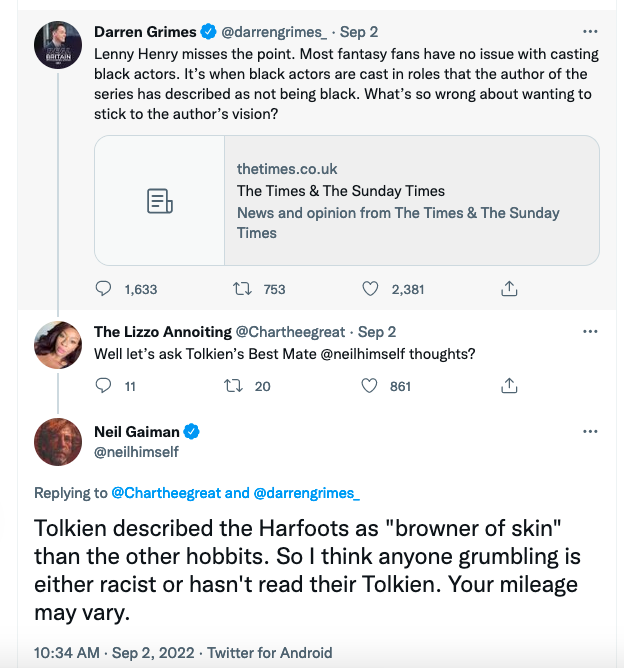
To be fair, I’ve seen such concerns offered with all appearance of sincerity and earnestness,8 and there are, if one has the patience for it, substantive counter-arguments, some of which are based in Tolkien’s own lore. One example that has gone viral is from none other than Neil Gaiman:
There is also the fact that medieval Europe wasn’t quite as monolithically white as is often assumed or depicted, given the vestiges of the multi-ethnic Roman legions left behind after the western empire imploded; there was also, more significantly, brisk trade that brought people from Moorish Spain, North Africa, and the Middle East into regular contact with Europeans of all shades.9
But again, this is all at least partly beside the point I want to make. To be generous, I’ll say that the idea that the casting choices in The Rings of Power are somehow transgressive resides in a vague understanding of the original story as sacrosanct, or that there is an “authentic” Tolkienian vision to which it behooves all adaptors to hew. Leaving aside the simple fact that “authenticity” in this context is always going to be illusory and chimerical, is it really even desirable? Are we obliged to honour every boundary, real and imagined, that an author places on interpretations of their work?
Fortunately such a myopic approach is not practical or feasible. Neither the creative arts nor literary criticism have anything like the legal doctrine of originalism, something of which Tolkien was well aware. He might have gotten stroppy over prospective filmic adaptations or a staged version of The Hobbit, but his lifelong project was to shape a mythology—something he was at his most candid and open about in a long letter to the publisher Milton Waldman. Tolkien was at the time (the letter is undated but most likely written late 1951) shopping around The Lord of the Rings; he was having some difficulty finding a publisher because he was still insisting that LotR should be published in a single volume with the prehistory that would eventually become The Silmarillion. Given the already-epic length of LotR, publishers were understandably reluctant at including the dense mythology. But Tolkien had not yet reconciled himself to jettisoning the narratives of Middle-earth’s First and Second Ages, and he attempted to persuade Waldman by explaining the import of the project to him. “I do not remember a time when I was not building it,” he says. “I have been at it since I could write.” His aim, he says, was not merely to make up stories, but to build a mythology that could supplement what he saw as a lack in his native country:
I was from early days grieved by the poverty of my own beloved country: it had no stories of its own (bound up with its tongue and soil), not of the quality that I sought, and found … in legends of other lands. There was Greek, and Celtic, and Romance, and Germanic, Scandinavian, and Finnish (which greatly affected me); but nothing English, save impoverished chap-book stuff. Of course there was and is all the Arthurian world, but powerful as it is, it is imperfectly naturalized, associated with the soil of Britain but not with English; and does not replace what I felt to be missing.
He goes on to explain that his own mythopoeic project was precisely an attempt to replace what he felt to be missing:
I had a mind to make a body of more or less connected legend, ranging from the large and cosmogonic, to the level of romantic fairy-story—the larger founded on the lesser in contact with the earth, the lesser drawing splendour from the vast backcloths—which I could dedicate simply to: to England: to my country.
Not exactly a humble ambition, something he self-deprecatingly acknowledges as he pleads “Do not laugh!” and adds at the end “Absurd.” But one is put in mind of John Milton’s determination to write an epic poem in English that would be the equal—or the superior—of Homer and Virgil,10 or James Joyce, whose own grandiose ambition was voiced by his alter ego Stephen Dedalus at the end of A Portrait of the Artist as a Young Man when he says, absurdly, “I go to encounter for the millionth time the reality of experience and to forge in the smithy of my soul the uncreated conscience of my race.”
But like Milton and Joyce11, Tolkien succeeded in his seemingly hubristic ambition—he did create a mythology that has taken on its own life as it captured people’s imaginations, albeit not perhaps as he thought it might. His vision, it turns out, was too modest: Middle-earth has transcended England and become the world’s mythology. And like all such mythologies, it is futile to try and contain it.
This is where we come back around to my first-year English class: as I said, we’re looking at modern and contemporary poetry and fiction that reimagines and revisits classic Greek myth, often in ways that give voice to those figures who are ancillary to the main action, or disposable in the name of advancing the plot. The modernist poet Hilda Doolittle (H.D.) writes “Eurydice,” in which the title character excoriates her husband Orpheus for consigning her to Hades—again!—when he couldn’t help but look back at the last moment (you had one job!). Or Canadian poet Don McKay’s reimagining of Icarus as an unapologetic adrenaline junky aiming to get that fall from on high just right.
And then there’s the story of Briseis: The Iliad, long considered the origin point of Western literature, begins when the great warrior Achilles and High King Agamemnon quarrel over Briseis, a Trojan woman who is Achilles’ spoil of war, whom Agamemnon takes from him. In a fit of pique, Achilles retires to his tent to sulk and withholds the forces he commands, allowing the Trojans to turn the tide and bring the fight all the way back to the Greek ships, forcing Agamemnon to swallow his pride and send Briseis back to Achilles. In her novel The Silence of the Girls, Pat Barker retells the events of The Iliad from Briseis’ point of view. This shift of perspective makes explicit the brutality of the war and the way it envelops non-combatants in its implacable, bloody logic: the trauma visited on ordinary people, the slaughter of innocents, the enslavement and rape of the women taken captive. Barker’s novel is harrowing, brilliant, and faithful to The Iliad; it would also, I am certain, be considered a “woke” attempt to tear down the edifice of classic Greek literature if read by those who view a Black elf as a profound betrayal of Tolkien’s legacy.
A thought I’ve had a lot lately is what low esteem Tolkien purists have for Tolkien’s work, given that they seem to believe the slightest deviation from what they perceive as the original or authentic vision is somehow mortally damaging to Tolkien’s legacy. The opposite is the case: Tolkien’s peculiar genius lies in the very capaciousness of his vision. It contains multitudes. Not even Amazon can dent it. And that, of course, is the nature of mythology: if the ancient Romans had had Twitter, there would have been endless arguments in the Greek myth fan community over the Latinizing of the gods’ names; Ovid would have been excoriated for the liberties he took, Virgil for being an Augustan propagandist; and legions of toga-clad hipsters would sniff into their wine (locally sourced, of course) that Hesiod was the only truly authentic mythographer.
But none of the Roman emendations and transformations of the Greek myths had a deleterious effect on Homer, any more than do contemporary novels by PatBarker or MadelineMiller. And no more than The Rings of Power, Ralph Bakshi’s The Lord of the Rings, or even Peter Jackson’s The Hobbit have had on Tolkien’s mythos.
Indeed, in his letter to Milton Waldman, Tolkien is quite clear about how he wants his mythology to be picked up, adapted, and transformed by others: “I would draw some of the great tales in fullness, and leave many only placed in the scheme, and sketched. The cycles should be linked to a majestic whole, and yet leave scope for other minds and hands, wielding paint and music and drama.” And so it has transpired. Whether Tolkien would have liked any of the scholarship, cinema and television, fan fiction, video games, and indeed the whole raft of imitative works that came to comprise the genre of fantasy as we now know it is irrelevant. Such is the risk you take when you create something transcendent.
NOTES
1. I suppose we should appreciate that Jackson established a spectrum of quality against which all future Tolkien adaptations can be measured, with the Lord of the Rings films establishing the high-water mark and The Hobbit films as the nadir.
2. One thing I will say on this point is that two of the things giving the anti-woke crowd the nativist vapours are my favourite parts of the show: namely, the young, impetuous, warrior version of Galadriel played by Morfydd Clark, and the EOC (elf of colour) Arondir, played by Ismael Cruz Cordova. Cordova is veritably mesmerizing as Arondir, playing the character with a tightly controlled mien that just barely hints at a tumult beneath; when in the third episode he breaks out the Legolas-like balletic combat, I don’t think his expression changes. Not that I would want to typecast him, but he’s all set to play a Vulcan should he want to stick with the SF/F thing.
Meanwhile, the complaints about Galadriel are as predictable as they are exhausting, starting with whinges about making a female character the show’s main focus and filter. Beyond that, (some) people can’t seem to reconcile Clark’s smouldering rage and badass combat skills with the cool reserve with which Cate Blanchett endowed the character … never considering, presumably, that that degree of imperturbable self-control is something one earns.
Also, it’s probably mere coincidence that the first thing Galadriel does in the first episode is kill a troll. I’m sure that wasn’t something the writers did in anticipation of the backlash the character would inevitably face.
3. We’re starting with Rick Riordan’s YA novel Percy Jackson and the Olympians: The Lightning Thief; then Pat Barker’s The Silence of the Girls, which is a retelling of The Iliad from the perspective of Briseis, the Trojan woman over whom Achilles and Agamemnon quarrel; Circe by Madeline Miller, which tells the story of the titular witch who plays a small but significant role in The Odyssey; and The Just City by Jo Walton, a novel in which the goddess Athene creates Plato’s Republic out of curiosity, to see if it would actually work. We’ll also be doing a bunch of poetry (Yeats’ “Leda and the Swan,” for example, and William Carlos Williams’ “Landscape with the Fall of Icarus”), as well as reading the relevant myths as recounted in Edith Hamilton’s Mythology (I would have actually preferred to use Stephen Fry’s book Mythos, which is an arch and elegant compendium, but it is too expensive and too long to justify including it, especially when my students would only be reading a fraction of it. I’ve been listening to it on audiobook off and on all summer—read, of course, by Fry himself—and it is a delight).
4. For legal reasons I haven’t entirely parsed, Amazon has the rights to The Lord of the Rings—and its appendices—but not The Silmarillion.
5. The Bakshi LotR was just the first half—that is, all of Fellowship and parts of The Two Towers. He’d planned the film to take place in two parts, but the second film never got made … for reasons that become clear when you watch the first.
6. If current film and television was in fact limited to these possibilities—which seem to be delineated here as Marvel’s archness, Game of Thrones’ sex and violence, and the self-righteousness of a vaguely imagined wokeness—he might just have a point. But I don’t have to reach back fifteen years to The Wire and The Sopranos and the rest of prestige television’s first glut of great work to refute Drout’s characterization. In just the past two or three years, Severance, Better Call Saul, Our Flag Means Death, The Mandalorian, The Plot Against America, Succession, The Good Place, Sex Education, Slow Horses, Yellowjackets, and countless other series have shown the depth and breadth of the subtlety and sophistication that is out there.
7. I’ve written previously on this blog about the contradictions inherent in Bezos’ avowed love of Star Trek, given that Gene Roddenberry’s utopian vision of the future was utopian in part because it imagined a future in which a billionaire class was unthinkable … but this isn’t really what Drout’s on about.
8. Though, really, any time you feel compelled to preface a statement with “I’m not racist, but …” there’s about a 100% chance you’re about to say something racist.
9. Also, not for nothing, but it’s not as if The Rings of Power is doing for the Tolkien expanded universe what Black Panther did for the MCU, in which Martin Freeman and Andy Serkis were the sole Tolkien white guys (get it?). The “diversity” of The Rings of Power, in the end, is a handful of dark faces in a large cast that is otherwise still overwhelmingly white. The fact that so many people are reacting as if the showrunners had put a sign saying “Caucasians need not apply” on the audition room door is perhaps the most telling point.
10. Interestingly, Milton had about as much regard in the end for Arthurian legend as Tolkien did—which is to say moderate regard, but like Tolkien he found it wanting. In the early days of considering what the subject for his epic would be, Milton considered King Arthur, but discarded the idea as too parochial.
11. The rumbling you hear is Harold Bloom spinning in his grave at me mentioning Tolkien in the same sentence as Milton and Joyce.
I’ve received a number of questions from people asking whether I plan to post on a weekly basis about House of the Dragon. Thanks to those who’ve reached out: it is gratifying to know the Game of Thrones posts I did with Nikki over nine (egad!) years were enjoyed. I’m afraid my answer has to be an unsatisfying maybe. I’ll certainly have stuff to say, which may or not make it to my blog, but what I definitely won’t be doing is posting long, detailed blow-by-blow recaps/reviews—not with Nikki, and not by myself. We did that for Game of Thrones eight seasons, and I think it’s safe to say we both hit our saturation point.
And there’s also the fact that one of the reasons we were able to sustain that output—by the end, our posts were averaging over ten thousand words, which even between two people is a lot of text to produce in a couple of days—is because GoT was a genuine cultural phenomenon. It’s not that I wouldn’t be amenable to the idea of doing that sort of thing again, but not with a property like HotD, whose Westrosi territory we’ve mapped pretty thoroughly.
But having written as much as I did—one half of seventy-three 8-12K word posts is a hefty chunk of text—there’s a certain amount of muscle memory there that would be hard to ignore, even if I wanted to. Two episodes has got my mind flexing in some familiar ways, though less with the granular details of the show than with the broader issues it raises that reflect back on GoT, having to do with fantasy and genre and world-building. Also, given that Rings of Power powers up this week, there’s some interesting possibilities arising in the serendipitous juxtaposition of HBO’s ongoing televisual adaptation of George R.R. Martin’s latter-day fantasy and Amazon’s attempt to build upon Peter Jackson’s success in bringing Middle-earth to the screen.
I also watched Wheel of Time, also on Amazon, this past winter. And while I didn’t have anything to say about it at the time—honestly, I was underwhelmed—revisiting it might make for some useful points of comparison.
I commented in my previous post that I was more worried about Rings of Power, because that show has set itself a much more difficult task. The two shows are superficially similar insofar as they’re both prequel-ish narratives adapted from the histories preceding the stories that made people interested in those histories to start with. But beyond that point of comparison, there really is, well, no comparison.
For the moment I’m going to keep my powder dry on The Silmarillion and Tolkien’s legendarium more broadly until I’ve seen the first episode of Rings. Suffice to say that adapting Tolkien’s mythology is not the same kind of task as adapting The Lord of the Rings.
By contrast, HotD is entirely the same kind of task as adapting A Song of Ice and Fire, and is made easier by the fact that all of the heavy lifting—which is to say, its principal world-building, its aesthetic, its general narrative sensibility—was well established by the eight seasons of GoT. Perhaps more significantly, there is much less at stake in HotD: whatever dragon-borne sexytime shenanigans these Targaryens get up to, we know that they’ll still be around for Robert Baratheon to usurp in two centuries or so. We even know, should we wish to consult Fire and Blood, GRRM’s “history” of the Targaryen dynasty, who wins and who loses and how these conflicts either resolve or don’t resolve themselves.
To be clear, when I say there isn’t much at stake, I mean artistically and narratively. HBO has the pots of money it’s investing at stake, so if people’s appetite for GRRM’s particular brand of venality and violence, of incest and intrigue proves to have been exhausted by GoT’s ignominious exit, well, that’s going to result in a fresh batch of firings. But for those of us tuning in, we’re going to be propelled less by where we’re going than how we get there—by which I mean how the episode-to-episode drama unfolds, and how much we invest emotionally in the characters.
The good news, based on episode two, is that they’re off to a good start. The awkwardness of the writing in the first episode was largely smoothed out, and we’re starting to get a better sense of the main players and their motivations. The casting is proving its quality: there are no discordant notes. The MVPs for this episode are Milly Alcock as the young and precocious Rhaenyra and Eve Best as the jaded but shrewd Rhaenys, the Queen that Never Was.
(Something that comes with adapting fantasy is the realization that names as written on the page don’t always do well when spoken out loud. GRRM is usually pretty user-friendly with his Jons and Roberts and Neds, but occasionally we stumble over the jaw-crackers—as Samwise Gamgee might call them—more typical of the genre).
Prince Cheeky McCheekbones and his Precious.
The conversation between the elder and younger Rhaenladies is a good indication of how this series will play out, and a reminder that GoT, for all its spectacle, was at its best when its antagonists fenced with words as well as swords. Rheanyra surprising the meeting on the bridge at Dragonstone and calling her uncle’s bluff was also a close contender for the episode’s high point.
But where GoT was about a multi-front civil war taking place against the looming threat of the Night King’s malevolent return, HotD is about the internecine conflict of a single dynastic family, whose end—as observed above—is foreordained by history. This much is made clear by the opening credits, which retain the theme music of the original and the general aesthetic sensibility, but which unfold within the contained and claustrophobic walls of a castle we assume is the Red Keep.
The unifying symbol of the GoT credits was the armillary sphere containing the sun, soaring above the vastness of Westeros and Essos. From this celestial perspective we were shown the key points of geography relevant to the given episode. By contrast, the armillary sphere is replaced at the start of the HotD credits with the House Targaryen sigil, which connects to all the other nodes within the castle walls with criss-crossing streams of blood—which itself has the triple meaning of referencing familiar bloodlines, one half of the Targaryen motto (which makes me wonder if future credits will feature fire?), and presumably the rivers of blood that will flow once the fighting begins in earnest.
[CORRECTION: The first image we see in the sequence is not the Targaryen sigil, but a sort of bas-relief of dragons flying around a stronghold that, based on King Viserys’ hobby-model (what kings do instead of model trains, presumably), is meant to be old Valyria. This almost certainly means that the stone walls and corridors through which the blood flows are probably those of the model and not, as I’d blithely assumed, the Red Keep. Not that this really changes my interpretation: it’s still contained within the confines of the Targaryen dynasty, except more explicitly, and with the added sense of being yoked to a mythologized history. Still, more food for thought there.]
By way of conclusion, few quick thoughts in no particular order:
The CGI ain’t great. It’s generally OK, but there are those telltale moments when it looks more like a middling video game than a high-budget series. I have to imagine HBO is hedging a bit, which is fair enough: it took GoT a few seasons to establish itself. Before that, they either avoided expensive, large-scale sequences by, say, knocking out Tyrion just before a battle, or limiting themselves to one or two big spectacles a season. It’s fortunate the show proved its worth by the time the dragons got big.
The scene in which King Viserys walks and talks with his possible grade-school bride is one of the squickier sequences I’ve seen in any show, but all credit to Paddy Consadine for exuding profound discomfort throughout.
I’m in equal measures intrigued and concerned with the character Mysaria, Daemon Targaryen’s prostitute-turned-paramour. Her scene following the bridge confrontation, in which she takes Daemon to task for using her as a provocation was powerful, and it makes me hope the writers paid attention to the criticism leveled at GoT’s cavalier use of sexual violence and disposable female characters. And I am concerned, well, because perhaps this will end up being just more of the same.
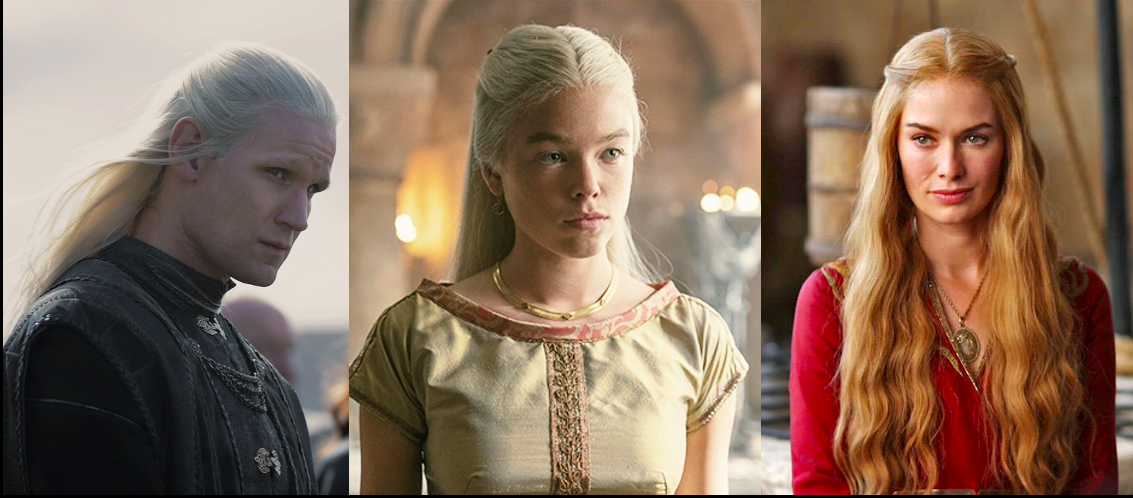
If Daemon and Rhaenyra are any indication, the Targaryens ruled by divine right of cheekbones; two hundred years hence, Cersei Lannister attempts to follow suit.






 it's all narrative