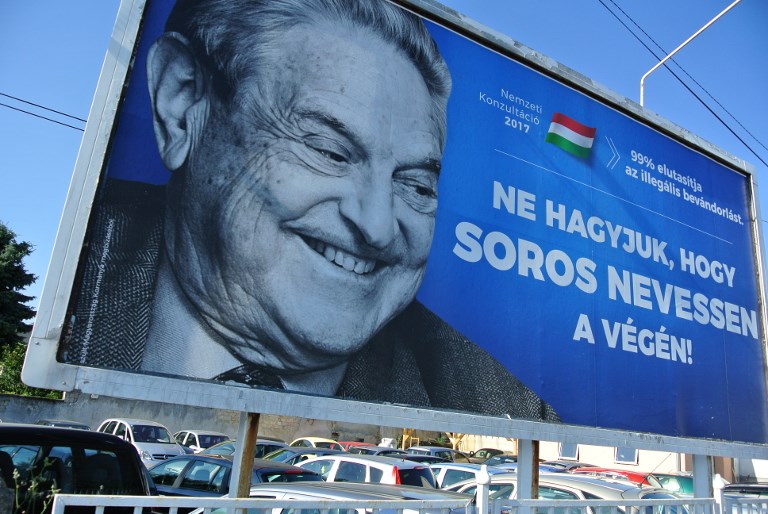
A billboard in Hungary that was part of Viktor Orban’s anti-George Soros campaign, which reads “Let’s not let Soros have the last laugh!” The billboards were taken down in advance of a state visit from israeli prime minister Benjamin Netanyahu, as the campaign had been accused of anti-Semitism.
I’m thinking of writing a one-act play á là Samuel Beckett’s Krapp’s Last Tape that would feature progressive billionaire George Soros alone on stage in a small pool of light with only a stool and an iPhone for company. The play would mostly be him scrolling and muttering to himself in increasingly unhinged non-sequiturs, the gist of which we eventually glean is his existential angst at being the only progressive billionaire, which means he thus must shoulder all of the instinctive hatred for billionaires directed at him from right-wing media and politicians. “Mercer, Murdoch, Musk,” he mutters in what becomes a refrain, “Koch. Bezos. They share. They share. (he scrolls for a long moment, then looks out at the darkness in the direction of the audience) Soros. Alone.”
The play ends midway through the pandemic. Soros grows more and more excited as he reads conspiracy theorists’ attacks on Bill Gates accusing him of putting mind-control chips in the covid vaccine. Soros looks up from his phone with a look of fragile hope on his face as he whispers, “Is thereanother?”
All of which is by way of saying that I’m endlessly fascinated by the way in which George Soros has become the singular bogeyman of the alt-right and Steve Bannon’s cohort, of QAnon conspiracy theorists, and Hungary’s Viktor Orban, current darling of the Tucker Carlson wing of the GOP (lots of overlaps in that Venn diagram, to be sure). When it comes to the question of billionaires, I’m generally in agreement Elizabeth Warren: that is, the existence of billionaires qua billionaires isn’t a problem; a proliferation of multi-billionaires existing concurrently with systemic poverty and hunger, widespread lack of access to health care, and the ongoing climate crisis is a moral obscenity. And while apologists might point to the Gates Foundation’s work to address some of these problems or the fact that Elon Musk has done more to move us toward electric vehicles than any group of people, well, kudos to them … but they remain a vanishingly small minority of the class.
More common is the Atlas Shrugged brand of libertarianism embraced by the likes of Charles Koch and his late brother David, which frames the making of obscene amounts of money as a form of virtue—and which tirelessly spends a huge amount of that money to ensure that it stays with the ultra-rich and furthers their ability to accumulate even more wealth. New Yorker staff writer Jane Mayer wrote an excellent, exhaustive book titled Dark Money in 2017, which did a deep and detailed dive into the vast sums spent by right-wing billionaires in shoring up conservative politicians at all levels of government—from local school boards to congress and the White House—as well as funding climate disinformation campaigns, conservative think tanks like the Claremont Institute and anti-tax organizations like American for Prosperity, as well as a huge constellation of other right-wing causes.
If there was something even approaching numerical parity between progressive and conservative billionaires, each advancing their political interests like Olympian gods choosing sides in the Trojan War, that would be one thing (it wouldn’t resolve or really even ameliorate the structural problems of billionaires in an inequitable society, but it would definitely be a thing). But the fact of the matter is that the conservative vilification of Soros’ progressive agenda is profoundly disingenuous, for the simple reason that he’s all they’ve got to attack, while on their side they’ve got Rupert Murdoch, Peter Thiel, Charles Koch, Robert and Rebekah Mercer—who are collectively worth over $100B compared to Soros’ $8.6B—as well as a legionofothers who actively spend their money on conservative political causes.
Of course, there’s also Warren Buffett, one of the world’s richest men who tends to voice liberal political opinions and is nominally in favour of higher taxes for the rich, but he’s largely left alone—for reasons I won’t speculate on for at least a few paragraphs—by the right-wing mediasphere.
There’s also the fact that, for all his mouthing of liberal platitudes, Buffett doesn’t do much to put his money where his mouth is, and has frequently been accused of hypocrisy by right and left alike. Indeed, even the most “liberal” of billionaires tend more to gesture at social progressivism while accumulating wealth through the most ruthless means available, espousing a libertarianism that puts free speech and legal weed in the same philosophical framework as industry deregulation and low taxes for the über-rich. Even Bill Gates, arguably the most socially conscious of the billionaire class, dismisses the policies of Elizabeth Warren and Bernie Sanders out of hand on the principle that individuals are better judges of how to spend their money than the government.
And if all billionaires—or really, just some of them—established their own versions of the Gates Foundation, he might have something approaching a point. But of course he and George Soros are the outliers, with most billionaires who engage in politics doing so with an eye to entrenching their wealth and facilitating the means to make more.
(If I’m being conspicuous in not mentioning Elon Musk, it’s because Musk is pretty much sui generis, falling into a category of his own devising that is somewhere between chaos muppet and Bond villain. If it weren’t for the fact that the man can tank the stock market with a tweet, it would be amusing to watch his new alt-right fanboys reconcile their love of Musk’s shitposting with the fact that he’s the godfather of the EV revolution).
So pity poor George Soros, the loneliest billionaire. As the sole progressive plutocrat who actually funds progressive causes, he gets the brunt of the paranoid right’s vitriol. Though if you find it puzzling as to the frequency and intensity of the attacks on a man with one sixteenth of Jeff Bezos’ wealth—which is still more money than any one person should be able to possess—you might want to take note of how often the name “Soros” is spoken in the same breath as “globalist.” Or to put it more plainly: it’s the anti-Semitism, stupid.
Two blog posts ago I went on at length about gremlins—both in general, and specific to The Twilight Zone episode “Nightmare at 20,000 Feet.” That episode comprised my most terrifying fictional experience, something that stuck with me for years. My students’ first assignment in my weird fiction class this summer is to write a piece of creative non-fiction describing their most terrifying fictional experience. As I said in that post, I was planning to write my own, by way of example and in the name of fairness—given that we’ll be sharing everyone’s pieces. And I said I would post it here.
So here we are. As might have been obvious from my last gremlins post, this is has become something of a very interesting and serendipitous rabbit hole for me, at once touching on a handful of my current research interests as well as jogging a lot of memories that I want to explore. Possibly this turns into a larger project, possibly it becomes an avenue of self-exploration, possibly both.
So what I’m saying is, don’t be surprised to see more posts here vectoring off from this line of inquiry.
One caveat: I made a point of not consulting with my parents as I wrote this. What I’ve related in this essay is purely based on my memory of the summer of 1984, and as such might be wildly off base. I’ll be interested to see what my Mom and Dad have to say and whether their own memories are at all consonant with mine. If not, I will write a follow-up.
Meanwhile, without further ado …
A man sees something on the wing of the airplane, a vague shape in the rain and lightning. It’s impossible that anything alive could be out there, at this speed and altitude. But he sees it again. He’s a nervous flyer; perhaps his mind is playing tricks. But then he sees it again: person-shaped but inhuman, its intent obviously malevolent as it tears into the wing.
He is the only one who sees it. He cries out to the flight attendants, to his fellow passengers in panic, but they think he’s crazy. He wonders himself if he’s losing his mind. He lets himself be calmed down, he closes the window shade, he tries to sleep. But soon enough, he can’t help himself. He opens the shade, and there is the thing, a creature that looks like a demonic goblin, inches from his face on the other side of the window, staring back at him with something like sadistic glee.
It’s a gremlin, of course, a folkloric imp that emerged in the age of flight, invented by RAF aviators in the years before WWII. Heir to a long lineage of mischievous pixies and fey folk, the gremlin is nevertheless a modern creation, blamed for the frequent and seemingly random malfunctions that bedeviled airplanes during the frantic steeplechase of flight technology between the wars. Gremlins weren’t just the comic antagonists of tall tales told by pilots and crew on airbases between missions—enough airmen were genuinely convinced that gremlins were real, swearing up and down that they’d seen the little bastards on their wings, that concerned psychological papers were written.
Roald Dahl’s first novel was about gremlins. Bugs Bunny tangled with one in the Looney Tunes short “Falling Hare.” Like their folkloric predecessors, gremlins were given to mischief and occasional cruelty, but were mostly depicted as annoyances and not threats.
For a time in my childhood, gremlins were a source of abject terror for me.
***
When I think of gremlins, I think of the summer of 1984. The movie Gremlins was released that June, but I never saw it. I still haven’t. By the time it hit theatres, I’d already been terrified beyond what was strictly reasonable by the gremlin in The Twilight Zone: The Movie, which my father rented for us to watch some time after its release in 1983 and before Gremlins came out. The fourth of the anthology film’s four segments was “Nightmare at 20,000 Feet,” in which a nervous flyer sees a gremlin on the wing of his plane. The moment when he opens the shade to see the demonic creature staring back at him haunted me for years. When I lay in bed at night and the scene came to mind, I hid my head under the covers—trapping myself, for suddenly I couldn’t shake the idea that the gremlin would be perched there, staring at me, if I lowered them.
Lest you assume these were the infantile fears of a young boy, let me clarify: these were the infantile fears of a twelve-year-old.
***
A vicious heat wave hit our Toronto suburb in 1984. It coincided with the Olympics, which ran from the last week of July into August. It was the kind heat that pervades my childhood memories of summer: a baking sun in a clear sky, air that was somehow stifling and humid while also drying the grass to brittle blades that abraded bare feet. Even basements were no refuge.
Our house had no air conditioning, so my father brought the television set outside onto the side deck where there was at least some shade and, occasionally, a breeze. This arrangement appealed to my mother: puritanical about not spending summer days indoors watching the tube, she also hated missing even a moment of Olympic coverage. Because the 1984 Games were held in Los Angeles, the time difference meant our Olympics viewing stretched into the darkening evening. We ate dinner on the deck and watched athletes run, swim, hurl, and paddle. Neighbours came over, bringing beer and wine and snacks. An ongoing PG-13 bacchanal took up residence on our deck and spilled out onto the yellowing grass of our corner lot as the neighbourhood kids staged our own Games.
***
The 1984 Games were notable for the absence of the Soviet Union and most of the Eastern Bloc. They boycotted Los Angeles in retaliation for the United States’ boycott of the 1980 Moscow Games, which had been in protest over Russia’s invasion of Afghanistan.
It was petulance, said one neighbour. Hypocritical, said another. Someone made an off-colour joke I didn’t understand about women’s weightlifting being fair this time. I didn’t grasp the nuances of the politics, but I knew that the Soviet absence tinged everything with vague unease. The 1984 summer Olympics marked the precise midpoint of Ronald Reagan’s presidency and the renewed belligerence of the Cold War. Fears of nuclear conflict that had smouldered like banked coals during the détente years of the 1970s leapt again into open flame. Pious sages of geopolitics kept inching the Doomsday Clock closer to midnight. I was in some ways a literal-minded child and did not quite understand that the clock was metaphorical. Every time its minute hand crept forward, I could not sleep for days afterward.
The Day After, a terrifying depiction of a nuclear exchange, aired in late 1983. It showed the effects of multiple warheads striking in the American heartland, and the immediate aftermath as people suffering from severe radiation poisoning struggle and fight over food and water. The images of the mushroom clouds and their devastation were the most graphic ever portrayed at the time. A disclaimer at the end told the audience that, however ghastly the film’s depiction had been, it was mild in comparison to what the reality would be. With over one hundred million viewers, it was the most-watched television event in history.
I did not see it. I didn’t even know it existed until I heard about it at school from classmates who had watched it. It had been recommended that parents watch it with their children; guides were made available to help with the discussions afterward. But it was not mentioned in my house and I was somehow smart enough not to ask why.
Whatever sleep I lost worrying about the Bomb, my mother’s nuclear anxieties contained multitudes.
***
Because serendipity is like gravity, that summer one of the television channels aired old episodes of The Twilight Zone. Every night when Olympics coverage ended, when most of the neighbours had gone home, while the lawn and the hedges and the asphalt of the street sighed the stored heat of the day into the darkness, we switched over to the slow cascading fall of the theme music and the studied portent in Rod Serling’s voice.
With one exception, I don’t remember which episodes we watched. I do remember my parents waxing on about episodes we didn’t see. “The Monsters Are Due on Maple Street” was a favourite of theirs. To this day I haven’t seen it, but the plot as they related it stuck in my mind: a quiet suburban neighbourhood like ours suffers an inexplicable blackout on a summer night; the neighbours congregate in the street, anxious but not concerned until the lights go on at one house. Suspicion starts to set in: what’s special about that person’s house? Other houses get power, then lose it, until the previously friendly neighbours descend into paranoid warring factions. The episode ends with aliens in a ship overhead, who have been manipulating the power grid, saying, Look, we don’t have to attack them, these humans will turn on each other.
But because serendipity is the gravity of my life, we did see “Nightmare at 20,000 Feet.” I can’t help but think that if I’d seen the original episode first, the spectre of a gremlin on a wing wouldn’t have stuck so deep in my brain’s fear centers. It featured a pre-Star Trek William Shatner as the nervous flyer, demonstrating that scenery-chewing was always his first and best talent. The gremlin itself looked like a man in a monkey suit, less a demon than an ugly teddy bear. Creepy but hardly terrifying.
But in the context of that uncanny summer fortnight, with the memory of the movie gremlin colouring its black and white predecessor with shades of fear out of space, what was otherwise risible had the effect of driving my original horror deeper into my mind. It became existential. Each night when we changed the channel over and the theme music played I felt ill, and yet could not look away. Then one night, the show began with Serling’s narration: “Portrait of a frightened man: Mr. Robert Wilson, thirty-seven, husband, father and salesman,” showing William Shatner (whom I did not then recognize as Captain Kirk) slouched in his airplane seat. We learned he had recently spent time in a sanitarium—that he had been there because he had a nervous breakdown on a flight “on an evening not dissimilar to this one.” On this night, however, Serling tells us, “his appointed destination … happens to be in the darkest corner of the Twilight Zone.”
I could not look away, even as part of me knew just how much this campy earlier iteration was about to make the lingering effects of the later one indelible. I have little memory of the actual episode. What I have is sense memory: the night’s heavy, suffocating humidity, the creak of crickets in the hedge, the smell of the grass, the bilious weight in my belly, and the dread of knowing I would soon have to try and sleep in my dark and stuffy room.
***
In German, “uncanny” is unheimlich, literally unhomely, that which makes you feel not at home. Those two weeks that summer were dislocating: I was not at home in my home, and my home itself felt adrift, untethered. Or perhaps what I felt was the dread certainty that it was always untethered on the world’s currents, and that the feeling of safety remote from the larger world was the illusion—that there was always a gremlin on the wing, marking time in missile silos and in the minds of world leaders. RAF airmen invented gremlins in part to resolve a contradiction: flight technology was advancing by leaps and bounds but left them uniquely vulnerable while aloft. What more unthinkable technology has existed than nuclear weapons? Perhaps for me the gremlin was not a narrative comfort as it was for the aviators, but the certainty of the technology’s malevolence.
***
The Twilight Zone was in many ways the quintessential Cold War TV show, as it embodied the nagging, unhomely sense of something being not quite right, which was the constant undercurrent of the bland suburban order that America was so desperate to convey to itself. It is no surprise that so many of the show’s episodes are set in such innocuous suburbs as Maple Street.
My father, who grew up in just such a suburb, loved The Twilight Zone when he was my age; he told me that he watched the episodes eagerly when they first aired. He was twelve when the show premiered in autumn 1959. He was a different twelve-year-old than me, apparently—I tried to imagine actually enjoying something that unsettling, actually looking forward to seeing what each new episode would bring, but that sensibility was still alien to me. In a few short years I would learn to love horror when I discovered Stephen King and tore through his novels at breakneck speed. But at twelve I had not yet grown out of the nausea the uncanny inspired in me. That two-week stretch of an otherwise idyllic summer was a perfect storm of subtle dislocations: the heat wave, the outdoor television viewing, the constant low-grade party atmosphere, the hours and hours of Olympic coverage, all with the Soviet absence drawing attention to the Cold War’s constant menacing background hum.
It occurs to me that the current state of the U.S. Supreme Court is like climate change … which is to say, it has been ongoing for several decades and visible to anyone willing to see it developing, but it has not prompted anything but the most tepid of responses. And now that we’re experiencing the judicial equivalent of massive flooding, it’s already too late.
(I can’t decide whether this analogy is ironic or appropriate, considering this court is likely to do everything in its power to curtail efforts to reverse climate change).
I remember reading Angels in America for the first time over twenty-five years ago, and coming on the scene in which the notorious lawyer and fixer Roy Cohn—now most famous for having been Donald Trump’s mentor in the 1970s—takes the closeted law clerk Joe Pitt out to dinner and introduces him to a Reagan Justice Department apparatchik who waxes poetic about how they’re seeding the federal bench with conservatives judges. “The Supreme Court will be block-solid Republican appointees,” he enthuses, “and the federal bench—Republican judges like land mines, everywhere, everywhere they turn … We’ll get our way on just about everything: abortion, defense, Central America, family values.”
I remember reading that and thinking, wow, diabolical. And then every time I read a news item about the Federalist Society or the GOP’s SCOTUS-oriented machinations, I thought of that scene. When Mitch McConnell held the late Antonin Scalia’s seat hostage from Merrick Garland, I thought of that scene, and thought of it again through Neil Gorsuch’s hearings and the debacle of Brett Kavanagh, and of course once again when McConnell rushed Amy Coney Barrett’s nomination through in what ended up being the last days of the Trump Administration. By then, the full crisis of the American judiciary (my first inkling of which was from a play that first ran off-Broadway in 1992) was plain to see. The U.S. has been experiencing extreme judicial weather events for over a decade now; the leak of the Samuel Alito-authored decision repealing Roe v. Wade is like knowing not just that there’s a category 5 hurricane just below the horizon, but that such storms and worse are the new normal for the foreseeable future.
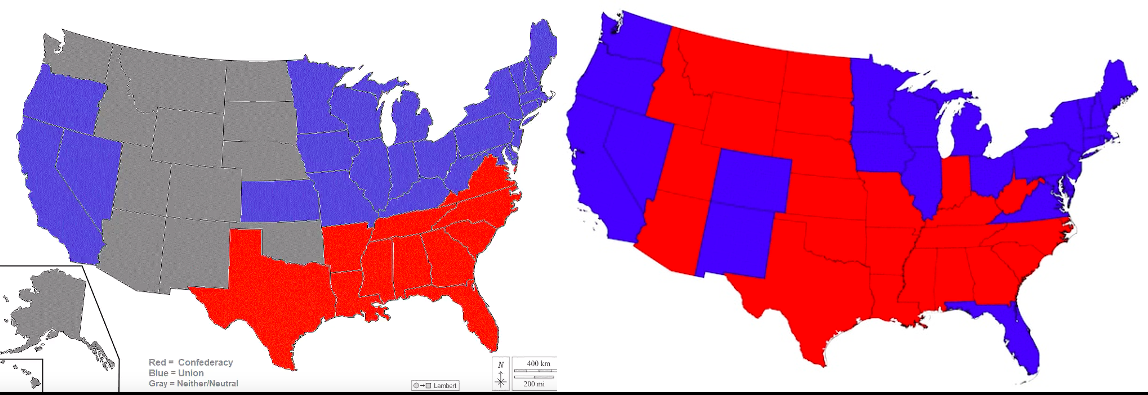
Union/Confederacy left, 2012 election map right.
Recently it has not been uncommon, especially at moments of more acute racial discord, for people to post images on social media juxtaposing recent electoral maps with maps circa 1860. The red states east of the Mississippi River match almost precisely with the Confederacy; and though Biden’s win in Georgia in 2020 is a welcome disruption of that consonance, otherwise the geography or red v. blue has been increasingly entrenched since Nixon first embarked on The Southern Strategy and accelerated a shift that, sadly, was probably inevitable the moment Lyndon Johnson signed the Civil Rights and Voting Rights Acts.
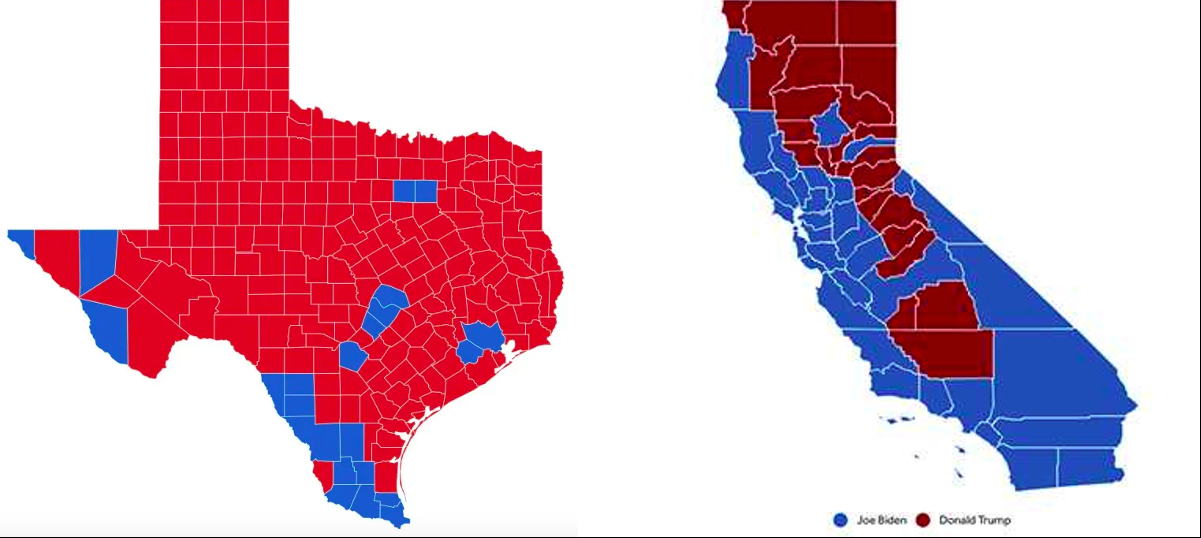
There has also been, especially since Trump’s election—and even more so since the January 6 insurrection—the prospect of a “new civil war” bandied about, from thinkpieces to more than a fewbooks. Most such speculations are careful to point out that any such conflict would necessarily be dramatically different from the actual U.S. Civil War—that the seemingly solid blocks of red and blue that replicate the territory of the Confederacy and the Union are deceptive; that however polarized U.S. politics have become, geographically speaking conservative and liberal factions are far more integrated than the maps allow. The divide is more urban/rural than north/south, with substantial blue enclaves in deep red states, like Austin in Texas, or big red swaths in rural California.
The pandemic shook the etch-a-sketch up somewhat, too, as urban professionals, forced to distance socially and work remotely, found the cheaper rents and real estate outside of their cities more amenable (whether the end of the pandemic reverses that out-migration remains to be seen). And when businesses decamp from states like California to states like Texas, they bring with them work forces that tend to be younger and more socially and politically progressive, muddying things further. (Let’s not forget that Florida governor Ron DeSantis’ current feud with Disney over the “Don’t Say Gay” bill was precipitated not by the company’s management, but by its workers, whose hue and cry over what they saw as an unconscionably tepid response prompted the CEO to, one assumes reluctantly, condemn the bill).
What I’m wondering today is: does the imminent repeal of Roe v. Wade herald a 21st century Great Migration? Except this time, instead of Black Americans fleeing the Jim Crow south, will it be liberals and progressives fleeing Republican states for Democratic ones? Possibly that seems like I’m overstating the case, but I think it will depend on just how far this SCOTUS will take the logic of Alito’s rationale, which is essentially predicated on the assertion that there is no right to privacy enshrined in the U.S. Constitution. Numerous legal experts have weighed in on this speculation, running down a list of landmark Supreme Court cases that hinged at least in part on the premise of the right to privacy: legal contraception, the abolition of anti-sodomy laws, interracial marriage, the prohibition of forced sterilization, and same-sex marriage. Even a year or two ago I would have not worried overmuch about such cases being overturned, thinking it unlikely that any high court, however conservative its composition, would be so retrograde. But this court’s conservative majority has demonstrated a shocking unconcern for even the appearance of being measured and apolitical. They’ve pretty much made it obvious that anything and everything is on the table. That goes also for the current spate of legislating being done by Republican-dominated states: injunctions against teaching the history of slavery, the banning of books, the abolition of sex education, and of course the aforementioned “Don’t Say Gay” bill in Florida, which looks ready to be imitated in other red states. Should any challenges to these pieces of legislation make it to a SCOTUS hearing, how likely do we think it is that the current bench would quash them?
Which makes me wonder at what point being a liberal or progressive living in a blue city in a red state becomes untenable? What would that do to the U.S. polity? There would be a significant brain drain from red states; businesses would be obliged to follow when their pool of qualified workers dried up; urban centers in red states would wither; the current political polarization would in fact become geographical, as the states lost their last vestiges of philosophical diversity and became more and more autonomous, no longer subject to any federal law or statute they felt like challenging before a sympathetic Supreme Court.
That might indeed be a recipe for a “traditional” civil war.
I’ve been thinking a lot about gremlins these past few days.
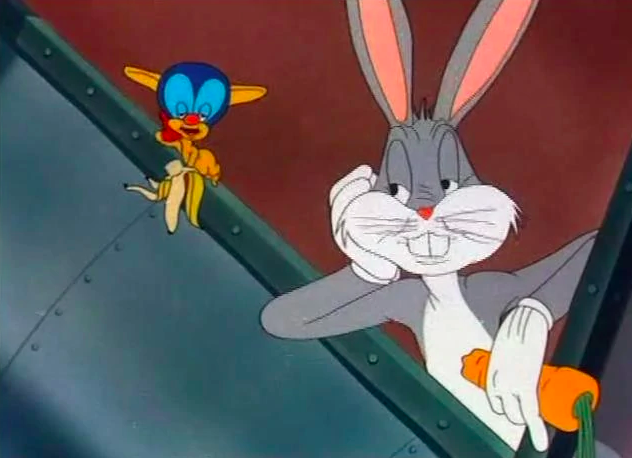
Bugs Bunny and friend in “Falling Hare” (1943)
I’m teaching a graduate seminar on weird fiction this summer (full title: “Weird Fiction: Lovecraft, Race, and the Queer Uncanny”), and the first assignment is a piece of creative non-fiction describing your most terrifying fictional experience; whether in a book, film, or episode of television, what scared you so badly that it stayed with you for weeks or years? I’ve done this kind of assignment before in upper-level classes, and it has always worked well—especially considering that I post everyone’s pieces in the online course shell so they can be read by the entire class. That always leads to a good and interesting class discussion.
In the interests of fairness and by way of example, I’m also writing one. Which is where the gremlins come in.
No, not the 1984 movie. I couldn’t watch it, given that by the time it was released I’d already been traumatized by “Nightmare at 20,000 Feet.” And no, not the original Twilight Zone episode from 1963. If I’d watched that episode—which featured pre-Star Trek William Shatner gnawing the furniture as a nervous flyer who sees a gremlin that looks like a man in a monkey suit on the wing of the plane—it’s possible gremlins wouldn’t have come to haunt my imagination the way they did. The original episode is creepy, to be certain, but not particularly scary; the gremlin is too fluffy and Shatner too Shatner to really evoke terror.
The gremlin that made me terrified to sleep at night for several months was the one in the “Nightmare” segment of the 1983 film The Twilight Zone: The Movie.
The premise is very simple, and most likely familiar even to those who haven’t seen it (not least because it was parodied in a Simpsons Halloween episode): a man who is a nervous flyer to start with is on a plane during a storm. Looking out the window, he sees … something. At first, he thinks his eyes are playing tricks, but then he sees it again. And then again, and each time it becomes clearer that there is a person-shaped thing out there on the wing. Panicked, he calls for a flight attendant, shouting “There’s a man on the wing of this plane!” This, of course, is impossible, and it is obvious that the fight staff and his fellow passengers think him hysterical (it doesn’t help his case that the segment begins with a flight attendant talking to him through the bathroom door as he’s inside having a panic attack). After talking himself down, realizing it would be impossible for a man to be on the wing at this speed and altitude, He accepts a valium from the senior flight attendant, closes the window shade, and attempts to sleep.
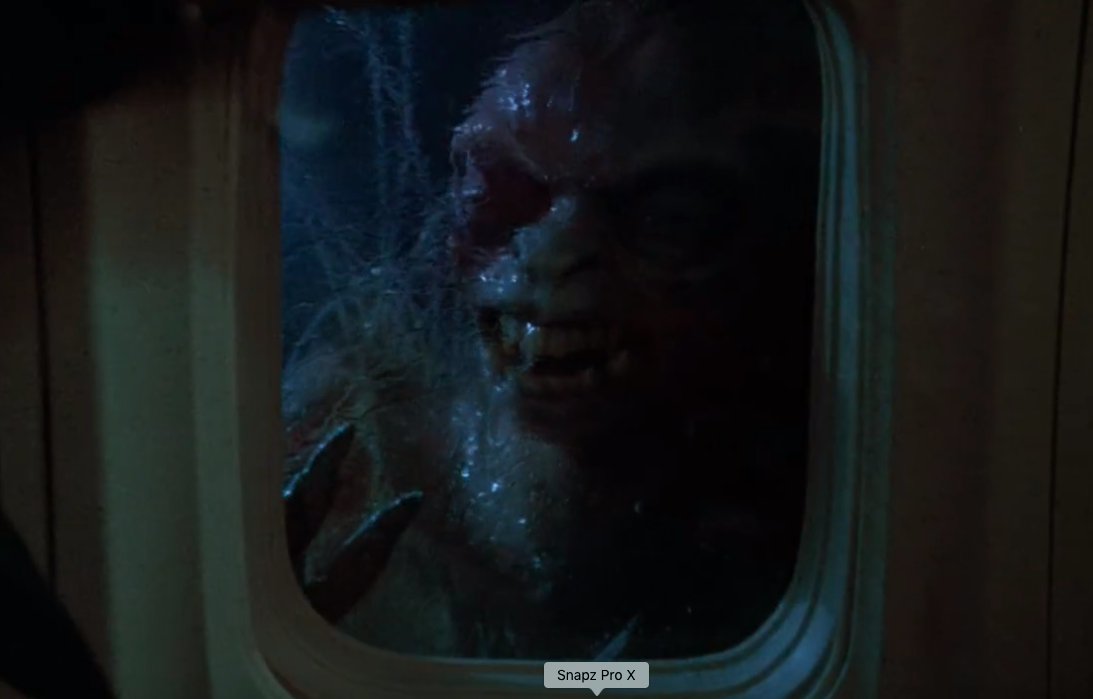
Of course, after a fitful attempt, he can’t help himself, and he opens the shade … and sees the thing, clearly demonic in appearance now, inches away from his face on the other side of the window.
Yup. This bastard.
This was the precise moment it broke my brain and gave me nightmares for months.
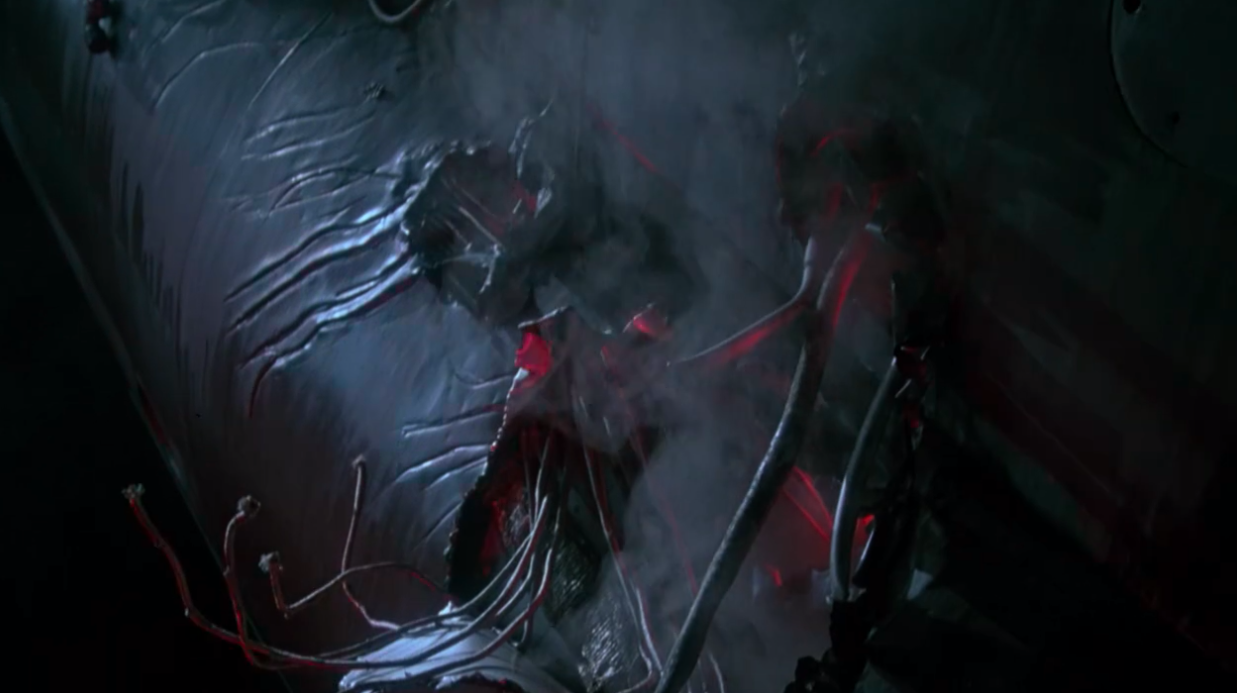
Anyway, TL;DR: either through turbulence or the creature’s sabotage, the plane lurches violently. The man grabs a gun from the sky marshal and shoots at the creature through the window. The cabin decompresses and he’s sucked out halfway. He shoots at the creature again, which wags a clawed finger at him, and flies off into the night. The plane lands and the man is taken off in a straitjacket; meanwhile, the mechanics examining the plane’s engine find it torn to shreds, the metal bent and ripped and covered in deep rents that look like claw marks.
I don’t remember any of the rest of the movie, which had three other segments based on old Twilight Zone episodes. I just remember watching “Nightmare,” being terrified, and my father telling me, in reply to my shocked question, that the creature was a gremlin and that they sabotage airplanes.
Really, it’s amazing I ever willingly went back on a plane.
I’ve been thinking about that and remembering a lot of details about the summer of 1984, which is when this all happened, and trying to work through precisely why it scared me so profoundly. I’ll post that essay here when it’s written; but in the meantime, I’ve been going down the rabbit hole on gremlins and their origins as an element of modern folklore.
***
There’s surprisingly little written about gremlins, which is possibly a function of the twinned facts that, on one hand, they’re basically a sub-species of a vast array of pixies, fairies, goblins, imps, and other mischievous fey creatures from folklore and legend; and on the other hand, they have a recent and fairly specific point of origin. Gremlins emerge alongside aviation (something The Twilight Zone hews to and the movie Gremlins ignores). More specifically, gremlins are creatures of the RAF, and start appearing as an explanation for random malfunctions sometime in the 1920s, becoming a staple of flyers’ mythos by the outbreak of WWII.
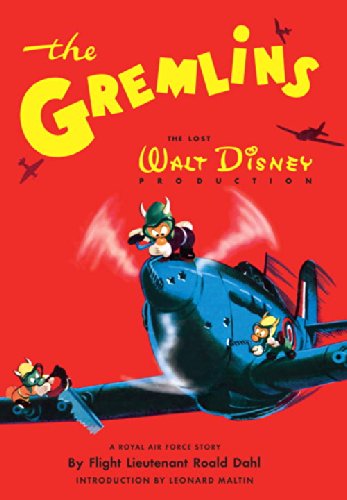
Gremlins, indeed, almost became the subject of a Disney film: author Roald Dahl, who would go on to write Charlie and the Chocolate Factory and James and the Giant Peach among innumerable other beloved children’s books, was an RAF pilot. His first book was titled The Gremlins, about a British Hawker Hurricane pilot named Gus who is first tormented by gremlins, but ultimately befriends them and convinces them to use their technical savvy to help the British war effort. In 1942, Dahl was invalided out of active service and sent to Washington, D.C. as an RAF attaché. The Gremlins brought the RAF mythos of airborne imps to America, and was popular enough that Disney optioned it as an animated feature. Though Disney ultimately did not make the movie, Dahl convinced them to publish it with the animators’ illustrations in 1943. First Lady Eleanor Roosevelt reportedly delighted in reading it to her grandchildren.
There was also a Loony Toons short in 1943 featuring Bugs Bunny being bedevilled by a gremlin on a U.S. airbase.
Though Dahl would later claim to have coined the word “gremlin,” that is demonstrably false, as the term was in use from the 1920s and was featured in Pauline Gower’s 1938 novel The ATA: Women With Wings. The word’s etymology is difficult to determine, with some suggesting it comes from the Old English word gremian, “to vex,” which is also possibly related to gremmies, British English slang for goblin or imp. Another theory holds that the word is a conflation of goblin and Fremlin, the latter being a popular brand of beer widely available on British airbases in the mid-century—one can imagine tales of mischievous airborne creatures characterized as goblins seen after too many Fremlins.
One of the more interesting aspects of the gremlins mythos is how many flyers seemed genuinely convinced of the creatures’ existence. So common were tales of malfunction attributed to gremlins that U.S. aircrews stationed in England picked up on the lore and many of them, like their British counterparts, swore up and down they’d actually seen the little bastards working their mischief. Indeed, one of the only academic pieces of writing I’ve been able to find on gremlins is not the work of a folklorist, but a sociologist: in a 1944 edition of The Journal of Educational Sociology, Charles Massinger writes gravely about the fact that “a phase of thinking that had become prevalent in the Royal Air Force”—which is to say, gremlins—“had subsequently infected the psychology of the American airmen in the present war.” Massinger’s article expresses concern that otherwise rational people, thoroughly trained in advanced aviation, who necessarily possess a “breadth of … scientific knowledge relative to cause and effect of stress on the fighting machine” would be so irrational as to actually believe in the existence of “fantastic imps.”
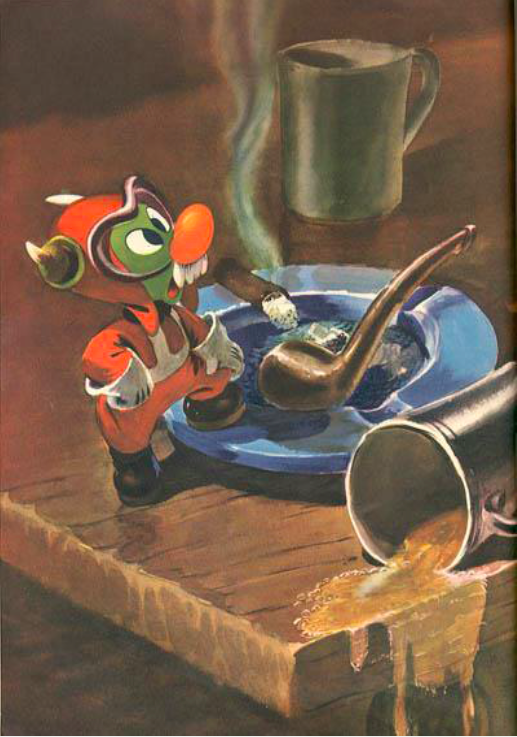
Massinger suggests that it is the stress of combat that gives rise to such fantasies, which is not an unreasonable hypothesis—war zones are notoriously given to all sorts of fabulation. But he says that it is the stress and fear in the moment, in which split-second decisions and reactions that don’t allow for measured and reasoned thought, that short-circuits the sense of reality: “If pilots had sufficient time to think rationally about machine deficiencies under actual flying conditions,” he says, “it is doubtful whether the pixy conception would have crept into their psychology.” Leaden prose aside, this argument strikes me as precisely wrong. The mythology surrounding gremlins may have had its start in panicked moments of crisis while aloft, but it developed and deepened in moments of leisure—airmen relaxing between missions in the officers’ club or mess, probably over numerous bottles of Fremlins. It is indeed with just such a scene that we first learn of gremlins in Dahl’s story.
I do however think Massinger’s instinct isn’t wrong here, i.e. the idea that airmen respond to the stresses of combat and the frustrations of frequent baffling breakdowns with fantasy rather than reason. What he’s missing is the way in which mess-hall fabulation humanizes the experience; the rationality of science and technology in such situations, I would hazard, is not a comfort, no matter how long the flyers have for reflection. The mechanical dimension of air combat is the alienating factor, especially at a point in time when flight was not just new but evolving by leaps and bounds. Roald Dahl’s experience in this respect is instructive: he started the war flying Gloster Gladiator biplanes, which were badly obsolete even when they were first introduced in 1934. By the time he was invalided, he had graduated to Hawker Hurricanes, which in the early days of the war were among the most advanced fighters. By the time he was in the U.S. and Eleanor Roosevelt was reading his first book to her grandchildren, the Allied bombing campaign had already lost more planes than flew in total during the First World War, with the new planes coming off assembly lines not just matching the losses but growing the massive air fleets.
Air travel has become so rote and banal today, and catastrophic airframe malfunctions so rare, that it is difficult to remember what must have been a vastly disorienting experience in WWII: ever-more sophisticated fighters and bombers that were nevertheless plagued by constant mechanical failures, machines of awesome destructive power that were also terribly vulnerable. Bomber crews suffered the highest rates of attrition in the war—about half of them were killed in action—while there was also the constant drumbeat of propaganda about the supposed indomitability of the Allied bombing wings.
When I teach my second-year course on American literature after 1945, I always start with the poetry of Randall Jarrell; specifically, we do a few of his war poems, as a means of emphasizing how the Second World War so profoundly transformed the world and the United States’ place in it, and the extent to which American popular culture became invested in mythologizing the war. Jarrell’s poetry is a disconcertingly ambivalent glimpse of the depersonalization and mechanization of the soldier by a war machine Hollywood has largely erased through such sentimental portrayals as The Longest Day and Saving Private Ryan. “The Death of the Turret-Ball Gunner” is usually the first poem we do, and I can reliably spend an entire class on it despite its brevity. In its entirety:
From my mother’s sleep I fell into the State, And I hunched in its belly till my wet fur froze. Six miles from earth, loosed from its dream of life, I woke to black flak and the nightmare fighters. When I died they washed me out of the turret with a hose.
The final line is a gut-punch, but it’s the first two lines that establish one of Jarrell’s key themes with devastating economy. The speaker “falls” from the warmth and safety of the mother’s care, where he is loved as an individual, to the ownership of the State, where he is depersonalized and expendable—rendered inhuman even before the “black flak” (anti-aircraft fire) unincorporates his body. In the second line, the State is explicitly conflated with the weapon of war, the bomber, of which he has become a mechanism, and which functions as a monstrous womb: the parallel structure of the two lines aligns the “belly” of airplane with the “mother’s sleep.” The “wet fur,” freezing in the sub-zero temperatures of the high altitude, is literally the fur lining his bomber jacket, but also alludes to the lanugo, the coat of fur that fetuses develop and then shed while in the womb.
The bomber functions in Jarrell’s poetry as the exemplar of the Second World War’s inhuman scope and scale, built in vast numbers, visiting vast devastation on its targets—the last two of which were Hiroshima and Nagasaki—but which itself was terribly vulnerable and always in need of more bodies to fill out its crews. The machine itself was never scarce.
All of which might seem like a huge digression from a discussion of gremlins, but it’s really not: gremlins are identifiably kin to myth and folklore’s long history of mischievous “little people,” from pixies to the sidhe. That they emerge as a specific sub-species (sub-genre?) at the dawn of aviation—specifically, military aviation—is suggestive of a similar mythopoeic impulse when faced with the shock of the new. That some airmen become convinced of their existence as the war went on and the air war grew to unthinkable proportions is, I would suggest, pace Massinger, utterly unsurprising.
A Disneyfied gremlin.
SOURCES
Donald, Graeme. Sticklers, Sideburns, and Bikinis: The Military Origins of Everyday Words and Phrases. 2008.
Leach, Maria (ed). The Dictionary of Folklore. 1985.
Massinger, Charles. “The Gremlin Myth.” The Journal of Educational Sociology., Vol. 17 No. 6 (Feb. 1944). pp. 359-367.
Rose, Carol. Spirits, Fairies, Gnomes, and Goblins: An Encyclopedia of the Little People. 1996.




 it's all narrative