Monthly Archives: May 2021

History, Memory, and Forgetting Part 2: Forgetting and the Limits of Defamiliarization

“We cross our bridges when we come to them, and burn them behind us, with nothing to show for our progress except a memory of the smell of smoke, and a presumption that once our eyes watered.”

—Tom Stoppard, Rosencrantz and Guildenstern are Dead

In my first year at Memorial, I taught one of our first-year fiction courses. I ended the term with Martin Amis’ novel Time’s Arrow—a narrative told from the perspective of a parasitic consciousness that experiences time backwards. The person to whom the consciousness is attached turns out to be a Nazi war criminal hiding in America, who was a physician working with Dr. Mengele at Auschwitz. Just as we get back there, after seeing this man’s life played in reverse to the bafflement of our narrator, the novel promises that things will start to make sense … now. And indeed, the conceit of Amis’ novel is that the Holocaust can only make sense if played in reverse. Then, it is not the extermination of a people, but an act of benevolent creation—in which ashes and smoke are called down out of the sky into the chimneys of Auschwitz’s ovens and formed into naked, inert bodies. These bodies then have life breathed into them, are clothed, and sent out into the world. “We were creating a race of people,” the narrative consciousness says in wonder.

Time’s Arrow, I told my class, is an exercise of defamiliarization: it wants to resist us becoming inured to the oft-repeated story of the Holocaust, and so requires us to view it from a different perspective. Roberto Benigni’s film Life is Beautiful, I added, worked to much the same end, by (mostly) leaving the explicit brutalities of the Holocaust offstage (as it were), as a father clowns his way through the horror in order to spare his son the reality of their circumstances. As I spoke, however, and looked around the classroom at my students’ uncomprehending expressions, I felt a dread settle in my stomach. Breaking off from my prepared lecture notes, I asked the class: OK, be honest here—what can you tell me about the Holocaust?

As it turned out, not much. They knew it happened in World War II? And the Germans were the bad guys? And the Jews didn’t come out of it well …? (I’m honestly not exaggerating here). I glanced at my notes, and put them aside—my lecture had been predicated on the assumption that my students would have a substantive understanding of the Holocaust. This was not, to my mind, an unreasonable assumption—I had grown up learning about it in school by way of books like Elie Wiesel’s Night, but also seeing movies depicting its horrors. But perhaps I misremembered: I was from a young age an avid reader of WWII history (and remain so to this day), so I might have assumed your average high school education would have covered these bases in a more thorough manner.[1]

The upshot was that I abandoned my lecture notes and spent the remaining forty minutes of class delivering an off-the-cuff brief history of the Holocaust that left my students looking as if I’d strangled puppies in front of them, and me deeply desiring a hot shower and a stiff drink.

In pretty much every single class I’ve ever taught since, I will reliably harangue my students that they need to read more history. To be fair, I’d probably do that even without having had this particular experience; but I remember thinking of Amis’ brilliant narrative conceit that defamiliarization only works if there has first been familiarization, and it depressed me to think that the passage of time brings with it unfamiliarization—i.e. the memory-holing of crucial history that, previously, was more or less fresh in the collective consciousness. The newfound tolerance for alt-right perspectives and the resurgence of authoritarian and fascist-curious perspectives (to which the Republican Party is currently in thrall) proceeds from a number of causes, but one of them is the erosion of memory that comes with time’s passage. The injunctions against fascism that were so powerful in the decades following WWII, when the memory of the Holocaust was still fresh and both the survivors and the liberators were still ubiquitous, have eroded—those whose first-hand testimonials gave substance to that history have largely passed away. Soon none will remain.

What happens with a novel like Time’s Arrow or a film like Life is Beautiful when you have audiences who are effectively ignorant of the history informing their narrative gambits? Life is Beautiful, not unpredictably, evoked controversy because it was a funny movie about the Holocaust. While it was largely acclaimed by critics, there were a significant number who thought comedy was egregiously inappropriate in a depiction of the Holocaust,[2] as was using the Holocaust as a backdrop for a story focused on a father and his young son. As Italian film critic Paolo Mereghetti observes, “In keeping with Theodor Adorno’s idea that there can be no poetry after Auschwitz, critics argued that telling a story of love and hope against the backdrop of the biggest tragedy in modern history trivialized and ultimately denied the essence of the Holocaust.” I understand the spirit of such critiques, given that humour—especially Roberto Benigni’s particular brand of manic clowning—is jarring and dissonant in such a context, but then again, that’s the entire point. The film wants us to feel that dissonance, and to interrogate it. And not for nothing, but for all of the hilarity Benigni generates, the film is among one of the most heartbreaking I’ve seen, as it is about a father’s love and his desperate need to spare his son from the cruel reality of their circumstances. Because we’re so focused on the father’s clownish distractions, we do not witness—except for one haunting and devastating scene—the horrors that surround them.

In this respect, Life is Beautiful is predicated on its audience being aware of those unseen horrors, just as Time’s Arrow is predicated on its readers knowing the fateful trajectory of Jews rounded up and transported in boxcars to their torture and death in the camps, to say nothing of the grotesque medical “experiments” conducted by Mengele. The underlying assumption of such defamiliarization is that an oft-told history such as the Holocaust’s runs the risk of inuring people to its genuinely unthinkable proportions.[3] It is that very unthinkability, fresher in the collective memory several decades ago, that drove Holocaust denial among neo-Nazi and white supremacist groups—because even such blinkered, hateful, ignorant bigots understood that the genocide of six million people was a morally problematic onion in their racial purity ointment.[4]

“I know nothing, I see nothing …”

They say that tragedy plus time begets comedy. It did not take long for Nazis to become clownish figures on one hand—Hogan’s Heroes first aired in 1965, and The Producers was released in 1967—and one-dimensional distillations of evil on the other. It has become something of a self-perpetuating process: Nazis make the best villains because (like racist Southerners, viz. my last post) you don’t need to spend any time explaining why they’re villainous. How many Stephen Spielberg films embody this principle? Think of Indiana Jones in The Last Crusade, looking through a window into a room swarming with people in a certain recognizable uniform: “Nazis. I hate these guys.” It’s an inadvertently meta- moment, as well as a throwback to Indy’s other phobia in Raiders of the Lost Ark: “Snakes. Why’d it have to be snakes?” Snakes, Nazis, tomato, tomahto. Though I personally consider that a slander against snakes, the parallel is really about an overdetermined signifier of evil and revulsion, one that functions to erase nuance.

Unfortunately, if tragedy plus time begets comedy, it also begets a certain cultural amnesia when historically-based signifiers become divorced from a substantive understanding of the history they’re referencing. Which is really just a professorial way of saying that the use of such terms as “Nazi” or “fascist,” or comparing people to Hitler has become ubiquitous in a problematic way, especially in the age of social media. Case in point, Godwin’s Law, which was formulated by Michael Godwin in the infancy of the internet (1990). Godwin’s Law declares that “As an online discussion grows longer, the probability of a comparison involving Nazis or Hitler approaches one.” This tendency has been added to the catalogue of logical fallacies as the “Reduction ad Hitlerum,” which entails “an attempt to invalidate someone else’s position on the basis that the same view was held by Adolf Hitler or the Nazi Party.”

Perhaps the most egregious recent example of this historical signification was Congresswoman and QAnon enthusiast Marjorie Taylor Greene’s comparison of Nancy Pelosi’s decision to continue requiring masks to be worn in the House of Representatives (because so many Republicans have declared their intention to not get vaccinated) to the Nazi law requiring Jews to wear a gold Star of David on their chests. She said, “You know, we can look back at a time in history where people were told to wear a gold star, and they were definitely treated like second class citizens, so much so that they were put in trains and taken to gas chambers in Nazi Germany. And this is exactly the type of abuse that Nancy Pelosi is talking about.”

To be certain, Greene was roundly condemned by almost everybody, including by many in her own party—even the craven and spineless Minority Leader Kevin McCarthy had some stern words for her—but what she said was different not in kind but in degree from the broader practice of alluding to Nazism and the Holocaust in glib and unreflective ways.[5]

Though this tendency is hardly new—Godwin’s Law is thirty-one years old—it has been amplified and exacerbated by social media, to the point where it made it difficult to find terms to usefully describe and define Donald Trump’s authoritarian tendencies. The ubiquity of Nazi allusions has made them necessarily diffuse, and so any attempt to characterize Trumpism as fascist in character could be easily ridiculed as alarmist and hysterical; and to be fair, there were voices crying “fascist!” from the moment he made that initial descent on his golden escalator to announce his candidacy. That those voices proved prescient rather than alarmist doesn’t obviate the fact that they muddied the rhetorical waters.[6] As the contours of Trump’s authoritarian tendencies came into focus, the fascistic qualities of the Trumpian Right became harder and harder to ignore; bizarrely, they’ve become even more clearly delineated since Trump left office, as the republicans still kowtow to the Mar-A-Lago strongman and move to consolidate minoritarian power.

Historians and political philosophers and a host of other thinkers of all stripes will be years in unravelling the historical and cultural strands of Trump’s rise and the previously unthinkable hold that Trumpism has over a stubborn rump of the electorate; but I do think that one of the most basic elements is our distressing tendency toward cultural amnesia. It makes me think we’re less in need of defamiliarizing history than defamiliarizing all the clichés of history that have become this inchoate jumble of floating signifiers, which allow neo-Nazis and white supremacists to refashion themselves as clean cut khaki-clad young men bearing tiki-torches, or to disingenuously euphemize their racism as “Western chauvinism” and meme their way out of accusations of ideological hatefulness—“It’s just about the lulz, dude.”

There is also, as I will discuss in the third of these three posts, the fact that remembering is itself a politically provocative act. On one hand, the diminution in the collective memory of Nazism and the Holocaust has facilitated the re-embracing of its key tropes; on the other, the active process of remembering the depredations of Western imperialism and the myriad ways in which slavery in the U.S. wasn’t incidental to the American experiment but integral gives rise to this backlash that takes refuge in such delusions as the pervasiveness of anti-white racism.

NOTES


[1] To be clear, this is not to castigate my students; as I’ll be expanding on as I go, historical amnesia is hardly limited to a handful of first-year university students in a class I taught fifteen years ago.

[2] One can only speculate on what such critics make of Mel Brooks’ career.

[3] Martin Amis attempts something similar in his 1985 short story collection Einstein’s Monsters, which is about nuclear war. His lengthy introductory essay “Thinkability” (to my mind, the best part of the book) addresses precisely the way in which military jargon euphemizes the scope and scale of a nuclear exchange, precisely to render the unthinkable thinkable. 

And speaking of humour used to defamiliarize horror: Dr. Strangelove, or How I Finally Stopped Worrying and Learned to Love the Bomb, and General Buck Turgidson (George C. Scott)’s own “thinkability” regarding the deaths in a nuclear war: “Mr. President, we are rapidly approaching a moment of truth, both for ourselves as human beings and for the life of our nation. Now, truth is not always a pleasant thing. But it is necessary now to make a choice, to choose between two admittedly regrettable, but nevertheless distinguishable, post-war environments: one where you got 20 million people killed, and the other where you got 150 million people killed! … Mr. President, I’m not saying we wouldn’t get our hair mussed, but I do say no more than 10 to 20 million killed, tops! Uh, depending on the breaks.”

[4] Which always rested on a tacit contradiction in their logic: it didn’t happen, but it should have.

[5] We see the same tendency, specifically among conservatives, to depict any attempt at raising taxes or expanding social programs as “socialism,” often raising the spectre of “Soviet Russia”—which is about as coherent as one of my favourite lines from Community, when Britta cries, “It’s just like Stalin back in Russia times!”

[6] I don’t say so to castigate any such voices, nor to suggest that they were premature—the contours of Trump’s authoritarian, nativist style were apparent from before he announced his candidacy to anyone who looked closely enough.
1 Comment

Filed under maunderings

History, Memory, and Forgetting Part 1: Deconstructing History in The Underground Railroad

“Yesterday, when asked about reparations, Senate Majority Leader Mitch McConnell offered a familiar reply: America should not be held liable for something that happened 150 years ago, since none of us currently alive are responsible … This rebuttal proffers a strange theory of governance, that American accounts are somehow bound by the lifetime of its generations … But we are American citizens, and thus bound to a collective enterprise that extends beyond our individual and personal reach.”

—Ta-Nehisi Coates, Congressional Hearing on Reparations, 20 June 2019
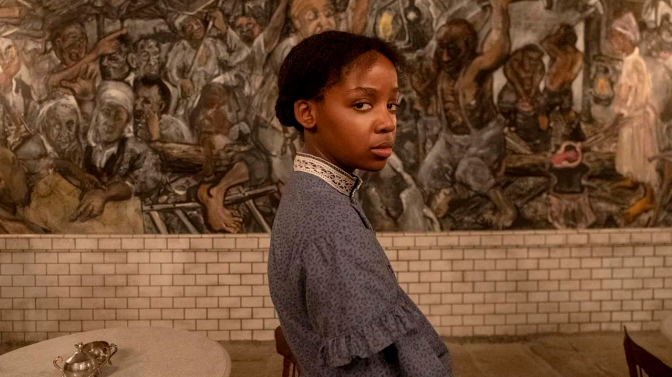
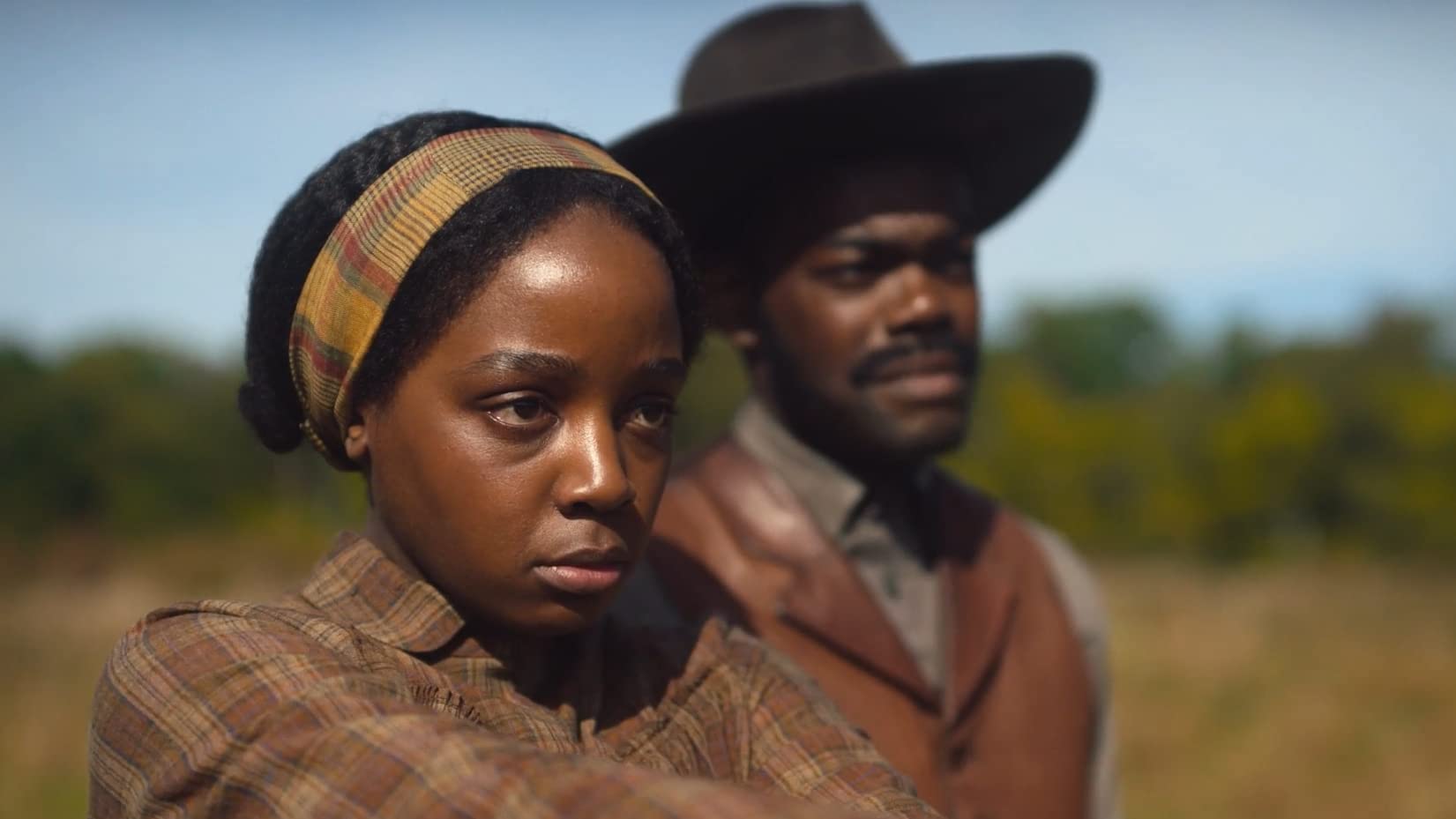
Thuso Mbedu as Cora in The Underground Railroad

I’ve been slowly working my way through Barry Jenkins’ ten-episode adaptation of Colson Whitehead’s novel The Underground Railroad. I’ve been a huge fan of Whitehead’s fiction ever since I got pointed towards his debut novel The Intuitionist; I read The Underground Railroad when it was still in hardcover, and I’ve included it twice in classes I’ve taught. When I saw it was being adapted to television by the virtuoso director of Moonlight and If Beale Street Could Talk, I knew this was a series I wanted to watch.

I was also wary—not because I was concerned about the series keeping faith with the novel, but because I knew it would make for difficult viewing. Whatever liberties Whitehead takes with history (as I discuss below), he is unsparing with the brutal historical realities of slavery and the casual cruelty and violence visited on slaves. It is often difficult enough to read such scenes, but having them depicted on screen—seeing cruelty and torture made explicit in audio and visual—can often be more difficult to watch.

For this reason, for myself at least, the series is the opposite of bingeable. After each episode, I need to digest the story and the visuals and think.

The Underground Railroad  focuses on the story of Cora (Thuso Mbedu), a teenage girl enslaved on a Georgia plantation whose mother had escaped when she was young and was never caught, leaving Cora behind. Another slave named Caesar (Aaron Pierre) convinces her to flee with him. Though reluctant at first, circumstances—the kind of circumstances which make the show difficult viewing—convince her to go. She and Caesar and another slave named Lovey (who had seen them go and, to their dismay, tagged along) are waylaid by slave-catchers. Though Lovey is recaptured, Cora and Caesar escape, but in the process one of the slave-catchers is killed. They make it to a node of the Underground Railroad and are sheltered by a white abolitionist with whom Caesar had been in contact. He then takes them underground to the “station,” where they wait for the subterranean train that will take them out of Georgia.

Because that is the principal conceit of The Underground Railroad: that the rail system spiriting slaves away is not metaphorical, but literal, running through underground tunnels linking the states.

More than a few reviews of the series, and also of the novel on which it is based, have referred to the story as “magical realism.” This is an inaccurate characterization. Magical realism is a mode of narrative in which one group or culture’s reality collides with another’s, and what seems entirely quotidian to one is perceived as magical by the other. That’s not what Colson Whitehead is doing, and, however lyrical and ethereal occasionally dreamlike Barry Jenkin’s visual rendering is, it’s not what the series is doing either. In truth, the literalization of the underground railroad is the least of Whitehead’s historical tweaks: The Underground Railroad is not magical realism, but nor is it alternative history (a genre that usually relies on a bifurcation in history’s progression, such as having Nazi sympathizer Charles Lindbergh win the presidency in 1940 in Philip Roth’s The Plot Against America). The Georgia plantation on which The Underground Railroad begins is familiar enough territory, not discernable from similar depictions in Uncle Tom’s Cabin or 12 Years a Slave. But then as Cora journeys from state to state, each state embodies a peculiar distillation of racism. Cora and Caesar first make it to South Carolina, which appears at first glance to be an enlightened and indeed almost utopian place: there is no slavery, and the white population seems dedicated to uplifting freed Blacks, from providing education and employment to scrupulous health care to good food and lodging. Soon however the paternalistic dimension of this altruism becomes more glaring, and Cora and Caesar realize that the free Blacks of South Carolina are being sterilized and unwittingly used in medical experimentation.

In North Carolina, by contrast, Blacks have been banished, and any found within the state borders are summarily executed. The white people of North Carolina declared slavery a blight—because it disenfranchised white workers. Since abolishing slavery and banishing or killing all of the Black people, the state has made the ostensible purity of whiteness a religious fetish. Cora spends her time in North Carolina huddled in the attic of a reluctant abolitionist and his even more reluctant wife in an episode that cannot help but allude to Anne Frank.

Whitehead’s vision—stunningly rendered in Jenkin’s adaptation—is less an alternative history than a deconstructive one. As Scott Woods argues, The Underground Railroad is not a history lesson, but a mirror, with none of “the finger-wagging of previous attempts to teach the horrors of slavery to mainstream audiences.” I think Woods is being polite here, using “mainstream” as a euphemism for “white,” and he tactfully does not observe that effectively all of such finger-wagging attempts (cinematically, at any rate) have tended to come from white directors and feature white saviour protagonists to make liberal white audiences feel better about themselves.

There are no white saviours in The Underground Railroad; there is, in fact, very little in the way of salvation of any sort, just moments of relative safety. As I still have a few episodes to go, I can’t say how the series ends; the novel, however, ends ambivalently, with Cora having defeated the dogged slave-catcher who has been pursuing her from the start, but still without a clear sense of where she is going—the liberatory trajectory of the underground railroad is unclear and fraught because of the weight of the experience Cora has accrued over her young life. As she says at one point, “Make you wonder if there ain’t no real place to escape to … only places to run from.” There is no terminus, just endless flight.

When I say The Underground Railway is a “deconstructive” history, I don’t use the term in the sense as developed by Jacques Derrida (or at least, not entirely). Rather, I mean it in the more colloquial sense such as employed by, for example, chefs when they put, say, a “deconstructed crème brûlée” on the menu, which might be a smear of custard on the plate speared by a shard of roasted sugar and garnished with granitas infused with cinnamon and nutmeg. If the dish is successful, it is because it defamiliarizes a familiar dessert by breaking down its constituent ingredients in such a way as to make the diner appreciate and understand them anew—and, ideally, develop a more nuanced appreciation for a classic crème brûlée.

So—yes, odd analogy. But I’d argue that Whitehead’s novel is deconstructive in much the same manner, by taking a pervasive understanding of racism and the legacy of slavery and breaking it down into some of its constituent parts. In South Carolina, Cora and Caesar experience the perniciousness of white paternalism of the “white man’s burden” variety—the self-important concern for Black “uplift” that is still invested in the conviction of Black culture’s barbarism and inferiority, and which takes from this conviction license to violate Black bodies in the name of “science.”

Thuso Mbedu as Cora and William Jackson Harper as Royal.

Then in North Carolina, we see rendered starkly the assertion that Blacks are by definition not American, and are essentially seen as the equivalent of an invasive species. This, indeed, was the basis of the notorious 1857 Supreme Court ruling on Dred Scott v. Sandford, which asserted that Black people could not be citizens of the United States. Though that precedent was effectively voided by the thirteenth and fourteenth amendments—which abolished slavery and established citizenship for people of African descent born in America, respectively—the franchise was not effectively extended to Black Americans until Lyndon Johnson signed the Voting Rights act a century after the end of the Civil War. The delegitimization of Black voters continues: while the current Trumpian incarnation of the G.O.P. tacitly depicts anyone voting Democrat as illegitimate and not a “real American,” in practice, almost all of the legal challenges to the 2020 election result were directed at precincts with large numbers of Black voters.

Later in the novel when Cora finds her way to Indiana to live on a thriving Black-run farm, we see the neighbouring white community’s inability to countenance Black prosperity in such close proximity, especially when Black people flourishing reflects badly on their own failures. The pogrom that follows very specifically evokes the Tulsa Massacre of 1921, when a huge white mob essentially burned down a thriving Black part of town.

What’s important to note here is that Whitehead’s deconstructive process is less about history proper than about our pervasive depictions of history in popular culture, especially by way of fiction, film, and television. Or to be more accurate, it is about the mythologization of certain historical tropes and narratives pertaining to how we understand racism. One of the big reasons why so many (white) people are able to guilelessly[1] suggest that America is not a racist nation, or claim that the election of a Black president proves that the U.S. is post-racial, is because racism has come to be understood as a character flaw rather than a systemic set of overlapping cultural and political practices. Think of the ways in which Hollywood has narrated the arc of American history from slavery to the Civil War to the fight for civil rights, and try to name films that don’t feature virtuous white protagonists versus racist white villains. Glory, Mississippi Burning, Ghosts of Mississippi, A Time to Kill, Green Book, The Help[2]—and this one will make some people bristle—To Kill a Mockingbird. I could go on.

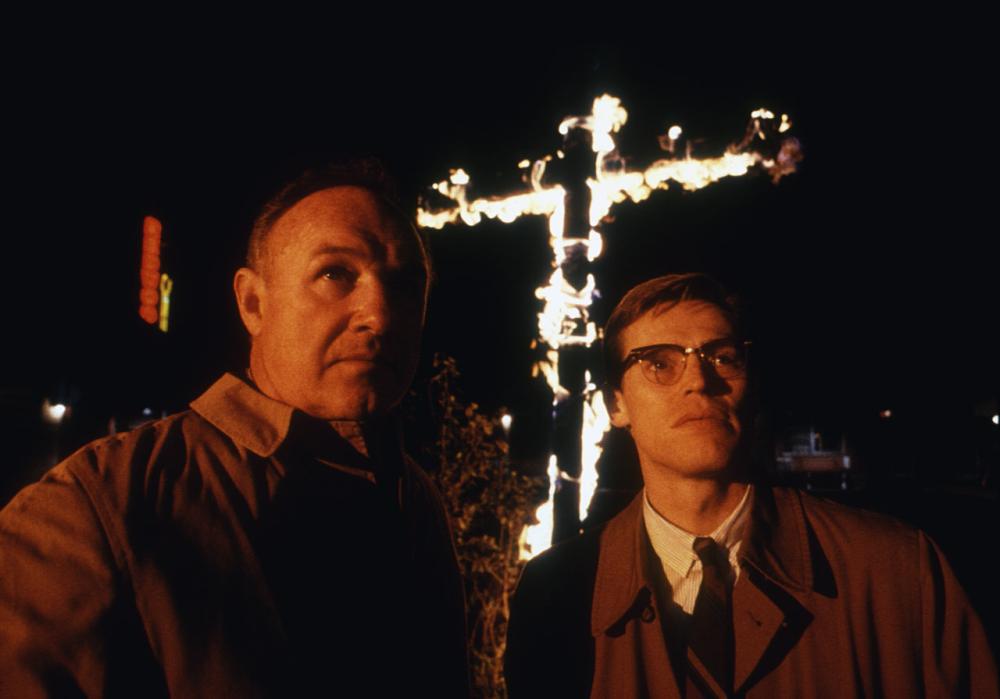
To be clear, I’m not saying some of these weren’t excellent films, some of which featured nuanced and textured Black characters[3] with considerable agency; but the point, as with all systemic issues, is not the individual examples, but the overall patterns. These films and novels flatter white audiences—we’re going to identify with Willem Dafoe’s earnest FBI agent in Mississippi Burning against the Klan-associated sheriff. “That would be me,” we[4] think, without considering how the FBI—at the time the film was set, no less!—was actively working to subvert the civil rights movement and shore up the societal structures subjugating and marginalizing Black Americans, because in this framing, racism is a personal choice, and therefore Dafoe’s character is not complicit in J. Edgar Hoover’s.  

Gene Hackman and Willem Dafoe in Mississippi Burning (1988).

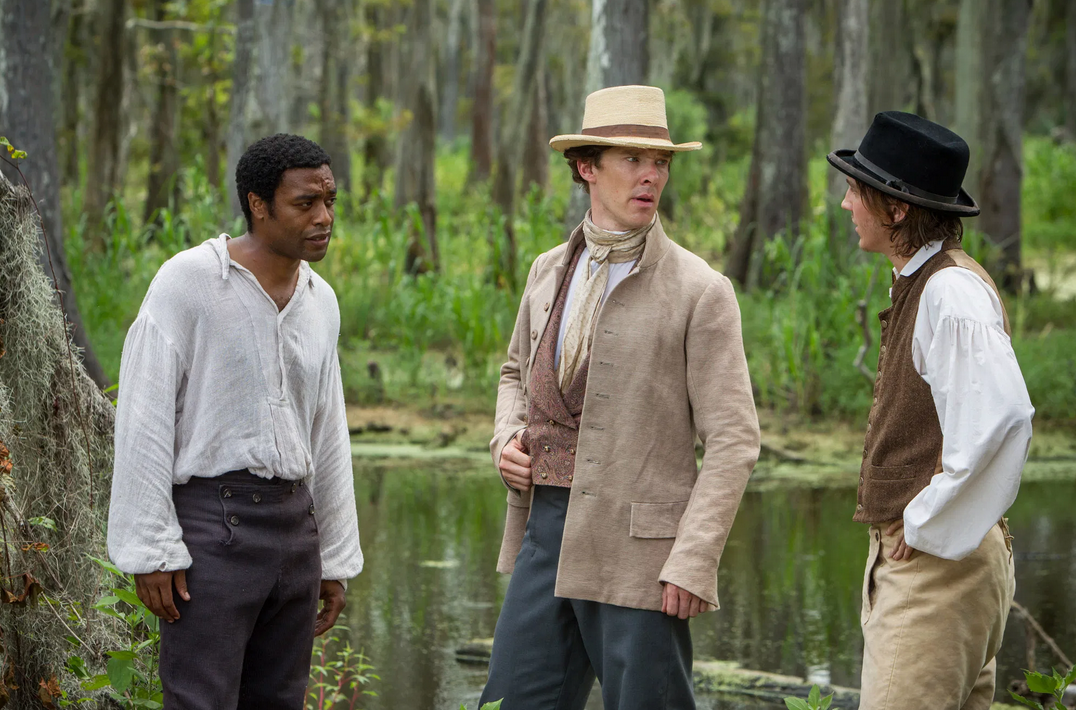
The white saviour tacitly absolves white audiences of complicity in racist systems in this way, by depicting racism as a failing of the individual. It allows us to indulge in the fantasy that we would ourselves be the white saviour: no matter what point in history we find ourselves, we would be the exception to the rule, resisting societal norms and pressures in order to be non-racists. Possibly the best cinematic rebuke to this fantasy was in 12 Years a Slave,[5] in the form of a liberal-minded plantation owner played by Benedict Cumberbatch, who recognizes the talents and intelligence of Solomon Northup (Chiwetel Ejiofor), a formerly free Black man who had been dragooned by thugs and illicitly sold into slavery. Cumberbatch’s character looks for a brief time to be Solomon’s saviour, as he enthusiastically takes Solomon’s advice on a construction project over that of his foreman. But when the foreman violently retaliates against Solomon, Cumberbatch’s character cannot stand up to him. In a more typical Hollywood offering, we might have expected the enlightened white man to intervene; instead, he lacks the intestinal fortitude to act in a way that would have brought social disapprobation, and as a “solution” sells Solomon to a man who proves to be cruelly sociopathic.

Arguing for the unlikeliness that most people could step out of the roles shaped for them by social and cultural norms and pressures might seem like an apologia for historical racism—how can we have expected people to behave differently?—but really it’s about the resistance to seeing ourselves enmeshed in contemporary systemic racism.

Saying that that is Whitehead’s key theme would be reductive; there is so much more to the novel that I’m not getting to. There is, to be certain, a place—a hugely important place—for straightforward historical accounts of the realities and finer details of slavery, even the more “finger wagging” versions Scott Woods alludes to. But what both Whitehead’s novel and Barry Jenkins’ adaptation of it offer is a deconstruction of the simplistic binarism of decades of us vs. them, good vs. bad constructions of racism that give cover to all but the most unapologetically racist white people. The current backlash against “critical race theory”—which I’ll talk more about in the third of these three posts—proceeds to a great extent from its insistence on racism not as individual but systemic, as something baked into the American system.

Which, when you think about it, is not the outrageous argument conservatives make it out to be. Not even close: Africans brought to American shores, starting in 1619, were dehumanized, brutalized, subjected to every imaginable violence, and treated as subhuman property for almost 250 years. Their descendants were not given the full franchise as American citizens until the Civil Rights Act and the Voting Rights Act of 1964 and 1965, respectively. Not quite sixty years on from that point, it’s frankly somewhat baffling that anyone, with a straight face, can claim that the U.S. isn’t a racist nation. One of the greatest stumbling blocks to arriving at that understanding is how we’ve personalized racism as an individual failing. It shouldn’t be so difficult to recognize, as a white person, one’s tacit complicity in a long history without having to feel the full weight of disapprobation that the label “racist” has come to connote through the pop cultural mythologization of racism as a simple binary.

NOTES


[1] I want to distinguish here between those who more cynically play the game of racial politics, and those who genuinely do not see racism as systemic (granted that there is a grey area in between these groups). These are the people for whom having one of more Black friends is proof of their non-racist bona fides, and who honestly believe that racism was resolved by the signing of the Civil Rights Act and definitively abolished by Obama’s election.

[2] The Help, both the novel and the film, is perhaps one of the purest distillations of a white saviour story packaged in such a way to flatter and comfort white audiences. Essentially, it is the story of an irrepressible young white woman (with red hair, of course) nicknamed Skeeter (played by Emma Stone) who chafes against the social conventions of 1963 Mississippi and dreams of being a writer and journalist. TL;DR: she ends up telling the stories of the “help,” the Black women working as domestic labour for wealthy families such as her own, publishes them—anonymously of course, though Skeeter is the credited author—and thus gets the traction she needs to leave Mississippi for a writing career.

I can’t get into all of the problems with this narrative in a footnote; hopefully I don’t need to enumerate them. But I will say that one of the key things that irked me about this story, both the novel and the movie, is how it constantly name-checks Harper Lee and To Kill a Mockingbird as Skeeter’s inspiration. Lee might have given us the archetype of the white saviour in the figure of Atticus Finch, but she did it at a moment in time (it was published in 1960) when the subject matter was dangerous (Mary Badham, who played Scout, found herself and her family shunned when they returned to Alabama after filming ended for having participated in a film that espoused civil rights). By contrast, The Help, which was published in 2009 and the film released in 2011, is about as safe a parable of racism can be in the present day—safely set in the most racist of southern states during the civil rights era, with satisfyingly vile racist villains and an endearing, attractive white protagonist whose own story of breaking gender taboos jockeys for pole position with her mission to give voice to “the help.”

[3] Though to be fair, in some instances this had as much to do with virtuoso performances by extremely talented actors, such as Denzel Washington, Morgan Freeman, and Andre Braugher in Glory. And not to heap yet more scorn on The Help, but the best thing that can be said about that film is that it gave Viola Davis and Octavia Spencer the visibility—and thus the future casting opportunities—that their talent deserves.

[4] I.e. white people.

[5] Not coincidentally helmed by a Black director, Steve McQueen (no, not that Steve McQueen, this Steve McQueen).

Leave a comment

Filed under Uncategorized

Summer Blogging and Finding Focus

Why do I write this blog? Well, it certainly isn’t because I have a huge audience—most of my posts top out at 40-60 views, and many garner a lot less than that. Every so often I get signal boosted when one or more people share a post. The most I’ve ever had was when a friend posted a link of one I wrote about The Wire and police militarization to Reddit, and I got somewhere in the neighbourhood of 1500 views.[1] Huge by my standards, minuscule by the internet’s.

Not that I’m complaining. I have no compunction to chase clicks, or to do the kind of networking on Twitter that seems increasingly necessary to building an online audience, which also entails strategically flattering some audiences and pissing off others. The topics I write about are eclectic and occasional, usually the product of a thought that crosses my mind and turns into a conversation with myself. My posts are frequently long and sometimes rambling, which is also not the best way to attract readers.

Blogging for me has always been something akin to thinking out loud—like writing in a journal, except in a slightly more formal manner, with the knowledge that, however scant my audience is, I’m still theoretically writing for other people, and so my thoughts have to be at least somewhat coherent. And every so often I get a hit of dopamine when someone shares a post or makes a complimentary comment.

I started my first blog when I moved to Newfoundland as a means of giving friends and family a window into my new life here, without subjecting them to the annoyance of periodic mass emails. I posted in An Ontarian in Newfoundland for eight years, from 2005 to 2013, during which time it went from being a digest of my experiences in Newfoundland to something more nebulous, in which I basically posted about whatever was on my mind. I transitioned to this blog with the thought that I would focus it more on professional considerations—using it as a test-space for scholarship I was working on, discussions about academic life, and considerations of things I was reading or watching. I did do that … but then also inevitably fell into the habit of posting about whatever was on my mind, often with long stretches of inactivity that sometimes lasted months.

During the pandemic, this blog has become something akin to self-care. I’ve written more consistently in this past year than I have since starting my first blog (though not nearly as prolifically as I posted in that first year), and it has frequently been a help in organizing what have become increasingly inchoate thoughts while enduring the nadir of Trump’s tenure and the quasi-isolation enforced by the pandemic. I won’t lie: it has been a difficult year, and wearing on my mental health. Sometimes putting a series of sentences together in a logical sequence to share with the world brought some order to the welter that has frequently been my mind.

As we approach the sixth month of the Biden presidency and I look forward to my first vaccination in a week, you’d think there would be a calming of the mental waters. And there has been, something helped by the more frequent good weather and more time spent outside. But even as we look to be emerging from the pandemic, there’s a lot still plaguing my peace of mind, from my dread certainty that we’re looking at the end of American democracy, to the fact that we’re facing huge budget cuts in health care and education here in Newfoundland.

The Venn diagram of the thoughts preoccupying my mind has a lot of overlaps, which contributes to the confusion. There are so many points of connection: the culture war, which irks me with all of its unnuanced (mis)understandings of postmodernism, Marxism, and critical race theory; the sustained attack on the humanities, which proceeds to a large degree from the misperception that it’s all about “woke” indoctrination; the ways in which cruelty has become the raison d’être of the new Right; the legacy of the “peace dividend” of the 1990s, the putative “end of history,” and the legacy of post-9/11 governance leading us to the present impasse; and on a more hopeful note, how a new humanism practiced with humility might be a means to redress some of our current problems.

For about three or four weeks I’ve been spending part of my days scribbling endless notes, trying to bring these inchoate preoccupations into some semblance of order. Reading this, you might think that my best route would be to unplug and refocus; except that this has actually been energizing. It helps in a way that there is significant overlap with a handful of articles I’m working on, about (variously) nostalgia and apocalypse, humanism and pragmatism, the transformations of fantasy as a genre, and the figuration of the “end of history” in Philip Roth’s The Plot Against America and contemporary Trumpist figurations of masculinity.

(Yes, that’s a lot. I’m hoping, realistically, to get one completed article out of all that, possibly two).

With all the writing I’ve been doing, it has been unclear—except for the scholarly stuff—how best to present it. I’ve been toying with the idea of writing a short book titled The Idiot’s[2] Guide to Postmodernism, which wouldn’t be an academic text but more of a user manual to the current distortions of the culture wars, with the almost certainly vain idea of reintroducing nuance into the discussion. That would be fun, but in the meantime I think I’ll be breaking it down into a series of blog posts.

Some of the things you can expect to see over the next while:

  • A three-part set of posts (coming shortly) on history, memory, and forgetting.
  • A deep dive into postmodernism—what it was, what it is, and why almost everyone bloviating about it and blaming it for all our current ills has no idea what they’re talking about.
  • A handful of posts about cruelty.
  • “Jung America”—a series of posts drawing a line from the “crisis of masculinity” of the 1990s to the current state of affairs with Trumpism and the likes of Jordan Peterson and Ben Shapiro.
  • At least one discussion about the current state of the humanities in the academy, as well as an apologia arguing why the humanities are as important and relevant now as they have ever been.

Phew. Knowing me, I might get halfway through this list, but we’ll see. Meantime, stay tuned.

NOTES


[1] David Simon also left a complimentary comment on that one. Without a doubt, the highlight of my blogging career.

[2] Specifically, Jordan Peterson, but there are others who could use a primer to get their facts straight.

2 Comments

Filed under blog business, Uncategorized

My Mostly Unscientific Take on UFOs

Over the past year or so, is has seemed as though whatever shadowy Deep State agencies responsible for covering up the existence of extraterrestrials have thrown up their hands and said “Yeah. Whatever.”

Perhaps the real-world equivalent of The X-Files Smoking Man finally succumbed to lung cancer, and all his subordinates just couldn’t be bothered to do their jobs any more.

Or perhaps the noise of the Trump presidency created the circumstances in which a tacit acknowledgement of numerous UFO sightings wouldn’t seem to be bizarre or world-changing.

One way or another, the rather remarkable number of declassified videos from fighter pilots’ heads-up-displays of unidentified flying objects of odd shapes and flying capabilities has evoked an equally remarkable blasé response. It’s as if the past four years of Trump, natural disasters, civil tragedies, and a once-in-a-century (touch wood) pandemic has so eroded our capacity for surprise that, collectively, we seem to be saying, “Aliens? Bring it.” Not even the QAnon hordes, for whom no event or detail is too unrelated not to be folded into the grand conspiracy have seen fit to make comment upon something that has so long been a favourite subject of conspiracists (“Aliens? But are they pedophile child sex-trafficking aliens?”).

Perhaps we’re all just a bit embarrassed at the prospect of alien contact, like having a posh and sophisticated acquaintance drop by when your place is an utter pigsty. I have to imagine that, even if the aliens are benevolent and peaceful, humanity would be subjected to a stern and humiliating talking-to about how we let our planet get to the state it’s in.

“I’m sorry to have to tell you, sir, that your polar icecaps are below regulation size for a planet of this category, sir.” (Good Omens)

Not to mention that if they landed pretty much anywhere in the U.S., they’d almost certainly get shot at.

And imagine if they’d landed a year ago.

“Take us to your leader!”
“Um … are you sure? Perhaps you should try another country.”
“All right, how do I get to Great Britain?”
“Ooh … no. You really don’t want that.”
“Russia then? China? India? Hungary?”
“Uh, no, no, no, and no.”
“Brazil?”
“A world of nope.”
“Wait–what’s the one with the guy with good hair?”
“Canada. But, yeah … probably don’t want to go there either. Maybe … try Germany?”
“Wasn’t that the Hitler country?”
“They got better.”

You’d think there would be more demand for the U.S. government to say more about these UFO sightings. The thing is, I’m sure that in some sections of the internet, there is a full-throated ongoing yawp all the time for that, but it hasn’t punctured the collective consciousness. And frankly, I don’t care enough to go looking for it.

It is weird, however, considering how we’ve always assumed that the existence of extraterrestrial life would fundamentally change humanity, throwing religious belief into crisis and dramatically transforming our existential outlook. The entire premise of Star Trek’s imagined future is that humanity’s first contact with the Vulcans forced a dramatic reset of our sense of self and others—a newly galactic perspective that rendered all our internecine tribal and cultural squabbles irrelevant, essentially at a stroke resolving Earth’s conflicts.

To be certain, there hasn’t been anything approaching definitive proof of alien life, so such epiphany or trauma lies only in a possible future. Those who speak with any authority on the matter are always careful to point out that “UFO” is not synonymous with “alien”—they’re not necessarily otherworldly, just unidentified.

I, for one, am deeply skeptical that these UFOs are of extraterrestrial origin—not because I don’t think it’s infinitesimally possible, just that the chances are in fact infinitesimal. In answer to the question of whether I think there’s life on other planets, my answer is an emphatic yes, which is something I base on the law of large numbers. The Milky Way galaxy, by current estimates, contains somewhere in the neighbourhood of 100 billion planets. Even if one tenth of one percent of those can sustain life, that’s still a million planets, and that in just one of the hundreds of billions of galaxies in the universe.

But then there’s the question of intelligence, and what comprises intelligent life. We have an understandably chauvinistic understanding of intelligence, one largely rooted in the capacity for abstract thought, communication, and inventiveness. We grant that dolphins and whales are intelligent creatures, but have very little means of quantifying that; we learn more and more about the intelligence of cephalopods like octopi, but again: such intelligences are literally alien to our own. The history of imagining alien encounters in SF has framed alien intelligence as akin to our own, just more advanced—developing along the same trajectory until interplanetary travel becomes a possibility. Dolphins might well be, by some metric we haven’t yet envisioned, far more intelligent than us, but they’ll never build a rocket—in part because, well, why would they want to? As Douglas Adams put it in The Hitchhiker’s Guide to the Galaxy, “man had always assumed that he was more intelligent than dolphins because he had achieved so much—the wheel, New York, wars and so on—whilst all the dolphins had ever done was muck about in the water having a good time. But conversely, the dolphins had always believed that they were far more intelligent than man—for precisely the same reasons.”

To put it another way, to properly imagine space-faring aliens, we have to imagine not so much what circumstances would lead to the development of space travel as how an alien species would arrive at an understanding of the universe that would facilitate the very idea of space travel.

Consider the thought experiment offered by Hans Blumenberg in the introduction of his book The Genesis of the Copernican World. Blumenberg points out that our atmosphere has a perfect density, “just thick enough to enable us to breath and to prevent us from being burned up by cosmic rays, while, on the other hand, it is not so opaque as to absorb entirely the light of the stars and block any view of the universe.” This happy medium, he observes, is “a fragile balance between the indispensable and the sublime.” The ability to see the stars in the night sky, he says, has shaped humanity’s understanding of themselves in relation to the cosmos, from our earliest rudimentary myths and models, to the Ptolemaic system that put us at the center of Creation and gave rise to the medieval music of the spheres, to our present-day forays in astrophysics. We’ve made the stars our oracles, our gods, and our navigational guides, and it was in this last capacity that the failings of the Ptolemaic model inspired a reclusive Polish astronomer named Mikołaj Kopernik, whom we now know as Copernicus.

But what, Blumenberg asks, if our atmosphere was too thick to see the stars? How then would have humanity developed its understanding of its place in the cosmos? And indeed, of our own world—without celestial navigation, how does seafaring evolve? How much longer before we understood that there was a cosmos, or grasped the movement of the earth without the motion of the stars? There would always of course be the sun, but it was always the stars, first and foremost, that inspired the celestial imagination. It is not too difficult to imagine an intelligent alien species inhabiting a world such as ours, with similar capabilities, but without the inspiration of the night sky to propel them from the surface of their planet.[1]

Now think of a planet of intelligent aquatic aliens, or creatures that live on a gas giant that swim deep in its dense atmosphere.

Or consider the possibility that our vaunted intelligence is in fact an evolutionary death sentence, and that that is in fact the case for any species such as ourselves—that our development of technology, our proliferation across the globe, and our environmental depredations inevitably outstrip our primate brains’ capacity to reverse the worst effects of our evolution.

Perhaps what we’ve been seeing is evidence of aliens who have mastered faster than light or transdimensional travel, but they’re biding their time—having learned the dangers of intelligence themselves, they’re waiting to see whether we succeed in not eradicating ourselves with nuclear weapons or environmental catastrophe; perhaps their rule for First Contact is to make certain a species such as homo sapiens can get its shit together and resolve all the disasters we’ve set in motion. Perhaps their Prime Directive is not to help us, because they’ve learned in the past that unless we can figure it out for our own damned selves, we’ll never learn.

In the words of the late great comedian Bill Hicks, “Please don’t shoot at the aliens. They might be here for me.”

EDIT: Stephanie read this post and complained that I hadn’t worked in Monty Python’s Galaxy Song, so here it is:

NOTES


[1] And indeed, Douglas Adams did imagine such a species in Life, the Universe, and Everything—an alien race on a planet surrounded by a dust cloud who live in utopian peace and harmony in the thought that they are the sum total of creation, until the day a spaceship crash-lands on their planet and shatters their illusion. At which point, on reverse engineering the spacecraft and flying beyond the dust cloud to behold the splendours of the universe, decide there’s nothing else for it but to destroy it all.

Leave a comment

Filed under maunderings, Uncategorized

Liz Cheney is as Constant as the Northern Star …

… and I don’t particularly mean that as a compliment.

Literally minutes before he is stabbed to death by a posse of conspiring senators, Shakespeare’s Julius Caesar declares himself to be the lone unshakeable, unmoving, stalwart man among his flip-flopping compatriots. He makes this claim as he arrogantly dismisses the petition of Metellus Cimber, who pleads for the reversal of his brother’s banishment. Cimber’s fellow conspirators echo his plea, prostrating themselves before Caesar, who finally declares in disgust,

I could be well moved if I were as you.
If I could pray to move, prayers would move me.
But I am constant as the northern star,
Of whose true-fixed and resting quality
There is no fellow in the firmament.
The skies are painted with unnumbered sparks.
They are all fire and every one doth shine,
But there’s but one in all doth hold his place.
So in the world. ‘Tis furnished well with men,
And men are flesh and blood, and apprehensive,
Yet in the number I do know but one
That unassailable holds on his rank,
Unshaked of motion. And that I am he.

Caesar mistakes the senators’ begging for weakness, not grasping that they are importuning him as a ploy to get close enough to stab him until it is too late.

Fear not, I’m not comparing Liz Cheney to Julius Caesar. I suppose you could argue that Cheney’s current anti-Trump stance is akin to Caesar’s sanctimonious declaration if you wanted to suggest that it’s more performative than principled. To be clear, I’m not making that argument—not because I don’t see it’s possible merits, but because I really don’t care.

I come not to praise Liz Cheney, whose political beliefs I find vile; nor do I come to bury her. The latter I’ll leave to her erstwhile comrades, and I confess I will watch the proceedings with a big metaphorical bowl of popcorn in my lap, for I will be a gratified observer no matter what the outcome. If the Trumpists succeed in burying her, well, I’m not about to mourn a torture apologist whose politics have always perfectly aligned with those of her father. If she soldiers on and continues to embarrass Trump’s sycophants by telling the truth, that also works for me.

Either way, I’m not about to offer encomiums for Cheney’s courage. I do think it’s admirable that she’s sticking to her guns, but as Adam Serwer recently pointed out in The Atlantic, “the [GOP’s] rejection of the rule of law is also an extension of a political logic that Cheney herself has cultivated for years.” During Obama’s tenure, she frequently went on Fox News to accuse the president of being sympathetic to jihadists, and just as frequently opined that American Muslims were a national security threat. During her run for a Wyoming Senate seat in 2014, she threw her lesbian sister Mary under the bus with her loud opposition to same-sex marriage, a point on which she stands to the right of her father. And, not to repeat myself, but she remains an enthusiastic advocate of torture. To say nothing of the fact that, up until the January 6th assault on the Capitol, was a reliable purveyor of the Trump agenda, celebrated then by such current critics as Steve Scalise and Matt Gaetz.

Serwer notes that the Cheney’s “political logic”—the logic of the War on Terror—is consonant with that of Trumpism not so much in policy as in spirit: the premise that there’s them and us, and that “The Enemy has no rights, and anyone who imagines otherwise, let alone seeks to uphold them, is also The Enemy.” In the Bush years, this meant the Manichaean opposition between America and Terrorism, and that any ameliorating sentiment about, say, the inequities of American foreign policy, meant you were With the Terrorists. In the present moment, the Enemy of the Trumpists is everyone who isn’t wholly on board with Trump. The ongoing promulgation of the Big Lie—that Biden didn’t actually win the election—is a variation of the theme of “the Enemy has no rights,” which is to say, that anyone who does not vote for Trump or his people is an illegitimate voter. Serwer writes:

This is the logic of the War on Terror, and also the logic of the party of Trump. As George W. Bush famously put it, “You are either with us or with the terrorists.” You are Real Americans or The Enemy. And if you are The Enemy, you have no rights. As Spencer Ackerman writes in his forthcoming book, Reign of Terror, the politics of endless war inevitably gives way to this authoritarian logic. Cheney now finds herself on the wrong side of a line she spent much of her political career enforcing.

All of which is by way of saying: Liz Cheney has made her bed. The fact that she’s chosen the hill of democracy to die on is a good thing, but this brings us back to my Julius Caesar allusion. The frustration being expressed by her Republican detractors, especially House Minority Leader Kevin McCarthy, is at least partially rational: she’s supposed to be a party leader, and in so vocally rejecting the party line, she’s not doing her actual job. She is being as constant as the Northern Star here, and those of us addicted to following American politics are being treated to a slow-motion assassination on the Senate (well, actually the House) floor.

But it is that constancy that is most telling in this moment. Cheney is anchored in her father’s neoconservative convictions, and in that respect, she’s something of a relic—an echo of the Bush years. As Serwer notes, however, while common wisdom says Trump effectively swept aside the Bush-Cheney legacy in his rise to be the presidential candidate, his candidacy and then presidency only deepened the bellicosity of Bush’s Us v. Them ethos, in which They are always already illegitimate. It’s just now that the Them is anyone opposed to Trump.

In the present moment, I think it’s useful to think of Liz Cheney as an unmoving point in the Republican firmament: to remember that her politics are as toxic and cruel as her father’s, and that there is little to no daylight between them. The fact that she is almost certainly going to lose both her leadership position and lose a primary in the next election to a Trump loyalist, is not a sign that she has changed. No: she is as constant as the Northern Star, and the Trump-addled GOP has moved around her. She is not become more virtuous; her party has just become so very much more debased.

2 Comments

Filed under maunderings, The Trump Era, Uncategorized, wingnuttery