Monthly Archives: November 2020

History’s Discordant Rhymes

Trump’s ongoing crusade to overturn the election has had a weird split-screen quality that would be hilarious if it weren’t so dystopian. On one hand, you have all the overblown rhetoric and accusations of fraud and election-rigging, elaborate conspiracy theories about voting machines being manipulated by China and Venezuela, dead people voting by the hundreds of thousands, and the active suppression of Republican poll-watchers. On the other hand, you have the fact that Trump et al have had, at this time of this writing, thirty-two of their legal challenges often literally laughed out of court, while they’ve only succeeded twice, on minor procedural questions. Notably, once in the courtroom, the allegations of fraud, never mind fraud on a massive conspiratorial scale, evaporate—because unlike one of Rudy Giuliani’s hysterically inchoate press conferences, the courts demand that evidence be presented.
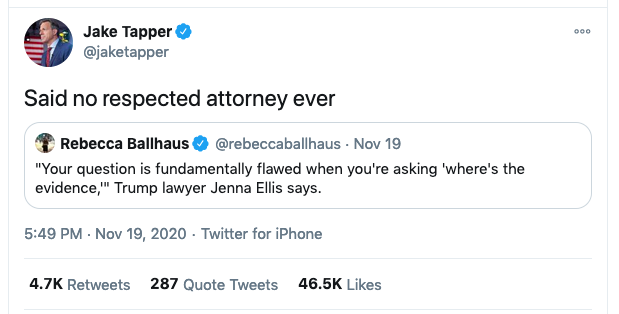
You might think that this contradiction between what the Trump people allege and their inability to produce evidence in court, coupled with the glaring fact of their 2-32 win/loss record so far, would start to sink in and make Trump’s followers start to understand that there was no fraud and that Biden won what Trump’s own Department of Homeland Security called “the most secure election in American history.” But then, in order to think that, you’d probably have had to be in a coma these past four years. About a week ago I broke a personal rule and got into an argument with someone on social media who was convinced that election fraud had been perpetrated. When I pointed to the fact that the Trump people had not been able to produce any evidence of systematic wrongdoing, he repeatedly and sarcastically demanded, “Oh, are you a lawyer? Are you there in the courtroom? You don’t know what evidence they have!” I have since seen this line of argument repeated, most prominently by Trump lawyer Jenna Ellis, as if these court cases are black boxes and not publicly available … or that if Trump and Giuliani actually had any actual evidence, that they wouldn’t be putting it on public display 24/7. (My argument with the fraud-advocate ended when he told me he was “terrified” for my students, as it was “obvious” that I couldn’t be trusted to let them offer opposing perspectives in class).

Meanwhile, as his legal teams racks up losses like the New York Jets on Dramamine, Trump keeps tweeting his confidence that his re-election is all but a done deal, and his supporters continue to close ranks. Even Trump’s most voluble advocates aren’t safe from their wrath should they voice even the slightest doubt, as Tucker Carlson found when he made the rather glaringly obvious observation that such subtly orchestrated fraud on a vast scale—which leaves no trace—strains credulity: “What [Trump lawyer Sydney] Powell was describing would amount to the single greatest crime in American history,” Carlson said on his show this past Thursday. “Millions of votes stolen in a day. Democracy destroyed. The end of our centuries-old system of government.” The backlash from Trump supporters and other Trump-friendly media figures was immediate, with Rush Limbaugh’s producer asking (and betraying an ignorance of how evidence and the law works), “Where is the ‘evidence’ the election was fair?” With trenchant understatement, the NY Times Jeremy W. Peters observes that “The backlash against Mr. Carlson and Fox for daring to exert even a moment of independence underscores how little willingness exists among Republicans to challenge the president and his false narrative about the election he insists was stolen.”

It goes without saying that this state of affairs is deeply dangerous, and serves to obviate any kind of amusement or schadenfreude at the spectacle of Trump’s presidency figuratively—and Giuliani literally—melting down.
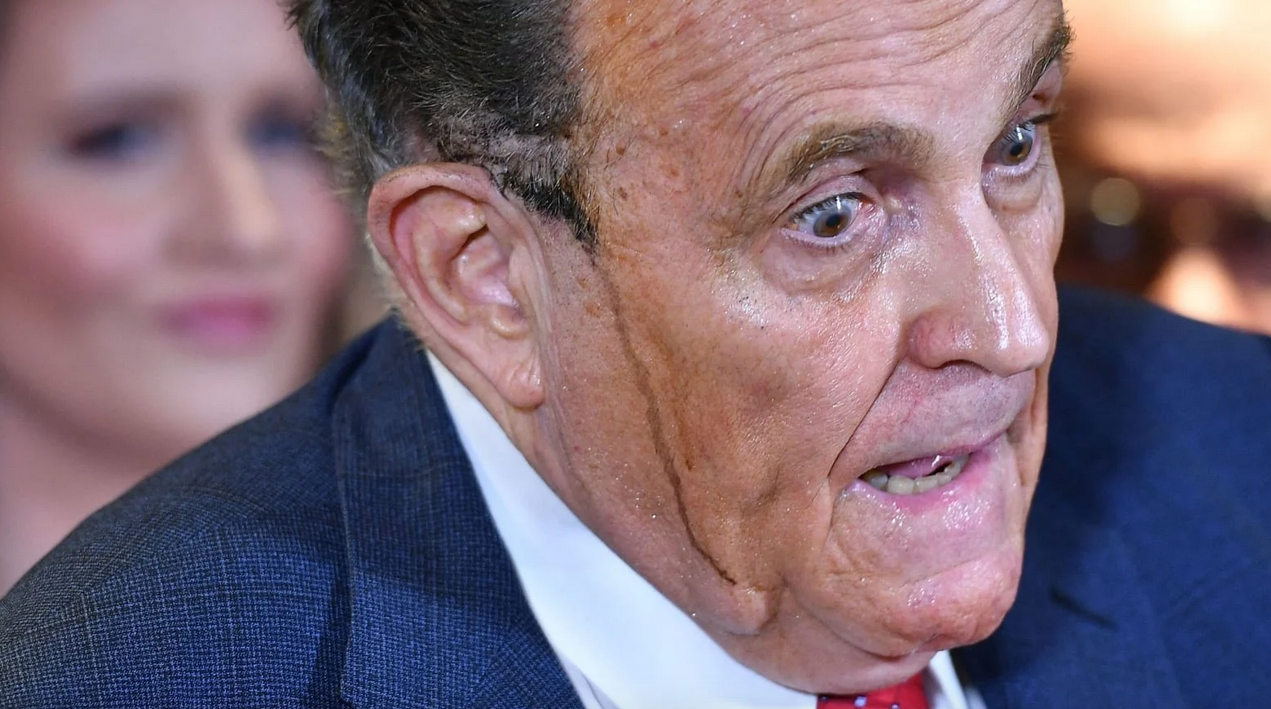
I think the adhesive for Rudy’s human mask is dissolving.

As I wrote in a recent post, the incoherence of the aggregate accusations being thrown around is a feature, not a bug, of conspiracism. All it all needs to do is cement in the minds of Trump voters—not all Trump voters, but a critical mass of them, to be certain—the illegitimacy of the Democrats and the impossibility that Biden could have won without cheating. It was always a given that Trump would not concede, but there was always the milder possibility that he’d resign with high dudgeon and Nixonian resentment (“You won’t have Donald Trump to kick around any more!”), claiming that he’d been cheated, accept a federal pardon from President Mike Pence, and retire to Mar-a-Lago to sulk and tweet and plan his comeback.

But no. It seems he’s determined to go all-in. Whether he actually believes he has a chance to steal the election with his scheme to have state electors overturn the results is something we’ll likely never know; but what seems more likely is that he wants to be forced from office. He wants to be seen going down fighting, a victim of Democratic malfeasance, the Deep State, interference from China, Venezuela, and Cuba, and whatever other fecal matter they want to fling at the wall. And while the prospect of seeing Trump literally frog-marched out of the White House by the Secret Service one minute after noon on January 20th is too delicious to contemplate, that is probably one of the worst scenarios. Why? Because all of those people who have gone all-in on Trump and the narrative of the election being stolen will look up from their phones on January 20th to see Biden taking the oath of office, and see the culmination of their present fears and convictions. And what happens then is anyone’s guess, though the one absolute certainty is that a not-insignificant proportion of the U.S. populace will believe it has been stabbed in the back by the rest of the country.

More than a few times I’ve seen the fantasy being built by Trump et al called the “stab in the back” narrative, and it never fails to chill. When Germany surrendered at the end of the First World War, it came as an utter shock to the soldiers and much of the civilian population. They had thought they were winning, due to a series of gains they had made in the spring of 1918, but in truth, there was nothing left with which to continue the war. The gains they had made were the result of the Kaiserschlacht, or “Kaiser’s Battle”—more commonly known as the “Spring Offensive,” that began in March 1918 and carried on for several months. The offensive was a gamble, and a risky one: the German High Command knew their resources were running low. The recent entry of the United States on the side of the Allies made the situation even more dire. So they went all-in on a massive series of attacks in the hopes of breaking the enemy lines and forcing them into a peace negotiation that would be favourable to Germany.

They failed, but they failed while looking as if they were winning. But the tank was empty. They could keep fighting, of course, with vastly denuded stocks of weapons and ammunition, with an ever-more demoralized army, and with starvation at home. They chose instead to surrender rather than put the military through the inevitable meat grinder.

But as is the nature or quasi-dictatorial monarchies, the German government wasn’t adept at messaging … the end came as a shock to the army and the civilian population because they had no idea how bad the situation actually was. And after the humiliation of the Treaty of Versailles, unsurprisingly, people looked for whom to blame. One of the most persistent theories was the “stab in the back” narrative, which held that powerful business interests with an internationalist character and therefore disloyal to Germany—i.e., the Jews—were responsible for bringing about Germany’s cowardly capitulation. For stabbing Germany in the back.

Yes, yes, insert Godwin’s Law disclaimer here. But it is more than a little uncanny to consider that these events occurred almost precisely one century ago—and doubly uncanny to further consider that 1918-1919 was the last occurrence of a truly global pandemic.

As the saying goes, history doesn’t repeat itself, but it does rhyme. Unlike most rhymes, however, these one can be discordant and jarring to the soul.

Leave a comment

Filed under maunderings, The Trump Era, Trump, wingnuttery

The Mad King in his Labyrinth

For reasons I can’t quite put my finger on, I’ve been thinking these past several days about mad kings, both fictional and historical.

It started with a Facebook post, alluding to George R.R. Martin’s series A Song of Ice and Fire—which some will know better by the HBO adaptation Game of Thrones—in which I said “We could really use a young Jaime Lannister in the White House right about now.” The allusion, which anyone who has read the novels and/or watched the series, will know, is to a key backstory plot point in which the Mad King, Aerys II, was murdered by Jaime Lannister, a member of his sworn Kingsguard—clearing the way for the usurpation of the Iron Throne by Robert Baratheon.

Martin, a keen student of history, loosely based the conflict animating the first few novels on the Wars of the Roses, the English civil wars that convulsed the nation for the better part of the fifteenth century; indeed, the two principal warring families of his series, the Starks and the Lannisters, bear more than a passing resemblance (phonetically, at any rate) with the Yorks and the Lancasters. But the Mad King himself—glimpsed only secondhand in various characters’ accounts of Robert Baratheon’s rebellion—bears a closer resemblance to the handful of lunatic Roman emperors who populated the empire’s declining years: Caligula with his murderous licentiousness, Nero’s narcissistic self-regard, and so forth. Nero was declared a public enemy by the Senate and killed himself in exile; Caligula was murdered by the Praetorian Guard. Martin borrows from a raft of such histories, which also include the killing of England’s Edward II and Richard II.

The other figure Martin’s Mad King resembles is the more contemporary dictator, reduced to paranoid, delusional ranting, surrounded by toadies and sycophants because he has banished or killed everybody who dares voice the slightest dissent. It was only a matter of time (probably minutes) before somebody did a Trump version of the much-memed bunker scene from Downfall.

The mad king—or tyrant, or dictator—is a compelling character for much the same reason that car crashes are fascinating: whether it’s Hitler in his bunker or Lear on the heath, we’re witness to the unspooling of a formerly powerful, formerly charismatic person’s mind. What has been remarkable about the Trump presidency these past few weeks is how public the unspooling has been. Historically, infirmity in the highest of offices has been hidden, as much as possible, from the public view (the examples of certain Roman emperors notwithstanding). Only a handful of royal handlers were witness to the madness of George III. When Woodrow Wilson suffered a stroke late into his second term, his wife and aides kept it quiet; ditto for Ronald Reagan’s latter-day dementia. We only found out about Richard Nixon’s drunken conversations with the portraits of former presidents in the final days before his resignation years after the fact.

But then again, Trump has arguably always been unhinged—that quality of mercurial unpredictability and volcanic temper is central to reality television, after all, and it was through The Apprentice that Trump was able to reforge his public persona in such a way as to delude a critical mass of Americans into believing that he was a brilliant and canny businessman and dealmaker. I’ve lost count of how many op-eds and think pieces have made the observation that his presidency has essentially unfolded like an exhausting four years (five, counting the campaign) of reality television conventions and tropes. He is himself not unaware of this fact; it is an open question of whether his tendency to do or say something outrageous when news unflattering to him breaks is a deliberate distraction strategy, or simply Trump being jealous of the spotlight.

But now we’re in the endgame. True to form, he’s playing a character, however inadvertently: sequestered in the White House, his general avoidance of the public eye speaks about as loudly as his all-caps tweets. Structurally, it is a bizarre situation, by which I mean the mad king in his labyrinth would normally be invisible to all but his closest advisors, some of whom would trot out to podiums every so often to offer anodyne updates. But of course this White House, as my mother would say, leaks like a chimney (as opposed to smoking like a sieve), and so we have frequent reports of Trump brooding, and details of the argument within his inner circle about whether to convince him to concede or keep fighting. But even without such leaks, we still have the logorrhea of Trump’s Twitter feed to keep us abreast of his downward spiral into increasingly deranged conspiracy theories about George Soros and Dominion Software voting machines. And of course we also have his devoted sycophants, like Rudy Giuliani and Lindsey Graham, taking every possible opportunity to go on television and propagate his paranoid maunderings.

The one bright spot in all of this is that at least there’s an expiration date: January 20, 2021, obviates the need for a Jaime Lannister or a Praetorian Guard. Which is fortunate for Trump.

Though that would make for good TV.

Leave a comment

Filed under maunderings, politics, The Trump Era, Trump, wingnuttery

Post (Mid?) Election Thoughts: The Incoherence of Conspiracy Theory

Sixteen years ago I defended my doctoral dissertation, which I’d titled “The Conspiratorial Imagination: Economies of Paranoia in Postmodern Culture.” You’d think that would make me an expert on conspiracism, and it does, but I have to admit that the proliferation of conspiracy theory over the past ten years or so—from Birtherism to Glenn Beck’s manic chalkboardsto the frenzied speculation over the Mueller investigation to the juggernaut of QAnon—makes my head spin. Every time I’ve had the thought that I should dust off the old thesis and revise it for publication in this context of renewed relevance, my mind has shrunk from the prospect. There was just too much. I would most likely have to start from scratch, and in the Age of Trump, where does one find an Archimedean foothold from which to form a critical methodology?

One thing I am finding rather fascinating, however, as we watch the election returns trickle in with excruciating slowness, is this bizarre conspiratorial split-screen in which Trump makes accusation after accusation of a Democratic conspiracy to steal the election, accusations which are themselves part of the execution of his own longstanding conspiracy to disrupt the election in the hopes of stealing it.

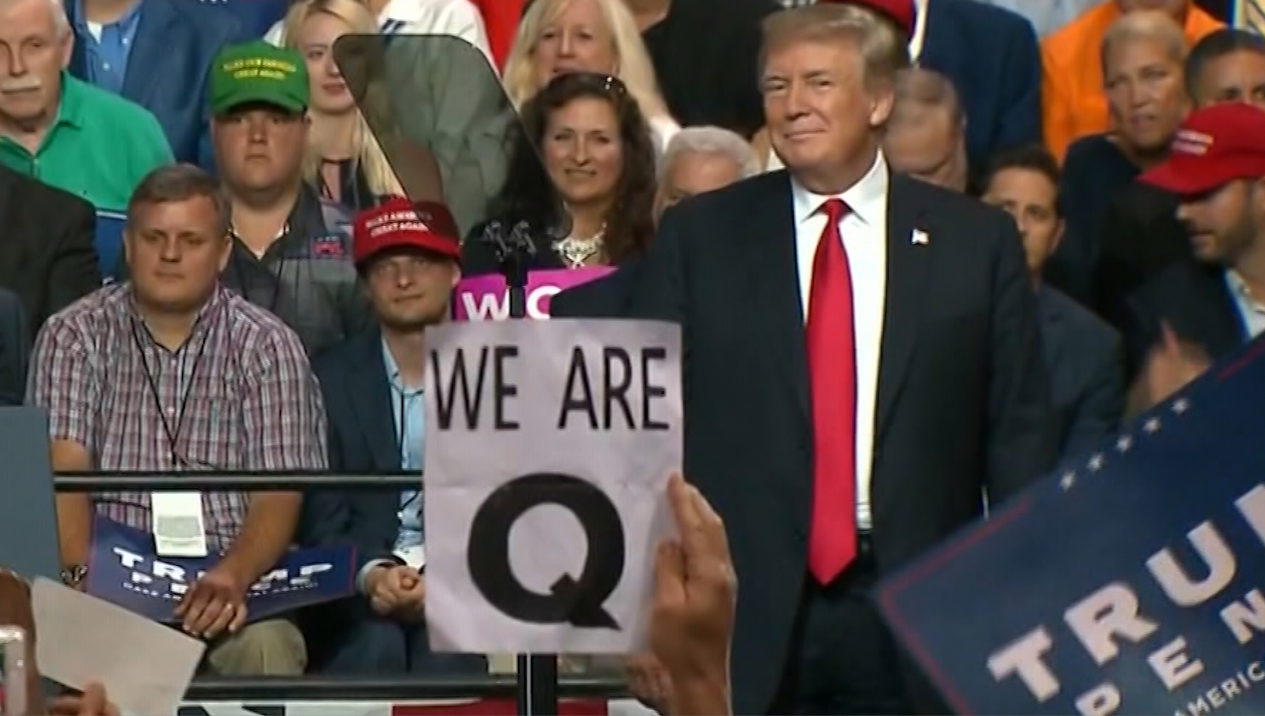
Though I suppose to call what Trump’s doing a “conspiracy” founders a bit on definitional shoals. Trump and his people—as the saying has gone these past four years—always say the quiet part out loud. Can we properly call something a conspiracy when it unfolds out in the open? It has long been something approaching a certainty that Trump would not go easily into the night if he lost, that he would accuse his enemies (a group that comprises anyone who isn’t a sycophant) of rigging the election. He did it in 2016, and he has been sounding that horn again at least since the Democratic primaries began. But then, over the past few months, he has sketched out his plan in greater detail: repeatedly claiming (falsely) that mail-in voting would be rife with fraud; “enlisting” an “army” of poll-watchers to monitor voting for the fraud he claimed was inevitable (and, presumably, intimidate voters and poll-workers, though mercifully there doesn’t seem to have been much of that so far); promising that he would challenge an election loss in the courts; and to that end, ramming through the confirmation of Amy Coney Barrett prior to the election, because—again, he said this out loud and repeatedly—he wanted a 6-3 majority on SCOTUS to adjudicate his court challenges (and though he didn’t say as much, Trump’s nakedly transactional nature dictates he believes Barrett, Kavanaugh, and Gorsuch owe him).

And now, as his prospects for victory dim with every tallied mail-in vote, he has twice addressed the nation and (a) claimed victory, (b) accused his opponents of voter fraud and a long list of other nefarious acts. His address from the White House on Thursday night was really quite shocking in the sheer number of blatant lies he told—and after four years of Trump’s rank mendacity, the fact that he can still shock is nauseatingly impressive. The gist of his speech, however, was an inchoate laundry-list of the ways in which his enemies have conspired to steal the election from him, starting with the accusation that the pre-election polling, which erroneously showed large leads for Biden and other Democrats, was deliberately inflated: “These really phony polls, I have to call them phony polls, fake polls, were designed to keep our voters at home, create the illusion of momentum for Mr. Biden and diminish Republican’s ability to raise funds. They were what’s called suppression polls, everyone knows that now.” He then went on to tell bald lies about how Republicans had been barred from poll-watching, that millions of unsolicited ballots had been mailed out, and continually suggested that the “whittling down” of his leads in Pennsylvania and Georgia was happening because the poll workers kept mysteriously “finding” ballots … and, oh, wasn’t it so interesting how one-sided the mail-in ballots were proving to be?

Never mind the fact that the scenario of Trump’s early leads evaporating wasn’t just predicted over and again, but that it was entirely predictable from the moment he started vilifying mail-in ballots and thus turning them into a partisan issue; predictable also because he turned the pandemic into a partisan issue, with Democrats believing the science and behaving accordingly, while Trump’s enthusiasts flouted mask-wearing and social distancing. Never mind the fact that he never made clear precisely how voter fraud on a massive scale was supposed to be perpetrated. Never mind that fact that, if the polls showing a significant Biden lead and the likelihood of a blue wave were consciously fabricated, then everybody in the news media and the polling industry at large is doing a really good job of pretending to wring their hands and beat their breasts at their abject failure. And finally, never mind the fact that if Trump’s enemies had in fact managed to orchestrate voter fraud on a huge scale, why would they have let Mitch McConnell, Lindsey Graham, and Susan Collins keep their Senate seats?

But of course, that is how conspiracism works: you have to never mind the facts. It is essentially the antithesis of Occam’s Razor: conspiracist thought flourishes on obfuscatory complexity in which apparent contradictions are actually subtle connections to which non-conspiracists are blind. Take a half hour to read about QAnon for what is perhaps the most spectacular example of this thinking to date. And as Fredric Jameson notes in his book The Geopolitical Aesthetic, the two basic elements of conspiracy theory are contradictory: the predication of a vast, omniscient cabal or group, and its invisibility. Where most conspiracy theories fall apart is in the assumption that a huge group of people can conspire to malevolent ends with preternatural silence and competence. Faking the moon landing would have entailed the labour of thousands of people. My simple question to 9/11 Truthers is: do you honestly believe that the Bush Administration was competent enough to carry that off without a hitch? And for the same reason, I never believed that there was a complex conspiracy between Trump and the Russians. Were Trump et al collusion-curious? Absolutely. But the smoking gun, the desire for a spectacular revelation that lies at the heart of conspiracism’s appeal, was never in the cards. And as for the spectral conspiracy Trump keeps flinging about, Stephen Colbert did a tidy job of summing up just how ludicrous it is: “If Donald Trump is right—if Joe Biden did pull the strings behind the scenes in Republican states like Arizona and Georgia while coordinating with Democratic states like Pennsylvania and Nevada and Wisconsin and Michigan and throwing in the red herring of letting the Republicans keep the Senate and gain a few seats in the House while just barely removing Donald Trump—wow! I mean, kudos to that level of interstate coordination. I mean, anyone who could accomplish that many things at once right now really would be the president we need during a global pandemic.”

There have been moments in the past four years when I’ve looked at Trump’s mendacity and the obvious fact that he has, at best, a tenuous grasp of reality; and I’ve looked at the stubborn support he has from forty percent of America’s electorate; and I’ve listened to the torturous logic employed by his enablers and mouthpieces to support and justify his presidency; and I’ve had moments in which I’ve honestly had to wonder whether it wasn’t me getting everything wrong. To be clear, these moments are rare, but they’re worrisome—not least because they are reflective of the broader cultural trend in which such touchstones as science, fact, and just a generally shared reality have been so deeply eroded—and are, in fact, anathema to Trump and the phenomenon of Trumpism.

So however anxiety-inducing and—as regards the Senate—disappointing this election has so far been, it’s been a weird comfort to see these two forms of conspiracy: the actual conspiracy articulated openly by Trump, and the manic conspiracism he flails about in as the reality of the election results encroach. It’s distressing to know that millions of people accept his conspiracy theories without question, but at least the contrast offers me a bit of mental stability in the moment.

Leave a comment

Filed under The Trump Era, wingnuttery

Four Years Later

Slightly less than four years ago, a countdown started. Perhaps it was obscured at points by speculations about the twenty-fifth amendment, or the spectre of impeachment and removal—or, well, really, any number of possible eventualities—but ultimately for those of us horrified by the election of Donald J. Trump, Election Day 2020 was a cognitive terminus, that point at which America’s national nightmare would either end or be validated anew. And given that the latter was, and is, more or less unthinkable—an existential crisis of both political and spiritual dimensions—this coming Tuesday is a day of reckoning. To repurpose a line from Good Omens, November 3, 2020 has been throbbing in the collective brain like a migraine.

With less than a week to go, I’ve been oscillating between zen-like calm and apocalyptic agitation. On one hand, I’ve been watching Trump unspooling in real time with all of the schadenfreude you would expect; every time he pleads, whines, or drops yet another increasingly absurd lie (did you know that California is forcing its citizens to wear a “special” mask that you cannot take off, and have to eat through? Or that Trump recently ended a 400-year war between Serbia and Kosovo?), I get calmer, seeing in his behaviour his realization that he’s going to lose. But then I read news pieces about the gun-wielding militias declaring their intentions to take to the streets if Trump loses; about the ongoing efforts by Republicans to suppress the vote; about the near-certainty that, if Republican legal challenges to a Biden victory make it to the Supreme Court, the facts of the case won’t matter all that much to Brett Kavanaugh and Amy Coney Barrett.

This all makes me feel, as Bilbo Baggins would say, somewhat thin and stretched, like too little butter spread over too much toast.

And I don’t even live in the U.S.

In the autumn of 2016, I was teaching a second-year course titled “Critical Approaches to Popular Culture.” The Department of English had recently absorbed the Communications Studies program; pop culture was (is) one of the required courses for the major. I’d taught pop culture years before, twice, when I was in the latter stages of my PhD at Western, so it was lovely to return to it. For one of the course’s units, I focused on recent sitcoms that articulated diverse, feminist sensibilities: we looked at episodes of Archer, Master of None, Brooklyn Nine-Nine, and Parks and Recreation. A former student of mine from about six or seven years earlier, who had gone on to do a masters in English and another in gender studies, and was at the time a journalist and feminist activist, was a massive fan of Parks and Recreation, and identified strongly with the series’ main character Leslie Knope (played by Amy Poehler). The connection my former student has with Leslie was and is an obvious one: she is blonde, passionate, unremittingly (sometimes exhaustingly) enthusiastic, and devoted to feminism and the possibilities of local government to do good. Early in the semester, I emailed her and asked if she’d like to do a guest lecture on feminism and Parks and Recreation. She emailed me back almost immediately, asking (possibly jokingly) if she should do it in character as Leslie Knope.

The way things had fallen out in my scheduling, her guest lecture would take place the Thursday after the 2016 election. This was not by design, but I was delighted by the serendipity of it: the idea that I would have this extraordinary former student coming in to deliver a lecture on the character of Leslie Knope—who, in the show, idolized Hillary Clinton—two days after what most of us assumed would have been the election of the first woman president of the United States.

Well. We know how that worked out.

It was a huge boon to me that I did not teach on Wednesdays that term. Normally I would have gone up to the office anyway, but that day—which was, as I recall, appropriately grey and rainy—I instead stayed home and sat at my desk in my pyjamas, trying to work through my thoughts. I read dozens of news articles online. I wrote a blog post. And I tried to come to terms with the fact that the United States had actually elected Donald Trump.

The next day, I introduced my former student in my pop culture class, and, not unpredictably, she knocked her guest lecture out of the park. She was amazing, her lecture was amazing, and I can still congratulate myself on my decision to invite her. But there was also the uneasy sense of whistling past the graveyard, as it were: Parks and Recreation, which had by that point ended its run, was wreathed in the spirit of the Obama years. Real political figures made not-infrequent cameos as the series went on, both Democrat and Republican, conveying a sense of comity consonant with Obama’s (frequently frustrated) inclination to want to reach across the aisle (such as in the episode where Cory Booker and Orrin Hatch tell Leslie that they share a passion for Polynesian folk music, and perform together in a band named “Across the Isle”). And of course there was the running joke of Leslie’s conviction that Joe Biden is the sexiest man alive:

(Somehow, Leslie’s admonition to the Secret Service that Biden is “precious cargo” is a little more poignant in the present moment).

In the days leading up to the 2020 election, I’ve been rewatching Parks and Recreation. On one hand, the show is not unlike The West Wing as an imaginative salve for the present moment; but where Aaron Sorkin’s drama offers a liberal fantasia in which people work and argue in good faith (mostly), Parks is somewhat more on point insofar as it hews to a more realistic premise: people are terrible. All Leslie Knope wants to do is improve people’s lives, and not infrequently suffers unforeseen effects of liberal statist interventionism.

One such case occurs when the town’s sole video rental store, which hosts weekly screenings of film classics, is about to go out of business, as every other video rental store in the world has. The store’s proprietor, a pretentious film snob played by Jason Schwartzman who refuses to stock popular movies, does not help himself by being, well, a pretentious film snob who refuses to stock popular movies. Leslie secures him a grant from the city council, making him promise to overhaul his stock with more popular selections—which he does in fact do, but goes to the other extreme and turns his store into a porn emporium. Business then booms, but not even remotely in the way Leslie Knope had intended.

Such mishaps aside, the series chronicles the ways in which Leslie’s earnest and idealistic faith in government batters against the apathy, indifference, and hostility of the citizens she so wants to help. But for all of their awfulness, the people of Leslie Knope’s Pawnee aren’t hateful; they do not actively wish harm on others. Rewatching the series right now, I can’t ignore the simple fact that a stubborn forty percent of Americans support a defiantly hateful man, whom they love not for his principles but for his enemies—for how much pain he can inflict and how much cruelty he can practice.

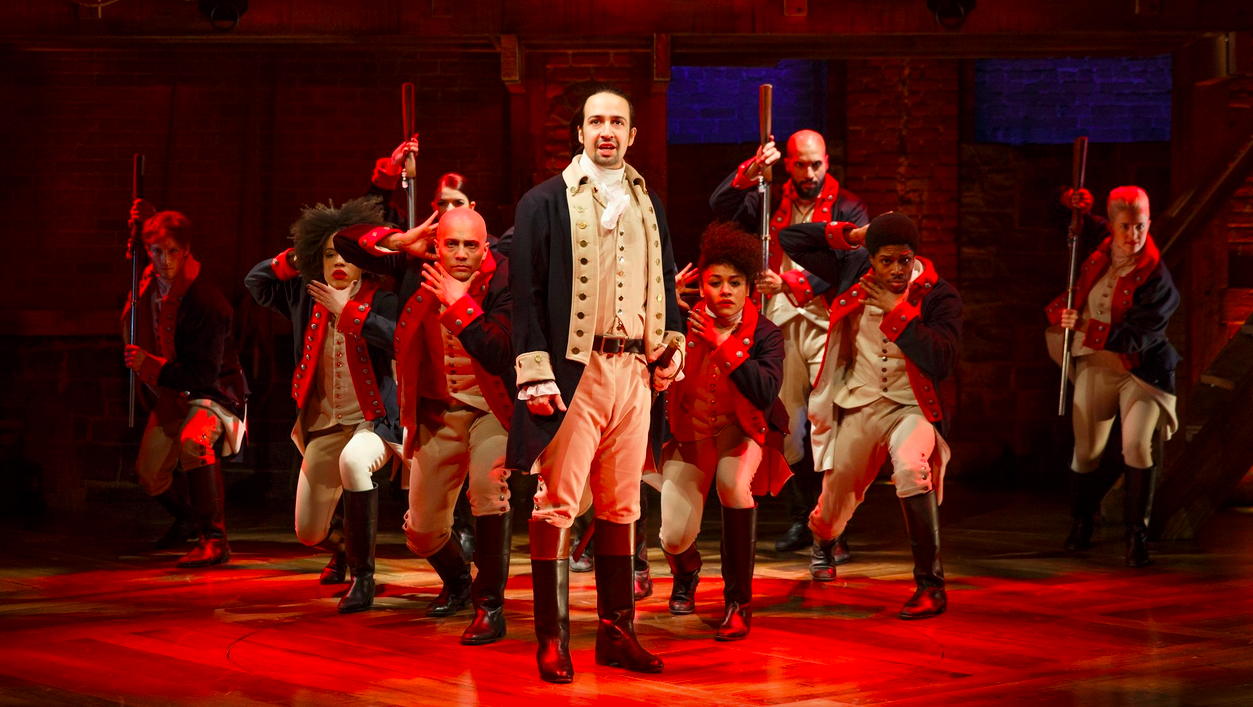
That same semester in 2016, I taught a fourth-year seminar I titled “Revenge of the Genres.” The premise of the course was to look at texts and authors that transcended popular genres, or else used them in metaphorical or critical ways: we did Neil Gaiman’s novel American Gods, Colson Whitehead’s zombie apocalypse novel Zone One, Alison Bechdel’s graphic novel Fun Home, among others … and we ended the class with Hamilton. Even more than Parks and Recreation, Hamilton feels like a relic of the Obama years—not least because its conception, staging, and extraordinary success unfolded over Obama’s presidency, and indeed received its first audience in 2009 for the title song at the White House.

One of our points of discussion in class was how to read Hamilton not just post-Obama, but in the new age of Trump. By the time we started on it in class, we were a few weeks past the election; there was a sort of cosmic irony in examining a musical about a man whose co-creation of the Electoral College was undertaken to prevent the rise of a populist demagogue to the presidency.

There was also the leaden feeling that the play’s optimism and faith in the American experiment had been definitively belied by Trump’s election. As much as I love Hamilton, my one misgiving about it has always been the conviction that part of its popularity—aside from simply being an astonishingly good play—proceeded from the fact that it gave white liberals permission to celebrate the origin story of the United States without caveats. I mean, let’s be honest—the story of the United States’ founding is a pretty compelling one to start with. As a Canadian kid who grew up watching Schoolhouse Rock, I was frequently envious, because my own country lacked a revolutionary beginning and such colourful characters as Hamilton, Jefferson, and Franklin. But of course, as one ages and learns more, the broader contours of that history become tainted by the ugly facts of slavery and the genocide of indigenous peoples. The story remains compelling, but the more honest we are about the actual history, the more those caveats are going to inflect it.

Hence, a hip-hop musical written by a man of Puerto Rican heritage—whose first musical, In The Heights, was about life in an Hispanic neighbourhood in New York—which not only unapologetically celebrates “the ten dollar founding father” and the “American experiment,” but also casts predominantly Black and brown performers to play the roles of the white Founders, gives permission to white milquetoast liberals like myself to set aside the caveats for two and a half hours and enjoy America’s origin story set to virtuosic music.

And lest that sound cynical, I should hasten to add that it’s not merely about the permission structure—it’s also the hope it inspires.

Hope also feels a little like a relic of the Obama years, but I can’t let myself think that. I’m wound up pretty tightly at the moment, but I do think that there are reasons to hope. I always tell my studies in my American Lit classes that America is an idea. As one obscure Irish poet put it, it’s possibly the best idea the world ever had, but it has never been properly realized. The power of that idea, however, is what fuels Hamilton, what made The West Wing a hit TV show, and why Leslie Knope is an endearing character. The problem at the heart of Trumpism, as with all nativist populism, is that it has divorced the idea of America from its mythos. The America of MAGA is inert: an unchanging bundle of resentment stuck somewhere in an imaginary past. The idea of America, by contrast, is dynamic and hopeful; it is generous and open. It is also what Joe Biden has been articulating throughout his campaign. Precious cargo, indeed.

See everybody on the other side.

Leave a comment

Filed under maunderings, The Trump Era, what I'm watching