Monthly Archives: September 2020

A week into classes

The new school year has just started–I’ve now taught three classes over zoom, which is proving less annoying than expected. Actually, it isn’t annoying at all, which is largely due to the fact that I’ve lucked into a great cohort of students who all seem interested and engaged and more than willing to contribute to our discussions.

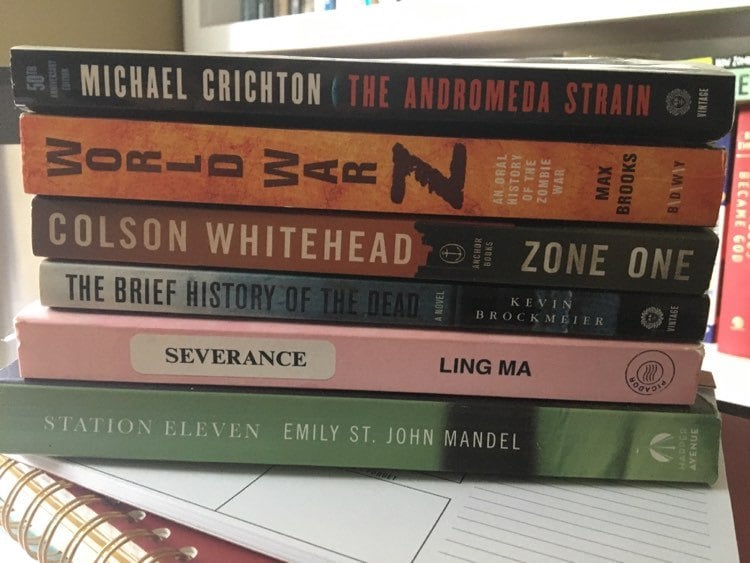
I’m teaching just the one class this term: a fourth-year seminar on Pandemic Fiction … because, you know, I like to be topical. The class’ first assignment is a personal essay: given that we’re studying pandemic fiction in the midst of an actual pandemic, I thought it might be fruitful to have my students share their own experiences. It’s a far more informal assignment than I would usually give, but then, these aren’t usual times.

But because a personal essay is a somewhat more open-ended proposition than a typical formal essay, I wanted to give my students some examples of the kind of thing they could do. So I’ve written two of my own: the first is a variation on a post I wrote in early May, “Of Bread and Patience”; this one is more personal, and details my experience of depression for the better part of that month. And when I finished writing, I figured what the hell–might as well post it to the blog.

Oh, and because the required word count for this assignment is 1200, this essay is precisely 1200 words. Because that’s how we do it downtown, baby. (It also means this is the shortest thing I’ve posted to this blog in a long time).
My May Doldrums, in Hindsight

My long dark night of the soul during the pandemic took place over the better part of May. I don’t know what it is like for other people, but I seem only to experience depression in hindsight. Even when in the midst of it, I tend to be blind to the indicators: bouts of anxiety, lassitude, lack of focus, avoidance. While the anxiety is the more acute and unpleasant experience, avoidance is more insidious—avoidance of work, of communication with friends and family, of simple tasks I’d promised myself I would do. All of which was, this past spring, exacerbated by the fact that there was nothing immediate that demanded my attention, like teaching classes or other such professional obligations. I’d been on a half-sabbatical in the winter term, going into my usual non-teaching summer research term, and so almost everything I was working on could be postponed for a day or two.

One of the reasons I only seem to recognize depression in hindsight—besides the fact that avoidance also applied to self-awareness—was that it ebbs and flows. I would have a few days in which I woke up with acute anxiety, followed by a few days that felt, by comparison, much better. But those “better” days weren’t actually good, they were just days in which I didn’t feel the tightness of anxiety in my gut. I was still unfocused, still avoiding those things I should be doing. In the early days of isolation, I wrote incessantly in my journal, and posted to my blog with a frequency it had not seen in years. I tried my hand at baking bread. I cooked elaborate meals. And I went for increasingly long walks; my peripatetic ruminations filled pages in my journal and informed blog posts.

That all crashed to a halt early in May. It did not feel like a crash at the time, but all of the documentary evidence—the sudden paucity of blog posts, the lack of entries in my journal, the sudden lack of pictures posted in my social media feed—spoke to an obvious and sudden gap in my mental activity. I can see now that in hindsight my fever of writing in the early days was itself a coping mechanism, but also that its lack signaled a descent into depression. What I did instead was play games on my computer while watching movies and TV on my iPad.

I should point out that playing computer games while watching something on my iPad is not unusual for me. I find it soothing to play Age of Empires II, Civilization V, or other such games that do not consume your attention in the way more kinetic games do, while having on my small screen something that I can half-watch. Indeed, this has been my preferred method of watching horror films: I am a wimp when it comes to scary movies, and will only go see them in the theatre under duress. I prefer the controlled circumstance of watching them on my own television, when I can get up and go to the kitchen to make tea or get a snack when the scary parts start going down. “Do you want me to pause it?” my girlfriend will call after me—goadingly, because she knows perfectly well the answer: “No, I’m good.” Even better is watching such films out of the corner of my eye as I direct my villagers to chop wood or mine stone while I send my infantry and cavalry to attack my foes.
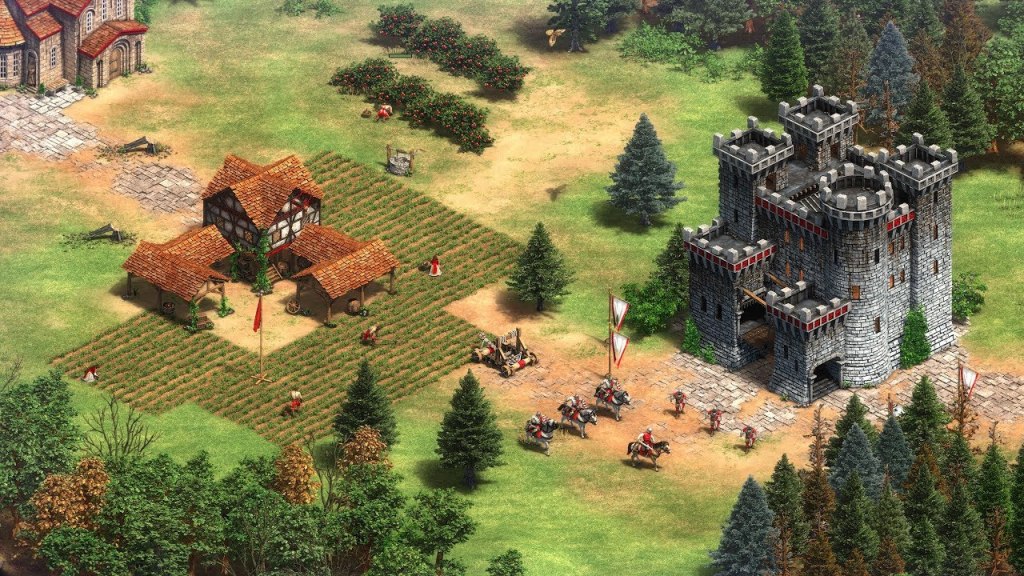
These games where you build a society or civilization have always been favourites of mine. I played Sid Miers’ Civilization in its original iterations, and all that have followed; Warcraft, Warcraft II, Starcraft and Starcraft II followed, but I think the most perfectly distilled version of these games is Age of Empires II. The point of such games is, starting with just a handful of workers, build a hamlet up into a city, and, ultimately, develop an army with which to vanquish rival peoples. In years past, the endgame was always the most enjoyable part for me: sending phalanxes of pikemen, missile troops, cavalry and artillery into the enemy settlements and razing them to the ground. As a military history buff, I used historical tactics as much as the game allowed: spearmen out front, protecting the second rank of archers who sent withering volleys at the enemy; always with a column or two of cavalry to send swooping in if I was getting outflanked; and finally, the catapults and trebuchets bringing up the rear, to rain fire on the enemy’s buildings once their armies were defeated.

Yes, there was a great satisfaction in such victories, but a core pleasure of the game preceded it: the accrual of resources and the construction of new buildings. I am always very fastidious in my urban planning: building out farms from the town hall, with houses along one side and military buildings on another, and one end of town given over to such crucial civilian buildings as the blacksmith, church, university, and market.

During the better part of May, I found myself playing hours of Age of Empires II, while incessantly binging and rewatching Archer, Community, and Parks and Recreation—sitcoms whose beats I knew instinctively by that point. Novelty was not desired. Nor, apparently, was ultimate victory in the game: I wanted only to build, to spawn my villagers and send them to chop wood, mine gold or stone, harvest food, or build up my village. I built defenses on the approaches from my enemies’ territory to frustrate their attempts at invasion, but was not myself inclined to invade. Leave me be, let me build my village and see to my people. On occasion, sometimes just out of boredom, I sent my armies to attack; but more often I ended the game when my resources were exhausted, and started a new one. All while episodes of television I could almost recite verbatim played alongside the computer.

It was all, I can recognize now, a soporific, something to distract my mind, and something to occupy me as I avoided all those other tasks I should have been doing. Perhaps that is why I was preoccupied with building and not with battle: the satisfaction of seeing those tiny, industrious villagers erect buildings and chop trees and mine ore served to offset my own glaring lack of industry. Perhaps, too, it was the illusion of a thriving community of people doing their thing, together, while my own reality was atomized, distanced, reduced to faces in small boxes on my laptop screen. And those sitcoms? Sitcoms are always about family, even when the characters aren’t technically related. Hindsight is annoying, because it shows you what you feel you should have recognized in the moment. I missed my family, both my actual family and the family of friends I have made here in St. John’s; I missed my own industry and sense of purpose; I missed community.

I still do. But coming out the other side of what I now think of as my May doldrums, that benefit of hindsight granted perspective I didn’t have in the moment.

Leave a comment

Filed under Isolated Thoughts

Fear Itself

When I was young and first watched The Empire Strikes Back, I was, as you might imagine, enthralled. But there was one part of Yoda’s now-notorious dictum that always unsettled me: “Fear is the path to the dark side. Fear leads to anger. Anger leads to hate. Hate leads to suffering.” I got the anger–>hate–>suffering equation; but I was agnostic about fear as the root of it all. I was, I should admit, an easily frightened child; I grew up into an easily frightened adult, especially where scary films are concerned. So the idea that fear could lead me to the dark side was more than just vaguely disturbing. Wait, I thought—I’m afraid of sharks. That could make me a Sith? I spent much of my childhood being afraid of the dark, and slept under my covers for longer than I care to admit. And it seemed to me utterly unreasonable that Luke Skywalker should not be terrified of facing the many threats before him, not least of which was the implacable evil of Darth Vader himself. Given that I had it on good authority (i.e. my parents) that courage and bravery was not about not being afraid, but being afraid and doing the scary thing anyway, I wondered if perhaps Yoda wasn’t asking rather a lot.

I suppose this says something about the difference between children’s and adults’ understanding of fear, and the way they experience it: I would of course later understand that Yoda wasn’t speaking of specific, circumstantial fear, which is the kind of fear we tend to experience as children—the monster under the bed, things that go bump in the night—but rather the more existential fears that have to do with who we are and how we see ourselves, and how we might continue on in the world.

It occurs to me that the bizarre arms race that gender reveal parties have become hews fairly neatly to Yoda’s dictum. The original idea, which involved making cakes with pink or blue interiors, was somewhat twee and painfully white-suburban from the start, but at least it was inoffensive—an excuse for a weekend afternoon of chardonnay and canapes. How that escalated into using alligators, go-karts, and explosives, is perhaps a question best addressed by sociologists, but let me offer a thought: at a moment in which the binarisms of gender are more and more eroded by the visibility of trans and non-binary people, and the language of trans rights becomes more ubiquitous (along with that of such detractors as Jordan Peterson and Ben Shapiro), the militant assertion of birth-bestowed gender is an unfortunate but not unforeseeable reaction. Were it to remain in the realm of cakes and balloons it would be innocuous, but as wildfires in Arizona and California attest, there is a not-insignificant number of people who want to assert their unborn child’s gender by literally blowing shit up.

The fear here is not difficult to grasp: the apparent upending of what has been for most people the most elemental feature of identity we have known. Gender has long been the easiest binary, and the most disconcerting one to have troubled. The thing is, anger isn’t the next inevitable step; but then, fear is not itself inevitable, unless one finds their sense of identity threatened. Then, anger is more likely, and at a moment when Facebook and YouTube algorithms will likely connect you to other angry people (like the aforementioned transphobic asshats), hatred can be a short trip. All of which might well convince you that making an explosive box filled with Schrödinger’s gender powder and setting it off in a place that hasn’t had rain in half a year is a good idea—because that’ll show those SJW snowflakes.

And suffering? Well …

The fear of which Yoda spoke was the same conception of fear invoked by Franklin Delano Roosevelt in his 1933 inaugural speech (and yes, I did just mention Yoda and FDR in the same sentence—life goals!). “There is nothing to fear but fear itself” is another dictum my young self found questionable, because sharks. But of course, FDR was talking about the same nebulous societal and cultural fear as Yoda, fear born of ignorance. Fear, after all, can be galvanizing—it can inspire courage and solidarity. But when we are uncertain of what we’re afraid of, and only know that we are in fact afraid, that is when reason gives way to anger and hate. Doris Kearns Goodwin has recently pointed out that the oft-quoted “fear itself” line of FDR’s speech is really only comprehensible in the context of a line immediately preceding it: “This is preeminently the time to speak the truth, the whole truth, frankly and boldly. Nor need we shrink from honestly facing conditions in our country today.” It was in speaking truth about the hardships facing the nation, and the difficult road ahead, Roosevelt asserted, that the blight of fear could be obviated.

And as Jill Lepore observes in These Truths, her magisterial history of the U.S., FDR employed the relatively new medium of radio to unite a nation with his Sunday evening “fireside chats”—in which he would explain what his government was doing; why it was doing it; and how it would affect ordinary Americans. In this way, Roosevelt talked the nation through the worst of the Great Depression, and was its anchor through the Second World War.

Which is why it was acutely galling to read that, in the wake of the revelations made by Bob Woodward this week, Fox News host and Trump’s putative shadow chief of staff, Sean Hannity, compared Trump’s handling of the coronavirus to FDR’s tenure as president:

Did President Roosevelt fan the flames of misery? Did he call for panic and anxiety? No, he actually rallied a nation in a time of need. He focused on making Americans stronger by staying positive, and he got to work and he rolled up his sleeves. During World War II, with the country on the brink, FDR proclaimed, “We have nothing to fear but fear itself.”

Well, those were brutally tough times. Did the media attack him? Of course not … The president’s job is to maintain order, and by the way, right the ship during and after a crisis, not spread panic, not spreading fear among the population. Let’s make one thing perfectly clear, President Trump has never misled or distorted the truth about this deadly disease.

This, it should be pointed out, was in defense of Trump’s comments to Bob Woodward that he deliberately downplayed the severity of the coronavirus so as to avoid a panic. Leaving aside the fact that there hasn’t been a panic Trump didn’t gleefully inflame, let’s recall two points I made just a moment ago: first, FDR spoke of “fear itself” in reference to the Great Depression, not WWII (which might seem a persnickety quibble, were it not for the fact that Hannity’s historical error came during a bit titled “Hannity’s History Lesson”); second, FDR espoused radical honesty. His very first fireside chat was about the week-long “bank holiday,” in which banks across the nation were closed so that the government could instantiate federal deposit insurance in the interim. Banks had been closing all across the U.S. since the crash of 1929, with millions of people losing their savings (remember that scene from It’s A Wonderful Life?); having the president talk the sixty million people listening through the rationale for the bank holiday not only soothed their fears, it enlisted them in FDR’s project.

The best responses to any national crisis always proceed from honesty. The greatest insult proceeding from Trump’s ostensible concern about “panic” is how profoundly it condescends to the electorate.

The thing is, aside from getting the timing of FDR’s “fear itself” line wrong, Hannity wasn’t wrong about anything else—until he says, “President Trump has never misled or distorted the truth about this deadly disease.” I don’t know if we can even call this gaslighting, as gaslighting at least entails a measure of subtlety. This is simple, outright lying, mendacity directed at an audience that doesn’t need to be gaslit. Which makes me think that Yoda possibly needed a prefatory condition for fear: ignorance.

Leave a comment

Filed under history, maunderings, politics, The Trump Era

The Mafioso-in-Chief

In the virtuosic opening sequence of Francis Ford Coppola’s The Godfather, we are treated to a sumptuous and lavish wedding reception. Present is Michael Corleone (Al Pacino) and his girlfriend Kay (Diane Keaton). Michael wears a Marines dress uniform; the Second World War has recently ended. In his conversation with Kay, Michael notes that his father Vito Corleone (Marlon Brando), a powerful mafia Don, was none too pleased with Michael’s enlistment. At the end of Godfather II, we get a flashback to the moment when Michael reveals to his brothers that he has enlisted. His eldest brother Sonny (James Caan) is incensed—immediately prior to Michael’s revelation, he had been going on about how people volunteering to go fight in the war were “saps,” because they’re risking their lives “for strangers.” Michael counters, “They’re risking their lives for their country.” “Your country ain’t your blood,” Sonny snaps back. “Don’t you forget that!”

Within the limited economy of organized crime, especially crime organized around family connections, Sonny’s perspective makes a certain amount of sense. If there is no higher loyalty than family, and the family’s prosperity, signing up to fight for a country whose laws the family in question flouts and rejects is, at best, an act of stupidity; at worst, of betrayal.

Michael Corleone will of course become the new Don by the end of the first Godfather, and become one of the most compellingly villainous anti-heroes in American film. But at the outset, nothing sets him apart from his family more, and nothing invites audience sympathy more, than his uniform. One of the great tensions at work in the Godfather films is this contrast between the blood ties of family and the abstractions of nation—given that politics is depicted as being as much of a scam as the rackets of organized crime, with law enforcement and elected officials all having their own price, the only real, authentic connections one has are to family. But like much art that challenges prevailing cultural mythologies, The Godfather uses Michael’s enlistment and his family’s anger at it in the service of troubling audience perception—the contrast between the gorgeous wedding reception and the usually-universal approbation attached to a WWII uniform, here the mark of Michael’s shame.

This week in The Atlantic, Jeffrey Goldberg published an article citing a variety of anonymous sources who quote Donald Trump echoing Sonny Corleone on numerous occasions. Referencing the time Trump cancelled a visit to the Aisne-Marne American cemetery in 2018, during the centennial of the end of WWI in Paris, because of “rain,” Goldberg writes:

Trump rejected the idea of the visit because he feared his hair would become disheveled in the rain, and because he did not believe it important to honor American war dead, according to four people with firsthand knowledge of the discussion that day. In a conversation with senior staff members on the morning of the scheduled visit, Trump said, “Why should I go to that cemetery? It’s filled with losers.” In a separate conversation on the same trip, Trump referred to the more than 1,800 marines who lost their lives at Belleau Wood as “suckers” for getting killed.

I’m beginning to think that “Shocked but not Surprised” should be the title of the definitive history of the Trump presidency.

The White House has of course denied these allegations and condemned Goldberg’s article, so I suppose we must in good faith acknowledge the possibility that his sources were, for reasons passing understanding, all lying. And indeed, it would be difficult to credit that any sitting U.S. president would voice such thoughts aloud. To anybody. Ever. Even if they were genuine sentiments.

But of course we’ve heard such things from Trump before, such as when he denied that John McCain was a war hero, because “I like people who weren’t captured.” Or his attacks on the parents of Humayun Khan, an Army officer was killed in Iraq, for having the temerity to speak for the Democrats at the 2016 convention. Or, as was detail in Philip Rucker and Carol Leonig’s book A Very Stable Genius, when he called the assembled Pentagon brass who were trying to give him a crash course in geopolitics, “a bunch of dopes and losers.” Or, when he saw that the White House flags had been lowered to half-staff when John McCain died, he exploded, “What the fuck are we doing that for? Guy was a fucking loser.”

The point here isn’t that we unequivocally owe military personnel our respect and reverence—I would, indeed, argue that the “thank you for your service” default setting, which allows people to be utterly unreflective about the nuances of uniformed life, is about as harmful as the reflexive hostility of anti-Vietnam protesters—but to observe, with an exhausted sigh, that these most impolitic of thoughts on Trump’s part only serve to reinforce what we know about the President’s narcissism and sociopathic self-regard. Perhaps the most appalling distillation of this is summed up by another tidbit from Goldberg’s article:

On Memorial Day 2017, Trump visited Arlington National Cemetery, a short drive from the White House. He was accompanied on this visit by John Kelly, who was then the secretary of homeland security, and who would, a short time later, be named the White House chief of staff. The two men were set to visit Section 60, the 14-acre area of the cemetery that is the burial ground for those killed in America’s most recent wars. Kelly’s son Robert is buried in Section 60. A first lieutenant in the Marine Corps, Robert Kelly was killed in 2010 in Afghanistan. He was 29. Trump was meant, on this visit, to join John Kelly in paying respects at his son’s grave, and to comfort the families of other fallen service members. But according to sources with knowledge of this visit, Trump, while standing by Robert Kelly’s grave, turned directly to his father and said, “I don’t get it. What was in it for them?”

Part of me doesn’t want to believe this. Not just the sentiment, but the fact that anyone would say as much to the father of a dead soldier while standing at the graveside.

Part of my doesn’t want to believe it, but at the same time, I have no difficulty believing it—not because, as some might charge, I’m invested in thinking the worst about Trump, but because he has, during the five years since announcing him campaign, given me no reason whatsoever to disbelieve it. Everything Trump does is transactional—as I said in my last post, he has made it obvious that his worldview is absolutely zero-sum. To paraphrase John Goodman in The Big Lebowski: say what you will about Sonny Corleone, but at least he had an ethos. Trump’s business and Trump’s presidency have both been compared more times than I can count to mafia-style operations; but to my mind, Trump et al are the mob at the end of the movie, when all of the original bonds of family and loyalty have been frayed by corruption and graft and over-reach. There was a time when I thought Goodfellas was a superior film to The Godfather and its sequels, because it seemed to me that, where Coppola romanticized his mafiosi, Scorsese was far more clear-eyed in depicting their sociopathy and moral bankruptcy. I’ve since come around on that: the decline and fall of Michael Corleone is the subtler of the two tales, not least because it showed how, criminal though the Corleone enterprise might have been, it had its roots not just in family, but a community at once ignored and victimized by an indifferent nation.

If the history of Fred Trump, Sr. and his successor Donald has showed anything, it’s that there was never that originary matrix of family and community. As Mary Trump details, the Trump legacy was never not zero-sum.

What was in it for them? Trump isn’t just asking that of dead soldiers. He’s asking it of anybody who does anything not just for themselves. He’s asking it of anybody who takes on a job whose labour and effort exceeds the fiscal reward—teachers, nurses, EMTs, firefighters, social workers—but which is done in the name of helping others, of serving a community. In Trump’s worldview, they’re all suckers.

And I think what’s most frustrating in the present moment is that his most ardent supporters—those that aren’t rich, that is—don’t grasp that he thinks the same thing about them. He loves their adulation, but was never about to stand for four hours of selfies like Elizabeth Warren did, or hear their stories. His attitude is best summed up by Bono, of all people, who told Jimmy Kimmel, “”He likes to see their faces in the crowd, but I don’t think he wants to know who they are when they go home.”

Of course he doesn’t. They’re not people to be served, they’re means to an end.

Leave a comment

Filed under Uncategorized

The Chaos is the Point

Hoo boy. Okay, so wrote this post in part as a failed effort at catharsis. I’ve been running election scenarios in my head, and none of them are happy. I don’t mean I think Joe Biden will lose—I mean I think Trump will render it all moot. I was not encouraged when I read about the “war games” played out by the Transition Integrity Project. Suffice to say, there were no scenarios that did not involve violence in the aftermath of election day.

I went back and forth about whether to post this, or relegate it to a lonely folder of forgotten musings on my desktop. But, well … misery loves company.

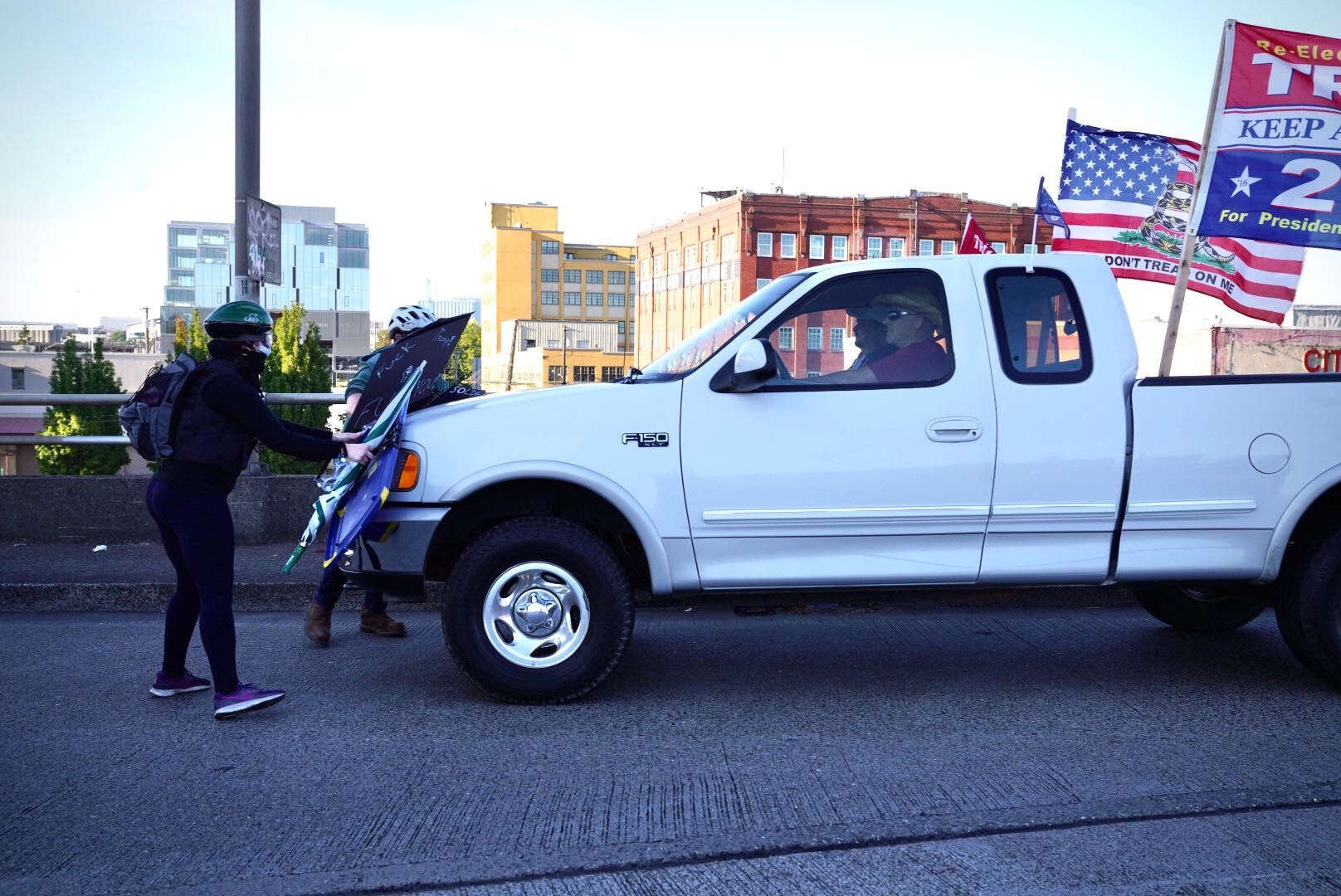
caravan

A truck from the pro-Trump “caravan” in Portland.

Two years ago, The Atlantic’s Adam Serwer wrote what I think has been the most incisive evaluation of Trump, his administration, and the phenomenon of Trumpism as a whole. It’s also one of those articles whose thesis is plainly stated in its very title: “The Cruelty is the Point.” I feel as though the “is” in that title should be italicized, in tacit response to the sort of punditry that affects bafflement or bemusement at Trump’s behaviour and that of his acolytes, and attempts the Sisyphean task of framing it in terms of everyday politics. What ideology exists in Trumpism is the ethos of resentment and revenge, in which the infliction of pain and suffering on one’s foes is not a bonus accrued in the process of political gamesmanship, it is the game. Serwer writes,

We can hear the spectacle of cruel laughter throughout the Trump era. There were the border-patrol agents cracking up at the crying immigrant children separated from their families, and the Trump adviser who delighted white supremacists when he mocked a child with Down syndrome who was separated from her mother. There were the police who laughed uproariously when the president encouraged them to abuse suspects, and the Fox News hosts mocking a survivor of the Pulse Nightclub massacre (and in the process inundating him with threats), the survivors of sexual assault protesting to Senator Jeff Flake, the women who said the president had sexually assaulted them, and the teen survivors of the Parkland school shooting. There was the president mocking Puerto Rican accents shortly after thousands were killed and tens of thousands displaced by Hurricane Maria, the black athletes protesting unjustified killings by the police, the women of the #MeToo movement who have come forward with stories of sexual abuse, and the disabled reporter whose crime was reporting on Trump truthfully.

It is this cruelty, and the outrage it reliably incites, that bonds Trump to his base and makes his stubborn refusal to do anything that might disappoint them comprehensible. “Their shared laughter at the suffering of others,” Serwer says of Trump’s most loyal adherents, “is an adhesive that binds them to one another, and to Trump.”

Even now, pundits and columnists not employed by Fox News still wonder why Trump can’t seem to grasp the fairly basic political ramifications of not presenting at least a thin façade of statesmanship and condemning violence on all sides, of saying something tepid that gestures toward de-escalation. And this after he’d actually managed to be relatively disciplined for four days. The Republication National Convention somehow managed to keep the president on a tight leash and somehow convinced him to stick to the teleprompter during his speech, and presented a carefully stage-managed spectacle specifically designed to give disaffected or alienated Trump voters a permission structure to vote for him again: trotting out every Black Trump supporter they could find, staging a naturalization ceremony for conspicuously dark-skinned new citizens, parading a veritable cavalcade of women (the balance of whom were, true to Trump’s pageant-owning past, blonde and statuesque) attesting to Trump’s kindness behind the scenes and his equitable treatment of women; all of which was by way of soothing people’s misgivings about Trump’s racism and misogyny. Don’t believe the liberal liars and Fake News, and don’t believe everything you think you’ve seen and heard for more than four years—this is the REAL Donald J. Trump.

Cue the panicking of the Chicken Littles, suddenly terrified that the Republicans had been successful in snowing the public yet again.

Don’t get me wrong—I’m afraid the sky is falling, too. I’m just not quite so worried about electoral math. If that was the only problem now, I’d sleep a lot better.

I’ve had a lot of people asked me if I think Trump can win in November. I say no, I don’t. The worry creasing their faces eases for a moment as I break down my reasoning. As we’ve seen since the 2016 election, Trump has a strangely resilient approval of around forty percent. It goes up and it goes down, but never by too much. For any other president, never once cresting fifty percent in the polls during a first term would be catastrophic, something we tend to forget in the present moment, because, however egregious Trump’s behaviour, however monumental his incompetence, and however disastrous his mismanagement of the pandemic response, the economy, and race-based civil unrest, that forty percent remains durable. That is, of course, cause for concern, as that was more or less the number he had going into 2016. But there are a handful of factors at play in 2020 that make a key difference. First, Trump is no longer an unknown and untested quantity. In 2016, it seemed a lot more reasonable to some people to give the chamber a spin and play Russian roulette with a Trump vote. What’s the worst that could happen? was asked a lot—or, as Trump said in his plea to Black voters, “What have you got to lose?” (Which is one of the many, many reasons White liberals need to pay more attention to Black voters—they’re very keenly aware of what they have to lose). After almost four years of corruption and self-dealing, and of course an economy cratered by a pandemic and a death toll pushing two hundred thousand, we’re now living “the worst that could happen.” Second, for a critical mass of unwarranted reasons (and a handful of warranted ones), Hillary Clinton was a deeply unpopular candidate whose unfavourables were comparable to Trump’s. Couple that with the divisiveness caused by a bitter primary fight, and it exacerbates the problem of the third item—third party candidates, who provided safe haven for people who couldn’t bring themselves to vote for Clinton (but who also believed she would still win in a walk). A possible Kanye West candidacy notwithstanding, third party candidates aren’t a factor this time around. And even if they were, anyone who bought into Trump’s spiel in 2016 about deal-making and his promises to build infrastructure and tax the rich aren’t about to be fooled again (I sincerely hope).

All of that makes Trump’s chances quite dire, even with that static forty percent popularity, and I haven’t yet mentioned the name Joe Biden. To be clear, he was never near the top of my list during the primary (Team Warren all the way!), and in the present moment I think a ficus in a fedora would give Trump a run for his money, but I’m not unconvinced he’s the person for the moment—someone whose history of tragedy and heartbreak has gifted him with the humility and empathy needed to heal a suffering nation. That, and (touch wood) it looks as though the Democrats have their shit together this time around.

Remember, Trump lost the popular vote; he won the electoral college by eking out victories of less than one percent in three key states. I’m not saying that can’t happen again, just that the factors listed above make it far less likely, at least mathematically.

And this is the point, when I’ve eased my friend’s worry somewhat, that I make their face fall by saying, “But that probably won’t matter.” Because I’m not worried about electoral math: I’m worried about Trump’s capacity to foment chaos.

Which brings us back to the ostensible confusion among some of the pundit class about Trump’s apparent inability to help himself politically by, say, condemning the vigilantism of armed pro-Trump militias in the same breath as he attacks rioters. Or possibly disavowing the ludicrous QAnon conspiracy theories. On one hand, it shouldn’t be surprising—these are, after all, of a piece with his refusal to condemn neo-Nazis after Charlottesville. But this close to an election he looks poised to lose, shouldn’t he do the politically expedient thing?

Well, no. For one thing, as I’ve already pointed out, he loves the adoration of his base too much to ever do anything that might ameliorate their ardour. But he is also by nature a provocateur and an agent of chaos. It’s tempting to quote Littlefinger’s “chaos is a ladder” speech from Game of Thrones, except that would be entirely inappropriate to the example of Trump—Littlefinger is a character of comparable amorality, but one who sees five moves ahead and foments chaos to further his own plans.

Trump, by contrast, doesn’t plan. In the present moment, chaos isn’t a ladder—chaos is the point. Chaos is an end in itself.

As we’ve learned from innumerable articles and books about Trump, his “management style” has always been to pit people against each other and see what comes of it. His multiple bankruptcies speak to the fact that, however many times he refers to himself as a “builder,” he’s never really been interested in building (indeed, his entire election campaign isn’t so much asking voters to be amnesiac about the past few years as it is an attempt to declare Chapter Eleven and start from scratch in January 2021). And there’s a reason he was so adept at reality television, a form that privileges conflict for the sake of conflict, and rewards cruelty and betrayal.

This is my fear: for months now, Trump and his acolytes have been laying the groundwork for abject chaos in November. The pandemic—or rather, Trump &co.’s catastrophic mismanagement of the response—might be the principal torpedo in the hull of Trump’s re-election, but it is also providing him his best means to disrupt the process and the results. Trump and his people have been banging the drum for weeks now about widespread mail-in voting fraud. The fact that this claim is itself demonstrably fraudulent is immaterial—the point is to make the claim as loudly and often as possible. Couple that with the fact that a preponderance of mailed ballots will almost certainly mean that the election won’t be called on the night of, but will take days or even weeks to tally votes, and there is a wide window for Trump to make mischief. I fear that the “Brooks Brothers Riots” of the 2000 recount in Florida—when Republicans organized preppie mobs of lawyers and political operatives (something Roger Stone had a key hand in, let us not forget) to harass the poll workers—will come to seem a genteel exercise. Imagine instead mobs of Trump supporters, many armed, descending on polling locations to denounce the “rigged” election; imagine also counter-protesters, and imagine what side law enforcement will take in such confrontations.

We’re seeing the first glimmers of such a scenario now. Why on earth would Trump make any move to de-escalate the violence of this latest round of protests? Why, indeed, would he discourage wannabe militiamen like Kyle Rittenhouse, who killed two people in Kenosha with his friend’s AR-15, or the “caravan” who went to Portland to shoot paintballs and pepper spray at Black Lives Matter protesters? As John Cassidy observes in The New Yorker,

By cheering on the members of the Portland caravan—“GREAT PATRIOTS,” he called them on Twitter—and defending Rittenhouse, despite the fact that he has been charged with two counts of first-degree homicide, the President has crossed a threshold. Faced with the prospect of losing an election, and power, he has gone beyond mere scaremongering and resorted to fomenting violent unrest from the White House.

It doesn’t help matters that Trump obviously sees chaos and disorder as helping his re-election prospects. In keeping with her boss’s habit of saying the quiet part out loud, Kellyanne Conway said on Fox and Friends, “The more chaos and anarchy and vandalism and violence reigns, the better it is for the very clear choice on who’s best on public safety and law and order.”

Trump thus has several reasons not just to abdicate any obligation to cool temperatures, but to actively raise them; but the central and unavoidable reason is that he knows no other way. As he has made painfully clear in everything he has ever done, his worldview is zero-sum. You’re either a winner or a loser, a predator or a mark; to be a loser is the worst fate, and so he has crafted his self-image with a single-minded determination to always be a winner, at least in his own eyes. While he obviously fears losing the presidency and, with it, legal immunity from the various investigations currently being pursued, it’s obvious that his greatest fear is being seen losing on the largest and most visible stage he’s ever been on.

And I think—I fear—he will do literally anything to avoid that.

Leave a comment

Filed under maunderings, The Trump Era, Trump, wingnuttery