Monthly Archives: August 2020

Lovecraft Country, “Sundown”

lovecraft country

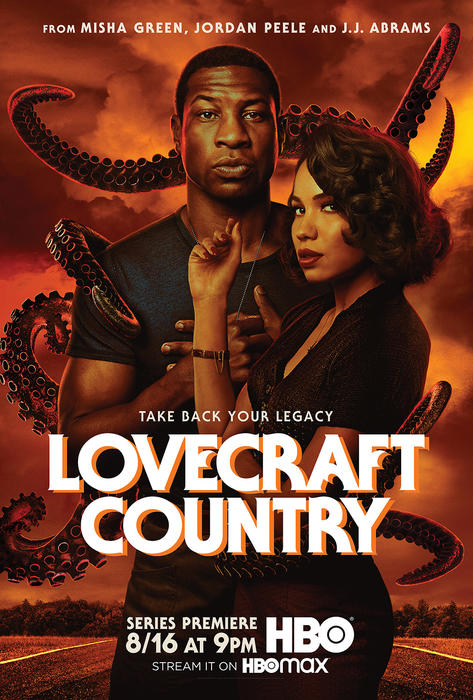
As I started to say in my previous post, Lovecraft Country, among other things—perhaps above other things—isn’t just an extended engagement with the fraught legacy of H.P. Lovecraft, but deploys that legacy as an extended metaphor for the even more fraught legacy of race in America. And though I refer here to the novel by Matt Ruff, the first episode of HBO’s adaptation, “Sundown,” is very much on the same page.

Atticus Freeman (Jonathan Majors) is a young Black man from the South Side of Chicago; a veteran of the Korean War; a son whose relationship to his father Montrose (Michael K. Williams) is fraught to the point of estrangement; and a lover of pulp science fiction and fantasy. The opening sequence of “Sundown” is at once a flashback to his time in Korea, and a dream  wrought by Edgar Rice Burroughs and other pulp authors, starting with visceral black-and-white hand-to-hand combat with North Korean soldiers, and moving into a technicolour attack by flying saucers, alien tripods á là H.G. Welles, and Lovecraftian, batlike monsters. The Cthulhu-esque tentacular beast confronting Atticus is suddenly split down the middle in a spume of green slime by none other than Jackie Robinson.

And then Atticus wakes up, on a bus taking him north, Edgar Rice Burroughs’ novel A Princess of Mars resting on his chest.

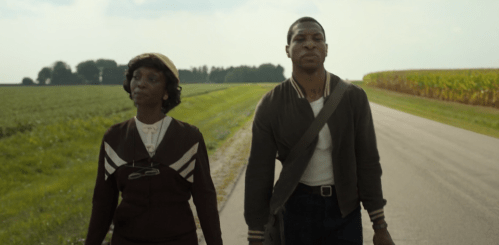
Atticus—or “Tic,” as others call him—comprises the central conceit of Lovecraft Country: a young Black man who knows as well as anybody the brutal realities of Jim Crow America; who served as a combat soldier in Korea, but doesn’t accrue any respect or gratitude for that from whites; but who is an enthusiastic reader of pulp fiction, in spite of the fact that those stories not only have little to say about him, but what they do have to say is racist and demeaning. Even the older Black woman with whom he ends up walking down a country road after their bus blows out doesn’t have much use for his choice of reading—pointing out to him that John Carter, the hero of Burroughs’ Mars novels, was a Confederate officer, and thus doesn’t deserve Atticus’ sympathies. Later, after Atticus makes it home to Chicago, he tells his uncle George (Courtney B. Vance) that his father Montrose had tried to cure him of his pulp addiction by making him memorize a certain piece of doggerel by H.P. Lovecraft. (I won’t cite the vile title of the poem or quote it—typing “Lovecraft on the creation” into Google will take you to it if you’re that curious—but the most euphemistic way to summarize it is to say it suggests the gods saw a gap in creation between man and beast, and filled that gap by creating Black people). When the woman he met on the bus points out that John Carter doesn’t get to be an “ex-Confederate,” because “he fought for slavery. You don’t get to put an ‘ex’ in front of that,” Atticus replies that, “Stories are like people. Loving them doesn’t make them perfect. You just try and cherish them, and overlook their flaws.”
Screen Shot 2020-08-21 at 10.08.26 PM

Coming as it does in the first minutes of the first episode, this assertion initially felt like a lame, mealy-mouthed defense, and Atticus doesn’t really speak the line with much conviction—it feels as though, more than anything, he’s trying to convince himself. “The flaws are still there,” the woman points out. “Yeah, they are,” Atticus concedes. On reflection, however—and on re-watching the episode—it strikes me that Atticus’ words, here at the outset, articulate a key theme of the series. For one thing, it becomes obvious that he’s talking as much about his father as about his beloved pulp stories—over the course of “Sundown,” we learn that his father Montrose is an abusive alcoholic who was himself abused by his father, but also that he loved Atticus deeply, even if he couldn’t express it—and that his loathing of Atticus’ pulp fiction addiction was of a piece with his rage at Atticus’ enlistment. Why give yourself over to these people who hate you? Why read fiction that extols whiteness and vilifies blackness? Why fight for a nation that makes you a second-class citizen?

While Atticus is an admirably nuanced and well-realized character in the novel—and Jonathan Majors’ performance so far promises to be extraordinary—he is also Lovecraft Country’s central conceit; that is to say, his love of fiction that doesn’t love him back, but which nevertheless resonates with him, is a poignant metaphor for the contradictions of the American Experiment. “In the beginning was not only the word,” wrote Ralph Ellison, author of Invisible Man, “but its contradiction.” That contradiction is baked into the opening lines of the Declaration of Independence. “We hold these truths to be self-evident, that all men are created equal,” wrote Thomas Jefferson, slave-owner. Black scholars and thinkers, from Frederick Douglass to Ellison to Toni Morrison, have long pointed out this contradiction between the promise of America and its practice, and demanded that the promise be fulfilled.

[It was at this moment in the drafting of this post that I abandoned the laptop and worked longhand, as I usually do when trying to work through ideas that aren’t easily gelling; I filled a few pages of a legal pad with several attempts to speak to the larger issues concerning race that have been brought to the fore in the past few months, and how Lovecraft Country bears on them. I have chosen discretion over valour, however, because (1) I want to get this post done in a relatively timely manner, and am loath to articulate thoughts on such topics not fully baked; and (2) I don’t want this post to be Tolstoy-length. Suffice to say, TL;DR: the timing of Lovecraft Country airing now is serendipitous, not least because we just saw the historic nomination of Kamala Harris as the VP candidate.]
Screen Shot 2020-08-21 at 10.11.56 PM

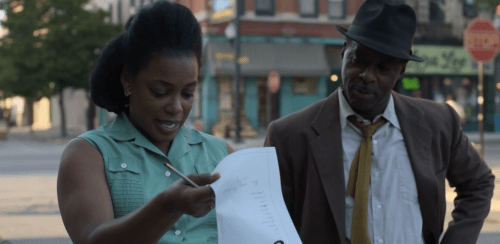
Aunjanue Ellis as Hippolyta and Courtney B. Vance as George Freeman.

“Sundown” does an admirable job of establishing the world of the story and introducing its main characters: in addition to Atticus as his uncle George, there’s George’s wife Hippolyta, and their daughter Diana, who has her own genre obsession—she draws comics featuring heroic characters. George and Hippolyta publish The Safe Negro Travel Guide, which lists towns, restaurants, and hotels that are Black-friendly. And if that publication sounds familiar, well, that’s because it’s based on the historical Green Book, which, as it happens, had its own movie not long ago. Writing for NPR, Glen Weldon lists the similarities and differences between the movie and the series:

Here is a list of things that the HBO series Lovecraft Country, premiering Sunday, August 16th, has in common with the 2018 film Green Book:

  1. Setting: Jim Crow-era America
  2. Acting: Subtle, nuanced performances (Viggo Mortensen’s dese-and-dose Green Book gangster notwithstanding).
  3. Subject: Story features a road trip involving a travel guidebook written to inform Black people where they can safely eat and stay. (Green Book: Entire film; Lovecraft Country: Opening episodes only.)

And here is a brief, incomplete list of the things that Lovecraft Country prominently features that Green Book emphatically does not:

1. A story centered on the lives of Black characters.
2. Black characters with agency, absent any White Savior narrative.
3. Shoggoths.

The second list is key: though Matt Ruff, author of Lovecraft Country, is white, he scrupulously avoids injecting white characters into the story to act as saviours. Indeed, Atticus’ name is a wry nod to the longtime liberal custom of telling nominally anti-racist stories in which victimized Black characters are saved through the intervention of a virtuous white protagonist—the veritable archetype for this character being Atticus Finch of Harper Lee’s To Kill A Mockingbird, immortalized in Gregory Peck’s performance in the film adaptation. Green Book was only one of the most recent examples of this tendency, mercifully eschewed by Lovecraft Country.

But to get back to the characters: we also meet Atticus’ childhood friend Letitia (Jurnee Smollett), who ends up hitting the road with Atticus and George as they go looking for Atticus’ missing father. And we also briefly encounter Letitia’s older sister Ruby (Wunmi Mosaku), who doesn’t figure much into this episode, but, assuming the series remains faithful to the novel, will have a more significant role later.

We do not, unfortunately, meet Atticus’ father Montrose, but I’m fairly sure he’ll show up in episode two (Omar comin’!).

At issue in this episode, and in the series more generally, is Atticus’ genealogy: he has returned home from Florida, where he’s been living since his discharge from the army, because of a letter from his father. Montrose wrote to say he’d discovered something about Atticus’ late mother’s ancestry, which was somehow related to a Massachusetts town called Ardham. Atticus, with understandable perplexity, initially reads as “Arkham” until George corrects him. One way or another, however, as Atticus observes, their search is going to take them deep into “Lovecraft country”—both literally, in terms of the New England countryside in which Lovecraft set much of his fiction; and figuratively, insofar as they encounter the virulent, violent racism of a sheriff who informs them that Devon County—in which Ardham is supposedly located—is a “sundown country,” meaning that unless they can remove themselves beyond its borders by sundown, the sheriff will hang them.

Sundown towns were distressingly common, and were actually quite prevalent throughout the northern states. The consequences might not be as extreme as lynching—though that was not unheard of—but would certainly be violent. Hence the need for a motorists’ guide that would inform Black travelers about which such towns to avoid (one criticism leveled at Green Book is that it elides the fact that the north was actually worse for sundown towns, and that New Jersey—tacitly depicted in the film as friendly territory—was particularly inhospitable, and that Viggo Mortensen’s character, the driver hired to chauffeur Mahershala Ali for his concert tour, only starts to consult the titular green book once they enter the south).

Sundown thus obtains a dual sense of dread—the real-world, historical threat it posed Blacks in such locales, as well as the horror-story fear of the dark that comes with night. For it is when Atticus, Letitia, and George have made their way into Devon County that these two threats intersect. While stopped in the middle of a forest as they vainly search for a road that will take them to Ardham, they find themselves confronted by Sheriff Eustace Hunt, who informs them of Devon County’s unwritten sundown law. Though they manage to cross the county line with seconds to spare, they are then stopped by more police. Sheriff Eustace, it seemed, called ahead. They are taken into the forest, forced to lie prone on their bellies, and accused of a string of burglaries while the cops hold shotguns to their heads. And then …

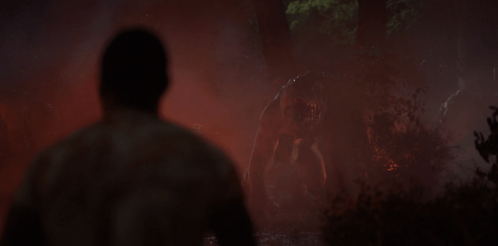
Well, then is when “Lovecraft country” becomes actually Lovecraftian, as they are all attacked by the aforementioned Shoggoths. Shoggoths, for those unfamiliar with Lovecraft’s fiction, are monstrous, amoebic blobs, dotted with many eyes. Or, as described in At the Mountains of Madness:

It was a terrible, indescribable thing vaster than any subway train—a shapeless congeries of protoplasmic bubbles, faintly self-luminous, and with myriads of temporary eyes forming and un-forming as pustules of greenish light all over the tunnel-filling front that bore down upon us, crushing the frantic penguins and slithering over the glistening floor that it and its kind had swept so evilly free of all litter.

The shoggoths of Lovecraft Country aren’t quite so blob-like as they are huge, hound-like beasts with round mouths forested with teeth, and quivering slimy skin with the consistency and complexion of dead fish. They do, however, have many eyes.
shoggoth

True to its pulp roots, Lovecraft Country doesn’t aim for subtlety in its metaphors—though to be fair, neither does much of the horror genre. Monsters are always representations of the most prevalent fears and anxieties in the cultural imaginary at a given moment. And people are often the worst monsters, even when there are actual monsters present to offer comparison. Lovecraft Country is about the monstrosity of racism, so when Sheriff Eustace, having been bitten by a Shoggoth, starts to transform into one, the point hits home quite plainly.

The presence of Shoggoths—or, perhaps more accurately, the suggested analogy between their beasts and the malevolent blobs of Lovecraft’s imagining—might also be read as a subtle dig at Lovecraft. In At the Mountains of Madness, the Miskatonic University exploratory team of scientists finds in Antarctica an ancient city of “cyclopean” proportions (one of Lovecraft’s favourite adjectives, meaning enormous). The city had been built by the Old Ones, ancient god-like alien creatures (like Cthulhu) who predated human existence on Earth. The shoggoths were created as a slave race to serve them, but ultimately rose up against their masters and destroyed them. Though the series is mostly faithful to the novel, some of the names have been changed: Atticus’ surname in the series is Freeman (with all of the significance that obtains), but in the novel it’s Turner—an allusion to Nat Turner, a slave who led a rebellion in Virginia in 1831. Also, when looking for news of his father, Atticus goes to the bar that was his habitual haunt—which is named Denmark Vesey’s Bar. Denmark Vesey was a free Black man who was executed in 1822 on the charge of planning a slave rebellion.

It takes “Sundown” some time before the supernatural elements intrude—we’re four-fifths of the way in when the Shoggoths appear—but the narrative and thematic build makes it worth the wait. Perhaps the most poignant sequence is a montage of our three heroes driving from the Midwest to Massachusetts—a montage scored not to music, but by a speech delivered by writer James Baldwin in 1965 at Cambridge University. The speech was Baldwin’s rebuttal to William F. Buckley in a debate over the proposition “The American Dream is at the expense of the American Negro.” It is worth watching in its entirety, or else reading the transcript.

Perhaps unsurprisingly, Baldwin won the debate resoundingly.

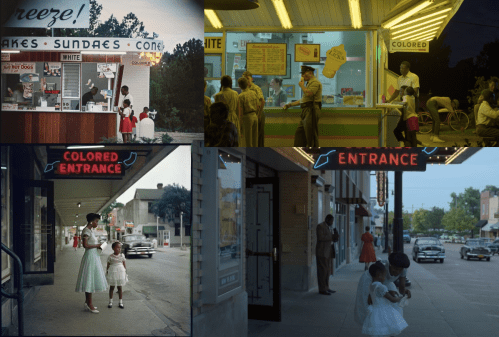
As we hear Baldwin’s eloquent and mellifluous words, we see images of Atticus, Letitia, and George at various points in their road trip, and we see images of a segregated America. At key moments, the mise-en-scène precisely echoes photographs by Gordon Parks, a Black photographer who, among other subjects, chronicled segregation in Jim Crow America.
gordon parks

On the left: Gordon Parks’ photography. On the right: stills from Lovecraft Country.

One of the most infuriating moments comes when, as they’re paused at a gas station, a skinny white boy mocks Atticus—who is eating a banana—by making monkey noises. Atticus looks threatening for a moment, but Letitia holds him back. Atticus settles for throwing the banana peel in the asshole’s face, which only evokes more laughter from him and his friends—secure in their societally sanctioned safety, in spite of the fact that the impressively muscled, combat veteran Atticus could likely snap the boy in two with no great effort.

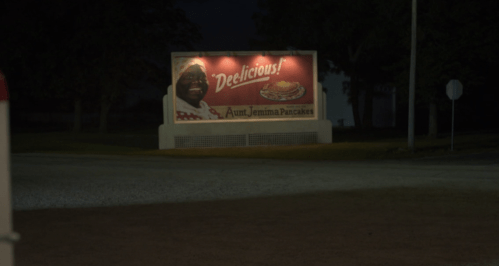
As they pull away from the station, we see a billboard advertising Aunt Jemima across the street.
aunt jemima

I think I’ll end this post here, not because I’ve run out of things to say, but because I could go on and on. The ending of the episode sets us up for the next one, so I’ll talk about that some time next week.

Suffice to say, there’s a lot going on here.
Leave a comment

Filed under television, what I'm watching

Some preliminary thoughts on H.P. Lovecraft before I post about Lovecraft Country

lovecraft countryI’ve taught the fiction of H.P. Lovecraft twice now: first in a second-year introduction to science fiction and fantasy, in which I paired up “classic” texts with more contemporary ones (Lovecraft I counterpoised with short fiction by China Miéville), and more extensively in a fourth-year seminar I called “The American Weird.” In the latter, we spent three weeks of a twelve-week semester looking specifically at Lovecraft’s short fiction, as well as his novella At the Mountains of Madness. And then we looked at authors who have been influenced by Lovecraft (Stephen King, for example), or who more specifically engage critically with Lovecraft’s tropes, preoccupations, and, importantly, his racism. One of the latter texts was a novella by Victor LaValle, The Ballad of Black Tom, which is a retelling of Lovecraft’s hella racist story (even for him) “The Horror at Red Hook,” from the perspective of a Black protagonist.

One of the other texts in the latter category was Matt Ruff’s novel Lovecraft Country.

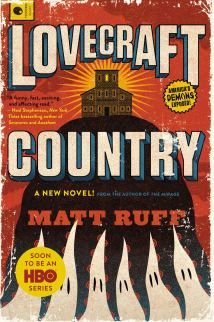
Lovecraft Country NovelLovecraft Country was easily a class favourite—which was something of a relief, as it was easily my favourite, and indeed one of the reasons I’d conceived of the course in the first place. So when HBO announced that Jordan Peele would be producing a series based on the novel, I was about as excited as I’d been ten years ago about Game of Thrones. The fact that one of the main characters was slated to be played by Michael K. Williams, aka Omar from The Wire, was just icing on the cake.
And after what seemed an interminable interlude, the series premiered this week.

I’m mulling whether I want to do episode-by-episode posts, á là my GoT posts with Nikki (except sans Nikki, unless she wants in). This may or may not happen. But I cannot let the first episode go by without airing my thoughts.

However … I won’t be talking about the first episode in this post. I’d originally thought I should have a brief little primer on H.P. Lovecraft, so as to better get into what Lovecraft Country is doing.

But, as anyone who knows me will tell you, I don’t do brief. And so I’ll be doing a second post in a day or two on the episode—this one is a more in-depth discussion of Lovecraft than I’d intended.

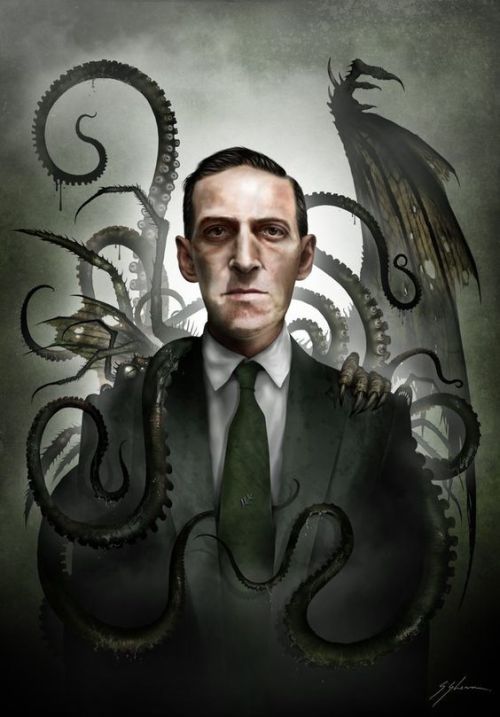
lovecraft

Lovecraft, it needs to be said, is something of an odd literary figure, insofar as he was an objectively terrible writer, both in terms of his prose and his storytelling, who ended up exerting an outsized influence on horror and its overlapping genres of science fiction and fantasy. When I said as much in my SF/F survey class, one student protested, saying he didn’t think there was anything particularly bad about Lovecraft’s prose. “Well, try this,” I suggested. “When you go home, read some of his sentences out loud, and we’ll revisit this next class.” Sure enough, next class the student sheepishly admitted that , when reading Lovecraft’s sentences aloud, he could not get past how wordy and awkward and clunky so many of them are.

Lugubrious is the word I would use, and pretentious in the manner of someone who wants to demonstrate a large vocabulary without really knowing how. Take, for example, the opening sentence of At the Mountains of Madness: “I am forced into speech because men of science have refused to follow my advice without knowing why.” While not one of his more egregious constructions—I’ll get to one of those in a moment—it is typical of Lovecraft’s typically forced cadences. “I am forced into speech” is precisely the kind of phrasing that earns my students an “awk.” in the margins, indicating that, while not technically incorrect grammatically, is still quite awkward and should be rethought. “Regrettably, circumstances compel me to speak, “ or “I must, reluctantly, speak up,” would be improvements, but not great ones; better to start with the reason why the narrator is “forced,” with something like, “The refusal of my fellow scientists to listen to me has left my no choice but to speak up.” Again, not elegant, but clearer: “men of science have refused to follow my advice without knowing why” is a little confusing, as the “why” is too vague—and also, how often are we likely to follow someone’s advice when we don’t know why we should?

Perhaps this seems nitpicky, and it is, but such phrasing and sentence structure is pervasive throughout Lovecraft’s corpus. The opening sentence of Mountains is more or less inoffensive, but then the second paragraph gives us this behemoth:

In the end I rely on the judgment and standing of the few scientific leaders who have, on the one hand, insufficient independence of thought to weigh my data on its own hideously convincing merits or in the light of certain primordial and highly baffling myth-cycles, and on the other hand, sufficient influence to deter the exploring world in general from my rash and overambitious programme in the region of those mountains of madness.

Woof. I won’t parse all that—that would take too long, and I have other old gods to fry—but perhaps you get a sense of Lovecraft’s prose, and why readers with a low threshold for bad writing wouldn’t get more than a few sentences into his fiction before tossing it aside and writing Lovecraft off as merely a “pulp” writer.

Well, to be fair, he was a pulp writer, one of the many whose often lurid stories were published in cheap paperbacks and magazines; but out of that milieu came a handful of authors who gave us some persistent and enduring—albeit deeply problematic—characters and stories. Robert E. Howard created Conan the Barbarian, and with him a strain of proto-fantasy that resisted gentrification by Tolkien and C.S. Lewis. Edgar Rice Burroughs—whom Atticus Freeman (Jonathan Majors) is reading at the start of Lovecraft Country—wrote all the John Carter of Mars novels, as well as numerous other SF works, but also created Tarzan. And though he was not in quite the same milieu, Englishman H. Rider Haggard invented the archaeological adventure story with novels like King Solomon’s Mines and She, without which we would not have Indiana Jones or Tomb Raider.

And then there’s Lovecraft, who despite his poor writing and shaky storytelling, profoundly influenced a generation of horror novelists and filmmakers. Unlike Howard and Burroughs, he did not have any memorable characters (unless you count the old god Cthulhu, but more on that below). What is so compelling about Lovecraft? His “mythos”—which imagined a malevolent universe populated by old gods and monsters that exist beyond the capacity of science and reason to comprehend them; much of his fiction is preoccupied with what happens when we mere mortals accidentally stumble into their ken. Spoiler alert: it never goes well for we mortals, who, if we’re lucky, are merely killed; the unlucky go mad, and the unluckiest somehow keep our minds but live with the crushing existential dread of knowing a cosmic truth that haunts us. Or as Lovecraft puts it at the start of “The Call of Cthulhu”:

The most merciful thing in the world, I think, is the inability of the human mind to correlate all its contents. We live on a placid island of ignorance in the midst of black seas of infinity, and it was not meant that we should voyage far. The sciences, each straining in its own direction, have hitherto harmed us little; but some day the piecing together of dissociated knowledge will open up such terrifying vistas of reality, and of our frightful position therein, that we shall either go mad from the revelation or flee from the deadly light into the peace and safety of a new dark age.

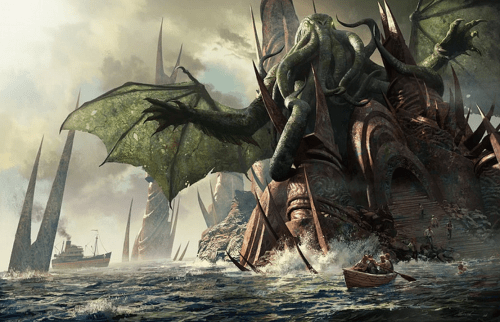
The “Cthulhu” in question is the old god that became central to Lovecraft’s mythos, to the point that it is now called the “Cthulhu Mythos.” It is a hideous, enormous tentacular horror that stalked the earth in its pre-pre-prehistorical days, but now lies slumbering beneath the earth. Its dreams infect the sensitive and give them visions of madness, or on occasion drive them actually mad. And, as chronicled in the story “The Call of Cthulhu,” sometimes tectonic events will drive his lair above the sea’s surface—at which point, eldritch hijinks ensue.

cthulhu

(If you want a rather hilarious rundown of Cthulhu &co.’s origin story, read Neil Gaiman’s “I, Cthulhu,” in which the old god in question recounts his tale in a fireside chat).

Lovecraft, a native New Englander, was deeply influenced by his home’s geography and its history. The vast majority of his fiction is based in, or connected to, a constellation of fictional small towns in Massachusetts—the principal one being Arkham, which houses Miskatonic University, with which many of his protagonists are affiliated. Beyond providing its geography, Lovecraft’s mythos is rooted in the region’s theocratic history: as has been discussed by a significant number of scholars, Lovecraft’s fiction is deeply influenced by the fire-and-brimstone Calvinism of New England’s Puritan settlers, in which humans are characterized as pitiful insects before God, whose only worth is to grovel before his greatness in the vain hope that he might grant salvation. The Cthulhu Mythos articulates this sort of Puritan self-abnegation, but without the hope of salvation—Lovecraft was a militant atheist, and took from the Puritan legacy mortals’ meaninglessness, without the hope.

Those unfamiliar with Lovecraft but steeped in the DC comics universe (though honestly I can’t imagine there are many of you in that particular Venn diagram) probably heard a bell go off at the name “Arkham.” Because, yes—the notorious Arkham Asylum of Batman and other Gotham-related tales is an overt reference to Lovecraft. The giant squid Ozymandias uses to destroy New York at the end of Watchmen is a nod to Cthulhu. The shape-shifting alien of The Thing is totally Lovecraftian. The xenomorph of the Alien franchise owes its existence to Lovecraft’s legacy. Buffy the Vampire Slayer is more indebted to Lovecraft than to Bram Stoker–its spinoff Angel perhaps even more so. As does, as I have written at some length, The Cabin in the Woods. And, well, I wouldn’t necessarily say Stephen King wouldn’t have a career without Lovecraft—but it would have been a very different career. To take just one example, It is probably the most Lovecraftian story there has been outside Lovecraft himself.

I could go on, but you probably get the point. Nobody will ever laud Lovecraft for his art, which is fair, but like a handful of his pulp compatriots, he has created compelling tropes that have lodged themselves in our collective imagination. But also like those of Burroughs and Howard and Haggard, they are deeply problematic. Conan the Barbarian is a veritable distillation of masculine characteristics that in the present moment we call toxic; H. Rider Haggard both traded on and furthered colonialist, racist representations of Africa and Africans as barbaric and hypersexualized; Burroughs did the same with Tarzan. In an early scene of “Sundown,” the first episode of Lovecraft Country, Atticus walks down a country road with an older Black woman after their bus had suffered a breakdown, and they were refused a ride in the pickup truck that came for them. When she asks him about the book he’s been reading, Burroughs’ A Princess of Mars, Atticus describes the travails of its hero John Carter. “Wait,” she interrupts him. “He’s a Confederate officer?” “Ex-confederate,” Atticus corrects her, but she’s having none of it. “He fought for slavery,” she says. “You don’t get to put an ‘ex’ in front of that.”

It’s a brief exchange, but a sharp one, and part of the point of Lovecraft Country is to interrogate Lovecraft’s legacy and influence—for, as I mentioned at the start of this post, Lovecraft was a virulent racist, and that racism informed his writing. China Miéville puts it quite well in his introduction to the Modern Library edition of At the Mountains of Madness:

Lovecraft was notoriously not only an elitist and a reactionary, but a bilious and lifelong racist. His idiot and disgraceful pronouncements on racial themes range from pompous pseudoscience—“The Negro is fundamentally the biologically inferior of all White and even Mongolian races”—to monstrous endorsements—“[Hitler’s] vision is … romantic and immature … yet that cannot blind us to the honest rightness of the man’s basic urge … I know he’s a clown, but by God, I like the boy!” This was written before the Holocaust, but Hitler’s attitudes were no secret, and the terrible threat he represented was stressed by many. (Lovecraft’s letter was written some months after Hitler had become chancellor). So while Lovecraft is here not overtly supporting genocide, he is hardly off the hook.

As Miéville notes, one of the common defenses offered of Lovecraft’s racism and anti-Semitism is that, well, that was what things were like at that time. As one of my students said, “It was the 1920s and 30s. Everyone was racist then.” To which I responded, well, no. There were actively antiracist white people then, and there were racists, but then there were also RACISTS—the lower-case group being people who did not question the overt societal ethos of white supremacy, and thought that Hitler fellow perfectly dreadful, but did not otherwise give it much thought; and then the latter, which were the Lovecrafts of the world—people actively and vocally championing white supremacy and superiority, opining at length on the inferiority of darker-skinned peoples, who saw in Hitler a brave and honest truth-teller, and who—like Lovecraft—endorsed eugenics and phrenology. So, no … Lovecraft was not merely “of his time” where his racial animus was concerned; he was in the vanguard.

(That being said, I get a bit squirrelly in making this distinction, because part of the cognitive dissonance of our present moment has proceeded from the tacit assumption that only all-caps racism is truly pernicious, or for that matter is the only real racism—that if you’re not hurling the N-word at Black people, or burning crosses, or otherwise behaving like every southern sheriff in every Hollywood movie about racism, then the charge is unfair. And when we’ve come to associate the terms “racism” and “racist” with those extreme behaviours, it makes it difficult for white people to make an honest reckoning with systemic racism and our complicity in it).

Lovecraft is thus an interesting figure to consider in our present moment of racial and historical reckoning, when such literal edifices as statues and monuments memorializing figures and events associated with slavery and institutional racism are being brought down. It’s easy enough to endorse the removal of Confederate monuments; it gets more complicated when the legacies and histories of the people memorialized are themselves more complicated. Does the authoring of the Declaration of Independence give slave-owning Thomas Jefferson a pass? Does Winston Churchill’s leadership during WWII outweigh his lethal policies in India?

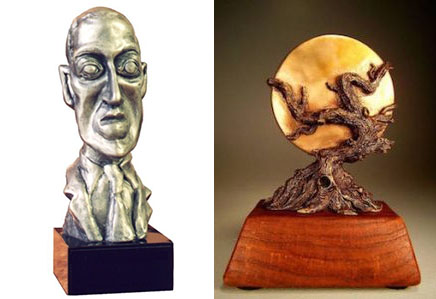
Lovecraft had his own moment of statuary removal several years ago. Since 1975, the World Fantasy Award—along with such SF/F awards as the Hugo and Nebula— has been one of the most prestigious honours in the world of genre fiction. The very first awards were bestowed at the World Fantasy Convention, held in 1975 in HP Lovecraft’s home city of Providence, Rhode Island. In Lovecraft’s honour, the statuette was a stylized, elongated bust of his face—and so it remained for the next four decades.

As SF/F has become less and less the near-exclusive territory of white male authors, and grown to include more diverse writership and readership, the predictable backlashes have occurred—not least of which being the campaign by the so-called “Sad Puppies,” who were up in arms that the Hugo Awards were too woke and were eschewing “real” SF/F in favour of novels and stories written by social justice warriors. (If you want to read my rant about it at the time, click here). This was also the time of Gamergate, and—well, I don’t want to rehash that bit of asshattery, so of you’re unfamiliar, Google it. In this same time frame, there was a lot of pressure to retire the Lovecraft statuette. Authors of colour who had been awarded the “Howard,” as it is called (H.P. stands for Howard Philips) pointed out what a tainted honour it was to be lauded for their work with the visage of a man who considered them less than human.

And so the Howard was retired, and a new trophy was created, with all of the predictable hue and cry from those who, anticipating the protests about Confederate statues, called the retirement of the Howard an erasure of history—and an erasure of Lovecraft’s work.

world-fantasy-award

Myself, I prefer the new trophy, and I reject the suggestion that the change is an erasure of any kind. It strikes me that what gets lost in the polarized debate about monuments and legacies and who we should memorialize is the overwhelming value of the debate itself. At the end of the day, whether or not the statue comes down, or whether or not a literary trophy gets a makeover, is at least a little bit beside the point: what I find encouraging in these moments is that arguments that have largely been had on the fringes have become more central. Do I think statues of Thomas Jefferson and Winston Churchill should be torn down? Actually, no—I do not. But I do think their histories and legacies need closer interrogation, and the tacit hagiography that attaches to them needs dispelling.

The same goes for those authors whose works resonate still today. Those influences are still powerful. But how we choose to be influenced, or how we critically approach the nature of that influence, is something else entirely. I’m seeing a lot of that in my current research with how fantasy as a genre is transforming what was, in its origins, a deeply conservative, reactionary, and religious sensibility, into a far more secular, humanist, and progressive one.

Not least of which are novels like Lovecraft Country, and its current adaptation on HBO.

Leave a comment

Filed under Revenge of the Genres, what I'm watching