Monthly Archives: October 2016

A Wee Bit of Comics Context

As I mentioned in my previous post, we’re moving on to Fun Home by Alison Bechdel this week, which is the text on this course I’m most trepidatious about teaching—mainly because, as I’ve said before, I’m not much of a comic book / graphic narrative person. Of all the various species of nerdiness I enthusiastically embraced when I was young, comic books were not in my wheelhouse … I think, in part, because I was a very fast reader. I loved to read, and could tear through a medium-sized novel in a day or two. Comic books were a matter of mere minutes, so when the time came to spend my allowance, it made far more economic sense to buy a chunky fantasy novel by Terry Brooks or Anne McCaffery.

That being said, I seem to be having a mid-life comic book renaissance, having read Brian K. Vaughan’s Saga (on the most excellent Nikki Stafford’s recommendation), the new Black Panther series by Ta-Nehisi Coates, as well as re-reading all the Sandman comics while we did American Gods in class. And of course I’ve read such staples as Art Spiegelman’s MAUS, Alan Moore’s Watchmen, and Marjane Satrapi’s wonderful Persepolis, but this still leaves me far from being a competent commentator on comics.

Enter my good friend and colleague Andrew Loman, who not only embraced the comic book dimension of nerdiness in his youth, but has parlayed that love into scholarly production: he has published articles on Spiegelman’s MAUS, has taught classes on comics and graphic novels here at Memorial, and since his first sabbatical two years ago has been plugging away at a massive project annotating Watchmen. And most recently he presented a paper at “Mixing Visual Media in Comics,” a conference on graphic narrative held here at Memorial just a week ago that featured some of the biggest luminaries in comics and graphic narrative scholarship in the world.

We’re going to have two discussions, the first of which will deal with comics, or “graphic narratives” as a field of academic study more broadly; the second will look at Fun Home more specifically.
Revenge of the Genres

Christopher: Let’s begin with the question of comic books as a field of scholarship, something that once upon a time, like film studies, would have been considered unthinkable as a viable area of academic inquiry. But now there are numerous English departments that feature classes on comics, many scholarly books and articles have been written on the subject, and our colleague Nancy Pedri can get a SSHRC (Social Sciences and Humanities Research Council) grant to host a conference devoted to it—and, indeed, feature respected scholars who have built their careers publishing and teaching on the subject. How would you characterize the emergence of comics as a scholarly pursuit?
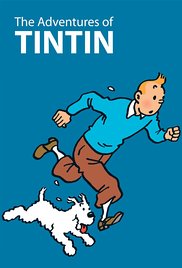
tintinAndrew: That’s a complicated question. The first important point to make, I think, is that while North American comics studies have only emerged in the past fifteen years, comics studies in France emerged considerably sooner. The first work of criticism I ever bought was Jean-Marie Apostolidès’ Les Metamorphoses de Tintin; the second was Benoit Peeters’ Les Bijous ravis. These studies of Hergé’s Tintin albums were published in France in the early 1980s. So while Comics Studies was until recently unthinkable in the Anglo-American context, it has been thinkable in the European context for decades.

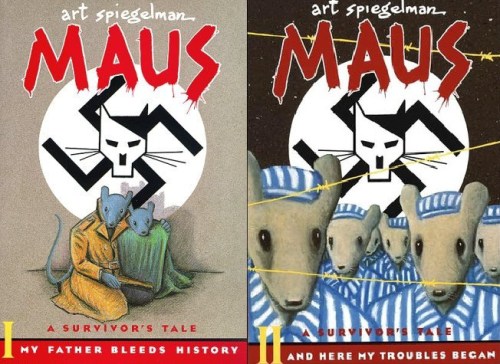
In the Anglo-American context, Comics Studies is still new, and it hasn’t yet established a firm toehold in the academy. Part of this belated emergence has to do with the disdain for mass culture that was part and parcel of the Anglo-American academy, which saw mass cultural forms, including comics, as Kitsch. I know you’re familiar with that prejudice from your interest in TV and genre studies: Clement Greenberg and Theodor Adorno cast long shadows. Part of it has to do with histories of censorship in comics: I’m thinking specifically of the Comics Code Authority, which came into place in the McCarthy era, which was modeled on the Hollywood Production Code, and which imposed various restrictions on mass-market comics, largely confining them to a child readership at a time when Children’s Literature itself flew under the scholarly radar. (The emergence of Children’s Literature studies is a related disciplinary tale.) And the largest part of it has to do with the slow emergence of the kind of the literary comic of which MAUS and Fun Home are exemplars.
maus
MAUS
was a breakthrough work for what would become Comics Studies, in two respects. First, its success emboldened publishers to take risks on other “weighty” comics, so that MAUS’s publisher, Pantheon Books, later published Chris Ware, Ben Katchor, Marjane Satrapi, and David B., and gradually there accumulated a critical mass of the kinds of comic that people mean when they use the not-very-useful term “graphic novel.” Secondly, because of MAUS’s seriousness of purpose, literary critics could appreciate it in a way that they couldn’t appreciate a work like Alan Moore and Dave Gibbons’ Watchmen. In its way, Watchmen is just as formally daring as MAUS; in some ways, because Spiegelman mostly kept his formal experiments at bay while writing MAUS, Watchmen is even more daring (there’s nothing in MAUS equal to Watchmen’s chiastic Chapter V). But Watchmen was still a superhero comic published by a mass-market publisher – that is, still caught in the grates of the mass-culture gutters. (I remember showing Watchmen to my Shakespeare professor at the University of Calgary. “It’s very violent,” he said, before returning to his lectures on King Lear and Titus Andronicus.)

comedian-in-the-watchmen-comic
The thematic seriousness of MAUS was its passport to the academy: it was often the first comic ever taught in university literature departments, because English professors could both appreciate it themselves and also represent it as a legitimate work to skeptical colleagues. Geoffrey Hartman wrote about it! And it made those other colleagues receptive to the argument that there might be other works that were as interesting and challenging, even a whole field worthy of scholarly inquiry. By the time I came to Memorial, I encountered only nominal resistance when I proposed a course on comics – only from the usual departmental mastodons, and even then only in the “this isn’t what I understand as literature, but go with God” attitude of the already-resigned.

I should add that comics scholars in Canada tend to be relatively young: we’re generally mid-career, which means we came of age as readers in the 1980s and later. MAUS and Watchmen and Love and Rockets have always been part of our cultural landscape. It isn’t surprising that as we displace an older generation of critics, we remodel the institution so that it reflects our own sensibilities. But we have no reason to be smug about that: you’ll remember, I’m sure, how our department reacted when someone proposed hiring a specialist in Gaming Studies. “The idea!” we all said, dust rising from our clothes as we shuddered.

Christopher: Right, I’d forgotten about that. Though for the record, I’m not opposed to the idea of hiring a Gaming Studies person, I just want us to hire the half-dozen other positions on the departmental wish list before we get there. Though now that we’ve absorbed Communication Studies, perhaps that IS something we should consider …

Okay, there’s a lot there in what you said that I want to unpack, but just a quick question first: in my introductory blurb, I made a point of saying “comics” and was careful to mark out “graphic narrative” just like that, in scare quotes, because I want in our classes on Fun Home to trouble that distinction; to my inexperienced eye, it sometimes seems that there’s a tacit (or not so tacit) hierarchy of texts in which “graphic novels” are designated as serious or literary, and “comics” play a role comparable to genre fiction in literary study (and your lovely history of comics scholarship seems to bear this out). Is this still a thing? Are these distinctions points of dispute?

Andrew: Your eye may be inexperienced but it’s keen. “Graphic novel” is a term associated with the comics artist Will Eisner, who started using it to describe his work in the late 1970s. But the term owes its present currency not to him but to publishers and booksellers, who liked the distinction it implied from the vulgar comic book. Hey adults! Graphic novels! It would draw in the status-conscious readers that booksellers coveted – and power to them, because without those readers and the market they helped create I probably wouldn’t be teaching comics.

joe-sacco2From a critical perspective, though, the term is troubling. It associates comics with a single literary form – the novel – with its own complex history and its own contract with readers. Among the terms of that contract is the (typical) expectation that the novel is a work of fiction. (I know that that adjective “typical” does a lot of work, but that’s my point: why saddle comics with all the sub-sub-clauses of the novel’s particular contract?) Is MAUS a novel? No, though in some respects it’s novelistic: it’s a work of dramatized testimony. Fun Home isn’t a novel, either, but rather a memoir; Joe Sacco’s Palestine isn’t a novel but rather a work of comics journalism. It’s true that “comics” isn’t a perfect term, either, insofar as it implies that we should respond to MAUS with laughter. A term that gained currency in the past few years, “graphic narrative,” is only marginally less bad than “graphic novel.” Finding the right word for this strange form is tough work, and maybe the only thing to do is to use different terms situationally and always ironically. But “comics” has one key virtue: it isn’t pretentious.

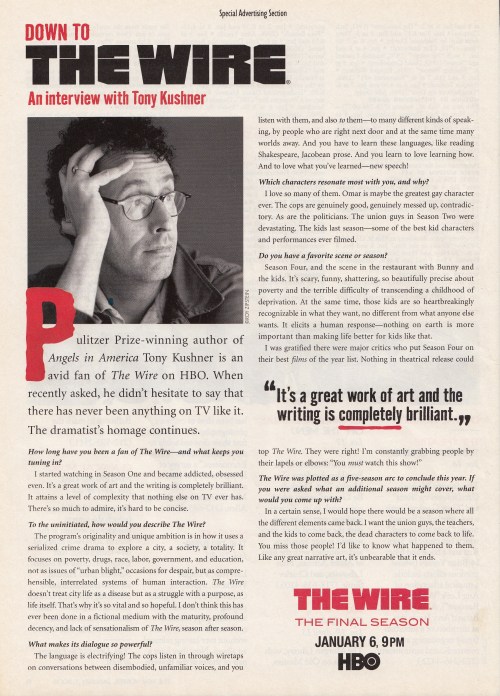
Christopher: Amen. This all reminds me of the New Yorker ad for season five of The Wire (which I noted in an early post for this series), which is basically an interview with Tony Kushner on why he thinks The Wire is great art—basically, giving permission to the intelligentsia and literati to watch television without guilt.

We’ll talk about the distinctions between “graphic novels,” “graphic narratives,” and “comics” in class, but I think in general I’ll stick with “comics,” however inaccurate the term might be at times.

Something I’m curious about: many of the “literary” comic writers/artists, like Spiegelman and Bechdel, emerged from a bohemian underground of “alternative” comics; again, not something I’m overly familiar with, but from what I gather, Spiegelman cut his teeth writing comics that were the equivalent of garage rock or poetry chapbooks, and Bechdel made her name with the lovely but (at the time) necessarily niche comic strip Dykes to Watch Out For. By contrast, as you point out, such luminaries as Alan Moore (or for that matter, Neil Gaiman) came up through the more popular, superhero-laden imprints, and thus took longer to gain academic recognition—in part because of their ostensibly unserious subject matter, but also because of their popular appeal. Does this kind of—what? I guess since we’re talking comics, I can say “origin story”—does this still obtain? (I guess in some ways I’m asking you to make a Frankfurt/Birmingham argument here. Sorry).
kushner-wire-ad

Andrew: I plead guilty to having first become aware of The Wire thanks to that very ad. But no one understands how much I love Tony Kushner. At least twice a month, I make pilgrimages to the Stephen Barclay Agency website to see if his profile mentions any new upcoming work. I’m still waiting for The Intelligent Homosexual’s Guide to Capitalism and Socialism with a Key to the Scriptures to see print; I cling to the hope that he’ll write the Phenomenology-of-Money cycle that he mentioned fifteen years ago; and I’ll be first in line if he and Spielberg ever make the Eugene O’Neill biopic he conjured up somewhere – maybe in his notes to the National Theatre’s 2003 production of Mourning Becomes Electra. I brought his comments on Sir Thomas Browne to the comics conference just in case someone asked why I thought Alan Moore might have read “The Garden of Cyrus.” (No one asked.) I love him. So I’m guilty – but I hope I get a reduced sentence.

You’re right that Spiegelman and Bechdel both come from alternative scenes, and that Moore and Gaiman’s path, lined as it is with capes and cowls, has set the terms of their institutional recognition. But Moore left DC years ago, and he went on to write many, many works that neither conform to recognizable genres nor would be well-received in the mass market (try pitching From Hell or Lost Girls to a media empire). Even so he still doesn’t have the critical stature of Spiegelman or Bechdel of Chris Ware. One suspects other factors at play. His work is seriously uneven (though Spiegelman’s is, too). He’s too weird for the generally middle-class critics who’ve made it through the polishing machine of graduate school and the job market (he worships a snake puppet!). And unlike, Spiegelman and Bechdel and Ware, who are all writer/artists, he relies on collaborators (as does Gaiman). That last one may be the most important: in spite of the collaborative example of film and theatre, cultural criticism remains most comfortable with single authors (witness the auteur theory in Film Studies, or the status of the showrunner in prestige TV).

I’d guess that critics’ preference for the alternative comics creator will persist as long as the high art/low art binary does. To me it seems robust. Bart Beaty recently wrote a critical study of Archie Comics in a spirit of rebellion against the canon-builders who’d only choose “respectable” artists while scorning the “litter auteurs” (if I may). An honourable project – but I think there are institutional and cultural forces working against him.

But ask me again tomorrow and I might tell a different story. The elevation of comics’ reputation has given rise to wonders: The New York Review of Books reviewing a Batman comic; Ta-Nehisi Coates writing Black Panther. We may yet wake up in a world where Nicole Eisenman is drawing Wonder Woman, and where Archie Comics are understood to be just as significant and sophisticated, on their own terms, as MAUS is, on its.

Christopher: I was going to save mention of the Ta-Nehisi black-pantherCoates Black Panther until later in this discussion, but since you brought it up, there’s no time like the present. When I first conceived of this course, I knew I’d want to include a comics component (in spite of my ignorance of the field). At the time when I was first jotting down the notes that would evolve into “Revenge of the Genres,” I was avidly reading Coates’ blog and his account of what it was like to write a comic book when this was something he’d never done. I was also, at that point, reading his heartbreaking and deeply affecting essay Between the World and Me, his cri de coeur about being a black man in America.
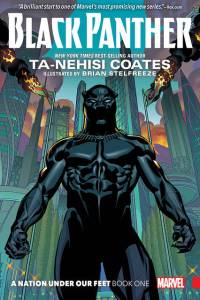
His Black Panther was in very close contention with Fun Home as the representative graphic text for this course.

I won’t ask you what you think of Coates’ take on Black Panther (that, presumably, will be an informal conversation over beer); I will, however, ask you what your thoughts are that a person who is arguably the leading African-American public intellectual of our historical moment (Toni Morrison has compared him to James Baldwin) has taken authorship over one of the very few black superheroes we have?

Andrew: It’s astonishing. I hope Suzan-Lori Parks or Tarell Alvin McCraney or Branden Jacobs-Jenkins gets an invitation next (I’m naming playwrights because I think they’d make the transition to comics more easily than would an essayist). I had an intimation that Coates might try his hand at comics a year or so ago when the New York Times asked him what he was reading. He mentioned E. L. Doctorow’s The Waterworks, which was the sort of book I would expect him to read; and then he mentioned Jonathan Hickman’s run on The Avengers, which was not. That’s when I first learned that he’s part of the nerd collective; I gather some wise person at Marvel figured that out sooner. It still gives me vertigo when I see his name on the covers of Marvel comics. Time will tell if his run is just a fluke convergence of personal inclination and corporate canniness (Disney jealously eyeing Coates’ cultural capital): that kind of literary tourism happens semi-regularly (“Why not dash off a comic or two, Ms. Atwood?”). But of course I’d love to see him alternate between essays and comics over the long term – especially as he becomes more dexterous as a comics writer.

But apropos of his take on Black Panther – why wait for beer? – I’ve read the first two issues and found them pretty forbidding. Coates has inherited the continuity and characters from earlier writers, and he begins in medias res, during some sort of Wakandan civil unrest. I’m sure it all makes sense to Marvel habitués, but I’m afraid I come to Black Panther knowing nothing about the character – so I can’t say I’ve enjoyed it so far. But I want desperately to believe. I’ve rarely been moved by any paragraph as much as by this one, from Between the World and Me:

Slavery is not an indefinable mass of flesh. It is a particular, specific enslaved woman, whose mind is active as your own, whose range of feeling is as vast as your own; who prefers the way the light falls in one particular spot in the woods, who enjoys fishing where the water eddies in a nearby stream, who loves her mother in her own complicated way, thinks her sister talks too loud, has a favorite cousin, a favorite season, who excels at dress-making and knows, inside herself, that she is as intelligent and capable as anyone.

Someone who can write like that is worth trying and trying again. I’ll be buying the trade paperback.

Christopher: That actually sets up both a great final question to end this discussion, and a useful segue into Fun Home. Which is to say: given its place on the literary fringes, do you think comics studies offers a more fruitful space for previously marginalized voices to make themselves heard than “literary” fiction?

Andrew: Not comics studies, but maybe comics – maybe. The received wisdom is that because American comics have been perennially a despised form, marginalized voices have made themselves heard there. The great example is the superhero, created by young writers who were overwhelmingly Jewish American. But if that received wisdom is true, then as comics come increasingly into the literary spotlight, they’ll become less, not more hospitable to marginalized voices: the legitimation of the form will be bad for its diversity. But the story is no doubt more complicated than the received wisdom would allow. Those inventors of the superhero were overwhelmingly men, for instance, while “literary” authors of the 1930s included many women. Where gender is concerned, “literary” fiction today is still substantially more diverse than comics. And the legitimation of comics seems to have made them more rather than less hospitable to gender diversity. Alison Bechdel is a trailblazer not only because she’s a Lesbian cartoonist but also because she’s a woman: in 2004, two years before she published Fun Home, The New York Times profiled five comics artists – Art Spiegelman, Chris Ware, Joe Sacco, Seth, and Chester Brown – and as you can see from that list, there was not a woman among them (there were of course women writing comics, including Aline Kominsky-Crumb and Lynda Barry, but they didn’t have the stature or visibility of those five men). Fantagraphics – a major publisher of comics with pretensions to art – was still largely a boy’s club. Glance at the comics section in a bookstore now (sorry, the “graphic novels” section), and you’ll see a number of women represented there – the brilliant Eleanor Davis, Leela Corman, Rutu Modan, Jillian Tamaki, Sarah Glidden, and many more.

But literary fiction is itself at the fringes of culture, so maybe we’re making the wrong comparison. Compared to Hollywood, comics are a festival of difference, and present a grand opportunity to those true artists, no matter their gender, ethnicity, or class, who are prepared to live hard-scrabble lives in draughty roach-choked apartments, struggling to make ends meet while they craft heartfelt works of subtlety and beauty that will finally come to press when they’re in their late 40s.
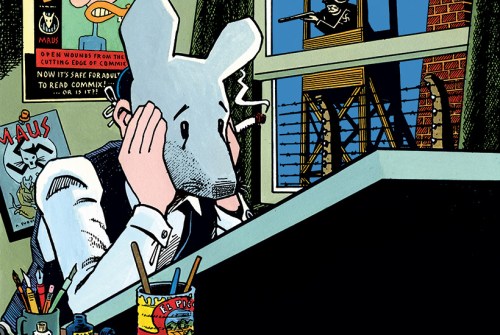
spiegleman_111213_820px

Christopher: And on that ringing endorsement of the comics-writing lifestyle, we’ll bring this discussion to a close. Thanks so much for talking with me about this, and for bringing your encyclopedic knowledge to bear on a topic for which I am but a neophyte.

And thanks everyone for reading. Stay tuned for the next installment: Andrew will be back to talk in more depth and detail about Alison Bechdel’s Fun Home.
Leave a comment

Filed under Uncategorized

Fun Home Part One: Just a Little Introduction

I’m starting to feel this blogging for this course getting a little away from me, at least based on the queue of entries I meant to write (and still mean to write) versus where we are in the course. Not unpredictable, considering the busyness of this term, but I’m going to try and get back on top of things. I have a second post on Station Eleven, looking at how it treats the theme of nostalgia, in the hopper; I’m still working on a final Zone One post, now very overdue; to say nothing of the one or two contextualizing posts I’d meant to put up at the start of the term.

Hopefully, all that will come. But at the present moment, it’s time to move on to our next text, Alison Bechdel’s graphic novel Fun Home. For reasons that will become apparent when I put up my second (already-written) post, this one will be brief.

Revenge of the Genres

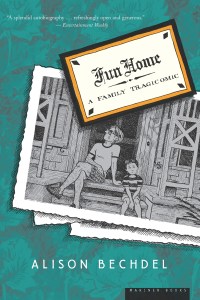
FunHomeWhy Fun Home?

When I started sketching this course out in my mind, I knew I’d want to do at least one unit involving comics and/or graphic narrative, not least because in the last decade or so, it is a form that has emerged from the margins of literary study to be taken seriously academically, as well as making inroads into mainstream reading from its previous enclaves of nerd and bohemian ghettoes. Comics, and its more respectable cousin graphic novels, tend to doubly be genre: genre in terms of form as visual story, and genre in terms of the stories they tend to tell, most notably mask-and-cape superhero sagas.

My problem going into choosing a representative text was that this is an area I am manifestly unfamiliar with—I have never been a reader of either comics or graphic novels. I’ve read some of the usual suspects: Art Spiegelman’s MAUS, Alan Moore’s Watchmen, Marjane Satrapi’s Persepolis, and as mentioned previously, I have read Neil Gaiman’s Sandman series in its entirety. All of these were worthy candidates; I also strongly considered, sight unseen, the current run of Marvel’s Black Panther, authored by the brilliant African-American essayist Ta-Nehisi Coates.

While mulling all this over, I also considered Fun Home—which, though I had not yet read it, was a necessary candidate simply by dint of reputation. With a few days left before I had to make my book orders, I purchased a copy, bought a coffee at the bookstore’s Starbucks, and sat down to read.

By page six, I had made up my mind—Fun Home it was.

Why? Well, even sight unseen, it was a strong contender: not just because people whose opinions I respect rave about it, but also because I wanted to have an eye to gender and racial representation in the course readings, and in the mental game of Tetris that is the fitting together of representative texts on a course, I was keenly aware that I was lacking where women were concerned. (And even including Bechdel, I didn’t do great—2/6 for the course).

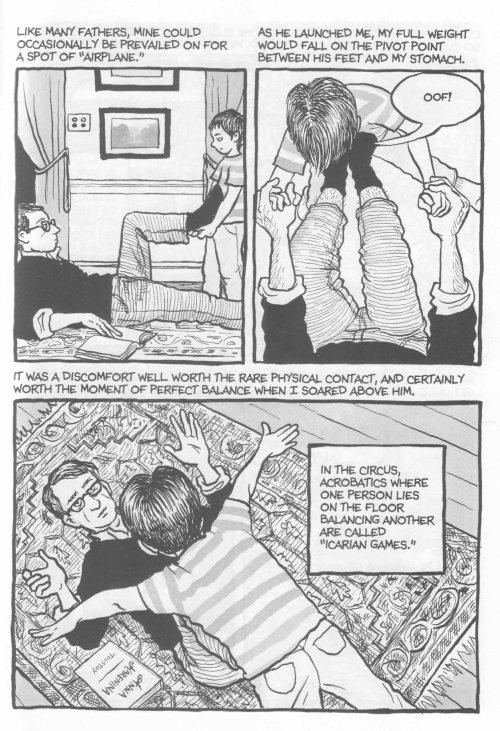
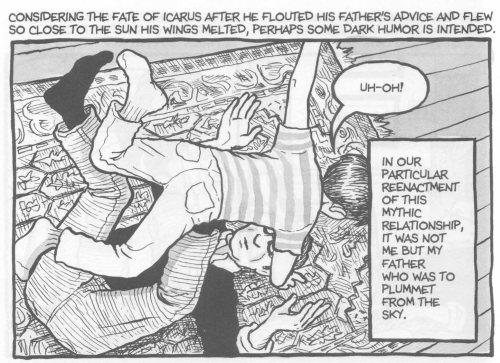
But more importantly, the story opens with an extended allusion to Icarus and Dedaelus by way of Bechdel depicting her young self playing a game of “airplane” with her otherwise unaffectionate father. fun-home-icarus-01

fun-home-icarus-02The opening chapter is titled “Old Father, Old Artificer,” an allusion to the final line of James Joyce’s A Portrait of the Artist as a Young Man: “Old father, old artificer, stand me now and ever in good stead.” Out of the gate, Bechdel at once identifies her graphic memoir with an august canon, and ironically signals this identification as transgression. It is a beautifully audacious beginning that reflects back upon the traditional strictures of literary canon, highlighting the fact that not only is this memoir a comic book, it is also written by a queer woman.
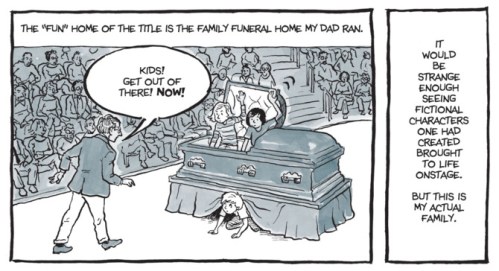
funhome-stage

There will be a lot more to talk about in future posts. Stay tuned for my special guest.

Leave a comment

Filed under Revenge of the Genres, teaching

Station Eleven, Part One: “Because Survival is Insufficient”

Sooooo, a bit of a lag there between posts. Apologies, especially to my students—the term is getting really busy between grading and the fact that the vast majority of administrative stuff we want to get done in terms of new courses and calendar changes has to happen before the middle of this week … so I’ve been a bit distracted.

Which means that I’m putting up my first Station Eleven post after we’ve already started the novel in class. Also, I’m not done talking about Zone One—I’ve been pecking away at a final post comparing Whitehead’s novel to Max Brooks’ World War Z, and the instructive contrasts between them. I was going to get that up soon after this one, but I think it will probably be a better idea to get my second Station Eleven post up first. As Liz Lemon would say: blerg.

But without further ado …

Revenge of the Genres

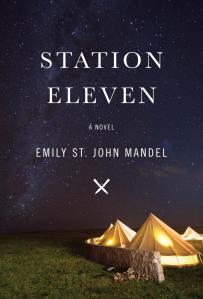
StationElevenWhy Station Eleven?

Neil Gaiman is a genre writer with literary acclaim, and Colson Whitehead is a literary novelist who wrote a genre novel, and both work nicely as examples of how we might trouble our preconceptions of the categories of both literature and genre (and “literature” as a genre). Station Eleven does something different, however—for that matter, it does a bunch of things differently. The novel is vaguely generic, insofar as it follows in the mold of Stephen King’s The Stand, in which the vast majority of human beings are killed off by a particularly virulent strain of influenza. Mercifully, the dead in this case stay dead. But the apocalypse itself, while obviously functioning as a crucial narrative fulcrum, ultimately proves to be a MacGuffin: while in many such narratives the site and source of the mass deaths is crucial to the story and allegorizes some fear or anxiety (natural disaster, alien invasion, weaponized biological agent, zombies), the “Georgian Flu” of Station Eleven is an ancillary detail. It could just as well have been any other means of mass extinction for all the attention it gets paid. Those of us who obsess over nerdy detail will be frustrated: was it a natural mutation of the flu, or was it weaponized? Are the survivors immune, or did they just manage to stay clear of infection? If it’s the latter, isn’t there the danger of the virus returning to finish the job?

Mandel is not concerned with such details: the central theme of the novel is not the mass extinction of most of humanity, but rather the ways in which people adapt and change, and what remains important in the aftermath. Much of the post-flu story follows a traveling band of actors and musicians called The Traveling Symphony, who trek from settlement to settlement and perform music and plays. Their main dramatic stock in trade is Shakespeare: “They’d performed more modern plays in the first few years,” we’re told, “but what was startling, what no one would have anticipated, was that audiences seemed to prefer Shakespeare to their other theatrical offerings.” One of the members of the troupe explains this preference, suggesting that “people want what was best about the world,” a theme that Mandel develops in more complex ways over the course of the novel.

I must reluctantly admit that this line makes me think of that terrible Christian Bale / Matthew McConaughey movie Reign of Fire, a post-apocalyptic story in which the purveyors of the apocalypse are dragons accidentally released from internment underground. And no, Station Eleven doesn’t make me think of that premise, but a moment early in the film when Christian Bale’s character stages a crude theatrical version of Star Wars for the benefit of the children in the fortified enclave he presides over. His audience is enthralled. Though everything else about the film is more or less execrable, and this particular scene is played for laughs, it did make me wonder: what stories will persist in the event of a cataclysm few people survive? What elements of pre-apocalyptic culture will cling to humanity as a basis for future stories, legends, and mythologies?

The idea that Star Wars might be repeated in non-cinematic form is not exactly beyond the pale, considering its own self-conscious basis in myth and romance (George Lucas, besides stealing much of the plot from Akira Kurosawa’s 1958 samurai film The Hidden Fortress, also wrote his screenplay with Joseph Campbell’s The Hero With a Thousand Faces at his elbow); it’s not unlikely that stories that don’t speak to specific historical moments would be more appealing than those requiring knowledge of historical or cultural contexts. Shakespeare’s plays have endured not just because of their poetry, but because they have proved endlessly adaptable, as anyone who has seen A Midsummer Night’s Dream set in 19th-century Italy, or a Richard III set in post-WWI England.

I have to say, as a lover of Shakespeare and someone who has directed a couple of his plays and acted in a few more, Mandel’s vision is comforting. The idea that people would revert (if that is the right verb) to the classics comprises a generous perspective on humanity, and a seductive one at that: who among us who feels guilty whenever we binge on Netflix rather than picking up a new novel, or when that novel we pick up isn’t something “literary,” hasn’t blamed (at least in part) the busyness of life and its myriad distractions? Sure, we’d get around to reading Ulysses or War and Peace, or reacquainting ourselves with Shakespeare, but who has the mental energy at the end of the day? By the same token, do we not blame social media and the internet for the fact that our younger generations lack the literacy and attention span for such great works?

(Not for nothing, but right now I’m lamenting the fact that I didn’t get my third zombie post written in time, as it deals in part with such tedium and mundanities of daily life).

As extrapolative SF, Station Eleven’s suggestion that we would find solace in Shakespeare is, at the least, a wee bit problematic—there is an element there of wishful thinking, but that might also be because we’re more accustomed to more cynical post-apocalyptic stories in which music and literature are the least of the survivors’ concerns, except as rare wistful moments of nostalgia when someone sings a sad song around the campfire moments before the zombies attack. But Station Eleven makes “culture” in this capacity its primary concern: the lead vehicle in the Traveling Symphony’s caravan (made up of pickup trucks “pulled by teams of horses on wheels of steel and wood”) bears the defiant motto “Because survival is insufficient”—a utopian declaration that being human means more than just getting by, it requires spiritual and intellectual nourishment as well. This, as we learn, underlies the Traveling Symphony’s mandate.

To return to the question of “why Station Eleven?”: if your nerd alarm is clanging, that’s likely because the assertion that “survival is insufficient” is a direct allusion to Star Trek: Voyager, a fact the novel acknowledges unabashedly. The line is spoken by former Borg Seven of Nine, expressing her realization that, as she re-learns how to be human, her need for an imaginative life is as necessary as the basic necessities of life.

There are a few points worth teasing out here, not the least of which is the way in which Mandel performs a cute little bit of prestidigitation, holding up Shakespeare as a cipher for enduring culture while sneaking in Star Trek and comic books. The novel’s title refers to a pair of comic books in the possession of one of the characters, from a series called Dr. Eleven:

Dr. Eleven is a physicist. He lives on a space station, but it’s a highly advanced space station that was designed to resemble a small planet. There are deep blue seas and rocky islands linked by bridges, orange and crimson skies with two moons on the horizon … Kirsten’s taken care of the comics as best she can but they’re dog-eared now, worn soft at the edges. The first issue falls open to a two-page spread. Dr. Eleven stands on dark rocks overlooking an indigo sea at twilight. Small boats move between islands, wind turbines spinning on the horizon. He holds his fedora in his hand. A small white animal stands by his side. (Several of the older Symphony members have confirmed that this animal is a dog, but it isn’t like any dog Kirsten’s ever seen. Its name is Luli. It looks like a cross between a fox and a cloud.) A line of text across the bottom of the frame: I stood looking over my damaged home and tried to forget the sweetness of life on Earth.

One of the great pleasures of Station Eleven is the way Mandel deftly weaves the stories of a disparate but substantial ensemble of characters together, moving forward and backward in time as we go such that we gradually see how each of the characters are narratively connected. The Dr. Eleven comics function both as a thematic bit of connective tissue, but also as a concrete object anchoring the post-apocalyptic lives of the survivors (Kirsten especially) in memories of the perished world.

The comics also function metafictionally: Dr. Eleven’s story is one of flight and exile from an earth conquered and enslaved by hostile aliens, dystopic SF functioning as a central motif in a novel about a post-apocalyptic world, a novel that itself resists easy generic classification. Though Station Eleven received the Arthur C. Clarke Award, Emily St. John Mandel demurs from the label of science fiction, in part because she does not want to disappoint people who pick it up expecting doctrinaire SF and finding that, aside from the near-extinction of humanity, there is a dearth of anything else resembling SF tropes.

Mandel’s previous three novels were also written, in her words, as “literary fiction,” but as she says, “I was surprised to discover that if you write literary fiction with a crime in it, it turns out you’ve written a crime novel.” Perhaps ironically, part of the reason she shifted gears with Station Eleven was because she did not want to get pigeonholed as a writer of crime thrillers.

I don’t doubt that Mandel is sincere when she professes bemusement over people’s characterization of Station Eleven as SF; dystopias and visions of apocalypse have increasingly become a staple amongst such “literary” novelists as Cormac McCarthy (The Road), Kazuo Ishiguro (Never Let Me Go), and Margaret Atwood (pretty much everything she’s written in the past decade or so), and even when an author like Atwood enthusiastically embraces the science-fiction classification, booksellers seem reluctant to shelve their novels alongside Isaac Asimov—and indeed, you won’t find Station Eleven there either. But for our purposes, Station Eleven is an instructive text less for the question of how it is classified than for its juxtaposition of “high” culture and “low” in its thought experiment on what art will sustain us.

Leave a comment

Filed under Revenge of the Genres, teaching

The Trumpocalypse Fallacy

We interrupt the planned blog post on the zombie apocalypse for the following rant about the Trumpocalypse (and why it won’t happen).

I watched the highlights of the vice-presidential debate this morning, expecting to be amused by the spectacle of (as one person in my Facebook feed put it) watching your homophobic uncle argue with your nerdy science teacher. Or the epic fight between mayonnaise and margarine. Or … well, choose your own analogy for bland vs. blank.

Instead, I find myself deeply disturbed.

Part of this discomfiture proceeds from other thoughts that have been rattling about in my head. If you’ve been reading this blog lately, you’ll know my last few posts have been preoccupied with apocalypse: most specifically of the zombie variety, but I also had an extended riff in my Pop Culture class last week on disaster films apropos of Independence Day. One of my recurrent points, which I made in my last post, was that narratives of apocalypse reflect a desire for radical change, coupled with an inability to imagine that change short of wholesale destruction. And I reflected parenthetically that this might account, in part, for the rise of Donald Trump.

Why? Because while there is a certain, deeply deluded segment of his supporters who seem to believe that he is a genius businessman who will use his deal-making acumen to fix the country, and another segment who embrace his racial politics to the exclusion of everything else, there are also those who are just so disgusted with the current U.S. government on all levels that they just want to burn it to the ground (to be certain, these are not three mutually exclusive categories—a Venn diagram would show massive overlap).

I had been mulling over a possible blog post exploring this idea: that a large part of people’s desire to see Trump elected proceeds from what Susan Sontag called “the imagination of disaster,” but which many ostensible Trump supporters have likened to a Heath-Ledger-as-Joker desire to “watch the world burn.” Which is itself not nihilistic, but apocalyptic in the true sense of the word: a purgation that would destroy a broken system and open space to erect a new one. Indeed, the most common mantra of Trump supporters is the assertion that “the system is broken” or “Washington is broken.” Thinking in these terms, it becomes easier to see why Trump’s many egregious enormities, his lies and erraticism, and his obvious incompetence, do not count against him—in this scenario, in which he is a bomb thrown by voters, his incompetence is his greatest asset.

Among his supporters, the sense is that he would eradicate the edifices of the smug elites, the politically correct, the “establishment.” And in some sectors of the left, Hilary Clinton is seen as anathema because she would just be a continuation of a broken and corrupt system, whereas—as Susan Sarandon said to MSNBC’s Chris Hayes—“Some people feel that Donald Trump will bring the revolution immediately, if he gets in. Then things will really, you know, explode.” I make no claims for Sarandon’s credentials as a political expert, but she does give voice to a not-insignificant number of disaffected Bernie Sanders’ supporters, for whom Hilary is unacceptable specifically because she will not tear down the system as they believe Bernie would have (which is its own quaint delusion, but that’s a post for another day).

Ever since Trump became the nominee—well, since he first descended that escalator a year and a half ago, but more intently since his nomination—I’ve been trying to wrap my head around this phenomenon. More specifically, I’ve been trying to understand the mindset of people who would vote for him. One thing I’ve settled on is that the only rational reason to prefer him over Hilary (if competence and rationality factor into your decision at all) is if you embrace this nuclear option: that you think he’ll actually explode the system. I understand that line of thinking. I find it morally indefensible, but at least it has a basis in logic.

But here’s the problem: it won’t happen.

This was my realization upon watching Mike Pence’s debate performance. There will be no Trumpocalypse, for the simple reason that for all Trump’s incompetence, bluster, attention deficit disorder, and inability to absorb even the most basic elements of American civics, he doesn’t have the wherewithal to wreak the kind of havoc the apocalypticists desire.

John Kasich’s campaign performed a great service when it revealed that Trump’s people had offered to make him the most powerful vice president in history, giving him oversight of foreign and domestic policy. What would President Trump concern himself with? they asked. “Making America great again.” This offer was a confirmation of something Trump critics had suspected from the start: that he’s uninterested in the actual business of governance.

Whether Mike Pence was made a comparable offer remains unknown, but there seems to be near-unanimity among the punditry that last night Pence looked and sounded more “presidential” than Trump ever has. Indeed, one piece of wisdom that has been floating around is that Pence’s performance was good for Pence, bad for Trump—namely because, probably for the first time ever, we watched a vice-presidential candidate demur from endorsing any of his running mate’s policies, and indeed seemed to inhabit an alternative reality from Trump as he simply denied a host of things Trump has said and done in recent months (and then had the audacity to suggest Tim Kaine was the one in an alternative reality for “imagining” these things).

Conversely, I don’t see Pence’s performance as bad for Trump at all. Trump’s supporters won’t care one way or another, but I can easily imagine Republicans leery of Trump being reassured: Pence’s entire shtick was about suggesting there will be an adult in the White House, and that while Trump is out and about making America great again, he will take care of the important stuff.

Of course, it is impossible to accurately predict what a Trump White House will be like. It may be that he is so bored by the day-to-day details of governance that he essentially abdicates to Pence. On the other hand, it is just as easy to imagine him getting his hackles up at the suggestion that his VP is the one in charge, and capriciously throwing spanners and executive orders into the gears. Certainly, the biggest and most exhausting task in a Trump administration would be damage control every time he holds a press conference or inadvertently insults a foreign dignitary.

But what we need to remember is that the American ship of state is not a sprightly frigate, but a massive and fully-laden oil tanker. It does not change course except by slow increments. I’m not speaking here of policy decisions, but of the deep structure of the federal government, which employs nearly 2.8 million people; there is a huge apparatus of civil servants carrying out the business of government on a daily basis, to say nothing of juggernauts like the Department of Defense and U.S. industry more broadly, none of which would be subject to revolutionary change—certainly not by way of anything Trump (or for that matter any president) could effect.

All of which is by way of saying that Trump’s histrionics in the west wing would wreak havoc, but not with the Republic’s elemental structures. They would adversely affect the most vulnerable: the poor, immigrants, people of colour, Muslims, women; and as for what Trump didn’t inflict, it’s a good bet that Mike Pence, working in concert with Paul Ryan, would pick up the slack, dismantling Planned Parenthood, eviscerating Obamacare, rolling back gay rights, facilitating more draconian law enforcement, slashing taxes on the 1%, doing away with environmental and financial regulations, denuding access to abortion and birth control—enough of which would be consonant with President Trump’s platform that it’s hard to imagine a complaint emanating from the Oval Office (presumably redecorated in gold leaf and Roman statuary).

To say nothing of the fact that everyone standing politically to the left of Attila the Hun would spend four years offering up novenas for the longevity of Justices Ginsburg, Kennedy, and Breyer.

I have little illusion that when I share my political perspectives, I’m doing little more than preaching to the choir of the forty-odd people who read my posts. And given that most of them are Canadians, this makes my editorializing that much more futile. Still: if you know an American, left or right, who sees the Trumpocalypse as a revolutionary possibility, please feel free to share my rant with them.

***

We will return to our regularly scheduled blog posts soon.

Leave a comment

Filed under politics, wingnuttery

Zone One Part Two: The Corporate Apocalypse

Sorry, this one is a day late and half a loaf—I’d intended to write a post comparing elements of Zone One with Max Brooks’ World War Z, but as so often happens, the post grew in the writing … and so in the interests of getting this up sooner rather than later, I’m postponing the second part dealing with Brooks until mid-week.

Revenge of the Genres

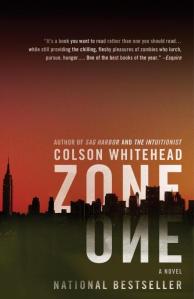
zone-one-paperbackAs I quoted Charlie Jane Anders saying in her review of Zone One, Colson Whitehead goes out of his way to subvert generic expectations: not the structural, large-scale expectations of a given generic form, but the small-scale satisfactions and symbolic resolutions that that form tends to offer. Which is to say: Zone One provides the expected and by now rote depictions of post-apocalyptic survivalism, including interludes of relative safety in secure locations, followed by the inevitable collapse of that security as the dead overwhelm the barricades. We meet a veritable checklist of ordinary folk turned accomplished zombie killers, religious fanatics, madmen, would-be warlords, opportunists and thieves, families desperate to stay together in the face of disaster.

But all this typical survivalist fodder takes place in the novel’s past. In the present of the novel, civilization is in the middle of staging a comeback: there are secure camps and a functioning U.S. government (relocated to Buffalo), a well-equipped military, and that symbol of American wealth, commerce, and culture—Manhattan—is in the process of bring reclaimed. This reclamation, indeed, is the focus of the novel’s present moment, three days in which protagonist Mark Spitz and his squad of “sweepers” perform tedious building-by-building grid searches, dispatching what few undead were missed in the marines’ epic initial assault.

The usual zombie movie fare of waking up to an infected world in which one must scrounge and learn martial skills to survive thus unfolds in Zone One as a series of flashbacks—flashbacks that surface capriciously into the narrative, sometimes mid-sentence, in a manner that can at times be bewildering and discomfiting. The effect is twofold: on one hand, Whitehead’s intricate web of memories woven into Mark Spitz’s present impressions and reflections performs post-traumatic stress for the reader. By definition, PTSD (or PASD, as it’s know in the novel, “post-apocalyptic stress disorder”), occurs in part as an inability to distinguish temporally between the traumatizing event and the present moment; Mark Spitz, like all his fellow survivors, lives as much in the memories of trauma as in the current moment of (perceived) safety and security.

On the other hand, putting the typical genre furniture in the novel’s past is simultaneously a distancing gesture. Even as the characters inhabit their memories, readers experience Mark Spitz’s survival tale at a remove from his present disaffection. Whitehead emphasizes this distance by introducing the motif of horror films as a recurrent motif. The novel opens with a flashback to before the plague, when Mark Spitz and his parents would visit his uncle’s Manhattan apartment. His childhood experience of the city—a city that, as New York so often does, functions as a character in this story—is conflated with watching horror films on his uncle’s shiny and impressive audio-visual system:

Millions of people tended to this magnificent contraption, they lived and sweated and toiled in it, serving the mechanism of metropolis and making it bigger, better, story by glorious story and idea by unlikely idea. How small he was, tumbling between the teeth. But the girlfriends were talking about the monster movies on TV, the women in the closet trying not to make a sound or vainly flagging down the pickup that might rescue them from the hillbilly slasher. The ones still standing at the credit roll made it through by dint of an obscure element in their character. “I can’t stand these scary stories,” the girlfriends said before returning to the grown-ups, attempting an auntly emanation as if they might be the first of their number promoted to that office. His father’s younger brother was fastidious when it came to expiration dates.

If you’ve never read anything by Colson Whitehead, this is pretty typical of his prose: elliptical, lyrical, and subtly layered. One of the common conceits of zombie narratives is that they almost invariably unfold in worlds that are completely ignorant of zombie narratives; if such a plague or infection or virus were to resurrect our dead into ravenous abominations, contemporary society would stand a decent chance of survival simply by dint of our massive cinematic archive detailing how to combat the zombie threat. Not so for the denizens of the stories themselves, a fact Whitehead alludes to here on the third page of his own contribution to the genre: the “expiration dates” on the uncle’s girlfriends reflects ironically on the horror genre’s marked tendency to put comparable expiration dates on its ancillary characters, those who lack the “obscure element” that facilitates survival.

At the same time, this passage establishes a handful of themes and motifs to which the novel will repeatedly return, not least of which is Mark Spitz’s recurrent meditation on what “obscure element,” precisely, he possesses that allowed him to live. Also present here is the city as omnipresent, silent character, and the horror film as framing device. The motif is subtle but pointed, as evidenced in Mark Spitz’s extended reflection on how he always imagined himself one of the singular survivors in these movies:

When he used to watch disaster flicks and horror movies he convinced himself he’d survive the particular death scenario: happen to be away from his home zip code when the megatons fell, upwind of the fallout, covering the bunker’s air vents with electrical tape. He was spread-eagled atop the butte and catching his breath when the tsunami swirled ashore, and in the lottery for a berth on the spacecraft, away from an Earth disintegrating under cosmic rays, his number was the last picked and it happened to be his birthday. Always the logical means of evasion, he’d make it through as he always did. He was the only cast member to heed the words of the bedraggled prophet from Act I, and the plucky dude who slid the lucky heirloom knife from his sock and sawed at the bonds while in the next room the cannibal family bickered over when to carve him for dinner. He was the one left to explain it all to the skeptical world after the end credits, jibbering in blood-drenched dungarees before the useless local authorities, news media vans, and government agencies who spent half the movie arriving on the scene. I know it sounds crazy, but they came from the radioactive anthill, the sorority girls were dead when I got there, the prehistoric sea creature is your perp, dredge the lake and you’ll find the bodies in its digestive tract, check it out. By his sights, the real movie started after the first one ended, in the impossible return to things before.

It is in this final sentence that Whitehead makes clear Zone One’s peculiar sensibility (peculiar in the broader context of zombie narratives, at any rate), and subverts the standard pleasures of the survivalist fantasy animating post-apocalyptic stories. As we talked about in class last week, post-apocalyptic narratives that feature the demise of civilization’s infrastructures—electricity and communication, security, and governance—share with fantasy a return to a premodern world shorn of the technology we take for granted. Technology goes from being banal and everyday to rare and precious, precisely because of its newfound scarcity. Life reverts to the faux-authenticity of survival, along with the erasure of moral grey areas: in a kill or be killed environment, we get to slough off qualms about violence, and feel perfectly fine about it because the enemy is already dead.

One comparable element of the zombie narrative that cannot be overstated is the disappearance of the principle of private property, at least in the early days of the apocalypse—it is not for nothing that these stories almost invariably include scenes of survivors gleefully looting shops and stores for supplies while there are still plentiful supplies to be had. True, there are versions in which these scenes are fraught with danger from other looters, such as the one in the film version of World War Z when Brad Pitt, seeking asthma medication for his daughter in a pharmacy gripped in Boschian anarchy, finds himself facing an ostensible thug in a hoodie … only to have the man hand him the medication, saying that it works wonders for his own kid.

But more commonly, such looting is the pleasure of plenty in the midst of danger. We think of 28 Days Later, when they come across a deserted grocery store, delightedly riding shopping carts up and down the aisles and loading them up, of Brendan Gleeson taking for himself a bottle of Lagavulin—and then a second, and a third, and a fourth.

The gold standard for such consumerist excess, however, is the “shopping” montage in Dawn of the Dead, and the comparable sequence in the 2004 remake, in which the survivors—safe for the time being, barricaded inside a mall—play out the fantasy of the uninhibited spree and the hedonism consumerism always promised.

It is easy, in this respect, to make up a checklist of our buttons that the zombie narrative tends to press: transgressive badassery, the erasure of the technological banal, shucking of societal and economic obligations (even in the most dire of apocalyptic scenarios, such as Cormac McCarthy’s The Road, I find myself thinking wistfully, “Well, I wouldn’t have to worry about my Mastercard bill”), free stuff, and a life that reverts to a set of simple equations. Which is why Zone One is such a discomfiting novel.

As I said above, Whitehead delivers on the broad strokes of the zombie genre, but on the smaller satisfactions just enumerated, he consistently frustrates us. In establishing horror conventions as a film with the credits already rolling, he takes us out of the fantasy of surviving and into the reality of survival, “the impossible return to things before.” Civilization’s return entails the return of implacable bureaucracy, micromanagement, and consumer culture. Mark Spitz and the other sweepers and enjoined from anything that will cause damage to the buildings they’re securing: no shooting out of windows or glass doors, no casual vandalism, and above all, no looting. However many stores in Lower Manhattan still in possession of their stock are not to be touched. At the same time, the sweepers are gifted with a variety of items, from energy drinks to notebooks (in which to log their activities), from corporate sponsors—from companies that have either survived the apocalypse, or founded by entrepreneurs who saw a new market in the post-apocalyptic world. And the return of civilization itself is subject to branding:

It was a new day. Now, the people were no longer mere survivors, half-mad refugees, a pathetic, shit-flecked, traumatized herd, but the “American Phoenix.” The more popular diminutive “pheenie” had taken off in the settlements, which also endured their round of cosmetics, as Camp 14 was rechristened New Vista, and Roanoke became Bubbling Brooks. Mark Spitz’s first civilian camp was Happy Acres, and indeed everyone’s mood did brighten a bit on seeing that name on the gate next to the barbed wire and electric fencing. Mark Spitz thought the merchandise helped out a lot, too, the hoodies and sun visors and such. The frigid hues and brittle lines of the logo conformed to a very popular design trend in the months preceding Last Night, and it was almost as if the culture was picking up where it left off.

The imagination of apocalypse almost invariably has to do with resolving the intractable problems of the real world by figuratively blowing them up: in some ways, it’s a failure of imagination, an inability to think outside of a given social or cultural system and so resorting to its wholesale destruction (not for nothing, but I firmly believe it is this precise sort of thinking that has given rise to Donald Trump as a viable presidential candidate—but that’s an entirely different post). The genre’s pleasures are thus concomitant with the real-world frustrations they resolve. Which is why Zone One functions as such a subtle, needling bait-and-switch, in which Mark Spitz’s tedious, corporatized sweeper job comes to remind him of the mindless corporate-drone jobs he held prior to the plague.

***

Wrapping this up here, with an eye to a second half in which I expand on Mark Spitz’s disaffection with regard to a comparable critique at work in Shaun of the Dead, and a contrast with the utopian spirit of World War Z (the novel).

Be good my friends, work hard.

Leave a comment

Filed under Revenge of the Genres, teaching