Monthly Archives: May 2016

Game of Thrones 6.05: The Door

gameofthrones_teaser02_screencap10

Hello hello once again friends, and welcome to this installment of the Chris and Nikki co-blog of Game of Thrones. This week, believe it or not, brings us to the mid-point of this season. Halfway! And episode five is easily on the best so far–though as we all know, Game of Thrones is a fickle mistress, and is not about to deliver an excellent episode without also ripping us apart inside.

Hold the door. That’s all I have to say. Nikki?
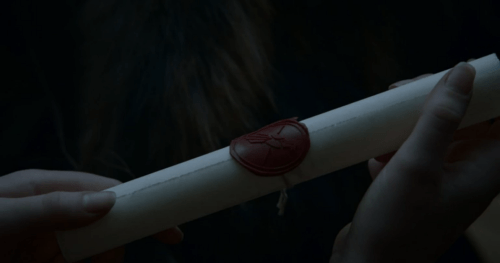
mockingbird_seal

Nikki: The first thing that must be pointed out about this fantastic episode is who directed it. You should have seen the look on my face when “Directed by Jack Bender” flashed across the screen. For those of you who didn’t obsess over every moment of Lost (in which case, how, exactly, did you come to read my blog?!), Jack Bender was the lead director and one of the executive producers of the show. He’s responsible for most of the best episodes of that series, and the images that we remember most vividly from it. He directed the series finale, as well as every season finale that preceded it. He directed 30 other episodes, including “Walkabout” and “The Constant” — in other words, when you have a key episode that could change everything, you bring in Jack Bender.

And considering the revelations, lies, and that devastating ending, this was definitely a key episode.

We begin with Sansa and Brienne as they face Littlefinger, who has sent Sansa a raven to meet up with him in Mole’s Town. We last saw this place when the wildlings, led by Tormund and Styr, attacked the town and killed everyone in it. Gilly has been hiding out in the brothel with Sam, and she huddled in the back where Ygritte found her and told her to stay quiet. She survived (obviously) and escaped back to Castle Black.

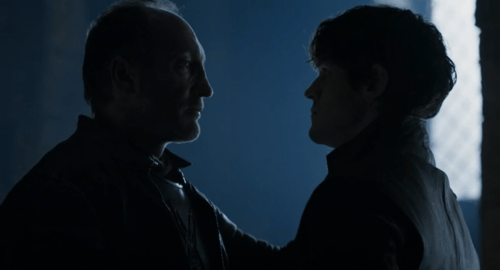
Now Sansa, Brienne, and Baelish stand amidst the wreckage left behind, and she gets to confront him in a glorious scene of retribution we’ve been waiting for. With Brienne having her back, Sansa glares at Littlefinger and dares him to tell her if he knew what he was getting her into by leaving her there. Of course, Baelish wants to skip by the answer, so he stammers his way through a round of shrugging before Brienne holds her sword and says menacingly, “Lady Sansa asked you a question.” Sansa then helps him out: “If you didn’t know, you’re an idiot,” she says, “And if you did know, then you’re my enemy.” We watch Baelish staring at Sansa, knowing he betrayed the daughter of the woman he’s loved his entire life, a girl who is the spitting image of her mother. Despite the fact Littlefinger’s heart is made of stone now, in this moment we catch a glimpse of him actually appearing to feel a tiny ounce of remorse for what he put her through.
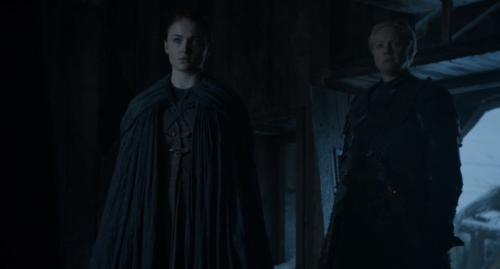
sansa_brienne

She tells him she can still feel what Ramsay did to her, not just in her heart but in her physical body. She tells him over and over again to imagine exactly what Ramsay did to her: mind, body, and soul. He didn’t touch her face, because he needed that, but he destroyed every other part of her body that could be covered up. Sansa stands like stone, as Brienne looks more enraged by the second yet maintains that cold glare.

“I’m… so… sorry,” Baelish says with phony empathy, and says he had wanted to protect her, and will do anything to protect her now. “You wouldn’t even be able to protect yourself if I told Lady Brienne to cut you down right now,” she spits back.

“You freed me from the monsters who murdered my family, and you gave me to other monsters who murdered my family.” And in that one sentence, she sums up exactly the hell she has lived through for years. The Starks were just a quiet family living in the North who had the misfortune of being chosen to be the Hand of the King, and in doing so became the target for every other family jostling for position. Baelish saved Sansa from the Lannisters, who had murdered her father, and he handed her off to the Boltons, who had murdered her mother, brother, and a sister-in-law she’d never met. He tells her that he will do anything to undo what’s been done to her, but you can tell from the look on Sansa’s face, there is no undoing what’s been done to her. But what it HAS done is made her stronger, willing to fight. She’s a strategist now, now some girl doing embroidery in the background while the men do the real fighting.
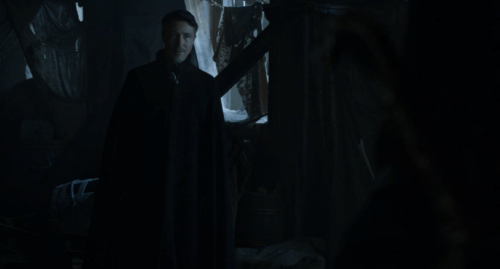
littlefinger

And as he leaves, realizing she’s not going to come with him (not that he ever thought that — I always feel like Baelish is 10 steps ahead of everyone) he tells her that he’s been in contact with her uncle, Bryndan the Blackfish, and that he’s gathered an army that would be willing to fight with her. She says, “I have an army.” Oh right, he says sarcastically as he passes her in the doorway, “Your brother’s army…” and then he corrects himself, “Half brother.”

Someone needs to push this guy through the moon door.

Sansa was my hero in this episode. Of course, what she does with Littlefinger’s information is suspect, and I can’t help but picture Admiral Ackbar jumping out of a doorway and yelling, “It’s a TRAP!!” but let’s give her a round of applause for making Baelish pause for even three seconds to actually consider what he’s done to Catelyn’s daughter.

And from there we move over to Arya, where she’s forced to watch a rather difficult reel of “Previously, on Game of Thrones.” In verse. What did you think of our Arya this week, Chris, and that very brief but squee-inducing cameo?
play

Christopher: To be honest, I completely missed Withnail on my first viewing—it was indeed very brief, and I must have been looking at my notes. When I rewatched the scene, I was thinking “what cameo?” … and then I saw him. Good old Richard E. Grant—he never disappoints.

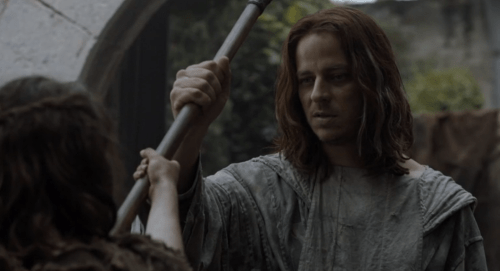
I loved the Arya scenes this week. She hasn’t had very much to do this season yet, so it was great to see her story moving along. What was interesting was the way in which her identity as a Stark continues to stick to her, however much she might protest that she is “no one.” What precipitates this uncertainty is her poor showing against the Waif in their fight training; indeed, the Waif is so superior to Arya that one wonders if she was feeling ill on the day when Arya bested her in spite of her blindness. Plot inconsistencies aside, however, the Waif’s insistence that “You’ll never be one of us … Lady Stark” segues into Jaqen’s acknowledgement that this might, in fact, be the case. “She has a point,” Jaqen says, and proceeds to expound on the history of the Faceless Men: that they were a society founded by former slaves, who fled Valyria after—he seems to suggest—they killed all their masters and overseers. “Where did they go?” Arya asks, and Jaqen reveals that the free city of Braavos was in fact founded by the Faceless Men.

Arya’s struggle to lose herself has become an interesting reflection of the significance of naming and names, especially when her scene is juxtaposed with Sansa’s determination to win back the North, and Littlefinger’s snide observation that Jon Snow is only Sansa’s half brother. It’s a seemingly throwaway aside that cuts as only Littlefinger knows how: at once reminding Sansa of how she mistreated Jon in the past because she didn’t consider him a true Stark, while also pointing to the issue of his legitimacy: he might putatively be Ned Stark’s son, but as a bastard he lacks the legal rights of a trueborn, and unlike Ramsay was never legitimized by his father or by a reigning monarch. While Sansa and Jon will struggle to assert the rightfulness of the Stark name in the North, Arya struggles to set her legacy aside, but it clings to her like a burr.
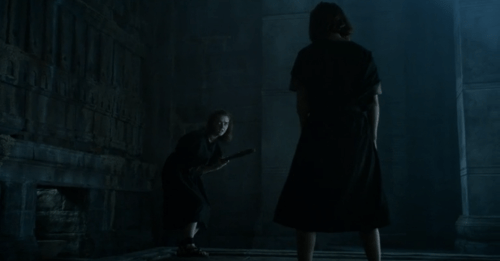
arya_waif

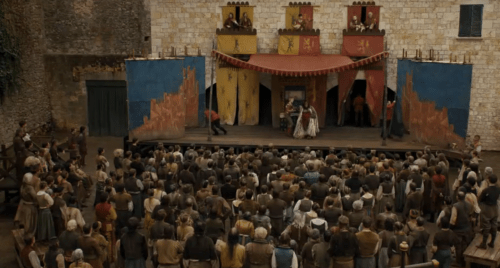
All of which is made even more glaring by the play she attends. Did Jaqen know what the play was about when he sent Arya off to reconnoiter her assignment? If so, it’s a cruel little twist of the knife and, I would assume, one more test for Arya. The recapitulation of the events of season one calls to mind Karl Marx’s assertion that history repeats itself first as tragedy, then as farce: the tragedy that Arya experienced first hand is repeated for her as a crude pantomime replete with farts, slapstick, and gratuitous nudity (all right, so that bit was accurate). It would appear that the Lannister propaganda machine has worked well: Cersei and Joffrey are depicted as fair and generous, Ned Stark as an oafish usurper, and Tyrion as the ultimate villain of the piece who arranges for Ned’s execution in spite of Joffrey’s leniency, humiliates Sansa, and slaps the new king (which, I must admit, is still deeply satisfying to watch even though it’s a fake Tyrion and Joffrey).

Maisie Williams does some lovely face-acting throughout the play, communicating that, however much she has committed herself to the Faceless Men, she is in fact still Arya Stark—and seeing her father misrepresented on stage obviously pains and angers her. These events are still very much a part of her, and she is a product of her personal history. Shucking all that to become “no one” is not easy.

As I’ve mentioned in previous posts, this season is doing a lot of calling back to the first season, giving us echoes of where all of this started. “Don’t you wish we could go back to the day we left?” Sansa asked Jon last week. “I want to scream at myself, ‘Don’t go, you idiot!’” Unbeknownst to Sansa, her brother Bran has been doing something close to that, momentarily distracting young Ned Stark as he starts to climb the Tower of Joy. It’s hard not to read Arya experience of this pantomime as thematically parallel to Bran’s astral travelling, especially considering the way in which the play shows history as fungible: it distorts the facts of Robert Baratheon’s death, Ned’s execution, and the Lannister seizure of power, but for all intents and purposes that has become the standard narrative as it is popularly understood. By the same token, we get confirmation this week of something only suggested previously: that Bran’s virtual travels are not merely passive viewership, but can and do affect and change the past and therefore the present. The broken-telephone telling and retelling of Ned’s execution that produces a comic play broadly correct in the narrative but profoundly wrong on the details presages the way in which an imperative given to Hodor in his youth transforms into his only word and, as it turns out, his one mission in life.
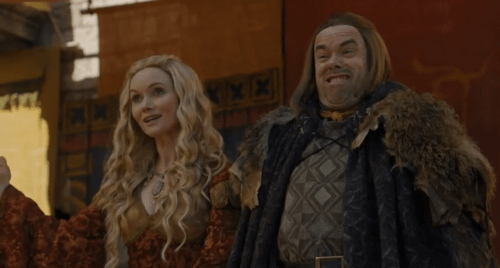
fake_cersei_ned

But I’m getting ahead of myself. The pantomime Arya watches is the most overt call-back of the season so far, and as anyone who has done Theatre Studies 101 knows, any time you see a play-with-a-play (or in this case, a play within a TV show), it’s a meta-theatrical gesture calling attention to the play’s very theatrical framing and artifice. And much like “The Murder of Gonzago” in Hamlet, this pantomime catches the conscience—not of a king, of course, and not just of Arya in her desire to dissolve herself into no one, but also that of the audience. I might be alone in this, but watching the play as Arya watches it, and seeing the distortions time and distance lend to the story, made me think of the increasing disparities between the novels and the series, and the ways in which the viewing experience is transformed for me now that we’re past the point where I, as an avid reader of the novels, had a narrative roadmap.

This sense was only heightened by the fact that this episode offers a handful of revelations, and a man wonders whether these will be consonant with the novels, or whether the showrunners are taking liberties. The first of these revelations happens after Arya’s scenes. What did you think of the fact that the White Walkers were created by the Children of the Forest as a weapon to fight humans, Nikki?
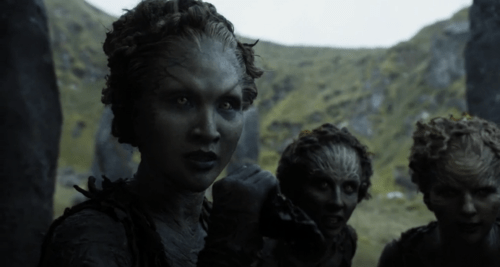
forest_child

Nikki: That was certainly a shock. The Children of the Forest are far more fleshed out in the books, and have only been touched on in the show, occasionally mentioned by others as a race that had died out and has been forgotten. Now that Bran is with them, we see some of them survived.

I saw some confusion on social media the day after this episode aired, and some of it was directed at the Children of the Forest. Who are these tree women, and where did they come from? The Children of the Forest, according to the legend depicted on the show, were the first inhabitants of Westeros, and lived in harmony with the weirwood trees… until man came along. The legend that has been told to us so far is that they engaged in battle with the White Walkers, and were killed off, with this small handful of Children driven north to where Bran is. The White Walkers not only slaughtered the Children of the Forest, but the giants. The key figure you see with Bran is Leaf, and she seems to act as a de facto leader of the Children of the Forest. So when she reveals that the White Walkers — the enemies of the Children — were created by the Children themselves, it’s a shock. Think back to when Sam Tarly killed one of the White Walkers with that piece of dragonglass. He says in that episode that the Children of the Forest used to carry dragonglass daggers. Now his anecdote comes full circle and we discover that they are created by dragonglass, and it is dragonglass that destroys them.
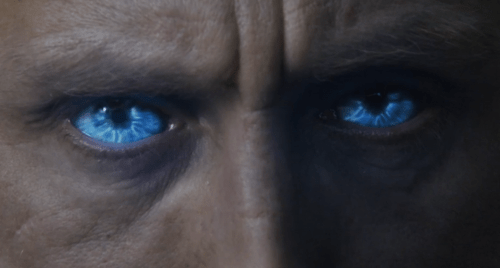
night_king-eyes

I remember once visiting Barbados, and a local man was telling me a story of how settlers first arrived in Barbados and brought rats with them. Soon the island was overrun with rats so they brought in snakes to eat the rats. When the snakes got the rat population under control, the island suddenly had a snake problem. So they brought in green monkeys to rid of them of the snakes, but the green monkeys multiplied so quickly they were soon everywhere. They have yet to figure out how to get rid of the monkeys.

I thought of that anecdote when I was watching this scene last night. The Children of the Forest were living in relative harmony until man came along and destroyed that peace (typical). So they created a monster to eradicate the humans, but that monster ended up killing the Children of the Forest instead, then the giants, and then turned on man. It was a shock to learn, but in retrospect, it made total sense.

We shall return to Leaf, Bran, and Hodor. (sniffle… Hodor…) But now we turn to the Iron Islands, and Yara making a play for the throne. These men will not follow her, they say. They’ve never had a queen and they don’t plan to start now. She rolls her eyes and says no one pays attention to them anymore, and she will bring attention to them on a world stage. But they argue that they shouldn’t have to follow her as long as Balon Greyjoy’s male heir has returned.
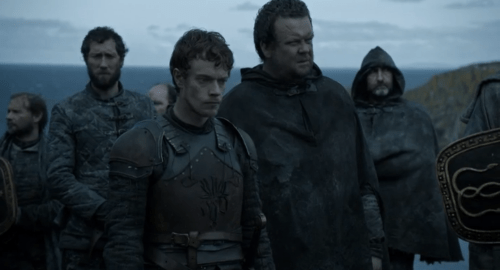
theon_glum

Cue camera on Theon, who was gorging himself on the canape table and didn’t realize everyone was about to look at him — “ye mean me?!”… OK, not really, it’s more like Theon standing there hoping they weren’t going to look at him, because he knows what they must be thinking about him, and how it must look that Balon’s son has returned, and yet it’s his daughter who is vying for the throne. The newly shorn Theon steps up, clears his throat, and addresses them. “I am Theon Greyjoy, last living son of Balon Greyjoy… and she is the rightful ruler.” He tells them she is a leader, a warrior, and iron born. “This is our queen,” he says, on the verge of tears. Theon wanted to rule the Iron Islands, and Ramsay has taken away his dignity (among other things) and he can barely show his face here, but at least pushing his sister to the forefront might make up for his misdeeds.

And… then the dickhead shows up. Euron Greyjoy steps forward and says HE is the rightful ruler of the Iron Islands, and through his travels he has learned everything about this world and will help them rule it. Yara is shocked; the moment she sees him she knows he was her father’s murderer, and announces it in front of everyone — to which Euron basically says, “Yeah, what of it.” He points out how useless Balon was (no argument here) and that he was leading them nowhere. Theon speaks up and says Euron was gallivanting around the world while Yara and Balon were here ruling the Iron Islands and led them thus far. But Euron knows exactly what’s happened to Theon, and tells everyone, including the loss of Theon’s member. It’s a devastating moment — Theon is only just barely holding it together throughout this scene just with the thought that they might know something of what happened to him when he was Reek, but now there’s no doubt that they all know. The laughter and hissing from the crowd is like another finger being removed, and Theon winces at it. Euron turns to the crowd and says he will build a fleet of a thousand ships, and tells them of Daenerys. He says he will sail across the channel and give her the fleet, along with something else (he grabs his crotch) and in that moment I thought, “Ah. You are not long for this world, my friend.” If this show has taught us anything about women, and especially Daenerys, a cock who shows up waving his cock is swept away before you can sing the theme song (which, granted, is about half an hour long, but you catch my drift…)
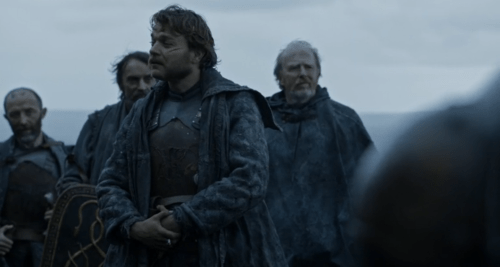
euron

And so, they make him king, baptizing him by killing him (this is clearly not a very advanced people) and chanting, “What is dead may never die” while Yara and Theon sneak off with Pyke’s best ships. Euron puts on his crown — which appears to be a piece of driftwood? — and announces that his first act as king is to murder his niece and nephew, before he realizes they’re already gone. And so he orders them all to build him those thousand ships, because he has some vengeance he needs to wreak.

I loved that Yara and Theon are now sticking together; we’ve seen them at each other’s throats so much, but if one tiny good thing came out of Ramsay’s abuse of Theon, it’s that Theon has been humbled by everything, and is finally following the right person. Though I do feel like Professor Marvel at the beginning of the Wizard of Oz film, looking off into the distance as the storm brews and saying, “Poor kid… I hope she’s all right.”

Before we move to the next scene, I just wanted to mention that the casting director for this episode was brilliant, especially with matching characters with their relatives. Euron looked like a dead ringer for an older Alfie Allen (Theon) — I couldn’t believe how much they looked alike. And when you see the flash of Ned Stark’s father, it looked so much like Sean Bean it was uncanny.

From the Iron Islands we sail to Vaes Dothrak, where Daenerys has a quiet and lovely scene of reconciliation that made me very happy. What did you think of the scene with her and Ser Jorah, Chris?
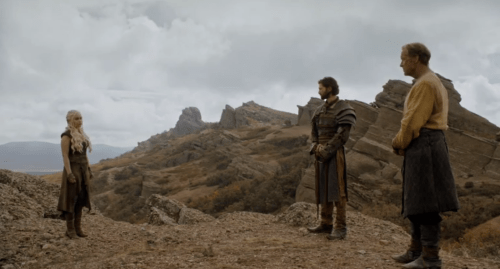
dany_daario_jorah

Christopher: It was a very sweet and powerful scene right up to the moment when Daenerys commanded Jorah to find a cure for his disease. And that last moment was made even more annoying by just how touching the preceding moments were: Daenerys’ affectionate frustration with Jorah’s stubbornness (“I banished you. Twice. You came back. Twice.”), giving way to concern and grief when he shows her his greyscale. “I’m so sorry,” she says, and we hear the tears in her voice. “Don’t be,” he replies. “All I’ve ever wanted to do was serve you.” At this moment in Jorah’s face we see regret eclipsed by a momentary happiness that shows the truth of his words: faced with certain death, he can take comfort in the fact that he has in fact served Daenerys, and served her well—and here, facing his end, he can admit that he loves her. He is ready to head off and face his fate. “Goodbye, Khaleesi.”

But she calls him back, refusing to release him from his vow to serve and obey her. Except, not really—he must still go, but with her command to find a cure and return to serve her.

Seriously? She is a queen with a whole host of new subjects, as well as her people in Meereen, and—I’ve got to assume—hundreds of message ravens they can send to all corners of the continent. What about, “We will send for the finest doctors in all the land to tend to you!” And yes, greyscale is contagious, but what about giving him a comfortable apartment in a remote part of the pyramid while healers are brought in to help him? She’s sending him off—alone!—in an inhospitable wilderness with what I’m assuming is not very much money, in an attempt to find a brilliant physician who can cure a deadly disease. And even if he finds it, the doctor will help him out of an overdeveloped sense of charity?

Nope. That didn’t work for me, and it was made worse by the fact that it was the one weak point in an otherwise wonderful espisode.
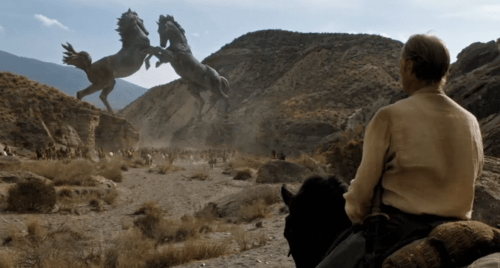
jorah_vaes-dothrak

“Well … fuck.”

We shift from Daenerys riding from Vaes Dothrak, presumably toward Meereen, to Meereen itself, where Varys asks Grey Worm to recount the instances of violence in the city since their pact with the Masters. A fragile peace has taken hold, he observes with some satisfaction. “For now,” says Grey Worm darkly. “For now is the best we get in our profession,” Varys points out, but Tyrion is not satisfied: “It’s not enough for Meereen to have peace,” he argues, “They need to know Daenerys is responsible for it.”

What it boils down to for Tyrion is a question of story—the Sons of the Harpy have a good story, he says, a simple and straightforward one: resist the foreign invader. Daenerys’ is even better, more heroic and grandiose. But in and of itself, it is not enough. “The people know who brought them freedom,” says Missandei, obviously a little offended at Tyrion’s perceived slight to her queen. Tyrion, however, is more pragmatic: freedom needs to be coupled with security, and the newfound peace has to be indelibly associated with Daenerys. As we have seen, and as we have commented over the past few episodes, Daenerys is far better on the campaign trail than actually holding office—as a ruler she tends toward a top-down managerial style and is given to authoritarian tendencies at times. She makes for spectacular symbolism; Tyrion would like to see her associated with a few more humble but profound accomplishments, something best accomplished by someone perceived as honest and incorruptible.

There’s a lovely echo from last season when Tyrion is able to repeat Varys’ line—“Who said anything about him?”—and we shortly learn that he means to employ the red priests and priestesses of R’Hllor as his propaganda outfit.

His decision to ally them with the Red Priestess Kinvara is shrewd, but risky. Kinvara is only too eager to take up Daenerys’ banner, as Tyrion knew she would be, having overheard (as she cannily observes) the street sermons being delivered in Volantis. Her speech about Daenerys, her accomplishments, and her dragons makes it clear that the red priests and priestesses of R’Hllor see in Daenerys everything they could desire in a Chosen One: freer of slaves, born in fire, dragons at her (sort of) command to immolate unbelievers.

Her evangelicism, however, makes Tyrion somewhat nervous.

KINVARA: The dragons will purify nonbelievers by the thousands. They will burn their sins and flesh away.
TYRION: Ideally, we’d like to avoid purifying too many nonbelievers. The Mother of Dragons has followers of many different faiths.
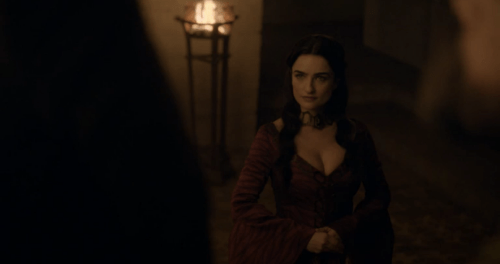
kinvara

Kinvara promises to send for her most eloquent priests, but Varys is skeptical. He reminds her of Stannis, of his failure at King’s Landing, and his most recent defeat in which he was killed. “It’s most hard for a fanatic to admit a mistake,” he says. “Isn’t that the whole point of being a fanatic? You’re always right. Everything is the Lord’s will.” I loved this little speech of Varys’—not least because it very pithily sums up my own dislike of fanatics, religious or otherwise—but Kinvara’s response reminds us that there is more at work here than mere power politics. There is also magic, ancient magic at that, and her offer to tell Varys who spoke from the fire that fateful day a sorcerer mutilated him says that there is more on heaven and earth than is dreamt of in Varys’ philosophy.

A point that is brought home rather powerfully when Bran decides to go astral surfing without his guide. What did you make of his encounter with the Night King and his army of ice zombies, Nikki?
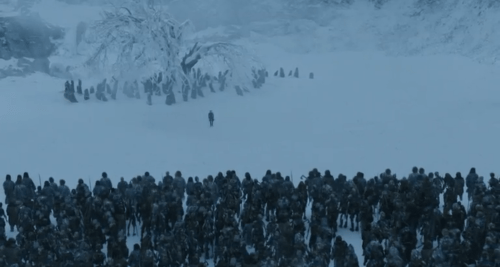
bran_horde

Nikki: I mentioned earlier that the casting in this episode was particularly excellent, and that includes Kinvara (or, as I think of her, Idina Menzel… or, as John Travolta thinks of her, Adelle Dazeem), who carried herself very much like Melisandre, right down to that very specific accent she uses when she speaks. I noticed Kinvara was also wearing the same necklace that Melisandre wears, so presumably she is also much older than she appears to be.

But now over to Bran, who wargs alone, and somehow turns into Carl on The Walking Dead (and should have just stayed in the fucking cave). This time, without his guide, winter has come. At first, as has been the case in his other warg adventures, he appears to be unseen, moving among the wights as they stand like statues and pay him no attention… until, in one terrifying moment, the Night King spots him, and then suddenly, all of the wights turn around and can see him. The scene abruptly transforms into the “Thriller” video, with the camera swirling around him as he turns back to the Night King, who’s now standing right beside him and grabs his arm. Bran screams, and wakes up.
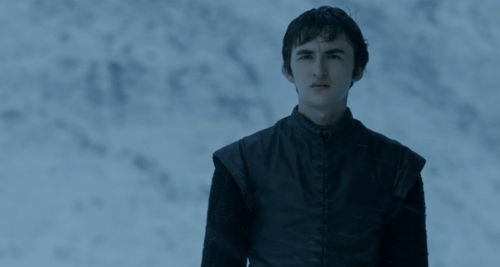
bran

It’s too late. He has the silvery mark on his wrist, and they have seen him. The three-eyed raven tells Bran that the Night King knows they’re here, and the mark on Bran’s arm is their entry pass to the cave, which, until now, has magically kept them out. He, Meera, and Hodor must leave. Meera begins frantically packing, while Hodor sits, immobilized, just muttering, “Hodor,” over and over again, quietly. The three-eyed raven tells Bran that it’s time he become him, and when Bran looks at him and says, “Am I ready?” the raven looks at him, and quite matter-of-factly says, “No.” And with that, Bran wargs one more time.

I’m going to let Chris take that final scene when we get there, but I wanted to bring things back around to my opening bit, and say this episode felt more like a Lost episode than any other before it, not least because Bender is directing. In season 5, when the Losties travelled back in time to the mid-70s, it took a while for Hurley to come to grips with the basic concept of time travel that diverged from what he thought he knew in Back to the Future — when time travelling, anything that happens back then always happened. Keep that in mind when watching that final scene: on Lost, the Losties learned that they had always gone back in time, and that their actions always happened. They weren’t changing the past — they has always gone back to the past and had been a part of it. Lost was always about love, loss, connections with people, and a general WTFness pervaded every episode, and this episode of Game of Thrones carried with it that same sense of an emotional rollercoaster.
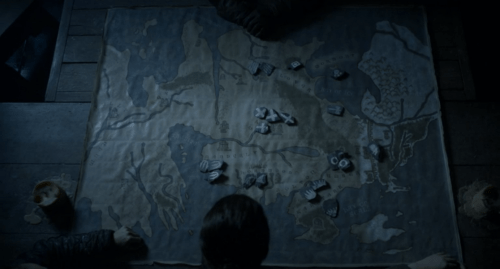
westeros_risk

Is this really the best time to play Risk, guys?

But before I sent Chris into the fray to dissect that moment (I don’t think I’d be capable of doing it without dissolving into tears), let’s stop over at Castle Black for a second, where Jon has a map on the table and says they must take Winterfell and they need more men. The Umbers and the Karstarks have aligned themselves with Ramsay, he says, and he also mentions the Mormonts and the Tullys. The Tullys are Catelyn’s family (who would certainly help Sansa, but it’s unclear if they would help Jon) but I was more intrigued by the mention of the Mormonts. Could this be the tie between Jon and Daenerys that I’ve been waiting for?
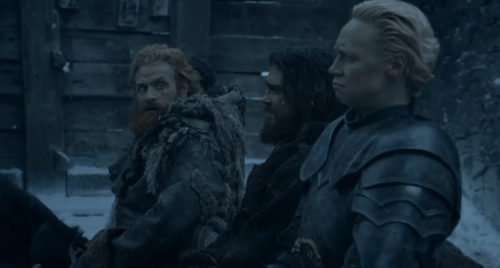
tormund_googly-eyes

Because none of these posts is ever going to be complete again with a picture of Tormund making googly-eyes at Brienne.
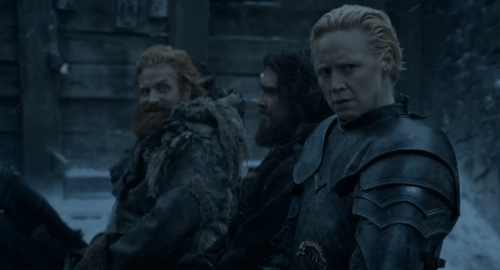
brienne_wtf

…or without one of Brienne making her WTF face.

Sansa tells the table that her uncle, the Blackfish, has an army, and then lies about where she got the information. Brienne immediately shifts in her seat and looks uncomfortable (it won’t be the last time in this episode that Brienne makes that face), because she knows exactly who gave them the information, and she doesn’t trust him as far as she could throw Tormund. Brienne confronts Sansa outside, and Sansa sends Brienne to Riverrun so she can check things out.

But Sansa


Sigh. Brienne isn’t worried about her own safety, but is more concerned about leaving Sansa behind. “With Jon?” asks Sansa. “Not him. I think he’s trustworthy. A bit… brooding, perhaps.” It’s Davos and Melisandre she’s concerned about. We can’t forget that for as much as we love Davos, she saw him help Stannis cut down Renly, whom she loved as a knight and perhaps as a woman. She cut down Stannis herself, but he was alone, already abandoned by Melisandre.

“And that wildling fellow with the beard…!!!” she adds, with a look of disgust on her face.

But Sansa knows Jon, and she reassures Brienne that he will keep her safe. “Then why did you lie to him when he asked how you learned about Riverrun?” she asks. Sansa has no answer. Out in the courtyard, the sister gives her brother a coat that was modelled after the one Ned used to wear, while Tormund gives Brienne the eye in an instantly gifable moment that is equal parts hilarity and awesomeness.

And as they all leave — Brienne to Riverrun, and the others to find Houses that will pledge fealty to the Starks — Edd realizes he’s suddenly the de facto Lord Commander, and immediately embraces the task.

And with that, we go back to Bran and the others at the cave, and the part you’ve all been waiting for. And with a gentle “Hodor,” I pass the reins over to you, my friend.
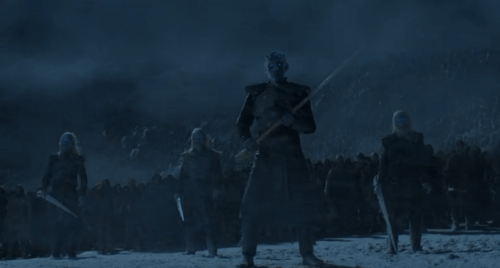
night-king-attack

Christopher: You night have had your Lost moment with this episode, but afterward I couldn’t help imagining the whining, grinding noise of the TARDIS appearing, either back at Winterfell, or as Meera runs with Bran off into the winter storm … because at this point in my life, anything involving time travel invariably makes me think of the Doctor. “Can we go back … and save Hodor?” “Fixed point in time and space. Nothing I can do. I am. So. Sorry.”

I’ll get to Hodor’s final act of heroism in a moment, but first I want to just run through a few details from this final scene.

First: knowing that the Night King is on his way, why are Bran and the Raven lost in visions of Winterfell past? (Possible answer below).

Second, I can’t say I’m entirely down with the Children of the Forest’s weaponry. They made for some impressive explosions, but I couldn’t stop thinking of them as Holy Hand Grenades. Also: while they were only moderately effective against the ice zombies (and totally useless against the Walkers), they would have been devastating against the bronze age humans they were ostensibly fighting when they created the White Walkers to begin with. Or was this weapons technology they devised in the interim years?

Third: R.I.P. Summer. Barring some unseen deus ex machina, this episode saw the death of yet another Stark direwolf. This means that, of the original six, there are only two left—and of those two, only one, Ghost, is still with his human (Arya having chased Nymeria off to spare her Lady’s fate).

Now onto the main event.

I rewatched this scene about five times (and cried each time) just to make sure I got the sequence of things right:

  1. After seeing the Night King and his hordes, Meera tries to wake Bran from his reverie, saying “We need Hodor!”, as Hodor has fallen into a panicked, very nearly fetal paralysis of hodors.
  2. Bran hears her voice in this midst of his vision of Winterfell, and the Three-Eyed Raven says “Listen to your friend.”
  3. Bran looks over at young Hodor; in the cave, present-day Hodor’s eyes go briefly milky.
  4. Hodor stands and grabs Bran’s sledge, and they start to make their escape.
  5. The Night King walks up to the Raven and swings his scythe; at Winterfell, Bran sees the Raven’s demise as him shattering into a thousand dark shards and swirling into nothing (at a certain point, it becomes hard not to start making analogies to The Matrix).
  6. Hodor, Meera, and Leaf—with Bran in tow—are now basically in the midst of a zombie chase, replete with sound effects that sound like they were lifted from The Walking Dead.
  7. Hodor, Meera, and Bran escape through the back door (Leaf having sacrificed herself), and Hodor hauls it shut. As she runs off with Bran, Meera cries repeatedly, “Hold the door!”
  8. At Winterfell, Bran hears Meera’s entreaties. Looking over at young Hodor, he sees his eyes roll back and he falls into a seizure, all the while crying desperately “Hold the door!” Which becomes … well, you know the rest.

The main question, as I ask above, is why were Bran and the Raven warging right then, when they knew full well the Night King was on his way? And why were they in so deep that Bran couldn’t bring himself out, even after he’d been parted from the tree roots? Why didn’t the Raven send him back before he died?
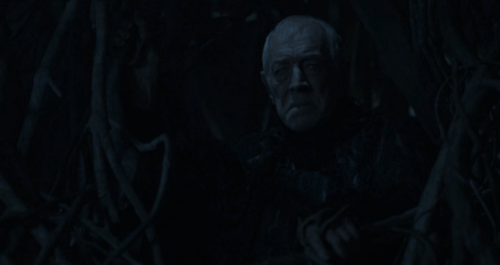
raven

I wasn’t being entirely glib when I brought up the Doctor Who chestnut of a “fixed point in time and space,” as it strikes me that a possible answer to this question is that it was necessary for Bran to be virtually at Winterfell as all this went down. What becomes painfully, heart-wrenchingly obvious in the final moments of this episode is that Hodor’s entire self has been focused on this one act of heroism: that the hijacking of his mind, his agency, his very capacity for speech—and as we saw in Bran’s earlier visions, though he is big and humble, he had a nimble mind and a wry sense of humour—occurred so that one day he could save Bran Stark.

It is a heartbreaking moment, not least because Hodor has always been the embodiment of the gentle giant, guided by little other than simple love and loyalty. The two instances of him being possessed in this episode—in the present and in the past—made me think of season four, episode five, “First of His Name,” which featured Jon Snow’s attack on the mutinous watchmen, who had killed the Lord Commander and taken over Craster’s Keep. If you’ll recall, the mutineers had also taken Bran, Meera, Jojen, and Hodor captive—and while Jon’s men carried out their attack, Bran warged into Hodor when Locke (Roose Bolton’s agent) tried to carry him off. (There’s a link here to the video—unfortunately, embedding was disabled). Possessed by Bran, Hodor breaks his bonds and gives chase, running down Locke and killing him with his bare hands. He then comes to, seeing the dead body at his feet and the blood on his hands; as you put it in our post, Nikki, “Bran turns Hodor into a killer, which resonates so deeply as Hodor stares at the blood on his hands in confusion and heartbreak.” It resonates so deeply because we know too well what a gentle soul Hodor is, and in that moment the liberty taken by Bran in possessing him is deeply discomforting.
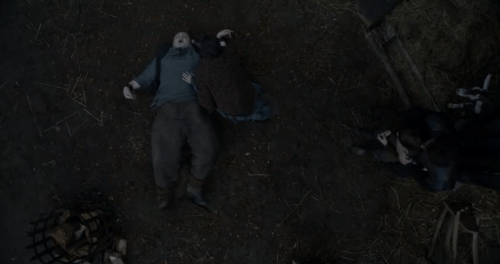
hodor_seizure

As it is in this episode—but even more, by a magnitude more, because it isn’t just a few moments of possession in this instance but the better part of a lifetime. One of the things I love about Game of Thrones and its source material, as I love about other contemporary fantasists like Neil Gaiman, Terry Pratchett, and Lev Grossman, is that the standard fantasy trope of fate and destiny tends to get upended. And in those cases where we see a certain determinism at work, as in Hodor’s death, it upsets the apple cart. We see Hodor’s end not so much as a grand fate, as his subjugation to forces we might otherwise consider benign—in this case, Bran’s fledgling flights of vision, which accidentally appropriate young Willas’ life and turn him into Hodor.

None of which detracts from Hodor’s final act of heroism, or the sorrow with which we bid him adieu.
hold-the-door-01

So that’s it for this week, friends. Be well, stay warm, and hold that door.

Leave a comment

Filed under Game of Thrones, television

Game of Thrones 6.04: Book of the Stranger

gameofthrones_teaser02_screencap10

Greetings and welcome dear friends to episode four! This week was all about brothers and sisters, with three reunions: one joyful, one painful, and one angry and tearful. We also had some great eye-rolling action from the Queen of Thorns, a parable of wealth and sin from the High Sparrow, some creative use of fire by Daenerys, and we wonder if Natalie Tena has now gone to her agent and demanded a role in a franchise where her character doesn’t get horribly killed. I once again have the pleasure of sharing the stage here with my good friend Nikki Stafford. It’s my turn to lead us off, so without further ado …

longclaw

Christopher: While there have been a handful of gasp-worthy and/or fist-pumping moments in the first three episodes, the consensus thus far on the interwebs seems to have been that this season started slowly. More than a few reviews I’ve read have been chomping at the bit for some of Game of Thrones’ patented operatic moments.

Well, now we know. The last three episodes have been building to this one.

Or not entirely. But mostly. Or at least, that’s how it felt watching this episode.

Am I not making sense? That might be because I’m writing this mere moments after watching that final, climactic scene. Let me take a deep breath and focus.

I had a couple of friends over to watch tonight’s episode, and we were speculating about what might transpire based on the trailer, which suggested strongly that Brienne and Sansa would arrive this week at Castle Black. As we’ll recall, last week’s episode ended with Jon Snow handing over the mantle of Lord Commander to Edd Tollett, saying “My watch has ended,” and seeming to walk out through the main gates. Did that mean he has departed? Would Sansa come looking for sanctuary from her half-brother, only to find he had deserted? It was, we decided, precisely the kind of thing Game of Thrones would throw at us.

With that in mind, the first shot had me confused: Jon’s sword Longclaw, given to him by his predecessor Jeor Mormont, sitting in the foreground. It is picked up by Edd Tollett. My first thought was that Jon had been wearing the sword as he seemed to leave Castle Black, but seeing Edd holding the sword made me wonder for just a second whether Jon had left it with Edd as part of the Lord Commander’s outfit. But no—a moment later we see Jon, and Edd grills him about what he means to do, and where he means to go. Jon’s answer is at once glib and heartfelt—he means to go south, so he can get warm again—but Edd is having none of it. He reminds him about Hardhome, saying, “You know what’s out there. You know what’s coming here. How can you leave us now?”

It’s a powerful question, as it goes right to the heart of Jon’s reasoning behind the very actions that got him murdered, that is, granting passage south of the Wall for the wildlings. Everything he did in the final episodes of last season was in the name of drawing a line between whom he saw as the true combatants in the wars to come: between the living and the dead.

It strikes me that this episode is very much about the drawing of battle lines. Later we see an uneasy truce between Cersei and Olenna, drawing a line between their houses and the High Sparrow; Theon pledges himself to his sister in her bid for the Iron Islands’ throne; and the spectacular ending of this episode is essentially Daenerys drawing a line between herself and the world.

sansa_brienne

Jon Snow, by contrast, is initially reluctant to re-enter the fray. When Edd asks him, “How can you leave us now?” Jon reminds him that he was murdered by his brothers. “You want me to stay here after that?” he demands, but once again Castle Black offers up a very timely knock at the door—though instead of a furious giant this time, it is a horn announcing the arrival of visitors, as my and my friends’ dour speculations are very happily proven wrong. For Brienne and Sansa (and Pod, of course) have arrived, and they ride into Castle Black’s courtyard to stares of consternation—some, we assume, directed at Sansa, but most at the tall and imposing figure of Brienne. Tormund in particular seems quite gobsmacked, something that will be played to comic effect later in the episode.

Like a cracker given to a starving man, the scene of Jon and Sansa’s reunion is overwhelming. Game of Thrones consistently offers action, thrills, triumph, and not a little bit of humour mixed in with what is more often than not an onerous and cripplingly dire set of circumstances. Tyrion and Varys’ banter leavens the mix; Brienne riding to the rescue makes us cheer; and sometimes there are dragons, and sometimes Joffrey dies. But there are precious few moments of genuine love and joy: the moment of recognition when Sansa looks up to see Jon, and their subsequent desperate embrace, was a balm to the soul of this show that, at this point, I didn’t realize it needed—so inured was I to the bleakness. And full credit to the actors: Sophie Turner and Kit Harrington so inhabit Sansa and Jon now, that their reunion is genuinely a thing of joy on the screen.

But to return to Edd’s question: “How can you leave us now?” he asks, and Sansa is, if not the answer, certainly an answer. “Where will you go?” she asks Jon, and he corrects her, “Where will we go?” They are family, they are reunited, and the argument that ensues—in which Jon professes his battle fatigue and unwillingness to fight any more—is understandable but perhaps somewhat disingenuous in the circumstances. We can certainly empathize with Jon’s fatigue, but Sansa—who, incidentally, in spite of not dying, arguably suffered far more than Jon—sees things more pragmatically. She tells him that Winterfell is their only home, and that she will take it with or without him, but the gist of what she says is plain: there simply is no way forward without fighting.

davos_mel

And as we sense battle lines being drawn, we begin to see factions emerging. Melissandre, we are utterly unsurprised to learn, will follow wherever Jon Snow goes. As will Davos, probably, but he has some questions he wants answered. What happened to Stannis? It seems odd that he has waited this long to ask her, but then perhaps her prior moping precluded such discussions. What happened to Stannis? He was defeated, she replies. What happened to Shireen? he then demands, a somewhat trickier question for her to answer … and she receives the mixed blessing of an interruption from Brienne. “I saw what happened,” she says, in a little moment of misdirection, as what she has to say is about Stannis and the battle, and not Shireen. But really, Brienne is there to say that she served in Renly’s Kingsguard and saw him killed at the hands of “blood magic.”

brienne_davos_mel

Uncomfortable silence. “That’s … in the past now,” says Davos. “Doesn’t mean I forget,” Brienne replies. “Or forgive.”

BRIENNE: He admitted it, you know.
DAVOS: Who did?
BRIENNE: Stannis. Just before I executed him.

Brienne turns and walks away, and in my notes I wrote MIC DROP. Battle lines are being drawn, but on this front we’re looking at some strange bedfellows. Jon and Sansa are now together one way or another, but Brienne, sworn to Sansa, has more or less thrown down the gauntlet to Melissandre, who will walk into fire for Jon (perhaps literally). I suspect we will see some tension in this northern alliance down the road.

But then we turn to the Vale and—finally!—the return of everyone’s favourite sleaze, Littlefinger. Were you happy to see Mayor Carcetti again, Nikki?

arrows

Nikki: Ha! I loved your opening because I thought Jon had walked out on Castle Black, too, and was confused about that opening. It’s like having a huge argument with a boyfriend and going, “That’s IT! I am OUT OF HERE!!” and slamming the door and leaving the house dramatically… only to realize you left your shoes, coat, and car keys inside. And for a second I thought, Did Jon just storm out of the place and then go, “Oh crap, forgot me clothes” and have to sneak back? It was definitely a bit of misdirection at the end of last week’s ep. I also thought it was very strange when Davos asked after Stannis and Shireen. Wha?! How is it bloody possible that the ravens deliver news of everything from imprisonments to the latest euchre results in King’s Landing and yet he hasn’t yet heard what happened to Stannis and Shireen? What the hell did he think Melisandre was all mopey about? It seemed a bit of a blunder on the part of the writers.

And now over to Brave Sir Robin, the sweet little inbred imbecile who runs the Vale. Throughout his scenes I was thinking he reminded me of someone. And then, dear readers, our Christopher went and posted something on Facebook that had me HOWLING with laughter, and 100% nailed exactly whom I’d been thinking about:

arryn-spleen

It’s the Shpleen!

HAHAHA!!

Anyway, Lord Baelish is back and showing that just as Tywin stepped in, put his arm around Tommen and immediately began teaching him how to be a king, Littlefinger has shown up, handed Brave Sir Robin a falcon, and won him over. On a whim I googled, “Falcon symbolism,” and got this back: “In Christian symbolism, the wild falcon represents the unconverted, materialistic soul and its sinful thoughts and deeds. The tamed bird symbolizes the Christian convert pursuing his lofty thoughts, hopes, and aspirations with courage.”

And from what we know of Brave Sir Robin and Littlefinger, they would definitely fall under the second category.

Cough.

So! A wild falcon, then. Ahem.

Littlefinger’s arrival interrupts an archery lesson Robin is having with Lord Royce, where Robin is showing some keen marksmanship… if his target had actually been the ant in the grass about three feet in front of him. If so? NAILED IT. As Baelish begins immediately manipulating the stupid creature, Royce instantly gleans what is happening. He wants to know where Sansa is, and Baelish plays dumb, saying they’d been attacked on their way by Bolton’s people and no matter what he did, Littlefinger simply couldn’t stop it. Royce immediately adopts a “Dude, I’m not Sir Robin so you can cut the bullshit” look on his face and tells him that sounds about as plausible as Brave Sir Robin being a Rhodes scholar, but Baelish doesn’t back down. He says actually, only one person knew exactly where they were going, and that was Lord Royce. Then he stands back and twirls his evil villain mustache while a couple of neurons spark in Sir Robin’s head, and a dim lightbulb switches on (before immediately cutting out again) registering with Robin, “Waaaaitaminute, you is traitor?!” and Baelish helps the poor creature out a bit more, and says, “My goodness, Robin, what shall we do with someone like this?” Robin, whose maturity hasn’t inched forward one iota since his mom was still breastfeeding him (which, granted, was when he was like 17 or something, but anyway…), repeats the same mantra he did back then: “Shall we throw him through the moon door?”

royce

Despite the underlying hilarity of the scene, it’s actually quite serious and ominous. Baelish can’t control the Lannisters or the Starks, so he’s come at this a different way. Make Brave Sir Robin an orphan, and then control the poor idiot boy and essentially take the Vale. Meanwhile you see the look on Royce’s face, where he realizes his life of fidelity to the Arryns will end in betrayal. But that would be too easy for Baelish, so instead he says to Robin that if they could trust Royce’s loyalty, he would make a capable commander, and maybe they should give him a second chance. Robin agrees.

Baelish is officially ruling the Vale now. Surmising that Sansa is heading to Castle Black, he declares, “Gather the knights of the Vale — the time has come to join the fray!”

Meanwhile, over in Slaver’s Bay, Tyrion is negotiating with the slavers, something that has made Grey Worm and Missandei very uneasy. The slavers want their old lives back, and they explain Daenerys is no different than they are; she’s simply the new master of Meereen, and slavery will never end. Tyrion lobs back that he’s not here to change the world, but that, interestingly, there haven’t been slaves in Westeros for hundreds of years. So he comes up with his compromise: slavery will cease effective immediately in Meereen, but will be allowed to carry on for seven more years as they gradually end the practice in other areas. The slaveholders will be compensated, and need to cut off ties with the Sons of the Harpy.

miss_grey

Grey Worm and Missandei are saddened by the turn of events, but when challenged by the former slaves in the Hall, Grey Worm simply says he wants peace, and Missandei quotes Tyrion: “A wise man once said, ‘We make peace with our enemies, not our friends.’” Tyrion smiles to think they both have his back, but as they walk away from the slaves, they tell him what they really think: that seven years might not seem like a long time to him, but it’s an eternity to a person in chains. Grey Worm explains, “When they look at me, they see a weapon. They look at her, they see a whore.” Tyrion counters, “They look at me and they see a misshapen little beast. Their contempt is their weakness.” Tyrion is confident that once again, his intelligence will get them through this. But Missandei and Grey Worm have been enslaved their entire lives, and they see it very differently. Tyrion thinks he has the upper hand, but Grey Worm warns him, “You will not use them: they will use you.” Tyrion was able to use his knowledge to trick his own family and throw all of King’s Landing into turmoil, but that’s because he understood the politics of the Lannisters. This is a very different situation altogether.

And then it’s off to Jorah and Daario, who actually seemed like a more entertaining duo this week. What did you think of their discussion in the hills overlooking Vaes Dothrak, Chris?

daario_jorah-2

Christopher: I think the most telling line in this scene is Daario’s resigned, “We’ll all disappoint her before long.” I found his fairly constant needling of Jorah about his age revealing; he doesn’t want to fight him, because he loses either way, either the guy who kills an old man or is killed by one; and he taunts Jorah over the fact that he has slept with Daenerys, suggesting that, however much Jorah loves and desires her, that the sheer exertion of her carnal attentions would likely overwhelm him. “It was hard enough for me,” he says, “and I’m a young man.” There has always been a rivalry between these two men, but Daario’s need to taunt Jorah, to constantly point out the disparity in their age, and to remind him that he’s known Daenerys’ bed, gives the lie to his cockiness—and shows the pathos of a man who loves a woman he knows has limited use for him. It’s less a matter that he’ll disappoint her than that she’ll ultimately need something far greater than he can offer.

His macho braggadocio thus comes across as somewhat pathetic, and when the time comes to surrender his weapons, the knife hilt carved in the shape of a wanton, naked woman has an adolescent quality to it. I cannot remember now if we’ve seen that dagger hilt before so clearly, or if such attention has been drawn to it. Certainly, the Daario of the novels frequently has his sword hilts described, but there they are very much of a piece with a character who is far more flamboyant, dangerous, and mercurial. Michael Huisman’s Daario retains elements of the novel Daario’s audacity and recklessness, but is ultimately more muted, and actually rather more nuanced.

We also have a moment in which Daario sees Jorah’s greyscale, which I thought was handled with a deft hand—very few words, and the expression on Huisman’s face was a lovely, subtle recognition of the fact that his cracks about Jorah’s age were perhaps a bit close to the bone, as the older man’s days were numbered.

I wonder, too, if they’re making Jorah more vulnerable and fragile as a function of his affliction: we open the scene with him panting and wheezing, only keeping up to Daario with difficulty; and in his fight with the Dothraki, at no point does he have the upper hand, ultimately needing rescue from Daario and the dagger he decided to bring after all.

Adding insult to injury (for Jorah, at least), is the fact that their “rescue” of their queen was, if not strictly unnecessary, was at least redundant, as once again Daenerys demonstrates her own ingenuity. I don’t want to steal your thunder, Nikki, as you’ll be playing us out this post with your discussion of the final scene, but I do want to raise one of the show’s more problematic issues, which starts to show itself in the Dosh Khaleen scene: namely, its racial politics. Sitting with the other widows, Daenerys listens to the elder who had been so stern with her on her arrival, now speaking in more conciliatory and friendly tones, trying to make her feel welcome by dismissing the belief of some that Dothraki should only marry Dothraki. She suggests a sort of melting pot view of their history, though hardly in utopian or even positive terms. She introduces her to a Lhazareen girl who survived the slaughter of her village only to be taken by a khal at twelve, who then a year later gave birth and was beaten for the sin of having a girl. Moments later, Daenerys finds out the girl was widowed at sixteen—not soon enough, Daenerys observes, eliciting a sad laugh from her.

In contrast, the elder tells her, the widows of the Dosh Khaleen have a better and more meaningful life than many, as their wisdom is valued. Here, we might surmise, is where Daenerys has the first stirrings of her plan: acknowledging that their lot is better than most, but with the unspoken sentiment that (a) their lot is still pretty dire, as they are literally prisoners to a patriarchal tradition, and (b) that this speaks to the brutal injustice experienced by the vast majority. “That is more than most have,” Daenerys agrees with the elder, though the word she elides in this sentence is “women.” The Dosh Khaleen are afforded respect and something resembling a comfortable life, but only within very strict parameters, and only as the widows of powerful men, and only in the service of powerful men. Daenerys is a revolutionary: as she said last season, she wants to “break the wheel,” to destroy the set of assumptions and practices on which life in the Dosh Khaleen can be seen as an honour and privilege.

In this, her motivations are admirable. But here also is where it gets somewhat cringe-worthy, in that she steps into the all-too-familiar role of the white saviour: the hero who not only liberates people of colour from their chains, but also from their ignorance, who tells them that there is another way to live because they cannot be expected to arrive at such thoughts on their own. The story told by the Lhazareen girl reminds Daenerys of her revolutionary instincts, but also serves to characterize the khals as essentially bestial and savage, the better to prime us for Daenerys’ fiery retribution in the end.

daenerys

There is a degree to which both the novels and the series work to undermine this mythos, by having Daenerys play the role of the white saviour with lofty ideals and high-handed tactics only to become mired in the practical imperatives of ruling in the aftermath of her conquests, in which arrogance and ignorance of local nuances prove pernicious. But this episode feels a little like the showrunners are hitting the reset button: while Tyrion, Varys, Grey Worm, and Missandei struggle to deal with the mess that is Meereen, Daenerys gets to start over with a new mass of non-white people in yet another spectacular display. The apt analogy of the moment would be to say that she campaigns brilliantly, but is utterly unsuited to ruling.

I think that in some ways, Game of Thrones—both the novels and the series—has become something of a victim of its own success. When he started writing the novels, GRRM was actually doing a number of innovative and progressive things in the context of the fantasy genre, which by the late 1980s had become somewhat moribund and regressive. A Song of Ice and Fire introduced a far more nuanced conception of power and politics into a genre that, as I commented in a previous post, tended to equate virtue with birthright and depict monarchy as a perfectly fine system provided the right arse is on the throne. Further to that, he broke down a lot of the genre’s clichés, and peppered the voluminous character roster with complex, strong, three-dimensional female characters. If the books had been merely successful, their more regressive tendencies would not, perhaps, have rankled quite so much. But in becoming an international phenomenon—coupled with the fact that the television show’s visuals make the racial dynamic that much starker—these elements become inescapable.

I’ll throw that particular ball high in the air for you to dunk, Nikki, when you deal with the episode’s final scene. For the time being, what did you make of the King’s Landing scenes this week?

sparrow

Nikki: You commented last week on how beautifully the High Sparrow’s dialogue is always written, and this week was no exception. Margaery is taken before him, where she sits at his feet as he tells her the story (which may be true, may be a parable, it’s never clear with him) of how he had once been a shoemaker, creating the most beautiful pairs of shoes for the highborn. He explains that people are always in pursuit of finery, money, and power — and that by saying she wants to see her brother and family, she’s pursuing exactly those things — but the real precious commodity each of us has is time. And it took so much time to make a single pair of shoes, and then the highborn wore his time on their feet. They wore someone else’s time on their backs, drank the wine of another’s time. It’s a beautiful conceit, and beautifully told, and one that makes you seriously think about what your time is worth, and is anyone taking advantage of it? And then he tells her how he had wine and pretty girls, and one night was with friends at a rather bacchanalian gathering, where they all ended up naked and drunk, lying amongst one another, next to the fine clothes that represented the time and hardship of someone else. And in that moment, he saw all of them naked, and realized without our clothes, without our fine shoes and robes, without the time of others that we wear, we are no different than they are. And with that he turned and walked out of the place, barefoot, and has remained so ever since.

He took on the mantle of the beggar, realizing that beggars are closer to the truth than he was. And with that, he offers his hand to Margaery and says he will take her to see Loras. She has listened to his story, interjecting only once to demonstrate an understanding of the stories the High Sparrow and his followers believe (and then explaining that it’s because Septa Unella likes to read them at her), but when he proffers his hand, she looks at it with astonishment. For all the ways she thought the story was going to end, finally going to see Loras — the pinnacle of decadence and depravity, as far as the Sparrows are concerned — was not one of them.

loras_marg

Not surprisingly, Loras is broken, an empty shell that has been no doubt mistreated and tortured, his immorality questioned and dissected for weeks, his very character degraded over and over again. If Margaery had to put up with Septa Unella reading at her, one can only imagine what Unella did to Loras, what she said to him, told him. In many scenes with Cersei and Margaery, the Sparrows have said they should be ashamed of themselves chiefly for caring about Loras.

And by the looks of it, it’s worked. Margaery remains strong and determined to cut down this new obstacle, but Loras has nothing left. He begs her to just give in to them, make it all stop, just let them win, take what they want, and let him go. She reasons with him and tells him that he’s the future of the family, and he says no, he just wants it to stop. As she embraces her brother — the only person for whom I believe she has ever felt even a modicum of fondness — there’s a look on her face much like the one Melisandre has been wearing all season long. Maybe she’s been going about this all wrong, and protecting Loras to help further her own cause, when in fact, if proving that she no longer has any fidelity to Loras will help her position with the High Sparrow…

Meanwhile, Pycelle continues to not die, which is surprising in itself (I swear he will outlive everyone on this show) and is attempting to windbaggingly advise Tommen. As usual, he gets caught talking about Cersei just as Cersei enters the room, and she tells him to leave. He takes three years to finally get out of there, and then Cersei turns to her last remaining child, who tells her that they must be careful around the High Sparrow and confesses that he’s spoken to him, and that he told her something. He asks if she even likes Margaery, and Cersei tells the truth: that it doesn’t matter whether or not she likes Margaery, all that matters is getting rid of this infestation that she herself brought to King’s Landing. As the mournful cello sounds of “The Rains of Castamere” begin to sound, Cersei tells him that whatever the High Sparrow told him, he can tell her: “I am your mother — you can always trust me.”

Cut to Cersei marching into the Small Council, where Olenna rolls her eyes as only Olenna can do, where she has finally figured out the card she needs to play to win over the head of House Tyrell: Margaery. She tells them all that while they might have been rather thrilled by Cersei’s own Walk of Atonement, Margaery is set to do the same, and they are scheduling the walk to happen immediately. And like that, Olenna forgets how much she despises Cersei and the Lannisters and says NO, she will not. She orders the Tyrell army to King’s Landing, and will join forces with the king. Ser Kevan (Cersei’s uncle, Tywin’s brother, for those keeping score at home), says the Kingsguard cannot be seen entering the fray with the Sparrows, and Cersei, like she just did with Olenna, appeals to his own filial ties. “Don’t you want to save Lancel?” she asks (Lancel being his son, Cersei’s cousin that she was sleeping with in season one — as one does in this family — and the one who administered the wine who killed Robert Baratheon… and now one of the High Sparrow’s chief Sparrows). She explains that the king can’t do anything against the Sparrows, but he can do nothing. He can let the Tyrell army overrun King’s Landing and take out the Sparrows. As she speaks and Kevan listens and Olenna agrees to support her, the strains of “The Rains of Castamere” get louder and louder, until it’s almost overpowering the scene. Once again, Cersei proves she won’t stay down for long.

And speaking of families coming together to find strength, Theon has made his way back to the Iron Islands and to his sister. What did you think of the scenes in Pyke this week, Chris?

yara_theon_hearth

Christopher: This episode was a whole lot of brothers and sisters, wasn’t it? Jon and Sansa, Margaery and Loras, and then Theon and Yara—three very, very different reunions, to be sure, but a persistent enough motif that it puts family at the heart of the story.

The Pyke scene wasn’t much in itself, beyond being a setup for what is to come—namely, the Kingsmoot at which the Ironborn elect their king (which is a very progressive political system for a society whose economy seems largely based on looting and pillaging). But I appreciated the way it worked thematically with the other two scenes that come before our return to Daenerys. All that really happens here is Theon apologizing, Yara telling him to stop apologizing, Theon crying, Yara telling him to stop crying, Yara being suspicious of Theon’s motives and the serendipity of his return on the eve of the Kingsmoot, and Theon finally pledging himself to her cause. But the callback in this scene to Yara’s failed rescue attempt—which failed because Theon was too broken to go with her—and all that Theon suffered at Ramsay’s hands gives a thematic bridge into the next scene, at Winterfell.

ramsay_osha

From the moment we saw Osha and Rickon unhooded last week, we knew their lives were about to get really shitty really quickly. My stomach sank when I saw Osha ushered into Ramsay’s presence; to be honest, my stomach sinks whenever Ramsay’s on screen, but the dread he evokes is vastly worse when he’s in the company of a sympathetic character.

The scene begins well for Osha, as she actually seems to give Ramsay momentary pause:

RAMSAY: You’ve seen my banners?
OSHA: The flayed man.
RAMSAY: Does that worry you at all?
OSHA: Do you eat them after?
RAMSAY: [pause] No.
OSHA: Then I’ve seen worse.

ramsay_pause

Both of them are putting on a show here: Ramsay mentions his banners as he peels an apple, a bit of business meant to be intimidatingly suggestive. Osha’s no fool and most likely sees through it, but she makes a mistake in thinking she has the upper hand. Ramsay puts down the knife and the apple. Is the knife a deliberate temptation for Osha? One way or another, her eyes briefly flit to it before she begins her attempt to seduce Ramsay.

OSHA: I can give you what you want.
RAMSAY: And you’re sure you know what that is?
OSHA: Same thing men always want.

Oh, Osha. You should have listened more carefully to the rumours about this monster.

The way these scenes are linked provides a subtle and cruel irony. We have just come from hearing Theon talk about Ramsay’s torments; we know Osha is willing to strategically seduce men, because we have seen her do it before—with Theon, as a means of distracting him so that she, Bran, Rickon, and Hodor could escape. Theon was an easy mark back then, easier than most because of his preening vanity. But Ramsay, as we know all too well by now, is not so simple. He has set a trap: he knows that Osha was instrumental in Bran and Rickon’s escape and that her pretense of self-interested cynicism is a façade, precisely because he broke Theon and learned these details from him.

And with that, Osha joins the ranks of GoT’s butcher’s bill—a mercy, in some respects, as a quick death under the Bolton roof is preferable to the alternatives (in my notes, I’ve written “Tonks had to die AGAIN?”). It was still shocking and had the same feel as the Sand Snakes’ murder of Doran and Areoh—that is, that the writers are seeking to cull the flock somewhat.

At the same time, Ramsay’s casual brutality and his mention of his banners links to the episode’s penultimate scene, as we see the Bolton sigil on the back of a messenger arriving at Castle Black under a flag of parley—an ominous sign, though before the message is received we are granted a few moments of levity. Sansa and Brienne appear mildly unimpressed (which is to say, revolted) by the food before them and the table manners of the wildlings and Night’s Watch, but make a herculean effort to be polite. This effort is not made easier for Brienne by the scrutiny of Tormund, who if we remember was visibly gobsmacked at the sight of her in the episode’s opening moments.

tormund

“How YOU doin’?”

brienne

“Um …”

edd_weird

“This is exactly why I don’t want Jon’s gig.”

If this episode provided a close-to-tears moment with the reunion of Jon and Sansa, it also provided my biggest belly laugh of the season so far with the image of Tormund the Giantsbane making googly-eyes at Brienne of Tarth. I’m not the only one to think so, as GoT fandom has already started ‘shipping these two, speculating about whether they’ll get together and make huge babies.

Of course Tormund would be rapt at the sight of Brienne. All of her qualities that make her undesirable among genteel Westerosi—her height, her strength, her refusal to play the lady, her ability to take you apart with her bare hands and put you back together like a deformed Voltron—would be catnip to this dude, who in the novels is constantly bragging about once having slept with a bear.

I do so hope we have a scene of Brienne handing his ass to him in the training yard, and him falling ever more deeply in love because of it.

jon_whip

Our moment of levity is broken however by the arrival of Ramsay’s letter to Jon Snow, and it is just as awful as we all assumed it would be. Its tone is taunting and arrogant, but is also literally apocalyptic. The refrain “come and see” is a direct allusion to Revelations 6:1-8 in the King James Bible, in which the four seals are opened and St. John the Divine sees the four horsemen of the apocalypse emerge:

And I saw when the Lamb opened one of the seals, and I heard, as it were the noise of thunder, one of the four beasts saying, Come and see.
And I saw, and behold a white horse: and he that sat on him had a bow; and a crown was given unto him: and he went forth conquering, and to conquer.
And when he had opened the second seal, I heard the second beast say, Come and see.
And there went out another horse that was red: and power was given to him that sat thereon to take peace from the earth, and that they should kill one another: and there was given unto him a great sword.
And when he had opened the third seal, I heard the third beast say, Come and see.
And I beheld, and lo a black horse; and he that sat on him had a pair of balances in his hand.
And I heard a voice in the midst of the four beasts say, A measure of wheat for a penny, and three measures of barley for a penny; and see thou hurt not the oil and the wine.
And when he had opened the fourth seal, I heard the voice of the fourth beast say, Come and see.
And I looked, and behold a pale horse: and his name that sat on him was Death, and Hell followed with him.

Whatever Jon Snow’s reluctance prior to receiving Ramsay’s missive, he is now committed to the fight—not least because Ramsays arrogation of the titles of Lord of Winterfell and Warden of the North to himself.

As I said before, this is an episode of battle lines. Before you get into the episode’s final scene, Nikki, what did you think of this moment at Castle Black?

daenerys_khals

Nikki: First, this — her height, her strength, her refusal to play the lady, her ability to take you apart with her bare hands and put you back together like a deformed Voltron—would be catnip to this dude, who in the novels is constantly bragging about once having slept with a bear — might be my favourite thing you have ever written.

The scene of Tormund looking at Brienne like she was a juicy steak after years of porridge was hysterical, made better only by the WTF look on Brienne’s face the entire time. She looked like she’d just smelled a bad smell (and considering the conditions at Castle Black and the fact these are all a bunch of bachelors with no actual showering area, that could very well be the case) but I was instantly shipping them in my head, too. Brimund? Thorienne? THIS NEEDS TO HAPPEN. Mostly just so we can watch her utterly dominate him to the point where he has little Looney Tune pink hearts in his eyes.

And now back to Vaes Dothrak, where Daenerys is about to stand trial and they’ll decide what to do with her. They keep saying the best-case scenario would be for her to live out her days with the other khaleesis in the temple, and haven’t exactly articulated the worst-case scenario: until now.

And then it’s a whirl of insanity for the next few minutes, the Cliff’s notes version being: blonde hair, Dothraki talk, angry guys, macho threats, fire fire fire, people bowing, boobs.

But if our readers know anything about us, it’s that we don’t resort to Cliff’s notes (as much as they probably would like us to at times). I really liked your assessment of the issues with the scene at the end, Chris, where you talked about how there’s this sense of colonialism that we can’t exactly avoid when watching or discussing it. On the surface one can read it as: white person comes in, kills the bad brown men, tells the other brown people they will from now on be ruled by the white person.

But in another sense, I don’t read this scene that way. This isn’t about colour, this is about gender. Daenerys, despite her very white skin, is an outsider, alone, the last of her kind. Her people have been conquered and wiped out, and now she walks among the other races and people, other languages and customs. She has seen the worst that the world has to give to people — she has seen Grey Worm and Missandei mistreated by slavers who have whiter skin than they do. But more than that, she has seen what the world does to women. She has seen them beaten down, raped, dismissed, killed. She knows that Sansa could be the head of her household, but that’s not going to stop some bastard from raping her. She knows that Brienne could knock down any wildling, and yet even she is now seen as a piece of ass. Jaime Lannister will never be stripped down, beaten, and forced to walk in shame down the street: that honour is reserved for his sister. She was nothing but a bartering chip to her brother, and the books of legend and history are filled with the names of men, not women. She knows that she will have to work twice as hard to earn half as much, and she’s pretty pissed that Hollywood actresses aren’t being paid as much as their male counterparts. She is woman, and you will fucking hear her roar.

And roar she does.

daenerys_smile

She reminds them of the great plans her husband once had, and how he was going to do the things she’s now doing. She reminds them that while the world is in turmoil, and evil people are on the throne, the “Great Khals” all sit together talking about what little villages they will raid, what women they will rape, and what horses they will plunder. “You are small men,” she says to them, standing confidently among the firepits as they stare at her, gobsmacked that this little girl is actually trying to take on an entire room of men. Every word she says to them is true, and true not only of this series but everywhere. How dare these men decide the fates of the women? How dare they suggest the wives of these great leaders — wives who are every bit as brave and strong as their male counterparts — get shoved into a temple to live out the rest of their days? Why should the world of men continue to decide the fates of the world of women? She holds up a mirror so they can all see exactly how small they are. “None of you are fit to lead the Dothraki,” she says. “But I am.”

She smiles. “So I will.”

And they laugh. And he tells her that the Khals will take turns raping her, and the bloodriders will rape her, and then when they’re all finished, they’ll let the horses have a turn.

And Daenerys’s smile just gets wider and wider. Look at these little men, she thinks. I’m showing them that they need to start thinking with their heads and not their dicks, and they respond by telling her how they will think, act, and live by their dicks. You can just see it in her eyes. They are so puny, so insignificant, and yet have somehow convinced everyone that they are the leaders and they must be obeyed. He tells her he will not serve her.

“You will not serve,” she says. “You will die.” And with that, she turns the firepits over, setting the temple on fire. The Khals all run, screaming, trying to escape, but the doors have been locked from the outside. Daenerys stands, unharmed, in the centre of the fire, and turns the last of the firepits over to incinerate all of them.

daenerys_fire

Outside the temple, as the bloodriders and their long-suffering women all rush to see the carnage, the door caves in, and Daenerys emerges, naked and unharmed. Even her silver hair is inflammable. The Dothraki all fall to their knees, as well as the widows, and she stands there, nose in the air, staring at all of them as they worship her. As Daario and Jorah approach, her face doesn’t change. Daario looks at her, mouth agape. He’s heard the stories, but now he sees it. He thought he’d been sleeping with a queen, but now he realizes she’s a god.

It’s a glorious scene, beautifully filmed and scored. On the one hand, Daenerys has pretty much proven 100% that she’s not one of the people, that she stands above all mortals and is not killed by fire, by cleansed by it. But on a symbolic level, she’s done it as a woman. She’s shown them that women are to be honoured and respected as much as the men, if not more. They are the bringers of life, they weather emotional and physical storms that the khals can’t even imagine, and they are the mothers of dragons. Some dragons literally fly and breathe fire; other dragons have so many soccer, baseball, and fastball practices that they make Mom late on her blog post every week. But on a show where we have seen women beaten, raped, degraded, and murdered, Daenerys is that woman who shows it doesn’t have to be that way. And she stands there before men, fully naked, as if daring them to suggest there’s something wrong with doing so, the way women have been told that since the dawn of time.

fire_distance

And now that we’ve written a post longer than all of the scripts this season put together, I shall stop here and thank you very much for having read so far! We will see you next week!

1 Comment

Filed under Game of Thrones, television

Game of Thrones 6.03: Oathbreaker

gameofthrones_teaser02_screencap10

Hello all, and welcome once again to the great Game of Thrones co-blog, in which I and my friend and boon companion Nikki Stafford recap and review the latest offering from the old gods and the new. We apologize for being up a little later than usual this week. Nikki wants me to tell you it’s her fault. And, well, it is … but lately her schedule is more insane than that of a character on your average Aaron Sorkin show, and I frankly don’t know how she manages to write anything at all, never mind her brilliant insights into the beautiful clusterfuck that is Westeros.

On the other hand, she finally has HBO up and running again, so she leads us off. What did you think of this week’s episode, Nikki?


jon-waking

Yeah. I’ve had mornings like that.

Nikki: After the one-two-three punch of last week’s episode, it stood to reason that this week’s would be a bit slower, and it definitely was. With the exception of a couple of gasps, it was pretty much a bridge episode, but it still had some great stuff. In an episode called “Oathbreaker,” I thought Brienne would play a larger role, but she didn’t even appear.

We’ve been waiting all week to see what the reaction will be at Castle Black to the Christ-like resurrection of Jon Snow. And it was one of my favourite moments of the episode. First we see the awakening of Jon, as he gasps for air before sitting up, and then gaping with shock and horror at his Saint Sebastian–like wounds. He doesn’t know why he’s alive, and while the Red Woman has brought him back to life, she clearly hasn’t taken the pain of the wounds away. Davos’s eyes are saucer-like as he slowly, carefully, makes his way back over to Jon Snow’s side, unsure of what rough beast has just awakened on the table. Even Ghost isn’t so sure about things, as he whimpers in the corner and stares at the person who should be Jon Snow, but couldn’t possibly be Jon Snow.

And yet, it is Jon Snow. This isn’t some creation of Victor Frankenstein, cobbled together with pieces of flesh and organs, this is the same man who was stabbed to death by his traitorous men, and the first thing he says to Davos is, “Ollie, he put a knife in my heart.” It’s the boy who’s hurt him the most, the boy he thought he was helping, the boy he wasn’t noticing seething in the corner at every turn. And the fact that Jon pinpoints this as the worst part of the incident told me that that, without doubt, was still Jon.

Melisandre comes rushing back into the room and, like a light switch, her faith instantly reignites. She wants to know what he saw, and you can see her eyes shining with hope. Moments ago, she was staring despondently into a fire, mourning the loss of her faith and coming to terms with a world in which the Lord of Light does not exist. But now that Jon is sitting there, impossibly back from the dead through the power of the Lord of Light, she has her proof. And she asks him what he saw. You can tell she wants to hear that he saw the Lord’s face, or a beautiful world shining where it was no longer dark and full of terror. But he disappoints her. “Nothing. Nothing at all,” he says. But she’s undaunted. “The Lord let you come back for a reason,” she says, her resolve strengthening by the second. She declares she was wrong about Stannis, that he wasn’t the prince: it was Jon.

But Jon doesn’t have time for this. To him, no time has passed: moments ago he was being stabbed to death and now he’s sitting here. “I did what I thought was right, and I got murdered for it. Now I’m back. Why?” While Davos still isn’t clinging to any Lord of Light crap — he knows a miracle has happened, but he’s not about to attribute it to some unseen god — he does agree with Melisandre that perhaps Jon is some sort of Chosen One who is destined to save them all. Davos sits with him and tells Jon, “Fight for as long as you can. Clean up as much shit as you can.” But Jon says he’s failed.

Davos: “Good. Now go fail again.”

I love the idea of Davos teaming up with Jon Snow, and I hope, despite the end of this episode, that that will be the case. Davos has always been one of my favourite characters, marred only by the fact that he aligned himself with someone like Stannis Baratheon. Now that both he and Melisandre have switched gears and are backing Jon instead, it promises to be a much more interesting group.

But now Jon has to show his face to everyone else, and he steps out onto the wooden staircase in front of the courtyard of wildlings, who stare at him in utter silence and disbelief. As Jon slowly and painfully walks through the group, they part, staring at him as if he’s a ghost, until he reaches Thormund, who had been in the room when Melisandre was working her mojo. Thormund tells him that they all think he’s some kind of god now. “I’m not a god,” says Jon bluntly. “I know,” Thormund reassures him. “I saw your pecker. What kind of god would have a pecker that small?”

tormund

He then moves to Eddison, who stares at Jon with apprehension and awe, and asks if it’s really him. Jon reassures him that it is, and jokes, “Hold off on burning my body for now.” “That’s funny,” Edd retorts. “Are you sure that’s still you in there?” And then he gives him a bear hug, one that clearly hurts a LOT by the look on Jon’s face.

It’s a great opening, where all signs point to the man before us as Jon Snow. Of course, the end of the episode will take away that certainty.

And from here it’s off to Sam and Gilly, sailing for the Citadel. It’s lovely to see them again, and clearly the sea air is good for Gilly, since she looked brighter and happier than I think I’ve ever seen her. Sam, on the other hand, is not handling the waves well, and hangs his face over a bucket (I know I’ve said it before, but my #1 pet peeve of TVs and movies is showing someone vomiting. I cannot handle it AT ALL. Blergh.) It’s a brief scene, where he tells her she can’t go into the Citadel so instead he’s taking her to his mother and sister, who will take care of her. And she, in turn, refers to him as the father of her son. It’s a lovely little moment before we move back to the past once again.

Christopher, did your jaw equally hit the ground when you saw the actor playing a young Ned Stark? WOW! I feel like I had gone back in time!

young-ned

Christopher: Unfortunately, no, given that that scene has had the life promo-ed out of it, and has further been painstakingly dissected by fandom … one of the unfortunate results of which is that it was something of a disappointment.

Let me back up: one of the key mysteries of A Song of Ice and Fire, as we know, is that of Jon Snow’s parentage. Was he really Ned Stark’s bastard, or the product of some other union? I don’t think it’s a spoiler any more to say that the good money for a long while now has been on Jon being the son of Rhaegar Targaryen and Lyanna Stark—the latter of whom’s ostensible abduction and rape by the former was the spark that lit the powderkeg of Robert Baratheon’s rebellion. There are innumerable clues scattered throughout the novels suggesting that Rhaegar did not abduct Lyanna, but that she was in love with him and went willingly.

By the same token, Ned Stark has a number of dreams and flashbacks in A Game of Thrones, in which he remembers holding a dying Lyanna in his arms as she pleads “Promise me, Ned …” He further has memories of facing down Ser Arthur Dayne and another member of the Kingsguard; he has six men with him against their two, but in the end only Howland Reed (Jojen and Meera’s father) survives with him. These memories are fragmentary and unspecific, but hint powerfully that the “official” narrative of Robert’s Rebellion, in which Rhaegar is a monstrous figure and Lyanna a tragic victim, is not entirely—or even remotely—true.

All this is by way of saying that, five seasons and five novels into this series, fans have arrived at the firm belief that “R+L=J,” and so the snippets of this scene shown in the trailers have evoked more than a little excitement … and the speculation was that this episode was going to reveal Jon Snow’s true parentage.

I admit to hoping as much myself, but really we all should have known better. Of course the show is going to tease this out over several episodes, if not in fact the entire season. I just wish this scene hadn’t been so prominent in the trailers—it would have been amazing to watch it unfold without having been forewarned.

All that being said, the scene was well done: tense and kinetic, with some nice fight choreography. And the actor playing young Ned (Robert Aramayo) is a great bit of casting—not only does he look like Sean Bean, but he gets the inflections of Bean’s Yorkshire accent precisely right. If I have a quibble, it’s that <nerd voice> while Ser Arthur Dayne, the “Sword of the Morning,” was famous for being the greatest swordsman of his age, he was just as famous for his Valyrian steel greatsword Dawn. He would not have fought with two swords, but with his single, two-handed sword. </nerd voice> Lack of fidelity to the books notwithstanding, watching Dayne dispatch Ned’s men in quick succession, it’s easy to believe his (dead) comrade’s boast that if they had been at the Battle of the Trident, where Rhaegar met his doom, it would have been Robert Baratheon pushing up the daisies. There’s a nice moment as young Ned finds himself facing Dayne alone, and his expression is a fine little bit of face-acting: a mingling of determination and the recognition that he will not survive this fight.

tower-of-joy

Though of course he does, but only through the dishonourable action of Howland Reed, who stabs Dayne in the back, much to Bran’s shock and confusion. “I’ve heard the story a hundred times,” he had said just moments before, and the expression on his face calls to mind so many of Sansa’s in seasons one and two, as she repeatedly learned the hard lesson that stories and reality often bear little resemblance. Ned then deals the finishing blow, an action whose motivation is ambiguous at best: was he dealing Arthur Dayne a merciful end? Was it a moment of vengeful rage, as his expression might suggest? Did he do it so when he claims in the future that he killed Arthur Dayne, there will be a germ of truth in the tale?

Whatever his motive, his brief reverie is broken by the sound of a woman’s agonized cry, whom we assume to be Lyanna. Bran of course wants to follow and see what is in the tower, ignoring at first the Three-Eyed Raven’s admonitions. He calls out to Ned, and for a moment it seems as though he is heard: Ned pauses, and turns to look at nothing. Back under the tree, Bran insists that his father heard him, and the Raven appears to grant the possibility, though he insists that “The past is already written. The ink is dry.” But is it? His warning to Bran that “Stay too long where you don’t belong, and you will never return,” suggests that their astral voyaging into the past is rather more involved than merely screening scenes from some magical archive, that Bran is more than a passive observer when he travels to these remotes times and places.

What is Bran? He is a warg, able to inhabit Summer’s body (and sometimes Hodor’s); he has apparently sorcerous abilities, and seems to be turning into that ubiquitous fantasy trope, the Chosen One: one thousand years the Raven has endured his solitary, static existence, because he’s been waiting for Bran. Not because Bran is the heir apparent, his replacement to operate the Tree of Seeing Things—no, Bran will ultimately leave and return to the world, though for what purpose we do not know. And heavens forbid the crusty old mentor should ever speak in anything other than stern and cryptic riddles.

daenerys-outdoors

Speaking of Chosen Ones, we’re now up to three of them in one episode: Jon Snow, Bran, and of course Daenerys, though her status as a former Khaleesi apparently earns her no respect. She is not granted the dignity of a horse, and is kicked and told to move her ass. Here we are again in Vaes Dothrak, which we saw in season one, when she came here with Khal Drogo to consecrate her marriage by eating a raw horse’s heart, and Drogo finally gave Viserys a golden crown—though one that sat somewhat more uncomfortably on his head than he’d hoped.

(There’s a lot of full-circle moments so far this season, by which I mean there’s been two—last week’s echo of the opening scenes in Winterfell, and now Daenerys’ own déjà vu at being back in the Dothraki “city.” I don’t having anything insightful to say about this, just that it will be interesting, going forward, to see whether we continue getting echoes of season one).

Her humiliations continue at the hands of the other Khals’ widows, stripping her of her queenly garb and dressing her in simple leathers. She is sternly reminded of the fact that she broke Dothraki custom in going out into the world rather than immediately returning to the Dosh Khaleen, and that for this transgression her fate might be more dire than living our her days with the other widows.

I admit that, when this episode ended, I was momentarily at a loss as to why it was titled “Oathbreaker.” Like you, I thought it might have something to do with Brienne and her sword, but I think it’s a more general descriptor: in this case to Daenerys’ failure to conform to Dothraki law (for which we can hardly blame her), but also to her apparent abandonment of Meereen. What did you think of the Meereen scenes in this episode, Nikki?

varys

Nikki: Just to jump back a bit, yes, I’ve been in the R+L=J camp for quite some time, which is why Jon Snow’s death at the end of last season felt like such a kick in the head. Everything I believed, the direction I thought the story had been going the whole time, had just been destroyed and now I had to start over. (I guess I understand a bit how Melisandre felt…) However, I’m a spoilerphobe of such epic proportions I’m only realizing now that I am apparently a complete master of it, because I knew nothing about what was happening this season. I didn’t know about the casting of young Ned, didn’t know about this scene in particular, and I don’t even watch the “Next Week On” previews at the end of the episodes, so I guess I shall happily sit alone as the single Unsullied Game of Thrones fan. Publicity is great, but man, surprise can be SO much better.

Meanwhile, in Meereen, Varys wonders how the guards can stand all that leather while he waits for Vala to arrive. This is the prostitute who lured White Rat into her chambers before he was massacred by the Sons of the Harpy in the last season. Vala is clever, refusing to speak: she tells Varys that Daenerys has come in to Meereen and is destroying their history, and ruining everything. But Varys is cleverer, and he knows her weak spot: her son, Dom. He tells her that her perspective is a valid one, and he will try to see things her way, but then he mentions her son… “Dom, is it?” And the smug look on her face suddenly disappears. Her eyes widen, and Varys knows he’s once again caught a poor fly in his web. He explains that he’s not exactly threatening her son, but she conspired against Daenerys’s soldiers, and there’s really only one way that can play out. How will poor Dom get on without his mother, he wonders aloud, “especially with that breathing problem.” Suddenly she’s begging him, explaining that she can’t talk or they’ll kill her, and Varys once again arranges for a ship to take her away with some silver. And suddenly, she’s singing like one of Varys’s favourite birds.

Meanwhile, waiting in the next room is Tyrion, Missandei, and Grey Worm, having the world’s most boring conversation, if one could even call it a conversation. As Tyrion realizes that every icebreaker he’s ever tried involves heavy drinking or sex games, and he’s looking at two non-drinkers who aren’t interested in the latter, he has nothing to talk about. So he asks Grey Worm to spark a conversation, and he says he could talk about his patrol, what he sees on patrol, people on patrol, what he learned on patrol, and one thinks wow… he and Missandei need a television. “A wise man once said a true history of the world is a history of great conversations in elegant rooms,” Tyrion tells them. “Who said this?” they ask. “Me, just now,” he answers, pouring himself another drink.

tyrion-conversation-2

It’s a very funny moment in the episode, and a chance for the writers to give Tyrion a witty throwaway line, but it also shows just how different they all are. Tyrion comes from a world so far removed from that of Missandei and Grey Worm that he can’t even talk to them for 10 seconds without getting bored. There’s no common ground here, and their conversation is simply a microcosm of the much bigger problem in Meereen: that Daenerys has come in to give the people what she thinks is best for them, without really knowing them at all.

And then Varys enters and tells them that the Sons of the Harpy have been bankrolled by the masters of Astapor, Yunkai, and Volantis — Astapor was the city of the Unsullied; Yunkai was the city Daenerys conquered where all of the slaves called her Mhysa, and Volantis is a city with Valyrian ties: Aegon Targaryen invaded the city with his dragons. All three of these cities rely heavily on slave labour and the divide between haves and have-nots, and as such, they see Daenerys as a major threat. Knowing where the threat is, the group can now figure out a way to fight against it. “Men can be fickle, but birds I always trust,” Varys says, and with that we’re back over in King’s Landing with the creepy Victor Frankenstein guy himself.

What did you think of Cersei adopting one of Varys’s best methods of spywork, Chris?

jaime_mountain

Christopher: Ha! In Cersei’s hands it becomes rather more dystopian than when Varys was the spymaster … Varys, while always more or less inscrutable in the early seasons, at least communicated a sense of balance, and loyalty to something greater than himself—especially in contrast to Littlefinger, beside whom Varys was a model of civic responsibility. On one hand, Cersei’s use of Varys’ former network (by way of Qyburn) marks an evolution in her character, an acknowledgement that subtlety can be preferable to blunt force; but then, her checklist of information she wants makes clear that she’s more interested in punishing slights against her and her family than in building a genuinely useful intelligence dossier. If Varys was always a charming but vaguely creepy snooper, Cersei makes it clear she wants to be the NSA.

I do have to say, I think my favourite little moment in this scene is where Jaime tries to goad the Mountain—in the process making it clear that he never had much esteem or respect for the hulking thug even before he was a reanimated Frankenstein’s monster.

We move from Cersei’s audience with Qyburn to the Small Council, and the welcome reappearance of the Queen of Thorns. Grand Maester Pycelle is in the process of holding forth (at length) about the iniquities of Qyburn and the monstrosity he has created (interesting to note that they’re just calling him Ser Gregor now, as opposed to his AKA “Ser Robert Strong”—I guess reanimating a man whose moniker “the Mountain” was an understatement doesn’t leave much room for disguises), which of course dictates that the object of his scorn will enter while he blathers on obliviously.

Here is a rare moment of Cersei and Jaime being the most reasonable people in the room: the most pressing matter at hand is the declaration of war by Dorne in the form of Myrcella’s murder. “Do you consider the murder of your own blood a ‘troublesome issue’?” Cersei asks her uncle, and Jaime points out that Dorne has essentially undergone a coup d’etat by a cabal that would cheerfully murder all Lannisters. But Ser Kevan is having none of it, and walks out with the rest of the Council, leaving Jaime and Cersei alone with the Mountain.

cersei_jaime

The person to watch in this scene—which should surprise no one—is Lady Olenna. She has little to say beyond the barbs she trades with Cersei, and yet is the most dominant presence in the room. The camera cuts to her reaction shots at a few key moments, and the expression she wears is one of interested evaluation—however much she might loathe Cersei, we get the distinct sense she sees more in her assertions than in anything Kevan or Pycelle have to say (and has a few lovely eye-rolls when her son speaks). She departs with the Council when they go, but I suspect there will be an uneasy truce between her and Cersei soon (and I’d think that even if I hadn’t watched the trailer for next week’s episode).

Next up is Tommen accosting the High Sparrow at his prayers, and demanding that Cersei be allowed to see Mycella’s resting place. After rewatching this scene several times, I have decided that it is my favourite of the episode. It makes me want to know what the dynamic of the GoT writers’ room is like: is there someone, or a handful of someones, who consistently write the High Sparrow scenes? Because while I have had much cause to praise Jonathan Pryce’s acting and the gravitas he brings to this character, he’s hardly had to make a silk purse out of a sow’s ear. The lines they give him have a depth and subtlety that stand out in a show that so often distinguishes itself for its writing. And as so frequently happens with him, we are treated to a discourse that is simultaneously inspiring and deeply manipulative … which I suppose is fair enough coming from an inspiring religious leader.

I also want to know if there was any consideration given to the timing: did someone, way back when this episode was being scripted, say “Hey! Do you think this might air on Mother’s Day?” Between the Sparrow’s disquisition on motherhood and the hint that Lyanna was in the Tower of Joy birthing Jon Snow, this was something of a mother-centric episode.

But back to Tommen and the Sparrow: last week we saw Tommen despairing of the fact that he wanted to be strong but wasn’t, and this week we see him desperately trying to present a tough visage to the High Sparrow. And, well, failing … he’s still a little kid, after all, and so his attempts to be commanding are by turns adorable and pathetic. His main problem, of course, is that he lacks a subtle enough mind to match the Sparrow’s preaching; one could easily imagine Tyrion at that age doing a much better job (and indeed, in my notes I wrote “Octavian from Rome would totally outclass this dude”).

sparrow

There were two elements in this scene at war with each other for me as I watched it: the first was my growing irritation with the Sparrow’s arrogation of the gods’ will to himself, his blithe insistence that he knows their minds, which with the backup of his armed thugs trumps (apparently) any royal decree. The revolt of the poor should be a galvanizing and cathartic narrative for us the viewers; I can only speak for myself of course, but the fact that it is grounded in an explicitly patriarchal and misogynist (and fundamentalist) religious movement makes it decidedly dystopian, something emphasized by the High Sparrow’s sententious pronouncements.

The second element, however, is the fact that the Sparrow’s faith is rooted in a conception of humanity’s good nature, even as he deploys it in manipulative fashion. He deflects Tommen’s anger about his treatment of Cersei with a powerful disquisition on mother’s love. “There’s a great deal of falsehood in Cersei,” he says, “but when she speaks of you, the mother’s love outshines it all. Her love for you is more real than anything in this world, because it doesn’t come from this world. But you know that. You’ve felt it.” Tommen agrees, and the Sparrow notes that he did not himself ever know a comparable mother’s love. “Envy,” he says, wistfully. “One more sin to atone for.” At which point, citing the pain in his knees, he begs the king’s leave to sit. One can well imagine Tywin Lannister or Daenerys denying him, forcing him to acknowledge their authority, but Tommen of course grants his wish … and at the Sparrow’s behest, also sits, and cedes whatever last vestige of kingly presence he’d brought.

What did you think of Tommen’s attempt to cow the Sparrow, Nikki?

tommen

Nikki: I agree with you 100%. In my notes for this scene, I wrote, “If conquest of King’s Landing fails, High Sparrow has future writing Mother’s Day cards for Hallmark.” As you say, this is a brilliantly written scene, crackling with energy and power plays, where Tommen has arrived to wield his kingly power, but the High Sparrow knows dealing with a young and inexperienced king is basically swatting away a pesky fly. When he sat on the bench and patted the seat beside him, I was mumbling, “Don’t sit… don’t sit…” and… he sat. In doing so, he not only acquiesced that they were equal, but that the High Sparrow now had the upper hand, in that the king obeyed his request. Poor Tommen. His brother was a sadistic little shit, his sister has been murdered, his uncle has murdered his grandfather and chief advisor and is now on the run, and his other uncle is actually his father, and deep down he knows it. His wife is being tortured and he can’t stop it and knows that should he ever get her back, she will neither love nor respect him, and his mother is the one who brought this evil into his city in the first place. How can this kid possibly win?

From our brave but ineffective little king we return to Arya, where the waif is slowly turning her into Daredevil. Blind but now able to anticipate the next blow, Arya has proven herself to be a willing fighter, but has also consistently refers to “Arya” in the third person, in the past, as someone who perhaps was once her, but is no longer. We hear her speak dispassionately about the very people who had enraged her before. We see her speaking to the waif, answering each of her questions, and she lists off the people on her list: Cersei Lannister, the Hound, Ser Gregor, Walder Frey. We know that list is much longer than that, although names like Joffrey and Meryn Trant have disappeared because they are dead. But Melisandre is not there, nor is Ilyn Payne. The waif notices the list seems short now, and asks her about the missing names. “Which name would you like a girl to speak?” she replies, rather than simply telling the waif what she wants to know. And the waif looks slightly taken aback, as if knowing Arya has figured out the game, mastered it, and is beginning to regain control. In the fighting ring she stands up again where before she’d fallen quickly. And by the end of the training, she’s smelling the various powders and mixing them properly; she’s able to anticipate the waif’s blows and return them in kind… and she seems to have removed all of Arya Stark from her person. Then, and only then, does Jaqen restore her sight.

arya-eyes

One of our readers pointed out last week that it would be a shame if we ultimately DO get the reunion of the Starks, but Arya remains hidden and watches her remaining siblings pass her by. But we’ve already seen one person — Theon — be apparently stripped of everything he is, tested by Ramsay, and proven himself to be Reek, a physical shell of who he once was with no Theon Greyjoy left. And after months of proving that to both Ramsay and the viewers at home, Theon suddenly shifted and showed that no, he could not erase who he was, and that Theon Greyjoy will always reside in there. When it came to his “sister” Sansa, Theon returned and did what he could to save her. I believe Arya is in there, too, and always will be. She can trick the Faceless Men, but doesn’t need to become one of them.

Speaking of Ramsay, he begins looking for loyalists, and comes up against something he’s not used to: resistance. Times change, and the loyalties are beginning to change, and when Smalljon Umber shows up, he’s not willing to give in to the bullshit ceremonies that have proven useless in the past. As Ramsay waxes on about his “beloved father,” Jon cuts him off, saying, “Your father was a cunt, and that’s why you killed him. I might have done the same to my father if he had not done me the favor of dying on his own.” It’s a fantastic moment where the camera flips back to the WTF expression on Ramsay’s face. Smalljon refuses to bend his knee before Ramsay, and tells him straight up that he hates House Bolton and had sided with the Starks. But now, out of necessity, he needs to align with House Bolton to protect the North against the wildlings. His castle, Last Hearth, is the one closest to the Wall, and the first one attacked should the wildlings come south. He wants Ramsay’s help, but will not swear fealty to House Bolton, nor will he perform any of the other redundant rituals that would be traditional in this sense. No, he won’t give in to that, because it has proved meaningless, as other people have gone down on bended knees before houses and then turned traitor on them later.

umber

No, instead he’ll give Ramsay what he really wants: Rickon Stark. And with that, he brings him in with Osha, and Ramsay just stares in shock (as did I: we haven’t seen this kid since season 3! He’s, uh… grown.) When we last saw Rickon, he had ben sent away by Bran for his own protection, with Osha leaving to help protect him. They said they were headed for Last Hearth, a place that, as Smalljon says in this meeting, had remained loyal to the Starks, and was therefore a safe haven. But Greatjon Umber is dead, and his son clearly doesn’t have the same fealty to the Starks, and so he simply offers these two refugees up as bait. It’s a shocking moment that suddenly turns heartbreaking when, to prove to Ramsay that this is indeed Rickon, they bring in the head of Rickon’s direwolf, Shaggydog, on a spike.

I swear the deaths of the direwolves is as upsetting to me as the deaths of the people. They were one of my favourite aspects of the early seasons, and we’ve seen so many of them die. Sansa’s wolf was killed first, by the orders of Robert Baratheon. Robb’s was killed at the Red Wedding. And now we see the head of Shaggydog. The only wolves left are Ghost, who accompanies Jon, Summer, who is with Bran Stark, and Nymeria, Arya’s wolf, whom she let go back in the first season after Nymeria bit Joffrey.

God help Rickon, is all I can say now.

And that brings us to the final scene of the episode, and I’ll let you handle that one, Chris.

jon-wary

Christopher: For the past year, since we saw the life drain out of Jon Snow in the final seconds of last season’s final episode, there has been rampant speculation about how Jon Snow might be resurrected. Few people (understandably) seemed willing to accept his death, but the mechanics of him coming back were speculated upon endlessly. Would he live on in Ghost’s consciousness? Would he come back as a wight, or a White Walker? Would Melissandre revive him, as Thoros of Myr did with Beric Dondarrion? And now that he has been brought back, in perhaps the most predictable fashion, the question has become an echo of Edd Tollett’s: is that really Jon? What can we expect from someone who has looked into the abyss?

It is worth looking back at season three, and Arya’s encounter with Ser Beric Dondarrion and Thoros of Myr (unfortunately, the embedding on the clip has been disabled). Ser Beric lost his life six times, each time being revived by the dissolute red priest Thoros. But it was not something that happened without a cost. “Every time I come back,” Beric tells Arya, “I’m a bit less. Pieces of you get chipped away.” What aspects of Jon Snow have been “chipped away”? There has been speculation that perhaps Jon will become harsher, crueler; perhaps even that he will turn evil. The former seems more likely than the latter, and not necessarily as a by-product of soul erosion: his despairing words to Davos in this episode’s opening scene may come to seem like an epiphany in the days to come. One wonders if whether Ned Stark, if he could have been brought back (as Arya wistfully imagines in the Beric scene) would have continued to be the same bastion of honour, or whether he would have adopted a more cynical outlook. Jon may well be making that very sort of change, considering that for all his attempts to do right, he was murdered by his own people.

The scenes at Castle Black bookending this episode are about faith: not religious faith per se, but people’s beliefs in the world, in what is right and wrong, in what actions will be virtuous and beneficial. Alliser Thorne is given a moment of dignity before his death. “I had a choice, Lord Commander. Betray you, or betray the Night’s Watch,” he tells Jon. “If I had to do it all over, knowing where I’d end up, I pray I’d make the right choice again.” He is confident in his principles. Melissandre very nearly had her faith broken by Stannis’ defeat and death, and then Jon’s; his return breaths new, if desperate, hope back into her. But Jon’s own faith has been sorely shaken.

It is Davos who offers the most pragmatic way forward—Davos, whom we would not fault for saying “Fuck this shit” and taking the fastest horse south. His sons have been killed, his king shows himself to be as monstrous as those he fights before he himself gets killed, and the cause to which he committed himself is in tatters. His stoicism reaches existentialist levels:

DAVOS: You go on. You fight for as long as you can. You clean up as much of the shit as you can.
JON: I don’t know how to do that. I thought I did, but … I failed.
DAVOS: Good. Now go fail again.

When Davos said this, my friend and I immediately quoted Samuel Beckett to each other. “Fail again! Fail better!” This line, which has (so, so very ironically) been adopted as a mantra by billionaires everywhere, comes from the novella Worstward Ho!, one of the very last works Beckett penned before his death: “All of old. Nothing else ever. Ever tried. Ever failed. No matter. Try again. Fail again. Fail better.” I have no idea whether this was a deliberate allusion, but it is weirdly apposite. Leaving aside for the moment that Castle Black and the Wall would be ideal for staging a Samuel Beckett theatre festival, “Oathbreaker” is at least in part about its characters’ existential crises.

alliser

I said earlier in this post that I wasn’t certain what the episode’s title referred to, but that it possibly resided in Daenerys’ lack of fidelity to Dothraki tradition and her apparent abandoning of Meereen. I think that still holds, but that we can also read a more subtle allusion to the Castle Black scenes. In the final moments, Jon abdicates not only the position of Lord Commander, but also his role as a sworn brother of the Night’s Watch. Does this constitute the breaking of his oath? Considering that the second sentence of that oath is “It shall not end until my death,” perhaps we can assume Jon is on solid, if unprecedented, legal ground. But oaths are tenuous things anyway, grounded as they are in the character and honour of those swearing the oaths to begin with. In so much classic fantasy, individual honour stands in for such modern notions as jurisprudence (which, before my medievalist friends go all Alliser Thorne on me for saying so, I hasten to add is a conceit of fantasy that ignores the very real judicial systems of the Middle Ages); and honour is an absolute quality in the Aragorns of the fantasy world, but in GRRM’s retread of such tropes, honour is a more fickle beast—and the breaking of oaths is what drives so much of the action in Westeros. Robert Baratheon rising up against his liege lord, Jaime Lannister killing that same king, Roose Bolton and Walder Frey betraying Robb Stark. If Smalljon Umber’s refusal to bend the knee to Ramsay is an acknowledgement of this fact, is Jon Snow’s departure at the end a progression or regression for his character? I guess we’ll have to wait and see.

Well, that’s all for us this week—until next episode, my friends, stay warm and don’t let your direwolves talk to strangers.

Leave a comment

Filed under Game of Thrones, television

Game of Thrones 6.02: Home

gameofthrones_teaser02_screencap10

Greetings once again, my fellow Westrosi, and welcome to the great Chris and Nikki Game of Thrones co-blog™. This episode was quite the ride, replete with time travel, skull smashing, deus ex wildlings, a pretty profound display of filial disrespect, and Tyrion providing about the pithiest professorial CV I’ve yet encountered.

And something to do with Jon Snow.

Normally Nikki would lead us off here, as I went first last week, but she’s been having some issues with Bell getting her HBO up and running (there may have to be some skull smashing on that front), so I took the first pass while she yelled at them over the phone … Ned&amp;Rodrik

Christopher: The general consensus about last week’s premiere has been that it was a decent enough episode, but a slow start—which really shouldn’t surprise anyone who has been watching Game of Thrones since the beginning. Season openers have tended to be a little lugubrious, as their main job is usually to resituate us in this world after ten months away. But they always end with a bang, with a shock or a revelation: season one saw Jaime push Bran out the window, season two was the massacre of Robert Baratheon’s bastards and the realization that Gendry is one of them; in season three, Barristan the Bold saves Daenerys from assassination, Arya kills Polliver with Needle in season four, and last season saw Mance Rayder burned at the stake—and mercifully killed with an arrow by Jon Snow. And of course last week was the Melissandre reveal.

After which, we’re usually off to the races, and this week’s episode should have satisfied people’s need for action and surprise: the wildling rescue of the Jon Snow loyalists, Ser Robert Strong’s showing what happens to those who tell tales about Cersei, the appearance of Euron Greyjoy and sudden dispatch of Balon … to say nothing of everything that went down among the Boltons.

Oh, and that little ending bit.

There were also a lot of lovely moments that were by turns quiet or tense, like Tommen’s reconciliation with Cersei or Tyrion freeing the dragons. But I think I most loved where this episode began. After an entire season plus one episode away, we finally meet up with Bran & co. again, more or less where we left them, in the caves under the weirwood tree of Bran’s visions. There are any number of questions left unanswered about the timeline, though the unavoidable fact that Bran has grown since last we saw him suggests that he has spent however long last season was supposed to have lasted underground, training with the Three-Eyed Raven. (Who, we should point out, is being played now by legendary actor Max von Sydow). And whatever training he has had seems to have paid off, as he can now travel through time.

His vision of Winterfell past lends the start of this episode a sense of déjà vu, as this was where the series effectively began: with Bran in this same yard practicing his archery with the encouragement of his brothers and his father. Here he sees his father at around the age he was when the series began, sparring with Benjen. “They were all so happy,” Bran says with something like wonder in his voice. “So were you, once,” the Three-Eyed Raven reminds him, and we recall that brief moment of peace with which the series opened, shattered along with Bran’s spine at the end of episode one.

Bran_Raven

Ned&amp;Catelyn

Little bit of deja vu.

We also see the infamous Lyanna, whose abduction at the hands of Rhaegar Targaryen precipitated the end of the Dragons’ dynasty, show here young and wild and obviously more confident in the saddle than her brothers (“Stop showin’ off!” young Ned says petulantly); we see the young version of Rodrik Cassel, already rocking the mutton chops; and most touchingly and surprisingly we see Hodor when he was still called Willas and capable of speech. I love how obvious it is that, even back then, he was a gentle soul, and obviously well-loved by the Starks.

But just as we, along with Bran, become sentimental for the past, it is time to return to the troubled present. Ignoring his plea to stay longer, the Raven brings Bran back to the cold cave and his useless legs, admonishing him that such journeying is like swimming under the sea, in that “if you stay too long, you drown.”

“I wasn’t drowning,” retorts Bran. “I was home.” This episode is titled “Home,” so it’s interesting to think of the ways that motif wends its way through the story. What is home for these displaced characters? Bran has a vision of Winterfell, but all of the surviving Starks are scattered around the world, and Winterfell itself has been stolen by the Boltons. Theon decides that he must needs return to his home in the Iron Islands, Tyrion is doing his level best to adopt Meereen, and Tommen has the realization that without his mother he is missing the better part of himself. Home is a safe space, but there are vanishingly few of them in this world.

What did you think of this episode, Nikki?

Davos et al

Nikki: Well, now that I’ve been able to sit for a moment after dancing merrily around my house for hours, I can say this episode was a spectacular return to the action we’ve come to know and love with Game of Thrones, and as you beautifully pointed out, it does so right from the very beginning. The Bran material was well handled, and for a moment, as you mentioned, I actually thought we were back in the beginning of episode 1 of the series. I expected to see a very young and surly Arya looking out the window as she longed to be wielding a sword and not wasting her time in embroidery lessons. I loved it, and especially loved seeing a young Hodor, who reminded me of Samwell Tarly.

But then we’re back at Castle Black, and a still dead Jon Snow, with Davos behind the door as Thorne, lying through his teeth, stands outside and promises him safe passage if they simply come out with their hands up. Even Ghost isn’t buying that one. As they all unsheathe their swords as a not-so-subtle message to Thorne that they will not, in fact, go quietly into that good night, and Ghost braces himself between all of them, teeth bared and growling, Thorne has one of his men begin to break down the door. And just as I started to wonder if this might be the end of Davos (please no!) while at the same time REALLY looking forward to watching Ghost go straight for Ser Alliser’s throat, there’s a second banging that stops the current action and pivots everyone’s attention to the outside walls. I fist-pumped. “Wildliiiiiiiiings!” I sang quietly from the couch, tense with anticipation. And then it was even better: Wildlings + giant. And when the wiener on the parapet decided to shoot his tiny, tiny arrow that bounced off the giant’s neck with a wee little *ping* sound, what the giant did next made the Hulk’s throttling of Loki in The Avengers look amateur in comparison. And the rest of Thorne’s army dropped their weapons quickly, eliciting an almost whiny “Oh COME ON, GUYS!” from Thorne that was hilarious in its frustration and expression of broken dreams. Off to prison with Thorne and the Annoying One (Buffy reference) and… it’s over to King’s Landing.
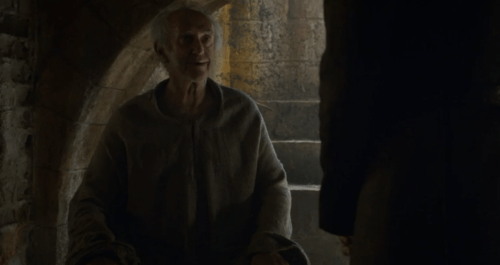
And we open on King’s Landing with this Eric Idle type standing in the street doing his version of Monty Python’s “nudge nudge wink wink” sketch involving an unlikely story about Cersei giving him the eye, a little monologue that causes the Mountain to smash the Facebook angry dislike button so hard that even I made a noise of disgust. (“Say no more!!”) This is the most we’ve seen of the Mountain since he was raised from the dead and has turned into nothing more than a meat-based killing machine (which, granted, is only a sidestep from what he was before he died), and that thick neck, grey face, and deadened eyes behind the mask lend a particularly horrifying element to him. I hope he never takes off that mask, because it’ll give me nightmares for life. But the appearance of the Mountain and what he does here looms large over the rest of the episode, so by the time we get to the events at the end, we’re not quite so sure about this whole raising from the dead thing.

Mountain

One does not merely piss on the Mountain’s feet.

As Cersei descends from the Red Keep with the Mountain at her back, she’s stopped by King Tommen’s guards, who stand before her in a YOU SHALL NOT PASS manner and explain, heads bowed, that despite her being the king’s mother and despite her destination being the funeral of her daughter, she is not allowed to leave the Red Keep. This is possibly the lowest we ever see Cersei, and despite everything she has done, you can’t help but feel badly for a mother who cannot say goodbye to her own daughter.

The show then takes us to Jaime and Tommen, standing at Myrcella’s side. Those creepy rocks with the wide-open eyes painted on them are lying on her face, and we remember that less than two years ago, they were standing in the same spot. Only when it was Joffrey on the slab, Cersei was standing at his side, cursing Tyrion’s name and convincing her twin brother that the imp had been behind it, as Tywin put his arm around Tommen’s shoulders and led the young boy away, establishing himself as Tommen’s chief advisor. How the times have changed: Cersei has been humbled to the point where she can’t even attend the funeral, Jaime has calmed down and it’s uncertain whether he still thinks Tyrion killed Joffrey, Tommen is a reasonable king who listened to the advice given him and is still making his way through everything, and Tywin is dead, by Tyrion’s hand.
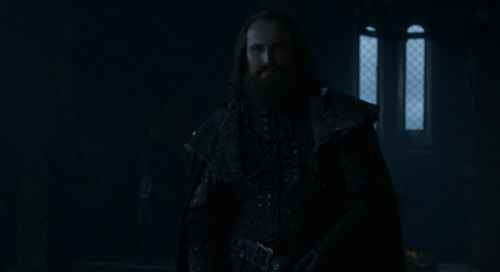
Tommen confesses to Jaime that the reason he has yet to visit his mother is simple: shame. He should have stopped what the High Sparrow did to her, he should be stopping what they’re doing to Margaery now, and he doesn’t know how to face either woman when he’s let them down so colossally. And right on cue, the High Sparrow emerges from his perch and begins to descend to where Myrcella’s cold body lay on a slab, as Jaime sends Tommen away to speak to his mother.

What did you think of the conversation between the High Sparrow and Jaime, Chris?

Sparrow

Christopher: As always, I am in awe of certain actors on this show, and Jonathan Pryce is a prime example. Jaime, we can see, is coming close to a breaking point: reunited with Cersei, having seen his daughter die and his family under siege, he seems ready to return to his violent tendencies and familial retrenchment. His fury at the High Sparrow is chilling in how cold and controlled it is, but for all intents and purposes the High Sparrow calls his bluff.

Not that Jaime doesn’t call out his hypocrisies. “Your sister,” says the Sparrow, “sought the gods’ mercy and atoned for her sins.” “What about my sins?” Jaime demands, and provides a litany of his misdeeds, from the killing of the Mad King to setting Tyrion free. “What atonement do I deserve?” It is the one moment in which the High Sparrow has no answer—for what could he say to that? The subtext of this conversation is the uneven dolling out of punishment, which disproportionally hurts women, and which is more preoccupied with sexual transgression. Cersei and Margaery suffer torture and humiliation, and we’re not certain of what is being inflicted on Loras. But Jaime’s laundry-list of sins has not garnered him anything more than the label Kingslayer.

Jaime’s mistake is overplaying his hand: he should have let the silence deepen, and let the High Sparrow attempt an answer that would have further shown his hypocrisy. But Jaime is not Tyrion, and so before the High Sparrow can become properly discomfited by his question, he grasps his dagger in a threatening manner, allowing the High Sparrow to deflect his words. “You would spill blood in this holy place?” he asks. Jaime’s response, that the gods are bloodier than all mortals put together, is a nice piece of rhetoric but comes off, ultimately, as empty bravado. Better to have pointed out that he has spilled blood in the throne room of King’s Landing and bring the question back around to what atonement he deserves.

faith-militant

One way or another, Jaime’s implied threat effectively summons the High Sparrow’s muscle, who array themselves around the sept but do not approach. And it is here that the High Sparrow stares down the Kingslayer, daring him to kill him. The face acting between these two is on point here: Coster-Waldau has a wonderful look of surprise and consternation when he’s invited to kill his foe; and Pryce very subtly communicates an instant of trepidation in making the challenge, replaced by his mounting confidence as he looks over Jaime’s shoulder to see that his Faith Militant have arrived. The Sparrow is still in danger from Jaime Lannister, should the latter choose to roll the dice and wager that he could fight his way out of the sept; but he knows that the calculus has changed, and it is far more likely that the Kingslayer will choose to fight another day.

And more importantly, it gives him fodder for one of his speeches: “No doubt many of us would fall,” he says of the prospect of Jaime cutting his way out. “But who are we? We have no names, no family … every one of us is poor and powerless. And yet, together? We can overthrow an empire.” The look he gives Jaime as he takes his leave falls short of open disdain, but it’s clear he knows he’s just owned the Kingslayer—and Jaime knows it too.

It does seem, however, that the High Sparrow’s estimation of his nameless, poor legions of the Faith Militant will be put to the test. Heeding Jaime’s advice, Tommen visits his mother to make his own atonement. He apologizes, and in the substance of his words we see a Lannister-in-training: “I should have executed all of them. I should have pulled down the sept onto the High Sparrow’s head before I let them do that to you.” Certainly, that would have been the path taken by the late-not-quite-lamented Lord Tywin; hearing the words from Tommen emphasizes again the familial retrenchment of the Lannisters, and the danger this could pose both to themselves and to the kingdom at large. “You raised me to be strong,” he continues. “I wasn’t. But I want to be.” In this moment, Cersei gets something resembling recompense for all her humiliations, but it does raise a few questions, re: Margaery. They’re still married, after all; she is still, in fact, the queen. If Tommen is returning to his mother’s tutelage, what kind of relationship can we expect him to have with his wife, assuming he manages to break her out? Cersei’s plotting late in last season effectively turned Margaery into her devoted enemy, and Margaery is hardly someone who will humbly accept the role of submissive wife. What role does House Tyrell have in the context of the Lannister wagon-circling?

We then segue to Meereen, where Tyrion’s alcoholism elicits Varys’ disapproval, which itself provokes Tyrion to make eunuch jokes, and banter ensues. As so often happens, Tyrion has my favourite lines of the episode, the first of which I’m seriously thinking of putting on my business cards. When Missandei asks him how he knows so much about dragons, he replies, “That’s what I do. I drink, and I know things.”

But as it turns out, he does more than just drink, venturing into the dungeon to unchain the dragons … presumably because no one else was willing to do so. What did you think of our time in Meereen, Nikki?


Tyrion-Varys

Yes. This is a GOOD idea, Tyrion.

Nikki: Tyrion and Varys were a highlight in an episode full of highlights. Just when you think you’re starting to know Tyrion, he surprises everyone with a lot of talk about dragons. He’s certainly expressed his awe of them before — witness the look on his face when he first saw Drogon flying overhead when he was in the boat with Ser Jorah. But now we discover he knows far more about them than the myths and legends: he knows how to actually take care of them. He explains that, like many animals in our world, in the wild dragons are massive creatures, but in captivity they can be quite small — he says in the great time of dragons, when they were all in captivity, they were the size of cats. (Cats!! I want a cat dragon!) And his explanation makes perfect sense. Our family actually has a pet bearded dragon. When he was little, we had to keep increasing the size of his cage or he would actually stop growing so he would never exceed his environment. I’m happy to report that at some point they do stop growing, but last year my son and I went to a reptile show, and there was a bearded dragon there from the wild that was four times the size of ours, and ours was considered full-grown. So the writers have actually culled this little fact from real-world creatures.

As Missandei, Grey Worm, and Varys look on, stunned, Tyrion explains to them that the dragons must be unchained, or they will die, and he will be the one to do it. “I am their friend!” he proclaims. “Do they know that?” Varys understandably replies.

The scene in the dungeon was so tense I could barely blink. Tyrion slowly descends the staircase as Varys stays safely by the door, and confronts the two dragons who have been left behind. Drogon, Daenerys’s favourite (and the largest of the three) is the one that’s out on the loose, and Tyrion slowly walks up to Rhaegal and Viserion. It’s interesting, in a sense, that there were three dragon siblings: Rhaegal are the smaller and more contemplative of the three, whereas Drogon is the largest and most aggressive. Tyrion’s family was the opposite: the two older ones were larger and more aggressive, while he was the smaller and more thoughtful of the three. Where Drogon, the large one, has left the nest, Tyrion, the smallest, is the one that’s been banished. And now he approaches the dragons. First we see four glowing eyes in the darkness, followed by a large head and a furnace burning brighter in the back of one of the throats… but the pilot light quickly goes out, as the dragons don’t have the energy to breathe fire at the moment. Tyrion, wide-eyed, is like a little boy coming face to face with the creatures of his wildest imagination, as he bows his head and begins speaking to them with great reverence. He is at once terrified, yet astonished to be in their presence. “I’m friends with your mother,” he tells them. “I’m here to help. Don’t eat the help.”

He explains that the only thing he ever asked for on his name day was a dragon, but everyone laughed at him. “My father told me the last dragon had died a century ago. I cried myself to sleep that night… but here you are.” He reaches out a hand and oh-so-tentatively touches its head before suddenly reaching out and grabbing the nail holding the chain together. At which point the other dragon bends its head forward, extending it so Tyrion can do the same. And the moment they are freed, the dragons lumber to the back of the cave. Tyrion stands, amazed, for one moment, before hustling it back to Varys. “Next time I have an idea like that,” he says, “punch me in the face.” It’s a brilliant, beautiful scene, where our favourite character meets our favourite creatures. Wow, what a combination they could make.

Jaqen

And speaking of punching in the face, a girl with no name is attacked once again by the waif, and this time the girl formerly known as Arya is pissed. She grabs that staff and swings in every direction, screaming and yelping… until the staff is suddenly stilled by the hand of Jaqen. I was thrilled to see him (I thought we’d seen the last of him) and in a very biblical moment, he tempts her with shelter, food, and even her sight if she’ll just tell him her name. “A girl has no name,” she replies, and then he leads her away. Will Arya see again? I can only imagine what Jaqen has in store for her next (but I hope she gets a good knock or two at the waif beforehand…) 😉

And then we get to the Boltons, the most depraved lot on a show filled with depravity. Once again Ramsay wants to do something drastic — in this case, storm Castle Black — because he’s thinking ahead and knows that’s where Sansa is going (and he’s right). Clearly no one has sent out a raven yet, and word that Jon Snow is dead has not been sent out as quickly as word like that usually moves (I swear the ravens in Westeros are faster than Twitter) but Roose, as usual, is cautious, and thinks moving on Castle Black is neither the right nor the politically astute choice at the moment. And just then it’s announced that Lady Walda has just given birth to a baby… boy. The child who will take the throne away from Ramsay, for a legitimate child always trumps a bastard, even if that bastard has been given his father’s last name. Roose looks to Ramsay, and embraces him, saying, “You’ll always be my first-born,” in a surprisingly touching moment… which is immediately cut down by Ramsay plunging a dagger into his father’s chest and killing him on the spot. This moment was definitely one of the most shocking I’ve seen on the show — I didn’t see that coming at all, despite everything that had happened leading up to it. And when Ramsay calls for Lady Walda and the baby, it just gets worse. We know what he’s done to Theon, and we know what he’s done to Sansa. We know how he uses those hounds, and when he lures Lady Walda into the kennel, it’s so much worse than the fate his father endured. I couldn’t move as I watched this scene, at once horrified and hoping against hope in my mind that this one time might be the moment Ramsay lets someone go (seriously, Nikki, do you ever learn??) I imagined standing there in the same way, and how, knowing how this would play out, it would probably be more merciful to smother the child on the spot than let the hounds take him. And in the final moment we see on screen, it looks like that might be exactly what she does. Notice how she turns away from the camera and falls forward, and you never hear a baby’s scream in that scene. I was incredibly thankful the directors didn’t show us that moment.

What did you think of what happened at Winterfell, Chris? Was it a complete surprise or were you suspicious it was going to move in this direction?


Roose_Ramsay

Ramsay being sentimental should always raise a red flag.

Christopher: I had a brief moment of confusion when Ramsay stabbed Roose, thinking at first it was the other way around—that with the birth of a son, Roose had no need for his bastard any more. That would have been shocking, but of course it would have ended Ramsay’s storyline, and I have a slight suspicion the showrunners want him around for some time yet, and will presumably (hopefully) give him a properly gruesome death. Perhaps we can start taking odds on who gets to kill him in the end? I’m saying Jon Snow 10:1, Brienne 5:1, his own hounds 3:1. Sansa? Even money.

But no, it’s too early in the season for Ramsay to go, but not too soon for Roose. It was still a surprise, though to quote a Buffyism, as justice goes it’s not unpoetic. In the world of GoT, certain things are sacrosanct, among them the laws of hospitality and the taboo against kinslaying. In aiding and abetting the Red Wedding, Roose violated the former—and one of the reasons the Boltons’ hold on the North is precarious at best is that many of the other houses look upon the Boltons as cursed for that transgression (a point emphasized more in the novels than in the series). That Roose loses his life to the monster he has cultivated, and who—as the rest of the scene demonstrates—is quite happy to kill his kin, is about as close to justice as we’re likely to get in Westeros.

And as we have seen, things in Westeros always get worse before they get better (wait—do they ever get better?). It is doubtful that the psychotic Ramsay can hold together the alliance he will need to win the North (and potentially defend against a Lannister army), but he can do a whole lot of damage in the meantime.

Meanwhile, Brienne, Sansa, et al seem to be in a bit of a holding pattern: of all the scenes in this episode, this one feels like the most extraneous, as its main purpose seems to be for Brienne to tall Sansa about her encounter with Arya, and for Theon to announce that he’ll be leaving them. The logic behind his reasoning isn’t entirely clear, but then I don’t know that logic is necessarily going to obtain with Theon at this stage. The only thing that is clear is that after all he has done, there is only one place left for him.

Balon_Yara

When he says “Home,” we then cut to the castles of Pyke, the seat of power in the Iron Islands, where Balon Greyjoy is in the midst of an argument with Yara, Theon’s sister. The gist of their dispute is Yara’s pragmatism in the face of Balon’s stubbornness, with her pointing out that islanders are ill-equipped to take and hold mainland fortresses. He will have none of it, storming out (ha!) onto what seems to me to be a rather rickety bridge between buildings. And here we meet a new character, Balon’s younger brother Euron, whom we glean has been away for many years, sailing to the ends of the earth. His time away seems to have … well, affected him somewhat. Which is to say he’s batshit, referring to himself as both the Drowned God and the storm itself before committing this episode’s second instance of kinslaying.

I’m not sure what I think of this new story line. In the fourth novel of the series, A Feast for Crows, GRRM introduces both the Iron Islands and the Dorne subplots. Given that Feast eschewed the Jon Snow and Daenerys storylines (thus making it the least favourite of the books among fans), these new dimensions in the Ice & Fire world could be presented with an economy of storytelling (or what passes for economy of storytelling in this series); but they came to complicate book five, A Dance With Dragons, making it the most shambolic of the books so far. Reading Dance, a friend of mine said in an apt analogy, was like pulling taffy. Given the difficulty of teasing out all these threads in a novel meant that the television show was ill-suited to take all of them on, and there was a general assumption when we undertook the Dorne plot last season that the series would ignore the Iron Islands.

Balon_funeral

Is it just me, or are Iron Islands funerals really lame? I mean, won’t that just wash up on shore somewhere else?

But here we are, and I’m worried—in part because the Dorne storyline was so clumsily mishandled, and we’re still stuck with it. And now the Iron Islands on top of it? Fingers crossed, but I’m worried we’re hitting Peak Narrative right now.

On the bright side, they will likely be mining A Feast for Crows for content, so at least there will be one storyline I’ll have an inkling about this season.

Which brings us to this episode’s final scenes, which I assume you have one or two thoughts about, Nikki. But before that, a few final thoughts on this episode:

  • Davos apologizing to the others for what they’re about to see as he draws Jon’s sword is classic, and a perfect line for that character.
  • The showrunners really want to be a bit more sparing with their deus ex machinas. Brienne riding to the rescue last week was great, but the wildlings’ appearance at Castle Black was so utterly predictable you could have set your watch to it. I found myself thinking “I wonder how many blows they’ll get on that door before Edd returns with Tormund?” Which isn’t to say it wasn’t a thrilling sequence, just that it’s not necessarily a good pattern to fall into.
  • It’s official: crushing skulls is the Mountain’s preferred method of killing. Dude doesn’t even need a sword.
  • “Next time I have an idea like that, punch me in the face” is my other favourite Tyrion line of the episode, though “Don’t eat the help!” is pretty good too.
  • I’m REALLY happy they cut away from Walda when the hounds attack, but the sound effects were almost as bad as seeing it.

That’s it for me. What did you think of the episode’s ending, Nikki?

Melissandre_Jon

Nikki: I’m sure there were a lot of people out there who thought the final three seconds of the episode were as predictable as it gets, but I’m not one of them. This show has thwarted hopes and expectations more often than not, and because it was so drawn out, with Melisandre making numerous attempts to raise Jon and failing every time, I thought there was a possibility that we would end with a quiet camera hold on Jon, fade to black.

Of course, that was while I was in the moment. In retrospect, fans would have stormed the HBO studios over it, and they knew that. They couldn’t have possibly gone in that direction, and so of course it had to end the way it did, but in that moment, I just wasn’t sure if they were going to go for it or not.

The final scene began with Melisandre sitting gloomily in her room listening to country music — the music of pain. (Dude, that’s three Buffy references in a single recap, this is some kind of record for us!!) Fans have been up and down with Melisandre from the beginning. I think she’s the most stunning looking person in the entire series, and I absolutely love the way the actress carries herself and speaks. Some other viwers find her grating. I found her rather unsettling in the beginning, when we first found her with Stannis, and she’s been utterly unpredictable in her actions every step of the way except in one aspect: her unwavering belief that her convictions are correct. She never questioned that the Lord of Light was leading the way, and that Stannis was his vessel on earth, and that he’d lead them all to glory. And when Stannis died, she stumbled, and went to Castle Black and said, “OK now I’ve got it right, it’s… Jon Snow!” and then Jon Snow was killed, and she doesn’t know what to believe anymore. She’s wasted so much of her life having faith in one thing that when it collapses, she has nothing more to live for. (To the point where last week, one of our readers wondered if Melisandre removed the necklace so she could lie down and die, a notion I confessed I’d also considered when I saw that scene.)

Many of us have had that feeling, whether it’s in a relationship or a job or anything you’ve been involved in for several years. But it’s one thing to say, “Aw, man, I worked at that company for 12 years and I should have moved on years ago”; it’s quite another to have devoted your entire being to worshiping a god for centuries, only to realize you were a wee bit incorrect on that one. She’s utterly despondent as she sits in her room, and the old, confident Melisandre has turned to ashes in the fire. “I assume you know why I’m here,” Davos says. “I will after you tell me,” she replies. The old Melisandre would have chided him for even questioning what she knows, and of course she would always know why he’s there.

But Davos won’t let her wallow, and he pushes her. He wants to know if she knows any magic that can bring back the dead, and she tells him that she met a man once who came back from the dead, but it shouldn’t have been possible. She knows the implications of this (anyone who’s seen any genre TV or movies knows the consequences are never good). She stares ahead, unblinking. “Everything I believed, the great victory I saw in the flames, were lies.”

Davos will have none of it. He steps forward, and tells her you know what? He’s not looking for the bloody Lord of Light, master of nothing, he’s asking for help from the woman who showed him that miracles do exist. The Lord of Light might be a lie, but she’s not. And she is pretty incredible. And with that, Melisandre finds the tiniest glimmer of hope within her, and follows him to Jon’s side. She cleans all of his wounds, like Mary washing the body of Christ, until they are just red half-moons all over his body. She cuts his hair (I’ll admit to wincing through that, like, I know you’re trying to bring him back from the dead and all, but do you really have to cut his hair?) and throws it into the fire, along with some of his blood. Ghost sleeps through the entire process, which I found a little odd: you’d think the direwolf would be standing at the ready, even knowing that Jon was dead. (And at one point I was yelling, “Put some of Ghost’s fur into the fire!”) She lays her hands upon him, and says the incantation, and… nothing. She tries it again, nothing. We watch the hope fade from her face as she tries it again and again. Tormund turns and walks out of the room, waving them off like he couldn’t believe he’d gotten caught up in this stupid charade in the first place, but Davos’s face remains steadfast. He doesn’t take his eyes off Jon, waiting for something to happen. Melisandre’s chant becomes more and more feeble, with less and less conviction, until finally she just gives up. Head hanging, shoulders low, she turns and leaves the room, as one by one they all leave. And only Jon and Ghost are left behind.

And then, Ghost stirs. And, I will admit, I went, “Oh my god, his spirit went into GHOST!!” but as soon as the words were out of my mouth I thought wait, no, that would just be weird. Even weirder than this show usually is. And as the camera closes in on Jon as Ghost begins making noises, we all know what’s going to happen, and it does.

Didn’t stop me from fist-pumping the air and going, “YAAAAAAAAASSSS!!” And my joy was so full that I didn’t turn to the person beside me and say, “YOU were wrong and I was right because I never wavered in my conviction that he was coming back and HA-ha ha-hahaha.” Oh wait, no… that’s totally what I did.

Thanks again for reading, and I look forward to chatting again next week!

resurrection


Leave a comment

Filed under Game of Thrones, television