Monthly Archives: May 2014

Game of Thrones 4.07: Mockingbird

GameOfThrones_Teaser02_Screencap10

I think my academic title for this episode would be “Mockingbird: Lysa Arryn and the Effects of Rapid Deceleration Syndrome.” And let me be the first to say, it couldn’t have happened to a nicer gal.

Yup, it’s that time again kids, in which Nikki Stafford and myself throw the most recent episode of Game of Thrones into the mass spectrometer that is our shared brain and emerge with a scientific breakdown of the contents. For real, this is Science™.

Want to lead us off, Nikki?
tyrion

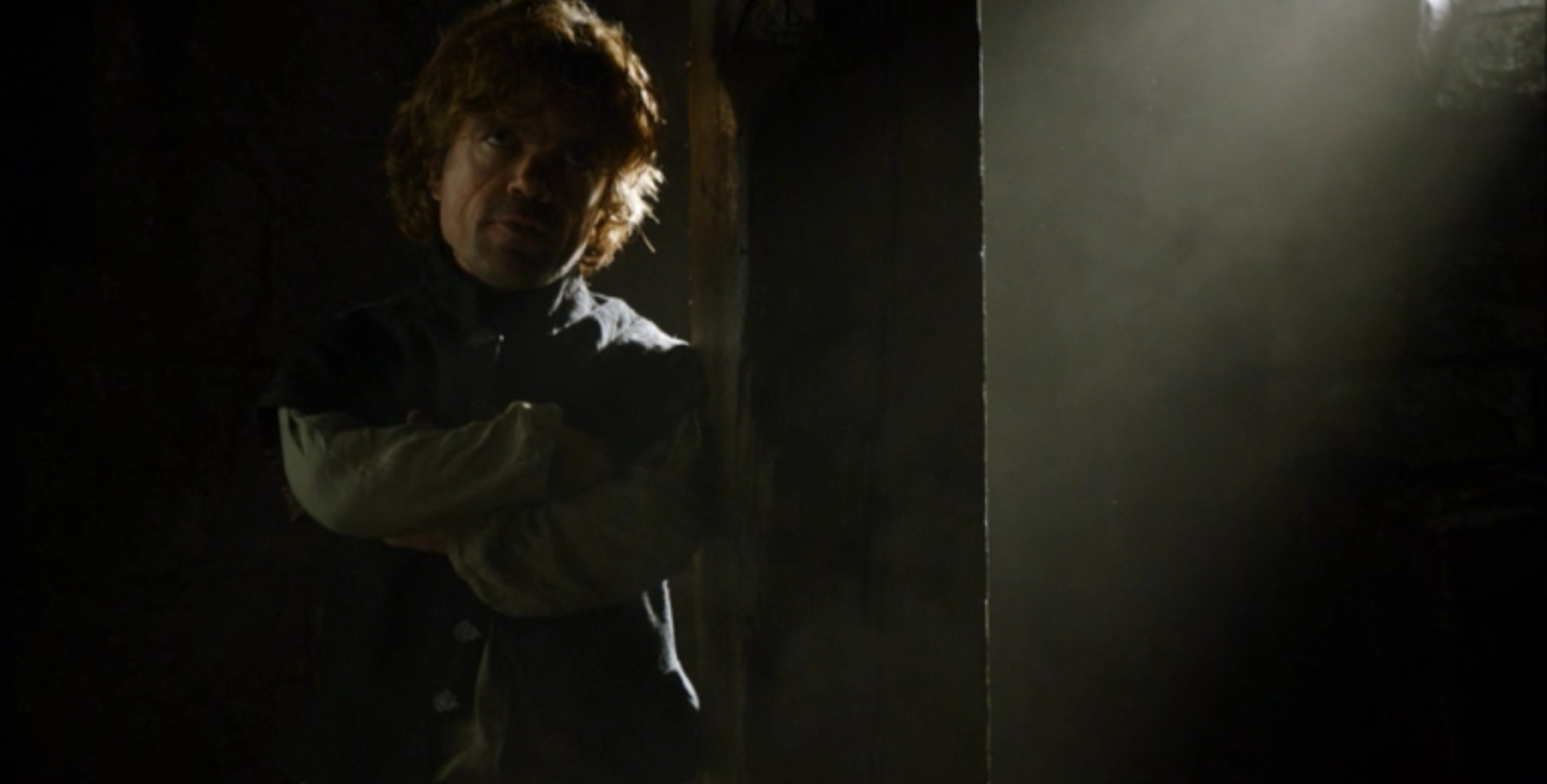
Nikki: This week opens with the Kingslayer and He Who Is Accused of Being a Kingslayer. Poor Tyrion is still reeling from his treatment at the hands of Shae, and doesn’t seem to be clear enough yet to realize that she did what she did out of heartbreak. “Yes, I fell in love with a whore,” he tells Jaime, “and I was stupid enough to think she’d fallen in love with me.” She really did give her heart to Tyrion, despite what he thinks, and he doesn’t realize that he took that heart and shattered it into a million pieces, because if he’d held onto it the way he’d wanted to, she’d be dead. But SHE doesn’t know that he was sacrificing himself to save her, and so she committed her act of pure revenge.

Tyrion had declared at the end of last week’s episode that he wants a trial by combat, and he wants a champion, and that becomes the theme of this week’s episode. Jaime was the one he wanted, and Jaime turns him down. He’s scared, and through his lessons he knows he’s no match for anyone anymore. He was cocky and self-assured at the beginning of the season, knowing he could fight with his other hand better than most people fight with their regular hand, but his lessons have taught him differently. And the Mountain, as we saw in that one grotesque scene, is quite the formidable foe. Poor Tyrion is lost, and tries one last feeble joke on his brother, telling him he’s the golden child, and wouldn’t it be funny to see their father’s face as the family name is snuffed out with one blow. Jaime actually considers it for a moment, but realizes he values his own life, and were he to step into the ring, both he and Tyrion would be dead.

And so Tyrion tries Bronn, the man who was his champion the last time. But Bronn isn’t the sellsword that he once was, willing to step up and fight for Tyrion for a few pieces of silver. Now he’s dressed in fancy clothes and betrothed a woman who will ensure him a castle (as long as he gets rid of the older pesky heir, of course) and has no need for Tyrion and his shekels. “I like you . . . I just like myself more,” he tells Tyrion, reminding him that despite theirs being a friendship that is actually important to him, Tyrion has never risked his life for Bronn. Tyrion resignedly accepts Bronn’s refusal. It’s easy to hate Bronn in this scene — after all, he was nothing but a sellsword wandering the lands before he took Tyrion’s challenge and saved his life at the Eyrie, and made a lot of money doing so. Since then he’s been at Tyrion’s side, receiving favours and being given higher positions of power at King’s Landing due to Tyrion’s continued favours, and along the way has mocked Tyrion’s every move and talked about what a ridiculous family the Lannisters are. And . . . actually, yeah, it is easy to hate Bronn in this scene. And for a moment, I thought they were going to actually attempt a David and Goliath thing when Tyrion joked that he could go up against the Mountain himself. “Wouldn’t that make for a great song?” he says.
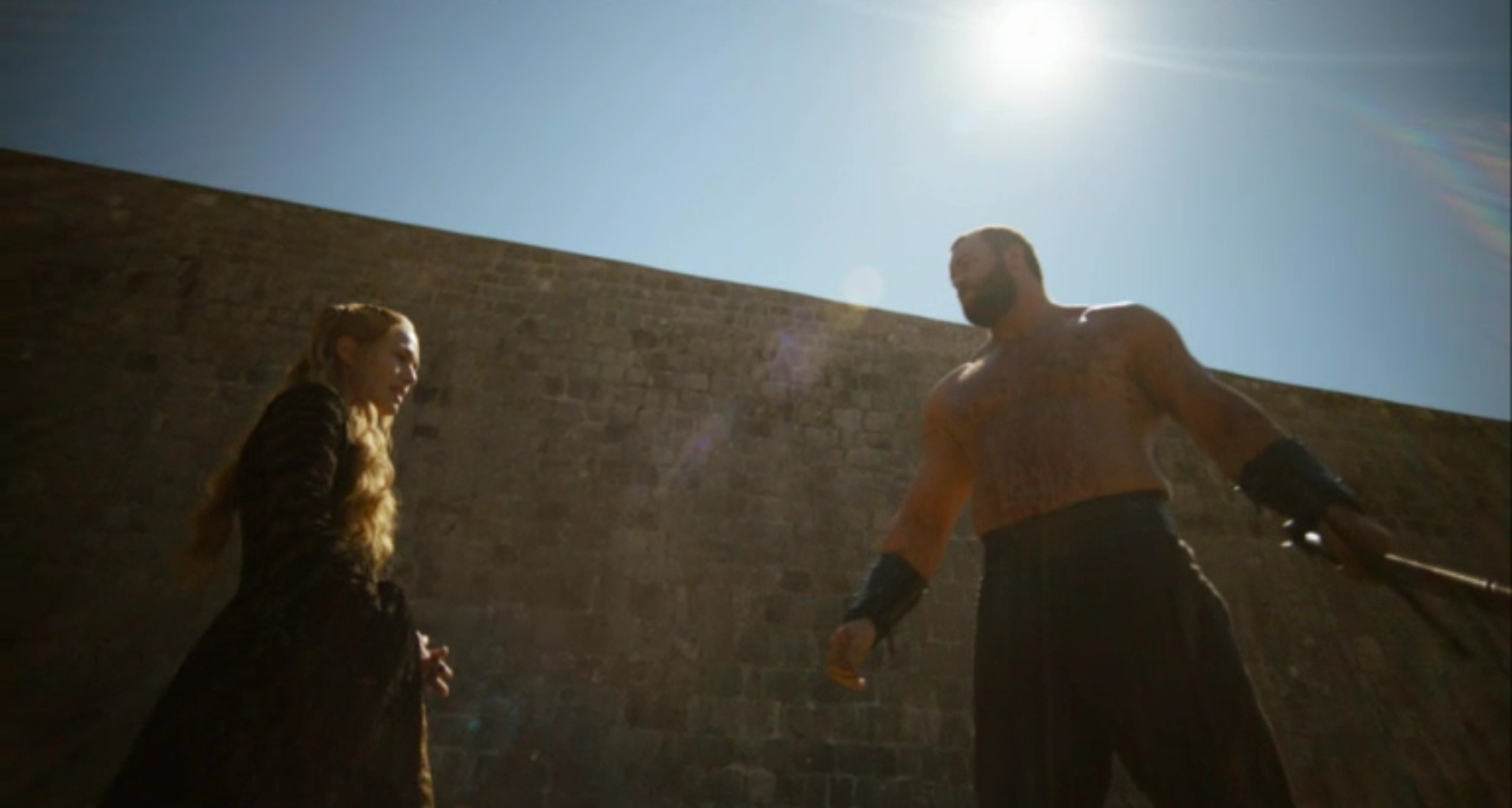
I know they're playing with the camera angles here to exaggerate things, but still: holy CRAP that guy is huge.

I know they’re playing with the camera angles here to exaggerate things, but still: holy CRAP that guy is huge.

Until the real champion enters the room. We talked about Oberyn last week, Chris, and what a fantastic character he is, both funny and casual, yet cunning and as full of political maneuvering as the next guy. But there’s a deeper purpose behind Oberyn’s actions: he knows what the Lannisters did to him, and specifically what horrors the Mountain enacted upon his sister, a sister he loved very much. The scene where he tells Tyrion about seeing him for the first time as a baby, a tiny misshapen thing that young Cersei had told him was a monster, is heartbreaking. We all talked about Dinklage’s incredible performance last week, but the one he gives during this scene might have topped it: he doesn’t say a word as Oberyn tells the story, but instead sits there, eyes welling with tears, jaw moving in fixed, clenched hatred of a sister who seemed to have despised him from the beginning, a little girl who would come in and pinch his pink cock, as Oberyn put it, until he thought she’d squeeze it right off and Jaime would have to stop her. Tyrion knows that Cersei has hated him for as long as he can remember, but it’s during this story he realizes she’s hated him even longer. At the trial he told Tywin he was on trial for being a dwarf. Now he realizes that as far as Cersei is concerned, he’s on trial for murdering her mother as well as her son.

“It’s rare to meet a Lannister who shares my enthusiasm for dead Lannisters,” Oberyn says of Cersei. But he’s not on her side. She’s a true Lannister, and one who backs the Mountain as her champion. And if the man who killed his niece and nephew before brutally raping his sister Elia (before slicing her in half with his giant sword) is going to be the Lannister’s champion, he will be the one to fight him.

What a song that will make. I hope they’re singing it for centuries afterwards.

If he does win, I wish he could head north to the Wall and take out Ser Alliser while he’s at it. That guy drives me nuts. What did you think of the non-celebration upon Jon Snow’s return, Chris?
alliser

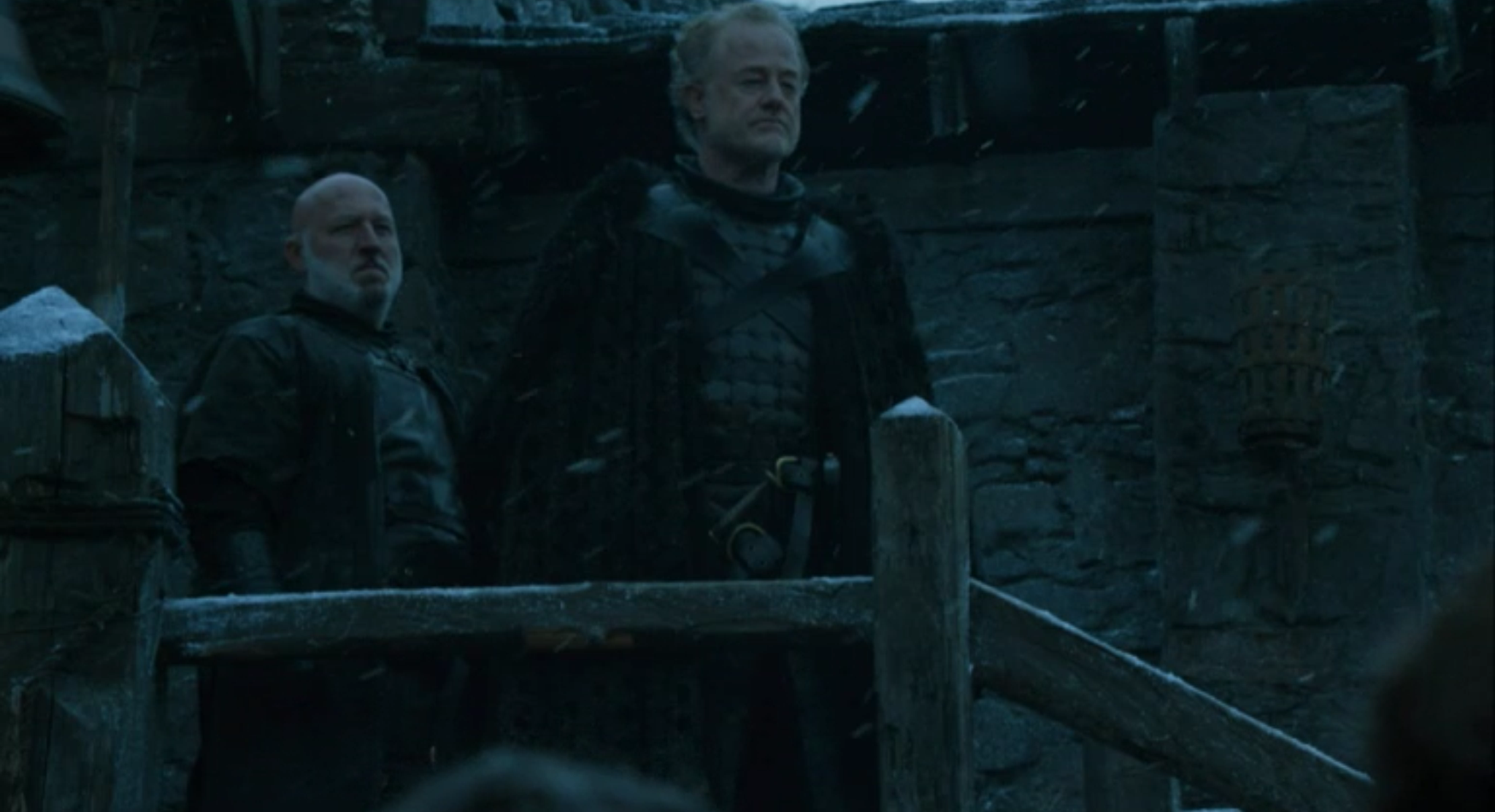
Christopher: GRRM’s talent for writing hateful characters is nowhere more evident than with Ser Alliser Thorne (well, and Joffrey). His sustained animosity toward Jon Snow is as consistent as it is vaguely baffling … especially when it flies in the face of common sense, as with Jon’s suggestion that they block the tunnels through the Wall. Tunnels can be re-built, but a massive wildling army south of the Wall would do more damage than Thorne seems to want to admit, to say nothing of leaving the Wall breached for the inevitable invasion of ice zombies.

The scenes at the Wall, however infuriating Ser Alliser is, felt a little like a placeholder—we’re in a holding pattern at the Wall, waiting for the arrival of Mance’s army. But then the rest of this episode felt like a placeholder. It was all quite good, don’t get me wrong, unlike the previous two episodes, not much actually happened (until the very end—but we’ll get to that). We do however get a new installment in the saga of Arya Stark’s unsentimental education, and another example of the common folk suffering in the aftermath of the war. “Who were they?” Arya asks the wounded farmer. “I stopped asking a while ago,” he replies, and his calm resignation in the last minutes of his life speaks less to stoicism than to exhaustion. Who were they? It matters not at all whether Lannister or Stark, Ironborn or Northmen is burning your home and plundering your coin. As we learned a few episodes ago, if the farmer had not already been attacked, the Hound would not have been adverse to relieving him of whatever meager wealth he possessed. The war might be over for the nobility, but the common folk still suffer.

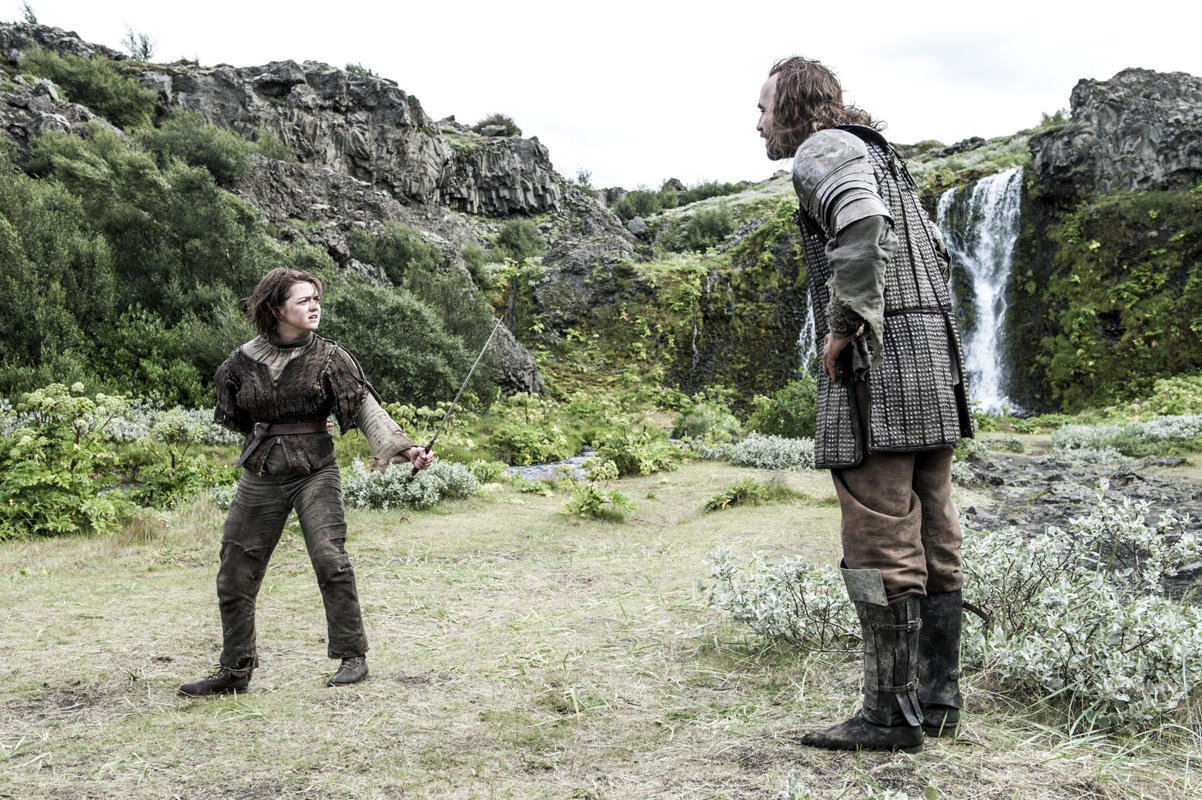
The Hound performs what he considers an act of kindness, putting the man out of his misery … only to be attacked by the men who (presumably) are responsible for sacking the farm, one of whom shared a cage with Jaqen H’ghar—a particularly nasty piece of work named Rorge. I was wondering if we were going to see him again, considering that he actually plays a somewhat more substantial role in the novels than he has so far in the series. I was wondering to myself, as he stood facing off against the Hound, “How is he going to escape this now so he can … Oh. OK, Arya killed him.” Apparently she took the Hound’s anatomy lesson to heart (get it? to “heart”? Oh, I kill me), and I think I was even more surprised than Rorge at Arya’s quick little thrust to his chest. I guess they’ll have to introduce another psychopathic killer to play the role Rorge plays later in the story …

What did you think of the ongoing Hound and Arya story, Nikki?
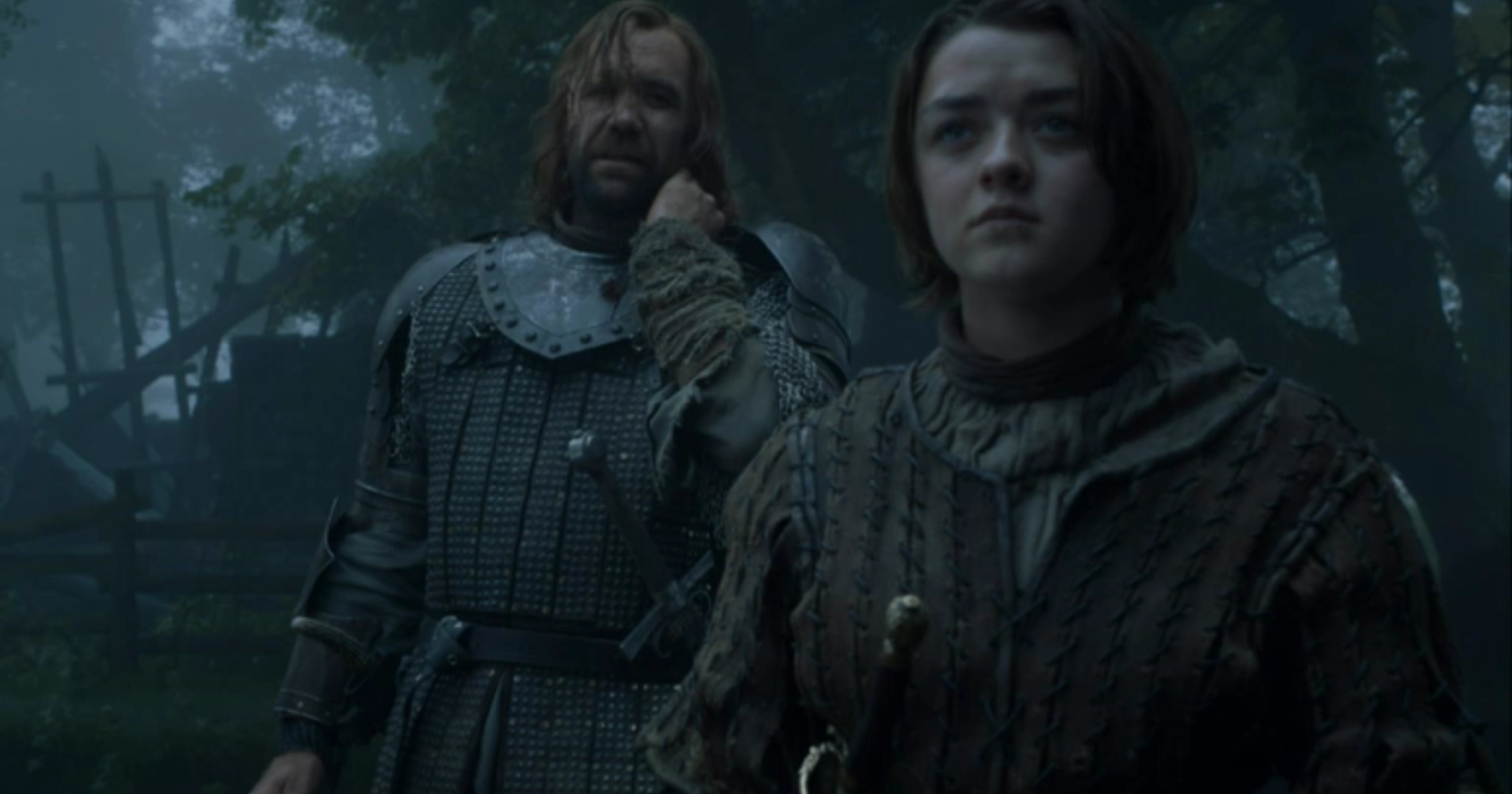
hound-arya

Nikki: Ooh, I’m intrigued by the fact there’s another psychopath later in the books, whether he be Rorge or not. As you say, with the exception of the conclusion a lot of the episode felt like exposition to get us to whatever’s going to happen next, but what I did like about the scenes with the Hound and Arya is that it moved their relationship a little further. As we discussed a few episodes ago, they can’t make the Hound completely sympathetic or he’ll lose the danger he’s supposed to pose to Arya at every turn. However, they can certainly give us some insight into his character and allow us to see things from his perspective. Yes, he could turn on Arya or anyone who does him wrong at any moment, but at least as an audience we’ll understand why.

In season one, at the jousting tournament for Robert Baratheon, Baelish sat with Sansa and told her the story of the Mountain and the Hound. He said it like he was telling a ghost story around a campfire, turning the Monster into a true monster, and it wasn’t clear if he was just telling a story to scare the shit out of Sansa or if it was actually true. (I believe in the books it’s simply stated by the narrator, so you know it to be true, but in the show it wasn’t as clear.) Now we have it stated by the Hound himself: his own brother stuck his face in the fire because Sandor was playing with Gregor’s toy. And much like with Tyrion hearing the story about himself as a baby, here we are reminded that the Hound was a mere child once, being horribly abused by his own brother, and we’re also reminded that he’s human, and that he can be hurt emotionally. As he tells Arya, the pain was bearable, the smell was worse, but it was the fact that his own brother did it — and that his own father covered it up by telling everyone that his bedding had caught on fire, thus letting Gregor off the hook — that showed him where his place was in the world. He has always been alone.
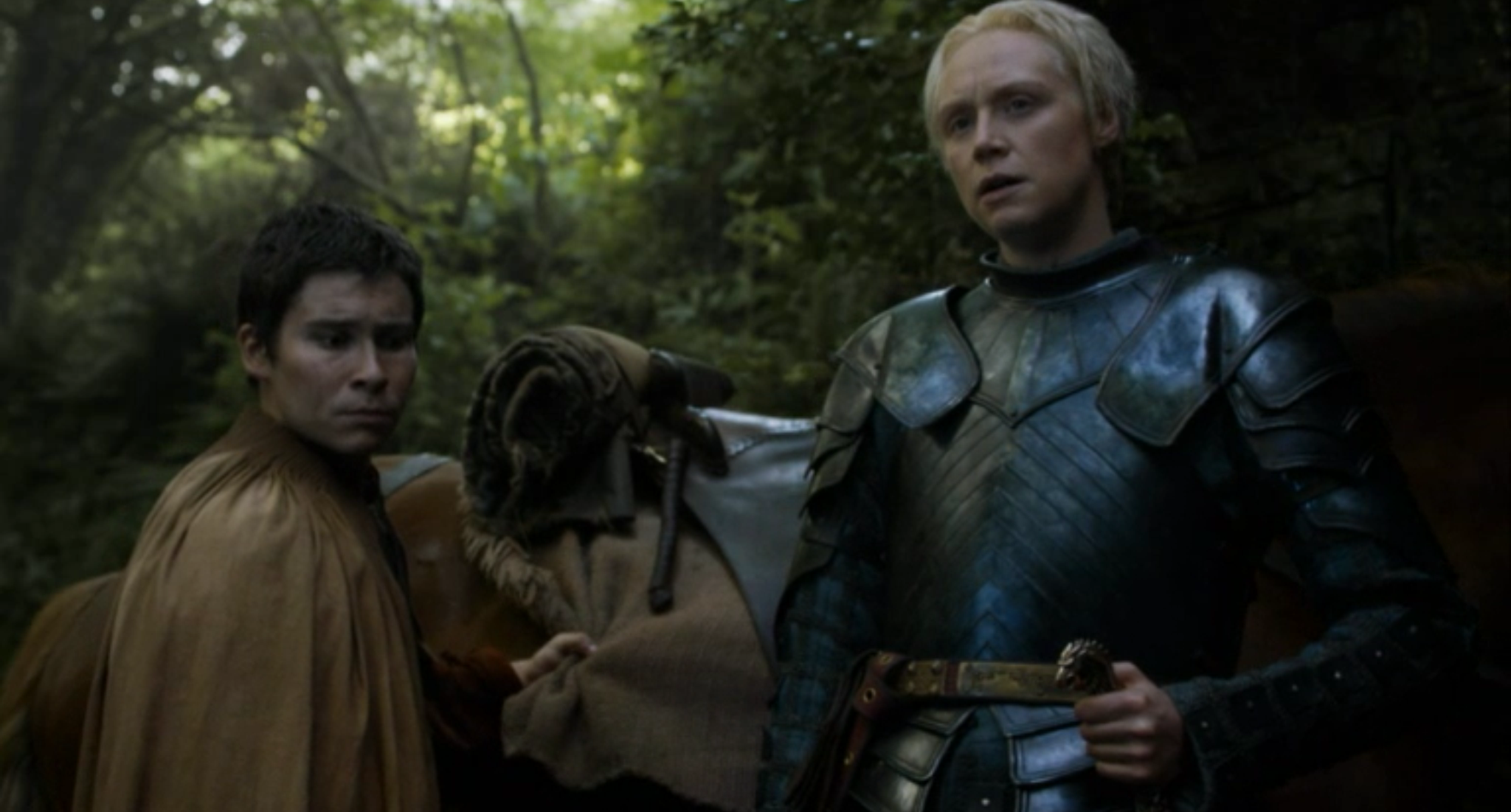
brienne_pod

For me one of the best parts of the episode was when Podrick, of all people, figured out where the Hound might actually be headed after he and Brienne discover that Arya is really and truly alive. I was thrilled when Brienne complimented the cook on his kidney pie and then the camera turned to reveal Hot Pie standing there! We see he’s doing well and thriving as a cook in this pub, and has been able to hone his craft (the bread direwolf that he sends with Brienne is much better than the one he’d made for Arya before). Where before Brienne and Podrick were presented as a comic duo, now we see just how well they work together. Brienne tells Hot Pie the truth about their quest, and where Podrick correctly thinks they should hold their cards closer to their chest, Brienne is the one who’d correctly asserted that Hot Pie was not their enemy and could be trusted. We’ve seen that Podrick is incredibly loyal, worthy in battle when he defended Tyrion and saved his life, and apparently very good with the ladies, but now we see just how brilliant he is when he deduces that if the Hound has Arya he must be taking her to the Eyrie because that’s the only place where he’d get a ransom.

Of course, now all I can think of is that if it’s like any other scene where Starks are about to come together (see Red Wedding and Bran and Jon a couple of episodes ago), either the Hound isn’t going to make it up the hill to the Eyrie or Sansa will have disappeared before he gets there, and Brienne and Podrick will be captured. Oh GRRM, how you frustrate us so!!

Speaking of frustrated, poor Selyse walks in upon Melisandre in her bath and not only has to continue to show her unwavering devotion, but must do so while gazing on the gorgeous body of the woman who has been with her husband. What did you make of that discussion?

mel_selyse

Christopher: Well, first and foremost I was impressed with just how much Tara Fitzgerald has allowed herself to be so dowdied up. Carice van Houten is an extremely beautiful women, to be certain, but so is Fitzgerald—when I first heard she was cast as the unattractive Selyse—who is described as plain, dowdy, and chinless—I wondered why they were departing from the novels in casting someone with Fitzgerald’s striking looks. But they’ve chosen to make Selyse severe and angular, turning her into an ascetic as well as a fanatic. We haven’t seen much of Selyse so far in the series; this encounter went a long way to explicating the power dynamic between the priestess and the would-be queen.

My initial reaction to this scene was to roll my eyes a little, as it first appears to be yet more classic Game of Thrones sexposition (without the actual sex), an excuse to let the camera linger on Melissandre’s naked form while she and Selyse talk. But I think you put your finger on it (that’s what she said) in observing that it works as a goad to poor Selyse, whom we assume to have taken to Melissandre’s religion with such passion to compensate for the fact that there is utterly no passion in her marriage to dutiful, cold Stannis. As I’ve noted previously, in the novels there is no sex between the priestess and Stannis, and I was dubious when, in a moment of rather hamfisted symbolism, she did him on the giant map of Westeros. Then I had about the same thought I had in this scene: that they were introducing this plot point as an excuse to get Carice van Houten naked (as with her seduction of Gendry). To be certain, it does seem that the writers have a bit of a crush on van Houten, as she has replaced Esme Bianco (Ros) as Character Most Likely To Get Naked. But upon reflection, I think that the series has made the relationships on Dragonstone somewhat more complex, and made Melissandre at once more human and more inscrutable. In the books, she is painfully beautiful but also aloof, operating (from what we gather) entirely according to whatever religious impetus brought her to Stannis to start with. The series’ Melissandre appears as slightly more self-interested. Sleeping with Stannis, we begin to suspect, wasn’t merely a religious rite; she has insinuated herself into the life of the man she wishes to place on the Iron Throne, and her conversation with Selyse delineates exactly how the power dynamic now works. Yes, it was a typical bit of Game of Thrones gratuitous nudity; but while van Houten’s nudity means to titillate the audience, Melissandre’s means to intimidate Selyse. As I’ve said before, there are many moments when this show uses female nudity as an assertion of power, such as the scene between Brienne and Jaime in the baths, or when Daenerys defiantly stands and stares down Daario Naharis 1.0. It is significant that part of Melissandre’s monologue deals with the trickery a priestess like her has to engage in: what powders and potions will put on a show for the credulous, but also which ones actually have power. The larger meaning here isn’t exactly subtle: Melissandre knows how to dazzle, how to impress, how to seduce … some tasks require magical assistance, some do not.

Melissandre: A drop of this in any man’s wine will drive him wild with lust.
Selyse: Did you use it with Stannis?
Melissandre: No.

I confess to a sharp intake of breath at this exchange, in spite of the fact that you can see Melissandre’s answer a mile off. Here she asserts her power over Selyse, which is the simple fact that she has power over Stannis, that she inspires in him the lust and desire that Selyse never has. And she goes on to exercise that power, more or less ordering her to bring Shireen with them when they sail. Why? Why does Melissandre want Stannis and Selyse’s unfortunate child with them?

Actually, I’m really asking … because this exchange (to the best of my memory) never happens in the novels.

But from one cauldron of sexual politics to another: it seems that Daenerys has allowed herself to succumb to Daario’s charms. And that’s quite the outfit she’s wearing in the scene: I have written in my notes that I can’t wait to see what Gay of Thrones has to say about it.
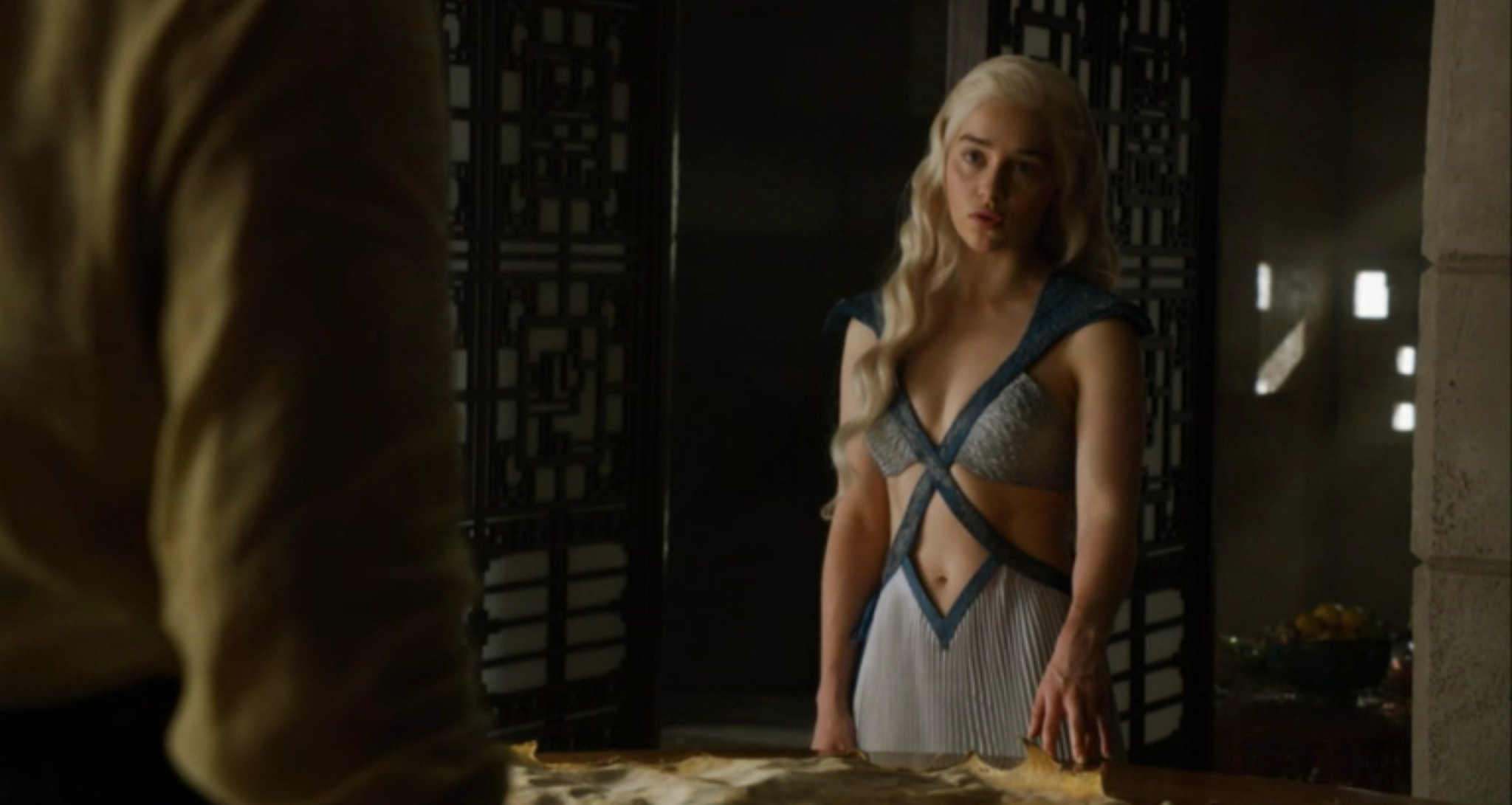
 

Let's just go ahead and call this outfit Daenerys' post-coital lounging duds.

Let’s just go ahead and call this outfit Daenerys’ post-coital lounging duds.

Nikki: HAHAHAHA!!! OMG, I have in my notes, “Well, there’s one more outfit I’ll never be able to cosplay.” I don’t think I’ve ever seen Daenerys in an outfit as revealing as that one, save her birthday suit. And also, no offense to Liam from Nashville, but I just felt like this scene might have made more sense with Daario 1.0. The new guy seems a little too hamfisted to be a Lothario. (That said, when he dropped trou I immediately said to my husband, “So THAT’S what Rayna James has been gettin’.”) Like Melisandre, Daenerys telling Daario to undress comes across as an order — one with which he is all too willing to comply — showing that even the most powerful woman has needs. She will not allow him to control her any more than Stannis controls Melisandre, but she will enjoy her time with him and then send him on his way, which, in the case of Daario, is pretty much all he was looking for anyway. Poor Ser Jorah then sees him leaving the room, and when we talk about sexual frustrations on Game of Thrones, Ser Jorah’s picture really needs to be sitting beside it. It’s clear he’s been in love with his Khaleesi from the get-go, which is why he stays at her side and why he dislikes Daario and anyone else who gets too close to her.
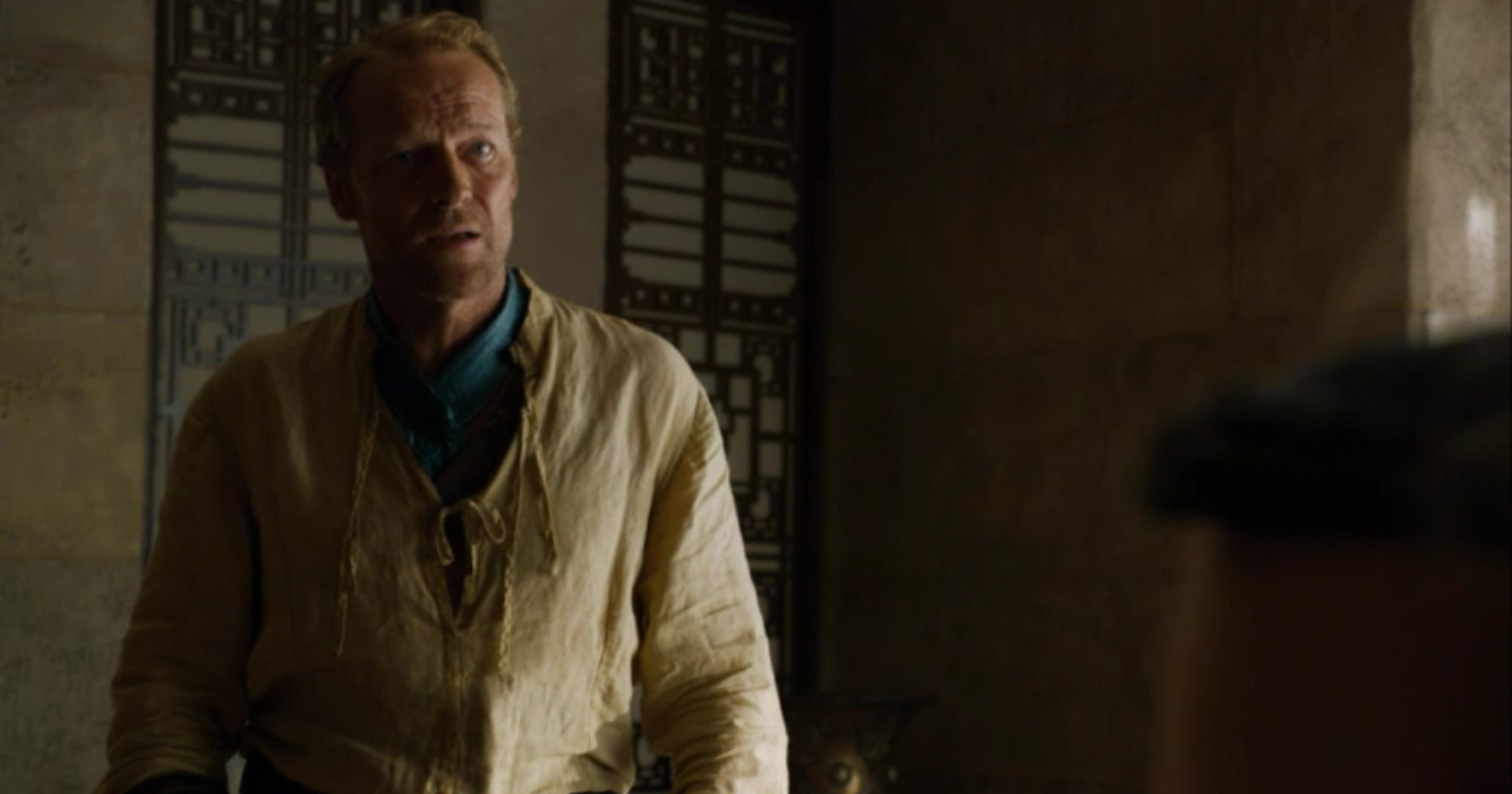
Poor Lord Friendzone.

Poor Lord Friendzone.

In this case, at first Daenerys seems to have learned nothing from Loraq’s visit in the last episode, telling her about how ill-gotten her attempt was to free the slaves of Meereen, and that she’d hurt his father, who was a master but a fair one who tried to get others to treat their slaves fairly. (To which Dany never asked, “But did your father pay his slaves?” If only to have the guy look around and say, “Uhhhhh… oh look over there!” and then run away.) She tells Jorah that she’s sending the Second Sons to Yunkai to slaughter all the masters and free the slaves again. Jorah argues for moderation, she says she wants an end to slavery and will do whatever it takes to get it. However, she tells him, she’s going to send Loraq as an ambassador so he can tell them that “they can live in my new world or they can die in their old one.”

Can this work? We’ve seen what Daenerys has done in Yunkai, Astapor, and Meereen, and word travels quickly in Westeros. Her name will be known far and wide if it isn’t already, and it’s one thing to free the slaves in Yunkai, leave, and have the masters try to restore order even worse than it was before, but it’s quite another to go back to Yunkai, remind everyone who’s boss, slaughter all the masters, and once again free the slaves by showing them someone is looking out for her. Jorah tries to advise her on moderation, and on the one hand he’s absolutely right: the world is not black and white, and there are even slaves who are terrible people, and masters who are good and righteous, but Daenerys isn’t looking to deal with individual will here. As far as she’s concerned there is a world with slavery, and a world without it. Sacrifices have to be made, and if a few good men die along the way to eradicating slavery, so be it: the greater good will endure.

And last but certainly not least we come to the Eyrie, a place of sexual frustration if ever there was one. First we have the exchange between Sansa and her super-creepy cousin, who asks her what kind of a place Winterfell could possibly have been if it didn’t have a moondoor that made people fly, and then Littlefinger reveals the intentions he has on Sansa that we kind of saw coming, and then there’s that spectacular ending.

I will leave the final discussion on this to you, my friend, and will just say that A) I thought the scene between Sansa and Robin was a dream at first because who the hell can pack snow that perfectly (???!!!), B) Sansa’s hair is an even more remarkably red than I thought it was, and C) what I love most about this season is that we’re not having to suffer through a lot of good people dying, but instead we’re getting some true karma here. Although, for as weird and effed-up a child as Robin is, part of me feels sorry for how he’s going to take this news. After all, he still appears to be breastfeeding. :::shudder:::


If she starts singing "Let it Go," I'm outta here.

If she starts singing “Let it Go,” I’m outta here.

Christopher: You’re quite right to observe that the lion’s share of the deaths this season have been people we won’t miss—but they’ve still been quite shocking, most of them, none more so than Lysa. And we’ve still got three episodes left, so expect that butcher’s bill to be added to.

This episode is titled for Littlefinger’s affected sigil: he wears a mockingbird, an eminently appropriate symbol for him, as they mimic the songs of other birds. Littlefinger has proven to be a master of dissembling, of being different things to different people and giving people the songs they want to hear. We see however in this episode that he is also playing the part of the cuckoo, insinuating himself into the Eyrie with Sansa as his ward and, after marrying Lysa—and thus giving himself title to the Eyrie—he disposes of her. We know from hard experience that Littlefinger is playing the long game, and for the most part he plays it utterly unsentimentally (recall his speech, re: chaos, ladder). What’s remarkable about his resurfacing this season is that he seems to be betraying genuine, deep feelings … When Sansa asks him why he really killed Joffrey, he replies “I loved your mother more than you could ever know. Given the opportunity, what do we do to those who’ve hurt the ones we love?” Sansa’s response is to smile: a moment ago when she asked the question, we could see her steeling herself, obviously ill at ease with Littlefinger, on guard. But when he characterizes his murder of Joffrey as vengeance, she allows herself a bit of complicitous satisfaction. She is still guarded, but there is a sense here that Littlefinger has said precisely the right thing. “In a better world,” he continues, “one where love can overcome strength and duty, you might have been my child.”

Engaging ick factor in 3 ... 2 ... 1 ...

Engaging ick factor in 3 … 2 … 1 …

I have previously voiced my ambivalence about the way in which the series has been portraying Littlefinger as an utterly unsentimental, utterly calculating player for whom all those around him are disposable. He has that dimension in the novels, to be certain, but there was always visible a minute chink in that armour where Catelyn was concerned, as well as his past humiliations. That has largely been absent until now, and the Littlefinger we see in this episode proves to be far more complex than he has let on.

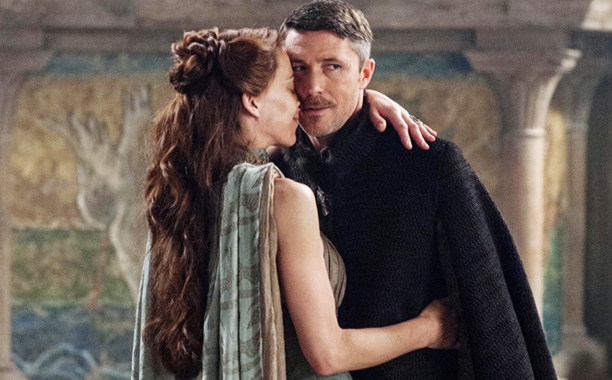
None of which is to suggest he isn’t being supremely creepy here. I’m not sure what’s more disturbing—the prospect that everything he has done has been all one big long con of almost algorithmic precision, or that it all proceeds from a perverse psychodrama in which Littlefinger has decided to resolve his past hurts by replacing Catelyn with Sansa. “But we don’t live in that world,” he tells Sansa. “You’re more beautiful than she ever was.” And he kisses her while audiences the world around squirm uncomfortably in their seats … and Lysa witnesses it.

What I like about Littlefinger in this episode is that he manages to be at once sympathetic and creepy, heartfelt and cruel. He doesn’t just shove Lysa out the Moon Door, he makes certain she knows she’s been terribly deceived. “I have only loved one woman,” he assures her, “only one, my entire life,” and for a brief moment she looks mollified. But of course he then stabs her metaphorically through the heart before literally killing her, giving her a terrible last thought to run through her head on the long, long way down.

On the bright side, we’ll never again have to watch her breastfeed her son.

moon-door

Well, that brings us to the end of another episode. Three more to go! As always happens, this season is flying by. So on behalf of Nikki Stafford and myself, have a wonderful week of anticipation.

Spoilers?

Spoilers?

Leave a comment

Filed under Game of Thrones, television

Game of Thrones 4.06: The Laws of Gods and Men

GameOfThrones_Teaser02_Screencap10

Well, if Peter Dinklage’s rant at the end of this episode wasn’t Emmy bait, I don’t know what is …

Hello and welcome once again to the Great Chris and Nikki Game of Thrones co-blog! I am your host, Christopher Lockett (Lord of the Pulled Pork, Keeper of the Sacred Clarence, Pretender to the Heisenberg Goatee), and I am yet again joined by Her Ladyship Nikki Stafford (Queen of the Buffy Rewatch, Most Prolific High Priestess of TV Posting, Scourge of Sparkly Vampires Everywhere).

But what I am prattling on about? To the episode!

Fun fact: the line from Julius Caesar "He doth bestride the narrow world like a colossus!" scans precisely the same as Darth Vader's line "You are part of the rebel alliance and a traitor!" Seriously, try it.

Fun fact: the line from Julius Caesar “He doth bestride the narrow world like a colossus!” scans precisely the same as Darth Vader’s line “You are part of the rebel alliance and a traitor!” Seriously, try it.


Christopher: Judging from a lot of the discussions I’ve been reading, the writers are making fans of the books increasingly nervous with this season’s deviations … and this episode will likely only serve to ratchet up that anxiety, given that essentially its first half comprises storylines that do not appear in the novels. I remain fairly sanguine, as I simply cannot imagine that the series will change the overarching story in any substantial ways. These narrative doglegs are interesting, however, for the simple question of how the writers will get us back on track. Certain things have to happen, and some of these departures make me wonder just how the writers will unknot the threads down the line.

Sorry to be cryptic, but that’s about as spoilery as I’m comfortable getting.

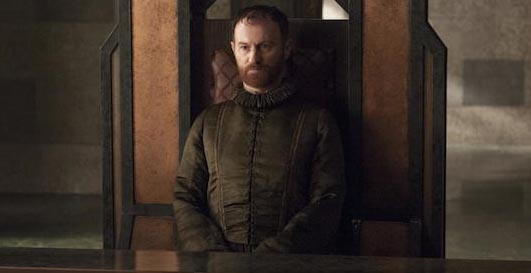
Let’s talk first about Stannis’ visit to the Iron Bank of Braavos, but before I say anything about that I need a little moment to geek out about seeing Braavos appear in the opening credits. This city is one of GRRM’s most intriguing inventions, modeled on late medieval Venice, and about as close to an egalitarian society as one is able to find in that world. Like Venice was in its heyday, Braavos is a hub of commerce, a city run not by hereditary nobility but by its moneymen and merchantmen. And we meet the most powerful of the former. Stannis and Davos cool their heels in an impressively austere room while Stannis paces and complains about being made to wait. Davos is more patient, observing that this is the Braavos way, and starts to relate a story of his smuggling past … and stops, presumably thinking that it might not be the time to remind his king that he used to be a criminal. And then the doors open and in walks … MYCROFT HOLMES! My, but that fellow does get around in the corridors of power. (If only Tyrion could have hired his brother later in this episode).

One does not simply borrow money from Mycroft.

One does not simply borrow money from Mycroft.

As mentioned, this entire sequence does not appear in the novels. Stannis does ultimately have dealings with the Iron Bank, but that comes much later, under rather different circumstances. I find it interesting that the series is choosing to make the Iron Bank more prominent: not just because they’re having a major plot point pivot on whether or not Stannis will get bankrolled and hence have the resources to renew his war with the Lannisters, but because they’re emphasizing that crucial aspect of GRRM’s writing I mentioned last week: the pragmatic logistical component. Stannis is a man of unwavering principle, but his legal claim on the Iron Throne holds absolutely no water for the bankers (something Stannis should have understood in the first place when Mycroft bluntly dismissed the title of “lord,” and then further repeated all of Stannis’ titles back to him in a bored voice). He points out the fact that patrilineal right has counted for little in Westeros’ history, that its history books are littered with such words as “usurper,” and that the question of who is the rightful king is always open to interpretation. “Here our books are full of numbers,” he tells Stannis. “Much less open to interpretation.” And again, the question of logistics: he makes Davos list all of Stannis’ forces and resources, which amounts to a whole lot of not very much. “You can see why these numbers don’t add up to a happy ending.”

I like that it was Davos who convinced them—Davos, the pragmatic man, who points out in no uncertain terms why the Bank’s current arrangement with King’s Landing is a losing bet: Tywin is rock-steady and reliable, yes, but he is also old (sixty-seven, apparently), and he is the only stable presence there: Tommen is just a boy, Cersei is crazy, Tyrion’s on trial for killing Joffrey, and Jaime is a king-killer.

I love this bit, even if it does feel a little disingenuous—one has to assume that Mycroft has already worked all this out for himself. Then again, it may be that he’s just taking the measure of this would-be king. A bird in the hand, after all … Tywin might be a thin thread to hang the bank’s investment on, but until Davos’ impassioned speech, he has no reason to think Stannis is anything more than just another usurper. And Davos speaks Mycroft’s language in terms of payment and debt, showing him his mutilated hand, his punishment for years of smuggling as the price for entering Stannis’ service. A Lannister may always pay his debts, but as we gleaned from Jaime’s discussion with his father, Lannisters are as dwindling a resource as their gold.

After Davos re-hires Salador Saan, we cut to Yara’s raiding party, as she reads Ramsay’s letter to her crew and riles them up. This raid on the Dreadfort is odd on two fronts: one, it’s geographically problematic; and two, it is a complete deviation from the books. What did you make of Yara’s abortive attempt to rescues Theon?

I found myself wondering whether Ramsay had sustained those wounds on the way to the dungeon, or whether he got them from having sex. Then I decided I didn't want to know.

I found myself wondering whether Ramsay had sustained those wounds on the way to the dungeon, or whether he got them from having sex. Then I decided I didn’t want to know.

Nikki: I too loved it when the doors opened and freakin’ Mark Gatiss strode in. I’m sure there was a huge audience of cult TV that squeed in that particular moment. He played it so straight, never wavering from that pasted-on smile until Davos began challenging him, and then we saw that confidence begin to waver. I, too, was thrilled with that scene (Stannis never would have been the one to say anything to convince him; that guy seems to be trapped in an arrested development where he requires everyone around him to do and say everything on his behalf) but it was brilliant.

And yes also on Braavos making it into the opening credits model. Just as my husband moaned, “Does this 28-minute opening sequence ever CHANGE?!” they showed it and I sat right up and exclaimed, “Ooh!! New city!! Ooh!! Back it up!! Big statue!!” Fantastic.

The Theon “rescue” sequence was heartbreaking. As Yara climbs back into the boat after failing to capture Theon, she bluntly says, “My brother’s dead,” and we know that’s the story she’ll take back to the Iron Islands and her father.

And the sad thing is, she’s absolutely right. Theon is dead. Now we have Reek, a quivering, shivering, shadow of his former self, who thought his sister was nothing more than another trick by Ramsay to make him think he was about to be rescued, rather than his actual rescue party. Yara’s departure means there’s no more rescue coming for him, and Reek’s complacency and actions in that moment solidified that he was 100% Ramsay’s puppet. As viewers, we internally beg Reek to go with Yara, to just be Theon again and run away rather than hinder the rescue mission. And yet… the writers oh so cleverly pull us in on the whole ruse in the following scene, when Ramsay tells him he’s drawn a hot bath for him and wants him to get in. Now we’re right there with Reek, shouting no, no, don’t get in there, he will drown you. And just as Ramsay has brainwashed Reek, he’s brainwashed all of us. He doesn’t do anything at all to Reek when he climbs into the tub; he simply begins washing him. Notice how Reek grabs the edges of the tub, almost to brace himself for the expectation that Ramsay will try to dunk his head under the water. Notice also the sadistic smile that creeps over Ramsay’s face when Reek drops his britches and one can only imagine the scarred, mutilated absence between Reek’s legs that Ramsay stares at. Now that Ramsay has his total loyalty, he tells him it’s time for Reek to pretend to be someone he’s not: Theon Greyjoy.

I thought the cutaway here to the Daenerys story was utterly brilliant. As I’ve been saying on here for a few weeks now, Daenerys (my girl, always my girl, please don’t take any offense to what I’m about to say oh First of Your Name, Mother of Dragons) has been “freeing” the slaves and punishing the slavemasters, but that opens up a whole new host of problems. Last week Ser Jorah told her that in Astapor and Yunkai she’s left more of a mess behind than perhaps was there to begin with AND she took the city’s armies from them, so now they’re utterly defenseless. She pulls the slaves on side and makes them love her, but it’s only so they’ll follow her into battle where most of them will be slaughtered. She expects their love and loyalty, but she’s freed them from one master only to control them herself. Cutting away from Theon’s story — where Theon has been beaten into submission, to the point where he now loves Ramsay, who seems to be freeing him from the life of torture he’d received from . . . Ramsay — reminds us that Daenerys frees them from one hell only to plunge many of them into another.

In this episode we see that the dragons are roaming the countrysides and fields, looking for herds of goats that they first barbecue and then eat. The goatherder approaches Daenerys on her throne and tells her what they’ve done, and she promises him three times what the goats are worth, and he backs away happily, grateful for his queen. (Did anyone else think that was his son’s bones in that blanket? When he first opened it I was horrified until I realized he was saying that was one of the goats. Apparently I didn’t notice the giant HORNS when I watched it the first time.) Daenerys looks thrilled that she’s made someone happy, and excitedly calls in the next supplicant. And… yeah, it’s not as happy as the first one. This guy is the son of one of the masters whom she had crucified (against Ser Barristan and Ser Jorah’s advice) and now she realizes the world isn’t black and white, with slaveowners being bad and slaves all being good: sometimes the slaveowners are good people, who fought against cruelty to the slaves, who treated the slaves well. In attacking the city and doing what she did, she looks like a despot who is forcing the people to trade one cruel monarchy for another. We know Daenerys wants the best for people, wants to be loved, and cares about her people, which sets her apart from other rulers, but this job ain’t as easy as she thought it was going to be.

What did you think of the Daenerys scene, Chris?

daenerys_throne

“The last time I was in Mereen and I saw someone putting herself above everyone … we disagreed.”

Christopher: I thought it was very well done, and unlike much of this episode, more or less hewed to the novel (more or less—there were a few deviations, but it got the gist of things). Dany has placed herself in a difficult spot, insofar as that she wants to be a liberator, but in order to do so, she has to be a conqueror too. And she faces a quandary we see through much of history: in liberating one segment of a population, it is necessary to overturn the customs and structures of another, and however much the revolution might be guided by moral imperatives, chaos and injustice are inevitable. In the case of something like slavery, there are no neat solutions, as the institution of slavery itself deforms a society in myriad pernicious ways.

One of the things that is admirable about A Song of Ice and Fire is that GRRM doesn’t shy from this basic fact, but places it front and center. There is a lot in the depiction of Daenerys’ “liberation” of the slave cities that is cringeworthy—first and foremost being the image of an extremely white person playing magnanimous saviour to pitiable people of colour (the final shot from last year’s season finale exemplifies this)—but on the level of storytelling, the degree to which the entire process is shown to be fraught is well done. Hizdahr zo Loraq’s entreaty reminds us of the grey areas, that not everyone is as deserving of punishment as others. On the other hand, I wanted Daenerys to remind him that, whatever his father’s opposition to the crucifixions, he was still complicit in the institution of slavery. The defense “well, I didn’t want to go as far as the others did” isn’t really a viable one when it comes to war crimes.

The fates of Astapor and Yunkai are also poignant for us because they resonate with so much of what has happened in the past hundred years in terms of the legacies of colonialism and wars of choice like Iraq. Daenerys’ blithe assumption that those cities would become peaceable simply because she ousted their tyrants and liberated the oppressed reminds me of nothing more than the neocons’ naïve belief that all you have to do is overthrow a dictator and say “you’re a democracy now,” and suddenly there will be a Starbucks on every corner (yes, I’m oversimplifying). But to her credit, Dany at least recognizes her mistakes and attempts to come to grips with them. Will she succeed? I actually can’t say, because GRRM hasn’t gotten that far in the novels. But I don’t think it’s a spoiler to say that things get much, much worse in Mereen before they gat better.

The cut-aways in this episode are quite good: from Ramsay to Daenerys, and from Daenerys’ struggles ruling to a meeting of the Small Council, with Oberyn taking up his new position there. His presence, as Tywin intended, is symbolic of the Seven Kingdoms finally resuming something resembling equilibrium … but for how long? The obvious antipathy between Mace Tyrell and Oberyn reminds us of long-standing feuds, and Oberyn’s own vendetta against the Mountain sneaks in with the mention of the Mountain’s brother. And of course we hear tell of a new threat—Daenerys and her army and dragons. There is a palpable anxiety in the room when she is mentioned, in spite of Tywin’s attempt to dismiss her with the oddly (for him) naïve comment that dragons have not been a factor in war for three hundred years. Really, Tywin? What, do you think she’ll arrive on the shores of Westeros and the people will collectively say, “Oh, dragons are SO three centuries ago”? It’s tempting to think of that line as a stumble, but I’m more inclined to think of it as a betrayal of Tywin’s actual nervousness. After all, if “that Targaryen girl” does in fact return, Tywin Lannister becomes public enemy number one. He’s trying to reassure his people … but he’s also trying to reassure himself. And am I alone in sensing a little bit of goading glee in Oberyn when he tells everyone just how formidable the Unsullied are?

Oberyn is more and more becoming an intriguing character. Obviously Tyrion’s trial is the most spectacular part of this episode, but I loved the little exchange between Oberyn and Varys. It was very reminiscent, deliberately so, of Varys’ verbal fencing with Littlefinger. But where Baelish and Varys were politely implacable enemies, we don’t entirely know Oberyn’s intentions … and he doesn’t know Varys’, as we see in his somewhat clumsy attempt to feel him out. It is made very clear just why Varys is such a formidable player: like Littlefinger, Oberyn is ruled by desire. Where Littlefinger’s is focused, Oberyn’s are more diffuse and hedonistic; but in both cases, neither person can quite understand Varys, who is not ruled by his passions.

Oberyn: Everyone is interested in something.
Varys: Not me. When I see what desire does to people, what it’s done to this country, I am very glad to have no part in it. Besides, the absence of desire leaves one free to pursue other things.
Oberyn: Such as?
Varys: [looks significantly at the Iron Throne]

This exchange is wonderfully cryptic. He is after the throne itself? Isn’t that a direct contradiction of what he has just said? Or is there another, subtler meaning in that look?

What do you think, Nikki?

Oberyn_and_Varys_throne_room

Nikki: One thing I love about doing these back and forth discussions with you is that almost every week, we write down exactly the same dialogue exchanges to be used later. The Varys/Oberyn (I can’t help but think of them as Dr. Evil and Mr. Sofia Vergara now… thank you Gay of Thrones) one I have written down word for word in my notes, just as you did. I, too, am intrigued by Oberyn and think he’s the best addition to the cast this year. He’s someone with his own ideas, who, like Tyrion at the beginning of season one, chases his passions and often gives the finger to political behind-the-scenes wheeling and dealing that everyone else takes so seriously. For Oberyn, life is about joy and passion; he’ll sit on the Small Council and seems happy to do so, but only for him to get an inside view of the goings-on, and then toss out a bon mot or three (my favourite in this episode being when he comments that the Unsullied are powerful on the battlefield, not so much in the bedroom, ha!).

The scene between the two of them sizzles because every time we learn the tiniest little tidbit of Varys’s past life, it feels significant. Here he keeps his hands hidden inside his sleeves as always, and occasionally gives a little nod or quiet word to either affirm or deny Oberyn’s leading questions. But that nod to the throne at the end… wow. It certainly looked like he was admitting he was the dark horse who’d lately thrown his hat in the ring, but we know he’s been playing it all along. But does he actually want to sit on the throne, or be the trusted advisor to the one sitting on the throne? The line “the absence of desire leaves one free to pursue other things” is such a loaded one. Could he be referring to Tyrion: with Shae out of the way and stuck in a loveless marriage, there’s no passion or desire in his way. Or Jaime Lannister, who, post–rape scene, seems to have lost all desire for Cersei? Or does he mean himself? While everyone else is giving in to the very passion that Oberyn deems significant — including Lord Baelish, who despite his cunning, is still ruled by his unrequited love for Catelyn — Varys just slowly and quietly keeps his eye on the prize. The question is, what prize, exactly? And for whom?

He’s not the only one with his eye on the prize, however. Tywin holds many keys in this episode, and while he certainly shows his vulnerability in the Small Council scene when he waves off the dragons like they’re not important, as you pointed out, he’s back in charge when Jaime comes to him to plead for Tyrion’s life. In that scene Jaime comes storming in and thinks he’s trying to strong-arm his dad into a bargain: you let Tyrion go, I’ll step down from the Kingsguard, marry, and have children that will carry on the Lannister name. He thought that was his initial offer and that a negotiation would ensue, until Tywin triumphantly pronounces, “DONE!” and stops Jaime in his tracks. Jaime stepping down from the Kingsguard, Tyrion being banished to the Wall never to be seen again, and the Lannister name being carried on through the most viable genetic line Tywin had? Exactly what Tywin’s wanted all along. How much of this entire trial was simply a means for Tywin to get what he wanted?

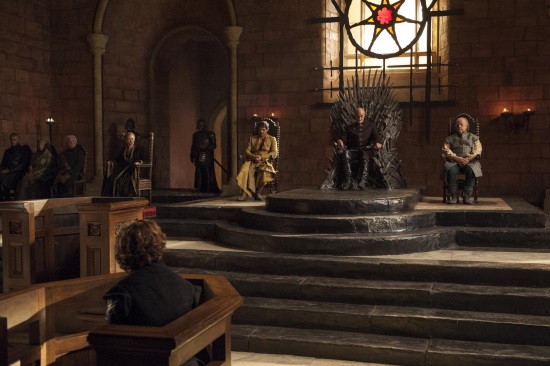
The trial (hilariously sent up as The People’s Court in this week’s Gay of Thrones) is definitely the highlight of the episode, for sure, and one of the highlights of the entire series thus far, but it’s split up: we have the initial scene of Jaime walking Tyrion to the “courtroom” in handcuffs as per Tywin’s orders, with Tyrion announcing loudly, “Well . . . we mustn’t disappoint Father!” Note how when they’re walking down the aisle, someone defiantly shouts, “Kingslayer!” from the crowd. We assume the disdain in that person’s voice means the insult was being thrown at Tyrion, but notice the irony that it used to be the compliment they paid to Jaime Lannister. I guess whether Kingslayer is a good or bad word depends entirely on which king it was that you slayed.

In this scene, we get a parade of untrustworthy people lying through their teeth about Tyrion’s guilt, which is brilliantly played out as Tyrion sits small in the prisoner’s dock, the top of his head barely showing above the rail, listening to these people while not being able to defend himself. What did you think of Tywin’s control over the trial and Jaime in that scene I mentioned? Or the group of people who come out in the trial and what they said? How much of what they said do you think was directed by Tywin, or are they all speaking of their own volition?

tyrion_trial02

Christopher: A little from column A, and a little from column B … As I mentioned before, though much of this episode departs from the novels, the trial unfolds practically word for word. And I should correct you on a specific point: the only person who actually lies outright is Shae. Everyone else more or less tells the truth, but tells it in such a way that puts Tyrion in the worst light possible. One interesting deviation from the novels is Pycelle producing Sansa’s necklace and declaring that the missing stone had left “traces” of the poison used to kill Joffrey (in my notes I’ve written “C.S.I.: King’s Landing”). I remember thinking, back when Littlefinger drops the necklace onto Dontos’ corpse, “Aren’t you worried that it will be found when the boat drifts ashore?” (in the novel, they burn Dontos and his boat to destroy the evidence). But on reflection I thought of course Littlefinger wants that damning evidence to make its way back to King’s Landing—so much the better for him to strengthen his hold over Sansa, to make her appear more unequivocally guilty (not that Cersei et al really need more evidence).

The most heartbreaking witness (besides Shae, of course) is Varys, who relates precisely Tyrion’s words to Joffrey after news of Robb Stark’s death, but then also colours his testimony with a little speculation, musing that perhaps Tyrion’s marriage to Sansa had made him sympathetic to the North. That, for me, is always such a painful moment (in the novel as well), specifically because of what Tyrion reminds Varys of—that Varys had been Tyrion’s friend and had thanked him for saving the city. But Varys is in no position to aid Tyrion, as he’s already warned him … whatever power he wields is tenuous, and in spite of his seemingly omniscient capacity to obtain intelligence, he cannot openly thwart powerful people. And so he will have to play Tywin’s game. None of which makes his testimony less damning or less painful for Tyrion, which prompts his question and Varys’ response—neither of which, I should note, are in the books. “Have you forgotten?” he demands. Varys’ answer is as hauntingly cryptic as his earlier discussion with Oberyn: “Sadly, my lord, I never forget a thing.”

How amazing is Conleth Hill in this role? As I’ve observed before, he’s nothing like the Varys of the novels except for his baldness. Oberyn could be excused for making assumptions about the sexual preferences of the novels’ Varys, who plays the part of a simpering, mincing, effeminate castrato. Conleth Hill’s Varys possesses a quiet dignity. I don’t know which version is better: the powdered, fluting Varys, it becomes apparent in the novels, is merely a performance, one mask worn by a master of disguise. We have not yet seen any chameleon-esque tendencies in Hill’s Varys, but that implacable equilibrium he radiates makes him such a compelling character—especially when displayed in contrast to the histrionics of those around him.

And then we cut to Tywin and Jaime, and it is a scene that, as you say Nikki, makes one wonder just how subtle Tywin is. Even given how much he hates Tyrion and is shamed by his very existence, it seems unlikely that Tywin would be so eager to see his flesh and blood executed for treason. And yet, that is precisely how the trial appears to be weighted: the deck has been stacked very neatly against him, and every avenue Tyrion might take in his own defense blocked. There seems no chance whatsoever of a not guilty verdict. And so Jaime pleads with his father for a way out, a chance for Tyrion to take the black. As you say, Nikki, Jaime presents his offer of leaving the Kingsguard and returning to Casterly Rock as the opening move in negotiations and is caught flat-footed by Tywin’s immediate acceptance. How much of the trial has been orchestrated by Tywin to arrive at this very resolution? It’s win-win-win for Tywin: the troublesome Joffrey replaced by the malleable Tommen, his despised son humiliated but not dead, exiled to the Wall, and his beloved son brought back into the fold to make a new generation of golden-haired Lannisters. Is he really that clever?

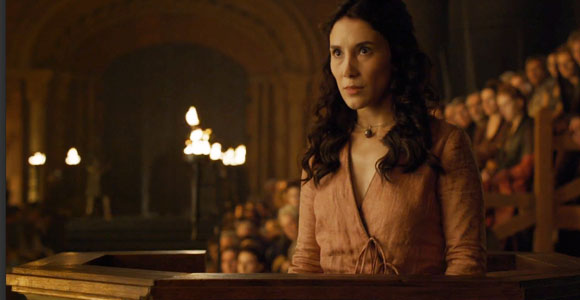
Perhaps not. Perhaps he then overplays his hand. Shae’s testimony is the most damning and the most mendacious, and that which most hurts Tyrion, provoking him to reject the whispered deal about taking the black and demanding trial by combat. There is little doubt that, even without Shae’s “evidence,” Tyrion is doomed. Shae is there to put the final nail in the coffin. Which makes me wonder: at whose behest is she betraying her erstwhile lover? Who brought her back? Did she return of her own accord to revenge herself on Tyrion’s final words? Was she captured, and gives this false testimony in exchange for her life? If so, who put those words in her mouth? Tywin? Is Tyrion’s father doing this to make a perverse point about his whoring? Or is it Cersei’s doing, making absolutely certain that her hated brother dies?

What do you think, Nikki?

Shae_dock

Nikki: When the doors opened and Shae walked in, my husband gasped loudly and my hands flew to my mouth, and I moaned, “Nooooo… not Shae!” It was an absolutely devastating moment, and the look on Tyrion’s face speaks volumes. Until then he’d become resigned to whom he was, what was happening to him, and just hoped that Jaime would come through for him. And then… Shae walked in.

You are absolutely correct that the people who come before Shae aren’t outwardly lying; when I said they were all lying about his guilt, I meant exactly that: they’ve taken his words out of context and suggested they were precursors to a murder he didn’t commit. They weren’t lying, but they were providing a misdirection by way of context. Tyrion took the poisons that Pycelle accuses him of, but that was to save the city during the Battle of Blackwater. Cersei quotes him out of context, as does Varys, and the soldier at the very beginning. All of their witness statements add up to a murderer proclaiming what he’s about to do . . . except the context in which each of those statements was uttered, of course.

But Shae . . . ugh. That was just so heartbreaking and painful, and I asked all the same questions you did. The day before the wedding, Shae is serving everyone at the dinner where Joffrey is given the sword, and Tyrion overhears Cersei telling Tywin that Shae is the whore she’d told him about. It’s in that very moment he decides he must save her life and send her away, but to do so he destroys her soul, making her despise him by calling her a whore and telling her she didn’t mean anything to him. I still think Dinklage’s performance in that scene is extraordinary: it’s one of the only times we ever see Tyrion outright lie about something, and every word that comes out of his mouth pierces his own heart even deeper than it pierces Shae’s. His voice cracks and is almost a growl by the end of the scene, and his face is screwed up with sorrow, which she takes to be disgust.

And now, days (weeks?) later, we see that he succeeded: she hates him. Varys whisked her away to another life, and now she’s back to exact her revenge. She never believed him when he told her exactly what they’d do to her if they found out she was his lover, yet she clearly believed every verbal dagger that spewed forth from his mouth in that terrible scene. To me, Varys is clearly at the bottom of this: he’s the only one who knew where Shae had gone to. And when he steps down from delivering his testimony and Tyrion asks him to recall that they were friends, he drops his head and says, “Sadly, my lord, I never forget a thing.” And clearly, he’s remembered Shae, where she went, and that by turning her over to Tywin and Cersei, he makes sure he gets more brownie points than ever before.

Was Tywin behind it? Cersei? They could have been in collusion to get her back, but I don’t think Tywin colludes with anyone, and I think Cersei’s been too drunk and in mourning to have actually gotten her act together to have created this conspiracy. I think it was Tywin, working with Varys to get her back.

Regardless of who did it (it was totally Tywin), the impact it has on Tyrion is immediate and horrifying. As her web of lies becomes more and more complicated, and eventually devolves into sordid lies about their sexual acts (which is where Oberyn sits up and starts becoming interested), Tyrion is not only feared and hated, but mocked. He becomes the laughing stock of the courtroom, and if he wasn’t already tiny inside that prisoner’s dock, he shrinks further in this moment. “Shae . . .” he finally says. “Please, don’t.” It’s the only time he begs, the only time he asks for someone to stop torturing him. He stood silent and in shock as Cersei pointed at him at the Purple Wedding and was walked away. He told Jaime and anyone who would visit him that he was innocent, but he never rattled his jail cell bars or screamed his innocence to passersby. He strode into the courtroom, silent, and never yelled, “THIS IS NOT TRUE” when people took the witness stand. But now, quietly, he begs her to stop lying, to stop breaking his heart.

But she’s only doing what he’d done to her. Lying to break his heart, to make him hate her the way he made her hate him. The difference is, he was trying to save his life, and Shae is trying to have him killed. “I am a whore, remember?” she fires back at him. And that’s when he realizes that despite Shae’s betrayal, despite his father’s machinations to get him into this very spot, despite his sister’s coldness and failure to see the truth, despite his innocence… he was the master of his own downfall. For he really DID say the things Cersei said he did. He DID take the poisons out of Pycelle’s store, even if it wasn’t for this and was ages ago. He DID call Shae a whore and turned her against him. He DID regularly use prostitutes and drink himself senseless and was everything his father ever accused him of being.

And it’s in that moment that he suddenly rises up. At first quietly, then in a booming voice, he says that he wishes to confess. “I am guilty,” he pronounces. “I’m guilty of being a dwarf. I’ve been on trial for it my entire life.” Jaime looks shattered, Shae looks like she has second thoughts about what she just did, Cersei remains stone-faced, and Tywin simply looks satisfied. As you said, Chris, he can’t have his son executed for treason, because while he wouldn’t care about losing the son, he wouldn’t want the blot on the family name. Instead he can send him to his certain death on the Wall. But… might Tyrion think he’d somehow won if he didn’t execute him? Hm… can’t have that. So… let’s destroy him from the inside. Tyrion’s outburst at the end of this episode is exactly what Tywin wanted: proof that he has triumphed over the son who was always too smart for his own good.

As Tyrion digs his hole deeper, turning to the disparaging and naïve citizens of King’s Landing, he tells them that he wishes he’d had the guts to kill King Joffrey, that he wishes he’d had enough poison to take out the whole lot of them. Amongst the gasps and oohs and aahs and chatter that rises up from the courtroom, you just see the look of quiet glee on Tywin’s face. And finally, to everyone’s surprise, he turns back to his father and tells him that he’s done with this, and demands a trial by combat. Cut to Jaime and that, “Oh… right” look on his face. Remember when you told Tyrion just a few episodes ago that if you’d been at the Eyrie you would have been his champion? Looks like you’re about to get called out on that.

I am positively giddy about the next episode. The ending of this was SO spectacular, so upsetting when it cut to credits (my “NOOOOOOO!!!” was heard throughout the neighbourhood) I just can’t wait until next week.

Near the beginning of the first book in the series, we are introduced to Tyrion Lannister when he has a conversation with Jon Snow about who has it worse: the dwarf or the bastard. And this is what GRRM writes:

[Tyrion] favored Jon with a rueful grin. “Remember this, boy. All dwarfs may be bastards, yet not all bastards need be dwarfs.” And with that he turned and sauntered back into the feast, whistling a tune. When he opened the door, the light from within threw his shadow clear across the yard, and for just a moment Tyrion Lannister stood tall as a king.

In this scene Tyrion once again stands tall, but makes himself the most hated man in King’s Landing. I mean, things can only get better from here, right? 😉

Leave a comment

Filed under Game of Thrones, television

Game of Thrones 4.05: First of His Name

GameOfThrones_Teaser02_Screencap10Hello again, everyone, and welcome once again to the great Chris & Nikki co-blog, wherein we gab about the most recent episode of Game of Thrones. This week’s was pretty impressive—I’d place it among the best episodes of the show so far. So much to love: Tommen is crowned, Cersei arrives at an apparent détente with Margaery, Arya learns a harsh lesson about swordcraft, Daenerys enters the queen-in-training program (Mereen campus), Sansa has some thoughts about frying pans and fires, and the Brienne-and-Jaime buddy comedy gets a spinoff.

And of course, one or two things happen north of the Wall.

But I’m getting ahead of ourselves. What shall we start with, Nikki?

sansa

This image feels as though it should be projected from the belly of a droid.


Nikki: So let’s start in the Eyrie, that place with the creepy Lysa and her much creepier son, Robin. We haven’t seen these people since season 1, when Robin urged his mother to send Tyrion flying through the moon door. Baelish told Sansa they were heading there, and I watched their entrance with one eye closed because I thought, oh my god, if she’s still breastfeeding that kid I’m switching over to Mad Men. She wasn’t . . . but he wasn’t far from her breast. And he’s even loopier than he was when he was younger: when he wasn’t dancing around Sansa and asking her if it was true that her family was slaughtered, he was taking Baelish’s precious gift of a glass bird (transported all the way from Westeros and up the mountains of the Eyrie without breaking it) and just flings it through the moon door to show them, you know, what he means when he refers to the moon door. (Note to Robin: next time, JUST POINT.)

But we can’t really blame the kid for being more than a little off; look at his mother, after all. She tells Sansa about how Catelyn used to eat so many sweets she was making herself fat (as she’s pushing the same sweets into Sansa’s mouth), then hints at the story of Catelyn being so drawn to Brandon Stark that he forced Baelish into a duel that almost killed Littlefinger (a story from Book 1), then pushes down on Sansa’s rings, seriously hurting the girl’s hands and scaring her by suggesting she’s a whore who’s trying to seduce Lord Baelish before taking her to her breast and whispering “there, there,” reassuring poor Sansa that soon Tyrion will be executed and she will be free to marry Robin and become Lady of the Vale. The “DA FUH?!” look on Sansa’s face when she catches that last part is priceless.

Oh, and then there’s the snogging with Littlefinger, which I could do with never, ever seeing again, where she promises him that she will scream across the Vale when he makes love to her that night . . . a promise that she keeps, much to Sansa’s dismay. The union between Littlefinger and Lysa didn’t seem to make a lot of sense at first; of course, he’s connected to her through his love of Catelyn (if you can’t have one sister, you might as well have the other… then again, switching from Catelyn to Lysa doesn’t quite seem like switching from Brandon to Ned). And Lysa is a powerful woman still, so the marriage could be worth something. But now we discover that they’ve been connected for years, ever since Baelish convinced her to poison her husband Jon Arryn, which then orchestrated the whole Robert Baratheon goes to Winterfell/Ned becomes the Hand of the King/Ned sniffs out the bastardy issue/Robert dies/Ned dies/all hell breaks loose thing. So there’s that.

Wait… WHAT?! Baelish was behind everything?! The entire game of thrones that began with the death of Jon Arryn wasn’t, in fact, executed by Pycelles or Cersei, but Baelish? Ooh… THIS just got more interesting.

What did you think of this episode, Chris?


Um ... I hate to point this out, Lysa, but he's just not that into you.

Um … I hate to point this out, Lysa, but he’s just not that into you.

Christopher: In many ways, this has been my favourite episode so far this season. So much happened—there are an awful lot of exclamation points in my notes. One thing I think worth mentioning is that this episode flipped back and forth between storylines a lot more frequently than we’ve tended to see. The trend for a while has been spending a good chunk of time on one thread, and then moving on … but we had a lot of backing and forthing, which gave this episode somewhat more of a dynamic feel to it.

That being said, we had only one sojourn with Daenerys this go-around, and the final sequence was a long stay with Jon Snow, Bran, and Locke (though to be fair, it did switch quite frequently between their perspectives). I’ll start with Daenerys, who is now considering her options. What to do? She has proved her worth in conquering three mighty cities, amassing in the process an army large enough to challenge King’s Landing. But as Jorah reminds her, King’s Landing is one thing—the entirety of Westeros is another. And she hears disturbing news from Astapor and Yunkai: those cities she has “liberated” have reverted to old practices, old despotisms, with unseemly haste. It makes you remember Tywin’s advice to Tommen last episode: King Robert was mighty in battle, but made the mortal error of mistaking prowess in war for competence in ruling. So much of this show is about the nature of power. Daenerys has shown just how formidable she is, but at the same time just how transient her influence is. Without her actual presence, these cities have no compunction to play by her rules.

But unlike other tyrants we’ve seen—unlike King Robert, or Joffrey, or Viserys—she recognizes as much and rejects her advisors’ urgings to sail for King’s Landing. “How can I rule the Seven Kingdoms,” she asks, “when I can’t rule one city?” How indeed … and so she opts to stay in Mereen—and prove her worth as a ruler.

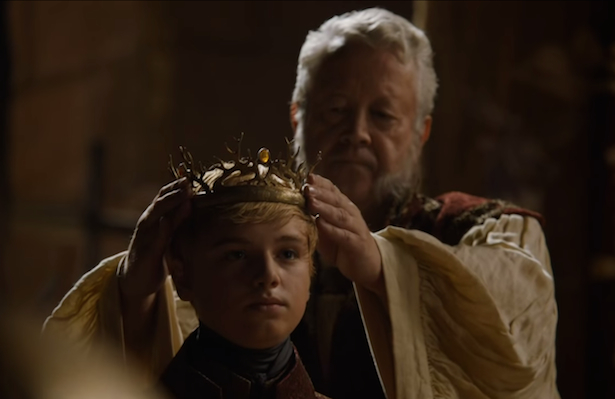
The nature of kingship (and queenship) is much on display and in debate in this episode. We begin with Tommen’s coronation—and can I say just how Christian and British that sequence is? The prevailing seven-pointed church of Westeros is an obvious analogy to Christianity, but I don’t think it’s been quite so explicit prior to this bit. But that parallel is quite significant, as it reminds us of the principle of divine right of kings. Hence, the conversation between Margaery and Cersei is, to put it mildly, somewhat loaded. Before I get into the substance of it, let me praise Natalie Dormer and Lena Headey for some extraordinarily understated acting. Anyone who had not seen the series to that point could be forgiven for thinking, “Oh, nice … they’re helping each other through their grief, and they’ll work in concert to aid Tommen.” HA! What a lovely depiction of honeyed barbs, especially on the heels of Margaery’s secret shared smiles with the new king, and Cersei’s rather pointed intrusion into her line of sight,

All of which helps to highlight the series’ troubling of the very notion of divine right. Margaery, looking at the diminutive Tommen on the Iron Throne, offers the saccharine platitude that “he sits the throne like he was born to it.” What I loved about this sequence was how blunt Cersei is: “But he wasn’t,” she asks, “was he?” What followed floored me: Cersei admitting, to her dead son’s bride, that her dead son was a monster. Though she doesn’t use those precise words, the meaning is plain. What an incredible moment of incommensurable conflict: the acknowledgement that Joffrey was a monster, alongside the mother’s fierce love for her first son. It’s obvious here that, though she obviously loves Tommen—who is, by all indications, a far superior human being to Joffrey—she cares far less for him than she did (does) for the wee prick.

But her admission is staggering, as is her suggestion that Tommen might be the first king in centuries who is actually good. “Who was the last decent king, I wonder?” she muses. A question to our readers: how many of you had the hair on the back of your neck stand up at that moment?

Of course, all of Cersei’s seeming commiseration with Margaery (not that we believed it) was belied by her conversation with her father. What did you think of that scene, Nikki?

tommenGoTFEAT

What odds Tommen is thinking about how the last three people who sat on this throne met their ends?


Nikki: This was definitely Cersei’s episode. So much so, in fact, that near the end I began to worry she was about to be killed off. (“Let’s give Lena some great scenes and then… off with her head!”) I think this season has gone a long way to making Cersei a more sympathetic character. That wine goblet is ever present, as much a constant accessory for Cersei as her rings and braided hair, showing how much she needs liquid courage just to get through her day. The conversation with Margaery was exactly what you said it was: staggering. In fact, I was so enthralled by what was happening that my note-taking ceased, and I scrambled to catch up after and had to rewatch that scene. Those two actresses are marvelous together, and as you pointed out, the moment of Cersei stepping between Tommen and Margaery as Margaery flirted from above and Tommen giggled on his throne was so powerfully symbolic.

And yet, for the first time, we got a real admission from her. Yes, as you say, the sincerity was undercut by the later discussion with Tywin, but for her to respond to Margaery’s loyalty to Joffrey with the curt, “He would have been your nightmare” was shocking. She’s gleaned what Margaery’s been up to, and so Cersei decides to take the reins rather than let Margaery get away with it: she encourages her to marry Tommen, forcing Margaery to act coy and say she’d have to ask her father, and then Cersei admits she’ll have to do the same. Of course they do: for all the power they wield, they are nothing.

And then we cut to the Tywin conversation where he confirms that the Tyrells are their “only true rivals” when it comes to resources, and they need to get them on side. The Lannisters had the gold, but it’s dried up completely and has yielded a total amount of zero gold (no ounces, pounds, or tons). Tywin admits that Robert Baratheon had created a tremendous debt now owed to the Iron Bank of Braavos (I couldn’t help but picture Gringotts). We knew this already because Tyrion pointed it out when he became Master of Coin, and it was in fact Littlefinger who did the drawing on the bank to cover up Baratheon’s massive spending and hide the mess he was making. He explains to Cersei that the weddings are necessary: despite her disgust, she must marry Renly to tie them to the Tyrells, just as Tommen must be with Margaery.

And here, once again, that theme of kingship in this episode comes to the fore: Baratheon was a terrible king who spent so much money that he’s left the kingdom in terrible debt to a bank that sounds like quite the formidable foe (“It is a temple, and we live in its shadow,” says Tywin), and now all sorts of alliances must be made with other houses that have nothing to do with military power, and everything to do with paying off old debts.

But for all of Cersei’s campaigning in this episode — first talking to Margaery, then to Tywin, and finally to Oberyn, and to each one repeating that her brother Tyrion killed Joffrey and he must pay for his actions — little does she know that the real killer is in the very House with whom she’s making these alliances.

The scene between Cersei and Oberyn further heightened my sympathies to her. I know she’s conniving, but just as she explained her love of Joffrey to Margaery — “You never love anything in the world the way you love your first child, no matter what they do” — her love for her other children is deep, too. She was devastated when they shipped Myrcella off to Dorne, and she goes to Oberyn to ask if he’s seen her. He tells of her laughing and playing in the water with his daughters and loving life, which, given the hellhole that Westeros has become, is like a dreamworld in comparison. (Is it possible he’s lying, or can we hold on to the hope that he’s telling the truth?) She asks him, “What good is power when you cannot save the ones you love?” When we first met Cersei, she was trapped in a loveless marriage but finding solace with Jaime; she had her children around her, Tyrion was in his place, Jaime was by her side, Robert was off fondling other women and barely noticing her existence, and her son was going to take over as king. Even then, she was an unhappy woman because of the alliance made to Robert, who made her life a constant misery. But now her father barely tolerates her, Jaime hates her and he disgusts her, her beloved first child is dead, and her daughter has been shipped elsewhere. As I said in last week’s recap, the women on Game of Thrones often have the look of power, but very little of it is actually theirs to wield, which is not the show necessarily being sexist, but providing an example of the sad reality around us every day. I literally gasped at the beauty and harshness of the next line Cersei uttered:

Oberyn: They don’t hurt little girls in Dorne.
Cersei: Everywhere in the world, they hurt little girls.

Cersei might be cold, calculating, and lack empathy, but in this episode we are reminded of how she was turned into that person: she has been used as a pawn her entire life, and everything she’s ever loved has been taken from her.

And similarly, everyone that Arya has ever loved has been seemingly taken from her. In this episode, we see her recite her list once again before sleep, and the final name (which I knew was coming all along) adds an extra punch. Everywhere in the world, they indeed hurt little girls. But not all little girls know how to wield a sword.


Yeah. This is a GOOD idea.

Yeah. This is a GOOD idea.

Christopher: Not all little girls wield a sword, it is true, but Arya’s showdown with the Hound reminds her (and us) of the great chasm between theory and practice. Arya is like a kid who thinks he can fight because he’s got his brown belt in karate, and proceeds to get his ass handed to him when he provokes someone who actually has experience fighting. The Hound’s amusement in this scene is brilliant.

Arya: No one’s going to kill me.
Hound: They will if you nance around like that.

Also brilliant is the utter contempt in his voice when Arya tells him Syrio was killed by Meryn Trant. We of course saw what happened, and we know that a fake sword is no match for actual steel and plate armour—no matter how brilliant the swordsman—and we further know that Syrio sacrificed himself to spare Arya … none of which really stands up to the Hound’s derision and his brutal confidence in his own abilities. I think, perhaps, we can safely say that our sympathy for the Hound is ebbing? Certainly the contemptuous backhand he deals Arya reminds us just how unsentimental this man is. And he cares nothing for Arya’s hate, sleeping soundly by her even though he has made her list of death. It doesn’t do to underestimate Arya, but neither should we overestimate her: Needle’s failure to so much as poke a hole in the Hound’s armour would have been hilarious if it wasn’t so pathetic. Never has Arya’s beloved sword looked more like a toy.

That’s one of the things I love about this series and the novels on which it is based: GRRM doesn’t merely not shy away from the brutal calculus of life and death in this world, he makes it a central theme. In some ways, Arya is practically archetypal: the young hero with a unique talent, who through determination and spunk bests seasoned warriors. Except that when you think about it, she hasn’t: everyone she has so far killed, she has killed by accident (the boy in the stable back in King’s Landing) or by trickery or stealth. All of which is entirely appropriate for a slip of a girl with a toothpick sword, but like the fact that even a brilliant swordsman like Syrio cannot defeat a mediocre one like Meryn Trant when the latter is encased in steel, so too the Hound’s size, strength, and utter willingness to kill will always trump Arya’s skill.

Arya’s feeble confrontation with the Hound reflects a broader reality as well, one acknowledged by Tywin: stuff matters. Having just spent a semester teaching a class on The Lord of the Rings, GRRM’s emphasis on the material necessities for war and governance is particularly striking. Tolkien’s novel is a masterpiece, but has little concern for questions of logistics. How does Gondor feed its armies? How does it pay them? From where do they procure the raw materials for weapons? And so forth … these questions are never raised by Tolkien, much less answered. Game of Thrones, by contrast, functions on the basic principle that armies must be fed, paid, provisioned, and that the money for that has to come from somewhere. Littlefinger’s ostensible mismanagement of the Iron Throne’s finances takes on a rather more sinister character, doesn’t it? As you point out, the revelation that Jon Arryn—whose assassination essentially put this story in motion—was killed by his wife at Littlefinger’s behest is one of the more shocking revelations in a series that raises shocking twists to the level of art. I remember nearly dropping the book when I read that. Littlefinger does seem to be behind everything, and has been working toward all of this for a very long time. But rest assured when I tell you his is only one of the conspiracies shaping the destinies of our favourite characters.

Speaking of our favourite characters (how’s that for a segue?) it looks as though we’re getting a new buddy comedy starring Brienne and Pod … though this one looks like it will feature much less sharp banter and a lot more slapstick. What did you think of the way Brienne’s new storyline is proceeding?


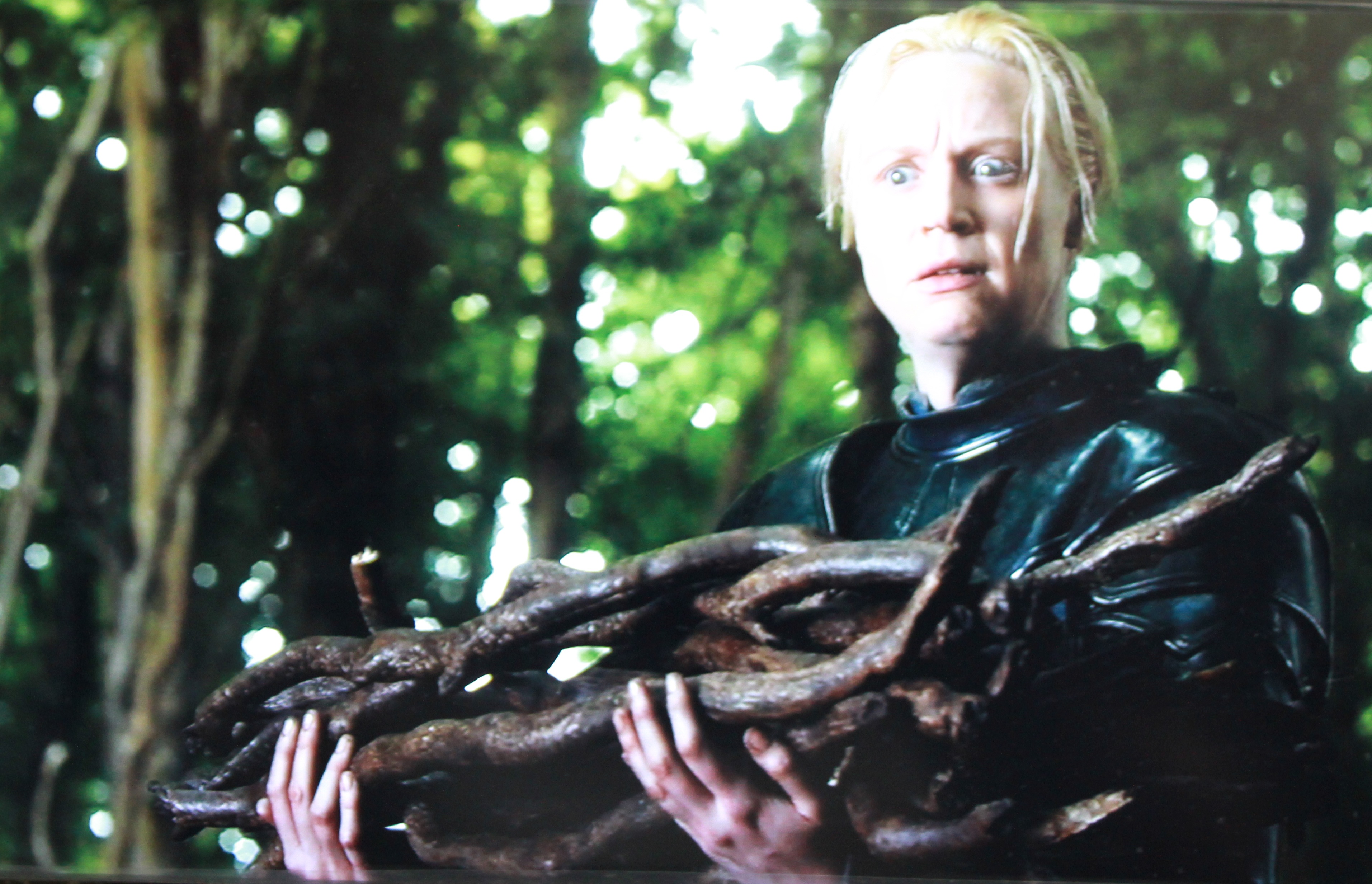
Yet another reason to love Gwendolen Christie as Brienne: this utterly brilliant "WTF?" face.

Yet another reason to love Gwendolen Christie as Brienne: this utterly brilliant “WTF?” face.

Nikki: As you know, my love of Brienne runs deep. And I think much of that love stems from the fact that her story is a perfect blend of comedy, tragedy, pathos, sadness, and triumph — moreso than possibly any other character on the show (save, perhaps, Tyrion), her story runs the gamut of emotions. This week there’s a lot of comedy — Pod unable to keep his horse straight, Brienne trying to convince him to just go away but he’s unwilling because it would make him a bad squire, Pod catching a rabbit on fire because he didn’t realize he needed to skin it first — but within that comedy we get a very big revelation for Brienne: that one of the Kingsguard tried to kill Tyrion during the Battle of Blackwater. This seemingly unimportant piece of information that Pod tosses off in the midst of explaining to her that he killed a man once to save Tyrion’s life could end up being a very valuable piece of information later. It’s possible Brienne could be killed (noooo!) before she’s able to actually use this piece of information — after all, GRRM often brings us to the brink of something happening and then shatters it — but here’s hoping that it becomes useful to her. What definitely happens in that scene is that Brienne develops sympathy for Pod, and realizes that what he might lack in skills he makes up for in loyalty. It’s a lovely moment when she allows him to remove her armour for her. But you can see from the look on her face that she’s rather shocked by what he just told her.

And, as you said above, that’s the thing I really enjoy about Game of Thrones and the books upon which it is based: that so often what would be a “dun-dun-DAAAAHHH!” moment on any other show — quickly given, used, and resolved — just becomes a puzzle piece on this show that might be used, or might be a dangling red herring. As you so rightfully point out, Arya could be a coming of age story of a girl who proves that a person is a person, no matter how small… or, in the world of GRRM, she can be a girl who longs to prove that, but will still end up dead in a ditch because her sword is about as useful as a twig my son would pick up in the woods and pretend to swordfight with. (In fact, I didn’t actually recognize Needle at first and wondered why she was parrying with a twig rather than Needle, and then realized… “Oh.”)

But the same goes for Daenerys. As much as I adore her (I repeat: my fealty lies in the House of Targaryen), I’ve always thought it rather convenient that she frees the slaves and has some of them follow her and… then what? What about the people left behind? Are the people really better off? What about the ones who don’t follow her? Aren’t they vulnerable right now? She just took all of the Unsullied out of Yunkai, isn’t that their only defense?

So in this episode, when her advisors explain that actually, things turned to shit in Astapor and Yunkai after she “liberated” them (definitely a commentary on recent world events), I was rather delighted. It’s not all sunshine and light, and GRRM shows the downside to military victory: his novels might be in the fantasy genre, but he shows the very real trials and tribulations attached to these circumstances; the military occupation and triumph might be done with the best of intentions, but sometimes with disastrous results. I was also very happy to hear her talking about Westeros — she’s always been so removed from the goings-on in the rest of the Seven Kingdoms, with her own story being entirely separate from the others (excepting the occasional references to her whereabouts that are mentioned in small councils) that hearing the two of them come together was rather wonderful. Unlike the men who reign over these other areas, she will stop, strengthen, and rule, getting to know her people and her kingdom before moving forward. “I will do what queens do: I will rule.”

Daenerys — her power and intelligence — is the perfect antidote to the sad lot of the other women in the story. And with that… we move to Craster’s Keep. Whoa. Talk about a crazy suspenseful sequence, where both my husband and I started to worry that Jon Snow might die next (NO! Not Jon Snow!) simply because Bran was this close to reuniting with him, and we remember what happened to the other Stark brother when Arya got that close to him. Eep! But first there’s Jojen’s revelation that they’re all just accompanying Bran to the weirwood; then the threatened rape of Jojen’s sister; then Bran turns Hodor into a killer, which resonates so deeply as Hodor stares at the blood on his hands in confusion and heartbreak; then the return of Ghost (YES!); then the horrifying death of Tanner… I literally had my knees pulled right up to my chin and was holding my hands out going, “Geeeeyaaaaahhh noooooo!” as Jon Snow s-l-o-w-l-y pulled that sword back out of his head GOOD GOD. Seriously, between that and the horse episode of Hannibal, which I just saw this week, I think I’m giving up eating popcorn while watching television. But what an insanely amazing end to the episode. You had revealed to us that Locke was a construct of the show, so I figured he wouldn’t last long on the show, but I really thought this entire sequence was rather spectacular nonetheless. What did you think, Chris?


Karl, watch it ... that kid's dad is Liam Neeson ...

Karl, watch it … that kid’s dad is Liam Neeson …

Christopher: I completely agree—it instantly became one of my favourite sequences on the show thus far, and is remarkable on two fronts: first, it was not in the books (I’m hard pressed to think of any of my other favourite bits that weren’t), and second, it had Bran in it! The last time Bran was in an awesome sequence, he was in a coma as his direwolf killed his would-be assassin.

It also renewed my faith in the writers. I should have known better than to worry about the appearance of Locke at the Wall and the apparent collision course between Jon and Bran. They sidestepped a potential rupture in GRRM’s overall story with a certain narrative elegance and a lot of brutal violence (as is their wont). And in the process they emphasized both Bran’s importance to the story and the cost of their mission—both in terms of what his protectors are willing to endure, as well as the actual human cost of blood spilled. But it was the Hodor moments that made this sequence as brilliant as it was. Poor Hodor … it’s quite an accomplishment to inspire that thrill and triumph of Hodor’s sudden badassery, while simultaneously cringing because we know just how much of a violation it is to make the gentle giant a killer. As you say, Nikki, the aftermath as he’s looking at his hands in hurt bewilderment is heartbreaking.

As is the necessity of Bran slipping away without having a reunion with Jon Snow. We recall from season one that they’d had a warm relationship, with Jon gently encouraging during his archery lesson, and the genuine hurt on his face when he sits next to comatose Bran’s bed to say farewell. Bran must desert one of his few remaining family members; and Jon will not know that the brother he thought dead by Theon’s hand is very much alive.

In other words, this final sequence is exemplary of what Game of Thrones can do when it’s on its game: exciting, suspenseful, and deeply satisfying on a visceral level, but also riddled with pathos and regret (but also love and warmth—if Cersei’s grief and Arya’s hate are the emotional low points of the episode, Jon’s reunion with Ghost is certainly the high one). For all the blood that’s spilled at Craster’s Keep and the deep satisfaction of seeing Tanner and Locke get their comeuppance, there’s a powerful ambivalence, best embodied by Craster’s wives … effectively imprisoned and enslaved by Craster, then imprisoned again by Karl Tanner and his mutineers and repeatedly raped, they nevertheless refuse Jon Snow’s offer of asylum. But neither can they return to the only home they’ve known, with its memories of Craster. “Burn it,” says the leader, in spite of the fact that that will leave them with no shelter as winter encroaches. Their wounds run deeper than winter’s chill.

Do you realize we’re now at the mid-point of this season? As with all good things, this goes too quickly. So thanks once again, Nikki! And thanks to all of you following the show with us. In the meantime, be good and work hard, and remember that if you suddenly wake up to find yourself choking a Night’s Watch impostor, don’t panic. Just go with it. He was probably an asshole anyway.

Oh, who's just a big puppy?

Oh, who’s just a big puppy?

1 Comment

Filed under Game of Thrones, television