I was asked to make a poster to advertise my winter term courses. I was quite pleased with this one.
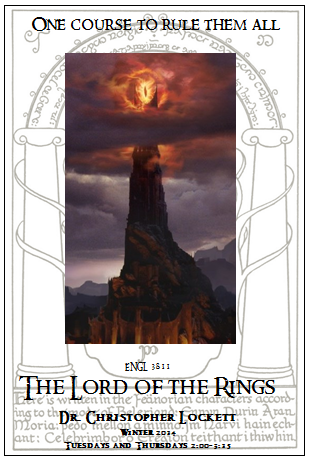 Yep. It will be a term of some serious geeking out.
I was asked to make a poster to advertise my winter term courses. I was quite pleased with this one.
Yep. It will be a term of some serious geeking out.
Filed under teaching
We did Harry Potter and the Prisoner of Azkaban in my fantasy and humanism grad class this week, much to the delight of my students. As much as I love the Harry Potter series, there have always been elements of it that irk me—mostly, what we might characterize as its relation to the “muggle” world. In some ways, the cognitive dissonance of Rowlings’ novels play to comic and symbolic effect; in other ways, for fantasy novels meant to depict an interface with the “primary reality,” they start to stretch credulity.
I could go on about this in pedantic fashion, but for a long time now I’ve been toying with a little setpiece drama that articulates my critique. Having dwelt at length this morning on the main elements, here it is.
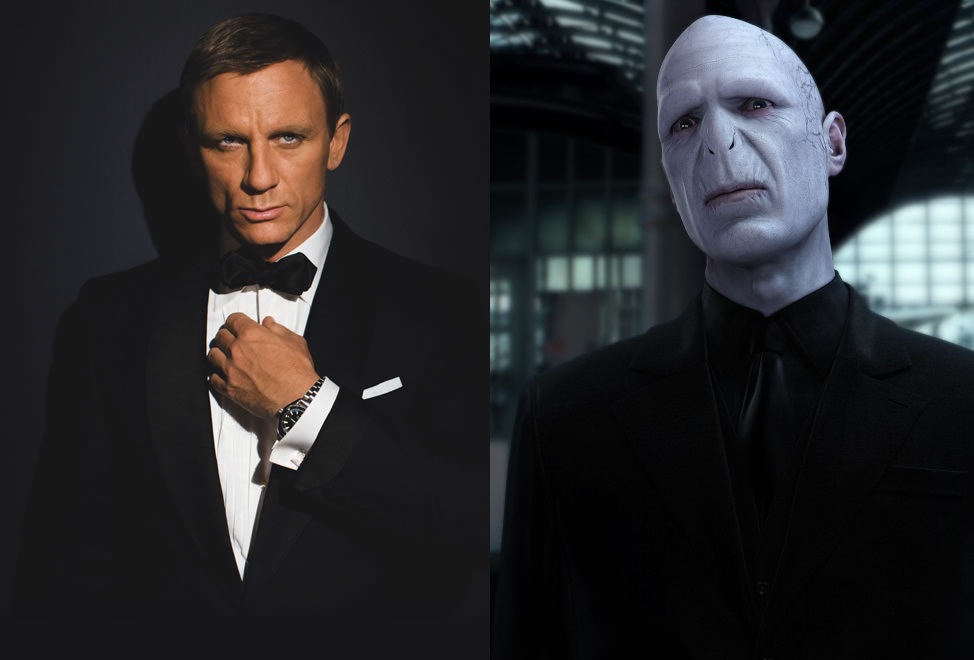
SETTING: the summer between the end of The Half-Blood Prince and the start of The Deathly Hallows. James Bond, dressed impeccably as always in a Saville Row suit, sits at a long table in Malfoy Manor, his feet resting insouciantly on the well-polished dark wood, the most recent edition of The Daily Prophet open in front of his face. On the table beside him sits his Walther PPK, fitted with a silencer. In the shadows behind him we can glimpse the still, unconscious forms of Lucius and Narcissa Malfoy.
There is a noise from the manor’s front hall as the door opens, and the sounds of low voices and footsteps approaching the room in which Bond waits. Laughter, low and satisfied—whatever the people entering have been doing, they have been successful. Voldemort enters, Nagini sliding silently along at his feet, followed by Bellatrix LeStrange and about half a dozen Death Eaters.
They all stop in confusion when they see the man sitting at the table.
BOND: (flipping the corner of the paper aside so they can see his face) Ah, there you are. About bloody time.
(mutters of confusion and outrage from the Death Eaters, silenced by Voldemort)
VOLDEMORT: A muggle?
(he speaks the word with great distaste, but also with caution, cocking his head as he stares at Bond. He has seen the Malfoys on the ground beyond him; though he senses that Bond is no wizard, he simply cannot grasp how a muggle would have invaded this space)
BOND: A muggle? Yes, of course, that name you give us. (slowly and deliberately, he folds up the paper as he talks and places it on the table, but does not remove his feet) Yes, I fear I am a … “muggle.” And I am here to deliver—
BELLATRIX: (enraged, lurches past Voldemort and levels her wand) AVADA KEDAVARA!
(the bolt of green light streaks across the room and dissolves as it strikes something invisible about three feet away from Bond’s face. He smiles at them suavely as they stare in disbelief)
BOND: (finally swinging his legs off the table, he leans forward and steeples his fingers) As I was saying, I am here to deliver a message from Her Majesty’s Secret Service. (gestures at the chairs opposite) Perhaps you would all like to sit down? No reason we cannot be civilized.
BELLATRIX: AVADA KEDAVARA!
(again, the bolt of green falters and evaporates against some invisible barrier. Bond sighs)
BOND: (to Voldemort) Would you please tell her to stop that? She can keep on all night, and all it will serve to do is interrupt.
VOLDEMORT: (leans on the edge of the table) How?
BOND: Ah. (raises his hands to show them his jewelled cuff links) Something Q and the boffins worked up. Couldn’t tell you how it works, but it gives me an anti-magical field extending three feet out in all directions. I suppose I should thank you, Miss LeStrange, for field-testing them.
BELLATRIX: Bloody, filthy muggle! Who do you think you are, coming in here—
(Voldemort irritably waves her silent)
BOND: Thank you.
VOLDEMORT: (sitting) I don’t disagree with her. The only reason I’m not killing you is because you … have a message?
BOND: Also, my cuff links.
VOLDEMORT: Your message, scum?
BOND: You’d do well to learn some courtesy, Mr. Riddle. Yes, we know who you are—or who you were—we do have our resources, you know, dirty muggles that we are. But I suppose I cannot expect you to adapt to the unexpected all at once.
VOLDEMORT: (visibly angry) Your message?
BOND: On behalf of Her Majesty’s Secret Service, I am here to inform you that all attacks on non-magical British citizens will cease immediately.
VOLDEMORT: (stares at Bond for a long moment incredulously and then bursts into a high-pitched laugh. His Death Eaters echo him) They will cease? And who, precisely, are you to demand anything of the Dark Lord? We will do as we wish, and all muggles will cower before us!
BOND: I’m not cowering. (to Bellatrix) Care to try your luck again? (for a moment it looks as though she will, but then he picks up his pistol) Be warned, this time, I’ll shoot back. Oh, and … (glancing down at the floor) if your snake comes any closer, I will in fact shoot it in the fucking head.
VOLDEMORT: (a little hastily) Nagini!
BOND: Let’s make a few things clear hear. For a very long time, the custom has been that, when we have a new prime minister, your Minister of Magic pays him a visit …
DEATH EATER: He’s not our minister.
BOND: (shrugging) From what I hear, he will be soon enough. Not that that matters a whit to us. But for generations now, your Minister of Magic pops into the office of the newly minted Prime Minister, and says something to the effect of “Hello, there are wizards in your country. Don’t worry your head about it. We’ll only ever need to speak if something goes wrong.” Is that about right? (he surveys the group opposite him, but no one answers) Sorry. Rhetorical question. But here’s another question: what, precisely, did you lot think would happen then? (again, silence, but a more confused one. Bond nods pityingly) I suspected as much. You lot thought we’d—what? Try desperately to forget? Think we’d just imagined it all? You’re very good at hiding yourselves from us, I’ll give you that. But let me tell you what happens every time a new prime minister gets a visit from your man: after a few minutes of bewilderment, he’s on the phone to the heads of MI-6 and MI-5, demanding—and pardon my French—“What the fuck just happened?”
(Bond smiles and leans forward)
And do you know what they say to him? “We’ll be right over to brief you, Prime Minister.” Because of course, having known we share a country with people of your particular … talents … we have been naturally a little uneasy. We have been looking into this … issue … for a very long time now. (there is a murmur of surprise from the Death Eaters. Bond shakes his head at them disdainfully) Honestly, you lot have been stupid. Underestimating your enemy is the first and last sin of warfare. Did you really think we’d discover there are wizards and witches among us and not prepare ourselves? (Bond has been getting slightly agitated. With an effort he calms himself and straightens his tie) Not that we’ve had cause for much concern. To be fair, your lot has been pretty quiescent for a long time. It was only about seventeen years ago that we started to get really worried. Care to guess why?
(again, silence from Voldemort and his cohort, except for a few embarrassed coughs)
Suddenly, you lot weren’t so quiescent. Deaths, violence … lots of dead “muggles.” Your minister was suddenly in contact with ours an awful lot, and we gathered that there was an unusually powerful wizard keen to conquer the rest of the magical world. Which would have mattered little to us, except that he and his people seemed pretty hostile to muggles.
(shakes his head)
Did you ever—ever—imagine that we were going to ignore a prospective threat in our nation? Well, of course you did. You can’t bring yourself to think that mudbloods are worth anything, much less muggles. In your eyes, we’re sheep. Am I wrong? (he stares challengingly at Voldemort)
VOLDEMORT: You are sheep. How dare you challenge us like this! How dare you even speak to me like this! AVADA KEDAVARA!
(he stands and flourishes his wand. The green bolt disperses just as Bellatrix’s did, and Bond does not even flinch. He reaches into his breast pocket and pulls out a tablet about half the size of an iPhone)
BOND: Impressive. I suppose you won’t be surprised to know your spell was twice as powerful as your friend’s. Not that it matters. (replaces the tablet in his pocket) This all is, frankly, getting tedious. If I can get to the bottom of the page: we have been developing countermeasures against your “magic” for decades now. And that’s just us here in Britain—I can’t even begin to tell you what the Americans are up to. This little meeting wouldn’t have been necessary, except that you lot seem to be getting a little ahead of yourselves. We don’t care, one way or another, who wins this war of yours … but it does seem that you have dreams beyond domination of the magical world, yes? You want the muggles to be your slaves?
VOLDEMORT: It is the right of the purebloods to rule over the tainted and the weak.
BOND: (scratching his chin ironically) Hm. Yes, that sounds familiar, somehow. You might do yourself a favour and study some muggle history and see how that attitude played out before. (shrugs) But really, that’s neither here nor there. You might want to revise your conception of muggles as somehow “weak.” Magic is an impressive thing, to be sure … and you have a talent for killing, Mr. Riddle. But … (Bond stands, and leans forward, his hands on the table) you might want to do some research and think about how many people you’re able to kill all at once … and how many we are able to kill all at once. (he straightens, and shrugs) It’s not something we’re necessarily proud of. But you should think twice about bringing your … (he gestures vaguely) hocus pocus into a fight where the other fellow has an atom bomb. (Voldemort and the Death Eaters stare at him blankly. Bond favours them with a cold smile) This is what I mean when I suggest you do some research.
VOLDEMORT: What are you telling us? What is your message?
BOND: I am telling you that you are free to wage your war as you see fit. Conquer your enemies. We muggles who know what’s what hope you will lose, of course, but we are not involved. But know this: the moment you decide dominion over the magical world isn’t enough, and you seek to subjugate the rest of us? (smiles frostily) That will spell the end of you.
(this causes the Death Eaters to erupt in a storm of outrage, the Dark Lord himself most of all. He levels his wand again at Bond)
VOLDEMORT: Crucio!
(this time, Bond holds up his right hand so his signet ring points directly at Voldemort. He presses the band on the inside of his finger and it emits a blinking light. Voldemort screams in agony as his spell rebounds on him)
BOND: (to himself) Well done, Q. You’ve outdone yourself. (to the Death Eaters, who stand in shocked silence, staring at Voldemort as he recovers from the effects of his own spell). One more thing: any and all killings of muggles will end now. Her Majesty’s Secret Service will remain neutral in your war, but we will respond with lethal force against the Death Eaters every time a non-magical citizen is murdered. To wit … (he picks up his pistol and glares, narrow-eyed, at the Death Eaters clustered around Voldemort) There was a shopkeeper found dead this evening in Bristol. No visible wounds. I imagine that was one of you?
(silence for a moment, and then a burly Death Eater steps belligerently forward)
DEATH EATER: That was me. I killed the dirty—
(he is cut off as Bond raises his gun and shoots him neatly twice in the head. There is a shocked silence)
BOND: Oh, yes. We’ve also developed ammunition that is impervious to your spells. (straightens his tie) I believe that is all, gentlemen … and lady. Your friends here behind me will recover in due time. I fear that your other friend there will not. Have yourselves a good evening.
(No one, not even Bellatrix, attempts to stop him as he circles the table and walks past where they’ve huddled around their fallen comrade. He is just past the threshold when Bellatrix breaks the silence)
BELLATRIX: Who are you?
(he pauses for a moment)
BOND: The name is Bond. James Bond.
(exit)
Filed under course readings
“Bad spelling can be lethal. For example, the greedy Seriph of Al-Ybi was cursed by a badly-educated deity and for some days everything he touched turned to Glod, which happened to be the name of a small dwarf from a mountain community hundreds of miles away who found himself magically dragged to the kingdom and mercilessly duplicated. Some two thousand Glods later the spell wore off. These days, the people of Al-Ybi are renowned for being unusually short and bad-tempered.”
—Witches Abroad
 Last week we did Witches Abroad by Sir Terry Pratchett in my graduate seminar, which was both a joy and a frustration—a frustration because I only allotted one class for him. The true genius of the Discworld novels only starts to become apparent once you have read five or six or twelve of them. Which, perhaps, seems like a backhanded compliment—suggesting that a truly great author could demonstrate that greatness in a single novel. And that might be true enough, as far as it goes; but it is also representative of just one approach to fiction and, more importantly, fictional worlds. Trying to teach Pratchett is not unlike trying to teach television: a single episode of Breaking Bad might offer up interesting formal and thematic considerations, but if you only ever watch one episode you won’t come close to understanding Breaking Bad.
So it is with Discworld.
For those unfamiliar with Discworld: hie thee to the fantasy section of your closest bookstore, post haste! But if you’re reading this outside regular business hours, or have currently barricaded yourself against zombies, or can’t go out for some other reason (though really, zombie apocalypse is the only acceptable one in this instance), let me set the series up for you. The Discworld is … well, let’s let Sir Terry himself describe it for you:
Through the fathomless deeps of space swims the star turtle Great A’Tuin, bearing on his back the four giant elephants who carry on their shoulders the mass of the Discworld. A tiny sun and moon spin around them, on a complicated orbit to induce seasons, so probably nowhere else in the multiverse is it sometimes necessary for an elephant to cock a leg to allow the sun to go past.
Exactly why this should be may never be known. Possibly the Creator of the universe got bored with all the usual business of axial inclination, albedos and rotational velocity, and decided to have a bit of fun for once. (Wyrd Sisters)

I started reading Discworld three and a half years ago, and in that time have read thirty of the thirty-three Discworld novels proper (which is to distinguish them from the five young adult Discworld novels and the one illustrated adventure The Last Hero). Pratchett’s output is astounding: folding in the five young adult Discworld novels, The Last Hero, Good Omens (his collaboration with Neil Gaiman), The Long Earth and The Long War (his collaborations with Stephen Baxter), The Carpet People, Truckers, Diggers, Wings, Nation (non-Discworld young adult novels), and … well, honestly, there’s more, but at this point the count is forty-six novels since he published The Colour of Magic in 1983.
And he has a new Discworld novel, Raising Steam, coming out in a month. Ye gods.
This prolific output is one of the things that has made Sir Terry a less-than-attractive subject for scholarly and academic attention.1 Never mind the standard prejudice that obtains once an author writes this much (“If he’s written that many novels, how good can they be?”), there is also the simple difficulty in accounting for the sheer volume of his work. Again, not dissimilar to teaching television: how does one account for an entire season, never mind the entire run of a show?
Discworld is an example of what I have taken to calling an “iterative world”: a fantasy world or alternative reality whose laws, geography, science, mythology, and history are refined with each new narrative added to the collective. If you go back and read one of the earlier novels—The Colour of Magic, for example, or Equal Rites—after having read a handful of the later ones, you’ll find a familiar Discworld … though not entirely familiar, as it has somewhat more nebulous dimensions and outlines, a more embryonic version of a place that comes into increasingly sharp focus as it accrues detail and substance.2
I could talk endlessly about Discworld as an imaginative space and the theoretical implications of it when set alongside other such iterative worlds as Middle-Earth, Westeros, or collaborative worlds like Azeroth (and I will, oh yes my preciouss, in future posts I will), but what struck me yet again in returning to Witches Abroad is Terry Pratchett’s humanistic pragmatism. Like much else informing Pratchett’s fiction, the humour and occasional slapstick of the stories—to say nothing of the frequent, hilarious footnotes he offers—can obscure his broader ethical preoccupations. For the Discworld novels do comprise, among other things, an extended discourse on secular humanist ethics, rooted in the acknowledgement of human imperfection and a deep suspicion of ideological solutions.
The idea for a graduate seminar on fantasy and humanism—and the research that informs it—derived from several places, but it is fair to say that reading Sir Terry had a huge influence on it. Discworld boasts pretty much every fantasy convention imaginable: from magic and magical beings, to every imaginable fantasy species (trolls, dwarfs, orcs, goblins, vampires, golems, werewolves, dragons, and so forth), great heroes (albeit often in ironic form, such as the octogenarian Cohen the Barbarian), castles and peasantry, and enchanted forests galore. But always the stories, many of them recognizable riffs on classic fantasy (“Do not meddle in the affairs of wizards because a refusal often offends, I read somewhere”), or popular narratives (Macbeth, A Midsummer Night’s Dream, The Phantom of the Opera in Wyrd Sisters, Lords and Ladies, and Maskerade, respectively), or real-world concerns (cinema and Hollywood in Moving Pictures, rock and roll in Soul Music, newspapers in The Truth, Christmas in Hogfather) … always the stories, whatever their focus, proceed from a sensibility that, even as it pays homage to the subject and/or source material, is at pains to frustrate generic expectations and draw attention to fantasy’s more regressive tendencies.
By way of example: in Men at Arms, we glean that the impressive Corporal Carrot of the City Watch is the prophesied King of Ankh-Morpork, and in fact possesses the sword that identifies him as such. But he does not take his “rightful” place, because Ankh-Morpork is much better off without a king, and he’s not really interested in the job anyway. In Jingo, the inevitable march to war against an identifiably Middle-Eastern enemy is halted by Samuel Vimes, who sees negotiation and compromise as preferable to bloodshed. In Monstrous Regiment, the familiar story of a girl from an impoverished family disguising herself as a man to join the army is given a comic twist as we slowly realize that every soldier in her regiment is actually an impoverished girl in disguise.
And in Witches Abroad, familiar stories and the expectations they evoke are the story:
Stories etch grooves deep enough for people to follow in the same way that water follows certain paths down a mountainside. And every time fresh actors tread the path of the story, the groove runs deeper.
This is called the theory of narrative causality and it means that a story, once started, takes a shape. It picks up on all the vibrations of all of all the others workings of the story that have ever been.
This is why history keeps on repeating all the time.
So a thousand heroes have stolen fire from the gods. A thousand wolves have eaten grandmother, a thousand princesses have been kissed. A million unknowing actors have moved, unknowing, through the pathways of story.
It is now impossible for the third and youngest son of any king, if he should embark on a quest which has so far claimed his older brothers, not to succeed.
Witches Abroad is about a demented fairy godmother who is absolutely determined to give people happy endings, and who has become the effective dictator of the Discworld city of Genua (a thinly veiled New Orleans), as she orchestrates her masterwork—bringing the Princess Emberella (whose true identity is secret, as she slaves in the home of her ostensible stepsisters) together with a nobleman (the “Duc”). The three witches of the title—Granny Weatherwax, Nanny Ogg, and Magrit Garlick—make their way to Genua to foil her. Along the way they encounter a series of other familiar stories, such as a Gollum-like creature in a subterranean river (Granny Weatherwax hits him with her paddle); a village terrorized by a vampire (Magrit smacks it with her window as it attempts to enter her room in bat form, and it gets eaten by Nanny Ogg’s cat as it lies, stunned, on the ground); they also encounter a confused wolf that feels compelled to eat a grandmother, a sleeping princess in an enchanted castle, hear tell of a trio of pigs in a neighbouring village with wolf issues, and Nanny Ogg—wearing her red boots—has a farmhouse suddenly fall on her head.
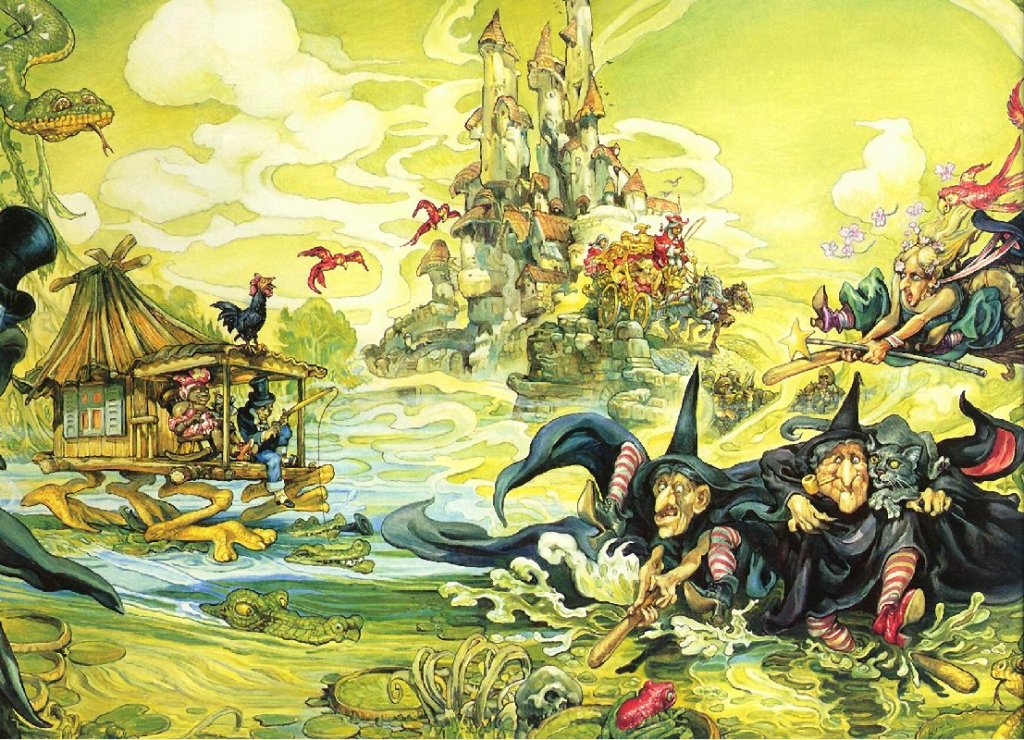
Their journey to Genua is thus comically picaresque, and as they get closer they see the fairy godmother’s handiwork in the stories they stumble across (and into). But while the novel begins with the apparently benign assertion that stories are happening all the time and that the frequency of their repetition gives their outcomes a certain inevitability, this determinism takes on an increasingly pernicious character. The Red Riding Hood sequence is actually heartbreaking, as the wolf has literally become a tortured soul in being compelled to behave in singularly un-wolflike ways, and ultimately makes a plaintive appeal to Granny Weatherwax to make an end. The woodsman who does the deed reflects in surprise at how willingly the poor beast puts its head on the chopping block.
When they reach Genua, which is under the thrall of Lilith, the fairy godmother, they find a city that is bright, clean, smiling, and utterly terrified—for if the people do not step outside the boundaries of what is acceptable for their stories, they are severely punished (such as the toymaker, who is thrown in the dungeon because he does not tell charming stories to children. Protesting that he doesn’t know any stories and is, furthermore, very bad at telling them, doesn’t garner him any leniency). The previous tyrant, the Baron, was cruel and ruthless; Lilith’s rule, however, is the other end of the dystopian spectrum: the utopian vision taken to despotic extremes. As Granny Weatherwax asserts, “You can’t go around building a better world for people. Only people can build a better world for people. Otherwise it’s just a cage.” Or as Sam Vimes puts it in in Night Watch, “The moment you start measuring people, some people won’t measure up.”
What the texts I’m teaching in this seminar articulate—and which Sir Terry’s work pretty much exemplifies—is a tendency within some recent fantasy to reverse what we might characterize as traditional fantasy’s religious temperament, at least where power dynamics are concerned. Such transcendent imperatives as prophecy, fate, destiny, and the presence of deterministic higher powers—so crucial to authors like Tolkien and Lewis—find themselves (at the very least) complicated, challenged, critiqued, or quite simply ignored in the works of authors like Neil Gaiman, Lev Grossman, J.K. Rowling, George R.R. Martin, Richard K. Morgan, or Patrick Rothfuss. In some of these works, this shift is subtle, perhaps even incidental; but what I love about Sir Terry is the way in which the Discworld novels function as specific critiques of what Jacques Derrida called “the transcendental signified,” i.e., discourse imagined as somehow innate, whose logic proceeds from something beyond the horizon of our understanding. Gods exist in Pratchett’s alternative world, but they are the product of human belief and thought rather than the other way around; magic exists, but is mostly avoided, as its use more often than not leads to more complications; and the greatest virtue practised (if not always espoused) is common sense and making allowances for human (and dwarf, and troll, etc.) failings and caprice. Indeed, the greatest conflicts in the Discworld novels arise when individuals or groups attempt to assert that this is the way things should be.
Those who have read a lot of Discworld novels will grasp what I mean when I say: there is a big, long essay to be written about Lord Vetinari in this respect.
Sir Terry makes his personal philosophy known in numerous interviews as well, in which he makes such humanistic statements as “in my religion, the building of a telescope is the building of a cathedral” or, more famously, “I would much rather be a rising ape than a falling angel.” For a sense of his wit and wisdom, this interview is one of my favourites:
I have three Discworld novels left to read, not counting the new one coming out in November. I have not yet been able to start any of them. I am reluctant to do so: a great part of me does not want to come to the end of these books, even though Sir Terry is still writing them.
NOTES
1. He suffers on this front from a quadruple-whammy—first, his output; second, his popularity (he was the highest-selling pre-Rowling author in the UK in the 1990s), for which authors are always treated with suspicion in English departments; thirdly, he writes fantasy; and lastly, he is absolutely, brilliantly, uproariously hilarious. Literary scholarship has difficulty dealing with genuinely funny texts, for it starts to feel as though our lectures and essays are just explaining the jokes (unless you’re teaching the likes of Shakespeare or Jonathan Swift, in which case explaining the jokes is a necessary preamble to your lecture).
2. Discworld has also been expanded and refined by fans and collaborators as well, with The Folklore of Discworld (written by Pratchett in collaboration with Jacqueline Simpson), four volumes of The Science of Discworld (with Ian Stewart and Jack Cohen), and The Discworld Mapp, a definitive map of Discworld created by cartographer Stephen Briggs. There are other books as well, some authorized and some not, to say nothing of a Discworld Wiki page and numerous other fan sites.
Filed under course readings
I’m no expert on German philosophy (or any philosophy, really), but the current state of U.S. politics has come to seem to me a rather spectacular vindication of Hegel’s theory of history.
As I watch the drama of the U.S. government shutdown unfolding, I do so with a feeling of incredulity I’m certain I share with many, if not most, of my fellow Canadians. This incredulity takes a variety of forms, not least of which is the bafflement at the apocalyptic terms with which a relatively mild and definitively conservative form of health care is being described. To listen to Ted Cruz and the rest of his “suicide caucus,” you’d think that what was on the table was a proposal to replace the Pledge of Allegiance with daily readings from Das Kapital.
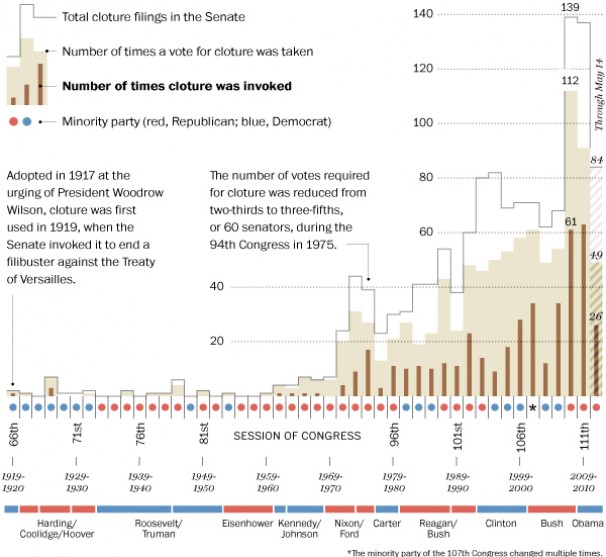
That’s the larger-scale incredulity. On a procedural scale, the question is, depending on the questioner, “How is this happening?” or “Why has this never happened before?” The latter question is better framed as “why has this never happened in this way or on this scale before,” as government shutdowns have occurred several times in the past, most famously when Newt Gingrich’s Republican-majority House sought to punish Bill Clinton in 1995. The House of Representatives has periodically shut down the government for various reasons at various times, and were that all that was happening now, it would not be as worrisome as it actually is. It is worrisome now in a way it has never been before, because it is emblematic of dysfunction that has been growing at an alarming rate since the Clinton presidency. The answer to the first question, “How is this happening?” is simple: it is built into the parliamentary rules of the U.S. government. The shutdown is only symptomatic: in the last five years, we have seen parliamentary procedure in the form of the filibuster being used more than in all of U.S. history combined (well, OK, not that much—but as the graph shows, it has been used a lot); and for those who have the romantic image of Jimmy Stewart in Mr. Smith Goes to Washington, you should know that actual physical filibusters are rare—the “filibuster” now entails cloture motions, which simply use the threat of filibustering to prevent a motion from coming to a vote. (Ezra Klein explains it much better than I can here).
That’s as far as I’m going to go in explaining American governmental dysfunction, because it’s been hashed out ad nauseum elsewhere, and besides, if you don’t believe me on the face of it, nothing else I’m going to say here will make sense. I will go one step further however and say that, as much as I’d love to do a “plague on both your houses” thing, I can’t. Because it’s the Republicans who are to blame—more specifically, a rump of the party that has receded so far into its epistemic closure that it has become genuinely delusional, and it has the cohort of the party that might otherwise be reasonable running scared.
And so: all of the parliamentary problems built into the U.S. constitution that have rarely, if ever, provided impediments to the functioning of government because lawmakers were too genteel to employ them? They’re now in play. All of the tacit understanding of unwritten rules that has informed executive and legislative behaviour for the balance of U.S. history has been abandoned. I’m no 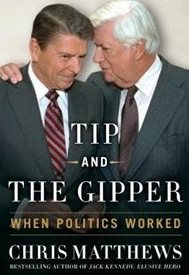 great fan of MSNBC host Chris Matthews—I think he’s a blowhard and a bully whose political inclinations bend toward whatever president sends a thrill up his leg—but he has a new book that interests me about his time as a staffer for Tip O’Neill, the Democratic Speaker of the House during the Reagan years. The subtitle is “When Politics Worked,” and the overarching premise seems to be that politics “worked” back then because politicians observed those unwritten rules—that Tip O’Neill, as Joan Walsh observes, “recognized that Reagan had won a big mandate and ought to be able to enact much of his program—and then be stuck with the results if they turned out badly.” Though ideologically at odds with Reagan, O’Neill was willing to acknowledge the will of the people in electing him, and by the same token let Reagan own the consequences of his policies, good or bad. As has been repeated by many people lately: Obama won the election. The Affordable Care Act has been made law, and was effectively ratified by the Supreme Court. Perhaps, as so many Republicans are claiming, it will be utterly disastrous. But rather than letting that play out, they are doing quite literally everything in their power to kill it with fire.
Which brings us back to Hegel.
My crude understanding of Hegel goes precisely this far: each society at its inception has embedded within it contradictions either invisible or ignorable; but as it develops, these contradictions become more and more glaring, harder and harder to ignore, until they develop into a conflict (which might be violent but not necessarily so), the resolution of which provides a new synthesis … and this new synthesis has its own minor contradictions, which eventually become glaring, and so on. The example I give my theory students when teaching this is that famous line from the United States’ Declaration of Independence: “We hold these truths to be self-evident, that all men are created equal …” And I ask: what are the two problems with this assertion? One, it leaves out women; and two, the author of this document, Thomas Jefferson, owned slaves. The great African-American novelist Ralph Ellison pointed to this when he said of the Declaration that “In the beginning was the word, and in the word was the contradiction.” Almost a century before that, Frederick Douglass wrote one of the most poignant essays in the history of American letters, “What to the Slave is the Fourth of July?”, observing that the great American narrative of revolution and independence was effectively meaningless to an indentured population. It is pretty simple to offer an Hegelian reading of American history: its founding documents contain some pretty profound contradictions, which came to a head in the Civil War; the resolution of the Civil War, with the indignities of Reconstruction and implementation of Jim Crow, was far from perfect, and brought about a new set of conflicts with the Civil Rights Movement. Each time there were improvements, moving the U.S. forward, but also the seeds of new conflicts and problems.
In this vein, it is difficult to not see the antipathy of Tea Party conservatism as the most recent manifestation of these contradictions. The election of Barack Obama was seen by many (myself included) as a moment of both historical and symbolic closure; my favourite editorial cartoon after the election was by Tom Toles, which featured Obama walking up to the White House under the Declaration’s assertion of all men being equal, with the footnote “Ratified November 4, 2008.” At the same time however, the lingering unresolved racial divide in the U.S. was exacerbated by Obama’s election—and however much Fox News and their fellow travelers howl in outrage whenever one of us lefties plays “the race card,” the particularly vicious vitriol directed at Obama has edged into race-baiting too often—and the Tea Party right is far too monochromatic—for it to not be based at least in part in unreconstructed white panic.
 That being said, the implicit and explicit racism underlying the backlash against Obama is just one of the contradictions being exacerbated by the present conflict. What underwrites the current legislative showdown, as I suggested above, is the fact that the system has provided the means for a stubborn and uncompromising minority to bring the government to a screeching halt—and if the debt ceiling is breached, it won’t just be the government. Hopefully I’m not overextending the metaphor too much when I characterize this as a perfect Hegelian storm, wherein the social and cultural contradictions have managed to employ the systemic contradictions. One way or another, I find it difficult to imagine that the U.S. government is going to look the same when all is done … my lefty heart is gladdened to see that Obama et al seem to be determined to hold fast, come hell, high water, or default, having come at last (I hope) to the realization that any compromise now only leads to further hostage-taking in the future (as it were).
The problem (one of them) with Hegel however is that he has a pretty relentlessly upbeat conception of history as inevitably progressive. The “syntheses” emerging from conflict, he suggests, are invariably positive … perhaps this is my deficient understanding of his work, but I don’t think he tends to account for the possibility of devolution, or a new synthesis that resolved previous contradictions in a negative or regressive manner. Andrew Sullivan, one of my favourite political bloggers, says again and again that the current Republican party should be ashamed to call itself conservative, as they are anything but. As he says in a recent post, “[Republicans] are the real Alinskyites and Obama is the real conservative,” i.e. Republicans have become a party of radicalism and revolution, the antithesis of traditional conservatism. I agree with that to a point, but beyond that point I think the radical Republicans are quite literally ultra-conservative: they demand stasis, absolute and paralytic cultural stasis, but want it to be of a sort they imagine to have existed fifty or one hundred years ago. Or possibly even before that: the rollback of gay rights, civil rights, the New Deal, scientific advances, and general social progress they seem to desire is really nothing short of terrifying.
And who knows? The direst predictions about breaching the debt ceiling say it will precipitate a global economic meltdown; in my more cynical moments, I wonder if the suicide caucus is genuinely suicidal, desiring precisely that kind of crisis, which could  potentially dissolve the federal government’s authority and fracture the union. Perhaps I’m being overly bleak, but then, as someone steeped in dystopian fiction, my mind has some well-trodden pathways it can take. The novel that keeps popping up for me now is Richard Morgan’s Black Man, which I wrote about on my old blog, and which I taught in my SF class last winter. In his imagined future, the United States has fractured into three parts: the Union, which is closely associated with the U.N. and Europe, and which comprises the northeastern states; the Rim States, the western states on the Pacific, which have entered into a loose federation with the rest of the Pacific Rim; and the Republic, the main swathe of Middle America, what we would call “Red States.” In the novel it also goes by the derogatory name “Jesusland,” and is precisely what that name suggests: a theocracy that rejects evolution, gay rights, women’s rights, where teaching creationism is the law and abortion a felony.
At times like these, it’s hard to think of Morgan’s vision of the future without feeling a little shiver of recognition.
Filed under wingnuttery
David Bowie recently listed his top one hundred must-read books as a part of his art show David Bowie Is, which has had spectacular runs at the Victoria and Albert Museum in London, and more recently at the Art Gallery of Ontario. He has, as one would expect of such an extraordinarily talented and intelligent person, some thought-provoking choices, and the list, overall, is endearingly eclectic. It is gratifying to see some of my own favourites there (Lolita, Herzog, In Cold Blood, Nights at the Circus, The Brief Wondrous Life of Oscar Wao), though he also includes On The Road (ick) … and there are a lot of Newfoundlanders who will not be pleased to see Howard Norman’s The Bird Artist, a book that ranks even lower in people’s esteem than The Shipping News for its hackneyed and egregiously inaccurate depiction of outport Newfoundland.
That being said, reading the list got me thinking … not so much about what my one hundred “must-reads” would be, but which one hundred books have affected me the most profoundly over the years. I’m not sure why my mind went there precisely, when the practice of telling people what they should read is both a pedantic hobby and a professional imperative … but I suspect that in the aftermath of last week’s posts about David Gilmour and his insistence on only teaching what he loves had me reflecting on those texts that I love.
It didn’t really occur to me as I wrote those posts, but when I go back and reread Gilmour’s Hazlitt piece and his interview in The National Post, I find it a little odd that, if his personal mandate is to teach only what he truly loves, he seems to have such a narrow range of authors he’s willing to teach. As I sat and made my own list, I reflected that the books I have read that I love and which had affected me profoundly is massive. My favourite part of teaching is that I get to share some of these books with my students.
But then, perhaps I’m just undiscriminating.
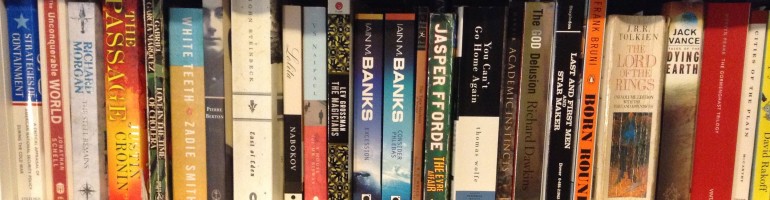
I’ve been picking away at this list all week in my spare moments. I started compiling it partially out of curiosity, because I’ve never really done it before. I was also curious to see—after two posts in which I took issue with David Gilmour’s and Margaret Wente’s antipathy to women authors—whether I would prove myself a hypocrite. The one comment I received on those posts was someone pointing out that the banner image at the top of this blog is almost exclusively male, with only Zadie Smith and Marjorie Garber as exceptions. As I replied, my choice of banner image is actually quite random: I took a few pictures of the various bookshelves in my office at home, and that was the one that turned out best (if I’d posted the shelf beneath, you’d think this was a George R.R. Martin fan site). I quite deliberately did not rearrange books to be more flattering—I wanted something honest, if not necessarily representative.
So, a word on my list: my rules to myself were that I could choose one book per author. (If it was a list of books proper, regardless of author, you’d see an awful lot more of Don DeLillo, Toni Morrison, Martin Amis, and so forth). The representative book had to be the work by that author that affected me in a significant manner, not the book that I would later come to consider the best by that author. So for example, Love in the Time of Cholera is the entry here from Gabriel García Marquez, even though I believe One Hundred Years of Solitude is his masterpiece (and one of the greatest novels of the twentieth century), because that was my first real encounter with Marquez. By contrast, the first book of Annie Dillard’s I read was The Writing Life, a slim volume in which she talks about the nature of writing and what the writer’s task is. I read that in high school and loved it, but it was eclipsed a few years later when I read A Pilgrim at Tinker Creek. I read Jane Austen’s Emma when I was an undergraduate, and hated it. Later I read Pride and Prejudice, which made me grudgingly think maybe this Austen person had some game; but it was on reading Northanger Abbey as the urging of an Austen-mad friend that I truly grasped Austen’s genius. I then went back and reread the other two novels (as well as the rest of her books) with new eyes , but it was Northanger that had the greatest affect.
All this is by way of saying that these choices are entirely idiosyncratic.
Also: there is no poetry, for the simple reason that, for me, that is an entirely different category and an entirely different species of affect. What we have here are novels, histories, philosophy and theory, and a handful of plays.
I encourage other lists. Most of the people reading this probably came here from Facebook: if so, post a list there! Otherwise, for you other bloggers, post to your blog and I’ll link to you.
Isabelle Allende, The House of the Spirits
Dorothy Allison, Bastard out of Carolina
Martin Amis, Time’s Arrow
Karen Armstrong, The Battle for God
Margaret Atwood, Lady Oracle
Jane Austen, Northanger Abbey
John Banville, Doctor Copernicus
Pat Barker, The Eye in the Door
Julian Barnes, A History of the World in 10 ½ Chapters
Walter Benjamin, Illuminations
Jorge Luis Borges, Labyrinths
Charlotte Brontë, Jane Eyre
Emily Brontë, Wuthering Heights
Judith Butler, Gender Trouble
Italo Calvino, Invisible Cities
Angela Carter, Nights at the Circus
Noam Chomsky, Necessary Illusions
Kate Chopin, The Awakening
Agatha Christie, And Then There Were None
Joseph Conrad, Heart of Darkness
Don DeLillo, Libra
Junot Diaz, The Brief Wondrous Life of Oscar Wao
Charles Dickens, A Tale of Two Cities
Joan Didion, Slouching Toward Bethlehem
Annie Dillard, A Pilgrim at Tinker Creek
Umberto Eco, The Name of the Rose
George Eliot, Middlemarch
Susan Faludi, The Terror Dream
William Faulkner, As I Lay Dying
Timothy Findley, Famous Last Words
E.M. Forster, A Passage to India
Michel Foucault, The Order of Things
George MacDonald Fraser, Flashman
Northrop Frye, The Educated Imagination
Paul Fussel, Wartime
Neil Gaiman, American Gods
Marjorie Garber, Shakespeare’s Ghost Writers
William Gibson, Neuromancer
Seamus Heaney, Preoccupations
Ernest Hemingway, A Farewell to Arms
Christopher Hitchens, God is not Great
Richard Hofstadter, The Paranoid Style in American Politics
Homer, The Iliad
Zora Neale Hurston, Their Eyes Were Watching God
Linda Hutcheon, A Poetics of Postmodernism
Henrik Ibsen, Hedda Gabler
Fredric Jameson, Postmodernism, or, The Cultural Logic of Late Capitalism
James Joyce, A Portrait of the Artist as a Young Man
Maxine Hong Kingston, The Woman Warrior
Arthur Koestler, The Sleepwalkers
Thomas Kuhn, The Copernican Revolution
Harper Lee, To Kill a Mockingbird
Milan Kundera, Immortality
Margaret Laurence, The Diviners
Ursula K. Le Guin, The Left Hand of Darkness
C.S. Lewis, Prince Caspian
Margaret MacMillan, Paris 1919: Six Months that Changed the World
Christopher Marlowe, Doctor Faustus
Gabriel García Marquez, Love in the Time of Cholera
George R.R. Martin, A Game of Thrones
Cormac McCarthy, Suttree
Ian McEwan, Atonement
Herman Melville, Moby-Dick
Toni Morrison, Paradise
Haruki Murakami, A Wild Sheep Chase
Vladimir Nabokov, Pale Fire
Azar Nafisi, Reading Lolita in Tehran
Gloria Naylor, Mama Day
Edna O’Brien, The House of Splendid Isolation
Flannery O’Connor, The Violent Bear it Away
Michael Ondaatje, The English Patient
Ann Patchett, Bel Canto
Terry Pratchett, Night Watch
Sylvia Plath, The Bell Jar
Thomas Pynchon, The Crying of Lot 49
Bill Readings, The University in Ruins
Jean Rhys, The Wide Sargasso Sea
Richard Rorty, Contingency, Irony, Solidarity
Philip Roth, The Human Stain
Salman Rushdie, Midnight’s Children
Elaine Scarry, On Beauty
William Shakespeare, Macbeth
Mary Shelley, Frankenstein
Jane Smiley, Moo
Susan Sontag, Against Interpretation
Sophocles, Antigone
Muriel Spark, The Prime of Miss Jean Brodie
Art Spiegelman, Maus
John Steinbeck, East of Eden
Bram Stoker, Dracula
Tom Stoppard, Rosencrantz and Guildenstern are Dead
J.R.R. Tolkien, The Lord of the Rings
Monique Truong, The Book of Salt
Alice Walker, Possessing the Secret of Joy
Evelyn Waugh, Brideshead Revisited
Edith Wharton, The Age of Innocence
Colson Whitehead, Sag Harbor
Jeannette Winterson, Sexing the Cherry
Virginia Woolf, A Room of One’s Own
Slavoj Zizek, Everything You Always Wanted to Know About Lacan, But were Afraid to Ask Hitchcock
Filed under Uncategorized
 | newkmbartleyyahoocom on SOTB (State of the Blog) and T… |
 | Sookie on Barbie and Utopia… |
 | Christopher Lockett on Barbie and Utopia… |
| Sookie on Barbie and Utopia… |

 it's all narrative